




Abstract
The diachronic description method and statistical analysis are combined to detect time-varying growth and decline trends in Nanchang citizens’ verbal function from 2021 to 2022 and 2006 to 2007. Data reveal that the trends are significantly correlated with time, making the conclusion reliable. Mandarin is becoming more popular among Nanchang residents, and Nanchang dialect is used at an essentially fixed ratio, whereas the pragmatic proficiency degradation has gradually slowed, with the language attitude becoming increasingly affable. It is indicated that Nanchang citizens have generally acquired bilingual competence. Mandarin dominates daily communication, while the dialect is deteriorating at a decreasing rate.
Introduction
Mandarin has been promoted in most cities of China and has become the most common language used by the country’s residents since its introduction. Additionally, Chinese dialects, which have endured for thousands of years in various places, still play an essential role in people’s life because of their grass-roots base and people’s fixation on their dialect. According to the famous linguist Bloomfield (1980), inferior languages borrow words from the superior ones. Mandarin has achieved a dominant position, while and dialects inevitably remain disadvantaged when they are in contact with Mandarin. Furthermore, local dialects are disappearing in urban areas at an unprecedented rate and intensity (D. Liu, 2019). The social function of dialects is responsible for the coexistence of multiple languages and dialects in China. The study on the development and changes in the social functions of languages helps predict the evolution of languages’ internal structure and make plans for their development. Therefore, the study of the relationship between dialects and Mandarin has attracted a lot of public attention.
Gan dialect is one of the earliest clearly defined regional dialects of Chinese, and Nanchang dialect is the representative dialect of Gan dialect. Jiang (2008) carried out a questionnaire survey with the citizens of Nanchang, Jiangxi Province, China, from 2006 to 2007 (from now on referred to as the 2006–2007 survey) based on a large number of up-to-date, detailed data of language situation and situational language in Nanchang at that time. The statistical analysis demonstrated that, in Nanchang, the verbal function of the Nanchang dialect and Mandarin has the following trend: “the dialect is declining, and Mandarin is growing.” This analysis supports the view that Mandarin is gaining momentum while dialects are losing ground in China (You, 2006). In the current paper, we surveyed the Nanchang dialect and Mandarin in Nanchang from 2021 to 2022 and, using the diachronic description method, which is sociological research method that compares and analyzes the similarities and differences of social phenomena in different periods to reveal the trends or general patterns of social phenomena. Then, we compared the survey results with the 2006 to 2007 survey to demonstrate the dynamics of the use of the two languages in Nanchang.
Surveys on language contain three aspects: dialects and Mandarin, the ability to use languages, and the attitude toward languages (Su, 1999). Carrying out the survey is critical to investigate the language situation, which is a specific part of realizing domestic situation and is an important basic work of language, as well provides a scientific basis for the formulation and implementation policies on language teaching (Chen, 1994). Therefore, our study helps us understand the extent of the promotion of Mandarin at different times and analyze dialects use at other times, which in turn provides critical data to accurately observe the broad situation of the country’s language, follow the language law, and develop a harmonious and healthy language life.
Literature Review
Related Studies on Dialects and Mandarin
In China, Nanchang dialects are acquired by a person initially, whereas Mandarin is the second in most cases (Cao, 2012). When Mandarin is promoted, each dialect will affect the Mandarin learner, resulting in various variants of Mandarin and forming Mandarin with regional accents. For example, the “Nanchang-accented Mandarin” and “New Nanchang Dialect” in Jiang Yan’s (You, 2006) study are the products of the amalgamation between Nanchang and Mandarin dialects. Besides, in terms of speech perception, dialect experiences have complicated influences on the categorical perception of Mandarin tones (Yu & Huang, 2019). Therefore, the survey of the contact between Nanchang and Mandarin dialects has received much attention from scholars. The pioneers in this field include P. Wang (1990, 2003, 2013), Su and Liu (2002), and Su et al. (2004). The former focused on the relationship between dialects and Mandarin and their modifications and examined the various phenomena arising from Chinese dialects and Mandarin contact. The latter explored the trend that dialects are converging with Mandarin. Their studies are innovative in terms of methodology and theory and the best of their kinds.
Studies Related to Language Situation Surveys
According to The Outline of National Long-term Language and Writing Reform and Development Plan (2012–2020) (China Education Daily, 2016), we should include language situation surveys in the key works and conduct them to investigate the use of language and to write in specific areas, thus providing policy support for local economic and social development. Therefore, surveys on language life and language situation have been carried out throughout the country in the past decade, including some pioneering articles. Representative authors include Li and Ren (2021), H. Liu and Li (2020), Xu and Zhou (2016), and C. Liu and Huang (2016). Scholars in other cities such as Nanjing, Shenyang, Xiamen, Shanghai, and areas inhabited by ethnic minorities have also carried out surveys, which are not listed here. Overall, the studies indicate that urban language surveys, which give us a new research perspective, are playing an increasingly important role (Xu & Wang, 2010).
Thus far, previous studies have thoroughly investigated Mandarin and dialect contact and the language situation in various regions of China from a synchronic perspective, but few studies have compared them diachronically, and fewer studies have conducted scientific data analysis on this basis.
Studies Related to Language and SPSS
The SPSS software is a common tool for empirical research in applied linguistics. It has a wide range of applications in dialect and Mandarin studies. First, the SPSS software is used to study the variation of pronunciation (Wang, 2017), vocabulary (Xu, 2019), and grammar of dialects to analyze the correlation between linguistic factors, such as pronunciation and vocabulary, and social factors. Second, the SPSS software is used to conduct an experimental study on dialect acoustics and consonants of Chinese and English (Xu & Zhai, 2017; Yang, 2017) to analyze the changes in the acoustic parameters and research methods of the dialects. Third, the SPSS software examines the language attitude and language use of dialects and Mandarin (X. Liu, 2017). In addition, cross-over studies of SPSS have a wide range of applications in second language acquisition, especially in English teaching, which needs no further elaboration. The studies reveal that the SPSS software is appropriate for processing the correlation between language-internal factors and social variables.
We found that, in studies of Chinese dialects and Mandarin, a slew of examples illustrates dialect changes, but hardly of them uses SPSS to investigate language life in Jiangxi. We examined the changes in the language functions of dialects and Mandarin from a diachronic perspective to provide real data for the coexistence of dialects and Mandarin, which has specific research value and practical significance.
Methodology
Research Design
According to the questionnaire form of the 2006 to 2007 survey, we chose “survey on Chinese dialect and Mandarin language” as the subject of the research to make the data comparison reliable. According to the purpose and target population of the survey, we designed two questionnaires, one for secondary school students and one for adults. The contents of the questionnaires that are related to this paper are (1) Basic information about the respondents, including gender, age, occupation, and the place of residence. (2) Respondents’ language use. (3) Respondents’ language ability and attitude while using their dialects and Mandarin. In the present paper, we compared the changes in the proportion of the use of Nanchang dialect and Mandarin, the changes in language ability, and the changes in language attitude, respectively, according to items (2) and (3) in the contents of the questionnaires.
For the conclusions that will be drawn from the data analysis of the questionnaire, we make the following hypotheses:
(1) In the family domain, the language use of Nanchang residents of two language groups in communication with their relatives is correlated with time; in the public domains, participants’ language use is not correlated with time.
(2) Nanchang citizens’ ability to use Mandarin is increasing, and their ability to use the Nanchang dialect is losing.
(3) Nanchang citizens’ language attitude is preferring “Mandarin” and being estranged from “Nanchang dialect” as before.
Data Collection
In this paper, the respondents were divided into two groups: minors and adults in Nanchang. Considering the requirements of the questionnaire for participants’ reading comprehension, we limited the group of minors to secondary school students. In addition, since adults’ language use, abilities and attitudes are more stable (Jiang, 2008), the age groups are not discussed separately. We distributed 750 questionnaires online, and 631 people responded to them, achieving an 84% response rate. The latter group is particularly adults living in Nanchang. We distributed 750 questionnaires online, and 623 people responded to them, achieving an 83% response rate. The age structure and the number of the respondents are shown in Table 1.
Age Structure of the Respondents.

Data Analysis
We used SPSS to carry out Pearson’s chi-square test and symmetrical measurement in the present paper. Pearson’s chi-square test was used to test significant differences between the uses of Chinese dialects and Mandarin in language, daily life, and in different areas. The symmetric measure was used to verify the reliability of the test results.
Calculation and Significance of Chi-Square Values
The chi-square test is a common hypothesis test based on the distribution of

The Pearson values are reported in the general chi-square test, and .05 is used as the boundary line (Dai, 2010). If the Pearson value is less than .05, the observed value deviates significantly from the theoretical value, and the null hypothesis must be rejected. The null hypothesis cannot be rejected if the value is more than .05, and the difference between the actual situation represented by the sample and the theoretical hypothesis cannot be substantial.
Calculation of the Symmetric Measure
After obtaining the results of Pearson’s chi-square, we proceeded to calculate the effect size of Pearson’s chi-square test and verify the reliability of the results. The formula for calculating the effect size Grammer Φ is as follows:

The value range of Grammer Φ, also known as the Clem V coefficient and calculated in SPSS, is determined mainly by Cohen’s (as shown in Table 2) assessment of the effect size of the Clem V coefficient and is used to test the reliability of the survey statistics.
Table of Cohen’s Assessment of the Effect Size of the Clem V Coefficient.

The present paper mainly reports on the Pearson chi-square test. In the Pearson chi-square test values, we calculated the value of Monte Carlo asymptotic significance (two-sided) and the asymptotic significance (two-sided). We mainly examined the former values if the data was sufficient and referred to the latter if there was no data.
Results and Discussion
Changes in the Proportion of the Use of Nanchang Dialect and Mandarin from the Diachronic Perspective
In terms of language use, the Register Theory of Fishman (1972), an American socio-linguist, is adopted in this paper to explain the changes in the proportion of language use through speakers’ language choices under different scenarios. Analysis of survey data from 2006 to 2007 by Jiang (2008) reveals that the proportion of the use of Mandarin in the Nanchang language is higher than that of the Nanchang dialect. The trends in the proportion of the use of Nanchang dialect and Mandarin are related. On the one hand, the number of people using Mandarin and the scope and frequency of the Mandarin use is increasing, so the standard form of Chinese is gradually evolving into a “universal language,” a “society-wide language,” and a “high-frequency language.” On the other hand, the number of people using Nanchang dialect and the scope and frequency of the Nanchang dialect use is decreasing, so the dialect is becoming less important. In this chapter, the language scenarios are set to the family and public domains. We compared the language choices of Nanchang citizens in different domains from 2021 to 2022 to those of the 2006 to 2007 survey and examined the changes in the proportion of the use of Nanchang dialect and Mandarin in Nanchang from the diachronic perspective.
The Use of Languages in the Family Domain
In terms of the use of languages in the family domain, we set the interaction partners of adults and secondary school students respectively, examined the language use and change patterns of the surveyed population in the family domain. The proportions of language use by different communicative objects in different periods are shown in Table 3. On this basis, we performed chi-square test, the Pearson chi-square values, corresponding probabilities, and Clem V coefficient values are shown in Table 4. From the results, we know:
For adults, their parents, husbands (or wives), siblings, and children were involved as sub-layer variables and conducted an independent chi-square test on their language use and domains. The p-value significance was less than .05, and the original hypothesis was rejected. Thus, language use and time are not independent and significantly correlated with each other when communicating with their relatives. In terms of the symmetric measure, the coefficient values for parents exhibited a large effect size, indicating that the statistical conclusion is credible, and the conclusion can be acceptable; the coefficient values for others demonstrated a medium effect size, indicating that the statistical conclusion is moderately credible, and this conclusion can be acceptable as well.
For secondary school students, their parents, maternal grandparents, siblings, and paternal grandparents were involved as sub-layer variables. The p-value was less than .05, and the original hypothesis was rejected. Therefore, language use and time are not independent and correlated significantly with each other when communicating with their relatives. The coefficient values in the symmetric measure exhibited medium effect size, indicating that the statistical conclusion is moderately credible and this conclusion can be acceptable.
Comparison of Language Use in the Family Domain of Nanchang Citizens.

The Chi-Squared Test on Language Use in the Family Domain of Nanchang Citizens.

The validation (1) and (2) prove that the language that Nanchang residents use when communicating with their relatives is significantly correlated with time. We can see from Table 2: compared with the proportion 15 years ago, the proportion of the current secondary school students using Mandarin when communicating with their relatives has decreased, and the proportion of the students who use the Nanchang dialect has increased significantly; the proportion of current adults who use Mandarin has increased significantly, especially when they are communicating with their husbands (wives) and children, and the proportion of the adults who use both Mandarin and Nanchang dialect has increased when they are communicating with their parents and siblings.
The Use of Languages in the Public Domain
To investigate the language use of different people in different scenarios, the proportions of different participants’ language use in the five scenarios we set are shown in Table 5. Furthermore, we performed the chi-square test, the Pearson chi-square values, corresponding probabilities, and Clem V coefficient values are shown in Table 6. From the results, we know:
For adults, we used different places as sub-layer variables to conduct an independent chi-square test on language use and time in adults. Among the variables, the p-value significance of language use in shopping places was greater than .05, and the original hypothesis was accepted. Therefore, no correlation between language use and time in shopping places was observed; the p-value significance of the last four items is all less than .05, and the original hypothesis was rejected, which means that language use and time are not independent and correlated significantly to each other in other places. The coefficient values of the symmetric measure in shopping places exhibited minimal effect size, indicating that the statistical conclusion is hardly credible and requires verification. The coefficient values of language use in medical and leisure places had a medium effect size, and the statistical conclusion was moderately credible. The conclusion can be acceptable. The coefficient values of language use in public transportation exhibited a large effect size, indicating that the statistical conclusion was credible and this conclusion can be satisfactory. The coefficient values of cultural places had a small effect size so this conclusion can be acceptable.
For secondary school students, the p-value significance is greater than .05, and the original hypothesis is rejected, indicating that no correlation between language use and time in the above places is observed. The coefficient values of the symmetric measure are all minimal effect size, indicating that the statistical conclusion is hardly credible and needs further verification.
Comparison of Nanchang Citizens’ Language Use in the Public Domain.

The Chi-Squared Test on Language Use in the Public Domains of Nanchang Citizens.

The validation (1) and (2) demonstrates that Nanchang dialect use and time in adults are significantly correlated in various places, except for shopping places; there is no correlation between minors’ language use and time in the above places. We can see from Table 4 that the proportion of current adults using Mandarin has increased compared with 15 years ago, but they use it less frequently in shopping and cultural places than in the other places, according to the data. Additionally, a little change in the use of the language of the secondary school students is observed and therefore shows no correlation in the validation p-value.
In conclusion, we have compared the language choice of Nanchang citizens in different domains from 2006 to 2007 with that from 2021 to 2022. By performing the chi-square test, we could conclude that in the family domain, the language use of Nanchang residents in communication with their relatives is significantly correlated with time; in the public domains, Nanchang adults’ language use, excluding that in shopping places, is significantly correlated with time; minors’ language use in the above places does not correlate with time. In terms of data change, there is a significant increase in the proportion of secondary school students using dialect and a significant increase in the proportion of adults using Mandarin in the family domain, the overall proportion of Mandarin use in the public domain increased.
Compared to 15 years ago, the number of people using Mandarin and the scope and frequency of Mandarin use are still increasing; the number of people using the Nanchang dialect and the scope and frequency of Nanchang dialect use have stayed the same, and the majority of people use the dialect in the family domain.
Changes in the Linguistic Ability of Nanchang Dialect and Mandarin in Nanchang From the Diachronic Perspective
In this chapter, we examined the change in the linguistic ability of the Nanchang dialect and Mandarin from three aspects: the change in the popularity of the two languages, the change in the use of the Nanchang dialect, and the degree of mastery of the two languages. The analysis of the survey data from 2006 to 2007 suggests that the linguistic ability of Mandarin speakers is greater than that of Nanchang dialect speakers in Nanchang, and the trend is that the Nanchang people’s ability to use Mandarin is steadily increasing, with an ever-increasing number of people being able to speak perfect Mandarin; their ability to use Nanchang dialect is losing, with fewer of them being able to speak standard Nanchang dialect. In particular, the younger generation’s ability to speak Mandarin increases significantly, and their ability to speak the Nanchang dialect decreases significantly. For the current study, the data were collected over the period of 2021 to 2022 and compared to the language competence of the participants and the popularity of two languages in 2006 to 2007 as described above, which constitutes the diachronic dimension.
Changes in the Popularity of the Nanchang Dialect and Mandarin
The statistics on the changes in the popularity of the Nanchang dialect and Mandarin are shown in Table 7. We used different populations as sub-layer variables and, on this basis, performed the chi-square test. The Pearson chi-square values, corresponding probabilities, and Clem V coefficient values are shown in Table 8. From the results, we know:
For adults, the p-value significance is less than .05, and the original hypothesis is rejected; that is, adults’ language choice and time are significantly correlated. The coefficient values of the symmetric measure are the moderate effect size, indicating that the statistical conclusion is moderately credible and this conclusion can be acceptable.
For secondary school students, the p-value significance is greater than .05, and the original hypothesis is accepted. Secondary school students’ language choices and time do not correlate. The coefficient values of the symmetric coefficient are close to the small effect size, indicating that the statistical conclusion is moderately credible and that this conclusion can be acceptable.
Which Language Can You Use to Talk to People Now.

The Chi-Square Test: Which Language Can You Use to Talk to People Now.
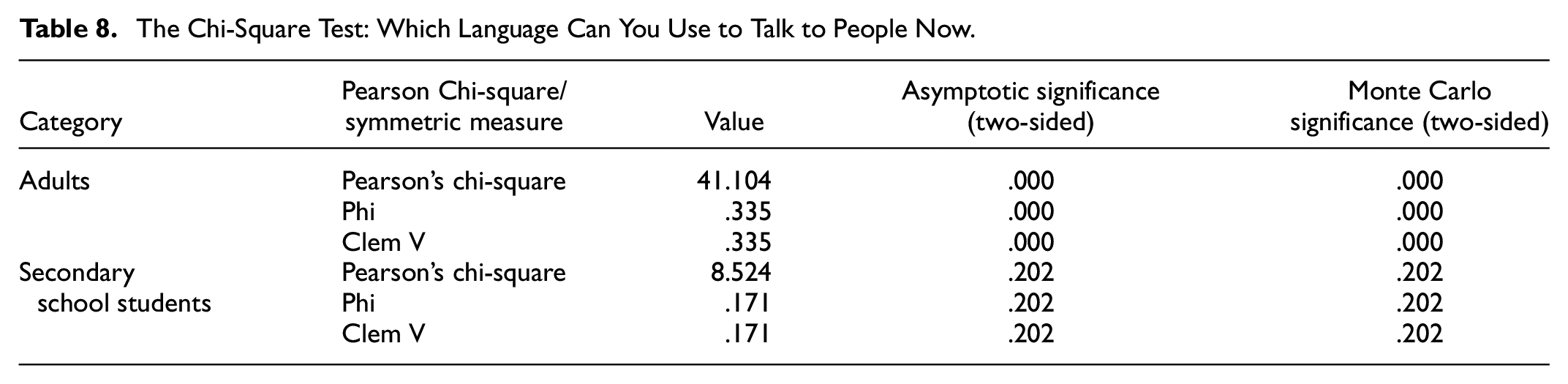
The validation (1) and (2) prove that the popularity of the two languages among adults in Nanchang is significantly correlated with time; there is no correlation between minors and time. We can see from Table 6: that the popularity of Mandarin among adults in Nanchang today is significantly greater than it was 15 years ago. The current change in secondary school students is not significant and therefore shows no correlation in the validation p-value.
Changes in Nanchang Dialect Use
The statistics on the changes in the Nanchang dialect use are shown in Table 9. We used different populations as sub-layer variables and, on this basis, performed the chi-square test. The Pearson chi-square values, corresponding probabilities, and Clem V coefficient values are shown in Table 10. From the results, we know:
For adults, the p-value significance is less than .05, and the original hypothesis is rejected. The frequency of Nanchang dialect use by adults is significantly correlated with time. The coefficient values of the symmetric measurement are medium effect size, indicating that the statistical conclusion is moderately credible and this conclusion can be acceptable.
For secondary school students, the p-value significance is less than .05, and the original hypothesis is rejected. The frequency of Nanchang dialect use by secondary school students is significantly correlated with time. The coefficient values of the symmetric measurement are small effect size, indicating that the statistical conclusion is hardly credible, but this conclusion can be acceptable.
Frequency of Speaking Nanchang Dialect in Daily Life.

The Chi-Square Test on Frequency of Speaking Nanchang Dialect in Daily Life.
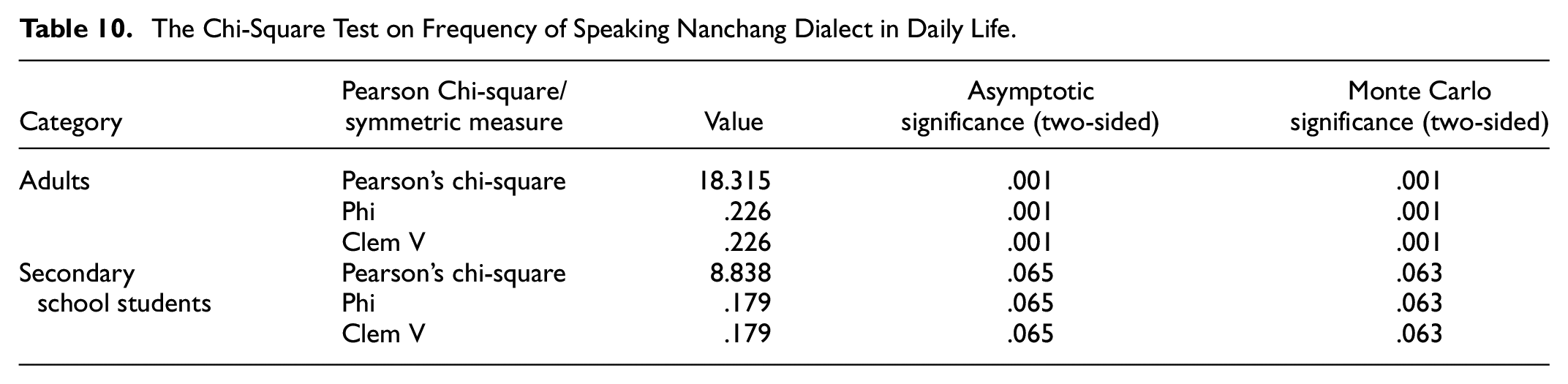
The validation (1) and (2) prove that the change in Nanchang dialect use of Nanchang citizens is significantly correlated with time. We can see from Table 8 that the frequency of Nanchang dialect use of adults in Nanchang nowadays has undergone a bigger change than 15 years ago in terms of the “increase significantly” and “decrease significantly” in particular. The frequency of secondary school students using the Nanchang dialect nowadays decreases in the “increase significantly” and “increase slightly.”
Changes in the Ability to Use the Nanchang Dialect and Mandarin
Regarding the changes in the ability to use the Nanchang dialect and Mandarin, we first examined mastery of Mandarin, and the statistics are shown in Table 11. At the same time, the Pearson chi-square values, corresponding probabilities, and Clem V coefficient values are shown in Table 12. From the results, we know:
For adults, the p-value significance is less than .05, and the original hypothesis is rejected. There is a significant difference between adults’ mastery of Mandarin and time. The coefficient values of the symmetric measurement are close to a large effect size, indicating that the statistical conclusion is credible, and this conclusion can be acceptable.
For secondary school students, the p-value significance is less than .05, and the hypothesis is rejected. There is a significant difference between the level of mastery of Mandarin and time. The coefficient value of the symmetric measurement is a small effect size, indicating that the reliability of the statistical conclusion is low, but this conclusion can be acceptable.
The Level of Mastery of Mandarin.

The Chi-Squared Test on the Level of Mastery of Mandarin.

The validation (1) and (2) prove that the change in Nanchang citizens’ mastery of Mandarin is significantly correlated with time. We can see from Table 10 that the proportion of secondary school students in Nanchang who can speak Mandarin fluently and well has experienced a small increase compared to 15 years ago, the proportion of the adults has increased slightly; the proportion of adults who can speak Mandarin fluently has increased significantly, and the proportion of adults who can speak Mandarin well but with non-standard pronunciation has witnessed a slight decrease. Next, we examined the surveyed population’s mastery of the Nanchang dialect, and the statistics are shown in Table 13. On this basis, we performed the chi-square test. The Pearson chi-square values, corresponding probabilities, and Clem V coefficient values are shown in Table 14. From the results, we know:
For adults, the p-value significance is less than .05, and the original hypothesis is rejected. That is, there is a significant difference between adults’ mastery of the Nanchang dialect and time. The coefficient value of the symmetric measurement is medium effect size, and this conclusion can be acceptable.
For secondary school students, the p-value significance is greater than .05, and the hypothesis is accepted. There is no correlation between secondary school students’ mastery of the Nanchang dialect and time. Meanwhile, the coefficient value of the symmetric measurement is close to medium effect size, which indicates that the statistical conclusion is moderately credible, and this conclusion can be acceptable.
The Level of Mastery of the Nanchang Dialect.

The Chi-Squared Test on the Level of Mastery of the Nanchang Dialect.

The validation (1) and (2) prove that the change in the mastery of the Nanchang dialect of adults in Nanchang is significantly correlated with time; there is no correlation between the change in the mastery of the Nanchang dialect of secondary school students and time. We can see from Table 12 that, compared to 15 years ago, the degree of secondary school student’s mastery of the Nanchang dialect has decreased, and the proportion of those who “can speak it” and “can understand but cannot speak it” has increased; the degree of adults’ mastery of Nanchang dialect has increased significantly, and the proportion of those who “can understand but cannot speak it” has decreased.
In this part, we have compared the changes in Nanchang citizens’ linguistic ability to use the Nanchang dialect and Mandarin from 2006 to 2007 with that from 2021 to 2022. By performing the chi-square test, we could conclude that the popularity of the two languages, the change in Nanchang dialect use, and the degree of mastery of Mandarin are significantly correlated with time; there is no correlation between the degree of secondary school student's mastery of Nanchang dialect and time. In terms of data changes, the popularity of both Nanchang dialect and Mandarin have undergone varying degrees of increase; the proportion of the increase in Nanchang dialect use is decreasing, and the proportion of the decrease is increasing; The overall level of mastery of Mandarin has increased; the degree of secondary school student’s mastery of Nanchang dialect has decreased, whereas the degree of adults’ mastery of Nanchang dialect has increased significantly.
It demonstrates that, compared to 15 years ago, Nanchang citizens’ ability to use Mandarin is still steadily increasing, and their ability to use the Nanchang dialect is losing. Among them, adults have made significant progress in Mandarin; secondary school students’ bilingual ability has improved.
The Comparison of Nanchang Citizens’ Language Attitudes From the Diachronic Perspective
Modern social psychology suggests that attitudes play a role in regulating human social behaviors. Therefore, referring to Lambert (1967) research viewpoint, we examined language attitudes from two aspects, namely language emotion and language social evaluation. Analysis of the survey data from 2006 to 2007 shows that Nanchang citizens’“language attitude” is that they prefer Mandarin and become estranged from the Nanchang dialect. In this chapter, we used a direct comparison method to observe the change in Nanchang citizens’ language attitudes from the above two aspects.
Emotional Attitudes Toward Nanchang Dialect and Mandarin
We used the question “impressions of Nanchang dialect/Mandarin” in the questionnaire to examine the respondents’ emotional attitudes toward the Nanchang dialect and Mandarin. The statistics are shown in Table 15.
Nanchang Citizens’ Impressions of Mandarin and Nanchang Dialects.

We can see from Table 15: 76.9% of adults and 75.3% of secondary school students found their dialect pleasant to the ear, more than half of the participants considered their dialect to be more friendly in conversation. In terms of the social function, Mandarin is widely perceived to be far more “socially influential” and “useful” than dialect.
Evaluation of the Social Status of Nanchang Dialect and Mandarin
We used the question “which languages do you think are more important in domestic communication” (multiple choice) to examine the respondent’s evaluation of the social status of the Nanchang dialect and Mandarin. The statistics are shown in Table 16.
Which Languages Do You Think Are Important in Domestic Communication.

We can see from Table 16 that the proportion of the people who think Mandarin is important is much higher than that of those who think other languages are important, whereas the proportion of those who think dialects are important has increased in both the minor and adult groups.
To conclude, by comparing Nanchang citizens’ language attitudes toward Nanchang dialect and Mandarin from 2021 to 2022, we can draw the following conclusions: Nanchang citizens have changed their attitude from preferring “Mandarin” and being estranged from “Nanchang dialect” (Jiang, 2008) to preferring both “Mandarin” and “Nanchang dialect” nowadays.
Conclusion
In this paper, we used the diachronic description method and SPSS to analyze the data on the 2006 to 2007 and the 2021 to 2022 survey from three aspects, namely the choice between the change in and the attitude toward Nanchang dialect and Mandarin. The data on the chi-square test shows that, in general, changes in the proportion of Nanchang residents’ language use and linguistic ability are significantly correlated with time. We can see from the comparison of data: that compared to 15 years ago, the proportion of Mandarin use, linguistic ability, and attitude of Nanchang citizens have been steadily improving, and an increasing number of people can speak Mandarin fluently and well; the downward trend in the proportion of citizens using Nanchang dialect and their ability to use the dialect has stayed the same. In addition, the dialect is still full of vitality, and Nanchang citizens have changed their attitude from preferring “Mandarin” and being estranged from “Nanchang dialect” (Jiang, 2008) to preferring both “Mandarin” and “Nanchang dialect” nowadays.
From the above-mentioned analysis, we conclude that, nowadays, Nanchang citizens have bilingual ability to use both Mandarin and the Nanchang dialect in general, in which Mandarin plays a dominant role in speech communication, and the degration of ability to use dialect has slowed down. Both dialects and Mandarin perform different social functions and do not conflict with each other. Both will coexist in a long-term, are helpful for the development of the city, and serve the communicative needs of citizens. Furthermore, this paper suggests: At the same time of deepening the promotion of Mandarin, we should carry out the protection of our local dialects, correctly guide citizens to use the standard language, create a harmonious language environment and bring the vitality and charm of the language while assuming social communication functions. Further studies need to be carried out by using statistical data to analyze the language life in provincial capitals and local cities and examine the use of dialects and Mandarin from a synchronic perspective.
Footnotes
Appendix
Acknowledgements
None.
Author Contributions
Weizhi Yan: Conceptualization, Supervision, Writing - Original draft; Xinran Tao: Writing - Reviewing and Editing; Xiaoyang Xu: Acquisition of data, Investigation, Formal Analysis; Zhigang Dai: Data curation, Visualization. All persons who meet authorship criteria are listed as authors, and all authors certify that they have participated sufficiently in the work to take public responsibility for the content, including participation in the concept, design, analysis, writing, or revision of the manuscript. Furthermore, each author certifies that this material or similar material has not been and will not be submitted to or published in any other publication before its appearance in the SAGE Open.
Declaration of Conflicting Interests
The author(s) declared no potential conflicts of interest with respect to the research, authorship, and/or publication of this article.
Funding
The author(s) received no financial support for the research, authorship, and/or publication of this article.
Ethical Approval
Not applicable.
Informed Consent
Not applicable.

Data Availability Statement
The data that support the findings of this study are available from the corresponding author, Weizhi Yan, upon reasonable request.