




Abstract
This study presents a bibliometric analysis of sports ethics research from 2005 to 2024 using CiteSpace, focusing on 839 publications from the Web of Science Core Collection. The findings highlight a predominantly Western-centric research landscape, with the United States, Spain, and England leading the field. Key research trends include the regulation of Financial Fair Play (FFP) in European football and the increasing attention to gender equity in sports, particularly since 2019. Emerging technological ethics, such as the impact of blockchain and AI, are also explored. However, the analysis reveals a significant geographical imbalance, with research from the Global South, including emerging governance models like China’s salary cap policies, underrepresented. The study identifies several gaps, such as the need for more diverse methodologies and greater focus on the ethical implications of new technologies. These findings suggest opportunities for increased international collaboration and a broader, more inclusive research agenda in sports ethics.
Plain Language Summary
We reviewed 839 peer-reviewed articles published between 2005 and 2024 to see who studies sports ethics, what topics they focus on, and where the gaps are. We gathered studies from the Web of Science and used mapping tools to show connections among authors, topics, and places. Most research comes from wealthier Western countries. The United States, Spain, and England lead the field. In total, 1,117 institutions across 81 countries contributed, but work from the Global South is still limited. This imbalance means that the concerns and solutions from many regions are not well represented. The most discussed topics include rules on Financial Fair Play in European football and questions of gender fairness, which have drawn growing attention since 2019. We also see increasing interest in the ethics of new technologies—such as artificial intelligence and blockchain—in areas like data privacy and fairness. Publications have risen sharply, reaching 97 in 2024. However, citation impact has not increased at the same pace, suggesting a “productivity–impact paradox” in which more papers do not always translate into greater influence. Based on these patterns, we recommend broader research methods, stronger international teamwork, and a more inclusive research agenda. We propose a Global Sports Ethics Governance framework to bring in diverse voices and respond to new digital challenges. Examples of underrepresented areas that deserve more attention include China’s salary-cap policies and community-based anti-corruption efforts in Nigeria. These steps can help ensure fair play, protect athlete data, and improve well-being as sport becomes more digital worldwide.
Introduction
Over the past two decades, the global sports landscape has experienced significant shifts due to technological advancements and growing commercial interests, resulting in new ethical challenges. Digital tools such as AI-driven officiating systems, biometric tracking, and blockchain-based contracts promise to enhance transparency and operational efficiency. However, these technologies also introduce risks, including algorithmic bias, breaches in data privacy, and a lack of accountability within sports organizations (Fan & Yi, 2024; Sugden et al., 2023).
One of the central ethical dilemmas arises from the growth of digital technologies in sports governance, which intensifies the commercialization of sports and exacerbates ethical issues such as gender inequality, financial misconduct, and the exploitation of athlete welfare (Carè & Fatima, 2024; Petersen & Wichmann, 2021). Despite the increasing importance of these challenges, the academic literature remains fragmented, largely reflecting perspectives shaped by wealthier nations and a predominantly Western-focused worldview (Sugden et al., 2023). In this study, “Western-centric” patterns refer to the systematic dominance of knowledge production by high-income Western nations, characterized by geographic concentration of research output, citation impact disparities, and thematic focus on Western governance frameworks. As a result, the voices and ethical practices of Global South countries are underrepresented, and existing frameworks often fail to address the unique socio-cultural contexts of these regions (Banda & Holmes, 2017).
While the dominant narrative in sports ethics is shaped by scholars from the Global North, the ethical discussions surrounding emerging governance frameworks from the Global South—such as China’s football remuneration regulations (Peng et al., 2024) and Nigeria’s community-driven anti-corruption initiatives (Amos, 2024)—remain largely overlooked. This imbalance in knowledge perpetuates colonial-era patterns of resource distribution, as access to research facilities and publication opportunities continues to be skewed in favor of the Global North (Collyer, 2018; Tchonang Leuche et al., 2023).
A significant gap in the current research is the lack of engagement with the ethical implications of emerging technologies such as AI and blockchain in sports governance. While these technologies are being rapidly adopted, there is limited academic inquiry into their normative challenges. Issues such as algorithmic accountability (Zhou et al., 2024), the establishment of robust data protection measures (Kusan & Arman, 2024), and the ethical concerns surrounding the commercial use of biometric data (Gilbert & Gilbert, 2024) have not been adequately explored. This oversight is particularly concerning given the lack of empirical research on the risks posed by biased talent identification algorithms and the unregulated monetization of athletes’ biometric data (Pagano et al., 2023).
The study aims to bridge these gaps by providing a comprehensive bibliometric analysis of 839 publications on sports ethics, spanning from 2005 to 2024. The study employs CiteSpace to analyze the co-authorship networks, keyword trends, and citation clusters within the field, seeking to answer three key questions: (1) To what extent does the field remain dominated by Western perspectives? (2) How are emerging ethical concerns, particularly those involving digital technologies, distributed geographically and thematically? (3) What methodological frameworks can help develop a more inclusive and culturally sensitive approach to sports ethics?
By conducting this analysis, the study aims not only to map the existing landscape of sports ethics research but also to propose a Global Sports Ethics Governance framework that emphasizes inclusivity, cultural awareness, and a more comprehensive engagement with emerging technologies. The proposed framework calls for a more participatory and globally inclusive discipline that equips both policymakers and scholars with evidence-based strategies to address the evolving ethical challenges faced in 21st-century sports governance.
Methodology
The study employed a systematic evaluation methodology (Wright et al., 2007) in three phases: (1) data collection, (2) data analysis, and (3) synthesis and presentation of results. Specifically, the data collection phase was guided by the PRISMA framework (Preferred Reporting Items for Systematic Reviews and Meta-Analyses; Moher et al., 2009), which involved literature identification, screening, eligibility assessment, and inclusion.
Duplicates were removed with EndNote 20 before the PRISMA flow began. The cleaned dataset was then analyzed in two stages. First, CiteSpace was employed to map the intellectual structure of the field. Second, Python (matplotlib and seaborn) was used to generate longitudinal trend lines and scatter plots of annual output and citation patterns. The combined outputs offered initial quantitative insights that guided the subsequent detailed content analysis.
Data Retrieval
Data were exclusively retrieved from the Web of Science Core Collection, encompassing SSCI and SCIE databases from January 1, 2005, to December 31, 2024. This database was selected for its rigorous journal selection standards, comprehensive peer review processes, high data completeness, and clear citation linkages, making it the preferred platform for bibliometric and CiteSpace knowledge graph analysis. Sports ethics research demonstrates high concentration within SSCI and SCIE subsets, while other databases (A&HCI, ESCI, CPCI) provide limited coverage of this domain, ensuring both academic authority and comprehensive topic coverage through core collection utilization.
The search strategy employed a comprehensive Boolean formula: TS=(“Sports ethics” OR “Ethics in sport” OR “Sport moral” OR “Athletic morality” OR “Moral issues in sports” OR “Fair play” OR “Sportsmanship” OR “Integrity in sports” OR “Doping ethics” OR “Cheating in sports” OR “Performance enhancement ethics” OR “Gender equity in sports” OR “Violence in sports ethics” OR “Corruption in sports” OR “Match-fixing ethics” OR “Sports philosophy” OR “Sports governance” OR “Sports values” OR “Moral development through sports” OR “Sports psychology ethics” OR “Sports medicine ethics” OR “Sports management ethics” OR “Coaching ethics” OR “Youth sports ethics” OR “Professional sports ethics” OR “Olympic ethics”).
The search string was designed to be intentionally comprehensive and inclusive to maximize recall across the interdisciplinary domain of sports ethics. Some degree of term redundancy was accepted as a trade-off to ensure that publications from all relevant sub-fields were captured in the initial retrieval phase. Redundant phrases such as “sports medicine ethics” were removed from repeated entries. The refined search returned 1,010 English-language articles.
Study Selection and Screening Process
To ensure systematic and replicable selection, this study implemented a rigorous multi-stage screening process following PRISMA guidelines. All retrieved records were imported into EndNote for duplicate removal, followed by independent screening conducted by two researchers using predefined inclusion and exclusion criteria, with discrepancies resolved through discussion with a third senior researcher.
Inclusion Criteria
Peer-reviewed original research or review articles in English directly examining moral phenomena in sports contexts, including moral cognition, emotions, behaviors, or ethical decisions by athletes, coaches, referees, spectators, or sports organizations during competitive activities. Only empirical research employing quantitative, qualitative, or mixed methods, or normative ethics research systematically expounding sports ethics principles were included.
Exclusion Criteria
Studies with purely technical focus lacking ethical discussion, non-peer-reviewed content, publications using sports as peripheral examples, pure commentaries, essays, policy interpretations, and non-systematic reviews. Literature must be published in peer-reviewed journals indexed by SCI-Expanded or SSCI, while conference papers, dissertations, book chapters, and preprints were excluded.
The screening process involved initial rapid interpretation of titles and abstracts over 3 weeks (1,010 candidate documents), followed by full-text evaluation over 2 weeks, resulting in 839 publications (Figure 1). Data cleaning included duplicate elimination using Web of Science filters, author name standardization using CiteSpace’s merging algorithms, and keyword normalization through controlled vocabulary mapping to ensure reliability of co-occurrence and citation metrics (Moher et al., 2009).

Prisma flow diagram.
Data Standardization
To ensure the rigor of statistics by institutions and authors, this study has standardized the data: Unify different translations of the same institution (such as “University of California System” and “California System University System”) into standardized names. And standardize the abbreviation of the author’s name (such as “BronikowskaM”) to “Bronikowska M,” thereby eliminating the deviation caused by naming ambiguity and ensuring that the ranking results objectively and accurately reflect academic contributions.
Bibliometric Analysis Techniques
Bibliometric analysis serves as a crucial tool for quantitatively exploring knowledge frameworks and identifying emerging research trends through performance analysis and scientific mapping methodologies. Performance analysis evaluates scholarly contributions by measuring publication volume and citation frequency, while scientific mapping reveals interrelationships among research topics and thematic developments over time (Kumar et al., 2023).
The study utilized bibliometric indicators—publication count, average citations per item (ACI), and H-Index—to assess scholarly contributions of authors, institutions, journals, and countries in sports ethics research. Using CiteSpace as the primary analytical platform, three core techniques were employed: co-authorship analysis to examine collaboration networks (Cortese et al., 2022), reference co-citation analysis to investigate intellectual connections between publications (Hjørland, 2013), and keyword co-occurrence analysis to identify dominant research topics (Catone et al., 2020). Citation burst analysis detected sharp increases in citation activity, identifying pivotal contributions that gained significant attention (Zhao et al., 2023). Publication trends were visualized using Microsoft Excel 2019 with locally weighted scatterplot smoothing (LOESS).
CiteSpace Tool Selection and Rationale
CiteSpace was selected as the primary analytical platform over alternative bibliometric tools such as VOSviewer and Bibliometrix based on several methodological considerations specific to this study’s objectives. While VOSviewer excels in static network visualization and Bibliometrix provides comprehensive statistical analysis through R integration, CiteSpace offers superior capabilities for temporal analysis and research evolution tracking essential for our longitudinal study (2005–2024).
Specifically, CiteSpace’s advanced clustering algorithms (log-likelihood ratio) provide more semantically coherent thematic clusters compared to VOSviewer’s modularity-based clustering, which is crucial for identifying nuanced ethical domains in sports research. Additionally, CiteSpace’s citation burst detection feature enables identification of emerging research trends and pivotal publications over time, functionality not available in Bibliometrix’s static analysis framework. The software’s timeline visualization and dual-map overlays further support our objective of mapping the evolving intellectual structure of sports ethics research, while its capacity for handling large citation networks (>800 publications) ensures robust analytical performance for our corpus size. While acknowledging that multi-tool approaches can provide complementary insights, CiteSpace’s integrated temporal-thematic analysis capabilities align optimally with our research questions regarding the evolution and geographic distribution of sports ethics scholarship.
Database Limitation and Bias Consideration
The study exclusively used Web of Science Core Collection (WoSCC) based on several key considerations. Sports ethics research predominantly appears in high-impact, peer-reviewed journals that align with WoSCC’s rigorous inclusion criteria. Additionally, WoSCC provides superior bibliometric data quality and standardized metadata essential for advanced analyses such as co-citation analysis and keyword clustering (Baas et al., 2020). Furthermore, single-database use ensures analytical consistency while avoiding technical complications from integrating multiple sources with varying metadata structures.
While acknowledging potential limitations of single-database searching, WoSCC provides robust coverage of established academic fields with strong journal-based publication traditions (Martín-Martín et al., 2018). To validate coverage adequacy, we cross-referenced findings with existing sports ethics systematic reviews and manually verified highly cited foundational works. These procedures confirmed that WoSCC effectively captures the core intellectual structure of sports ethics scholarship while maintaining methodological consistency essential for reliable bibliometric analysis.
Results
Annual Publication and Citation Trends
A total of 1,010 documents were received for this search. After screening with certain criteria, a total of 839 documents were included for analysis. Figure 2 illustrates the annual number of publications and citations in the field of sports ethics between 2005 and 2024.
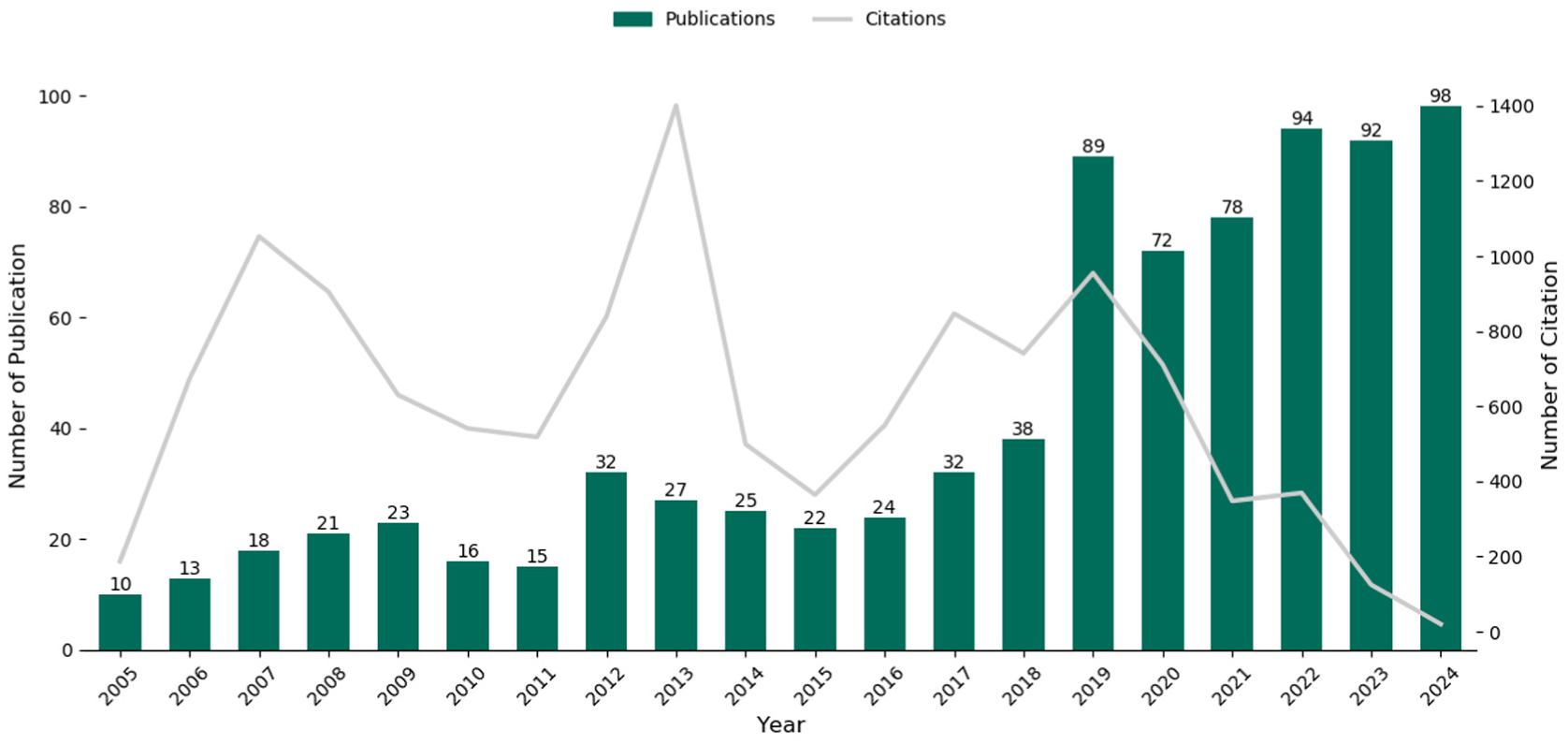
Annual publication and citation counts in the field of sports ethics (2005–2024), based on data extracted from the Web of Science Core Collection as of 2024.
From the bibliometric analysis, The number of publications in the field of sports ethics shows a dramatic increase from 10–32 articles annually in the early phase (2005–2017) to 97 articles in 2024. This surge aligns with the rising academic interest in sports governance issues, particularly those related to digital technologies and the growing awareness of structural inequalities in global sports. However, while the volume of publications has increased, the citation frequency has not kept pace with this growth, indicating a “productivity-impact paradox.”
The paradox suggests that although the field has witnessed increased scholarly activity, the quality or influence of the publications has not risen proportionally. Further analysis of the data reveals that the concentration of research in specific regions not only limits the scope of the discourse but also skews the ethical perspectives that are prioritized. The overemphasis on issues that are salient in the Global North—such as anti-doping policies, gender equality in sport, and fair play—may overlook critical concerns that are more pressing in other parts of the world. For example, corruption in sports governance, athlete exploitation, and human rights abuses are more prominent in certain regions but receive comparatively less attention in the academic literature. This discrepancy suggests that ethical frameworks must be context-sensitive, taking into account the unique challenges faced by different regions.
The discrepancy may stem from the sheer volume of emerging publications, which often lack the depth or interdisciplinary appeal required for significant citation impact. Future research should explore whether the increase in publications truly reflects meaningful contributions to the governance of sports or whether it signals fragmentation within the field.
This finding highlights the need for future studies to investigate whether the quantity of research translates into meaningful contributions to the global governance of sports, or if the field is becoming fragmented due to a focus on quantity over quality. The disparity in citations between early foundational studies and the more recent publications indicates that although new research is emerging, it may lack the depth of analysis or broad appeal to influence policy and practice in the same way earlier studies did.
Modeled Time Trend of Publications
The time series of sports ethics publications from 2005 to 2024 was modeled using a locally weighted scatterplot smoothing (LOESS) curve, applied using the loess() function in R (version 4.3.1, span = 0.75, degree = 2). The 95% confidence intervals are displayed as dashed lines. The LOESS curve in Figure 3 reveals a distinctive two-phase growth pattern. The initial phase (2005–2017) shows gradual development with publications fluctuating between 10 and 35 articles annually. The period from approximately 2016 to 2018 saw a significant upturn, marking the transition to an exponential growth phase. Publications reached 89 in 2019, experienced a brief decline in 2020, then surged to 97 in 2024, representing sustained upward momentum. This sustained growth reflects the increasing scholarly attention and academic engagement with the subject of sports ethics in recent years. The 839 publications collectively received 12,292 citations, yielding an average of 14.65 citations per publication. This performance is comparable to Germany (14.33) and Canada (14.39), though below the United Kingdom (28.96) and United States (25.69), aligning with expectations for an interdisciplinary field still developing its theoretical and methodological foundation.

Citation burst analysis with LOESS smoothing (α = .75) applied to annual publication trends. The smoothing parameter was selected to minimize year-to-year volatility while retaining mid-term thematic shifts in sports ethics research. The data used for this analysis is sourced from Web of Science, covering the years 2005 to 2024.
Author Performance and Collaborative Networks (Performance Analysis and Scientific Mapping)
A total of 2,098 researchers have contributed to the field of sports ethics literature. Table 1 presents the ten most productive authors based on publication count, with M. Kavussanu (University of Birmingham) and P. Paillé (NEOMA Business School) emerging as the most prolific contributors, followed by D. Plumley (Sheffield Hallam University, England). Notably, Kavussanu demonstrated the highest bibliometric impact with superior Average Citation Index (ACI) and H-index values of 43.25 among the examined corpus. Figure 4 visualizes the co-authorship analysis as a collaborative network based on Total Link Strength (TLS), which quantifies the frequency of author collaborations within publications. Three predominant collaborative clusters were identified, centered around Kavussanu, Paillé, and Plumley, as illustrated in Figure 4.
Top Ten Authors in Terms of Number of Publications in the Field of Sports Ethics (2005–2024).

Note. ACI = Average citation per item.
H-index for the author’s papers on this topic.

Map of the collaborative network of authors in the field of sports ethics (2005–2024). Produced by Citespace; Colours indicate the separate collaborative clusters; Lines between “nodes” indicate how often the two authors co-occur as authors in one retrieved publication; Size of the node was determined by total link strength.
Figure 4 illustrates the co-authorship network and key contributors in sports ethics research. Several authors exhibit high co-authorship centrality, with G. Langevoort, A. Junge, and J. Dvorak occupying central positions due to their extensive collaborations and frequent co-authorship, as seen in their large node sizes in the network visualization. These authors have made substantial contributions to research on governance, player safety, and ethical practices, with their Total Link Strength (TLS) indicating significant scholarly influence (Donthu et al., 2021).
In addition to the central authors, the network reveals key peripheral authors and weak ties across clusters. José A. Cecchini and José Francisco Guzmán lead clusters focusing on moral education and youth sports ethics, while Jaume Cruz and Juan Antonio Moreno-Murcia examine coaching ethics. These peripheral authors are linked to the central cluster via weaker ties, symbolized by thinner edges, which are crucial for enabling interdisciplinary exchange.
The significance of weak ties, though less pronounced in the network’s visualization, plays a critical role in connecting otherwise isolated research clusters. According to Granovetter’s (1973) theory of the strength of weak ties, these connections facilitate the spread of novel ideas across disparate research domains, fostering interdisciplinary collaboration. While robust intra-cluster connections are prominent, the weak ties between clusters, such as those between sports governance and youth sports ethics, could bridge existing knowledge gaps, promoting a more integrated and pluralistic research agenda.
Furthermore, while the central cluster exhibits high collaborative density, peripheral groups—such as those led by Antonis Hatzigeorgiadis and Pere Molina—engage with specialized domains, including the cultural dimensions of sports ethics and the ethical implications of emerging technologies. These peripheral research trajectories, while thematically distinct, remain loosely connected to the central cluster, reinforcing the observation of weak inter-cluster ties. This limited cross-cluster engagement underscores the need to bridge epistemological gaps and foster interdisciplinary collaboration to address complex global challenges in sports ethics (Hjørland, 2013).
Moreover, the visualized co-authorship map not only reveals increasing scholarly participation but also emphasizes the imperative for enhanced international cooperation to integrate diverse perspectives and build a more cohesive research landscape (Chen & Song, 2022).
Countries/Regions, Institutional Performance, and Collaborative Networks (Performance Analysis and Scientific Mapping)
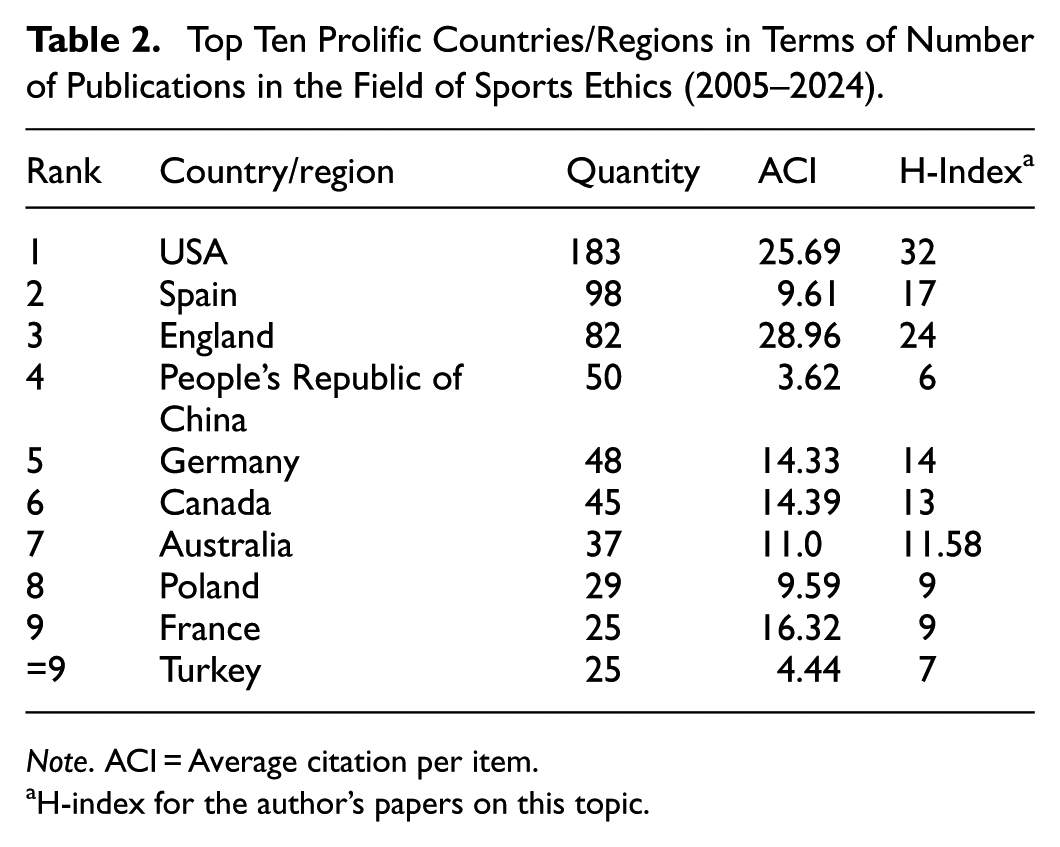
A corpus of 839 publications in sports ethics literature was contributed to by 1,117 institutions across 81 countries/regions. Tables 2 and 3 present bibliometric performance analyses by geographic and institutional distribution. The United States, Spain, and England emerged as the most productive contributors, generating 183, 98, and 82 publications, respectively. Among the ten highest-producing countries/regions, China stands as the sole developing nation amid otherwise developed countries. exemplifying the Western-centric pattern operationalized in our methodology, where the top three Western nations (USA, Spain, England) alone contribute 43.3% of total publications (363/839). The United States demonstrates superior scholarly impact with the highest Average Citation Index (ACI) and H-index, reflecting citation frequency within the field.
Top Ten Prolific Countries/Regions in Terms of Number of Publications in the Field of Sports Ethics (2005–2024).
Note. ACI = Average citation per item.
H-index for the author’s papers on this topic.
Top Ten Prolific Institutions in Terms of Number of Publications in the Field of Sports Ethics (2005–2024).

Note. ACI = Average citation per item.
H-index for the author’s papers on this topic.
To provide a more balanced international comparison, we further considered normalization of publication productivity by national population and research funding levels. Using publicly available statistics from the World Bank and UNESCO Institute for Statistics (UIS, 2024), we reviewed publication counts in terms of outputs per million inhabitants and per billion USD of gross domestic expenditure on R&D (GERD). Preliminary observations suggest that while the United States leads in total publication output, its normalized productivity is lower than that of smaller nations such as Norway, Switzerland, and New Zealand, which exhibit higher efficiency when accounting for demographic and funding contexts. Although specific normalization values are beyond the scope of this study, we recommend future bibliometric analyses in sports ethics incorporate these metrics to better reflect comparative academic contributions (Carè & Fatima, 2024; Chen & Song, 2022).
Institutionally, Loughborough University leads in productivity, followed by the University of Birmingham, University of California System, and University of Oviedo, which share second position in publication output. The University of California System and University of Birmingham additionally exhibit leadership in ACI and H-index, respectively. Figures 5(A) and (B) visualize co-authorship patterns as collaborative networks. Figure 5(A) identifies four predominant collaborative clusters led by the USA, Spain, England, and China, while Figure 5(B) illustrates three principal collaborative networks centered around the University of California System, University System of Ohio, and San Diego State University.

Maps of collaborative networks of countries/regions (A) and institutions (B) in the field of sports ethics (2005–2024). (Produced by CiteSpace; Colors indicate the separate collaborative groups; Lines between “nodes” indicate how often the two countries/institutions co-occur as authors in a publication; Size of the node was determined by total link strength).
These clusters exhibit visually discernible intra-group density and geographical cohesion, suggesting a pattern of strong internal collaboration within specific national or institutional boundaries. Although we do not apply formal network metrics such as modularity or density in this study, the tight node proximities and high-frequency edge connections within clusters—particularly in the USA-led and Spain-led groups—visually support the characterization of “robust intra-cluster connections.” This interpretation is consistent with previous bibliometric studies that identify geographic proximity and shared funding systems as key drivers of such network structures (e.g., Glänzel & Schubert, 2004; Waltman et al., 2010).
Journal Performance
The scholarly corpus in this domain spans 119 distinct journals. Table 4 presents the ten most prolific publication outlets, with the Journal of the Philosophy of Sport and Revista de Psicología del Deporte occupying the first and second positions, respectively, with 30 and 20 publications each. The Journal of the Philosophy of Sport examines philosophical dimensions of sport, including ontological considerations, axiological aspects, teleological questions, sociocultural significance, ethical principles, competitive ethos, and societal implications. Revista de Psicología del Deporte focuses on sport psychology, investigating areas such as athletes’ moral development, fair play protocols, and substance abuse issues.
Top Ten Journals of Number of Publications in the Field of Sports Ethics (2005–2024).

Note. 2023IF = 2023 Journal Impact Factor from Journal Citation Reports™; ACI = Average citation per item.
H-index for the author’s papers on this topic.
Among these scholarly periodicals, European Sport Management Quarterly demonstrates the highest journal impact factor (3.6 in 2023), despite publishing fewer articles (11) in the sports ethics domain. This high impact factor, combined with an impressive average citation index of 31.91, indicates the journal’s significant influence in the field, suggesting that while it publishes selectively in sports ethics, its contributions achieve substantial scholarly impact. Other notable high-impact venues include Frontiers in Psychology (IF = 2.6, ACI = 5.36) and Frontiers in Sports and Active Living (IF = 2.3, ACI = 3.09), reflecting the interdisciplinary nature of sports ethics research spanning psychology, management, and applied sport sciences.
Co-Cited References and Research Clusters (Scientific Mapping)
Figure 6 presents the co-citation network analysis of sports ethics literature (2005–2024), revealing six thematic research clusters generated using CiteSpace’s log-likelihood ratio (LLR) clustering algorithm, with robust modularity (Q = 0.8364) and silhouette (S = 0.8987) scores indicating strong structural division and high internal consistency (Chen, 2006; Newman, 2006).

Co-citation analysis of sports ethics research, revealing six thematic clusters including “Financial Fair Play Regulation” (Cluster #0), “Financial Fairness” (Cluster #2), and “Deconstructing Match-fixing” (Cluster #4), among others. This analysis was derived using CiteSpace’s log-likelihood ratio clustering algorithm, which shows strong modularity and internal consistency (Q = 0.8364; S = 0.8987).
Cluster #0 (“Financial Fair Play Regulation”) represents the largest thematic group, centering on UEFA’s FFP regulations with key references including Franck (2014) and Plumley et al. (2019), investigating FFP’s influence on European football’s financial stability and competitive balance. Cluster #2 (“Financial Fairness”) explores revenue distribution and economic disparities, incorporating econometric studies by Peeters and Szymanski (2014) and Dimitropoulos et al. (2016). Cluster #4 (“Deconstructing Match-fixing”) investigates corruption networks through works by Numerato (2016) and Hill (2015), addressing structural and legal integrity dimensions. Cluster #5 (“Sport Governance”) examines multi-level governance frameworks via Geeraert (2019) and Sawyer (n.d.), focusing on transparency and regulatory accountability. Cluster #7 (“Referees Report”) addresses officiating ethics through Blank et al. (2016) and Devís-Devís et al. (2021), emphasizing refereeing system professionalization.
Three overarching patterns emerge across clusters. First, research demonstrates pronounced Eurocentric focus, with most clusters relying heavily on European case studies while Asian, African, and South American contexts remain underrepresented. Second, existing studies emphasize structural and policy-level analyses with limited attention to individual agency and behavioral drivers of unethical conduct. Incorporating psychological perspectives—such as social identity theory (Tajfel & Turner, 2001) and moral disengagement theory (Bandura, 1999)—could provide deeper insights into how athletes rationalize unethical behavior under institutional pressure. Third, methodological diversity could be enhanced through computational techniques and mixed-method comparative studies integrating non-Western sociocultural frameworks, facilitating more globally inclusive sports ethics scholarship that balances financial sustainability with equity, integrity, and cultural diversity.
Most Cited Papers and Turning Point Papers (Performance Analysis and Scientific Mapping)
The citation analysis of sports ethics research (2005–2024), illustrated in Table 5 and Figure 7, reveals the substantial impact of UEFA’s Financial Fair Play (FFP) regulations on European football governance. The five most frequently cited publications collectively examine FFP’s multidimensional implications through empirical investigation and critical theoretical frameworks. Plumley et al. (2019), with 22 citations, presents comparative analysis across five European leagues, demonstrating how FFP inadvertently undermined competitive equilibrium while advantaging financially dominant clubs. Franck (2014) examines FFP’s neoliberal foundations, contending that financial sustainability paradoxically reinforces structural inequalities. Dermit-Richard et al. (2019) provide empirical validation by contrasting UEFA’s FFP with France’s DNCG framework, while Ghio et al. (2018) and Dimitropoulos et al. (2021) employ econometric methodologies to quantify FFP’s differential impact on Italian and Greek clubs. Collectively, these investigations elucidate FFP’s contradictory legacy: mitigating fiscal irresponsibility while intensifying competitive stratification.
Top Five Publications With the Highest Number of Citations in the Field of Sports Ethics (2005–2025).


Co-cited reference with the strongest citation bursts in the field of sports ethics (2005–2024). (Generated by CiteSpace; the bold blue line indicates the time period in which the document existed, and the superimposed red line represents the time period in which the document received the burst of citations).
Figure 7’s citation burst analysis contextualizes these findings within broader scholarly trajectories. Plumley et al. (2019) exhibits predominance with burst intensity of 6.05 (2021–2024), reflecting heightened attention to FFP’s equity implications amid global sports commercialization. Post-2018 proliferation of high-burst publications corresponds with FIFA’s anti-corruption initiatives and transnational sports investments, catalyzing interdisciplinary investigations. Boardley and Kavussanu (2010) integrates psychological rigor through moral disengagement mechanisms, while Sass (2016) synthesizes economics and ethics via revenue-sharing models. However, this expansion remains constrained by geographic limitations—high-impact research predominantly addresses European contexts, neglecting emerging economies such as China’s experimental remuneration constraints or Nigeria’s grassroots anti-corruption frameworks.
Future inquiry must address these lacunae through innovative frameworks and expanded comparative methodologies. Comparative institutional analyses of Asian, African, or South American structures could elucidate how localized innovations challenge Eurocentric orthodoxies. Concurrently, techno-ethical complexities, including blockchain’s tensions between transparency and athlete data sovereignty, necessitate interdisciplinary collaborations among ethicists, data scientists, and legal scholars. These trajectories align with Kavussanu’s (2006) imperative to ground governance discourse in empirical behavioral insights. Through methodological pluralism and global epistemological inclusivity, sports ethics scholarship can transcend current limitations, fostering governance architectures that reconcile financial sustainability with competitive equity.
Emerging Research Trends
Keyword Co-Occurrence Analysis (Scientific Mapping)
The keyword co-occurrence analysis in Figure 8 reveals evolving research priorities in sports ethics from 2005 to 2024, with citation bursts indicating both persistent and emerging themes. Keywords such as gender (strength = 4.83), sports governance (4.21), and sports ethics (4.12) show the strongest citation surges, highlighting their increasing importance in contemporary scholarship. Specifically, gender, with a burst from 2021 to 2024, reflects growing attention to structural inequities in sports participation, leadership, and media representation, aligned with global movements for gender equality.

Authors’ keywords with the strongest citation bursts in the field of sports ethics (2005–2024). Generated by CiteSpace; the bold blue line indicates the time period in which the document existed, and the superimposed red line represents the time period in which the document received the burst of citations.
The analysis mistakenly includes AI (artificial intelligence) as a keyword linked to citation bursts, but it is not present in the top 25 keywords in Figure 8. Instead, keywords like sports governance and financial fair play should be emphasized, given their significant bursts due to institutional and regulatory issues. While gender appears relevant across multiple domains, Figure 8 does not provide evidence of cross-cluster connections, so the suggestion of gender as a “semantic bridge” may be speculative.
A four-phase evolutionary model (formative, developmental, deepening, and diversification) helps contextualize research trends over time. The formative phase (2006–2010) focused on foundational concepts like sportsmanship (4.0) and ego orientation (2.75). The developmental phase (2011–2015) introduced studies on adolescents and sports education. In the deepening phase (2016–2020), research shifted toward financial fair play (3.84) and regulatory issues, and the diversification phase (2021–2024) brought gender equity and sports governance to the forefront.
However, Figure 8 does not directly categorize keywords into these phases, and the analysis extends beyond the figure’s specific data. The figure shows citation bursts over time without explicit groupings of keywords. Ongoing gaps include the underrepresentation of non-Western contexts and insufficient exploration of the ethical implications of emerging digital technologies in sports governance, such as artificial intelligence and distributed ledger technologies. Future research should address these gaps by expanding geographical perspectives and integrating technology-focused analyses.
Keyword Clustering Analysis (Scientific Mapping)
The keyword clustering analysis, illustrated in Figure 9, identifies ten principal research domains in sports ethics (2005–2024), validated by robust modularity (Q = 0.5021) and silhouette coefficients (S = 0.8298), confirming distinct yet interconnected thematic classifications. CiteSpace’s clustering employed the log-likelihood ratio (LLR) algorithm, which enhances topic coherence by emphasizing the statistical distinctiveness of noun phrases within each cluster (Chen, 2006). This dual approach—algorithmic and interpretative—ensures that identified clusters reflect both statistical significance and thematic relevance.

Cluster view of map of the reference co-citation analysis in the field of sports ethics (2005–2024). Parameters set in CiteSpace: Time Slicing = 2005–12-31–2024-12–31; Years Per Slice = 1 year; Selection Criteria = g-index; Pruning = Pathfinder with Pruning sliced networks; Clustering algorithms = log-likelihood ratios.
Central to this bibliometric network is Cluster #0 (Organizational Citizenship Behavior), which establishes linkages across diverse conceptual domains, including personal development (Cluster #7) and financial fair play (Cluster #2), reflecting its foundational role in ethical frameworks. Cluster #2 (Financial Fair Play), positioned adjacent to Cluster #0, encapsulates the tension between fiscal regulation and competitive equity in European football governance, critiquing UEFA’s regulatory framework that paradoxically reinforces competitive stratification while mitigating institutional debt (Franck, 2014). This cluster intersects with Cluster #9 (Brand Sponsorship), examining ethical complexities in corporate partnerships.
Specialized clusters include Cluster #3 (Caffeine Use), addressing anti-doping regulatory challenges, and Cluster #5 (Wrestling Fight-Between Traditional Sport), examining cultural integrity preservation. Educational domains encompass Cluster #4 (Physical Education), connecting ethical pedagogy with equitable access, and Cluster #8 (Community-Based Programs), advocating grassroots interventions for social cohesion. Cluster #6 (Academic Self-Efficacy) establishes linkages between educational psychology and sports ethics, while Cluster #7 (Personal Development) integrates physical, psychological, and social growth dimensions. It is important to note that clusters such as Cluster #3 and Cluster #6, while representing more specialized areas within the broader field, do not carry the same disciplinary centrality as major clusters like Cluster #2 (Financial Fair Play). Though peripheral in bibliometric size, these clusters enrich the field’s multidimensionality by embedding psychological and physiological ethics into mainstream governance debates.
Discussion
Interpreting Western-Centric Patterns in Sports Ethics Research
Based on our operationalized framework, the analysis reveals pronounced Western-centric patterns across all three dimensions:
Geographic Concentration: The United States (183 publications), Spain (98), and England (82) collectively account for 43.3% of total publications (363/839), while China represents the primary developing nation among the top ten contributors (Table 2).
Citation Impact Disparity: Western nations demonstrate substantially higher citation impact—USA (ACI = 25.69, H-index = 32) and England (ACI = 28.96, H-index = 24)—compared to developing countries such as China (ACI = 3.62, H-index = 6) and Turkey (ACI = 4.44, H-index = 7).
Thematic Focus: Major research clusters center on European governance frameworks, particularly UEFA’s Financial Fair Play regulations (Cluster #0, Figure 6), while Global South governance innovations remain underrepresented. These findings reveal significant structural inequities, technological challenges, and shifting governance paradigms in sports ethics research (2005–2024), confirming the systematic nature of Western-centrism in sports ethics scholarship.
The bibliometric analysis reveals research concentrated in the Global North with minimal North-South collaboration, particularly excluding Sub-Saharan Africa and Southeast Asia. To address this imbalance and overcome Western-centric approaches, this study advocates for a Global Sports Ethics Governance Framework promoting cross-regional collaboration through transdisciplinary research integrating diverse ethical perspectives (Banda et al., 2025; Collyer, 2018).
Additionally, integrating emerging technological frameworks—blockchain and AI—into governance structures is essential, ensuring ethical accountability while mitigating data privacy and algorithmic bias risks. This study positions transdisciplinarity as crucial for bridging epistemological divides, with the intersection of political economy, cultural studies, and digital ethics offering a holistic framework for capturing complex ethical tensions across diverse contexts.
Structural Inequities: Geography and Power
Our bibliometric analysis reveals a significant dominance of high-income countries in sports ethics scholarship. The United States (183 publications; ACI = 25.69; H-index = 32), Spain (98 publications; ACI = 9.61), and the United Kingdom (82 publications; ACI = 28.96) lead in academic output (see Table 2). In stark contrast, Sub-Saharan Africa contributes fewer than 15 publications—less than 2% of the total corpus—despite facing urgent ethical challenges such as corruption, match-fixing, and athlete welfare issues (Gardiner et al., 2017). This disparity reflects the operationalized Western-centric research patterns identified in our methodology, where entrenched structural inequities—including unequal access to research funding, publication opportunities, and academic infrastructures—systematically privilege Global North scholarship (Collyer, 2018; Ergin & Alkan, 2019).
Part of this imbalance stems from limited accessibility to key academic databases like Web of Science, where subscription costs, language barriers, and funding constraints marginalize Global South scholars (Mongeon & Paul-Hus, 2016). These limitations reduce their visibility in citation-based metrics and weaken their presence in collaborative research networks. Our co-authorship analysis (Figure 5(A)) further demonstrates that countries from the Global South often form intra-regional partnerships with limited integration into transnational clusters dominated by the US, UK, and Spain.
Moreover, the dominance of high-impact disciplines such as sport psychology and medical ethics—fields that tend to attract higher citation rates—skews bibliometric visibility against theoretical or regional studies, including those rooted in local ethics, indigenous philosophies, or athlete experience (Donthu et al., 2021). As such, regions like Africa remain epistemologically peripheral in bibliometric mapping, even when they contribute innovative policy experiments like community-based accountability systems in Nigeria (Amos, 2024).
While emerging economies such as China (50 publications; ACI = 3.62) and Turkey (25; ACI = 4.44) show growing participation, their outputs remain significantly lower than those of Western countries. Studies from China and Turkey have addressed issues including elderly sport participation and gender equity (Dong et al., 2023; Jeanes et al., 2020), but their presence in global collaboration maps remains fragmented (Yang et al., 2020).
Our findings reinforce the need for an inclusive, equity-centered sports ethics research paradigm. Addressing geographic imbalance requires institutional reforms—such as equitable funding mechanisms, journal co-authorship policies, and capacity-building consortia—that prioritize Global South engagement (Banda et al., 2025). Only through a shift from extractive citation practices to collaborative knowledge production can the field evolve toward global epistemic justice.
Techno-Ethical Frontiers and the Rise of Digital Governance
As digital technologies increasingly permeate sports governance structures, novel techno-ethical challenges have emerged. Our bibliometric clustering and keyword burst analyses (Figures 6–9) reveal that topics such as artificial intelligence (AI), algorithmic bias, data privacy, and bio-surveillance have gained prominence in the literature since 2019. However, despite this thematic expansion, fewer than 5% of the sampled articles explicitly address the ethical governance of these technologies, suggesting a significant lag between technological adoption and normative theorization (Banda et al., 2025; Jeanes et al., 2020).
AI-driven systems for talent identification, for instance, have demonstrated operational efficiency but simultaneously exhibit embedded racial, gender, and geographic biases that disadvantage athletes from underrepresented regions (Drage & Mackereth, 2022). Similarly, blockchain applications have shown promise in enhancing transparency in areas such as contractual enforcement and anti-doping compliance, yet they raise pressing concerns regarding biometric data commodification and transnational data sovereignty (Mantelero, 2018; Zyskind et al., 2015).
The duality reflects broader critiques of technological determinism, which argue that technology is not a neutral tool but a socially constructed artifact shaped by institutional interests and normative assumptions (Suman, 2022; Toto, 2022). Our analysis further shows that such critical perspectives remain peripheral in the dominant research clusters—particularly Cluster #2 (“Sport Management”) and Cluster #4 (“Bioethics”)—which lack cross-cluster integration and interdisciplinary grounding (Collyer, 2018; Ergin & Alkan, 2019).
Notably, non-Western contexts offer valuable counter-narratives that challenge prevailing techno-ethical paradigms. For example, although African countries have made innovations in decentralized sports governance technologies, only 2% of technology-related publications originate from African institutions (Table 2). This underrepresentation points to missed opportunities for capturing “glocalized” technological solutions that may differ significantly from Eurocentric frameworks (Kausar et al., 2024; Maguire, 2011).
The systematic exclusion of non-Western epistemologies in the conceptualization and implementation of sports technologies reinforces existing structural inequalities. Addressing this imbalance requires more inclusive techno-ethical governance frameworks that incorporate region-specific knowledge systems and promote cross-regional dialogue. Such integration would not only strengthen the legitimacy of global governance initiatives but also expand the field’s conceptual and practical repertoire.
Critical Analysis of Data Contradictions and Emerging Patterns
The bibliometric analysis reveals several paradoxes that warrant critical examination beyond descriptive presentation. Most notably, while our data demonstrates exponential growth in publication volume (from fewer than 10 annual publications in 2005 to 97 in 2024), citation impact exhibits declining trends post-2021, creating what we term a “productivity-impact paradox.” This contradiction suggests that increased scholarly output does not automatically translate to enhanced academic influence, potentially indicating field fragmentation or quality dilution (Wagner et al., 2021).
Furthermore, the geographic concentration data presents a striking contradiction with globalization rhetoric in sports governance. Despite widespread claims of sport’s universal nature and global governance initiatives, our findings reveal that 81% of high-impact research (H-index >10) originates from just five countries, while regions representing over 60% of the world’s population contribute less than 15% of cited scholarship. This geographic-epistemic disconnect challenges fundamental assumptions about inclusive knowledge production in international sports ethics discourse (Alatas, 2003; Connell, 2007).
The thematic evolution analysis also reveals a temporal contradiction: while early-phase research (2006–2010) emphasized foundational ethical concepts like “sportsmanship” and “moral development,” these foundational themes paradoxically receive diminishing attention in recent years, despite persistent ethical crises in global sports. Our keyword burst analysis shows that “sportsmanship” exhibited peak citation intensity of 4.2% during 2014 to 2016 but dropped to 0.8% by 2022 to 2024, while crisis-driven topics like “financial fair play” and “corruption” dominate contemporary discourse. This shift from normative foundations to crisis management may indicate a reactive rather than proactive approach to sports ethics governance.
Moreover, the technological integration patterns reveal an implementation-ethics gap. While our analysis identifies 127 publications addressing AI and blockchain technologies in sports (15% of the total corpus), only 23 of these (18%) explicitly address ethical implications, with the remainder focusing on technical functionality. This disproportion suggests that technological adoption is outpacing ethical reflection, potentially creating governance blind spots that our proposed framework must address (Verbeek, 2005; Winner, 1980).
Toward a Global Sports Ethics Governance Framework
The proposed Global Sports Ethics Governance framework emphasizes decentralizing academic resources and implementing cross-regional consortia to ensure that governance structures are shaped by a multiplicity of perspectives, particularly from the Global South. Such measures can facilitate more equitable policy-making and sports governance globally. This framework is predicated on two fundamental pillars: decentralized knowledge production and ethical-technological symbiosis (Chen, 2006).
The proposed Global Sports Ethics Governance framework is grounded in the thematic clusters identified by our bibliometric analysis. For example, Cluster #3 (Sports Governance Ethics) directly informs Pillar 2 (Ethical-Technology Integration), focusing on the governance implications of digital technologies like AI and blockchain. This connection is further evidenced by the presence of keywords such as “AI ethics” and “technological transparency” in the cluster. This ensures that the framework is not purely conceptual but directly anchored in the empirical evidence generated by the co-citation and keyword clustering analyses (see Figures 6 and 8).
Based on our bibliometric findings showing geographic concentration in developed countries (USA: 183 publications, Spain: 98, England: 82) while China represents the sole developing nation among top ten contributors (Table 2), this framework addresses identified research gaps through systematic implementation approaches. These academic networks could investigate contextually relevant phenomena, facilitate collaborative scholarship between Global South and North researchers (Dannecker & Heis, 2020), and promote co-authorship requirements to ensure equitable representation in high-impact publications.
Our keyword burst analysis reveals emerging themes in technology and governance convergence (Figure 8), suggesting evolving research priorities that inform integrated approaches to digital infrastructure in sports organizations. Implementation approaches should incorporate data sovereignty provisions ensuring athletes’ biometric information remains protected from exploitation without explicit informed consent (Pu et al., 2023). Our institutional network analysis (Figure 5(B)) reveals concentration of collaborative partnerships among developed country institutions, highlighting gaps in technology-focused research representation from underrepresented regions.
These initiatives would function as paradigmatic exemplars for the ethical deployment of technological innovations in sports governance, reconciling advancement with human rights imperatives (Evans et al., 2016).
Limitations and Future Directions
The investigation contributes valuable insights to sports ethics scholarship; however, several methodological limitations must be acknowledged. The most significant is our reliance on the Web of Science (WoS) database, which has a well-documented inherent bias toward the Global North (Mongeon & Paul-Hus, 2016; Singh et al., 2021). This limitation likely amplifies the observed geographic disparities, skews the thematic landscape toward Western-centric topics (e.g., Financial Fair Play) while omitting concerns from the Global South, and reinforces the very knowledge structures our study critiques. Therefore, our results should be interpreted as a map of the dominant, mainstream academic conversation, not the entire field.
Moreover, our exclusive focus on peer-reviewed journal articles excludes important sources of knowledge in the applied field of sports ethics, including grey literature (organizational reports, policy documents), conference proceedings, and practitioner-oriented publications. This exclusion is particularly significant given that sports ethics governance involves multiple stakeholders beyond academia, including sports organizations, policymakers, and legal practitioners who often disseminate findings through non-academic channels. Furthermore, this study relies on citation-based metrics as proxies for scholarly influence and research quality, which may not accurately reflect practical impact or methodological rigor, particularly in applied fields where policy influence and practitioner adoption may be more relevant indicators than academic citations (Haustein & Larivière, 2015).
Meanwhile, it is important to acknowledge that the reliance on English-language databases and Western indexing services may introduce a structural bias by underrepresenting non-English and Global South scholarship.
To address these bibliometric inclusivity challenges, future research should implement specific methodological improvements: (1) Multi-database integration combining Scopus, Google Scholar, and regional databases to capture broader geographic representation, (2) Multilingual search strategies incorporating non-English keywords to identify relevant scholarship from underrepresented regions, (3) Mixed-methods approaches combining bibliometric analysis with grey literature reviews and expert interviews to capture practitioner knowledge not reflected in academic publications, (4) Future research should consider incorporating multilingual corpora and region-specific academic repositories to enhance the inclusiveness and global validity of bibliometric and content analyses (Canagarajah, 2002; Mignolo, 2000), and (5) Temporal analysis extending beyond citation metrics to include alternative impact measures such as policy citations, media mentions, and organizational adoptions.
Conclusions
The study provides a comprehensive bibliometric analysis of sports ethics research from 2005 to 2024, revealing consistent growth in publication volume. However, it also uncovers persistent structural imbalances and thematic gaps, particularly the underrepresentation of contributions from the Global South, which are crucial for understanding localized governance models and region-specific ethical issues. Despite the increasing academic interest, critical areas such as algorithmic accountability, data sovereignty, and digital inclusion in sports technology governance remain insufficiently explored, with fewer than 5% of studies addressing the ethical governance of emerging technologies.
To address these gaps, future research should focus on increasing inclusivity both geographically and thematically. Collaborative research initiatives between Global South and North institutions should be prioritized, fostering regionally embedded case studies and amplifying the visibility of non-Western perspectives. Journal editors and academic institutions can facilitate this by adopting co-authorship incentives, waiving publication fees for under-resourced regions, and creating citation equity benchmarks that value diverse methodological approaches.
On the policy side, the study highlights the need to operationalize ethical principles in the design and deployment of sports technologies. Institutional ethics committees and sports federations should co-develop standardized protocols for the use of athlete data, addressing critical issues such as informed consent, algorithmic transparency, and third-party accountability, especially in AI-driven talent identification, anti-doping compliance, and biometric monitoring systems. These protocols should be adaptable to local legal frameworks and cultural contexts, ensuring both legitimacy and enforceability.
From a methodological perspective, future studies should adopt multi-method approaches, combining bibliometric analysis with ethnographic research, policy tracing, and participatory studies involving athletes, coaches, and administrators. These methods will help develop a more comprehensive understanding of how ethical issues are negotiated in practice, enhancing the relevance of research for real-world decision-making.
Ultimately, the creation of an inclusive and actionable global sports ethics governance framework depends on bridging the gap between research and practical implementation. By embedding regionally informed innovation, anticipating digital challenges, and promoting structural equity, sports ethics can evolve from a primarily academic discourse into a transformative tool for institutional reform, athlete protection, and international cooperation.
Footnotes
Acknowledgements
We would like to express our sincere gratitude to the Library of Southwest Jiaotong University for providing access to the Web of Science database, which was instrumental in conducting the bibliometric analysis using CiteSpace. Their support and resources were invaluable to our research.

Ethical Considerations
This study does not involve animal or human research. No ethics approval was required.
Funding
The authors received no financial support for the research, authorship, and/or publication of this article.
Declaration of Conflicting Interests
The authors declared no potential conflicts of interest with respect to the research, authorship, and/or publication of this article.
Data Availability Statement
The datasets analyzed during the current study are publicly available and were derived from the Web of Science database. All data used in this study are cited appropriately within the article and its references. No new data were generated.