




Abstract
Academic burnout has become a growing concern in education and psychology, especially in the context of rising academic demands and the increasing digitalization of learning. This study seeks to map the intellectual landscape of academic burnout research across Chinese and international contexts from 2002 to 2023. Using CiteSpace, we examined publication trends, author collaborations, and keyword dynamics based on data from the Web of Science Core Collection and China National Knowledge Infrastructure. Results indicate a marked increase in international publications after 2019, whereas research in China has shown a more gradual progression. Keyword co-occurrence and burst analyses reveal shared concerns—such as academic stress and mental health—while also highlighting a growing international emphasis on personality traits, depressive symptoms, and burnout among medical students. The evolution of research themes reflects theoretical insights from the Job Demands–Resources model and Self-Determination Theory, underscoring the role of student motivation, emotional resources, and coping mechanisms. Emerging topics such as online learning and Internet addiction point to a shift in focus toward addressing burnout in digital learning environments. Future research should apply longitudinal designs, enhance theoretical integration, and develop culturally responsive, need-supportive interventions that respond to the evolving challenges of student well-being in increasingly digitized and high-pressure academic settings.
Introduction
Academic burnout has become an increasingly prominent focus in educational and psychological research, especially against the backdrop of heightened academic demands and growing concerns about student mental health. Commonly conceptualized as a chronic state of emotional exhaustion, reduced academic motivation, and disengagement from learning (Schaufeli et al., 2002), academic burnout has been linked to a wide range of negative outcomes, including anxiety, depression, academic withdrawal, and diminished well-being (Bask & Salmela-Aro, 2013; Kristanto et al., 2016). In many educational settings, particularly among high school and college students, the prevalence of burnout has reached concerning levels (Dong & Lü, 2013; Dong & Lv, 2013; P. Wang, 2022).
Over the past two decades, research on academic burnout has grown rapidly, covering diverse themes such as individual predictors (e.g., academic stress, perfectionism), psychological consequences (e.g., emotional distress, disengagement), and intervention strategies (e.g., counseling, mindfulness). Although studies have employed various methodological approaches—from small-scale case studies to large-scale surveys—the field remains both conceptually and methodologically fragmented. Longitudinal and intervention-based studies are still scarce (Madigan et al., 2024; Q. Wang et al., 2022), institutional and policy-level perspectives are largely overlooked, and interdisciplinary integration remains limited (Bali et al., 2024).
In addition, ongoing theoretical and measurement debates have raised concerns about the definitional clarity of academic burnout and the cross-context applicability of standard instruments like the Maslach Burnout Inventory (Kristensen et al., 2005; Schaufeli et al., 2009). Despite these challenges, cumulative evaluations of the field are limited. While several meta-analyses have explored specific aspects—such as academic outcomes (Madigan & Curran, 2021) or student engagement (De la Fuente et al., 2020)—a comprehensive bibliometric synthesis that maps the field’s structure and evolution remains absent. This fragmentation has increasingly attracted methodological attention.
Scholars have criticized the field’s lack of definitional consistency, theoretical integration, and empirical coherence (Taris, 2006). Without a comprehensive synthesis, it remains difficult to identify intellectual trends, evaluate research maturity, or build cumulative knowledge. In other disciplines, bibliometric studies have demonstrated the value of quantitative mapping in addressing such challenges by tracing knowledge structures, identifying influential contributors, and detecting emerging themes (Donthu et al., 2021; Wu et al., 2024). However, academic burnout research has yet to receive a comparable systematic investigation.
Given the fragmented and under-integrated nature of existing research, a comprehensive mapping strategy is required to synthesize the field’s intellectual structure. To address this gap, the present study conducts a bibliometric analysis of academic burnout literature published between 2002 and 2023. Bibliometric analysis is a quantitative approach that evaluates large bodies of academic literature through statistical, network-based, and temporal methods, allowing researchers to visualize the structure, development, and evolution of a given field (Donthu et al., 2021). This method is especially valuable in conceptually fragmented fields like academic burnout, where it can help identify key contributors, delineate thematic clusters, and spotlight research frontiers. Drawing on data from both the Web of Science (WOS) Core Collection and the China National Knowledge Infrastructure (CNKI), this research provides a large-scale, visual representation of the academic landscape. Using CiteSpace software (Chen, 2006), a widely adopted tool for bibliometric visualization, the study identifies seminal works, keyword co-occurrence networks, major research clusters, and thematic developments across the field. These tools support a macro-level mapping of intellectual structures and emerging trends, offering critical insights into the field’s progression and potential future directions.
Anchored in a dual theoretical perspective, this study draws on the Job Demands–Resources (JD-R) model (Demerouti et al., 2001) and Self-Determination Theory (SDT; Deci & Ryan, 2000) to contextualize academic burnout. The JD-R model conceptualizes burnout as a strain response arising from an imbalance between excessive academic demands and insufficient personal or environmental resources. SDT, by contrast, highlights the motivational consequences of unmet psychological needs for autonomy, competence, and relatedness in academic settings. These complementary frameworks were chosen for their relevance to both stress-related and motivational dimensions of burnout, and they provide a conceptual basis for interpreting thematic clusters related to academic pressure, emotional exhaustion, student engagement, and intervention strategies identified through bibliometric mapping.
In conclusion, this study aims to deliver a systematic, theory-informed, and visually grounded mapping of academic burnout research over the past two decades, thereby contributing to a more coherent understanding of the field and guiding future research and intervention efforts.
Data Collection
To construct a comprehensive and cross-cultural representation of academic burnout research, this study employed a dual-source strategy combining international and Chinese scholarly databases. Specifically, data were drawn from the WOS Core Collection and the CNKI. These two databases were selected for four reasons: First, WOS offers broad global coverage of peer-reviewed research with standardized citation formats compatible with bibliometric tools such as CiteSpace. Second, CNKI provides access to authoritative Chinese-language sources, including CSSCI and Peking University Core Journals, essential for capturing localized scholarship. Third, both databases support advanced search and export functions that ensure methodological rigor. Fourth, this combination allows for a balanced representation of international and regional perspectives, enhancing the coverage and cultural breadth of the corpus.
The literature search covered the period from 2002 to 2023, a timeframe aligned with the conceptual emergence of academic burnout as a distinct research topic. Specifically, Schaufeli et al. (2002) formally introduced “school burnout” as a separate construct adapted from occupational burnout theory, providing a theoretical and psychometric foundation that stimulated a surge of subsequent empirical studies. Therefore, 2002 was chosen as a logical starting point for tracing the field’s evolution.
An advanced search of the Chinese-language literature was conducted via the CNKI platform using the keyword “学业倦怠” (“academic burnout” and learning burnout in Chinese). To ensure academic rigor, the search was limited to journals indexed in the CSSCI and Peking University Core Journal systems, and the source type was restricted to peer-reviewed academic journal articles. This search yielded a total of 315 records.
For the English-language literature, a corresponding search was carried out in the Web of Science Core Collection using the keywords “school burnout,”“learning burnout,” and “academic burnout.” These terms were selected based on their prevalence and conceptual relevance in prior international research. The search was refined using Boolean operators and truncation and was limited to peer-reviewed journal articles published in English. A total of 1,576 records were initially retrieved.
After removing duplicates, 1,750 unique records remained and were screened for eligibility. Two independent reviewers assessed all articles using predefined inclusion and exclusion criteria to ensure consistency and methodological transparency. Articles were included if they focused on academic burnout among student populations, adopted empirical or review-based designs, and were published in peer-reviewed journals. Exclusion criteria involved duplicate entries, non-academic content (e.g., editorials, reports, dissertations), and incomplete metadata or missing information.
After screening, 462 full-text articles were assessed for eligibility, and 216 Chinese-language articles and 246 English-language articles were retained for final analysis. The entire screening process is visually summarized in Figure 1 and was conducted in accordance with established bibliometric procedures.

Article screening process.
Research Methodology
This study employed CiteSpace (version 6.1.R6) to analyze the collected literature (no primary questionnaires were administered). As a bibliometric visualization software developed by Chaomei Chen, CiteSpace is well-suited for exploring structural and temporal patterns within a research field. It enables the identification of influential authors and institutions, thematic clusters, and evolving research frontiers.
In this analysis, the software was used to examine various dimensions of the academic burnout literature, including trends in annual publication volume, collaboration networks among scholars and institutions, keyword co-occurrence patterns, and high-frequency terms with notable citation bursts. These indicators helped reveal the major research trajectories and knowledge gaps in the field over time.
The time range was set from 2002 to 2023, with one-year intervals for slicing the data. In the node selection process, “Author,”“Institution,” and “Keyword” were chosen to capture both intellectual and collaborative structures. All other parameters were retained at their default settings to maintain analytical consistency. Through this approach, the study provides a clear and systematic mapping of academic burnout research, offering both macro-level overviews and micro-level insights.
Results and Analysis
Annual Publication Volume
To systematically compare the publication trends of academic burnout research in China and internationally, and to reflect global development patterns, a line graph illustrating the annual publication volumes was generated (see Figure 2). Over the past two decades, 216 studies on academic burnout were published in Chinese core journals, while 246 studies were published in international journal publications.

Line chart of annual publication counts on academic burnout in China and internationally.
The first study on academic burnout in Chinese core journals was published in 2005 by Rong Lian, Lixian Yang, and Lanhua Wu, who developed the Learning Burnout Scale for students in China (Lian et al., 2005). Since then, Chinese scholars’ interest in academic burnout has seen significant growth. Between 2010 and 2014, the number of Chinese-language publications increased sharply, peaking in 2013 with 29 articles. Although there was a slight decline in publication numbers after 2013, the volume has remained relatively stable, reflecting a sustained academic interest in the issue within China.
In contrast, international journal publications exhibited a consistent upward trend from 2002 to 2020. Notably, since 2016, the growth rate of international journal publications has accelerated, with a marked increase observed post-2019. In 2022, the number of international journal publications reached a new peak of 54 articles, signaling that international attention and investment in academic burnout research have entered a phase of rapid advancement.
In summary, the growth of international journal publications has accelerated significantly after 2020, outpacing the growth rate of publications in China. Meanwhile, the number of Chinese-language publications has stabilized following its peak in 2013. Overall, research on academic burnout continues to expand both in China and internationally, highlighting sustained academic attention and the ongoing exploration of the field.
Analysis of Research Institutions
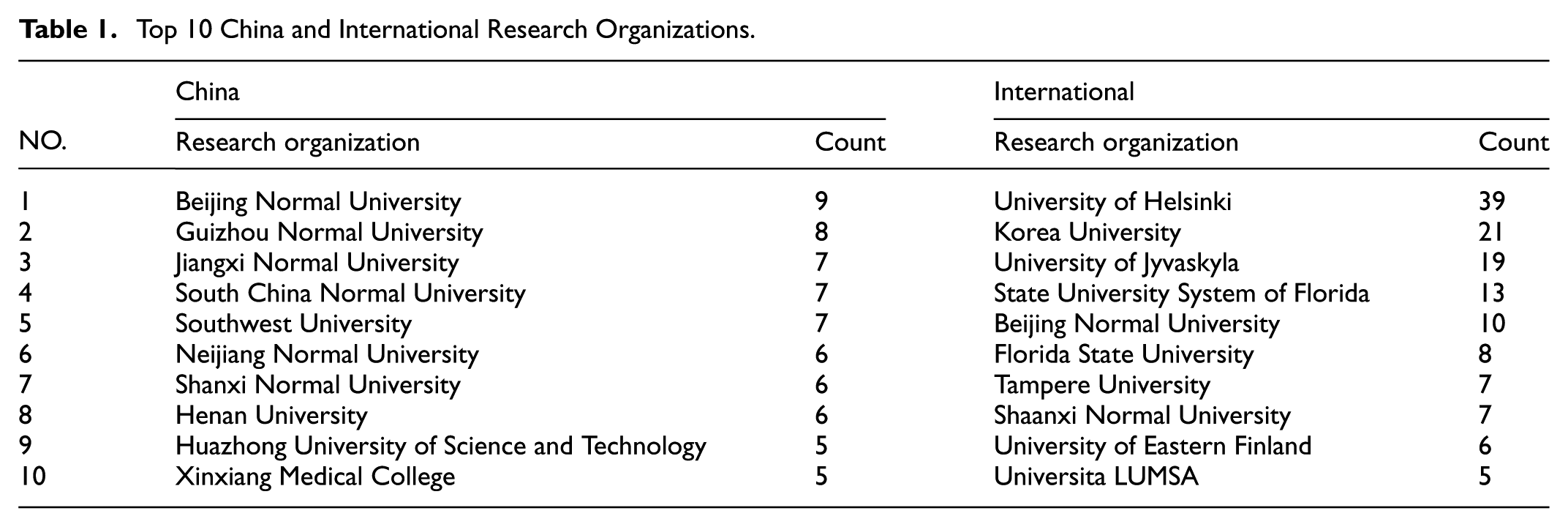
Among the 216 documents selected from the China National Knowledge Infrastructure (CNKI), 202 organizations participated in academic burnout research, including collaborative efforts. Since 2005, the volume of articles published by research institutions in China on CNKI has remained relatively modest. Notably, Beijing Normal University led with nine publications, followed by Guizhou Normal University with eight. Jiangxi Normal University, Southwest University, and South China Normal University each have seven articles. Despite the progress in academic burnout research among research institutions in China, a robust collaborative network and efficient information exchange remain underdeveloped. The centrality degree of all China-based research institutions is below 0.03, indicating minimal cooperation and limited information exchange. Consequently, an interconnected and cohesive research network has yet to emerge in the field.
In contrast, while about 97% of international research institutions have a centrality of less than 0.05, suggesting that collaborative networks in academic burnout research are still not well-established internationally, a few institutions show stronger collaborative networks. For example, the State University System of Florida (SUSF), with a centrality of 0.17, possesses a comparatively well-established collaborative network. Similarly, the University of Helsinki has published 39 articles with a centrality of 0.13, and Korea University has contributed 20 articles with a centrality of 0.10. This data indicates that although certain international institutions have made significant contributions to the academic burnout literature, their collaborative networks require further enhancement to establish more robust and cohesive research partnerships (Table 1).
Top 10 China and International Research Organizations.
Analysis of Authors of Publications
The author cooperation network mapping provides a clear and intuitive view of authors’ publications and their collaborative relationships, as shown in Figure 3. In the Chinese author cooperation network, there are 372 nodes (N = 372), 403 links (E = 403), and a density of 0.0058. In contrast, the international author cooperation network comprises 288 nodes (N = 288), 406 links (E = 406), with a higher density of 0.0099. These figures indicate that the breadth and depth of collaboration among authors in China are lower than those seen in international research, and cooperation between authors in China and internationally is also less frequent.
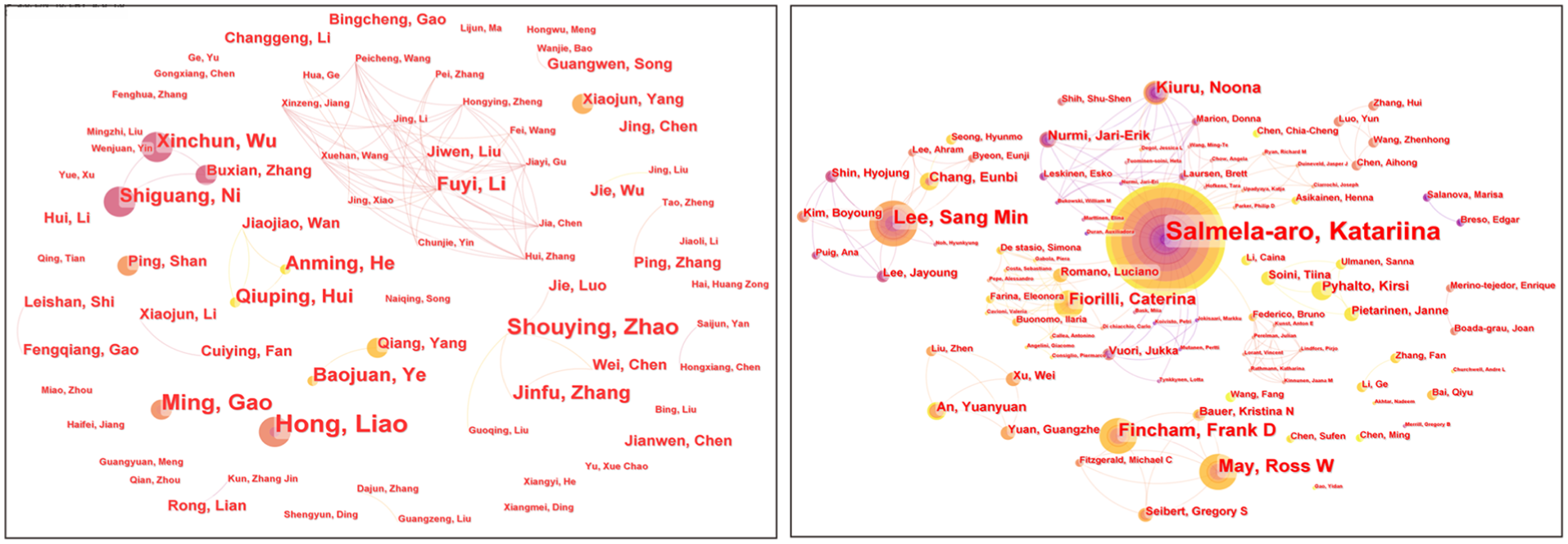
Knowledge map of author cooperation in China and internationally (Left: Chinese literature; Right: International literature).
In China, early collaborations were relatively close, with a prominent team centered around Fuye Li and Jiwen Liu. However, in recent years, collaboration among authors has become more fragmented. Even the most prolific authors, such as Hong Liao and Ming Gao, have not formed strong ties with other researchers within the collaborative network. This lack of sustained collaborative networks may limit the dissemination and impact of research findings in China. Hong Liao, the author with the most publications in Chinese core journals, has contributed five papers primarily exploring various factors influencing academic burnout, such as academic pressure, family functioning, and social support. Her work provides empirical evidence for fostering positive learning psychology and enhancing learning efficiency among college students (Liao, 2010a, 2010b, 2013a, 2013b). The second most prolific author, Ming Gao, has published four papers focusing on the relationship between boredom and academic burnout, core self-evaluation, and professional commitment among higher education students, further refining the research scope of academic burnout (Gao, 2013).
In contrast, international collaboration in academic burnout research is notably stronger, with a core network centered around Salmela-Aro Katariina. Active since 2008, Katariina has made significant contributions to the field, particularly in longitudinal studies analyzing the impact of school environments on student burnout. This research provides an empirical basis for understanding how environmental and teaching factors contribute to academic burnout (Salmela-Aro et al., 2008). Other prominent international researchers, such as Lee Sang Min, May Ross W, and Fincham, Frank D, have formed sub-networks with frequent intra-network collaboration, demonstrating greater depth in their cooperative efforts. Lee Sang Min, with 10 publications, has explored specific burnout patterns among Korean students, integrating cultural factors into the study of academic burnout, which aids educators and policymakers in designing targeted interventions (Lee et al., 2010).
In summary, while significant contributors to academic burnout research exist both in China and internationally, international efforts exhibit a broader and deeper collaboration network. Strengthening collaboration between scholars in China and internationally will further advance the field of academic burnout research and amplify the impact of its findings (Table 2).
Authors of China and International Studies on Academic Burnout (Top10).

Keyword Analysis
Keyword Co-Occurrence Analysis
Keywords serve as concise indicators of an article’s central themes and are widely used in bibliometric studies to identify research hotspots and evolving trends. In this study, we focused on two key metrics in keyword analysis: frequency, which reflects thematic prominence, and betweenness centrality, which captures a keyword’s role in bridging different clusters within the network. Following standard practices in CiteSpace, we interpreted keywords with a betweenness centrality above 0.1 as structurally important (Chen et al., 2012). To construct the co-occurrence network, CiteSpace (version 6.1.R6) was used with default pruning settings, including Pathfinder, sliced network, and merged network pruning (Chen, 2006). These methods were adopted to enhance visual clarity and reduce redundant links in the keyword network (See Figure 4).

Knowledge map of keyword co-occurrence in academic burnout research in China and internationally (Left: Chinese authors; Right: International authors).
In the Chinese literature, the most frequently occurring keywords include “learning burnout,”“college students,”“academic burnout,”“student,” and “higher vocational students.” In terms of centrality, “learning burnout” remains the most prominent, followed by “college students,”“academic burnout,”“mediating role,” and “middle school students.” These terms reflect a strong focus on student populations across different educational stages, as well as growing interest in explanatory mechanisms. In contrast, international literature emphasizes keywords such as “engagement,”“school burnout,”“academic burnout,”“stress,” and “student.” Keywords with high centrality also include “stress,”“school burnout,” and “achievement,” suggesting a research orientation toward emotional well-being, academic performance, and motivational dynamics. Compared with Chinese studies, international research appears more oriented toward psychological constructs and outcome-related variables (see Table 3).
Statistics of High-Frequency Keywords (Top 10) in China and International Academic Burnout Research.

The co-occurrence network of keywords related to academic burnout in Chinese literature reveals several key research themes (see Table 3). “Learning burnout” emerges as a central term, frequently co-occurring with various student groups—including college students, higher vocational students, and middle school students—as well as with “learning pressure,” indicating that Chinese research primarily examines the impact of academic stress on burnout, with particular attention to stress-reduction strategies. “Mental health” and “social support” also appear frequently, reflecting a common emphasis in Chinese studies on psychological well-being and external support as critical buffers against burnout. Many studies discuss the role of social and emotional support systems in mitigating students’ burnout levels. Additionally, the co-occurrence of “social support” and “academic burnout” highlights the importance of interpersonal and environmental support systems. Some research examines how various forms of social support—such as family, peer, and teacher support—can buffer against burnout and promote students’ psychological well-being. This co-occurrence pattern reflects the unique priorities of Chinese research, particularly its focus on contextual stressors and relational support systems. In contrast, international studies may emphasize different psychological and performance-related dimensions, which are discussed in subsequent sections.
Keyword Emergence Analysis
Keywords with high burst strength indicate changes in their popularity and significance within a specific period. The higher the burst strength, the more popular the keyword, and the more likely it is to become a research hot spot (Chen, 2006). Based on the analysis of burst keywords in academic burnout research, three distinct chronological phases can be identified. As illustrated in Figure 5, terms such as “academic burnout” and “online learning” exhibited pronounced bursts after 2020, closely corresponding to the educational disruptions and digital transformations triggered by the COVID-19 pandemic.

Knowledge map of keyword emergence in China and internationally (Left: Chinese authors; Right: International authors).
In the early phase, both Chinese and international research primarily focused on foundational issues. In the Chinese literature, keywords such as “fatigue” (Strength = 2.46; 2010–2012) and “students” (Strength = 2.25; 2010–2013) emphasized the identification and characterization of student burnout. In international research, terms like “inventory” (Strength = 2.05; 2002–2013) and “academic performance” (Strength = 2.00; 2014–2017) reflected efforts to develop reliable assessment tools and to examine the consequences of burnout. The emergence of “depressive symptom” (Strength = 2.11; 2008–2018) highlighted growing concern with mental health. Overall, this period represents the conceptual consolidation of academic burnout as a distinct phenomenon, differentiated from broader constructs such as academic dissatisfaction or psychological distress.
In the transitional phase, research themes diversified. Chinese studies began to focus on specific student populations, such as “higher vocational students” (Strength = 1.98; 2013–2015) and “college students” (Strength = 1.72; 2005–2010), while the keyword “learning” (Strength = 1.71; 2015–2017) gained prominence in discussions of academic efficiency and pressure. International studies, meanwhile, shifted toward developmental and psychological variables, with “adolescence” (Strength = 2.03; 2014–2015) and “adjustment” (Strength = 1.95; 2014–2016) framing burnout as a process linked to developmental stress. Keywords such as “predictor” (Strength = 2.68; 2015–2018) and “reliability” (Strength = 2.66; 2015–2016) reflected growing attention to risk identification and psychometric validation. The emergence of “dispositional mindfulness” (Strength = 1.82; 2017–2018) indicated increasing interest in psychological resilience and self-regulation strategies. These trends likely parallel broader educational reforms and the intensification of performance-driven learning environments.
In the most recent phase, both Chinese and international research became more refined and context-sensitive. Chinese literature increasingly examined the roles of “emotional intelligence” (Strength = 1.88; 2018–2021), “internet addiction” (Strength = 2.09; 2021–2023), and “online learning” (Strength = 1.89; 2021–2023) in shaping burnout experiences. These bursts align with the post-pandemic shift toward digital learning environments and growing concerns about screen-related stress and disengagement. In parallel, international studies focused on personalization and intervention strategies, as evidenced by the emergence of “personality” (Strength = 1.94; 2020–2021) and “strategy” (Strength = 1.70; 2021–2023), reflecting efforts to tailor burnout prevention in high-pressure academic contexts.
Taken together, these evolving keyword patterns reveal both convergence and divergence between Chinese and international research. Shared concerns—such as academic stress, mental health, and academic engagement—are evident, yet international studies have shown a sharper turn toward specialized, intervention-oriented topics such as personality traits and burnout in medical education. This divergence underscores the need for greater theoretical and methodological integration across cultural and institutional contexts.
These trends can be meaningfully interpreted through the lenses of the Job Demands–Resources (JD-R) model and Self-Determination Theory (SDT). For example, the emergence of “internet addiction” and “online learning” reflects increasing academic demands and external pressures, consistent with the JD-R model’s proposition that burnout arises when institutional or technological demands exceed individual coping resources (Demerouti et al., 2001). Conversely, keywords such as “emotional intelligence” and “adjustment” highlight the importance of psychological capacities that help students meet their basic needs for autonomy, competence, and relatedness, as emphasized in SDT (Deci & Ryan, 2000). The transition from broad descriptors (e.g., “student,”“academic burnout”) to more targeted constructs (e.g., “strategy,”“personality,”“higher vocational students”) signals a growing emphasis on individual differences and context-specific mechanisms, reinforcing the integrative value of JD-R and SDT in explaining academic burnout trajectories.
Research Conclusion
By mapping the development of academic burnout research over the past two decades, this study offers a comprehensive overview of its evolution in both Chinese and international contexts. Using CiteSpace, we visualized patterns in publication growth, research collaboration, and keyword emergence, which together point to four notable trends.
To begin with, the number of studies on academic burnout has increased significantly since 2019. This surge likely reflects a growing awareness of the issue’s relevance—not just in education, but also in mental health—especially in light of the widespread transition to digital learning during the COVID-19 pandemic.
Second, although collaboration between authors and institutions is generally limited and often regionally clustered, some international hubs—such as the University of Helsinki and the State University System of Florida—stand out for their more active research networks, suggesting room for broader global cooperation.
Third, thematic differences between Chinese and international research have become more apparent. Chinese studies tend to concentrate on academic pressure, support systems, and learning burnout, whereas international work leans more toward mental health symptoms, personality traits, and intervention strategies. This divergence reflects how different academic cultures prioritize different facets of student well-being.
Lastly, the shift in research themes over time aligns with key psychological frameworks like the Job Demands–Resources model and Self-Determination Theory. Newer topics—such as emotional intelligence, online learning, and social support—highlight a growing interest in how external demands interact with students’ internal resources and needs.
Looking ahead, academic burnout research will benefit from greater integration of theory and context. Future work should continue to bridge psychological models with culturally specific perspectives, in order to develop more nuanced, context-aware approaches to student support.
Limitations
Despite this study’s large-scale review of both Chinese and international literature, which illuminates recent developments in research themes, collaborative networks, and theoretical applications within the field of academic burnout, several deeper limitations remain. First, the theoretical foundations and measurement tools for academic burnout are still fragmented at the international level. In particular, consensus has not yet been reached regarding definitional boundaries, questionnaire applicability, and construct dimensions across different cultural contexts, which directly impacts the comparability and cumulative value of research findings from China and abroad. Second, while bibliometric methods are valuable for capturing the overall landscape, they fall short in analyzing the complex interactions among variables, causal pathways, and the dynamic evolution of micro-level psychological mechanisms. As a result, it is difficult to fully uncover the developmental processes underlying academic burnout. Moreover, limitations in database coverage and retrieval strategies mean that certain gray literature, emerging digital practice cases, or multilingual studies may not be included, leading to a potentially incomplete understanding of the phenomenon. Notably, with the rise of digital learning environments, internet addiction, and emotional distress in the post-pandemic era, these new challenges are becoming increasingly salient; however, empirical intervention and longitudinal studies in these areas remain limited, making it difficult to provide robust support for policy development and practical improvement.
Future Research
Given these limitations, future research should move beyond descriptive analyses to empirically test and refine established theoretical models such as the JD-R and SDT frameworks in varied cultural and educational contexts. Emphasis should also be placed on developing and validating culturally sensitive measurement tools, as well as exploring effective intervention strategies—particularly in response to new challenges brought by digital learning and post-pandemic environments. The following areas warrant special attention:
Individual Differences and Personalized Interventions
Emerging keywords indicate a growing focus on developing effective interventions and personalized coping strategies for individuals experiencing academic burnout. However, much of the current research relies on cross-sectional designs, which primarily capture mean burnout levels across student populations and tend to overlook the longitudinal development of academic burnout (R. Liu et al., 2023). This approach may fail to account for the dynamic and individual variations in burnout experiences. Future research should integrate more longitudinal designs to examine the trajectories and critical turning points of academic burnout over time. For instance, the Latent Class Growth Model (LCGM) could be employed to analyze the developmental dynamics of academic burnout, classifying students into latent groups based on their burnout levels, such as low burnout, high burnout, and perseverance (Kanayama et al., 2016; Ling, 2021). Such an approach would enable a more nuanced understanding of the developmental trajectories of different student subgroups, highlighting pivotal moments of change. Insights from these analyses could guide the design of more effective, individualized interventions tailored to specific student needs, ultimately enhancing both their academic performance and mental well-being.
Diversified Research Perspectives
To further advance the study of academic burnout, it is essential for future research to broaden its perspective by drawing on interdisciplinary theoretical frameworks, incorporating concepts from pedagogy, psychology, and sociology. This interdisciplinary approach will facilitate the identification of the multidimensional factors that contribute to academic burnout. A particular focus should be placed on the role of family environment and social support in shaping academic burnout. For example, studies could explore how family education styles, parental support, and economic conditions influence students’ burnout levels (Ma et al., 2017). Previous research in psychology has shown that family support significantly impacts emotional intelligence and self-efficacy, which are critical in managing burnout. For instance, students with higher self-efficacy tend to cope more effectively with academic stress, thus reducing the likelihood of burnout. Furthermore, exploring the construction of effective social support systems could shed light on the various ways in which students manage academic stress (Zeng et al., 2022). A strong social support network has the potential to buffer the negative effects of academic stress, enhancing students’ resilience and overall well-being.
Academic Burnout in the Context of Digitalization and Online Learning
With the rapid growth of online education—especially during and after the COVID-19 pandemic—the impact of digital learning environments on academic burnout has become an increasingly salient concern. As demonstrated in the keyword co-occurrence and burst analyses, terms such as “online learning,”“internet addiction,” and “strategy” have gained prominence, reflecting mounting academic stress in digital contexts. Remote instruction, prolonged screen exposure, and reduced face-to-face interaction have significantly transformed students’ academic and emotional experiences.
Future research should further examine how factors like platform usability, interactivity, and feedback mechanisms shape students’ vulnerability to burnout. Particular attention should be given to Internet addiction, which may blur the boundaries between study and leisure, thereby contributing to emotional exhaustion. According to the JD-R model, high digital demands without adequate support can drain students’ coping resources and increase the risk of burnout. Likewise, SDT underscores the importance of digital systems that support autonomy, competence, and relatedness for maintaining motivation and well-being.
Digital platforms intentionally designed with these theoretical principles in mind—featuring clear learning goals, timely feedback, and opportunities for social connection—may serve as buffers against burnout. Identifying and promoting such protective features is essential for fostering student resilience and safeguarding mental health within the evolving digital education landscape (Aria et al., 2024; Ilic & Ilic, 2025; Nurani et al., 2022).
Mental Health and Social Support Systems
The connection between academic burnout and students’ mental health, along with the role of social support systems, remains a critical area for future research. Keywords such as “depressive symptoms,”“stress,” and “fatigue” have frequently appeared in the literature, highlighting their importance in understanding academic burnout (Cheng et al., 2020). Future studies should explore in greater depth the mechanisms linking mental health issues, particularly anxiety and depression, with academic burnout. Additionally, research should focus on the development of effective social support systems that can alleviate burnout through the combined efforts of family, school, and community (Jacobs & Dodd, 2003). Notably, the co-occurrence of “family functioning” and “academic burnout” in keyword networks underscores the importance of family dynamics. Some studies have begun to explore how family functioning influences students’ vulnerability to burnout and highlight the potential of family-based approaches in mitigating academic stress. For instance, studies could examine the role of school-based mental health services, the influence of family support on students’ psychological well-being, and how community resources can help alleviate academic stress (Y. Liu & Cao, 2022). By investigating these dimensions, researchers can develop more effective intervention strategies aimed at reducing academic burnout and improving students’ overall mental health (Popa-Velea et al., 2017).
Footnotes
Acknowledgements
The authors would like to thank the anonymous reviewers for their constructive feedback and valuable suggestions.

Ethical Considerations
This manuscript is a review of existing research and does not report any original studies involving human participants or animals. Consequently, approval from an institutional ethics committee was not necessary.
Consent to Participate
Not applicable. The study did not recruit human participants.
Consent for Publication
We, Wanru Lin, Xiaoxiao Hong, Qing Wang, Xi Chen, and Yuefu Liu, hereby give our consent for the publication of this manuscript entitled “Mapping Two Decades of Academic Burnout Research: Key Insights and Future Directions.” We confirm that this work is original and has not been published elsewhere.
Funding
The authors disclosed receipt of the following financial support for the research, authorship, and/or publication of this article: This research was supported by the Guangdong Province Education Science Planning Project (No. 2024GXJK395) and the Philosophy and Social Science Planning Project of Guangdong Province (No. GD25YJY33). The funding agencies had no role in the study design, data collection and analysis, interpretation of results, or writing of the manuscript.
Declaration of Conflicting Interests
The authors declared no potential conflicts of interest with respect to the research, authorship, and/or publication of this article.
Data Availability Statement
Due to the nature of the study as a graduation thesis, data cannot be made publicly available. Researchers interested in accessing the data may contact the corresponding author via email to apply for data access.