




Abstract
This study aims to fill the research gap in understanding the factors influencing job-pursuit intentions towards higher education institutions. Drawing on the instrumental-symbolic theory, it constructs an integrative model to explore how quality of work-life expectancy, career development opportunities, university reputation, and perceived person-organisation fit affect job seekers’ intentions. A quantitative research method was employed, targeting master’s and doctoral degree job seekers in China. Data were collected through non-random sampling, yielding 518 valid samples. The results support the theoretical model, with significant relationships found between the variables. Quality of work-life expectancy and career development opportunities, as instrumental attributes, along with university reputation as a symbolic attribute, influence perceived person-organisation fit and job pursuit intentions. The mediating role of perceived person-organisation fit is also confirmed. Theoretically, this study broadens the understanding of the instrumental-symbolic theory and person-organisation fit theory in the context of academic job pursuit. Practically, it provides strategies for organisations, especially universities, to enhance human resource management and talent acquisition.
Plain Language Summary
This study builds an integrative model to explore how work-life quality, career development, and university reputation affect academic job seekers’ intentions via perceived person–organisation fit, based on 518 survey responses in China. This study explores how instrumental (e.g., career development, work-life quality) and symbolic (e.g., university reputation) factors affect academic job seekers’ intentions through the role of person–organisation fit.
Keywords
Introduction
Higher education, as a key driver of global, national and local development, not only bears the vital functions of promoting social progress, individual growth, and economic prosperity (Chankseliani, 2022; Stolze & Sailer, 2022), it also confronts multiple challenges encompassing technological innovation, educational quality, and faculty composition. For instance, the rapid advancement of digital technologies compels higher education institutions to continually update curricula to align with future workplace demands (Ahmad, 2020); simultaneously, the development of high-calibre teaching staff is crucial for the inclusivity and quality of higher education (Florian & Camedda, 2020). This not only helps meet students’ diverse needs (Mun et al., 2020) but also enhances universities’ research and innovation capabilities (Goh & Abdul-Wahab, 2020). Against this backdrop of transformation, universities are progressively evolving from “academic communities” into competing talent organisations (Powell & Arora-Jonsson, 2022). Consequently, attracting and retaining high-calibre faculty has become a central issue in institutional strategic management (Li & Xue, 2021).
Despite widespread recognition of the strategic value of faculty recruitment, academic institutions still face challenges in demonstrating employer attractiveness to potential candidates. Institutions must effectively communicate their values and strengths to enhance the job-seeking intentions of outstanding scholars (Abell & Becker, 2021). However, existing research indicates that employer attractiveness mechanisms within higher education remain under-explored—particularly lacking systematic analyses of factors influencing academic job-seekers’ behaviour (Civera et al., 2023). Current research predominantly focuses on developed nations such as Europe and the United States (Abell & Becker, 2021), with empirical studies in developing regions like China remaining scarce. Furthermore, although human resource literature emphasises that job application intentions are shaped by multiple factors including personal characteristics, organisational fit, and employer brand (Delva et al., 2021), integrated research on these variables within the higher education context exhibits significant gaps.
Against this theoretical and practical backdrop, this study adopts an integrative approach to construct an analytical model examining the multi-level factors influencing academic job seekers' employment intentions. Building upon the individual–organisational fit theory, we systematically examine the influence pathways of organisational-level variables (work–life quality, career development opportunities, university reputation) and individual-level fit perceptions on job search intentions. This endeavour aims to address existing gaps in the literature and generate findings with both theoretical and practical value.
The remainder of this paper is structured into four key sections. Section two provides a detailed account of the theoretical framework and the development of the study’s hypotheses. The third section details the sample and research methods used in the study. Section four presents the empirical findings, while section five outlines the key conclusions, acknowledges the study’s limitations, and offers recommendations for future research avenues.
Literature Review and Hypothesis Development
Instrumental-Symbolic Theory
The Instrumental–Symbolic Theory originated in the field of marketing (Lievens & Highhouse, 2003), centring on the proposition that customers evaluate brands by considering both the product’s practical functionality (instrumental attributes) and the symbolic meaning conveyed by the brand (Katz, 1960; Keller, 1993). This theory emphasises the dual role of these two attributes in shaping brand image. Lievens and Highhouse (2003) first introduced this theory into the field of human resource management, proposing that when attracting job seekers, enterprises similarly need to shape their employer image across both instrumental and symbolic dimensions to enhance initial appeal.
Within this theoretical framework, instrumental attributes typically refer to specific quantifiable job characteristics such as remuneration, benefits, geographical location, and career progression pathways, fundamentally addressing individuals’ rational utilitarian needs (Ružojčić et al., 2021). In contrast, symbolic attributes represent the abstract values conveyed by an organisation, such as reputation, professionalism, ethical image, or personality traits (Iglesias et al., 2020). Research indicates that these symbolic attributes not only enhance employer attractiveness but also fulfil psychological needs for self-expression and identity construction among job seekers (Akter et al., 2022). For instance, organisational image traits such as integrity, prestige, and social responsibility have been demonstrated to positively influence the attraction of high-calibre candidates (Kleine & Rudolph, 2022; Kumari & Saini, 2018).
In recent years, some scholars have begun extending the instrumental–symbolic theory to explore deeper mechanisms of employer preference formation. This includes investigating the direct impact of brand attributes on job-seeking choices (Hoppe et al., 2022) or identifying key variables influencing job-seeking intentions (Ahamad et al., 2023). However, despite the tool–symbol framework’s widespread recognition within HR, existing research predominantly focuses on single-level influence mechanisms. Few studies integrate it with psychological variables such as person–organisation fit (P–O fit) to construct systematic explanatory models. Consequently, how brand attributes influence job-seeking intentions via fit, the relative importance of different attributes, and their causal pathways remain critical theoretical and practical questions requiring clarification.
Addressing this theoretical gap, this study constructs an integrated mediational model to systematically examine how characteristics of higher education employers at the instrumental and symbolic attribute levels influence academic job seekers’ organisational fit and ultimate employment intentions. It aims to provide new research perspectives for deepening the theory of “attractiveness of higher education employers” and informing practical strategies.
Quality of Work-Life Expectancy and Perceived Person-Organisation Fit
The concept of “work-life quality” was first introduced by Irving Blusthorn in the 1960s within General Motors’ human resources development programme (Tongo, 2015). Over the subsequent four decades, scholars from diverse disciplines have proposed numerous definitions of work-life quality (Lee et al., 2015). Despite variations in specific formulations, the academic community broadly recognises its multidimensional nature, encompassing six dimensions: health and safety; economic and family aspects; self-actualisation; respect; social relationships; and knowledge and aesthetics (Lee et al., 2015). Drawing upon need-satisfaction theory and expectancy theory, work-life quality can be conceptualised as an individual’s belief that future work contexts will yield positive outcomes (Ciavolino et al., 2022). Consequently, this study defines ‘work-life quality expectations’ as: job seekers’ belief that their future work environment will satisfy their multifaceted work and life demands. As a pivotal concept in human resource management, work-life quality not only concerns an organisation’s capacity to fulfil job seekers’ fundamental material and security needs but also reflects their overall aspirations regarding career development and life balance. This holds direct significance for higher education institutions in attracting and retaining outstanding talent (Liu et al., 2025).
Within organisational behaviour research, person–organisation fit serves as a vital theoretical framework for explaining employee attitudes and behaviours. It denotes the degree of alignment between individuals and organisations in terms of values, goals, and characteristics (Kristof, 1996), and has been extensively applied in personnel psychology and recruitment studies (Firfiray & Mayo, 2017). From the job seeker’s perspective, person–organisation fit emphasises whether their personality traits and values align with the culture of the recruiting organisation (Tett et al., 2021). Existing research indicates that when job seekers anticipate an organisation can provide work-life balance aligned with their expectations, they are more likely to perceive cultural and value alignment with that organisation (Firfiray & Mayo, 2017). Similarly, organisations perceived as supportive of employees’ quality of life are more likely to attract job seekers seeking such support, thereby enhancing their perceived fit (Mäkikangas & Schaufeli, 2021). Further empirical research indicates that organisations offering high levels of work-life quality benefits and supportive environments not only attract greater talent but also retain employees who perceive a strong alignment between themselves and the organisational culture (Morris & Mo, 2023).
However, despite existing research revealing potential links between work-life quality and individual-organisational fit, the literature remains predominantly focused on the perceptions and retention behaviours of incumbent employees. Attention remains limited regarding how academic job seekers in higher education contexts form perceptions of organisational fit through work-life quality expectations. Furthermore, there is a current lack of empirical models systematically integrating work-life quality expectations with individual-organisational fit to examine their underlying mechanisms. Consequently, this study employs work-life quality expectations as the independent variable, focusing on its influence pathways on job seekers’ perceived fit. The following hypotheses are proposed:
Quality of Work-Life Expectancy and Job Pursuit Intentions
Job intention is typically defined as an individual’s demonstrated interest and willingness to pursue a specific position or organisation during the job search process (Dutta et al., 2021). Unlike mere job-seeking behaviour, job intention encompasses not only the inherent appeal of the role itself but also how well that role aligns with the individual’s long-term career objectives and overall well-being. In recent years, expectations regarding work-life quality have progressively emerged as a significant factor influencing job search intentions. Policies such as flexible working hours and family care support are now regarded as key indicators of an organisation’s genuine commitment to supporting employee needs. These policies not only reflect the extent to which an organisation supports employees’ personal lives while they fulfil their professional responsibilities, but also significantly shape job seekers’ perceptions of potential employers (Weber et al., 2024).
Existing research indicates that job seekers increasingly prioritise the quality of work-life experiences when evaluating employment opportunities, as this directly determines an individual’s overall well-being and job satisfaction (Ahamad et al., 2023). For instance, Chung and Booker (2023) found that flexible working arrangements significantly improve the distribution of domestic labour and childcare responsibilities, holding critical importance for many job seekers—particularly those balancing family commitments. Furthermore, scholars have confirmed that work-life balance benefits often exert a greater influence on employer attractiveness than traditional standard benefits such as remuneration and promotion prospects. Among flexible working arrangements, flexible working hours demonstrate the most pronounced positive effect on job application intentions (Ahamad et al., 2023). Collectively, these findings illustrate that anticipated work-life quality serves not only as a crucial reference point for job seekers when weighing different opportunities but also as a strategic tool for organisations to shape their attractiveness.
However, while existing research has revealed the connection between work-life balance and job search intentions, the literature primarily focuses on the perspective of general employees. Research on how academic job seekers in higher education form job search intentions through expectations of work-life quality remains relatively scarce. In this context, exploring the pathways through which work-life expectations influence job search intentions can both address gaps in academic research on employer attractiveness and provide empirical evidence for universities competing in recruitment.
Based on the foregoing, this study proposes the following hypothesis:
Career Development Opportunities and Perceived Person-Organisation Fit
Based on the economic exchange model, Liu et al. (2021) contend that employers can enhance employees’ job security by providing diverse career development opportunities, thereby boosting their loyalty and performance. As an organisational investment, career development opportunities not only furnish employees with valuable and market-competitive resources but also reinforce perceptions of organisational support and improve individual-environment fit (Rodrigues et al., 2022). This process fosters a mutually beneficial relationship between organisations and employees: organisations support individuals’ career aspirations, while employees drive organisational success through heightened performance and identification. Consequently, career development opportunities are regarded as a critical resource for enhancing employees’ career adaptability and perceived employability (Chen et al., 2024). Within higher education institutions, offering comprehensive career development programmes not only demonstrates a commitment to faculty growth and long-term professional success but also strengthens the alignment between job seekers’ personal aspirations and organisational culture (Ho et al., 2023). This alignment proves particularly vital within university settings that emphasise continuous learning and development. Research indicates that when job seekers perceive an organisation as offering abundant developmental resources and learning opportunities, they are more likely to form a perception of high organisational fit (Huang et al., 2019; Jia Jun & Hua-Ming, 2022). Further empirical research indicates that when organisations clearly map out career progression pathways, employees perceive opportunities for professional growth. This reinforces their identification with organisational goals and emotional attachment, significantly enhancing individual-organisational fit (Liu & Xie, 2024). In summary, career development opportunities are not only vital for attracting and retaining talent but also serve as a key mechanism for shaping employees’ sense of fit and support. However, while existing research has revealed the potential pathways through which career development opportunities influence person-organisation fit from an employee perspective, empirical testing within the higher education context remains insufficient, particularly lacking systematic analysis of academic job seekers. Therefore, this study positions career development opportunities as a core organisational-level variable, focusing on examining its influence mechanisms on job seekers’ perceived person–organisation fit.
Based on the foregoing, the following hypothesis is proposed:
Career Development Opportunities and Job Pursuit Intentions
Career adaptability theory posits that job seekers typically evaluate career opportunities based on their expectations regarding future career development, thereby informing their employment decisions (Savickas, 1997). Within this framework, career development opportunities represent not merely an organisational resource, but also embody the organisation’s efforts in fulfilling its psychological contract with employees (Kumari & Saini, 2018). Existing research consistently indicates that career development opportunities constitute a significant factor in job seekers’ employment choices. They markedly enhance a position’s attractiveness and are regarded as a core mechanism influencing employment intentions (Nowiński et al., 2020). Particularly for recent graduates and entry-level job seekers in high-uncertainty industries, career development opportunities effectively reduce the uncertainty associated with career choices, bolster confidence in occupational stability, and thereby enhance job-seeking willingness (Ferguson & Schussler, 2025). Further empirical research indicates that potential candidates demonstrate significantly higher job-seeking intentions towards organisations offering extensive career development opportunities compared to employers providing limited growth prospects (Kumari & Saini, 2018). However, while existing studies have revealed a positive link between career development opportunities and job-seeking intentions, the literature predominantly focuses on corporate environments, with relatively insufficient systematic examination of higher education institutions as a distinct employer group. Given higher education’s emphasis on long-term career progression and scholarly growth, the role of career development opportunities in attracting academic talent warrants deeper exploration. Consequently, this study positions career development opportunities as a key organisational-level variable, focusing on its causal pathways influencing job-seeking intentions among academic candidates. The following hypothesis is proposed:
University Reputation and Perceived Person-Organisation Fit
Organisational identity theory posits that organisational identity constitutes members’ collective perception of the organisation’s core, enduring and distinctive attributes (Whetten & Godfrey, 1998). This identity not only exists within the organisation but also influences external groups’ perceptions, including prospective employees’ views of the organisation (Hesse et al., 2021). Within this framework, corporate reputation, as a vital component of organisational identity, is regarded as a key reference point for external stakeholders (including job seekers) in understanding and evaluating the organisation (Mariappanadar, 2020). From the perspective of organisational identity theory, a positive and stable organisational reputation not only reflects the organisation’s core values, culture, and spiritual essence but also enhances individuals’ perceptions of person–organisation fit (P–O fit) (Christodoulides et al., 2021). Existing research indicates that favourable organisational reputations are typically associated with trust, credibility, and a robust employer brand. These elements play a significant role in shaping job seekers’ perceptions of potential organisational fit (Schaarschmidt et al., 2021). A positive organisational reputation enhances the organisation’s overall attractiveness, making it easier for job seekers to perceive alignment between their personal values and the organisation’s objectives (Sharma & Tanwar, 2023). Further empirical research has also found that organisations with distinguished reputations are more likely to attract candidates who identify with their mission and values, thereby fostering a more engaged and motivated workforce (Balmer, 2022). Concurrently, reputation has been demonstrated to positively influence job seekers’ perceptions of organisational value, thereby enhancing their willingness to join (Verčič & Ćorić, 2018). Within higher education, university reputation—as a distinct manifestation of organisational reputation—serves not only as an external indicator of academic quality and research calibre, but also functions to communicate the institution’s core values, culture, and spiritual essence to prospective candidates. Consequently, a strong university reputation reinforces academic talent’s perception of organisational fit, thereby heightening their inclination to join the institution.
Based on this, the study proposes the following hypothesis:
University Reputation and Job Pursuit Intentions
Employer branding theory posits that an organisation’s reputation as an employer significantly influences potential job seekers’ perceptions and decision-making processes (Xiao et al., 2022). A positive organisational reputation not only signals desirable workplace attributes such as supportive environments, career development opportunities, and job security (Xiao et al., 2022), but also plays a pivotal role in the job market. Prospective employees frequently base their decision to apply on their perception of an organisation’s reputation (Schaarschmidt et al., 2021). Concurrently, social identity theory posits that individuals derive part of their identity and self-esteem from their organisational affiliations (Tajfel, 2010). Consequently, when an organisation possesses a favourable reputation, job seekers are more likely to perceive it as an environment that can enhance their self-concept and social identity, thereby increasing their employment willingness (Blickle et al., 2020). Recent empirical research further validates this logic, revealing that organisations with distinguished reputations tend to attract higher-calibre applicants and reduce staff turnover (Zhan et al., 2022). Additionally, other studies indicate that positive organisational reputations significantly influence whether job seekers accept offers, thereby enhancing their actual employment intentions (Sharma & Tanwar, 2023; Silva & Dias, 2022). However, existing research has relatively limited exploration of how the reputation of higher education institutions influences academic talent’s job search intentions, a question of particular importance against the backdrop of intensifying global academic competition. Therefore, this study adopts university reputation as a key organisational-level variable to examine its pathways of influence on academic job seekers’ employment choices. Based on the above research, the following hypothesis is proposed:
Perceived Person-Organisation Fit and Job Pursuit Intentions
The Attraction–Selection–Attrition (ASA) theory posits that when individuals perceive a high degree of alignment with an organisation, they are often drawn to it and subsequently exhibit greater commitment and satisfaction in their career development (Schneider, 1987). This sense of alignment not only influences job seekers’ organisational choices but also significantly shapes their expectations regarding future working relationships. Extensive empirical research has confirmed that perceived individual-organisation fit serves as a significant predictor of job application intentions. When job seekers perceive strong alignment between their personal values and goals with an organisation, they are more likely to view that organisation as an ideal employer and exhibit heightened motivation to apply (Hakel, 2019). Recent research has further expanded this finding, indicating that the positive effects of individual-organisation fit extend beyond initial job search intentions to influence employees’ job satisfaction and retention intentions over the long term (Sharma & Tanwar, 2023). However, while related research has been extensively validated in corporate contexts, the relationship between academic job seekers’ perceptions of individual-organisation fit and their job search intentions within higher education institutions remains under-explored in systematic empirical terms. Given that academic talent places greater emphasis on organisational cultural and value alignment when selecting higher education employers, this study posits individual–organisational fit as a key psychological mechanism, exploring its causal pathways on job search intentions within the university recruitment context. Based on this rationale, the following hypothesis is proposed:
Mediating Effects of Perceived Person-Organisation Fit
The preceding sections of this paper have examined how expectations regarding work-life quality, career development opportunities, and university reputation respectively influence perceived individual-organisational fit, as well as the direct pathways through which individual-organisational fit affects job-seeking intentions. However, within human resource management research, scholars have noted that individual-organisational fit may serve not only as an outcome variable but also as a crucial mediating mechanism linking employer characteristics to individual attitudes. Kooij and Boon (2018) contend that when employees perceive an organisation as genuinely caring for their wellbeing and committed to investing in their development, they are more likely to comprehend and align with the organisation’s values, beliefs, and characteristics. This cognitive process helps clarify mutual expectations between individuals and the organisation, thereby enhancing employees’ sense of belonging and psychological fulfilment. Consequently, employees exhibiting high levels of individual-organisational fit typically demonstrate stronger emotional commitment and positive responses. Furthermore, Tanwar and Kumar (2019) research indicates that individual-organisation fit serves as a crucial psychological mechanism linking employer brand dimensions (such as remuneration incentives, work culture, ethical norms, and corporate social responsibility) to individuals’ perceptions of “preferred employers.” From this perspective, individual-organisation fit not only explains how organisational characteristics influence employee responses but also reveals the latent psychological pathways through which employer attributes translate into job-seeking intentions. Although existing literature has validated the mediating role of individual–organisational fit, systematic empirical testing remains lacking in higher education contexts regarding whether academic job seekers translate evaluations of employer attributes (such as work-life quality, career development opportunities, and university reputation) into actual job-seeking intentions via perceived fit.
Consequently, this study proposes the following hypothesis:
Based on the aforementioned hypotheses, a conceptual framework has been developed and is presented in Figure 1.

Conceptual framework.
Methodology
Research Design and Data Collection
This study employs quantitative research methods, with the research subjects being job seekers within China holding master’s degrees or higher. The research was approved by the Institutional Ethics Review Board of a university in China. During data collection, the research team provided detailed explanations on the questionnaire cover page to all potential participants regarding the study’s objectives, the voluntary nature of participation, data anonymity, and confidentiality measures. It was emphasised that respondents could withdraw at any stage without incurring any adverse consequences. All participants completed the questionnaire voluntarily and with full knowledge, thereby ensuring ethical compliance.
Data collection employed non-random sampling. Specifically, the research team first designed an electronic questionnaire. Following approval from the postgraduate offices of several universities, their staff assisted in distributing the questionnaire to master’s and doctoral students actively seeking employment. Informed consent was obtained from all participants prior to data collection. Participants were informed about the purpose of the study, their right to withdraw at any time, and the confidentiality of their responses. Written consent was secured through a digital checkbox embedded in the online questionnaire interface, in accordance with APA Ethical Guidelines (Section 8.05).
Concurrently, human resources departments of several enterprises assisted in recommending eligible employees to participate in the survey. Through this multi-channel recruitment approach, the study ensured a degree of diversity and representativeness within the sample of academic job seekers. Data collection spanned 1 month from mid-May to mid-June 2024. A total of 536 questionnaires were obtained, of which 18 were excluded due to incomplete responses. The final valid sample comprised 518 responses, yielding an effective recovery rate of 96.6%.
Regarding data analysis methodology, this study employed structural equation modelling (SEM), utilising AMOS 26 software for modelling and estimation. The Maximum Likelihood Estimation (MLE) method was applied, which is suitable for large-sample contexts and demonstrates robust stability under conditions of sufficient sample size and approximately normal data distribution. According to existing research, SEM requires a sample size of no fewer than 200 (Reinartz et al., 2009), or adherence to the empirical rule of a minimum 10:1 ratio of sample size to observed variables (Mueller, 1997). Consequently, the 518 valid samples in this study fully meet the sample size requirements for SEM analysis.
Regarding statistical hypothesis testing, this study first examined the normality of the data. Results indicated that the skewness and kurtosis of all observed variables fell within the ±2 range, suggesting the data approximated the assumption of normal distribution. Furthermore, during data cleaning, 18 incomplete questionnaires were excluded, effectively mitigating potential interference from missing data and ensuring the integrity and reliability of the final 518 samples.
In summary, this study exercised rigorous control over sample selection, data collection, and pre-processing to ensure the robustness of subsequent empirical analysis and the credibility of research conclusions.
The gender distribution of the valid sample population showed nearly equal proportions, with 299 males (57.72%) and 219 females (42.28%), reflecting a reasonably balanced representation of survey respondents in terms of gender. Regarding education level, the participants had a strong academic background, with 35.12% holding a master’s degree and 64.88% holding a doctoral degree. The participants’ ages ranged from 23 to 65 years, with the most concentrated age group being 33 to 42 years, accounting for 33.89% of the total.
Measures
Quality of work-life expectancy was measured using 7 items adapted from Zaman and Ansari (2022). A sample item is “My salary and benefits are anticipated to be commensurate with my workload.” The scale for career development opportunities was adapted from Nouri and Parker (2013), consisting of 5 items. A sample item is “The prospective university position is expected to significantly contribute to the individual’s career growth and professional development.” University reputation was measured using a 6-item scale adapted from Wayne and Casper (2012). A sample item is “it would be prestigious to work for this university.” The perceived person-organisation fit scale, with 3 items, was adapted from Cable and DeRue (2002). A sample item is “This university’s values and culture provide a good fit with the things that I value in life.” Finally, the scale of job pursuit intentions including 4 items adapted from Wang (2013). An example item is “My willingness to apply for the university’s job is very high.” The survey was conducted in Chinese. Initially, the measurement items were developed in English, then translated into Chinese and subsequently back-translated into English following Baron and Kenny’s (1986) methodology. Responses were evaluated using a 7-point Likert scale, with 1 indicating “strongly disagree” and 7 indicating “strongly agree.”
Data Analysis
Data analysis was conducted using AMOS 26 with a two-step approach. Initially, the constructs’ reliability and validity were evaluated. Reliability was assessed through item reliability, composite reliability, and Cronbach’s alpha, while validity was examined via convergent and discriminant validity. Subsequently, the structural model was evaluated, incorporating path analysis and mediation effects tests.
Results
Common Method Bias (CMB)
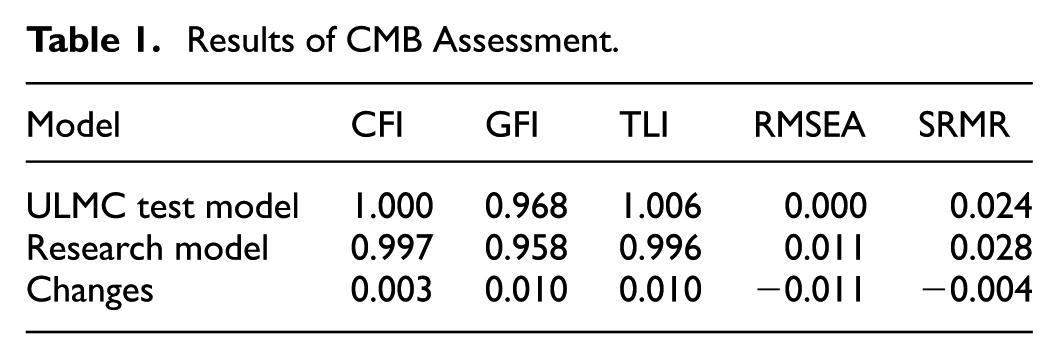
To further control and assess common method bias (CMB), this study supplemented the conventional Harman’s single-factor test with the Unmeasured Latent Method Construct (ULMC) technique. Specifically, a common latent method factor was introduced into the measurement model and compared with the original research model. As shown in Table 1, the differences between the ULMC test model and the research model across all fit indices were negligible, with changes in CFI, GFI, TLI, RMSEA, and SRMR all falling below the recommended threshold of 0.02 (Podsakoff et al., 2003). This indicates that the inclusion of a common method factor did not lead to any substantial improvement in model fit, suggesting that the data in this study are not subject to serious common method bias.
Results of CMB Assessment.
Measurement Model Assessment
The reliability of each factor in the instrument was assessed using Cronbach’s alpha (α) with a threshold of 0.7 or higher indicating strong reliability (Churchill, 1979). As shown in Table 2, all measured constructs demonstrated reliabilities exceeding the minimum benchmark of 0.7, which is acceptable in social science research. Internal consistency, evaluated to determine the interrelatedness among measurement items designed to assess uniformity, showed that the composite reliability (CR) coefficients for all constructs were above the recommended value of 0.70 (Hair et al., 2010), and the factor loadings surpassed the 0.50 benchmark (Hair et al., 2010). Convergent validity, involving the evaluation of measures against each other rather than external standards, was assessed using the average variance extracted (AVE), which must be greater than 0.50 (Kline, 2015). As shown in Table 2, all AVE values exceeded this threshold, indicating satisfactory convergent validity for the measurement model. These results suggest that the measurement constructs are reliable, ensuring that reliable findings can be obtained from the study.
Reliability and Convergent Validity.
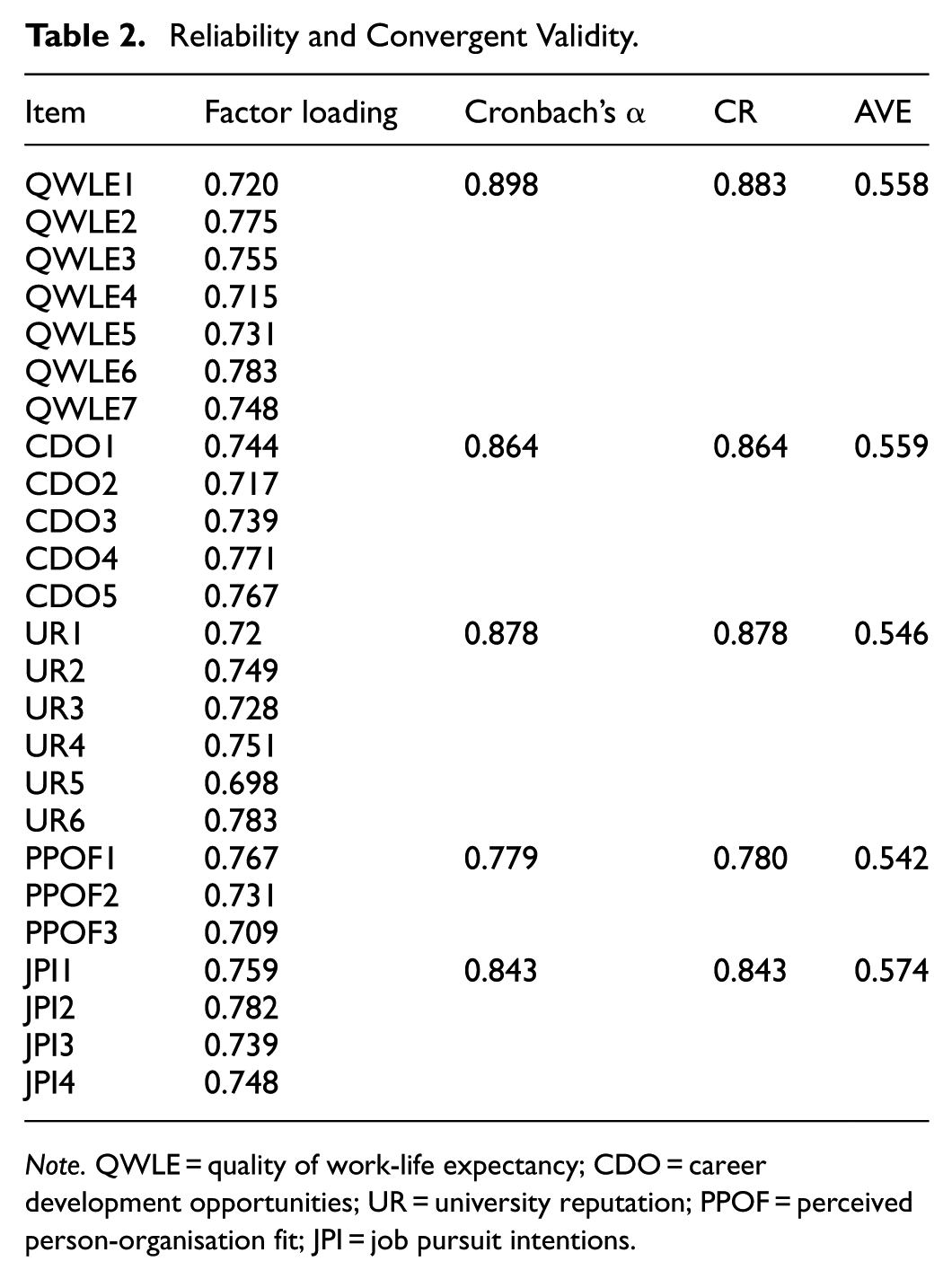
Note. QWLE = quality of work-life expectancy; CDO = career development opportunities; UR = university reputation; PPOF = perceived person-organisation fit; JPI = job pursuit intentions.
Discriminant validity was assessed using the Fornell-Larcker criterion. As shown in Table 3, the correlation coefficients between the factors were lower than their respective square root AVEs, thereby meeting the requirements for discriminant validity (Fornell & Larcker, 1981).
Discriminant Validity Test Results.

Note. Bolded is the square root of AVE. QWLE = quality of work-life expectancy; CDO = career development opportunities; UR = university reputation; PPOF = perceived person-organisation fit; JPI = job pursuit intentions.
Structural Model Assessment
The proposed hypotheses were examined by performing Structural equation modelling (SEM) with AMOS software. First, the fit indices of the model were assessed. The chi-square/degree of freedom (χ2/df) value was less than the recommended value of 3 (Hu & Bentler, 1999), indicating a good model fit. The GFI and AGFI wereboth above the recommended value of 0.8, indicating a good overall model fit (Byrne, 2001). In addition, the IFI, TLI, and CFI were all close to 1, exceeding the standard value of 0.9, further indicating an excellent model fit (Bentler, 1990). The RMSEA was less than 0.08, indicating that the model error was within a reasonable range (Browne & Cudeck, 1992). The values of fit indexes mentioned above are shown in Table 4.
Goodness of Fit Model.

This study employed structural equation modelling using AMOS 26 and conducted path analysis to test the proposed hypotheses, with results presented in Table 5. The overall model demonstrated excellent fit, with all primary paths achieving statistical significance, thereby supporting the theoretical framework. Specifically, the anticipated quality of work and life (QWLE) exerted a significant positive influence on perceived person–organisation fit (PPOF) (β = .201, p < .001), supporting H1; QWLE’s direct effect on job search intention (JPI) was also significant (β = .158, p < .01), supporting H2. Career development opportunities (CDO) significantly influenced PPOF (β = .213, p < .001), supporting H3; CDO’s direct effect on JPI was also significant (β = .228, p < .001), supporting H4. University reputation (UR) exerted a positive and significant effect on PPOF (β = .198, p < .001), supporting H5; UR’s positive effect on JPI was similarly established (β = .206, p < .001), supporting H6. Finally, the positive effect of PPOF on JPI was significant (β = .167, p < .01), supporting H7.
Path Coefficients and Hypothesis Testing.

Note. QWLE = quality of work-life expectancy; CDO = career development opportunities; UR = university reputation; PPOF = perceived person-organisation fit; JPI = job pursuit intentions.
p < .05. **p < .01. ***p < .001.
Regarding explanatory power, AMOS outputs indicate the model adequately accounts for variation in endogenous variables: R2 for PPOF was 0.47 and for JPI 0.52, both exceeding the moderate threshold of 0.25 (Hair et al., 2010), demonstrating robust explanatory capability.
As AMOS does not directly output f2 effect sizes or Q2 predictive validity, these metrics primarily rely on the PLS-SEM framework. In this study, we assessed model explanatory power through R2 values and overall fit indices, and in conjunction with recommended standards from the literature (Mueller, 1997; Reinartz et al., 2009), concluded that the model possesses reasonable explanatory validity and a degree of predictive power.
Mediating Effects
To further examine the mediating role of perceived person–organisation fit (PPOF) in the relationship between quality of work life expectancy (QWLE), career development opportunities (CDO), university reputation (UR), and job search intention (JPI), this study employed the bootstrapping method proposed by Baron and Kenny (1986). Specifically, 5,000 repeated samples were drawn using bias-corrected bootstrapping with a 95% confidence interval to test the significance of indirect effects.
As shown in Table 6, QWLE, CDO, and UR all exerted significant indirect effects on JPI via PPOF. Specifically, the indirect effect of QWLE on JPI via PPOF was β = .067, 95% CI [0.04, 0.10], p = .015, supporting hypothesis H8a; the indirect effect of CDO on JPI via PPOF was β = .063, 95% CI [0.03, 0.10], p = .031, supporting hypothesis H8b; UR’s indirect effect on JPI via PPOF was β = .064, 95% CI [0.03, 0.11], p = .019, supporting hypothesis H8c. These findings indicate that PPOF partially mediates the relationship between organisational characteristics (work-life quality, career development opportunities, and university reputation) and job search intentions, thereby revealing the key psychological mechanism through which perceived individual fit influences the formation of job search intentions.
Mediation Analysis Results.

Note. QWLE = quality of work-life expectancy; CDO = career development opportunities; UR = university reputation; PPOF = perceived person-organisation fit; JPI = job pursuit intentions.
p < .05. **p < .01. ***p < .001.
Discussion, Implications, and Limitations
Discussion
The findings of this study provide novel evidence for understanding the employment intentions of academic job seekers, offering insights with both theoretical and practical implications. Firstly, from the perspective of instrumental-symbolic theory, this research validates the dual role of instrumental and symbolic attributes in shaping job-seeking intentions. Expectations of work-life quality and career development opportunities, as instrumental factors, alongside university reputation as a symbolic factor, collectively influence individuals’ perceptions and decision-making processes. This finding not only aligns with existing research (Ahamad et al., 2023; Chen et al., 2024; Liu et al., 2025) but also further enriches the applicability of this theory within the higher education recruitment context.
Regarding specific path effects, this study found that anticipated work-life quality significantly influenced both perceived P–O fit (β = .201, p < .001) and job search intentions directly (β = .158, p < .01). This indicates that job seekers evaluate potential employers not only by their capacity to provide supportive work environments, but also by assessing organisational cultural fit through anticipated work-life balance. An effect size of β ≈ .20 signifies a moderate influence of this factor on job search intentions and fit perceptions. Practically, this suggests that universities implementing flexible working arrangements and family-friendly policies may enhance their attractiveness to outstanding scholars. This finding validates Weber et al.’s (2024) emphasis on the importance of work–life policies while extending it to employment contexts within Chinese higher education.
Career development opportunities also exerted a significant influence, with effect sizes approaching 0.20 for both individual-organisational fit (β = .213, p < .001) and job search intentions (β = .228, p < .001). This indicates a moderate impact of this variable on academic job seekers’ employment intentions. This finding aligns with studies by Chen et al. (2024) and Ho et al. (2023), demonstrating that clear career pathways and growth opportunities not only enhance fit perceptions but also elevate individuals’ long-term employment attractiveness. The present study extends existing research by underscoring that career development opportunities serve as a critical lever for enhancing university recruitment appeal within highly competitive academic talent markets.
University reputation, as a symbolic factor, exerted significant effects on both individual-organisational fit (β = .198, p < .001) and job-seeking intentions (β = .206, p < .001). Although the effect size was similarly moderate, its mechanism of action differed from that of instrumental factors. Reputation serves not only as a symbolic marker of identity but also communicates the organisation’s core values and culture to job seekers. This finding aligns with conclusions from Schaarschmidt et al. (2021) and Sharma and Tanwar (2023), indicating that universities with distinguished reputations enhance job seekers’ self-worth recognition and organisational belonging. Building upon this foundation, the present study further expands by revealing the unique role of university reputation in shaping academic talent’s employment intentions.
Moreover, individual-organisation fit itself exerted a significant influence on job search intentions (β = .167, p < .01). Although the effect size was marginally below 0.20, it remained statistically significant. This indicates that fit perception serves as a crucial psychological mechanism linking organisational characteristics to individual behaviour, corroborating the findings of Mäkikangas and Schaufeli (2021). Through empirical validation within the Chinese higher education context, this study extends the applicability of the ASA framework across diverse cultural settings.
Finally, the mediation analysis results further elucidate the bridging role of individual-organisation fit. Quality of work-life expectancy, Career Development Opportunities, and University Reputation all exerted significant indirect effects on job-seeking intentions via individual-organisational fit (β range = .063–.067, p < .05). This indicates that fit serves not only as an independent predictor but also as a key mechanism integrating the influence of diverse organisational characteristics. This finding resonates with the perspectives of Kooij and Boon (2018) and Tanwar and Kumar (2019), while extending their applicability. It underscores that the mediating role of organisational fit in recruitment within higher education institutions cannot be overlooked.
Theoretical Implications
The findings of this study provide several significant theoretical contributions to the field of human resource management, particularly in understanding the factors that influence job pursuit intentions through perceived person-organisation fit.
Firstly, the study provides empirical evidence supporting the instrumental-symbolic theory, which posits that both tangible (instrumental) and intangible (symbolic) attributes influence individuals’ attraction to organisations (Lievens & Highhouse, 2003). By categorising work-life expectancy and career development opportunities as instrumental attributes and university reputation as a symbolic attribute, this research broadens the understanding of how these attributes interact to shape job seekers’ perceptions and intentions. This extension highlights the multifaceted nature of job attractiveness and underscores the importance of considering both types of attributes in human resource management strategies.
Secondly, the findings of this study reinforce the importance of person-organisation fit theory in the context of job pursuit intentions (Kristof, 1996). By demonstrating the mediating role of perceived person-organisation fit in the relationships between work-life expectancy, career development opportunities, and university reputation with job pursuit intentions, this research contributes to the understanding of how organisational attributes can influence employee attraction and retention. This mediation effect highlights the pivotal role of perceived fit in translating organisational attributes into actionable job pursuit behaviours.
Thirdly, the study’s findings regarding the integrated conceptual model offer a fresh perspective on how organisations can attract talent within the academic context. By linking these constructs, the research suggests that academic job seekers highly value institutions that provide clear career paths and a supportive work-life balance, while also considering the university’s reputation. These factors are crucial as job seekers evaluate the fit between themselves and the institution, thereby extending existing theoretical frameworks to the specific context of academic job seekers. This provides a more nuanced understanding of their motivations and expectations, highlighting the importance of aligning institutional attributes with the values and needs of potential academic employees.
Practical Implications
According to the findings of this study, organisations, especially universities, can derive several practical strategies to enhance their human resource management and talent acquisition processes.
First, to attract and retain top talent, organisations should strategically leverage both instrumental (tangible) and symbolic (intangible) attributes. Enhancing the quality of work-life through flexible work arrangements, comprehensive health and wellness programs, and a supportive work environment can significantly improve employee satisfaction and their perceived fit with the organisation. Additionally, investing in professional development programs, mentorship opportunities, and clear career progression paths demonstrates a commitment to employees’ career growth, which can attract potential job seekers and increase engagement and retention among current staff. Actively managing and promoting the institution’s reputation by highlighting achievements, research contributions, and overall prestige through strategic marketing and public relations efforts further enhances perceived person-organisation fit and makes the institution more attractive to potential employees.
Second, organisations should deeply understand the psychological needs and expectations of job seekers to enhance person-organisation fit. Creating a congruent organisational culture that aligns with job seekers’ needs and preferences is crucial. By fostering an environment that resonates with employees’ values and expectations, organisations can increase job pursuit intentions and reduce turnover rates. Regularly conducting employee surveys and feedback mechanisms to gauge psychological fit and making necessary adjustments ensures that employees feel a sense of belonging and alignment with the organisation, significantly boosting job satisfaction and loyalty.
Third, higher education institutions should develop effective recruitment strategies that highlight the key attributes identified in this study. Showcasing the quality of work-life, career development opportunities, and university reputation in job advertisements, recruitment materials, and during the interview process can attract high-quality candidates who are a good fit for the organisation. Simplifying and streamlining the recruitment process to ensure a positive experience for job seekers is essential. Providing clear job descriptions, timely communication and feedback, and a transparent recruitment process enhances candidate satisfaction and engagement. Additionally, regularly evaluating and improving HR management practices to ensure alignment with organisational strategic goals and job seekers’ expectations can enhance the institution’s competitiveness in the job market.
Limitations and Further Research
This study, while providing valuable insights into the relationships between quality of work-life expectancy, career development opportunities, university reputation, perceived person-organisation fit, and job pursuit intentions, is not without limitations. These limitations, in turn, suggest several avenues for further research.
First, the sample employed in this study may not comprehensively reflect the broader population of job seekers. The data collection was limited to job seekers from certain universities who were specifically interested in positions within academic institutions. This could restrict the generalisability of the findings, as the results might not hold true for job seekers in other industries or those with different career aspirations. To enhance the external validity of the study, future research should aim to obtain a more diverse and geographically dispersed sample, including job seekers from various industries and educational backgrounds. This would ensure that the findings are more generalisable across different populations and contexts.
Second, the study employed a cross-sectional design, which only provides a snapshot of the relationships at a single point in time. This design cannot establish causality definitively. While the hypothesised relationships were supported statistically, it is possible that other unobserved variables or reverse causality might be at play. For instance, it could be that job pursuit intentions influence the perception of person-organisation fit rather than the other way around. Longitudinal studies are needed to track changes over time and better understand the causal mechanisms underlying these relationships. Additionally, experimental designs could be used to manipulate certain variables, such as the introduction of new career development programs or changes in work-life policies, to observe their direct impact on perceived person-organisation fit and job pursuit intentions.
Third, the measurement of some constructs might have been subject to biases or inaccuracies. For example, the perception of person-organisation fit was measured using self-reported scales, which could be influenced by social desirability bias. Additionally, the measures of quality of work-life expectancy and career development opportunities might not have captured all relevant aspects comprehensively. Future research could explore the use of more objective measures or multiple methods of data collection to improve the accuracy and reliability of the measurements. This could include using behavioural data, peer assessments, or mixed-method approaches to triangulate findings. In addition, future research could extend to examining how different organisational contexts, such as the size of the organisation, its industry type, or its stage of development, influence the relationships. For example, start-up enterprises may prioritise career development prospects and a flexible working environment to attract talent, whereas more established organisations are likely to capitalise on their reputational strength.
Conclusion
This study constructed an integrative model to investigate how instrumental and symbolic attributes—namely, quality of work-life expectancy, career development opportunities, and university reputation—influence academic job seekers’ job pursuit intentions. The findings confirm that all three attributes significantly predict job pursuit intention, both directly and indirectly through perceived person–organisation fit. These results support the instrumental-symbolic framework and highlight the mediating role of organisational fit in higher education employment decisions. This research enriches the literature on employer attractiveness and offers practical strategies for universities to attract top-tier academic talent. Future studies are encouraged to expand geographic diversity and adopt longitudinal designs to examine causal relationships.
Footnotes

Ethical Considerations
This study was conducted in accordance with the ethical guidelines outlined by SAGE Open and adheres to the American Psychological Association’s (APA) Ethical Principles of Psychologists and Code of Conduct (Section 8.05). The content and procedures of this research were reviewed and approved by the Ethics Committee of the Division of Science and Technology at Kunming University (Approval ID: 2024004). To minimise potential risks to participants, the research employed a non-invasive, anonymous survey method, ensuring no physical, psychological, or legal harm. Participation was entirely voluntary, with no incentives or coercive measures. Prior to participation, all respondents received a written introduction clearly explaining the purpose, content, confidentiality measures, and right to withdraw at any stage without consequence. Informed consent was obtained in written form.
The potential benefits of this study, both for academic understanding and policy implementation concerning urban infrastructure, are considered to outweigh any minimal risks. The results will help promote inclusive public decision-making and contribute to more citizen-oriented governance frameworks.
Consent to Participate
Written informed consent was obtained from all participants through a checkbox confirmation on the online questionnaire interface after being presented with a full explanation of the study purpose, voluntary nature, and anonymity assurance. This procedure complies with the APA Ethical Principles of Psychologists and Code of Conduct (Section 8.05).
Author Contributions
In this study, Heng Chu was responsible for the study design and writing the first draft, Chun Li Ji performed data collection and analysis, and Wen Jun Yang was responsible for the final proofreading and revision.
Funding
The authors received no financial support for the research, authorship, and/or publication of this article.
Declaration of Conflicting Interests
The authors declared no potential conflicts of interest with respect to the research, authorship, and/or publication of this article.
Data Availability Statement
The raw data for this study will be made available after the initial review of the journal has been completed and revisions have been accepted. Considering the privacy issues, the data will only be made available after approval from the reviewers and the journal. Please contact the authors if required, data sharing will follow the journal’s policy and relevant ethical norms.