




Abstract
The present study explains how different factors of knowledge hiding (e.g., evasive, playing dumb, and rationalized) influence on team creativity. Drawn on social exchange theory, the present study theorizes that factors of knowledge hiding have a negative relationship with team creativity, and absorptive capacity mediates this relationship. In addition, the perceived mastery motivational climate (PMMC) as a moderator attenuates the negative relationship between factors of knowledge hiding and team creativity. Study 1, an investigation (through the experience sampling method) from 41 participants of social media, confirms the existence of knowledge hiding practices in Pakistan. Study 2 applied a partial least squares, structural equation modeling approach on randomly selected time lag data of 282 respondents from state-owned universities of Pakistan. Results show that evasive hiding and playing dumb have a significant negative relationship with team creativity; however, rationalized hiding does not affect significantly on team creativity. The absorptive capacity also does not mediate the relationship between factors of knowledge hiding and team creativity. The PMMC attenuates the negative influence of evasive hiding and playing dumb on team creativity; however, the PMMC does not moderate the influence of rationalized hiding on team creativity. The implications and future research directions are discussed in the last section of this study.
Keywords
Introduction
As a preceding activity of innovation, creativity is an effective solution to sustain the competitive advantage and success of a business organization. Literature provides many pieces of evidence for a positive association between knowledge sharing behaviors and creativity (Dong, Bartol, Zhang, & Li, 2017; Fong, Men, Luo, & Jia, 2018; Liao, Chen, & Hu, 2018). For instance, Dong et al. (2017) reported that team-level knowledge sharing behavior has a positive impact on individual and team creativity (TC). As compared with knowledge sharing, knowledge hiding (KH) is a novel phenomenon which is defined as an intentional effort to conceal or hold back the knowledge that has been asked by others (colleagues; Connelly, Zweig, Webster, & Trougakos, 2012; Fong et al., 2018). Several scholars have proved that KH has a negative association with TC (Černe, Nerstad, Dysvik, & Škerlavaj, 2014; Connelly et al., 2012; Fong et al., 2018). However, none of the previous inquiries investigated the association between factors of KH, that is, evasive hiding, playing dumb, and rationalized hiding (Fong et al., 2018), and TC. Each factor of KH has a different scenario and these scenarios can affect differently (negatively/positively) on knowledge seekers. For instance, evasive KH and playing dumb are based on intentional deception; however, rationalized knowledge hider explains his duty and justification of KH. In this situation, based on social exchange theory, knowledge seeker may react negatively toward evasive hiding and playing dumb behaviors, and positively toward rationalized KH. The question, how knowledge seekers will respond against different factors of KH as well as to TC, yet needs to be explored empirically.
Evasive hiding refers to a limited deception-based KH behavior, where the hider presents incorrect knowledge or a deceiving commitment (with no intention to fulfill) of a complete response in the future (Connelly et al., 2012). Playing dumb refers to a deception-based KH behavior whereby the hider poses to be unfamiliar to the pertinent knowledge and avoids to provide the required knowledge (Connelly et al., 2012). Rationalized hiding refers to a conditional deception-based KH behavior where the hider provides mere justifications for failing to provide requested information and explained that he or she cannot give the information asked for or by accusing the second party (Connelly et al., 2012). The TC denotes to the creation of innovative and effective notions by team fellows working together, which are link to products, processes, operations, and services (Fong et al., 2018; Shin & Zhou, 2007).
This inquiry relates to the issue of the generalizability of theory at various levels, which lacks the attention of scholars in factors of KH and TC exploration (Fong et al., 2018; Zhou & Shalley, 2008). The scope of generalizability is critical in light of the fact that it indicates the central unit to which the theoretical and empirical proclamations of the investigation apply (Drazin, Glynn, & Kazanjian, 1999; Fong et al., 2018). Therefore, the inquiry of whether the different factors of the same antecedent determines different levels of TC likewise stay unanswered. As individual colleagues of a team may react distinctively to a similar context, it is untimely to accept that different factors/behaviors of KH have an equal impact on TC. Along with these lines and responding to the call of Fong et al. (2018), this study aimed to investigate the influence of different factors of KH on TC.
Todorova and Durisin (2007) referred to W. M. Cohen and Levinthal (1989, 1990), and defined absorptive capacity (AC) as “the organizational capabilities to recognize the value of new knowledge, to assimilate it, and to apply it to commercial ends (p. 774).” To explain the mechanics between factors of KH and TC, the present study uses AC perspective. An effective AC enhances the knowledge repositories and technical skills of individuals as well as teams which lead to creativity (Fong et al., 2018; Gong, Kim, Lee, & Zhu, 2013). Based on social exchange theory and AC perspective, this study contends that KH behaviors of knowledge workers hinder the AC of knowledge hiders and knowledge seekers simultaneously (Fong et al., 2018; Serenko & Bontis, 2016). For instance, if worker “A” hides its tacit and explicit knowledge from worker “B,” reciprocally, worker “B” will also hide his or her knowledge from worker “A.” This way, chances of knowledge creation and assimilation will be minimized and AC of both workers will be decreased which will affect negatively on TC. Thus, this article hypothesizes AC as a mediator between the relationship of factors of KH and TC.
Once the managers recognize that the KH hinders TC, they need to identify the remedy to moderate this issue. By considering the work environment as a cause of failure or success, a perceived motivational climate can affect the social exchange behaviors (Ames, 1995; Černe et al., 2014). A perceived mastery motivational climate (PMMC) refers to a motivational climate which values employees’ hardworking, cooperation, self-growth, development, and learning behaviors (Černe et al., 2014; Fong et al., 2018). In PMMC, employees may realize mutual KH as devastating conduct blocks the advantage of knowledge sharing and creativity in their team (Černe et al., 2014). The PMMC may moderate the influences of KH factors on TC via AC differently. For example, if a team member is practicing evasive hiding and playing dumb behaviors, the PMMC may alter these behaviors and weaken their impact on TC by creating mutual collaboration and job interdependence. Contrary, the PMMC may provide support to a team member who is practicing rationalized KH behavior because positive intentions and legitimate actions are always appreciated. Thus, considering the call of Fong et al. (2018), the present study proposes PMMC as a moderator to bound the influences of factors of KH on TC via AC.
The theoretical perspective and empirical outcomes of the present study offer substantial share to the theory of KH and TC literature. First, in spite of the fact that the famous press claims that knowledge workers certainly hide their knowledge (Connelly et al., 2012), however, this is the first study in Pakistani context that determines which and how often different factors of KH occur. Second, though the previous studies have investigated an association between KH and TC (Černe et al., 2014; Fong et al., 2018), however, this is one of the first studies that examines the influences of different KH factors on TC individually. Third, this study develops a theoretical structure to comprehend the association between different factors of KH and TC. Drawn on social exchange theory (Emerson, 1976) and perspective of AC (W. M. Cohen & Levinthal, 1990; Fong et al., 2018), the present study uses AC as a mediator between factors of KH and TC. Fourth, this article explores PMMC as a moderator to bound the influence of different factors of KH on TC via AC.
Theoretical Background and Proposition Development
Factors of KH and TC
Creativity has been built up as a crucial driver that fills in as a source for persons, groups, and associations to seek innovative endeavors (Černe et al., 2014). The creative ideas are the consequence of collection novel blends of the different points of view and ways to deal with which individuals are uncovered through social discussions (Černe et al., 2014; Perry-Smith & Shalley, 2003); thus, creativity depends on knowledge and information sharing through social interactions.
Connelly et al. (2012) explained that KH is a different paradigm than knowledge hoarding, deception, and knowledge sharing. Knowledge hiders intentionally withhold knowledge/information requested by colleagues, whereas knowledge hoarding refers to the act of knowledge accumulation that might possibly be shared or not in future dates (Connelly et al., 2012; Hislop, 2003). The roots of these three KH factors are developed from distrusted behaviors among team members (Connelly et al., 2012; Fong et al., 2018). However, as per social exchange and interdependence theories (Kellev & Thibaut, 1978), workers modify their behaviors and working practices in ways that are situationally fit, keeping in mind that their behaviors do not meddle with their capacity to accomplish their objectives (Connelly et al., 2012; Fong et al., 2018). For instance, if a worker feels that evasive hiding is less socially suitable than rationalized hiding or playing dumb, at that point this conduct might be more emphatically identified with organizational climate (Connelly et al., 2012). Likewise, if workers feel that playing dumb may adversely influence how their team members notice them (e.g., insensible), at that point they might probably take part in evasive or rationalized hiding (Connelly et al., 2012). Knowledge sharing and KH can happen side by side. Sometimes, colleagues may share insignificant information, however, they conceal indispensable information from whom they disbelieve (Fong et al., 2018; Ford & Staples, 2008).
Connelly et al. (2012) explained that factors of KH exist with different consequences. Evasive hiding may harm relational connections more seriously than rationalized hiding, where clarification is given for not giving the required knowledge, but rather it might be very evident that the learning is as a rule intentionally covered up (Webster et al., 2008). Conversely, “plays dumb” behavior of KH creates less influence on social interactions of team members (Connelly et al., 2012; Demirkasımoğlu, 2016). Remembering that KH is not really expected to be hurtful, for instance, it is conceivable that positive objectives are related more firmly with rationalized hiding than other two factors of KH (Connelly & Zweig, 2015; Connelly et al., 2012). As per social exchange theory, three factors of KH not only stop colleagues from developing innovative notions but also have an influence on the creative capabilities of knowledge hider and the team negatively (Černe et al., 2014; Peng, 2013). Drawing on social exchange and KH theories (Connelly et al., 2012), factors of KH (e.g., evasive hiding, playing dumb, and rationalized hiding) may influence on TC at different levels. Hence, this study hypothesizes the following:
AC as a Mediator
Considering the studies of W. M. Cohen and Levinthal (1990) and Zahra and George (2002), AC refers to “a set of dynamic organizational routines and processes by which firms acquire, assimilate, transform, and exploit knowledge” (Leal-Rodríguez, Roldán, Ariza-Montes, & Leal-Millán, 2014, p. 894). Zahra and George categorized AC into potential capacity and realized capacity. The potential capacity refers to recognizing and obtaining novel peripheral knowledge. The potential AC depends on the further two teams’ capacities, namely, acquisition and assimilation capacities (Bjorvatn & Wald, 2018; Leal-Rodríguez et al., 2014). Acquisition capacity means close individual contacts, reciprocal trust, and regard among colleagues. These team qualities encourage successful and cost-proficient identification and obtaining of relevant innovative knowledge (Bjorvatn & Wald, 2018; Zahra & George, 2002). Assimilation capacity is portrayed by the team’s capacity to cooperate crosswise over expert and departmental divisions. The realized capacity refers to originating new visions and significance from the blend of existing and recently obtained knowledge into operations (Fong et al., 2018; Leal-Rodríguez et al., 2014). Realized AC depends on further two capacities, namely, transformational and exploitation (Bjorvatn & Wald, 2018). Transformational capacity refers to the capacity to adjust previous and innovative knowledge. Exploitation capacity refers to the teams’ ability to achieve the task by knowledge utilization without or minimum delay and wastefulness (Bjorvatn & Wald, 2018).
Creativity is firmly connected to explorative and exploitative practices (Fong et al., 2018; Rosing, Frese, & Bausch, 2011). Creativity demands going beyond scheduled activities, normal suppositions, and experimentation (Rosing et al., 2011). AC has a positive association with the organizational ability to perform technical and cost-efficient significant innovations (Engelman, Fracasso, Schmidt, & Zen, 2017; Fong et al., 2018). Several empirical studies have also confirmed a significant positive association between knowledge AC and innovation (Fong et al., 2018; Leal-Rodríguez et al., 2014; Tsai, 2001). AC as a pivotal, systematic, and organized capacity of the team can enhance the creativity of the team (Fong et al., 2018).
Drawn on social exchange theory (Cropanzano & Mitchell, 2005), KH creates reciprocal effects on the AC of knowledge hider and knowledge seeker (Fong et al., 2018). As per paradigm of psychological contract (Rousseau, 2000), when a knowledge worker experiences bad or negative conduct with his or her associates, in exchange, he or she adopts counterproductive work behavior because this empowers him or her to rebuff out-of-line performers (Fong et al., 2018; Jiang & Gu, 2016) or improves his or her feelings better (Černe et al., 2014; Fong et al., 2018). This study anticipates that AC will intercede the connection between factors of KH and knowledge-focused team results. This study looks at AC as a mediator between factors of KH on TC. Drawn on social exchange theory and AC perspective, the AC of a team relies upon the absorptive limits of its team members (W. M. Cohen & Levinthal, 1990). Subsequently, the present study contends that factors of KH restrain team AC (Fong et al., 2018).
In view of the above investigation, this study proposes that factors of KH affect TC through team AC. AC performs an intervening role between factors of KH and TC. Thus, this study hypothesizes the following:
Moderating Role of PMMC
Nerstad, Roberts, and Richardsen (2013) categorized workplace motivational climate into performance climate and mastery climate. The perceived motivational performance climate is based on social evaluation and intra-team rivalry which may increase reciprocal KH behavior among employees (Černe et al., 2014). Whereas PMMC expects workers’ endeavors, personal growth, learning, and collaboration. Therefore, workers may feel mutual KH as a negative attitude which hinders the reciprocal advantage of knowledge sharing and creativity in their team (Černe, Hernaus, Dysvik, & Škerlavaj, 2017; Černe et al., 2014; Fong et al., 2018). An individual depicts cognitive, adaptive, and behavioral patterns when he or she perceives PMMC. On the contrary, when ego-based directions are provided and when an individual at workplace perceives performance-based climate, he or she may develop maladaptive behavior (Ntoumanis & Biddle, 1999). Therefore, several scholars recommend that team leaders, coaches, and practitioners should transform their behavior after evaluating contestants’ individual observations of the motivational climate (Harwood, Keegan, Smith, & Raine, 2015). Mastery climate is an aspect of the motivational climate that supports action and assistance underlining learning, mastery, and improvement of aptitudes (Ames, 1995; Černe et al., 2017). Mastery climate helps to promote more versatile practices. For instance, better performance, attempting hard, elevating the amount of work commitment, and constancy when confronting trouble can be likewise connected with creativity and innovation (Černe et al., 2017).
PMMC helps to decrease the negative influences of KH on creativity (Černe et al., 2017). Thus, Fong et al. (2018) called an investigation of PMMC as a moderator between the relationship of factors of KH and TC via AC. Scholars suggest that the perception of a mastery climate may encourage the intentions and intrinsic motivation of individuals to perform actively at the workplace (Sproule, John Wang, Morgan, McNeill, & McMorris, 2007). Nerstad et al. (2018) concluded that PMMC creates more trust among employees and between supervisors and employees at individual and team levels. In addition, PMMC fosters knowledge sharing behavior among workers and supervisors (Nerstad et al., 2018). Therefore, the negative impact of factors of KH can be weakened in the presence of PMMC. Škerlavaj, Černe, Dysvik, Nerstad, and Su (2019) also confirmed that a high mastery climate has a significant influence on creativity and implementation of creative ideas. Carole Ames and Archer (1988) explained that an aggregate environment of equity, trust, and participation is increased in the presence of PMMC. A trusted environment leads to more viable social exchanges among associates. Mutual trusted workers probably not perceive KH as an act of disbelief; therefore, chances of KH are minimum (Černe et al., 2017). In the presence of high PMMC, the relationship between factors of KH and AC can be deteriorated. Hence, it is hypothesized the following:
Figure 1 depicts the framework of this study and the roles of different variables.

Study framework.
Method
Two empirical investigations (Study 1, Study 2) are performed to achieve the present research objectives. Study 1 is conducted to confirm the existence of phenomena (KH) in state-owned universities of a developing country, whereas Study 2 investigates the impact of factors of KH on TC.
Study 1: KH Practices
Experience sampling method (ESM) which also denotes to ecological momentary assessment or daily diary is an emerging technique in organizational research and an old effective research technique in other sciences such as psychology (Fisher & To, 2012). The repeated response of recent experience or observation from the same responded/sample for a few days/weeks refers to ESM (Connelly et al., 2012; Csikszentmihalyi & LeFevre, 1989). Despite positive features, ESM is difficult to lead due to certain challenges in its design, data collection, evaluation, the motivation of respondents, and comparatively higher monetary cost (Fisher & To, 2012). However, ESM helps to understand whether and what frequency of factors of KH occurs in Pakistan. Thus, Study 1 has the following research question:
Sample and procedure
First of all, the ethics committee at the Lyallpur Business School, Government College University, Faisalabad, approved this study content. Randomly selected PhD supervisors and students from state-owned universities of Pakistan were contacted at social media (Facebook) for participation in this study. At the start of the survey, the researchers’ team explained the purpose of the study to each participant and confirmed that “your response is just your opinion not a right or wrong answer”; therefore, they should choose the answers as honestly as possible and their response will be confidential. The informed consent of the participants was implied through survey completion. Forty-eight from the 80 randomly selected supervisors/students answered; however, seven participants were excluded from the investigation due to improper replies. This sample size is similar to several previous studies with the same methodology (Beal, Trougakos, Weiss, & Green, 2006; Connelly et al., 2012); 63% of total respondents were male, age ranges from 28 to 54 years, work experience less than 1 to 21 years, belong to different schools (e.g., business administration, food sciences, chemistry, information technology). Some of the respondents were also involved in the administrative role of their schools. It was requested to the respondents to complete a brief daily questionnaire at Facebook (private message) regarding their KH/sharing events. Four days regularly, every day, they were requested to think regarding any knowledge request received. For instance, if any colleague asked you some information or approached you for particular data to solve an issue? If “Yes” they were asked further several questions regarding knowledge sharing or hiding behavior on that event.
Measures: KH intentions
Drawn on Bock, Zmud, Kim, and Lee’s (2005) and Fishbein and Ajzen’s (1975) study instruments, six items of KH/knowledge sharing were followed. For instance, would you like to keep your ideas to yourself if your colleague asks you for help?
Results and analysis
Respondents replied 4 consecutive days on a daily basis at different times. Subsequently, there were possible 164 responses by 41 participants. Collectively, respondents completed 105 (64%) daily questionnaires on their KH behaviors. Out of 105 survey reports, eight respondents did not agree with the practices of KH in state-owned universities of Pakistan. Remaining 97 respondents confirmed that different factors of KH are in practices. Thirty-four percent of respondents were involved in evasive KH, 41% accepted the practices of playing dumb, and 26% of respondents were agreed with rationalized hiding. Another interesting fact was revealed that old age respondents are more involved in rationalized KH.
Conclusion
Results of study 1 confirm the practices of all factors of KH in state-owned universities of Pakistan. Thus, study 1 indicates to investigate the influences of factors of KH on TC. Scholars consider KH behavior as a low base rate event; however, its occurrence creates significant implications for firm and workers (Connelly et al., 2012; Pearson, Andersson, & Porath, 2000).
Study 2; Influences of Factors of KH on TC
Method
Sample demographics
All respondents are randomly selected from seven state-owned universities of Pakistan. From a total sample of 282, 73% are male and 27% female. The average age of the participants is 30.3 years. The experience of respondents varies from 1 to 18 years. The education level of respondents is master’s (63%) and PhD (37%) degrees. The respondents belong to diverse educational backgrounds such as business management, information technology, economics, education, chemistry, food science, and psychology.
Data collection procedure
The participants of the present study were students and their research supervisors from the education sector (state-owned universities) of Pakistan. The participants were randomly selected who were full-time students and supervisors in universities. Members of the investigation team got permission from the respective heads of the departments before data collection. A letter was submitted to the department heads to ensure that data will be maintained with full confidentiality and only volunteers will be asked to participate in this study survey. The ethics committee at the Lyallpur Business School, Government College University, Faisalabad, also approved this study. The hard copies of the questionnaire and pencils were distributed to the participants for completion of the survey forms. Data were collected during morning and evening classes with the support and permission of teachers/supervisors. Each time, at the beginning of the survey, researchers’ team promised confidentiality and protection of the participant’s answers. In addition, the researchers’ team also explained the purpose of the study and made each participant realize that “your response is just your opinion not a right or wrong answer”; therefore, they should choose the answers as honestly as possible. The informed consent of the participants was implied through survey completion.
The psychological climate is considered for all constructs (Kuenzi & Schminke, 2009). The data were collected after approval from the team supervisors with the commitment of data confidentiality and to share the outcomes of the study with them. The data were collected in three waves—the endogenous, exogenous, and mediator—and moderator constructs are measured by a time lag to decrease biases such as illusional correlations and consistent pattern which may occur in a cross-sectional data. However, a short time gap cannot decrease the influence of the predictor construct/openness in subconsciousness (Peng, 2013). Therefore, this article follows a 40-day lag, which was very reasonable.
Wave 1: First time, 441 contributors were requested to fill a questionnaire on factors of KH and their demographics; 364 respondents completed the questionnaire. The response rate was 82.53%. Wave 2: Forty days later, the same respondents who completed the first survey were requested to fill another questionnaire on TC and AC; 294 contributors completed the survey. The response rate was 80.9%. Wave 3: The respondents who completed the first two waves of the survey were requested to fill the questionnaire on PMMC. Finally, 282 contributors completed all the three waves of the survey. The total attrition rate was 63.94%. Therefore, 282 respondents’ data are used for analysis.
Measures
Factors of KH
The factors of KH are measured on a 5-point Likert-type scale ranging from 1 (never) to 5 (always) adopted from Demirkasımoğlu (2016) who also adopted originally from Connelly et al. (2012). Each factor is measured with four items. For instance, “I agree to help him or her but never really intend to” (Evasive Hiding), “I pretend that I do not know the information” (Playing Dumb), and “I tell him or her that my boss would not let anyone share this knowledge” (Rationalized Hiding). Cronbach’s Alpha values of evasive hiding, playing dumb, and rationalized hiding are .841, .831, and .777, respectively.
AC
AC refers to the employees’ capabilities to recognize the value of new knowledge, to assimilate it, and to apply it for better performance of the individual and the team. AC is measured at a 5-point scale from 1 = strongly disagree to 5 = strongly agree, adopted from Yoo and Vonderembse (2011) originally developed by Szulanski (1996). AC is measured with five items, for instance, “Recognize the value of new information or knowledge.” Cronbach’s alpha values .729.
TC
TC is also measured on a 5-point Likert-type scale, from 1 = not at all to 5 = exceptional degree, adopted from Scott and Bruce (1994). TC is measured with six items, for instance, “Generates creative ideas.” It is a self-reported scale. Some scholars suggest that creativity should be evaluated by supervisors (Binyamin & Carmeli, 2010); however, several scholars use the self-reported response for creativity measurement, because an individual can evaluate his or her creative performance easily than others (Liao et al., 2018). Cronbach’s alpha values .855.
PMMC
PMMC is measured on a 5-point Likert-type scale from 1 = strongly disagree to 5 = strongly agree, adopted from Nerstad et al. (2013). PMMC is measured with six items. For instance, “In my department/workgroup, one is encouraged to cooperate and exchange thoughts and ideas mutually.” The psychological climate (individual level) is adopted while evaluating the PMMC. Cronbach’s alpha values .911.
Statistical model
For the empirical investigation, this study uses a partial least squares, structural equation modeling (PLS-SEM) approach with Smart-PLS software-3. PLS-SEM is a multivariate investigation method applied to appraise path models with latent constructs (for more information, see Hair, Hult, Ringle, & Sarstedt, 2016). There are several reasons and advantages of PLS-SEM application. First, due to time lag data, the sample size is small (n = 282). Second, the complex model, moderation, and mediation are involved within propositions (Pittino, Martínez, Chirico, & Galván, 2018). Third, the goodness-of-fit estimations of PLS-SEM is different from covariance-based SEM. Therefore, confirmation of the reliability and validity did not require before examining the propositions (Williams, Brandon, Hayek, Haden, & Atinc, 2017). Simulation investigations determine that covariance-based SEM and PLS-SEM estimations have a very small difference (Mitchell, Boyle, & Von Stieglitz, 2019; Reinartz, Haenlein, & Henseler, 2009).
Analysis and Results
The smart PLS-SEM completes the data analysis with a two-step process: first, investigation of measurement theory, and second, confirming the logic and significant level of structural associations and examining the hypotheses (Sarstedt, Ringle, Smith, Reams, & Hair, 2014).
Model Measurement (Stage 1)
The present reflective construct–based model is evaluated in four phases. First, the reliability of individual item is considered enough when outer loading is normally higher than .7 of an item on its corresponding construct (Hair et al., 2016). All outer loadings are higher than the threshold level (Table 1), except one item of AC and one item of TC, which are deleted from the model due to low outer loadings. Furthermore, one item of AC is little weak (.675); however, it is decided to hold it, keeping in mind the content validity of the scale (Pittino et al., 2018). Second, constructs reliability helps to evaluate whether the indicators really evaluate the constructs. Table 1 depicts that all constructs are reliable as their composite reliability (CR) is higher than .7 (Bari & Fanchen, 2017; Hair et al., 2016). Another contemporary approach to measure the reliability is rho_A coefficient. Table 1 shows that rho_A coefficients of all constructs are above the threshold level of 0.7 (Dijkstra & Henseler, 2015). The mean values of all variables are also mentioned in Table 1.
Model Measurement.
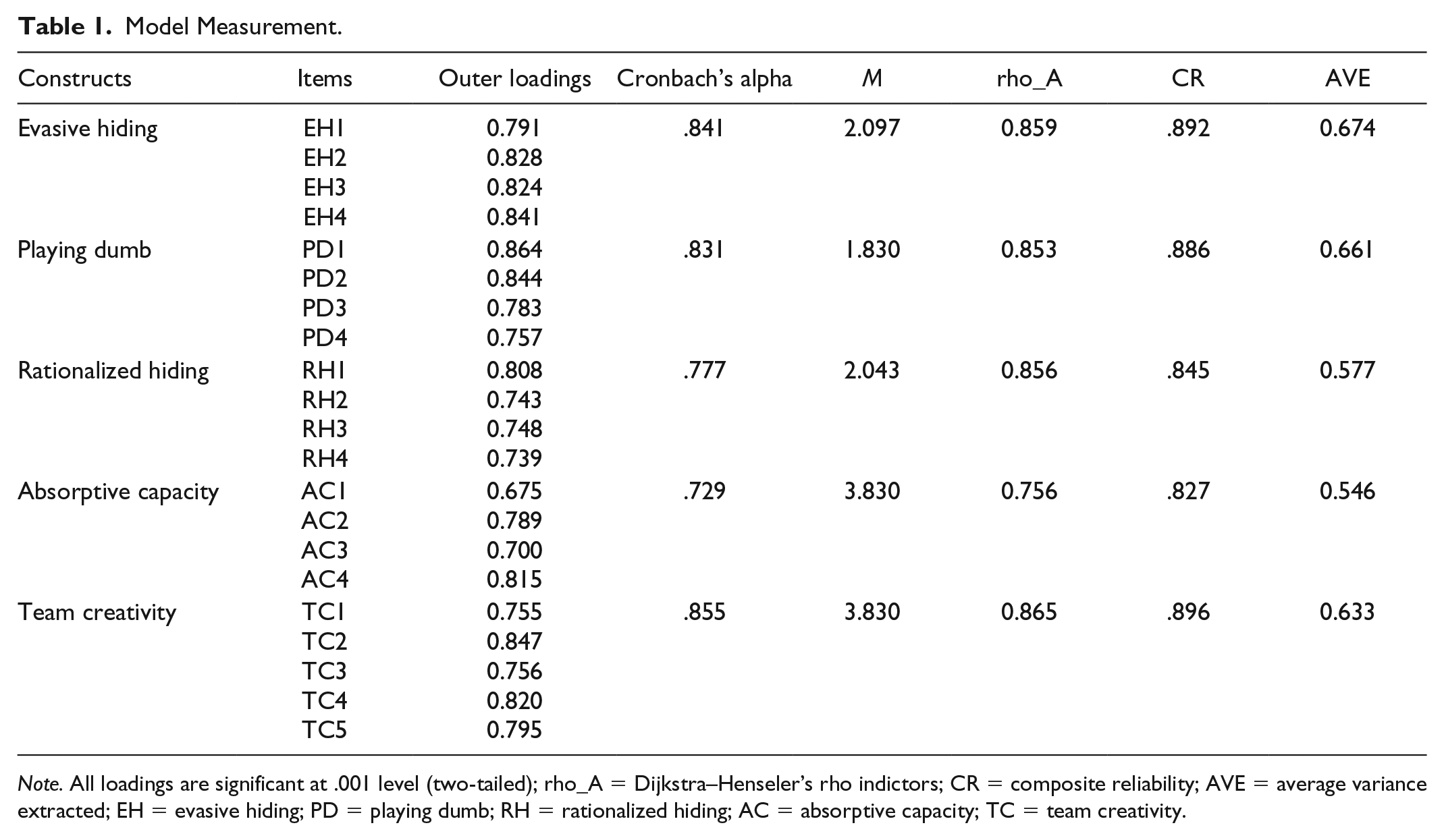
Note. All loadings are significant at .001 level (two-tailed); rho_A = Dijkstra–Henseler’s rho indictors; CR = composite reliability; AVE = average variance extracted; EH = evasive hiding; PD = playing dumb; RH = rationalized hiding; AC = absorptive capacity; TC = team creativity.
Third, the average variance extracted (AVE) measure helps to determine the limit to which a variable converges on its indicators by evaluating the item variance (Hair et al., 2016). Table 1 explains that all values of AVE are higher than the threshold level of 0.5 (Bari, Fanchen, & Baloch, 2016). Fourth, discriminant validity determines the degree to which a variable is empirically discrete from other variables in the model. In the present study, two approaches are used to measure discriminant validity. In the Fornell–Larcker criterion, discriminant validity is determined when the diagonal values are reasonably higher than the other diagonal values in the relevant columns and rows (Hair et al., 2016). Table 2 explains that the condition of Fornell–Larcker criterion is fulfilled to determine the discriminant validity. The second method to measure discriminant validity is the heterotrait–monotrait ratio of correlations (HTMT; Hair et al., 2016). HTMT determines the factors’ correlation. To visibly discriminate between two variables, the HTMT values should be <1 (Henseler, Hubona, & Ray, 2016; Pittino et al., 2018). Table 2 confirms that all constructs have attained discriminant validity as per the HTMT criterion.
Discriminant Validity.

Note. HTMT = heterotrait–monotrait ratio of correlations; AC = absorptive capacity; EH = evasive hiding; PD = playing dumb; RH = rationalized hiding; TC = team creativity.
This study used two approaches to address the common method bias. First, data were collected in three waves to minimize the respondent bias. Second, by considering the Podsakoff, MacKenzie, Lee, and Podsakoff (2003) approach on common method bias, this study analyzed the data with the unevaluated latent method. This method permits all self-reported indicators to load both on their hypothetical variables and on an uncorrelated method factor (Pittino et al., 2018). The results show that all factor loadings are significant and prove no common method bias. The appendix represents the statistical values of ICC (intraclass correlation coefficient). According to obtained statistical results, the values of the majority of theoretical variables are within acceptable range. A good level of conformity lies between 0.5 and 0.74 (Shrout & Fleiss, 1979). In current study findings, evasive hiding, playing dumb, TC, and PMMC have ICC coefficients .560, .549, .535, .626, respectively. On the contrary, rationalized hiding and AC have ICC coefficients .444 and .400, respectively.
Structural Model Assessment (Stage 2)
Structural model assessment enlightens the predictive accuracy and capabilities of the model and association among the variables. The four (variance inflation factor [VIF], R2, f2, Q2) measures are used to determine the predictive relevance of the model. VIF values are analyzed to determine the collinearity issues in the model. Table 3 depicts that all VIF values are under the threshold of 5.00 (Hair et al., 2016), which means there is no collinearity problem in the model. The R2 values of AC and TC are .029 and .138, respectively. Table 3 shows that TC has a substantial value of R2 and AC has comparatively weak value (Hair et al., 2016). As per f2 effect size criteria by J. Cohen (1988), playing dumb has a small effect size on AC; however, evasive hiding and rationalized hiding have no significant f2 effect on AC. In addition, evasive hiding and playing dumb have a small effect size on TC, but AC and rationalized hiding have no significant effect on TC. Q2 (cross-validated redundancy index) values for the dependent variables are calculated through the Blindfolding approach. Q2 values >0 indicate that the structural model has predictive relevance (Chin, 2010). The results in Table 3 depict that Q2 values of the model have acceptable predictive relevance for all the dependent variables. The model fit measures, that is, SRMR (standardized root mean square residual) and RMS theta (root mean square residual covariance), values 0.08 and 0.13 respectively which also confirm the PLS-SEM model fitness (Hair et al., 2016).
Model’s Predictive Capabilities.
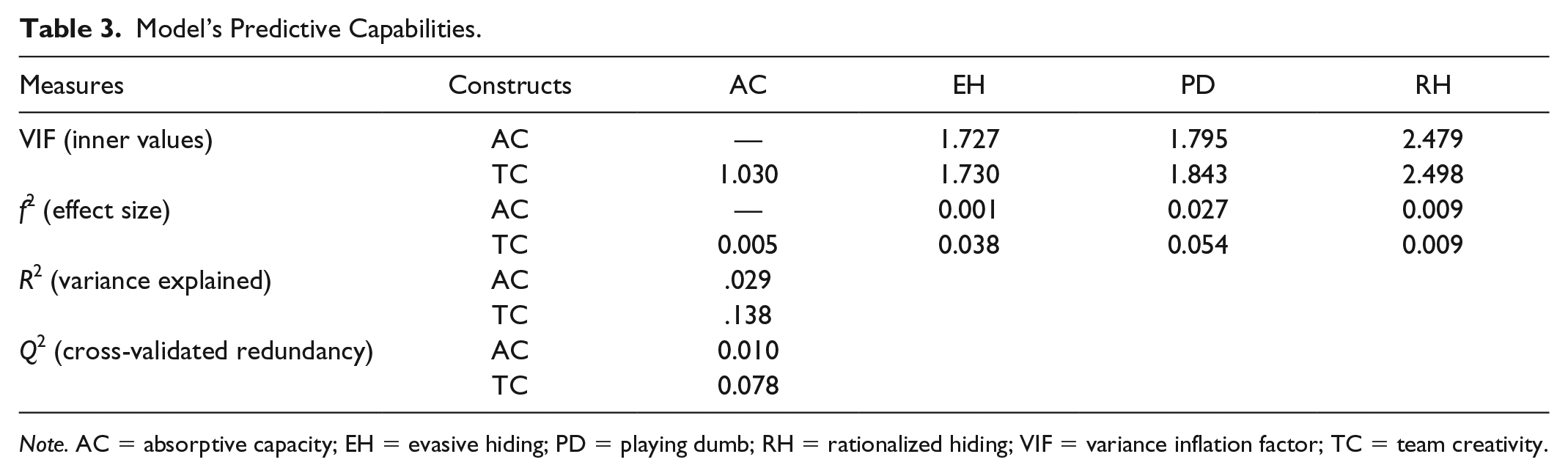
Note. AC = absorptive capacity; EH = evasive hiding; PD = playing dumb; RH = rationalized hiding; VIF = variance inflation factor; TC = team creativity.
Bootstrapping approach, with 5,500 sample replacements, has been used to calculate the statistical implication of the structural path coefficients. At 95% confidence interval, Table 4 explains that evasive hiding and playing dumb have a significant negative effect on TC; thus, H1a and H1b are accepted. However, H1c is not accepted because rationalized hiding has no significant influence on TC. Table 5 explains the mediation analyses of the structural path model. Variance accounted for (VAF) index is used to determine the level of mediation. The VAF index >80%, between 20% and 80%, and <20% indicates full, partial, and no mediation, respectively (Bari et al., 2016; Hair, Sarstedt, Hopkins, & Kuppelwieser, 2014). The results explain that AC as a mediator does not mediate the effects of factors of KH on TC. AC mediates the effects of evasive hiding, playing dumb, and rationalized hiding on TC at the level of 1.25%, 4.88%, and 6.12%, respectively. It means all values are <20% which refer to no mediation. Thus, H2a, H2b, and H2c are not accepted. Figure 2 presents the mediation analyses.
Significance of Structural Paths (Direct Effects).
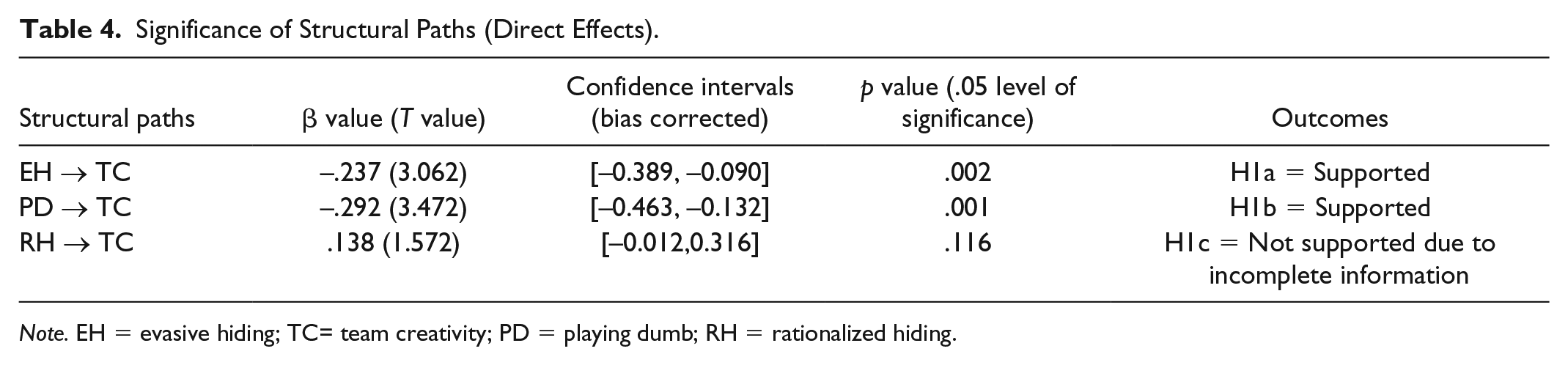
Note. EH = evasive hiding; TC= team creativity; PD = playing dumb; RH = rationalized hiding.
Significance of Structural Paths (Indirect Effects).
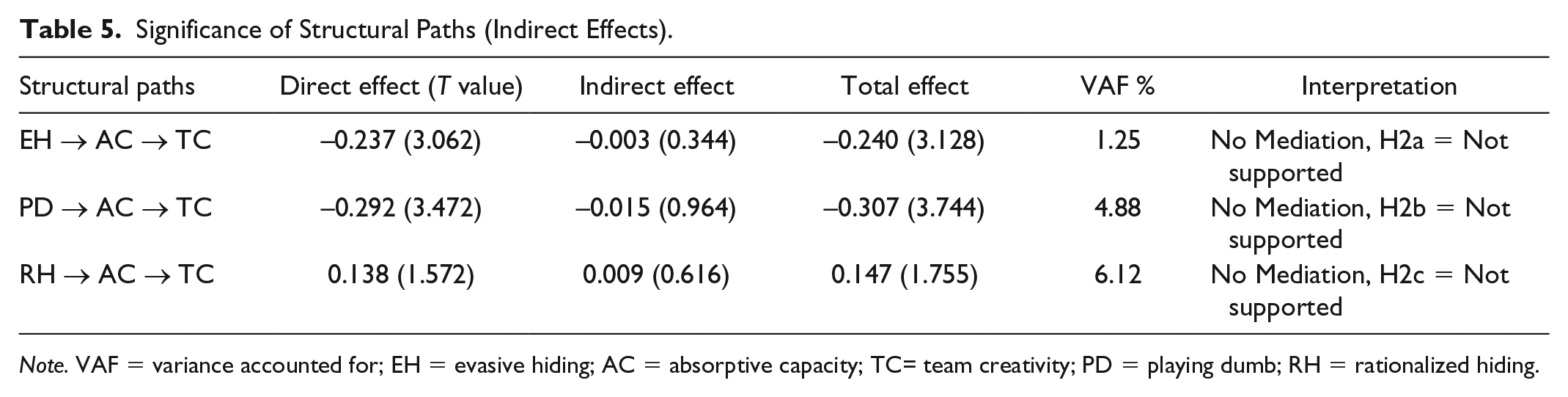
Note. VAF = variance accounted for; EH = evasive hiding; AC = absorptive capacity; TC= team creativity; PD = playing dumb; RH = rationalized hiding.

Mediation results.
Moderated Mediation Analyses
This study used PMMC as a moderator. Prior to evaluating the significance of structural paths of moderation effect, measurement of the newly added construct (PMMC) is performed to check its reliability, convergent validity, and discernment validity. All six items of PMMCs’ outer loading values are greater than the threshold level of 0.7. The Cronbach’s alpha, rho_A, CR, and AVE values are .914, 0.931, .933, and 0.700, respectively, which are greater than their threshold levels (Hair et al., 2016). Discriminant validity of the structural path model is measured and confirmed with Fornell–Larcker criterion and HTMT ratios (Henseler, Ringle, & Sarstedt, 2015). VIF values are also under a threshold level of 5 (Hair et al., 2016).
There are two approaches to measure the significant level of moderation effect, that is, p value and f2 effect size. As per the p value approach, Table 6 enlightens that the interaction term (PMMC × Evasive Hiding) has a significant effect at .100 level of significance. It means PMMC significantly moderates the negative relationship between evasive hiding and AC; thus, H3a is accepted. However, two other interaction terms (PMMC × Playing Dumb, PMMC × Rationalized Hiding) have no significant effects. It means PMMC does not moderate the relationship between playing dumb and AC, and rationalized hiding and AC, respectively. Therefore, H3b and H3c are not accepted as per the analyzed statistical data. As per f2 effect size approach, three criteria to measure the f2 effect size in moderation are recommended by J. Cohen (1988); Aguinis, Beaty, Boik, and Pierce (2005); and Kenny (2016). The effect size f2 can be calculated as f2 = (R2 included – R2 excluded) / (1 – R2 included) (Pittino et al., 2018). Aguinis et al. suggested that in moderation test, average effect size is only 0.009. On the contrary, Kenny (2016) advocated that in moderation test, 0.025, 0.01, and 0.005 values are considered as large, medium, and small f2 effect sizes, respectively (Bari, Abrar, Bashir, Baig, & Fanchen, 2019). However, J. Cohen (1988) recommended a strict criterion that 0.35, 0.15, and 0.02 depict large, medium, and small f2 effect sizes, respectively. Considering these criteria, PMMC moderates the negative relationship between evasive hiding, playing dumb, and AC with medium and small effect sizes correspondingly. However, the moderation influence of PMMC between rationalized hiding and AC is negligible. Figure 3 presents the moderation analyses of the present study.
Significance of Structural Paths: Moderated Mediation.

Note. PMMC= perceived mastery motivational climate; EH= evasive hiding; AC = absorptive capacity; PD = playing dumb; RH = rationalized hiding.
Significant at .100 level of significance. Italic value indicates the T values.

Moderation results.
Discussion
Drawn on social exchange theory (Blau, 1964; Cropanzano & Mitchell, 2005) and AC perspective (W. M. Cohen & Levinthal, 1990; Zahra & George, 2002), this article explains a theoretic and cohesive model to demarcate the relationship between factors of KH and TC. Concretely, this study examines the independent effect of factors of KH on TC directly and via AC. In extension, the present study enlightens the moderating role of PMMC between the association of factors of KH and AC.
The present study offers multiple notional aids to the literature of KH and TC. First, this article ameliorates awareness regarding the negative facets of knowledge management and their role in TC. Mostly, previous studies have focused on positive activities of knowledge such as knowledge transference, sharing, coding, and documenting, which positively affect TC (Dong et al., 2017; Liao et al., 2018). Fewer studies have focused on the effects and antecedents of KH (Anand, 2014; Connelly & Zweig, 2015; Fong et al., 2018). However, this is one of the first studies which explored the linkage between different factors of KH and TC directly and via AC. The present article not only confirms the existence of phenomena (KH) in a developing country (Pakistan) but also present the empirical proof regarding the different deleterious impact of factors of KH on TC. The empirical investigation enlightens that evasive hiding and playing dumb have a significant association with TC. However, rationalized hiding has not a significant relationship with TC, even, β value is positive (Table 4). It indicates that academic teams did not consider the rationalized KH as a negative influence on creativity. In line with these results, Connelly and Zweig (2015) concluded that because rationalized hiders are gratifying their duties, therefore, victims of rationalized hiding might be interested to maintain the social ties with the perpetrator with an end goal to evade future dismissal. The results are also in line with the study of Demirkasımoğlu (2016).
Second, this study also enlightens the role of AC as a mediator between three factors of KH and TC. The outcomes of this investigation reveal that AC does not significantly mediate the influence between factors of KH and TC (Table 5, Figure 2). These results change the angle of research toward the considerations of Lane (2006) regarding AC. While discussing “the reification of absorptive capacity,” Lane (2006) explained two internal drivers (i.e., individual cognitions, the coherence of strategy and structure) of AC. Individual cognitions are the foundation of a team’s AC. Considering the original arguments of W. M. Cohen and Levinthal (1990), Lane (2006) the individual and shared mental models of a team’s members can enlighten that what type of novel knowledge is grasped, how it is metamorphosed and conjoined, and how it is practiced. An organization’s strategy determines which knowledge should target, assimilate, and practice, and which type of organizational structure can support the implementation of these strategies. The Global Competitiveness Report, 2017–2018, revealed that individuals/institutions of Pakistan are weak in above-mentioned both internal drivers of AC. The statistics of this report claims that Pakistan has insufficient capacity to innovate and fall at 115th rank out of 137 nations (Schwab & Sala-i-Martín, 2018). As a second argument, while discussing critically with the respondents, it is revealed that academic team members do not depend only on the knowledge of the team members for AC building and creativity. Thus, KH is not the only cause of the decrease in AC. Many other knowledge resources such as online social networking can increase the AC of the members of a team.
Third, the present study also contributes to the literature on AC and creativity. Scholars of knowledge management such as Černe et al. (2014) and Fong et al. (2018) claim that knowledge behaviors accelerate creativity. Similarly, scholars of AC also consider the AC as a substance of creativity (W. M. Cohen & Levinthal, 1990; Engelman et al., 2017; Fong et al., 2018). This article simultaneously verified both these viewpoints in an integrative framework and confirmed that KH factors and AC have influences on creativity. However, reification of AC, that is, internal and external drivers of AC, can affect the significance of AC for creativity. This study also edifies that the impact of factors of KH on AC is contingent. The PMMC can moderate the effect of evasive hiding and playing dumb on AC with significant f2 effect size (Table 6, Figure 3). However, PMMC fails to significantly moderate the impact of rationalized hiding on AC which means rationalized hiders are already motivated and while hiding, they are actually performing their responsibilities. In fact, rationalized hiding is difficult in the absence of PMMC. Rationalized KH can be considered as a way to protect the intellectual property of an organization.
Study Implications
The present study offers certain managerial and theoretical implications. First, managers need to analyze critically the KH behaviors of team members and should discourage evasive hiding and playing dumb behaviors. Drawn on social exchange theory, evasive hiding and playing dumb are a serious danger for TC and AC. However, the case of rationalized hiding varies from incident to incident. Within the team, rationalized hiding up to job description should be appreciated by the managers/supervisors, and gratuitous rationalized hiding should be dismayed. Second, this article has established the negative impact of evasive hiding and playing dumb on AC and TC. However, rationalized hiding has proved a positive antecedent of AC and TC. This study confirms the positive impact of PMMC on the negative relationship between evasive hiding, playing dumb, and AC. Conversely, the PMMC negatively moderates the positive association between rationalized hiding and AC. These results indicate that team members do not consider the rationalized hiding as a negative knowledge sharing behavior. However, drawn on the theory of planned behavior, Gagné (2009) explained that continuous presence of PMMC can change the state of mind of rationalized hiders, and, as a result, they can share some secrets with others which is hazardous. Thus, managers should encourage rationalized hiders accordingly.
Third, theoretically, literature confirms the impact of AC on creativity (Leal-Rodríguez et al., 2014), and several scholars confirm the significant mediating role of AC between KH and creativity (Fong et al., 2018). However, this study did not find AC as a significant mediator between factors of KH (evasive hiding and playing dumb) and TC, which indicates a weak AC in team members. The weak AC cannot transfer the impact of knowledge behaviors (knowledge sharing and hiding) on innovation. Thus, the significant reification of AC is possible, if managers/supervisors concentrate on the internal (individual cognition, and interrelation of strategy and structure) (Lane, 2006; Lowik, Kraaijenbrink, & Groen, 2016) and external drivers (strategic, cultural, structural, and compensation fit, and firm’s environment) of AC (Lane, 2006). Fourth, the empirical investigation of the present study recognizes the rationalized KH behavior as an antecedent of intellectual property protection, innovative performance, and source of competitive advantage of an organization.
Limitations and Future Directions
The present study has certain limitations, which are also directions for future studies. First, this study investigated the influences of each factor of KH on TC. However, this study did not segregate the impact of tacit and explicit KH on TC. As per the nature of the tacit and explicit knowledge, tacit knowledge is easy to hide without annoying the knowledge seekers. Thus, separate investigation of tacit and explicit KH at factors’ level is recommended. Second, KH behaviors also depend on the cost of knowledge and nature of knowledge (strategic and operational knowledge). A paid (time and money) knowledge may develop evasive hiding behavior than voluntary knowledge. Similarly, strategic knowledge favor more rationalized hiding than an operational one. Considering the cost and nature of knowledge, future studies can investigate the impact of factors of KH on creativity. Third, the secrets of the organizations support them to get a competitive advantage. This study has concluded the positive relationship between rationalized hiding and creativity. Therefore, rationalized hiding as a source of competitive advantage and creativity can be investigated. Fourth, cross-cultural and context differences can change the causes of KH and intensity of reaction against KH. Thus, as a future research direction, cross-cultural and comparative studies between countries and industries are recommended. Fifth, considering the issue of common method bias in self-reported data, this study collected the data in three waves from the respondents. However, a certain level of biases still exists, which can be controlled through longitudinal/multigroup data analysis.
Conclusion
The present study evaluates the impact of KH factors (e.g., evasive, playing dumb, and rationalized) on TC via AC. Drawn on social exchange theory and AC perspectives, the empirical investigation explains that evasive KH and playing dumb have a negative relationship with TC. However, rationalized KH has no significant relationship with TC. AC as a mediator does not mediate the relationship between factors of KH and TC significantly. The PMMC as a moderator has a significant influence on the relationship of evasive hiding, playing dumb, and AC. However, the PMMC does not significantly moderate the association of rationalized hiding and TC.
Footnotes
Appendix
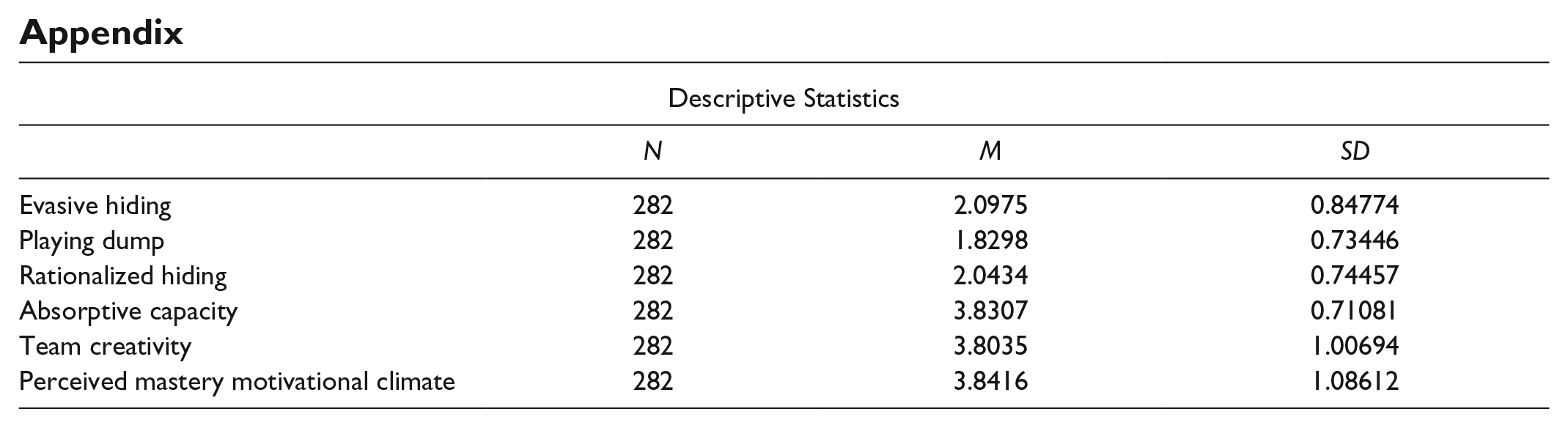
| Descriptive Statistics | |||
|---|---|---|---|
| N | M | SD | |
| Evasive hiding | 282 | 2.0975 | 0.84774 |
| Playing dump | 282 | 1.8298 | 0.73446 |
| Rationalized hiding | 282 | 2.0434 | 0.74457 |
| Absorptive capacity | 282 | 3.8307 | 0.71081 |
| Team creativity | 282 | 3.8035 | 1.00694 |
| Perceived mastery motivational climate | 282 | 3.8416 | 1.08612 |
Declaration of Conflicting Interests
The author(s) declared no potential conflicts of interest with respect to the research, authorship, and/or publication of this article.
Funding
The author(s) disclosed receipt of the following financial support for the research, authorship, and/or publication of this article: This research paper is completed under the research grant of “Humanities and Social Science Fund of the Ministry of Education of China” (Reference No. 17YAC30071).
