




Abstract
Socio-cultural and ecological elements, which extend beyond a place’s physical form, are integral to place identity. Research shows that place identity is fluid and contested. Scholars have approached urban identity from multiple angles, including the physical structure of urban environments (e.g., Kevin Lynch) and the patterns of human experience within them (e.g., Christopher Alexander). Drawing on affordance theory and environmental behaviour studies, this study examines how human perception shapes urban identity while promoting environmental equity. Based on residents’ preferences, it identifies 19 distinct groupings that contribute to urban identity and supports the view that perceptions of urban identity incorporate an affordance-based understanding of the environment. The findings demonstrate that, in Vietnamese cities, the cultivation and conservation of identity values can coexist with urbanisation. The study also offers recommendations for Vietnam and for other cities with similar cultural and geographic characteristics.
Introduction
Background
Identity is a widely used concept across disciplines such as psychology, sociology, geography, and urban studies, where it is employed to investigate human behaviour, action, and institutional life (Kaymaz, 2013). It plays a crucial role in shaping social and cultural life, extending well beyond the physical traits of a place. The physical arrangement of urban areas is deeply intertwined with their socio-cultural characteristics, political processes, and economic frameworks (Baris et al., 2009).
Place identity refers to the memories, notions, interpretations, ideas, and feelings associated with specific physical settings, as well as types of settings (Proshansky et al., 2014). The term “sense of place” denotes a perception of a location held by individuals, rather than the location itself. It functions as a symbol that distinguishes one location from another and is a characteristic some places possess while others do not. The ways in which individuals experience, express, envision, and comprehend their environment are manifestations of this sense of place. The terms “sense of place” and “attachment to place” point to an intricate relationship between people and their environments, encompassing both the influence of the natural environment on humans and the transformations produced by human activity in that environment (Buttimer, 2015; Qazimi, 2014).
Place identity is neither fixed nor closed-ended. Scholars commonly describe several functions of place identity, including recognition, meaning, expressive requirements, mediating change, anxiety reduction, and defence (Alexander, 2018; Qazimi, 2014). From a user’s perspective, the identity of a city or specific place is complex and diverse. As a result, place identity operates as a cognitive reference against which each physical setting is evaluated, shaping perceptions and actions toward the built environment and diversifying human experiences in that locale (Alexander, 2018; Qazimi, 2014).
Regional and territorial identity constitute a fascinating yet complex field of study, which has received limited attention from regional economists, social psychologists, and political scientists. While regional identity is rooted in socio-cultural dimensions, territorial identity integrates socio-cultural, cognitive, and economic factors, emphasising similarity and solidarity. This integration calls for a relational understanding of space, defined by functional and hierarchical relationships within a geographic area, which distinguishes and enhances the appeal of one territory over another (Capello, 2019). Territorial identity may therefore be understood as the presence of socio-economic conditions that align collective and private interests, fostering belonging and loyalty to a community. Empirical evidence suggests that attachment to a local area depends on the convergence of public and private interests, particularly when cohesion policies align with individuals’ preferences for specific actions (Capello, 2019).
However, territorial identity can also constrain the advancement of environmental justice. Research by Do and Mori (2022) indicates that improvements in the quality of the built environment can influence perceptions of accessibility among low-income groups. This finding suggests that, despite shared socio-cultural dimensions, individuals with differing demographic characteristics may perceive territorial identity in distinct ways (Do & Mori, 2022).
A territorial identity emerges in cities through their interaction with complex environments (Padua, 2007; Raja, 2003). This identity is multidimensional and distinctive, shaped by cultural influences and environmental data from the natural, social, and built contexts of cities (Saleh, 2001; Suher et al., 2004). Yet irregular, unplanned, and unaesthetic development, combined with rapid urbanisation and globalisation, has contributed to stereotyped urban forms. In turn, urban culture and identity have often deteriorated or disappeared amid socio-economic and political change (Baris et al., 2009; Yaldız et al., 2014). Authorities in many cities, including those in Vietnam, face difficulties in identifying and sustaining urban identities rooted in diverse cultural and social contexts, leading to an ongoing identity crisis (Le & Le, 2022). Traditional cultural values are gradually being displaced by external influences, and architectural heritage, festivals, and indigenous customs are increasingly encroached upon by globalised popular culture (Son, 2024). Social identity theory helps explain related intergroup dynamics by linking behaviours to perceived differences in group status (Qazimi, 2014).
Environmental justice, as defined by the United States Environmental Protection Agency (EPA), emphasises the equitable treatment and meaningful inclusion of all individuals in the formulation and implementation of environmental policies. Extending this principle, built environment justice advocates fairness in the planning, design, and maintenance of the physical spaces and infrastructure that shape everyday life. It seeks the equitable distribution of the benefits of urban development, such as access to safe housing, efficient transport, and high-quality public spaces, while protecting marginalised communities from disproportionate harm or systemic neglect. By addressing disparities in essential services, exposure to environmental hazards, and access to green spaces, built environment justice underscores the significant influence of the built environment on public health, social equity, and quality of life.
To navigate the tension between fostering territorial identity and advancing environmental justice, this study adopts Gibson’s concept of affordance as a unifying theoretical framework. By leveraging this approach, the research aims to align the goals of built environment justice, creating inclusive, sustainable spaces that support the well-being of diverse communities and promote a more equitable and resilient future, with the preservation and integration of territorial identity in urban regions.
Theoretical Background and Previous Studies
Gibson’s concept of affordance is a widely acknowledged idea in cognitive psychology. It posits that humans tend to modify their environments to adjust affordances so that they better meet their needs (Gibson, 2014). This indicates a cognitive process through which individuals recognise environmental features that correspond to their perceptions. The concept of affordance is closely related to behaviour settings, which are distinct from their broader contexts and from users’ behaviour (Bechtel et al., 1987; Schoggen, 1989). An affordance can be understood as the value that the environment provides, offers, or establishes for users (Greeno, 1994). This framing clarifies which environmental factors or elements suit particular activities or behaviours, thereby facilitating user access (Greeno, 1994). In Gibson’s view, the affordances of the surrounding environment are integrated with a sense of place. Socialisation depends on acquiring the ability to perceive affordances (Gibson & Pick, 2000). The affordance concept has since expanded to encompass spatial and physical dimensions as well as socio-personal aspects, with identity emerging as a consequential component (Gregory et al., 2011; Proshansky et al., 2014).
Identity is widely recognised as the outcome of self-categorisation in social identity theory or identification in identity theory (Turner, 1987; Abrams & Hogg, 2010; Stets & Burke, 2000). These frameworks imply that the self is reflexive, able to classify, name, or consider itself as an object, and to position itself relative to other social categories. Across psychology, philosophy, sociology, human geography, and anthropology, numerous studies have defined and developed the concept of place identity, including seminal contributions by Relph (1976), Canter (1977), and Proshansky (1983). These works have substantially shaped theorising on urban identity within environmental studies and urbanism (Mansour et al., 2023). Nevertheless, the conceptualisation of urban identity and identification often rests on self-concept, and the literature on place identity has been inconsistent in definitions, thin in empirical work, and limited by inadequate measurement instruments (Lalli, 1992; Mansour et al., 2023).
In Urban Planning and Cultural Identity, Neill (2003) underscores the intense spatiality of conflicts surrounding identity construction in cities, where culture and place identity carry distinct requirements for self-characterisation (Neill, 2003). He also highlights cultural distinctions within communities that are tightly linked to urban identity (Neill, 2003). Planners and visitors may identify certain locations as culturally significant, yet these may not be the places most used or valued by local residents. Although interest in this issue is growing, studies seldom compare the adequacy of spatial configuration, cognition, and behaviour in ways that support the integration of local perspectives and experiences in planning (Bai et al., 2023). Anastasiou et al. (2022) examined relationships between residents’ sociodemographic characteristics and their perceptions of urban identity, but the work remained preliminary. A subsequent study considered factors shaping perception, including gender, age, family status, and lifestyle (Anastasiou et al., 2022). Similarly, Kulozu (2021) conducted an exploratory case study in a historic city and found that environmental factors outweighed social factors and identity, while also noting differences by respondents’ educational backgrounds and ages. These investigations focus primarily on individuals’ perceptions of urban identity and typically employ structured questionnaires based on variables drawn from prior studies. Such approaches risk overlooking context-specific variables, since people perceive places differently (Alexander, 2018; Kulozu, 2021; Lynch, 1984; Neill, 2003; Qazimi, 2014).
This study advances understanding of urban identity in Vietnamese cities by centring on residents’ cognitive perceptions of identity-related features. By documenting how inhabitants evaluate cultural and environmental elements, it offers a more comprehensive basis for preserving and developing distinctive urban identities while accommodating contemporary urban change.
Objective and Research Questions
This study applies affordance theory, using environmental behaviour studies as a methodological lens to develop a theoretical framework for urban identity that aligns with principles of environmental justice. Using Da Lat City (Vietnam) as the case study, the research investigates how residents perceive and identify urban identity. We develop a perception-based model grounded in cultural and environmental factors. A set of variables is specified to clarify how individuals recognise the elements and dimensions that define a city’s identity and to compare differences in cognition across groups of urban dwellers.
The findings can inform development, preservation, and management strategies for Da Lat, other Vietnamese cities, and cities in developing countries with comparable social contexts. In doing so, they support the cultivation of distinctive urban identities amid contemporary urbanisation, globalisation, and multiculturalism.
To address key questions about how urban dwellers perceive urban identity, the study examines:
(1) How perceptions of urban identity vary with individuals’ cultural, social, and economic contexts.
(2) Which dimensions of urban identity exert the greatest influence on residents’ perceived identity-related behaviours.
(3) Which variables that contribute to urban identity shape residents’ perceptions of a city’s recognised identity.
These insights can assist policymakers, public authorities, designers, planners, and tourism agencies in developing sustainable policies that respect social and cultural contexts, strengthen urban communities, and enhance social justice. The study’s workflow, inputs and outputs, and research objectives are outlined in the framework shown in Figure 1.
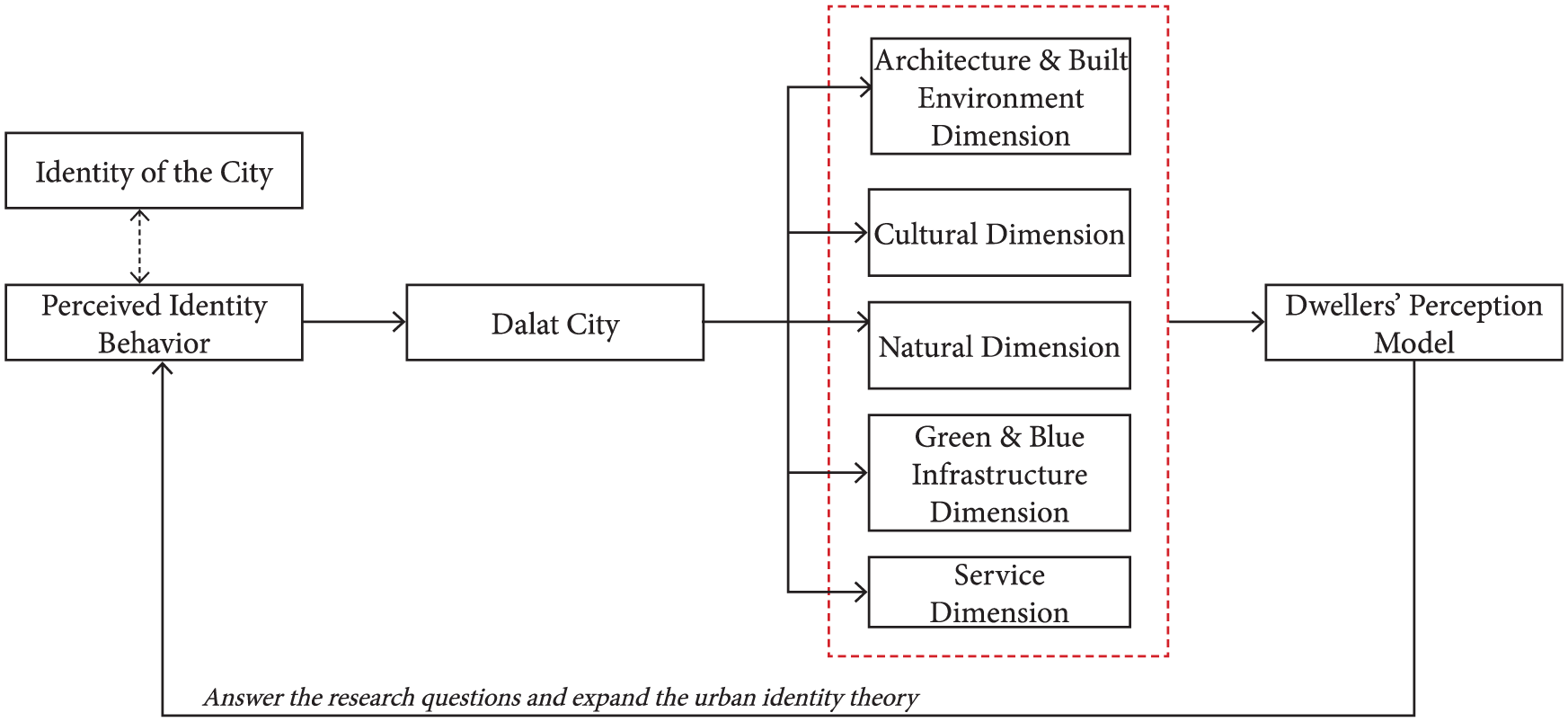
Research framework illustrating the workflow and the inputs and outputs.
Methodology
A methodology grounded in environmental behaviour studies was developed to clarify the social behaviour of urban residents. First, semi-structured interviews were conducted to identify residents’ concerns about Da Lat’s urban identity. Second, a focus group discussion was held to explore and consolidate the factors relevant to the city’s identity. Drawing on prior research and analysis, these factors were organised into five principal dimensions: (1) Architecture and Built Environment; (2) Cultural; (3) Natural; (4) Green and Blue Infrastructure; and (5) Services. Finally, a questionnaire survey was administered to capture residents’ views on the identity of Da Lat City. The study framework summarises the objectives, procedures, and methods, as shown in Figure 2.

Research methods aligned with, and implemented for, each specific research objective.
Dalat City and Its Identity
In the context of urban development in Vietnam, the lack of a clear and robust theoretical foundation has led to multiple issues that undermine urban identity. Many Vietnamese cities are gradually losing their distinctive character and converging toward a common model. In some cases, historical and environmental values accumulated over centuries have been traded away in the name of development (Ngo & Ton, 2019). Current responses focus primarily on the management, preservation, and restoration of historical and cultural structures (Linh, 2024). To enhance and promote urban identity, it is first necessary to identify its constituent elements and their values (Linh, 2024).
Da Lat, situated at approximately 1,500 m (4,900 ft) above sea level on the Langbian Plateau, is the most populous settlement in Vietnam’s Central Highlands and one of the country’s leading tourist destinations (Figure 3). Throughout its history, this unique urban area has witnessed the coexistence and development of diverse cultures. Following the indigenous period that lasted until the late nineteenth century, the Governor-General of Indochina initiated the Da Lat planning project, designed by Ernest Hébrard and J. Lagisquet with a distinctly Western approach. In recent decades, a new development plan has guided urban expansion, with a planned urban area of 336,000 hectares by 2030 (Hien, 2015; Hoa, 2013; Vietnamese Prime, 2014). As new urban areas have expanded, Da Lat has increasingly risked losing elements of its distinctive identity (Gia, 2012).

Boundary of Da Lat City and research location.
The city contains extensive historical and unique heritage values, yet it is closely interwoven with modern development in both the core urban area and adjacent agricultural zones. Alongside its geographical distinctiveness, Da Lat functions as a major tourist destination. Because this study seeks to understand how residents perceive urban identity in ways that can be applied to other cities with varied attributes, Da Lat, with its combination of historical layers and contemporary transformations, provides an appropriate and informative case study.
Data Collection
Focus Group Discussion and In-Depth Interview
A focus group discussion (FGD) is a qualitative research method in which a moderator facilitates an in-depth discussion among a purposively selected group on a specific topic (Hennink, 2013). The aim is to elicit participants’ thoughts, emotions, knowledge, experiences, and behaviours through interactive dialogue within a diverse group. The premise of FGDs is that group dynamics can reveal collective insights that may be harder to access in individual interviews. At the same time, FGDs recognise that knowledge is not equally distributed among participants and that communities do not necessarily share a single, coherent set of understandings. Rather, they enable the exploration of shared narratives alongside differences in individual experiences, perspectives, and cultural understandings through open-ended discussion.
To complement the FGDs and obtain detailed information about personal identity and the factors that contribute to urban identity and prominence, face-to-face, in-depth interviews were also conducted. As outlined in Supplemental Appendix 1, these interviews were designed to maximise the depth and richness of the data collected. The organisational framework and respondent characteristics are presented in Table 1.
Demographic Profile of Respondents.

Note. F = female; M = male.
Questionnaires
In order to develop the questionnaire set (Figure 4), findings from the in-depth interviews and focus group discussions were synthesised into five core dimensions and 20 subcategories. The questionnaire comprised two sections, each with distinct objectives. The first section collected respondents’ demographic information, including age, place of birth, current residence, income, and other relevant details (see Supplemental Appendix 2). The second section drew on insights from the earlier phase to assess factors of metropolitan identity. Further details on respondent characteristics are provided in Table 2.

Five dimensions, with different variables, affecting residents’ perceptions of urban identity; data compiled from FGDs and in-depth interviews.
Questionnaire Respondents in Da Lat City.

Note. F = female; M = male; O = other.
To examine the relationships between these factors and perceived identity-related behaviour, the instruments were expanded to include sociodemographic variables (Table 3). In addition, an overall perception item on recognising the city’s identity was included to indicate how residents evaluate the other dimensions (see Figure 4 and Supplemental Appendix 2).
Sociodemographic Information.

Retrieved from the General Statistics Office of Vietnam, 2024 (Vietnamese General Statistics Office, 2024).
Ethical Considerations
This research involved focus group discussions, in-depth interviews, and questionnaires with human participants. Several measures were implemented to minimise potential risks. First, participation was entirely voluntary, and participants could decline to answer any question or withdraw at any time without consequence. Second, all data were anonymised and stored securely to protect confidentiality. Third, no personally identifiable or sensitive information was collected beyond what was essential for the research aims. These steps reduced the risk of psychological or social harm.
The potential benefits of the study outweighed the minimal risks. By contributing insights into the urban identity factors that influence residents’ perceptions, the research provides evidence to inform policy, practice, and future scholarship, while offering participants an opportunity to share their experiences and perspectives.
Informed consent was obtained from all participants prior to their involvement. For focus group discussions and in-depth interviews, participants received an information sheet outlining the objectives, procedures, risks, and benefits of the study, and consent was obtained verbally before the sessions began. For questionnaire respondents, consent was secured through an introductory statement requiring agreement before proceeding. All procedures complied with the APA Ethical Principles of Psychologists and Code of Conduct (2017, Standard 8.05).
Data Analysis Processing
The qualitative questionnaire, comprising 134 items, elicited self-assessments and perceptions of users regarding 128 identity-related elements, along with six overall assessments of urban identity (see Figure 4 and Supplemental Appendix 2). Cronbach’s α was calculated to evaluate the reliability of the data. The results indicate that residents apply consistent criteria when evaluating the components that shape urban identity and perception. Higher α values reflect greater internal consistency. The data show satisfactory reliability, with αs of .977 for the 128 item-level responses and 0.809 for the six overall assessment items (Table 4).
Reliability of Questionnaire Responses (Cronbach’s α).

Social-Demographic and Urban Identity Perception Correlation Analysis
To examine whether residents’ perceived urban identity differs across respondent groups, particularly by income level and educational background, we conducted descriptive statistical analyses to characterise participants’ sociodemographic profiles. We also compared other variables, including gender, age, and place of birth, across groups.
The Impact of Various Dimensions on the Perceptions of Urban Identity
To assess the significance of the urban identity dimensions, we estimated a two-factor regression model to test whether these dimensions predict identity perceptions across income groups and educational backgrounds. Responses in the overall perception section served as the dependent variables, while perceptions related to the twenty factor categories shown in Figure 4 were treated as independent variables. Results were compared for each factor group.
A Comprehensive Regression Model Examining the Variables That Influence Perceptions of Urban Identity
Six regression models were specified to identify variables that influence residents’ perceptions of urban identity. These comprised a general (full) regression model and five dimension-specific models covering (i) Architectural and Built Environment, (ii) Cultural, (iii) Natural, (iv) Green and Blue Infrastructure, and (v) Services (Figure 5).

Analysis process and summary of the full regression model.
In the full regression model (column 1), overall urban identity perceptions were regressed on all 128 variables, which were organised into twenty principal categories across the five dimensions noted above. Three variants of this model were estimated: one by income group, one by educational background, and one for the combined sample of all residents. The remaining five models examined each dimension separately, with the 128 variables grouped into twenty subcategories. In the second model (column 2), the dependent variable was the perceived identity for the Architectural and Built Environment dimension, and the independent variables were the items in six subcategories. In the third model (column 3), the dependent variable was perceived cultural identity, with independent variables drawn from five subcategories. In the fourth model (column 4), the dependent variable was perceived natural identity, with independent variables from two subcategories. In the fifth model (column 5), the dependent variable was perceived identity for green and blue infrastructure, with independent variables from two subcategories. In the sixth model (column 6), the dependent variable was perceived identity for services, with independent variables from five subcategories. Where relevant, estimates were compared across income and education groups to highlight differences in the determinants of perceived urban identity.
Results
Exploratory Factor Analysis
Exploratory factor analysis identified five dimensions represented by specific subcategories. (1) The Architectural and Built Environment dimension comprises six subcategories: III.Gr1 (French-influenced buildings), III.Gr2 (modern architecture and urban space from 1945 to 1975), III.Gr3 (indigenous-style buildings), III.Gr4 (modern architecture from 1975 onward), III.Gr5 (public open space and objects), and III.Gr6 (religious buildings). (2) The Cultural dimension includes four subcategories: IV.Gr1 (lifestyle), IV.Gr2 (legend and tradition), IV.Gr3 (cuisine), and IV.Gr4 (specialty fruit). (3) The Natural dimension consists of three subcategories: V.Gr1 (weather characteristics), V.Gr2 (landform characteristics), and V.Gr3 (toponyms). (4) The Green and Blue Infrastructure dimension is explained by three subcategories: VI.Gr1 (semi-natural water surfaces), VI.Gr2 (natural water surfaces), and VI.Gr3 (specialty flowers and flora). Finally, (5) the Services dimension comprises three subcategories: VII.Gr1 (agritourism), VII.Gr2 (leisure and recreation), and VII.Gr3 (fundamental tourism). Detailed information for each factor and its subcategories is provided in Table 5.
Urban Identity Dimensions, Elements, and Their Categories.

Overview of Respondent’s Sociodemographic Characteristics
The representativeness of the urban identity study was assessed by comparing respondents across income levels and educational backgrounds, in order to understand how perceptions may differ between residents and visitors with distinct sociodemographic profiles. Comparative results across income categories are reported in Table 6.
Respondent’s Sociodemographic Overview.

To examine the potential influence of sociodemographic variables on identity perception, we conducted ANOVA for quantitative and mixed comparisons, chi-square tests for categorical variables, and correlations for quantitative variables. No statistically significant relationships were detected (all p-values > .05). Accordingly, we found no evidence of association between homeownership status, gender, place of birth, or length of residence and the groupings by income (low versus high) or education (high school/vocational versus university/college).
Within the education comparison, respondents were unevenly distributed between high school/vocational (30.5%) and university/college (69.5%). Gender distributions were broadly similar across the two groups. The high school/vocational group contained the largest share aged 26 to 55 (44.5%), whereas the university/college group had the largest share under 25. Those aged 56 and above formed the smallest share in both groups. By birthplace, indigenous residents of the Langbian Plateau constituted the highest proportion in both education groups, followed by migrants from other regions. Educational attainment did not differ meaningfully between Da Lat residents and travellers/visitors. Most respondents resided in Da Lat City: 87.0% in the high school/vocational group and 83.3% in the university/college group. For both qualifications, the share by length of residence declined from the longest to the shortest period, with values of 60.5, 21.5, and 18.0% for the high school/vocational group, and 46.7, 33.8, and 19.5% for the university/college group. A majority reported below-average income: 75.5% in the high school/vocational group and 71.3% in the university/college group.
In the income comparison, respondents were unevenly distributed between low income (72.6%) and high income (27.4%). Within the low-income cohort, males accounted for 45.2% and females for 57.8%. Higher-income respondents were predominantly aged 26 or older. Indigenous residents of the Langbian Plateau were well represented in both income categories. In the low-income group, the share by length of residence increased from the longest to the shortest period (17.2, 34.5, and 48.3%). In the high-income group, the smallest share had resided in Da Lat for 1 to 5 years (18.3%).
Urban Identity Perception of Dalat’s Dwellers
As shown in Table 7, approximately 81.8% of respondents reported that Da Lat has a distinctive urban identity. Perceptions were also compared across income groups. The lower-income group reported a higher rate of perceived identity than the higher-income group (83.2% vs. 78.3%). Differences by educational attainment were small. The high school/vocational group reported a stronger perception of identity than the university/college group (84.5% vs. 80.7%).
Perceptions of Da Lat’s Urban Identity by Income and Education.

The Significance of Urban Identity Dimensions in the Perception of Users
Results of the two-factor regression analysis are summarised in Table 8. Across the full sample and the income- and education-based subgroups, several dimensions were statistically significant predictors of perceived urban identity (p < .01 or p < .05).
Regression Models for Five Urban Identity Dimensions in Dalat City.

p < .05. **p < .01.
For the income comparison, four dimensions contributed to perceived urban identity: Architectural and Built Environment, Cultural, Natural, and Green and Blue Infrastructure. Together, these dimensions explained 20.5% of the variance in perceived identity in the lower-income group and 23.8% in the higher-income group (R2 = 0.205 and 0.238, respectively). In the lower-income cohort, three categories were significant: IV.Gr1 (Cultural) with β = .118, p < .05; V.Gr2 (Natural) with β = .165, p < .05; and VI.Gr1 (Green and Blue Infrastructure, semi-natural water surfaces) with β = 0.144, p < .05. In the higher-income cohort, significant effects were observed for III.Gr1 (Architectural and Built Environment, French-influenced buildings) with β = .230, p < .05; III.Gr2 (Architectural and Built Environment, modern architecture and urban space 1945–1975) with β = −.246, p < .05; V.Gr3 (Natural, toponyms) with β = .224, p < .05; VI.Gr2 (Green and Blue Infrastructure, natural water surfaces) with β = .291, p < .01; and VI.Gr1 (semi-natural water surfaces) with β = −.205, p < .05, indicating a negative association with perceived identity.
For the education comparison, the same four dimensions—Architectural and Built Environment, Cultural, Natural, and Green and Blue Infrastructure—were associated with perceived urban identity. These explained 22.4% of the variance in the high-school/vocational group and 20.5% in the university/college group (R2 = 0.224 and 0.205, respectively). In the high-school/vocational group, III.Gr2 (modern architecture and urban space 1945–1975) showed a significant negative association with perceived identity (β = −.274, p < .01). In the university/college group, Green and Blue Infrastructure exerted the strongest influence, particularly VI.Gr1 (semi-natural water surfaces; β = .223, p < .01), VI.Gr2 (natural water surfaces; β = −.126, p < .05), and VI.Gr3 (specialty flowers; β = −.129, p < .05). Additional significant associations were found for V.Gr2 (Natural, landform characteristics; β = .197, p < .01), IV.Gr1 (Cultural, lifestyle; β = .165, p < .01), and III.Gr1 (Architectural and Built Environment, French-influenced buildings; β = .158, p < .05).
Overall, three dimensions (1) Architectural and Built Environment, (2) Cultural, and (3) Green and Blue Infrastructure consistently contributed to residents’ perceptions of urban identity.
Effects of Identity Elements on Residents’ Perceptions of Urban Identity
Results of the multivariate regression analyses are presented in Table 9. Eight regression models were estimated to examine the effects of specific elements on perceived identity by income group. Column 1 reports three variants of the overall model, estimated for all respondents, the lower-income subgroup, and the higher-income subgroup. Columns 2 to 6 report five dimension-specific models estimated for all respondents: Architectural and Built Environment, Cultural, Natural, Green and Blue Infrastructure, and Services. In general, most models were statistically significant.
Comprehensive Regression Models of Residents’ Perceptions of Urban Identity.

Note. *p < 0.05 (2-tailed); **p < 0.01 (2-tailed).
Overall Urban Identity (Column 1)
For the full sample, groups III.Gr1, IV.Gr1, VI.Gr1, VI.Gr2, and VI.Gr3 were significant predictors of overall perceived identity (p < .05). Standardised coefficients (β) indicate that III.Gr1, IV.Gr1, and VI.Gr1 were positively associated with perceived identity (β > 0), whereas VI.Gr2 and VI.Gr3 were negatively associated (β < 0). In descending order of magnitude, the effects were VI.Gr1, III.Gr1, IV.Gr1, VI.Gr2, and VI.Gr3. These variables explained 20.9% of the variance in overall perceived identity.
Within the lower-income subgroup, IV.Gr1, V.Gr2, and VI.Gr1 were significant (p < .05), each with a positive association (β > 0). The order of effects was V.Gr2, VI.Gr1, and IV.Gr1, explaining 20.5% of the variance.
Within the higher-income subgroup, III.Gr1, III.Gr2, V.Gr3, VI.Gr1, and VI.Gr2 were significant predictors. Positive associations were observed for III.Gr1, V.Gr3, and VI.Gr1, while III.Gr2 and VI.Gr2 were negatively associated with perceived identity. In descending order, the effects were VI.Gr1, III.Gr2, III.Gr1, and VI.Gr2. Together, these variables explained 23.8% of the variance.
Architectural and Built Environment (Column 2)
Perceived identity for this dimension was significantly associated with III.Gr1 and III.Gr5 (both p < .01). The magnitude of effect decreased from III.Gr1 to III.Gr5. These predictors explained 20.9% of the variance in identity perception for this dimension.
Cultural (Column 3)
Two groups, IV.Gr1 and IV.Gr2, were significant and positively associated with perceived cultural identity, with β = .246 and β = .284, respectively (both p < .01). These variables explained 20.4% of the variance.
Natural (Column 4)
Two groups, V.Gr1 and V.Gr2, were significant and positively associated with perceived natural identity, with β = .098 (p < .05) and β = .341 (p < .01), respectively. Together, they explained 16.8% of the variance.
Green and Blue Infrastructure (Column 5)
Two groups were significant and positively associated with perceived identity for this dimension: VI.Gr1 (β = .272, p < .01) and VI.Gr2 (β = .112, p < .05). These variables explained 14.3% of the variance, with a larger effect for VI.Gr1.
Services (Column 6)
Two groups within the Services dimension were significant and positively associated with perceived identity: VII.Gr1 (β = .325, p < .01) and VII.Gr2 (β = .196, p < .01). These predictors explained 21.0% of the variance.
The findings indicate that factors across all five dimensions contribute to shaping perceived urban identity. The Architectural and Built Environment, Cultural, and Services dimensions were especially influential, accounting for substantial variation in perceptions. However, the importance and direction of specific variables differed by income group, underscoring the nuanced and multifaceted nature of urban identity. In particular, perceived identity in the lower-income group was most affected by Culture (IV.Gr1), Natural conditions (V.Gr2), and Green and Blue Infrastructure (VI.Gr1). In the higher-income group, the strongest influences were observed for Architectural and Built Environment (III.Gr1 and III.Gr2), Natural (V.Gr3), and Green and Blue Infrastructure (VI.Gr1 and VI.Gr2). Perceptions related to Green and Blue Infrastructure were the most consistently robust across categories.
Discussion
Urban Identity and the Diversity of Social Perceptions
This study examines residents’ perceptions of urban identity within Viet Nam’s social, cultural, and economic context, across multiple dimensions. Among the nineteen factor categories that contribute to urban identity, five dimensions were identified: (1) Architectural and Built Environment, (2) Cultural, (3) Natural, (4) Green and Blue Infrastructure, and (5) Services. In both the income and education comparisons, four of these five dimensions were implicated in how individuals perceive urban identity. This finding reinforces the view that identity is multidimensional, distinctive, and context specific, arising from the interplay of cultural, natural, and social environments (Do et al., 2025; Saleh, 2001; Suher et al., 2004).
Urban identity was more readily acknowledged by the lower-income group than by the higher-income group, indicating that the two groups perceive environmental affordances differently. The correlation between spatial and physical dimensions and socio-personal aspects of perception is evident in activity and behaviour, which supports Gibson’s account of affordances (Gibson & Pick, 2000) and the broader conceptualisation of identity as a consequential component of the affordance framework (Gregory et al., 2011; Proshansky et al., 2014). This result also extends Do’s research, which observed variation in environmental use among distinct groups within the same settings (Do & Mori, 2022). More broadly, the present study enlarges the set of factors considered to shape perceptions of urban identity beyond sociodemographic attributes such as gender, age, family status, and lifestyle (Anastasiou et al., 2022).
Although the strength of perception differs by income group, both groups are influenced by two shared dimensions: Natural and Green and Blue Infrastructure. This suggests that people are first drawn to natural attributes such as climate, weather, and landform, and then to the qualities of green infrastructure and water bodies. These fundamental yet critical components underpin the identity of place (Jorgensen & Stedman, 2001; Knez, 2005; Sang et al., 2016).
The findings indicate that cultural elements, including public art, local festivals, and legends, have a stronger effect within the lower-income group. By contrast, the higher-income group is more strongly influenced by the Architectural and Built Environment dimension, which encompasses historic structures, architectural character, and related cultural expressions. One plausible explanation is that a larger share of lower-income respondents have lived in Da Lat for longer periods, and thus are more familiar with everyday cultural practices and community life, which they recognise as especially significant. The higher-income group, with a concentration of respondents aged 26 to 55, may be more attuned to the city’s architectural and heritage assets. Consequently, respondents under 26 appear less engaged with long-established architectural heritage. This aligns with previous work suggesting that younger generations are drawn more to available activities than to the historical or architectural setting per se (Çiftçi, 2020; Ismail & Nadarajah, 2016). This generational pattern highlights the need for planning and policy that create dynamic, activity-oriented spaces which integrate and celebrate historical elements, thereby fostering connections to heritage in ways that engage younger audiences.
With respect to education, no significant differences were observed in identity perception. This contrasts with Kulozu’s findings that educational background influences perceptions of urban identity (Kulozu, 2021). The discrepancy may reflect the present study’s focus on an entire urban area with multiple dimensions rather than on a single historic city. Considering a range of dimensions may allow identity to be perceived more intuitively, without requiring specialist knowledge of a specific historical theme. For general urban qualities, such as attractions or overall aesthetics, laypersons and specialists may not differ markedly (Nasar, 1994; Šafárová et al., 2019). At the same time, the university or college group expressed broader and more multifaceted concerns, which is consistent with the expectation that higher qualifications prompt consideration of a wider set of factors when choosing or evaluating a place. Overall, the findings indicate that contemporary contexts require attention to multiple urban dimensions to support the development, preservation, and promotion of urban identity.
Despite the pressures of urbanisation, Da Lat continues to exhibit a strong sense of identity. This supports the view that contemporary development can establish and reinforce identity rather than necessarily eroding it (Gia, 2012; Hien, 2015; Tran, 2024). Urbanisation can threaten identity, yet it also creates opportunities for diverse identity expressions through the combination of multiple dimensions. It is therefore important to integrate new urban areas with established districts, optimise the functions of new developments, and ensure robust conservation of selected areas. Such an approach can expand and diversify the unique elements of urban identity, enabling the city to serve a wide range of residents and visitors regardless of income or educational background (Tran, 2024).
Implications for Strengthening Urban Identity
The findings indicate that urban identity arises not only from tangible elements such as architecture and landscape, but also from residents’ everyday experiences, perceptions of nature and aesthetics, and local cultural values. Practice should therefore prioritise experiential identity rather than relying solely on iconic symbols. Instead of focusing on isolated historical emblems, the concept of identity should be broadened to include factors tied to spatial use and behaviour, including lifestyle, climate, topography, community cultural activities, and place-based services. The results show that local lifestyle, characteristic architecture, and semi-natural waterscapes exert the strongest influence on perceived identity, underscoring the role of living, interactive elements. At the same time, identity should highlight features shared across social groups, such as green spaces, natural water bodies, heritage architecture, and community services, to build inclusivity and strengthen social cohesion. Interventions in elements that may polarise public perception, for example, certain forms of modern architecture from 1945 to 1975 that are rated unfavourably by many residents, should proceed with caution, community consultation, and a reassessment of their symbolic role in contemporary life.
For Da Lat specifically, the system of French colonial heritage architecture remains central to the city’s present-day identity. This building stock registers strongly not only among higher-income residents but also across the wider population. The city should therefore continue to prioritise in situ conservation, adaptive reuse, and the interpretation of landscape and historical values for tourism and community education. In parallel, urban waterscapes and ecological infrastructure should be treated as core pillars of identity. Features such as Xuan Huong Lake, Tuyen Lam Lake, waterfalls, and pine forests are highly valued, yet some natural water bodies receive negative assessments, likely reflecting pollution or diminished experiential quality. Da Lat should implement programmes to restore aquatic ecosystems, expand public access, and improve the quality of waterside experiences.
Public space and ground-level layouts should be reconfigured to support layered identities that respond to different perceptual channels among residents. Younger people tend to favour experiential services and everyday cultural life, whereas middle-aged groups place greater emphasis on history and architecture. The city can leverage these preferences by developing identity-themed spatial clusters, such as lifestyle districts linked to markets, cafés, and small accommodations; heritage corridors along streets with significant architecture; and ecological zones in areas such as Tuyen Lam and Suoi Vang. Such clustering can meet diverse needs while enriching the city’s overall identity.
Finally, development strategy should combine conservation with innovation through a flexible notion of identity. Under the pressures of urbanisation and tourism, identity should not be fixed to a single, immutable template. The city must protect core values in architecture, nature, and culture while enabling creative adaptation to contemporary life through new services, technology applications, and public art. In doing so, Da Lat can preserve the depth of its identity and, at the same time, sustain its urban vitality.
Limitations and Directions for Future Research
Although this study provides insights into perceptions of urban identity within Viet Nam’s social, cultural, and economic context, particularly in Da Lat, several limitations should be acknowledged to guide future work.
First, the sample focuses mainly on residents and short-term visitors in Da Lat, with a high proportion of younger respondents and those with university-level education. This composition may bias the results, particularly with respect to older adults, ethnic minority groups, and individuals with lower educational attainment, who may hold markedly different views of urban identity. Future studies should broaden the sample to include a more diverse range of residents to improve representativeness and capture the full cultural and social dimensions of the locality.
Second, while the survey and quantitative analyses identified factors influencing perceptions of urban identity, they did not fully capture emotional, symbolic, and intangible attachments. Personal memories, places linked to historical events, and informal cultural experiences can play crucial roles in shaping identity but are difficult to quantify. Qualitative approaches such as in-depth interviews, photo diaries, and cognitive mapping would complement the quantitative methods and enable a deeper, more layered understanding.
Third, the present analysis emphasises differences by income and educational attainment but does not consider other psychosocial variables such as personal values, level of civic engagement, religion, or specific patterns of space use (e.g., pedestrians, festival participants, or tourism workers). These factors may substantially shape how individuals perceive and connect with urban identity. Future research should expand the set of independent variables to explain more fully the mechanisms through which identity perceptions are formed.
Fourth, the study examines a single, distinctive city. Da Lat has unique natural conditions, historical trajectories, and cultural characteristics. As a result, the conclusions may not be directly generalisable to other Vietnamese cities such as Ha Noi, Ho Chi Minh City, or Da Nang, which have markedly different urban profiles. Replicating this research across multiple locations would help test the generality of the identified identity dimensions and support comparative analyses across urban types.
Finally, in an era of rapid urban change shaped by climate dynamics, digital technologies, and post-pandemic social transitions, urban identity should be approached as dynamic, adaptive, and capable of restructuring over time. Future studies should examine both continuity and change rather than treating identity as static. Framing identity as a process may be better suited to the pace and complexity of contemporary urban transformation.
Conclusions
To build urban areas with strong identities that fit the socio-cultural context of each region and locality, this study examined residents’ perceptions of urban identity. The findings indicate that identity is shaped by multiple factors, including differences in education and income. Understanding these differences is essential for developing distinctive urban environments that serve diverse groups. The results clarify how various urban dimensions influence perceptions of distinctiveness across demographic segments. Together, they provide a conceptual framework to guide urban managers, planners, and authorities in devising policies, regulations, and planning options that foster fair and diverse urban environments, improve quality of life, attract tourism, and stimulate local economies.
This research highlights the several notes for urban identity in the context of urbanisation.
(1) Architectural and Built Environment. Prioritise the protection and enhancement of III.Gr1 (French-influenced buildings) and III.Gr5 (public open spaces and objects).
(2) Cultural. Give attention to IV.Gr1 (lifestyle) and IV.Gr2 (legend and tradition) to strengthen the intangible characteristics of place.
(3) Natural. Preserve V.Gr1 (weather characteristics) and V.Gr2 (landform characteristics) through regional planning, environmental management and conservation, and alignment with sustainable development policies.
(4) Green and Blue Infrastructure. Consider VI.Gr1 (semi-natural water surfaces) and VI.Gr2 (natural water surfaces) in development processes. Preserving natural water bodies and appropriately developing artificial and semi-artificial water features strengthen place attachment and support sustainable urban ecosystems.
(5) Services. Account for VII.Gr1 (agritourism) and VII.Gr2 (leisure and recreation). These categories reinforce one another and play a critical role in comprehensive, sustainable development while preserving and leveraging local values, thereby enriching the city’s identity.
(6) Equity across income groups. To ensure accessibility and relevance for lower-income groups, attend to IV.Gr1 (lifestyle), V.Gr2 (landform characteristics), and VI.Gr1 (semi-natural water surfaces). For higher-income groups, the most influential elements are III.Gr1 (French-influenced buildings), III.Gr2 (modern architecture and urban space, 1945–1975), V.Gr3 (toponyms), VI.Gr1 (semi-natural water surfaces), and VI.Gr2 (natural water surfaces).
These factors not only strengthen and preserve urban identity for Vietnamese communities but also advance environmental justice across user groups. The distinctive qualities of each place are determined by local social contexts and environmental conditions, which are fundamental to developing urban identity. Different urban models require tailored approaches to enhancement, planning, and design. Planners and authorities should therefore investigate community characteristics through targeted research to improve social outcomes.
This paper examines a multidimensional urban identity model to deepen understanding of residents’ perceptions across varied socio-environmental patterns. Urban designers and planners can use these findings to understand the mechanisms of identity perception and to establish guidelines for enhancing and preserving urban identity and the spirit of place, recognised across social groups. Although the survey sample remains limited, the study provides a comprehensive perspective on urban identity. To optimise future insights, the scope of respondents and case studies should be broadened. Subsequent research should synthesise and identify sets of urban identity patterns within and across cities. This will enable the development of an urban identity pattern language (Alexander, 2018), thereby extending and complementing place-identity theory.
Supplemental Material
sj-docx-1-sgo-10.1177_21582440251403740 – Supplemental material for Shaping Urban Identity: How Physical and Non-Physical Factors Influence Resident Perception
Supplemental material, sj-docx-1-sgo-10.1177_21582440251403740 for Shaping Urban Identity: How Physical and Non-Physical Factors Influence Resident Perception by Thinh Duy Do and Son Xuan Do in SAGE Open
Supplemental Material
sj-docx-2-sgo-10.1177_21582440251403740 – Supplemental material for Shaping Urban Identity: How Physical and Non-Physical Factors Influence Resident Perception
Supplemental material, sj-docx-2-sgo-10.1177_21582440251403740 for Shaping Urban Identity: How Physical and Non-Physical Factors Influence Resident Perception by Thinh Duy Do and Son Xuan Do in SAGE Open
Footnotes

Ethical Considerations
This study involved human participants through focus group discussions, in-depth interviews, and questionnaires. All research procedures were carried out in accordance with the APA Ethical Principles of Psychologists and Code of Conduct (2017, Section 8.05). Confidentiality and anonymity were rigorously maintained, and all data were securely stored. The study design was developed to minimize any potential risks to participants, ensuring that anticipated benefits to individuals and society outweighed any potential harm.
Consent to Participate
Participants were fully informed about the purpose and procedures of the study, the voluntary nature of their involvement, and their right to withdraw at any point without consequence. Verbal informed consent was obtained from all participants prior to data collection.
Funding
The authors received no financial support for the research, authorship, and/or publication of this article.
Declaration of Conflicting Interests
The authors declared no potential conflicts of interest with respect to the research, authorship, and/or publication of this article.
Data Availability Statement
Data sharing not applicable to this article as no datasets were generated or analysed during the current study.
Supplemental Material
Supplemental material for this article is available online.
References
Supplementary Material
Please find the following supplemental material available below.
For Open Access articles published under a Creative Commons License, all supplemental material carries the same license as the article it is associated with.
For non-Open Access articles published, all supplemental material carries a non-exclusive license, and permission requests for re-use of supplemental material or any part of supplemental material shall be sent directly to the copyright owner as specified in the copyright notice associated with the article.
