




Abstract
The purpose of this study was to evaluate the reliability and construct validity of the Ethnic Identity, National Identity, and Perception of Social Mobility Scale in China. The data for this study were collected in 2014 and 2016, from one middle school in China. The school deployed a Chinese ethnic minority education policy, aimed at cultivating youth elites who uphold the Chinese government. The educational process involved significant interventions in the students’ identity building and their perception of social mobility. The total sample of 338 students was recruited in 2014 for exploratory factor analysis (EFA), while 609 students were recruited in the same school in 2016 for confirmatory factor analysis (CFA). EFA was first used to devise an optimal structure. The results of EFAs supported a two-factor solution to ethnic identity: commitment and exploration; a three-factor solution for national identity: commitment, exploration, and behavioral involvement; and a three-factor solution for perception of social mobility: sense of being elite, perception of social status, and educational attainment. The second step was to confirm the structure, using CFA methods. CFA showed that the eight-factor model for Ethnic Identity, National Identity, and Perception of Social Mobility Scale provides a good fit for the data. These findings shed light on a combined way of approaching the relationship between identity building and social mobility within the educational sectors of a multi-ethnic society. Based on a Chinese context, this study offers a situated and contextualized quantitative approach to examining the Chinese state’s efforts toward identity building and promoting upward social mobility within the educational sector. Future research and the potential limitations of the study are discussed.
Keywords
Introduction: Theories on Ethnic Identity, National Identity, and the Perception of Social Mobility in Educational Context
The management of the relations between ethnic identity and national identity has long been important, and one of the most challenging government practices in multi-ethnic societies: from multiculturalism and indigenous rights movements in North America, post-Soviet ethnonationalism in Central and Eastern Europe, to indigenista movements in Latin America, and to the ethnic tensions between majority Han and other ethnic minority groups (shaoshu minzu, 1 少数民族) (i.e., Uyghur, Tibetan, Mongolian, etc.) in China (Eriksen, 2001). Indeed, ethnic identity and national identity are not only focal points for thinking about the ways in which people might engage with the government in pursuit of their upward social mobility and group interests but also for producing a critical approach to understanding the asymmetric power relationship and inequality between the dominant and the dominated, and the majority and the minority, within a multi-ethnic state (Verkuyten, 2018). Inquiry into the interplay between ethnic identity, national identity, and social mobility has been particularly important in the contemporary world, given that the social norms and core values of a multi-ethnic state are constantly reproduced by the agendas of international and inter-regional migration and domestic mobility, which significantly deposits people from different ethnic backgrounds into systems within which specific cultural and political norms and values are conducted (Andreouli & Chryssochoou, 2015).
Among other factors, education has been widely acknowledged as being vital for the public, particularly the culturally, ethnically, and demographically subaltern groups, to gain equal opportunity to achieve upward social mobility within a multi-ethnic society (Hao & Pong, 2008). However, substantial qualitatively based evidences have outlined that students’ sociocultural and sociopolitical backgrounds have significant influence on their experience in school, and further result in distinct prospects for and consequences of social mobility (Ogbu, 1987, 1992). Among various axes of social categories, the relationship between ethnic identity and national identity is particularly important because of its implications for the perception and consequences of social mobility among adolescents within an educational context (Fordham & Ogbu, 1986; Ogbu & Simons, 1998).
Whether ethnic identity is a resource or a drawback for social mobility has been hotly debated in recent decades (Li, 2001). In response to the “drawback model,” 2 as devised by Tepperman (1975), Darroch (1979), and Herberg (1990), proposing that ethnic identity is a negative factor for upward social mobility, an international survey on ethnic identity and social mobility, conducted by Isajiw, Sev’er, and Driedger (1993), has shown that ethnic identity could be both a resource and a drawback to social mobility. Undoubtedly, factors like the original marginalized status of an ethnic group, the specific structure/hierarchy of an ethnic community, and psychological commitment to an ethnic group might, together, exert a negative influence on ethnic minorities’ career expectations and aspirations (Porter, 1965; Wiley, 1967). However, this school of thought has received much criticism in recent years. Scholarship has gradually evidenced that ethnic identity could constitute social capital, and especially bonding capital, in helping the young members of an ethnic group to achieve upward social mobility through education (Smith, 2007; Zhou, 2005; Zhou & Kim, 2006). In so doing, whether ethnic identity could act as both resources and drawbacks for ethnic minority students in gaining upward mobility is still under debate, and needs to be explored in different social contexts.
Unlike ethnic identity, national identity has widely been regarded as a positive element in cultivating an adolescent’s perception of upward social mobility, in particular for those ethnic minority youths who are studying in multi-ethnic societies. In his oft-cited works on language, national identity, and social mobility, Oakes (2001, p. 36) argues, convincingly, that “social mobility refers to assimilation to the dominant outgroup.” Indeed, through the nation-building agenda within state school curriculums, ethnic minority students are educated to not only learn history, geography, and the official language of the country but also to accept and/or internalize the mainstream norms and values. In so doing, they cultivate a strong sense of patriotism, nationalism, and national identity. Within this “civilisation” process (Apple, 2012, 2013), ethnic minority students are expected to broaden their cultural sophistication beyond an ethnic community, and to obtain the essential skills and capabilities of cultural tolerance, to ensure their “success” and upward social mobility in mainstream society (Ogbu, 2004; Postiglione, 2017).
Although the relationship between ethnic identity and national identity in education, as well as the relationship between identity building and students’ perception of social mobility, has been widely discussed within Anglophone scholarship, what is relatively underexplored is how the nexus of ethnic identity, national identity, and students’ perception of social mobility have been unfolded in schools in non-Western society, where identity building has been assumed to be a key part of state education. As Postiglione (2013) has argued, China is currently at a crossroads in terms of utilizing state education to promote nation building among the 120 million members of its officially recognized ethnic minority communities. In an era of unprecedented social and economic change, and increasingly complex and visible interethnic inequalities and disparities, China’s minority education policy plays a special role and faces special pressures. Based on a Chinese context, this article revises the established measurement models of ethnic identity, national identity, and perception of social mobility widely used in democratic/Western societies. To this end, this article aims to design a measurement model that suits the Chinese context, and in so doing, sheds lights on future quantitatively based discussion of the relationship between identity building and social mobility within the educational sector in China.
China is home to 55 officially recognized ethnic minority groups, and a Han majority. As of 2010, the population of ethnic minority groups comprised 8.49% of the population of mainland China (Toops, 2016). In the Chinese context, although the management of the relations between the ethnic identity and the national identity of minority groups differs between geographical, historical, political, and sociocultural contexts (Leibold & Chen, 2014; for ethnic Miao in Yunnan and Guizhou Province, see also Oakes, 2016; Yuan, Qian, & Zhu, 2014 for ethnic Korean, see also Gao, 2014), the majority of research has contended that the Chinese state views the agenda concerning national identity building as somewhat conflicted with ethnic identity (Zhu, 2007), especially in the far-west and ethnic minority concentrated regions, such as Xinjiang and Tibet (Leibold, 2016). Analyzing state education and ethnic exclusion in China, Yi (2008) argues that the ethnic minority students’ paradoxical situation in relation to identity is largely responsible for their barely satisfactory performance in education and social mobility. Yi’s research echoes a cohort of studies which contend that prolonged imbalances between ethnic Han and ethnic minorities in economic (i.e., household income and employment), political (i.e., numbers of representatives and power of decision-making within governmental systems), and cultural systems (i.e., educational attainment and cultural representations) have created a persistently imbalanced social structure between the majority Han and ethnic minorities. This further results in ethnic minority students’ low expectations of social mobility, and even their rejection of the largely Han-centric and nation-building-focused state education system.
However, Harrell and Ma (1999) remind us of the possibility that some ethnic minority groups can tactically adopt education as a “mobility strategy”: they can sometimes preserve their ethnic identity and still opt into the school project, which is filled with the values of the majority. The self-discipline of ethnic minority students in the Han-centric state-run school is a tactic for them to achieve upward mobility and then empower themselves within the mainstream society. Even though the politics of identity building and its influence on the students’ perception of social mobility in China’s educational contexts is still under-studied, the following messages are clear: how ethnic identity and national identity are related has significant implications for understanding ethnic minority students’ perceptions of and performances in relation to social mobility in the Chinese context. Also, a close examination of students’ responses to ethnic and national identity building and its relations to their perceptions of social mobility is a crucial approach when assessing China’s strategies of identity management within its state education system.
Method
Case Selection
This article focuses on the Xinjiang Interior Class (hereafter, Xinjiangban) policy, which is one of the most iconic minority education programs that involve management of identity building and control of social mobility of ethnic minority students in China. The Xinjiangban is a relocated educational program initiated by the Chinese government since 2000, to fund junior secondary school graduates (mostly ethnic minority and ethnic Uyghur 3 in particular) in Xinjiang Uyghur Autonomous Region (hereafter Xinjiang) to attend the senior secondary schools in the richest, and predominantly Han majority, cities in eastern and central China. Xinjiang is China’s far-west ethnic minority concentrated region (Uyghur is the ethnic majority in the region in terms of population), in which ethnic separatism and religious resistance present major challenges to the Chinese central government (Bovingdon, 2010). Enhancing interethnic mingling in Xinjiang has emerged as a key policy priority for Beijing in recent years, especially following the outbreak of violent ethnic conflicts between Uyghur and Han in Ürümqi in July 2009 (Hayes & Clarke, 2015; Leibold, 2013).
Taking its basic shape at the very beginning of the policy design process, and further reinforced in response to the recent ethnic riots, the Xinjiangban policy was designed to serve a diverse package of political objectives. The Ministry of Education has defined the Xinjiangban as a staunch battleground for enhancing ethnic unity, safeguarding national unity, opposing ethnic separatism, and promoting leapfrog-style development and prolonged political stability in Xinjiang. Despite its obvious political motivation, the policy has seemingly been a “highly sought-after commodity” among minority students and their families (Leibold, 2018): Over the past 18 years, the network of Xinjiangban has covered 93 schools across 45 cities in China. As of 2017, there were 36,000 current students and 46,000 graduates of the Xinjiangban, of which 21,000 graduates have earned bachelor’s degrees 4 ; a total of 48,096 students took part in the entrance examination in 2017, of which only 9,880 could be selected. 5 The policy has become one of the most prominent ethnic-minority-centered educational projects in contemporary China, and it is likely to have a great impact on future relations between Xinjiang and the Chinese heartland (Chen, 2008).
Special strategies have been employed to conduct identity management within the daily schooling of the Xinjiangban. First, the long-distance (from far-West to coastal-East) and cross-culture (from an ethnic minority concentrated area to a Han dominated society) relocation is a form of educational migration, offering a specific time and space for the Xinjiang students to experience different cultures and rethink the question “who am I?” (Yuan, 2018). Second, some aspects of ethnic minority culture (i.e., Uyghur students’ language, Muslim identity, and Islamic lifestyles) have been somewhat controlled and carefully managed within the daily operation (Chen & Postiglione, 2009). Control of the representation of ethnic culture in the school is related to broader sociopolitical issues concerning nation-state relations in China, within which mutual distrust, resentment, and power imbalances between the majority Han and ethnic minorities (in particular Uyghur) have existed for a very long period of time. These tensions are generally held to be the main sources of social unrest in Xinjiang in recent years (Mackerras, 2001; Starr, 2015). Third, the education in the Xinjiangban shows the policy’s special efforts in promoting the students’ patriotism and attachment to the state. “Ideologies” to be taught include identity education, focused on the “great motherland” (weida zuguo, 伟大祖国), the “Chinese ethno-nation” (zhonghua minzu, 中华民族), and “Chinese culture” (zhonghua wenhua, 中华文化). Fourth, in contrast to the controls on social and physical mobility exerted in the name of social security in Xinjiang (Zenz & Leibold, 2017), the Xinjiangban provides a state-designed pathway of mobility—students enjoy better educational facilities in the Xinjiangban schools; they are provided with better chances of being recruited by the highly ranked universities in China, and they are expected to be more competitive within the job market than their peers who study in Xinjiang. Indeed, the Xinjiangban school environment has been officially portrayed as “a place where dreams begin (meng kaishi de difang, 梦开始的地方)”—somewhere in which students are promised better quality education and, by implication, better career returns (Grose, 2010; Yuan, 2018). These policy strategies and goals render the Xinjiangban a compelling case for exploring the state’s recent efforts in managing ethnic minority students’ ethnic identity, national identity, and social mobility from an educational perspective.
Moreover, the selected Xinjiangban school where the questionnaire survey was conducted is representative in terms of what it reflects about the general aims and multi-ethnic nature of the Xinjiangban project. First, the surveyed school is located in Southern China, with about 600 Xinjiang students coming from 16 different ethnic backgrounds. It reflects the general scale of enrolment in the Xinjiangban schools and the ethnic diversity of Xinjiang, as well as the multi-ethnic recruitment strategy of the Xinjiangban policy. Second, like many other Xinjiangban schools, the selected school has had a high university entrance rate for graduates. This indicates that the school is a good projection of what the state intends the Xinjiangban project to be—a success in providing Xinjiang students with high-quality education and social mobility. Last but not least, given the sensitivity associated with the project, access to Xinjiangban schools has long been a crucial limitation for researchers working in this area. Relying on the author’s unique access to the selected school, as a casual education consultant, this work is the first study in English to approach the Xinjiangban policy using a quantitatively based method.
Measures
Ethnic identity
As with other collective identities, ethnic identity refers to a sense of self, involving a self-identification derived from belonging to a particular group (Phinney, 1989; Tajfel & Turner, 1986). The measurement of ethnic identity has been under discussion for decades, in many fields of social science (see Ponterotto & Park-Taylor, 2007; Umaña-Taylor, Yazedjian, & Bámaca-Gómez, 2004). This article will employ the Multigroup Ethnic Identity Measure–Revised (MEIM-R; Phinney & Ong, 2007), with slight revisions to the questionnaire items to fit with and reflect the particular situation of the Xinjiangban (i.e., the researcher considered Xinjiang students’ ethnic and religious backgrounds in designing the items for the questionnaires). Phinney and Ong (2007) argue that ethnic identity consists of two factors: exploration and commitment. The two factors reflect independent contributions to the structure of ethnic identity. Exploration refers to a series of activities involved in seeking information and experiences related to an ethnicity (Phinney, 2006). Commitment mainly refers to the attachment and personal investment in an ethnic group (Ashmore, Deaux, & McLaughlin-Volpe, 2004). The measure consists of 31 statements, to which participants indicated their agreement on a 5-point scale, ranging from 1 (strongly disagree) to 5 (strongly agree). Typical statements are “I have a strong sense of belonging to my own ethnic group,” “I clearly know to which ethnic group I belong,” and “I understand the origin and history of my own ethnic group.”
National identity
As another kind of collective identity, national identity refers to an individual’s self-concept, which derives from one’s knowledge, values, behavior, and the emotional significance attached to a nation (Smith, 1991; Tajfel, 1982). The measurement of national identity in this article is developed from Phinney and Devich-Navarro’s (1997) eight-item scale measurement. Considering the special conditions of the Xinjiangban (i.e., the researcher considered the reinforced patriotic education in Xinjiangban education), the factors of national identity were labeled in three folds: exploration, commitment, and behavior. Compared with the oft-cited two-factor structure of collective identity, the factor of “behavior” was added, to assess engagement in the patriotic activities frequently held by the school. In summary, the measure consists of 28 statements. As with ethnic identity, items were answered on a 5-point Likert-type scale, ranging from 1 (strongly disagree) to 5 (strongly agree). Typical statements are “I am proud of being Chinese,” “I understand China’s traditional customs,” and “Chinese is my daily language with Xinjiang students.”
Perception of social mobility
According to Sorokin (1927), social mobility is the movement of individuals within various social structures of a society. It is worth noting that unlike the measurement which assesses income and occupational mobility in the adult world, the modified version deployed in this article is intended to examine the Xinjiang adolescents’ perception of social mobility. The perception of social mobility is understood as students’ perception of their current and future social status (Ellemers, Knippenberg, & Wilke, 1990). The identity building process is influenced by one’s perception of social mobility in particular ways. Perception of social mobility might not only be an integral part of any person’s self-conception, but could also influence the cultural psychology of different ethnic groups, especially in a society where the tension/inequality between ethnic majority and ethnic minority is significant in terms of economic opportunity, cultural representation, political representativeness, and so on (Ogbu & Simons, 1998). Consequently, perception of social mobility becomes an important construct that might influence the identity building process of different ethnic groups. Specifically, a modified version of the Subjective Social Status Scale Youth Version (Goodman et al., 2001) was employed to measure Xinjiang students’ perception of social status. Three factors are considered: perception of future social status, sense of elite, and educational attainment.
As Weintraub, Fernald, Adler, Bertozzi, and Syme (2015) argue, an adolescent’s perception of social mobility is highly influenced by their expectation of their future social status. Therefore, three items were designed to calculate perceived social mobility as the difference in rank between the anticipated future social position and the perceived current social position. A typical statement is “I think I will have a better career than my parents in the future.” Moreover, drawing on the theory of elite cycle, Pareto (1991) outlines that the sense of elite is critical in forming an adolescent’s perception of social mobility. A typical statement of this item is “I think the Xinjiangban graduates are elites among peers.” In addition, educational attainment is one of the key variables in our study related to students’ capability of achieving upward social mobility. A typical statement is “the scientific knowledge delivered in Xinjiangban education significantly contributes to my development.” In summary, the measure consists of 19 statements. The usual response options are on a 5-point scale, from 1 (strongly disagree) to 5 (strongly agree).
Participants and Procedure
To refine the items of the questionnaire, a pilot study was conducted in a Xinjiangban school in 2014. An original 78-item questionnaire (31 items for ethnic identity, 28 items for national identity, and 19 items for social mobility) was used to test the reliability of the items. A 5-point Likert-type response scale was employed in the questionnaire. A sample of 338 Xinjiang students, covering various ethnic groups and years of study, was voluntarily collected from the studied Xinjiangban school in 2014. Subsequently, the item analysis was conducted by computing the reliability analysis through Cronbach’s alpha, evaluating the items’ semantic and content validity. Specifically, the factor structure was assessed by principal-axis factoring methods with direct oblimin rotation (Li, Wang, & Zhang, 2012). The number of factors to retain was defined by three indexes: parallel analysis (Horn, 1965), Scree plot (Cattell, 1966), and eigenvalues greater than one (Kaiser, 1960). This study repeatedly conducted factor analysis until all the above criteria were met by all items. The questionnaire was modified by removing the items which did not have adequate levels of reliability. Also, expert evaluation was conducted to further refine the items.
The modified 37-item questionnaire (10 items for ethnic identity, 16 items for national identity, and 11 items for social mobility) was used to survey a sample of 609 Xinjiang students in the same Xinjiangban school in 2016. 6 Given the effect of years of education on identity building (Suinn, Ahuna, & Khoo, 1992), the Xinjiang students from all grades and different ethnic groups in the studied school were recruited, to ensure that the participants represented a broad range of cultural backgrounds. 7 Table 1 lists the demographic information of the overall sample. The Xinjiang students were asked to fill out the designed questionnaire during a self-study session in their classrooms, with a completion time of around 50 min. For both minor and adult students, the researcher provided them with the plain language statement and consent form, ensuring the participants’ acknowledgment regarding the research purpose, as well as the task and the rights they have in the survey. The completed questionnaires were collected on the spot.
Demographic Characteristics of Participants.

Overview of Statistical Analyses
Data from the questionnaires were analyzed using SPSS Version 24.0 for Windows. Exploratory factor analysis (EFA) and confirmatory factor analysis (CFA) were used to investigate the factor structure of the items from the questionnaire. First, EFA was used to find the component factors, which were determined using the criteria of an eigenvalue greater than 1. The consideration of correction among error terms was based not only on the theoretical model but also on the modification indices (Whittaker, 2012). Then, CFA analysis was used to verify the models by conducting structural equation modeling in AMOS Version 24.0.
It is worth noting that the normality of each of these items was investigated in terms of its skewness and kurtosis. Although some values were out of the level recommended for a CFA with maximum-likelihood (ML) estimation (skew > 2, kurtosis > 7) (West, Finch, & Curran, 1995), the ML estimator is considered relatively robust to violations of normality assumptions (Bollen, 1989; Diamantopoulos, Siguaw, & Siguaw, 2000). The large sample size leads to a reduction in the problem of multivariate non-normality (Hair, Black, Babin, & Anderson, 2010).
Results
EFA
The exploratory factor analyses regarding ethnic identity, national identity, and perception of social mobility were made by an extraction method of calculating the Kaiser–Meyer–Olkin (KMO) index and Bartlett’s test of sphericity (for ethnic identity, KMO = .86, chi-square = 2830.00, df = 45, p < .001; for national identity, KMO = .92, chi-square = 7,139.26, df = 120, p < .001; for prospect of social mobility, KMO = .88, chi-square = 3,031.73, df =55, p < .001).
By ethnic identity, the result of this initial analysis suggested that two factors (named as “commitment” and “exploration”) explain 33.58% and 27.72%, respectively, of the total variance; by national identity, the results suggested that three factors (named as “commitment,” “exploration,” and “behavioral involvement”) explain 40.56%, 14.86%, and 13.82%, respectively, of the total variance; by perception of social mobility, the results analysis suggested that three factors (named as “sense of being elite,” “perception of social status,” and “educational attainment”) explain 25.61%, 24.25%, and 17.00%, respectively, of the total variance. It is worth noting that the naming of the abovementioned factors was based on the specific contents of the items and the theories of the construction of ethnic identity (two-factor structure), national identity (three-factor structure), and perception of social mobility (three-factor structure) as discussed above.
Reliability
The internal consistency reliability of the questionnaire was assessed by Cronbach’s alpha. The alpha values shown in the results ranged from .90 to .92 (referring to Table 2). The results were above .70. This indicated that the results were above the acceptable threshold that Babbie (1992) has defined. Drawing on Babbie’s classification of the reliability index, the analysis result showed Cronbach’s alpha value was higher than .70, which falls into the classification of high and very high (ranging from .70 to .89; see also Yusof, Mustapha, Mohamad, & Bunian, 2012).
Results of Exploratory Factor Analyses and Reliability Analyses.

CFA
CFA was analyzed using the structure model which is constructed by the eight factors hypothesized (two factors of ethnic identity; three factors of national identity; three factors of perception of social mobility). Figure 1 presents the first-order measurement model of eight attributes. The result of the overall fit analysis for the measurement model shows chi-square/degrees of freedom (CMIN/df ) = 2.16, the Tucker–Lewis index (TLI) = .943, the comparative fit index (CFI) = .95, the root mean square error of approximation (RMSEA) = .04, and the normed fit index (NFI) = .91. Drawing on the recommendations by Hu and Bentler (2000) and Kline (2004), which are the CMIN/df < 3.0, the TLI > .90, the CFI > .90, the RMSEA < .08, goodness-of-fit index (GFI) > .90, NFI > .90, this study employed multiple indices to assess model fit (see also Yang & Montgomery, 2011). The results demonstrated a proper fit to the data, which further evidenced the validity of the questionnaire.
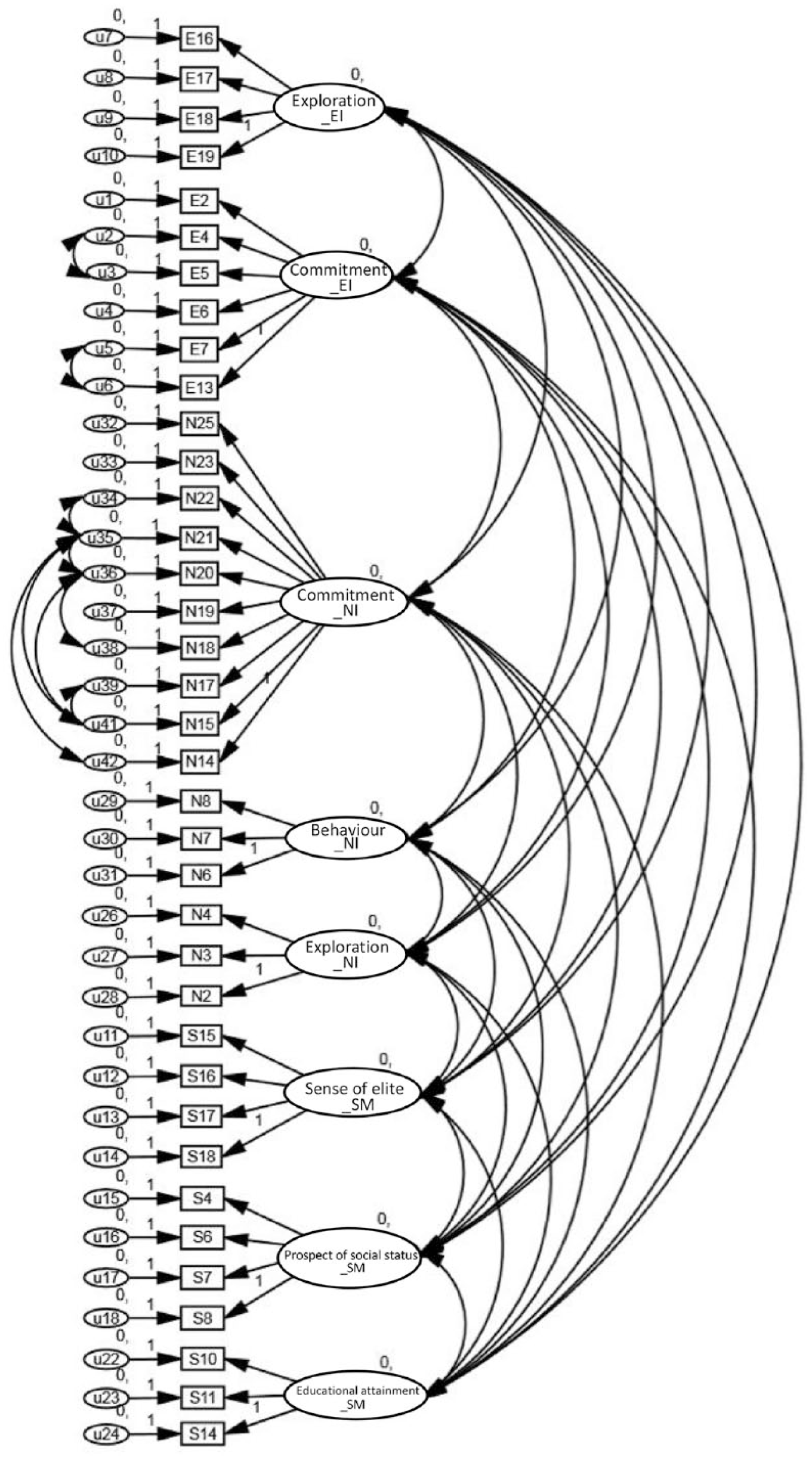
Final confirmatory factor analysis (CFA) model of the Ethnic Identity–National Identity–Perception of Social Mobility Scale.
Validity
This article further analyses the convergent validity and the discriminant validity. As Hair et al. (2010) indicate, the analyses of convergent validity are based on factor loading, composite reliability, and variances extracted. The results shown in Table 3 present that the factor loadings for all items exceed or are around .5. This echoes Hair et al.’s (2010) recommendation that factor loadings can be considered as very significant when the result is greater than .50.
Result of CFA for Measurement Model.
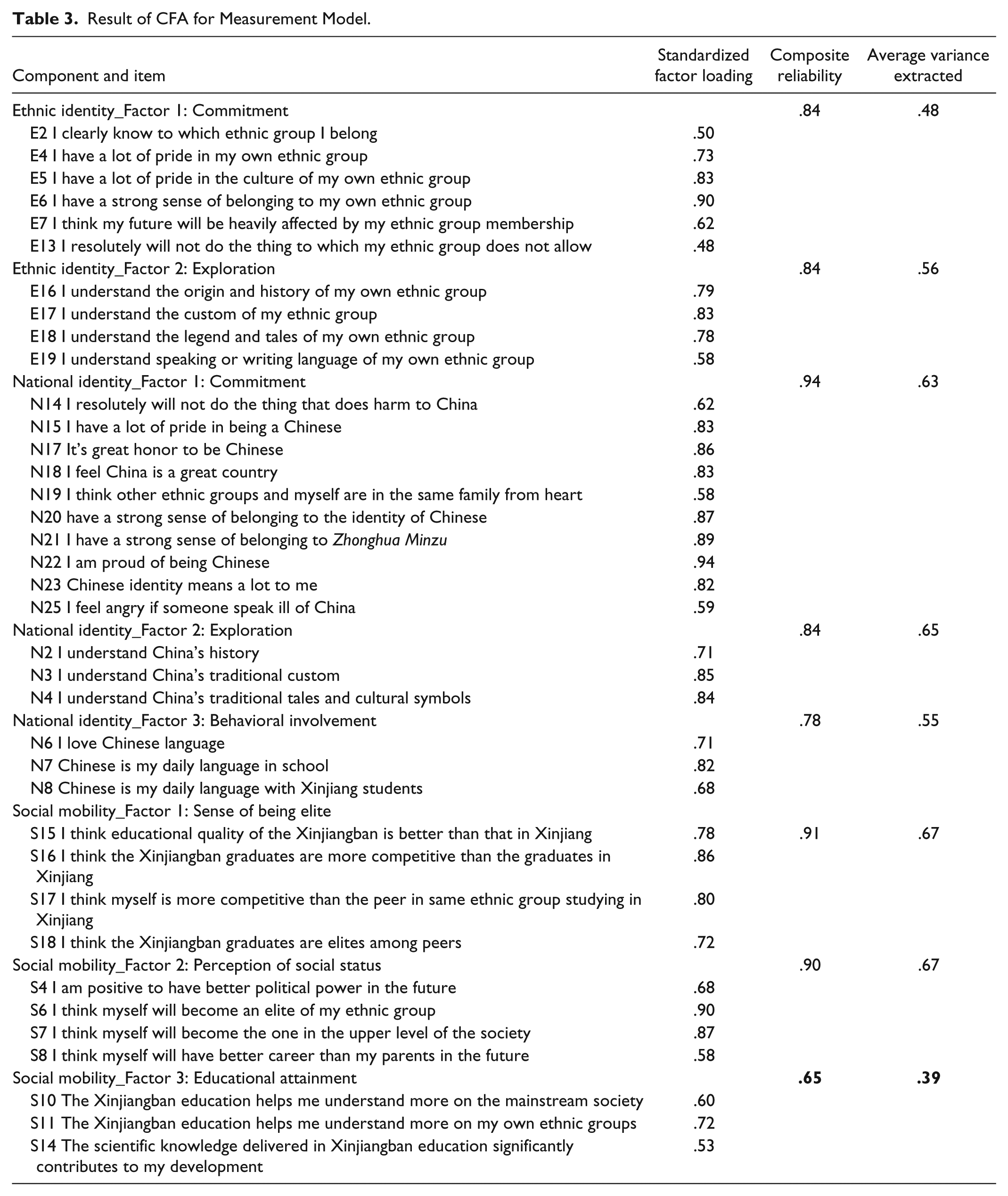
By examining the composite reliability values, this article aims to describe the degree to which the construct indicators indicate the latent construct (Raykov, 1997). The results of the value shown in Table 3 range from .65 to .94. The composite reliability of all latent constructs exceeded .7 which is the assessment criteria from Fornell & Larcker (1981) (except only one [Social mobility_Factor 3: “Educational attainment”] around .7). This echoes Hair et al.’s (2010) recommendation that composite reliability values can be considered as significant when the result is greater than .50.
By analyzing the average variances extracted, this article aims to examine the overall amount of variance in the indicators accounted for by the latent construct (Lee & Ashforth, 1990); the results of the average variances extracted exceed or are around .5. This echoes Bagozzi and Yi’s (1988) recommendation that average variances extracted larger than .50 are desirable.
To show the degree to which the measures of different concepts are distinct (Cable & DeRue, 2002), this article analyzes the discriminant validity. As Anderson and Gerbing (1988) claim, discriminant validity can be examined by comparing the squared correlations between constructs and variance extracted for a construct (Anderson & Gerbing, 1988; Fornell & Larcker, 1981; Hair et al., 2010). Table 4 shows that the square correlation for each construct, which should be less than the average variance extracted by the indicators measuring that construct based on the discriminant validity assessment criteria of using Fornell-Lacker criterion (Fornell & Larcker, 1981). This implies that apart from “Educational attainment,” the measure has adequate discriminant validity. Generally, the measurement model demonstrated good reliability.
Discriminant Validity of Constructs.

Note. EI = Ethnic Identity; NI = National Identity.
In summary, the result of the CFA evidenced that the eight-factor model for the Ethnic Identity, National Identity, and Perception of Social Mobility Scale provides a proper fit for the observed data. Consequently, the general construct of the relationship between identity building and social mobility in educational context can be described by the eight facets of support provided by commitment (ethnic identity), exploration (ethnic identity), commitment (national identity), exploration (national identity), behavioral involvement (national identity), sense of elite, perception of social status, and educational attainment.
Discussion
This article has designed a combined way of examining the relationship between identity building and social mobility within the educational sectors of a multi-ethnic society. Furthermore, the eight-factor measurement model has important psychometric value. Specifically, this article contributes to exploring the interrelationship between ethnic identity, national identity, and perception of social mobility in an educational context. In contrast to the existing literature, which largely measures the students’ ethnic identity, national identity, and its relations to students’ perception of social mobility separately, this scale provides a combined approach to examining the dynamics within these three dimensions. Specifically, this scale not only examines the mutual relationship between ethnic identity and national identity but also investigates the triangular relationships between ethnic identity, national identity, and students’ perception of social mobility. To this end, this scale is expected to open a window to explore the relationship between identity building and social mobility in educational sectors, especially in multi-ethnic societies where the tension between the majority and minority is significant and thus has far-reaching influence on creating differences of social mobility between ethnic groups.
Moreover, this study employed the oft-cited scales of ethnic identity, national identity, and perception of social mobility in a Chinese context. Given the special social context of China as well as the Xinjiangban educational policy, this study designed and then demonstrated the reliability and validity of the eight-factor measurement model in an ethnic minority concentrated boarding school in China. Undoubtedly, the current qualitatively based majority of research on Chinese ethnic minority education has unique strengths in describing the subjective experience of identity building among ethnic minority students, which includes, but is not limited to, feelings, behaviors, needs, expectations, desires, routines, life track, cases, and a variety of other information essential to understanding the political–economic and social-cultural agendas that shape the subjectivity of ethnic minority students (Grose, 2015; Leibold & Chen, 2014; Postiglione, 1999; Yuan, Qian, & Zhu, 2017).
However, the weaknesses of the existing qualitative research are that the results and analysis of the qualitative data are largely subjective and highly dependent on the researchers’ own positionality, knowledge, and experience. Moreover, most results of qualitative research are contextualized and situated, rendering these difficult to verify to build up comparative studies in different contexts. This study, based on a quantitative method, aims to provide researchers with a different approach to examining the construct of ethnic identity and national identity and their relations to the perception of social mobility among ethnic minority students.
First, the suggested quantitative method can be further adjusted and used by studies in different areas or over time with the production of comparable findings. Second, the study findings can be generalized to the student population from which data are collected. Third, the approach permits researchers to further study the structural factors that determine the politics of identity building and social mobility among ethnic minority students. Although focusing on a quantitative method, this study does not intend to downplay qualitative research in researching the relations of the three concepts. Rather, this research encourages researchers to see qualitative and quantitative as mutually constitutive and proposes conducting mixed method research in future studies on the relationships between ethnic identity, national identity, and students’ perception of social mobility in different temporal and spatial contexts.
Limitations and Future Direction
The study has several limitations. First, as indicated in CFA, little connectivity can be found between some items (i.e., E4 and E5, E7 and E13, and several items of commitment [NI]). This indicates that some items are somewhat overlapping, because they measure something in common. On one hand, this is fairly usual in scale development, as the researcher deliberately repeated the questions to test students’ reliability in response (DeVellis, 2016). However, on the other hand, this might have led to overlap in items.
Second, in the validity analysis of CFA, the result shows that all factors have adequately discriminant validity except “Educational attainment.” This indicates that the distinctiveness of the factor “Educational attainment” is not as significant as other seven factors. Further examination is required in future studies.
Third, although the selected case has significant representativeness in reflecting the relationship between identity building and social mobility within the educational sector of China, this eight-factor measurement model is built on a single case. From this perspective, further research is expected to use this model in different cases with similar social contexts.
The eight-factor model disclosed in EFA and CFA of this study has evidenced that the well-established measurement model is required to be revised and modified according to the local context and the object that the model aims to study. In so doing, this article argues that the measurement model is a “work-in-progress”: models should be subject to ongoing revisions and modifications based on local contexts and the object under study. To this end, future research should further link the model with different social contexts, making the model a contextualized toolkit.
Footnotes
Declaration of Conflicting Interests
The author(s) declared no potential conflicts of interest with respect to the research, authorship, and/or publication of this article.
Funding
The author(s) disclosed receipt of the following financial support for the research, authorship, and/or publication of this article: Fundings of this research come from the National Science Foundation of China (Grant No: 41630635, 41601133, 41701146), Provincial Science Foundation of Guangdong Province (Grant No:2016A030313427)
