




Abstract
The work environment plays a vital role in the transfer of the newly attained knowledge, skills, and abilities (KSAs) at the workplace. In the past decades, a series of studies have investigated the direct relationship between the work environment and training transfer. Surprisingly, empirical findings noted the inconsistent relationship between the work environment and training transfer. Whereas, the moderating effect between these relationships has been less examined in the training transfer literature. Therefore, addressing this gap, the prospective study was designed to investigate the moderating role of organizational justice as a potential moderator between the relationships of work environment and training transfer in Pakistani large-scale textile organizations (LSTO). Survey data were collected from 336 front-line managers by employing a multi-stage sampling technique. Structural equation modeling and hierarchical regression technique were used to test the hypotheses. The results showed that supervisor support, peer support, and opportunity to use learning (i.e., dimensions of work environment) correlate positively with training transfer. The findings also confirmed the moderating role of procedural justice and distributive justice (i.e., dimensions of organization justice) between the relationship of work environment and training transfer. These results underscore the critical role played by organizational justice to enhance the transfer of training at the workplace. This study shows, for the first time, that how organizational justice is an important mechanism to stimulate the work environment to training transfer.
Keywords
Introduction
In today’s era of professional milieus, where organizations are in confront of rapid technological changes, where innovation is happening every day, where social and economic uncertainty is prevailing, sustaining the competitive advantage has become necessary for every organization (Banerjee et al., 2017; Sarfraz et al., 2020). Keeping in view the intensity of these challenges and sustaining the competitive advantages, management of these organizations are continuously trying to upgrade the knowledge, skills, and abilities (KSAs) of their employees (Baldwin et al., 2017) through providing training (Bulut & Culha, 2010) and fostering a training culture inside the organizations (Bates & Khasawneh, 2005; Grossman & Salas, 2011). Training is an important strategy of the organizations (Massenberg et al., 2017) and a key function of the human resources practices (Alvelos et al., 2015) that helps the organizations to mitigate the effect of these changes that occur inside the organization at a different level. Hence, training is one of the most effective practices that help organizations to gain a competitive edge (Sarfraz et al., 2020; Storberg-Walker, 2005) and enhance performance and productivity at the individual and organizational levels (Arthur et al., 2003).
To gain a competitive advantage, organizations are investing a substantial amount to improve the KSAs of their employees (Blume et al., 2010; Chauhan et al., 2016). An important study by Baldwin et al. (2017) points out that in 2015, American organizations have invested a sum of $360 billion in employee training and education. Whereas, the Association for Talent Development estimated that in 2015, a sum of $200 billion was invested by worldwide organizations on employee training (Association for Talent Development, 2015). Thus, an training investment is expected to increase the employee’s performance and yield several financial benefits for the organization (Ma & Chang, 2013). However, it has been argued in previous literature that the organization’s concern regarding training transfer has been increased (Pham et al., 2013). Since a major part of the training investment is wasted due to poor training transfer (Baldwin et al., 2017; Hurt, 2016) or employees are failing to transfer the newly attained KSAs at the workplace (Homklin et al., 2014). For example, Lim and Morris (2006) have stated that only 10% to 20% of training is transferred at the workplace, Sookhai and Budworth (2010) pointed out that 66% to 90% of the skills are lost due to poor training transfer. Whereas, Laker and Powell (2011) reported an estimated annual financial lost $50 to $200 billion. Thus, the problem of lower training transfer and training investment wastage has become more critical and have attained special attention during the last decade (Pham et al., 2013).
Training transfer referred to the effective and continuous application of the newly attained KSAs at the workplace (Baldwin & Ford, 1988). Over the past many years, numerous studies have been conducted on training transfer, findings of these studies confirmed that work environment, trainee characteristics, and training design are the influential factors that affect training transfer (Baldwin & Ford, 1988; Baldwin et al., 2017; Blume et al., 2010; Velada et al., 2007). According to Baldwin and Ford (1988), work environment means factors of the work environment that either facilitate or inhibits the trainees for the successful training transfer. Trainee characteristics refer to the trainee’s own physical and mental abilities that help them for successful training transfer. While training design means that training is designed in such a way that provides a maximum opportunity for trainees to learn and transfer what they have acquired during a training program.
Though, training transfer literature confirmed the importance of these factors in training transfer, while we focus on work environment specifically, because the prior literature confirmed its significance than other factors (Blume et al., 2010; Chauhan et al., 2016; Homklin et al., 2014). Moreover, it is the first place where trainees after completion of the training program interact with the environment for the implementation of newly gained KSAs. Whereas, findings of prior research (e.g., Baldwin & Ford, 1988; Pham et al., 2013; Tracey et al., 1995; Velada et al., 2007) indicate that work environment is considered one of the most significant factors that play a key role in training transfer. Moreover, in the context of current study settings that is highly labor-intensive (Shafiq et al., 2019), where front-line managers spent their maximum time with their supervisor/peers for the completion of daily tasks and also for the application of newly gained KSAs. Thus, due to these possible reasons, we focus on the work environment because of our interest in understanding that how the work environment facilitates the front-line managers in training transfer. The work environment may broadly include supervisor support, peer support, and the opportunity to use learning (Baldwin & Ford, 1988; Blume et al., 2010).
Indeed, it is agreed that the work environment is considered more important in training transfer (Baldwin & Ford, 1988; Blume et al., 2010; Cheng & Ho, 2001; Pham et al., 2013). Nonetheless, debate continues that how work environment influences the training transfer is still scarce. Most importantly, past studies have noted inconsistent findings between the relationships of the work environment and training transfer. For example, some empirical studies confirmed that work environment is significantly related to training transfer (e.g., Austin et al., 2006; Holton et al., 2000; Pham et al., 2013; Reinhold et al., 2018; Saks & Belcourt, 2006). Whereas, some studies (e.g., Chiaburu et al., 2010; Devos et al., 2007; Ng, 2013; Nijman et al., 2006; Rouiller & Goldstein, 1993) noted an insignificant relationship between the work environment and training transfer.
Moreover, the researchers (e.g., Homklin et al., 2014; Pham et al., 2013; Simosi, 2012) suggested the dire need for a moderator, but hidden variables. These scholars argue that training transfer can be maximized when there is some fairness inside the organization related to policies and procedures. Since, support to trainees heavily relies on the attitude and behavior of supervisors and peers which merely rely on the equality inside the organization and signals toward organizational justice (Simosi, 2012). Hence, it has been argued that support to the trainee is a psychological mechanism of reciprocation between supervisors, trainees, and the organization (Simosi, 2012). Besides, few scholars (e.g., Arasanmi, 2019; Massenberg et al., 2015; Reinhold et al., 2018; Schindler & Burkholder, 2016) include calls for moderators and specifically signals to investigate fairness factors (i.e., organizational justice) as a potential moderator between the relationship of the work environment and training transfer.
Given that, drawing from procedural preference model (Leventhal, 1976), equity theory (Adam, 1965), and social exchange theory (Blau, 1964), the current study argues that in the presence of a supportive working environment and fairness in processes and rewards-distribution, front-line managers are more likely to transfer what they have acquired during a training program. Thus, the current study made an effort to empirically investigate the joint effect of organizational justice and work environment on training transfer of front-line managers in large-scale textile organizations, a gap that still exists (Massenberg et al., 2015; Reinhold et al., 2018; Simosi, 2012).
The current study adds value to the existing literature as it is conducted in textile organizations that contribute more than 60 % in total export of Pakistan (Shafiq et al., 2019). Currently, these organizations are facing various challenges and most importantly shortage of skillful human resources and lower employee productivity (Iqbal Chaudhry & Azam Roomi, 2010; Mikami & Furukawa, 2018). To cope with these challenges, these organizations have considered the significance of training and a large numbers of international and local agencies (e.g., Japan International Cooperation Agency, National Productivity Organization, and All Pakistan Textile Mills Association) are providing training in these organizations (All Pakistan Textile Mills Association, 2019; Mikami & Furukawa, 2018; National Productivity Organization, 2018). Despite the huge training investment, employee’s performance and productivity are still low and they are not fully transferring the newly attained KSAs at the workplace (e.g., Iqbal Chaudhry & Azam Roomi, 2010; Kazmi & Takala, 2014; Mikami & Furukawa, 2018). They further stated that only 5% of organizations measure the training transfer. These studies highlight the importance and need to study the training transfer in these organizations.
Taken together, our study aims to investigate the possible relationship between work environment and training transfer in LSTO in Pakistan. The study was further aimed to investigate which factor of work environment is the significant predictor of training transfer. Besides, this study also aims to expand the existing relationship between work environment and training transfer by investigating the moderating role of organizational justice as a potential moderator. To our knowledge, limited efforts were made to investigate the moderating role of organizational justice as a potential moderator in training transfer literature. Therefore, the current study will fill this gap, and the findings of this study would add value to the practical and theoretical perspective for the management and academicians (discussed later). The following section covers the theories and possible relationships among the study variables.
Theoretical Background and Hypotheses
The conceptual model of the current study as summarized in Figure 1 is supported by the procedural preference model (Leventhal, 1980), equity theory (Adam, 1965), and social exchange theory (Blau, 1964). The procedural preference model is of the view that fairness in resource-distribution procedures prompts positive feelings in employee’s attitudes and behavior. When employees perceive that promotions and financial benefits are based on fair procedures and there is a defined mechanism for defining these financial outcomes. They are more likely to be supportive, especially supervisors and peers when they feel that in case of trainees succeeded to apply newly gained KSAs on the job, and they have no fear for the growth and promotion of trainees. Because there is a defined mechanism for the judgment of individual promotion. Thus in return, the supervisor and peers will be supportive and support the trainees in the transfer of new knowledge. Besides, equity theory states that when employees perceived that their efforts and rewards are similar to others having the same efforts and monetary benefits. This fairness in rewards-distribution prompts positive feelings in their attitude and behavior and in return employees particularly supervisors and peers are more supportive and support the trainees for the transfer of training.

Conceptual model.
Whereas, social exchange theory (SET) states that employees inside the organization are keen to compare their input-output ratio with other employees having the same job. If they perceive fairness in rewards-distribution, they feel happy and in exchange, they perform their job in a good manner. While, biasedness leads to negative sentiments and results in lower performance (Adam, 1965; Poon, 2012). In this regard, when employees specifically supervisors and peers perceived procedural and distributive fairness, in exchange they are more likely to be supportive and will support the front-line manager for the transfer of newly gained KSAs and strengthen the relationships. On contrary, biasedness practices from the organization result in lesser support from the supervisor and peers and results in weaken the relationships. Hence, SET supports the view that fairness in allocation and distribution of rewards is a moderating factor between the relationship of the work environment and training transfer.
Relationship Between Supervisor Support and Training Transfer
Supervisor support refers to the extent to which the supervisor reinforces and encourages the trainee at the workplace for the smooth implementation of all the newly learned KSAs (Chauhan et al., 2016). According to Baldwin and Ford (1988), supervisor support is a multi-dimensional construct and the supervisor supports the trainees in numerous ways. For example, allowing the trainees to practice the new skills continuously (Chiaburu & Marinova, 2005), listen to the voice of the trainee and provide a conducive environment (Lancaster et al., 2013), providing on-going feedback and assistance (Lim & Johnson, 2002; Velada et al., 2007); providing enough space and opportunity to apply newly learned KSAs (Nijman et al., 2006), coaching and appreciate him openly when trainee successfully implemented the newly learned KSAs (Lancaster et al., 2013).
The prior studies (e.g., Blume et al., 2010; Broad & Newstrom, 1992; Chiaburu et al., 2010; Heilmann et al., 2013; Zamani et al., 2016) have noted that support from a supervisor has a significant influence on training transfer. Findings of past studies have noted that supervisor support is positively related to training transfer (e.g., Awais Bhatti et al., 2013; Pham et al., 2013; Reinhold et al., 2018). Whereas, the scholars (e.g., Awoniyi et al., 2002; Chiaburu & Marinova, 2005; Homklin et al., 2014; Ng, 2015) have reported insignificant relationship. While, few scholars (e.g., Devos et al., 2007; Gilpin-Jackson & Bushe, 2007; Ng, 2013; Velada et al., 2007) have reported that supervisor support is not related to training transfer. The main reason behind these mixed findings may be the use of the supervisor support construct as unidimensional or cultural variation in various industries and countries.
Although, training transfer literature noted mixed findings, while the significant role of supervisor support to trainees cannot be ignored. Since supervisors have a legitimate power to manage the subordinates and trainees have to take assistance from the supervisor for making any decision and action. Therefore, it seems that role of the supervisor remains significant. Literature also confirmed the importance of supervisors and findings of past studies also noted the key role played by the supervisor in training transfer (Blume et al., 2010; Chauhan et al., 2016; Reinhold et al., 2018). These studies suggested that trainees having support from their supervisor are more motivated to transfer the training than those having less support. Thus, this study purports that supervisor has a key role in training transfer and with their support, trainees can be able to fully transfer what they have learned during the training program. For this reason, the present study suggests that greater supervisor support felt by trainees leads to maximum transfer of training. Thus based on the above-mentioned arguments, this study hypothesized:
H1. Supervisor support to trainees for training transfer will be positively related to training transfer.
Relationship Between Peer Support and Training Transfer
Peer support can be described as the extent to which peers support and motivate the trainees for the transfer of newly attained KSAs at the workplace (Holton et al., 2000). Prior studies (e.g., Chauhan et al., 2016; Muduli & Raval, 2018) have noted the significance of peer support and confirmed an important predictor of training transfer. Most importantly, the significant role of peer support has emerged more at the workplace due to the increased use of team-oriented assignments (Pham et al., 2013). According to Reinhold et al. (2018), the workplace has become more complex and employees spent their maximum time with their colleagues for the completion of daily tasks. Therefore, they interact more with their peers than their supervisors. In general, trainees feel more comfortable getting support from peers than supervisors. Thus the role of peer support in training transfer has become more valuable than the supervisor.
Whereas, findings of past studies (e.g., Chauhan et al., 2016; Homklin et al., 2014; Reinhold et al., 2018) also confirmed that trainees are highly motivated to transfer training when they get support from peers instead of supervisors. Moreover, prior studies (e.g., Awais Bhatti et al., 2013; Massenberg et al., 2015; Muduli & Raval, 2018) have also confirmed that peer support is an important element that plays a key role in training transfer. Whereas, literature review findings of Burke and Hutchins (2007) also identified the importance of peers and stated that peers have a more consistent and vibrant relationship with training transfer than a supervisor. Besides, Martin (2010) also noted that trainees having support from peers have shown greater interest and attitude in training transfer than those having less support from their peers.
Several empirical studies have postulated a convergence between peer support and training transfer. Findings of the studies (e.g., Chauhan et al., 2016; Homklin et al., 2014; Muduli & Raval, 2018) confirmed that peer support positively influences training transfer. In contrast to a positive relationship, few studies (e.g., Almannie, 2015; Hutchins et al., 2013; Lee et al., 2014) have identified that peer support is irrelevant to training transfer. Though, literature noted inconsistent results, while Muduli and Raval (2018) argue that support from peer stimulate positive feelings and they feel happier to transfer what they have learned from training. More specifically, peer feedback to trainees that how they are implementing new learning, motivate the trainees and increase the likelihood of training transfer. Thus, based on the aforementioned arguments, this study hypothesized:
H2. Peer support to trainees for training transfer will be positively related to training transfer.
Relationship Between the Opportunity to Use Learning and Training Transfer
The literature identified the role of opportunity to use learning in training transfer and argues that for maximum training transfer, trainees should be provided ample time and resources for the application of newly gained KSAs at the workplace (e.g., Burke & Hutchins, 2007; Clarke, 2002; Cromwell & Kolb, 2004; Gilpin-Jackson & Bushe, 2007). Lim and Morris (2006) stated that limited chances of applying what trainees have learned are also one of the main obstacles in training transfer. Whereas, Muduli and Raval (2018) concluded that trainees rated the opportunity to use trained tasks as the highest form of support, and conversely, the lack of opportunity was the major hindrance for successful training transfer. However, Gilpin-Jackson and Bushe (2007) added that having time to apply new skills is also critical for the training transfer and lack of time is also a critical barrier for smooth transfer (Cromwell & Kolb, 2004). Therefore, managers must have to analyze the trainees’ workload and provide them a conducive environment for the practice of newly attained KSAs on the job (Clarke, 2002).
Previous studies (e.g., Gilpin-Jackson & Bushe, 2007; Lim & Johnson, 2002; Muduli & Raval, 2018; Pham et al., 2013) have investigated the relationship, and findings of these studies confirmed that providing an opportunity to trainee for the practice of newly gained KSAs motivate them and increase the chances of training transfer. These studies also concluded that lesser opportunities stimulate negative feelings and resulted in lower training transfer. Therefore, for training transfer, trainees should be provided ample resources and time, so that they can easily apply what they have learned during a training program. Thus, based on the above-mentioned arguments, this study hypothesized that:
H3. The opportunity provided to trainees for training transfer will be positively related to training transfer.
Overview of Organizational Justice
The term organizational justice refers to the employee’s perception of fairness inside the organization (Greenberg & Colquitt, 2013), and these perceptions of fairness have been demonstrated to impact a series of employee’s personal attitudinal, behavioral, and organizational outcomes (e.g., Colquitt et al., 2001; Poon, 2012). Organizational justice is one of the frequently studied topics among socialist, political scientists, legal, and management scholars (Melkonian et al., 2011) and has attained special attention in the field of organizational behavior, psychology, and human resource management (Colquitt & Rodell, 2011). According to Rupp et al. (2017), it is an intangible glue of the organization’s philosophy that holds employees to work together inside the organization. It stems from Adam (1965) equity theory. This theory suggests that employee’s judgment of equity and inequity inside the organization is derived from the comparisons between one’s inputs (e.g., efforts) and outcomes (e.g., pay and rewards) with the inputs and outcomes of other employees having performed a similar job (Greenberg, 1990).
Broadly, researchers classified organizational justice into three main types: procedural justice, distributive justice, and interactional justice (Ambrose & Schminke, 2009; Colquitt et al., 2001). Procedural justice focuses on the fairness in procedures, processes, and mechanism that is being used in making bias-free resource-distribution decisions (Poon, 2012). Whereas, distributive justice refers to the fairness in a managerial decision related to the resource-distribution (Greenberg, 1987) and is discussed mostly concerning Adam’s (1965) equity theory. This theory suggests that employees inside the organization measure the fairness in the distribution of rewards and benefits by comparing their inputs (such as efforts, education, time, and energy) with the outcomes (such as financial benefits, power, responsibilities, job increments, further training) to the inputs and outcomes rations with their colleagues. Lastly, interactional justice focuses on the employee’s perception of the fairness of interpersonal treatment from the organization (Bies, 2005). Interactional justice is nurtured when employees inside the organization are treated with respect, dignity, and fairness, and the decisions and information are explained and shared timely and accurately (Colquitt et al., 2001; Cropanzano & Stein, 2009). Whereas, a few researchers have conceptualized it into two dimensions: interpersonal justice that deals with personal treatment (e.g., respect, dignity, care, and politeness that employees received from their coworkers and management) and informational justice that deals the explanation part (e.g., timely and accurately sharing of information from the seniors and the management) (Poon, 2012).
Parenthetically, we opted for two dimensions of organizational justice (i.e., procedural justice and distributive justice), thereby following prior scholars (e.g., Poon, 2012; Rupp et al., 2017; Tessema et al., 2014) reasoning. They contended that interactional justice (the third dimension of organizational justice) is a subset of procedural justice and only procedural justice and distributive justice are considered more important in organizational justice literature. Moreover, the scholars (e.g., Alexander & Ruderman, 1987; Raja et al., 2018) also stressed the significance of these two dimensions and stated that employees in an organization are only concerned with decision-making procedures and decision outcomes (i.e., procedural justice and distributive justice). So, therefore, by considering the significance and recommendation of the above-mentioned scholars, we used only these two dimensions in the present study. While considering the importance of interactional justice, acknowledging that to expand the current study by introducing interactional justice in the future study. Hence the following section, therefore, will explain how procedural justice and distributive justice will moderate in the relationship between work environment and training transfer.
The Moderating Role of Procedural Justice
Procedural justice deals with fairness in method, mechanism, and processes that are being used to determine resource-distribution outcomes (Colquitt et al., 2001). According to Poon (2012), procedural justice plays a vital role in shaping employees’ attitudes and behaviors. Prior research indicates that procedural justice is related to attitude and behaviors, such as satisfaction, commitment, citizenship behavior, and individual performance (i.e., training transfer) (Chang, 2014; Colquitt et al., 2001; Holton et al., 2000). Findings of the past studies show that procedural justice stimulates positive changes in employee’s attitudes and behavior (Ko & Hur, 2014; Raja et al., 2018). For example, supportive attitude with colleagues, job satisfaction, loyalty with organizations, increase in performance (Colquitt et al., 2001; Lu & Guy, 2018). While, biasedness in procedural justice stimulates negative feelings resulted in lower employee performance and productivity, lower individual performance (Colquitt et al., 2001; Raja et al., 2018).
Nonetheless, literature is clear that work environment and procedural justice are a prime predictor of behavior related outcomes like job performance, citizenship behavior, organizational commitment, job satisfaction, and individual performance (i.e., training transfer) (Colquitt et al., 2001; Holton et al., 2000; Muduli & Raval, 2018; Rupp et al., 2017; Tufail et al., 2017). Since both work environment and procedural justice directly affect individual performance (i.e., training transfer). However, the interactional effect of the work environment and procedural justice with training transfer lacks in literature. Whereas, little is known about the mechanism of how the work environment interacts with procedural justice to training transfer. More specifically, apart from the direct relationship among work environment, procedural justice, and individual performance (i.e., training transfer), few of the studies have demonstrated the moderating role of procedural justice between employee’s work-related behaviors and performance outcomes. For example, Fatima et al. (2015) investigated procedural justice as a moderator between organizational silence and organizational citizenship behavior, result noted the moderating role of procedural justice between these relationships. Whereas, finding of previous studies (e.g., Chang, 2014; Ko & Hur, 2014; Lu & Guy, 2018; Sharoni et al., 2012; Sulander et al., 2016) also demonstrate the moderating role of procedural justice in various human resource management settings and employee’s behavioral outcomes relationships.
Even though a supportive work environment helps the trainees to transfer the newly gained KSAs on the job. However, the organizational factor may affect employees in a different way (Islam, 2019). For example, in an environment, with low fairness of procedures, lower involvement of employees in making procedures that leads toward resource-distribution decisions and limited support both from supervisor and peers, and lesser opportunity for trainees to apply what they have learned during the training. In this situation, trainees may feel that they are unable to transfer the new knowledge on the job. Whereas, an organization with fairness in procedures, the involvement of employees in making a decision, having conducive working environment, this supportive environment and procedural fairness results in a maximum transfer of newly gained KSAs on the job. According to Raja et al. (2018), such low fairness leads to negative outcomes such as dissatisfaction, lesser teamwork, and lower individual performance (i.e., training transfer).
Hence, based on the above arguments, it is plausible that trainees having low fairness in procedures, and when they perceive that their work environment is nonconductive, will have a lower ability to transfer the newly attained KSAs on the job. Whereas, organizations where trainees perceive fairness in procedures, the work environment is supportive, will have greater chances for the transfer of newly gained KSAs on the job. Hence, following the above arguments, this study purports that procedural justice would help strengthen the relationship between work environment and training transfer. Thus this study hypothesized:
H4. Procedural justice will positively moderate the relationship of supervisor support (a), peer support (b), and the opportunity to use learning (c) with training transfer.
The Moderating Role of Distributive Justice
Distributive justice refers to the perceived fairness of resource distribution inside the organization (Janssen et al., 2010). Distributive justice is embedded in the assumption of equity theory (Adam, 1965) and is concerned with the perceived fairness of rewards distribution in organizations. Thus theory states that employees inside the organization tend to compare their outcomes (e.g., extent of recognition or other types of rewards distribution) with the outcomes received by other similar employees (i.e., those having done a similar amount of work at a similar level of quality—known as “input” (Raja et al., 2018). Extant research shows that fairness in the rewards distribution affects positively employee’s behavioral outcomes. For example, satisfaction, commitment, performance, and productivity (Colquitt et al., 2001). Whereas, unfairness in the distribution of financial resources results in unfavorable consequences for an organization. For example, non-productive work behaviors, lower productivity, lesser teamwork, and poor individual performance (Adam, 1965; Rupp et al., 2017).
Although, literature is clear that distributive justice is a prime predictor of behavior-related outcomes like job performance, citizenship behavior, organizational commitment, and individual performance (i.e., training transfer) (Holton et al., 2000; Kashif et al., 2017; Poon, 2012). Similarly, the work environment is also a significant predictor of training transfer (Awais Bhatti et al., 2013; Baldwin & Ford, 1988; Reinhold et al., 2018). As both distributive justice and work environment directly affect individual performance (i.e., training transfer), however, the interactional effect of the work environment and distributive justice with training transfer lacks in literature. Whereas, little is known about the mechanism of how the work environment interacts with distributive justice to training transfer. More specifically, apart from the direct relationship among work environment, distributive justice, and individual performance (i.e., training transfer), few of the studies have demonstrated the moderating role of distributive justice between employee’s work-related behaviors and performance outcomes relationships.
For example, the scholars (e.g., Chang, 2014; Ko & Hur, 2014; Lu & Guy, 2018; Sharoni et al., 2012; Sulander et al., 2016), investigated the moderating role of distributive justice in various human resource management setting and the different employee’s behavioral outcomes, results noted the moderating role of distributive justice in these relationships. Indeed, a supportive work environment helps the trainees to transfer the newly gained KSAs on the job. However, the organizational factor may affect employees in a different way (Islam & Ahmed, 2018). For example, in an organization, with biasedness in the distribution of rewards and benefits and a non-conducive work environment, this situation trainees may be unable to transfer the newly attained KSAs on the job. Whereas, an organization with fairness in rewards-distribution and a supportive working environment where trainees get maximum support for the transfer of newly gained KSAs on the job results in maximum training transfer.
Thus, based on the aforementioned arguments, it is plausible that trainees having low fairness in rewards-distribution, and less support from the work environment, will have lesser ability to transfer the newly attained KSAs on the job. On contrary, organizations having fairness in rewards-distribution, a supportive work environment, and trainees tends to transfer newly gained KSAs on the job. Hence, following the above arguments, this study purports that distributive justice would help in strengthening the relationship between work environment and training transfer. Therefore, this study hypothesized:
H5. Distributive justice will positively moderate the relationship of supervisor support (a), peer support (b), and the opportunity to use learning (c) with training transfer.
Sample and Data Collection Procedures
This study was conducted in the textile sector of Pakistan. The textile sector is the backbone of the country’s economy, contributes 60% in total export, and employs more than 38% of the total production labor force (Shafiq et al., 2019). Textile sector comprised of small, medium, and large-scale organizations. Small and medium scale organizations having employees not more than 250 and large scale organizations having employees more than 250 (Khan et al., 2013; Syed et al., 2012). These organizations having high turnover, fewer human resources management practices, improper management structure, less training culture, and having less implementation of labor laws and policies (Jamali et al., 2010; Khan et al., 2013).Whereas, large-scale organizations are having an 80 % share in manufacturing and a 10.7% contribution in the gross domestic product (GDP) of Pakistan (Pakistan Economic Survey, 2019). These organizations having comparatively better human resource management practices and are implementing policies in a better way.
In particular to this study, a multi-stage sampling technique was used to collect the data from the target population. According to Sekaran and Bougie (2009), this technique is appropriate when the population is geographically scattered. According to the All Pakistan Textile Mills Association (2019), a state base textile ministry, the Textile sector of Pakistan is geographically scattered into three major states that is, Khyber Pakhtunkhwa, Punjab, and Sindh. In the first stage, the city namely called Faisalabad which falls in the Punjab state was selected through purposive sampling. The main reason for selecting this city was that it contributed more than half of the total textile export of Pakistan (Akhtar et al., 2018; Tara et al., 2019). Secondly, data were collected from those organizations which are registered at All Pakistan Textile Mills Association, because it is the most recognized and legitimate governmental body in the textile industry (All Pakistan Textile Mills Association, 2019).
Thirdly, data were collected from large-scale organizations, since these organizations having employees of more than 250 and are practicing human resource management practices in a better way. For this study, data were collected from front-line managers. The main reason to collect data from the front line manager is that these employees fall in the first level of management, involved in the overall business process, and play a key role in textile organizations (Danish & Usman, 2010; Tufail et al., 2017). So due to their critical role, the front line manager was selected as respondent. In the fourth stage, a total of 50 organizations falls in the criteria and a total of five organizations (with the total front line manager 4,500) were selected randomly (All Pakistan Textile Mills Association, 2019). In the last stage, a proportionate sample of 365 front-line managers was selected based on the formula of Krejcie and Morgan (1970). Official contacts of the chamber of commerce were used to gain access to these target organizations. A proportionate number of questionnaires were handed to these human resource managers, they administrated and filled the questionnaires from the target respondents. During the process, these managers contact the researchers for clarification of few items, and appropriate answers were given. After a week, a total of 342 filled questionnaires were collected and these managers were assured of the confidentiality and ethical conduct of the research.
The respondents were also evaluated regarding their demographical attributes. Although the textile sector is highly labor-intensive (Shafiq et al., 2019), the majority of the respondents were male (N = 312, 92%) because females preferred less to work in textile organizations due to longer working hours. Most interestingly, a majority of them were between the age of 30 and 39 years (N = 138, 42%) and having a length of work experience of 4 to 6 years (N = 72, 21%). Closer inspection of the data showed that 141 respondents are university/college graduates (42%) with total training sessions attended in the current company within a year were in the ranges of 3 to 4 (N = 124, 37%). This information showed that textile organizations have qualified staff and are investing a substantial amount in the training of their human resources.
Measures
All constructs were measured with previously validated scales, using five-point Likert scales ranging from 1 (“strongly disagree”) to 5 (“strongly agree”).
Supervisor support, peer support, and opportunity to use learning were measured from the learning transfer system inventory (LTSI) Holton et al. (2000). Supervisor support was measured by a six-item scale with sample items included “My supervisor meets with me regularly to work on a problem I may be having in trying to use my training.” Chauhan et al. (2016) used the same scale and reported .82 as its internal consistency. This study also found .81 as its internal consistency. Similarly, peer support was measured by a four-item scale with sample items included “My peer encourages me to use the skills I have learned in training.” Zamani et al. (2016) used the same scale and reported .84 as its internal consistency. The present study also noted .75 as its internal consistency. Lastly, the opportunity to use learning was measured by a four-item scale with sample items included “The resources I need to use what I learned will be available to me after training.” Massenberg et al. (2017) used the same scale and reported its internal reliability above .70. The current study also found .81 as its internal consistency.
Training Transfer
A six-item scale from Xiao’s (1996) was used to measure training transfer with sample items includes “I can accomplish my job tasks faster than before training.” Islam and Ahmed (2018) used the same scale in the context of Pakistan and reported internal consistency .86. The present study noted .78 as its internal consistency.
Procedural Justice and Distributive Justice
Lambert et al. (2005) nine-item scale was used to measure procedural justice and distributive justice. Procedural justice was measured by a five-item scale with sample items included “The standards used to evaluate my performance at this place have been fair and objective.” Tufail et al. (2017) used the same scale in the Pakistani context and reported accepted reliability value (i.e., .72). The current study also found .78 as its internal consistency. Similarly, distributive justice was measured by a four-item scale with sample items included “I am fairly rewarded considering the responsibilities and work that I do”. Lambert et al. (2018) reported the value of internal consistency as .92. Whereas, this study also found .85 as its internal consistency.
Findings
The structural equation modeling (SEM) technique was applied to test the hypotheses. Before applying SEM, firstly, preliminary analyzes (i.e., missing values, normality, outliers, and multicollinearity) were performed (Byrne, 2010; Islam, 2019). Since data with these problems may impact the findings and leads to inappropriate results (Tabachnick & Fidell, 2007). Missing values were treated by following the instruction of Kline (2005) and five questionnaires were excluded having missing values of more than 10%. The normality of the data were examined through the skewness and Kurtosis with the standard range of ±2.58, and the data were found normal (Hair et al., 2010). Similarly, a multivariate outlier in the data were examined through a Mahalanobis Distance test with p < .000 (Kline, 2005), and there were found no outlier values. Lastly, multicollinearity was examined through the values of correlation among the study variables. None of the values were found more than the threshold limit 0.85 (see Table 1). These findings confirm the absence of a multicollinearity problem in the data (Tabachnick & Fidell, 2007).
Descriptive Statistics, Correlations and Scale Reliabilities.

Whereas, common method bias (CMB) is a problem that occurred when data collected from the same source and at the same point. Data with this problem may affect the validity of the results (Podsakoff et al., 2003). To deal with this problem, the researcher took necessary steps which include; examined the face validity from two practitioners, conduct a pilot study from a sample of 30 respondents and finally change the question order and avoid the double-barreled question at the time of data collection (Podsakoff et al., 2003). Additionally, Harman’s single factor method (Harman, 1960) was also applied to examine the variance produced by a single factor. The findings confirmed that a single factor caused less than 40% variance (Podsakoff et al., 2003) and free from the CMV problem.
The descriptive analyses of the study variables were presented in Table 1. It is apparent from this table that the mean value of the study variables were lies in the range of 3.75 to 4.09, which indicates that the majority of the respondents agreed or neutral in their responses. Further analyses showed that all the variables having the value of reliability above the cut-off value of .70 (Hair et al., 2010). Whereas, a positive correlation was found between supervisor support, peer support, and opportunity to use learning with training transfer (i.e., r = .44, .59, .48). These results provide support for Hypothesis H1 (a–c).Similarly, procedural justice and distributive justice were also positively correlated with training transfer (r = .37 and .29, p < .01).
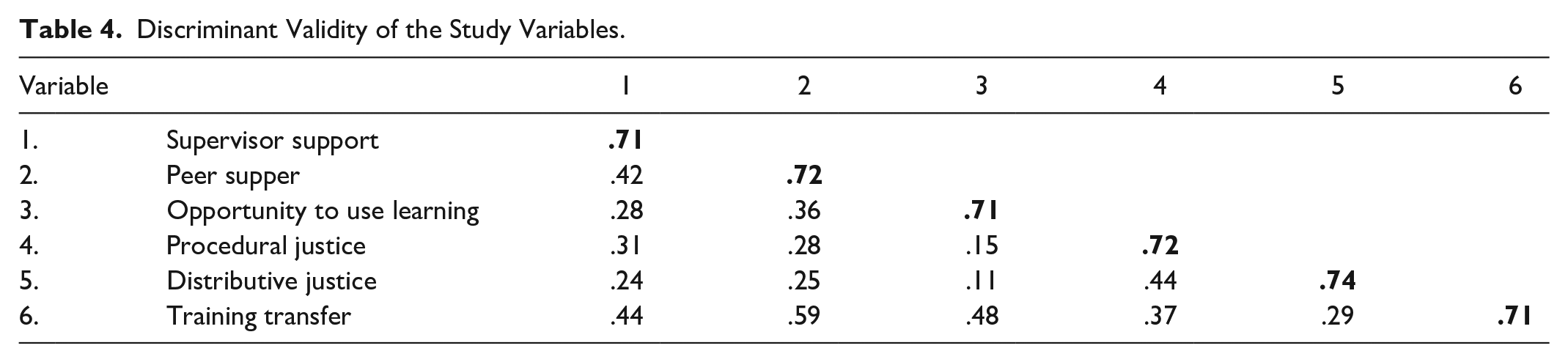
After these preliminary analyses, we applied structural equation modeling (SEM) in two-stage by following the instruction of Anderson and Gerbing (1988). In the first stage, the confirmatory factor analysis (CFA) was conducted to examine the fitness of the measurement model. Initially, the values of model fit were found to be less than the recommended values given by Hair et al. (2010) (see Table 2). Some modifications were made to improve the values of model fit indexes. Furthermore, we examined the convergent validity and discernment validity of the constructs given by the instruction of Fornell and Larcker (1981). Factor loading values of each item (given in Table 3) were above the cut-off value 0.50 and the value of average variance extracted was more than 0.50 confirm the convergent validity of the construct (Fornell & Larcker, 1981). Besides, the discriminant validity of the constructs was examined by comparing the value of the square root of the AVE with the correlation estimates of the corresponding construct (Fornell & Larcker, 1981). Since the value of the square root of AVE (see Table 4) was higher than the correlation estimates of the corresponding construct, confirmed the discriminant validity (Fornell & Larcker, 1981). Together, these results provide important insights regarding the validity and model fitness of the measurement model.
Goodness of Fit Indices.

Source. Hair et al. (2010), Byrne (2010), and Kline (2005).
Convergent Validity.

Discriminant Validity of the Study Variables.
After that, we investigate the moderating role of procedural justice and distributive justice by following the instruction of Cohen et al. (2003) (see Table 5 and Table 6). We applied a hierarchical regression technique in three steps. In the first step, covariates of all demographic variables that is, age, gender, qualification, total work experience, and total numbers of training session attended in the current organization were entered as a control variable with the dependent variable (i.e., training transfer) to better differentiate the variance from the independent variables in the dependent variable. In the second step, the independent variables (i.e., supervisor support, peer support, and opportunity to use learning) and moderating variables (i.e., procedural justice and distributive justice) were regressed with the dependent variable (i.e., training transfer). In the last step, the interactional terms between independent variables and moderating variables were regressed with the dependent variable.
Regression Results for Moderating Role of Procedural Justice.

p < .01.
Regression results for moderating role of distributive justice.

p < .01.
The results of the hierarchical regression are summarized in Table 5 and Table 6. It indicates that only two control variables (i.e., work experience at the current employer and total training sessions attended at the current employer) were found to have a significant association with training transfer with a total variance of 9%. Whereas, rest of the control variables have a non-significant association with the training transfer. It can be seen from the data in Table 5 that the main effect of supervisor support, peer support, and opportunity to use learning were positive and significantly related to training transfer with the total variance of 22% (β = .22, β = .27, β = .16 and p < .01). Besides, procedural justice was also positively related to training transfer (β = .14, p < .01). Similarly, the result of interactional terms (i.e., supervisor support × procedural justice, peer support × procedural justice, and opportunity to use learning × procedural justice) was also found to be positive and significant with 37% of variance (β = .29, β = .32, β = .18; p < .01) suggesting that procedural justice moderates the existing relationships. This indicates that the greater the procedural justice, the higher the impact of work environment factors on training transfer. These regression results confirm the moderating role of procedural justice and support the suggested hypothesis H4 component a–c.
Similarly, the moderating effect of distributive justice was investigated (see Table 6). As shown in Table 6, the main effect of supervisor support, peer support, and opportunity to use learning on training transfer is positive and significant (β = .17, β = .25, β = .14, p < .01) with 19% variance. No significant effect was noted between control variables and training transfer. Whereas, distributive justice was positively related to training transfer (β = .12, p < .01). Besides, the β coefficient values of the interactional terms (i.e., supervisor support × distributive justice) and (peer support × distributive justice) were found to be positive and significant (β = .17, β = .22, p < .01) suggesting that distributive justice moderates the existing relationships. This indicates that the greater the distributive justice, the higher the impact of work environment factors on training transfer. Whereas, the interactional effect of opportunity to use learning × distributive justice was found to be insignificant with (β = .11, p > .01) suggesting that distributive justice does not moderate the relationship between the opportunity to use learning and training transfer. These results support hypothesis H5 (a–b) and failed to support hypothesis 5c.
Together, these results provide important insight into the association of work environment, organizational justice, and training transfer. The overall findings suggested that procedural justice and distributive justice both strengthen the positive effects of supervisor support, peer support, and the opportunity to use learning on training transfer. In other words, the positive impacts of supervisor support, peer support, and opportunity to use learning on training transfer are found higher if a trainee is having a high level of procedural and distributive justice. However, procedural justice was found to have a more significant influence than distributive justice as a moderator between the same (see Tables 5 and 6).
Discussion and Study Implications
The current study aimed to determine the possible relationship of supervisor support, peer support, and opportunity to use learning with training transfer in large-scale textile organizations in Pakistan. Secondly, the study was set out to investigate the influential factor that affects more on training transfer. The last main aim was to investigate the moderating role of procedural justice and distributive justice between the relationship of supervisor support, peer support, and opportunity to use learning with training transfer. The study identified that front-line managers having support from supervisors, peers, and opportunity are more likely to transfer the newly attained KSAs at the workplace. These findings are in line with the results of prior studies (e.g., Chauhan et al., 2016; Muduli & Raval, 2018; Pham et al., 2013). A possible reason may be the change in attitude and behaviors of employees in these organizations that is resulted from heavy training investment which these organizations are continuously investing. These views are further supported by Khan et al. (2013) and Attiq et al. (2017) who suggested that Pakistani organizations are continuously trying to provide a supportive environment for their employees. Another reason may be the lesser job opportunity and higher unemployment rate in Pakistani textile organizations that force employees to facilitate the front-line managers during the transfer of training. Thus, this study inferred that textile organizations should promote a more conducive environment where front-line managers feel happier to discuss training transfer matters openly with their supervisors and peers and can get the opportunity for the transfer of newly attained KSAs at the workplace.
The second findings were related to determining which factor of the work environment affects more on training transfer. In this regard, the findings observed that peer support is a significant predictor of training transfer. It seems that trainees are highly motivated and exhibit more intention to transfer training when they experienced a higher degree of support from peers than the supervisor. These findings are in line with the results of Homklin et al. (2014) and Chauhan et al. (2016) who also found that peers have a more influential role than a supervisor. A possible reason may be the change in the work setting in textile organizations. Since the workplace has become more complex and organizations are focusing more on team-oriented culture and team-based assignments (van der Klink et al., 2001). Whereas on contrary, the supervisor in textile organizations have a wider span of control, additional roles, and extra assignments, it’s become difficult for them to interact and meet with everyone daily. This seems to show that front-line managers have less opportunity to interact with their supervisor and they feel comfortable talking openly with peers for transfer of newly attained KSAs at the workplace. Another possible reason may be due to the strong team culture in these organizations, peer support has become a more significant predictor of training transfer than supervisor support.
The last findings were related to investigating the moderating role of procedural justice and distributive justice between the relationships of supervisor support, peer support, and opportunity to use learning with training transfer. Consistent with the overall assertion that perception in procedural fairness prompts a buffering effect in behavioral and outcomes relationships (Poon, 2012), the current study also found the buffer effect of procedural justice and moderate the existing relationships. These results support hypothesis H4 (a–c) and are in line with prior results (Fatima et al., 2015; Lu & Guy, 2018). This study has identified that the path coefficient of all interactional terms was positive and significant. It indicates that higher procedural justice strengthens the impact of supervisor, peer support, and opportunity to use learning on training transfer. It seems that textile organizations have developed defined procedures regarding the (e.g., promotion, career growth, and financial benefits, etc.) and are practicing at the workplace. This indicates that in the presence of procedural fairness, front-line managers are also motivated to transfer what they have learned and supervisors, peers are also more inclined to support them in the transfer of training. Fairness in procedures gives an additional advantage for employees who perceive that there is a defined mechanism of fringe benefits and promotion, this further encourages them to transfer of training.
Similarly, the findings of the study identify a moderating role of distributive justice between the relationships of supervisor support and peer support with training transfer. These results support the suggested hypothesis H5 (a–b). Whereas, it does not moderate the relationship of opportunity to use learning and training transfer. These results are in agreement with the past studies (e.g., Kashif et al., 2017; Kim et al., 2017). While the path coefficient of interactional terms was positive and significant, indicated that higher distributive justice strengthens the existing relationships. This study noted that when supervisors and peers perceived that the distribution of rewards is fair, they are more likely to support the front-line managers in the transfer of training and front-line managers are also motivated to transfer what they have acquired during a training program. These findings offer several practical and theoretical implications.
From a practical perspective, the study has implications for training managers, trainers, trainees, and top management. As the study noted peer support is the main predictor of training transfer. Usually, it is observed that the magnitude and intensity of this support vary and trainees did not get this support consistently, results in loss of training investment. Since training is the core function of every organization and training managers facilitate all training activities. Thus, this study suggested that it is the prime responsibility of these managers to understand the importance of training transfer and the key role played by a supervisor, peer, and opportunity to use learning in maximum yield of training investment. Therefore, they must have to arrange awareness sessions (Clark et al., 1993), and the focus should be on the role of the work environment in maximizing the training transfer efforts inside the organizations. Additionally, a checklist can also be provided to all employees regarding their role and responsibility in the transfer of training (Massenberg et al., 2017).
Secondly, training managers can improve training transfer by ensuring that trainees believe that they have the capabilities to learn and utilized the new knowledge on the job. This can be improved by (a) showing trainees that other employees who have received the training have successfully improved their job performance and productivity, (b) providing trainees the opportunity to experience mastery of the training material in the training environment, and (c) modeling the appropriate behaviors so that trainees can conceptualize how the new learning can be utilized outside of the training context. Thirdly, these managers should conduct follow-up assessments after the training to ensure that the training is transfer and trainees are implementing new learning at the workplace. Lastly, these managers must have to define rewards mechanisms in terms of promotion and growth for those trainees who successfully transfer and punishment for those who failed to transfer of training. These efforts will make trainees more accountable and they will put maximum effort in terms of training transfer.
Similarly, the findings have also implications for trainers. As textile organizations are investing a substantial amount for the training of their human resources. While on the other hand, the findings indicate that there is less training transfer. Thus, it’s the prime responsibility of these trainers to contribute to maximizing the transfer of training efforts. Firstly, they must have to understand the concept of training transfer and its significant role in training transfer, it is better if they can incorporate training transfer contents as part of each training program. It will help the participants to understand its importance in overall training effectiveness. Secondly, they must have to plan activities during the training program and provides an opportunity for trainees to learn how to transfer the training on the job. Thirdly, trainers must have to plan follow-up assessments to ensure that training content is retained over time. These assessments will provide an opportunity for the trainer to understand the possible challenges that trainees can face during training transfer. This feedback will also provide a base in designing effective training transfer strategies inside the organization. Lastly, trainers should work closely with the top management and guide them in the designing of conducive policies that help the individuals to perform their tasks efficiently. Thus, trainers must hold top management liable for developing a training transfer culture inside the organization to gain a competitive advantage. These efforts would help to eliminate the chances of training loss and results in improving the performance and productivity of employees as well as the organizations.
Besides, the findings have also implications for trainees in textile organizations. As findings of the study found that trainees are transferring the newly gained KSAs and they are getting support and opportunity for transfer of training. However, in case of a non-supportive attitude, trainees must have to raise their voice openly and inform the management of such attitudes. Secondly, they must have to understand the significance of training and their desired outcomes. As organizations invested a huge amount in their training with the faith that it will improve their performance and productivity as a result of training transfer. Therefore, trainees must have to care about the training investment and put maximum effort into the transfer of knowledge. Lastly, for successful training transfer, these trainees must have to share knowledge with others, it will provide an opportunity for them to get feedback regarding their performance and transfer the training.
For top management, findings of the study suggested that in presence of procedural and distributive fairness, supervisor and peers are more inclined to support the trainees and strengthen the relationships. Whereas, unfairness leads toward weakening the existing relationship. Findings suggest that top management should listen to the voice of employees in making rewards-distribution procedures, and distribution of rewards should be based on merit by following a proper performance management system. This will boost the employee’s trust, confidence and minimized the negativity regarding benefits snatching and resulted in a more supportive attitude at the workplace. Since the cost that occurred in practicing fairness is much lower than the wastage of training investment due to poor training transfer. Thus, top management should have to cultivate a fair culture which can only be possible by practicing fair procedures, and rewards distributing mechanism should be based on these procedures. Since, when employees perceived that their promotion and rewards are solely based on some merit-based mechanism, they are more likely to support the trainees in training transfer and strengthen these relationships. Moreover, training on the subject of “organizational justice” for managers can also help to promote fairness inside the organizations (Skarlicki & Latham, 2005).
Theoretically, the present study contributes by considering procedural justice and distributive justice as a moderating variable between work environment and training transfer relationship. Probably, this is the first empirical attempt that investigated this relationship in large-scale textile organizations in Pakistan. This study contributes by answering why and when questions (i.e., why and when the supervisor and peer) will support and provide an opportunity to trainees for the successful implementation of newly attained KSAs at the workplace. Using a moderation mechanism, this study shows how procedural justice and distributive justice moderates the direct link between work environment and training transfer. This study contributes to the procedural preference model of Leventhal (1980) that fairness of rewards-distributions should be based on fair procedures, as fairness prompts positive feelings in employee’s attitudes and behavior. This study is in line with equity theory that employees tend to compare their efforts and rewards with the efforts and rewards of others having similar job duties. Specifically, unfairness in rewards-distribution leads toward negative behavior outcomes and results in lesser support and poor training transfer.
The current study also contributes to social exchange theory by incorporating the moderating role of procedural justice and distributive justice and argued that justice practices can generate a significant impact on the trainee’s attitude and behavior. Fairness in process and rewards-distribution strengthen the perceptions of a supportive work environment toward front-line managers which generate more positive attitudes and behavior among them. Whereas, unfairness weakens the perception of the work environment toward trainees which can cause adverse negative effects and results in a lesser transfer of training. Particularly, when there will be fairness, in exchange supervisor and peers will be supportive and trainees will also be highly motivated to transfer new learning. Conversely, when employees perceived that resource-distribution decisions are biased and based on unfair procedures, support from supervisors and peers will be lower and training transfer intention will also be lower.
Thus, according to the findings of the study, it is convincingly shown that organizational justice is an important mechanism to influence the work environment to individual performance (i.e., training transfer). Thus, social exchange theory supports the notion of fairness in allocation and distribution of rewards as a moderating factor between the relationship of the work environment and training transfer.
Limitations and Direction for Future Research
Despite the practical and theoretical implications, few aspects needed more clarity and further research. First, the study was limited in terms of generalizability. Indeed, this is the first empirical evidence that investigated the moderating role of procedural justice and distributive justice in training transfer literature. Future studies are needed to be carried out to validate these findings in diverse organizations with samples from different levels. Second, only two dimensions of organizational justice were considered while ignoring interactional justice. Future research using a broader range of organizational justice could shed more light and needed to be investigated in other avenues of training transfer.
Third, data were collected from front-line managers through the self-report method. Although, prior training transfer literature (e.g., Chauhan et al., 2016; Homklin et al., 2014; Velada et al., 2007) confirmed the accuracy of this method. However, this method only provides the views of front-line managers. As supervisors and peers play a significant role in the transfer of training, while data collected through this method is limited to trainees and ignores the information from several other sources regarding trainees’ performance in the transfer of training. Thus, we do suggest using additional measures (e.g., peers, supervisors, and line managers) to cross-check the trainee ratings and verify their views that could provide more holistic findings and account more for help to improve the transfer of training by considering the trainee’s feedback. Fourth, the current study was cross-sectional and data were collected at one point in time which may confine to develop causality (Aguinis & Glavas, 2012). Thus, for further work in this area, it is proposed to conduct longitudinal studies. Lastly, the study relied on quantitative methods, and data were collected through questionnaires. Though, results obtained from this technique are reliable and provides the feelings and views of the respondent in a shorter time. However, numerous factors such as resources, health issues, or even understanding of the questionnaires can impact the accuracy of data. Thus to overcome these challenges, it is suggested that a mixed method of study to cater to the trainee’s true perception would be worthwhile.
Conclusion
The present study contributes to the transfer of training literature in three ways. First, this study validates the past findings by examining that supervisor support, peer support, and opportunity to use learning predict training transfer in Pakistani textile organizations. Second, the study explained how peer support influences more on training transfer than other factors. Finally, the study provides a mechanism that when and how fairness in procedure and rewards-distributive contributes to moderating the relationship of supervisor support, peer support, and opportunity to use learning with training transfer. Overall, the findings of the study add value to training transfer literature by explaining that how organizations can yield the highest training investment by cultivating fairness practices inside their organization.
Footnotes
Declaration of Conflicting Interests
The author(s) declared no potential conflicts of interest with respect to the research, authorship, and/or publication of this article.
Funding
The author(s) received no financial support for the research, authorship, and/or publication of this article.
Ethics Statement
This is an empirical paper which do not include any animal or human subject, so no approval is required.
