




Abstract
In the post-pandemic era, a growing emphasis on elevating the quality of tourism consumption has been observed. This study explores how different language portfolios on product packaging can influence tourists’ perceptions and purchase intentions to promote sustainable consumption. Previous studies on tourism product strategies often addressed national identity, power perception, and stereotypes, but overlooked the fundamental role of multilingual packaging strategies for enterprises and tourists. This study focuses on sake, which combines cultural and natural attributes, as its experimental object. Sub-studies 1, 2, and 3 empirically analyzed how perceptions of competence and warmth are affected by monolingual, bilingual, and trilingual properties of language packaging, respectively, and their impact on tourists’ purchase intentions. The findings suggest that monolingual and bilingual packaging enhances tourists’ competence perception, while trilingual packaging enhances tourists’ warmth perception, thereby stimulating tourists’ positive purchase intentions. Additionally, cultural identity significantly moderates the effectiveness of multilingual packaging strategies. Understanding these dynamics can help tourism enterprises design more effective promotional activities and packaging language strategies for tourists’ preferences. It can also enhance the post-pandemic tourism industry.
Plain language summary
In this paper, we clarify the mechanism of how different types of language packaging and product attributes influence product perceptions, explore tourists’ preference for the tourism product attributes and their purchase responses. We focus on the tourism products and consider the effectiveness of multilingual packaging strategies according to the packaging language (portfolio) of tourism products and its embodied competence and warmth perceptions. We aim to provide novel theoretical and managerial insights in creating market positioning for tourism products.
Keywords
Introduction
The outbreak of COVID-19 has severely damaged the development of the tourism industry, changed international tourism commodity trade and tourist consumption behavior(Li et al., 2021; Wang et al., 2021; Yi et al., 2022), and affected the entire tourism industrial chain. As an export-oriented economic model, the tourism economy highlights the significance of individual tourists’ demand for tourism products and services, which is crucial for supporting the development of the tourism industry (Manzoor et al., 2019). Therefore, tourism products are regarded as the basic carrier and main form of the tourism economy, accounting for a significant proportion of international trade exchanges (Cronjé & du Plessis, 2020).
Operators and decision-makers of tourism enterprises must effectively address the turbulent business environment and different consumption decisions in the post-pandemic era. Currently, with the rapid expansion of the international tourism market, many enterprises are innovating in the language design of tourism product packaging. This is typically based on the host country’s language to highlight the characteristics of tourism products, while also aligning with tourists’ native language and international common languages.
On the one hand, this aims to improve customers’ competence perception of tourism products, which is closely related to the image of the country of origin or other types of stereotypes (Chen & Hsu, 2021). For example, Japan has always been committed to technological excellence (Shapoval et al., 2018), and paid attention to environment-friendly designs and product recyclability (Li et al., 2022; Tseng et al., 2020). Therefore, including Japanese in product packaging stimulates consumers’ associations with high performance and sustainable development, while conveying the brand’s personality and cultural characteristics. Similarly, using English in product packaging can stimulate consumers’ association with fashion and modernization owing to its status as an international language (Smith et al., 2018). Hence, adding English to the packaging of tourism products can generate positive associations to maximize product benefits (Khalid et al., 2022). On the other hand, using large market languages including Chinese on the packaging of tourism products can improve customers’ warmth perception of the products by attracting language users and improving tourists’ preferences for tourism products (Stone & Nyaupanane, 2019). Recently, the high consumption of Chinese tourists traveling abroad has garnered significant attention from industry and academia(Hung et al., 2021; Jin et al., 2020; Wen et al., 2018; Ying & Wen, 2019). Businesses aim to improve the intimate perception of products through Chinese product packaging (Gao et al., 2020; Lin, 2017).
By leveraging competence and warmth perceptions through multilingual product packaging design, tourism products will be preferred by consumers significantly, thereby boosting tourists’ purchase intentions (Khan & Lee, 2020; Zhang & Lin, 2018).
Existing literature has extensively explored the role of language in the international market by focusing on consumer perceptions including perceived national identity, power perception, and stereotype perception. By examining consumer responses to packaging language information, enterprises can optimize product packaging strategies to attract consumers and enhance purchase decisions. In tourism shopping contexts, consumers often encounter tourism product packaging in multiple languages, which leads to diverse perspectives. However, limited research has addressed how tourists perceive tourism product packaging in different language portfolios and the role of cultural identity in shaping these perceptions. Therefore, in the post-pandemic era, this study aims to explore how consumers respond to different language portfolios on packaging. The study investigates perceptual differences caused by language diversity, discusses the role of cultural identity, and proposes effective packaging language strategies for enterprises aiming to enhance consumer purchase intention.
To explore the competence and warmth characteristics of multilingual packaging, this study selects monolingual, bilingual, and trilingual forms of language packaging of sake products for empirical analysis. The specific steps include: (1) Presenting pictures of sake with only Japanese (monolingual), Japanese and English (bilingual), and Japanese, English, and Chinese (trilingual) to the respondents. (2) Collecting data online by distributing and collecting questionnaires through an online professional research platform, analyzing the logical relationships between questionnaire options, and eliminating invalid responses. (3) Exploring the path mechanism of competence and warmth perceptions in multilingual packaging of tourism products in the post-pandemic era, verifying the mediating effect of consumers’ competence and warmth perceptions between multilingual packaging and purchase intention, and examining the moderating effect of cultural identity in the process. (4) Summarizing and comparing the similarities, differences, and characteristics of the three types of language packaging.
This study aimed to clarify the mechanism by which different types of language packaging and product attributes influence product perceptions. It also explores tourists’ preferences for tourism product attributes and their buying behavior. The study proposes that in the post-pandemic era, enterprises can infer the target market groups of tourism products according to the packaging language (portfolio) and its embodied competence and warmth perceptions. This can provide new theoretical insights for the market positioning of tourism products. Moreover, it has practical significance for formulating scientific and reasonable language strategies for tourism product packaging in a diversified international tourism market.
Specifically, this study is divided into three parts. Sub-study 1 discusses the case where only the host language (Japanese) appears on sake packaging. We analyze the path mechanism by which monolingual packaging influences tourists’ perceptions and purchase intentions, along with the moderating role of cultural identity. This provides preliminary support for the theoretical model of this study.
Sub-study 2 explores the case where the packaging includes the host language (Japanese) and one common international language (English). We examine the mechanism by which bilingual packaging triggers tourists’ perceptions and purchase intentions, and the moderating role of cultural identity by comparing its role with that of monolingual packaging to further verify the theoretical model.
Sub-study 3 investigates the case where the packaging includes the host language (Japanese), one common international language (English), and one large market language (Chinese). We delineate the mechanism by which trilingual packaging influences tourists’ perceptions and purchase intentions, as well as the moderating role of cultural identity. We also compare the differences among monolingual, bilingual, and trilingual packaging to provide strong support for validating the theoretical model in this study.
Literature Review and Research Hypotheses
Competence Perception of Tourism Products
The competence perception of tourism products is based on the cultural connotation and unique significance highlighted by tourism destinations. Previous studies indicate that the authenticity of tourism products (Fu et al., 2018; Zhang & Xie, 2019), cultural connotation(Gao et al., 2020; Mckercher, 2020; Su et al., 2019), origin realization (Volgger et al., 2021; Xie et al., 2012) and exoticness (Gorostidi-Martinez et al., 2017; Steenkamp, 2019) demonstrate the symbolism and uniqueness of tourism products, and thus fall under competence perception.
From a conceptual connotation perspective, cultural connotation and origin realization form the basis for the authenticity of tourism products. This authenticity reflects the close relationship between tourism products and their destinations to highlight the cultural connotation of tourism destinations (Melewar & Skinner, 2020; Park et al., 2019). Therefore, this study further categorizes the competence perception of tourism products into authenticity and exoticness. Authenticity is expressed as originality, legitimacy, and credibility (Soukhathammavong & Park, 2019). Enterprises can emphasize the authenticity of tourism products by highlighting origin characteristics, such as origin sales and the host country’s language, to effectively improve the symbolic meaning and value perception of tourism products (del Barrio García & Prados-Peña, 2019; Kim et al., 2020a).
Exoticness is represented by an international orientation manifested in fashion and quality (Balabanis & Diamantopoulos, 2016). Therefore, when tourism product packaging includes an international common language while maintaining authenticity, consumers tend to perceive the international image of the products. This results in a stronger purchase intention (Steenkamp, 2019). However, incorporating non-tourist destination elements, such as large market language, may dilute the characteristics of tourist destinations(Gomez & Torelli, 2015).
This study posits that highlighting the host language and the international common languages can enhance tourists’ competence perception of tourism products. The host language enhances tourists’ original perception, while the international common language improves tourists’ exotic perception of the tourism products. Conversely, including a large market language may weaken both originality and exoticness perceptions. Therefore, this study proposes the following hypotheses:
H1a: Monolingual packaging has a significant positive effect on competence perception.
H1b: Bilingual packaging has a significant positive effect on competence perception.
H1c: Trilingual packaging has a significant negative effect on competence perception.
H1d: Competence perception has a significant positive effect on purchase intention.
H1e: Competence perception plays a significant mediating role between multilingual packaging and purchase intention.
Warmth Perception of Tourism Products
The warmth perception of tourism products is manifested in strengthening the emotional attachment and social connection of tourists, which offers tourism products more extensive and richer meanings (Lin et al., 2021). This study summarizes the warmth perception of tourism products as the perception of affinity and connection. Affinity is interpreted as the ultimate experience of warmth perception, derived from tourists’ identity in product design and their attachment and belonging to their own country (Pontinha & do Vale, 2019; Wood, 2020).
Previous studies have suggested that including consumers’ native language in product packaging helps consumers understand product information and enhances their emotional attachment and sense of belonging to their home country (Khan & Lee, 2020). This strengthened affinity for the products results in positive product evaluation and purchase intention (Ashraf et al., 2019).
Connectivity is manifested in the social connections facilitated by tourism products, which function as gifts conveying tourists’ memories and emotions about tourism destinations (Jin et al., 2020; Li & Ryan, 2018). When tourists perceive that tourism products can express their feelings and memories of the tourism destination to others, they develop a strong connection awareness, thereby leading to a strong purchase intention.
Therefore, this study posits that highlighting the large market language and the host country’s language can enhance tourists’ warmth perception of tourism products. The large market language increases tourists’ affinity for the products, while the host country’s language helps convey their feelings and memories of the tourism destination. This leads to a higher connection sensitivity. Conversely, the affinity and connection perceptions produced by the international common languages are lower, thus resulting in a weakened warmth perception. Therefore, this study proposes the following hypotheses:
H2a: Monolingual packaging has a significant positive effect on warmth perception.
H2b: Bilingual packaging has a significant negative effect on warmth perception.
H2c: Trilingual packaging has a significant positive effect on warmth perception.
H2d: Warmth perception has a significant positive effect on purchase intention.
H2e: Warmth perception plays a significant mediating role between multilingual packaging and purchase intention.
Significance of Multilingual Packaging
In recent years, owing to the impact of the pandemic, consumers have preferred sustainable “fashion.” This trend has led enterprises to incorporate sustainability concepts into tourism product packaging (Paiano et al., 2020). Part of this approach involves using visual language with natural elements, including a multilingual word portfolio, in packaging design (Festila & Chrysochou, 2018). Domestic and international marketing literature has extensively explored the role of language in the global market. For example, some scholars have examined the impact of international and national languages on perceived national identity. They suggest that international languages often emphasize global appeal, enhancing the “internationalism” of products and brands(Kizgin et al., 2020; Licsandru & Cui, 2019). Conversely, national languages foster consumer affinity and belonging. Regarding power perception, scholars have analyzed the influence of mainstream and subordinate languages. They argue that dominant languages are associated with social, economic, cultural, and political power, thereby suggesting more favorable social connections (Pezzuti et al., 2021). Furthermore, studies on stereotype perceptions highlight how specific languages can enhance a product’s symbolic identity and image perception. Tailoring language to target markets improves the congruence between product and language, enhancing marketing effectiveness (Hornikx & van Meurs, 2017; Pogacar et al., 2021).
This study further suggests that multilingual packaging can affect tourists’ purchase intention in two distinct ways. First, from the cognitive aspect, cognitive legitimacy plays a crucial role in shaping tourists’ perceptions of tourism products. Some studies indicate that higher cognitive legitimacy in multilingual packaging strategies enhances tourists’ recognition of tourism products as tangible embodiments of their tourism experiences (Kock et al., 2019), thereby fostering positive purchase intentions.
Second, from the emotional aspect, the emotional attachment conveyed through multilingual packaging significantly impacts tourists’ purchase intention (Dwyer et al., 2019). Attachment generates strong emotional desires but also increases individuals’ investment and commitment to maintaining the attachment relationship (DeMarco & Newheiser, 2019; Hur et al., 2020; Wang et al., 2020). This investment is reflected in tourists’ willingness to allocate personal resources to maintain their relationship with the tourism product (Han et al., 2019). Tourists with higher attachment levels tend to develop a sense of belonging and emotional connection through tourism products. This enhances their social relationships (Li & Ryan, 2018) and fosters positive purchase intentions. Therefore, this study proposes the following hypotheses:
H3a: Monolingual packaging significantly correlates positively with purchase intention.
H3b: Bilingual packaging significantly correlates positively with purchase intention.
H3c: Trilingual packaging significantly correlates positively with purchase intention.
Effects of Cultural Identity
Language significantly contributes to expressing cultural norms and beliefs (Carroll & Luna, 2011; Puntoni et al., 2009) and serves as a vital symbol of identity (Fitriati & Rata, 2021). The theory of target culture effect emphasizes that consumers perceive specific language strategies as targeting particular cultures rather than individuals residing in the country where the language is used. Consumer recognition of the underlying culture significantly influences their attitudes (Motsi & Park, 2020). Disagreement with the cultural values behind a language, even among its users, can lead to low product evaluations (Gopinath et al., 2013). Aligning language use with consumers’ cultural values can improve their consumption experience (Shavitt & Barnes, 2020).
Moreover, consumers’ cultural identity enhances the smoothness and comfort perceived when using language (Carroll & Luna, 2011). According to the selective access model, closer cultural distances intensify tourists’ emotional attachment through language strategies, thereby enhancing warmth. Conversely, cultural distances that accentuate differences between tourists’ national culture and others will be further strengthened (Liu et al., 2020). The language that effectively represents and highlights characteristics of the host country reinforces tourists’ sense of destination identity (Lai et al., 2018), which fosters perceptions of authenticity and exoticism and strengthens competence perception. Therefore, this study hypothesizes that consumers’ cultural identity will affect the competence and warmth perceptions caused by the multilingual packaging of tourism products. Hence, the study proposes the following hypotheses:
H4a: Cultural identity plays a significant moderating role between multilingual packaging and competence perception.
H4b: Cultural identity plays a significant moderating role between multilingual packaging and warmth perception.
Therefore, a theoretical model diagram of the product purchase intention promotion path via multilingual packaging is constructed, as shown in Figure 1.

Theoretical model diagram.
Research Design
With the onset of the global COVID-19 pandemic, tourism activities were among the first to cease. Countries shifted their focus to preventing virus spread and implementing emergency stimulus measures to mitigate economic slowdowns. While several studies document the pandemic’s immediate economic impact on tourism (Mariolis et al., 2020; Qiu et al., 2020; Yang et al., 2020), many scholars argue that it provides an opportunity for the tourism industry to prioritize a more sustainable tourism model over the traditional growth-oriented approach(Gössling, 2021; Niewiadomski, 2020; Prideaux et al., 2020; Sigala, 2020).
Sake, as a representative traditional drink of Japan, has a long history. It has become a crucial symbol of Japanese culture. Therefore, to align with the sustainable development goals advocated in the post-pandemic era, this study focuses on the packaging designs of sake that embody traditional culture and natural product attributes. Respondents are presented with sake packaging images in three different language portfolios: monolingual, bilingual, and trilingual versions. The monolingual packaging (Japanese only) highlights sake as a significant symbol of Japanese culture while emphasizing its tradition and locality. This appeals particularly to consumers seeking an authentic Japanese experience, particularly those deeply interested in Japanese culture (Li & Katsumata, 2020). The bilingual packaging (in Japanese and English) preserves the distinctive features of Japanese culture while being more adaptable to the international market, particularly in Europe and the United States. Including English makes product information more accessible to global consumers (Cleveland & Bartsch, 2019). This demonstrates the openness and adaptability of sake brands in cross-cultural communication. The trilingual packaging (Japanese, English, and Chinese) further expands market coverage and impact, particularly in the Chinese market. The introduction of Chinese enhances the appeal to Chinese consumers and reinforces the product’s cultural identity in the Chinese market (Su & Chun, 2021). Through this layered approach to language packaging, sake brands can accurately communicate their cultural identity and brand image. They also flexibly adjust their marketing strategies to influence Chinese consumers’ purchasing decisions and brand loyalty. This packaging strategy enhances the global competitiveness of sake and highlights its diversity and inclusiveness as a cultural product.
Following the guidelines for multilingual packaging design outlined above, the fourth author, as a researcher with Japanese participant relations, conducted in-depth visits with academic teachers and classmates to deepen his understanding of the Japanese cultural market during initial product determination and evaluation. These exchanges elucidated the role and significance of sake in Japanese culture (Lee & Shin, 2015; Sasaki et al., 2019).
Subsequently, the first, second, third, and fourth authors collaborated to design the research framework by focusing on Chinese tourists purchasing products in Japan. The research scenario emphasizes alignment among products, individuals, and cultures. Specifically:
Sub-study 1 analyzes the effect of monolingual packaging strategies (e.g., sake packaging solely in Japanese) on competence and warmth perceptions of tourism products, their effects on tourists’ purchase intention, and the moderating role of cultural identity.
Sub-study 2 extends Sub-study 1 by adding language (e.g., English) and analyzing the effects of bilingual packaging (e.g., Japanese and English) on competence and warmth perceptions, purchase intention, and cultural identity moderation.
Sub-study 3 builds upon Sub-study 2 by introducing another language (e.g., Chinese) to investigate the effects of trilingual packaging (e.g., Japanese, English, and Chinese) on competence and warmth perceptions, purchase intention, and cultural identity moderation. To maintain experimental rigor, the packaging variations across these studies are limited to language differences, while other elements including accessories and colors remain consistent. This approach ensures the integrity and reliability of the studies.
The measurement items for each variable are adapted from established scales, and tailored to fit the objectives of this study. Among them, multilingual packaging is assessed using five items from Zaichkowsky’s (1994) product involvement scale, including “the language information on the product packaging (Japanese only/including Japanese and English/including Japanese, English, and Chinese) is important to you.” Cultural identity is evaluated with five items from Cleveland et al.’s (2015) national and ethnic identity scale, such as “you are willing to learn the culture and lifestyle of other countries.” Competence perception adopts four items from Fu et al.’s (2018) authenticity scale and three items from Strizhakova and Coulter’s (2015) quality function scale, including “you think the product is processed from local materials” and “you think that the packaging language of the product can be used as a sign of its characteristics and quality.” Warmth perception utilizes six items from Khan and Lee’s (2020) consumer ethnocentric scale and seven items from Hollebeek et al.’s (2014) independent brand connection scale, such as “the product is packaged in a language designed to be friendly to you and even your country” and “you will recommend the product to friends and family.” Purchase intention refers to five items from Dodds et al.’s (1991) purchase intention scale, such as “you think buying this product is worthy of recognition.” All variables are measured using a five-point Likert scale. The specific questions are listed in Table 1.
Questionnaire Measurement Items.

The study analyzes perceptions of competence and warmth of different language portfolios in tourists’ purchase intention. It also compares the monolingual, bilingual, and trilingual properties of language packaging, to comprehensively and systematically explore the mechanism of the influence of multi-language packaging strategies on the purchase decision of broadly defined tourism products. The study aims to offer a novel perspective on understanding the purchase decisions related to tourism products.
Sub-study 1: Products with Monolingual Packaging
Sub-study 1 analyzes how the monolingual packaging strategy affects tourists’ competence and warmth perceptions of international tourism products and their purchase intention. Besides, it explores how cultural identity moderates between monolingual packaging and competence perception and warmth perception to build the purchase intention promotion mechanism for products with monolingual packaging.
Sample and Methodology
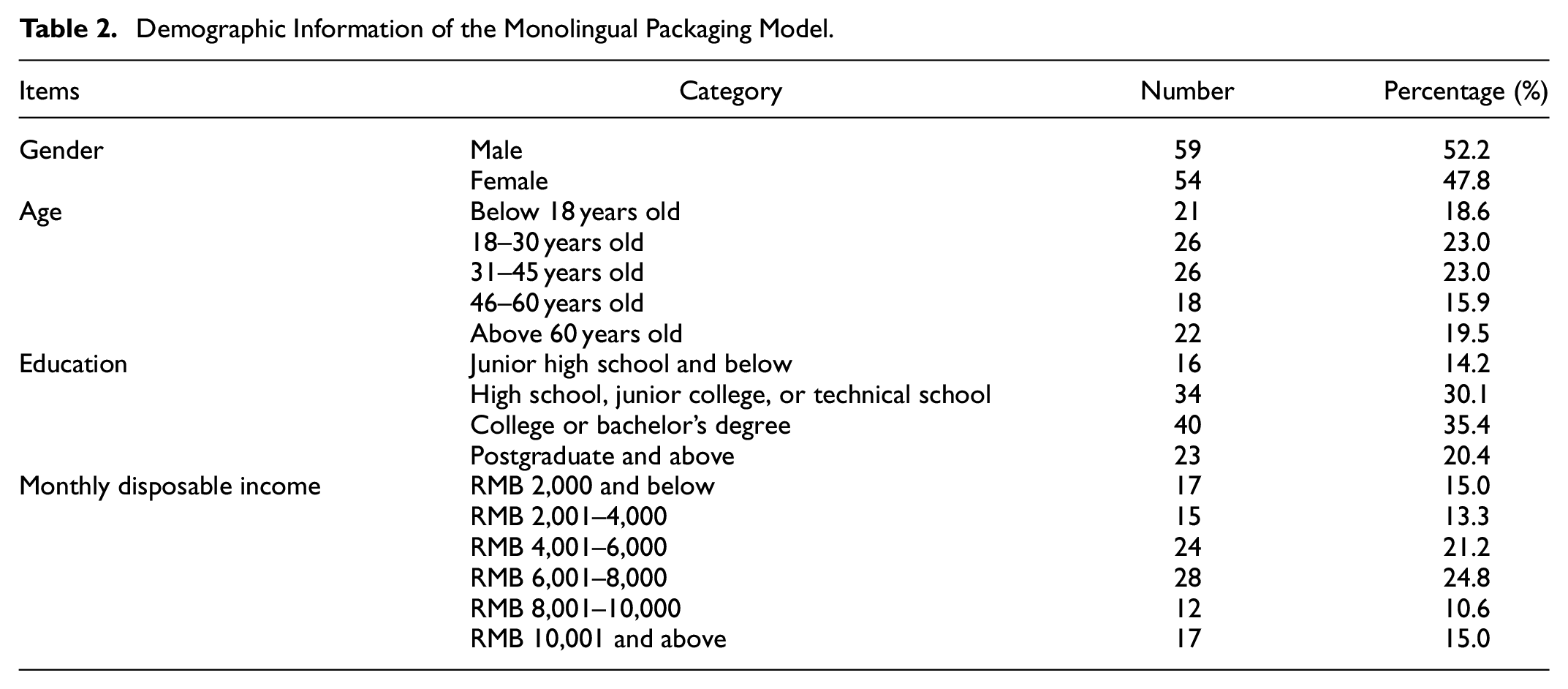
Sub-study 1 first presented pictures of sake in Japanese to the 138 respondents, as shown in Figure 2. Then the online professional research platform was used to distribute and collect the questionnaire data. After eliminating invalid questionnaires with incorrect answers, missing questions, and inconsistent logic, 113 valid questionnaires were finally obtained, with a questionnaire validity rate of 81.88%. In terms of gender, the number of men and women remained the same; 52.2% were men and 47.8% were women. Concerning age, the participants under the age of 45 account for 64.6%. Concerning educational background, several participants received a high school education or a bachelor’s degree totaling 74 persons, accounting for 65.5%. Regarding monthly disposable income, most of them had a monthly income from 6,001 to 8,000 yuan. The details are presented in Table 2.

Picture presentation of the monolingual packaging.
Demographic Information of the Monolingual Packaging Model.
Findings
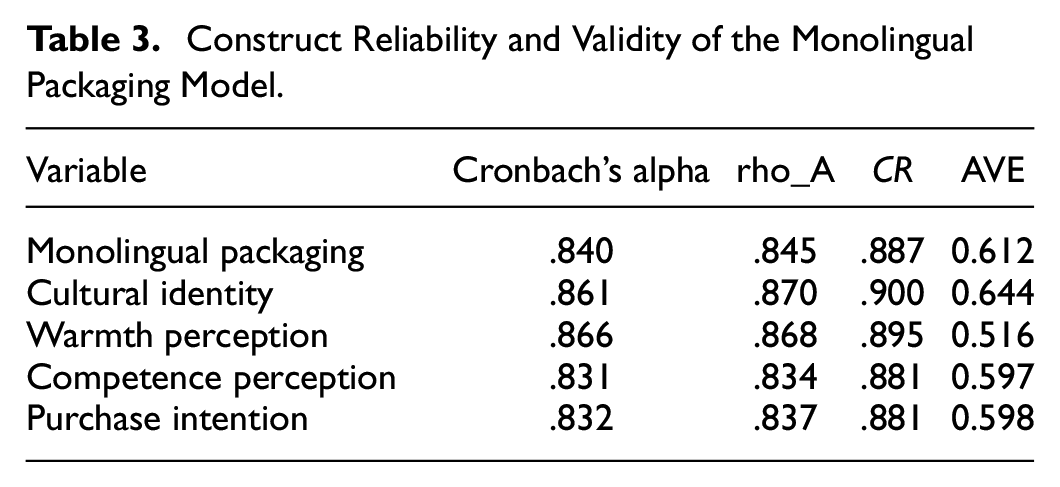
The measurement model analysis results are as follows. First, the PLS-SEM analysis results suggest that the factor distribution of each dimension conforms to the expected setting of the scale. To ensure the reliability of the data, the required indicators for the composition are above .65. The output results indicate that the data structure is relatively reasonable, and the five indicators required have received satisfactory feedback. Second, the standardized results are used for analysis. As listed in Table 3, the Cronbach’s alpha coefficient of each latent variable exceeded .8, the composite reliability (CR) exceeded .8, and the average variance extracted (AVE) exceeded 0.5. This indicated that the reliability and validity of each latent variable were significant. Third, as listed in Table 4, in the model test, the R2 values of warmth perception, competence perception, and purchase intention were all above .5, and the model fit index (NFI) was 0.742. This indicated that the model-fitting effect was robust in this study.
Construct Reliability and Validity of the Monolingual Packaging Model.
Predictive Power of the Monolingual Packaging Model.

The results of the structural model analysis are presented in Table 5. First, monolingual packaging had a significant positive effect on tourists’ competence perception and warmth perception (βcompetence = .599, p < .001; βwarmth = .240, p < .01), which is consistent with H1a and H2a. Second, monolingual packaging had a significant positive effect on tourists’ purchase intention (β = .335, p < .001), thus H3a is verified. Third, competence perception and warmth perception had a significant positive effect on tourists’ purchase intention (βcompetence = .216, p = .012; βwarmth = .469, p < .001), which is consistent with H1d and H2d. Fourth, both competence perception and warmth perception played a significant mediating role between monolingual packaging and consumers’ purchase intention (Pcompetence = 0.016; Pwarmth = 0.015), thus H1e and H2e are verified. Fifth, cultural identity had a significant moderating effect between language packaging and competence perception and warmth perception (Pcompetence = 0.032; Pwarmth = 0.008), thus H4a and H4b are verified.
Path Coefficients of the Monolingual Packaging Model.

Discussion
This sub-study explored the mechanism of tourists’ perceptions and purchase intention in the case of monolingual packaging, which provided preliminary support for the theoretical model of this study. By displaying pictures of sake in Japanese to the respondents, and analyzing the data from 113 questionnaires, the study suggests that when tourism products are packaged in one language, consumers’ competence perception and warmth perception are improved, thereby enhancing their intention to buy the products. However, the monolingual packaging will lead to enhanced tourists’ perception of the authenticity of tourism products, that is, the effect on competence perception is stronger than that of warmth perception. In addition, cultural identity also plays a significant moderating role between monolingual packaging and tourists’ perceptions, especially because it can strengthen tourists’ perception of warmth to balance the perceptions of competence and warmth of tourism products. However, this sub-study only discusses the case of the host country’s language (Japanese), which has limitations, and it is unknown whether and how the path mechanism will change if the international common language (English) is added to the product packaging, which leads to the next sub-study.
Sub-study 2: Products with Bilingual Packaging
Sub-study 2 incorporates an additional language based on Sub-study 1 to analyze how the monolingual packaging strategy affects tourists’ competence and warmth perceptions of international tourism products, as well as tourists’ purchase intention. Moreover, it explores how cultural identity moderates between bilingual packaging and competence perception and warmth perception to build the purchase intention promotion mechanism for products with bilingual packaging.
Sample and Methodology
Sub-study 2 first presented pictures of sake in Japanese and English to the 113 respondents, as shown in Figure 3. Then the online professional research platform was used to distribute and collect the questionnaire data. After eliminating invalid questionnaires with incorrect answers, missing questions, and inconsistent logic, 105 valid questionnaires were finally obtained, with a questionnaire validity rate of 92.92%. The number of men and women remained the same. Men were 45.7% and women 54.3%; the majority are under 45 years old, accounting for 61.9%. The educational background and monthly disposable income were distributed quite evenly. The details are presented in Table 6.
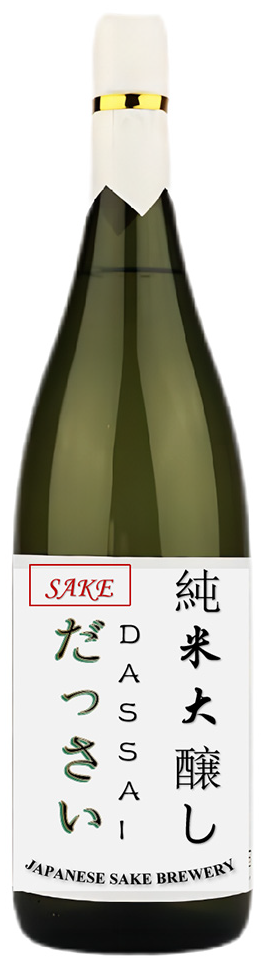
Picture presentation of the bilingual packaging.
Demographic Information of the Bilingual Packaging Model.

Findings
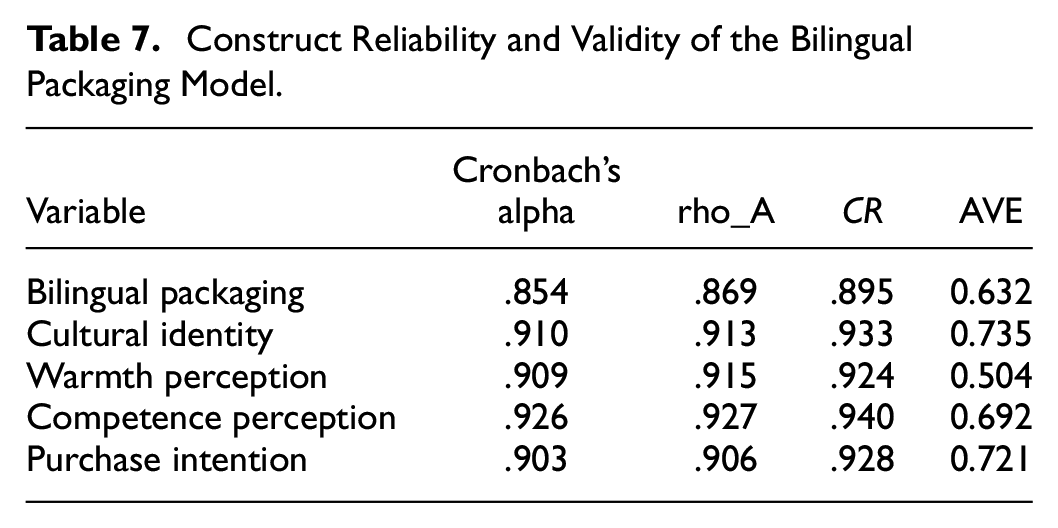
The measurement model analysis results are as follows. First, the PLS-SEM analysis results suggest that the factor distribution of each dimension conforms to the expected setting of the scale. To ensure the reliability of the data, the required indicators for the composition are above .65. The output results indicate that the data structure is relatively reasonable, and the five indicators required have received good feedback. Second, the standardized results are used for analysis. As listed in Table 7, the Cronbach’s alpha coefficient of each latent variable exceeded .8, the CR exceeded .8, and the AVE surpassed 0.5, indicating that the reliability and validity of each latent variable are high. Third, as listed in Table 8, in the model test, the R2 values of warmth perception, competence perception, and purchase intention all exceeded .75, while the model fit index (NFI) was 0.760. This indicated that the model fitting effect was robust in Sub-study 2.
Construct Reliability and Validity of the Bilingual Packaging Model.
Predictive Power of the Bilingual Packaging Model.

The results of the structural model analysis are presented in Table 9. First, bilingual packaging has a significant positive effect on tourists’ competence perception( β = .519, p < .001), and it has a significant negative effect on tourists’ warmth perception (β = −.264, p < .001), which is consistent with H1b and H2b. Second, bilingual packaging has a significant positive effect on tourists’ purchase intention (β = .205, p < .001), thus H3b is verified. Third, both competence perception and warmth perception can significantly and positively affect tourists’ purchase intention (βcompetence = .696, p < .001; βwarmth = .194, p = 0.015), which is consistent with H1d and H2d. Fourth, both competence perception and warmth perception play a significant mediating role between bilingual packaging and consumers’ purchase intention (Pcompetence < 0.001; Pwarmth = 0.034), thus H1e and H2e are verified. Fifth, cultural identity has a significant moderating effect between bilingual packaging and perceptions of competence and warmth (Pcompetence < 0.001; P warmth < 0.001), thus H4a and H4b are verified.
Path Coefficients of the Bilingual Packaging Model.

Discussions
Sub-study 2 adds the international common language (English) to Sub-study 1 to explore the mechanism of tourists’ perceptions and purchase intention in the case of bilingual packaging, which provides further support for the theoretical model of this study. Through presenting sake packaging containing Japanese and English to the respondents, and analyzing 105 measurement objects, the results suggest that the use of bilingual packaging for tourism products can enhance consumers’ competence perception, whereas the warmth perception will decline. However, owing to the greater effect of competence perception on purchase intention, bilingual packaging can enhance the purchase intention of products through competence perception. Cultural identity also plays a significant moderating effect between bilingual language packaging and perceptions of competence and warmth. Although this sub-study enriches the languages based on Sub-study 1 and discusses the combination of the host language (Japanese) and the international common language (English), however, as a result of the rapid expansion of the scale of the international tourism market, the number of tourists whose mother tongue is the large market language is increasing, and the language with a large proportion of market capacity will inevitably be used on the packaging of tourism products, which leads to Sub-study 3.
Sub-study 3: Products with Trilingual Packaging
Sub-study 3 adds one more language based on Sub-study 2 to analyze how the trilingual packaging strategy affects tourists’ competence and warmth perceptions of international tourism products as well as their purchase intention. Moreover, it explores how cultural identity moderates between trilingual packaging and competence perception and warmth perception to build the purchase intention promotion mechanism for products with trilingual packaging.
Sample and Methodology
This sub-study adopts a similar method. First, the pictures of sake in three languages (Japanese, English, and Chinese) were displayed to the respondents, as shown in Figure 4. Then the data were collected online, and 117 valid questionnaires were finally obtained. In terms of gender, the number of men and women remains the same, of which 47.9% are men and 52.1% are women; In terms of age, participants under the age of 45 account for 63.2%; In terms of educational background, the number of participants with junior college or a bachelor’s degree is the largest, with a total of 37 persons, accounting for 31.6%; Their monthly disposable income is mostly between 4,001 and 8,000 yuan. The details are presented in Table 10.
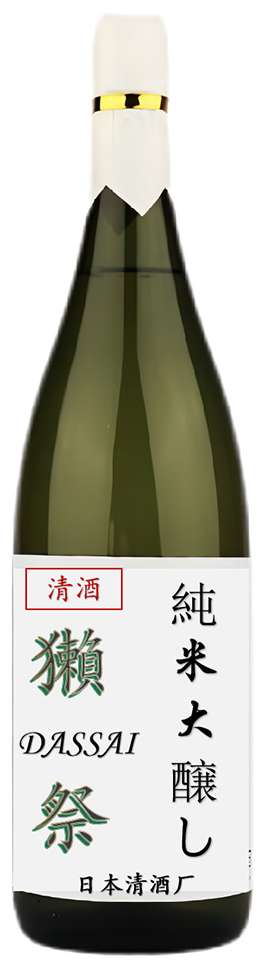
Picture presentation of the trilingual packaging.
Demographic Information of the Trilingual Packaging Model.

Results
The measurement model analysis results are as follows. First, the PLS-SEM analysis results suggest that the factor distribution of each dimension conforms to the expected setting of the scale. To ensure the reliability of the data, the required indicators for the composition are above .65. The output results indicate that the data structure is relatively reasonable, and the five indicators required have received good feedback. Second, the standardized results are used for analysis. As listed in Table 11, the Cronbach’s Alpha coefficient of each latent variable is greater than .7, the composite reliability (CR) is greater than .8, and the average variance extracted (AVE) is greater than 0.5, indicating that the reliability and validity of each latent variable are high. Third, as listed in Table 12, in the model test, the R2 values of warmth perception, competence perception, and purchase intention are all above .5, and the model fit index (NFI) is 0.797, indicating that the model fitting effect is good in Sub-study 3.
Construct Reliability and Validity of the Trilingual Packaging Model.

Predictive Power of the Trilingual Packaging Model.

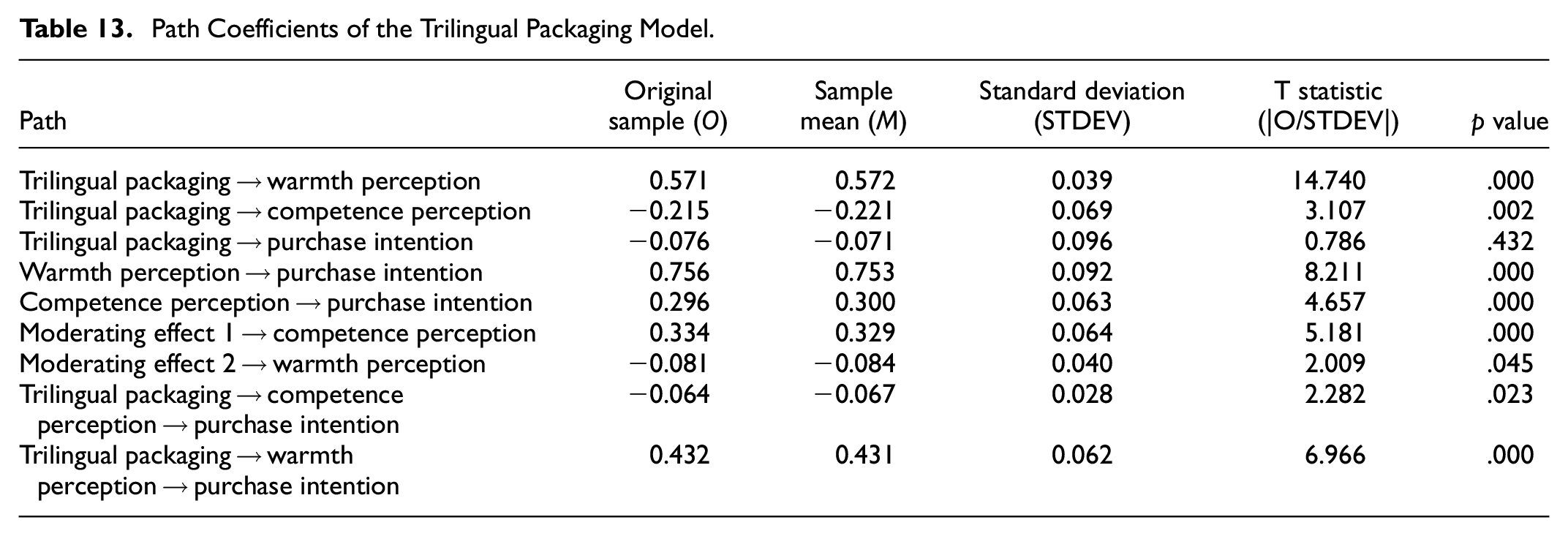
The results of the structural model analysis are presented in Table 13. First, trilingual packaging has a significant positive effect on tourists’ perception of warmth (β = .571, p < .001), which has a significant negative effect on tourists’ competence perception (β = −.215, p < .01), which is consistent with H1c and H2c. Second, trilingual packaging does not have a significant positive effect on tourists’ purchase intention (β = −.076, p = .432), thus H3c is not verified. Third, both competence perception and warmth perception can significantly and positively affect tourists’ purchase intention (βcompetence = .296, p < .001; βwarmth = .756, p < .001), which is consistent with H1d and H2d. Fourth, both competence perception and warmth perception play a significant mediating role between trilingual packaging and consumers’ purchase intention (Pcompetence = 0.023; Pwarmth < 0.001), thus H1e and H2e are verified. Fifth, cultural identity has a significant moderating effect between trilingual packaging and competence perception and warmth perception (Pcompetence < 0.001; Pwarmth = 0.045), thus H4a and H4b are verified.
Path Coefficients of the Trilingual Packaging Model.
Discussions
Sub-study 3 adds the large market language (Chinese) to Sub-study 2, which provides strong support for the theoretical model of this study. Through presenting sake packaging containing Japanese, English, and Chinese to the respondents, and analyzing 117 measurement objects, the results suggest that the use of trilingual packaging for tourism products can enhance consumers’ warmth perception whereas their competence perception declines, and consumers’ perceptions of value and quality also decline. However, because warmth perception has a greater effect on purchase intention, trilingual packaging can enhance the purchase intention of the products through warmth perception. Cultural identity also plays a significant moderating role between trilingual packaging and perceptions of competence and warmth.
Conclusions and Discussion
Conclusions
In the post-pandemic era, the consumption phenomenon with tourism shopping as the main purpose has attracted extensive attention from the industry and academia. It has become an urgent problem for tourism enterprises to think and explore how to skillfully use multilingual packaging strategies for tourism products, stimulate tourists’ perceptions (competence perception and warmth perception), and enhance tourists’ purchase intention in combination with cultural identity. As the language portfolio for tourism product packaging is different, tourists’ perceptions of product attributes will also be different. Therefore, this study makes an empirical analysis of the perceptions of competence and warmth in the multilingual packaging of tourism products and explores the moderating effect of cultural identity therein.
Firstly, the higher the level of authenticity of tourism products when they are packaged in one language, the higher the level of consumers’ perception of the brand value. In addition, tourism products packaged in one language can be used as gifts to convey tourists’ memories and emotions about tourism destinations, enhance the connection of tourists’ social relations, and improve consumers’ competence perception and warmth perception, which is moderated by cultural identity to enhance their purchase intention (Sub-study 1). Second, the use of bilingual packaging in tourism products can enhance consumers’ competence perception, whereas warmth perception will decline. However, because competence perception has a greater effect on purchase intention, bilingual packaging can enhance their purchase intention through competence perception, and cultural identity also plays a significant moderating role between bilingual packaging and perceptions of competence and warmth (Sub-study 2). Finally, when trilingual packaging is used for tourism products, it can enhance consumers’ warmth perception to the detriment of their competence perception and consumers’ perception of value and quality. However, owing to the greater effect of warmth perception on purchase intention, trilingual packaging can enhance their purchase intention of the products through warmth perception, and cultural identity also plays a significant moderating role between trilingual packaging and perceptions of competence and warmth (Sub-study 3).
In summary, this study reveals the mechanisms of the perceptions of competence and warmth behind different language packages, and how cultural factors affect the decision-making process of consumers, thus highlighting the role and importance of language packages in the transmission of emotions, brand value, social ties and so on. This not only helps to promote the development of market positioning and promotion strategies for tourism products but also provides new theoretical perspectives and empirical evidence for the study of cross-cultural marketing and consumer behavior.
Theoretical Implications
Theoretically, the findings of this study are of great significance in the following three aspects. First, starting from the multilingual packaging strategy that reflects the natural attributes of products, this study considers the effectiveness of multilingual packaging strategies for tourism products from the perspective of enterprises’ market positioning and tourist perceptions. Previous studies on tourism product strategies were mainly from the perspectives of national identity perception (Stone & Nyaupane, 2019), power perception (Kim et al., 2020b), and stereotype perception (Shen et al., 2019), but the basic fact that multilingual packaging strategy serves enterprises and tourists was ignored. Therefore, from the perceptive and emotional angles, this study proposes that in the post-pandemic era, enterprises can infer the target market groups of tourism products according to the language (portfolio) used in the tourism products packaging, and divide the product packaging language into monolingual, bilingual and trilingual versions; that is, tourists regard tourism products as targeted at a country or culture according to the packaging language portfolio, to provide new theoretical insights for the market positioning of tourism products of enterprises in the post-pandemic era.
Second, this study is not limited to the definition of tourism products in traditional tourism management research, namely, the concept of tourism souvenirs in a narrow sense (Ho et al., 2021; Keskitalo et al., 2021; Sthapit, 2018), but extends the concept of tourism products and summarizes its characteristics as competence attributes (authenticity and exoticness) and warmth attributes (affinity and connection) to further investigate the effects of multilingual packaging strategies on the basic attributes of tourism products, explore the attribute preferences of tourists for tourism products and final purchase decisions, and comprehensively and systematically consider the effect mechanism of multilingual packaging strategies on the purchase decision of tourism products in a broad sense to make theoretical contributions to the existing research on the purchase decision of tourism products.
Third, this study divides the multilingual scenes into monolingual, bilingual, and trilingual, comparing the effects of multilingual packaging on tourists’ competence perception and warmth perception under the three language scenarios, which confirms that under the monolingual packaging, the consumer’s competence perception and warmth perception will be improved; under the bilingual packaging, consumers’ competence perception is enhanced, but the warmth perception will be weakened; and under the trilingual packaging, consumers’ warmth perception is enhanced, but their competence perception will be weakened. This shows that the cultural connotation and emotional connection in different multilingual packaging scenarios will be biased. Therefore, this study proposes that the advantages of different languages can be weighed, thus furnishing novel ideas in the marketing field in the post-pandemic era.
Practical Implications
The diversified market characteristics of the international tourism market make it difficult for enterprises to grasp the needs of consumer groups and their positioning. Based on the basic characteristics of the international tourism market and the market positioning of enterprises, this study attempts to divide multilingual strategies into monolingual, bilingual, and trilingual forms to deeply discuss the effects of three types of language packaging on tourists’ purchase decisions of tourism products to provide managerial enlightenment for tourism enterprises to grasp the reasonable positioning of tourism product sales in the international tourism market in the post-pandemic era and formulate reasonable and effective packaging strategies of tourism products.
This study suggests that in the post-pandemic era, enterprises should focus on the internal needs of consumers in the process of formulating tourism product packaging language strategies. In the purchase decision of tourism products, tourists will not only pay attention to the tourism destination characteristics of tourism products (i.e., the symbolic characteristics such as authenticity and place of origin realization) but also consider the characteristics of pragmatic tendencies such as affinity and connection of tourism products. When enterprises adopt a specific packaging language strategy, they often need to make trade-offs between different characteristics. For instance, when enterprises adopt trilingual designs including Japanese, English, and Chinese on sake products, they must weigh the authenticity and affinity of products. Moreover, in this process, the factor of consumer cultural identity should be considered, which will facilitate tourism enterprises to understand better the consumption needs of tourists (Yi et al., 2021), design packaging language strategies closer to the tourists’ consumption needs, improve the competitiveness of tourism products and enhance the image of tourism destinations.
Research Limitations and Prospect
This study explores the mediating role of competence and warmth perceptions between multilingual packaging (monolingual, bilingual, and trilingual) of tourism products and tourists’ purchase intention, as well as the moderating role of cultural identity to build the purchase intention promotion mechanism. However, owing to various subjective or objective reasons, this study is unavoidable with limitations. First, although this study discusses the effect of competence perception (authenticity and exoticness) and warmth perception (affinity and connection) produced by multilingual packaging on purchase intention, this approach is not the only one, and subsequent studies can attempt to explore this mechanism from different theoretical perspectives. Second, this study only discusses the moderating role of cultural identity between multilingual packaging and tourist perceptions, but they may be affected by consumers’ characteristics and knowledge structure, which can be further explored in subsequent research. Third, this study considers the natural attributes of tourism products and takes them as part of the experimental design, however, it does not verify whether the environmental factors will affect tourists’ perceptions and purchase intention. Therefore, future research can consider the role of environmental factors and expand the theoretical model of this study to further deepen the sustainable development concept of tourism in the post-pandemic era.
Footnotes
Acknowledgements
We appreciate the time and effort that reviewers put into reviewing our manuscript and providing us with valuable comments and suggestions.
Declaration of Conflicting Interests
The author(s) declared no potential conflicts of interest with respect to the research, authorship, and/or publication of this article.
Funding
The author(s) disclosed receipt of the following financial support for the research, authorship, and/or publication of this article: This study is supported by the funding of Social Science Planning Project in Nanchang City (XW202404); Humanities and Social Sciences Planning Fund of the Ministry of Education (24YJA860021); National Social Science Fund Post-funding Project (22FXWB020); Graduate Innovation Special Fund Project in Jiangxi Province (YC2023-S431); The 18th Student Research Project of Jiangxi University of Finance and Economics (20231013234221093); National Natural Science Foundation of China (72102151); National Natural Science Foundation of China (72362017); National Statistical Science Research Project (2024LZ030); Ganpo Talent Support Program for Cultural Leaders Funding Project.
Ethical Approval
All procedures performed in studies involving human participants were in accordance with the ethical standards of the institutional and/or national research committee and with the 1964 Helsinki declaration and its later amendments or comparable ethical standards.
Informed Consent
Informed Consent was obtained from all participants included in the study.

Data Availability Statement
All data relevant to the study are included in the article. In addition, the data that support the findings of this study are available from the corresponding author on reasonable request, but restrictions apply to the availability of these data, which were used under license for the current study, and so are not publicly available.