




Abstract
The research is conducted with employees in the textile sector operating in Kahramanmaraş/Türkiye. The study aims to examine the effect of inclusive leadership on employees’ innovative work behavior, as well as the mediating roles of trust in leader and psychological empowerment in this interaction. This cross-sectional study collected data from 275 employees in the textile industry of Kahramanmaraş/Türkiye. The data were analyzed by the structural equation modeling (SEM) method using SmartPLS 4 software. The results of the analysis revealed that inclusive leadership has a direct positive effect on IWB. In addition, it was determined that inclusive leadership increases psychological empowerment and trust in leader. While psychological empowerment was found to have a significant mediating role in the relationship between inclusive leadership and innovative work behavior, the mediating role of trust in leader was not supported. The findings suggest that focusing on psychological empowerment in inclusive leadership practices is effective in increasing IWB. The limited effect of trust in leader on innovative work behavior indicates the complexity of leadership and employee interactions. Theoretical and practical implications and recommendations are presented at the end of the study.
Keywords
Introduction
The Turkish textile and raw materials sector exported approximately $9.56 billion in 2023, exporting 2.33 million tons of products (Türkiye İhracatçılar Meclisi (Turkish Exporters Assembly), 2024). Furthermore, the sector holds a prominent position in the global value chain, with a network structure that exports to 199 countries and free zones (e-Textile Magazine, 2023). However, cost pressures, increased competition, and particularly the impact of the February 6, 2023, earthquake—as cities like Gaziantep, Malatya, and Kahramanmaraş play a critical role in Türkiye’s textile production—have created chain reactions, from production capacity and logistics to labor access (Vogue Business, 2024). These multifaceted pressures are weakening the ability to compete with traditional mass-production processes and driving companies to integrate innovative approaches, digitalization, and sustainable production. Therefore, analyzing the impact of individual and organizational variables, such as inclusive leadership, psychological empowerment (PE), and trust in leaders, on innovative work behavior is of great importance for providing a scientific basis for sectoral transformation strategies.
In a rapidly changing business world full of uncertainties, one way for organizations to gain a competitive advantage and make it sustainable is to produce continuous innovation (Anderson et al., 2014). A significant part of an organization’s capacity to produce innovation stems from innovative work behavior (IWB), new idea proposals, and creative behaviors exhibited by employees (Scott & Bruce, 1994). IWB not only enhance product and service quality but also facilitate organizational adaptation to environmental changes (Janssen, 2000).
IWB is defined as the set of creative actions that employees voluntarily exhibit to improve existing work processes, generate new ideas, and translate these ideas into practice. These behaviors support not only individual creativity but also the adoption of innovation within the organization and the establishment of a culture of continuous improvement. Therefore, employees’ IWB have become a critical factor in increasing business competitiveness and adapting to changing environmental conditions (Amankwaa et al., 2019; Karimi et al., 2023). When considered specifically in the textile sector, the sectoral implications of IWB are quite evident. Rapidly changing fashion trends, pressure for sustainable production, and the integration of digital technologies highlight employees’ innovative thinking skills in textile businesses. Technological innovations that increase production process efficiency, the use of environmentally friendly materials, and creative design practices are becoming key elements in achieving competitive advantage in the sector (Harsanto et al., 2023).
IWB are complex processes that require security and psychological support from employees, as they involve uncertainty, risk, and sometimes deviation from organizational norms (Carmeli et al., 2006). This complex process underscores the importance of understanding how leadership styles impact employees. Previous research has shown that different leadership styles and psychosocial factors encourage employees’ innovative behaviors; these studies reveal that leadership has indirect effects through variables such as motivation, PE, and organizational commitment (Ajmal et al., 2025; Ekmekcioglu & Öner, 2024; Islam et al., 2024; Lee & Seo, 2024).
More specifically, studies in the textile industry have found that inclusive leadership (IL) plays a critical role in increasing employees’ IWB (Javed et al., 2017, 2021; M. Khan et al., 2017). By creating an environment where employees can freely express their ideas, inclusive leaders foster PE and a perception of trust in the leader; these mechanisms support the emergence of risk-taking innovative behaviors (Carmeli et al., 2010; Zhu et al., 2019).
The literature frequently uses social exchange theory (SET) to explain how participative leadership enables employees to express themselves and contribute to the organization’s benefit (Eva et al., 2019; Usman et al., 2021). According to SET (Blau, 1964), individuals tend to respond positively to beneficial behaviors based on the principle of reciprocity in their social relationships. Inclusive leaders value employees, include them in decision-making processes, and make their individual contributions visible. This approach creates a social exchange dynamic within the organization, leading to PE for employees and trust in their leaders. Thus, employees are more likely to engage in risky, innovative behaviors (Carmeli et al., 2010; Cropanzano & Mitchell, 2005).
This framework also supports the importance of high-quality leader-employee relationships, as demonstrated by Leader-Member Exchange (LMX) theory (Graen & Uhl-Bien, 1995). According to LMX theory, strong relationships based on trust between leaders and employees increase employees’ IWB through mutual commitment, support, and knowledge sharing. Therefore, inclusive leaders can strengthen employees’ innovative behaviors through both social exchange and LMX-based interaction mechanisms.
PE relates to individuals feeling competent, meaningful, and autonomous in their work processes (Spreitzer, 1995). When employees feel listened to and their ideas valued by inclusive leaders, their perception of control and influence increases. This increases their level of ownership of their work, paving the way for them to voluntarily exhibit innovative behaviors (X. Zhang & Bartol, 2010). Therefore, PE is one of the key psychological mechanisms through which IL increases employees’ propensity for innovation.
Trust in the leader, on the other hand, reflects employees’ belief that their leaders are fair, supportive, and predictable (Dirks & Ferrin, 2002). Because IWB inherently involves risk, employees must trust their leaders to engage in such behaviors. When trust develops, employees believe that potential failures will not be punished and receive psychological support from their leaders. Thus, an environment of trust facilitates the sharing, testing, and maintenance of innovative ideas (Carmeli & Spreitzer, 2009).
However, there is insufficient research on how and in which ways IL fosters employees’ innovative ideas. Moreover, the psychological elements (e.g., trust in leader and PE) that influence the emergence of IWB of inclusive leaders have not been addressed holistically (Javed, Abdullah et al., 2019; Y. X. Wang et al., 2019). In particular, there is a lack of an explanatory model in the literature on how PE, which occurs when employees feel more powerful and valuable in their relationship with an inclusive leader, affects their tendency to exhibit innovative behaviors.
Similarly, trust in leader (TIL) is assumed to provide a foundation of “psychological safety” for individuals to participate in innovation processes that involve uncertainty. However, empirical support for this relationship is weak (A. C. Edmondson & Lei, 2014). Furthermore, most studies have focused on the service or IT sectors. In contrast, studies in manufacturing-dominated fields such as the textile sector, known for its intense competition and traditional structures, are quite limited.
In this context, the main research question is, “Through what processes does inclusive leadership influence employees’ innovative work behavior?” This study examines the impact of IL on IWB, with PE and TIL as mediating factors. Previous research has been limited in its holistic consideration of these two mediating variables. Most studies have focused on the service or IT sectors, and the manufacturing and textile contexts have not been sufficiently explored. However, the Kahramanmaraş textile sector presents a unique environment characterized by a tightly hierarchical culture, intense competition, labor-intensive production processes, and traditional leadership patterns. In particular, the damage and workforce losses in production facilities following the 2023 earthquake have necessitated companies to strengthen traditional production processes with innovative methods.
This study offers a unique context for examining the psychosocial processes through which IL drives IWB. This research distinguishes itself from previous studies by simultaneously examining the relationship between IL and IWB, with PE and TIL acting as mediating mechanisms. This holistic approach contributes to the literature, both conceptually and empirically, by revealing the multilayered nature of leader-employee interactions in the context of innovative behavior.
Moreover, the study’s results are valuable not only theoretically but also practically. In post-disaster reconstruction processes, they provide significant evidence that IL and trust-based relationships can enhance organizational resilience by strengthening employees’ innovative potential. In this respect, the study clarifies the fundamental dynamics that shape employees’ innovative behavior through the perspectives of inclusive leadership, LMX, and SET, and offers a guiding framework for both academic literature and practitioners.
The other parts of this study are structured as follows: First, the conceptual framework and the related literature are examined in detail, and then hypotheses are developed. In the next section, methodological approaches, sampling, measurement tools, and analysis techniques are explained. The Findings section presents the test results of the hypotheses, followed by a Discussion section where the findings are interpreted in comparison with the literature. Finally, the theoretical and practical contributions, limitations, and suggestions for future research are presented.
Literature Review and Hypothesis Development
SET is widely used to explain the dynamics of interaction within organizations. SET was theorized by Blau (1964) and argues that people tend to respond positively to positive behaviors. This principle of reciprocity states that when employees feel valued and supported at work, they respond with supportive behaviors in return (Cropanzano & Mitchell, 2005). This positive interactional environment, as predicted by SET, can facilitate employees’ ability to bring forward innovative business ideas. When inclusive leaders make their employees feel valued, employees’ trust in their leaders increases, leading them to feel more empowered and more able to bring forward innovative ideas within the organization (Elsetouhi et al., 2023; Fatima et al., 2017; Mata et al., 2023).
Here, LMX theory plays a critical role in explaining the application of SET at the individual level. LMX argues that the quality of the relationship between the leader and each employee determines outcomes such as support, feedback, and access to resources (Graen & Uhl-Bien, 1995). The reciprocity mechanism predicted by SET operates more strongly in high-quality LMX relationships; employees reciprocate the support and value they receive from the leader with higher levels of PE and innovative behavior. Therefore, behaviors such as tolerance, guidance, and appreciation provided by inclusive leaders to their employees increase employees’ psychological safety and sense of belonging at the individual level through LMX (Javed et al., 2017).
Within the LMX framework, trust increases the stability and interactional intensity of the leader-employee relationship (Dirks & Ferrin, 2002). When the general principles of SET and the relationship-focused approach of LMX are combined, leaders’ fairness, consistency, and supportive attitudes motivate employees’ interactive collaboration (IWB) and innovative behavior. In this context, interactive collaboration can be viewed as value-adding behaviors that employees develop based on the trust and support they receive from their leaders (A. Al Daboub et al., 2024).
In summary, this study uses SET and LMX theories together to explain the effects of IL on employees’ PE and IWB. At the same time, SET provides the general reciprocity mechanism, LMX models individual differences and interaction intensity by revealing the quality of leader-employee relationships. Thus, employees’ innovative behaviors are shaped not only by the leader’s behavior but also by the quality of the leader-employee relationship (Alwali, 2024; M. Grošelj et al., 2021; X. Zhang et al., 2022).
Inclusive Leadership and Innovative Work Behavior
IL is defined as a leadership style in which employees are encouraged to participate in organizational processes and are appreciated (Nembhard & Edmondson, 2006). IL is important for strengthening the sense of belonging in the workplace in terms of including employees with different characteristics (Randel et al., 2016). Inclusive leaders are managers who are successful in making employees feel valued and validated, providing respect and emotional support to employees (Nguyen et al., 2019; Ospina & El Hadidy, 2011). According to another definition, IL is “a management approach that respects diversity, encourages open communication and collaboration, and has a high tolerance for error” (Carmeli et al., 2010).
The positive structure of IL provides positive outcomes for organizations. According to the research on these positive outcomes, IL increases IWB (Guo et al., 2022; Lee & Seo, 2024; Sürücü et al., 2023) and supports creativity (Fu et al., 2022; J. Jia et al., 2022). IWB are defined as “the development and implementation of new and useful ideas by employees” (De Jong & Den Hartog, 2010; Farr & Ford, 1990). In this context, leaders need to create an environment that values employees’ ideas, supports innovative business ideas, and transforms these ideas into actionable behaviors. Thus, employees’ innovative ideas can be freely revealed within the organization (Carmeli et al., 2010). Like this view, previous research indicates that supportive environments facilitated through IL promote innovative behavior (Sürücü et al., 2023).
A study in the textile sector in Pakistan indicates that IL positively affects IWB (Javed, Naqvi et al., 2019). Similarly, Javed et al. (2021) found that IL is positively associated with IWB in their study examining small-capital, change-oriented textile firms. The path analysis results of another study conducted in the textile, banking, and tourism sectors in Türkiye also indicate that IL can increase employees’ IWB (Çetinkaya & Yeşilada, 2022).
Another study conducted by Shakil et al. (2023), based on SET, supports the literature. SET-based studies have shown that IL creates a harmonious organizational climate and strengthens employees’ innovative behaviors in line with their creative self-efficacy; this supports IWB and the sustainable development of businesses (G. Zhang & Zhao, 2024). Additionally, another study examining the relationship between IL and team innovation was conducted through the SET perspective (Duc & Tho, 2025).
In studies conducted in various sectors, especially in the health sector (AlMulhim & Mohammed, 2023; Javed et al., 2021; Mansoor et al., 2021; Qi et al., 2019; Shakil et al., 2023; Y. X. Wang et al., 2019; Zafar et al., 2024). Research has shown that leaders’ inclusive behaviors positively impact IWB. The previous research results align with the SET. According to SET, leaders’ positive attitudes toward employees will increase their tendency to make efforts for the benefit of the organization (Umrani et al., 2024).
Additionally, the LMX (Leader-Member Exchange) theory perspective suggests that the quality of the individual relationships established by IL with employees plays a critical role in supporting IWB. High-quality leader-employee relationships make employees feel valued, enhance trust, and facilitate initiative and innovative behaviors (Graen & Uhl-Bien, 1995; Ilies et al., 2007). In this context, the impact of IL on IWB can be explained through both the reciprocity mechanism of SET and the individual relationship quality of LMX. The research hypothesis, which was formulated by considering the results of previous research and inferences based on SET, is as follows:
Inclusive Leadership and Psychological Empowerment
The concept of PE has received increasing attention in the management and organization literature since the early 1990s (Mathew & Nair, 2022). Conger and Kanungo (1988) defined PE as the leader’s sharing of power with subordinates in a dynamic, reciprocal relationship, treating empowerment as a relational construct in management practices (Llorente-Alonso et al., 2024). PE is essentially a motivational concept that refers to the quality of individuals’ relationship with their job role and their motivation to fulfill this role (Maynard et al., 2012; Spreitzer, 1995). Thomas and Velthouse (1990) explained PE in terms of four basic cognitive components: meaningfulness of work, belief in one’s own competence, a sense of self-determination over work, and a sense of having influence over the outcomes of one’s work. The integration of these components increases employees’ intrinsic motivation.
The relationship between IL and PE can be explained by SET (Alwali, 2024; Blau, 1964). According to SET, positive approaches by leaders toward employees strengthen employees’ sense of reciprocity (Cropanzano & Mitchell, 2005) and create an environment where every voice is truly valued (Lee & Seo, 2024). This increases mutual trust, well-being, and a sense of belonging by making employees feel valued and accepted within the organization (Clarke et al., 2025; Dadam & Viegi, 2024; Mohase et al., 2025; Shafaei et al., 2024).
Psychological safety within the organizational environment plays a vital role in creating an environment where individuals feel comfortable expressing their ideas, engaging in open dialog, and challenging the status quo (A. C. Edmondson, 2018). In response to positive behavior, employees can feel more empowered and empowered to make positive contributions on behalf of the organization; This increases employees’ motivation to add value to the organization (Çetinkaya & Yeşilada, 2022; Siyal et al., 2023). This psychological safety climate created by the leader positively affects perceptions of meaning, competence, autonomy, and authority, components of PE (Creon & Schermuly, 2025).
Recent studies reveal that IL affects PE in various ways. For example, Javed, Abdullah et al. (2019) showed that constructive dialogs established by inclusive leaders with employees support PE by increasing employees’ perceptions of the meaningfulness of work. Younas et al. (2023) stated that IL directly increases employees’ PE, thereby increasing their voice in the organization. Similarly, Kumari et al. (2025) reported that IL positively affects employees’ PE by creating a safe work environment. The impact of IL on PE occurs by strengthening employees’ sense of meaning in their work and organization, developing their competencies, and increasing their autonomy (M. A. Khan et al., 2020; Siyal et al., 2023).
Furthermore, leader behaviors such as humility and inclusiveness further enhance PE by reinforcing employees’ sense of trust and belonging (Mrayyan & Al-Rjoub, 2024; Qu et al., 2024). In other words, IL supports PE by increasing the meaningfulness of employees’ work, enhancing their learning levels, and providing autonomy (M. A. Khan et al., 2020; Siyal et al., 2023). Consequently, SET contributes to the PE process by establishing a reciprocity-based relationship between the leader and the employee. In line with this theoretical framework and previous studies, it can be predicted that IL will increase employees’ PE levels. Therefore, the hypothesis is as follows.
Inclusive Leadership and Trust in Leader
Trust is considered one of the main pillars of sustainable and healthy interactions in both individual and organizational relationships. Rousseau et al. (1998) defined trust as “a psychological state comprising the intention to accept vulnerability based upon positive expectations of the intentions or behaviour of another.” In this framework, TIL is defined as the state of having a positive expectation of the leader’s intentions and behaviors, especially in conditions involving uncertainty or risk (Gao et al., 2011).
The relationship between IL and TIL can be explained through two main theoretical approaches in the literature: SET (Blau, 1964) and LMX Theory (Graen & Uhl-Bien, 1995). SET explains why trust develops, while LMX helps explain how trust develops. Sürücü et al. (2023) conducted a study in the Turkish context, showing that inclusive leaders develop trust-based leader-member relationships through openness and participation behaviors. This finding supports the LMX theory prediction that IL shapes employee attitudes through trust-based social bonds. This is because IL is positively associated with LMX (S. Wang et al., 2025). Masih et al. (2025) demonstrated that IL influences change-oriented extra-role behaviors in employees through LMX and trust in the leader. Research findings indicate that IL first enhances LMX quality, which, in turn, strengthens employees’ perceptions of trust in the leader’s fairness and goodwill. Thus, IL contributes to the strengthening of trust through both direct and relational processes. However, the literature on how inclusive leaders build employee trust is limited. Therefore, the theoretical underpinning of SET is important in establishing the theoretical framework for this relationship. According to SET, trust plays a crucial role in the relationship between leaders and employees (Blau, 1964).
One of the important antecedents of trust in a leader is the leader himself/herself. In fact, studies have frequently examined the relationship between leadership types and TIL (Enwereuzor et al., 2020; Jaiswal & Dhar, 2017; Javed et al., 2018; Joseph & Winston, 2005; Ötken & Cenkci, 2012; Podsakoff et al., 1990). The type of communication and relationship that the leader has developed with the employee directly affects the trust of the employee toward the leader. In terms of IL, inclusive leaders have characteristics such as respecting the views of subordinates, encouraging their participation in decisions, and embracing their differences, making it easier for employees to feel that the leader is trustworthy (Masih et al., 2025; Orekoya, 2024; Siyal, 2023). The literature on how inclusive leaders develop employees’ TIL is not extensive. Therefore, the theoretical support of SET is important in establishing the theoretical framework of this relationship. According to SET, trust plays an important role in the relationship between leaders and employees (Blau, 1964). The inclusive leader’s encouragement of participation and the creation of a fair work environment help the development of trust between employees and the leader (Cropanzano & Mitchell, 2005; Nembhard & Edmondson, 2006). The behaviors of inclusive leaders that take into account the employees provide the conditions for change by creating an environment of trust (Orekoya, 2024; Raiz et al., 2023; Siyal, 2023; Siyal et al., 2023). As a result, when SET and previous research results are considered together, IL is expected to positively affect employees’ TIL. Therefore, the hypothesis is as follows;
Psychological Empowerment and Innovative Work Behavior
Innovative business behaviors have become a critical success factor for businesses in an increasingly competitive environment (Canet-Giner et al., 2020). In this environment where competition intensifies, the introduction of new and creative ideas stands out as one of the key factors that directly affect the performance of businesses (Rubera & Kirca, 2012; Utomo et al., 2023). In this context, both practitioners and researchers focus on which factors should be activated to support employees’ innovative behaviors (M. A. Khan et al., 2020; Kustanto et al., 2020).
Although strategic decisions about innovation are usually made by top management (Damanpour & Schneider, 2006), the spread of innovation within the organization and the achievement of success largely depend on employees’ IWB (Mytelka & Smith, 2002). Therefore, employees need to be psychologically empowered in order to exhibit innovative behaviors (Spreitzer, 1995). In the literature, it is emphasized that PE has a positive effect on employees’ IWB (Al Nahyan et al., 2025; Javed, Abdullah et al., 2019; Muktar & Kassie, 2022). Conger and Kanungo (1988) defined PE as the individual’s confidence in his/her abilities and skills and stated that this is an important source of motivation in participating in innovative activities.
PE increases employees’ perceptions of competence and authorization. Additionally, employees begin to feel that they are less restricted by rules and management (Ryan & Deci, 2000). Increased self-confidence in the employee can enable them to take the initiative to generate new ideas (Yasir et al., 2023). Employees who perceive themselves as competent can express their innovative business ideas freely (Stanescu et al., 2021).
The literature on the impact of employee empowerment on IWB also draws on the implications of the SET framework. According to SET’s principle of reciprocity, employees are empowered within the organization. Empowerment, increased competencies, and autonomy strengthen the employee’s search for meaning and motivation toward work (Wu & Lee, 2017). Employees strive to repay the organization by making positive contributions in return for the benefits they have received from the organization and their managers. For employees, PE involves fulfilling their responsibility to make a positive contribution to the organization in return for the benefits they receive. When SET and previous research results are considered together, PE is expected to lead to increased IWB among employees. The research hypothesis formed with this idea is as follows;
Trust in Leader and Innovative Work Behavior
With the rise of the knowledge economy, intellectual capital and creative human resources have become increasingly important for the sustainability of firm success (O’Donovan, 2020). In this context, employee-oriented approaches, as well as organization-oriented policies, have gained importance in supporting the generation of innovative ideas. While the organization-focused perspective emphasizes that organizational structures and policies should be shaped to encourage innovation (Al-Romeedy & Khairy, 2024; De Clercq & Pereira, 2024; N. Jia, 2024; Kaur & Kang, 2023), employee-focused perspectives reveal that trust-based work environments can positively affect IWB (Ataei et al., 2024; Hanifah et al., 2022; Konno & Schillaci, 2021).
In employee-oriented approaches, it is argued that leadership behaviors play a decisive role in employees’ perception of trust and innovative behaviors (Kmieciak, 2021; Rockstuhl & Ng, 2015; Z. Wang et al., 2019). The quality of interactions between leaders and employees is critical in creating innovative work environments by shaping employees’ attitudes and behaviors (Harris et al., 2014). Moreover, leaders emerge as strategic actors in creating working conditions that foster IWB (Friedman & Carmeli, 2018; Rosdaniati & Muafi, 2021).
It is widely reported in the literature (Alwali, 2024; Hadi et al., 2024; Pham et al., 2024) that different leadership styles positively affect employees’ innovative and creative behaviors by increasing their sense of trust and thus contribute to the development of innovative work environments (Caniëls & Veld, 2019). Leaders gaining the trust of their followers (Bennis & Nanus, 1997), leading with their decisions and behaviors (Mayer et al., 1995), and assuming responsibility (Shapiro, 1990) are among the important components of this process.
Research on the effect of TIL on IWB has important implications. According to these studies, the leader’s positive and consistent behaviors lead to the perception of trust in the leader. TIL will increase the employee’s tendency to contribute to the solution of organizational problems (Masood & Afsar, 2017; Min & Ko, 2015; Taştan & Davoudi, 2015). Since TIL will reduce employees’ uncertainty, anxiety, and fear, employees can present their innovative and problem-solving ideas with confidence (Afsar & Masood, 2018). In line with the theoretical implications of SET, it means that the necessary environment is provided for employees to share their innovative ideas comfortably (Afsar & Masood, 2018; Chen & Sriphon, 2022; Connelly et al., 2012). When SET and the evidence in the literature are considered together, TIL is expected to increase employees’ IWB. The hypothesis based on this interest is as follows;
Mediating Role of Psychological Empowerment
Previous studies have demonstrated the relationships between inclusive leadership, PE, and IWB. This study aims to examine the mediating role of PE in the relationship between IL and IWB within the framework of SET. According to SET, the trust-based climate and reciprocity and trust-based relational processes that leaders establish with employees can shape both employee attitudes and innovative behaviors. Psychologically empowered employees can generate new ideas without fear of being belittled, ostracized, or dismissed. Therefore, we chose PE as the mediating variable (Ashford et al., 2009).
A review of the literature found that inclusive leadership, both directly and indirectly, increases IWB across sectors. For example, a study conducted by Alwali (2024) in higher education institutions also found that IL directly increases IWB. The researcher found that PE increases academics’ innovative behavior by enhancing inclusive leadership. A study by Çetinkaya and Yeşilada (2022) in the tourism, textile, and banking sectors found that transactional leadership increased employees’ PE, which, in turn, positively affected their IWB. A study conducted by Javed, Abdullah et al. (2019) in the information technologies and cargo sectors found that PE mediated the effect of IL on IWB.
Tamasevicius et al. (2025), in their study conducted with professionals in different sectors, found that IL contributes to employees’ IWB by providing PE. Mert and Aslan (2021) conducted a study in plastics, machinery, and textile factories and found that IL increases IWB through PE.
Although literature on the role of PE in the effect of IL on IWB exists, it is not yet mature; some studies suggest that PE is critical in the effect of IL on IWB (M. Ali et al., 2020; Alwali, 2024; Amırlı & Bakan, 2024; Çetinkaya & Yeşilada, 2022; Javed, Naqvi et al., 2019; Toros et al., 2021).
While previous research results provide evidence for the relationships among IL, PE, and IWB, SET strengthens the logical basis for these relationships. As repeatedly emphasized, SET suggests that employees tend to exhibit positive behaviors in response to the inclusive and supportive attitudes of their leaders (Blau, 1964). From this perspective, IL enables employees to be psychologically empowered, develop their competencies, and enable them to act autonomously in their jobs (Keller & Dansereau, 1995; X. Zhang & Bartol, 2010). These behaviors are considered indicators of PE. Psychologically empowered employees are expected to be open to solving problems and offering innovative ideas (Alwali, 2024; Amabile & Pratt, 2016). Considering the theoretical foundations of SET and previous research, inclusive leaders are expected to increase employees’ IWB by elevating their PE levels. The research hypothesis based on this idea is as follows.
Mediating Role of Trust in Leader
Research across various sectors demonstrates that TIL plays a critical role in fostering IWB. For example, Min and Ko (2015) found that TIL significantly supports innovative behavior among Korean airline service employees. Afsar and Masood (2018) obtained similar results in their study with nurses. Taştan and Davoudi (2015) also observed positive relationships between TIL and IWB in studies conducted in the finance, banking, IT, telecommunications, and education sectors.
These results suggest that TIL supports innovation, particularly in service and knowledge-intensive sectors. Conversely, in labor-intensive and hierarchical sectors, such as production-oriented industries like textiles, employees may perceive greater risks when sharing innovative ideas; therefore, the effect of TIL on motivating innovative behaviors may be limited. From a SET and LMX perspective, inclusive leaders increase employees’ trust perceptions by establishing high-quality leader-member relationships and, in turn, support PE (Blau, 1964; Graen & Uhl-Bien, 1995; Javed, Abdullah et al., 2019; Younas et al., 2023). Psychologically empowered employees are more willing to take risks and generate innovative ideas, thereby increasing IWB (Alwali, 2024; P. Grošelj et al., 2021; X. Zhang et al., 2022). In this framework, although sectoral context differences are taken into account, the effect of IL on IWB through PE is supported by employee trust and reciprocal relationships.
The research model created in accordance with the above hypotheses is shown in Figure 1.

Research model.
Research Methodology
Research Design
The purpose of this study is to examine the role of trust in leaders and psychological empowerment in the effect of inclusive leadership on innovative work behavior. Quantitative techniques are applied to examine this relationship network. A simple random sampling was preferred for sample selection in the textile sector in Türkiye. Within the scope of the research, data were collected from employees using questionnaire forms. The questionnaire forms were personally handed out to employees during working hours with the permission of business owners and managers, and were collected once completed. The data were collected using a cross-sectional survey model in March and April 2025.
Ethical approval number 2025-7 was obtained from the Kahramanmaraş Sütçü Imam University University Social and Human Sciences Ethics Committee for the administration of the survey forms. The study did not pose any physical or psychological risks. Data collection was conducted entirely voluntarily, and written informed consent was obtained from participants. All data was anonymized, participant information was kept confidential, and was not shared with third parties. Furthermore, the purpose of the study was explained at the beginning of the survey form, and participant confidentiality was ensured by stating that the data obtained would be used only for scientific purposes.
Participants
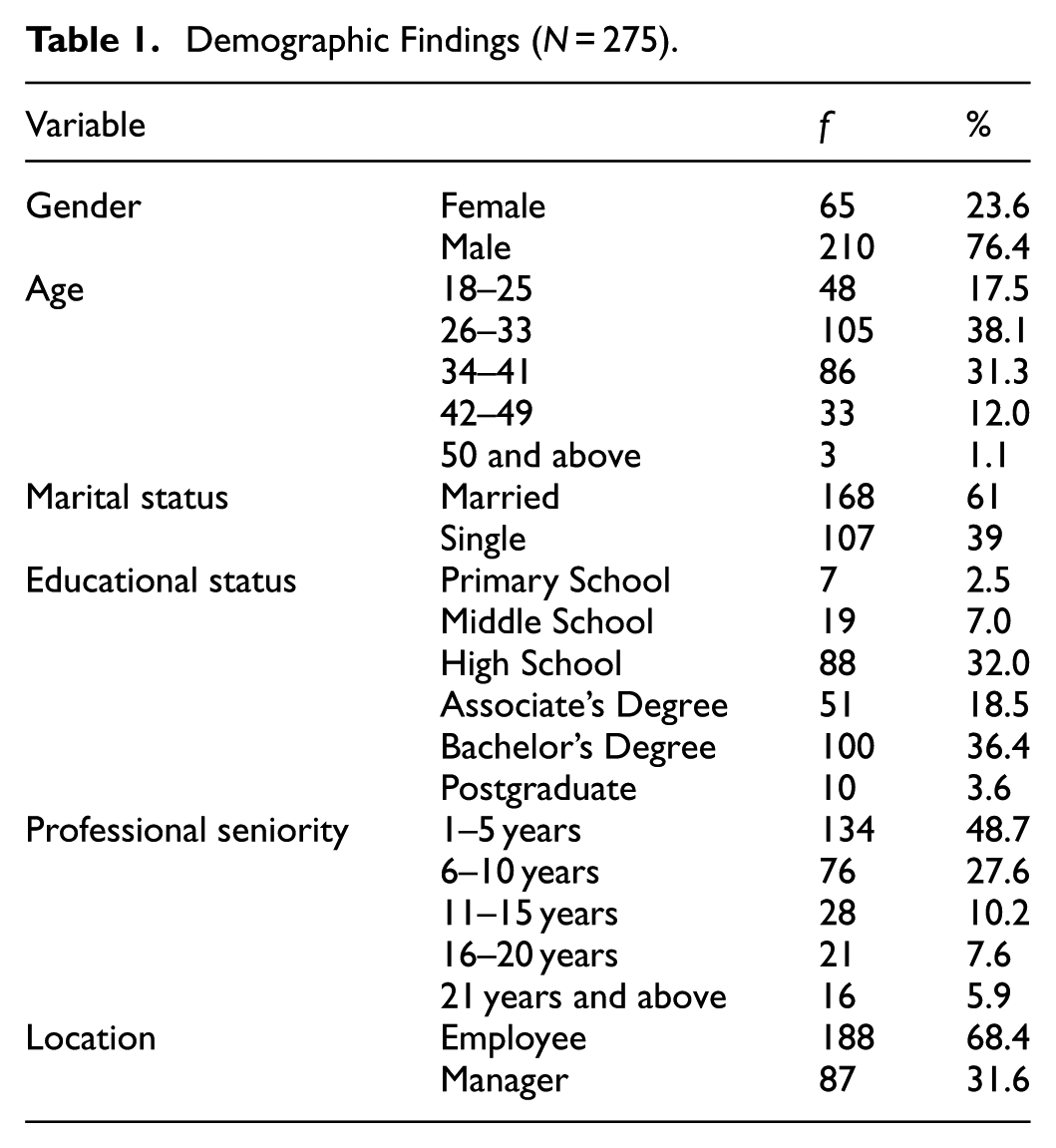
The research was conducted in Kahramanmaraş, which is important in Türkiye’s textile sector. According to Kahramanmaraş Chamber of Commerce and Industry (KMTSO) data, the city, which has approximately 100 textile exporter companies, realized exports of $868,855,000 in 2022. This rate declined in 2023 due to the February 6, 2023, earthquake. However, it recovered somewhat in 2024 and reached 501 million dollars in the first 9 months. In addition, according to the data of the Eastern Mediterranean Development Agency (DOĞAKA), 51% of the industrial workers in Kahramanmaraş are employed in the textile sector. Although current data is not available, the Ministry of Industry and Technology reports that more than 500,000 people are employed in the textile sector. L. Cohen et al. (2007) suggested that “272 participants are sufficient for a research population of 500,000 people.” Additionally, the G*Power 3.1.9.4 software was also used to determine the sample size of the study (J. Cohen, 2013; Kang, 2021). In the sample size analysis, “α err prob” was set to .05, “power (1 − β err prob)” to .95, and “number of predictors” to 5. The analysis determined that the total sample size was 138. In this context, questionnaires were distributed to 300 participants. However, 25 questionnaires were excluded from the study because they were incomplete and had similar responses. As a result, the study’s participants consisted of 275 employees. The demographic information of the participants is presented in Table 1.
Demographic Findings (N = 275).
Measures
All of the research scales were scored on a 5-point Likert scale graded as “1-Strongly Disagree/5-Strongly Agree.”
IL
In this study, the scale developed (α = .94) by Carmeli et al. (2010) and adapted into Turkish (α = .91) by Sürücü and Maslakçı (2021) was used. The scale consists of nine-items and three sub-dimensions: openness, availability, and accessibility. Examples of items include “The manager is open to hearing new ideas” (openness), “The manager is an ongoing ‘presence’ in this team-someone who is readily available” (availability), and “The manager encourages me to access him/her on emerging issues” (accessibility).
IWB
In the measurement of IWB, a scale consisting of 10-items and four sub-dimensions (idea generation, idea exploration, idea championing, and idea implementation) developed (α = .92) by De Jong and Den Hartog (2010) and adapted to Turkish culture (α = .93) by Çimen and Yücel (2017) was used. Example items include “How often does this employee search out new working methods, techniques or instruments?” (idea generation), “How often does this employee pay attention to issues that are not part of his daily work?” (idea exploration), “How often does this employee make important organizational members enthusiastic for innovative ideas?” (idea championing), and “How often does this employee contribute to the implementation of new ideas?” (idea implementation).
PE
The PE scale used in this study was developed by Spreitzer (1995; α = .72 and .62). Turkish adaptation of the scale was conducted by Uner and Turan (2010; α = .83 and .88). The scale comprises 12-items and four sub-dimensions: meaning, competence, self-determination, and impact. Sample items include “The work 1 do is very important to me” (meaning), “I am confident about my ability to do my job” (competence), “I have significant autonomy In determining how 1 do my job” (self-determination), and “My impact on what happens in my department is large” (impact).
TIL
In this study, the scale developed (α = .92) by McAllister (1995) and adapted into Turkish (α = .87) by Arı (2003) was used to measure participants’ perceptions of TIL. The scale consists of 11-items and two sub-dimensions: affect-based trust and cognition-based trust. Examples of items include “We have a sharing relationship. We can hoth freely share our ideas, feelings, and hopes.” (affect-based trust), “We would hoth feel a sense of loss if one of us was transferred and we could no longer work together.” (affect-based trust), “This person approaches his/her job with professionalism and dedication.” (cognition-based trust), and “I can rely on this person not to make my job more difficult by careless work.” (cognition-based trust).
Control Variables
To determine the participants’ socio-demographic information, questions such as “gender, age, marital status, educational status, professional seniority, and location” were included.
Findings
Measurement Model
The SmartPLS 4 and SPSS 25.0 software packages were used for data analysis. SEM can be employed in two distinct ways: “Partial Least Squares Structural Equation Modeling” (PLS-SEM) and “Covariance-Based Structural Equation Modeling” (CB-SEM) (Hussain, Xuetong et al., 2022). In this study, SmartPLS 4 (PLS-SEM) software was used for measurement and testing structural models within the scope of structural equation modeling. This choice was based on the study’s limited sample size, the relatively complex structure of the model, the lack of a requirement for data normality, software availability, and the desire to examine the relationships between variables at an exploratory level (Hair et al., 2019; Hussain et al., 2018; Hussain, Maqbool et al., 2022; Hussain, Xuetong et al., 2022). PLS-SEM is a variance-based structural equation modeling method that is widely recognized as a highly functional tool, particularly in the social sciences, for developing new models (Hair, Matthews et al., 2017; Hussain et al., 2023). PLS-SEM also offers the ability to test the significance of path coefficients in the structural model using the bootstrap procedure, thus increasing the model’s empirical support. In its simplest form, PLS-SEM is a technique that combines regression, multiple correlation, factor analysis, and path analysis (Hussain et al., 2019). For these reasons, PLS-SEM was chosen as the analysis method most appropriate for the theoretical framework and data structure used in the study (Hair et al., 2017b; Henseler et al., 2016).
According to Hair et al. (2019), Cronbach’s Alpha (CA) and Composite Reliability (CR) values for the scales are expected to be above .70, the AVE value above 0.50, and factor loadings above 0.708. Factor loadings below 0.40 are definitely excluded from the measurement model. The authors also recommend checking the scale’s AVE value if the factor loadings related to the items are below 0.708. If the AVE value is below 0.50, the items with low factor loadings are sequentially removed from the measurement model, and the analysis is repeated.
When the findings in Table 2 are examined, it is seen that the Cronabach Alpha (CA) and Composite Reliability (CR) values of the IL, IWB, and TIL scales are greater than the minimum recommended value of 0.70; the AVE values are above 0.50, and the factor loadings for the items are above 0.60. However, the AVE value of the PE scale was found to be below 0.50. Therefore, the items numbered 1, 5, and 6 were excluded from the analysis. After the process, the AVE value of the PE scale exceeded the threshold value (0.50). As a result, it can be said that the scales have good reliability and internal consistency. The criterion proposed by Fornell and Larcker (1981) calculates the discriminant validity between the scales. According to Fornell and Larcker (1981), the square root of the AVE values in the research should be higher than the correlation values between other constructs. In addition to the Fornell-Larcker criterion, Henseler et al. (2015) proposed a new divergence validity analysis called the “Heterotrait-Monotrait Ratio (HTMT)” view. Henseler et al. (2015) state that HTMT values above 0.90 reveal divergence validity problems. Table 3 presents the Fornell-Larcker and HTMT values. When the values in the table are analyzed, it is seen that the Fornell-Larcker criteria are met, and the HTMT values are below the threshold value (0.90).
Reliability and Validity.

Note. IL = inclusive leadership; IWB = innovative work behavior; PE = psychological empowerment; TIL = trust in leader; CA = Cronbach alpha; CR = construct reliability; AVE = average variance extracted.
Fornell-Larcker and HTMT Values.
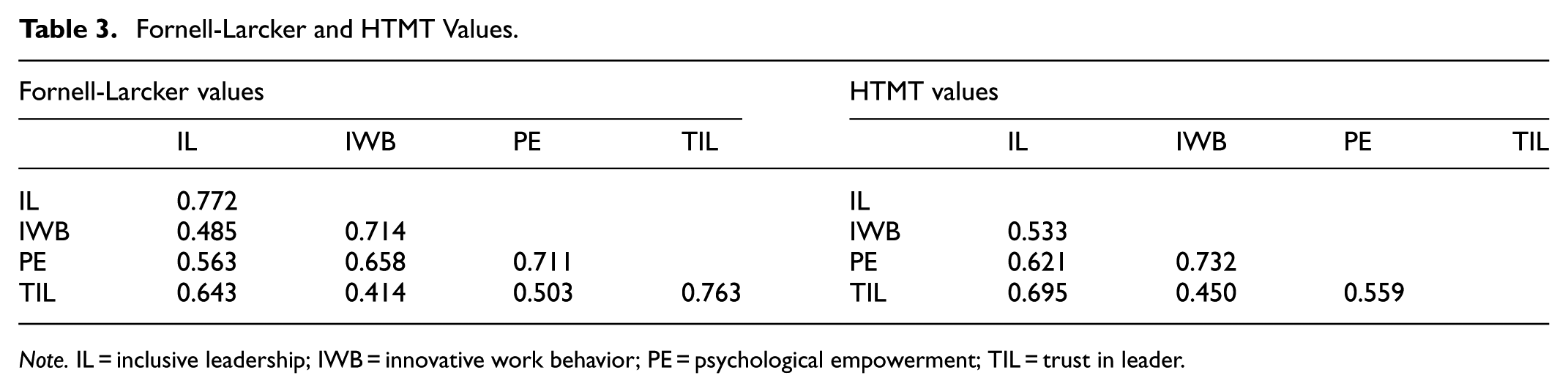
Note. IL = inclusive leadership; IWB = innovative work behavior; PE = psychological empowerment; TIL = trust in leader.
Evaluation of the Structural Model (Hypotheses Testing)
The bootstrapping method was employed to assess the statistical significance of the path analyses specified in the study’s structural model. Path analysis was performed using 5.000 bootstrap samples with the Smart PLS-SEM program. Before evaluating the structural model, the full collinearity VIF test proposed by Kock (2015) was applied to determine whether there was common method bias (CMV; Podsakoff et al., 2003) and a linearity problem between the variables (Hair et al., 2019) in the model. Common method bias (CMV) is used to identify systematic errors that may arise in survey-based research due to data being collected from the same source, at the same time, and using the same method (Podsakoff et al., 2003). According to Kock (2015), a VIF value greater than 3.3 indicates that the model may be contaminated with common method bias (CMV). In addition, Hair et al. (2019) state that VIF values should be less than 3.0 for each predictive structure. If the VIF values are acceptable, the next step is to examine the R 2 coefficients (Hair et al., 2019). Hair et al. (2022) stated that “R 2 is a measure of the explanatory power of a model.”R 2 coefficients range between 0 and 1 (.75 < R 2 = strong; .50 < R 2 = moderate; .25 < R 2 = weak) and larger values indicate stronger explanations. Table 4 shows the values related to the VIF and R 2 tests.
VIF and R 2 Coefficients.

Note. IL = inclusive leadership; IWB = innovative work behavior; PE = psychological empowerment; TIL = trust in leader; VIF = variance inflation factor.
Table 4 shows that the VIF values are less than 1.963. This finding indicates that there is no common method bias problem in the model and no linearity problem between the variables. In addition, as seen in the table, the variables in the study have an R 2 value greater than .25.
Table 5 and Figure 2 show the direct effect coefficients of the structural model. According to the results, IL has a positive and significant effect on IWB (β = .146), PE (β = .564), and TIL (β = .643). In addition, PE has a positive and significant effect on IWB (β = .556). However, TIL does not significantly affect IWB (p > .05). Therefore, H1, H2, H3, and H4 are supported. H5 is not supported.
Hypothesis Test Results.

Note. IL = inclusive leadership; IWB = innovative work behavior; PE = psychological empowerment; TIL = trust in leader; β = path coefficient.
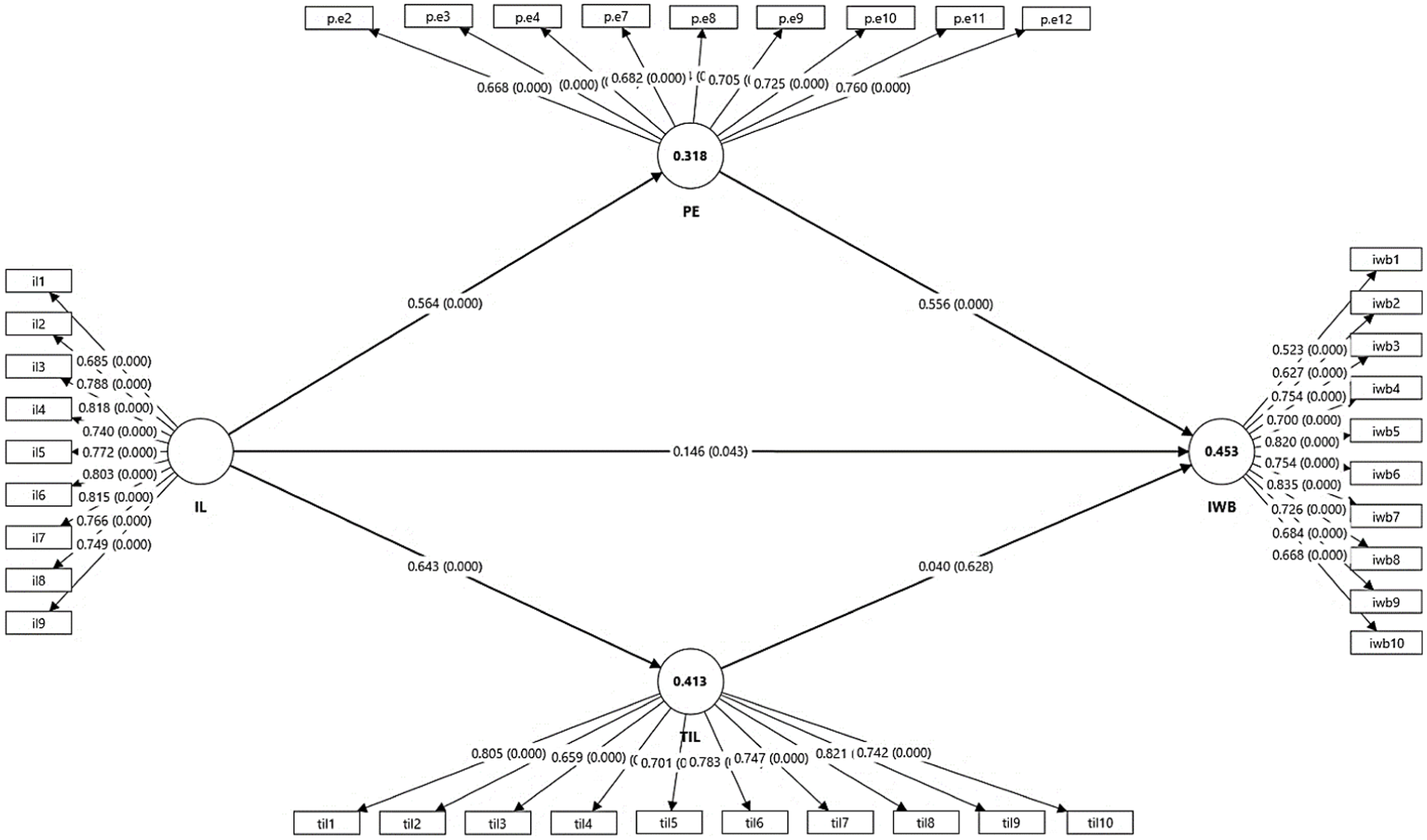
SEM analysis.
Mediating Effect
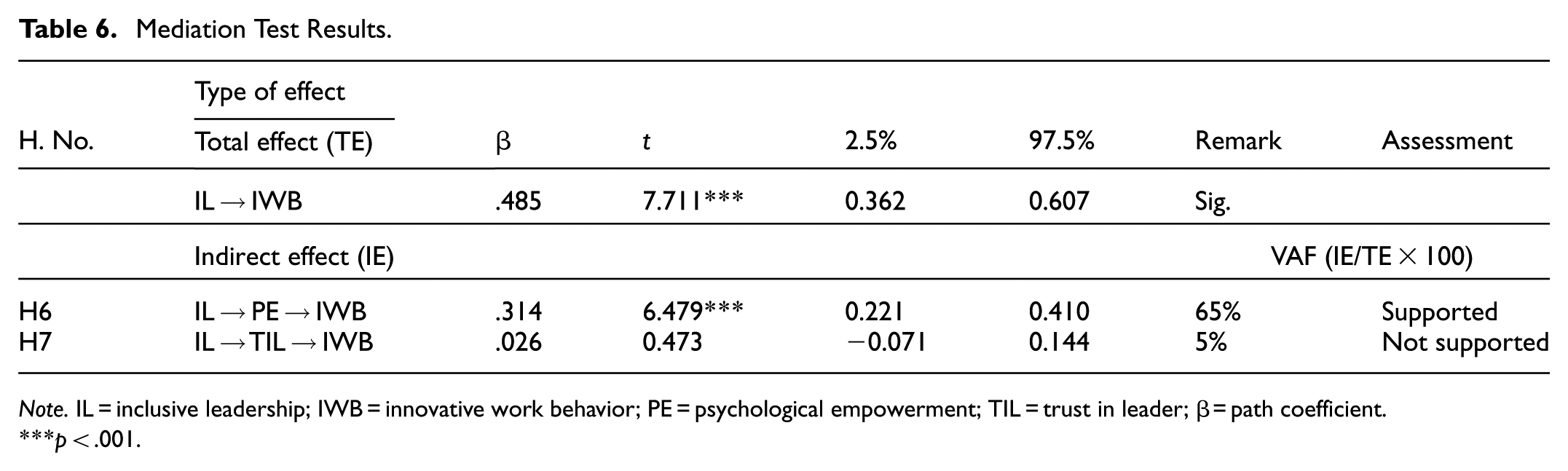
Table 6 includes the coefficients showing the mediating role of TIL and PE in the effect of IL on IWB. In the analysis of the mediator effect, the VAF (Variance Accounted For) value is calculated to determine the share of the indirect effect in the total effect. VAF is calculated as “the ratio of the indirect effect to the total effect.” It is also used to quantitatively express the mediating role. In this context, a VAF value below 20% is considered to indicate weak mediation, between 20% and 80% is considered to indicate partial mediation, and above 80% is considered to indicate full mediation (Hair et al., 2017a).
Mediation Test Results.
Note. IL = inclusive leadership; IWB = innovative work behavior; PE = psychological empowerment; TIL = trust in leader; β = path coefficient.
p < .001.
As seen in Table 6, the indirect effect for the path “IL → PE → IWB” is 0.314, and the indirect effect for the path “IL → TIL → IWB” is 0.026. The total effect is 0.485. The VAF value calculated according to the related formula was found to be 65% for the path “IL → PE → IWB” and 5% for the path “IL → TIL → IWB”. Therefore, TIL does not mediate the effect of IL on IWB, while PE has a partial mediating effect. As a result, H6 “PE has a mediating role in the effect of IL on IWB” is supported. In contrast, H7 “TIL has a mediating role in the effect of IL on IWB” is not supported.
Discussion
Our research has concluded that IL positively affects IWB. In fact, inclusive leaders’ encouraging, appreciative, guiding, tolerant, and accessible nature (Nembhard & Edmondson, 2006) enables the development and implementation of employees’ valuable ideas (Carmeli et al., 2010; De Jong & Den Hartog, 2010). Considering previous research and general literature, it is expected that IL positively affects IWB (Javed et al., 2021; Mansoor et al., 2021; Shakil et al., 2023; Zafar et al., 2024). Studies across sectors (e.g., telecommunications) have also found that inclusive leadership, both directly and indirectly, increases IWB (AlMulhim & Mohammed, 2023; Sürücü et al., 2023). Alwali (2024) also found that IL directly increases IWB in a study conducted in higher education institutions. It is possible to say that the results of previous research and our study are consistent. Our study found that IL increases employees’ levels of PE. The tolerant, guiding, encouraging, and appreciative characteristics of IL (Nembhard & Edmondson, 2006; Zafar et al., 2024) pave the way for employees to experience greater meaning at work. Thus, employees gain understanding and competence in their work. Similarly, a study in the textile sector by Younas et al. (2023) found that IL increases employees’ PE. A study by Gupta et al. (2022) among manufacturing companies in Saudi Arabia also found that IL positively affects employees’ PE. A study conducted by Çetinkaya and Yeşilada (2022) in various sectors (including the textile sector) found that IL increases employees’ psychological safety. When our results are compared with the results of previous studies in different sectors (e.g., health, education, information technologies; Alwali, 2024; Islam et al., 2024; Javed, Abdullah et al., 2019; S. Zhang et al., 2022), it is possible to state that IL is an important factor for PE in the textile sector and different sectors.
Our research found that IL positively affects trust in the leader. A few studies in the literature examine the impact of IL on trust in the leader. Some previous research has argued that inclusive leaders, through their characteristics such as including employees in decision-making processes, being open to different opinions, and being supportive, strengthen perceptions of competence, goodwill, and honesty—the key components of trust (Carmeli et al., 2010; Clipa et al., 2019; Mayer et al., 1995). One of the rare studies was conducted by Siyal (2023) in labor-intensive sectors such as textiles, manufacturing, and construction in China. The study found that IL positively affects trust in the leader. Orekoya (2024) conducted a study across textile, furniture, bakery, and palm oil production companies and found that IL increases team members’ trust in their leaders.
Furthermore, Blau (1964) argues in his theory of social exchange that the leader’s inclusive attitude triggers the principle of reciprocity, thereby creating a trusting relationship. On the other hand, LMX emphasizes the leader’s relationship with the employee. A high-quality relationship between a leader and an employee supports employees’ perceptions of trust (Erdurmazlı & Kalkın, 2023; Jawahar et al., 2019). When considered in conjunction with SET and LMX theories, it is possible to argue that our findings that IL increases TIL are grounded in rationality.
Another finding in our research is that PE increases employees’ IWB. The literature supports our result. Employees’ embrace of the value and importance of their work, their possession of the skills required for the job, and their autonomy (R. S. Al Daboub et al., 2024; Pacheco & Coello-Montecel, 2023) help them take responsibility for recognizing problems, generating ideas for problem solutions, and introducing and implementing solutions (De Spiegelaere et al., 2014; Stanescu et al., 2021). An examination of empirical studies in the literature has concluded that PE increases IWB in different sectors. For example, according to a study by Stanescu et al. (2021) with participants at different management levels, PE motivates IWB among managers. Studies conducted in the service sector (H. Ali et al., 2022) and technology companies (M. Grošelj et al., 2021) have found that PE increases employees’ innovative behavior. In particular, a study by Çetinkaya and Yeşilada (2022) in the Turkish textile sector found that PE increases employees’ innovative behavior. Finally, a study conducted by Yasir et al. (2023) in SMEs yielded similar results. The findings of this study are consistent with the findings of studies examining different sectors and firm structures in the literature. According to our research findings, TIL does not have a significant effect on IWB.
Furthermore, the mediating role of TIL in the effect of IL on IWB has not been confirmed. These results do not fully align with the existing literature. While studies directly examining this relationship are limited in the literature, some important findings are present.
Kularathne and Sujeewa (2021), in their study of software engineers, confirmed the mediating role of TIL in the effect of LMX on IWB. Similarly, Auliyah et al. (2025) found that trust positively influenced IWB in creative industries. In contrast, Taştan and Davoudi (2015) showed that the quality of the leader-member relationship was not significantly related to innovative behaviors in knowledge-intensive industries. Hughes et al. (2018) found that trust in colleagues influenced innovative behaviors and job performance more strongly than trust in senior management. Devapriyanga and Subashini (2025) found that IL in the Indian IT sector increased innovative behavior by fostering a culture of trust.
When these findings across different sectors are compared, TIL appears to increase IWB. For example, in their study with Korean airline service employees, Min and Ko (2015) found that TIL significantly supported innovative behaviors. Afsar and Masood (2018) found similar results in their study with nurses. Taştan and Davoudi (2015) found similar findings in the finance, banking, IT, telecommunications, and education sectors. These results suggest that TIL supports innovation in service and knowledge-intensive sectors. However, the absence of this effect in labor-intensive and hierarchical manufacturing sectors suggests differences in organizational context. Employees in labor-intensive sectors, such as textiles, may perceive greater risks when sharing innovative ideas, thereby limiting trust and motivating innovative behavior.
This situation contradicts the results expected within the SET framework. According to SET, trust should motivate employees to exhibit innovative behaviors through the principle of reciprocity. However, our findings show that this mechanism does not operate equally in all contexts. Blau (1964) stated that the magnitude of the risk taken can affect an individual’s give-take balance, leading to risk aversion even in a trusting environment. In this context, when the risk of failure is high, employees may feel threatened and avoid innovative behaviors (Ameen et al., 2024). The LMX perspective can also explain this situation. For example, low-quality leader-member relationships or increased risk perception during crisis periods can limit the impact of trust on innovative behaviors (Graen & Uhl-Bien, 1995). In the textile industry, the quality of LMX relationships can be a critical determinant in the emergence of innovative behaviors.
Furthermore, strategic decisions in organizations are influenced not only by leaders but also by upper management (Hambrick, 1995). Therefore, employees’ innovative behavior may depend not only on the leader but also on the organization’s overall governance structure. In addition to some theoretical considerations, the current problems of the Turkish textile sector may also lead to insignificant relationships between both the mediating and antecedent roles of TIL hip. Following the 2023 earthquakes, many textile businesses suffered physical and financial losses and adopted sustainability-focused production processes. This process may have increased risk aversion within organizations and led employees to shift their trust from the organization to a search for job security and stability. Consequently, employees’ TIL may have evolved into a search for psychological safety that maintains the status quo rather than fostering innovative behavior. In this context, the post-earthquake organizational restructuring and the uncertain environment can be considered external factors that render the mediating effect of TIL hip on IWB weak or insignificant. This may indicate the need to redefine the concepts of psychological safety and trust, particularly in crisis and post-disaster sectors.
In conclusion, this study demonstrates that the effect of TIL on innovative behavior is context-sensitive. This finding makes a theoretical contribution by highlighting the need to re-evaluate the validity of SET across sectors.
According to the research findings, PE mediates the effect of IL on employees’ IWB. This result suggests that inclusive leaders do not directly influence innovative behaviors, but rather indirectly by increasing employees’ PE. IL is a leadership style that values employees’ ideas, recognizes their contributions, and creates a supportive work environment (Carmeli et al., 2010; Nembhard & Edmondson, 2006). In such an environment, employees feel valued, better understand the meaning of their work, and participate more actively in decision-making processes (Javed, Abdullah et al., 2019; Zafar et al., 2024). This, in turn, increases employees’ PE, making it easier for them to engage in innovative behaviors (Gupta et al., 2022; Younas et al., 2023).
Similarly, S. Zhang et al. (2022) and Alwali (2024) stated that IL increases employees’ creativity levels through PE. P. Grošelj et al. (2021) conducted a study in technology companies and showed that employees’ PE increases the likelihood of generating and implementing innovative ideas. Çetinkaya and Yeşilada (2022) found that PE significantly mediates the relationship between IL and innovative behaviors in the textile sector in Türkiye. Similar findings were confirmed in studies conducted in different sectors by H. Ali et al. (2022), Yasir et al. (2023), and Stanescu et al. (2021).
These results are also consistent with the SET (Blau, 1964). According to the theory, a leader’s supportive and inclusive attitude strengthens employees’ sense of reciprocity. Employees respond to these positive leadership behaviors by taking on greater responsibility at work, developing new ideas, and making innovative contributions to the organization (Auliyah et al., 2025; Cropanzano & Mitchell, 2005). Employees who are psychologically empowered by inclusive leaders are more motivated to engage in innovative behaviors (A. Al Daboub et al., 2024).
Consequently, our research findings are consistent with previous studies and demonstrate that IL supports IWB through an indirect mechanism involving PE. This finding highlights the role of empowerment, a key psychological factor, in inclusive leadership, unlocking employees’ innovative potential.
Practical Implications
The Turkish textile sector is characterized by a labor-intensive production structure, a hierarchical organizational culture, and an operationally focused management style. Because employees in this sector are often directly involved in production processes, the emergence of IWB is often shaped by leadership style and psychological factors. Within the scope of our research model, IL has been found to support innovative behaviors by increasing employees’ PE. This result suggests that innovation in textile businesses is fueled not only by technical skills but also by employees’ sense of value and competence. When IL provides employees with the opportunity to express their ideas, participate in decision-making, and experiment without fear of making mistakes, an innovative culture can develop even in production-focused structures. However, the lack of a significant role for TIL in these relationships may be due to the strong hierarchy, limited communication channels, and centralized decision-making processes prevalent in the Turkish textile sector. Therefore, this study demonstrates that PE is the primary psychological mechanism linking IL to IWB. In contrast, TIL may be less decisive in labor-intensive sectors. In this context, the research adds sectoral depth to existing models of the relationship between leadership and innovation by accounting for the unique organizational dynamics of the Turkish textile sector.
Limitations
The study, despite its significant findings, also has some limitations. First, the study only addresses the role of TIL and PE in the impact of IL on IWB. Therefore, the conceptual framework of the study is limited to these variables.
The study was conducted on employees operating in the Turkish textile sector. While the findings can be generalized to sectors with similar production dynamics, it should be noted that the results may vary due to business practices, levels of competition, and technological intensity in different sectors (Barney, 1991; Coenen & Díaz López, 2010; Utterback & Suárez, 1993). Therefore, retesting the model in different sectors is recommended in the future.
The data were collected cross-sectionally. This creates a limitation in explaining how the leader’s inclusive behaviors affect employees’ trust and IWB over time. Longitudinal research designs can more accurately reveal the evolution of the effects of leader behaviors on employees’ psychological processes over time (Taris & Kompier, 2003).
Furthermore, the scope of the research focused solely on the leader figure. However, the emergence of innovative behaviors in organizations is closely related to top management team strategic decisions and the organizational climate (Hambrick, 1995; Papadakis & Barwise, 2002). Therefore, it is recommended that future research include organizational-level factors (e.g., innovation culture, organizational support, level of digital transformation) in the model.
One important limitation of the research is its sectoral context. The study was conducted on the Turkish textile sector. Therefore, it should be considered that the findings may have been influenced by the sector’s unique structural and environmental conditions. The textile sector in Türkiye: Labor-intensive production structures, high dependence on foreign markets, and cost pressures exhibit distinct dynamics in terms of employee behavior. These unique circumstances may reflect the interaction of leadership styles, employee attitudes, and innovative behaviors to a limited extent.
Furthermore, considering the devastating effects of the earthquake disaster on regional economies and organizational culture during the period the study was conducted, fluctuations in employees’ perceptions of trust, PE, and innovation may have occurred. However, this study did not directly address the effects of the post-earthquake reconstruction process on managerial and employee behavior. Therefore, the impact of structural changes on leader-employee interactions and organizational processes is beyond the scope of this research.
Leader-employee relationships in this study were examined within the framework of SET and LMX theory (Blau, 1964; Graen & Uhl-Bien, 1995). SET emphasizes that the leader’s supportive and inclusive behaviors strengthen employees’ sense of reciprocity. At the same time, LMX highlights the decisive influence of the quality of the relationship between leader and employee on attitudes and behavior. However, since the multi-level effects of personal, occupational, and organizational factors were not addressed in this study, the effects are presented in a limited way.
Recommendations
Several recommendations are offered based on the research findings and limitations. First, it is crucial for managers to systematically demonstrate IL behaviors in their relationships with employees. Taking employees’ diverse perspectives into account, ensuring their participation in decision-making processes, and creating a supportive communication climate will contribute to their PE and, consequently, their inclination toward IWB (Carmeli et al., 2010).
Research also indicates that leaders’ positive behaviors alone may not be sufficient to support innovative behavior. In this context, not only leaders but also senior management teams and organizational policymakers need to adopt a more integrated, participatory, and supportive approach with employees. Given the structure of the Turkish textile industry, mechanisms (e.g., suggestion systems, innovative idea competitions, small project funds) can be developed to encourage employee innovative behavior.
In addition, it is recommended that policymakers and industry associations develop training and certification programs focused on positive leadership skills at the industry level. Such practices will both enhance leadership quality and strengthen relationships with employees and managers, particularly in SME-scale businesses. Furthermore, considering that many textile businesses are striving to rebuild organizational resilience and trust during the post-earthquake reconstruction process, IL can be considered a crucial component of this process.
In light of the limitations of this study, it is recommended that future studies replicate the study with samples from different sectors. Because cross-sectoral differences have significant effects on leadership perceptions and the nature of innovative behaviors (Barney, 1991; Coenen & Díaz López, 2010). Research conducted in different contexts, such as the service, technology, or public sector, would be beneficial to test the generalizability of the current model.
It is recommended that future research prioritize longitudinal research designs to better understand the nature of SET and LMX. Longitudinal research designs can more accurately reveal the effects of leader behaviors on employee attitudes and behaviors over time (Taris & Kompier, 2003). Only in this way can we reveal how leaders’ inclusive behaviors influence the trust-building process over time. Furthermore, more holistic models that include the role of other organizational layers (e.g., top management teams) in the development of innovative behaviors, in addition to the behavior of leaders, can add depth to the research field (Hambrick, 1995; Papadakis & Barwise, 2002).
Original Contribution
This study provides an original contribution to the literature by examining the role of leadership and employee behavior in fostering organizational innovativeness in the aftermath of major disasters such as earthquakes in Türkiye. Inclusive leadership, psychological empowerment, trust in leader, and innovative work behavior were tested together for the first time within a single, integrated model. The findings demonstrate that, in post-crisis contexts, inclusive leadership enhances employees’ psychological empowerment and trust, thereby stimulating innovative behaviors. Thus, the study offers both theoretical and practical originality by addressing leadership–employee dynamics through the lens of creativity and recovery following disasters.
Conclusion
Our research, which examined the mediating role of trust in leader and psychological empowerment, found that inclusive leadership has a significant effect on employees’ innovative work behavior in the textile sector. The results indicated that inclusive leadership in the textile sector had a direct and positive impact on employees’ innovative work behavior. Furthermore, inclusive leadership was found to be a positive factor in employee psychological empowerment. Another finding was that inclusive leadership increased employees’ trust in their leaders.
According to the research results, psychological empowerment activities increase employees’ innovative work behavior. Contrary to expectations, trust in leader was not associated with innovative work behavior. Furthermore, it was determined that trust in leader did not mediate the effect of inclusive leadership on innovative work behavior. Furthermore, psychological empowerment was found to mediate the effect of inclusive leadership on innovative work behavior.
The research findings (excluding trust in the leader) are consistent with the researchers’ expectations. The insignificant effect of trust in leader on innovative work behavior and the insignificant mediating role are not the expected relationships.
Footnotes

Ethical Considerations
For the realization of this research, permission was obtained from the Kahramanmaraş Sütçü Imam University Social and Human Sciences Ethics Committee, as per the decision dated April 11, 2025, and numbered 2025-7.
Consent to Participate
The study poses no physical or psychological risks. Data collection was conducted voluntarily, and written informed consent was obtained from all participants before their participation. The societal benefits of the study far outweigh any potential risks to participants.
Funding
The authors received no financial support for the research, authorship, and/or publication of this article.
Declaration of Conflicting Interests
The authors declared no potential conflicts of interest with respect to the research, authorship, and/or publication of this article.
Data Availability Statement
The data that support the findings of this study are available from the corresponding author upon reasonable request.