




Abstract
The natural resource-based view is applied to explore the impact of green transformational leadership on green innovative work behavior (IWB) and green innovation (GI), thereby enhancing entrepreneurial performance (GEP) in Chinese manufacturing firms. More specifically, innovative work behavior serves as an intervening mechanism between green transformational leadership and entrepreneurial performance. Furthermore, green creativity strengthens the relationship between green entrepreneurial performance and green innovation with innovative work behavior. The SEM results were examined using a convenience sampling approach, with data collected from 619 employees of Chinese manufacturing firms. The findings reveal a significant relationship among green transformational leadership, innovative work behavior, green innovation, and entrepreneurial performance. Green creativity moderating is more effective for manufacturing firms in a dynamic environment characterized by IWB, GI, and GEP. The study advances theoretical and practical knowledge for GI and green entrepreneurial performance in manufacturing firms. It highlights managerial development influencing green innovation, particularly within Chinese manufacturing firms.
Plain Language Summary
This study applies the natural resource-based view to investigate how green transformational leadership influences green innovative work behavior (IWB) and green innovation (GI), which, in turn, enhances green entrepreneurial performance (GEP) in Chinese manufacturing firms. It examines the mediating role of IWB between GI and GEP, as well as the moderating effect of green creativity on the relationships among IWB, GI, and GEP. Using convenience sampling, data were collected from 619 employees and analyzed through SEM. Findings confirm significant positive relationships among green transformational leadership, IWB, GI, and GEP. The moderating role of green creativity is decisive in dynamic manufacturing environments. This research contributes to both theory and practice by emphasizing the importance of managerial development in fostering green innovation and entrepreneurial success in Chinese manufacturing firms.
Keywords
Introduction
Globally, a competitive business environment enables manufacturing firms to expand their business with limited resources (Hamidu et al., 2023). Manufacturing firms re-evaluate their resources to adopt advanced business models to survive in a volatile market (Trimi & Berbegal-Mirabent, 2012). They should follow the local government’s policies on environmental change (You et al., 2024). Ebrahimi and Mirbargkar (2017) illustrated stakeholders’ interest in government green adoption policies. However, local government also pushes the manufacturing firms to adopt and perform green environmental practices (Campo & Trio, 2022). Lastly, over several years, the firm’s distracted environment has become a significant problem for employees, and implementing green practices helps preserve the environment and address issues affecting society and firm management.
Firms are adopting green innovation strategies to achieve economic growth and protect the environment (Mubeen et al., 2023). Green practices enhance green business strategies and a pollution-free environment (J.-W. Huang & Li, 2017), develop a friendly environment, economic growth, and low-carbon development (Long et al., 2023). Velvin et al. (2016) argued that a manufacturing firm contributes to a country’s economy and reduces the unemployment ratio. Green entrepreneurial performance generates profit with green products and services. It also expands the product line and accounts for environmental preservation to avoid climate issues (Ebrahimi & Mirbargkar, 2017).
A firm’s ability to generate entrepreneurial outcomes through environmentally sustainable innovations and gain prominence in China’s manufacturing sector amid intensifying environmental regulations and sustainability. The recent studies show that green innovation enhances entrepreneurial outcomes and firm resilience in the Chinese manufacturing context (J. Huang et al., 2025). Moreover, green innovation and transformation technologies have been found to boost further green entrepreneurial performance in China’s industrial firms (Du et al., 2021). Green innovation reduces societal negativity (Z. Chen et al., 2022). An optimistic replication of a leader’s behavior is a transformed form of the leader (Khan & Khan, 2022).
Green innovation represents a long-term strategy focused on reducing the environmental impact of business activities through innovations in products, processes, and other areas (Ha et al., 2023). Green innovation is increasingly reshaping China’s manufacturing sector, driving environmental sustainability and enhancing entrepreneurship performance (Ebrahimi & Mirbargkar, 2017). Furthermore, green industrial policies, such as the “Green Factory Identification” initiative, play a pivotal role in fostering green innovation in Chinese manufacturing firms (G. Zhang et al., 2025). The firm’s leadership needs an active leader who forecasts future direction based on today’s rapid business changes and implements the green management practices (Lathabhavan & Kaur, 2023). Green transformational leadership motivates and inspires employees to address environmental challenges and achieve environmental goals, as well as to enhance the firm’s sustainable development performance (Priyadarshini et al., 2023).
The use of entrepreneurial skills involves recognizing, availing, and utilizing opportunities for product development (Le & Le, 2021). Additionally, they face challenges while encouraging employees to adopt green innovation (Semedo et al., 2022). Every firm is adopting the GTL approach to overcome business fluctuations and compete with economic changes (Khan & Khan, 2022). Green TL has drawn the attention of prominent researchers who have explored the precursors of innovative behavior in the existing body of literature on innovative work behavior (Shahbaz et al., 2024). An employee’s IWB supports the firm in solving problems, constant advancement, technology adoption, and strategic planning for competitive achievement (Aboramadan, 2022). To encourage the IWB among employees, there should be a friendly, transparent environment in decision-making, organizational justice, and psychological empowerment (Amrutha & Geetha, 2024).
A leader’s intellectual behavior and transparency may inspire employees to engage in IWB, focusing on market trends and customers’ demands (Rojak et al., 2024). Innovative employee behavior advanced green innovation and sustained competitive advantage. It entails idea generation, promotion, and implementation to enhance products, processes, or environmental performance. Studies indicate that green transformational leadership and a supportive learning climate significantly boost IWB in China’s manufacturing sector (Knezović & Drkić, 2021; Odugbesan et al., 2023). Creativity brings innovative ideas for unique and valuable products, services, and green practices. Green creativity transforms conventional product problems into sustainable green solutions that help to achieve firm goals (Avolio & Drummey, 2023). Numerous studies indicate that green innovation is used to utilize the firm’s and entrepreneurial dynamic capabilities that enhance the firm’s performance (Y. Wang et al., 2024). Green creativity directly contributes to green entrepreneurial performance by enabling firms to develop innovative, sustainable solutions that meet market and regulatory demands (Adomako & Nguyen, 2023). In manufacturing, it drives eco-friendly product development, process optimization, and resource efficiency, ultimately enhancing profitability while reducing environmental impact (Katsikeas et al., 2016; Shishodia et al., 2024).
In previous research on manufacturing firms, it was found that GTL enables IWB, GI, and GEP among employees in several industries (C. Li et al., 2024), the SME manufacturing sector (H. Li et al., 2023), hospitality sector (X. Wang et al., 2018), information technology (W. Li et al., 2020), the hotel management (Farrukh et al., 2024), governmental sector (B. Xu et al., 2022), the automotive industry (Maitlo et al., 2022), and the chemical industry (Ding et al., 2023). Still, there is a need for research on employees’ green transformational leadership in Chinese manufacturing firms; numerous studies have focused on green inclusive leadership, environmental leadership, procreative leadership, authentic leadership, and responsible leadership (L. Wang & Wu, 2024). This research links GTL with GI, IWB, and entrepreneurial performance; few studies provide evidence for the prior research. It is necessary to develop a theoretical contribution to green transformational leadership that advances innovative work behavior (Al Daboub et al., 2024).
Secondly, the influence of IWB on GI and GEP has not been fully explored in the literature on how innovative work behavior can facilitate employees' innovative behavior in manufacturing firms (Marampa et al., 2025). The most fundamental factor in employees' innovative behavior toward GI and GEP is the presence of manufacturing firms (Jabid et al., 2025). Thirdly, our research makes a significant contribution to the existing literature by supporting entrepreneurs with innovative ideas and enhancing their performance (Aslam et al., 2025). For entrepreneurial performance, firm reputation, and a strong relationship with vendors, IWB supports waste material management, better use of natural resources, supply chain management, and economic performance to drive the country's economic growth.
Fourthly, our study contributes to green entrepreneurial performance via green innovation; existing literature still needs to explore the role of green innovation in entrepreneurial performance. Green products, processes, and managerial innovations support entrepreneurs to improve their performance. This study contributes to prior research by examining the relationships among green creativity, green entrepreneurial performance, and green innovation. It consistently generates new ideas and identifies opportunities for innovation, enabling entrepreneurs to enter the market and the firm (Merín-Rodrigáñez et al., 2024). No existing literature shows the moderating role of creativity between IWB and entrepreneurial performance in Chinese SME manufacturing firms.
Previously, researchers applied organizational theory (Riva et al., 2021), social learning theory (Farrukh et al., 2024), SCT (B. Xu et al., 2022), and social exchange theory (X. Wang et al., 2018). Moreover, the componential theory of creativity impacts leadership on EP and IWB. Our study applied NRB Theory and CTC to examine the relationships among green transformational leadership, IWB, green innovation, and green entrepreneurial performance. This area has received less empirical attention in prior literature (Farrukh et al., 2024). However, the relationship among IWB, green entrepreneurial performance, and green innovation must be examined in manufacturing firms. Lastly, our study provides valuable insights for manufacturing firms by examining the moderating effect of green creativity on the relationship between employees' innovative work behavior, green innovation, and green entrepreneurial performance.
Fewer studies focused on green transformational leadership, and no study was found that measured GEP and GI alongside GTL within a single conceptual framework, with context for Chinese manufacturing firms. Meanwhile, the researchers identified a gap in existing studies when examining the role of green transformational leadership with GEP through IWB and GI. The role of green innovation also needs to be better explored. Therefore, to extend the prior literature, our study examines the mediating and moderating effects of the interaction between the intervening variables, innovative work behavior, and green creativity.
Our research responds to the following questions:
This gap ultimately extends into existing knowledge by applying new research to the study variables and exploring how green transformational leadership contributes to manufacturing firms. The following study discusses the methodology, results, conclusion, and discussion in light of the proposed and previous studies, with implications, limitations, and future endeavors.
Theoretical Building and Hypotheses Development
Underpinning Theories
The Natural Resource-Based View (NRBV) posits that firms can attain a competitive advantage in a favorable environment (O. Hart, 1995). NRBV theory emphasizes leveraging eco-friendly capabilities, such as green innovation and green transformational leadership, to achieve competitive advantage and long-term performance in manufacturing firms (S. Liu, 2025). Consistent refinement optimizes the utilization of natural resources within the production process, yielding multiple strategic, operational, and environmental benefits that enhance efficiency, sustainability, and long-term competitive advantages. It encompasses environmental pollution reduction, saving cost, competitive advantage through early adoption, and building entrepreneurial leadership for better performance (X. Zhang et al., 2023). NRBV emphasizes the strategic development of firm resources for competitive advantage, and interaction with stakeholders, customers, and environmentally conscious suppliers that focus on enhancing the green strategic concept (Andersén, 2021).
NRBV provides a strategic framework for understanding how firms leverage unique environmental capabilities to achieve sustainable competitive advantage. Green transformational leadership fosters a culture that encourages innovative work behavior, which drives the development of green innovations (X. Chen et al., 2025). These green innovations enhance green entrepreneurial performance by aligning operations with sustainability while achieving economic objectives (Mondal et al., 2024). Thus, NRBV integrates leadership, employee behavior, and innovation as critical firm resources contributing to superior green entrepreneurial outcomes in manufacturing and related sectors.
Adidas and Nike have strategically partnered with Parley and FieldTurf to recycle ocean plastics, used sportswear, and manufacture waste into the production of new sportswear (Borah et al., 2023). Parley and FieldTurf’s environmental expertise enables Adidas and Nike to achieve a competitive advantage through ecologically friendly production processes. Borah et al. (2024) explored Adidas’s 2018 sale of 5 million pairs of sneakers manufactured from reclaimed ocean waste, illustrating the commercial viability of such innovations. This behavior can encourage the Chinese manufacturing firms to enhance green innovation and entrepreneurial performance by using green creativity and IWB, supported by the effective utilization of natural resources.
The Componential Theory of Creativity (CTC) refers to creativity as an innovation and execution of valuable ideas that drive new product development and process innovation (West & Sacramento, 2023). CTC posits an individual’s ability to establish a creative environment with innovative work behavior within a firm (W. Li et al., 2020). Prior studies established that CTC generates innovative ideas to enhance green innovation for firm performance (Tuan, 2023). Additionally, green creativity transforms novel ideas into valuable product development (Karatepe et al., 2020), and boosts green innovation that enhances green entrepreneurial performance (Idrees et al., 2025). Accepting challenges and articulating an innovative vision to employees helps move toward innovation and creation.
CTC is unable to understand how green innovation emerges within a firm and emphasizes the interaction between individual creativity, supportive environments, and firm processes, which together foster the generation and implementation of environmentally sustainable ideas. CTC highlights how leadership supports employees for creativity, drives the development of novel green products and processes. These innovations not only contribute to creativity but also enhance firm competitiveness and entrepreneurial performance (Amabile et al., 1996). Thus, CTC provides theoretical grounding for linking creativity, green innovation, and green entrepreneurial performance.
GTL, GI, GEP, and Innovative Work Behavior
Transformational interactions between the entrepreneur, firm change, and leadership (Bayraktar & Jiménez, 2020). GTL motivates followers toward the firm's vision (Men, 2014), thereby increasing their motivation (Franco & Matos, 2015). Any business activity that generates profit for an individual is considered entrepreneurship (Caliendo et al., 2023), which can be measured in different ways, for example, by employees’ volume and retention rate, and the firm’s profit (Igbinoba et al., 2022). GTL significantly enables entrepreneurs to achieve goals (Y.-S. Chen & Chang, 2013), stimulates followers for IWB, and becomes a leader (Buil et al., 2019). NRBV theory also supports firm performance in terms of innovative work behavior and entrepreneurial success. GTL relates positively to entrepreneurial performance, which impacts the firm’s performance (Mittal, 2016). Prior literature shows the notable absence of green innovation mechanisms that enhance green entrepreneurship in firm performance (Ebrahimi & Mirbargkar, 2017).
Begum, Ashfaq et al. (2022) recommended a comprehensive understanding of the relationship between GTL and GI. Moreover, GTL supports GI in manufacturing firms to be continually involved in and to influence various factors that impact performance. S. L. Hart (1995) introduced the NRBV theory, which supports GTL for GI by utilizing the firm’s resources and capabilities in conjunction with the natural environment. GTL realizes the entrepreneurs’ responsibilities, dynamic capabilities, and characteristics (Shabbir & Hassan, 2022), and start-ups recognize internal and external motivational forces that may result in positive outcomes (Cooney, 2012). GTL supports green innovation to impact the manufacturing industry significantly (Abbas, 2024).
The followers seek innovation for challenges from existing solutions (García-Villaverde et al., 2018) that empower the employees to build a creative atmosphere within the firm (Begum, Xia et al., 2022). GTL enhances the IWB in employees to perform and survive in a strict management structure (Jung, 2001). Leaders establish a mental framework in employees to facilitate communication and enhance green innovation through IWB (Z. Wang et al., 2021). Previous literature explored various antecedents that impact GI, for example, green intellectual capital (Rehman et al., 2021), green absorptive capacity (C. Li et al., 2020), and external knowledge sharing (Epezagne Assamala et al., 2022), the impact of GTL on green innovation remains unexamined in the existing literature.
Consequently, our research presents an opportunity for researchers to delve into the unexplored relationship of GTL with GI, IWB, and green entrepreneurial performance within China’s manufacturing firms.
IWB, GI, and Green Entrepreneurial Performance
Employees’ IWB influences the firm’s decision-making process (S. K. Singh et al., 2020), and their capabilities support the firm’s growth and performance (García-Villaverde et al., 2018). Risk-taking, proactiveness, and innovativeness are employed to assess employees’ innovative work behavior (Wales et al., 2023), and re-elevating the failed projects may give valuable lessons for the future (Anderson & Kilduff, 2009). Employees’ proactive behavior entails a firm’s ability to seize creativity by vigilantly monitoring market changes, future trends, and performance (Lumpkin & Dess, 2001). Innovative behavior gives better solutions for the challenges and improves performance (Leonidou et al., 2017).
An employee’s innovative work behavior enhances green entrepreneurial performance (Bărbulescu et al., 2021), and green innovation with quality work (Shahid et al., 2023). IWB enhances green innovative work efficiency in employees (Bos-Nehles & Veenendaal, 2019). These findings suggested that personal and firm characteristics are necessary to promote green innovation and green entrepreneurial performance. Prior research posits IWB as an independent variable that impacts a firm’s strategic commitment to advance green innovation and green entrepreneurial performance across environmental, economic, and social (Aftab et al., 2023). In addition, the existing literature shows that IWB positively relates to green entrepreneurial performance. Leaders foster relationships with green innovation within the firm, and entrepreneurial performance, whereas the existing literature reveals a close association between IWB and GI, as well as GEP, in manufacturing firms.
Green Innovation and Green Entrepreneurial Performance
GI promotes green economy, and green entrepreneurial performance at the individual and group level (Ebrahimi & Mirbargkar, 2017). A green innovation brings novel ideas, green product development, and green performance (Mongelli & Rullani, 2017). Schumpeter and Nichol (1934) outlined that green innovation promotes entrepreneurs’ economic and social status. The green innovation enhances entrepreneurs’ financial profit, competitive achievements, self-satisfaction, and performance (Aguilera-Caracuel & Ortiz-de-Mandojana, 2013). Green innovation involves innovative capabilities, market research capacities, orientation, and a tendency toward entrepreneurial performance (Boso et al., 2013). Green innovation is demonstrated through green products, processes, administration, and innovation (Y.-S. Chen, 2008; Oly Ndubisi & Iftikhar, 2012). Adoption of eco-friendly technologies improves efficiency, reduces costs, and strengthens competitive positioning.
In light of China’s stringent environmental policies and rising consumer preference for green products, green innovation acts as a vital driver of firm growth and market success (G. Zhang et al., 2025; Zhu et al., 2024). Green innovation support in product design enhances quality, market safety, and increases green entrepreneurial performance by reducing toxins during production (Abbasi et al., 2023). Prior studies on green entrepreneurship are still developing and need to be explored more in the manufacturing firms’ context, as existing research has examined the impact of green innovation on performance, but their findings have been inconclusive. A green innovation helps to increase the entrepreneurial personality traits, actions, skills, and performance, which are more complicated than those of a leader (Avolio & Drummey, 2023). The above discussion concluded that GI enhances GEP in manufacturing firms by adopting the concept of green innovation in green entrepreneurial performance. Prior studies on green entrepreneurship are still developing and need to be explored more in the manufacturing firms’ context, as existing research has examined the impact of green innovation on performance, but their findings have been inconclusive. Therefore, we hypothesize that green innovation positively influences entrepreneurial performance in Chinese manufacturing firms, supporting sustainable competitive advantage and long-term viability.
Mediation of Innovative Work Behavior
Leaders enable employees to engage in innovative work behavior, recognizing opportunities for entrepreneurs to develop new green products (Eckersley, 2020). Entrepreneurs' lack of confidence, innovative work behavior, and experience create uncertainty about performance (Dabic et al., 2023). A leader's transformational skills motivate in the IWB, which enhances entrepreneurial performance (J. De Jong & Den Hartog, 2010). GTL inspires employees through the IWB, which boosts green entrepreneurial performance (S. K. Singh et al., 2020). The use of leadership skills motivates subordinates, which positively influences green entrepreneurial performance (J. P. J. de Jong & Den Hartog, 2007).
A leader's supportive behavior enhances the employee's IWB level (Campo & Trio, 2022), which builds a better relationship with the entrepreneur (Khan & Khan, 2022). Firms focus on employees' innovative work behavior capabilities that acquire competitive advantages from the market for green entrepreneurial performance (Tosun et al., 2022). The significant relationship between GTL and innovative work behavior reduces negative employee behavior, which, in turn, boosts green entrepreneurial performance (N. Singh et al., 2015). In addition, GTL enhances IWB with innovative ideas and skills, enabling entrepreneurs to become problem solvers and performers (S. K. Singh et al., 2020).
IWB mediates between GTL and green entrepreneurial performance by taking the initiative to create and execute the business (Bıçakcıoğlu et al., 2020). However, GTL brings enthusiasm, loyalty, and devotion in employees that lead to innovative work behavior (Yusoff et al., 2020), and support in green entrepreneurial performance (Yusoff et al., 2020). IWB is posited to mediate the relationship between green transformational leadership and green innovation GI. GTL fosters a supportive and motivating environment that encourages employees to engage in innovative work behavior to generate, promote, and implement novel green ideas (Campo & Trio, 2022; S. K. Singh et al., 2020; Yusoff et al., 2020). Leadership styles inspire employees to engage in innovative work behavior that fosters creativity, proactive problem-solving, and green innovation (J. P. J. de Jong & Den Hartog, 2007; Khan et al., 2024). IWB facilitates the development and execution of environmentally sustainable innovations within firms (Bıçakcıoğlu et al., 2020). Therefore, GTL positively influences GI indirectly through IWB, highlighting its critical mediating role.
IWB mediates the relationship between GTL and GI by empowering an environment that motivates employees to engage in sustainability-driven innovative activities (Kirkman et al., 2009; S. Singh et al., 2023). GTL enhances employees’ IWB with creativity and proactive problem-solving behavior (J. P. J. de Jong & Den Hartog, 2007), which facilitates the development and implementation of green innovations in the firm (Bıçakcıoğlu et al., 2020; Q. Wang & Shao, 2024). Therefore, IWB mediates between GTL and green innovation (Campo & Trio, 2022). Green transformational leadership builds a visionary environment that motivates employees innovative work behavior, which mediates the relationship between GTL and both green innovation and green entrepreneurial performance in Chinese manufacturing firms (S. Singh et al., 2023). IWB enables employees to proactively generate and implement environmentally sustainable ideas via GTL, thereby enhancing green innovation capacity and entrepreneurial performance (Bıçakcıoğlu et al., 2020). Thus, we hypothesize that IWB significantly mediates the impact of GTL on GI and GEP, supporting sustainable competitive advantage in the manufacturing sector.
Green Creativity as a Moderator
Amabile (1988) reveals that novel ideas become unique products in the market (Lee et al., 2023). CTC emphasizes that individuals with limited capabilities produce moderate creative work in a firm (Boso et al., 2013), whereas social influence results in more creative (Amin et al., 2023). Green creativity enhances dynamic capabilities that contribute to social and intellectual capital, product development, and innovation (Karatepe et al., 2020). The positive influence of innovative work behavior and green creativity on entrepreneurial orientation significantly contributes to green entrepreneurial performance (Cui & Li, 2023).
Green creativity positively moderates the relationship between innovative work behavior IWB and green entrepreneurial performance GEP, such that the positive impact of IWB on GEP is more substantial when green creativity is high. Employees with higher green creativity can more effectively transform innovative ideas into eco-friendly products and processes, thereby enhancing the overall entrepreneurial performance of manufacturing firms (He et al., 2023; G. Zhang et al., 2025).
According to Garousi Mokhtarzadedeh et al. (2022), green creativity develops mechanisms that enhance entrepreneurial performance, innovative behavior, and sustainable innovation. The interaction between IWB and green creativity stimulates environmentally oriented idea generation, thereby strengthening the relationship with green innovation. Prior research revealed that skilled leadership recognizes green creativity that moderates between innovative work behavior and green innovation (Jaiswal & Dhar, 2015). Green creativity enhances employee transformation and shapes innovative ideas into green products, processes, and practices. This moderating role ensures that innovative efforts are effective for achieving green innovation outcomes. Ramalingam et al. (2021) findings support the green creativity influence on green innovation (Nguyen et al., 2023).
Green creativity positively moderates the relationship between IWB and green innovation, such that the effect of IWB on GI is more substantial when employees exhibit higher levels of green creativity. By facilitating the transformation of novel ideas into environmentally sustainable solutions, green creativity enhances the effectiveness of innovative work behavior in achieving green innovation within manufacturing firms (X. Chen et al., 2025; Y.-S. Chen & Chang, 2013). An individual assumes that entrepreneurial personality traits, actions, and skills are more complicated than those of a leader (Avolio & Drummey, 2023). Green creativity fosters a strong relationship between IWB, GI, and GEP, leveraging available information and resources (L. Chen et al., 2022).
Therefore, the existing literature confirmed a significant relationship between green creativity and green entrepreneurial performance (L. Liu & Zhao, 2019) and between green creativity and green innovation (W. Li et al., 2020). However, it can demonstrate that green creativity moderates and stimulates followers’ innovative work behavior for green innovation and green entrepreneurial performance. Creative thinking and problem-solving abilities with the IWB strengthen the relationship with GI and GC. Based on the existing literature, we can assume that green creativity moderates the relationship between green innovative work behavior and green entrepreneurial performance in Chinese manufacturing firms.
Figure 1 illustrates the conceptual model, which explores GTL’s impact on green innovation and entrepreneurial performance, with the mediating–moderating role of innovative work behavior and green creativity.

Conceptual model.
Materials and Methodology
Context Selection
The Chinese manufacturing, services, and agricultural sectors contribute to GDP; the per capita income reached $13,300 in 2024 and is projected to be $13,688 to $13,778 by the end of 2025 (https://tradingeconomics.com/china/gdp-per-capita). This study targets entrepreneurs and top-level managers from manufacturing firms across different cities in Jiangsu Province, including Changzhou, Nanjing, Nantong, Taizhou, Suzhou, Zhenjiang, and Wuxi. Jiangsu province was selected for two reasons: it is the most developed and industrialized province, and it is the most popular for managing pollution sources. In 2018, it crossed 9 trillion Yuan in income and made an impressive contribution to China’s GDP ratio (Kong et al., 2023). In 2017, Jiangsu experienced a 2% decrease in annual PM2.5 concentration in pollution, still had significant pollution levels, with the concentration standing at 48 g/m3 in 2017, surpassing the WHO IT-1 standard of 35 g/m3 by 37% (Ashraf et al., 2024; Chu et al., 2021). However, from 2022, the PM2.5 concentration continuously decreased, as indicated by an average concentration of 31.5 µg per cubic meter (https://www.macaubusiness.com/air-quality-continues-to-improve-in-jiangsu-east-china/). This represents a 3% decrease from the previous year, marking the ninth consecutive year of decline since 2013.
Construct Development
A five-point Likert scale questionnaire was adapted to collect data. Initially, the questionnaire was designed in English and later translated into Chinese to improve respondents' understanding, as many were not very familiar with English (Malhotra et al., 2017). In this study, the five translators were selected based on the following criteria: (1) a minimum of a master's degree in linguistics, translation studies, or social sciences, (2) proven bilingual proficiency in English and the target language. Three of the translators were university faculty members specializing in linguistics and were foreign-qualified, as the parent university is a foreign-language institution. At the same time, the remaining two were professional translators with more than 10 years of experience in academic and technical translation, serving as liaisons between foreigners and Chinese at the university.
To ensure translation quality and cultural alignment, we adopted a forward–backward translation process. Initially, the questionnaire was translated from English to the target language by two independent translators. Another two translators then back-translated the instrument into English. The fifth translator, serving as a moderator, compared both versions to identify discrepancies and ensure semantic, conceptual, and cultural equivalence. Any inconsistencies were discussed and resolved through consensus among all translators. This procedure aligns with recommended cross-cultural research practices (Beaton et al., 2000; Brislin, 1980). Additionally, a pilot study was conducted with 30 respondents from the target audience to assess the questionnaire's validity and reliability for further analysis. The valuable feedback received refined the metrics and enhanced the validity. Feedback resulted in minor wording adjustments. These responses were valid but excluded from the primary data analysis.
The questionnaire includes respondents’ demographics and measures for GTL, IWB, GC, GI, and GEP; GTL was measured using six adapted item scales from the study by Y.-S. Chen and Chang (2013) adopted the IWB five-item from the study by J. De Jong and Den Hartog (2010). A six-item scale was adopted to measure GC (Biraglia & Kadile, 2017; Y.-S. Chen & Chang, 2013). The GEP scale was adapted from Colbert et al. (2008), and four items were adapted from Asadi et al. (2020) to measure green innovation.
Sample Design and Data Collection
A deductive approach was employed for firm selection, utilizing a systematic procedure to ensure an unbiased representation of manufacturing enterprises and top-level employees. There are 1,362 listed manufacturing firms in Jiangsu province (Crunchbase, 2022), which were the target for responses in our research. While a sample size of 200 or more provides a reasonable foundation, it is important to recognize that the optimal sample size for Structural Equation Modeling (SEM) depends on factors such as study objectives, measurement model characteristics, and the complexity of the structural model (J. F. Hair et al., 2012). The sample size benchmark was determined using the formula proposed by Miller and Brewer (2003), which indicated that the minimum required responses should be at least 310. Consequently, a large number of firms were targeted, and 650 questionnaires were distributed to achieve the desired sample size.
The mathematical model is as follows:

Where:
N is the total sample frame (population size), n is the desired sample size, and α represents the significance level.
The study uses a 95% confidence level with a 5% margin of error, yielding a significance level of .05.

A structured questionnaire was distributed to targeted respondents through both online and physical channels to facilitate data collection. To enhance participation, multiple follow-up efforts were undertaken, including reminder emails and telephonic calls, aiming to sustain respondents’ engagement with the survey. The researchers ensured that all participants possessed the requisite job-related knowledge to complete the questionnaire accurately. After two to three rounds of reminders, a total of 650 questionnaires were returned. Upon screening, 31 questionnaires were identified as incomplete, with substantial missing data in key measurement items that would compromise the validity and reliability of the results, and were therefore excluded from further analysis. The data collection phase spanned approximately 6 months, from May 2023 to November 2023. Ultimately, 619 fully completed questionnaires were retained, resulting in a 61.9% response rate, which is considered acceptable for further statistical analysis.
Following the recommendation of Hair (J. Hair et al., 2017) and Cohen’s power theory (Cohen, 1988), the sample size adequacy was analyzed. G*power post-hoc analysis was performed for all exogenous variables using a significance level of 0.05, an effect size of 0.15, and an obtained sample size of 619, respectively. The test yielded a statistical power exceeding the recommended threshold of 0.8, including sufficient power for the planned analyses (Ashraf et al., 2024).
Analysis Methods
To evaluate the authenticity of collected data, PLS-SEM was employed for both measurement and structural evaluation (Sarstedt et al., 2021). Convergent validity, causal analysis, and empirical model testing were applied through Smart-PLS 4.0 to enhance analytical rigor and ensure robustness in the results (J. F. Hair et al., 2012). PLS-SEM is considered appropriate for evaluating composite latent variable models, the principal factor model, as well as multivariate analysis (Rahman et al., 2013; Sarstedt et al., 2021). This method was applied to examine the predictors of GTL, GC, innovative work behavior, green creativity, green innovation, and green entrepreneurial performance (Maitlo et al., 2022). Harman’s one-factor method calculated CMB on a 29-item measurement model with eight distinct factors. The largest variance explained by a single factor was 32.07%, which is below the 40% threshold, indicating no significant CMB issues (Podsakoff et al., 2003). Additionally, all variance inflation factors (VIF) values are below the threshold value of 4.4, confirming the absence of problematic multicollinearity (Kock, 2015).
Results
Demographics
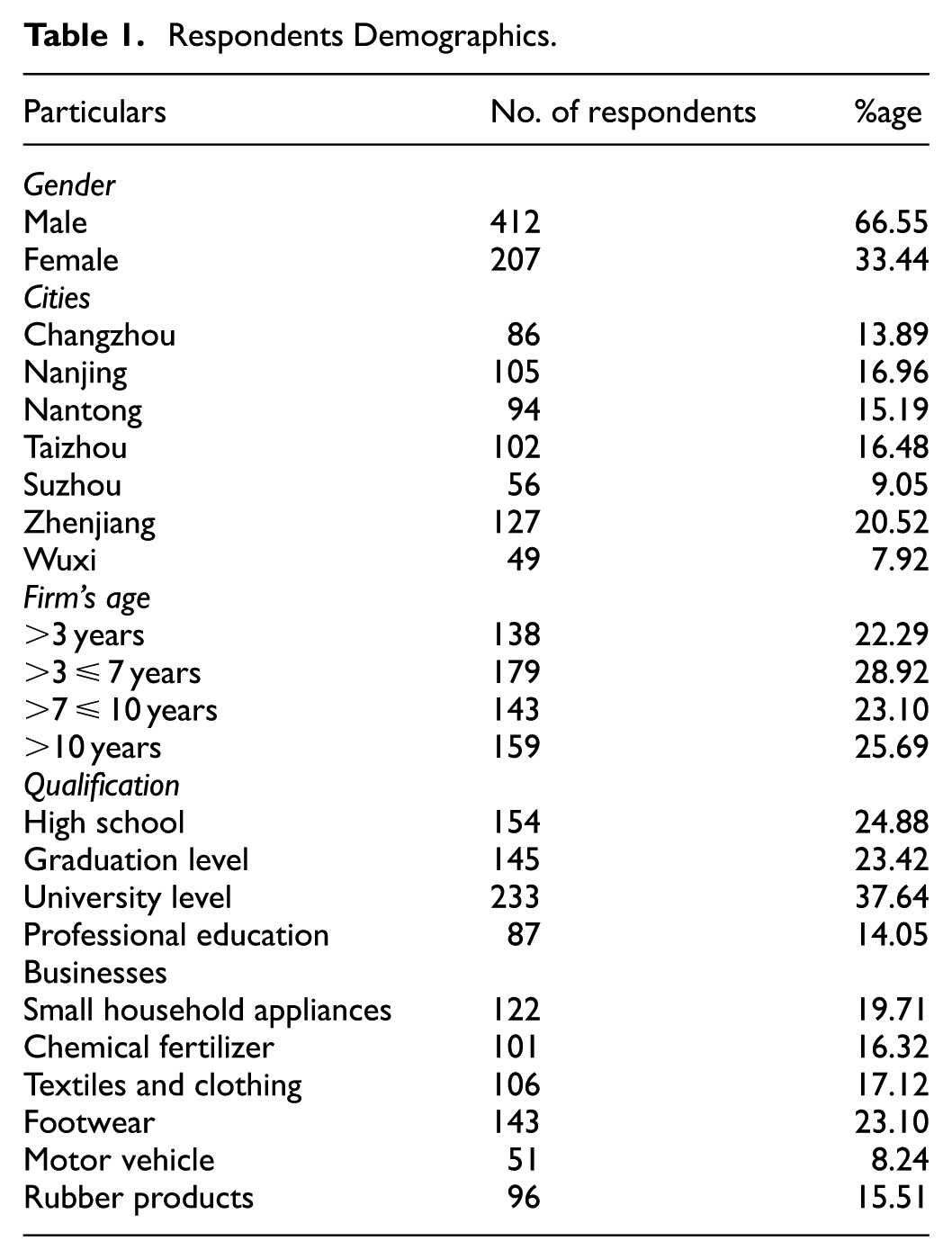
Table 1 shows that 412 (66.55%) respondents were male and 207 (33.44%) were female, among a total of 619 units. Our study targeted seven industrial cities of Jiangsu Province, with the proposition of Changzhou 86 (13.89%), Nanjiang 105 (16.96%), Nantong 94 (15.19%), Taizhou 102 (16.48%), Suzhou 56 (9.05%), Zhenjiang 127 (20.52%), and Wuxi with 49 (7.92%) respondents. The firms’ ages ranged from 3 to 10 years. Education levels include high school, graduation, and university-level education, and some professional (Technical) education. It also calculated the different manufacturing sectors: Small Household Appliances 122 (19.71%), Chemical fertilizer 101 (16.32%), Textiles and Clothing 106 (17.12%), Footwear 143 (23.10%), Motor Vehicle 51 (8.24%), and Rubber Products 96 (15.51%).
Respondents Demographics.
Confirmatory Factor Analysis
Table 2 presents two distinct methods applied to the collected data: initially, the measurement model for data validity, and subsequently, SEM using SmartPLS. This comprehensive methodology evaluates the measurement and structural model (Cheah et al., 2018; Sarstedt et al., 2021).
Confirmatory Factor Analysis.

Table 2 shows Cronbach’s alpha values, which ranged from .861 to .921; AVE ranged from .591 to .748; Rhoda values ranged from .862 to .923; and CR ranged from .897 to .938. The threshold values for AVE and CR are >0.5 and 0.7 (Fornell & Larcker, 1981b). All predictor values are acceptable and up to the threshold (C. Li et al., 2020).
Discriminant Validity
The existing scales were adapted to measure five variables discriminating outcomes for GTL, IWB, GC, GI, and GEP. Tables 3 and 4 confirm the discriminant validity: the square root of the AVE should equal the corresponding correlation (C. Li et al., 2020), indicating no discriminant issue (Fornell & Larcker, 1981a; Tabachnick et al., 2007). The VIF values ranged from 1.393 to 4.269.
Fornell-Larcker Criterion.

Heterotrait-Monotrait Ratio (HTMT) – Matrix.

Predictive Relevance and Model Fitness
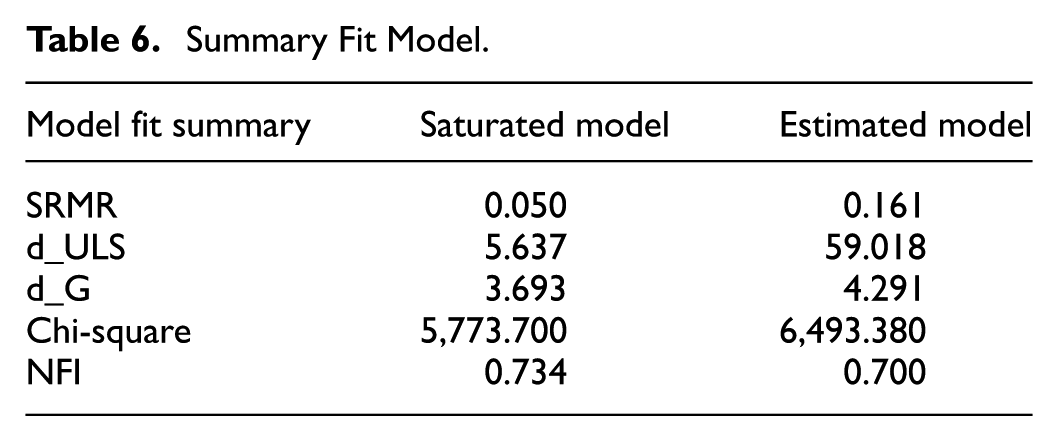
Tables 5 and 6 represent values for R2, Q2, and SRMR. The values for R2 range from .182 to .515, which are within the acceptable range (Chin, 1998). Meanwhile, Q2 estimation values ranged from 0.411 to 0.609, which shows a medium range. The Standardized Root Mean Square Residual (SRMR) was employed as a model fit index to assess the difference between observed and predicted correlations. In this study, the SRMR value fell below the recommended threshold of 0.08, indicating a good model fit (Sarstedt et al., 2021).
Q 2 and R2.

Summary Fit Model.
Path Model Analysis
Smart-PLS 4.0 was used to conduct the variance-based SEM analysis, employing the Bootstrap Bias-Corrected (BC) method with 5,000 bootstrap samples. This methodological approach is suitable for investigating the interrelationships among multiple constructs, with multiple mediating and moderating effects. To further validate the indirect effects, Sobel’s test was applied to extract mediation and moderation paths. The results indicated that GTL significantly impacts IWB and GI, with p-values exceeding .05. Furthermore, IWB observed a significant influence on GI and GEP within the context of manufacturing firms, with p-values greater than .05.
Table 7 and Figure 2 show
Path Estimates.


Path model.
Furthermore, Table 8 and Figure 2 show the mediating effect of IWB between GTL and GEP and GI, and suggest that innovation should be adopted to enhance GEP. At the same time, GC moderates the relationship between IWB, GI, and GEP.
Mediation and Moderation Estimates.

Furthermore,
Discussion
This research offers novel insights into the existing literature concerning green innovation and green entrepreneurial performance by empirically validating the significant influence of green transformational leadership and innovative work behavior in the Chinese manufacturing firm context. The findings provide evidence that GTL directly impacts green innovation and green entrepreneurial performance. At the same time, IWB mediates and strengthens these relationships, focusing on the centrality of employees’ innovative work behavior in achieving sustainability. Furthermore, the moderating role of green creativity enhances the impact of IWB on both GI and GEP, thereby adding an important behavioral dimension to the leadership innovation.
First, our findings indicate that GTL has a positive impact on green innovation (Y.-S. Chen et al., 2014; Choi et al., 2016). Transformational leadership within manufacturing firms performs as a catalyst, shaping employees’ environmental values, providing vision, and empowering the subordinates to generate green innovative solutions that reduce the polluted atmosphere. The findings are aligned with Jiangsu Province, where industrial firms face challenging environmental and regulatory expectations. Our findings highlight the role of GTL in enhancing a green organizational ethos. This study extends previous leadership research into the domain of green entrepreneurial performance.
Secondly, our study findings are consistent with the existing studies (Batjargal et al., 2023) and explored how green transformational leadership enhances followers’ motivation levels and commitment to green objectives (Buil et al., 2019). Consequently, employees internalize the leader’s environmental vision and transform into eco-friendly practices that strengthen both innovation capacity and green entrepreneurial performance. The results align with existing research that green transformational leadership positively influences green entrepreneurial performance through the application of leadership styles (Malik et al., 2017; Moriano et al., 2014).
Thirdly, our study revealed that GTL significantly enhances innovative work behavior, which in turn enhances GI and GEP. This finding is aligned with the prior study of Odugbesan et al. (2023). Messmann et al. (2022) suggesting that transformational leaders instill psychological empowerment, enabling employees to identify opportunities proactively, generate novel ideas, and implement green initiatives. IWB thus emerges as a critical mechanism through which leadership enhances green innovation and green entrepreneurial performance, reinforcing the importance of fostering employee agency in sustainability transitions.
Fourthly, a significant relationship between IWB and green innovation indicates that employees’ cognitive capacity, resources, skills, and environmental preservation are essential to enhance green innovation (Bednall et al., 2018). Ahmad et al. (2020) found that employees’ proactive behavior and environmental consciousness contribute directly to developing eco-friendly technologies and practices. Our study highlights how IWB not only complements leadership but also serves a vital role in enhancing green innovation within Chinese manufacturing firms.
Fifth, the research findings establish the role of green creativity as a moderator between IWB, green innovation, and green entrepreneurial performance. The findings are consistent with prior studies of Song and Yu (2018) and Arslan et al. (2022), Leong and Rasli (2014), which highlights that creative problem-solving enhances the effectiveness of IWB in achieving green creativity (Y.-S. Chen & Chang, 2013). In high-pollution manufacturing industries, creativity provides the flexibility and originality needed to transform ideas into practical solutions. Our findings suggest that green entrepreneurial performance is significantly enhanced when employees’ innovative behaviors are supported by creative capabilities, thereby linking micro-level individual traits with macro-level firm performance (Arici & Uysal, 2022; Luu, 2021).
Collectively, these results extend theoretical understanding by integrating GTL, IWB, GI, GEP, and green creativity into a comprehensive framework. The study demonstrates that GTL not only has a direct effect on green innovation but also exerts influence indirectly by shaping IWB, which is further amplified by green creativity. This multi-layered interaction addresses a key gap in the literature, particularly in the underexplored context of Chinese manufacturing, where firms face growing pressure to balance competitiveness with environmental sustainability.
Conclusion, Implications, Limitations, and Future Prospects
Conclusion
Previous studies have largely neglected the direct relationship between green transformational leadership and green entrepreneurial performance, particularly within the manufacturing sector. This study addresses the gap, focusing on manufacturing firms in Jiangsu Province, China, thus providing valuable insights specific to the Chinese manufacturing firm context. Innovative work behavior mediates between GTL with GI and GEP, making crucial contributions to the existing literature by demonstrating that these relationships operate both directly and indirectly. Additionally, innovative work behavior significantly impacts the green entrepreneurial performance and green innovation by empowering employees to take initiative and contribute creatively (Pieterse et al., 2010). Our study findings extend existing literature by highlighting the moderating effect of green creativity, which strengthens the positive impact of innovative work behavior on green innovation and green entrepreneurial performance (F. Xu & Jin, 2022).
Our study argues that effective leadership not only empowers employees to engage in innovative work behavior but also encourages innovative thinking, resulting in greater engagement in green entrepreneurial performance. Transformational leadership is essential for driving green innovation and enhancing entrepreneurial performance in the highly competitive, resource-sensitive Chinese manufacturing industry. Additionally, the study underscores the importance of a firm's culture and environmental consciousness in facilitating these dynamics, providing practical managerial implications for fostering green transformational leadership, green creativity, and innovative work behavior. Collectively, these findings offer a comprehensive framework to understand how leadership, employee behavior, and creativity interact to promote sustainable business practices, thereby contributing to China's broader environmental and economic goals.
Theoretical Implications
Our study offers several valid theoretical contributions to the existing literature on green entrepreneurial performance and green innovation by incorporating green transformational leadership, innovative work behavior, and green creativity. This study extends prior research on how green transformational leadership fosters an environment that stimulates novel ideas, experimental initiatives, and sustainable innovation, particularly important for Chinese manufacturing firms facing rapid environmental and market changes. The traditional command-and-control style in firms has gradually given way to a leadership approach that promotes entrepreneurial growth, productivity, and risk-taking behavior for better opportunities. Our research further contributes to business research by integrating NRBV theory with CTC, a novel combination in the context of Chinese manufacturing firms. Further investigation explored how innovative work behavior support among GTL enhances GEP and GI in manufacturing firms. However, this study investigates and contributes to the existing literature by examining the moderating role of green creativity in the relationship between green entrepreneurial performance and green innovation, thereby strengthening the relationship among them in the firm context. Moreover, this research provides a deep understanding of the factors that influence green innovation and green entrepreneurial performance, and of how transformational leaders perceive and respond to these challenges.
Practical Implications
Our study’s findings have several practical implications for managers, entrepreneurs, and policymakers, particularly for Chinese manufacturing firms operating in an increasingly competitive, environmentally conscious market.
Firstly, our results outlined the significant impact of green transformational leadership on green innovation and green entrepreneurial performance. For managers and entrepreneurs in manufacturing firms, adopting GTL practices, such as demonstrating a clear green vision, encouraging intellectual stimulation, and creating a green environment, can instill a strong environmental ethos throughout the firm. They should develop an environment that inspires employees to think about innovation, recognize opportunities, develop eco-friendly products, and solve environmental issues by improving market competitiveness and challenges with China’s rules and regulations about the manufacturing sector.
Secondly, our results emphasize the pivotal role of innovative work behavior in enhancing green innovation. For manufacturing firms in China, where production systems are often resource-intensive, integrating IWB into corporate strategy can lead to breakthrough solutions for energy efficiency, waste minimization, and circular economy practices. Managers should actively encourage employees to take initiative, challenge the status quo, and experiment with environmentally responsible solutions. This requires creating an enabling environment where innovative efforts are recognized, rewarded, and aligned with the firm’s sustainability objectives.
Thirdly, our findings contribute to the GTL not only by enhancing IWB but also by facilitating a problem-solving approach to environmental challenges. Employees motivated under GTL are more likely to develop creative alternatives for cleaner production, supply chain sustainability, and green process innovation. Through the Chinese manufacturing firm, it can directly contribute to China’s national goal of carbon neutrality by 2060, well-being behavior, green industry, and sustainable economic growth under the Made in China 2025 Strategy.
Additionally, green creativity acts as a moderator, amplifying the significant impact of innovative work behavior on green innovation and green entrepreneurial performance. Furthermore, our study findings hold significant implications for government authorities regarding environmental concerns; managers should focus on training programs, innovation workshops designed to enhance employee creative problem-solving capabilities, and cross-departmental collaboration platforms, particularly in innovation and product design.
The Chinese government can support these efforts through marketing-based instruments. These design policies motivate individuals, offer tax incentives for green R&D, subsidize energy-efficient manufacturing processes, and recognize green innovation with awards, “Green Leadership Awards,” to encourage firms. Public and private partnerships between manufacturing firms, universities, and research institutions can further boost the diffusion of green technologies and an innovation ecosystem that prioritizes sustainability.
Finally, for long-term competitiveness, Chinese manufacturing firms should embed GTL, IWB, and GC as interconnected capabilities that drive entrepreneurial, environmental, and economic performance. Failure to integrate these elements risks falling behind in an era where green innovation is no longer optional but a critical determinant of survival and growth in the global market.
Limitations and Future Research
As with all studies, our research also has limitations that should be acknowledged. First, the data were collected using a single-source technique from Chinese manufacturing firms; the focus on this single province was due to data availability, which may limit generalizability. Future research should incorporate a broader cross-regional sample to enable comparative analysis across provinces and regions.
Second, the study adopted a cross-sectional design, which restricts the ability to draw causal inferences. Longitudinal data collection is recommended to assess changes in entrepreneurial leadership, innovative work behavior, and performance. Our research is also limited to subgroup analysis, and researchers are suggested to explore subgroup analysis (e.g., firm size or ownership structure) to understand the heterogeneity of effects.
Third, while our model controls for certain factors, future research could incorporate additional control variables, such as demographic characteristics, government policies, and entrepreneurial regulations, to further refine the analysis. Moreover, this study targeted entrepreneurial firms; future research could expand the respondent base to include general business management professionals and other industry sectors.
Fourth, while the proposed research model was tested in the manufacturing sector, future studies could apply it to other industries, particularly the hospitality, pharmaceutical, and health care sectors, where transformational leadership and green innovation practices can address environmental challenges. For example, large-scale cooking in hotels and restaurants produces significant emissions and waste; therefore, green innovation in cooking technology, waste reduction, and energy efficiency, under transformational leadership, could play a critical role in reducing pollution and promoting sustainable practices.
Finally, replicating the study in different industrial contexts, applying it across diverse business fields, and considering varied time frames could enhance the model’s applicability and provide more robust, generalizable insights.
Footnotes
Acknowledgements
We thank the editorial board and the anonymous journal reviewers for their insights that helped improve the manuscript.

Ethical Considerations
This study was reviewed and approved by the Human Research Ethics Committee of Guangdong University of Foreign Studies, China, on 13 April 2023. The study purpose was explained to participants, and informed consent was obtained electronically. Data were collected anonymously, participation was voluntary, and respondents could withdraw at any stage without consequence.
Consent to Participate
Informed consent was obtained from all participants before data collection. Respondents were provided with an information sheet explaining the study’s purpose, voluntary nature, procedures, and assurance of confidentiality. Consent was obtained electronically before the survey began, and only those who agreed were included in the study.
Author Contributions
Sheikh Farhan Ashraf: Writing original draft, Project administration, Data collection, Validation, Software, and data analysis. Li Qing: Conceptualization, Review and editing, Supervision, Methodology. Aemin Nasir: Writing—review and editing, proofreading, and revision. Saba Amin: Formal Analysis, software, and data analysis.
Funding
The authors received no financial support for the research, authorship, and/or publication of this article.
Declaration of Conflicting Interests
The authors declared no potential conflicts of interest with respect to the research, authorship, and/or publication of this article.
Data Availability Statement
The data supporting this study’s findings are available on request from the corresponding author. However, due to privacy or ethical restrictions, they are not publicly available.