



Abstract
Drawing on social exchange theory (SET), the purposes of this research are to investigate the effect that developmental human resource configuration (DHRC) has on employee innovative work behavior (IWB) and to examine the role that an empowerment climate plays in the relationship. The study assumes that knowledge workers perform IWB if they perceive the application of DHRC and the empowerment climate to support autonomy, information sharing, and team accountability. The data were collected from 37 R&D managers and 370 full-time R&D engineers, constituting 37 different high-tech companies in Guangdong province, China. Results show that a positive relationship between DHRC and IWB was found and was partially mediated by unique human capital. Findings also demonstrate that empowerment climates strengthen this relationship. The implications of the findings and future directions for research are further discussed.
Keywords
Introduction
To survive and thrive in the highly dynamic high-tech industries, knowledge-intensive organizations put emphasis on the significance of innovation outcomes from new products, services, and improved process. In order to respond to their customers in a timely manner, organizations are assumed to be able to create, manage, and upgrade innovative performance to obtain their competitive advantages (Bos-Nehles et al., 2017). A main factor in transforming ideas into innovative outcomes is human resource (HR). Despite its importance, within literature on innovation outcomes, few studies emphasize how innovation can be facilitated at the individual level (Bos-Nehles et al., 2017; Jiang et al., 2012; van Esch et al., 2018).
This study focuses on individual innovative work behaviors (IWB)s based on the accumulation of individual knowledge, skills, and abilities (KSAs) for continuous innovation performance (e.g., Bos-Nehles & Veenendaal, 2019; De Jong & Den Hartog, 2010). IWB is defined as “the intentional creation, introduction and application of new ideas within a work role, group or organisation, in order to benefit role performance, the group, or the organisation” (Janssen, 2000, p. 288). As important carriers and processors of new and creative ideas, most innovative outcomes mainly derive from individuals (Bos-Nehles & Veenendaal, 2019). Therefore, it is necessary to examine what motivates individual IWB.
Based on the resource-based view (RBV), HR configurations are a set of human resource management (HRM) practices that help develop KSAs of a firm’s current employees as well as attract competent individuals from the external labor market (Barney, 1991; Chien & Lin, 2013; Choudhury & Mishra, 2010). Previous research had shown that firm-specific HR practices, such as developmental human resource configuration (DHRC) help to deliver organizational innovative outcomes (Bowen & Ostroff, 2004; Cabello-Medina et al., 2011; Jiang et al., 2012). DHRC is composed of comprehensive trainings; promotion from within; developmental performance appraisal and skill-based pay which may develop and accumulate KSAs of current and potential employees (Chien & Lin, 2013; Choudhury & Mishra, 2010; Jiang et al., 2012). Based on social exchange theory (SET), employees receiving rewards for innovative outcomes from DHRC are more likely to reciprocate with more IWB and support their organizations to achieve better outcomes (Blau, 1964; Bos-Nehles & Veenendaal, 2019). At the outset, this study examines the relationship between DHRC and employee IWB.
In addition to the direct influence of DHRC on IWB, studies also suggest that these practices may increase organizational innovative outcomes by developing the KSAs of their current employees (Choudhury & Mishra, 2010; Nieves & Quintana, 2018). Human capital is the collection of employee KSAs accumulated from organizational HRs (Jiang et al., 2012; López-Cabrales et al., 2011). Unlike general human capital, unique human capital is the collection of firm-specific knowledge from training, education, and working experiences (Choudhury & Mishra, 2010; Nieves & Quintana, 2018). Due to its inimitability, uniqueness, and nonsubstitutability, unique human capital is not transferable to other jobs and industries which make sustainable competitive advantage possible. As such, this study further examined the mediating role of unique human capital to uncover the “black box” of the relationship between DHRC and IWB.
In addition, the impact that perceived DHRC has on IWB may be due to their perceptions of work contexts (e.g., van Esch et al., 2018). This study then, investigates the impact of situational variables on the relationship between DHRC and IWB via unique human capital. The relationship will be strengthened when employees perceive a higher empowerment climate and this is beneficial to IWB. Empowerment climate refers to a work environment supporting employee efforts through structures, policies, and practices for autonomy and information sharing across boundaries and team accountability (Randolph, 1995; Seibert et al., 2004). An empowerment climate is one that supports employees to have more control over their own decision-making process with less managerial control, the ability to share information and create ideas, which may motivate more IWB (Amabile et al., 1996; Seibert et al., 2004). Owing to the specific characteristics high-tech industry employees working in an empowerment climate with autonomy and cross-functional cooperation, may perceive respect and trust with a sense of common values and vision as well as clarity of goals and responsibilities that further results in their willingness and motivation to IWB (Amabile et al., 1996).
This study contributes to the literature by focusing on high-tech industry to obtain a deeper view of how the employee IWB is influenced by their perceptions of DHRC. Also, by taking unique human capital as a mediator, this research expands previous studies emphasizing the mediating factor (i.e., unique human capital) which links DHRC and IWB. We explore the contextual variable (i.e., empowerment climate) that may impact the DHRC on IWB through a firm’s valuable, rare, hard-to-copy, and nonsubstitutable human capital by specifically including both macro- and micro-level perspectives (Chang et al., 2014; He et al., 2018; Si & Wei, 2012).
Theoretical Background
DHRC and Employee IWB
Studies show that individuals play a critical role in most innovation because they are not only the holders but the processors in generating ideas and transforming them into innovation outcomes (Bos-Nehles & Veenendaal, 2019). To achieve competitive advantage, organizations may investigate how to invest in human capital to motivate their IWB. As an individual-level variable, IWB is defined as individual behaviors aimed at generating, processing, and executing new ideas, technologies, and work processes to attain organizational goals and better performance (Bos-Nehles & Veenendaal, 2019). Previous findings proposed that HR practices and policies have a significantly positive influence on employees’ motives and behavior toward innovative outcomes (Nieves & Quintana, 2018). Through DHRC, including comprehensive training, promotion from within, development-purpose performance appraisal, and skill-based compensation, organizations can increase the willingness of employees and support them to absorb, create, transfer, and share knowledge, based on various forms of education, training, and on-the-job experience. HR configuration, such as DHRC has been considered critical to motivate, develop, and reward employee IWB (e.g., Bos-Nehles et al., 2017; Bos-Nehles & Veenendaal, 2019; Chien & Lin, 2013; Choudhury & Mishra, 2010; He et al., 2018).
Among types of DHRC, promotion-from-within shows firms are willing to maintain long-term employment relationships with employees who may also encourage employee IWB (Bergh et al., 2014; Chien & Lin, 2013; van Esch et al., 2018). Similarly, by working closely with the developmental-purpose performance appraisal, employees may identify and reflect capabilities they need to upgrade which are conducive to innovation (Choudhury & Mishra, 2010; van Esch et al., 2018). Also, skill-based compensation systems may also signal that organizations offer financial rewards in exchange for employee effort and dedication to extra-role behaviors, such as IWB, to increase organizational performance. SET suggests that when firms link pay with directed and expected behaviors, employees perceive a sense of obligation to reciprocate with IWB from unique knowledge and innovative ideas for improved performances (Bos-Nehles & Veenendaal, 2019; Cabello-Medina et al., 2011; Choudhury & Mishra, 2010; van Esch et al., 2018). Therefore, DHRC signals to employees that the appropriate behaviors may lead to IWB and may help attain organizational goals (Blau, 1964; Bos-Nehles & Veenendaal, 2019; Janssen, 2000). Thus, we propose that:
DHRC, Unique Human Capital, and Employee IWB
Most knowledge-intensive firms in high-tech industries emphasize the significance of human capital because it contributes to a firm’s competitive advantage through efficiency and effectiveness, and it helps neutralize threats and take advantage of opportunities (Choudhury & Mishra, 2010). Human capital represents the set of KSAs that are embedded in the firm’s HRs (Lado & Wilson, 1994). Human capital is divided into “general/generic” and “specific/unique” (Choudhury & Mishra, 2010). The former refers to a set of skills that enable individuals to perform generic tasks required for production in a wide range of industries while the latter represents skills which are highly specialized tasks of certain industries and jobs (Choudhury & Mishra, 2010; Lado & Wilson, 1994). Nevertheless, not all human capital may be considered equally important, only unique/firm-specific human capital may be able to create competitive advantage over rivals due to its nature as hard-to-imitate, duplicate, and transfer (Barney, 1991; Cabello-Medina et al., 2011; Lepak & Snell, 1999; Ployhart et al., 2011).
Earlier studies demonstrate that human capital is the key resources to affect organizational distinctive advantages (e.g., Lepak & Snell, 1999; Nieves & Quintana, 2018). These results reflect the importance of firm-specific human capital as a mediating role in the relationship between organizational HR practices and their performance. Furthermore, various studies have shown that some HR practices are significant for organizations to build up their unique human capital (Lepak & Snell, 1999; Youndt & Snell, 2004). In DHRC, comprehensive trainings are considered to improve unique human capital (Youndt & Snell, 2004). Education and training have long been adopted to ensure a skilled and competent workforce (Choudhury & Mishra, 2010). From orientation programs and daily technical training to advanced leadership development, coaching, and mentoring, comprehensive training programs are said to be closely related to advancing employees KSAs and may further encourage team learning to build idiosyncratic human capital, which will help firms to outperform their competitors (Cabello-Medina et al., 2011; Choudhury & Mishra, 2010; Nieves & Quintana, 2018). The process of accumulating unique human capital from employees with firm-specific KSAs may be facilitated by means of organizational DHRC (Bergh et al., 2014; Bos-Nehles & Veenendaal, 2019; Cabello-Medina et al., 2011). Combing with promotion from within or recruiting from the internal labor market, employees are encouraged to perform better because they perceive these practices as long-term investment in their employment relationship through reciprocity (Choudhury & Mishra, 2010; Nieves & Quintana, 2018). This article then proposes the following hypothesis.
The RBV proposes that firms need unique resources that are valuable, rare, and difficult to imitate and substitute, to obtain competitive advantage from strategic decisions (Barney, 1991). Organizations can outperform their competitors based on firm-specific and nontransferable resources, such as unique human capital (Choudhury & Mishra, 2010). Beyond general human capital, unique human capital refers to employee KSAs of critical thinking and the ability to implement technical know-how which is necessary and specific to certain firms (Choudhury & Mishra, 2010; Choudhary et al., 2020). Accumulating firm-specific knowledge closely depends on unique human capital to obtain new knowledge, generate ideas, and question current patterns, by motivating their tendency and ability to innovate. IWB as an intentional creation, promotion, and implementation of new ideas and procedures may need to be facilitated and executed by unique human capital (Choudhary et al., 2020). Research shows the positive relationship between knowledge stock generated by unique human capital and their innovation activities (Choudhary et al., 2020; Nieves & Quintana, 2018). The more the stock of unique human capital, the greater the chance will be for a firm to have more IWB based on firm-specific KSAs. Thus, the study proposes the following hypothesis:
Previous HR research suggests that employee perceptions of organizational HR practices may determine how these practices influence employee work attitudes and behaviors (Lado & Wilson, 1994; Lepak & Snell, 1999). Strategic designed HRM may enhance organizational human capital, and in turn, positively influence their innovative outcomes (Cabello-Medina et al., 2011). Organizations may manage their own knowledge created by unique human capital by means of developing KSAs through DHRCs. Based on SET, employees are willing to dedicate themselves to extra-role behaviors (e.g., IWB) for benefits and offers from organizations (Choudhary et al., 2020). For instance, comprehensive training supports individuals to advance their learning and sharing of knowledge. It leads to human capital optimizing learning and new product development in the business process (Choudhury & Mishra, 2010). Subsequently, a set of firm-specific HR configurations (i.e., DHRC) supports organizations to accumulate and develop unique human capital that further deliver synergetic outcomes, such as IWB (van Esch et al., 2018). Thus, the more the implementation of DHRC for developing and maintaining human capital, the greater the possibilities of developing unique human capital leading to IWB. Therefore, we propose the following hypothesis:
The Moderating Role of Empowerment Climate
Based on contingency view, organizational climate refers to the perceptions that their members hold regarding embedded values and expected behaviors from their surroundings, such as norms, HR practices, and policies (Bos-Nehles & Veenendaal, 2019; van Esch et al., 2018). In an empowerment climate, members’ shared perceptions about autonomy, information-sharing, and team accountability, based on organizational structures and practices which facilitate frequent and relatively free flow of information, create a higher level of trust with less supervisory control in decision-making processes (Jha, 2017; Si & Wei, 2012).
Based on aforementioned discussions, IWB is a critical prerequisite for organizations to achieve competitive advantage and long-term performance in a highly dynamic business environment. IWB representing the creation, development, and implementation of new and practical ideas in the organization may largely depend on employee KASs specifically for the organization (i.e., unique human capital) (Jada et al., 2019). In the field of high-tech industry, tasks and environment are typically designed based on cooperative product development teams (Nieves & Quintana, 2018). The creation of knowledge not only derives from individuals with high level of KSAs, but incorporates continuous exchanging and combing existing knowledge to generate more original and creative ideas. Therefore, this study examines the moderating impact of an empowerment climate between unique human capital and IWB because firm-specific knowledge generated by unique human capital will facilitate IWB more when members perceive an empowerment climate. Individuals working in a high empowerment climate may facilitate the IWB by knowledge creation process from unique human capital because they have autonomy and freedom to coordinating their specialized knowledge, working with common goals and directions and with more trust between members (Randolph, 1995; Si & Wei, 2012). By applying SET (Blau, 1964), employees with unique human capital are motivated to take extra responsibilities generating IWB due to the perceptions of autonomy, accountability, trust, and respect from their workplace context (i.e., empowerment climate) (Blau, 1964; Bos-Nehles & Veenendaal, 2019; Randolph, 1995; Si & Wei, 2012). Thus,
HR practices may create organizational competitive advantage by leveraging human capital (Barney, 1991; Lado & Wilson, 1994). These HR practices facilitate investment in firm-specific human capital that further strengthen organizational capabilities to deliver innovative outcomes (Nieves & Quintana, 2018). From signals about what is expected of them and how they should behave by certain HR practices (e.g., DHRC), unique human capital feel valued and reciprocate with IWB, especially when they perceive a climate of trust, definite goals and more freedom in decision-making (i.e., empowerment climate) to fulfill organizational strategic objectives (Jada et al., 2019; Randolph, 1995; Si & Wei, 2012).
Based on SET, such an empowerment climate is thus likely to strengthen the positive influence that DHRC can have on IWB through unique human capital by creating a context of relative freedom, trust, and risk-taking (Jada et al., 2019; Randolph, 1995; Si & Wei, 2012). Subsequently, DHRC communicates a harmonious and supportive message to unique human capital and integrating that may inspire these firm-specific professionals to display more IWB, specifically in a high empowerment climate. Thus, this study assumes that an empowerment climate moderates the relationship between perceptions of DHRC and IWB through unique human capital. Therefore, a cross-level-moderated mediation hypothesis is as follows:
The conceptual scheme of this research is depicted in Figure 1.

Conceptual model.
Method
Sample and Data Collection
The data were collected from 37 high-tech companies operating in Guangdong province, the People’s Republic of China to test the proposed theoretical framework. We adopted the snowball sampling technique that used contacts of contacts, which is particularly useful in the Chinese context (Sun et al., 2007), to gain access to the research samples. The survey procedures for our study are as follows. First, we asked some of our MBA students to contact one of the top managers they knew from the potential companies. If these managers agreed to participate in our survey, then they would provide the contact information of R&D managers to our students. Second, our research assistants contacted them directly and explained our research purpose and discussed the procedures of collecting data to the R&D managers. Finally, the time for survey was decided by our research assistants and each company’s R&D manager. In addition, to avoid common method biases (Podsakoff et al., 2003), a multisource survey (i.e., R&D managers and engineers) was conducted in these companies. Based on a ratio of 1:10 proportional distributions, each R&D manager was asked to assess 10 randomly selected R&D engineer’s unique human capital, IWB and department information, while other R&D engineers assessed the DHRC, empowerment climate and their demographic information. Two sources of surveys were matched by the last four-digit mobile phone numbers. To minimize participant anxiety and assure respondents that they should answer questions as honestly as possible, anonymity and privacy were guaranteed during the survey process.
Our participants consisted of 37 R&D managers and 370 full-time R&D engineers, constituting 37 different high-tech companies who completed surveys during their regular work hours. The response rate was 100% (i.e., 370 R&D manager questionnaires and 370 R&D engineer questionnaires) due to the repeated visiting procedures of the research assistants collecting the final questionnaires. In addition, we asked our research assistants to check that all the questions in each questionnaire had been answered before the respondents they were submitted. The purpose was to make sure all the questionnaires were usable. Among all the R&D engineers, 52.0% were males; 9.5% of the R&D engineers had been working in the R&D department between 1 up to 3 years, 33% had been working between 3 and up to 5 years, 44.9% had been working between 5 and up to 10 years, and 12.7% had been working more than 10 years. Regarding education, 12.7% had attained a junior college degree, 70.5% had a bachelor’s degree, and 16.8% had a master’s or doctoral degree. In terms of R&D manager’s demographic information, most R&D managers were males (91.9%), and most were fairly well educated; 75.5% had at least attained a bachelor’s degree. The average age and R&D tenure were 42.1 (SD = 5.1) and 11.6 (SD = 3.7) years, respectively.
Measures
As all the questionnaires were originally designed in English and were administered in a Chinese context, a standard back translation was necessary to ensure equivalence of the measures in Chinese- and English-language versions (Brislin, 1980). These related tasks were done with the help of two Chinese–English management professors at first. Subsequently, the Chinese-version of the questionnaire was pilot tested on some of our MBA students. Based on the feedback of the pilot test, we discussed with two professors and revised some ambiguous wording to determine the final-version of the questionnaire.
DHRC
A 9-item scale developed by Youndt and Snell (2004) was adopted to measure the extent to which the HR configuration focused on human capital enhancement in a work unit. The R&D engineers were asked to rate, on a 5-point Likert-type scale ranging from 1 = “strongly disagree” to 5 = “strongly agree.” A sample item was “Our department provides continuous developmental opportunities for us.” The scale’s alpha reliability was .92.
Unique Human Capital
To measure unique human capital, we used the 4-item scale developed by Lepak and Snell (2002) and revised by Cabello-Medins et al. (2011). Each R&D manager responded to this scale using a 5-point Likert-type scale ranging from 1 = “strongly disagree” to 5 = “strongly agree.” A sample item was “He/She has skills that are difficult for our competitors to imitate or duplicate.” The scale’s alpha reliability was .88.
Empowerment Climate
Empowerment climate was measured with a 30-item scale, including three subscales, originally developed by Blanchard et al. (1995). Based on Seibert et al. (2004), we adapted this to a 27-item scale for all subsequent analyses because three items from this scale were inconsistent with the construct used in this study. Three multi-item subscales focused on (a) information sharing—example item: “We get information into the hands of frontline people so they can make responsible decisions.” (b) autonomy through boundaries—example item: “Our department create new structures, policies and practices that help people use their knowledge and motivation.” And (c) team responsibility and accountability—example item: “We work hard in our department to develop effective, self-directed teams.” As an empowerment climate is a work-unit level construct, consistent with the level theory and past research has theorized and tested this construct at the department level (e.g., Seibert et al., 2004), we aggregated individual empowerment climates to the department to form the measure of empowerment climate. Analysis of aggregation properties of the empowerment climate instrument are reported in the results section. The scale’s alpha reliability is .96.
IWB
To measure IWB, we used 6-item scale developed by Scott and Bruce (1994). Each R&D manager indicated how characteristic each behavior was of the employee being rated on a scale ranging from 1 = “not at all characteristic” to 5 = “very characteristic.” A sample item was “He/She develops adequate plans and schedules for the implementation of new ideas.” The scale’s alpha reliability was .88.
Control Variables
It is suggested that demographic variables may influence employee IWB (Mumford & Gustafson, 1988). Therefore, in this study, we included gender, R&D tenure, and education as control variables. Gender was coded 1 = male, 0 = female. R&D tenure was coded 1 = 1 to less than 3 years, 2 = 3 to less than 5 years, 3 = 5 to less than 10 years, 4 = more than 10 years. Education was coded 1 = junior college, 2 = bachelor’s degree, and 3 = master’s or doctoral degree. In addition, we also controlled department size, which was measured by employee numbers, at the department level.
Data Aggregation
In addition to the individual-level variables, including unique human capital and IWB, we also checked the viability of aggregating individual-level data to the department level, including DHRC, and empowerment climate. To examine the appropriateness of data aggregation, we calculated the inter-rater agreement (rwg), intraclass correlation coefficient (ICC1), and reliability of group mean (ICC2) for department-level DHRC and empowerment climate (Bliese, 2000; Hofmann, 1997).
The results showed that the values of rwg ranged from 0.89 to 0.97 for DHRC and 0.98 to 0.99 for empowerment climate, suggesting a high level of inter-rater agreement on these two variables’ responses. In addition, we obtain the ICC1 and ICC2 values which were 0.23 and 0.75 for DHRC and 0.29 and 0.81 for empowerment climate. All these values are higher than the conventionally accepted value of 0.12 for ICC1 and 0.70 for ICC2. The one-way analysis of variance (ANOVA) also showed significant variation between departments in DHRC: F (36, 333) = 4.06, p < .001 and empowerment climate: F (36, 333) = 5.29, p < .001. Therefore, all aforementioned results supported that DHRC and empowerment climate were appropriate to be aggregated to the department level.
Confirmatory Factor Analysis
We conducted a series of confirmatory factor analyses (CFAs) to test the measurement model specifying DHRC, unique human capital, empowerment climate, and IWB as separate factors. Table 1 presents the CFA results. As shown, the hypothesized 4-factor model (χ2[203] = 402.70, comparative fit index [CFI] = 0.97, Tucker–Lewis Index [TLI] = 0.96, standardized root mean square residual [SRMR] = 0.03, and root mean square error of approximation [RMSEA] = 0.05) fits the data better than the 1-factor model (χ2[209] = 1,986.44, CFI = 0.69, TLI = 0.66, SRMR = 0.09, and RMSEA = 0.15), 2-factor model (χ2[208] = 1,038.52, CFI = 0.86, TLI = 0.84, SRMR = 0.07, and RMSEA = 0.10), and the 3-factor model (χ2[206] = 765.02, CFI = 0.90, TLI = 0.89, SRMR = 0.06, and RMSEA = 0.09). Therefore, these results support our measures’ discriminant validity.
The Results of Confirmatory Factor Analyses.

Note. The χ2 difference was compared based on the value of the 4-factor model (our proposed model). One-factor model: all items loaded on a common factor. Two-factor model: all developmental human resource configuration, unique human capital, and work-innovative behavior items loaded on the first factor while empowerment climate items loaded on the second factor. Three-factor model: all developmental human resource configuration and unique human capital items loaded on the first factor, all work innovative behavior items loaded on the second factor, while empowerment climate items loaded on the third factor. Four-factor model: our proposed model. CFI = comparative fit index; TLI = Tucker–Lewis Index; SRMR = standardized root mean residual; RMSEA = root mean square error of approximation.
p < .001.
Analytical Approach
Our theoretical model is multilevel in nature, consisting of variables at both the individual (i.e., unique human capital and work innovative behavior) and department (i.e., DHRC and empowerment climate) level of analysis. In addition, individuals (R&D engineers) in this study were nested within departments. Therefore, to deal with nonindependence issues, we conducted multilevel analysis using hierarchical linear modeling (HLM) (Bryk et al., 2000) software to test our hypotheses.
Results
Descriptive Statistics and Correlations
Table 2 shows the means, standard deviations, and intercorrelations of all study variables at the individual level.
Means, Standard Deviations, and Intercorrelations Among the Variables.

Note. DHRC = developmental human resource configuration; UHC = unique human capital; IWB = innovative work behavior; EC = empowerment climate.
p < .05. **p < .01. ***p < .001.
Hypothesis Tests
Before conducting our analyses, we first examined the degree of between work-units (i.e., departments) variances in the level-1 mediator variable (i.e., unique human capital) and the outcome variable (i.e., IWB). Results of a null model revealed that 19.61% and 24.44% of the variance in unique human capital and IWB, respectively, resides between work-units (i.e., departments). The chi-square tests revealed that the between work-units (i.e., departments) variances were significant, χ2 (36, 333) = 120.97, p < .001 for unique human capital; χ2 (36, 333) = 149.21, p < .001 for IWB. We thus proceeded to test our hypotheses using HLM.
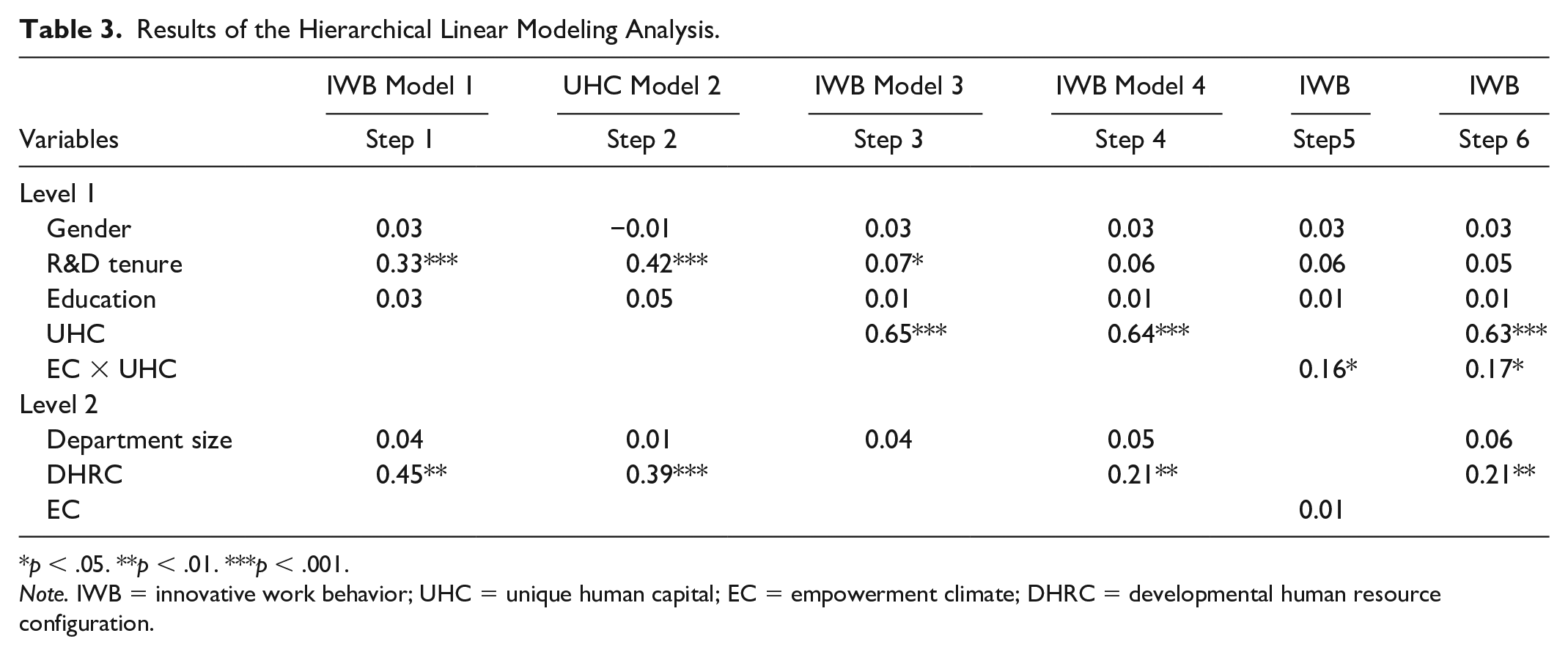
Hypothesis 1 predicted that DHRC was positively related to IWB. HLM results showed that DHRC was significantly associated with employee IWB (γ = 0.45, p < .01, Step 1, Model 1 in Table 3). Thus, Hypothesis 1 was supported. Hypothesis 2 predicted that DHRC was positively related to unique human capital. Results showed that DHRC was significantly associated with unique human capital (γ = 0.39, p < .001, Step 2, Model 2 in Table 3). Thus, Hypothesis 2 was supported. Hypothesis 3 predicted that unique human capital was positively related to employee IWB. Results showed that unique human capital was significantly associated with employee IWB (γ = 0.65, p < .001, Step3, Model 3 in Table 3). Thus, Hypothesis 3 was supported.
Results of the Hierarchical Linear Modeling Analysis.
p < .05. **p < .01. ***p < .001.
Note. IWB = innovative work behavior; UHC = unique human capital; EC = empowerment climate; DHRC = developmental human resource configuration.
Hypothesis 4 predicted that unique human capital would mediate the relationship between DHRC and employee IWB. To verify this meso-mediation model, we followed the 4-step procedures proposed by Baron and Kenny (1986) and Krull and MacKinnon’s (2001) propositions of multilevel equations for cross-level mediation validation. In Step 1, DHRC needed to be related to employee IWB. This requirement was supported by the results of Hypothesis 1. Thus, the first requirement was met. Step 2 required that DHRC was related to unique human capital. This requirement was supported by the results of Hypothesis 2. Thus, the second requirement was met. Step 3 required that unique human capital was related to employee IWB. This requirement was supported by the results of Hypothesis 3. Thus, the third requirement was met. Consequently, we continued to test Step 4. After controlling unique human capital, results revealed that unique human capital was significantly related to employee IWB (γ = 0.64, p < .001, Step 4, Model 4 in Table 3) and the effect of DHRC remained significant but was reduced in magnitude (γ = 0.21, p < .01, Step 4, Model 4 in Table 3) when compared with the effect in Step 1, Model 1 in Table 3. This result suggested that unique human capital partially mediated the relationship between DHRC and employee IWB. The indirect effect = 0.64 × 0.39 = 0.24, which is equal to the total effect (0.645) subtracts the direct effect (0.21). The Sobel (1982) test confirmed that the indirect effect (z = 4.18, p < .001) was significant. Therefore, Hypothesis 4 received support.
Finally, we conducted the cross-level moderation and moderated mediation model to test our Hypotheses 5 and 6. Hypothesis 5 predicted that empowerment climate would moderate the relationship between unique human capital and employee IWB. As shown in Table 3 Step 5, the interaction term of unique human capital and empowerment climate (γ = 0.16, p < .05) was significantly related to IWB. Therefore, Hypothesis 5 was supported. Hypothesis 6 predicted that empowerment climate would moderate the indirect relationship of DHRC on employee IWB via unique human capital. As shown in Table3 Step 6, the interaction term of unique human capital and empowerment climate (γ = 0.1, p < .05) was significantly related to IWB. Therefore, Hypothesis 6 was supported. To clearly identify the interaction effect at different levels of moderator, we followed the procedures proposed by Aiken et al. (1991) and plotted interaction using a cut value of one standard deviation above and below the mean of empowerment climate to represent high empowerment climate and low empowerment climate. These results are depicted in Figure 2.

Moderating effect of empowerment climate on the relationship between unique human capital and IWB.
Discussion
The purposes of this research included (a) examining the impact of DHRC on employee IWB; (b) the mediating role that unique human capital plays; and (c) the moderating role of empowerment climate in this mediation mechanism. By collecting samples from high-tech industries in Guangdong Province, China, the results were as follows. First, we found that DHRC was positively related to employee IWB. Next, the relationship between DHRC and IWB was partially mediated by unique human capital. Then, the indirect effect of DHRC on employee IWB through unique human capital was moderated by empowerment climate.
RBV proposed that only those resources that are valuable, rare, inimitable, and nonsubstitutable might lead to organizational sustainable competitive advantage (Barney, 1991). As the critical drivers, individuals play the vital role in creating sustainable competitive advantage because they possess firm-specific KSAs to generate organizational and individual innovative outcomes (e.g., Bos-Nehles & Veenendaal, 2019). Unlike generic human capital representing KSAs applicable across organizations and industries, unique human capital is closely linked to specific firms that have little relevance to other industries and organizations (Ployhart et al., 2011). HR literature has purposed that not all kinds of human capital are weighed as equally important and only unique human capital rewarded and encouraged by DHRC helps create competitive advantage (Barney, 1991; Ployhart et al., 2011). The Hypothesis 2 reflects that DHRC have both direct and indirect positive impacts on IWB (through unique human capital). The value and specificity of human capital developed by DHRC motivate employees to integrate and accumulate their KSAs to attain organizational strategic goals by IWB (Chien & Lin, 2013; López-Cabrales et al., 2011). Based on SET, DHRC, including skill-based pay, promotion-from-within, developmental performance appraisal, and comprehensive trainings may motivate employees to repay their organizations with discretionary behaviors (i.e., DHRC) accordingly (Blau, 1964; Bos-Nehles et al., 2017; Bos-Nehles & Veenendaal, 2019; Choudhury & Mishra, 2010; He et al., 2018).
Our research goes beyond previous research because we included both DHRC and empowerment climate as contextual factors that motivate employee IWB. In terms of the cross-level moderated mediation, our hypotheses demonstrate that the relationship between DHRC and IWB, through unique human capital, would be moderated by the empowerment climate. The strength of this indirect relationship was contingent upon the empowerment climate within an organization. The results reflect prior research that the effectiveness of DHRC on IWB via firm-specific human capital is contingent on the organizational empowerment climate, composed of sense of trust, risk-taking preferences and autonomy (e.g., Si & Wei, 2012). An empowerment climate may implement specific purpose-oriented practices, such as DHRC as well as delegating decision latitude for tasks and business processes. If the organization creates a supportive context for employee autonomy, encourages information sharing and closely cooperates with others as teams, employees will comfortably express ideas, being respected and sponsored for creative thinking and IWB (Cabello-Medina et al., 2011). That is, when perceiving more organization support through information sharing, autonomy, and team accountability, employees are more willing to dedicate their unique human capital to extra-role behaviors such as IWB to their organizations (Randolph, 1995; Seibert et al., 2004).
Theoretical Implications
The study has added knowledge to the academic literature in the following ways. First, the findings broaden our understanding of the purpose-oriented HR practices (i.e., DHRC) by demonstrating the positive impact of DHRC on employee’s IWB (De Jong & Den Hartog, 2010). Second, by empirically explicating the process by which unique human capital influences employee IWB and the boundary factor, this study contributes to current literature. The study enriches the current HRM-innovation literature by exploring the “black box” of unique human capital in the relationship between DHRC and IWB which has received little attention thus far. The research also reflects the importance of the situational variables between DHRC and IWB via unique human capital which investigate the impact of boundary conditions on strengthening the SET literature (Nieves & Quintana, 2018; Si & Wei, 2012). The findings advance the limited conclusions when taking both HRM and situational elements into consideration by identifying empowerment climate as a significant situational factor and through examining the role it plays in moderating the impact of DHRC on IWB. When organizations keep seeking ways to improve their innovative outcomes in a dynamic global context, the findings that unique human capital can lead to IWB may support organizations purposefully designing HRM accordingly when strategically considering work contexts (e.g., Choudhary et al., 2020).
Practical Implications
This study has some implications for practitioners. In a dynamic workplace characterized by knowledge-intensive focus, high-tech organizations are actively encouraged to attract, maintain, and retain those knowledge workers who have distinctive KSAs and to create and accumulate unique human capital by IWB to increase organization competitiveness and adaptability in a relatively uncertain environment (Bos-Nehles et al., 2017; Bos-Nehles & Veenendaal, 2019; Choudhary et al., 2020). One of the important implications of this study is that IWB can be attained by internally developing unique human capital rather than simply targeting individuals from outside companies. For instance, skill-based pay encourages individuals to use their specific KSAs to complete tasks and responsibilities with less effort (e.g., Choudhury & Mishra, 2010). In addition, comprehensive trainings, including professional expertise and personal development may signal the importance of unique human capital that organizations continuously support through seminars, simulations, mentoring, and coaching. Developmental purpose performance management may evaluate employees based on multifaceted abilities, such as communication, decision-making and analytical ability, retrieving feedback from different perspectives within and outside companies. Combing training, performance management, and reward by promotion from within, organizations may benefit from innovative outcomes (i.e., IWB) and motivate employees to develop firm-specific KSAs (e.g., Choudhary et al., 2020; Youndt & Snell, 2004).
In addition to DHRC, the findings of the study show the importance of situational elements for promoting employee IWB. Practically, knowledge-intensive organizations may create a climate in which individuals may receive respect and appreciation and may freely express and share information in generating creative ideas and innovative behavior. An empowerment climate may facilitate employee dedication to create and share knowledge, based less on control, more on trust, with greater discretion and autonomy (Jiang et al., 2012; López-Cabrales et al., 2011). By including both DHRC and empowerment climate, organizations may motivate employees to build and develop reciprocal relationship with extra-role behaviors, like IWB was show by this study.
Limitations and Directions for Future Research
This study has some limitations that shed light on future research directions. First, it would be useful to expand the framework to other industries, organizations, and job categories. For instance, due to the importance of innovation to corporate competitiveness, we specifically collected data from high-tech firms in Guangdong Province, China. There is a need to further explore if the existing relationships derives from the high-tech sectors in particular. Future research may include samples from different industries, including service and manufacturing to enhance generalizability. Furthermore, future researchers may access random samples for better representativeness in data collection other than the snowball approach applied in this study. Third, the partial mediation result implies the possibility of other mediators than unique human capital in the relationship between DHRC and IWB. Studies from Marane (2012) and Ramamoorthy et al. (2005) found that trust and psychological contract were mediators when examining the relationship between HR practices and IWB. Thus, future research may investigate other possible mediators to uncover the “black box” in relation to the impact of HR practices on employee behaviors in the workplace. In addition to mediators, based on a contingency viewpoint, the role of other moderators (e.g., involvement climate and innovative climate) may need further discussion to fully understand the effect of HR practices on IWB (e.g., van Esch et al., 2018).
Conclusion
Innovation is one of the most critical elements resulting in performance (Nieves & Quintana, 2018). It provides opportunity for organizations to strengthen their capabilities to expand into new markets and increase profitability for continuous growth in a highly competitive and dynamic business environment. This study advances our understanding of the impact of DHRC on IWB. The mediating effect of unique human capital and the moderating impact of empowerment climate provides rich insight into how DHRC can encourage IWB in the high-tech industry by specific HR practices to strengthen employees KSAs. The study further expands the influence of workplace context by empowerment climate which moderates the relationship between DHRC and IWB and affects the indirect relationship between unique human capital on IWB. The findings may encourage employers to foster IWB by empowering employees to share knowledge with DHRC designed to motivate unique human capital.
Footnotes
Declaration of Conflicting Interests
The author(s) declared no potential conflicts of interest with respect to the research, authorship, and/or publication of this article.
Funding
The author(s) disclosed receipt of the following financial support for the research, authorship, and/or publication of this article: This study was supported by the project titled “The relationship between working value and innovative performance of new generation employees: Taking the Great Bay Area, China for example” under grant No. 2020WTSCX242.
