




Abstract
Empirical studies on English as Foreign Language (EFL) instruction in China have indicated that in-service EFL teachers often lack sufficient training in implementing phonics instruction. To address this, effective professional development requires a training material guide that identifies the fundamental phonics content knowledge required by the National English Curriculum. This study aimed to determine the essential content knowledge that in-service EFL teachers need to effectively teach phonics. Initially, a provisional knowledge framework was developed through a review of the literature. This framework was then refined through a focus group discussion involving six experienced educators. Subsequently, a survey and another focus group discussion were conducted with in-service EFL teachers in compulsory education to further consolidate the crucial content knowledge. The findings suggest that knowledge of phonics decoding rules and effective phonics instructional approaches should form the core content knowledge for teacher training. Additional knowledge areas, such as general phonics-related concepts, phonemic awareness, sound system knowledge, rule reinforcement strategies, lesson planning, and sight word instruction, could be included or adapted to meet the specific learning needs of different teacher groups. This study provides preliminary recommendations regarding the content of a phonics training guide and proposes a needs assessment as a pre-requisite for in-service EFL teachers from diverse teaching contexts who require training in phonics instruction.
Plain Language Summary
This study investigated what in-service English as a Foreign Language (EFL) teachers in mainland China believe is the essential phonics knowledge for effective teaching. It was conducted to help address the lack of sufficient training materials available to teachers on this subject. The researchers used a mixed-method approach, which included focus group discussions with educators and a survey of 276 primary and secondary school teachers. The findings show that teachers consider knowledge of phonics decoding rules (such as vowel sounds and phonograms) and instructional approaches (like the analogy, analytic, and synthetic methods) to be the most important. This suggests that a strong understanding of both the “what” and “how” of phonics is crucial for them. A key difference emerged between primary and secondary school teachers. While both groups prioritized core phonics rules, primary teachers also considered it very important to know how to teach irregular words. In contrast, secondary teachers placed less importance on this skill because their students also learn the International Phonetic Alphabet (IPA) to help with word pronunciation and spelling. Overall, the teachers surveyed considered knowledge about phonemic awareness, the English sound system, and lesson planning to be less important. The study concludes that any future phonics training guides or professional development programs for these teachers should be based on their specific needs and priorities to be effective. The research provides a valuable framework for educators and policymakers to develop targeted training initiatives that can enhance teacher skills and improve student reading comprehension.
Keywords
Introduction
A knowledge base refers to the fundamental understanding that a teacher or instructor needs to effectively conduct teaching activities within a specific subject (Kim, 2024; Shulman, 1986). Effective teaching generally begins with a teacher’s fundamental understanding of what and how to teach (Bagherzadeh et al., 2019; Marianna, 2022). This knowledge base encompasses various components, including content knowledge, general pedagogical knowledge, curriculum knowledge, pedagogical content knowledge, understanding of learners, awareness of the educational context, and knowledge of educational goals. Together, these elements ensure that teachers are well-equipped to understands both the subject matter and the most effective pedagogical approaches. Content knowledge, in particular, is crucial as it informs decisions regarding textbooks, curriculum materials, teaching objectives, and the effective transmission of subject matter to students (Grossman, 1989; Levrints, 2022).
Phonics refers to the relationship between letters and sounds in English (Bear et al., 2020). It is an early reading strategy that helps learners develop the ability to recognize and manipulate the phonemes in spoken language, thereby understanding the correspondence between phonemes and graphemes (Papp, 2020). The goal of phonics instruction is to teach learners the connection between sounds and their written symbols (Gopal & Singh, 2020). This method enhances decoding skills, reading accuracy, fluency, comprehension, and spelling for all learners, particularly EFL students who experience reading difficulties (International Literacy Association, 2019).
Prospective and current in-service EFL teachers instructing beginners in mainland China should possess at least foundational understanding of phonics content knowledge. Both Blevins (2017) and the International Literacy Association (ILA, 2019) emphasize that teachers’ content knowledge significantly influences their pedagogical decisions and actions during phonics instructions. A fundamental grasp of phonics empowers teachers to select the most effective instructional approaches for conveying phonics rules and to accurately assess student progress (Blevins, 2017; Zhang, 2019). Nevertheless, previous studies indicate that many in-service EFL teachers in mainland China exhibit limited knowledge for implementing phonics instruction effectively (Zhao et al., 2015). Further studies reveal that some teachers lack awareness of the very meaning of phonics and struggle to teach it or explain irregular English words that deviate from standard decoding or encoding patterns. Consequently, a significant number of practicing EFL teachers have expressed a need for further professional development in this area (Long, 2019; Zhao, 2019; Zhong, 2020; Zhong & Kang, 2021).
In China, compulsory education spans Grades 1 to 6 in primary school and Grades 7 to 9 in junior middle school. The recently implemented National English Curriculum for compulsory education mandates that teachers at this level possess current phonics knowledge, a concept introduced in mainland China in 2011 (Zhang, 2019). Defining the essential phonics content knowledge is the crucial first step toward enabling effective phonics instruction for EFL learners. To ensure the quality of subsequent training, a pre-training need assessment can identify in-service EFL teachers’ existing phonics knowledge and their desired professional development, allowing the training to focus specifically on the identified content gaps (Branch, 2018; Morrison et al., 2019; Macalister & Nation, 2020).
Therefore, this study aims to determine the phonics content knowledge of in-service EFL teachers in mainland China, considering the context of recently implemented National English Curriculum for compulsory education. This investigation was guided by the following primary research questions:
(1) What specific content knowledge should in-service EFL teachers in mainland China possess to effectively deliver phonics instruction?
(2) What differences in preferred content knowledge between primary school and junior middle school in-service EFL teachers within the compulsory education phase?
Literature Review
This section reviews relevant literature to identify research gaps and establish the initial content knowledge framework for the current study.
Studies on Teachers’ Knowledge Base to Teach Phonics
Content knowledge forms a crucial part of a teacher’s knowledge base for any given subject (Grossman, 1989; Zhang, 2019). Consequently, research within early reading education in English-speaking countries, particularly concerning phonics instruction, has increasingly focused on in-service teachers’ knowledge of phonics instruction. For instance, Blevins (2006, 2017), McCoy (2017) and Syamdianita and Cahyono (2021) emphasised that teachers’ content knowledge of phonics significantly influences their pedagogical decisions during phonics instructions and their comprehensive understanding of learners’ errors. Furthermore, Moats (1994, 2009) investigated in-service teachers’ content knowledge of early reading through phonics and found that many teachers are inadequately prepared to explain phonics decoding rules to struggling beginners. Moats (1995) further noted that English, as an alphabetical language, comprises three interconnected layers: phonology, phonetics, and morphology. Therefore, Moats (1995, 2014) suggested that teachers should possess explicit knowledge of each of these layers to effectively teach phonics.
Furthermore, Spear-Swerling and Brucker (2004), along with Piasta et al. (2009) highlighted that a teacher’s content knowledge of phonics significantly shapes their pedagogical decisions during the instruction process. The Department of Education, Science and Training (2005) emphasized an urgent need to prepare primary and secondary school teachers to teach early reading through phonics instruction. Similarly, the Department for Education and Skills (DES, 2007) advocated for equipping practitioners and in-service primary school teachers with a strong knowledge base for phonics instruction. Concurrently, Spear-Swerling and Brucker (2004) and Spear-Swerling et al. (2005) demonstrated a positive correlation between improvements in a teacher’s content knowledge following professional training and their learners’ word reading scores. Considering that in-service teachers’ content knowledge can directly influence learners’ learning outcomes, enhancing their subject-matter expertise is crucial for promoting the quality of phonics instruction. It is important to note, however, that unlike the EFL context in China, the abovementioned studies were conducted in first-language English settings.
Compared to native English-speaking teachers in North America, EFL teachers in China typically give significant consideration to phonics (Long, 2019). Research on phonics is crucial for teaching both pronunciation and the comprehension of letter-sound correspondences (Zhong, 2020). Teachers in China often distinguish phonics from the International Phonetic Alphabet (IPA) when viewing phonics as a word identification strategy. The IPA is commonly used to teach junior high school students (Grades 7–9) in China, and this distinction has sparked discussions regarding the advantages and disadvantages of each systems (Zhong & Kang, 2021). Lower-grade students in China typically learn phonics first and then IPA as they progress through the grades, facilitating their adjustment to secondary school English instruction (Zhao, 2019). Given the increasing use of phonics to enhance primary English literacy, more studies investigating the theory and practice of teaching phonics in Chinese EFL classrooms have revealed challenges stemming from inadequate phonics knowledge and inaccurate language processing (Zhao et al., 2015).
The China National Knowledge Infrastructure (CNKI), the most widely used database in mainland China, indicates a scarcity of literature on this specific topic. Few studies have emphasised in-service EFL teachers’ knowledge of teaching phonics. For example, Zhao et al. (2015) investigated the phonics teaching knowledge base of 776 in-service EFL teachers and revealed unsatisfactory findings. Other studies (Long, 2019; Zhao, 2019; Zhong, 2020; Zhong & Kang, 2021) suggested that the lack of a phonics instructional guide and relevant training contributed to the challenges faced by in-service EFL teachers in delivering effective phonics instruction. Previous studies revealed that participants lacked a fundamental understanding of phonics, including explicit phonics decoding principles, instructional strategies, and methods for explaining irregular words. However, these studies primarily identified the factors hindering in-service EFL teachers from effectively implementing phonics instruction without specifying the precise content knowledge they should possess to instruct EFL beginners. Consequently, this study aims to address this gap in the existing literature.
Provisional Required Content Knowledge Framework
To identify the necessary content knowledge both inductively and deductively (Macalister & Nation, 2020), existing literature and established frameworks can serve as sources for a provisional content knowledge framework, which can then be adapted for or inform the development of research instruments. Studies on phonics instruction in China have indicated that in-service EFL teachers often lack sufficient content knowledge regarding phonics, decoding rules, effective teaching methodologies, and strategies for addressing irregular words (Long, 2019; Zhao, 2019; Zhong, 2020; Zhong & Kang, 2021). Consequently, a provisional content knowledge framework for phonics instruction should initially encompass basic phonics-related general knowledge, phonics decoding rules, various phonics instruction approaches, and strategies for managing irregular words. The knowledge frameworks proposed by Hatcher (2006) and Manchester Metropolitan University (2015) were analysed to construct a comprehensive provisional content knowledge framework, which then guided the selection or adaptation of instruments for this study.
Hatcher (2006) developed the Reading with Phonology program to support beginners who have limited spoken language development and experience early reading difficulties. This programme focuses on training fundamental letter-sound relationships, such as basic phonemes, aligning with the Bottom-Up Theory of Reading Process. This theory posits that early reading instruction should begin with explicit foundational sub-skills, such as the phonics coding process, and progress through various stages of reading comprehension (Carroll et al., 2011; Papp, 2020). EFL beginners in China often fit this profile, starting to read with inadequate decoding skills due to a lack of fundamental English vocabulary and a less immersive language environment. Therefore, in-service EFL teachers should possess the necessary knowledge to implement the Reading with Phonology Programme effectively, including phonics decoding rules, phonemic awareness instruction (segmenting and blending), book reading strategies, and sight words instruction. Within this programme, the initial aim of book reading is to cultivate learners’ appreciation for literature and provide opportunities to practice decoding skills.
Within the EFL context, Blevins (2017) suggested introducing decodable texts to learners at this stage. In this programme, sight word instruction primarily focuses on addressing irregular words, which are often treated as sight words through repeated practice and multisensory instruction. This approach aligns with the Law of Exercise in S-R Theory with Reinforcement, emphasizing the importance of consistent drills and exercises to establish connections between stimuli and the desired response (Budiman, 2017; Schunk, 2020). This adaptable framework can be tailored to learners’ individual needs and existing knowledge level (Carroll et al., 2011). Consequently, these four components can be integrated into the provisional content knowledge framework and categorized as: phonics decoding rules, the decoding rules reinforcement approach (using decodable book), the sight words instruction approach, and phonemic awareness knowledge and skills.
Consequently, a provisional content knowledge framework for phonics instruction should initially encompass basic phonics-related general knowledge, phonics decoding rules, various phonics instruction approaches, and strategies for managing irregular words. The analytic approach to phonics teaches students to analyze letter-sound relationships within known words, moving from the whole word to its parts, while the analogy approach teaches students to use parts of known words (e.g., phonograms like “-at”) to decode new, similar words (e.g., “cat,”“sat,”“mat”). The knowledge frameworks proposed by Hatcher (2006) and MMU (2015) were analyzed to construct a comprehensive provisional content knowledge framework, which then guided the selection or adaptation of instruments for this study.
Therefore, a working grasp of the phonics system, including syllable and phonemes, and an understanding of phonics’ relevance to early reading are prerequisites for both pre-service and in-service instructors aiming to implement phonics education effectively (Brady et al., 2009). Given that a basic understanding of phonics and early reading constitutes phonics-related general knowledge, the provisional required content knowledge for this study encompasses the following dimensions, derived from the abovementioned literature and frameworks in China and worldwide: (i) phonics-related general knowledge, (ii) basic knowledge of the English sound system, (iii) phonemic awareness knowledge and skills, (iv) phonics decoding rules, (v) phonics instruction approaches, (vi) decoding rules reinforcing approaches, and (vii) sight words instruction approaches.
Theoretical Framework
The identified content knowledge necessary for effective phonics instruction among Chinese EFL teachers can be analyzed through the lens of established models of teacher knowledge. Shulman’s (1987) concept of Pedagogical Content Knowledge (PCK), which emphasizes the intricate blend of subject matter knowledge and pedagogical understanding required for effective teaching, provides a valuable framework. By examining the specific phonics content knowledge deemed essential by the study's findings, we can analyze how this knowledge intersects with the pedagogical skills and strategies needed to effectively impart these concepts to EFL learners in the Chinese context. This connection allows us to move beyond a descriptive account of necessary knowledge and delve into the cognitive and practical dimensions of how teachers utilize this knowledge in their instructional practices.
Furthermore, the study’s focus on developing phonics instruction competencies in in-service teachers naturally aligns with various theories of professional development. Frameworks such as Guskey’s (2002) model of professional development and teacher change, which highlights the importance of teacher beliefs and attitudes, implementation, and student outcomes, can provide a theoretical lens through which to interpret the identified training needs and potential interventions. By situating the study within these theoretical perspectives, we can better understand the mechanisms through which professional development initiatives can effectively address the specific knowledge gaps and instructional challenges faced by Chinese EFL teachers in implementing phonics. This connection allows for a more nuanced discussion of how training materials and pedagogical approaches can be designed to foster meaningful and sustainable changes in teacher practice.
A deeper engagement with international phonics research is crucial for understanding how the relative importance of phonemic awareness, lesson planning, and differentiated approaches changes between L1 and EFL settings (Geva, 2000). By integrating these global perspectives, educators can develop more effective, context-specific phonics pedagogies that are theoretically sound and practically adapted to diverse learning environments, ultimately improving literacy outcomes (Schunk, 2020).
Finally, the core focus on phonics instruction requires a clear articulation of its theoretical underpinnings within second language acquisition research. The well-established body of work highlighting the critical role of phonological awareness in L1 reading development has been increasingly extended to the L2 context (e.g., Geva, 2000; Sparks & Ganschow, 1991). Connecting the study's findings regarding the essential phonics decoding rules and effective instructional approaches to this body of research will underscore the theoretical significance of developing these competencies in EFL teachers. By explicitly linking the identified knowledge gaps to the potential challenges faced by Chinese EFL learners in developing L2 reading skills due to insufficient phonological awareness, the article can strengthen its argument for the importance of targeted phonics instruction and the need for well-prepared teachers. This theoretical grounding will not only enrich the analysis of the study’s findings but also enhance its relevance to the broader field of SLA research and its implications for effective L2 literacy instruction.
Based on the above elaboration, Figure 1 shows its relationship in the form of phonics instruction knowledge pyramid.

Phonics instruction knowledge pyramid.
The pyramid in Figure 1 illustrates how the essential Content Knowledge for phonics instruction, identified by this study, is combined with Pedagogical Skills (teaching strategies) to form Pedagogical Content Knowledge (PCK) Integration for effective EFL teaching practice.
Research Methods
To achieve the study’s objectives and address the two research questions, a mixed-method approach was employed. Both quantitative and qualitative methods were used deductively and inductively to investigate the phonics content knowledge required for effective instruction utilizing exploratory sequential approach (Cresswell & Creswell, 2018). This section elaborates on the research design, participants, instruments, and data analysis procedures.
Research Design and Rationale
This study was conducted in Sichuan Province, China, involving in-service EFL teachers from primary and junior secondary schools within the compulsory education phase. The participants were recruited from local public teachers’ colleges. To determine the necessary content knowledge for these in-service EFL teachers, both quantitative and qualitative methods were employed. The required content knowledge for phonics instruction was identified through both inductive and deductive reasoning. Following the suggestion of Macalister and Nation (2020), a provisional knowledge framework was developed based on existing literature from China and internationally to ensure a comprehensive scope of phonics instruction. This provisional framework also served as an empirical foundation for the development of the research instruments.
The chronological steps of this study involved the initial focus group, survey, and final focus groups.
(1) Initial focus group: This was a foundational step. The initial qualitative focus group served to validate and refine the provisional framework, ensuring the subsequent large-scale questionnaire was grounded in expert-informed content. The study commenced with a focus group discussion involving six participants to explore the specific content knowledge within the provisional framework that in-service EFL teachers should possess for enhanced implementation of phonics instruction. This approach is grounded in the principle that, alongside a generalised knowledge framework, target situation analysis is crucial in determining necessary knowledge (Macalister & Nation, 2020).
(2) Questionnaire: This was the broad-based quantitative phase designed to triangulate the expert-driven findings from the initial focus group with the perceptions of a large, representative sample of in-service teachers. Subsequently, a questionnaire employing a five-point Likert scale was distributed to 276 in-service EFL teachers across the compulsory education phase (from Grades 1 to 9) to collect data on their perceptions of the specific knowledge they should possess regarding phonics instruction.
(3) Final focus group: Finally, two additional focus group discussions were conducted with in-service EFL teachers (six from the primary teaching level and six from the secondary teaching level, respectively) to gain a deeper understanding of their preferred content knowledge. The final focus groups were conducted to allow participants to elaborate on their reasoning and context.
Sampling Strategies and Justification
For the initial focus group, purposive sampling was used to select six educators with expertise in Phonology or Pedagogy (Associate Professors or PhD holders) to ensure the initial knowledge framework was critically reviewed and validated by individuals with established academic and practical expertise in the field. This maximized the relevance and quality of the conceptual framework guiding the study. The purpose of this discussion was to determine the specific knowledge within the provisional framework that in-service EFL teachers should possess. Purposive sampling was adopted to maximise the volume of desired participants’ information (Creswell & Creswell, 2018).
Based on a population of 1,243 in-service EFL teachers, a sample size of 267 falls within the recommended range, which ensures a 95% confidence level and a margin of error of 5% (Krejcie & Morgan, 1970). Random sampling was adopted to select 276 in-service EFL teachers in the compulsory education phase. A total of 148 respondents were from primary schools, while 138 were from secondary schools. This technique was chosen as random sampling is the premise for inferential statistics (Johnson & Christensen, 2019).
Finally, purposive sampling was re-applied to select 12 in-service EFL teachers with distinct experiences and contexts. By separating participants into primary and secondary groups (Np = 6, Ns = 6), the study could explore potential differences in phonics knowledge preferences that might be influenced by teaching level and curriculum requirements.
Instrument Validation
Three instruments were employed in this study. First, the focus group discussion from Alsamadani (2017) and Bennet (2017) was performed to obtain information from six teacher educators to determine the specific knowledge to be included in the provisional knowledge framework based on previous studies. This instrument was validated by four educators. The second instrument was a five-point Likert scale questionnaire to gather data on in-service EFL teachers’ preferences for the specific content knowledge of teaching phonics based on Wahba (2019). This questionnaire included 18 items regarding phonics knowledge, which had acceptable reliability and construct validity (Cronbach’s alpha = .844, KMO = .800, and p < .001; Kumar, 2019). The third instrument was a focus group discussion among in-service EFL teachers based on Alsamadani (2017) and Bennet (2017) to further investigate the in-service EFL teachers’ preferences for specific knowledge items in the provisional knowledge framework, which was validated by four educators.
Overall, the initial and final focus group discussion protocols were validated by four educators. This involved a peer review process where these experts provided feedback on the clarity, appropriateness, and comprehensiveness of the questions to ensure they would elicit the desired information and align with the research objectives. For the questionnaire, the Cronbach’s alpha value of .844 indicates a high level of internal consistency among the questionnaire items, suggesting they reliably measure the same underlying construct. The KMO value of .800 and the significant p-value (<.001) confirm the data’s suitability for factor analysis, demonstrating acceptable construct validity. Table 1 presents the summary of research instruments.
Summary of Research Instruments.

Data Analysis Process
The qualitative data obtained from the focus group discussions were recorded. The audio recordings were then carefully transcribed into text format for analysis. Qualitative content analysis was applied to enable the researcher to comprehend underlying latent meanings in print. This approach also enabled subjective text data interpretation through coding and categorising patterns, which can be applied deductively or inductively (Hsieh & Shannon, 2005; Zhang & Wildemuth, 2009). The primary methodology used was inductive conventional qualitative content analysis to enable new data categories by inductively extracting coding categories from the raw text data. Hence, most of the themes and sub-themes could be derived from the text data based on the inductive approach, which produced descriptions by categorizing the raw text data into themes or groups based on valid interpretations to illustrate various meanings (Zhang & Wildemuth, 2009). In essence, the coding process began inductively to allow new themes to emerge from the raw data, followed by a directed approach to ensure all data were systematically coded within the established framework, thereby avoiding oversimplification.
Directed content analysis was adopted as the second approach of thematization to ensure that all the text data was fully interpreted and coded under the proper themes or sub-themes and avoid oversimplification (Ellis & Barkhuizen, 2005). This approach enabled generating sub-themes or themes from findings in the existing literature or frameworks (Zhang & Wildemuth, 2009). During the coding process, the individual theme was the unit for analysis, while the constant comparison method was applied (Krueger & Casey, 2015). The text data and themes were constantly compared and categorised under labels until all the text data were categorized. This method was useful when examining the entire text dataset to identify underlying or potential themes (Krueger & Casey, 2015). For example, while themes like “phonics rules” were anticipated from the literature (directed approach), the constant comparison method inductively revealed a new theme related to “teacher confidence in pronunciation” which was not explicitly captured in the provisional framework.
Finally, quantitative data were gathered based on a five-point Likert scale ranging from “least preferred” (1) to “most preferred” (5) and converted to numerical form for the subsequent analysis. The means, standard deviations, and percentiles were calculated to identify the teachers’ preference for phonics-related knowledge items.
Ethical Considerations
The study was non-invasive, relying solely on anonymous survey data related to professional needs and preferences, which posed no physical, psychological, or social risk to participants. Potential harm was primarily limited to the risk of a breach of confidentiality. To mitigate this, no personal identifying information (such as names, specific school names, or contact details) was collected alongside the survey responses. Additionally, the data were aggregated for analysis, ensuring that individual responses could not be traced back to specific participants.
The potential benefits to society and the teaching profession substantially outweighed the minimal risk of participation. The findings of this research provide an empirically-driven needs analysis that will directly inform the development of targeted, effective professional development materials and policies for phonics instruction in EFL contexts. This, in turn, is expected to improve teacher competencies and ultimately enhance student literacy outcomes in China. The benefits are academic and practical, contributing to teacher professionalization and curriculum enhancement. Since the only risk was minimal confidentiality risk, the potential for widespread positive educational impact justified the study.
Furthermore, informed consent was secured through a digital consent form presented to all potential participants at the very beginning of the online survey. This form explicitly stated the purpose and objectives of the study, the voluntary nature of participation, including the right to decline to participate or to withdraw at any time without penalty, confirmation that the survey was entirely anonymous and confidential, and the expected time commitment. Participants were required to click “I consent to participate in this study” before they could gain access to the survey questions. This documented digital act served as the formal record of informed consent.
Findings
This section introduces the findings from the two focus groups. First, six educators from three local teachers’ colleges were examined to establish the provisional knowledge framework on phonics instruction.
Focus Group Findings
Three themes emerged from the qualitative content analysis of the focus group discussion with the six educators: Core Content Knowledge, Secondary Content Knowledge, and Supplementary Content Knowledge (Table 2).
Findings from Focus Group Discussion with Educators.

Table 2 indicates that the educators first classified the knowledge dimensions in the provisional knowledge framework on phonics instruction into two categories based on the National Curriculum: core content knowledge and secondary content knowledge. The national curriculum requires EFL beginners to grasp basic letter-sound relationships, namely basic phonics decoding rules. Therefore, the educators considered that in-service EFL teachers should at least be prepared to teach these basic decoding rules. Regarding phonics instruction implementation, the teachers indicated that in-service EFL teachers should know the pedagogical approach and how to teach phonics using different English textbook layouts. Generally, other English books from various publishing houses adopt unique approaches to present phonics decoding rules.
The educators suggested that in-service EFL teachers be familiar with these approaches to tailor the textbook content to their students’ needs. Lastly, phonics-related knowledge is crucial to explicitly explain the decoding rules, such as the definitions, sound system terms, and the necessity of phonics. In summary, the educators identified core knowledge dimensions for in-service teachers as: phonics decoding rules, instructional approaches, and phonics-related general knowledge. Several educators expressed as follows:
Educator 1: In fact, most of the in-service EFL teachers tried to ignore [the] “I can spell” section in the textbook because [they were] unaware of the importance of phonics [for] EFL students’ early reading process. Educator 2: The foremost thing is that the in-service EFL teachers know the phonics decoding rules explicitly so that they can teach students…True, it is better for them to understand general knowledge related to phonics. For instance, they should know basic phonology terms such as diphthongs or consonants in order to explain decoding rules better. Educator 3: Yes, I agree, knowing those spelling regulations is essential. However, they also should know the teaching methods to implement the instruction. Educator 6: True, [if they] only possess [this] knowledge, are they able to teach phonics?
Some educators proposed that EFL students would find the early English reading process easier when teachers possess knowledge of phonemic awareness, irregular words, and how students can be assisted to maintain their already-acquired phonics decoding rules. For instance, Educator 5 stated, “Sometimes, they should explain to their students why certain words do not follow the taught phonics decoding rules…” while Educator 4 mentioned that by “knowing how to use decodable text to help students reinforce the acquired rules and to accumulate the sight words, the teaching effect of phonics would be better.”
Educators 1 and 4 indicated that in-service EFL instructors should be able to organise intense phonics instruction classes explicitly and methodically to conduct phonics instruction based on the national curriculum and given the constrained teaching periods. Therefore, lesson planning might be taught as a complementary skill.
Survey Results with EFL Teachers
The following tables highlight respondents’ basic information, such as age distribution (Table 3), teaching level (Table 4), and gender distribution (Table 5).
Frequency of Respondents’ Age Distribution.

Frequency of Distribution of Respondents’ Teaching Level.

Gender Distribution of Respondents.

Table 3 indicates that the respondents’ age ranged from 20 to 50 years old. The majority of in-service EFL teachers were aged between 40 and 50, while newly recruited in-service EFL teachers accounted for approximately 22%.
Table 4 demonstrates that approximately half of the respondents taught at primary school level, while the other half were at the secondary education level.
Table 5 shows that most respondents from both primary and secondary teaching levels were female. Notably, significant more female in-service EFL teachers completed the questionnaire compared to males, with a difference of 52.2%.
Furthermore, Tables 6 and 7 present respondents’ preferences and those of primary and secondary teaching levels, respectively, in descending order.
Respondents’ Preferences in Descending Order.

Primary Teaching Level Respondents’ Preferences in Descending Order.

Based on Table 6, respondents considered it necessary to possess almost all the phonics knowledge to teach phonics, as they rated 11 out of 18 items over 4 points and 6 out of 7 items under 4 points. Specifically, the respondents considered basic decoding rules (phonograms, consonant spelling rules, and vowel spelling rules) as important as phonics instruction approaches (the analogy, analytic, and synthetic approaches). The approaches to managing irregulars were also considered similarly vital. Conversely, the respondents did not consider the following necessary: knowledge of phonemic awareness, sound system knowledge, approaches to facilitate EFL students to reinforce their acquired decoding rules, lesson planning skills, or general phonics-related knowledge (the definition and purpose of phonics) as the means for these items were under 4 points. Thus, primary research question 1 was addressed.
Tables 6 and 7 address primary research question 2 concerning the preference between the 2 groups of EFL teachers from primary and secondary teaching levels.
Table 7 indicates that respondents from the primary teaching level considered knowledge of phonograms, the analogy phonics approach, and methods of introducing irregular English words as the most important. Meanwhile, Table 8 outlines that the respondents from the secondary teaching level considered the most important aspects as follows: knowing about consonant digraphs, phonograms, the analogy phonics approach, and the analytic phonics instruction approach.
Secondary Teaching Level Respondents’ Preferences in Descending Order.
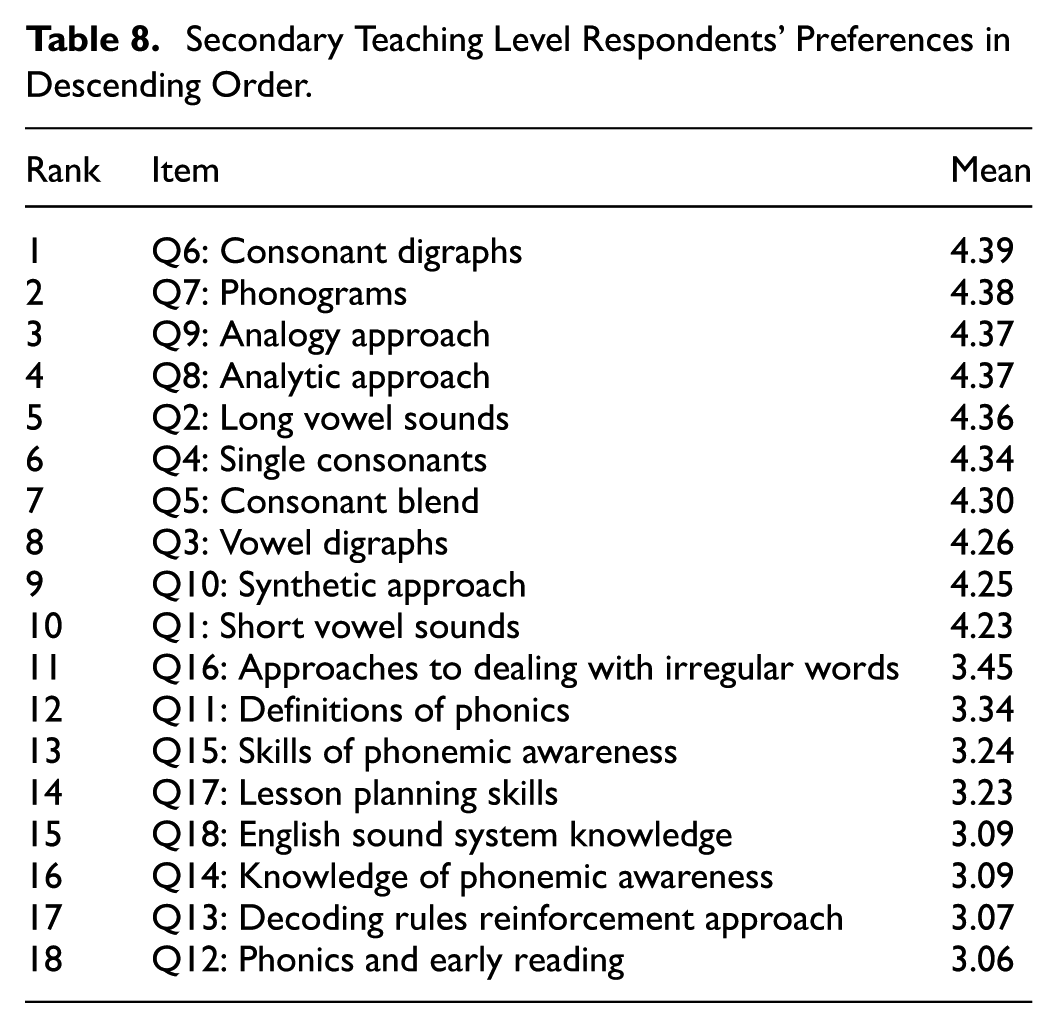
Respondents from both groups emphasised the analogy phonics instruction approach and phonograms, which are discussed in depth in the subsequent sections. Both groups mentioned that understanding how to cope with irregulars, understanding what phonics is, possessing strong phonemic awareness, using the reinforcement method, and the goal of phonics teaching was less significant. Additionally, knowledge of phonics decoding principles and phonics education methods were considered top priorities among both groups. Therefore, the second primary research question was addressed comprehensively.
As the broader implications, the findings suggest a key difference in pedagogical priorities between primary and secondary EFL teachers. Primary teachers appear to prioritize foundational skills and specific phonics elements like phonograms and irregular words, which aligns with the needs of younger learners who are building their literacy foundation. Their high ranking of “Approaches to managing irregular words” (Q16) and “Analogy approach” (Q9) indicates a focus on practical application and pattern recognition, which is critical for early reading acquisition.
Findings of Focus Group Discussion with In-Service EFL Teachers
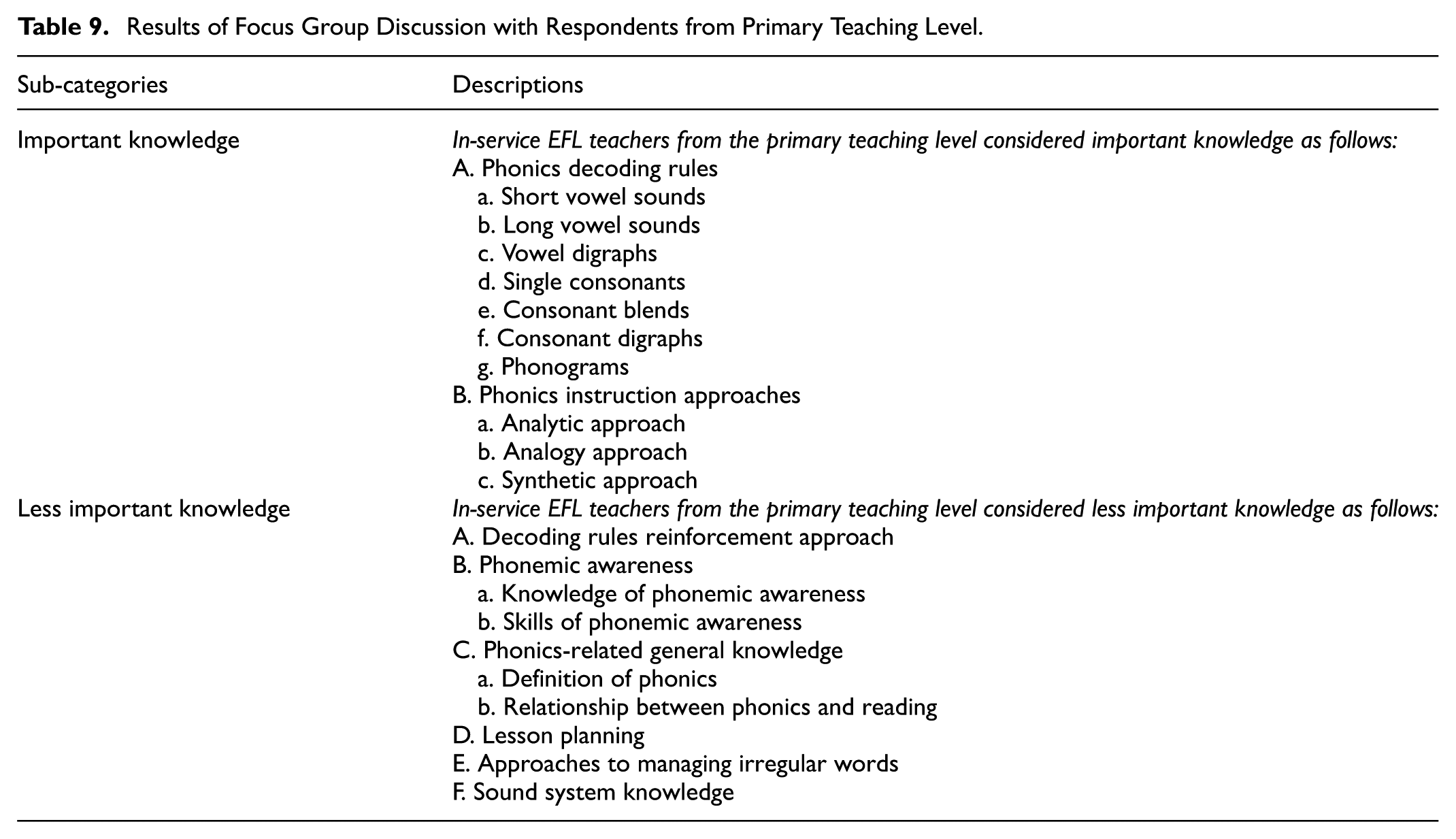
The two focus group discussions with in-service EFL teachers were conducted to obtain a deeper understanding of the desired knowledge base with in-service EFL teachers (six from the primary teaching level and the remaining from the secondary teaching level). Tables 9 and 10 list the results of the focus group discussions.
Results of Focus Group Discussion with Respondents from Primary Teaching Level.
Results of Focus Group Discussion with Respondents from Secondary Teaching Level.

Two general themes emerged from the discussion with the primary-level teachers: Important Knowledge and Less Important Knowledge.
The results of the focus group discussion with the secondary-level teaching respondents are presented in Table 9.
Based on the findings, both groups suggested that teachers at both levels must be knowledgeable of the phonics decoding principles and how to teach phonics. Essentially, in-service EFL teachers whose primary responsibility is instructing English as a foreign language only needed to learn how to teach phonics to students to aid the latter vocabulary growth. For example, participant 2 from group 2 (secondary teaching level) and participant 3 from group 1 (primary teaching level) expressed similar opinions as follows:
G2P2: As an in-service EFL teacher, since phonics is required from primary schools onward in the National English Curriculum, basically, phonics decoding rules should be acquired then … [teachers should] learn to teach [it]. G1P3: Actually, [when] equipped with specific decoding rules and the phonics teaching methods, we can implement the phonics instruction in different ways to meet our students’ needs. I think both [forms of] knowledge are essential to us.
Neither group considered phonemic awareness knowledge or abilities crucial as they were unnecessary in the EFL setting and could not be taught in additional teaching sessions, as quoted by the following respondents:
G2P1: …our students are in junior middle schools, so they already do not need to develop phonemic awareness anymore and their learning must focus on reading comprehension and vocabulary accumulation. G1P6: …English is our foreign language, and when the students start to learn English they may already have gained phonemic awareness in the process of learning Chinese Pinyin. Of course, no extra time is allowed for monitoring it.
A contrast emerged between the two teaching levels in their views on managing irregular words. Primary-level participants highlighted the necessity of explaining these words to their students, believing it aids in understanding their non-standard spelling. To illustrate this, two participants mentioned:
G1P1: …sometimes the students come to ask why certain words are pronounced in such an odd way, but we do not know how to explain to them. G1P4: …yes, if they do not understand the tricky words, they may misspell some of the words or they may be confused about the spelling rules.
The secondary-level participants prioritized decoding rules and instruction approaches over explicitly explaining tricky words. Their reasoning was that students at this level are already receiving instruction in the International Phonetic Alphabet (IPA), enabling them to independently decode words and build their vocabulary. This viewpoint was articulated by the respondents as follows:
G2P1: …they have already mastered the International Phonetic Alphabet. G2P5: …yes, if they do not know how to vocalise a word, they are able to look it up in a dictionary independently…Therefore we do not need to explain tricky words to help them understand [the words].
Both group of participants deemed acquiring further knowledge of lesson planning and the English sound system as less important, primarily because they believed their previous phonology instruction hall already equipped them with adequate understanding of the latter. They also considered specific lesson planning skills for phonics to be of lower priority. Additionally, secondary-level participants expressed the view that phonics was generally less important for their teaching context, given their current knowledge, as evidenced below:
G1P5: …we already knew this [sound system knowledge] while being taught [the] International Phonetic Alphabet… G2P5: …those [forms of] knowledge are already being taught to our students [when we teach the] IPA… G2P2: sure, for them, [the] IPA is more important than phonics, [because] to teach [the] IPA, sound system knowledge [is] already included…
Discussion
Identifying the necessary content knowledge for Chinese in-service EFL teachers to effectively deliver explicit and systematic phonics instruction was the central aim of this study. The results lay a practical groundwork for creating a phonics instructional guide tailored to their subjective and objective needs, ultimately intended to improve EFL students’ reading comprehension. Several key findings emerged that warrant further discussion.
Consistent with Shulman’s (1987) emphasis on subject matter content knowledge and pedagogical content knowledge, both educators and in-service EFL teachers in this study considered a strong understanding of phonics decoding rules and teaching approaches to be crucial. They believed instructors must grasp the core concept of phonics and possess the skills to teach them effectively. This foundational subject matter knowledge is essential for conveying information, while pedagogical content knowledge enables the organization of effective teaching activities. Specifically, familiarity with various phonics decoding rules and instructional approaches, including synthetic, analogy, and analytic phonics, allows teachers to utilize resources and select appropriate strategies for their EFL students.
Aligning with previous research in China (Long, 2019; Yan, 2018; Zhao, 2019; Zhong, 2020), the current study’s survey indicated that in-service EFL teachers’ prioritize phonics knowledge related to decoding rules, instructional approaches, and explaining irregular words (mean score > 4). These studies similarly found a desire among primary and secondary teachers to learn about the fundamental aspects of phonics, its teaching methodologies, and techniques for addressing irregular words.
While generally aligning with Long (2019) regarding the importance of decoding rules and instructional approaches, the present findings offer a nuanced contrast concerning the perceived necessity of knowledge for managing irregular words. Specifically, secondary-level in-service EFL teachers in this study considered this knowledge less vital. This divergence can be attributed to the fact that their students are typically introduced to the International Phonetic Alphabet (IPA) as a tool for word recognition and spelling, a requirement of the National English Curriculum. As a result, secondary teachers expressed a strong need for explicit strategies in explaining irregularities, a distinction that adds a valuable layer to the existing body of literature.
The high priority given by EFL teachers to the analogy phonics instruction approach and phonograms is likely due to its direct applicability to common English textbook structures. Many textbooks present phonics through phonograms, inherently suggesting the use of analogy in instruction. Examples include the widely used textbooks by Bai (2018), Qin (2019), Shi (2018), and Yang (2019), which feature patterns like “-at, mat, cat, hat; -ug, bug, hug, slug; -old, cold; -all, ball, fall; -ays, says, lays…” This familiar format enables in-service EFL teachers to quickly recognize phonograms and implement analogy-based teaching, thus explaining their strong preference for these elements, particularly at the primary level.
Limited English teaching time appears to be the primary reason why in-service EFL teachers considered secondary and supplementary phonics knowledge, like reinforcing decoding rules, less important. This aligns with the conclusion of Long (2019) and Zhao (2019). Another contributing factor is likely the teachers’ prior training, which often prioritizes the International Phonetic Alphabet (Zhao et al., 2015). Finally, the specific context of teaching English as a foreign language in China explains the lower emphasis on phonemic awareness, as students typically develop this foundational skill through learning Chinese Pinyin before their English studies begin, a point supported by Pan (2011) and Xu (2002).
International research consistently highlights phonemic awareness as crucial for reading success. The lower priority given to this skill by Chinese EFL teachers, though understandable given the Pinyin system, could be a drawback (Long, 2019). Assuming a seamless transfer of Pinyin knowledge may hinder students’ ability to decode irregular English words, potentially limiting their long-term reading fluency. Similarly, the de-emphasis on lesson planning skills is a concern (Qin, 2019). While using ready-made materials is practical, it can prevent teachers from creating comprehensive and responsive lessons. Without strong planning, teachers may struggle to address individual student needs, leading to a less adaptable instructional environment (Zhao et al., 2015). These findings, while contextually specific, highlight a potential disconnect with global best practices that future professional development should address.
Hence, the empirical findings carry several important implications. The varying knowledge preferences for phonics instruction suggest a clear need for a needs assessment to accurately determine the specific learning requirements of in-service EFL teachers based on the identified content knowledge. Furthermore, the development of the instructional guide should be guided by the National English Curriculum and the reality of limited teaching time to ensure the effective and understandable delivery of precise phonics information The novel nature of these results within the Chinese EFL context provides valuable insights into the specific content and pedagogical content knowledge necessary for these teachers to effectively teach phonics.
Conclusion
The findings of this preliminary investigation underscore the imperative for phonics decoding rules and effective instructional approaches to constitute the foundational knowledge base for in-service EFL teacher training in China. Conversely, other related knowledge domains should be considered supplementary, strategically tailored to accommodate the heterogenous learning needs of trainees. Furthermore, the necessity of a comprehensive needs assessment in subsequent phases of research is highlighted as a crucial precursor to the design and development of a robust phonics instructional guide. Such an evaluative step is essential to ensure the pedagogical efficacy of the guide and its training content in directly addressing the identified needs of the trainees, thereby optimizing their preparedness to implement phonics instruction effectively in their classroom.
The outcomes of this initial study offer compelling inputs for educators and policymakers to prioritize the development of targeted professional development initiatives, potentially including a needs-based phonics instructional guide, with the overarching aim of enhancing the professional capacity of in-service EFL teachers within the Chinese educational contexts. However, the study’s geographic scope was limited to Sichuan Province, China, which may restrict the generalizability of the findings to the diverse EFL teaching contexts across the entire country. Furthermore, the reliance on self-reported data (preferences and perceptions) from the in-service teachers, as opposed to direct assessment of their existing content knowledge and instructional practice, is a limitation.
Future research should focus on the operationalization and empirical validation of such needs-based training interventions to ascertain their impact on teacher practice and ultimately, student literacy outcomes. These findings suggest policymakers should make phonics a core part of teacher training. Rather than a one-size-fits-all approach, policy should support differentiated training modules for primary and secondary teachers. The curriculum should also be reviewed to explicitly include phonemic awareness skills specific to English, a need highlighted by the study’s data.
Footnotes

Ethical Considerations
Ethical approval for this study was obtained from the Ethics Committee. All procedures were performed in accordance with the ethical standards of the institutional and national research committee its later amendments or comparable ethical standards.
Consent to Participate
Informed consent was obtained from all individual participants included in the study. Participants were fully informed of the study’s purpose, their right to confidentiality, and their right to withdraw at any time without penalty before participating in the survey.
Funding
The authors disclosed receipt of the following financial support for the research, authorship, and/or publication of this article: This article is a preliminary result of the research project supported by the Chinese Society for Tao Xingzhi Studies (2022SC006)—Empirical Study on the Improvement Path of In-Service EFL Teachers’ Content Knowledge to Instruct English Early Reading in Light of National Curriculum.
Declaration of Conflicting Interests
The authors declared no potential conflicts of interest with respect to the research, authorship, and/or publication of this article.
Data Availability Statement
The data that support the findings of this study are available on request from the corresponding author. The data are not publicly available due to privacy or ethical restrictions.