




Abstract
The birth of China’s Standards of English Language Ability (CSELA) marks a new era of English education in China. As the country’s first national English standard, CSELA is expected to significantly refine the current system of English assessment and further improve the quality of English education. Due to its relatively short history, there is still much unknown about the impact that CSELA may have on English teaching, learning, and testing. Therefore, this study is conducted to demonstrate how Chinese English teachers in higher education view this new standard of English. Based on semi-structured interviews with 15 university English teachers divided into three focus groups, findings demonstrate that practitioners generally hold positive attitudes toward CSELA in terms of its possible contribution to English teaching and learning. In the meantime, English teachers also share certain concerns, especially about their unpreparedness with the new standard. Finally, participants further express their needs in English teaching, as well as their desire to be more deeply involved in policy making processes. These results provide important information to enrich the field’s knowledge about CSELA. A set of implications emerge based on these findings.
Keywords
Introduction
According to Wei and Su (2012), there had been more than 390 million English learners and users in China in the year of 2000, and this number is still rising although more recent statistics are not available (Wei & Gao, 2022). With probably the largest number of English learners in the world, China has made remarkable achievements in English education in the past several decades (G. Hu, 2005). However, it may be a surprising fact to many scholars in the field of foreign and second language (L2) education that China had long lacked an English standard at the national level. A set of standards exist at different stages of English education, as well as in different schools and regions, but these standards are usually disconnected from each other. Consequently, a number of studies have reported that the criteria for different English assessments are inconsistent, and benchmarks for English teaching and learning are incoherent at various educational levels. These have caused multiple issues in English education in China, such as Chinese learners’ unbalanced skills in English development, and students’ widening gaps in English learning between more advanced provinces and less developed regions (e.g., Cai, 2011; Pan, 2011).
To combat the issues in English education, China’s Standards of English Language Ability (CSELA) was developed in 2018. As an essential component of a new wave of English education reform, CSELA aims to resolve some of the existing problems in China’s English education by creating a more organized framework of English assessment, promoting high-quality instruction, and further improving Chinese students’ overall proficiency in the English language (Lin, 2015).
Due to its relatively short history, research on CSELA remains inadequate. In the current literature, major attention has been devoted to uncovering the connection between this new standard and some existing English tests (e.g., H. Wang, 2020). There is still little knowledge about how English teachers view CSELA. However, it is reasonable to argue that practitioners are key stakeholders in this education reform. Their teaching practices may be strongly influenced by the new standard, and their work in turn may be an important variable impacting the outcome of CSELA, such as whether this standard can be implemented successfully, and if so, to what extent. In order to fulfill this gap and expand the field’s understanding of CSELA as a new national English standard for English education in China, the present study was carried out to explore how university English teachers in China view CSELA.
A Brief Introduction to China’s Standards of English Language Ability
The development of China’s Standards of English Language Ability was launched by the Chinese government in 2014 as a key part of a new English education reform in the country (The State Council, 2014). In 2018, the official version of CSELA was released by the Chinese Ministry of Education and National Language Commission, and then soon came into effect in the same year. Based on the statistics in the Ministry of Education’s (2018) report, the creation of CSELA as China’s first national English standard involved more than 200 researchers domestically and internationally, including scholars from the British Council and Educational Testing Service. During the developmental process, pilot research was conducted in about 1,500 primary schools, secondary schools, and universities in 28 provinces in China; about 160,000 students and English teachers participated in these studies. Many were supported by the publishing organizations (i.e., the Ministry of Education and National Language Commission), which can be seen as examples of the vast investment from the Chinese government in endorsing and supporting this standard. It also suggests that CSELA is an important milestone in promoting the execution of the new national English education reform.
As a comprehensive English standard, CSELA provides specific definitions and detailed scales for a variety of English skills. Due to the scope and space available, only the major dimensions and the nine-level scale in the standard are reviewed in this section.
The major parameters of English language ability covered in CSELA include six dimensions, which are English learners’ ability in English comprehension, English production, pragmatics, linguistic knowledge, interpretation/translation, and the use of language learning and communicative strategies. Each dimension is measured based on a set of behavioral and cognitive performances. For instance, the English comprehension dimension contains students’ abilities in comprehending information through reading and listening, and some measuring criteria for reading comprehension include students’ performance when they read written instructions (e.g., manuals for electronic devices) and descriptions (e.g., informative texts).
In addition to these dimensions, CSELA adopts a nine-level scale to determine English learners’ language abilities at different developmental stages. In this scale, Level 1 to 3 are the fundamental stages for novices; Level 4 to 6 are the improving stages for learners at an intermediate level; and Level 7 to 9 are the proficient stages for high-level students of English. Within each level, a set of measuring items is used to determine English learners’ language abilities. It is also important to note that CSELA contains both a summative nine-level scale to assess students’ overall English proficiency and a number of sub-scales for more specific language skills. These sub-scales are also in the form of nine levels, aiming to measure more specific abilities within each language dimension, such as students’ ability to comprehend written descriptions within the dimension of English reading comprehension ability.
The Background of China’s Standards of English Language Ability
The establishment of CSELA is largely related to the historical mission and practical needs of English education in China. Historically, most of the major education reforms and changes in China are embedded in China’s concentration of effort in its economic prosperity and national modernization (G. Hu, 2005). Since the beginning of China’s opening-up and reform in the 1970s, advanced science and technology have been believed in the country to be the keys to economic development. Therefore, English as a global lingua franca has become one of the central subjects at all educational levels in China, and a lot of resources are devoted to improving the quality of English education in the country. By the end of the first decade of the 21st century, China has enjoyed phenomenal economic growth as it has participated deeply in the international market. Meanwhile, it also faces unprecedented challenges of globalization, competition in technological advances and knowledge-driven economics, and pressure for innovation (Y. Hu, 2007). In 2014, the Chinese government pushed a new national policy of education (The State Council, 2014), aiming to further improve the quality of English education in China, which marked the starting point of CSELA. Therefore, the creation of the standard and its future implementation can be seen as China’s endeavor to maintain its current position in the international economy, as well as enhance its competitiveness in this globalized world.
Meanwhile, a number of practical issues have been found in English education in China, and many of these issues are inherently connected to the lack of a national English standard for language teaching, learning, and testing. For example, Fang et al. (2008) reported that the definitions and dimensions of English language abilities differed vastly in different English assessments at particular educational levels and in different English teaching programs. These differences caused certain chaos and omissions of some key language skills in English teaching and learning. For instance, while communicative competence was highlighted in some programs, others only focused on vocabulary and grammar, and communicative skills were largely ignored (Fang et al., 2008). Moreover, past studies also demonstrated that Chinese students’ development of unbalanced language abilities (e.g., more proficient in reading but less fluent in speaking) was greatly influenced by the conventional English standards, which emphasized reading and writing whereas speaking and listening were often neglected (e.g., Cai, 2011; Gao, 2007). In addition, researchers recognized the potential relationship between the limitations of existing English standards and the widening gaps in the quality of English education in different regions of China. Taking Yuan (2005) as an example, this study revealed that significant differences in the quality of English teaching and the outcomes of Chinese students’ English learning existed between rural areas and cities, between more developed and less developed provinces, and between key and non-key educational institutions. Such differences caused large gaps in students’ English development, especially for those who were from less advantaged regions. An important reason for these differences was related to the diverse standards implemented by regional education administrations and local schools.
Recent Research on China’s Standards of English Language Ability
Since CSELA was released officially in 2018, contemporaneous studies on the impact of the standard on English teaching, learning, and testing in China remain generally inadequate. In the meantime, there has been much empirical research on CSELA, examining its validity based on results obtained from applications in existing English tests. Observation of current literature shows that a major research effort on CSELA is to examine the alignment between existing in-house English proficiency tests and the new standard. An “in-house English proficiency test” refers to a type of English exam administered at higher education that is usually developed by one or several universities, aiming to evaluate students’ English skills studying at these institutions. In-house English tests are created based on local needs, thus often operating based on different standards (He, 2019). Since an important mission of CSELA is to provide an overarching framework for English testing in China (Liu, 2015), it indicates that investigating the consistency between existing in-house tests and CSELA is imperative. In this topical domain, studies have reported positive results after adopting CSELA in in-house English tests and provided suggestions to further refine the standard. For instance, He, Ruan, and Min (2021) explored the alignment between CSELA and an in-house writing test at one Chinese university. Results showed that the test matched the Level 5 standards in CSELA, suggesting that the test evaluated students’ writing proficiency accurately. Moreover, studies found that CSELA provided precise and valid standards for in-house listening tests, which indicated the applicability of CSELA in guiding test designs in this proficiency domain (Min & Jiang, 2020; Min et al., 2022). Beside these, similar results were also obtained from H. Wang (2020), which demonstrated that the Level 4 to 8 standards in CSELA were valid to measure students’ English abilities in listening, reading, speaking, and writing in an in-house proficiency test assessing all these four language skills. Although these past studies only focused on a limited number of in-house English tests in China, they altogether provided positive evidence to reveal the potential applicability and validity of CSELA in bridging the new national standard with local needs in English testing.
Following this research inquiry, scholars have started to utilize CSELA as guidance for diagnostic assessment. As an important work in this area, He, Jiang, and Min (2021) developed a diagnostic checklist with 15 descriptors based on CSELA. These descriptors were then applied to assess the writing skills of students at low and high proficiency levels, focusing on different domains of writing proficiency, including grammatical knowledge, textual knowledge, functional knowledge, and sociolinguistic knowledge. Results revealed that the diagnostic checklist was effective in evaluating students’ strengths and weaknesses in English writing, and students were able to make remediations by reflecting on the testing results. Meanwhile, the checklist also successfully distinguished students with low and high writing skills. As its high discriminating power was verified, the authors argued that the diagnostic checklist developed based on CSELA “could facilitate further learning and increase examinees’ overall competence through diagnostic feedback and remedial activities” (He, Jiang, & Min, 2021, p. 11).
In addition, current research has attempted to investigate how CSELA could be adopted in English teaching and learning. For example, Liu (2019b) provided specific strategies for applying CSELA in English teaching in areas of task-based language teaching methods, teaching pragmatic skills, igniting students’ higher-order thinking skills according to Bloom’s Taxonomy (e.g., evaluating and creating), and designing procedural assessment in English instruction (e.g., using portfolios). The author probed that a distinguishing feature of CSELA was its focus on the practical skills of English, especially English for daily communication. This would permit English teachers to design their classes around concrete English language tasks and guide students to develop more balanced skills in different domains of English. S. Wang (2018) echoed this position and further discussed that students could benefit from CSELA by creating personal learning plans and strategies to evaluate and monitor their own language learning processes. As examples, the “I can” items in CSELA, such as “I can discuss around familiar topics in academic and professional communications” (speaking: Level 6) and “I can read argumentative and commentary essays on familiar topics” (reading: Level 5), were relevant to students’ English development, thus offering clues for students to make active adjustments in their processes of learning English. Additionally, scholars have also attempted to pinpoint the influencing factors that may impact English teachers’ intention to adopt CSELA in instruction. Wu (2021), as an example of this line of research, conducted a grounded theory study with 32 English teachers from different provinces in China to explore how they adopted CSELA in English teaching and the factors that impacted the standard adoption. A set of factors were identified, including participants’ perceived characteristics of innovation (i.e., how to interpret CSELA), outcome expectations (i.e., what to be achieved by using CSELA), subjective norm (i.e., the impact of social members), self-efficacy (i.e., the degree of confidence in trying new things), personal factors (e.g., age, length of service, and teaching philosophy), as well as external conditions and resources (e.g., teaching materials and institutional support). These factors provided important avenues through which teachers’ perspectives of and practices with CSELA were to be explored.
In all, existing studies exploring CSELA’s impact on English education in China remain scarce. As aforementioned in previous reviews, observation of the existing literature shows two major lines of research inquiry on CSELA: First, how this standard can be applied in designing English tests, and how valid these tests are after linking to CSELA (e.g., He, Ruan, & Min, 2021; Min & Jiang, 2020; H. Wang, 2020); second, how CSELA might impact English teaching and learning, and how teachers and learners are suggested to adopt this new standard (e.g., Liu, 2019b; S. Wang, 2018). The first kind of these studies is commonly designed as statistically quantitative, while the second type is generally reviews of past research and teaching practices. Although these previous studies have contributed significantly to the field, greater details and more nuanced understandings could be made by using qualitative methods. However, there is only a handful of qualitative research on CSELA (e.g., Wu, 2019, 2021), indicating that the inadequacy of qualitative studies on CSELA appears to be one of the limitations in existing research. Particularly, there is limited knowledge in the field about English teachers’ views toward CSELA and their needs in putting this new standard into practice. These are important topics in CSELA research because past studies have demonstrated that practitioners are key stakeholders in education reforms, since their beliefs are closely related to their instructional practices, which then influences the ultimate attainment of the reform (e.g., G. Hu, 2005; Li, 2017). Therefore, revealing practitioners’ perceptions and needs using a qualitative design may help enrich the field’s knowledge of CSELA’s potential impact on English teachers. To address this gap, the present study is set out to investigate Chinese English teachers’ views toward CSELA by unpacking their voice through semi-structured interviews in focus groups.
Method
English teachers at Chinese universities were determined to be the targeted participants in this study. The rationale for selecting university English teachers was twofold: First, existing research on CSELA was predominantly conducted in the contexts of English teaching, learning, and testing in higher education, so it was anticipated that university English teachers would generally have more experience with CSELA than other groups of English teachers. Second, past studies showed that university teachers were likely to be influenced by the new standard in the near future (e.g., S. Wang, 2018), so hearing their voice appeared to be more imperative. Grounded on these assumptions, English teachers at Chinese universities were chosen as participants in the present study.
The major universities (N = 7) in a particular province in China were determined to be the sources for participant recruitment. These universities were chosen based on their overall rankings, academic reputation, and influence in the region. Specifically, these top-seven universities in the province were selected since all of them ranked within the top 100 universities in China, suggesting that they were relatively more active in research and provided generally high quality education (including English education) in undergraduate studies, with possibly more English teachers who would be familiar with CSELA. Meanwhile, this specific province was selected because its overall quality of English education was at an average level in China (S. Wang et al., 2013). To recruit participants, I sent out electronic invitation letters to teachers’ university emails and their WeChat work groups. The invitation letter contained a brief overview of this study, an introduction of what participants were expected to do, disclosure of participants’ rights, and a sign-up form that collected teachers’ consent for voluntary participation and some of their personal information, including age, gender, number of years teaching English in higher education, and a personal estimation of familiarity with CSELA (in the scale of 1–5: 1 stands for extremely unfamiliar and 5 stands for very familiar). In all, 43 university English teachers signed up for participation.
After recruiting the initial participants, I then categorized them based on their personal estimation of familiarity with CSELA, and only those who rated 5 (labeled as “optimal”) or 4 (labeled as “acceptable”) were kept for further participation. Then the selected participants were further divided into three focus groups according to their length of service in English teaching: Group A involved teachers who had taught for less than 3 years; Group B involved teachers who had more than 3 years but less than 10 years of teaching experience; and Group C involved teachers who had taught English in higher education for more than 10 years. After this, five participants were randomly selected in each group, so eventually 15 university English teachers were chosen to be the focal participants for interview. Table 1 provides specific information about the participants in each group.
Information About Participants in Three Focus Groups.

Focus group as a way of bringing together interviewees with similar demographic characteristics to discuss a topic of interest has been widely practiced in qualitative research (e.g., Brinkmann & Kvale, 2015; Hyland, 2002). It is of particular value in prompting participants “to describe their attitudes, priorities, frames of understanding, norms, values, and other things that may otherwise go unarticulated in other research methods” (Prior, 2019, p. 236). Therefore, conducting focus group interviews was determined appropriate and practical due to the exploratory nature of the present study. Meanwhile, Participants were divided into focus groups according to their English teaching experience in higher education because in this way I expected to examine how English teachers at Chinese universities with diverse experiences in English teaching, as speculatively novice, experienced, and more skilled teachers, would unveil, interpret, and narrate their perspectives of CSELA. Although the length of teachers’ service time in instruction may not necessarily speak to their teaching expertise, research has suggested that teachers who have more teaching experience are generally more skillful in the profession (e.g., Brown, 2001). In all, collecting information from these teachers could help provide a fuller picture of how CSELA was viewed by teachers with different experiences of English teaching in higher education.
As shown in Table 1, all focal participants rated 5 or 4 when personally estimating their familiarity with the standard. Before the formal interviews, I communicated with each focal participant on WeChat and found that some major reasons for their familiarity included: (1) The teachers’ personal interest in the standard for teaching and research; and (2) some teachers were guided by university staff to incorporate and practice with the standard in teaching.
After selecting focal participants, I conducted three face-to-face semi-structured interviews with these three focus groups, respectively. All participants in each focus group attended their interview. A set of questions were prepared as prompts to guide participants to share their knowledge of and ideas about CSELA as the focal topic. These guiding questions were designed as generally open-ended, allowing participants to articulate their thoughts and opinions more freely. The questions touched on topics such as what participants knew about the standard, how they thought about its content and individual items, how they viewed the link between the standard and their own teaching, and what might be needed to better support their English teaching (see Appendix A). During each interview, an audio-recorder was used to document participants’ responses. These interviews were designed to be informal so that participants could respond to the guiding questions freely and communicate with each other when they wanted to. To reduce participants’ anxiety, certain interviewing techniques were implemented. For example, based on the preferences and characteristics of different groups of participants, the ways through which interviews were conducted differed from one group to another, including more informal panel-like discussions and comparatively less informal ways similar to work meetings. The interview settings were also determined by participants (e.g., a local café for Group A, a teacher lounge for group B, and a meeting room for Group C), so that teachers could feel more relaxed and comfortable during interviews. Additionally, all interviews were conducted in Chinese as the participants’ native language.
After completing all interviews, the collected data were transcribed into Chinese characters. Values coding (Saldaña, 2016) was carried out, aiming to explore participants’ beliefs and attitudes about the topic (i.e., CSELA). Specifically, values codes such as “helpful,”“good,” and “challenging” were highlighted in the transcripts, and then these codes were categorized according to their collective meanings and interplay to generate values code groups such as “positive thoughts” and “negative thoughts.” After this step, thematic analysis (Silverman, 2006) was conducted to develop themes of the values codes based on their respective groups. For example, values codes such as “difficult,”“challenging,” and “useless” were grouped together, so a theme of the participants’ negative perspective of the topic emerged based on these codes, which was then named as “the possible limitations of CSELA.” Once a theme was developed, the codes in this category were used to retrieve details from the transcribed data, and these details were translated into English and presented as quotations. In the data analytical processes, certain strategies were used to ensure the validity of this study. First, a back-translation procedure was followed; that is, the translated English quotations were converted back into Chinese and compared with the original Chinese transcripts. Second, the translated English transcripts and coded interview results were sent back to participants so that each participant was asked to review if their opinions were interpreted correctly. In addition, two researchers with specializations in English teaching and testing were invited to independently review the coding processes and data analytical results. In all, positive and consistent agreements were obtained from the back-translation comparisons, participants’ feedback, and each scholar’s respective evaluation. These triangulation results altogether indicated the accuracy of the data analyses and my interpretation of the interview data.
Findings and Discussion
The results of the analyses are presented in this section, followed by discussions based on the findings in the present study and those revealed by past research. According to the themes emerged from data analyses, this section begins with an overview of the participants’ voice in telling their thoughts about and experience with CSELA, followed by a more specific look at the respective themes in their perspectives, including the potential benefits and possible limitations of CSELA, as well as participants’ considerations of their current and future needs in relation to CSELA. Teachers’ codes, as shown in Table 1, are used to refer to each individual participant when displaying quotations extracted from the interview data.
Teachers’ Perspectives: An Overview
Table 2 presents an overview of the data analytical results of participants’ perspectives of CSELA in the interviews. As shown in the table, three major themes were identified, including the potential benefits of CSELA, its possible limitations, as well as teachers’ needs and expectations in putting CSELA to work (see Table 2).
An Overview of Participants’ Perspectives of CSELA.
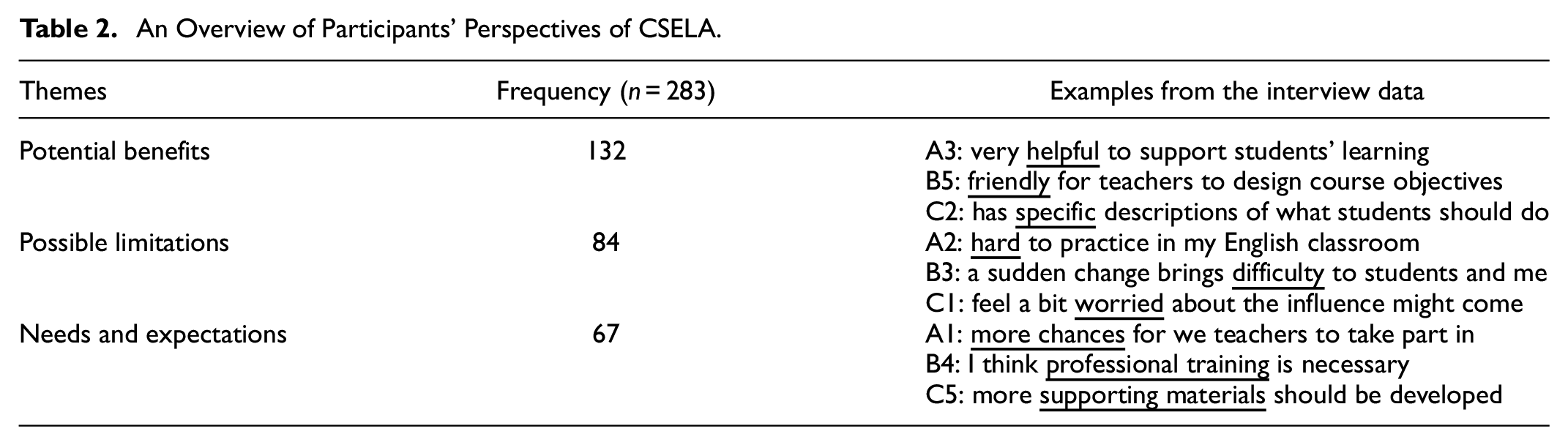
As shown in Table 2, a total of 283 code units were pinpointed in the interview data, within which three themes were found. Among these themes, the first one was related to participants’ thoughts on the potential benefits of CSELA. This theme appeared to be the most significant one, with 132 out of 283 code unit counts (46.6%). In the second theme, there were 84 code units (29.7%) speaking to CSELA’s possible limitations according to participants’ perspectives. In addition, the third theme, with 67 out of 283 code units (23.7%), focused on the needs and expectations in terms of what participants thought they were in need of in implementing CSELA in their English teaching. These results provide evidence to show that participants generally hold a positive attitude toward CSELA as a new national standard; meanwhile, they have a number of concerns as well as specific needs and expectations viewing CSELA as practitioners. In the following sections, the three themes demonstrated in Table 2 are unpacked and analyzed based on quotations extracted from participants’ responses in the interviews.
Teachers’ Perspective (1): The Potential Benefits of CSELA
As the first theme in the interview results, a common view amongst the English teachers in the present study was that all of them believed that they could benefit from CSELA by developing clearer goals for English teaching, due to the comprehensive scales and detailed measuring items in the standard, from the fundamental, novice level to more advanced, proficient level. For example, Teacher C2 pointed out:
Teacher C2: What I like the most about this standard (i.e., CSELA) is its clear measuring criteria. Some past standards only provide vague summaries of what knowledge students should grasp, but this standard has very specific descriptions of what students should actually do with English. (Quotation 1)
Quotation 1 indicates that a strength of CSELA is its detailed measuring system that offers practitioners clear criteria to assess whether students achieve the learning goals at certain language levels. According to Teacher C2, this is a unique characteristic of CSELA that distinguishes it from many conventional English standards that only include general, unspecified expectations of students’ English learning outcomes. An example of CSELA’s specific measuring items can be seen in its oral production scale at Level 4, which illustrates that students at this level should be able to communicate around interested topics and respond to other speakers in time to maintain communication. For practitioners, such detailed items are helpful for them to create objectives for English instruction and help students achieve learning goals appropriate and specific to their targeted levels of English learning.
Teacher C2’s comment in Quotation 1 also implies another strength of CSELA, as he argued that “this standard has very specific descriptions of what students should actually do with English.” Although he did not continue discussions on this point of view, this argument was made more explicitly in Teacher A5’s answer:
Teacher A5: Sometimes teaching English is hard because sometimes you don’t know whether they (i.e., her students) understand or not. I think some standards we use are not very helpful, because they only tell you that students should understand this or students should know that, but it’s hard to figure out if they understand or not. However, this standard (i.e., CSELA) is different because it tells what performance students should demonstrate in behavior. These demonstrated things, I think, are much more straight-forward to help us find out if students achieve the learning goals and whether our teaching is successful. (Quotation 2)
Quotation 2 shows Teacher A5’s view toward the measuring items in CSELA, which are largely based on English learners’ behavioral performance. Teacher A5 believes that these behavioral items are of good support to her teaching, because they are direct indicators revealing the results of students’ English learning. This argument was also reinforced by Teacher B1, who referred to a criterion in the oral production scale at Level 8, which suggested that students at this level should be able to accurately and sufficiency express personal ideas on professional topics in academic discussions. Teacher B1 shared his thoughts on this item. As a more experienced university English teacher, he confirmed that this measuring item was appropriate at its level for undergraduate students. It offered a clear goal for his English teaching, so that he could aim to help students develop the abilities to carry out discussions in their specialized areas of study, using English.
Beside having clearer goals for teaching, English teachers were also in favor of CSELA in terms of its potential benefits for students’ English learning. Specifically for example, Teacher C3 commented on how Chinese students could make use of CSELA, as shown in Quotation 3.
Teacher C3: I think this standard can be a useful resource for students to guide their learning … Students must put more effort in developing listening, writing, and speaking abilities. These are the areas that our students are usually not good at. Of course it’s partially because of our current curricula, but also because many students ignore them and spend very little time on these. (Quotation 3)
As shown in Quotation 3, Teacher C3 highlights that CSELA may influence and reshape students’ emphases in English learning. This is because as a national standard of English, CSELA has the potential to be practiced nationwide and it may change some existing systems of English assessment. Consequently, students’ views toward and strategies for learning English may be influenced accompanying the changing English assessment. According to Teacher C3, many Chinese learners of English spend less time studying English listening, writing, and speaking, compared to their effort in learning reading. They are expected to make changes and develop more balanced skills in all areas of English. CSELA may help promote such changes, because all language skills, including interpreting and translating, are highlighted and measured in this standard. In line with this argument, Teacher A3 shared his perspective on how Chinese students might benefit from CSELA.
Teacher A3: I have a strong impression of the standard’s self-evaluation scales. I think they are very helpful for students to check their own progress in English learning, and see if they get to the targeted levels at certain stages. (Quotation 4)
In Quotation 4, Teacher A3 mentions the self-evaluation scales in CSELA and holds that these scales can be a useful tool to facilitate students’ English development. According to CSELA, the self-evaluation scales aim to assist English learners to monitor their own English learning progress. The scales also provide a set of recommendations for learners to consider and follow according to their own needs. In Teacher A3’s case, these self-evaluation scales could be useful for his students to set goals for learning English at the university level, assess achievements and determine deficits, based on which students may create future English learning plans appropriate for their own. One example is related to the measuring items in the self-evaluation scale for written production at Level 6, which are about English learners’ ability to write abstracts for academic articles and write brief book reviews. These learning goals in writing provide specific aims for students to make plans and carry out English learning practices according to their needs in undergraduate English study.
In all, these findings about teachers’ perspectives on the potential benefits of CSELA echo past studies in a number of ways. First, although research on the application of CSELA in English teaching remains in its infancy, there have been some studies exploring the potential impact that the standard might have on English teachers. For instance, S. Wang (2018) contended that the language ability scales in CSELA could help English teachers develop specific instructional strategies. This was because CSELA involved very detailed measuring items that were mostly behavioral descriptive. This was one of the most significant differences between CSELA and many conventional English standards in China, that CSELA’s items, based on learners’ behavioral signs, were much more applicable for English teachers to make teaching plans and evaluate students’ learning results. Moreover, S. Wang (2018) also argued that CSELA might be especially helpful for English teachers in higher education, since it aligned with the multiple aims of English education at the undergraduate level in China: English for general purposes (i.e., daily communication) + English for specific purposes (i.e., major subjects) + English for crosscultural communication.
Meanwhile, the findings in the present study are also consistent with many scholars’ arguments on CSELA in terms of the standard’s potential contribution to Chinese students’ English learning. For example, Liu (2019a) posited that CSELA might influence Chinese students to develop a more balanced view toward learning different types of English skills. Conventionally, Chinese English learners were found to be much more fluent in reading, whereas remained comparatively “mute” in speaking (C. Wang, 2003, p. 4). However, CSELA might change this situation and encourage students to take on a usage-oriented perspective of English by spending more effort in developing English skills for language production.
In addition, similar to what was found in the present study, Liu (2019a) also anticipated that Chinese students might benefit from CSELA by utilizing its measuring items to create personal learning plans and develop strategies for English learning. This was because CSELA contained very detailed scales devoted to assisting students to evaluate their own progress in English development, so it became possible for learners to construct language learning plans and strategies according to their current and targeted levels. However, Liu (2019a) further emphasized that students’ self-regulated learning skills were not spontaneous, so educators’ support was indispensable to facilitating English learners making good use of the new standard.
Teachers’ Perspective (2): The Possible Limitations of CSELA
In addition to the potential benefits that CSELA might bring to English teachers and learners, the participants in the present study also shared their concerns about the possible limitations of the standard. An important topic emerged from the interviews was that all English teachers felt unprepared for the changes that might occur in the English classroom. For example, Teacher C1 stated:
Teacher C1: I have been teaching (English) for many years … To be honest, I feel a bit worried about the influence that this standard (i.e., CSELA) may have on we senior teachers … We have been teaching in the old ways and it’s hard to change. In fact, personally I am willing to change but I don’t think I am well prepared for the possible changes in the future (Quotation 5)
As demonstrated in Quotation 5, Teacher C1 expresses her personal concern about the possible impact that CSELA may have on her English teaching. As a senior university English teacher, Teacher C1 claims that she is used to teaching English “in the old ways.” Although the meaning of “the old ways” in this quotation is not specified, it is reflected in the interviewees’ discursive responses during the interview. The “old ways” generally refer to the traditional English teaching strategies that heavily rely on repeated and decontextualized drills where students are guided to focus on linguistic knowledge. At the end of her response, Teacher C1 shares her concern about not feeling prepared although she is willing to make changes in teaching.
While Teacher C1’s answer sheds light on participants’ overall concern about the possible impact of CSELA, responses from other teachers provide a further look at the reasons why they feel not ready. For example:
Teacher B3: I usually teach freshman students and they just had the College Entrance Exam. My students are used to the ways how English is taught and learned in high schools, but now suddenly they have to change … I think that will be difficult for them and also difficult for me as their instructor. (Quotation 6)
In Quotation 6, Teacher B3 recognizes the fact that the College Entrance Exam usually has a strong impact on Chinese English learners’ views toward and practices in English learning. This high-stakes standardized test in China is conventionally thought to strongly shape how English is taught and learned before university, where communicative skills are not quite highlighted. Therefore, Teacher B3 explains that both she and her freshman students may not be fully prepared for the changes taking place in higher education where communicative English teaching and learning is emphasized. Beside this, Teacher A2 also articulated her concern in relation to her working context.
Teacher A2: I think the whole idea is good, that English is for use and communication. But what I experience in school teaching is that our current curriculum, pace for instruction, and school atmosphere do not support this mode (i.e., communicative-oriented) 100%… I learned task-based language teaching in my master’s study, but I find it hard to practice this pedagogy in real-life English classroom, because there lacks of resources, time, and assistance from, for example, more skilled teachers. (Quotation 7)
Teacher A2’s answer reveals a common issue encountered by English teachers. That is, although English teachers believe in the communicative nature of English as a lingua franca, and English instruction should be structured in a way that nurtures students’ communicative skills, many of them are not well supported by the current working conditions in English education. As demonstrated in Quotation 7, Teacher A2 receives training on task-based language teaching as a means for communicative English instruction in her master’s study, but she finds that it is difficult to carry out communicative language teaching without aid from her school and other colleagues. Therefore, Teacher A2’s case implies that merely preparing teachers with cutting-edge and research-based pedagogical skills in English teacher education is not enough to ensure the establishment of a communicative-oriented English classroom. Schools, education administrations, teacher colleagues, and other stakeholders in English education should be involved and contribute to the implementation of communicative English instruction, which is one of the key aims of CSELA.
Based on the author’s reading of the existing literature, there still lacks much research that devotes to uncovering the connection between CSELA and communicative language teaching. However, lessons may be learned from a similar English education reform in China that took place at the beginning of the 21st century, which also aimed to transform English teaching to be more communicative-oriented. In 2001, the English Curriculum Standards (ECS) (Ministry of Education, 2001) was issued, which adapted international English standards and incorporated communicative English teaching methods in curriculum design. Embedded in its historical context where China joined the World Trade Organization and would hold Beijing Olympics Games in 2008, ECS required that English teachers and learners should shift their emphases in English teaching and learning, moving from a sole focus on linguistic studies to improving learners’ overall communicative abilities in English. Although ECS brought some positive changes to English education in China and “marked the birth of a new foreign language policy” (Y. Hu, 2007, p. 360), a number of studies found that ECS’s implementation in the country was not completely successful (e.g., Li, 2010; Nunan, 2003). This was because although ECS highlighted the role of communicative English pedagogy (e.g., task-based language teaching method) in English education, research demonstrated that communicative language teaching per se did not guarantee high quality English education, nor produce significantly positive English learning outcomes. Gu (2004) argued that many optimal conditions should be met in order to realize the potential benefits of communicative English instruction, such as suitable teaching and learning materials, well-trained and sufficiently prepared English teachers, as well as a supportive language environment in the larger social context. However, these conditions were not adequately met during the time of the implementation of ECS, which led to the standard’s partial accomplishment.
The lessons learned from ECS provide important implications for CSELA. They reveal that publishing a new English standard alone may not impact English teaching and learning positively to the extent of which educators and researchers expect in the first place. Conversely, English teachers may feel unprepared, concerned, and worried about the possible changes in their professional practices, as shown in the present study. Following this result, interview findings about teachers’ needs are presented in the next section.
Teachers’ Perspective (3): Needs and Expectations
The participants discussed a number of needs and expectations in putting CSELA to work, which was the third theme in the findings. When sharing their needs in making use of CSELA, English teachers commonly emphasized professional development training as an avenue to prepare them for the new standard. As an example, Teacher B4 stated:
Teacher B4: I think professional training is necessary to help us apply it (i.e., CSELA), such as lectures and workshops. I haven’t heard there are such opportunities in my school, but I hope there will be some in the future, because we need them. (Quotation 8)
In Quotation 8, Teacher B4 points out that professional training could be a useful means to help her become skillful in incorporating the new standard in her teaching. She is willing to learn more about the standard, but based on her knowledge, there had not been any training opportunities in her school during the time of this study. Beside this example, Teacher C3 extended this point of view by providing his thoughts about why professional training was necessary.
Teacher C3: I will be interested if there is training on this (i.e., CSELA) … I looked at the document before and found that there are so many scales in the standard. So much information. I think it will be hard for teachers to apply the standard without systematic and effective training, which helps teachers know how to make use of it. (Quotation 9)
Quotation 9 demonstrates that Teacher C3 feels the need for professional training on CSELA because of the abundant information contained in the new standard. In fact, the original CSELA published by the Chinese Ministry of Education is a 107-page long document, in which there are more than 80 scales. Due to its length and sophisticated measuring systems, it is reasonable to argue that practitioners will encounter great difficulty if they are to explore the standard all by themselves. Therefore, professional training is of emerging necessity along with the publication of CSELA as a new standard. Moreover, supporting materials such as brochures, manuals, charts, and graphs, in the forms of hardcopies, electronic files, videos, and/or interactive mobile apps, are also needed. These materials can help make CSELA more accessible to practitioners, which may lead to English teachers’ better application of the standard.
Finally, a key expectation shared by English teachers was their desire to participate more deeply in the policy-making processes in the future. As an example, Quotation 10 demonstrates Teacher A1’s perspective on this topic:
Teacher A1: I think there should be more chances to allow we teachers to take part in the process … Sometimes I feel I am just told to do things, but our opinions should also be considered if there are reforms and if changes are to be made. (Quotation 10)
In this quotation, Teacher A1 delivers her voice on the topic of how CSELA is created. As reviewed in the previous passage, the establishment of CSELA included a number of scholars, and pilot studies were conducted in many schools. However, practitioners as important stakeholders in English education were not fully involved in the process where CSELA was developed. English teachers from both higher education and other educational levels are an important group of stakeholders who are expected to be significantly influenced by CSELA. Moreover, their work can also strongly shape the possible outcomes of the implementation of this new standard.
Teacher A1’s comment is supported by many past studies. She and other participants’ desire of having their voice heard has also captured researchers’ attention. Previous studies have shown that China usually adopts a top-down policy-making approach in English education reforms (Lu, 2003). As explained in Li (2017), the top-down approach refers to a way of policy making where a policy or standard of education is developed by a committee of specialists; the “top” government agencies are in charge of the policy/standard-making, and the “bottom” schools and teachers in local cities are required to implement the formulated policy/standard. In this process, practitioners who are at the “bottom” of the chain may not be fully involved in the policy/standard making process, and in turn they may not be well prepared to carry out the policy/standard in teaching. Li (2017) suggests that it may be beneficial to appropriately “empower the locals,” since teachers usually “have their students’ best interests in their hearts” (p. 724). In fact, nowadays the Chinese government is making progress to seek a more equal distribution of power, aiming to create a more just society. Shanghai’s “non-top-down” case has shown that such a change is possible. In this case, Shanghai was successful in adapting an international curriculum in education with desirable outcomes (Tan, 2013). Therefore, both practitioners’ passion to be more deeply involved in policy making and the government’s expenditure of effort to adjust the conventional top-down approach can be seen as signs of social progress in English education in China.
Conclusion
The present study has examined 15 university English teachers’ perspectives on China’s Standards of English Language Ability, which is the first comprehensive English standard at the national level for English education in China. Based on the interview results, this study shows that practitioners generally hold a positive attitude toward the potential benefits that may be contributed by CSELA in areas of English teaching and learning; meanwhile, they also recognize the possible limitations of the new standard. These findings demonstrate that CSELA has particular potential to significantly push English teaching and learning in China toward a more communicative-oriented direction, and it may help improve the overall quality of English education in the country. In the meantime, the findings also imply that without a rich amount of support such as materials, training, and teacher education, merely publishing a new standard may not guarantee the expected outcomes. Before these resources are made available, many English teachers may feel unprepared and concerned. In addition to these, the present study also reveals that practitioners wish to participate more in the policy-making process and have their voice heard. This finding indicates a possible social progress in English education in China, as the traditional top-down policy-making approach is now being challenged. Research has demonstrated that in some cases, stakeholders who are conventionally at the “bottom” level are empowered, and such a change has contributed to positive results in education.
Footnotes
Appendix A
Acknowledgements
None.
Declaration of Conflicting Interests
The author declared no potential conflicts of interest with respect to the research, authorship, and/or publication of this article.
Funding
The author received no financial support for the research, authorship, and/or publication of this article.
Ethics Statement
Consent was obtained from all participants at the beginning of the research.
