




Abstract
The contemporary dynamic business climate is dominated by hyper competition and technological advancement, challenging businesses to engage their human capital. To overcome this, there is a need to focus on the employee-employer relationship to improve work behaviour. To address this, the study looks at how the “relational psychological contract” affects “innovative work behaviour” among employees in the IT sector, with work engagement acting as a mediating factor. An online survey received 250 responses from participants within the IT sector. The study used SPSS and PLS-SEM tools to analyse 250 responses using the structural equation modelling technique. Analysing the mediation effect of work engagement between “relational psychological contract” and “innovative work behaviour.” This paper reflects the findings of the “relational psychological contract” effect on “innovative work behaviour” within a remote working culture. Followed by managerial & theoretical implications and limitations of the study, along with outlining the scope for future research.
Keywords
Introduction
Technological acceleration necessitates transformation in the business environment. To survive in this rapidly changing landscape, organisations must implement both preventive and adaptive changes (Urbach et al., 2017). Unforeseen market conditions, including technological disruption, socio-political changes, tough competition, and changes in government laws and policies, have reshaped the dynamics of business today.
Pluta and Rudawska (2016) noted significant changes in the behaviour and expectations of market players due to technological shifts in business. Gates (2018) emphasised that innovation in products, services, and practices is essential for success. The Global Innovation Index (2020) reports that innovation hubs have increased globally despite economic challenges, with organisations focusing on continuous innovation even during crises like COVID-19 (Montani & Staglianò, 2022).
The study focuses on the IT sector. India’s IT sector, its largest service industry, contributes significantly to the economy: 54.77% to Gross Value Added, 38% to exports, and 31% to employment (Economic Survey 2020-2021, n.d., Volume I; Volume II). With a vast pool of skilled IT professionals, India has become a global hub for IT outsourcing, covering approximately 55% of the global sourcing market. Additionally, India dominates the global digital capabilities sector, with around 75% of the world’s digital talent being Indian. Investors are drawn to India due to its abundant resources, cost-effective human capital, and robust economic fundamentals (Singh et al., 2020). Thus, the IT sector significantly contributes to India’s GDP and generates substantial employment opportunities.
Over the past 2 years, the COVID-19 pandemic has significantly disrupted global business operations. Initially, many organisations faced challenges due to inadequate preparation and infrastructure. However, they quickly adapted by embracing strategies such as remote work, investing in essential equipment, ensuring reliable broadband connectivity, and adopting digital tools. Today, businesses rely on video conferencing, mobile applications, online portals, electronic documentation, automation, and artificial intelligence to maintain continuity. Today workforce is mostly consist of 70% millennials, which according to Yudiatmaja et al. (2023), millennials have increasingly demonstrated innovative behaviour and recognise the value of employee-employer relationship in the form of leadership exchange, which plays a crucial role in fostering organisational trust.
Remote working has become popular, especially in the IT industry, and surged during the COVID-19 pandemic to maintain business operations. Post-pandemic, remote work is now common. It benefits organisations by reducing costs and provides employees with flexibility. About 60% of IT employees worked remotely during the pandemic and continue to do so. Bick et al. (2023) found flexible work advantageous for both workers and employers, predicting one in seven workers will choose remote work post-pandemic. This trend matches survey expectations on future work dynamics. Companies are including hybrid and remote options to attract and retain talent. However, remote work can cause stress, work-life imbalance, and anxiety, which may affect innovation (Karani et al., 2022). Further research into remote work and innovation in Asian countries is needed (Kutaula et al., 2020). Exploring remote employees’ views on engaging in innovative behaviour is essential in this evolving context.
The study picked psychological contracts as an essential element to understanding employee attitudes, behaviours, and performance outcomes (Barnhill & Smith, 2019; Kapil & Rastogi, 2020; Ramamoorthy et al., 2005). Organisational support manifested through trust, recognition, and developmental opportunities often fosters positive employee responses, which are critical for enhancing organisational resilience, especially during periods of disruption such as technological change or global crises like the COVID-19 pandemic (Aviso et al., 2018). In light of increasing workplace volatility, P. Kim et al. (2024) emphasise the need for further research into the effects of workplace disruptions, organisational responses, and their implications for employees.
Grounded in Psychological Contract Theory (Rousseau, 1995) and the Job Demands-Resources (JD-R) model (Schaufeli & Bakker, 2004), this study explores the relationship between relational psychological contracts and innovative work behaviour, with work engagement as a mediating factor. The Psychological contract is an individual psychological reflection of a reciprocal exchange relationship between the employee and the employer. Work engagement, characterised by vigour, dedication, and absorption, represents a positive, fulfilling state of mind related to one’s work (Schaufeli & Bakker, 2004).
In the workplace, relational psychological contracts help explain how an employer supports employees in fulfilling their basic organisational needs, including trust, respect, autonomy, and growth, thereby fostering intrinsic motivation, which ultimately turns into innovative work behaviour. Furthermore, by when employees experience a relational psychological contract, it fosters an environment that encourages which helps in generation of new ideas. Relational psychological contract enhances employees’ intrinsic motivation by driving them to invest additional effort in creative and innovative endeavours (Sharoni et al., 2015). When employees perceive support in the form of job security, career development, autonomy, and respectful leadership, they are more likely to be psychologically engaged (Agarwal, 2017; Garg & Dhar, 2017; Lebrón et al., 2018; Li et al., 2020; Soares & Mosquera, 2019). Such engagement often leads to discretionary innovative behaviours that go beyond formal job requirements (H. Zhao, 2015).
The present study contributes to the existing literature on relational psychological contract and innovative work behaviour. First, this study contributes to the understanding of the relationship between relational psychological contract and innovative work behaviour through an individual micro-level analysis from an employee’s perspective. This finding offers additional evidence for the significance of work engagement in promoting individual innovation among employees in Indian IT organisations. It fills an important gap in the literature, as research on this topic is still scarce (Chakraborty et al., 2023; P. Kim et al., 2024; Rabenu et al., 2021; Sharoni et al., 2015; Vu et al., 2025). Second, by uncovering the mediating mechanisms that have been largely overlooked in prior studies, this research advances understanding of the underlying psychological processes and motivational factors that transmit the effects of relational psychological contract on employee innovation outcomes.
Literature Review
Organisations were bound to alter their ways of working and procedures because of the unanticipated disruptive health & economic crisis. Employee outcomes are positively impacted by employees who have Relational Psychological Contracts (Agarwal, 2017; Bhatnagar, 2014; Chang et al., 2013; T. T. Kim et al., 2018). Therefore, there is discussion about how organisations may improve employees’ behavioural outcomes in dynamic business situations. A conceptual framework for addressing the organisational challenge is thus provided by evaluating prior literature.
“Innovative Work Behaviour”
West and Farr (1989) and Amabile (1988) were the pioneers who proposed the concept of organisational innovation practices. The concept of innovative work behaviour was further developed by Scott and Bruce (1994), who proposed innovation as a multistage process. Janssen (2000) later defined “Innovative work behaviour” as –“the intentional creation, introduction and application of new ideas within a work role, group or organisation to benefit role performance, the group or the organisation.” Innovative work behaviour has three stages –“idea generation, idea promotion and idea implementation.”“Idea generation includes the search and generation of new ideas. Idea promotion outlines the benefit of the idea, and idea implementation calls for effort and an action-oriented attitude toward implementing the ideas” (Janssen, 2000).
Thornhill (2006) made the argument that innovation is essential for a company’s performance. It enables the company to take on the challenges posed by the growing competition and take advantage of new opportunities. Anderson et al. (2004) emphasised the necessity to study innovation and its relationship with others. With the dynamic changes in the global economy, continuous innovation is the biggest want from the organisation around the world; hence, studying Innovation at work is an important topic to explore (Agarwal, 2014a; Chakraborty & Pandey, 2023; Zhou & Velamuri, 2018).
Thus, a review of past research focused on innovative behaviour and various factors influencing innovation, like the psychological contract, organisational citizenship behaviours, work engagement, organisational commitment, perceived supervisor support, and leader-member exchange. Psychological capital, creativity, job autonomy, intrinsic motivation, knowledge sharing, and many others, which act as an antecedent of Innovative work behaviour. The necessity for profound research to comprehend the psychological processes influencing an employee’s capacity for innovation was underlined by Yuan and Woodman (2010). Studies spanning several cultures & ethnicities are few and far between. The variables influencing employee innovation in the various industry types should be studied. Therefore, the study’s goal is to discover what factors encourage innovative activity in the setting of the Indian IT industries (Hsiao et al., 2017).
Psychological Contracts
The reciprocal exchange relationships between persons and organisations are examined by psychological contract theory. Psychological contracts are “individual beliefs, shaped by the organisation, regarding terms of an exchange agreement between individuals and their organisation,” according to Rousseau (1995). Scholars have been exploring the “psychological contract theory” on various employee consequences because of the building block set by Rousseau’s key work.
In 2007, the meta-analysis by Zhao, Wayne, Glibkowski, and Bravo discovered that “psychological contracts” predict behavioural factors. H. A. O. Zhao et al.’s (2007) conclusion was a re-verification of meta-analysis done by Bal et al. (2008), which highlights the psychological contract theory’s significance towards organisational behaviour.
A relationship where there is a reciprocal obligation exchange is referred to as a psychological contract. The theoretical framework, conceptualised as cognitive schemata, is based on social exchange theory. “Transactional” and “relational” contracts are the two varieties of psychological contracts. A “transactional” connection is a brief exchange that meets an employee’s financial demands in return for the services they render. A long-term socioemotional exchange centred on trust, respect, and loyalty is known as a “relational contract.” In exchange, the employee seeks career advancement, skill advancement and job security (Janssens et al., 2003).
The literature review identifies variables such as work engagement, innovative behaviour, job attitudes, leadership, perceived supervisor support, job resources, psychological ownership, commitment, trust, and job performance that have been examined with the psychological contract in previous studies. Most of the studies span the manufacturing, health care, public sector, and research and development industries. Most of the investigations were carried out in industrialised nations like the USA and Europe. According to Thomas et al. (2010), “psychological contract” research cannot be generalised across organisational and cultural boundaries. Studies on “psychological contract types” and their relationships with other variables are quite rare in India (U. Aggarwal & Bhargava, 2010). Studying the variables impacting the relational and transactional “psychological contract” has been called for by Janssen (2004) and Soares and Mosquera (2019).
Work Engagement
Macey et al. (2011) define Work engagement’ as is define as a “psychic kick of immersion, striving, absorption, focus and involvement.” Kahn in 1990 defined engagement as an attachment of “individual selves to their job by which they engage and express themselves physically, cognitively and emotionally during the Job role.”Schaufeli and Bakker (2004) state work engagement as an active state of mind, which creates positive work-related engagement, which is characterised by “vigour,”“dedication,” and “absorption.” Vigour is defined as energetic, resilient and the willingness to invest positive energy into work, along with the diligence to face challenges. Dedication is defined as a sense of enthusiasm, motivation, and psychological drive to achieve success. Absorption is defined as being focused and contented involvement at work, to the point that it is difficult to detach from work.
The review of literature highlights much research on Work Engagement with multiple variables, like Psychological Contracts, Job demands, job resources, job satisfaction, leader–member exchange, Perceived organisational support, psychological contract fulfilment, affective commitment, creativity, Innovation, and many others. Healthcare, hotel, and engineering are among the most studied industries. Agarwal (2014b) examines the effects of work engagement on employees’ innovative work behaviour, with organisational justice and trust as predictors for work engagement. Huhtala and Parzefall (2007) proposed that work engagement, reflected via employee well-being and positive mindset, is a prerequisite for innovativeness. Despite increased corporate interest, there hasn’t been much research on employees’ work engagement (Bakker & Schaufeli, 2008). Investigating how work engagement influences the initiation of innovative behaviour might help to better understand the relation and offer ideas to improve management practices (Chang et al., 2013). To better understand the influence of work involvement in the current context, this study proposes to include work engagement within the study.
Relationship Between Relational Psychological Contracts, Innovative Work Behaviour and Work Engagement
The relationship between relational psychological contract, innovative work behaviour, and work engagement is built upon the foundation of mutual trust and support between employers and employees, supported by psychological contracts theory. A relational psychological contract is a long-term reciprocal exchange where employees feel valued and supported by their organisation, leading to a work environment that fosters growth and motivation. According to Kahn (1990), employees’ perceptions of their work environment shape their psychological experiences, directly influencing their willingness to engage in work tasks. When employees experience relational psychological contracts, they feel obliged to reciprocate the trust and support by fully committing themselves to their roles and utilising available job resources to grow within the organisation (Hui et al., 2004).
Employees experiencing relational psychological contracts also fulfil key psychological conditions: meaningfulness, safety, and availability, which further strengthen their engagement in work. The Job Demands-Resources model supports this connection, explaining that employees who receive sufficient job resources demonstrate higher levels of work engagement. Thus, relational psychological contracts provide the necessary job resources that initiate a motivational process, fostering deep commitment to work, leading to innovative behaviour at work (Bakker & Xanthopoulou, 2009; Halbesleben, 2010).
Moreover, work engagement plays a vital role in innovative work behaviour, as highly engaged employees invest behavioural, intellectual, and emotional energy into creativity and ideation at work (Huhtala & Parzefall, 2007). Employees need to be deeply absorbed and dedicated to their tasks to achieve innovation, and studies have found a positive correlation between work engagement and innovative behaviour (Agarwal et al., 2012; Rabenu et al., 2021; Sharoni et al., 2015). The psychological conditions associated with work engagement create a favourable work environment that encourages employees to engage in discretionary behaviours such as innovation (Amabile et al., 2004; Atwater & Carmeli, 2009).
There is limited research to understand the interaction between relational psychological contract, innovative work behaviour, and work engagement together within the Indian context. (A. Aggarwal et al., 2020). Also, it’s important to understand that the physiological process leading to innovation is under changing economic conditions and work environment (M. S. Kim & Koo, 2017).
Theoretical Framework
The study applies the theoretical foundation of psychological contract theory and the job demand and resource model. Psychological contract theory refers to the unwritten, informal expectations between an employer and an employee. Unlike formal employment contracts, which outline legal obligations, psychological contracts are based on mutual perceptions, trust, and expectations regarding workplace behaviour, rewards, and responsibilities. The concept was developed by Rousseau in 1989. It plays a crucial role in shaping employee motivation, engagement, and job satisfaction. When employees feel, their psychological contract is fulfilled, meaning their expectations align with reality, they tend to be more committed and productive.
Psychological contract theory plays a significant role in shaping innovative work behaviour. Studies suggest that psychological contract fulfilment, when employees feel their expectations are met, positively impacts innovative work behaviour. Employees who perceive fairness and trust in their psychological contract are more likely to engage in knowledge sharing and creative problem-solving.
The job Demands-Resources (JD-R) model explains that every job has its demands that hinder and resources that aid employees in their work, as proposed by Demerouti et al. (2001) and later detailed by Schaufeli and Bakker (2004). The JD-R model divides work environments into job demands and resources, with specific elements varying by context. A ‘Job demands are those physical, social, or organisational aspects of the job that require sustained physical and psychological effort. Whereas ‘Job resources are those physical, social, or organisational aspects of the job that reduce job demands and stimulate personal growth and development” (Demerouti et al., 2001). Schaufeli and Bakker (2004) expanded the version of the Job Demands-Resources model by including engagement as a part of the model.
This study uses the Job Demands-Resources (JD-R) model to examine how job resources, like psychological contracts and work engagement, mitigate the negative effects of innovation demands. While high job demands can hinder innovation and cause strain, sufficient resources balance these pressures and support employee well-being. Adequate job resources help employees manage tasks, reach goals, and act as motivators, enhancing workplace behaviour and motivation (Schaufeli & Bakker, 2004).
Hypothesis Development
A conceptual framework for the construction of the research model was provided by the studies to evaluate the theoretical foundation of “Relational Psychological Contract,”“Innovative Work Behaviour,” and “Work Engagement” together. The intended conceptual model that directs the study’s execution is shown in Figure 1. The development of objectives and hypotheses is followed in the sections below.

Proposed conceptual model.
Relational Psychological Contract and Innovative Work Behaviour
Researchers Raja et al. (2004), Chang et al. (2013), and T. T. Kim et al. (2018) discovered a substantial correlation between “psychological contract” and “innovative work behaviour.” Additionally, according to Thompson and Heron (2003), Raja et al. (2004), Hui et al. (2004), Newton et al. (2008), Liao and Chen (2018), Soares and Mosquera (2019), and Chakraborty et al. (2023), innovation showed a positive relationship with relational contract.
Employee discretionary behaviour is what drives innovation in organisations. It demands an investment of socio-political and cognitive resources. It depends on the organisational and individual resources. According to Scott and Bruce (1994), the psychological contract serves as a job resource that represents people’s perceptions about organisational reciprocal expectations. Similarly, it also offers insight into an employee’s expectations and behaviour. Relational contracts have been found to have favourable connections with innovative behaviour in prior studies on various contract types (Chakraborty et al., 2023; Chang et al., 2013; Clegg et al., 2002; Ramamoorthy et al., 2005; Rousseau, 1995; Storey et al., 2002; Thompson & Heron, 2006).
Innovative behaviour develops as a result of the interplay between the employee and the circumstances they face while working (Chang et al., 2013; Raja et al., 2004). Therefore, different psychological contract types can have an impact on an employee’s drive for innovation and outcome at work (Liao & Chen, 2018; Storey et al., 2002). As a result, the study suggests the following hypothesis.
Relationships Between “Work Engagement” and “Innovative Work Behaviour”
A “Work Engagement” is an important ingredient for an employee to have a motivational mindset, where the employee voluntarily devotes their physical, mental, and emotional energy into work. Huhtala and Parzefall (2007) examine that there is a direct association between innovation and work engagement. Individuals need to be innovative and need to have an approach of creativity and ideation at work, this can be achieved by investing behavioural, intellectual, and emotional energies at the job. To achieve a level of innovativeness, employees need to become absorbed and completely dedicated to concentrating on work to be able to achieve the desired goals. A positive correlation was found by Agarwal et al. (2012) between “work engagement” and innovation. In the similar lines psychological conditions associated with “work engagement” (“psychological meaningfulness,”“psychological safety,” and “psychological availability”) also plays an important role to bring favourable condition at work roles to brings elements of positive motivation at work to be indulge in promoting discretionary behaviours like innovative behaviour (Amabile et al., 2004; Atwater & Carmeli, 2009; Gupta et al., 2017; Kasekende, 2017; M. S. Kim & Koo, 2017; Montani et al., 2020; Orth & Volmer, 2017; Park et al., 2014; Sari et al., 2021) Thus, proposes the following hypothesis
Relationships Between Psychological Contract and “Work Engagement”
“Relational psychological contract” is a long-term reciprocal exchange relationship between employee and employer which creates a positive environment for employees to perform and grow. According to Kahn (1990), how people perceive their work environments creates psychological factors that have a direct impact on people’s willingness to perform work-related tasks. An employee experiencing relational psychological contracts feels obliged to reciprocate the supporting environment employers create by providing maximum job resources at the job and grow within the organisation (Hui et al., 2004). Such employees experience positive emotion along with three psychological conditions of work engagement: psychological meaningfulness, safety, and availability. The employees who experience relational psychological contracts can work on their self-growth, which enhances work engagement within employees, which is characterised by vigour, dedication, and absorption (Halbesleben, 2010; Rabenu et al., 2021; Schaufeli et al., 2006; Sharoni et al., 2015). Work engagement is also closely related to the JD-R model, which explains that employees who possess more job resources are highly engaged at work. The Job resources can be defined as any physical, psychological, social and organisational aspects of the job that help and support employees in their work. Therefore, having a relational psychological contract provides ample job resources to an employee, which stimulates the initiation of a motivational process. This helps in stimulating the feeling of work engagement amongst employees, where employees completely dedicate themselves to work (A. Aggarwal et al., 2020; Bakker & Xanthopoulou, 2009). Thus, the association between “psychological contracts” and “work engagement” is crucial to study through the intervening processes of job resources and job outcomes. Hence proposes the following hypothesis.
Mediating Role of “Work Engagement”
Building on Kahn’s (1990) foundational work, this study emphasises work engagement as a key mechanism linking relational psychological contracts to innovative work behaviour. Kahn identified three essential psychological conditions, meaningfulness, safety, and availability – that influence an individual’s willingness to engage at work fully. These conditions are closely aligned with the nature of relational psychological contracts, which are built on long-term, trust-based exchanges between employees and employers.
Employees experiencing relational psychological contracts are more likely to perceive their work as meaningful, feel psychologically safe, and have the emotional and cognitive availability to invest in their roles. These conditions foster a deep sense of engagement, which is critical for innovation. The Job Demands-Resources (JD-R) model further supports this connection, suggesting that when employees are provided with adequate job resources – such as training, feedback, autonomy, and career development opportunities – they are more likely to experience higher levels of engagement (Bakker & Xanthopoulou, 2009; Halbesleben, 2010).
Relational psychological contracts thus serve as a foundation for providing these resources, initiating a motivational process that leads to stronger commitment and innovative behaviour. As noted by Agarwal et al. (2012), such supportive environments foster value congruence and socioemotional bonds, which are essential for sustaining work engagement (Park et al., 2014).
Moreover, work engagement plays a vital role in driving innovative work behaviour. Highly engaged employees invest behavioural, intellectual, and emotional energy into their tasks, which enhances creativity and ideation (Huhtala & Parzefall, 2007). They are more likely to be absorbed in their work, take initiative, and go beyond formal job requirements by engaging in discretionary behaviours such as proposing new ideas, improving processes, experimenting with new tools, or collaborating across departments to solve complex problems (Amabile et al., 2004; Atwater & Carmeli, 2009).
When these psychological conditions are met, employees are more likely to experience positive emotions, feel secure in expressing themselves, and invest their full selves into their roles. This heightened engagement manifests in behaviours such as proactively suggesting improvements, experimenting with new methods, collaborating across teams to solve complex problems, and taking initiative in developing new products or services (Bakker & Xanthopoulou, 2009; Schaufeli et al., 2002).
Highly engaged employees not only perform their core duties with dedication but also go beyond formal job requirements by engaging in discretionary innovative behaviours (Garg & Dhar, 2017; P. Kim et al., 2024; Rabenu et al., 2021; Sharoni et al., 2015; Vu et al., 2025). Furthermore, it is essential to recognise that the psychological processes underlying innovation are dynamic, influenced by shifting economic conditions and evolving work environments (M. S. Kim & Koo, 2017). This highlights the importance of further studying how relational psychological contracts can drive sustainable innovation by improving work engagement, as noted in the literature review.
Therefore, this study proposes that relational psychological contracts create the psychological conditions necessary for work engagement, which in turn fosters innovative work behaviour. The following hypotheses are thus proposed
Research Methodology
The questionnaire was built with items from already existing scales, designed in two parts. The first portion contains items to instruments for the model constructs (relational psychological contracts, Innovation work behaviour & work engagement). The second part of the questionnaire covered demographic information like education, gender, age, years of experience in the IT Industry, and years of experience in the current organisation. The data was collected via online survey mode (Google Form). All participants were informed about the objectives and scope of the research. The participants had acknowledged a consent statement, certifying that participation was voluntary. An assurance of data privacy and confidentiality was maintained during the data collection. No personal data of participants was collected. It was mentioned that the data will not be used for educational purposes only. The online form was sent to 400 participants (employees) from IT industries within the service sector, mostly from the metro cities of India, and out of which 250 participants have responded to the survey.
Measurement
The measures using a five-point Likert scale (“1 as never and 5 as always”) and the demographic details are studied using categorical information.
Data analysis used “SPSS version 21.0” and “PLSwarp version 7.0” tools. WarpPLS is a SEM software to analyse structural models and uses the partial least squares (PLS) method. PLS-SEM is a multivariate analysis technique based on the ordinary least squares method and variances. PLS-SEM models are defined by an inner model (Structure) specifying relationships between constructs and an outer model which depicts relationships between observed variables and constructs. The software calculates various model regression coefficients, path effects, p-values, model fit estimates, and collinearity values. Along with testing the hypothesis defined. The reliability and validity of the instrument used in the measurement model were also assessed. These scales are introduced as below.
Innovative work behaviour: Janssen (2000) 9-item scale for “Innovation work behaviour” is used as a measurement. Three items each for “idea generation, idea promotion and idea realisation” with the 5-point scale from 1 (never) to 5 (always). The scale had Cronbach’s alphas of .89.
Relational Psychological contracts: A Scale established for psychological contract type by Millward and Hopkins (1998) had 16 items. A 10-item scale to measure “relational psychological contract” was adopted for the study. The validation of this scale was done by Raja et al. (2004) on a 5-point scale of “1 (never) to 5 (always)” with .88 as Cronbach’s alpha values.
Work Engagement: Nine items from the Utrecht Work Engagement Scale (UWES-9; Schaufeli et al., 2006) were adapted to measure work engagement. Three items each for measuring vigour, dedication, and absorption. It has a 5-point scale of “1” (never) to “5” (always), with a Cronbach’s alpha of .87.
Sample Size: The Rule for sample size is not defined. A sample size between 100 and 200 is good for SEM studies, suggested by Boomsma (1985). Hair et al. (2011) suggested a thumb rule for selecting sample size for SEM or PLS-SEM (sufficient sample is 10 times greater than the largest number of structural paths at any construct). Bollen (1989) highlighted that the minimum sample size should be equal to the nos. of items in the construct to be estimated in the model multiplied by 5, and Nunnally (1967) suggested 10 samples per variable as another thumb rule. Thus, researchers indicated that any sample size between 100 and 200 is satisfactory and sufficient; the researchers therefore have 250 respondents from the survey data. The responses were accurate, and there was no missing data.
Data Analysis and Results
The gender percentages are 40% women and 60% men. In terms of experience in the IT sector, 35.4% of respondents have more than 10 years of experience, whereas 34.2% had 5 to 10 years of experience, 30.8% had up to 5 years of experience, as shown in Figure 2 below.

Years of experience in service industries of the respondents.
In terms of age, 74.5% of participants are within the age group of 25 to 45 years; 13.8% were more than 45 years of age, the remaining were below 25 years, as shown in Figure 3 below.
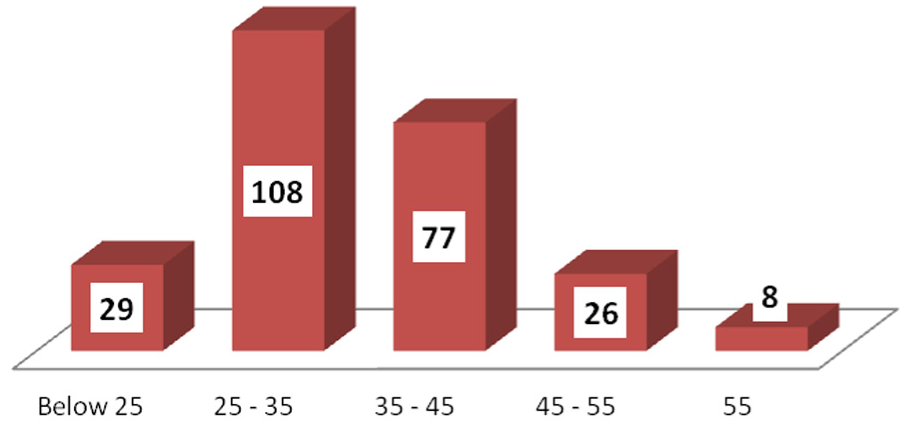
Age of the respondents.
In PLS-SEM, “common method bias” occurs due to the “measurement method” employed in the study, rather than the underlying causes and effects in the model under examination. By utilising full collinearity assessment to detect common method bias, by looking for vertical and horizontal collinearity in a model (Kock & Gaskins, 2014). This approach uses Variance Inflation Factors (VIFs) to assess the extent of multicollinearity among variables. High VIFs may indicate common method bias, whereas the VIF have shown lower than the threshold value of 2.403, so no common method bias was detected.
Analysing the data with SPSS V21, the researchers discovered that the KMO (Kaiser-Meyer-Olkin) value was 0.952. According to Hair et al. (1998), values more than 0.6 are good and greater than 0.9 are exceptional. As demonstrated in Table 1, “Bartlett’s Test of Sphericity” was significant at .1. The data was thus suitable for factor analysis.
KMO and Bartlett’s Test Result.

Utilising Varimax rotation, the exploratory factor analysis was conducted. Keeping factors with loadings ranging from 0.55 to 0.78, eliminated cross-loadings greater than 0.3, and varied communalities from 45 to 0.754. Greater than 1 Eigenvalue factors accounted for 58.75% of the variation. Thus, all the items were retained as they met the criteria of factor analysis.
Using PLS-SEM (WapPLS 7.0), PLS-SEM is a multivariate analysis technique based on the ordinary least squares method and based on variances. PLS-SEM models are defined by a model structure specifying relationships between constructs and depict associations between observed variables and constructs. As per Henseler et al. (2009), PLS-SEM estimates parameters in three stages that is, Stage 1: iterative four step estimation of construct to obtain convergence via outer model approximation, inner model estimation, inner model approximation and outer model estimation, Stage 2: identify loadings estimation with path coefficients, Stage 3: estimation of location (central tendency) parameters.
The WarpPLS software performs multiple iterations to arrive at the model solution to give coefficients, p-value, and R2 for each latent predictor variable. The output model has arrows with values, with which the hypothesis between the predictor and response variable can be interpreted using the p value. Various parameters are checked for overall model fit, and variables are selected based proposed conceptual model.
Confirmatory Model Analysis
The model was defined in WarpPLS with observed and dependent variables. Confirmatory factor analysis is used to assess model validity and reliability. Factor loadings help confirm the structure consisting of observed variables (or items) and the latent variables (or constructs). They also indicate the degree of association of items with the construct. Loadings close to zero indicate very low association, and values close to 1 indicate very high association. A cut-off value of .5 at p < .05 (alpha) is adopted for selecting items as part of the model structure (Hair et al., 2011). Thus, in Table 2, the factor loadings for items greater than 0.5 are retained.
Loadings and Cross-Loadings.

Note. Loadings are unrotated, and cross-loadings are oblique-rotated. SEs and p values are for loadings. p Values < .05 are desirable for reflective indicators. IWB = innovative work behaviour; RPC = Relational Psychological Contract; WE = Work Engagement. Bold number indicate high value of factor loading, where p < .05 (alpha) is adopted for selecting items.
Reliability and Validity
In PLS CFA analysis, initially the model is evaluated by assessing each construct’s reliability, convergent validity, and discriminant validity. Convergent and discriminant validity are two important criteria for the latent constructs to ensure the results of the model are valid and generalisable. Convergent validity aims to measure the degree to which the items of the construct correlate and measure up to the construct variable. As per Hair et al. (2011), standardised factor loadings and Average Variance Extracted (AVE) value for the construct should be greater than 0.5 for satisfactory convergent validity. Further, as per Fornell and Larcker (1981), Composite Reliability should be greater than 0.7; values slightly lower than 0.5 are acceptable. From the observed values in Table 3, all standardised factor loadings are greater than 0.5, the Average Variance Extracted (AVE) for all constructs is greater than 0.5, and further composite reliability is greater than 0.7. As per the criteria recommended by Fornell and Larcker (1981), the convergent validity of the model is established.
Convergent Validity Test.

Note. IWB = innovative work behaviour; RPC = Relational Psychological Contract; WE = Work Engagement.
Discriminant validity tests point out if there are significant correlations between the constructs. During CFA inter-factor correlation matrix is derived and checked for independence (Campbell & Fiske, 1959). The square root of Average Variance Extracted (AVE) for each construct represents how well the items within each construct are correlated. As seen in Table 4 for Correlations among latent variables and the square root of Average Variance Extracted (AVE) for each construct, the diagonal element is greater than other values in the respective column. Thus, the discriminant validity of the model is established. Thus, it can be concluded that each construct is conceptually different.
Discriminant Validity Test. Correlations Among Latent Variables Versus With sq. rts. of Average Variance Extracted (AVEs).
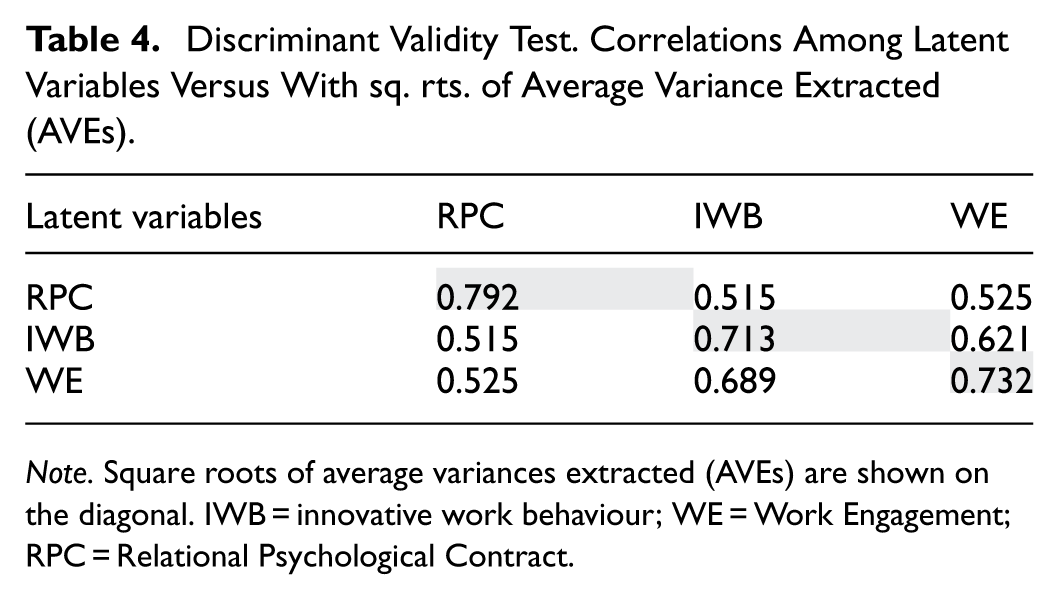

Note. Square roots of average variances extracted (AVEs) are shown on the diagonal. IWB = innovative work behaviour; WE = Work Engagement; RPC = Relational Psychological Contract.
Structural Model Estimates and Model
Model fit assessment is critical in SEM to see if there is a statistically large difference between the observed and expected covariances and correlation matrices. Table 5 below details various Model fit indices based on the SEM WarpPLS results of the model.
Fit Indices for Structural Equation Model.

The model fit indices are given in Table 5 above and all fit indices shows good model fit, with APC 0.462 greater than .01; VIF of 1.388, AFVIF 2.403, Tenenhaus GoF 0.516 and SRMR 0.075. The measurement model shows good results, thus there is no change needed in any items in the subsequent construct. Also, above observed values for causality criteria (SPR/RSCR/SSR/NLBCDR) shows that causality directions assumed earlier in the structural model are correct.
The structural model shown (Figure 4) shows the path analysis amongst the latent variables. The R Square value of .68 indicates the important role of the identified constructs. The variations in the independent constructs are responsible for 68% of the changes in innovative work behaviour. The high value of R2 indicates high confidence in the relationship between the independent constructs and the dependent variable.

Structural equation model.
A Path Coefficients (beta), showing the direct effect of each independent reflective construct on the dependent variable, is seen in Table 6 above. In the model, the path coefficients are standardised in OLS (ordinary least squares) regression, which can be interpreted. According to Chin (1998), paths should be at least 0.2 and above to be considered meaningful; below 0.1 are considered insignificant. Path coefficients of RPC →WE (0.53), WE → IWB (0.75), RP → IWB (0.12). The results show that Path Coefficients values are above 0.2 for two paths (RPC →WE & WE → IWB) while path RP → IWB is >0.1. The p-value of all the direct relationships is significant since the p-value is less than 0.01. The effect size is evaluated using Cohen’s f2, the values range from 0.25 to 0.62, which are classified as a medium to large effect size, substantial for the model. Thus, the predictive capability of the model via reviewing three parameters, that is, “path coefficient,”p Value & “effect size,” imply that the model has high predictive capability and significance.
Structural Equation Model Results.
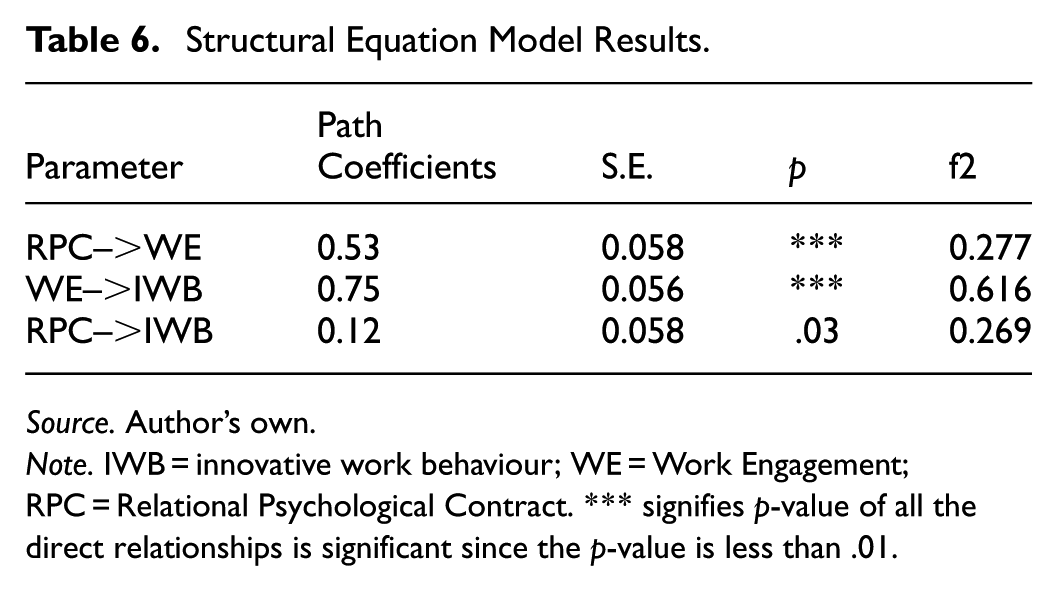
Source. Author’s own.
Note. IWB = innovative work behaviour; WE = Work Engagement; RPC = Relational Psychological Contract. *** signifies p-value of all the direct relationships is significant since the p-value is less than .01.
Mediation Analysis
The value for “Variance Accounted For” (VAF), which reflects the proportion of the indirect effects’ beta coefficient to the total effects, was used by the researcher to examine the mediation.
A VAF value bigger than 80% represents full mediation, a VAF value of between 20% and 80% means a partial mediation, while a value below 20% means no mediation (Hair et al., 2011). As seen in Table 7 above, the mediation path (“Relational Psychological Contract→ Work Engagement→Innovative Work Behaviour”) had values higher than 0.8, thus proving complete mediation. Thus, work engagement mediates the relationship of relational psychological contract and innovative work behaviour.
Mediation Analysis Variance Accounted for (VAF).

Source. Author’s own.
Hypothesis Testing
From the PLS-SEM structural model test statistics, we can analyse results for the hypotheses via Model path coefficients and p-values. Table 8 below shows the hypotheses summary.
Hypothesis Testing Table.
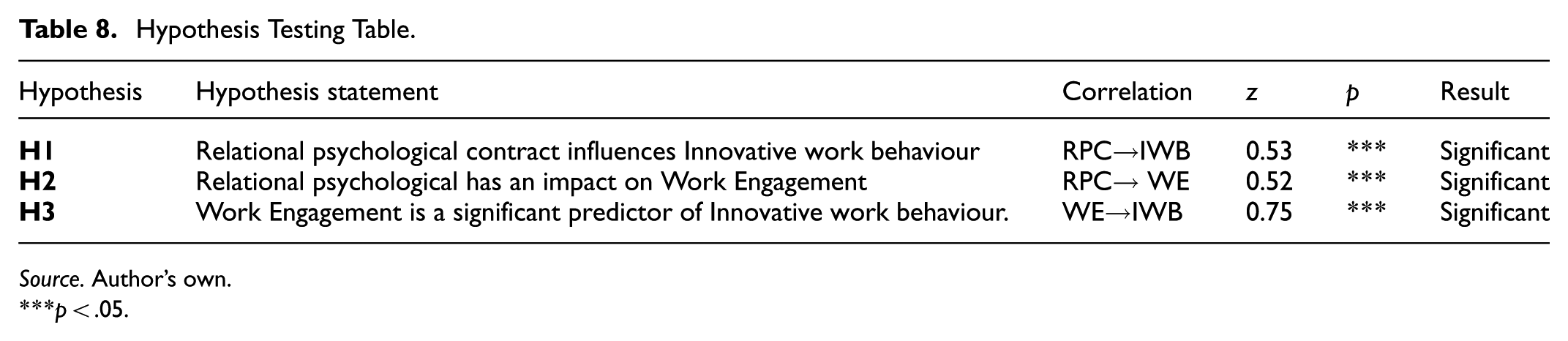
Source. Author’s own.
p < .05.
The outcome as shows in Table 8 above, highlight the latent construct (relational Psychological Contract) grows by one unit of standard deviation from its mean then, “Innovative work behaviour” also moves ahead by 0.53 and Work Engagement moves up by 0.52, when means that “Relational psychological contract” is positively connected with “Innovative work behaviour” and “Work Engagement” (
Work engagement serves as a mediator variable between the relationship of the “relational psychological contract” and “innovative work behaviour” (
Discussion
On one hand, employees’ innovative behaviour is the need of the hour for organisational competitive advantage, while on the other hand, employees’ well-being and providing support at work are also crucial. Those organisations that take a people-centric approach and value their long-term relationship with employees can survive and sustain any economic changes. The psychological contract was an independent variable in the study’s model, innovation work behaviour was a dependent variable, and work engagement served as a mediating variable. According to the study, an employee’s “relational psychological contract” has a substantial correlation with innovation, with a p-value < .05. The study validated the finding of past research (U. Aggarwal & Bhargava, 2010; Bal & Kooij, 2011; Bhatnagar, 2014; Chakraborty et al., 2023; Chang et al., 2013; Liao & Chen, 2018; Newton et al., 2008; Ramamoorthy et al., 2005; Soares & Mosquera, 2019). The psychological contract and social exchange theories can be used to explain this. According to these theories, employees who have “relational psychological contracts” and long-term associations with an organisation exhibit high levels of engagement at work, which promotes innovation.
Recent organisational environment trends indicate significant changes in work practices post-pandemic. Many organisations are now focusing on talent retention by offering inclusive work environments, flexible working hours, hybrid work models, and remote work options to accommodate employees’ professional and personal needs. Employees working remotely manage personal responsibilities such as household chores, childcare, and caring for parents or in-laws, alongside their work commitments. Remote work allows employees to save time on commuting, find it economically beneficial to stay home, and achieve a better work-life balance. Additionally, the Social Information Processing Theory (SIPT) proposed by Salancik and Pfeffer (1978) suggests that communication modes influence employee attitudes and behaviours based on social context cues such as values, work requirements or expectations from social environments (Salancik & Pfeffer, 1978). Considering this theory’s applicability in Asian contexts, it is crucial to examine how employees interpret information during work from home conditions that can lead to job outcomes (Kutaula et al., 2020). Therefore, employees with relational psychological contracts contribute towards the psychological well-being of an employee and help them reciprocate by showing Innovation at work (Bal & Kooij, 2011; Chakraborty et al., 2023; Chang et al., 2013; Karani & Mehta, 2022; P. Kim et al., 2024; Orth & Volmer, 2017). Because of this, employees can relate to the need for organisational innovation and are prepared to use their best efforts to be creative, despite the new working arrangements and the prevalence of remote work.
The introduction of “Work Engagement” as a mediator in the relationship has shown a solid association between work Engagement and innovative work behaviour (p-value < .05). Earlier studies (Amabile et al., 2004; Gupta et al., 2017; M. S. Kim & Koo, 2017; Montani et al., 2020; Orth & Volmer, 2017; Park et al., 2014) have also shown a positive relationship between work Engagement and innovation. The employees experiencing relational psychological contract receive more job resources and support from employers in the form of training and development, performance feedback, create a stable career path and growth. Agarwal (2014b) explains that this supportive environment nurtures the relationship and creates value congruence between individuals and their organisation, which in turn creates a feeling of “psychological meaningfulness” at work. Similarly, employees who get support from their employer develop “psychological safety” to express themselves without any feeling of fear. Also, the element of socioemotional relationship helps to develop a feeling of job security, which promotes “psychological availability.” Hence, relational psychological contracts develop the “psychological conditions” which enhance positive “work engagement.” Highly engaged employees take challenges; concentrate, emotionally connect at work and take additional responsibilities at work by doing discretionary extra job roles like innovation (Agarwal et al., 2012; Bakker & Xanthopoulou, 2009; Burch & Guarana, 2014; Garg & Dhar, 2017; Matta et al., 2015; Park et al., 2014; Rabenu et al., 2021; Runhaar et al., 2013; Schaufeli et al., 2002; Sharoni et al., 2015).
Thus, we can conclude that change in ways of working don’t impacts the intention to innovate within employees. An employee working from home or from the office can equally show innovative behaviour at work. A remote worker feels more emotionally attached to their employer for providing work-from-home facilities, by which employees can manage their demands along with their job. The employee puts its 100% at work and reciprocates towards the organisational support, trust and respect it receive from an employer.
Manufacturing, engineering & R&D, hotel & hospitality sectors (Agarwal et al., 2012; Chang et al., 2013; Dhar, 2016; Liao & Chen, 2018) was focused of previous studies and the variables included were, psychological contract construct, organisational citizenship, trust, innovative behaviour, commitment, work engagement, and perceived organisational support. As a result, research of “relational psychological contract,”“innovation work behaviour,” and “work engagement” together within IT sector, primarily among remote workers, is a contribution towards earlier research gaps and scope which highlighted the need to study “psychological contract” considering shifting market situations and employment dynamics. Additionally, by including the Indian IT sector as a scope, we attempted to bridge the gap of a lack of research across various cultural and industry sectors.
Theoretical Implications
The IT industry was a major focus of the study, and innovation is a field of study in behavioural psychology. The study helped the company meet its requirement for innovation by providing employees with flexible and improved working environments (like remote working). The majority of the studies conducted in the past did not include much information about the IT sector. As earlier studies were unable to provide a collective outlook of “psychological contract types” along with work engagement impacting innovation motivation within remote workers, the research attempted to bring three variables together under one roof, namely relational psychological contract, work engagement, and innovative work behaviour. The study also examines the role that job engagement capacities play in mediating the relationship between relational psychological contract and innovative work behaviour, an area that has received little attention in previous research (Agarwal et al., 2012; Chang et al., 2013; Garg & Dhar, 2017). As a result, the study attempted to close the research gaps by introducing the perspective of engagement in fostering creativity. The research also identifies the impact of relational psychological contracts on innovation outcomes through the lenses of social exchange theory and psychological contract theory, which illustrates the interaction between the mutually obligatory association between the employee and the employer, along with work engagement, enabling this relationship. Thus, provides relevance to the current situation of economic conditions post-pandemic, high inflation rates, and a recession-like situation, which overstress employees for ensuring job security and contributing towards a sustainable future by getting themselves involved in innovative work, which will lead to new products, solutions, or services. As a result, the study adds to the body of knowledge and will open more opportunities for research in related fields.
Managerial Implications
The “psychological contract” starts forming as soon as an employee joins a company, when they begin to feel realistic job previews; this aids in the development of a “relational psychological contract,” which fosters a feeling of safety, trust and belonging between individuals and organisations. Employees learn what is required of them on the job and what is expected from the organisation through the process of going through the employment life cycle. Organisations can foster the formation of relational contracts using people-centric policies, like career development opportunities, working environments, organisational culture, competency-building initiatives, skill enhancement through assessment and development centres, and promoting job rotation. Organisations can offer the dual-career option, which can aid in the retention of top performers. Like this, providing flexible working schedules like, hybrid, remote working, can further enhance the employee-employer relationship as employees feel emotionally attached towards their organisation as the employer provides an opportunity to create a balance of work and personal life by being at home.
Also, resilience and adaptability are key factors in shaping psychological contracts and driving innovation in the workplace. Organisations that nurture these qualities in employees create a more engaged workforce, fostering trust and commitment even in uncertain environments. Employees who feel supported in terms of job security, career growth, and empowerment are more likely to exhibit innovative behaviours, embracing challenges as opportunities for learning and problem-solving.
Work engagement and organisational support enhance adaptability, helping employees navigate shifting expectations even in difficult economic conditions and a disruptive environment like the pandemic. Fulfilled psychological contract and perceived organisational support play a significant role, particularly in sustainability-oriented workplaces and satisfying job demands. To build resilience, companies can encourage a growth mindset, provide social support, offer stress management training, and empower employees with autonomy.
Relational psychological contract is recognised as the important job resources which act as an important element in developing psychological wellbeing among employees, which in turn leads to work engagement, where employees feel completely engrossed physically, mentally, and emotionally towards their job, thus helping promote creativity at work. When an employer provides the correct amount of support and recognition, it can encourage employees to engage in discretionary work behaviours, including creativity, innovation, and supporting high performance (U. Aggarwal & Bhargava, 2010; Romani-Torres & Norena-Chavez, 2023; Vu et al., 2025). The findings of this study indicate that work engagement is crucial for encouraging innovative work conduct. The behavioural contributions that employees’ creativity may make to an organisation’s success are highlighted in this study. Through a process of psychological and behavioural improvement, work engagement influences innovative work behaviour both directly and indirectly. The study also indicates evaluating the existing work culture via “Innovative Culture Enhancement Framework,” which would help organisations to amend or adjust the existing organisational culture to enhance the level of desired innovation behaviour within employees (Bendak et al., 2020).
Limitations and Suggestions for Future Research
A limitation of the study is that the respondents were primarily from the states of Maharashtra and Karnataka in the western part of India. Additional factors were not included in this study, such as job performance, commitment, work-life balance, leadership, trust, and personal demands, which might have an impact on innovation motivation. The effects of additional factors on this relationship could be investigated in future research. Also investigating resilience as moderators or mediators in the relationship between psychological contracts and innovative work behaviours could add significant value for future studies. Examining how psychological contracts evolve during crises, and the role of adaptability in maintaining employee engagement and innovation, is crucial. A longitudinal study as future scope could track the changing perceptions and behaviours of employees over time, especially post-pandemic, which would help examine the long-term effects of remote working on innovation and establish causal relationships. The study was restricted to IT services; other service industries were not included, which is a limitation that was found. Testing this variable in different industry types may be included in the future scope. The service sector is an area that has not yet been thoroughly studied; thus, it offers fresh opportunities to research innovation within service sector industries. The study only included employees who worked from home; therefore, it cannot be applied to office workers. This provides sufficient justification to look into future behaviour and employee expectations of the company. Therefore, the current study’s limitations provide room for future research.
Conclusion
In conclusion, the study reinforces the critical role of relational psychological contracts in shaping work engagement and innovative work behaviour. Employees who experience strong relational psychological contracts characterised by mutual trust, support, and long-term commitment demonstrate higher engagement levels, which in turn fosters creativity and innovation within the workplace. The findings highlight that employees, whether working remotely or in traditional office settings, are equally capable of exhibiting innovative behaviours when provided with the necessary job resources, supportive environments, and psychological security.
The findings emphasise the growing importance of flexibility, well-being, and inclusivity in post-pandemic workplaces. Organisations that cultivate psychological meaningfulness, safety, and availability enable employees to remain highly motivated and productive, strengthening their commitment to innovation. Moreover, this study expands the scope by addressing relational psychological contracts, innovation, and work engagement within the Indian IT sector, particularly among remote workers. This contribution helps bridge gaps in existing literature, offering fresh perspectives on how psychological contracts influence employee behaviour in diverse cultural and industry contexts.
Ultimately, the study underscores that employee innovation is not restricted by work location or organisational changes; rather, it thrives in environments where employers invest in relational contracts, creating a foundation of trust, support, and engagement that inspires discretionary behaviours like innovation. These insights have profound implications for Organisations aiming to sustain competitive advantage, enhance employee well-being, and build resilient, forward-thinking work cultures in an evolving business landscape.
Despite its contributions, the study acknowledges limitations such as geographical focus and industry specificity, encouraging future research to explore psychological contracts across different sectors and examine resilience as a moderating factor. Longitudinal studies could provide deeper insights into how remote work continues to shape employee engagement and innovation over time.
The study demonstrates that innovation is not confined to work arrangements; it flourishes in environments where relational contracts foster trust, engagement, and creativity. Organisations that invest in psychological contracts cultivate a cycle of reciprocity, inspiring employees to contribute meaningfully, adapt to change, enhance organisational success, creativity, and long-term sustainability, thus driving sustained innovation in the modern workplace.
Footnotes

Ethical Considerations
This study was conducted by the ethical standards of Symbiosis International University and with comparable ethical standards. All procedures involving human participants were reviewed to ensure the protection of participants’ rights, privacy, and well-being. The research team ensured that participation was voluntary and that participants could withdraw at any time without any consequences. The survey was anonymised, with no personal data collected in the process of data collection.
• How your study design limited the risk of harm to your study participants?
- The Study was designed to limit any risk to the participants as the survey was anonymised, with no personal data collected in the process of data collection
• Why the potential benefits of the research to society and to the study participants outweigh the risk of harm to the study participants ?
- The potential benefits of this research to both society and the study participants significantly outweigh the minimal risks involved. The study was designed to explore the relationship between Psychological Contract and Innovative Work Behaviour with the Mediating role of Work Engagement, which has direct implications for improving organisational practices, enhancing product and service delivery, and influencing policy decisions within the IT sector. The IT sector is changing massively due to technological advancement, which heavily depends on employees for its survival in this disruptive economic environment.
Participants were asked to share their experiences and perspectives online surveys, with no foreseeable physical or psychological harm. All data collection procedures were non-invasive, and participants were assured of confidentiality and anonymity throughout the process.
The societal benefit lies in the potential to generate actionable insights that can lead to improved workplace environments, better customer satisfaction, and more inclusive and ethical business practices. For participants, the opportunity to voice their experiences may contribute to organisational improvements that directly affect their professional or organisations.
To mitigate any potential risks, participants were fully informed of their rights, including the right to withdraw at any time via the Informed Consent Statement
• How you obtained informed consent from the study participants:
- Via Informed Consent Statement
Consent to Participate
Informed consent was obtained from all participants included in the study before participating into the survey. Participants were provided with detailed information about the purpose of the research, the procedures involved, and their rights as participants. No personal data was collected in the process of data collection.
Funding
The authors received no financial support for the research, authorship, and/or publication of this article.
Declaration of Conflicting Interests
The authors declared no potential conflicts of interest with respect to the research, authorship, and/or publication of this article.
Data Availability Statement
The participants of this study did not give written consent for their personal data to be shared publicly. The datasets analysed in the study are available from the corresponding author on reasonable request.