




Abstract
This study examines the effects of paradoxical leadership on innovative work behaviours, with a focus on the mediating roles of self-leadership and work engagement and the moderating role of leader-member exchange (LMX). Utilizing a 2 × 2 between-groups quasi-experimental design, the research involved manipulating participants’ perceptions through scenario experiments related to paradoxical leadership and LMX. A sample of 288 service sector employees was randomly distributed across 4 different scenarios, with subsequent survey completion post-scenario exposure. Our findings reveal that paradoxical leadership indirectly influences innovative behaviours through enhancing followers’ self-leadership and engagement. Significantly, the impact varies with the quality of LMX: in paradoxical scenarios, higher LMX levels notably increase self-leadership and engagement, an effect absents in non-paradoxical contexts. However, LMX does not directly moderate the relationship between paradoxical leadership and innovative work behaviours. This research underscores the complex interplay between leadership styles and interpersonal dynamics, emphasizing the essential role of cultivating followers’ self-leadership and robust leader-member exchanges to enhance organisational innovation.
Plain language summary
Why was it done? The research in this article was aimed at determining how paradoxical leadership, which is a complex style of management that balances contrasting behaviours, influences innovation in the workplace. The researchers were interested to understand whether this kind of leadership enhances the self-leadership of employees and their engagement in their jobs and, on the other side, how the relationship between leaders and employees might moderate the process. What did the researchers do? The researchers experimented with a 2×2 design using a sample of 288 service sector employees to test various scenarios by manipulating participants’ perceptions of their leaders’ styles and the quality of relationships between them. And what did the researchers find? They discovered that paradoxical leadership can support innovation only indirectly, through enhancement in self-leadership and engagement at work. The quality of the relationship between leaders and employees was crucial: the better the relationships, the stronger the positive effects of paradoxical leadership on self-leadership and engagement. However, this relationship did not directly affect how paradoxical leadership influenced innovative behaviour’s. What do these findings mean? The research is underlining such leadership styles that balance different approaches with the importance of strengthening leader-employee relations in innovativeness. Organizational awareness of these dynamics will encourage creativity and innovation among employees.
Keywords
Introduction
Innovation plays a crucial role in the success and sustained growth of organisations in today’s complex, technologically advanced, and globalised business environment (Pericolic & Teece, 2019). It encompasses not only the creation and implementation of novel ideas, services, or projects but also the cultivation of adaptive productive work behaviours (Janssen, 2000). Employees are pivotal in this process as their contributions form the foundation for developing new products and improving work processes. By balancing conflicting, yet complementary goals, innovation challenges employees to transcend traditional thinking and nurture a culture of creativity (Van de Ven, 2021). This process requires a delicate balance between novelty and practicality, drawing from past successes while exploring new ideas (Smith & Lewis, 2011). This dynamic equilibrium poses a significant challenge for effective leadership. Leaders must set work objectives and control decision-making processes while considering employees’ needs and interests to provide flexibility and empowerment (Fürstenberg et al., 2021). Therefore, research on effective innovation management is critical for optimising its implementation and impact within organisations. Leaders must consciously integrate seemingly contradictory aspects to obtain better results than if each part were applied separately (Smith & Lewis, 2011).
Most leadership theories and research are yet to thoroughly explore the potential benefits of integrating divergent leadership styles for followers (Fürstenberg et al., 2024). The dominant focus so far has been on the binary choices of leadership behaviours and on determining which behaviour is more appropriate under specific conditions. Paradoxical leadership, however, does not confine itself to a single extreme; rather, it seeks to integrate seemingly opposing perspectives into new behavioural strategies, accommodating various needs over time (X. A. Zhang et al., 2015). Social exchange theory suggests that individual behaviours within organisations are influenced by interpersonal relationships, highlighting the crucial role of reciprocity in fostering leadership, self-management, and innovative behaviours (Li & Ding, 2022; Ranzino & Mitchell, 2005). Paradoxical leadership skilfully balances relational and task-oriented demands by adjusting strategies based on environmental factors and follower characteristics (S. J. Zhang et al., 2015). By integrating democratic and directive approaches, paradoxical leadership not only focuses on task completion but also attends to employees’ personal development and needs, thereby enhancing innovation (Li et al., 2020).
As the global economy shifts from a manufacturing-based focus to one centred on knowledge and services, the nature of work and job creation is undergoing significant changes (Grant & Parker, 2009). This transition has heightened the demand for knowledge workers who can self-lead and adeptly address new challenges independently (Houghton et al., 2012). Self-leadership is crucial in this context; it enables employees to effectively manage their thoughts and behaviours, driving innovation without the need for direct supervision (Gomes et al., 2015). Employee work engagement enables them to proactively explore new ideas and strategies, thereby exhibiting greater creativity and adaptability when faced with new challenges (Schaufeli et al., 2002). Innovation, which resembles the process of biological evolution, requires iterative trial and error (Ziman, 2003). This inherent risk necessitates not only the support of leaders but also the proactive exploration by followers. While external leadership is a prerequisite for self-leadership (Stewart et al., 2019), innovation is fundamentally driven by individuals (Manz, 1986). Employees proficient in self-leadership can identify opportunities and take decisive actions in dynamic environments, thereby enhancing organisational agility and competitiveness (Gatherer, 2013). This capability not only helps employees remain efficient in rapidly changing work environments but also fosters a continuous drive for innovation within the organisation
In the context of paradoxical leadership, Leader-Member Exchange (LMX) is crucial for fostering employee self-leadership and engagement. Although paradoxical leadership is associated with various positive outcomes, it can be novel, ambiguous, and confusing for followers (Schilling et al., 2023). The inherent inconsistency and unpredictability of paradoxical leadership may diminish followers’ trust in their leaders, hindering the practice of self-leadership and engagement (Kiewitz et al., 2016). Cable et al. (2013) emphasised the importance of empowering employees to leverage their unique strengths and perspectives in task execution and express their authentic selves. High-quality LMX relationships, characterised by leader support and trust, enhance opportunities for employee self-expression, thereby improving individual performance and driving collective innovation (Graen & Uhl-Bien, 1995). This interaction between self-leadership, work engagement and LMX underscores the increasing focus on employee-centred organisational innovation. Empowering individuals and cultivating effective leader-employee relationships are essential for maintaining a competitive edge.
Demand for innovation has also increased with the expansion of the service sector (Carayannis et al., 2012). In China, the service sector holds a pivotal position in the country’s economy since the 1990s and has become a key driver of gross domestic product (GDP) growth (Y. Wu, 2007). Encompassing fields such as education, healthcare, culture, and professional services, this sector contributes significantly to economic diversification and modernisation (Yang, 2019). Factors such as technological advancement, demographic changes, globalisation, and economic crises have imposed higher demands on the service industry, raising societal expectations for addressing social issues, enhancing service quality, and boosting innovation capacity. Despite this increasing need, the overall innovation capability of service sector remains inadequate. Research indicates that service sector employees generally lack motivation for innovation and struggle to maintain an efficient innovation state (Ettlie & Rosenthal, 2012). Moreover, only a small proportion of employees have the opportunity to engage in meaningful innovation projects (S. J. Zhang et al., 2015). This phenomenon highlights deficiencies in innovative behaviour among service sector employees and underscores the importance of fostering such behaviour. Leaders play a crucial role in this process, as they must effectively manage daily operations and inspire creativity and innovation potential in employees (Lei et al., 2020). Understanding the effectiveness of different leadership styles in the service sector and their impact on employee innovative behaviour is vital for enhancing organisational performance and employee development. (Nordin et al., 2024).
Our study makes several significant contributions to the literature. First, we propose a new theoretical framework explaining how integrative leadership behaviours can benefit followers by exploring how paradoxical leadership influences innovative work behaviours through employee self-leadership and work engagement (S. J. Zhang et al., 2015). While previous research has shown that paradoxical leadership is effective in promoting positive employee behaviours (Shehata et al., 2023), the underlying mechanisms have predominantly focused on organisational benefits (e.g., organisational citizenship behaviour, Pan, 2021) without adequately considering the role of individual self-development and control. Based on the reciprocity principle of social exchange theory, we argue that paradoxical leadership provides clear guidance and control while granting followers sufficient autonomy, making them feel supported, and thus enhancing their self-leadership and engagement. We posit that individual proactivity and self-motivation are core drivers of innovative behaviour. Additionally, we examine the moderating role of LMX in the relationship between paradoxical leadership and employee self-leadership and work engagement. Given the unique inconsistency and unpredictability of paradoxical leadership (Kiewitz et al., 2016), LMX may be a crucial factor in determining whether followers can effectively exercise self-leadership and engagement when faced with paradoxical leadership despite its well-documented positive effects. Our study provides a more comprehensive empirical validation of the impact of paradoxical leadership on innovative behaviour by investigating the mediating role of employee self-leadership and engagement, as well as the moderating role of LMX.
Furthermore, given that experimental methods are considered the gold standard for causal inference (Colnet et al., 2024), we used a scenario experiment to manipulate perceptions of paradoxical leadership and LMX and assess self-leadership, work engagement and innovative behaviour. By this method, we further elucidate the mechanisms and boundary conditions of the impact of paradoxical leadership on innovative behaviour, enhancing the explanatory power of the theoretical framework and providing a solid foundation for future research.
Theoretical Background and Hypothesis Development
Paradoxical Leadership
Leaders in organisations frequently encounter management paradoxes, such as balancing empowerment and control, equality, and individualisation (Lavine, 2014). Traditional leadership theories address these dilemmas by emphasizing duality and dialectics, theorising and separating paradox elements (Waldman et al., 2019). Although effective leadership requires aligning leadership styles with specific situational needs, these opposing mechanisms can conflict under different conditions. For sustainable development, leaders must reconcile these conflicts (Smith & Lewis, 2011). Paradoxical leadership, introduced by S. J. Zhang et al. (2015) and inspired by the Daoist Yin and Yang philosophy, highlights the importance of unified, interdependent opposing forces. This philosophy encourages balancing and integrating organisational contradictions, harmonising opposing forces to drive continuous organisational progress (Waldman et al., 2019). X. A. Zhang et al. (2015) describe paradoxical leadership using the “both-and” approach, encompassing attributes like being self-centred and other-centred. Paradoxical leaders maintain authority to influence followers while demonstrating concern and respect for them.
A growing body of research has underscored the profound organisational impact of paradoxical leadership. X. Li et al. (2020) found its role in fostering promotive and prohibitive voice behaviours, thereby driving organisational innovation and sustainability. Building on this, M. J. Zhang et al. (2022) provided empirical evidence of paradoxical leadership’s indirect but favourable effects on individual and team innovation through the cultivation of ambidexterity, drawing from a comprehensive mix of field studies and online surveys. Shehata et al. (2023) noted a clear positive correlation between paradoxical leadership and increased work engagement among hotel personnel. However, despite these promising findings, much existing research on leadership behaviour tends to gravitate towards “either-or” styles (Khan et al., 2021), which prescribe context-specific behaviours. Given the inherent paradoxical nature of innovation, there is a strong case for adopting a comprehensive and adaptable leadership approach that is capable of effectively navigating and leveraging these contradictions to propel organisational success.
Innovation Work Behaviour
Innovative work behaviour (IWB) thrives under supportive leadership (Tian & Sanchez, 2017). Janssen (2000) comprehensively defines IWB as the deliberate creation and application of advantageous novel ideas within a work role, team, or organisation. This dynamic process encompasses the conception and realisation of ideas, emphasising innovative thinking while maintaining efficiency and orientation. Organisations must embrace these contradictory perspectives to effectively manage innovative information and ensure seamless operations within teams (Nijstad & De Dreu, 2012).
Paradoxical leadership, by demonstrating care and support (affinity) as well as clear expectations and direction (authority), establishes a trust-based environment. This leadership style not only enhances psychological safety, as posited by social exchange theory when leaders display genuine concern and respect, thereby increasing employees’ willingness to venture into new methods and ideas (Cropanzano & Mitchell, 2005), but also intensifies the frequency and diversity of interactions between leaders and employees, offering both challenges and support. According to the principle of reciprocity, such dynamic interactions foster positive social exchanges, prompting employees to reciprocate with heightened work engagement and innovative behaviours (S. J. Zhang et al., 2015). Moreover, paradoxical leaders cultivate an environment that respects diverse perspectives and fosters an open mindset, thereby enabling the constructive resolution of work-related contradictions through the integration of diverse viewpoints and solutions (M. J. Zhang et al., 2022). This approach not only values multiple viewpoints during task execution but also uses professional diversity to create synergistic effects that enhance innovation (Q. Li et al., 2018). Therefore:
Work Engagement
In contemporary organisational management research, work engagement garners considerable attention and is characterized by a triumvirate of components: vigor, dedication, and absorption, as posited by Schaufeli et al. (2002). Positive organisational outcomes like work satisfaction and organisational commitment are produced by high levels of engagement (Kaya & Karatepe, 2020).
Leadership plays a crucial role in boosting followers’ work engagement. Under social exchange theory, reciprocal interactions, based on perceived value, influence behaviour (Roch et al., 2019). Paradoxical leaders adeptly balance demands, engendering followers’ trust and reciprocation in work engagement (Pearce et al., 2019). They also provide essential work resources, such as goal clarity and autonomy (Fürstenberg et al., 2021; X. A. Zhang et al., 2015), key predictors of engagement and intrinsic motivation.
Work engagement fuels proactive learning and future-oriented behaviours, such as innovation (Chang et al., 2013). Highly engaged individuals demonstrate adaptability and resilience, facing challenges and thoroughly committing to tasks (Yuan & Woodman, 2010). This encourages exploration of novel approaches (Anderson et al., 2014), fostering innovation. Rich et al. (2010) posit that engaged employees are more innovative, investing energy to focus, conceptualize innovation, and assume responsibility for their creative roles. This brings us to the subsequent hypothesis:
Self-Leadership
The current focus in organisational studies has largely cantered on the interactions between team and organisational leaders and their followers, frequently framing followers as an extension of the leaders’ roles (Carmeli et al., 2006). However, the emergence of self-leadership has disrupted traditional assumptions in organisational behaviour and psychology, opening up avenues for informal leadership opportunities (Stewart et al., 2019). At first glance, the terms’self and leadership seem contradictory. Traditional leadership models typically involve two individuals: a leader and follower (Northouse, 2021). However, self-leadership, defined as a process of self-motivation and influence encompassing behavioural, natural reward, and cognitive strategies, challenges this notion (Manz, 1986). This process empowers individuals to enhance their behavioural, mental, and motivational levels, leading to improved personal performance (Harari et al., 2021; Manz, 1986). This suggests that individuals can fulfil the roles of both follower and leader, or at the very least, be their leaders.
Notably, external leadership serves as an intriguing precursor to self-leadership (Stewart et al., 2019). When leaders actively encourage followers to engage in self-leadership, their practices become more pronounced. In other words, leaders’ external support and rewards contribute to the development of more self-leading followers (Druskat & Wheeler, 2003). Consequently, external leader assistance may be essential for followers to effectively practice self-leadership, despite the apparent contradictions. Stewart et al. (2019) highlighted a potential paradox involving depletion and reinforcement. While self-leadership empowers individuals to enhance their capabilities and performance, this process can deplete resources and raise questions about its sustainability. We posit that leadership support plays a crucial role in reconciling this paradox.
The social exchange theory suggests a reciprocal relationship between paradoxical leadership and self-leadership (Cropanzano & Mitchell, 2005). Empowerment and support from paradoxical leaders can accelerate the development of self-leadership among followers (Houghton & Yoho, 2005), leading to improved individual and organisational performance through the effective management of behaviour, cognition, and motivation (Harari et al., 2021). These dynamics initiate a virtuous cycle. Additionally, in resource-exchange relationships, paradoxical leaders offer guidance and motivation, while followers reciprocate skills and efforts toward organisational goals (Cropanzano & Mitchell, 2005). As self-leadership evolves, followers contribute more valuable resources, reinforcing mutual benefits between leaders and followers. Self-leadership is inherently paradoxical in that individuals simultaneously assume the roles of both leaders and followers. Paradoxical leadership addresses this contradiction by retaining decision-making power while affording follower autonomy (N. Li & Ding, 2022). Despite its importance, empirical research on formal paradoxical leadership and self-leadership remains scarce, hence the need for further research (Pearce et al., 2019).
Evidence strongly supports a positive association between self-leadership and innovation (DiLiello & Houghton, 2006). Innovative work behaviour, characterized by risk-taking, problem identification, idea generation, and successful outcome delivery, is often hindered by various obstacles and setbacks (Yuan & Woodman, 2010). Individuals engaged in innovative behaviour encounter significant effort requirements and potential external resistance. Although motivation for innovation is widespread, effectively demonstrating innovative behaviour requires self-leadership to overcome internal pressure and external resistance (Carmeli et al., 2006). Robust self-leadership equips individuals with the necessary self-direction and motivation to navigate innovation complexities (Harari et al., 2021). Autonomy, a fundamental aspect of self-leadership (Manz, 1986), is vital for fostering innovative behaviour (Demircioglu, 2021). Howell (2005) and Carmeli et al. (2006) proposed that individual differences in innovation processes stem from variances in self-leadership. Hence, self-leadership is likely to mediate this process, leading to the following hypothesis:
Leader-Member Exchange
Leader-member exchange (LMX) focuses on the distinct dyadic relationships between leaders and followers (Waismel-Manor et al., 2010). Given time and energy constraints, leaders distribute finite resources based on perceptions, evoking varied employee responses and communication levels (Bernerth et al., 2007). Leaders distinguish between “in-group” and “out-group” members, with the former developing trust-based relationships, resulting in emotional attachment. These members gain increased encouragement, empowerment, and emotional support, promoting normative reciprocity, contrasting “out-group” members (Anand et al., 2011). Studies reveal that high-quality LMX relationships lead to improved performance (Gottfredson et al., 2020), underscoring LMX’s significance in leadership studies.
LMX has been recognized as a critical antecedent for innovation (Mascareño et al., 2020). As per social exchange theory, Y. Zhang et al. (2015) argue that employees’ innovation serves as a direct reward for leaders fostering high-quality LMX relationships. Initially, Morrison and Phelps (1999) described innovation as spontaneous extra-role behaviour. Without leaders’ support, the transformative nature of innovation might deter employee engagement due to inherent risks. Followers in lower-quality LMX relationships may refrain from autonomous transformative actions fearing potential disruption and subsequent resentment. However, high-quality LMX relationships allow followers to perceive themselves as “in-group members,” boosting autonomous problem-solving and fostering self-leadership (Stewart et al., 2019), thus encouraging risk-taking and spontaneous innovation (Demircioglu, 2021).
High-quality LMX positively influences followers to cultivate self-leadership and work engagement (Son et al., 2022). As Breevaart et al. (2015) observed, followers reciprocate the support and resources received in high-quality LMX relationships with increased work engagement. Simultaneously, they gain challenging tasks, decision-making authority, and task autonomy (Zhou et al., 2012) - key components for self-leadership development (Harari et al., 2021). From a self-leadership perspective, leaders’ impact is influenced by LMX quality. Although followers face external influences, boundaries, and demands, their response is discretionary (Stewart et al., 2019). This discretion often hinges on the leader-follower relationship (Son et al., 2022), with “in-group” followers more inclined to accept leaders’ demands, while “out-group” members likely resist. Consequently, LMX may act as a moderator, influencing the impact of paradoxical leadership on followers’ outcomes. The following hypotheses ensue:
The proposed hypotheses (refer to Figure 1) were assessed in a quasi-experimental study centring on how paradoxical leadership impacts innovative work behaviours via self-leadership and work engagement, coupled with the moderating role of LMX. To examine these influences, participants were provided a scenario involving an internet company leader where paradoxical leadership and LMX were manipulated, subsequently measuring self-leadership, work engagement, and innovative work behaviours.

Conceptual framework.
Method
Participants and Design
This study employed snowball sampling to recruit participants from the service sector (Van Dierendonck et al., 2014). The recruitment process began by reaching out to acquaintances, such as friends, family, coworkers, and relatives, who were then asked to refer others within the service industry who might be interested in participating in the study. The focus was on the service sector due to its significant GDP contribution and scholarly interest in middle-income countries like China (Sohag et al., 2017). The selected industries, including healthcare, education, business and finance, and legal services, were chosen for their broad societal impact, direct interactions, and relevance to China’s evolving large segments of the population (Liao, 2020). These fields are integral to understanding the dynamics and trends in China’s rapidly evolving service landscape.
In this study, we employed a scenario experiment methodology, which involves simulating real-life situations to manipulate independent variables and control extraneous factors while randomly assigning participants to different experimental conditions. This approach allows for the observation of how various scenarios influence individuals’ cognition, emotions, and behaviours. Scenarios serve as a core component, providing concise descriptions that systematically integrate people, events, and objects (Atzmüller & Steiner, 2010). These scenarios can be effectively presented through mediums such as text or video to elicit authentic responses from participants (Hughes & Huby, 2002). Specifically, we utilized first-person textual scenarios, prompting participants to envision themselves as the protagonist within the described contexts. A G*Power analysis revealed that a sample size of 70 participants would achieve over 80% power to detect a medium effect size (Cohen’s d = 0.50) in a 2 × 2 between-group design (Kang, 2021). However, to enhance the robustness of our findings, we recruited a larger cohort of 288 participants, which included 169 females and 119 males with an average age of 32 years. In this quasi-experimental study (Maciejewski, 2020), participants were randomly assigned to ensure effective engagement and the capacity to realistically envision themselves within the study scenarios. The study utilized a 2 × 2 between-group design, manipulating variables of paradoxical leadership (paradoxical vs. non-paradoxical) and leader-member exchange (LMX) (high vs. low). Each of the 4 groups comprised 72 participants.
Ethical Considerations
This study involves participants reading a passage of text followed by a questionnaire. Participants are not required to prepare in advance and need only to respond to the questionnaire based on their understanding of the text. This process does not involve any alteration to the participants’ traits. Participation is entirely voluntary, and individuals are informed prior to the start of the questionnaire that they may withdraw from the study at any time without providing a reason and without any subsequent impact on themselves. Furthermore, no video or audio recording will be conducted during the study, nor will any personally identifiable information be collected. Participants are advised that their consent to continue with the questionnaire implies permission for the researchers to record, analyse, and utilize their data for the purposes of this study. Participants retain the right to revoke this consent at any point.
Experimental Manipulations
Before the study began, participants were informed that they would participate in a scenario simulation experiment on leadership behaviour, playing the role of an employee on an internet software development team. The scenario was as follows: The participant, along with a colleague named Wong, joins a newly formed project team led by a person named Zhang due to project reallocation. The scenario described Zhang’s leadership style and interactions with the participant and Wong. Zhang’s description was manipulated to represent paradoxical leadership and varying levels of LMX based on our prior design.
Drawing from X. A. Zhang et al. (2015) and adapting it to our experimental context, the description of paradoxical leadership was as follows: Over the 6 months in the project team, you gradually got to know your new leader, Zhang. Zhang treats each team member fairly, considering individual personalities and needs. Zhang has strict standards for task supervision while granting the team considerable decision-making autonomy. During meetings, Zhang encourages team participation in decision-making and the expression of opinions, although the overall strategic direction is set by Zhang. Despite the high standards, Zhang handles team shortcomings or mistakes with empathy. In daily interactions, Zhang maintains authority without being overbearing, striking a balance between approachability and respect.
For the non-paradoxical leadership scenario, the description was: Over the 6 months in the project team, you gradually got to know your new leader, Zhang. Zhang manages strictly according to company regulations and procedures, with clear requirements and expectations for work. In task allocation, Zhang ensures everyone understands their responsibilities. During meetings, Zhang elaborates on personal plans. When facing team shortcomings or mistakes, Zhang occasionally criticizes. In daily interactions, Zhang maintains a certain distance from team members.
Based on Graen and Uhl-Bien (1995) and adapted to our context, the high LMX scenario was described as: During the project’s progress, Zhang always favoured you. Zhang frequently sought your opinions in meetings and often shared insights and strategies with you privately. Zhang was well aware of your abilities and actively sought to develop your potential. When encountering problems in the project, you naturally turned to Zhang for help and always received a response. Zhang even entrusted you with conveying decisions or instructions. Although you and Wong joined the project team simultaneously, you felt you were growing faster and had more promotion opportunities.
The low LMX scenario was described as: During the project’s progress, Zhang always favoured Wong, giving you little attention. Zhang rarely sought your opinions in meetings and seldom communicated with you privately. Zhang had limited knowledge of your abilities and no intention to develop your potential. When encountering problems in the project, you sought Zhang’s help but rarely received a response. Sometimes, Zhang entrusted Wong to convey decisions or instructions to you. Although you and Wong joined the project team simultaneously, you felt marginalized in comparison.
Given the study’s focus on the interaction effects of paradoxical leadership and LMX on self-leadership and innovative behaviour, the scenarios were combined to create four experimental conditions. After reading the randomly assigned scenario, participants were asked to immerse themselves in the scenario and answer a series of questions, including manipulation checks, core variable questions, and demographic information.
Manipulation Checks
Manipulation checks serve as empirical measures within experiments to ascertain whether the experimental manipulations, such as treatment applications, have the anticipated effects on participants (Hauser et al., 2018). Many researchers and scholarly publications consider these checks essential (Fayant et al., 2017) because they validate the efficacy of experimental manipulations, ensuring that observed effects can indeed be attributed to the manipulative interventions rather than extraneous variables. The manipulation check tools selected for this study are outlined as follows:
Paradoxical leadership: We used X. A. Zhang et al.’s (2015) five-item scale as a manipulation check for paradoxical leadership (e.g., “Uses a fair approach to treat all subordinates uniformly, but also treats them as individuals.”). Respondents rated the leadership on five-point Likert-type scale ranging from 1 (strongly disagree) to 5 (strongly agree). The selection of the items was predicated on their capacity to embody fundamental elements of paradoxical leadership.
Leader-Member Exchange: A five-item scale created by Tang et al. (2021) was employed as a manipulation check for leader-member exchange (e.g., “Your leader recognize your potential well”). Respondents rated LMX on five-point Likert-type scale ranging from 1 (strongly disagree) to 5 (strongly agree). The selection of the items was predicated on their capacity to embody fundamental elements of paradoxical leadership.
Measure
Innovative Work Behaviour: A 10-item scale created by George and Zhou (2001) was employed to measure innovative work behaviour (e.g., “I come up with new ideas to achieve goals and tasks”). Respondents rated the behaviour on five-point Likert-type scale ranging from 1 (strongly disagree) to 5 (strongly agree).
Self-Leadership: A 35-item scale created by Houghton and Neck (2002) was employed to measure self-leadership (e.g., “I establish specific goals for my own performance”). Respondents rated self-leadership on five-point Likert-type scale ranging from 1 (strongly disagree) to 5 (strongly agree).
Work Engagement: A 17-item scale created by Schaufeli et al. (2002) was employed to measure work engagement (e.g., “When I am working, I forget everything else around me”). Respondents rated work engagement on five-point Likert-type scale ranging from 1 (strongly disagree) to 5 (strongly agree).
Covariates: We controlled the variables including gender, age, organisational tenure, job position and levels of education among all respondents, since they may reflect an impact on behavioural constructs (Yiing & Ahmad, 2009) (Table 1).
Summary of Measurements.

Results
Reliability and Validity Check
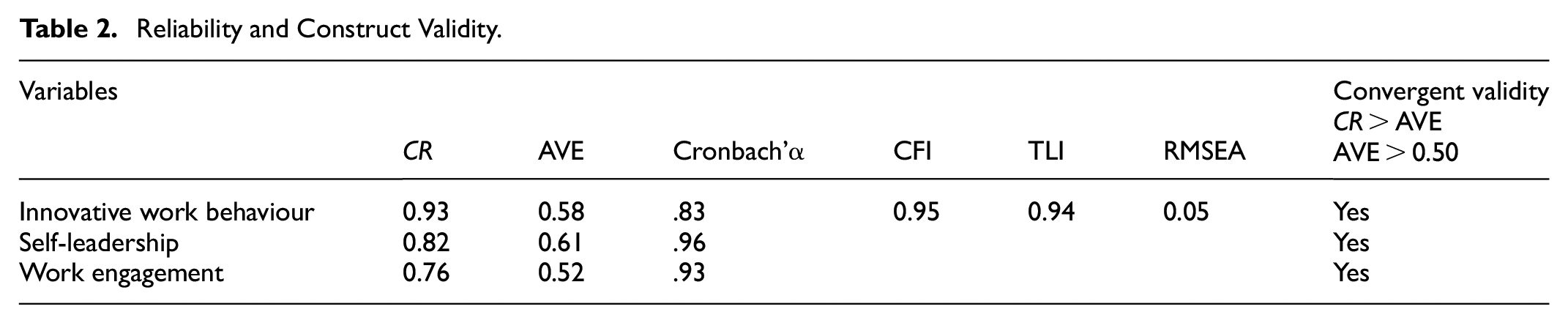
Table 2 is the result of the reliability and validity test for all measure variables. The study shows that the reliability of CR and Cronbach alpha meet the requirement as well as the convergent validity (Fornell & Larcker, 1981). Since Paradoxical Leadership and Leader-Member Exchange were coded as dummy variables, their means were not subjected to algebraic operations. Therefore, Innovative Work Behaviour, Self-Leadership, and Work Engagement were used as a three-factor model for structural validity testing. The results showed: the fit indices of the three-factor model are good, indicating a strong structural validity.
Reliability and Construct Validity.
Manipulation Check
After reading the scenarios, participants answered manipulation check questions. The independent samples t-test results indicated that participants in the paradoxical leadership condition perceived Zhang as exhibiting more paradoxical leadership behaviours than those in the non-paradoxical leadership condition (M_paradoxical = 4.17, M_non-paradoxical = 3.66, t[286] = 7.03, p < .001). Regarding LMX, participants in the high LMX condition perceived their relationship with Zhang as higher quality than those in the low LMX condition (M_High-LMX = 4.13, M_Low-LMX = 3.56, t[286] = 7.04, p < .001). These results indicate that manipulation of leadership style and LMX is effective.
Test of the Hypotheses
Using two-way analyses of covariance (ANCOVAs), the study first tested the main effects of paradoxical leadership (see Tables 3 and 4). After controlling for gender, age, organisational tenure, job position, and levels of education, paradoxical leadership significantly influenced self-leadership (F[1, 279] = 39.32, p < .001, ηp2 = .12), work engagement (F[1, 279] = 39.56, p < .001, ηp2 = .12), and innovative work behaviour (F[1, 279] = 50.87, p < .001, ηp2 = .15). Participants in the paradoxical condition reported higher levels of self-leadership (M = 4.02, SD = 0.33), work engagement (M = 4.01, SD = 0.33), and innovative work behaviour (M = 4.09, SD = 0.37) compared to those in the non-paradoxical condition, who reported self-leadership (M = 3.70, SD = 0.50), work engagement (M = 3.68, SD = 0.49), and innovative work behaviour (M = 3.68, SD = 0.55). Thus, Hypothesis 1, 2a, 3a are supported.
Descriptive Statistics for Self-Leadership, Work Engagement and Innovative Work Behaviour.

Two-Way ANCOVA Summary Table for Self-Leadership, Work Engagement and Innovative Work Behaviour.
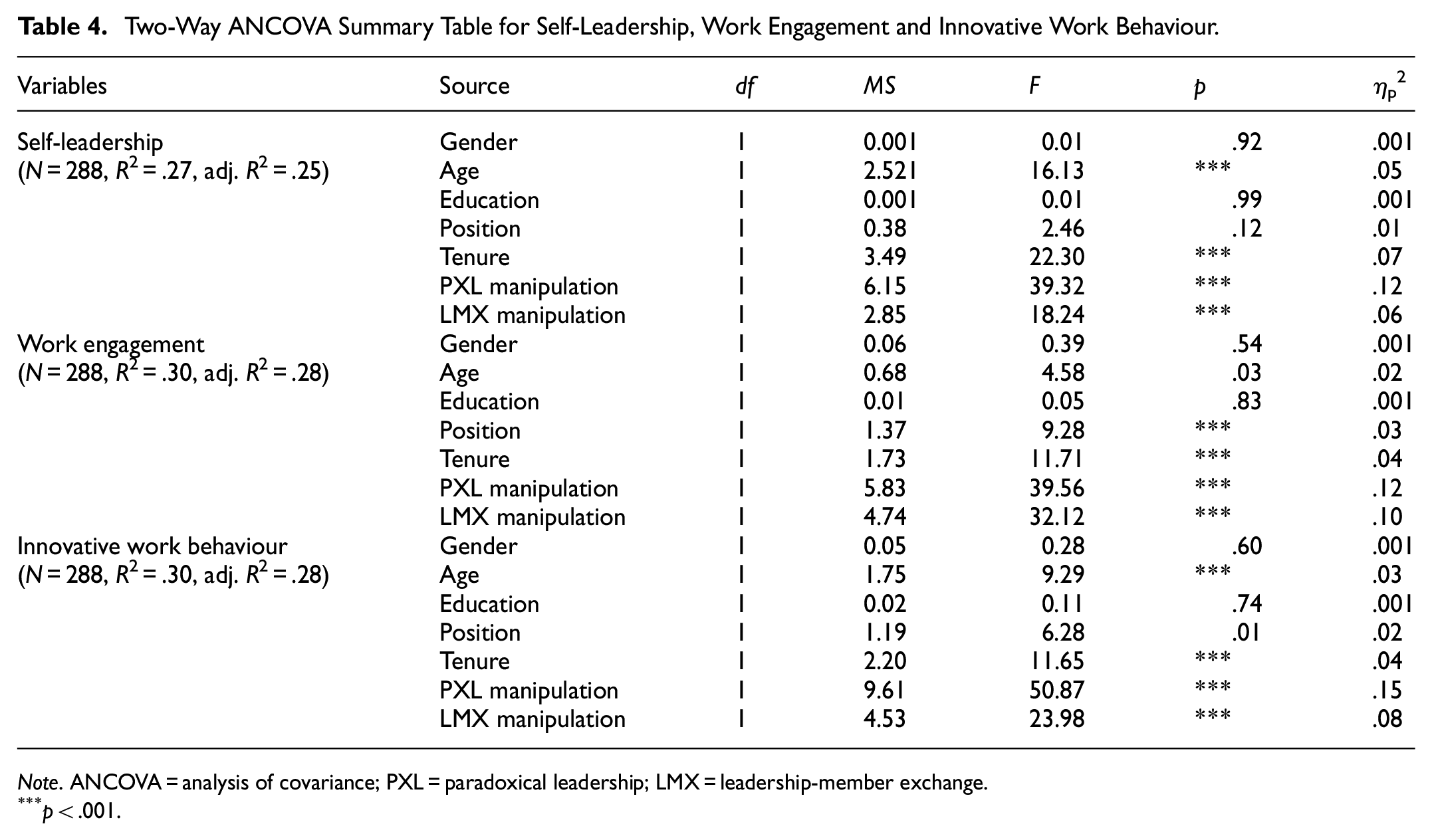
Note. ANCOVA = analysis of covariance; PXL = paradoxical leadership; LMX = leadership-member exchange.
p < .001.
Similarly, controlling for gender, age, organisational tenure, job position, and levels of education, leader-member exchange significantly influenced self-leadership (F[1, 279] = 18.24, p < .001, ηp2 = .06), work engagement (F[1, 279] = 32.12, p < .001, ηp2 = .10), and innovative work behaviour (F[1, 279] = 23.98, p < .001, ηp2 = .08). Participants in the high LMX condition reported higher levels of self-leadership (M = 3.96, SD = 0.37), work engagement (M = 3.98, SD = 0.36), and innovative work behaviour (M = 4.02, SD = 0.43) compared to those in the low LMX condition, who reported self-leadership (M = 3.76, SD = 0.51), work engagement (M = 3.71, SD = 0.49), and innovative work behaviour (M = 3.76, SD = 0.56).
A moderated mediation model was constructed using centralized variables, employing 5,000 bootstrap samples. In this model, paradoxical leadership (X, coded as 1 for Paradoxical condition and 0 for Non-Paradoxical condition) and its interaction with leader-member exchange (X*W) were designated as independent variables. Self-leadership (M1) and work engagement (M2) were included as mediators. Leader-member exchange was used as the moderating variable (W, with high LMX condition coded as 1 and low LMX condition as 0), and innovative work behaviour was identified as the dependent variable (Y).
The results indicated that after controlling for the influence of gender, age, organisational tenure, job position and levels of education, the total effect was 0.38, 95% CI [0.27, 0.49]; the self-leadership mediation effect of X on Y was 0.12 [0.07, 0.19], and the work engagement mediation effect of X on Y was 0.13 [0.06, 0.20]. This suggests that self-leadership and work engagement play the mediating role in the relationship between paradoxical leadership and innovative work behaviour. Thus, Hypotheses 2b, 2c, 3b, and 3c are supported.
Furthermore, the interaction between paradoxical leadership and leader-member exchange significantly predicted both self-leadership (β = .48, 95% CI [0.05, 0.91]) and work engagement (β = .55, [0.13, 0.87]) (refer to Table 5). At a low LMX condition (M-1SD), the mediation effects were as follows: self-leadership at 0.15 [0.19, 0.46], and work engagement at 0.13 [0.01, 0.29]. Conversely, at a high LMX condition (M + 1SD), the mediation effects increased to 0.32 for self-leadership [0.19, 0.46] and 0.33 for work engagement [0.17, 0.50]. These findings demonstrate that leader-member exchange acts as a moderator of the mediating effects of self-leadership and work engagement in the relationship between paradoxical leadership and innovative work behaviour. The complete model and path coefficients are depicted in Figure 2.
Summary of Moderated Mediation Model.

Note. PXL*LMX = the interaction between paradoxical leadership and leadership-member exchange.
***P < .001
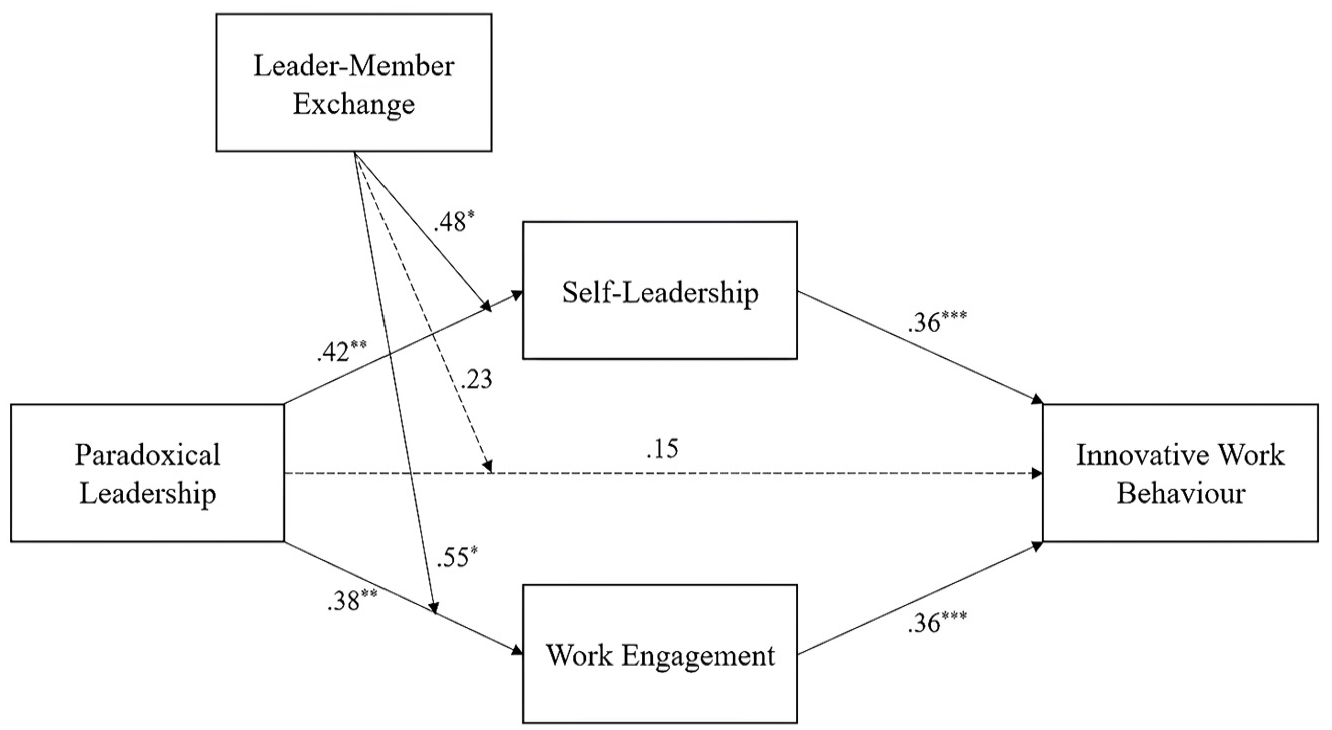
The moderated mediation model and path coefficients.
To further elucidate the moderating role of leader-member exchange, we categorized LMX into high and low groups, coded as 1 and 0, respectively. Subsequently, we conducted a simple slopes analysis to assess the effects. The results, presented in Figures 3 –5, show that when LMX was low, the direct effect of paradoxical leadership on innovative work behaviour was not significant (Bsimple 0.15, p = .17, 95% CI [−0.06, 0.37]). Conversely, when LMX was high, the direct effect was significant (Bsimple = 0.38, p = .002, [0.15, 0.62]). Additionally, in non-paradoxical condition, both high and low LMX are associated with lower levels of self-leadership and work engagement. However, in paradoxical condition, high LMX significantly enhances the levels of self-leadership and work engagement, while the impact of low LMX remains relatively minor (see Figures 3 and 4). Thus, Hypotheses 4b, and 4c are supported. The results do not support Hypothesis 4a, as the variation in innovative work behaviour remains small regardless of changes in conditions (see Figure 5).

The interaction of paradoxical leadership and leader-member exchange on self-leadership.

The interaction of paradoxical leadership and leader-member exchange on work engagement.

The interaction of paradoxical leadership and leader-member exchange on innovative work behaviour.
Discussion
This study examines the nuanced impact of paradoxical leadership on innovative work behaviour via self-leadership and work engagement, using a quasi-experimental setup. It also probes the modulating effect of leader-member exchange (LMX) under different degrees of paradoxical leadership. Findings suggest paradoxical leadership indirectly influences innovative behaviour through enhancing self-leadership and work engagement. While the role of work engagement aligns with previous research (Fürstenberg et al., 2021), this study sheds novel light on the pivotal function of self-leadership in this dynamic, in line with Pearce et al.’s (2019) call for deeper exploration.
Self-leadership intrinsically represents a paradoxical process, acting as both one’s leader and follower. Therefore, as the self takes on a leadership role, external challenges presented by the environment are pivotal, prompting individuals to set ambitious goals and step outside their comfort zones (Pina et al., 2017). During this process, they are likely to explore novel approaches and strategies to meet these challenges, thereby enhancing their self-leadership abilities. Concurrently, the self, in a follower role, requires external leadership to offer support, including resources, guidance, and feedback. This ensures that employees do not feel isolated when facing challenges, preventing the unsustainability of implementing self-leadership (Druskat & Wheeler, 2003). Paradoxical leadership adeptly meets the dual needs for self-leadership development, namely external challenges and support. Such leaders set high work standards for employees, encouraging them to challenge themselves. Meanwhile, they allow room for errors, improvements, and learning, offering requisite support. This may reconcile the contradictory demands of self-leadership, maximizing its effectiveness.
Paradoxical leadership strikes a balance between leadership authority and employee empowerment, fostering an environment conducive to self-leadership: offering clear direction without getting bogged down in minutiae and allowing employee exploration. This is crucial for stimulating innovation in followers. As Kline and Rosenberg (2010) aptly noted, innovation isn’t a “smooth, linear process,” but a multifaceted, uncertain, and turbulent one, akin to biological evolution (Ziman, 2003). Within this context, individuals face the risks of “evolution” while repeatedly experimenting. High levels of self-leadership enable them to confront, rather than flee from, the inherent instability of innovation (Carmeli et al., 2006). Thus, innovative work behaviour is influenced not only by leadership and other environmental factors but, importantly, by the self-leadership capabilities of the followers. Notably, a distinguishing characteristic of paradoxical leaders is their ability to adapt their leadership behaviours flexibly according to specific team and task needs (Waldman et al., 2019). They offer guidance and support when employees need it and step back to let employees demonstrate their self-leadership when they are ready.
Our study also underscored the critical moderating impact of leader-member exchange (LMX) in this process. Confronted with paradoxical leadership, higher LMX levels notably increase self-leadership and engagement. However, under non-paradoxical leadership, a similar LMX enhance doesn’t provoke significant shifts. This indicates that paradoxical leadership might require high-quality LMX as a bedrock, enabling followers to comprehend and embrace such seemingly contradictory leadership only within a well-cultivated exchange relationship. When LMX quality wanes, trust, respect, and mutual comprehension between leaders and followers dwindle (Anand et al., 2011). Followers might then question leaders’ intentions, and this scepticism could intensify under paradoxical leadership, which juxtaposes strict norm adherence with encouragement of autonomy and innovation (S. J. Zhang et al., 2015). In low LMX situations, followers may grapple to understand these conflicting demands, fostering confusion and action uncertainty. Moreover, substandard LMX may stress followers (Hesselgreaves & Scholarios, 2014), generating concerns over meeting leaders’ expectations or facing unfair performance appraisal. This stress can adversely affect their self-leadership and work engagement, as they may become preoccupied with meeting leaders’ demands, compromising self-leadership and innovation.
Low-level paradoxical leadership, akin to traditional unidimensional leadership emphasizing norms and efficiency (Waldman et al., 2019), as reflected in our manipulation, may not robustly stimulate followers but provides clarity and consistency in leaders’ behaviours and expectations. Hence, despite low LMX, followers understand leaders’ expectations. Consequently, a decline in LMX under low-level paradoxical leadership may not significantly affect followers’ self-leadership and work engagement. This insight warns that paradoxical leadership could risk misinterpretation or confusion among followers, underscoring the importance of maintaining high-quality exchange relationships.
This study’s selection of measurement scales aims to capture the underlying relationships between variables and to support our research conclusions. For instance, the paradoxical leadership scale, derived from S. J. Zhang et al. (2015), encompasses five dimensions. Among these, the dimension of “Maintaining decision control while allowing autonomy” facilitates the development of behaviour-focused strategies within self-leadership (Houghton & Neck, 2002) by enabling followers to work independently according to their own goals and timelines, thus fostering self-leadership. Additionally, this approach enhances “Absorption” in work engagement (Schaufeli, 2002) by granting followers discretionary power in their tasks, reducing interruptions from constant reporting. Furthermore, Leader-Member Exchange (LMX) and Innovative Work Behaviour (IWB) are treated as unidimensional constructs. LMX primarily assesses whether followers are perceived as “in-group” members by the leader, while IWB focuses on the behaviours of individuals proposing and implementing new ideas at work. When leaders maintain decision control while allowing autonomy but perceive followers as “out-group” members, followers may interpret the autonomy granted as a sign of neglect. This perception could undermine the “natural rewards” aspect of self-leadership, leading them to no longer view work as intrinsically rewarding, thereby inhibiting their engagement in innovative behaviours.
Demographic analyses revealed a positive correlation between age and self-leadership, signifying its evolvement with individual growth (Unsworth & Mason, 2012). Yet, interestingly, organisational tenure negatively predicted self-leadership, posing a seeming contradiction. Aligning with Ng and Feldman’s (2011) findings suggesting the diminishing positive outcomes with increased organisational tenure, extended tenure may ingrain individuals in existing cultures, norms, and practices, potentially leading to conservatism and resistance to change (Musteen et al., 2006). Such entrenched familiarity may limit or even reduce self-leadership as individuals may refrain from self-motivation or goal setting. This unexpected finding highlights the intricate dynamics of self-leadership development within organisations, meriting further research.
Limitations and Future Directions
While this study’s findings illuminate the mechanisms and conditions influencing paradoxical leadership, it is worth noting some inherent limitations persist, despite its contributions. Firstly, while the manipulation checks of our study affirm the validity of our paradoxical leadership and leader-member exchange manipulations, our reliance on scenario-based manipulations could have potentially compromised ecological validity. Such methods may capture respondents’ perceptions or behavioural tendencies more than actual experiences and capabilities. Secondly, due to constraints, this study employed convenience sampling, which limits the generalizability of the results. The non-random selection of the sample may introduce biases, constraining the ability to interpret the findings from a causal perspective. To enhance the representativeness and external validity of future research, it is recommended that random sampling be utilized, and consideration be given to expanding the sample size and diversity. Besides, the depiction of paradoxical leadership in our research presents an imagined role to the respondents, not an immediate and tangible leader. Knowing they are participating in a research project, not engaging with a real leader, might result in different responses in actual work scenarios. Finally, although the incorporation of experimental manipulations mitigates concerns about common method bias, the nature of our data remains cross-sectional. Thus, we cannot fully discount the possibility of reverse causality playing a role in our results. Future studies with longitudinal data or field experiments could provide more insight into these relationships.
Implication and Conclusion
Our study provides novel perspectives on the influence of paradoxical leadership on follower innovative behaviour, augmenting our comprehension of this emergent leadership style’s impact. The theoretical implications are considerable, presenting deep insights into the machinations of how paradoxical leadership affects innovative work behaviour. It highlights that the role of paradoxical leadership in bolstering innovation is realized through stimulating follower self-leadership and work engagement. Importantly, this work addresses research gaps by preliminarily clarifying the relationship between paradoxical leadership and follower self-leadership (Pearce et al., 2019). This suggests that self-leadership might be a vital factor for paradoxical leadership’s efficacy. Also, we confirm Leader-Member Exchange (LMX) as a critical boundary condition. This nuance contributes to our findings’ theoretical richness.
Furthermore, this study accentuates paradoxical leadership’s significant implications for nurturing organisational innovation, underlining leaders’ need to grasp its intricacies for promoting an innovative culture. The crucial moderating function of Leader-Member Exchange (LMX) is emphasized, suggesting enhancing such relationships amplifies paradoxical leadership’s effectiveness. Notably, self-leadership emerges as key in navigating paradoxical leadership’s complexities, underlining the importance of cultivating such skills within teams. The study also unveils demographic factors such as age and organisational tenure’s influence on self-leadership, offering valuable insights for Human Resource practices in recruitment, retention, and employee development. Lastly, the potential of prolonged tenure to hamper self-leadership and innovation calls for organisations to ensure a culture of continuous learning and dynamism, inclusive of long-serving employees.
Footnotes
Acknowledgements
The authors would like to thank the University of Malaya for its support in this research.

Ethical Considerations
This research was approved by the University of Malaya Research Ethics Committee (UMREC) [UM.TNC2/UMREC_1532]. Participants were informed that their participation in the study was entirely voluntary, and they were not required to prepare in advance. They were asked to respond to the questionnaire based solely on their understanding of the text, with no alterations to their personal traits involved. Participants were also informed prior to commencing the questionnaire that they could withdraw from the study at any time without providing a reason, and without any negative consequences to themselves. Additionally, no video or audio recordings were conducted during the study, and no personally identifiable information was collected.
Consent to Participate
Participants were informed that by continuing with the questionnaire, they were providing consent for the researchers to record, analyse, and utilize their data for the purposes of this study. Participants were also advised that they retained the right to withdraw this consent at any time.
Author Contributions
(1) Kai Zhao: Methodology, Investigation, Formal Analysis, Writing - Original Draft, Visualization.
(2) Nurul Liyana Mohd Kamil: Conceptualization, Resources, Writing - Review & Editing, Supervision, Funding Acquisition.
Funding
The author(s) received financial support for the research, authorship, and/or publication of this article: This work was supported by the University of Malaya under a University Grant (Project No: UMG029I-2024).
Declaration of Conflicting Interests
The author(s) declared no potential conflicts of interest with respect to the research, authorship, and/or publication of this article.
Data Availability Statement
The datasets generated during and/or analysed during the current study are available from the corresponding author on reasonable request.