




Abstract
This study examines how agile work practices (AWPs) foster team engagement through individual-level job engagement within a multilevel framework. It addresses a critical gap in understanding the psychological and social mechanisms that connect AWPs to engagement. Drawing on job demands–resources (JD–R) theory, self-determination theory (SDT), and social information processing theory, including concepts of team reflexivity and team episode model, the study integrates these perspectives to explain engagement processes. Two-wave survey data were collected from 210 employees nested within 66 agile teams in South Korea and analyzed using multilevel structural equation modeling. The results indicate that both agile taskwork and teamwork positively predict individual job engagement, which in turn positively predicts team engagement. Individual engagement fully mediates the effects of agile taskwork and teamwork on team engagement, with no significant direct effects remaining. These findings extend JD–R theory by demonstrating how AWPs satisfy basic psychological needs and shape social perceptions, thereby serving as tools for mobilizing resources. The study also advances multilevel engagement research by elucidating the micro-mechanisms through which individual engagement coalesces into a collective team state. Practical implications for optimizing agile transformations to enhance engagement at both individual and team levels are discussed.
Plain Language Summary
Many companies are adopting “agile” ways of working, using flexible teams to adapt quickly. But how do these agile practices actually make a team feel more energetic and engaged? This study investigated this question by surveying 210 employees across 66 agile teams in South Korea. The findings show a clear “bottom-up” process. Agile practices—like working in short “sprints” or holding daily “stand-up” meetings—don’t automatically make the whole team engaged. Instead, these practices first make individual employees feel more engaged in their personal work. When these individual members feel energized and dedicated, their engagement combines to create a highly engaged and enthusiastic team. The key takeaway for managers is that if you want an engaged agile team, you must first use agile practices to support and engage each member individually.
Introduction
In response to the escalating dynamism of the global business environment, organizations are progressively adopting agile methodologies to improve their adaptability and responsiveness to market demands (Junker et al., 2023; Rigby et al., 2020). Originally developed for software engineering (Beck et al., 2001), agile ways of working have now permeated a wide range of industries and functional areas, including human resources and marketing (Annosi et al., 2020; Cappelli & Tavis, 2018; Roper et al., 2022). A central element of this transformation is the implementation of self-organizing, flexible, and feedback-driven agile teams (Junker et al., 2023; Moe et al., 2010; Rigby et al., 2020). Within such frameworks, fostering high levels of both individual and team engagement is essential, given the well-documented association between engagement and organizational outcomes such as financial performance and service quality (Barrick et al., 2015; Eldor, 2020; Schneider et al., 2018).
Despite their growing prevalence and practical significance, agile methodologies remain insufficiently understood from an organizational behavior perspective (Niederman et al., 2018; Junker et al., 2022; Junker et al., 2023; Rietze & Zacher, 2022). Much of the existing literature relies on qualitative data or single-level designs (Grass et al., 2020; Tripp et al., 2016), which are ill-suited to capturing the complex, multilevel nature of agile practices and their effects on individuals within teams (Junker et al., 2022). Although some studies (Junker, Bakker, et al., 2025) have explored the benefits of agile work practices (AWPs) for team engagement within frameworks like the job demands–resources (JD–R) model, these efforts have largely focused on identifying correlations or boundary conditions at a single level of analysis, rather than clarifying the psychological and social mechanisms that operate across levels (e.g., need fulfillment and information processing). Critical “how” questions, such as how agile taskwork and teamwork fulfill individual needs, how individuals process social information in agile environments, and how individual experiences aggregate into collective team states, remain largely unanswered (Junker, Bakker, 2025; Metiu & Rothbard, 2013). This theoretical gap, particularly concerning the micro-foundations and emergent dynamics of collective engagement in agile teams, poses challenges for both scholarly understanding and practical implementation. Without a comprehensive grasp of these mechanisms, organizations struggle to identify reliable levers for fostering and sustaining engagement during agile transformations.
This study addresses these pressing issues by developing a more theoretically grounded explanation of the motivational and social processes through which AWPs promote engagement. Its primary goal is to clarify how agile taskwork and teamwork contribute to both individual and team engagement by fulfilling psychological needs and shaping social perceptions, and to uncover the mechanism by which individual engagement serves as a bridge linking these practices to collective team engagement.
To achieve this objective, the present study adopts JD–R theory (Bakker & Demerouti, 2018; Bakker et al., 2023) as a foundational framework for understanding job resources and their connection to work engagement. It also incorporates insights from self-determination theory (SDT; Ryan & Deci, 2024) and social information processing (SIP) theory (Salancik & Pfeffer, 1978) to explain the psychological and social mechanisms through which AWPs influence individual engagement. In addition, the study draws on the concepts of team reflexivity (Schippers et al., 2007) and the team episode model (Marks et al., 2001) to clarify how individual engagement aggregates into a collective team state. Employing a 2-1-2 multilevel mediation model, the study adopts a rigorous methodological approach to trace the transformation of team-level practices into individual-level experiences and, ultimately, into team-level outcomes. This approach differs from prior research in that it explicitly theorizes and empirically tests key psychological and social mechanisms.
This study makes several important contributions to the field. Theoretically, it makes a significant contribution by being one of the first to apply a multilevel framework to the relationship between AWPs and engagement, addressing a critical gap left by prior single-level studies. The primary novelty of this study lies in specifying and empirically testing a 2-1-2 multilevel mediation model, which elucidates the micro-foundational mechanisms. By leveraging JD–R theory, the study identifies the micro-foundational mechanisms driving individual engagement. Specifically, it uses SDT to explain how AWPs fulfill basic psychological needs. It also draws on SIP theory to show how social cues influence perceptions and engagement. Furthermore, by incorporating the frameworks of team reflexivity and the Team Episode Model, the study clarifies how individual engagement evolves into a collective team-level phenomenon, offering novel insights into the micro-mechanisms of engagement in agile settings. Practically, the findings offer actionable guidance for organizations undergoing agile transformations by identifying strategies for optimizing AWPs to enhance both individual and team engagement (Baham & Hirschheim, 2022; Junker, Bakker, et al., 2025; Steegh et al., 2025). The study underscores the importance of attending to individual psychological experiences and team-level social dynamics when cultivating engagement, thereby informing more effective human resource management in agile environments.
The remainder of this paper is organized as follows: Theory and hypothesis section reviews the relevant literature and develops the research hypotheses; Methods section outlines the research methodology, including the sample, measurement instruments, and statistical analyses; Results section presents the results of the multilevel analysis; Discussion section adresses the theoretical and practical implications of the findings, acknowledges the study’s limitations, and suggests directions for future research.
Theory and Hypothesis
The present study extends existing theory on work engagement by examining how AWPs contribute to collective work engagement within teams. It integrates perspectives from JD–R theory and SDT, along with SIP theory and the concepts of team reflexivity and the team episode model, to propose a multilevel model that explains the complex relationships among AWPs, individual and team engagement, and the mediating role of individual engagement. In this framework, AWPs are viewed as practical tools that enable teams to mobilize resources. SDT offers a psychological basis for understanding how AWPs fulfill basic human needs to enhance engagement, while SIP theory explains how social information shapes these processes.
AWPs: Taskwork and Teamwork
Agile methodologies, originally developed in software engineering (Beck et al., 2001), have been widely adopted across industries for their emphasis on adaptability and responsiveness in dynamic environments. AWPs are defined as routines that support an iterative approach to taskwork and teamwork through structured planning. The distinction between taskwork and teamwork is well established in team research. Taskwork refers to how teams structure tasks and pursue goals (Crawford & LePine, 2013; Fisher, 2014; Marks et al., 2001), while teamwork concerns how team members coordinate roles and interactions to meet social and emotional needs (Marks et al., 2001).
Agile taskwork specifically involves working in short, iterative cycles (i.e., “sprints”) and refining work outcomes through continuous improvement and experimentation (Ghosh & Wu, 2023; Liu et al., 2019; Sutherland, 2014; Van Oorschot et al., 2018). This approach relies on core principles such as incremental development and rapid iteration. Its goal is to enhance performance by enabling teams to learn progressively and adapt their strategies accordingly. Research has shown that agile taskwork helps overcome the “progression fallacy,” which is the tendency to overinvest in early project phases while neglecting later ones (Lieberum et al., 2022). This is achieved by establishing time-bound cycles that promote deeper cognitive engagement and more effective collaboration among team members (Labianca et al., 2005; Lieberum et al., 2022). The routinized structure of agile work can also free cognitive resources, enabling individuals to engage in more stimulating activities, such as taking personal initiative (Chae & Choi, 2019; Junker et al., 2022).
In contrast, agile teamwork is defined by recurrent, goal-directed interactions among team members (Grass et al., 2020; Junker et al., 2022; Twemlow et al., 2023). Key practices include daily “stand-up” meetings (Stray et al., 2016) and retrospective meetings conducted at the end of each sprint cycle (Andriyani et al., 2017). Prior research has demonstrated the effectiveness of these practices in prioritizing goals (Ghosh & Wu, 2023) and encouraging reflective thinking (Hennel & Rosenkranz, 2021; Schippers et al., 2007). These rituals also foster psychological safety within teams by promoting open dialogue and shared reflection (Edmondson, 1999; Hennel & Rosenkranz, 2021). Agile teamwork has also been found to enhance present-focused management by encouraging clear responsibility assignment, prioritization of objectives, and effective communication (Brown & Eisenhardt, 1997).
AWPs can be viewed in two ways. They are sometimes seen as resources in their own right (Rietze & Zacher, 2022). However, this study understands them as tools that facilitate the mobilization of existing cognitive-attentional and socio-emotional resources within teams (Junker, Bakker, Derks, 2025). This perspective aligns with prior research suggesting that AWPs promote proactive behaviors, thereby enhancing the ability of teams to harness and deploy resources efficiently (Junker et al., 2022; Tims et al., 2013; Twemlow et al., 2023; Vough et al., 2017; Williams et al., 2010). Agile teams are characterized by their capacity to rapidly mobilize and allocate resources where they are most needed (Baham & Hirschheim, 2022; Cunha et al., 2020; Junker, Bakker, Derks, 2025; Kremser & Blagoev, 2021; Steegh et al., 2025).
Individual-Level Job Engagement: Integrating JD-R Theory and SDT
Job engagement at the individual-level is defined as a positive, fulfilling, work-related state of mind characterized by vigor, dedication, and absorption (Schaufeli & Bakker, 2004, 2023). Engaged employees tend to demonstrate high levels of enthusiasm and personal initiative (Bakker & Xanthopoulou, 2009; Metiu & Rothbard, 2013; Van Mierlo & Bakker, 2018), and their positive attitudes can spread through social influence (Barsade et al., 2018; Cheshin et al., 2011) and shared work experiences (Bakker et al., 2006; Totterdell et al., 1998).
According to JD–R theory, job resources play a central role in fostering work engagement by enhancing employees’ capacity to manage job demands, accomplish work objectives, and pursue personal development (Bakker & Demerouti, 2018; Bakker et al., 2023). In this study, agile taskwork and teamwork are conceptualized as key job resources that enhance individual engagement by fulfilling basic psychological needs, as defined by SDT.
Agile taskwork, which emphasizes short sprints and iterative development, has been shown to help individuals focus on clearly defined, manageable goals (Liu et al., 2019), while also offering opportunities for skill application and autonomy (Tripp et al., 2016). This approach fosters a sense of competence by providing frequent opportunities for mastery and tangible progress toward mini-goals. Additionally, the flexibility to determine how tasks are approached, coupled with the self-organizing nature of sprint cycles, supports the need for autonomy by allowing individuals to exert control over their work processes. These experiences collectively enhance feelings of accomplishment, self-efficacy, competence, and autonomy, all of which contribute to increased vigor and absorption. Moreover, the routinized structure of agile taskwork has been found to free up cognitive resources, enabling individuals to engage more deeply in stimulating activities (Chae & Choi, 2019; Junker et al., 2022).
In addition, agile teamwork, characterized by frequent, structured interactions such as stand-up and retrospective meetings, has been shown to foster a strong sense of relatedness among team members (Bakker, 2022; Metiu & Rothbard, 2013). These meetings offer regular opportunities to exchange information from customers, clients, and other stakeholders (Hoda et al., 2011; Stray et al., 2016), and to engage in positive communication, including informal conversation and humor (Lehmann-Willenbrock & Allen, 2014; Redlbacher et al., 2022). Such interactions help strengthen social bonds and foster a sense of belonging. The fulfillment of the need for relatedness, combined with collaborative opportunities to prioritize goals and solve problems, which support competence and autonomy, enhances individuals’ dedication and enthusiasm. These experiences have been shown to promote intrinsic motivation, which in turn contributes to the emotional contagion of work engagement (Bakker, 2022; Bakker & Xanthopoulou, 2009). Moreover, consistent with SIP theory, these routine interactions provide social cues and contextual information that shape individuals’ perceptions of the work environment as one that supports proactive and engaged behavior, thereby reinforcing individual-level job engagement.
Team Engagement: From Individual Experiences to Collective State
Team engagement refers to a collective psychological state in which team members feel enthusiastic about their tasks and direct their energy toward shared goals (Bakker, 2022; Costa et al., 2014; Metiu & Rothbard, 2013). According to Costa et al. (2014), this construct is best measured using a team-level referent. Metiu and Rothbard (2013) describe team engagement as emerging when members jointly concentrate on shared goals, situations, or challenges, allowing them to allocate cognitive-attentional resources to the task at hand. This collective state is further reinforced by the exchange of positive emotions (Hatfield et al., 1994; Metiu & Rothbard, 2013), which foster socio-emotional resources such as shared enthusiasm and mutual support (Lehmann–Willenbrock et al., 2017). Although team engagement is inherently collective, it often stems from the accumulation of individual experiences and interactions within the team. When individual members are highly engaged in their work, their energy and enthusiasm are likely to translate into a cohesive, engaged team. Positive attitudes and expressions of engagement have been shown to be contagious, spreading from one member to another (Barsade et al., 2018; Cheshin et al., 2011). When team members feel connected and supported, they are more likely to participate in collective reflection and discussion. These meetings also serve as moments of team reflexivity (Schippers et al., 2007), during which individual insights and engagement are shared, aligned, and integrated to improve team performance and cohesion. Enhancing individual engagement—through the fulfillment of psychological needs and reinforcement from episodic team processes and reflexive practices—boosts both emotional and social resources, thereby strengthening individual job engagement. Conversely, teams composed of individuals who engage in frequent positive social interactions are more likely to develop into fully engaged collective units, which reflects the bottom-up “emergence” process of collective states described by Costa et al. (2014). Theoretically, this emergent process can be described schematically. It begins at the individual level (Level 1), where members possess individual job engagement. Through team interaction episodes, such as daily stand-ups and retrospectives, these individual states are shared and processed. Mechanisms such as emotional contagion and team reflexivity facilitate this transfer, allowing individual perceptions and enthusiasm to align and coalesce. This bottom-up aggregation and amplification process ultimately results in the formation of a robust, collective team engagement (Level 2).
Mediating Role of Individual-Level Job Engagement: Amplified by SDT and Team Dynamics
Building on the preceding arguments, the positive effect of AWPs on team engagement is proposed to be indirect, operating through their influence on individual-level job engagement. This elevated individual engagement subsequently fuels overall team engagement, aligning with the idea that early team interactions have enduring impacts on taskwork (Tuckman, 1965). This mediation process is further supported by principles from SDT and team dynamics, particularly team reflexivity and episodic processes. Specifically, agile taskwork provides clear, short-term goals (Nahrgang et al., 2013) and frequent iterative feedback (Ghosh & Wu, 2023; Liu et al., 2019), allowing individuals to concentrate cognitive-attentional resources and achieve a sense of mastery. This process inherently satisfies SDT’s fundamental psychological needs for competence and autonomy. The resulting intrinsic motivation and heightened job engagement at the individual-level then contribute to a shared positive team state. During specific team episodes (e.g., sprint reviews and daily stand-up meetings; Marks et al., 2001) when multiple team members are deeply engaged, their collective energy fosters a mutually focused and emotionally rich environment, characteristic of strong team engagement (Metiu & Rothbard, 2013). Moreover, agile teamwork practices, including stand-up and retrospective meetings, create repeated opportunities for social interaction and mutual support (Bakker, 2022; Metiu & Rothbard, 2013). These interactions directly satisfy SDT’s need for relatedness, reinforcing social bonds and a sense of belonging among team members. The proposed 2-1-2 multilevel mediation model (i.e., Level-2 predictor → Level-1 mediator → Level-2 outcome) suggests that team-level AWPs (Level 2) enhance individual job engagement (Level 1) by fulfilling basic psychological needs for autonomy, competence, and relatedness, and by shaping social information. These individual-level enhancements then aggregate during team episodes and through reflexive team processes to strengthen team engagement (Level 2). This underscores the importance of considering how team-level practices shape both individual psychological states and collective team dynamics to ensure their effectiveness.
Methods
Sample and Procedure
To minimize the risk of common method bias (Podsakoff et al., 2003) and enhance the external validity of the sample, data were collected from organizations in South Korea across a variety of industries that actively implement agile methodologies. Following approval from the institutional review board of the affiliated university, a two-wave survey design was employed. In the first wave, survey links were distributed to 304 employees nested within 83 teams. One month later, the second wave was administered to the same participant pool. In the first wave, responses were received from 253 individuals across 75 teams, yielding a response rate of 83.2%. In the second wave, 235 individuals from the same teams responded, resulting in a 77.3% response rate. Participants received a gift voucher worth approximately USD 4 for each completed wave. After removing incomplete or inattentive responses from those who participated in both waves, the final dataset consisted of 210 individuals across 66 teams. Of these respondents, 63.8% (n = 134) were male. The age distribution was as follows: 16.67% in their 20s (n = 35), 45.24% in their 30s (n = 95), 34.29% in their 40s (n = 72), and 3.81% in their 50s (n = 8). The average tenure on the current team was 55.43 months. The average team size was 3.57 members, consistent with the small, self-organizing structure typical of agile teams.
Measures
All survey-based variables were measured using multi-item instruments rated on a seven-point Likert scale (1 = strongly disagree, 7 = strongly agree). To ensure both linguistic and conceptual equivalence for the Korean context, all instruments originally developed in English underwent a rigorous translation and back-translation process conducted by independent bilingual experts.
AWP
AWP was assessed using the AWP Instrument (Junker et al., 2023), which distinguishes between two dimensions: agile taskwork and agile teamwork. This instrument was administered during the first wave of data collection. Agile taskwork was measured with eight items covering two subdimensions. Iterative development was assessed using four items (e.g., “We develop a prototype/pilot before layering out plans”), and sprints were assessed with four items (e.g., “We try to reduce uncertainties by keeping work cycles short”). The internal consistency of this scale was satisfactory, with a Cronbach’s alpha of .838. Agile teamwork was also measured with eight items. Retrospective meetings were captured using four items (e.g., “We take our time to appreciate each other for our efforts”), and stand-up meetings were assessed with four items (e.g., “We have a short meeting to discuss new developments in our tasks”). This scale also demonstrated strong internal consistency, with a Cronbach’s alpha of .905.
To justify aggregating individual responses to the team-level, interrater agreement and reliability statistics were computed. For agile taskwork, the within-group agreement index (Rwg(j)) was 0.79, the intraclass correlation coefficient ICC(1) was 0.15, and ICC(2) was 0.37. For agile teamwork, Rwg(j) was also 0.79, ICC(1) was 0.32, and ICC(2) was 0.60. These values indicate acceptable within-group consensus, supporting aggregation at the team-level, particularly for agile teamwork, in accordance with established guidelines (Glick, 1985; James et al., 1984). Although the ICC(2) for agile taskwork was slightly below conventional thresholds, the satisfactory Rwg(j) supports aggregation for exploratory purposes.
Individual-Level Job Engagement
Individual-level job engagement was assessed using the Utrecht Work Engagement Scale (UWES-9; Schaufeli et al., 2006). This nine-item instrument captures the degree of energy, enthusiasm, and immersion individuals experience in their work. Sample items include “At my job, I feel strong and vigorous” and “I am enthusiastic about my job.” This measure was administered in the first wave of the survey. The internal consistency of the scale was high, with a Cronbach’s alpha of .91.
Team Engagement
To differentiate team-level engagement from individual-level engagement, the study employed a distinct scale developed by Barrick et al. (2015). This instrument, conceptually and operationally distinct from the UWES-9, was administered during the second wave and designed to capture shared engagement within teams. Sample items include “My coworkers and I really “throw” ourselves into our work” and “My coworkers and I tend to be highly focused when doing our jobs.” Participants evaluated their team’s collective engagement, and responses were aggregated to the team-level. The internal consistency of the scale was strong, with a Cronbach’s alpha of .884.
Team-level aggregation was further supported by interrater agreement and reliability indices. The within-group agreement index (Rwg(j)) was 0.89, the intraclass correlation coefficient ICC(1) was 0.31, and ICC(2) was 0.58. These values indicate strong within-team consensus and justify aggregation to the team-level (Glick, 1985; James et al., 1984).
Control Variables
Gender and team tenure were included as control variables at the individual level due to their potential association with work attitudes and engagement experiences. At the team-level, team size was included as a control variable given its relevance to team processes.
Statistical Analysis Method
To test the proposed hypotheses, multilevel structural equation modeling (MSEM) was conducted using Mplus v.8.4 (Muthén & Muthén, 2019). MSEM was chosen because it effectively addresses the potential for biased or attenuated multilevel mediation effects that can occur when variables measured at different hierarchical levels are analyzed using single-level models (Preacher et al., 2010). This technique allows for the explicit specification of latent variables at both the between-group and within-group levels, thereby appropriately partitioning variance across levels. At the same time, it controls for measurement error and models latent constructs using multiple indicators. MSEM is particularly well suited for testing 2-1-2 multilevel mediation models, where a Level-2 independent variable influences a Level-2 dependent variable indirectly through a Level-1 mediator.
Following the two-step approach recommended by Anderson and Gerbing (1988), confirmatory factor analysis (CFA) was first conducted to evaluate the validity of the measurement model. Subsequently, the structural model, including the hypothesized mediation paths, was tested. In the current study, AWP was treated as the independent variable, comprising agile taskwork and teamwork, and the dependent variable was team engagement, modeled at Level 2 (team-level). The mediator, individual-level job engagement, was specified at Level 1 (individual-level). This model specification enabled the investigation of cross-level indirect effects consistent with the hypothesized 2-1-2 mediation framework.
Results
Descriptive Statistics and Correlations
Descriptive statistics and bivariate correlations for all study and control variables, stratified by their respective levels, are presented in Table 1. Correlation analyses were conducted separately at the individual and team levels. A negative correlation between gender and team tenure was observed (r = −.192), suggesting that male employees tended to have longer tenure within their teams. As anticipated, a strong positive correlation was found between the two dimensions of AWP (i.e., agile taskwork and agile teamwork; r = .663), indicating a meaningful association while preserving their conceptual distinctiveness. Additionally, a moderately high correlation was observed between agile teamwork and team engagement (r = .545), consistent with previous research emphasizing the importance of collaborative team processes in fostering shared engagement (Junker, Bakker, et al., 2025).
Means, Standard Deviations, and Correlations of Variables.

Note. Internal consistency reliabilities are in parentheses on the diagonal when applicable.
p < .01.
Prior to hypothesis testing, a multilevel CFA was conducted to evaluate the measurement structure of the proposed four-factor model. In this model, individual-level job engagement was modeled at the within-team-level, while agile taskwork, agile teamwork, and team-level engagement were specified at the between-team-level. The results indicated an acceptable fit to the data: χ2(455) = 746.584, comparative fit index (CFI) = 0.880, Tucker–Lewis index (TLI) = 0.859, and root mean square error of approximation (RMSEA) = 0.055.
Although the CFI and TLI values were slightly below conventional thresholds, the RMSEA value of 0.055 suggests a good overall fit. This is acceptable, especially in the context of multilevel models where model complexity often lowers these indices and conventional cutoffs may be overly conservative (Hu & Bentler, 1999; Kenny et al., 2015). As shown in Table 2, the hypothesized four-factor model outperformed a three-factor model combining agile taskwork and agile teamwork into a single latent variable representing AWP and a two-factor model collapsing all team-level constructs into one factor. These results support the distinctiveness of the latent variables and provide strong evidence for the discriminant validity of the constructs used in the study.
Measurement Model Test.

Structural Model and Mediation Tests
Direct Effects
Model fit for the 2-1-2 multilevel SEM was also acceptable: χ2(500) = 792.676, p < .01; CFI = 0.880; TLI = 0.868; RMSEA = 0.053. At the within-team-level, gender was marginally related to individual-level job engagement (γ = .251, p = .089), while team tenure did not significantly predict engagement (γ = .001, p = .285). At the between-team-level, neither team size (γ = –.024, p = .688) nor other control variables significantly predicted individual engagement. However, both agile taskwork (γ = .429, p = .049) and agile teamwork (γ = .499, p = .049) were significant positive predictors of individual-level job engagement, supporting Hypotheses 1a and 1b.
In contrast, direct effects from agile taskwork (γ = –.444, p = .186) and agile teamwork (γ = –.587, p = .142) on team engagement were not statistically significant. This absence of direct effects, coupled with significant paths to individual engagement, indicates a full mediation pattern. Finally, individual-level job engagement demonstrated a strong positive effect on team engagement (γ = 1.805, p < .01), providing strong support for Hypothesis 2 (Figure 1 and Table 3).
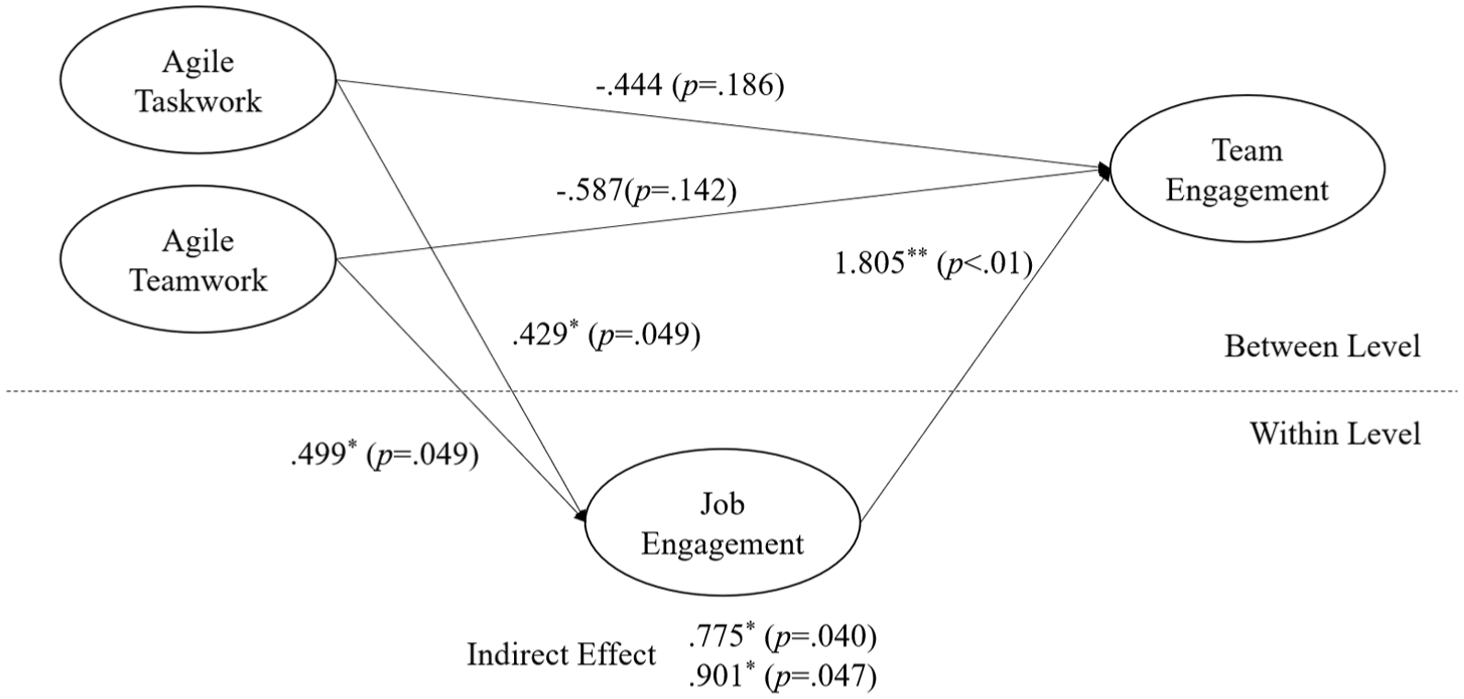
A hypothesized 2-1-2 multilevel mediation model.
MSEM Result for the Research Model.

Note. N = 210 at Level 1, N = 66 at Level 2.
<.10.
p < .05, **p < .01.
Indirect (Mediation) Effects
Hypotheses 3a and 3b predicted that individual-level job engagement would mediate the relationships between each dimension of AWP and team engagement. Bias-corrected bootstrap estimates presented in Table 4 indicate that the indirect effect of agile taskwork on team engagement through individual-level job engagement was significant (multilevel indirect β = .775, 95% CI [0.035, 1.516], p < .05). Similarly, the indirect effect of agile teamwork on team engagement via individual-level job engagement was also significant (multilevel indirect β = .901, 95% CI [0.011, 1.791], p < .05).
Result for the 2-1-2 Multilevel Mediation Effect of Individual Engagement

Note. I-Engagement = Individual Engagement; T-Engagement = Team Engagement.
p < .05.
Taken together, these findings fully support Hypotheses 3a and 3b and confirm the proposed 2-1-2 multilevel mediation model, wherein both dimensions of AWP influence team engagement exclusively through their effects on individual-level job engagement.
Discussion
Summary of Findings
The present study examined the multilevel mediating relationship between AWPs and team engagement through individual-level job engagement. The results offer strong evidence of a full mediation pattern: both agile taskwork and agile teamwork affect team engagement solely through their impact on individual engagement.
First, the analysis revealed that agile taskwork (γ = .429, p = .049) and agile teamwork (γ = .499, p = .049) each positively predicted individual-level job engagement, supporting Hypotheses 1a and 1b. This suggests that specific agile practices directly enhance employees’ engagement with their work. Second, individual-level job engagement strongly predicted team engagement (γ = 1.805, p < .01), providing robust support for Hypothesis 2. This finding underscores the importance of individual employees’ personal investment and enthusiasm as a foundation for building collective team engagement. Third, mediation tests demonstrated that agile taskwork influenced team engagement indirectly through individual engagement (β = .775, p < .05), and the same pattern held for agile teamwork (β = .901, p < .05), fully supporting Hypotheses 3a and 3b. Neither agile taskwork (γ = −.444, p = .186) nor agile teamwork (γ = −.587, p = .142) had a significant direct effect on team engagement. This indicates that the influence of team-level agile practices on collective engagement operates primarily through individual engagement. Overall, these findings provide strong support for the proposed 2-1-2 multilevel mediation model, demonstrating that agile practices enhance team engagement by first elevating individual engagement.
Theoretical Implications
This study makes several important theoretical contributions. First, by using JD–R theory as its foundational framework, it offers a novel understanding of how AWPs function as job resources that promote engagement. Through the integration of SDT, the findings demonstrate that agile taskwork satisfies core psychological needs for competence and autonomy, while agile teamwork fulfills the need for relatedness—both of which contribute to increased individual job engagement. Additionally, SIP theory helps clarify how frequent interactions inherent in agile teamwork serve as social cues that reinforce engaged behavior. This emphasis on the satisfaction of psychological needs fills a key gap in previous JD–R applications, which have often focused more broadly on resources without specifying the core psychological mechanisms they activate.
Second, the study advances multilevel engagement theory by applying a 2-1-2 multilevel mediation model to illustrate how team-level agile practices influence individual-level engagement, which then aggregates to form collective team engagement. The finding of full mediation implies that a team’s collective engagement is fundamentally rooted in the engagement of its individual members, shaped in response to team-level practices. The study specifically highlights how individual engagement evolves into a shared team state through episodic interactions (e.g., sprint reviews and daily stand-ups) and through team reflexivity, where personal insights and engagement are exchanged and aligned. This offers a deeper understanding of the emergent nature of collective work engagement, a dimension that has been largely underexplored in prior research (Junker, Bakker, et al., 2025; Metiu & Rothbard, 2013).
Third, this research contributes to the emerging field of agile organizational behavior by identifying specific practices in agile taskwork and teamwork and demonstrating their multilevel impact on engagement using well established psychological and social theories. Its rigorous methodology, including a two-wave survey design to reduce common method bias and the use of MSEM to partition variance appropriately, strengthens both the causal inferences and the external validity of the findings.
Practical Implications
The findings of this study provide practical guidance for organizations implementing or refining agile methodologies. First, since team engagement is fully mediated by individual engagement, the most direct path to improving team engagement is to first ensure that agile practices are effectively boosting each member’s personal engagement (Junker, Bakker, et al., 2025). This necessitates a shift in focus for human resource professionals and team leaders: from simply following agile routines to intentionally cultivating an environment in which individual team members feel their psychological needs for autonomy, competence, and relatedness are met.
Second, drawing on SDT and SIP theory, leaders should prioritize granting individuals greater autonomy in how they approach tasks during sprint planning, facilitate opportunities for competence development through timely feedback and mastery experiences in sprint reviews, and foster interpersonal relatedness through structured yet authentic team interactions. For example, implementing agile practices in a way that genuinely empowers team members to make decisions and control their work processes can enhance vigor and absorption. Likewise, promoting open communication, mutual support, and psychological safety during daily stand-ups and retrospectives can strengthen social bonds and boost enthusiasm.
Third, these findings have direct implications for leadership development in agile contexts. Agile leaders, such as scrum masters, should focus on enabling access to resources and supporting individual autonomy (Tripp et al., 2016), while also creating psychologically safe environments during team meetings (Edmondson, 1999; Hennel & Rosenkranz, 2021). Their role extends beyond enforcing agile routines; they must ensure these rituals fulfill core psychological needs and enable positive social information exchange, thereby enhancing job satisfaction and overall well-being (Junker et al., 2023; Rietze & Zacher, 2022).
Finally, by strengthening engagement, organizations can expect improvements in team performance and employee well-being (Barrick et al., 2015; Eldor, 2020; Schneider et al., 2018). This study offers a blueprint for designing agile work environments that are not only operationally efficient but also human-centered, supporting a healthier and more productive workforce.
Limitations and Future Research
Despite its contributions, this study has several limitations that suggest valuable directions for future research. First, although a two-wave survey design was employed to mitigate common method bias and establish temporal separation, the cross-sectional nature of some relationships limits the ability to draw definitive causal conclusions. Future research would benefit from longitudinal or experimental designs to better capture the dynamic interplay and causal mechanisms among agile practices, individual engagement, and team engagement.
Second, the study relied primarily on self-reported data, which, despite the use of methodological safeguards, remains vulnerable to common method variance. To strengthen construct validity, future research should incorporate multi-source data, such as supervisor ratings, peer evaluations, or objective performance indicators, to achieve a more comprehensive and triangulated assessment. Furthermore, there is a methodological limitation regarding the aggregation of agile taskwork. While the within-group agreement index (Rwg(j)) was acceptable, the relatively low ICC(2) value 0.37 was below the conventional threshold, suggesting that team-level consensus on this factor was modest. Although this was deemed acceptable for exploratory purposes, caution is warranted when interpreting findings related to agile taskwork. This modest reliability suggests the relationships in the research model may have been attenuated. Future research should continue to refine the measurement and aggregation of this construct.
Third, the generalizability of the findings may be constrained by the sample characteristics, which included organizations based in South Korea, specific industry sectors, and a participant pool that was predominantly male and highly educated. Specifically, the South Korean context is characterized by a relatively collectivistic culture, which may amplify the importance of agile teamwork and strengthen the emergent aggregation process from individual to team engagement (Hypothesis 2). Conversely, in a traditionally high-power-distance context, the autonomy and self-organization inherent in agile taskwork might provide a particularly strong motivational lift, an effect that may be less pronounced in cultures with lower power distance. Future studies should therefore explicitly test whether cultural dimensions (e.g., collectivism, power distance) moderate the proposed 2-1-2 mediation model, using more diverse samples across different cultural settings, industries, and organizational sizes to enhance the external validity and applicability of the model.
Finally, the current model focuses exclusively on individual engagement as the mediating mechanism. Future research could expand this framework by examining additional multilevel mediators or moderators. For example, leadership styles such as transformational or servant leadership, team climate variables like psychological safety beyond retrospective meetings, or job demands including work complexity and role conflict could provide a more nuanced understanding of the conditions under which agile practices are most effective. Investigating daily fluctuations in team engagement (Klasmeier & Rowold, 2022) may also yield important insights into the dynamic and episodic nature of collective engagement.
Conclusion
In conclusion, this study presents a rigorous multilevel investigation into how AWPs promote team engagement through the critical mediating role of individual-level job engagement. By leveraging JD–R theory and uniquely integrating SDT and SIP theory, the findings underscore that the effectiveness of team-level agile practices depends on their ability to fulfill employees’ core psychological needs (i.e., autonomy, competence, and relatedness) and to foster constructive social cues. These insights not only enrich the theoretical understanding of engagement in dynamic work environments but also offer practical guidance for organizations seeking to build highly engaged and effective agile teams.
Footnotes

Ethical Considerations
The study design ensured minimal risk to participants by maintaining anonymity and confidentiality. No personally identifiable information was collected or reported. Participation did not involve any foreseeable psychological or physical harm. This study was conducted in strict adherence to ethical guidelines and received formal ethical approval from the Institutional Review Board (IRB) of Kookmin University (Approval No. KMU-202406-HR-417). All efforts were made to protect participants’ rights and well-being.
Consent to Participate
This study involved human participants (employees in agile teams) who participated in a two-wave survey. All participants were fully informed about the purpose, procedures, and voluntary nature of the study, and voluntary informed consent was obtained from each participant prior to data collection.
Funding
The author received no financial support for the research, authorship, and/or publication of this article.
Declaration of Conflicting Interests
The author declared no potential conflicts of interest with respect to the research, authorship, and/or publication of this article.
Data Availability Statement
The data that support the findings of this study are available from the corresponding author upon reasonable request.