




Abstract
The aim of this research is twofold. First, to identify the role of personal resources on burnout and work engagement in nursing staff and second to evaluate whether these last two concepts are or not, opposite faces of the same construct. Personal resources are understood as individuals’ aspects that make people more confident to control their environment successfully. This study used a cross-sectional approach with a sample composed of 219 Colombian nursing personnel all of them were women. In line with our predictions, personal resources were positively related to employees’ work engagement (rxy = .40) and negatively to burnout (rxy = -.51), as well as engagement and burnout showed to be different constructs that are inversely related (rxy = -.95). The greater inverse correlation between personal resources and burnout seems to indicate that personal resources could be an important protective factor for nursing staff. Since personal resources can be developed, these findings have important implications for the human resource management in the health care settings. Due to the complexity of health work environment, further research needs to find more evidence to understand the role of personal resources in these environments.
Introduction
To provide service to users in work environments of health institutions, health care workers must have several skills and abilities that allow them to respond with efficiency, guaranteeing quality care and patient safety. This denotes a highly complex and demanding work environment in which the dynamics of intervention render the practice of health care professionals, technicians, and assistants to require high responsibility, dedication, and commitment (Humphries et al., 2014; Slocum-Gori et al., 2013).
Nursing practice in particular is characterized by rather demanding work conditions, including close attention to activities, high complexity, thoroughness in tasks performed, provision of care to patients and their families, long working hours and permanent rotation of work schedules, among many others. Therefore, such working conditions require the use of health care workers’ personal resources to meet demands and face risks present in these work environments in the best possible way to sustain motivation and commitment with the organization and to adequately perform tasks and fulfill responsibilities associated with their position (Fiabane et al., 2013; Harris, 2013). Personal resources defined as self-aspects that usually are related to resilience giving to individuals a sense of control and influence to cope successfully their environment (Hobfoll, 1989; Hobfoll et al., 2003).
When workers have not acquired or developed these resources within their behavioral repertoires and, primarily, when they perceive a permanent imbalance between demands of work environment and their personal resources, they can develop exhaustion, fatigue, and chronic stress, increasing the probability of suffer of burnout syndrome (Halbesleben et al., 2009). Burnout is a syndrome characterized by a persistent and harmful state related to work conditions and characteristics which implies a prolonged response to stress (Maslach, 2003). Moreover, it can be conceptualized as a kind of chronic stress that people suffer in a workplace due to negative relationships that are beyond their ability to adapt, such that the individual does not have enough personal resources to cope with it (Manzano-García & Ayala-Calvo, 2013).
The burnout syndrome is defined by emotional exhaustion, cynicism and decreased perception of personal accomplishment (Maslach & Leiter, 2016), remaining as a frequent problem in health care and related occupations (Cooper et al., 2016; Demerouti et al., 2000; Molero et al., 2018). Consequently, much research has been focused on establishing determinants and factors related to favorable cope of stress and strengthening of personal strategies and resources for the protection and well-being of health care personnel (Bennett et al., 2017; Czabala & Charzynska, 2014; McDaid & Park, 2014).
Personal resources are, therefore, a crucial factor in facilitating adaptation to work environment among health care workers, which allows them to cope with highly demanding work conditions. Workers who have developed adequate personal resources tend to be more flexible, sensitive to change, open to learning, and inclined toward permanent development of these resources (Airila et al., 2014), which include feeling appreciated, perceiving self-control, and having skills and attitudes associated with such feelings (Mastenbroek et al., 2014).
Personal resources promote worker well-being (Hobfoll, 2002; Luthans et al., 2005; Ventura et al., 2015) by helping them cope with demanding work conditions more efficiently as well as by preventing exhaustion and burnout (Hakanen & Roodt, 2010; Luthans & Youssef, 2007; Mastenbroek et al., 2014). Recently, Mazzetti et al. (2016) have found that personal resources are related to job resources, and this association reduces the symptoms of psychological distress. Job resources are defined as physical and organizational aspects of the work environment that allow employees to achieve organizational goals, reducing job demands and physiological and psychological cost associated, while stimulating personal growth and development (Xanthopoulou et al., 2007). Likewise, when workers develop and use their personal resources, tend to perceive more welfare (Gauche et al., 2017; Xanthopoulou et al., 2009), more work engagement and job satisfaction (Airila et al., 2014; Schaufeli & Taris, 2014). Specifically, in the health care personnel, these resources have show relation to a better quality of performance (Bhatti et al., 2018; Fiabane et al., 2013; Grover et al., 2018).
Specifically, work engagement is a state of well-being as well as affective and motivational commitment to work (Schaufeli & Bakker, 2004; Schaufeli, Martínez, et al., 2002), which is manifested by individuals’ high energy levels, enthusiasm, and immersion in activities they perform (Macey & Schneider, 2008; May et al., 2004). Work engagement comprises three dimensions: vigor, dedication, and absorption. Vigor refers to feeling high levels of energy and cognitive resistance while working, having willingness to invest efforts at work, and showing persistence when faced with difficulties. Dedication describes strong involvement in work, accompanied by feelings of enthusiasm, pride, and inspiration, individuals feel recognized, and the tasks they perform mean much to them. Finally, absorption refers to a state in which individuals are completely concentrated and immersed in their activities such that they perceive time as passing quickly, sometimes experiencing some difficulty in detaching from their work (Llorens et al., 2007).
Based on the above, could be expected that work engagement may be promoted by developing personal resources of nursing workers, favoring processes of adaptation to challenging and demanding work conditions, which may constitute a protective factor against burnout. Such a situation has important implications for the quality of care provided to users as well as for responsibility exercised while performing duties.
This research is supported from the Conservation of Resources (COR) theory (Hobfoll, 1989). According to COR theory, loss resources is disproportionate more salient than gain resources (Hobfoll et al., 2018) thus, in an effort to preserve, protect, and create resources to respond to demands of a work environment in an appropriate manner, the individual considers the potential or current loss of these resources as a threat, which triggers stress and chronically leads to burnout (Demerouti et al., 2004; Hobfoll & Freedy, 1993). Likewise, according to this theory, individuals seek achievement and satisfaction, which leads them to develop behaviors that increase the likelihood of immediate environmental reinforcement, creating and maintaining personal characteristics or resources, using which they increase motivation and welfare (Hobfoll, 2002; Houkes et al., 2001). COR theory proposes that people have to invest resources, which can be personal to protect them to resource loss, and gain resource (Hobfoll et al., 2018). Therefore, this perspective may explain the way individuals increase work engagement and reduce burnout through their personal resources (Kotze, 2018).
Five personal resources were specifically examined in this research: optimism, proactivity, self-efficacy, reflexivity, and assertiveness. Optimism is the tendency to assume that great results will generally be experienced in life and to believe that positive results will be obtained from the activities that are carried out (Scheier et al., 1994; Segerstrom et al., 2017). Proactivity, in contrast, refers to an anticipatory autonomous behavior, oriented toward change. The individual takes control, acts effectively, and perseveres instead of simply adjusting to the situation, anticipating potential stressors, preventing consequences, and neutralizing effects (Bateman & Crant, 1999; Grant & Ashford, 2008).
Furthermore, self-efficacy refers to the conviction individuals have regarding their ability to succeed in specific situations or when performing a task; in other words, it is the confidence in one’s ability to achieve the intended results (Bandura, 1977). In turn, reflexivity is assumed as the preference to act only when the action is considered adequate after a cognitive analysis, which usually involves a low number of errors but a high latency time (Buela-Casal et al., 2000; Haghighi et al., 2015; Kagan, 1966). Therefore, reflexive skills facilitate decision making (Mastenbroek et al., 2014). Finally, assertiveness is defined as the behavior that allows individuals express themselves adequately based on their interests, to comfortably express honest feelings, and to exercise and respect their rights (Alberti & Emmons, 1978).
Personal Resources and Engagement
There is some evidence supporting the association between personal resources and engagement. Xanthopoulou et al. (2009) have found that resources, such as self-efficacy, self-esteem, and optimism, are important for workers to experience work engagement. Similarly, Bakker et al. (2006) have found that resources, such as resilience, self-efficacy, and optimism, directly contribute to work engagement. Furthermore, in a longitudinal study involving health care workers, Mauno et al. (2007) have found that self-esteem, depending on organizations, is one of the most important predictors of work engagement.
Notably, Karatepe and Olugbade (2009) have demonstrated that the personal resource of competitiveness favors work engagement as a general construct, while self-efficacy significantly and positively influences absorption—a component of engagement. Subsequently, Garrosa et al. (2011) have revealed that primary effects of optimism, resistant personality, and emotional competence are associated with greater engagement, specifically among the nursing staff. Similarly, Choi and Kang (2012) have found that personal resources, such as strength and optimism, predict work engagement. Recently, Mazzetti et al. (2016) revealed that personal resources such as positive affectivity could lead health care workers to experience a sense of enthusiasm, inspiration and pride, shown greater levels of work engagement.
Based on the evidence reported in previous research, we presented the following hypothesis:
Personal Resources and Burnout
Burnout has been studied for more than 40 years due to its implications for the health care workers, not only for their well-being but for the quality of their performance. Maslach and Leiter (2016) point out that, although the evidence has shown that burnout is more closely related to workplace variables than personal characteristics. These authors assert that personal characteristics and working conditions in the work environment should be study jointly. There is evidence regarding the relationship between personal resources and burnout (Antonovsky, 1979). According to this author, the lack of these resources can lead to burnout, predisposing health care workers to stress, while their presence and development can prevent burnout. For example, low self-esteem is associated with the three dimensions of burnout and their main symptoms (Byrne, 1999; Golembiewski & Aldinger, 1994; Suh et al., 2015), while high self-esteem can exert a protective effect against these (Alarcon et al., 2009; González et al., 2016; Janssen et al., 1999).
Likewise, other authors have identified that optimism is an important resource that mitigates effects of occupational stressors and, by extension, protects against the development of work stress and burnout (Mäkikangas & Kinnunen, 2003; Otero et al., 2010; Salmela-Aro et al., 2009). Moreover, proactive attitudes and behaviors, regarded as personal resources, have shown an inverse correlation with burnout (Aspinwall & Taylor, 1997; Costa, 2003).
Other studies have demonstrated that low self-efficacy can be a precursor to burnout (Boujut et al., 2017; Extremera et al., 2010; Friedman & Farber, 1992; Schwarzer & Hallum, 2008; Tang et al., 2001), whereas high self-efficacy can decrease chronic stress. Likewise, self-esteem can moderate effects of stressful experiences at work (Friedman, 2003; Rabinowitz et al., 1996; Schwarzer & Schmitz, 2004). Finally, reflexivity and assertiveness as personal resources serve as coping factors and prevent burnout, reducing fatigue developed with work-related stress (Gil-Monte, 2001; Grant, 2017; Shimizu et al., 2003; Suzuki et al., 2009). As it can be seen, all these previous findings have included samples from countries different to Latin America where the work conditions and health care context may be different from other studied countries.
Based on these previous findings, we presented the following hypothesis:
Work Engagement and Burnout
Although the association between burnout and work engagement has been comprehensively analyzed in recent years, whether these concepts are empirically and conceptually different or whether they represent two sides of the same construct remains controversial (Cole et al., 2012; Leon et al., 2015; Taris et al., 2017). In this regard, work engagement and burnout may be seen as two opposite poles of a continuum (Maslach et al., 1996). In fact, Leiter and Maslach (1999) have stated that burnout is “an erosion of engagement with the job”—as soon as energy becomes fatigue, emotional involvement becomes depersonalization and effectiveness becomes inefficiency. However, Schaufeli, Salanova, et al. (2002) have contradicted this notion as the absence of burnout does not necessarily imply the presence of work engagement or vice versa, indicating that they are independent constructs, which must be measured through different questionnaires.
Studies conducted on these two notions, including meta-analyses, have empirically shown an inverse association between them (Cole et al., 2012; Hakanen et al., 2006; Hakanen & Schaufeli, 2012; Taris et al., 2017; Upadyaya et al., 2016). Schaufeli and Bakker (2004) have found a particularly strong inverse correlation of the two dimensions of engagement with burnout: vigor with exhaustion and dedication with depersonalization.
In any case, burnout and work engagement are psychological constructs that imply a level of emotional involvement with work and their manifestations seem to be contrary by definition. However, whether these are opposite phenomena or whether they are the two poles of the same construct remains inconclusive.
Based on these findings, we present the following hypothesis:
In Figure 1, the hypothesized proposed model is presented.

Hypothesized proposed model.
Materials and Methods
Participants
This study used cross-sectional approach with a subject-type sampling of 219 participants, which represents the 61% of the total of nursing staff of the hospital. These personnel belongs to a private Colombian hospital of third level of complexity with more than 70 years of operation located in Bogotá, the capital of the country. Participants were females, which is a characteristic of the nursing field. Overall, 66.9% of the participants were between 30 and 49 years of age and most of them (98.2%) belong to low-middle socio-economic condition. Academic training of this nursing staff was mainly technical (72.6%) which is equivalent to tertiary education.
Materials
Personal resources
Personal resources were examined through the Inventory of Labor Demands and Resources (Mastenbroek et al., 2014), which includes five personal resources: Optimism (6 items), proactivity (6 items), self-efficacy (3 items), reflexivity (5 items), and assertiveness (6 items). The questionnaire includes five response alternatives, ranging from “strongly disagree” (0) to “strongly agree” (4). According to these authors, the internal consistency of the personal resources was from 0.72 to 0.79. An estimate of 0.79 was obtained for this study, indicating that the instrument used had a high measurement consistency.
Work engagement
Work engagement was estimated using the Spanish version of Utrecht Work Engagement Scale (UWES) developed by Schaufeli and Bakker (2003). This scale has 17 items with 7 response alternatives, ranging from “never” (0) to “always” (6) and has three dimensions: (a) vigor (6 items), which expresses energy levels while working, persistence and a sustained effort at work; (b) dedication (5 items), which shows the relevance of work for a worker’s life as well as enthusiasm, inspiration, and pride regarding what they do; and (c) absorption (6 items), which expresses the focus on the activities performed, the satisfaction derived from work, and compliance with responsibilities. Moreover, the scale reports the degree of concentration that translates into a feeling that time passes very quickly while working (Salanova et al., 2000). Arenas and Andrade (2013) have reported an internal consistency of >0.80 for these three dimensions of UWES, which indicates a high degree of reliability. Similarly, a Cronbach’s alpha of .84 was obtained in this study, which shows its high internal consistency.
Burnout
The Spanish version of the Maslach Burnout Inventory (MBI) was used (Maslach & Jackson, 1997). This questionnaire comprises 22 items in the form of statements, which inquire about feelings and attitudes toward their work and users, and includes three subscales: (a) emotional exhaustion, referring to the experience of being emotionally exhausted by the demands of work (9 items), (b) depersonalization, related to the degree to which each person recognizes attitudes of indifference and distancing (5 items), and (c) personal accomplishment, which estimates the feelings of self-efficacy and individual completion (8 items). The scale provides 7 response alternatives, ranging from “never” (0) to “every day” (6). MBI has demonstrated high internal consistency and a reliability of nearly 0.90. An estimate of 0.81 was obtained in this study for the whole instrument, indicating a satisfactory internal consistency.
Procedure
Prior to data collection, the purpose of the study and questionnaires were presented to the director, chief nurse, and other hospital directive personnel, to obtain their permission to conduct the research. Once authorization from the manager of the hospital was obtained, the questionnaires were applied to the nursing staff. All participants signed the informed consent before answering the questionnaire. Data were stored anonymously in the database and the signed informed consents were also stored. Participants had the possibility to drop out at any time. Participants were asked they agreed that the data obtained would be used for academic purposes. Participation was voluntary, and no economic compensation was offered for it. The questionnaires were completed individually in writing, and the anonymity of answers was guaranteed. The questionnaires were applied to groups at the beginning of the working day in a conference room at the hospital.
Data were analyzed using the SPSS version 25, software frequently used in social sciences. Quantitative approaches such as descriptive analysis and the internal consistency reliability analysis (Cronbach’s alpha) were made. Finally, the structural equation modeling (SEM) was carried out through AMOS version 25.
Results
Characteristics of the Participants
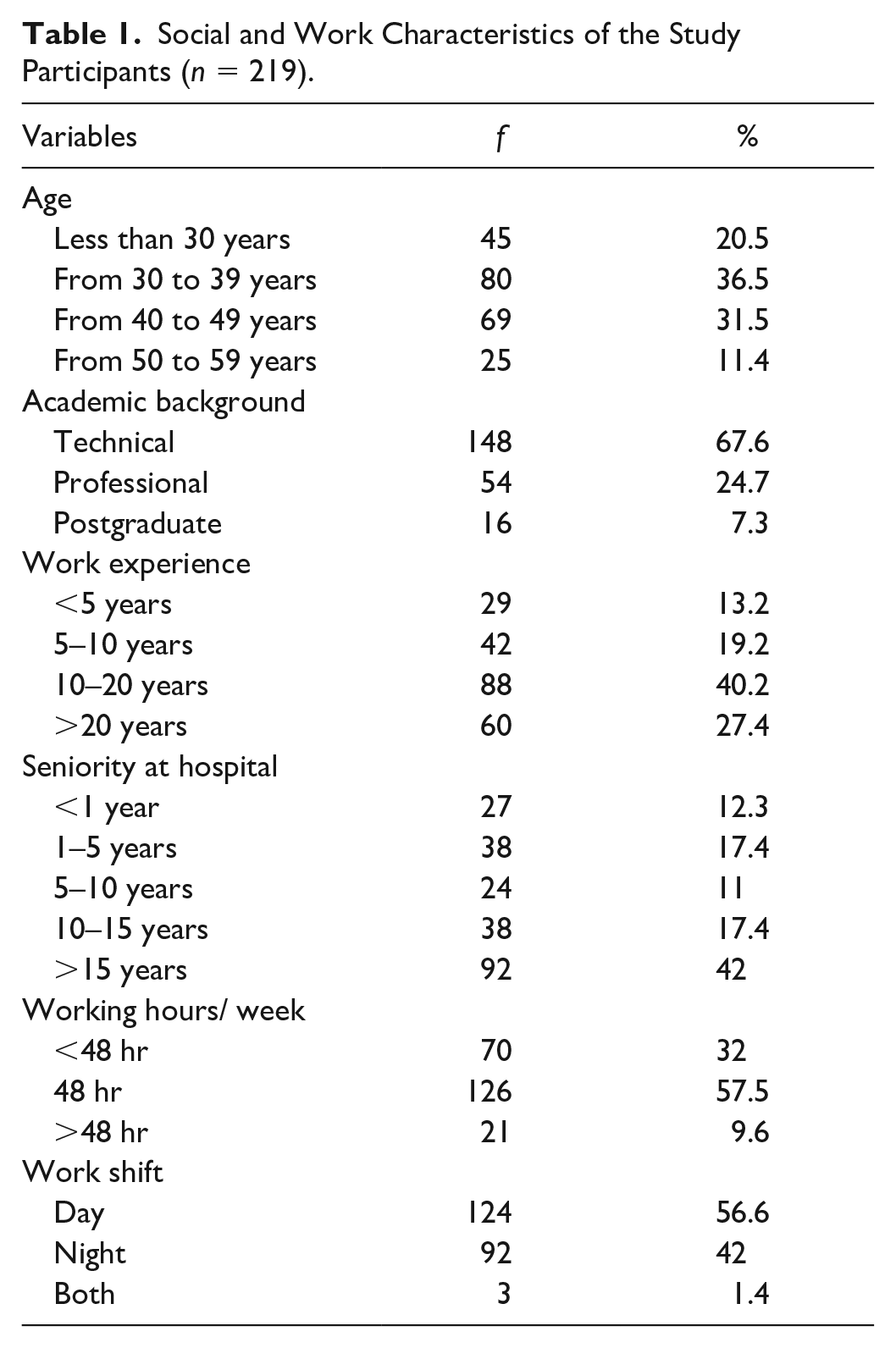
The sample comprises 219 nursing staff. More than half of them (67.6%) had more than 10 years of work experience, indicating that this was a group of workers highly experienced in the field of health care. Regarding work schedule, 56.6% worked the day work shift, while 42% worked the night work shift. Moreover, more than half of the participants (57.5%) reported working 48 hr a week, while a small percentage indicated working more than 48 hr a week (9.6%), which is another characteristic of the nursing staff. A detailed description of participant characteristics is summarized in Table 1.
Social and Work Characteristics of the Study Participants (n = 219).
Descriptive Analysis of Personal Resources, Work Engagement, and Burnout of Participants
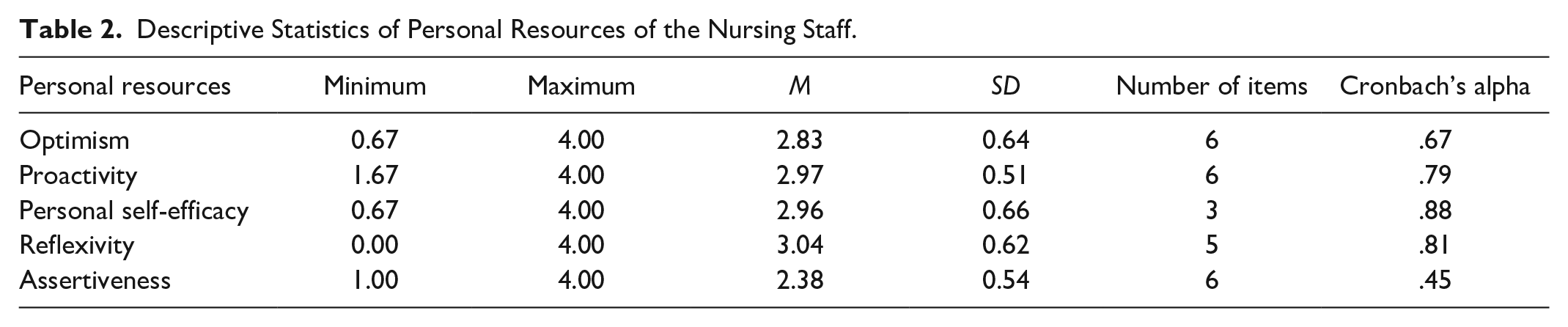
Descriptive statistics of personal resources presented by the nursing staff are shown in Table 2. Regarding the average scores, results show high levels in four of the five estimated resources, while assertiveness scored in a moderate to high level. The Cronbach’s alphas for personal resources were acceptable, although for assertiveness was moderate. However, as a whole, the scale shows a high consistency.
Descriptive Statistics of Personal Resources of the Nursing Staff.
On the other hand, work engagement shows high averages in its three dimensions (vigor, dedication, and absorption). The averages obtained indicated a predominance of dedication as a potential source of work engagement among the studied nursing staff (Table 3). The Cronbach’s alphas of dimensions of the UWES questionnaire were acceptable.
Descriptive Statistics of Work Engagement Among the Nursing Staff.

Finally, results obtained through MBI scale indicate that average scores of emotional exhaustion and depersonalization scales were in a moderate level. In contrast, scores for the subscale of personal accomplishment were located in the upper level (Table 4). Given that burnout occurs when there is high emotional exhaustion, high depersonalization, and low personal accomplishment, we could assert that the studied sample is less likely to experience burnout. Except the dimension of depersonalization, the Cronbach’s alphas of dimensions of the MBI scale were acceptable.
Descriptive Statistics of Burnout Among the Nursing Staff.

Data Analysis
The proposed hypotheses were tested through a model of structural equations (Figure 2). Results of this analysis allowed for the identification of a robust maximum likelihood model (p = .533), showing an adequate adjustment with adjusted goodness of fit (AGFI) and normed fit index (NFI) of ≥0.95 and root mean square error of approximation (RMSEA) below 0.08. The fit goodness model can be considered acceptable. Although results obtained using these analyses are satisfactory for personal resources and work engagement, they indicate a need to review the estimates for burnout as a construct; this is in agreement with a recent report by Maslach (2017), affirming that MBI presents less internal coherence than does UWES for the measurement of burnout and work engagement, respectively.

Model of structural equations of relationships between personal resources, work engagement and burnout.
The relationships between observed variables and constructs to which they belong were supported in all cases. Regarding personal resources, proactivity, personal efficacy, and reflexivity were the most important items in the configuration of the construct, while optimism and assertiveness presented medium-level weighted regression. Regarding work engagement, the three dimensions significantly contributed to the construct, although the contribution of vigor was greater. Finally, regarding burnout, the three subscales showed a similar trend, with medium-level weighted regression. Notably, although the subscale of personal accomplishment (reverse) was used for the structural equations model, it did not affect the absolute values presented.
Regarding the association between constructs, the results confirmed the three hypotheses put forth in this investigation. Personal resources were positively correlated to work engagement (Hypothesis 1), while negatively correlated to burnout (Hypothesis 2). There was a negative correlation between work engagement and burnout (Hypothesis 3). Importantly, the correlation between personal resources and burnout was stronger than the correlation between personal resources and work engagement, and there was a strong, negative correlation between burnout and work engagement, thus confirming the contradictory roles of these two constructs.
Discussion
Despite the highly challenging and demanding work conditions of nursing, a high percentage of participants in this study showed moderately high levels of personal resources and work engagement, with dedication being the main component of the latter. This condition was accompanied by a reduced experience of burnout in the group of workers who presented average levels of two of its dimensions (emotional exhaustion and depersonalization) and high levels of personal accomplishment—the latter is contrary to the configuration of the syndrome. Finding little burnout in the nursing staff is contrary to reports in the literature, in which burnout is considered a frequent problem in health care and related occupations (Cooper et al., 2016; Demerouti et al., 2000; Molero et al., 2018). One reason that could help to understand this discrepancy with previous studies could be related to working conditions such as stability (70.4% of workers have more than 5 years of tenure in this hospital) and by personal characteristics, in this case, the work experience that participants have (the 59.4% report more than 5 years of experience). These conditions seem to mitigate the experience of burnout, something that should be studied in further researches.
Our results could be explained by the framework of COR theory (Hobfoll, 2002), according to which the nursing staff, who must exercise their functions in a highly demanding, complex, and exhausting environment owing to long working hours, strive to preserve, protect, and acquire more resources than they already have to meet the demands of the work environment, which in the context of health implies high stress. Based on this theory, the perception of stress constitutes a potential loss of resources or at least a threat of their loss, which generates a favorable stress toward protection. This can explain high levels of personal resources and work engagement as well as the low levels of burnout noted in this population, contrary to what one might suppose, given the working conditions and the demands of nursing practice.
Thus, in the context of the COR theory, owning and appropriately using personal resources allows nursing staff to adequately address the risks and demands of their work environment to keep their employees motivated and committed as well as to adequately carry out their own tasks and responsibilities (Fiabane et al., 2013; Harris, 2013). On the contrary, participants suffering from burnout, which implies a prolonged response to stress (Maslach, 2003), may be those who have not acquired or developed adequate resources (Halbesleben et al., 2009). This is based on the fact that burnout is a type of chronic stress associated with the work environment in which individuals do not possess sufficient personal resources to cope with stress (Manzano-García & Ayala-Calvo, 2013). Given the low burnout levels among the participating nursing staff in this study, cultural variables that may exert certain effects, which have not been identified in this population, should be examined in the future.
Furthermore, although the association between the observed variables and the construct to which they belong were supported in all cases, it is important to make some remarks. “personal resources” as a construct must be further strengthened to progress in its study; however, there does not seem to be a consensus on variables that define this construct, and the diversity of approaches prevents making contrasts in different populations and contexts, thus constituting an important limitation. In this study, using the “personal resources” dimension proposed by Mastenbroek et al. (2014), we found that proactivity, self-efficacy, and reflexivity are more important in the configuration of the construct than are optimism and assertiveness. Nonetheless, it is worth mentioning that the average weighted regressions that make up the burnout construct may be due to the fact that most of the participants did not suffer from burnout. We suggest reviewing this construct in a larger population that manifests the syndrome to verify its solidity based on the variables that from the construct. On the contrary, according to the results of this study, the solidity of the work engagement conformation stands out from the dimensions proposed by Schaufeli and Bakker (2003).
Regarding the hypotheses, the results obtained are consistent with our proposed findings. As proposed in hypothesis 1, personal resources showed a positive correlation with work engagement, corroborating the findings reported in previous studies (Bakker et al., 2006; Choi & Kang, 2012; Garrosa et al., 2011; Karatepe & Olugbade, 2009; Mauno et al., 2007; Xanthopoulou et al., 2007). As reported in previous studies, when workers develop personal resources, they are highly motivated toward work and obtain greater job satisfaction, (Airila et al., 2014; Schaufeli & Taris, 2014), both of which are characteristics of engagement (Schaufeli & Bakker, 2004; Schaufeli, Salanova, et al., 2002). Notably, however, all these studies have been conducted among cultures different from the culture of population studied in this research; therefore, these results provide evidence to understand this phenomenon in the Colombian context.
Furthermore, hypothesis 2 was confirmed—personal resources of the participants were negatively associated with burnout. These results coincide with those reported by other authors (Antonovsky, 1979; Boujut et al., 2017; Friedman & Farber, 1992; Gil-Monte, 2001; Grant, 2017; Schwarzer & Hallum, 2008; Shimizu et al., 2003; Suzuki et al., 2009; Tang et al., 2001). As in the previous case, these studies were conducted among cultures different from the culture of population that participated in this research, in which, contrary to that stated in the literature, low burnout levels were reported.
Interestingly, the correlation between personal resources and burnout was stronger than that between personal resources and engagement, suggesting that these resources are more important for preventing burnout (Hakanen & Roodt, 2010; Luthans & Youssef, 2007; Mäkikangas & Kinnunen, 2003; Mastenbroek et al., 2014; Otero et al., 2010; Salmela-Aro et al., 2009) rather than for strengthening work engagement. Therefore, this study provides new evidence that warrant further research.
Finally, the third hypothesis was intended to contribute to the debate on whether work engagement and burnout are the two poles of a continuum or whether they are conceptually different inversely correlated constructs. Our findings confirmed the hypothesis that these two constructs are negatively associated, which supports the previously reported notion (Cole et al., 2012; Hakanen et al., 2006; Hakanen & Schaufeli, 2012; Schaufeli & Bakker, 2004; Taris et al., 2017; Upadyaya et al., 2016). However, such an inverse association is not sufficient to support the existence of the two poles of a continuum, as the absence of one does not guarantee the presence of the other (Maslach et al., 1996). Consequently, findings of the present study support the idea put forth by Schaufeli et al. (2002), who argued that these are two independent constructs, correlated in an inverse manner.
To end, given the association of personal resources and work engagement with burnout as well as the effects they have on the well-being of health care workers and the quality of their performance, factors related to strengthening personal resources, as stated by other authors (Bennett et al., 2017; Czabala & Charzynska, 2014; McDaid & Park, 2014) warrant further research. This is especially true considering that workers who have developed adequate personal resources show a greater tendency to continue developing them (Airila et al., 2014), which coincides with assumptions of the COR theory. Therefore, our findings support the notion that personal resources can prevent burnout (e.g., Hakanen & Roodt, 2010; Luthans & Youssef, 2007; Mastenbroek et al., 2014) and favor work engagement among individuals—an important factor related to performance in health care and related occupations, especially in the field of nursing (Bhatti et al., 2018; Fiabane et al., 2013; Grover et al., 2018).
Conclusion
Contrary to reported in the literature, the group of participants showed a moderately high levels of personal resources and engagement, in this latter dedication was its main component. In accordance, the experience of burnout was low.
Regarding the main objective of this research, personal resources were positively related to employee work engagement and negatively to burnout, as we have hypothesized. Likewise, engagement and burnout show a significant inverse correlation that confirms the opposite roles of these constructs. COR theory constitutes an appropriate framework that allowed explaining the relationships proposed in this study.
Practical Implications
Results of this research support the importance of personal resources in health care settings, where the work environment is highly demanding. Our findings indicate that an adequate managing of personal resources can result in better health conditions of nurses, due to the relationship of the studied constructs (burnout and engagement) on the employees’ wellbeing. Health care organizations should be interested in implement interventions addressed to helps health care personnel to develop these protective resources. Due to closely relationship between personal resources and job resources and its implications, managers in charge of nursing staff, should considerer the balance among demands and resources to prevent the burnout and promote the engagement. This balance will have important effects on the wellbeing, not only of health care personnel but the patients as an important outcome.
The results of this study allow recognizing the importance of stimulating personal resources in nursing staff, seeking an adequate balance between the challenges and personal resources. This can be achieved through adequate human resource management. The findings point out as well, the importance of permanent assessing and following of personal resources in these workers. It is suggested to implement measurement practices that involve objective and subjective technics. As a result, individual advice and counseling are recommended. Due to personal resources could be fostered by management practices, it is important to give training to supervisors and leaders about how to provide support to their employees, promoting a culture centered in people, with fair compensations within a healthy work environment.
Limitations
This study has some limitations that are important to take into account. First, the study was based on cross-sectional data. Second, the sample came from a single organization, which means that our results can be influenced by this condition. Further studies should be conducted in different health care organizations to prove the tested model in this research.
Footnotes
Declaration of Conflicting Interests
The author(s) declared no potential conflicts of interest with respect to the research, authorship, and/or publication of this article.
Funding
The author(s) received no financial support for the research, authorship, and/or publication of this article.
