




Abstract
This study develops an Employee Emotional Engagement Model in the work and family domain using structural equation modeling. The effects of transiting from work to family role are measured via the experience sampling method over 2 weeks from 126 university teachers. Multilevel modeling results indicate that family engagement worsened when employees engaged in surface acting but improved when they engaged in deep acting. Furthermore, work-to-family conflict mediates the negative relationship between surface acting and family engagement, while work-to-family enrichment mediates the positive relationship of deep acting on family engagement. Employees older in age, married, and with bigger family size predict a higher level of work-to-family conflict and lower level of work-to-family enrichment. Findings reveal that females experienced stronger enrichment from work to family while deep acting compared to males. Analyses also revealed that family engagement strongly predicts work engagement in employees.
Introduction
In today’s dynamic and competitive work environment, human resource face challenging demand for emotion regulation. Teaching is a front-line profession which demands emotion management while interacting with students, parents, and colleagues (Yin et al., 2019). It is significantly important for faculty to understand and monitor their emotions and regulate their emotional expression to contemplate the effect of emotions on their actions and actions of others (Cote & Morgan, 2002). The importance of managing emotions at the workplace depends upon the awareness of what emotions are acceptable at work. Teaching job demands effective emotion regulation to achieve academic effectiveness and to establish a positive learning environment. Moreover, teaching profession is known to be overburdened and underappreciated (Q. Zhang & Zhu, 2008), where teachers face intensified emotional labor due to stressful work environment (Dreer, 2021).
Hochschild (1983) introduced the term emotional labor and defined it as “management of feelings to create a publicly observable facial and bodily display” while analyzing emotional labor performed by flight attendants. Her findings stated that emotional labor induces stress in employees, damaging their personal well-being. Hochschild (2003) defined two methods of expressing emotions: surface acting (fake feelings) and deep acting (exhort feelings). Furthermore, Ashforth and Humphrey (1993) introduced a third method of performing emotional labor known as spontaneous and genuine emotional labor (authentic feelings). Based on these methods employees regulate emotions arousal, their emotional experience and the way they express these emotions based on the cognitive appraisal of the situation, which is known as emotion regulation as defined by Gross (1998) in his emotion regulation theory.
Work role stress due to social display rules and emotion regulation cause employees to experience inter-role conflict when transiting from work to family domain. After an emotionally stressful day at work faculty are susceptible to inculcate negative moods and preoccupied mental state when transiting to home after work, thus resulting in work-to-family conflict (Brotheridge & Grandey, 2002; Yanchus et al., 2010). Emotional experiences and role demand related with family life has specific emotional display requirements (Yanchus et al., 2010). Work-to-family conflict occurs when the stress of work affects employees crossing role boundaries and maintaining work-life balance based on time, strain, and behavior. Therefore, work-to-family conflict is expected to predict negative family engagement, which in return causes a decrease in work engagement (Greenhaus & Beutell, 1985).
On the contrary, positive collaboration between work and family causes positive spillover of moods and attitude, enhancement in the acquisition of resources, and facilitation of effective functioning in the other domain. Work-to-family enrichment occurs when experience in one domain (work role) improves the life quality in the other domain (family role). Moreover, when physical and social capital resources gained in one domain, directly improve the functionality in the other domain, it is an instrumental path, whereas the indirect influence is an affective path (Carlson et al., 2006; Greenhaus & Powell, 2006). Hence, work-to-family enrichment is expected to predict positive family engagement and work engagement level in employees.
Consistent with previous research, it is stated that emotion regulation affects employees’ work and non-work outcomes (Greenhaus & Beutell, 1985). Work engagement (work outcome) implies that employees connect themselves with their work roles to effectively attain their role performance. Comprehensive attachment (physically, emotionally, and cognitively) with their work roles encourages a positive attitude toward their job, organization, and reputation (Kahn, 1990; Saleem et al., 2020). Furthermore, family engagement (non-work outcome) refers to appropriate emotional expression in the family domain with spouse and child (any other family member; Alam et al., 2019).
Little is known about the role of individual differences in the context of gender on emotion regulation (Kwon et al., 2013) and its relations with other constructs in the work-to-family domain (Baral & Bhargava, 2011), even though theoretical models specify links between gender differences, emotional labor, and emotional display rules (Moran et al., 2013; Scott & Barnes, 2011). Literature shows that women generally perceive stronger emotion management norms than men. Moreover, women express higher emotional intensity and have greater emotional expressiveness than men. These individual differences have implications for faculty who exhibit emotion regulation during their role performance (Grandey & Melloy, 2017). Female faculty members strive to display deep acting and genuine emotions at work because it is more role appropriate (consistent with women’s role as a mother, sister, wife, etc.) at home. However, male faculty easily hide or fake (surface acting) emotions from others, causing less emotional dissonance and stress (Sarwar et al., 2021; Scott & Barnes, 2011).
This research aims to develop an Employee Emotional Engagement Model (EEEM) in work-to-family role transition. The model encompasses emotion regulation exerted by employees in transiting from work to family, which is embedded with employees’ gender, their exhibit of work-to-family conflict, work-to-family enrichment, and their performance outcome (work and non-work). This research is based on testable propositions proposed by Alam et al. (2019) and future recommendations provided by Humphrey et al. (2015). Emotions research had been limited to front-line service workers such as physical laborers, sale/service workers, and human service workers. It was further taken up by Brotheridge and Grandey (2002), who included managers and leaders in emotional labor study (Humphrey et al., 2008). However, teaching is a profession, which is still overlooked by researchers. The proposed EEEM model is to be tested for faculty members serving at the university level in Pakistan.
Research Question and Research Objectives
This research was guided by the following research question:
How does the causal relationship between emotion regulation, work-to-family interaction, and work-family outcomes affect university teachers during work-to-family role transition?
The objectives of this research are:
Obj 1: An empirical study whereby the construct of emotion regulation is applied to work-to-family interaction (work-to-family conflict and work-to-family enrichment).
Obj 2: To explore the mediating effects of work-to-family conflict and work-to-family enrichment between emotion regulation and work-family outcomes.
Obj 3: The moderating role of gender on emotion regulation in the work-family context.
Literature Review and Hypotheses Development
Emotions and Their Role in the Workplace
Emotions are perceived as biological reactions to certain stimuli such as joy, fear, anger, sorrow, and disgust (Damásio, 1994). Furthermore, emotion is the mental ability to recognize and experience environmental stimuli that trigger a behavioral response. It is a complex psychophysiological experience that results in discrete emotions. Discrete emotions can be positive and negative, related to an object or an event’s occurrence (Ashkanasy & Dorris, 2017). Expression of these discrete emotions varies across context, country, and gender based on emotional display rules (Moran et al., 2013). Emotional labor research involves multiple levels of analysis, such as within-person, between-person, interpersonal, and cultural, which illustrate the dynamic nature of emotion regulation during role transition from work to family.
Emotions play a vital role in the workplace. Everyday emotions have a significant impact on the behavior and performance of employees at work. Ashforth and Humphrey (1993) argued on the importance of emotions and its applications to motivation, leadership, and group dynamics. Emotions define an individual’s perception about a job, an organization, and a team. Emotions directly affect individual’s behavior at workplace. Individuals recognize and understand emotions on the basis of self-awareness and social-awareness (Burr et al., 2021; Frijda, 1986). Generally, emotions have a significant impact on everything that people do. Emotions are categorized to have positive impact, such as increasing motivation level of employee and negative impact, such as declining employee morale.
Emotion Regulation in Service Workers
Ideally, employees’ need to surface act or deep act is to generate expressions that are in accordance with the display rules conforming to organizations demand (Grandey, 2003). Recent research on the concept of emotional labor argues that employee’s effort to exhibit organizationally desired emotion during interpersonal transaction depends on his/her inner feeling/emotions, the organization’s social display rules, and the nature of the interaction (Lam et al., 2022). During service transaction, expressing socially desired behavior based on spontaneous and genuine emotions is preferred, as customers perceive sincerity and good faith in employee’s dealing. Lam et al. (2022) and Yang and Chen (2021) research results showed that genuine display of emotions positively effects professional efficacy, personal accomplishment, and job satisfaction and is positively lined with commitment to the organization.
The occupational roles held by employees at service sector organizations are emotionally laborious. The research done in the field of emotional labor focused on public sector occupations (such as social workers, doctors, nurses, attorneys, law enforcement officers, prison warden, counselors, and teachers; Hsieh et al., 2012) and private sector occupations (such as bus drivers, airhostess, hair dressers, retailers, tellers, and guards; Yang & Chen, 2021). All these researches have stated emotional labor as the “central component of any job requiring interpersonal contact” (Yang & Chen, 2021). This research focuses on the service work of teachers. Teaching is an emotional process (Yin et al., 2019; Q. Zhang & Zhu, 2008), whereby the teacher needs to display a wide range of emotions based on the situation. A teacher displays sympathy and concern as well as anger and sternness. They are usually required to display positive and friendly emotions with customers (students; Sutton & Wheatley, 2003). They must interact with students while teaching and mentoring (inside and outside class) and colleagues (attending meetings, arranging seminars, and other official work). Moreover, teachers often interact with students to provide guidance and mentoring other than delivering a lecture (Yin et al., 2019).
Extending Emotion Regulation in Work-to-Family Interaction
Work-to-family interaction can be categorized into work-to-family enrichment (positive outcome) and work-to-family conflict (negative outcome; Wu et al., 2020). Furthermore, the work-to-family interface occurs bidirectionally: work-to-family and family-to-work. Work-to-family enrichment means that an individual’s resource gain in the work domain results in enhanced functionality in the family domain, whereas work-to-family conflict occurs when work role stress deteriorates the individual’s family functioning. Similarly, family-to-work enrichment means the resource gains provided in the family domain enhance functionality in the work domain, and family-to-work conflict occurs when negative family experiences deteriorate individuals functioning at work (Greenhaus & Beutell, 1985; Greenhaus & Powell, 2006). However, this research focuses on the work-to-family direction to examine emotion regulation strategies.
Emotion Regulation and Work-to-Family Conflict
Prior research work has described stress and strain as reasons for conflict between work and family domain. The role pressure established due to the demand and expectations causes inter-role conflict between work and non-work. Work role stress damage one’s family functioning and family interactions (Dierdorff & Ellington, 2008). Furthermore, the regulation of work-related emotions that cause inter-role conflict between the two domains is also significant. Greenhaus and Beutell (1985) stated that work-family conflict has three forms: time-based conflict, strain-based conflict, and behavior-based conflict.
Individuals who engage in surface acting suffer from cognitive preoccupation, negative mood, emotional, and physical exhaustion. Behavior-based conflict arises in individuals who do not express genuine emotions and feelings and perform surface expressions. However, this restricts an individual’s genuine interaction with family but reduces time-based conflict. Due to engagement in work-related thoughts, individuals give insufficient attention toward family, hence distancing themselves from family, which causes anxiety and tension, inducing strain-based conflict (Alam et al., 2019). Hence, we hypothesize.
Cognitive, emotional, and physical dissonance at work cause time-based, strain-based, and behavior-based conflicts when individuals transit to the family role. Individuals perform deep acting in the family domain (observing adequate behavior at home) to detach themselves from work-related stress and strain. Individuals sincere in their emotions (deep acting) at home, meet family role expectations and maintain healthy family relationships. Genuine emotional expression at home helps them to perform appropriate behavior by giving time to their family (spouse, parents, and children). As a result, they can relax emotionally and physically, reducing stress, anxiety, and fatigue, reducing work-to-family conflict (Alam et al., 2019; Seery et al., 2008). Hence, we hypothesize.
Overall, it can be stated that surface acting tends to increase work-to-family conflict and deep acting tend to reduce work-to-family conflict over time (Gu et al., 2020).
Emotion regulation and work-to-family enrichment
Work-to-family enrichment defines the positive interdependences between work and family, demonstrating concepts of enhancement, positive spillover, and facilitation (Greenhaus & Powell, 2006). The development of job-related resources like skills and behavior at work is anticipated to improve the quality of life in the family domain. Furthermore, the emotional enhancement and psychosocial capital positively affect an individual’s performance in the family domain. Tement and Korunka (2013) described that employee involvement in work role is positively associated with the acquisition of skills and ability (work-to-family development), enhancement in a positive mood, attitude, and behavior (work-to-family affect), and resource gain in the psychosocial capital (work-to-family capital).
Zuhaiza and Madi (2021) further elaborated the synergistic model proposed by Greenhaus and Powell (2006) which delineated that the experience gained in one role results in increased performance in the other. Development of skills, knowledge, and behavior in work domain is transferred to family domain which help an individual be a better family member. Affect occurs when positive emotional state help transfer positive experiences from work to family domain. Whereas capital is defined as psychosocial resource gain which induce sense of accomplishment and achievement at work as well as help raise the level of performance in family domain.
According to Seery et al. (2008), surface acting is negatively related in their demands-resources model, and deep acting is positively related to work-to-family facilitation. While surface acting, individual’s fake emotional expressions which are inconsistent with the desired behavior at home. Kacmar et al. (2020) found that while facing challenging situations individuals surface act which requires significant emotional effort and depletes resources. In contrast, deep acting or genuine emotional expression is compatible with the behavior expected at home. Hence, it is postulated that individuals who surface act while participating in multiple roles will have a depleted pool of resources.
Despite the negative effect of emotion regulation, deep acting or genuine emotional expression may lead to enhanced resource acquisition in the work domain. Moreover, improved work resources may positively contribute to an individual’s effective functioning in the family domain (Wu et al., 2020). Hence, it is suggested that individuals deep acting while participating in multiple roles will have an enriched rather than depleted pool of resources that allow them to display genuine positive feelings.
Based on these assumptions, the study extends the concept of emotional labor, capturing the individual differences in surface acting and deep acting over time. Measuring variability in emotional labor requires observation of individuals, whether they are consistent or variable in their use of surface acting and deep acting over an extended period. The literature on emotional labor variability has shown that the fluctuations in temporal levels of emotional labor are significantly higher in customer service employees (Gabriel & Diefendorff, 2015). During role transition from work to family, employees perform emotional display and exhibit different emotion regulation strategies. Similarly, research proves that eliciting events 1 day (positive or negative) affects events occurring on the next day. Moreover, the individual differences of fluctuations in surface acting and deep acting affect the level of work-to-family conflict and work-to-family enrichment (Scott et al., 2012).
The Mediating Role of Work-to-Family Conflict and Work-to-Family Enrichment
According to emotion regulation theory, employees performing surface acting in the family domain suffer from resource depletion due to emotional dissonance, tension, fatigue, and anxiety. Faking and modifying emotions at home, tax emotionally, cognitively, and physically, which causes failure to perform the family role. Moreover, individuals who perform surface acting also face work-to-family conflict. Inter-role pressure to fulfill their job duties, induce stress due to time constraint, and deteriorates behavior toward family members (Wu et al., 2020).
Considering the service job performance, especially faculty in this research setting, requires emotional labor to manage appropriate expression of emotions. Surface acting is required to monitor the display of emotions, that is, hiding the felt emotions and expressing the unfelt emotions as per the requirement of the display rules. Previous studies have proved that surface acting is emotionally demanding, hence potentially depleting resources due to extended emotion regulation (Greenhaus & Powell, 2006). Consequently, it reduces the capacity of an individual to engage in their role. The inter-role conflict across domains results in deteriorating task accomplishment (Wu et al., 2020). Hence, it is suggested that the depletion of resources caused by surface acting can impede one’s family engagement.
Work-family research has proved the linking mechanism in which conflict negatively predicts, while enrichment positively predicts performance, engagement in both domains, and work-family balance (Sarwar et al., 2021; Wu et al., 2020). In work-family interface, work-to-family conflict is an inter-role conflict caused due to friction between competing role demands (work role and family role) whereas work-to-family enrichment is the resource spillover from one role to the other role. Constantly faking or modifying the emotional display (i.e., surface acting) to fulfil the organizationally expected display rules makes employees feel emotionally drained.
Emotional dissonance and fatigue due to resource depletion is carried over to the family domain, which leads to work-to-family conflict. Studies have shown that resource depletion cause negative mood, cognitive dissonance, and individual ill-being. Moreover, these negative feelings elicit detrimental efforts toward family involvement (Adams et al., 1996). Hence, it is postulated that those who exhibit surface acting experience higher level of work-to-family conflict and in line with the view of resource depletion, they find it difficult to fulfill their family role commitment.
Previous studies focused on the association of emotion regulation with conflict, whereas this study contributes toward finding the association between emotion regulation and work-to family enrichment. An individual surface acting in work domain experience resource depletion, anxiety, and stress which is carried forward to family domain and results in lowered levels of family engagement. Considering that surface acting has negative direct relationship with family engagement, the mediating effect of enrichment is to be explored in this context. Hence, it is postulated for those who surface act, to explore the mediating effect of work-to-family enrichment on family engagement.
Research has shown that individual deep acting at home (in the family role) is expected to improve family engagement. Deep acting is an authentic expression of emotions that does not require monitoring and effortful regulation, thus reducing work-related fatigue and anxiety. Therefore, an individual performing deep acting in the family domain expresses genuine care and affection toward family, gives time to family members, and functions effectively in the family role. Moreover, this may result in work-to-family enrichment, whereby the enhancement and facilitation of resources in the work domain may spillover and lead to an abundance of resources in the family domain (Wu et al., 2020).
Studies indicate that those who deep act, gain resource that is associated with improvement in their family role performance. Drawing on social psychology, faculty are naturally prone toward expressing genuine or felt emotions, which improve their enthusiasm and contentment. This positivity in personal accomplishment is thus reflected in improved role performance in the family domain. Hence, the hypothesis is suggested that the resource gain caused by deep acting can aid one’s family engagement.
Previous studies have also depicted that deep acting yields positive emotional state, inducing enhanced resources (Huang et al., 2019; Wu et al., 2020). The additional resource gain combined with positive felt emotions through deep acting, fuels to drive toward achieving work-family balance and enhanced role performance in family domain. Work-to-family conflict acts as an indicator of resource loss and its role in causing friction between the demanding work and family roles is to be explored. Considering that deep acting has positive direct relationship with family engagement, the mediating effect of conflict is to be explored in this context. Hence, it is postulated that deep acting has a positive direct relationship with family engagement mediated by work-to-family conflict.
Research proves that deep acting is not as much of maladaptive and do not harm individual well-being. Deep acting promotes the abundance of personal resources which spill over to the family domain, thereby escalating the experienced work-to-family enrichment. Work-to-family enrichment helps improve the quality of life in family domain (Greenhaus & Powell, 2006). Moreover, intervention of resource enrichment induces improved performance of family role, family involvement, and family engagement. Thus, work-to-family enrichment provides extra resources and favors positive behavior contributing to higher engagement and commitment levels (Wu et al., 2020). Hence, it is postulated that deep acting has a positive direct relationship with family engagement mediated by work-to-family enrichment.
The Work-Family Outcome
Work-family research defines the model of engagement in work and family. Engagement is defined as an individual’s commitment and dedication toward his/her role (Kahn, 1990), which can also be termed as role engagement. Individuals need to perform multiple life roles between work and family, and the prime focus is to maintain a balance between these roles. It is significantly vital to manage the boundary between the roles (while transiting from work role to family role) such that one role’s demand and requirements do not interfere with another role’s demand and requirement.
Work engagement refers to the “harnessing of organizational members’ selves to their work roles; in engagement, people employ and express themselves physically, cognitively, and emotionally during role performances” (Kahn, 1990). Employee engagement at work is the degree to which an employee aligns his/her personal goals and objectives with the organization’s vision. In other words, engaged employee relates his/her personal self with his/her work. Furthermore, organizations put in their effort to develop an environment which encourages improved engagement level for employees and motivate them to achieve their goals. Hence, a highly engaged employee with progressive work attitude proves a valuable asset for the organization, its repute and values (Saks, 2019).
Family engagement refers to one’s degree of involvement with family members, material and social support, and fulfillment of family responsibilities. Individual’s involvement with family, socializing with spouse and children, interaction, and relationship with family members lead to self-satisfaction and contentment. Family involvement behavior requires the devotion of time and energy to family members, which in return serves to promote social, emotional, physical, and occupational growth. On the other hand, successful family engagement creates meaningful collaboration among employees, families, and organizations (Adams et al., 1996).
Work engagement (work outcome) and family engagement (non-work outcome) are pertinent to the work and family domain, respectively. In the organizational sciences, studies have operationalized work outcomes in terms of job satisfaction and job involvement, and non-work outcomes in terms of family engagement, life satisfaction, and family involvement (McNall et al., 2010). Alam et al. (2019) stated that job satisfaction and family satisfaction are positively related to each other. Similarly, Adams et al. (1996) proved that job satisfaction positively relates to life satisfaction. Moreover, Rothbard (2001) defined a theoretical model of engagement in work and family. The study focused on how engagement in one role affects engagement in another role in the context of work and family. The evidence provided proved that spillover of engagement, satisfaction, and enhancement in the work domain positively affects a similar construct in the family domain. Therefore, it can be stated that an increase in family engagement may induce a positive effect on work engagement. Hence, it is postulated that family engagement and work engagement are intercorrelated positively.
Moderating Effect of Gender
Gender differences in emotional expression exist in different countries and cultures, which can moderate the relationship between emotion regulation and work-family outcomes. Women contemplate deeply as compared to men while performing in the work and family domain. Moreover, men are engaged in suppressing emotions more than women, and women are found to suppress the expression of anger to a much greater extent than men (Kwon et al., 2013). Furthermore, L. Zhang et al. (2020) worked on gender differences, and their study reported that females who prefer to forgive apply cognitive reappraisal more than males. Hence, it is postulated that gender differences in emotion regulation might reflect the fact that females tend to experience more family engagement.
Studies demonstrate that surface acting costs an employee resource depletion and work anxiety, which causes dissonance in expressing feelings. Furthermore, this adverse impact is more pronounced in males than in females (Krannitz et al., 2015). Scott and Barnes (2011) argued that females are better at deep acting than males, showing higher emotional intensity and expressiveness. Thus, we propose an indirect effect of gender on work-to-family interaction via surface acting and deep acting.
Beginning with surface acting, it is proposed that the more the employee is surface acting, the more resources are depleted, and more work-to-family conflict occurs, especially in males. As compared, deep acting is more beneficial for females, as they display natural and genuine emotions and are more likely to experience a low level of work-to-family conflict (Scott & Barnes, 2011). Similarly, role enhancement or expansion explains the underlying assumption that females perform better while deep acting and gain higher work-to-family enrichment than males (Baral & Bhargava, 2011). It is expected that males expressing surface acting at work will be positively related to the work-to-family conflict (due to lack of resources) and vice versa. Similarly, females expressing deep acting at work will be positively related to work-to-family enrichment and vice versa. Hence, the following hypotheses are postulated.
According to the literature on gender role socialization, males socialize to perform the bread-earner role (work role), whereas females socialize to perform the motherhood and homemaker role (family role; Baral & Bhargava, 2011). Since males invest time and energy in their work role, while females assign more priority to spend time in fulfilling family role responsibilities, therefore females tend to invest their skills and abilities to higher work-to-family enrichment, while the opposite is true for males (Calvo-Salguero et al., 2010). Arguably, as males and females perform different roles at work and in family, their perceptions about work-to-family conflict are also different, such that work stress has a more significant impact on females than on males. Hence, it is postulated that the association between work-to-family conflict and family engagement will be stronger for females than for males (Foley et al., 2005).
Moreover, research evidence suggests that females reported eliciting support and working conditions while facing challenging work-family situations, accomplishing higher work-family balance. Women attribute, acquire, and utilize resources efficiently in their work and family domain, to enhance family engagement (Baral & Bhargava, 2011; Buffardi et al., 1999). For these reasons, it is postulated that a positive association between work-to-family enrichment and family engagement will be stronger for females than males.
Based on the discussion and the evidence provided by literature, the model is proposed (Figure 1), depicting the hypothesized relationships among variables.

Conceptual framework for employee emotional performance model (EEPM).
Research Design
To understand the complex dynamics of emotion regulation, we examined the relationships between these constructs experienced by faculty members (teachers) in real-time at their workplace (university) and with family (home).
Justification for Selecting University Faculty as the Sample for the Current Study
The current research is focused on studying emotions in service sector organizations. Numerous research has been done in health sector (doctors and nurses), hair dressers, bus drivers, and other service providers (Yang & Chen, 2021). Most of the research conducted on the emotions of teachers is focused on school-level teachers, however some scholars Hagenauer and Volet (2014), Mendzheritskaya and Hansen (2019), and Postareff and Lindblom-Ylänne (2011) have emphasized the importance of studying emotion regulation and address emotional issues at higher education level. This research has taken university academic faculty as sample of the study because this sector has been least focused and studied.
The Pakistani higher education context
This study was performed on public sector university academic faculty in Pakistan. In 2002, Pakistan government established Higher Education Commission (HEC) and introduced educational reforms in the country. HEC aimed to support initiatives to enhance collaboration between academia and industry. Hence, academic jobs which were flexible, autonomous, and less stressful, modified into competitive and demanding job. Furthermore, in doing so HEC revolutionized and standardized the education system by exerting greater influence (like high expectations and demanding job pressure) on public sector universities compared to private sector universities (Parveen et al., 2011).
A comparative study done by Rehman (2016) stated that faculty members employed in public sector universities in Pakistan experience significantly higher work-to-family conflict as compared to those working in private sector universities. Similarly, Aung and Tewogbola (2019) stated that there is a considerable need to further study employees who expend emotional labor in dealing with the challenges of meeting the demands of a service-oriented industry . Therefore, pertinent to the current scenario, it is of particular interest to investigate interactive effects of emotion regulation, work-to-family interaction, and performance outcomes among public sector university academicians in Pakistan.
Levels of Analysis in Measuring Emotion Regulation, Work-Family Interaction, and Outcome
The present research uses experience sampling methodology (ESM) to examine emotion regulation, work-to-family interaction, and outcome at two different levels. Given the hierarchical nature of data, multilevel modeling is performed, that is, level 1 could vary within individuals, level 2 data could vary between individuals (Figure 2).

Level of analysis in assessing employee emotional performance.
Sampling
To determine the appropriate sample size for structural equation modeling (SEM) recommendation of Kline (2015) was followed, which stated that the N:q ratio should be 20:1. That is, ratio of observations/participants (N) for each estimated parameter (q) in the model. For the current study, there are five estimated parameters, hence the ideal minimum sample size would be 20:5, N = 100. Moreover, according to Tabaschnick and Fidell (2013) sample size of 100 to 150 is considered the minimum sample size for conducting SEM. Based on the critical analysis and considerations for scholarly advancement in ESM by Gabriel et al. (2019) the sample size for this study was determined. The recommended sample size at Level 1 is at least 835 and level 2 is 83 for management and organizational research.
Using the ESM, we collected data regarding faculty’s subjective experiences in work-to-family interaction. In total, 1,260 responses were collected (days [Level 1; n = 1,260] nested within people [Level 2; n = 126]), fulfilling the recommended sample size (Gabriel et al., 2019). To test our hypotheses, the current study targeted a sample of 126 faculty members. The target is a small sample size at the individual level, with employees having similar within-individual relationships as the practice followed in other studies (Liu et al., 2017; Z. E. Zhou et al., 2019). Researchers have adopted a similar methodology in recent work–family studies (Sarwar et al., 2021; Wayne et al., 2020).
The inclusion criteria for selecting participants are that he/she (a) has teaching experience of more than 3 years, (b) provide consent to participate, (c) has family commitments, and (d) goes straight home after work. The exclusion criteria are that he/she (a) is living alone or do not have a family (wife, mother, father, brother(s), sister(s), and children), (b) is on leave (sick, maternity, or annual) or studying (local or abroad) during the research investigation, and (c) have frequent social (attending parties) or personal activities (going gym) after work hours.
A similar sampling procedure was utilized by Downs (2004) recommending that participants must have family commitments such as taking care of children, supervising a younger sibling, regularly assisting a grandparent or older adult relative, routinely taking care of household tasks like cooking, cleaning, and running errands. Family commitments includes intergenerational relationships (i.e., commitment between parents and children, children and grandparents), and commitment between siblings. Furthermore, all participants must be full-time employed and living with at least one family member as followed by Adams et al. (1996). No part-time faculty or visiting faculty was selected in the sample, as the study intends to focus on employees who have worked in the same organization and performed their work role over time. Moreover, employees working under tight schedules face the most potential for work-family conflict (in terms of time), negatively affecting their family engagement (Y. Zhou et al., 2019). Hence, the sampling criteria has limited to participants who most often go straight home after work because regularly attending other social activities after work has a positive or negative effect on emotions and alters an individual’s mood, which may hinder the measurement of emotions construct of the study.
Participants and procedure
The study participants were full-time faculty members teaching at undergraduate and graduate level in COMSATS University Islamabad, Pakistan. A total of 235 potentially eligible faculty members were selected for this study. The researcher conducted a face-to-face introductory session with these faculty members (teachers), enlightening them about the research and encouraged them to sign up. Participation in the survey was voluntary, and those who were willing returned a consent form signed by them to the researcher. A total of 185 faculty members volunteered to participate, 166 of whom provided written consent. Those who consent to participate entered in a lucky draw for 40 US $100 prize money. The participants were then asked to complete an initial web-based survey assessing their demographic details.
This empirical research employs ESM with Interval-based response cues for the data collection daily. The daily diary method was used for data collection from participants for two consecutive weeks (10 working days). This longitudinal study was conducted using a highly structured web-based survey (Google Forms) for collecting data. The faculty members who returned the consent form and their demographic details were invited to participate in 2 weeks online survey, which began in the same month as the baseline survey. Each participant was sent an email with a link to the survey and was asked to respond twice daily. That is, start-of-the-day (9:00 am) and end-of-the day (9:00 pm). The participants were given 2 hours to complete the survey.
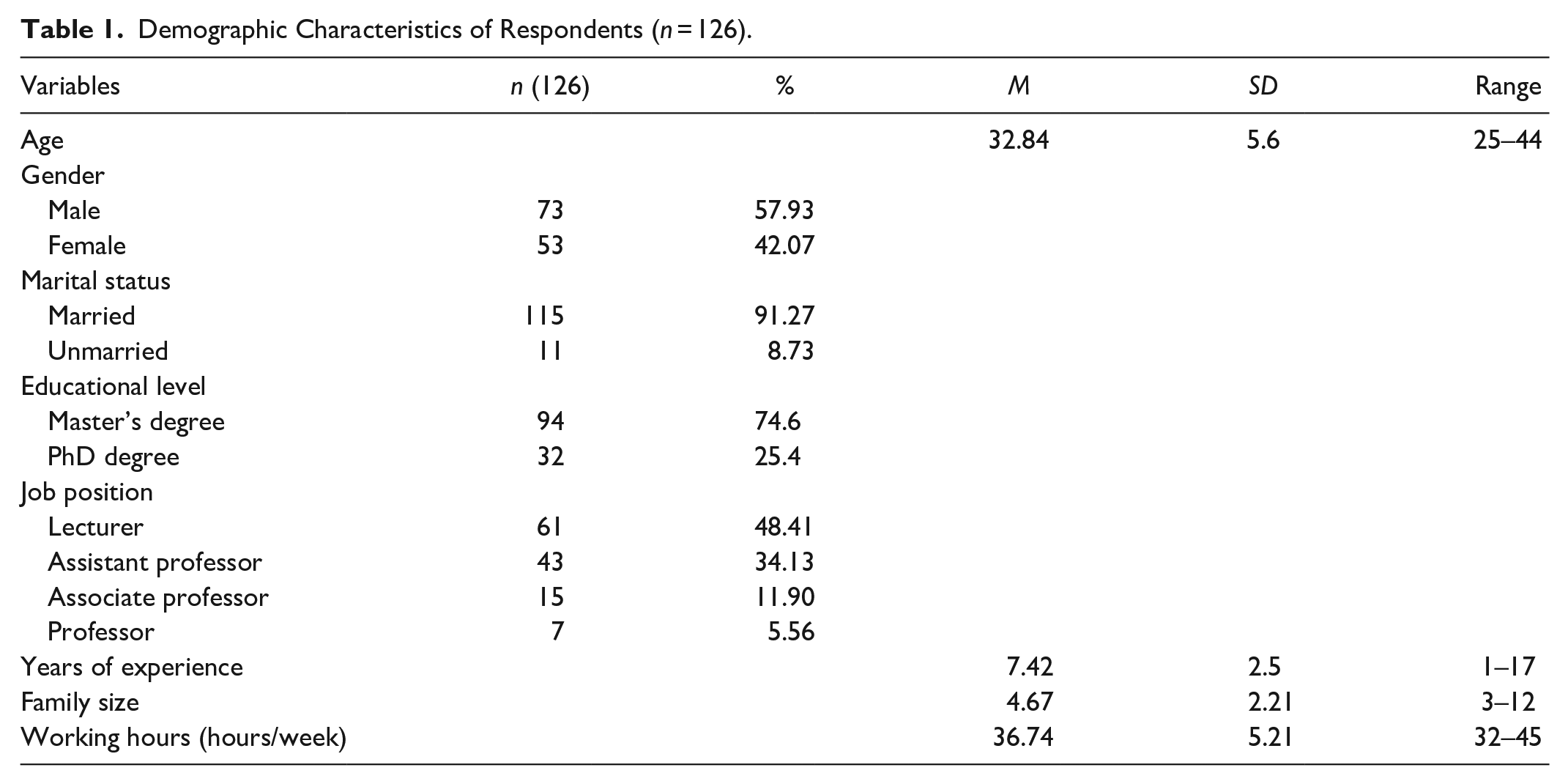
Gentle reminders were sent to each participant on their contact numbers (mobile phones) to fill a web-based survey, which was emailed to them, throughout the course of the daily study. The start-of-the-day form assessed momentary feelings about work engagement and work-to-family enrichment, whereas, end-of-the day form inquired about emotional regulation, work-to-family conflict, and family engagement. Date and time stamps were checked to guarantee permissible submission and removal of data provided outside the specified time. Out of 166 participants, 22 participants did not complete the full 2-week assessments; therefore, their responses were discarded. Further, 18 responses were removed due to missing data, leaving us with a sample was of 126 participants, with a response rate of 75.9%. Finally, 1,260 days of data, nested within 126 participants were available for multilevel analysis. The demographic detail of respondents is presented in Table 1)
Demographic Characteristics of Respondents (n = 126).
Research Instrument
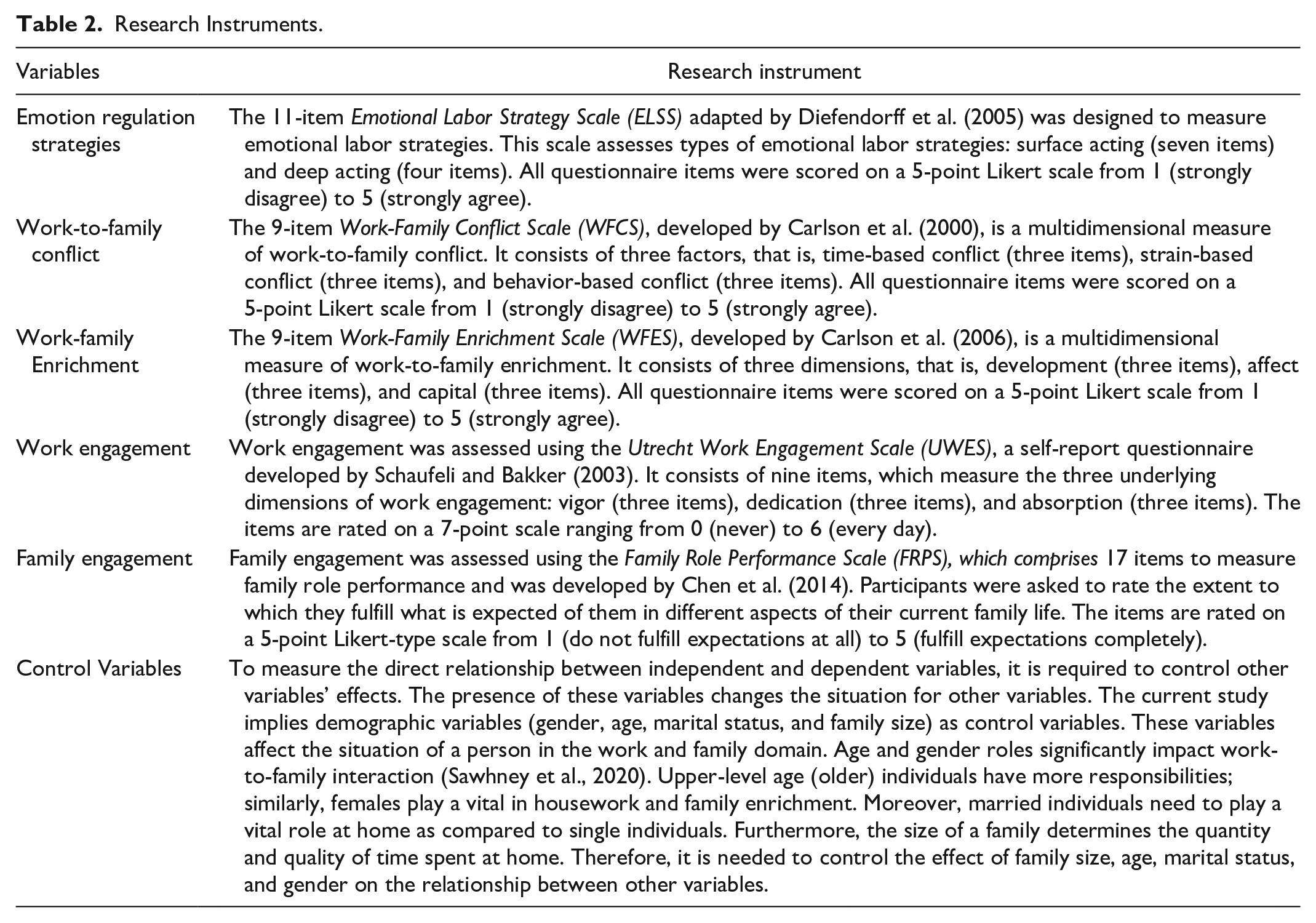
Previously determined scales are used to ensure adequate measurement of each variable (Table 2).
Research Instruments.
Analysis Strategy
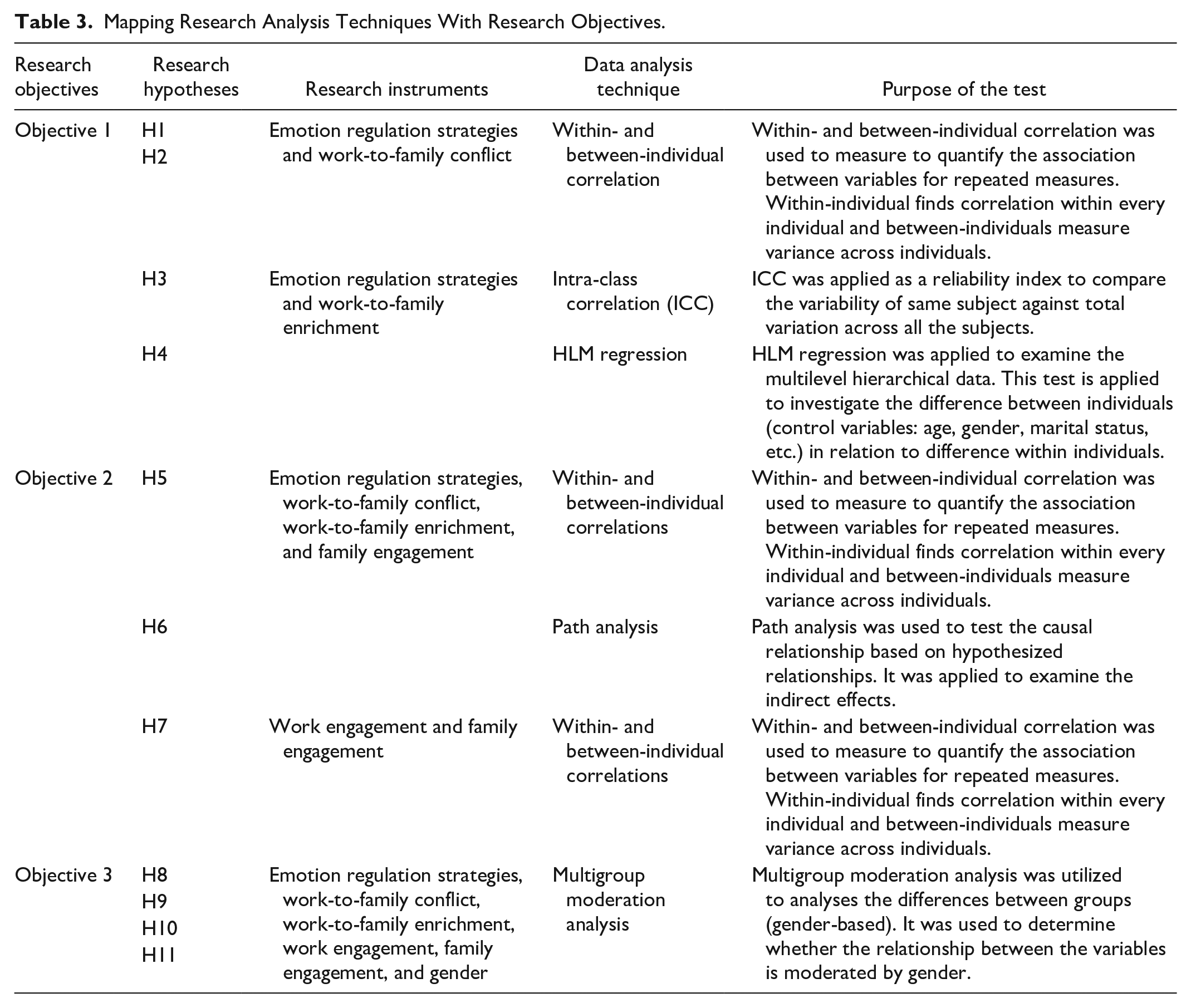
Prior to test the hypotheses, the level 1 predictors were group-mean centered (centered at individuals’ means), whereas level 2 predictors were grand-mean centered. Furthermore, the control variables (gender and marital status) were dichotomized, except for age and family size, which were grand-mean centered, following the recommendation of Hofmann et al. (2000). The statistical analysis was performed using SPSS (ver. 25), with Analysis of Moment (AMOS) 27.0 and HLM (ver. 8). The research analysis techniques used for hypotheses testing are mapped with each research objective and demonstrated in Table 3.
Mapping Research Analysis Techniques With Research Objectives.
Results
Preliminary Analysis
Common method bias (CMB)
Taking into account the potential risk associated with CMB in organizational and behavioral studies, this study executed a test to ensure that there is no variance in observed scores and that correlations are not exaggerated due to the methods effect (Aminu & Shariff, 2014). Unrotated factor analysis with 46 items of the entire model constructs depicted that no signal factor contributed for more than 50% of the variance. The results revealed 13 unique factors, with only 17.16% of the total variance was accounted by the single factor, showing that CMB was not present in this study. This is consistent with the findings of Podsakoff et al. (2003), who argued that CMB exists when a single factor accounts for more than 50% of the variance.
Multilevel confirmatory factor analysis
Confirmatory factor analysis (CFA) was conducted initially to test the model, given that it had not been tested previously in any sample. CFA was carried out using the maximum likelihood (ML) method (Ab Hamid et al., 2011; Hair et al., 2010). This confirmatory model contained five latent factors which were allowed to correlate freely, and the factor loadings were found to be significant and ranged from .43 to .97. As the current study had a small sample size at the individual level, similar within-individual relationships were employed as the practice followed in other studies (Liu et al., 2017; Z. E. Zhou et al., 2019).
Findings suggest that the model’s five-factor structure is sound, and representative of the response behavior observed in the current sample. Inspection of results depicted that the data is acceptably well. A significant chi-square, χ2 = 848.6 was obtained, goodness of fit index (GFI) = 0.991, standardized root mean square residual (SRMR) = 0.052, comparative fit index (CFI) = 0.988, and root mean square error of approximation (RMSEA) = 0.056. The results of CFA show that the model fits well and satisfies the basic requirements (Bentler & Bonett, 1980; Cudeck & Browne, 1983)
Measurement Model Assessment
Internal consistency reliability is determined through Cronbach’s alpha and composite reliability. The threshold value for Cronbach’s alpha is .707 and for Composite reliability is .7(Hair et al., 2010, 2021). All the latent variables under the current research represents higher reliability, as values of Cronbach alpha and composite reliability are above the set limit.
Convergent validity is established through Average Variance Extracted (AVE) and Outer model loadings. The threshold value for AVE is generally specified as .5 or above (Hair et al., 2010). In the present research, the values of AVE for all the latent constructs are greater than 0.5, which demonstrates that latent variables are representing over 50% of the variation.
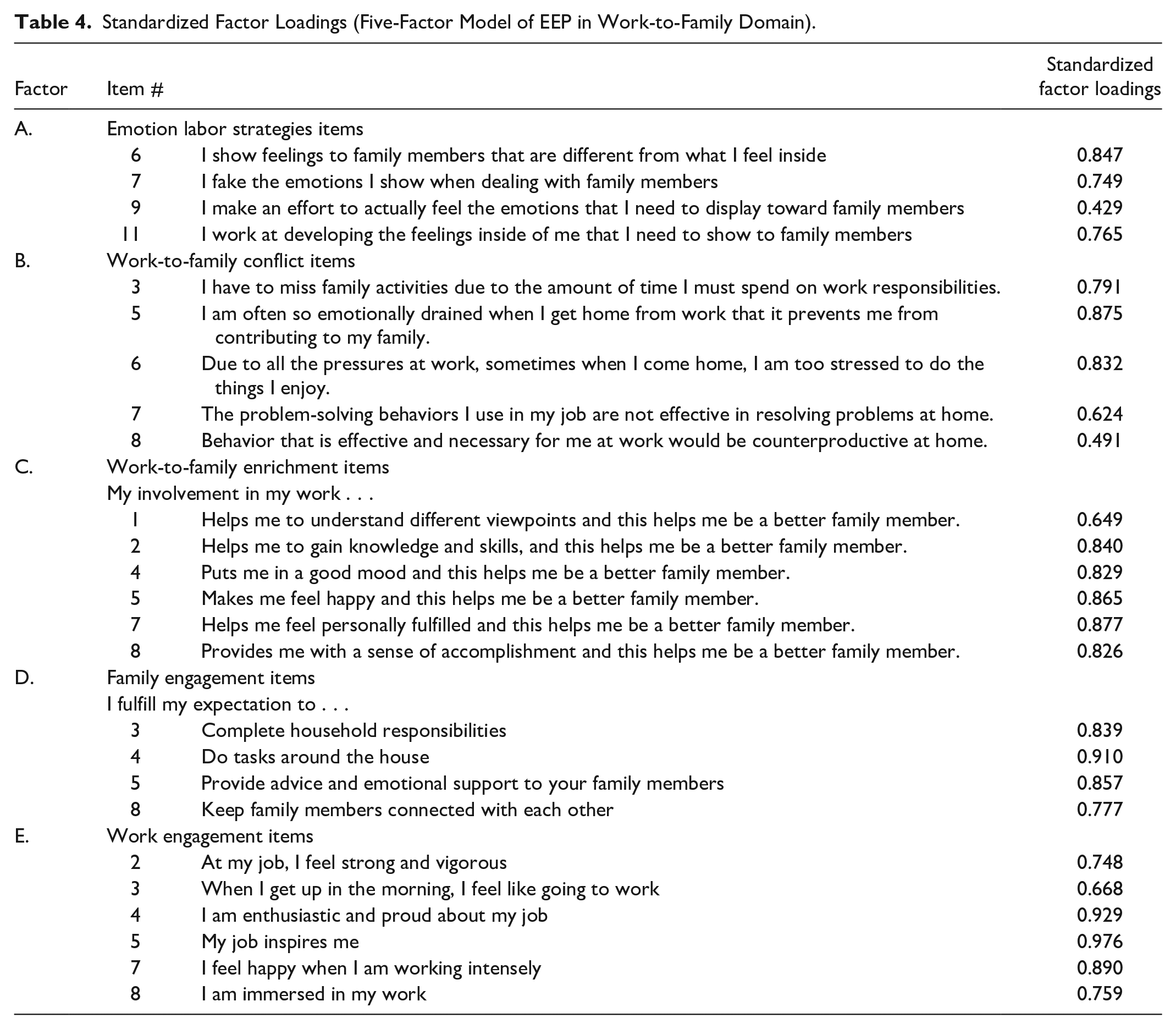
The factor loadings for all 46 items were observed and the initial results of analyses revealed that the model does not fit the data well. As the model has poor fit, the source of the misfit was investigated. Items with factor loading below the threshold value 0.708 were removed (Hair et al., 2010). However, loading below the threshold values can be retained if the AVE value exceeds .50 (Fornell & Larcker, 1981). The model was re-estimated with the removal of 21 items and 25 items were retained in the model for further investigation (see Tables 4–6).
Standardized Factor Loadings (Five-Factor Model of EEP in Work-to-Family Domain).
Goodness of Fit Statistics.

Note. N = 1,260. GFI = goodness fit index; SRMR = standardized root mean squared residual; CFI = comparative fit index; RMSEA = root mean square error of approximation.
p < .001.
Measurement Model, Cronbach’s Alpha, Composite Reliability, and AVE.

Discriminant Validity is established through Fornell and Larcker (1981) criterion and Heterotrait-monotrait (HTMT) ratio. According to Fornell and Larcker criterion the square root of AVE for each latent variable was more than the construct’s respective correlation with all other constructs (Fornell & Larcker, 1981; Table 7).
Correlations Among Constructs.

Note. AVE = average variance extracted.
Square root of the AVE on the diagonal (in bold).
HTMT ratio has a recommended threshold value of 0.85 or 0.90. If the HTMT ratio value exceeds this threshold value, then there is a lack of discriminant validity (Henseler et al., 2015). The HTMT ratio was calculated using the AMOS HTMT plugin (Gaskin et al., 2019) and was found to be within the acceptable level (0.85) for all constructs (Table 8).
HTMT Analysis.

Descriptive Statistics and Correlation
The means, standard deviations, and correlations for all the variables are shown in Table 9. The variables were assessed daily and then aggregated over the days (2-week period) of data collection to the individual level (n = 126). Within-individual correlations are depicted above the diagonal; between-individual correlations are below.
Within- and Between-Individual Correlations, Means, and Standard Deviations.

Note. Between-individuals (n = 126) correlations are shown below the diagonal, and within-individuals (n = 1,260) correlations are presented above the diagonal. Means and standard deviations are based on between-individuals scores.
Correlation is significant at the .05 level (two-tailed).
Correlation is significant at the .01 level (two-tailed).
The Intra-class correlation (ICC) is examined for all variables at two levels: within-individual and between-individual (Table 10).
Intra-Class Correlations (ICCs).

Main Analysis
Emotion regulation and work-to-family interaction
Hypothesis H1 predicts that surface acting reduces work-to-family time-based conflict (1a), no effect on strain-based conflict (1b) and enhances behavior-based conflict (1c). Hypothesis H2 predicts that deep acting reduces work-to-family time-based conflict (2a), strain-based conflict (2b), and behavior-based conflict (2c). First, the results of partial correlation (Table 9) depicted the correlation of surface acting with deep acting (r = −.365, p < .01), interestingly show a significant negative relationship. In contrast, both strain-based and behavior-based work-to-family conflict positively associate with surface acting, whereas time-based conflict depicts a negative association. Hence supporting hypothesis H1, it is concluded that an increase in surface acting increases work-to-family conflict (r = .214, p < .01). Moreover, time-based, strain-based, and behavior-based work-to-family conflict shows a negative association with deep acting. Hence proving hypothesis H2 states that an increase in deep acting decreases work-to-family conflict (r = −.269, p < .01). Second, results of HLM regression (controlled for gender, age, marital status, and family size) reveal that surface acting was positively associated with work-to-family conflict (β10 = .38, p < .05). In contrast, deep acting was negatively associated with work-to-family conflict (β20 = −.54, p < .05), fully supporting the Hypothesis H1 and H2. Table 11 provides the results of HLM regression testing these hypotheses.
HLM Results Predicting the Effects of Emotion Regulation on Work-to-Family Interaction.

Note. All level 1 predictors were centered at individual’s means. All level 2 predictors were grand-mean centered, with the exceptions of gender and marital status. Gender was coded male = 0 and female = 1. Marital Status was coded unmarried = 0 and married = 1. β values are unstandardized regression coefficients obtained from HLM (level 1 n = 1,260; level 2 n = 126).
p < .05. **p < .01. ***p < .001.
Hypothesis H3 predicts that surface acting reduces work-to-family development (3a), affect (3b), and capital (3c). Hypothesis H4 predicts that deep acting enhances work-to-family development (4a), affect (4b), and capital (4c). First, correlation results (Table 9) reveal that work-to-family development (r = −.286, p < .01), affect (r = −.255, p < .01), and capital (r = −.267, p < .01) show negative association with surface acting. Hence supporting hypothesis H3, it is concluded that an increase in surface acting decreases work-to-family enrichment (r = −.344, p < .01). Moreover, work-to-family development (r = .159, p < .01), affect (r = .166, p < 0.01), and capital (r = .263, p < .01) show positive association with deep acting. Hence proving hypothesis H4, it is stated that an increase in deep acting increases work-to-family enrichment (r = .249, p < .01). Second, HLM regression (Table 11) reveals that surface acting has a negative but not significant association with work-to-family enrichment (β10 = −.06), failing to support Hypothesis H3. Whereas deep acting has a significantly positive association with work-to-family enrichment (β20 = .06, p < .05), fully supporting the Hypothesis H4.
The HLM results delineate that the level 2 predictor, surface acting variability has significantly positive association with work-to-family conflict (β05 = .56, p < .05) and significantly negative association with work-to-family enrichment (β06 = −.29, p < .05). Moreover, deep acting variability has negative (but not significant) association with work-to-family conflict (β05 = −.08) and work-to-family enrichment (β06 = −.02). Consistent with our prediction, the findings show that variability in surface acting over two-weeks is a strong predictor for work-to-family conflict and work-to-family enrichment. In comparison, deep acting variability does not show improvement in association with the outcome variables.
Furthermore, age (β02 = .02, p < .01) and family size (β04 = .03, p < .05) depict a significant positive association with work-to-family conflict, which means aged (i.e., older) individuals face more conflict when transiting from work to family as compared to younger colleagues; similarly, individuals with bigger family size also face the same due to increasing responsibilities. Age depicts significant negative (β02 = −.04, p < .01) and family size (β04 = −.02) depict negative association with work-to-family enrichment. Individual’s increasing age and family size decrease the level of work-to-family enrichment.
Mediating effect of work-to-family interaction
Hypothesis H5 concern the mediating role of work-to-family interaction (work-to-family conflict and work-to-family enrichment) between surface acting and family engagement, and hypothesis H6 between deep acting and family engagement. The results of correlation analysis (Table 9) depict a significant negative association between surface acting and family engagement (r = −.286, p < .01), significant positive association between deep acting and family engagement (r = .159, p < .01), supporting hypothesis H5a and H6a, respectively.
In order to investigate whether work-to-family conflict and work-to-family enrichment mediate the relationship between emotion regulation strategies and family engagement, path analysis was performed. Test of the hypothesized model showed good model fit (χ2 = 9.434, p = .307, df = 8, CFI = 0.998, GFI = 0.996, adjusted goodness of fit index [AGFI] = 0.977, incremental fit index [IFI] = 0.998, RMSEA = 0.019, normed fit index [NFI] = 0.990, root mean square residual [RMR] = 0.047). The final model presenting statistically significant paths only is presented in Figure 3.
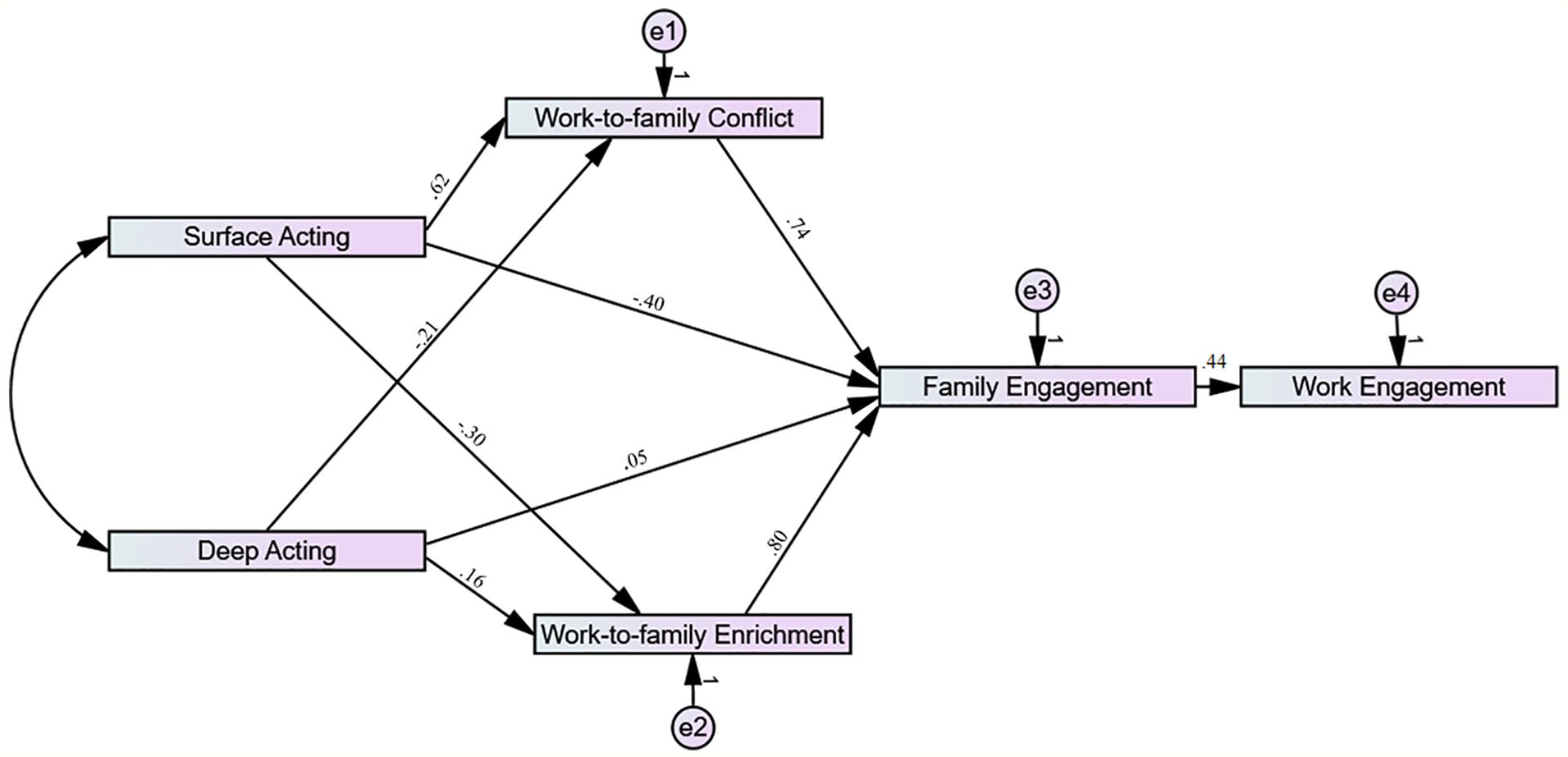
Final model (work-to-family conflict and work-to-family enrichment play a mediating role between emotion regulation strategies and family engagement).
Effect estimates
Surface acting had a significant negative direct effect on family engagement (β = −.374, p < .01), and deep acting had a significant weak positive direct effect on family engagement (β = .045, p < .05); the model explained 60.4% of the variances of family engagement. Hence, Hypotheses H5a and H6a were accepted.
Surface acting had a significant positive direct effect on work-to-family conflict (β = .625, p < .05). Whereas work-to-family conflict negatively predicted family engagement (β = −.735, p < .001). Moreover, the standardized indirect effect (i.e., mediated by work-to-family conflict) of surface acting on family engagement showed a strong negative effect (β = −.460, p < .05), and the model explained 39.2% of the variances. Based on these results, Hypotheses H5b was accepted. Surface acting had a significant negative direct effect on work-to-family enrichment (β = −.299, p < .001). Whereas work-to-family enrichment positively predicted family engagement (β = .795, p < .001). Moreover, the standardized indirect effect (i.e., mediated by work-to-family enrichment) of surface acting on family engagement showed a negative effect (β = −.238, p < .001), and the model explained 15.8% of the variances. Based on these results, Hypotheses H5c was accepted.
Deep acting had a significant negative direct effect on work-to-family conflict (β = −.212, p < .001). Whereas work-to-family conflict negatively predicted family engagement (β = −.735, p < .001). Moreover, the standardized indirect effect (i.e., mediated by work-to-family conflict) of deep acting on family engagement showed a positive effect (β = .156, p < .001). Based on these results, Hypotheses H6b was accepted. Deep acting had a significant positive direct effect on work-to-family enrichment (β = .158, p < .001). Whereas work-to-family enrichment positively predicted family engagement (β = .795, p < .001). Moreover, the standardized indirect effect (i.e., mediated by work-to-family enrichment) of deep acting on family engagement showed a positive effect (β = .126, p < .01). Based on these results, Hypotheses H6c was accepted.
Work-to-family outcome
Hypothesis H7 predicts that family engagement is positively associated with work engagement. On the final note, correlation results (Table 9) depict that family engagement and work engagement also reveal significant positive (r = .271, p < .01) association supporting hypothesis H7. Moreover, path analysis results (Table 12) also reveal the significant and robust positive direct effect of family engagement on work engagement (β = .444, p < .001), and the model explained 5.2% of the variances. Based on these results, Hypotheses H7 was also accepted.
Result of Hypotheses Test.

Note. Path_SWFC represents surface acting→work-to-family conflict→family engagement (work-to-family conflict as a mediating variable); Path_SWFE represents surface acting→work-to-family enrichment→family engagement (work-to-family enrichment as a mediating variable); Path_DWFC represents deep acting→work-to-family conflict→family engagement (work-to-family conflict as a mediating variable); Path_DWFE represents deep acting→work-to-family enrichment→family engagement (work-to-family enrichment as a mediating variable); FE = family engagement; WE = work engagement; a, b, and c represent the path coefficients of three paths from independent variable to intermediate variable, from intermediate variable to dependent variable, and from independent variable to dependent variable, respectively; ab represents the size of the mediation effect; c represents the direct effect of the independent variable to the dependent variable.
p < .05. **p < .01. ***p < .001.
Moderating effect of gender
Hypotheses H8a and H8b concern the moderating effect of gender on the relationship between surface acting, deep acting, and family engagement. Hypotheses H9 and H10 concern the moderating effect of gender on the relationship between surface acting, deep acting, and work-to-family conflict and work-to-family enrichment. Finally, hypotheses H11a and H11b concern the moderating effect of gender on the relationship between work-to-family conflict, work-to-family enrichment, and family engagement.
Multigroup moderation analysis was conducted using MGA multigroup moderation magic plugin for AMOS (Gaskin & Lim, 2018). A multigroup moderation analysis of the specified model for the males (n = 73) and females (n = 53) was performed. Using the ESM, a total of 730 responses were collected from males and 530 responses were collected from females, which falls within the acceptable range of 100 cases or observations per group, for multigroup analysis (Kline, 2015). The analysis results showed that the negative relationship between surface acting and family engagement (β = −.143, p < .01) is only significant for females, supporting hypothesis H8a. However, the direct effect of deep acting on family engagement was similar in males and females. The association of surface acting with work-to-family conflict was significant among females and not males (β = .198, p < .001), supporting hypothesis H9a. At the same time, there was no difference for males and females found between deep acting and work-to-family conflict. Among females, there was a positive relationship between deep acting and work-to-family enrichment (β = .297, p < .001), supporting hypothesis H10b. Moreover, results also depict that work-to-family conflict has negative and work-to-family enrichment has a positive relationship with family engagement, but do not show any difference between males and females (Table 13).
Moderating Effects of Gender.
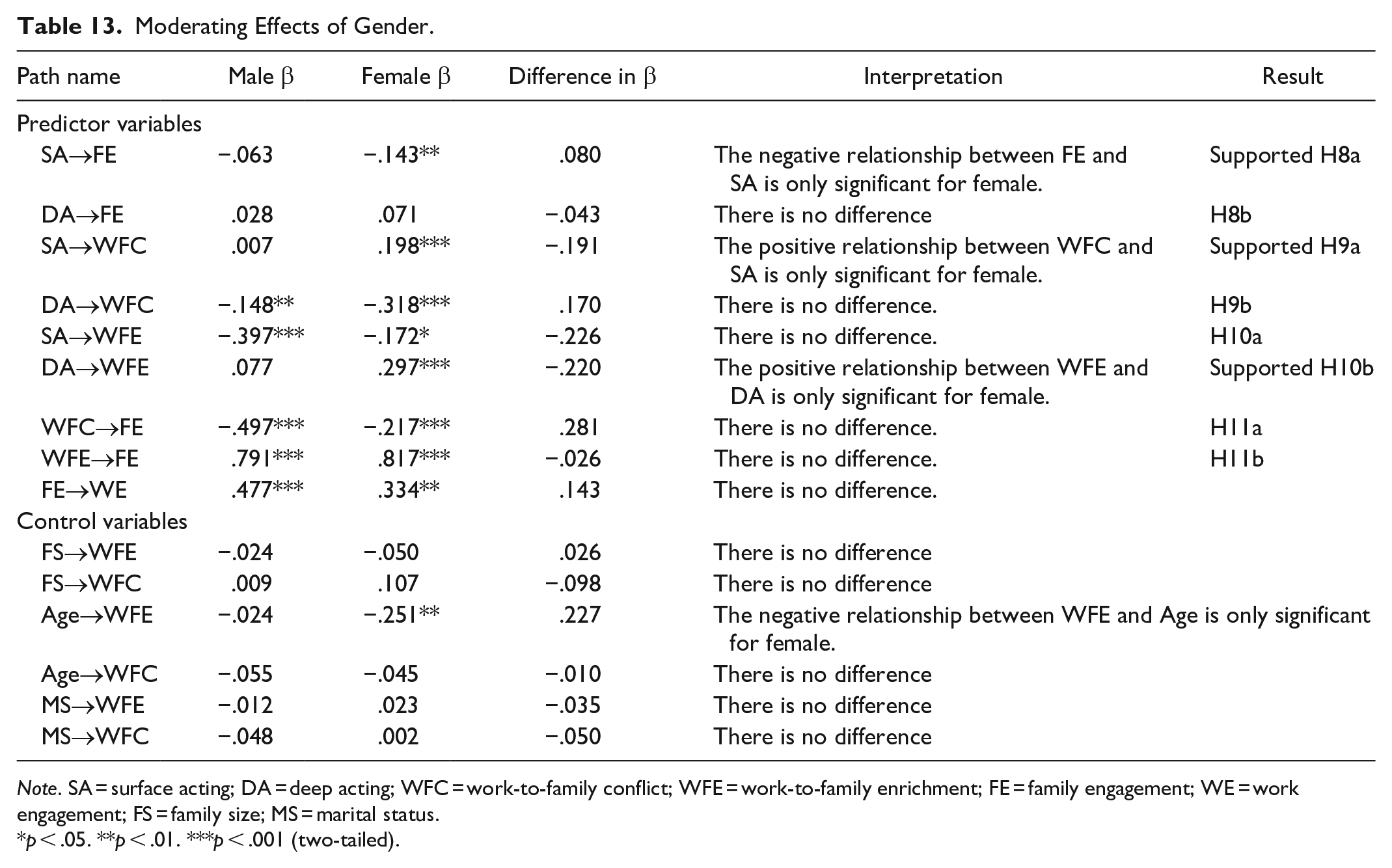
Note. SA = surface acting; DA = deep acting; WFC = work-to-family conflict; WFE = work-to-family enrichment; FE = family engagement; WE = work engagement; FS = family size; MS = marital status.
p < .05. **p < .01. ***p < .001 (two-tailed).
Figure 4 presents the interaction plot, which shows that the positive relationship between deep acting and work-to-family enrichment would be stronger for females than males. The resource enrichment consequent to deep acting enables females to function smoothly and effectively in the family domain. Thus, enhanced performance at work and the family domain lead to work-to-family enrichment.

Effect of deep acting on work-to-family enrichment for males and females.
Discussion
This study delineated an integrated theoretical model (EEEM) that accounts for emotion regulation and both work-to-family conflict and enrichment relationships between the work and home domains, which have been lacking. This multilevel research has revealed that individuals differ in their emotion regulation at work and with family. Furthermore, other constructs like work-to-family conflict and work-to-family enrichment are associated with their performance outcome at work (work engagement) and home (family engagement). The study implied ESM, although it is not the first study (Burr et al., 2021; Sawhney et al., 2020; Scott et al., 2012), which contributes additional construct to extend theory and research on emotional labor.
This study represents results based on a sample of faculty members teaching at the university level. Teaching job has distinctive features that are quite different from other service sector jobs. They undergo a higher level of time flexibility and a lower level of direct supervision than most jobs. Moreover, the teacher and student interaction differs from the service provider and customer (Sutton & Wheatley, 2003). Based on these facts, the study results provide insight into the emotion regulation strategy used by faculty when transiting from work to family. Furthermore, this research considered respondents who have the tightest schedules, that is, the sample excludes respondents who do not go straight home after work. The effect of socializing after work alters emotions, hampering emotion regulation measurement. Employees working under tight schedules face the most potential for work-family conflict (at least in terms of time; Y. Zhou et al., 2019; Z. E. Zhou et al., 2019).
Emotion Regulation Between Work and Family
The test for Hypotheses 1, 2, 3, and 4 address the first objective: examine emotion regulation (surface acting and deep acting) in work-to-family interaction (work-to-family conflict and work-to-family enrichment). The present results demonstrate the between-individual level of analysis rather than a within-individual level and extend the previous research to the family domain. Between-individual differences based on age, marital status, and family size have presented interesting results which further support the study. The data suggests that old aged faculty members confront a higher degree of conflict when transiting from work to family domain compared to young faculty. Similarly, family role at home escalates for married individuals, which is also a contributing factor to the family size increase (Tement & Korunka, 2013).
The results suggested that faculty members who exhibit surface acting tend to experience more work-to-family conflict, consistent with previous studies (Wu et al., 2020). Individuals who fake and suppress the felt emotions limit their ability to perform in the family domain. Work-related distress and distraction cause behavior hindrance (behavior-based conflict), as individuals cannot adjust while transiting from work to home. In contrast, suppressing true emotions induce intensification of energy consumption (strain-based conflict) and time consumption (time-based conflict) due to mental preoccupation (Tement & Korunka, 2013). In contrast, deep acting reduces work-to-family conflict. Service employees, particularly individuals who express genuine emotions and do not resist expressing true feelings, avoid work-related distraction, stress, and anxiety. The focused engagement in the family domain is a result of reduced time-based, strain-based, and behavior-based conflict (Dierdorff & Ellington, 2008; Greenhaus & Beutell, 1985; Halbesleben et al., 2009).
The findings show that employees who perform surface acting experience conflict and stress that detract their quality of life at home. They encounter deterioration in overall well-being and quality of family life. Faking emotions, reduce the acquisition of new skills and knowledge (work-to-family development), induce negative mood and attitude (work-to-family affect) and deteriorate confidence, self-fulfillment, and security (work-to-family capital; Tement & Korunka, 2013). On the contrary, deep acting improves family life quality, and enrichment occurs when the family experiences improvement regarding development, affect, and capital (Greenhaus & Powell, 2006; Hill, 2005). Furthermore, in line with the assumption that surface acting variability is associated with work-to-family conflict and work-to-family enrichment, results reported that employees who were consistent in their use of surface acting over two-weeks exhibit a higher level of conflict as well as an enrichment when transiting from work-to-family. Whereas employees engaged in deep acting on a temporal basis did not support the assumption (Scott et al., 2012).
An explanation for the present findings is that teaching requires emotional involvement at work, taxing individuals in time and energy. Those who manipulate their surface expressions, and resist expressing true emotions, experience dissonance between felt and expressed emotions (Holman et al., 2008). As a result, anxiety, tension, and distress increase, causing conflict when transiting from work to family and hurdle in performing family roles (Grandey & Melloy, 2017). Surface acting drains employees’ cognitive and emotional resources (Krannitz et al., 2015), depriving them of accomplishing household chores with the spouse and childcare, etc. Whereas, deep acting makes an individual appear sincere toward family, further engaging him/her in family activities. Reappraisal changes an individual’s mood, replenishes the resource drain and helps them attain their family roles and responsibilities effectively (Alam et al., 2019).
Work-to-Family Interaction and Work-Family Work Outcomes
The test for Hypotheses 5, 6, and 7 address the second objective: to explore the mediating effects of work-to-family conflict and work-to-family enrichment between emotion regulation and work-family outcomes. The results indicated that surface acting is detrimental to family engagement via work-to-family conflict. In contrast, work-to-family enrichment enhanced faculty members’ family engagement at home, consistent with past research stating that resource-engaged employees face work interference with the family role (Halbesleben et al., 2009). Individuals who suppress and fake at home experience more conflict when performing the family role, which ultimately reduces their family involvement level. Our findings suggest that service employees, specifically Pakistani university faculty, favor deep acting at home; they act and express genuinely appropriate emotions, which results in resource gain and positive performance at work, as well as effective engagement in the family domain (Q. Zhang & Zhu, 2008).
Besides, work-to-family conflict’s mediating effect reveals that deep acting reduces work-to-family conflict, and work-to-family conflict detriment family engagement, whereas this relationship, is significantly improved through mediation. At home, individuals who deep act better perform their family role, which has a positive spillover from family to work (Yin et al., 2019). A genuine expression of emotions provides extra resources, which encourage positive behavior and performance in family role. Furthermore, work-to-family enrichment improves the negative association between surface acting and family engagement. The emotional drain experienced by individuals due to surface acting causes resource depletion, which induces deterioration in the performance of the family role. Despite the negative effect, work-to-family enrichment leads to generate positive feelings and behavior toward family, adding resources available for successful performance at home (Wu et al., 2020).
Results also delineated a positive association between family and work engagement. The positive spillover of the family setting result from engagement in the family role, which eventually ameliorates engagement in the work role. Positive emotional response enhances an individual’s availability and motivation to perform tasks and interpersonal roles (Rothbard, 2001). In sum, this study indicates that work-to-family interaction significantly mediates emotion regulation strategies and family engagement in university faculty. Surface acting causes a decrease in family engagement, but deep acting reverses this adverse effect.
Moreover, work-to-family conflict mediates to decline family engagement further when surface acting and enhance family engagement when deep acting. In contrast, work-to-family enrichment mediates to improve family engagement while both surface acting and deep acting. Therefore, faculty members should engage in appropriate emotion regulation strategies to benefit from family role engagement and work role engagement (Adams et al., 1996; Q. Zhang & Zhu, 2008). Sarwar et al. (2021) and Wayne et al. (2020) corroborated in their study the mediating role of work-to-family conflict and work-to-family enrichment between job demand, job resource, and balance satisfaction which is consistent with the findings of the present study. If an individual has ample resource gain from work like social support from colleagues, job autonomy and adequate training, it may help to reduce the interference of work-life on family roles.
The Role of Gender in Emotion Regulation
The test for Hypotheses 8, 9, 10, and 11 address the third objective: to analyze the moderating role of gender on emotion regulation in the work-family context. This research elucidates the gender differences to the extent that variation of gender has a significant moderating effect on emotion regulation in work-to-family context. Past research has suggested that the relationship between work and family is characterized by conflict and social support (Greenhaus & Beutell, 1985). Moreover, studies on gender differences suggest that societal expectations differ for males and females, and females are more emotionally expressive than males. Specifically, females experience more enrichment when transiting from family to work, whereas males experience enrichment from work to family (Baral & Bhargava, 2011; Foley et al., 2005; Rothbard, 2001). Overall, more linkages were found between work and family context for females than for males.
The findings of this study revealed mixed support for these hypotheses. The results of the structural model for females are quite different from males. Findings proved a negative relationship between family engagement and surface acting for females, which is in line with the notion that females who exhibit fake emotions experience decreased family engagement. Similarly, females who surface act deplete resources and encounter a higher level of work-to-family conflict regarding negative affect and lower family attention (Foley et al., 2005; Rothbard, 2001). However, on the other hand, findings suggest a positive relationship between work-to-family enrichment and deep acting is stronger for females. The implication is that faculty members who perform deep acting and display the authenticity of emotions over surface acting effectively alleviate emotional burnout and stress. Women perform better work-life balance than their male counterparts, enhancing their functioning in the family role (Baral & Bhargava, 2011). The ability to satisfactorily perform work and family role lead to higher engagement at work and at home.
The results imply that gender does not moderate the relationship between work-to-family interaction and family engagement. The results are consistent with Greenhaus and Beutell (1985) demonstrating that work-to-family-conflict is negatively related with family and life satisfaction Greenhaus and Powell (2006) and stating that work-to-family enrichment is positively related with family satisfaction. Moreover, no significant difference was found for males and females, on the relationship between work-family conflict and family engagement and work-to-family enrichment and family engagement. A possible explanation is that there is no individual difference for employees (males or females) on gender basis because of equal family commitment, family support, and family role satisfaction (Aboobaker & Edward, 2020).
In this study, males and females did not differ significantly on work engagement at the workplace and family engagement at home. This implies that gender had no significant moderation effect on the relationship between family engagement and work engagement. Both males and females do not differ in their experience of family and work engagement because of equal family support and socialization (Baral & Bhargava, 2011). Furthermore, the results indicate that age played a moderating effect and showed a negative relationship with work-to-family enrichment, which was significant specifically for females. However, no difference was detected for the family size and marital status of an individual. Previous research shows that age plays a vital role in work-to-family interaction. Older faculty members (on a higher level in the career stage) regulate their emotions better than the younger employees. They have ample experience to handle immediate unpleasant events and feelings, classroom events, and subjective feelings (Kelchtermans, 2005; Yin et al., 2019).
Implications of the Research
This research implies that:
University management need to assist its faculty with incentives to acquire positive resources and energies at work, which will reciprocate in their family life as a benefit from work. Management needs to deliver support to the faculty so that they can align their work role and family role to maintain work-family balance.
Faculty must be trained to avoid stressful emotion management by self-assertion and maintain positive learning environment. Furthermore, they must pay attention toward training faculty to use adaptive strategies with students and understand the emotional aspects of their job.
Given the positive productivity opportunity, universities must ensure creating career development opportunities for females as well as relieve their work stress and improve their work-family balance. Management must ensure equal workload distribution among male and female faculty members, also considering the age of the employee.
Conclusion
First, the employee emotional engagement model (EEEM) is an extension of several previous models (Alam et al., 2019; Scott & Barnes, 2011; Scott et al., 2012; Wu et al., 2020; L. Zhang et al., 2020). This study extended the research on the relationship between emotion regulation, work-to-family interaction, and work-family outcome. Second, the significant direct effect suggests work-to-family conflict and work-to-family enrichment partially mediated the association of emotion regulation and family engagement. The results provide evidence that work-to-family conflict is associated with the decline of family engagement for those who surface act whereas, work-to-family enrichment is associated with enhancing family engagement for those who deep act. This study also produces significant finding that work-to-family conflict increase family engagement for deep actors and work-to-family enrichment increase family engagement for surface actors. Third, the contribution of this research is that it provides analytical analyses of the moderating effect of gender on the relationships in the model. Gender differences based on emotion regulation in the work-family context support the concept that a positive relationship between surface acting and work-to-family conflict and between deep acting and work-to-family enrichment was stronger for females than males.
Limitations and Suggestions for Future Research
There are a few limitations in this study that should be considered while interpreting the results. First, the study provides analysis evidence based on the experience sampling methodology, which is a strength, but it relies on self-reporting (subjective data) of behaviors and performance, creating concern for method bias. To remove this limitation, future research can consider the collection of objective data. Second, the EEEM model consists of emotion regulation strategies (surface acting and deep acting), ignoring other kinds of emotion regulation strategies (e.g., genuine emotional expression), which should be included in future research. Moreover, future studies could attempt to include more within and between individual indicators. Furthermore, the study did not consider the impact of cultural differences. Future research can incorporate cultural variables and situational characteristics to explain regional differences based on individualism and collectivism. Third, the data of this research is drawn from a small sample of highly educated faculty at the university level, although the number of observations collected is large, limiting the generalizability of the research findings. Fourth, the research is limited to the unidirectional impact of emotion regulation from work to family but not vice versa. An advantage of the event sampling method is the exploitation of directional temporal relations (bidirectional), which can be incorporated in future research. Fifth, the cross-level interaction to assess the moderating influence of gender is not very significant. Although a significant difference is not revealed in the findings, but gender does matter. Construct of positive and negative affect, affective experience, family, and spousal support should be explored in future research. Finally, the data used in this research is from Pakistan and may have influenced the generalizability of results due to the disposition of the emerging economy. Future researchers are encouraged to test the model on samples drawn from developed economies.
Footnotes
Acknowledgements
All the authors give sincere thanks to all the respondents for participating in our research.
Declaration of Conflicting Interests
The author(s) declared no potential conflicts of interest with respect to the research, authorship, and/or publication of this article.
Funding
The author(s) received no financial support for the research, authorship, and/or publication of this article.
Informed Consent
Informed consent was obtained from all individual participants included in the study.
Ethical Statement
I testify on behalf of all co-authors that our article submitted to SageOpen: (1) this material has not been published in whole or in part elsewhere; (2) the manuscript is not currently being considered for publication in another journal; (3) all authors have been personally and actively involved in substantive work leading to the manuscript, and will hold themselves jointly and individually responsible for its content.
