



Abstract
Amid profound transformations in global political and social landscapes, the trust relationship between citizens and their governments has emerged as a pivotal theme in political science and sociology studies. In increasingly diverse societies, understanding how states foster national identity to enhance social cohesion and institutional stability has become a pressing research agenda. Utilizing data from the 2020 Chinese Netizens Social Consciousness Survey, this research employed the Ordered Probit regression model to examine the effects of governmental trust on citizens’ sense of national identity and the underlying mechanisms. The results reveal that government trust substantially bolsters national identity, with political news attention and democratic consciousness serving as significant positive mediators. Heterogeneity analysis indicates that this relationship is moderated by income level and modes of media exposure, with stronger effects observed among high-income individuals and those who rely on traditional media. This study advances the understanding of the link between trust in government and national identity and offers empirical insights into the formation of national identity in non-Western contexts.
Plain Language Summary
Keywords
Introduction
In the digital era, the interconnectedness and mutual shaping of global political, economic, and cultural activities have become increasingly pronounced. On the one hand, the widespread use of the Internet has expanded public avenues for opinion expression and participation in public affairs, thereby diversifying the forms of social mobilization. On the other hand, the openness, immediacy, and anonymity of online platforms have accelerated the spread of irrational views, misinformation, and emotional polarization. These dynamics have gradually eroded the relationship between citizens and the state, intensified trust deficits, and undermined both governmental authority and the symbolic foundations of national identity (Lu & Liu, 2018; Lu & Yu, 2019). As such developments pose a potential threat to social cohesion and political stability, strengthening national identity has become a matter of growing concern for governments worldwide (Engelstein, 2024).
To foster a stronger sense of national identity, governments often rely on institutionalized rituals and education policies. In the United States, national holidays such as Presidents’ Day and Veterans Day reinforce civic consciousness; in Japan, commemorative days like National Foundation Day and Constitution Memorial Day serve a similar purpose. In China, events such as National Day and Army Day help reinforce collective memory and emotional attachment to the nation. These approaches, however, are shaped by historical, cultural, and institutional differences. In China’s case, national identity is cultivated through distinct institutional mechanisms rooted in its socialist system. The maturity of this system is reflected not only in stable institutional norms and governance structures, but more critically, in the deep institutional trust and emotional allegiance citizens express toward the state (Hu & Yin, 2022; Kaplan, 2025).
Since 2012, the Chinese government has undertaken comprehensive reform initiatives aimed at enhancing institutional legitimacy and emotional identification. Key policy documents—such as the “Decision of the CPC Central Committee on Several Major Issues Concerning Comprehensively Deepening Reform,” the “Opinions on Deepening the Reform of the Income Distribution System,” and the “Decision on Further Deepening Reform and Advancing Chinese-Style Modernization”—have sought to improve governance performance and institutional arrangements as a means to bolster national identity. However, policy efforts alone are insufficient to fully address weakening identification. Government trust serves as a critical bridge between institutional legitimacy and citizens’ emotional attachment. It operates not only through rational channels—enhancing acceptance of policies and institutional arrangements—but also through emotional pathways, fostering resonance with the values and actions of the state (Alm, 2022; Chanley et al., 2000; Dellmuth & Tallberg, 2020). Strengthening national identity, therefore, hinges on the pivotal role of government trust.
Existing academic literature has explored the formation of national identity from various angles. One body of work emphasizes institutional determinants, such as political system design and the effectiveness of policy implementation (Fukuyama, 2018; Stuckey, 2023). Another line of inquiry highlights the role of historical memory and cultural tradition, noting that shared historical experiences and cultural symbols significantly enhance group cohesion and national attachment (Danugroho, 2024; Li et al., 2021). Additionally, many studies underscore the importance of education policy, suggesting that national curricula and civic rituals can foster loyalty and a stronger sense of belonging among citizens (Sautereau & Faas, 2023). Nevertheless, two key research gaps remain. First, most studies are centered on Western democracies, offering limited insight into the mechanisms of national identity formation in non-Western institutional contexts. Second, although government trust is widely regarded as central to political legitimacy (Khan, 2016), few studies have systematically unpacked how it contributes to national identity or clarified the mechanisms through which it operates.
Based on the above analysis, this study selects Chinese Internet users as the research subject and applies quantitative analysis methods to systematically examine the specific mechanisms and pathways through which government trust influences national identity. Specifically, this paper conducts an empirical analysis using the ordered Probit model and reveals the specific pathways of the impact of government trust on national identity through political news attention (cognitive pathway) and democratic consciousness (value-based pathway). At the same time, this study adopts instrumental variable methods and heterogeneity analysis to ensure the robustness of the empirical conclusions, alleviate potential endogeneity problems, and identify the differences in effects across different subgroups.
The core contributions of this paper lie in three areas: First, from the perspective of government trust, it fills a theoretical gap in the field of national identity research, particularly by extending relevant theories in non-Western institutional contexts. Second, it enriches the existing literature on the relationship between government trust and national identity through the use of localized data and context from China. Finally, by employing the method of mediation effect analysis, it specifically uncovers the mechanism and pathway by which government trust affects national identity, providing more nuanced and empirically grounded evidence for relevant theoretical frameworks. In conclusion, this study not only broadens the theoretical perspective but also offers important practical references for enhancing citizens’ political identity, improving institutional cohesion, and strengthening policy implementation.
Literature Review
Government Trust and National Identity
As a form of institutional trust, government trust is broadly understood as the public’s perception of and expectations toward the political system, encompassing both evaluations of government performance and confidence in the government’s capacity and willingness to act in the public interest (Intawan & Nicholson, 2018; Miller, 1974). It is not only a political attitude but also a key pillar of political legitimacy, widely studied in the contexts of national governance, social capital, and institutional effectiveness. In the study of national identity, government trust is often conceptualized as a bridge connecting institutional performance with emotional attachment, functioning through both cognitive and affective mechanisms.
From the perspective of institutional performance, government trust reflects the extent to which the government provides public goods effectively and equitably and responds to citizens’ concerns. High levels of trust are believed to foster citizens’ engagement in institutionalized political processes—such as elections, policy consultation, and feedback—while reducing reliance on non-institutionalized forms of protest (Y. Lee & Schachter, 2019; C. Wang & Zhang, 2024). Conversely, low levels of trust increase the likelihood of dissent through demonstrations or protests, thereby undermining institutional legitimacy and weakening the foundations of national identity (Marien & Hooghe, 2011). When citizens perceive government performance positively, they are more likely to develop institutional identification at the national level (Kim et al., 2020). According to the theory of public satisfaction, government trust contributes to a sense of satisfaction, belonging, and social integration, serving as a psychological foundation for group loyalty and national identity (Gustavsson & Stendahl, 2020). Empirical studies based on South Korea and Japan have confirmed the close relationship between government trust, public approval, and civic satisfaction (Kim, 2010). Specifically, trust in government encourages political participation and institutional attachment, enhances rational evaluations of service performance, and improves satisfaction with public services. Over time, such stable satisfaction fosters citizens’ identification with the state and reinforces national cohesion (Häggblom, 2024). Additionally, government trust enhances citizens’ confidence in national governance capacity and value goals, facilitating a shift from short-term policy satisfaction to long-term national belonging (Mahmood et al., 2019). Beyond rational considerations, government trust also entails affective identification, reflected in citizens’ psychological acceptance of and emotional support for government actions. According to the Affective Attachment Model, affective trust in government can elicit emotional loyalty to national institutions—an allegiance grounded not in cost-benefit calculations but in the experience of an “imagined community” (Erhardt, Freitag et al., 2021). Emotional trust reduces the cognitive burden of political processes and fosters emotional resonance with national symbols and values, thereby strengthening affective attachment and identification with the nation. Accordingly, this study proposes the following hypothesis:
The Mechanism Through Which Government Trust Influences National Identity
In the digital age, online media has emerged as a significant platform for government governance and citizens’ access to information. Public political cognition and attitudes are increasingly shaped and reconstructed by media content (Hoewe & Peacock, 2020). Political news attention, a key route by which individuals acquire political knowledge and form political judgments, is widely recognized as a pivotal cognitive pathway that interconnects government trust and national identity.
On the one hand, trust in government increases individuals’ attentiveness to political information. In digital environments, trust not only shapes emotional acceptance of political institutions, but also guides individuals’ information-seeking behavior and content preferences. People with higher levels of trust are more inclined to turn to mainstream media and official sources, thereby enhancing their understanding of national policies and institutional frameworks, and reinforcing political comprehension and system-level identification. From the perspective of political communication theory, government trust can be reinforced through mediated exposure, contributing to a virtuous cycle of increased political interest, knowledge, and engagement (Andersen et al., 2023). It also strengthens citizens’ attention to political content by enhancing perceived credibility of media sources, which in turn increases the depth and frequency of political information processing, establishing a positive cycle of trust and media contact (Gong et al., 2022). On the other hand, political news attention itself promotes national identity. Prior research has shown that individuals who actively engage with political news are more likely to develop a rational understanding of institutional operations, policy objectives, and the role of the state, which serves as a foundation for affective identification (Bargain & Aminjonov, 2020; Wojcieszak et al., 2016). This process not only fosters trust in political systems but also facilitates the transformation from trust in individual political actors to a broader sense of affiliation with national institutions. Such outcomes give rise to “understanding-based identity” and “institutional loyalty,” contributing to a deeper cognitive and affective alignment with the state. This aligns with the “cognition–comprehension–affection” model, whereby trust in government influences how individuals engage with political information, ultimately shaping both the cognitive and emotional dimensions of national identity (Schurz et al., 2021). Political news attention, therefore, not only reflects behavioral manifestations of government trust but also acts as a key mediating mechanism in its influence on national identity. Accordingly, this study proposes the following hypothesis:
Beyond the cognitive mechanism, it is also essential to explore how government trust influences national identity through a value-oriented pathway. In an era of rapid technological advancement and the widespread dissemination of democratic ideals, democratic consciousness—defined as individuals’ endorsement of core values such as liberty, rights, equality, and participation—has become a key indicator of civic political sophistication and a hallmark of modern national identity formation. Democratic consciousness encompasses not only emotional attachment to principles like freedom and justice but also a willingness to engage in political life, monitor government performance, and exercise civic rights. It serves as a vital point of convergence between cultural identification and institutional support in modern governance (Ruck et al., 2020).
Government trust is widely recognized as a foundational condition for fostering democratic consciousness. According to political efficacy theory, individuals who trust the government are more likely to perceive the political system as responsive, thereby enhancing their internal political efficacy—that is, the belief that they can influence political outcomes through legitimate means. A heightened sense of efficacy encourages democratic participation and affirms the legitimacy of democratic institutions (C. Wang & Zhang, 2024). From the institutional responsiveness perspective, trust in government is often linked to perceptions of transparency and openness, which nurture value-based commitments to procedural justice, deliberative democracy, and governmental accountability (Q. Wang & Guan, 2023). When citizens perceive political processes as legitimate, their support for democratic norms increases, giving rise to both rational acceptance and emotional endorsement of democratic ideals (Boulianne, 2019). Third, according to democratic political culture theory, government trust offers individuals a sense of security and institutional predictability, making them more receptive to norms such as equal rights and freedom of speech, while also nurturing institutional loyalty and a sense of civic responsibility (Ventura & Takahashi, 2025). Moreover, trust reduces political cynicism and institutional skepticism, strengthening belief in democratic governance and reinforcing the normative legitimacy of democratic ideals (van Stekelenburg & Klandermans, 2018).
Democratic consciousness is also closely linked to national identity at both psychological and behavioral levels. First, it reflects not only citizens’ acceptance of democratic norms but also their internalized sense of membership in the national community. Research has shown that democratic consciousness enhances political engagement and civic responsibility, thereby fostering a deeper sense of belonging and loyalty to the nation (Gabrielsson et al., 2025). In non-Western contexts in particular, it is often viewed as a marker of transition from passive obedience to active, participatory forms of national identification. Second, drawing on Social Identity Theory, democratic consciousness reinforces citizens’ self-perception as members of the state and links this civic identity with the broader image of the nation. In this view, democratic consciousness is not merely a value preference but a key expression of one’s attachment to the political community (Erhardt, Wamsler, & Freitag, 2021; J. Y. Hong, 2024). Under conditions of high democratic consciousness, individuals are more likely to see the state as a platform for realizing personal and collective values, which in turn cultivates stronger emotional attachment and patriotic loyalty. Accordingly, this study proposes the following hypothesis:
Building on prior theoretical and empirical studies, this study develops an analytical framework to examine how government trust affects national identity, as illustrated in Figure 1.

The research model.
Data, Variables, and Models
Data Source
This study used data from the “2020 Chinese Netizens Social Consciousness Survey,” maintained by the Chinese National Survey Data Archive (CNSDA). The survey focuses on Chinese Internet users and aimed to capture their genuine attitudes regarding political views and social perceptions. The dataset has been widely employed in empirical studies published in prestigious domestic and international journals, and it is recognized for its high academic validity and reliability (Ma & Lewis, 2020; Ma & Wang, 2015). The survey was administered via an online questionnaire between November and December 2020. To ensure data quality, rigorous control procedures were implemented, including the exclusion of responses with unrealistically short completion times or clear inconsistencies. For statistical accuracy, cases with missing values were removed using listwise deletion. The final dataset consists of 3,435 valid observations. All data collection procedures received ethical approval and usage permission.
Introduction to the Variables
Dependent Variable
In this study, national identity is conceptualized as the dependent variable, reflecting individuals’ emotional and psychological sense of belonging to the nation. Rather than emphasizing instrumental or institutional support based on policy performance, this research focuses on the affective dimension of national identity—a form of deep attachment rooted in shared historical memory, cultural tradition, and symbolic community ties. Although such emotional identification may not directly translate into support for specific institutional arrangements, it plays a vital role in fostering social integration, strengthening national cohesion, and cultivating political loyalty (Antonsich et al., 2020).
The existing literature generally adopts two main approaches to measuring national identity. One emphasizes individuals’ perception of the nation as the foundation and protector of familial and social life. The other centers on individuals’ allegiance and ideological alignment with the state. Given the deep-rooted “family-state isomorphism” in Chinese cultural traditions, this study adopts a culturally grounded measurement by using the attitudinal statement: “The country is the foundation of the family; without a strong country, there is no happy family.” Respondents rate their agreement on a five-point Likert scale ranging from 1 (“strongly disagree”) to 5 (“strongly agree”), with higher scores indicating a stronger sense of national identity. This measure demonstrates strong cultural relevance, as well as solid reliability and validity, thereby offering a consistent and robust basis for the subsequent analysis of causal mechanisms.
Independent Variable
The independent variable in this study is government trust, which captures the degree of trust citizens place in governmental institutions. Following the approach of previous research, a composite index is constructed based on respondents’ trust in both the central and county-level governments (Xu et al., 2022). The questionnaire includes two items: “How much do you trust the central government?” and “How much do you trust the county-level government?” Each item uses a five-point Likert scale: “Completely distrust,”“Somewhat distrust,”“Neutral,”“Somewhat trust,” and “Completely trust,” coded from 1 to 5. Responses indicating “Don’t know” or “Refuse to answer” were treated as missing and excluded from the analysis. The final government trust index is calculated by summing the two items, yielding a total score ranging from 2 to 10. Conceptually, this composite index captures individuals’ integrated assessment of governmental legitimacy and governance capacity.
Mediating Variable
Political news attention is used to assess respondents’ interest in political information. Drawing on prior studies, the frequency and duration of political news consumption are employed as indicators. This variable is measured with the item: “How much time do you spend reading current affairs and political news?” with six response options: “Never,”“Once or twice a month,”“Several times a month,”“Several times a week,”“Almost every day,” and “At least one hour every day.” These responses are coded from 1 to 6, with higher values indicating greater attention to political news. The resulting measure is treated as an ordinal variable and serves as a proxy for political interest in the mediation analysis.
To assess democratic consciousness, this study aims to measure the extent to which individuals endorse core democratic values—particularly those related to rights, political participation, and accountability—as a potential value-based mechanism linking institutional trust to national identity. Three representative survey items are used to construct this measure: “If the state cannot protect individual interests, it loses its legitimacy; human rights should take precedence over national sovereignty”; “Government officials are public servants employed by the people and should be removed from office if they fail to perform”; and “Land ownership should be vested in individuals, rather than in the state or collective entities.” Responses were recorded on a five-point Likert scale ranging from 1 (“strongly disagree”) to 5 (“strongly agree”). The total score, ranging from 3 to 15, constitutes an index of democratic consciousness. Reliability analysis indicates strong internal consistency, with a Cronbach’s alpha of .853, confirming the scale’s robustness and construct validity.
Control Variables
To minimize potential estimation bias caused by omitted variables, this study incorporates several key control variables into the empirical model, covering both individual-level demographics and regional-level characteristics. Specifically, the demographic controls include gender, age, political affiliation, education level, occupational category, and personal income. Occupational category is measured using a binary indicator. Individuals employed in the public sector—such as civil servants, SOE managers, judicial staff, university faculty, medical professionals, media personnel, and members of mass organizations—are coded as 1. In light of the political socialization role of the Chinese education system, high school and university students are also classified as public-sector affiliates. Those working in agriculture, manufacturing, services, private enterprises, self-employment, cultural and creative industries, NGOs, or currently unemployed are coded as 0. Income is also included as a binary variable, with a 50,000 yuan threshold based on the 2020 national average income released by the National Bureau of Statistics. For details, see Table 1. To account for regional heterogeneity in national identity, regional fixed effects are included by categorizing provinces into eastern, central, and western regions. The inclusion of these controls strengthens model specification and improves the credibility of causal inference.
Descriptive Statistics.

Note. A total of 3,435 observations were included. Means and standard deviations are reported for continuous and ordinal variables, while frequencies and percentages are provided for categorical variables, all rounded to two decimal places.
Descriptive Statistics
Table 1 presents the descriptive statistics for key variables. The average national identity score is 4.29, which is relatively high, indicating a strong identification with the nation among Chinese citizens. The average level of government trust is 8.37, with the highest value being 10, demonstrating that citizens generally have high government trust. The mean political news attention score is 4.05, indicating a moderately high level of interest. Democratic consciousness has an average score of 9.98, reflecting a moderate level of public recognition and valuation of democratic rights. Demographically, 65.01% of respondents are male, and the average category for age is 1.67, suggesting a younger respondent profile. Political party membership, specifically the Communist Party, comprises 15.95% of the sample. The average education level is 3.23, with 95.34% having completed compulsory education. Public officials make up 27.71% of the sample, and 67.42% of respondents earn an annual income over 50,000 yuan. Overall, these statistics align with real-world conditions. Further analysis shows no significant issues with multicollinearity among variables, providing a reliable basis for the deeper empirical analysis that follows.
Model Specification
This study aims to examine whether and how government trust influences national identity. Given that the dependent variable—national identity—is measured as a five-point ordinal variable, applying a traditional Ordinary Least Squares (OLS) model would violate key assumptions, including the requirement of equal intervals and normality. Such violations may lead to biased estimates and compromise the validity of statistical inference. To address this, the analysis adopts an Ordered Probit model (OProbit), following the approach of Acemoglu et al. This model assumes that individuals’ national identity reflects an underlying latent continuous variable

In Equation 1,
Empirical Findings
Baseline Model Estimates
Using the OProbit model to estimate the regression coefficients, to reduce estimation bias due to omitted variables, and to facilitate visual comparison of control effects, Table 2 shows the regression results without controlling for variables, controlling for individual characteristic variables, and further controlling for regional effects. The results in columns (1), (2), and (3) indicate that citizens’ government trust significantly positively affects national identity at the 1% level of statistical significance. This suggests that greater government trust correlates with an enhanced sense of national identity, corroborating
The Impact of government trust on National Identity.

Note. Standard error of the mean in parentheses.
p < .1, **p < .05, ***p < .01.
Further investigation into the econometric model for national identity reveals that gender, political affiliation, education level, and occupational type significantly influence citizens’ national identity. Females, in particular, tend to identify more with the national community than males. There are notable differences based on the level of education; higher educational attainment is associated with stronger national identity. However, the results for political affiliation and occupational type diverge from prior studies, with the party and public officials exhibiting lower national identity scores than their non-party and non-public officials. This finding could reflect the complexities of social reality. Primarily, the diminished sense of national identity among public officials might stem from their deep engagement in governmental affairs, which could lead to heightened awareness and critical perspectives on issues within national governance. Prolonged interaction with governmental structures may elevate their expectations of the nation, thereby amplifying their dissatisfaction with certain policies or systems.
Robustness Analysis
To assess the robustness of the empirical findings and mitigate potential biases arising from model misspecification and omitted variable concerns, this study conducts a series of robustness checks across three dimensions: alternative model specifications, substitution of key variables, and controls for endogeneity. These efforts aim to strengthen the validity and interpretability of the results.
First, the baseline model is replaced. While the Ordered Probit model is well-suited for handling ordinal dependent variables, this study assesses the sensitivity of the results to model specification by following the approach of Acemoglu et al. (2020), re-estimating the model using OLS under the assumption that the ordinal outcome can be treated as continuous. As reported in Model (4) of Table 2, the coefficient for government trust remains positive and statistically significant at the 1% level, closely aligning with the baseline estimates, indicating robustness to model specification.
Second, the core outcome variable is replaced. To minimize reliance on a single measurement indicator, this study adopts an alternative measure of national identity that emphasizes individuals’ adherence to national values. Specifically, national loyalty is employed as a proxy variable to test the robustness of the findings. Loyalty is assessed using the statement: “The nation is like a mother; regardless of her past mistakes, we should remain loyal to her.” Respondents rated their agreement on a five-point Likert scale ranging from 1 (“strongly disagree”) to 5 (“strongly agree”), with higher values indicating stronger national loyalty. The results, as shown in Model (5) of Table 2, affirm that government trust significantly enhances national identity, supporting our initial hypothesis.
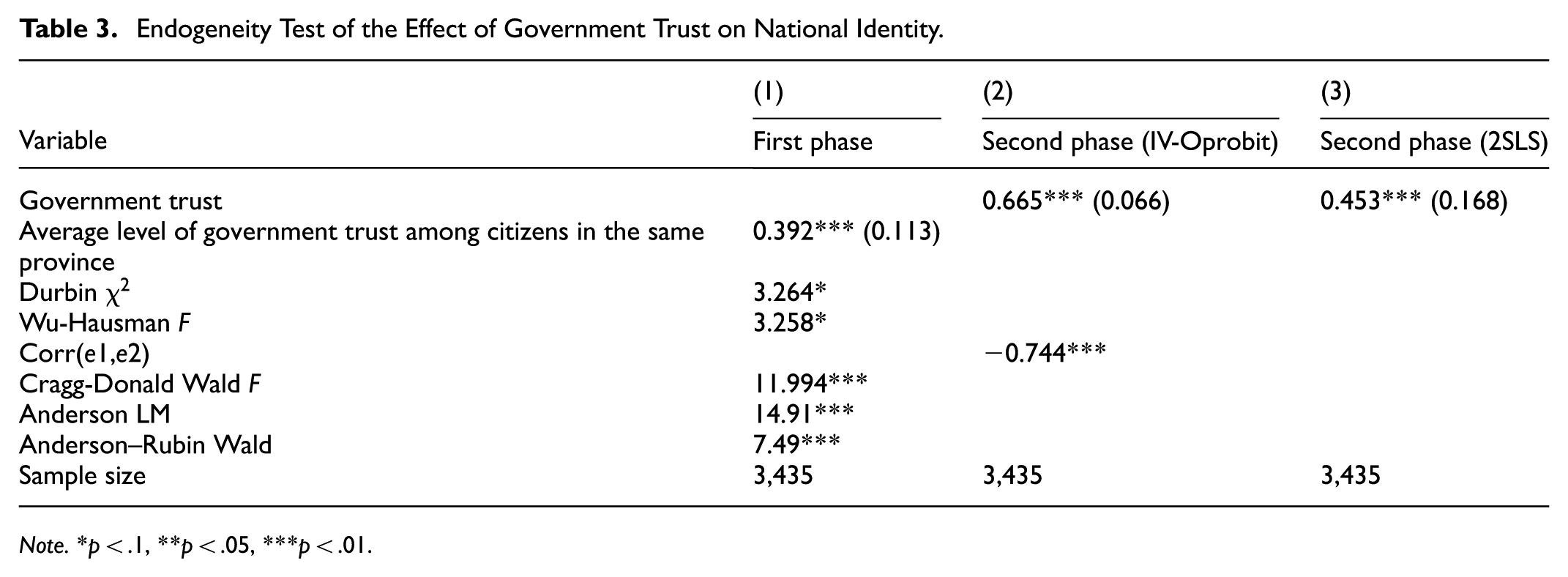
Third, this study addresses potential endogeneity concerns. Two primary sources of endogeneity may bias the estimated relationship between government trust and national identity. On the one hand, although the model includes a range of demographic and social covariates, unobserved factors—particularly those related to institutional perceptions or cultural predispositions—may still be omitted. On the other hand, a bidirectional causal relationship may exist, as individuals with stronger national identity may be more inclined to trust the government. If left unaddressed, these issues may lead to biased estimates that do not reflect the true causal effect. To assess the presence of endogeneity, a heteroskedasticity-robust Durbin-Wu-Hausman test is conducted. The results indicate that the residuals from the first-stage regression are statistically significant at the 10% level (Durbin χ2 = 3.264, p = .071; Wu-Hausman F = 3.258, p = .072), suggesting that government trust is an endogenous variable in the model.
To mitigate the effects of endogeneity, this study employs an instrumental variable (IV) approach. This method isolates the exogenous component of the endogenous regressor by introducing a variable that is strongly correlated with the endogenous predictor but unrelated to the outcome variable, thereby enabling more accurate estimation of causal effects. Following the approach used (Evans et al., 1992), the average level of government trust among citizens within the same province is used as the instrument. This choice is supported by two theoretical considerations. First, the variable reflects the broader regional climate of social trust, which can significantly shape individuals’ trust in government, satisfying the relevance condition for a valid instrument. Second, as a contextual, province-level factor, it is unlikely to influence individual national identity directly; rather, it operates indirectly through its effect on personal trust in government. Although it may correlate with regional cultural characteristics, the inclusion of regional fixed effects and a comprehensive set of control variables helps mitigate such potential confounding. This strategy is therefore broadly consistent with the exogeneity assumption. Based on this specification, the analysis applies the IV-Oprobit model and conducts additional robustness checks using two-stage least squares (2SLS). Detailed results are presented in Table 3.
Endogeneity Test of the Effect of Government Trust on National Identity.
Note.*p < .1, **p < .05, ***p < .01.
Firstly, the initial regression phase of our study demonstrates that the government trust levels of citizens within the same region significantly enhance an individual’s government trust, substantiating the correlation between our chosen instrumental variable and the endogenous variable. Additionally, the Cragg-Donald Wald F statistic stands at 14.939, exceeding the critical threshold of 10. This outcome negates the possibility of the instrumental variable being weak, thus reinforcing its validity. Furthermore, the Anderson LM test yields a statistically significant result (p < .01), rejecting the null hypothesis of under-identification and confirming that the instrument is relevant for identifying the endogenous regressor. Building on this, the Anderson–Rubin Wald test also produces significant results (p < .01), indicating that the structural effect of government trust on national identity remains robust and significant even under potential weak instrument conditions. These findings strengthen the credibility of the estimated relationship. In the second-stage regression, the coefficients derived under the IV-Oprobit approach in column (2) are notably higher than those estimated via the Oprobit method in Table 2. This discrepancy suggests that the influence of citizens’ government trust on their national identity may have been underestimated in our baseline analysis. The conclusive findings indicate that upon effectively addressing the endogeneity through the instrumental variable technique, our regression outcomes align with those of the baseline model, lending additional support to
Mediation Analysis
To delve deeper into how government trust influences citizens’ national identity, this study integrated two mediating variables into the baseline regression model: political news attention and democratic consciousness. To test the mediation effect, this study employs the Bootstrap method following the procedure outlined (Davidson & MacKinnon, 2006). Specifically, 2,000 bootstrap replications are conducted to construct 95% confidence intervals for the estimated indirect effects, thereby assessing the statistical significance of the mediation pathway. As a non-parametric approach, the Bootstrap method allows for more reliable inference without requiring the assumption of normality. Additionally, the Karlson–Holm–Breen (KHB) method is employed as a complementary approach (Breen et al., 2013). Designed for nonlinear models such as Probit and Logit, the KHB method enables accurate decomposition of mediation effects while accounting for the rescaling bias introduced by control variables. This allows for a clearer distinction between direct and indirect effects and their respective contributions.
Results reported in Table 4 indicate that the indirect effects of both mediation pathways are positive and statistically significant at the 1% level. This suggests that attention to political news and democratic consciousness serve as significant positive mediators in the relationship between government trust and national identity, thereby providing empirical support for
Mediation Effect Test Results.

Note.*p < .1, **p < .05, ***p < .01.
Heterogeneity Analysis
Although the impact of citizens’ government trust influences national identity has been examined above and concluded to be a significant “facilitating” effect, these conclusions were drawn from average effects across the full sample without considering variations across different groups. In China, significant income inequality persists alongside rapid economic growth, potentially magnifying differences in national identity among income groups. This disparity could reduce government trust among low-income groups, negatively affecting their national identity (Jiang et al., 2023). Additionally, the proliferation of self-media diversifies information sources, enriching public discourse but complicating the authenticity of information, especially on political topics. Negative information could increase skepticism toward the government among certain groups, leading to a fragmentation of national identity (Li et al., 2021). Consequently, this segment of the study concentrates on two aspects: initially, the differential pattern of citizen government trust on national identity under varying income status; secondly, the complex impact of citizen government trust on national identity under different channels of information exposure.
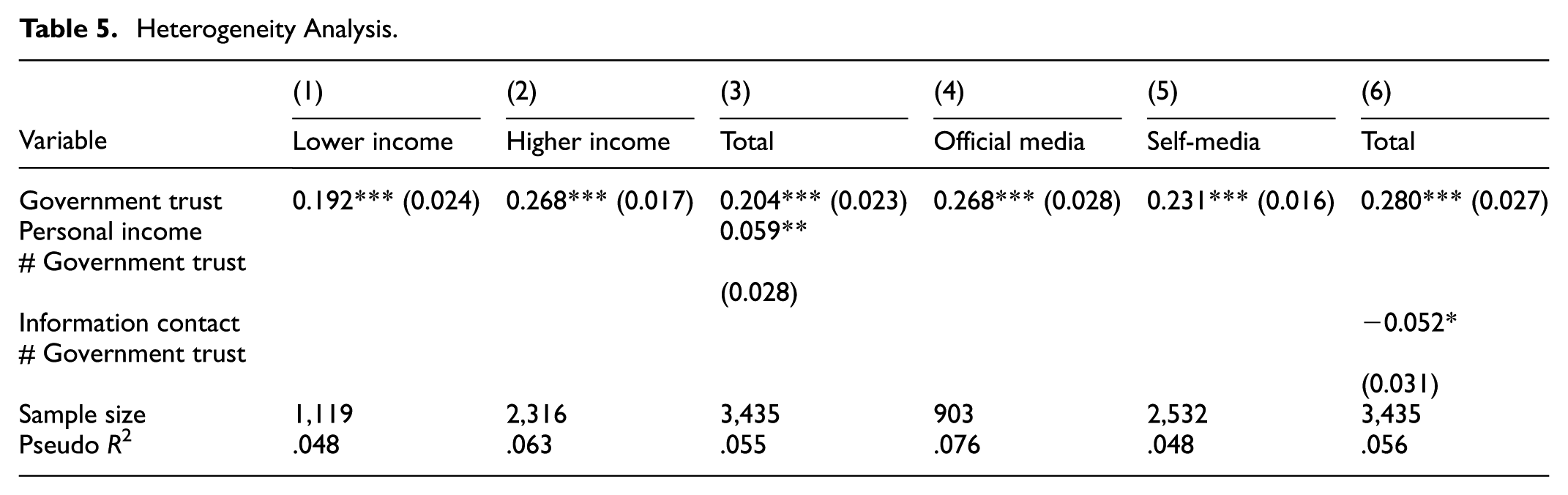
To examine heterogeneous effects, this study classifies individuals into high- and low-income groups based on income level, and distinguishes between two primary sources of political information: “traditional media” (e.g., CCTV, Xinhua News Agency, commercial news portals) and “social media platforms” (e.g., Weibo, Zhihu, WeChat official accounts). The analysis proceeds in two steps. First, subgroup regressions are conducted to estimate the main effects of government trust within each group. Second, interaction terms between government trust and group characteristics are included in the full-sample models to evaluate both the statistical significance and directional patterns of moderation effects. This empirical strategy facilitates the identification of group-specific differences in how government trust shapes national identity, thereby contributing to a more nuanced understanding of the mechanisms of institutional trust. It also enhances the study’s ability to account for the complexity of contemporary social structures. The results are shown in Table 5.
Heterogeneity Analysis.
Income Level-Based Heterogeneity
Table 5 illustrates that from Column (1) to Column (2), there is a consistently significant positive effect of citizens’ government trust on their sense of national identity, aligning with the preliminary Oprobit regression outcomes and underscoring the robustness of the study’s main findings. Among them, in column (2), the effect of the higher income group is more significant, and the influence coefficient is 0.268; in column (1), the effect of the lower income group is relatively small, with an influence coefficient of 0.192. Column (3) delves deeper, exploring the interplay between personal income and government trust, where the interaction effect is quantified at 0.059, achieving significance at the 1% level. This highlights that the relationship between government trust and national identity indeed varies significantly across income strata, suggesting that income disparities play a critical role in this dynamic. A potential explanation is that individuals in higher-income brackets, who generally have greater access to economic and social resources, perceive and support government policies more favorably, thereby strengthening their national identity. Conversely, those in lower-income brackets may exhibit reduced government trust due to perceived economic inequalities or instabilities, diminishing the effects on national identity. These findings illustrate that income level is crucial not only in influencing government trust but also as a significant factor in shaping national identity.
Media Exposure-Based Heterogeneity
Table 5 illustrates that citizens’ government trust positively influences their national identity. Specifically, in Column (4), the effect is more pronounced among those who frequently use traditional media, with an effect coefficient of 0.268. In contrast, in Column (5), those who predominantly use self-media as their main source of information show a lower effect, with a coefficient of 0.231. The results in Column (6) demonstrate an interaction effect of −0.052 between the mode of information contact and government trust, significant at the 10% level. This suggests that the source of information notably moderates the relationship between government trust and national identity. This could be explained by the fact that official media, with their strong governmental ties and higher credibility, often promote a positive national image and enhance government credibility. Therefore, individuals who rely on traditional media are more likely to develop government trust, subsequently strengthening their national identity. On the other hand, self-media sources are varied and may not always ensure the authenticity and consistency of information, sometimes spreading negative or inaccurate content. This variability could diminish citizens’ government trust and, consequently, their sense of national identity. Thus, the diversity in information sources significantly impacts the role of government trust in shaping national identity, highlighting the crucial moderating effect of media in this dynamic.
Discussion
Amid the rapid advancement of computer and Internet technologies, online platforms have become a critical medium for information exchange between governments and citizens. Against this backdrop, this study utilizes nationally representative data from the Chinese Internet Users’ Social Awareness Survey to examine how government trust shapes national identity and the mechanisms through which this occurs. The results indicate that government trust significantly enhances citizens’ sense of national identity, and this effect remains robust across various model specifications and endogeneity adjustments. From a mechanism-based perspective, both political news attention and democratic consciousness serve as significant and positive mediators, illustrating how government trust promotes national identity through cognitive and value-based channels. Moreover, heterogeneity analysis reveals that this relationship is particularly pronounced among higher-income individuals and those who primarily rely on traditional media, highlighting the moderating roles of socioeconomic status and media environment in the trust–identity nexus.
This study contributes empirical evidence from China to the broader discussion on the relationship between government trust and national identity, embedding this relationship within the theoretical frameworks of identity theory and comparative authoritarianism. From the perspective of global identity theory, national identity represents a diffuse, institutionally grounded macro-identity that encompasses both cognitive evaluations and emotional attachments (Fukuyama, 2018). In contrast, government trust embodies not only “specific support” for concrete policy performance but also “diffuse support” for the broader political community and institutional order (Gabrielsson, 2022; Lenard & Miller, 2017). The findings indicate that government trust exerts a significant and robust positive effect on national identity. While this appears as a favorable translation of policy performance, it in essence reflects the internalization of institutional cues into emotional attachment to the nation. This aligns with the “imagined community” perspective, wherein the state, through narratives, symbols, and everyday practices, continually reproduces the meaning of institutional belonging within citizens’ identities (Y. Lee & Schachter, 2019; C. Wang & Zhang, 2024). Positioning the Chinese experience within the broader framework of comparative authoritarianism further reveals both its shared mechanisms and unique features. Comparative studies suggest that the legitimacy and identity of authoritarian regimes are sustained through three primary mechanisms: performance-based legitimacy (economic and public service delivery), ideological and nationalist mobilization, and consultative or responsive governance accompanied by state communication (Chacko, 2018; von Soest & Grauvogel, 2017; Whiting, 2017). Consistent with this framework, our findings show that performance-oriented governmental signals are translated into national identity through the channel of institutional trust, following the general “performance–legitimacy–identity” logic. Yet, China’s distinctive characteristics—its state-directed narrative governance, mobilization of symbolic resources, and institutionalized communication structures—render this process more deeply embedded and stable (Huang et al., 2023). Thus, this study not only affirms the central propositions of comparative authoritarianism but also underscores the organizational and institutionalized nature of identity construction in the Chinese context.
On the other hand, this study lends support to arguments in political communication theory suggesting that media use functions as a cognitive mechanism in the construction of political identity (Andersen et al., 2023; Hoewe & Peacock, 2020). It highlights the mediating role of political information exposure in linking citizens’ engagement with political content to their sense of national belonging. Specifically, active attention to political news not only improves public understanding of policy performance but also fosters acceptance of official narratives and institutional discourse, thereby reinforcing national identity. Notably, this communicative logic implies that media engagement itself has become a strategic tool through which the state promotes institutional identification and political legitimacy (Landerer, 2013). In addition, by introducing democratic consciousness as a value-oriented mediator, this study extends the explanatory scope of both political efficacy theory and social identity theory (Linde & Peters, 2020; Wojciechowska, 2019). It underscores the importance of democratic participation in shaping citizens’ political attachment. It is important to underscore that identity formation in China is deeply embedded in institutional arrangements. Through selective political communication, tangible policy performance, and the strategic mobilization of symbolic resources, the state cultivates both emotional attachment to the regime and normative alignment with it, thereby sustaining a strongly state-led mechanism of identity formation (C. Wang & Zhang, 2024). Within this framework, democratic consciousness should not be equated with liberalization per se; rather, it reflects rational expectations for effective governance and the protection of citizens’ rights. Its positive mediating effect indicates that, in non-Western institutional settings, value-based identification can function as a critical bridge between institutional trust and national identity. This interpretation extends the study of the trust–identity nexus beyond the liberal-democratic theoretical canon to the domain of authoritarian governance, where performance legitimacy and national narratives are central.
The study’s findings on heterogeneous effects offer nuanced empirical insights into the micro-level mechanisms underpinning national identity formation. First, income-based heterogeneity underscores the critical moderating role of resource distribution in translating institutional trust into national identification. Individuals with higher incomes tend to be more politically aware and possess greater institutional literacy, making them more likely to convert favorable assessments of government performance into emotional attachment to the state (D. Lee et al., 2021). This pathway aligns with the “resource advantage–political participation” logic embedded in theories of social capital and resource mobilization, while also underscoring the profound structural influence that resource disparities exert on the formation of national identity (Alcorta et al., 2020; Baydhowi et al., 2025; Foster & Frieden, 2017). Second, variation in media type also significantly shapes the cognitive mechanism linking government trust to national identity. Individuals who rely on traditional media are more frequently exposed to state-curated content with strong narrative authority. The stability and affirmative framing of such messaging fosters favorable perceptions of institutional legitimacy, thereby reinforcing the cognitive pathway from trust to identification (Y. Hong & Zhang, 2020). This finding extends theoretical discussions in political communication and public cognition, and suggests that in highly institutionalized media environments, media type itself functions as a structural mechanism in the formation of national identity.
From a theoretical standpoint, this study makes several important contributions. First, it incorporates government trust into the analytical framework of national identity from the lens of collective belonging, enriching the conceptual understanding of identity and extending the applicability of national identity theory to non-Western political-cultural contexts. Second, this study not only confirms the direct effect of government trust on national identity, but also clarifies the two parallel pathways of political news attention and democratic consciousness, providing theoretical expansion and empirical response for understanding the specific shaping mechanisms of national identity under non-Western regimes within the field of comparative politics. Third, through its heterogeneity analysis across socioeconomic strata and media use types, the study highlights group-level variation in the construction of national identity, addressing a critical gap in prior literature that often focuses on average effects. These findings provide new empirical insights into the dynamic formation of national identity and offer a theoretical foundation for efforts to enhance national cohesion and promote social integration.
The findings of this study also yield several practical implications. First, consolidate institutional trust through verifiable public performance and greater institutional transparency so as to foster national identity. Practically, enhance cross-agency information disclosure, improve government service response systems, and institute closed-loop complaint handling to prevent widening gaps driven by compounding trust–resource advantages. Second, strengthen governance of the information environment. Maintain the reference role of traditional media in authoritative messaging and risk communication, and improve the timeliness and accessibility of official information releases. In parallel, regulate user-generated media platforms by enforcing content-quality standards and rigorous fact-checking to curb the spread of false or misleading content and to mitigate trust polarization arising from heterogeneous exposure. Third, embed the core values of rights, participation, and accountability into long-term civic-capacity building within the civic education system. Use differentiated curricula for distinct populations and community-level participatory programs to steadily improve citizens’ comprehension of political information and their affective attachment to institutions. Finally, for non-internet users and information-constrained groups, expand access to traditional media infrastructure and offline service counters, and promote multi-channel, multi-format policy communication and feedback collection. When scaling these recommendations across contexts, adopt localized strategies tailored to differences in media environments, social structures, and audience characteristics, and pair them with clear evaluation metrics and feedback loops to ensure the transferability and sustainability of policy effects.
Despite its contributions, this study is subject to several limitations. First, given the dataset’s cross-sectional design, it is unable to capture the dynamic causal relationship between government trust and national identity over time. Future research should employ longitudinal designs or experimental methods to better establish causal inference. Second, although efforts were made to capture the multidimensionality of national identity through alternative indicators, the measurement remains restricted by the limited scope of available variables. Key dimensions such as cultural belonging and symbolic loyalty are insufficiently addressed, which narrows the conceptual depth of the analysis. Third, although this study employs both Bootstrap and KHB methods to verify the robustness of the mediation pathways, potential endogeneity remains a concern, particularly due to the possibility of reverse causality from national identity to the mediators. To enhance the credibility of causal claims, future research should consider adopting structural equation modeling, natural experiments, or other advanced identification strategies. Finally, as data derive from Chinese internet users—a sample biased toward younger, urban, and highly educated individuals—generalizability remains constrained. Future studies are encouraged to incorporate more representative samples and undertake cross-regional and cross-cultural comparative analyses to examine the robustness and contextual conditionality of the identified mechanisms.
Conclusion and Implications
Drawing on data from the 2020 China Internet Users Social Cognition Survey, this study systematically examines the relationship between government trust and national identity, along with its underlying mechanisms. The findings reveal a robust positive association between trust in government and citizens’ sense of national identity. Moreover, attention to political news and democratic consciousness function as significant mediators, offering preliminary evidence for cognitive and value-based pathways through which government trust shapes identity. The heterogeneity analysis further reveals that income level and information sources significantly influence this transformation process, suggesting that the formation of national identity is co-shaped by both resource distribution and the structure of communication channels.
The broader implication of this study lies in translating the “trust–identity” mechanism into a comparative policy and governance framework. Across authoritarian, non-authoritarian, and hybrid regimes, strengthening national identity requires concurrent attention to three domains: tangible public services and procedural signals, transparent information and credible public communication, and responsiveness to civic value expectations. In non-authoritarian or hybrid contexts, institutionalizing transparency, accountability, and participatory channels allows performance and procedural information to be transformed into trustworthy public narratives. A diverse and high-quality media environment reduces information noise and fosters shared understanding of public issues. Enhancing accessibility and providing tailored communication for disadvantaged and offline populations can mitigate identity fragmentation driven by inequalities in resources and information access. Accordingly, contextual factors such as income disparities and media structures should be integrated into policy evaluation and communication design. Through more targeted service delivery and communication strategies, different social groups can cultivate positive cognitive and emotional attachments to institutions in their everyday encounters with governance—thereby sustaining broad and resilient national identification even amid increasing political openness and social complexity.
Footnotes
Acknowledgements
We gratefully thank Professor Ma Deyong of Renmin University of China for his generous sharing of the research data of the “2020 Chinese Netizens Social Consciousness Survey.”

Ethical Considerations
Our study examines the impact of government trust on national identity, using micro-survey data, without involving humans or animals.
Author Contributions
Y.Y. and Z.W. jointly developed the research idea and methodology. Y.Y. led the drafting of the original manuscript, Z.W. shaped the theoretical framework, guided the overall structure, and contributed equally to revising and refining the content.
Funding
The authors disclosed receipt of the following financial support for the research, authorship, and/or publication of this article: This research was supported by the National Social Science Fund of China (No. 22ASK002) and Postgraduate Research & Practice Innovation Program of Jiangsu Province (No. KYCX25_0541).
Declaration of Conflicting Interests
The authors declared no potential conflicts of interest with respect to the research, authorship, and/or publication of this article.
Data Availability Statement
Data is available on request from the authors.