



Abstract
This study investigated how consumers perceive government advertising about climate change. The effectiveness of government advertising itself is important, but trust in the government can also affect government advertising as it reflects the government’s philosophy. As a result of a survey of the general public, it was found that involvement in climate change had a positive effect on attitudes toward government advertising and behavioral intention to participate in climate change campaigns. Trust in the government influenced attitudes toward government advertisements and behavioral intention to participate. Advertising value was also found to have a positive effect on both dependent variables. Advertising believability only affected advertising attitude. In the final model, the influence of trust in government disappeared in both advertising attitude and participation intention. These results show the role of personal and advertising variables on the effectiveness of government advertising on climate change and provide implications both academically and practically.
Plain language summary
This study investigated how consumers perceive government advertising about climate change. As a result of a survey, it was found that involvement in climate change had a positive effect on attitudes toward government advertising and behavioral intention to participate in climate change campaigns.
Keywords
Introduction
The issue of climate change is an important issue. In 2023, the world is facing climate change that has never been experienced before (Korea Meteorological Administration, 2024).
During the summer, the whole world suffered from heat waves and could be strongest climate signal yet (Berwyn, 2018). Climate change is an issue that confronts us, and efforts must be made by each country. However, no active movement has been shown yet. Efforts are needed in various fields to solve the climate change crisis, but the government’s efforts must come first. Policy support and practical programs are needed. Among them, raising public awareness through public announcement or government advertisements related to climate change can be an effective method (Jun & Bae, 2024).
Korea has a unique government advertising management system. Korea operates a system in which advertisements run by the government are exclusively handled by consignment agencies. In 1972, government advertising was carried out on behalf of the Prime Minister through an order, and in 2018, a law was enacted, and government advertising was handled by the Korea Press Foundation. As of 2022, government advertisements handled by the Korea Press Foundation amount to 1,216 Billion Korea Won, ranking fourth in the total amount handled by all advertising agencies in Korea (Korea Press Foundation, 2023). Government advertising sales are continuously increasing. Government advertising in Korea is divided into several parts which are administrative advertisements, policy promotion advertisements, opinion advertisements, urgent issue advertisements, public service advertisements (public interest advertisements), and product and service advertisements. The central government as well as local governments implement various policies and advertise them. Although the Korean government has a significant amount of government advertisements, not much research has been done on these government advertisements. It is time to conduct government advertising research that considers the Korean situation.
This study investigated how the public’s perception of government advertising in Korea influences their evaluation of government advertising on climate change. Considering that government advertisements in Korea change depending on the ideology of the government, government advertisements and perceptions of the government cannot be considered separately. When discussing the effects of government advertising, it is necessary to distinguish between trust in the government and trust in advertising. Of course, awareness of climate change is also included in the research model and discussed.
Literature Review
In traditional attitude psychology, attitude is said to be composed of three things: reason, emotion, and behavior. It is revealed that various factors influence the formation and change of attitudes. The rational and emotional dimensions can independently influence attitudes. Among the rational dimensions, beliefs are included (Albarracin et al., 2005). Beliefs serve as an important factor in forming and changing attitudes. This study discusses trust and value as sub dimensions of belief. Accordingly, we would like to propose a trust-value-attitude model based on the relationship between trust, value, and attitude.
Issue Involvement
Involvement is defined as a state of motivation, arousal, or attention due to a specific situation or stimulus (Havitz et al., 1994). Therefore, involvement refers to the degree of personal involvement. Involvement has been defined as the degree of an individual’s perceived relevance or importance of an object in a particular situation (Celsi & Olson, 1988; Petty et al., 1986; Sherif & Hovland, 1961; Zaichkowsky, 1985). An individual’s perceived relevance to a specific object is due to the individual’s inherent needs and personal interests and values (Zaichkowsky, 1985). Involvement is sometimes referred to as an individual’s level of attention to a specific object (Ratchford, 1987), and is sometimes studied by dividing it into high involvement and low involvement (Krugman, 1966). Consumers who are highly involved in a specific product or service strive to gain more knowledge about that object, so as their involvement increases, their level of knowledge also increases. A study by G. H. Chung et al. (2015) presented results showing that involvement had a significant effect on the level of knowledge.
According to previous studies on advertising effectiveness (Brown & Stayman, 1992; Zaichkowsky, 1985), involvement affects not only the attitudinal dimension of product/brand evaluation but also the behavioral dimension of purchase intention. In particular, many studies have shown that involvement with a product or brand modulates advertising effectiveness (H. Chung & Zhao, 2003; Muehling et al., 1991). Consumers experience differences in response behavior because their information processing and decision-making processes occur differently depending on their level of involvement in a specific object. The difference between these response behaviors refers to behaviors such as revisit, recommendation intention, satisfaction, and visit motivation, and involvement appears as a leading variable (Cevdet Altunel & Erkurt, 2015). The reason why involvement affects a consumer’s purchase decision is because the degree of voluntary exposure of the consumer varies depending on the degree of involvement in a specific object (Celsi & Olson, 1988). According to Iwasaki and Havitz (1998), consumers with a high level of involvement show high loyalty even after purchase because they choose the product that best suits them, and Oliver (1981) found that they are motivated by the relationship or benefits between the brand and themselves, thus maintaining their level of expectation.
According to Petty and Cacioppo (1979) define issue involvement as ‘the degree to which an individual thinks an issue is important to him or her’. In other words, if an issue is personally meaningful to oneself and one thinks it has an impact on one’s life, issue involvement is high. The higher the level of issue involvement, the more actively thinking about the presented issue and creating a cognitive response.
In the context of climate change, individuals may vary in their level of involvement, ranging from those who are highly concerned and active to those who are less informed or apathetic. This spectrum of involvement has implications for how individuals process and respond to climate change advertising. Highly involved individuals are likely to engage more deeply with climate change advertising both cognitively and emotionally. They may seek out information, critically evaluate messages, and connect on a personal level with the issue. Advertising that appeals to their values, concerns, and aspirations is more likely to resonate and trigger positive responses. Therefore, this study proposes the following hypothesis.
Government Trust
Trust is the belief that the other person will act according to one’s expectations even in situations where the other person’s behavior cannot be observed (Rousseau et al., 1998). Trust allows interaction between conflicting parties even when information is lacking and the future is uncertain (Putnam et al., 1994). Trust in government refers to the area of judgment or belief that citizens have regarding the implementation and execution of policies, and according to previous research, trust in government can be formed by realizing public values such as legitimacy, efficiency, and transparency toward the government (Goodsell, 2006). Trust in government is formed by citizens’ evaluation of policy performance (Muller & Jukam, 1977), subjective perception of government activities performed to meet citizens’ expectations, expectations of government activities, and level of response to government outcomes (Hetherington, 1998). Trust in government provides legitimacy to the government, enables citizens to accept policies, and is the core of democratic system operation (Gamson, 1968). High levels of government trust are associated with increased compliance with laws, higher levels of civic engagement, and more positive attitudes toward government initiatives (Bouckaert & van de Walle, 2003). A trusted government can consistently implement bold policies with delegated authority, but an untrusted government weakens government functions and creates a vicious cycle in which disappointed citizens distrust the government again (Citrin, 1974). This is because the higher people’s trust in government, the lower their uncertainty about complexity of society (Gefen, 2000).
Traditionally, consumer trust helps form positive attitudes (Chetioui et al., 2020). In marketing research, consumer trust also has a positive effect on trust in products (Salehzadeh et al., 2021). Many studies show that consumer trust shapes positive attitudes toward purchased products (Aziz et al., 2019; Fan et al., 2018; Limbu et al., 2012; van Den Heuvel et al., 2017).
Because trust in government occurs in the public sphere, it may emerge through indirect information exchange rather than direct interaction or information exchange (Brehm & Rahn, 1997). When the government’s responsiveness to specific issues is low, recipients become more anxious about the government (Miller, 1974). When a series of dangerous situations occur and the government’s response is passive, recipients form their attitudes toward the government through information acquired from the media. This trust is pivotal in shaping the overall perception of governmental actions, policies, and, notably, its communication efforts. Trust in government institutions can especially affect people’s emotions when information is limited (Siegrist et al., 2007). High levels of trust in government can enhance the effectiveness of government advertising, leading to more positive attitudes and higher participation rates (Mansoor, 2021). Having trust in government institutions can lead to positive emotions (Siegrist et al., 2007), while low trust can lead to negative emotions (Griffin et al., 2008). Previous studies have shown that the risk perceived by people with high trust in government institutions is smaller than the risk perceived by people with low trust (Flynn et al., 1992). Especially in cases where knowledge is insufficient to make judgments about risks and benefits, such as in science or medicine, people rely on information from experts (Gregory & Miller, 1998). The higher the trust in organizations that manage water quality, the lower the perceived risk of drinking tap water (Zhen et al., 2019). Additionally, the higher the trust in the government, the lower the risk perception of vaccines (Liu & Yang, 2020). The higher the trust in government, the higher the acceptance of new services provided by the government (Warkentin et al., 2002) and the actual use of services (Irani et al., 2007). Trust in government can shape consumer attitudes toward government messages and policies. When trust levels are high, consumers are more likely to view government advertisements positively, leading to greater acceptance of the messages and willingness to comply with recommendations (Van der Meer & Hakhverdian, 2017). Government advertising that is perceived as credible and trustworthy can lead to increased public participation in government programs and initiatives. This includes participation in public campaigns, voting, and other forms of civic engagement (Hooghe & Marien, 2013). The higher people’s trust in the government, the higher their expectations for policy performance, and thus the effectiveness and interest in public campaigns will also increase (Gefen et al., 2005). Based on this discussion, we propose the following research hypothesis.
Government Advertising Value
Value is a variable that explains an individual’s behavior as the degree of benefit or reward that the consumer receives in return for the investment of time, effort, money, and emotions. It is the customer’s overall evaluation of utility based on everything provided and received (Zeithaml, 1988). It is also defined as a set of importance that humans consider when performing a specific action, and is explained as a decision scale that influences an individual’s attitude and behavior, and is naturally expressed according to the laws, customs, cultural traditions, etc. of the group to which the individual belongs (Babin et al., 1994). In many previous studies explaining consumption, values were classified into emotion-oriented hedonic values and goal-oriented utilitarian values. Hedonic value was conceptualized as a subjective value focused on individual experience, and utilitarian value was conceptualized from the perspective of efficient information processing (Ozturk et al., 2016). Sheth et al. (1991) proposed value as an approach to understanding consumer behavior in selecting specific products and brands, and consumer selection was influenced by five values: functional, emotional, social, epistemic and conditional. Sweeney and Soutar (2001) adopted functional, emotional, and social values to evaluate customers’ perceived value of durable products and brand quality.
The Value-Attitude-Behavior (VAB) Model has been widely used in the field of social psychology to understand the relationship between psychological mechanisms and behavior. Homer and Kahle (1988) first presented the VAB model and demonstrated a hierarchical structure in which customer values form attitudes toward a brand or company and further influence customer behavioral intentions. The VAB model is a type of cognitive hierarchy model, and the key point is that attitude mediates the relationship between values and behavior (Milfont et al., 2010). Along with values, another component of the VAB model is attitudes and behaviors. Ajzen (1991) defined attitude as the degree to which an individual has a consistent favorable or unfavorable evaluation of an object through information and experience, and behavioral intention is the intention of people to act in a specific way.
The VAB model is a model used to predict consumer behavior and is widely applied in various consumption and non-consumption-related studies (Deng et al., 2014). The value provided by products, services, or channels has been studied as a leading variable that has a significant impact on the formation of customer attitude (Park & Yang, 2006). An individual’s value system is reflected in their behavior. When a consumer makes a purchase, he or she ultimately satisfies the value he or she pursues by acquiring the product he or she has assigned value to. In this sense, value becomes an important variable that explains the psychology of consumer behavior and influences behavior through attitude. Overby and Lee (2006) also stated that the value perceived by consumers plays an important role in predicting future behavioral intention because it acts as a strong motivating factor, and that value has a significant direct influence on the formation of customer behavioral intention (Ozturk et al., 2016).
The value of advertising is also an important research topic, and when Internet advertising was introduced, Ducoffe (1996) defined the value of advertising. Factors that affect advertising value are entertainment, information, and irritation. Entertainment and information have a positive effect on advertising value, and irritation has a negative effect. In Internet advertising, advertising value is positively linked to attitude, and the relationship between value and attitude in the value-attitude behavior model has been verified in Internet advertising (Ducoffe, 1996).
Based on previous research, this study proposes hypotheses focusing on the values, attitudes, and behavioral intentions of government advertising.
Government Advertising Believability
Advertising believability is a key factor in the effectiveness of marketing communications. Advertising believability refers to the degree of confidence in the truthfulness of an advertisement that can be accepted by consumers (Beltramini, 1982). Keller and Lehmann (2006) defined it as the degree to which an audience perceives the content of an advertisement as credible and likely to be true. Advertising believability is not just about the accuracy of the message but also involves the consumer’s perception of the ad’s intent and the overall credibility of the advertiser. Although much research has been done on advertising, not much research has been done on its believability in explaining consumer effects (O’Cass & Griffin, 2006). Most studies have investigated source credibility (Gotlieb & Sarel, 1991), attitudes toward the advertising (Burton & Lichtenstein, 1988; Neese & Capella, 1996), and involvement in advertising (Greenwald & Leavitt, 1984; Laczniak & Muehling, 1993). While information source credibility is a study from the sender’s perspective, advertising believability is a study that focuses on the content of the message (O’Cass & Griffin, 2006). Advertising believability is a different concept from information source credibility and requires more in-depth research. Because it focuses on the content of the advertisement, believability explores the information in the advertisement message. For example, advertising believability has been assessed through content analysis of cigarette advertisements (Beltramini, 1982); Studies have been conducted on the believability of alcohol warning labels (Andrews et al., 1990, 1991; DeCarlo et al., 1997) and AIDS information sources (Raymond et al., 1998). The believability of political advertisements also has a significant impact on voter involvement in elections (O’cass, 2002).
Advertising believability is a useful concept in social issues in that individuals believe in advertising messages (Beltramini, 1982). According to Beltramini (1982), advertising believability is closely related to advertising beliefs. Advertising believability in social issues focuses on the truth of individuals’ beliefs and information about specific social issues (Andrews, 1989). This means that it is important that the theme and content of the advertisement are believable and correct (O’Cass & Griffin, 2006). The impact of advertising believability on consumer attitudes is well-documented in recent studies. Believable advertisements can lead to positive consumer attitudes, including increased trust in the brand, greater engagement with the advertisement, and higher likelihood of purchase (MacInnis & Jaworski, 1989). The believability of an advertisement is closely linked to consumer purchase intentions, which refers to the likelihood that a consumer will buy a product or service after exposure to an advertisement. Believable advertisements are more likely to foster positive attitudes toward the brand, increase trust, and ultimately lead to higher purchase intentions (Belanche et al., 2021). Believable advertisements provide consumers with the confidence needed to make informed purchasing decisions. By reducing uncertainty and enhancing the perceived value of the product, believable advertisements directly influence consumer decision-making and purchase intentions (Yang et al., 2021).
Given that advertising believability is a useful concept for social issues, it can be expected to have a significant impact on climate change advertising. Therefore, we believe that advertising believability will have a positive effect on attitudes toward government advertising and intention to participate in climate change campaigns and propose the following hypotheses.
Methodology
Samples
A survey was conducted to verify the hypotheses proposed in this study. A professional research company was hired and questionnaires were sent by email to the panel members they had. Although it is a non-parametric sample, the sample was collected by evenly matching gender and age range. The population for this survey is the general public in their 20s or older who are members of the Panel Power Center. During the survey, 623 people accessed the survey and 429 people completed the survey. Among these, cases where the response time was extreme or the subjective opinion was poor were excluded. As a result of the survey, a total of 300 people participated in the survey. Among the respondents, 149 (49.7%) were men and 151 (50.3%) were women. Respondents ranged in age from a minimum age of 21 to a maximum age of 69. The average age of respondents was 45.2 years (standard deviation 13.4).
The political inclination of the sample was on a scale of 1 (conservative) to 7 (progressive), with an average of 4.11 and a standard deviation of 1.18. The educational background of the respondents was 43 (14.3%) with a high school diploma or less, 35 (11.7%) enrolled in a junior college or less, 170 (56.7%) with a college degree or less, and 52 (17.3%) with a graduate school degree or more. The respondents’ occupation was 160 office workers (53.3%), 25 self-employed (8.3%), 26 professionals (8.7%), 45 housewives (15.0%), 20 students (6.7%), and 24 others (8.0%) appeared.
Measurements
In the survey, questions were asked about government advertisements related to climate change among government advertisements carried out in Korea. Rather than targeting specific advertisements, general awareness of government advertisements on climate change was measured. Involvement in climate change issues is about how important and valuable the issue of climate change is to themselves. Climate change issue involvement was used by modifying the involvement items from existing research to fit the climate change issue (Jae Ko et al., 2010). The detailed measurement items are ‘The issue of climate change is important to me’, ‘It is necessary to think about the issue of climate change’, ‘I am interested in the issue of climate change’, and ‘The issue of climate change is of great value to me’. Trust in government was defined as trust in Korea’s current president and ruling party. Trust in government was measured with four items (Chaudhuri & Holbrook, 2001). The measurement items are ‘the government of the Republic of Korea is trustworthy’, ‘the government of the Republic of Korea is safe’, ‘the government of the Republic of Korea can be relied on’, and ‘the government of the Republic of Korea is honest.’
Advertising believability, unlike advertising credibility, refers to the degree to which the message depicted in government advertising is plausible and acceptable. Advertising believability was measured with 10 items from Beltramini (1982) (O’Cass & Griffin, 2006). The measurement items are ‘Government advertising is trustworthy’, ‘Government advertising is believable’, ‘Government advertising is persuasive’, ‘Government advertising has a reason’, ‘Government advertising is honest’, and ‘Government advertising is ‘There is no question’, ‘Government advertising speaks categorically’, and ‘Government advertising is plausible.’
The value of government advertising refers to the value of government advertising itself, and value measurement items for Internet advertising were used. For the value of government advertising, questions from Ducoffe (1996) were used. The measurement items are ‘Government advertising is useful’, ‘Government advertising is valuable’, and ‘Government advertising is important to me’.
The dependent variable, attitude toward government advertising on climate change, was measured with four items commonly used to measure advertising attitude (Holbrook & Batra, 1987). The measurement items are ‘I am favorable toward government advertisements on climate change’, ‘I think positively about government advertisements on climate change’, ‘I like government advertisements on climate change’, and ‘I think government advertisements on climate change is good’. Behavioral intention was measured with three items (Stafford et al., 1996). The measurement items are ‘I will participate in the government climate change campaign’, ‘I may participate in the government climate change campaign’, and ‘I am likely to participate in the government climate change campaign’. Except for political orientation, all remaining items were measured on a 7-point Likert scale.
Results
Hypotheses Testing
Hierarchical regression analysis was conducted to verify the hypotheses proposed in this study. First, a hierarchical regression analysis was conducted targeting attitude toward government advertising (Table 1). The results of the analysis showed that involvement in climate change had a positive effect on attitudes toward government advertising (B = 0.283, p < .001). Next, the result of trust in government was statistically significant (B = 0.479, p < .001). The value of government advertising also had a positive impact (B = 0.545, p < .001). Advertising believability was also found to have a positive effect on advertising attitude (B = 0.263, p < .01). After advertising credibility was added, the influence of government trust disappeared. The demographic variables used as control variables in the study showed that the younger the age, the more positive the attitude toward government advertising.
Effects on Advertising Attitudes. #

p < .1. *p < .05. **p < .01. ***p < .001.
Next, a hierarchical regression analysis was conducted targeting participation intention (Table 2). Climate change involvement had a positive effect on climate change participation behavior (B = 0.436, p < .001). Trust in government showed a statistically significant effect (B = 0.320, p < .001). Advertising value also had a positive effect on participation intention (B = 0.389, p < .001). After advertising value was added, the influence of government trust disappeared. Advertising believability was not statistically significant and only showed directional at the p < .10 level in participation behavior. In the final model, only climate change involvement and advertising value were statistically significant.
Effects on Participation Intention. #
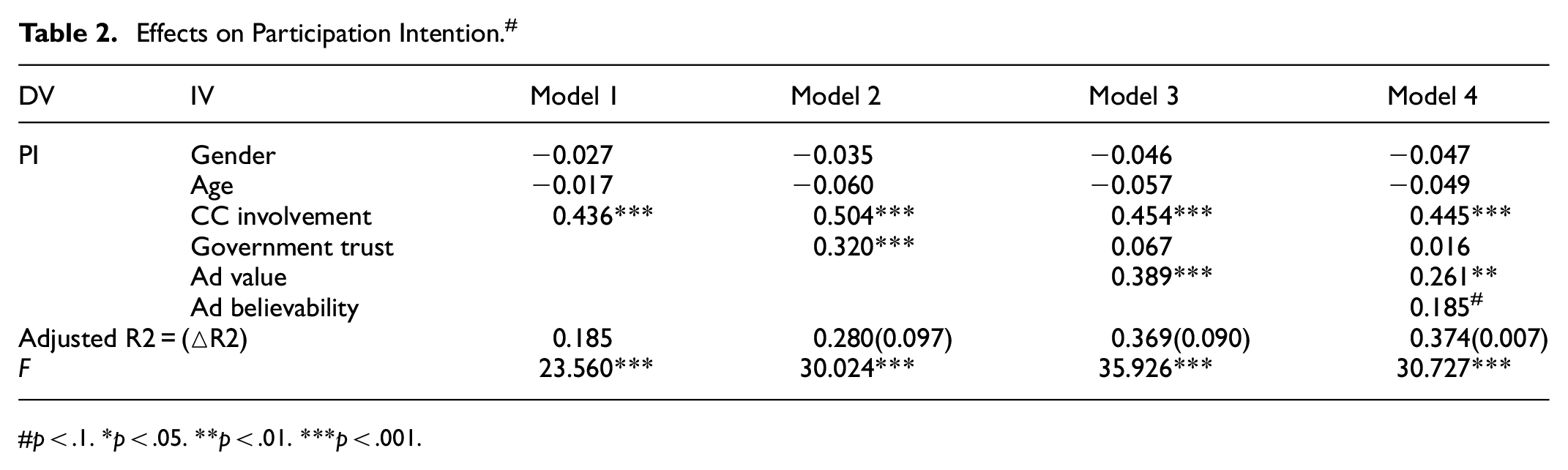
p < .1. *p < .05. **p < .01. ***p < .001.
Discussions and Conclusion
This study modeled and verified the antecedent factors that influence consumers’ advertising attitudes and behavioral intentions toward government advertisements on climate change. The results of the antecedents affecting government advertising on climate change are as follows. Involvement in climate change had a positive effect on attitudes toward government advertising (Hypothesis 1-1). Additionally, involvement in climate change had a positive effect on intention to participate in climate change campaigns (Hypothesis 1-2). Trust in government had a positive effect on attitude toward government advertising and intention to participate in campaigns (Hypothesis 2-1, Hypothesis 2-2). The value of government advertising was also found to have a positive effect on government advertising attitude and campaign participation intention (Hypothesis 3-1, Hypothesis 3-2). Government advertising believability had a positive effect on government advertising attitudes (Hypothesis 4-1). However, believability had no effect on intention to participate in the campaign (Hypothesis 4-2).
This study provides academic implications. First, the demographic variables used as control variables were found to have little influence. Only the role of age was partially verified.
The results of the study showed that gender did not have a statistically significant effect on both attitude toward government advertising and intention to participate. However, the final model showed that the younger the age, the more favorable the attitude toward government advertising on climate change. Age also did not have a significant effect on the intention to participate in government advertising on climate change. Demographic variables have been used as important segmentation variables in the past, but currently their influence is not great. However, in the current Korean society, where gender conflict is deepening and differences between generations are highlighted, a more in-depth discussion is needed on the communication effects of gender and age (Cha & Kim, 2023).
Involvement in climate change was used as the primary variable to verify the effectiveness of government advertising. As a result of the study, involvement in climate change was found to be an important issue. Involvement in climate change had a positive effect not only on attitudes toward government advertising but also on intention to participate. The same results were confirmed as previous studies demonstrating that involvement influences behavioral dimensions such as purchase intention along with the formation of attitudes toward advertisements, products, and brands in the field of communication for a long time.
Trust in government has a positive effect on climate change government advertising and participation intention in the initial model. However, after the advertising variable was introduced, its influence appears to disappear. The effect of trust in government on intention to participate in climate change appears to disappear immediately after advertising value is added. Attitude toward advertising is maintained even after advertising value is added, but disappears after government advertising believability is added. This result is due to the difference in relative importance between government trust, government advertising value, and credibility variables. Although trust in the government is an influential factor in consumer evaluations of government advertisements, consumer attitudes and behavioral intentions show that consumer perception of the advertisement itself is more important. This refers to the relative importance of government advertising variables. This means that the effect of the value and credibility of government advertising appears even after controlling for trust in the government, which is interpreted differently.
Perception of the value of government advertising is key to attitudes and behavioral intentions. The role of value is well explained in the value-attitude-behavior model. CAM focuses on the perceived value calculated by comparing the sacrifices that the customer must accept and the benefits that can be obtained to maximize value, and determines behavioral intention based on the perceived value. The role of these value appears to have been verified in government advertising as well.
Advertising believability affects attitudes and does not lead to behavioral intentions. Not much research has been done on the impact of advertising believability on consumers’ advertising attitudes and purchase intentions, so it is difficult to provide a consistent explanation for the results. For example Jun and Ham (2011) explained that advertising believability is a critical factor in consumer attitude and purchase, especially for new products. Furthermore, advertising believability could be an igniting factor to form strong purchase intentions. In this study, behavioral intention was set as the general intention to participate in climate change campaigns. Research results show that government advertising believability can shape general attitudes toward government advertising. However, the role of government advertising believability on general behavioral intention without a specific target may have been difficult to discover. When a specific advertisement was presented, respondents would have been able to form stronger attitudes and behavioral intentions based on the believability of the advertisement. In order to have a more in-depth discussion on the believability of government advertisements, follow-up research targeting specific government advertisements will be necessary.
This study also provides practical implications. Most importantly, when running government advertisements on the topic of climate change, there is a need to increase awareness of the value of government advertisements. There must be constant communication about the role of advertising and its necessity for public purposes, which are run by the government, not general companies. It is true that there are many negative perceptions about government advertising in Korea (Kim & Shim, 2020). Depending on political inclination, evaluations of what the government do also differ. In a democratic society, it is desirable for diverse opinions to be expressed. However, in order to raise awareness of government advertising performed for public purposes, work to appeal to the public about the value of government advertising must continue.
Increasing the believability of government advertisements is also a necessary task. The public does not completely trust government-run advertisements. There are many cases where there is suspicion that there is political intent. Even in the case of advertisements about issues that are important to humanity, such as climate change, securing the believability of government advertisements must come first. To make better advertising believability, marketers should consider that the ad message should be trustworthy, credible, convincible and reasonable because advertising believability is associated with the theme of the ad messages. Improving the believability of government advertisements must also be preceded by efforts to enhance trust in the government. In Korea, the value of government advertising and its believability are closely related to trust in the government. The fact that the effect of trust in government disappears due to the value and believability of government advertising in the research results means that, in other words, trust in government shares many aspects with the value and believability of government advertising. Therefore, a strategy is needed to increase both trust in the government and trust in government advertising.
Limitations come from the research design that explored general perceptions of government advertising. Although it provides a useful explanation for the overall perception of government advertising, it is limited in that it is not a detailed study of perceptions of government advertisements. This research design can also be confirmed in the results in which government advertising believability only affects attitudes and does not affect behavioral intentions. This requires further confirmation in follow-up studies targeting specific government advertisements. The study uses a non-parametric sample, which can limit the generalizability of the findings. Sampling issues can act as a limitation in generalizing the results. These limitations need to be supplemented through follow-up research. Research into the messages of specific government advertisements would also be meaningful. Research on perceptions of government advertising on topics other than climate change will also be needed.
Footnotes

Ethical Approval
*An ethics statement (including the committee approval number) for animal and human studies is not available.
Funding
The author(s) disclosed receipt of the following financial support for the research, authorship, and/or publication of this article: This work was supported by the Ministry of Education of the Republic of Korea and the National Research Foundation of Korea (NRF-2021S1A5C2A04089214).
Declaration of Conflicting Interests
The author(s) declared no potential conflicts of interest with respect to the research, authorship, and/or publication of this article.
Data Availability Statement
The data that support the findings of this study are available from the corresponding author upon reasonable request.