




Abstract
It is commonly assumed that international sport reinforces feelings of national pride and national identity. Using large-scale survey data from Germany, covering the period between 1992 and 2008, some unresolved key questions surrounding sportive nationalism are addressed. We examine the relative importance of sport as a source of national pride, analyze the sociodemographics of sportive nationalism, and describe its long-term development in East and West Germany after reunification. Results reveal that sport is an increasingly important source of pride in Germany. Sportive nationalism is more common among younger generations, males, and individuals with lower socioeconomic status. Prevailing differences between East and West Germany document persistent socialization effects of former sport-centered identity politics. Among East Germans, sport is more important for general national pride, and sportive nationalism is much more equally distributed between various social groups (with regard to age, gender, education). From 1992 to 2008, however, a trend toward convergence between East and West Germans is also demonstrated.
Introduction
The 20th century has seen the rise of international sports and of sportive nationalism. While Mussolini and Hitler demonstrated early how symbolic benefits can be reaped from international sport events, the so-called “politicization” of international sports, that is, the use of sport as a vehicle for identity politics, has heavily intensified after World War II (Tomlinson & Young, 2006). International sport events, in particular the Olympic Games, turned into an arena of the Cold War after the Soviet government had decided to participate in the 1952 Olympics in order to broadcast the message of communist superiority (Allison & Monnington, 2002). In particular, the two Germanys (the Federal Republic of Germany [FRG] and the German Democratic Republic [GDR]) became involved in a fierce “Cold War on the dirt track” (Balbier, 2005). In both parts of Germany, athletic success was regarded as a cue for general productivity and efficiency of the country. Furthermore, in the GDR sport became a vehicle for increasing the legitimacy of the socialist regime and for creating a distinct East German national identity (Holzweißig, 1995; Krebs, 1995).
After German reunification, however, sport was also used as a tool to enhance national unity and solidarity in the reunited country, for example, by giving the TV broadcast of the Olympic Games 1992 a highly patriotic orchestration, which was coined as “the new nationalism” of the German sports media (Gebauer, 1996). Moreover, the staging of the FIFA World Cup in 2006 and the associated marketing campaigns were also used to envision a tolerant, friendly, and open-minded nation and to foster a new self-image of the Germans, unburdened by the shame and guilt of World War II (Kersting, 2007; Schrag, 2009). Hence, the peculiarities of its history make Germany a very interesting case for studying sportive nationalism. Whereas older generations were socialized in two different states with contrasting ideologies, fiercely competing for superiority in the field of sport, younger cohorts were raised in a reunified country, where sport is seen as a tool to tie the nation together. Moreover, the open display of patriotism has recently become commonplace, at least in the realms of sport, which is also in stark contrast to the former norm of a reserved and dispassionate consumption of national sporting events (Ismer, 2011).
The fact that sport has been widely used as a vehicle for national identity politics has inspired scholars to assume that international sport plays a key role in reinforcing feelings of national identity and national pride (Washington & Karen, 2001). Scholars have particularly focused on effects associated with the hosting of large-scale sports events. For example, it has been claimed that the Rugby World Cup 1995 in South Africa fostered the nation-building process in the post-apartheid period by transforming the South African Rugby team, the “Springboks”—a former symbol of the apartheid era—into an icon of the new non-racist rainbow nation (Cornelissen, 2008; Farquharson & Marjoribanks, 2003). Moreover, the victory of the multiethnic French soccer team in its home World Cup in 1998 has been depicted as having inspired national pride as well as strengthened multiculturalism and inclusive citizenship as elements of French national identity (Marks, 1998). Studies on the 2008 Beijing Olympic Games (Lau, Lam, Leung, Choi, & Ransdell, 2012) and the 2010 Singapore Youth Olympic Games (Leng, Kuo, Baysa-Pee, & Tay, 2014) also conclude that staging these events positively impacted national pride, at least in the host city. Most recently, the Olympic Winter Games in Sochi, Russia, were used to create images of national strength and economic viability (Alekseyeva, 2014; Persson & Petersson, 2014).
In addition, there exists a vibrant research on the relation between media coverage of international sports and nationalism. Scholars have stressed that national stereotypes as well as nationalism and patriotism are reinforced through sport media (Billings et al., 2013; Blain, Boyle, & O’Donnell, 1993; Falcous & West, 2009; Garland & Rowe, 1999; Maguire, Poulton, & Possamai, 1999). Moreover, international sporting competitions have a salience enhancing function (Gebauer, 1996; Reicher, 2013). Media discourses render the national category salient, because media presentation is virtually always centered around the own nation’s athletes and favors sports and competitions in which national athletes are likely to perform well. Thus, broadcasts of international sport remind people permanently of their nationality. At least in Germany, media coverage of major sports events seems to have shifted from a matter-of-fact style in the 1970s toward a highly emotionalized, patriotic presentation likely to enhance the arousal and identification of TV viewers (Ismer, 2011).
Other researchers have addressed the question of how sporting success impact national pride. According to Kavetsos (2012), unexpected success at the UEFA Euro 2000 was positively related to national pride. Hallmann, Breuer, and Kühnreich (2013) concluded on the basis of a nationwide survey that a majority of Germans felt proud and happy when German athletes are successful at major sport events. A majority of Germans perceives Olympic medals indeed as important, but by far not as important as sticking to sporting values and the rules of fair play (Haut, Prohl, & Emrich, 2016). Moreover, studies conducted by Mutz (2013) and Von Scheve, Beyer, Ismer, Kozlowska, and Morawetz (2014) indicate that only individuals with a high degree of emotional and symbolic involvement become more patriotic during major football events. According to both studies, experience of strong emotions, participation in collective rituals, and adoption of national symbols are key factors explaining the changes between pre-event and post-event patriotism scores. In addition, Elling, van Hilvoorde, and Van den Dool (2014) as well as van Hilvoorde, Elling, and Stokvis (2010) provided evidence that the extent to which national pride can be influenced by sporting success seems to be rather limited and the eruptions in national pride might only be short-lived. National pride in Germany, for instance, increased steeply during the 2006 World Cup, but dropped at almost the same rate after the defeat of the German team in the semifinal (Mutz, 2013).
However, some key questions surrounding sportive nationalism have remained unexplored. Based on the assumption that its history turns Germany into an ideal laboratory for studying the relationship between sport and national identity, research presented here addresses some of these questions: First, we examine the relative importance of sportive nationalism compared with other sources of national pride as well as its correlation with general national pride. Second, we explore the social demographics of sportive nationalism in Germany. Third, as our data set covers a 16-year period from 1992 to 2008, we analyze differences between East and West Germans over time. Hence, the data allow for descriptions of long-term trends and shifts in sport-related national pride in both parts of Germany, beginning only two years after its reunification.
Sports-Related Policies in the Divided Germany
As in other domains, the division of Germany resulted—at least initially—in different trajectories of sport policy making. In the FRG, the sport movement struggled to recover from its collaboration with the Nazi regime that had compromised most of sport’s leading figures (Daume, 1973). These efforts for reconstruction resulted in a lasting tendency to present West German sport as an “Olympic model student” committed to particular high moral standards. Sport was now framed as a domain in its own right independent from politics and economics. Accordingly, the government was supposed to respect sport’s autonomy and to abstain from interventions (Krüger, 1995). Mainly due to the sporting challenge by the GDR, these efforts to abstain from using sport as vehicle for identity politics proved not sustainable (Balbier, 2005).
However, sport soon became a symbol of the successful reconstruction after the devastating defeat in World War II. The unexpected West German win of the Football World Cup in 1954 resulted in a national euphoria giving rise to the feeling of “We are somebody again” (Brüggemeier, 2004). The East Germans had their own athletic reconstruction heroes. Cycling world champion Gustav-Adolf “Täve” Schur became a legend and an ultimate communist role model when he waived his own chance for victory for a team mate during the 1960 World Championships. Schur remained a staunch supporter of the GDR even after its collapse and was voted East Germany’s biggest sport idol of all times in 1990 (Sajutkow & Gries, 2002).
Beyond serving as a reconstruction symbol, sport became a vehicle for identity politics as the East Germans turned sporting successes into a means for gaining diplomatic recognition. West German sport organizations tried to prevent such recognition on the basis of the Hallstein Doctrine, declaring the FRG as sole legitimate representative of Germany. Accordingly, East German elite athletes were turned into “diplomats in training suits” (Holzweißig, 1981) and the two Germanys became involved in a “Cold War on the dirt track” (Balbier, 2005). The quest for athletic dominance resulted in the creation of highly sophisticated sport systems utilizing the latest advances in exercise and training physiology (Hunt, 2007). As a matter of fact, the East German strategy proved to be successful as outstanding performances forced international sport authorities to finally recognize the GDR (Balbier, 2005). After the International Olympic Committee (IOC) had become increasingly tired of the intra-German arguments, the GDR was allowed to participate in the Munich Games of 1972 as a sovereign state and defeated the West German team on its home ground (Braun & Wiese, 2005). Thanks to enormous investments in training science, inclusive talent screening, and a clandestine “state doping” (Franke & Berendonk, 1997), the GDR became a sporting world power competing with the Soviets and the United States (Dann, 1996). Although the success of the GDR’s efforts to use sport as vehicle for increasing the legitimacy of the socialist regime and for creating a distinct East German national identity have been controversially discussed (Andersen, 2011; Fetzer, 2003; Holzweißig, 1995; Krebs, 1995), most scholars would admit that sporting successes have at least somewhat improved the identification of the GDR citizens with the socialist regime.
However, East German athletic dominance came with consequences for West German sport as the West German political elite perceived international sport as an important Cold War arena as well. The political interest in athletic achievements inspired the modernization of structures and policies within the West German sport movement because the federal government offered heavily increased subsidies in exchange for efforts to improve performances (Balbier, 2005, see also Meier & Reinold, 2013). Yet the increased politicization of sport remained controversial in West Germany. Sport became ideologically contested after the “New Left” adopted a highly critical stance toward high-performance sport and depicted sport as means of discipline and the extension of capitalist logics into leisure time (Rigauer, 1979). Thus, sport never occupied such a central role in West German self-representation and identity politics.
Thus, in sport as in other domains, the division of Germany served to create quite different institutions and policies. The fact that reunification has placed two very different societies under the West German regime has raised the question if and how East German attitudes and behaviors would adapt (Arnold, Freier, & Kroh, 2015; Bauernschuster & Rainer, 2011; Fuchs, Roller, & Weßels 1997; Konietzka & Kreyenfeld, 2002; Lee, Alwin, & Tufis, 2007; Svallfors, 2010).
Research Questions
In light of these peculiarities of its history, Germany represents an ideal case for studying the long-term effects of identity politics. The division of Germany has created a unique laboratory for examining political socialization effects of sport-centered identity politics. Three important yet unresolved questions are at the core of this study:
Method and Data
Data Source
The German General Social Survey (GGSS; GESIS—Leibniz Institute for the Social Sciences, 2012) is a cross-sectional survey with a focus on attitudes, behavior, and social structure in Germany. The GGSS has been conducted every 2 years since 1980 and contains a large body of permanent questions. Before German reunification in 1990, the sample represented the adult population of West Germany and West Berlin. Since 1992, the sample represents the resident adult population (>18 years) in East and West Germany. Questions on national identity and sporting national pride have been included in the 1992, 1996, 2000, and 2008 survey wave; hence, our analysis relies on these four waves. Sample sizes in these waves vary between 3,469 and 3,804 respondents. In each wave, at least 1,000 persons are surveyed in East Germany to allow for comparisons of East and West Germans. As questions on national pride were only presented to individuals with German citizenship, we cannot account for sportive nationalism of non-German residents. Details on the samples and questionnaires are provided on the website of the German Leibniz-Institute for the Social Sciences (www.gesis.org/en/allbus/) and in the GGSS technical reports (e.g., Wasmer, Scholz, & Blohm, 2010).
Variables
Research presented here uses the GGSS measures for domain-specific national pride and general national pride. Furthermore, sociodemographic indicators as well as political orientations are used as covariates in the models. These control variables are fully described in the Appendix.
Domain-specific national pride was assessed in each wave with questions addressing various German institutions and achievements: (a) the German constitution (“Grundgesetz”), (b) the German parliament (“Bundestag”), (c) achievements of German athletes, (d) economic achievements, (e) German art and literature, (f) scientific achievements, and (g) services of the welfare state. Respondents were told to choose up to three institutions or achievements, which make them proud of Germany. Across all GGSS waves, about 75% of respondents indicated the maximum number of three sources of pride, 15% reported to be proud of at least one or two of said institutions or achievements, and another 10% spontaneously replied not to be proud of any of the above-mentioned aspects. Based on these data, our operational definition of sport-related national pride is thus located on a relational level: Compared with six other possible sources of pride, respondents had to rank the achievements of athletes among the top three to be considered sportive nationalists.
General national pride was captured with one item, “I am proud to be a German.” This wording was used in the most recent survey of 2008. Respondents indicated their national pride on a 5-point rating scale. As general national pride was assessed with different items and scales in different waves, the GGSS is unsuitable for comparisons over time in this particular case.
Results
The Importance of Sport as a Domain of National Pride
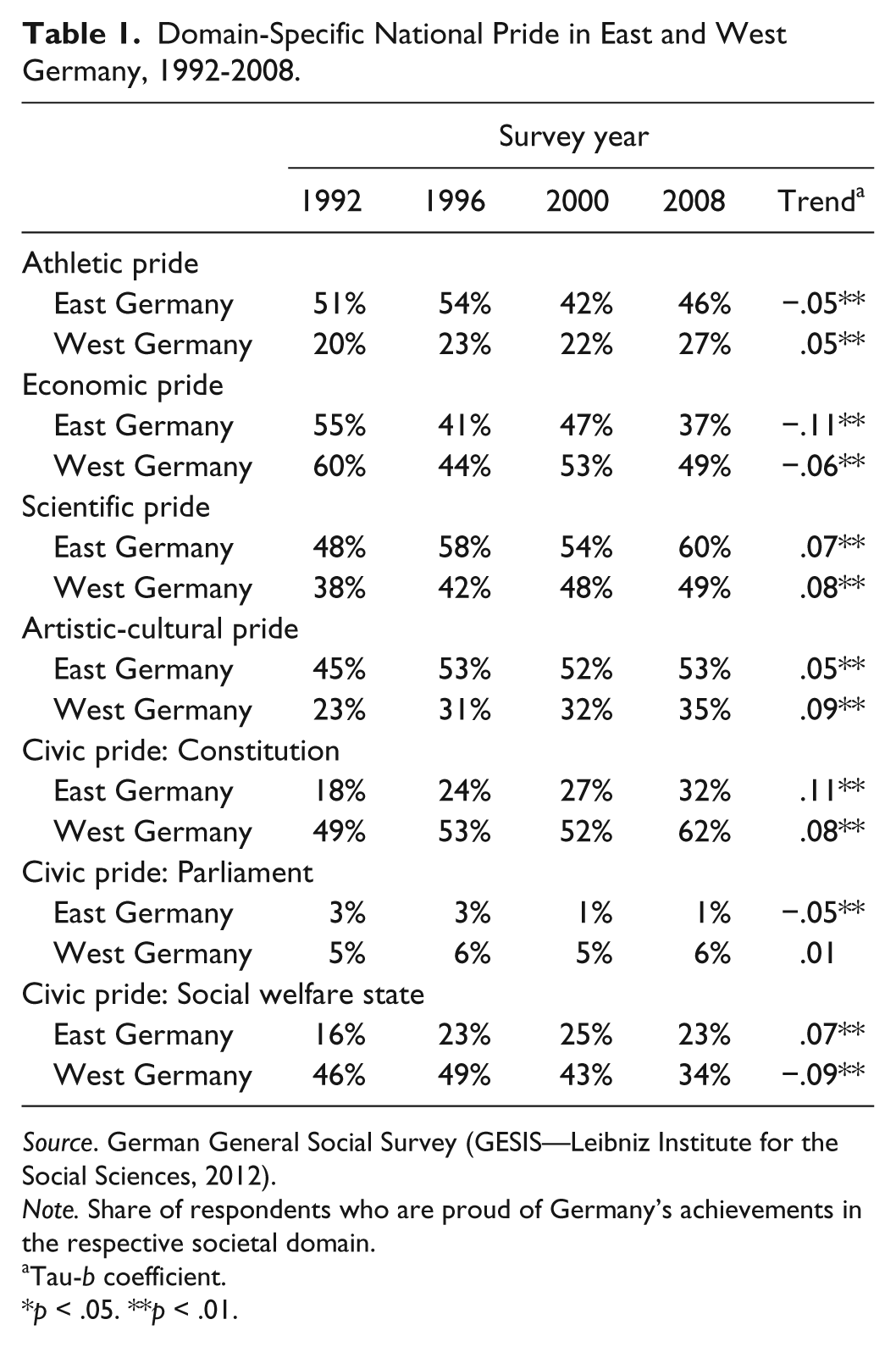
In several GGSS waves, respondents were asked which achievements make them feel proud of Germany. We document the share of respondents who are proud of Germany with regard to its achievements in the (a) athletic, (b) economic, (c) cultural, (d) scientific, and (e) civic domain, whereby the civic domain is measured with three items referring to constitution, parliament, and welfare state (Table 1).
Domain-Specific National Pride in East and West Germany, 1992-2008.
Source. German General Social Survey (GESIS—Leibniz Institute for the Social Sciences, 2012).
Note. Share of respondents who are proud of Germany’s achievements in the respective societal domain.
Tau-b coefficient.
p < .05. **p < .01.
Respondents in West Germany most frequently indicate that they are proud of Germany’s constitution as well as its economic and scientific achievements. Whereas pride in the constitution increased from 49% in 1992 to 62% in 2008, the importance of economic pride has decreased significantly, from a peak of 60% in 1992 to 49% in 2008. Science also became more important over time with 49% of Germans reporting to be proud of achievements in this domain in 2008. Sporting success of German athletes is of lesser importance in West Germany. Only a minority of 20% were proud of Germany’s athletic achievements in 1992. However, this share increased to 27% in the latest GGSS wave. Hence, although still at a rather low level compared with other domains, sport-related pride has become more common in West Germany from 1992 to 2008.
Data on East Germany, however, reveal a very different pattern. East Germans are less proud of civic achievements like the constitution, the parliament, or the welfare system. This may be due to their socialization under a very different political regime. Moreover, their pride in the economy declined sharply from 55% in 1992 to 37% in 2008, reflecting the enduring economic decline in the East German federal states. However, sport-related national pride is of far greater importance for East Germans compared with West Germans, because about one in two East Germans selected sport as a domain for national pride. This high level of sportive nationalism in East Germany is in line with the socialization hypothesis, which assumes a formative and thus long-lasting impact of the former GDR’s identity politics. Thus, even in 2008—18 years after reunification—the importance of sport as a domain for national pride varies strongly between East and West Germany. Sport is less important in West Germany, where the economic, scientific, and civic domains appear to be more important for national pride. In East Germany, however, sportive nationalism is far higher and positioned among the top domains for national pride.
At second glance, however, the data also support the notion of convergence between East and West Germany: Whereas sportive nationalism was 2.55 times higher in East than in West Germany in 1992 (51% vs. 20%), this ratio dropped steadily over time, to 2.35 (1996: 54% vs. 23%), 1.91 (2000: 42% vs. 22%), and 1.70 in the 2008 survey (46% vs. 27%). Hence, differences in sportive nationalism between East and West Germans became smaller and may converge in the long run.
Sport-Related National Pride and General National Pride
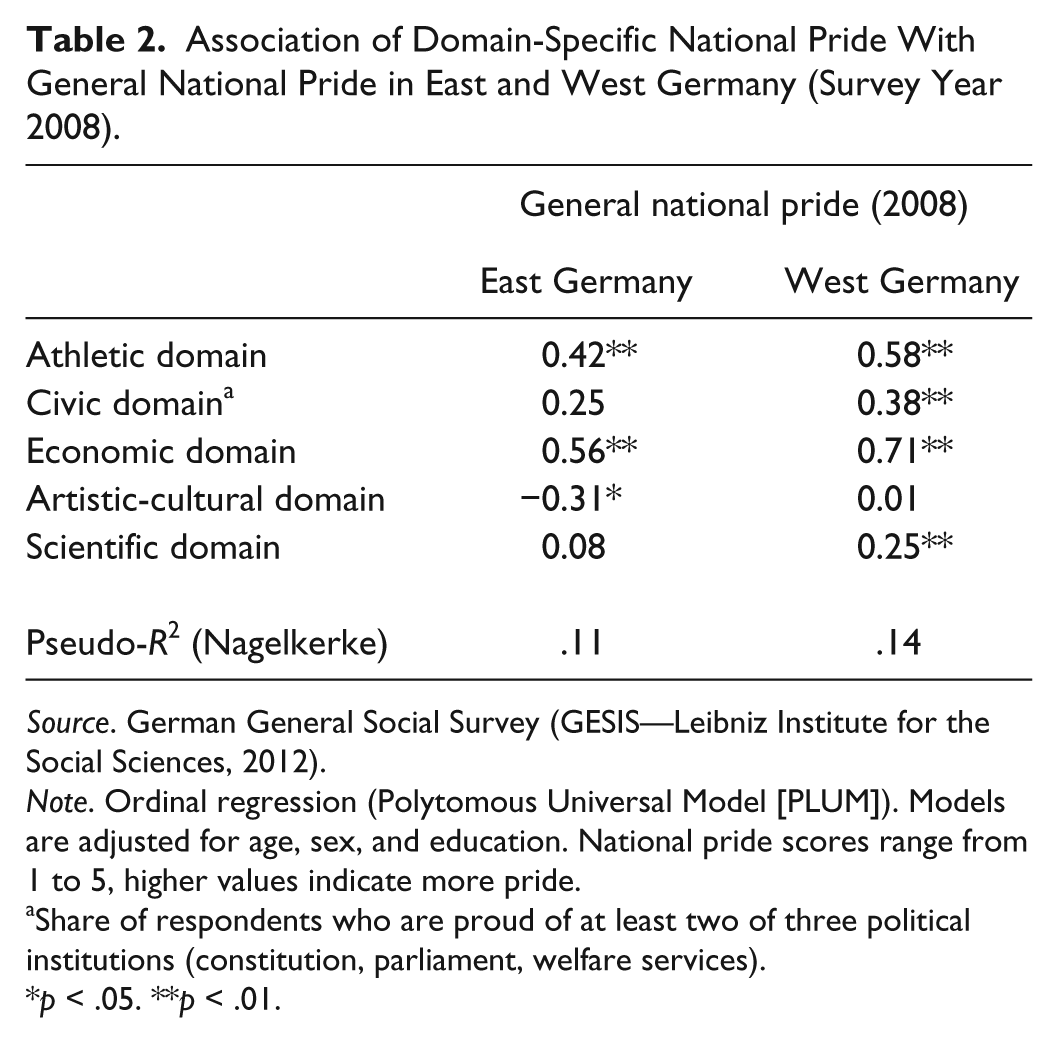
The last wave of 2008 included a question on general national pride, so that the relevance of sport for general national pride can be assessed. Accordingly, an ordinal regression model was conducted with general national pride as the dependent variable and domain-specific national pride scores as the predictor variables. Age, gender, and educational level of the respondents served as control variables. The model was calculated for East and West Germany separately (Table 2).
Association of Domain-Specific National Pride With General National Pride in East and West Germany (Survey Year 2008).
Source. German General Social Survey (GESIS—Leibniz Institute for the Social Sciences, 2012).
Note. Ordinal regression (Polytomous Universal Model [PLUM]). Models are adjusted for age, sex, and education. National pride scores range from 1 to 5, higher values indicate more pride.
Share of respondents who are proud of at least two of three political institutions (constitution, parliament, welfare services).
p < .05. **p < .01.
It has to be noted, however, that cross-national research supports the idea that Germans show comparatively low levels of national pride (Evans & Kelley, 2002). In the GGSS samples, about 15% to 20% of the adult population report a strong sense of national pride. These rather low numbers are usually ascribed to Germany’s inglorious past. In view of the atrocities of the Nazi regime and due to the collective guilt over these crimes, the open expression of national pride is still considered inappropriate by many, particularly in older generations. Hence, those who openly express a strong sense of national pride are mostly younger people, those with right-wing political orientations and a rather uncritical attitude toward Germany’s history.
Results reveal that sportive nationalism is a strong predictor of general national pride in both parts of Germany. Respondents who chose sport as an important domain for national pride also indicated more general national pride. Besides the economic sphere, sport is most closely correlated with general national pride. At least in West Germany, civic and scientific national pride are also positively correlated with general national pride; however, the effects of these domains are not as strong as for sport. In East Germany, perceived achievements in the civic and scientific domains are not significant predictors of general national pride. Pride in artistic and cultural achievements is not substantially associated with general pride in West Germany and even negatively correlated with general nationalism in East Germany. Hence, athletic success does not only lead to sport-related national pride but also fosters general nationalism. Achievements in other societal domains, for example, in the field of arts and literature, might nurture domain-specific pride but do not increase general national pride to a noticeable degree.
The Sociodemographics of Sportive Nationalism in Germany
Concerning the sociodemographics, previous research suggests that higher levels of sportive nationalism correlate with a lower educational level and fewer economic resources. Here, we analyze the sociodemographics of sportive nationalism with regard to age, gender, education, income level, self-placement in the left–right political spectrum and place of residence, that is, East versus West Germany.
Given the fact that Germany provides a “natural experiment” for studying socialization effects of sport-centered identity politics, it is of utmost interest to examine East–West differences and changes in the sociodemographics of sportive nationalism over time. Therefore, we tested for interactions of the sociodemographic variables with (a) East and West Germany and (b) with the survey year. The first set of interactions accounts for differences in the sociodemographic distribution of sportive nationalism among East and West Germans, whereas the second set of interactions allows for trend analyses over a 16-year period (1992-2008). Although we tested for all possible interactions, the final logistic regression model (Table 3) only includes those effects which turned out as significant.
Sociodemographics of Sportive Nationalism in Germany, 1992-2008.

Source. German General Social Survey (GESIS—Leibniz Institute for the Social Sciences, 2012).
Note. Logistic regression. Pooled analysis of four German General Social Survey waves: 1992, 1996, 2000, and 2008. Table presents logits (b) and odds ratios (OR). N = 9,630.
p < .10. *p < .05. **p < .01.
Significant main effects are found for all of the included variables: A higher degree of sportive nationalism is a characteristic of younger generations, males, individuals with lower and medium educational levels, a lower income, and for East Germans. The generation effect illustrates that older respondents are less prone to report sportive nationalism than younger respondents. Respondents born in the 1970s and 1980s show significantly higher levels of sportive nationalism compared with respondents born before 1950, hence compared to those socialized under the Nazi regime and/or in the post–World War period. The gender effect on sportive nationalism seems highly plausible: Because sport represents a highly gendered sphere, it does not come as a surprise that males also take more pride from Germany’s sporting success. In addition, education and income seem to strongly influence sporting pride. Thus, our findings support similar results from other studies, which also documented more sporting pride among lower status groups (Elling et al., 2014; Hallmann et al., 2013; Haut et al., 2016). Findings thus support claims made by Schediwy (2012) that identification with successful German athletes becomes more attractive in times of economic crisis, in particular among individuals with lower social status who are economically more vulnerable. For these individuals, identification with successful sport teams and athletes may, at least gradually, compensate for the loss of individual self-worth that typically results from unemployment or precarious working conditions. Moreover, the time variable (survey year) once more indicates that sportive nationalism generally has increased in Germany from 1992 to 2008.
These findings appear to be quite stable over time because only one of the interaction effects with the survey year reaches significance. Namely, the significant interaction with East/West Germany shows that the main effect—that East Germans feel more pride when Germany’s athletes succeed—has decreased over time. Similar to a number of other legacies of East German political socialization, differences in sports-related pride appear to wane over time and even may converge in the long run.
Nevertheless, the differences between East and West Germany with regard to sportive nationalism are still striking. Besides the markedly higher level of sport-related national pride in East Germany, further socialization effects are indicated by the fact that sportive nationalism in East Germany is less influenced by education, less “gendered” and more equally distributed among different generations. Hence, East German women and better-educated East Germans are more likely to display sportive nationalism than their West German counterparts. Moreover, older East Germans show more and younger East Germans less sports-related pride compared with West Germans of the same generation. In addition, East German identity politics seem to have succeeded in dissolving the relationship between right-wing attitudes and sportive nationalism. Whereas in West Germany sportive nationalism is more common among those who place themselves further right on the left–right political continuum, there is no such effect in East Germany. Hence, one effect of the GDR’s sports-centered identity politics may be seen in the fact that sportive nationalism is much more equally distributed between various social groups (with regard to age, gender, class, etc.) in East Germany compared with West Germany.
Discussion
Taking Germany as a crucial case, research presented here has addressed a number of questions concerning the role and specific contours of sportive nationalism. By analyzing a unique longitudinal German data set consisting of four surveys and covering a 16-year period, we addressed some unresolved key questions concerning sportive nationalism and sports-based identity politics.
Regarding the relative importance of sportive nationalism, we were able to demonstrate that pride in athletic achievements represents an important source of national pride, but that other societal domains, such as economy, science, and culture are more important. This, however, is not true for East Germany, where pride gained from athletic achievements is a more prevailing phenomenon. However, pride in athletic achievements has also grown in West Germany until 2008, which might reflect the rise of sport as a global entertainment industry and may mirror the German “summer tale” of 2006 where the national football team inspired the masses at the German World Cup. Moreover, sportive nationalism proved to be a main predictor of general national pride. Hence, athletic success is to a greater extent linked to the nation as a whole than achievements in science, arts, or politics.
Furthermore, we have explored the sociodemographics of sport-related national pride. The findings support a number of intuitive assumptions concerning sportive nationalism. A higher degree of sportive nationalism is more common among younger generations, males, individuals with lower and medium educational levels, and a lower income. These findings inspire a number of interpretations. First, sportive nationalism might indeed serve self-esteem enhancing purposes for most vulnerable social groups. Second, the gendered character of sport has the effect that the domain represents a far less important source of national pride for women. Third, sport-centered identity politics have long-lasting socialization effects. The emphasis on success in high-performance sport under the socialist regime in the former GDR has indeed resulted in higher levels of sportive nationalism among East Germans, continuing until today. However, just like other legacies of the socialist regime, the socialization effects of the GDR’s identity politics wane in the long run. From reunification until 2008, a significant trend toward convergence can be detected when it comes to the levels of sportive nationalism in East and West Germany.
Finally, it is necessary to reflect on the limitations of our study. While we believe that the longitudinal character of the GGSS data serves to increase the robustness of our findings, two major limitations have to be mentioned. First, the forced choice format used by the GGSS is far from optimal and should be replaced by rating scales. Second, the exclusion of immigrants prevented us from addressing the question how sportive nationalism figures among ethnic minorities.
Footnotes
Appendix
Covariates Included in the Regression Models.

| Variable | Comments | Descriptive statistics for each wave |
|---|---|---|
| Generation | Dummy variables based on year of birth of respondent | Wave 1992: <1934 = 27%; 1934-1949 = 26%; 1950-1969 = 42%; >1969 = 5% |
| Wave 1996: <1934 = 19%; 1934-1949 = 28%; 1950-1969 = 41%; >1969 = 12% | ||
| Wave 2000: <1934 = 17%; 1934-1949 = 27%; 1950-1969 = 39%; >1969 = 17% | ||
| Wave 2008: <1934 = 10%; 1934-1949 = 25%; 1950-1969 = 38%; >1969 = 27% | ||
| Sex | Dummy variable for females (= 1) vs. males (= 0) | Wave 1992: female = 51%; male = 49% |
| Wave 1996: female = 51%; male = 49% | ||
| Wave 2000: female = 52%; male = 48% | ||
| Wave 2008: female = 51%; male = 49% | ||
| Educational level | Dummy variables for lower secondary education, medium secondary education, and higher secondary education vs. tertiary education | Wave 1992: low = 51%; med = 28%; high = 14%; very high = 8% |
| Wave 1996: low = 48%; med = 29%; high = 15%; very high = 8% | ||
| Wave 2000: low = 48%; med = 28%; high = 16%; very high = 9% | ||
| Wave 2008: low = 41%; med = 30%; high = 17%; very high = 12% | ||
| Region of residence | Dummy variable for East Germany (= 1) vs. West Germany (= 0) | Wave 1992: East = 20%; West = 80% |
| Wave 1996: East = 21%; West = 79% | ||
| Wave 2000: East = 20%; West = 80% | ||
| Wave 2008: East = 20%; West = 80% | ||
| Income category | Original values. Values range from 0 = no income to 22 = more than 7,500 euros/month | Wave 1992: M = 7.24; SD = 5.05 |
| Wave 1996: M = 8.10; SD = 5.12 | ||
| Wave 2000: M = 8.60; SD = 5.31 | ||
| Wave 2008: M = 9.33; SD = 5.68 | ||
| Left–right placement | Original values. Values range from 1 = left to 10 = right | Wave 1992: M = 5.36; SD = 1.87 |
| Wave 1996: M = 5.27; SD = 1.79 | ||
| Wave 2000: M = 5.08; SD = 1.75 | ||
| Wave 2008: M = 5.20; SD = 1.73 | ||
| Survey year | Values range from 1 = wave 1992 to 4 = wave 2008 | — |
Declaration of Conflicting Interests
The author(s) declared no potential conflicts of interest with respect to the research, authorship, and/or publication of this article.
Funding
The author(s) received no financial support for the research and/or authorship of this article.