




Abstract
Few studies have investigated national identity construction in a diachronic and holistic manner. To address this gap, in applying constructivist views of international relations and Critical Discourse Analysis (CDA), this paper analyzes business news titles of Chinese and ASEAN (Association of South-East Asian Nations) country mainstream media to reveal identities that both parties construct of one another and relationships between discourse and identity construction. Findings suggest that ASEAN identities constructed by Chinese media are positive and complimentary, demonstrating its adherence to foreign policies of neighborliness and friendship. However, ASEAN countries develop a range of contradictory identities toward China. This paper concludes that such discourse manifests and constructs national identities and shapes international relations. The paper also proposes that in facing passive identities constructed by ASEAN countries China must construct a clear discourse theory to make its voice heard, project China’s stance on the international stage, respond actively to skepticism, and construct images of peace, development, and friendship.
Keywords
Introduction
As the “center of social science” (Bamberg et al., 2007, p. 1), identity construction is a heated topic in discourse studies. Several scholars note that studies of international relations and national identity based on language/discourse facilitate the formulation and enforcement of national strategies while offering guidance on foreign policy design (Hansen, 2006; Shi-xu, 2014; Sun, 2008; Wodak et al., 2009; You, 2011). Recent research has enriched our understandings of national identity construction through developing a sense of Others during a nation’s encounter with foreign countries (Suzuki, 2007). For example, this is manifested in how Japan strives to establish its national identity by responding to the Western others and the Asia others (Tamaki, 2019). Similar trajectories have also been observed in China and Korea where this notion of Other “was incessantly reproduced to construct ‘our nation’” (Seo, 2021).
ASEAN, short for “Association of South-East Asian Nations,” is a transnational organization founded in 1967. Originally there were five countries—Indonesia, Malaysia, Philippines, Singapore, and Thailand. About two decades after the founding, Brunei Darussalam, Vietnam, Lao PDR, Myanmar, and Cambodia joined the organization. During the Cold War, relationship between China and the ASEAN countries was troubled, because some countries such as Philippines and Thailand resisted China’s exportation of communist revolution. It was not until 1971 that the China-ASEAN relationship gradually began to restore (Lu, 2011).
As China’s third largest trading economy and an important component of the Belt and Road Initiative, which is a policy initiated by China for the formation of a shared community in which ASEAN plays a vital role. ASEAN has always been a good neighbor and a friend of China despite certain unavoidable disagreements and fractions through their association. As a result, it is of great significance to examine the national identity constructions based on discourse to better understand the development of China-ASEAN relations. The current research analyses business news titles of Chinese and ASEAN country mainstream media from a CDA perspective and discusses the cross-construction of national identities, namely the China’s national identity construction by ASEAN and those of ASEAN’s members by China. We focus particularly on Malaysia, Philippines, and Indonesia because they are involved in territorial disputes with China, which has been a defining element for China-ASEAN relationship since July 2013.
The Discursive Construction of National Identity
A country’s national identity, which is formed through its interactions with other countries based on its self-cognition, represents its image on the global stage. For example, Wendt (1999) once stated that meaningful attributes of nations are constructed through relationship among countries as actors who create identities for each other and behave accordingly. The behavior of a national actor is reflected in its discourse, which is designed to construct social realities such as identities and relations (Gee, 2005). This view echoes that of De Cillia et al. (1999) and Wodak et al. (2009) who hold that national identity construction—discursively created, recreated, transformed and decomposed—represents a special form of social identity.
In the field of international relations, identity, as a product of social language construction, is sustained and developed through language. It acts as an independent factor that affects international orders especially in times of crisis (Sun, 2008). Both constructivists and post-modern theorists of international relations believe that language not only reflects social realities but also (re)constructs them (You, 2015). The role that language plays in the formation of national identity is self-evident. Language is needed not only for the construction of a country’s own properties but also for the construction of relations between countries (Epstein, 2011, 2013; Zhao, 2013), which is why some scholars claim that there is no so-called objective “reality” in international relations and that all realities are discursively constructed. Elsewhere, this relational understanding of national identity construction is known as Self-Other dynamics that helps draw the boundary between social groups (Abdelal et al., 2009). In national identity politics, sovereign states are involved in recognition games in which some states attempt to become recognized by the international Others and claim their self-image (Nissen & Tsinovoi, 2018). Such an intersubjective conception of national identity driven by material incentives facilitate the design of foreign policies that foster cooperation and engender conflict with foreign countries in order to maintain national interests (Köstem, 2018).
Some scholars approach identities in reference to national defense discourse (Liang & Tan, 2015) and China-US government defense white books (Dou et al., 2012; Shi-xu, 2016; Zhang, 2012). Among scholars focusing on human rights discourse, Bu (2014) explores the discursive construction of human rights within the framework of human rights and its practical use and trans-cultural barriers, based on which he puts forward suggestions on the international dissemination of human rights law in China. Shi-xu (2014) analyzes the problems that China confronts concerning human rights and its responses to specific situations. He believes that efficient, multidimensional, and fierce responses made by Chinese official newspapers have weakened accusations that the United States has lodged against China’s human rights and thus have indirectly proven that China’s image with regard to human rights has been improved.
Other scholars of international politics have also examined national identity construction by analyzing diplomatic discourses in international conferences (e.g., Liu, 2013; Xue, 2015). In exploring Chinese leaders’ speeches given at the China-ASEAN Summit, Liu (2013) holds that Chinese leaders have constructed an identity and image as “cooperators.” His study serves as evidence that national identity is not given but is discursively constructed. Xue (2015) claims that conceptual metaphors selectively employed in speeches are closely related to a country’s political positions and wills, based on which different national identities are constructed. Gu (2018) examines China’s political press conference data and has noticed a gap between the Chinese version and its English translation. He believes that the latter has been modified by the interpreters to reinforce a glorified national identity on the global stage.
In sum, previous studies on discourse and national identity have shown how national identity is shaped by discourses of different areas by only exploring the discourse of certain sides. Most researchers are interested in the sender of messages, whereas the interactive process of identity construction remains understudied. They have, therefore, failed to offer a comprehensive understanding of national identity construction process. To solve this problem, we examine how a nation constructs its own identity and is being constructed by others via trade discourse. We believe that examining the trade discourse of both sides can help the international community (particularly major economies such as the United States, European Union, and ASEAN countries) understand China’s trade discourse and China’s course of peaceful development.
Theoretical Background
Research on national identity construction based on constructivism and post-structuralism is a burgeoning area in international relations. Both perspectives stress the significance of discourse in constructing national identity. The former holds that discourse of social practices contributes to national identity construction (Onuf, 1989; Risse, 2000). The latter highlights the central role that discourse plays and does not readily place trust in social realities because they are at large constructed by discourse (Derian, 1989; Neumann, 2009). Research suggests that discourse is more than a tool that people use to understand the world, it is also a product of society and an integral part of social reality (Fairclough, 2006; Fairclough & Wodak, 1997). Through social structures, social practices, and social events, Fairclough (2006) explains how the social world functions and how social practices, which are revealed in orders of discourses, mediate social structures and the more concrete social events. Therefore, as a form of social practice, discourse constructs social identity, shapes social relations, and facilitates understandings of the world. In media representation, such discursive practice is highly contingent upon power relations within the society. Certain social practices and social events may be considered as legitimate and normalized as knowledge while others may not be well represented in media due to their sociopolitical positioning (Caldas-Coulthard, 2003). A growing number of scholars have paid attention to the media framing issues in their studies, including refugee and asylum seeker coverage (Cooper et al., 2017), ideological impact of news bulletin headlines (Hassan, 2018), and air pollution news and national image (Wang, 2018). In light of these studies and the observation that news coverage is seldomly value free (Van Dijk, 1988), we believe CDA can enrich our understanding of discursive construction of national identity in media coverage.
According to Fairclough (1993, as cited in Hassan, 2018), CDA involves text analysis including vocabulary, grammar, cohesion, text structure, analysis of utterance force, text coherence, intertextuality in text, and sociocultural analysis, which is mainly concerned with power relations embedded in the social world. Based on a language as social practice view, analyzing discourse helps uncover ideologies, social positions, and identities embedded in texts (Fairclough, 2006). Hernandez (2008, p. 229) for instance investigates national identity construction in media discourse and suggests that a critical perspective “allows the researcher to examine and understand the broader social and cultural context in which identities are constructed through language as social practice.” Due to space limitations, we focus on the discourse analysis of the classification of subject identities in discourse. Specifically, the current study adopts a dialectical perspective in exploring identity constructions of China and ASEAN countries by each other and the distribution of and changes in these identities from 2009 to 2013. In so doing, this paper shows China’s attitudes toward ASEAN countries and measures its consistency in diplomatic policy making. It also analyzes differences in the patterns of identity construction between the two sides and offers guidance on China-ASEAN diplomatic relations.
Data Collection
We examined three newspapers from ASEAN countries, namely The Star Online in Malaysia (https://www.thestar.com.my/), Philippine Star in Philippine (https://www.philstar.com), and Jakarta Post in Indonesia (https://www.thejakartapost.com). We have selected these three newspapers to build the corpus of ASEAN business discourse due to the linguistic diversity of ASEAN countries and the limited sample size of English media. Malaysia Times (MYT), Philippine Stars (PHS), and Jakarta Post (JAS) are the major English-language newspapers in each country. They constitute an English dataset comparable to People’s Daily in size. Among the three newspapers, The Star Online is the most circulated newspaper in Malaysia and is controlled by the government (Kasim & Mohd Sani, 2016). Philippine Star is one of the top three readership and circulation newspapers in Philippine that publishes more pro-government and positive stories (Rosales & Lowry, 2000). Jakarta Post is the largest English newspaper in Indonesia and supports anticorruption movement (Kurniawan & Utami, 2017). The Chinese corpus is built from reports on China-ASEAN trade collected from the overseas section of People’s Daily (http://en.people.cn). This is one of the most prominent Chinese media outlets and represents the voice of Chinese government as its content is supervised by the Chinese Government’s Central Committee’s Central Publicity Department (Montiel et al., 2014).
We first entered keywords “China,” “ASEAN,” and “trade” on its website to collect 70 excerpts of news. Using the keywords “China and ASEAN” and “Chinese trade with ASEAN” on the websites of the three newspapers, we collected 29 excerpts of news from The Star Online (TSO), 34 excerpts from Philippine Stars (PHS) and 27 excerpts from Jakarta Post (JAS), forming a corpus of 90 excerpts altogether. Data collected from ASEAN country newspapers covers the period from January 1st, 2009, to June 1st, 2013. We use this time period because from 2009, the China-ASEAN free trade zone has removed tariffs, as a result, trade between China and ASEAN has sky-rocketed, spurring a considerable amount of business discourse. Furthermore, since July 2013, the South China Sea Issue 1 has become increasingly prominent, impacting the business relations of both sides and causing relevant discourses to be somewhat oriented toward politics.
Data Analysis
A combination of quantitative and qualitive analysis was adopted in this study. First we quantified identity categories in each separate year and presented in tables for the ease of comparison, then we coded positive and negative identities appeared in news titles. During our coding, titles that use derogatory or hostile terms are considered as negative, those that include friendly and up-lifting tones are viewed as positive. Informed by grounded theory (Strauss & Corbin, 1998), we then provided a brief qualitative interpretation of identity categories and the number changes across years, considering sociocultural and political contexts. During the qualitative phase, the authors independently categorized identities from titles, further confirmed news reports, and negotiated with each other to reach agreements when discrepancies arose. The level of inter-rater reliability was measured at .86, denoting the use of highly stable judgments and highly reliable categorizations. In the following section, we classify these identities based on news titles and news content (when titles do not provide sufficient information for explicit identity identification) along with detailed explanations.
Findings and Discussion
The Classification of Identities Constructed by China and ASEAN Countries
Chinese and ASEAN identities are defined as follows. Examples of news titles considered are listed in Tables 1 and 2.
ASEAN Identities Constructed by Chinese Media Outlets.

Chinese Identities Constructed by ASEAN Media Outlets.
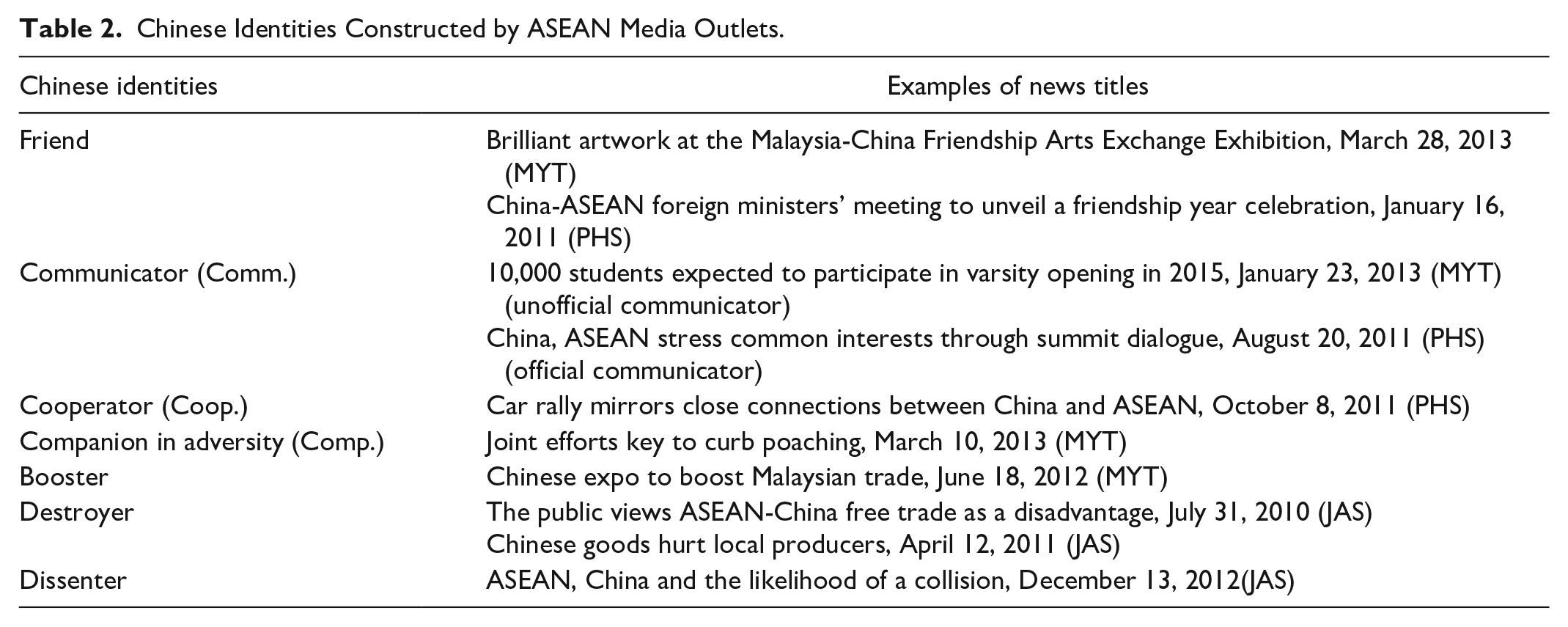
China most frequently refers to ASEAN as a “beneficiary in cooperation” and “communicator,” while ASEAN most frequently refers to China as a “cooperator” and “booster.” This suggests that cooperation and exchange are the main issues discussed in relation to China-ASEAN trade. China relates five identities to ASEAN, while ASEAN relates seven different identities to China. Of these identities, the “companion in adversity,” “friend,” and “communicator” identities are referenced by both entities. ASEAN is also referred to as a “governmental organization,” while China is also referred to as a “booster,” “dissenter,” and “destroyer.” The largest number of identities was referenced in 2011, with identities for ASEAN constructed by China being positive while identities for China constructed by ASEAN were varied and occasionally negative. Additionally in 2013, only one identity was constructed by China while 23 were constructed by ASEAN. This may suggest that ASEAN was confident in and relied on economic relationships and trade with China before the South China Sea conflict emerged.
Friend
When calls are made between leaders of two sides, contact and mutual understanding between China and ASEAN are viewed as communication between friends, and ASEAN is constructed as a “friend” by the Chinese media. Under this category, most identities are official friends featured by communication between national leaders or countries. Keywords such as “ties” and “friendship” are included in the titles.
Communicator
Generally speaking, meetings or visits among national leaders are coded as dialogues for China-ASEAN communication. From this point of view, ASEAN is categorized as a communicator, which includes two subdivisions: an official communicator and an unofficial communicator. The former refers to national leaders who attend conventions or deliver speeches in public. Some titles of this type also indicate that “a multilateral dialogue relation” has been forged. The latter focuses on interactions among multilateral non-governmental organizations covering the economy, trade, and cultural communication. Keywords in such titles include “dialogue” and “talk.”
Governmental organization
Governmental organization is ASEAN’s most basic identity. ASEAN, as a body of 10 Southeast Asian countries, facilitates cooperation and exchange with other national organizations.
Beneficiary in cooperation, companion in adversity
ASEAN has mostly been described as a beneficiary in cooperation, meaning that ASEAN has cooperated with China and has benefited considerably as a result. Titles of this type often include keywords such as “cooperation” (e.g., “deepen regional cooperation to achieve multilateral prospects,” “new sparks in China-ASEAN economic trade and cooperation,” and “cooperation is a win-win,” etc.) and “benefit.”
Despite the generally prosperous and mutually beneficial development of multilateral businesses, a number of problems face both sides. Such problems have bound China and ASEAN, and the interests of both sides can be maximized by settling these problems together. Titles of this kind are characterized by highlighting problems or challenges that face both sides as indirect evidence of this identity. The “companion in adversity” and “cooperator” distinctions differ in that the latter refers to the potential for cooperation while the former calls for cooperation (i.e., when China and ASEAN refuse to collaborate, they both suffer as their destinies are intertwined) (You, 2011, p. 245).
ASEAN most commonly characterizes China as a cooperator. Titles of this category typically refer to certain cooperation programs. Similarly, when faced with bottlenecks of cooperation and development, the two sides must address them jointly as reflected in the titles with keywords such as “joint effort.”
Booster
Both “China” and “ASEAN” are included in the titles of this category, suggesting that China-ASEAN cooperation has generated more development opportunities and benefits for ASEAN. Keywords such as “gaining from ACFTA” and “create opportunity” indicate that China has boosted ASEAN’s trade development.
Destroyer and dissenter
These two identities suggest that ASEAN’s interests are being infringed upon through its trade with China, impacting local economies and trade. China is also described as a dissenter when the two sides disagree on certain treaties.
ASEAN’s Identities Given in Separate Years
As is shown in Table 3, ASEAN’s identities are constructed with different frequencies in separate years.
ASEAN Identities Constructed by Chinese Media Outlets in Separate Years.
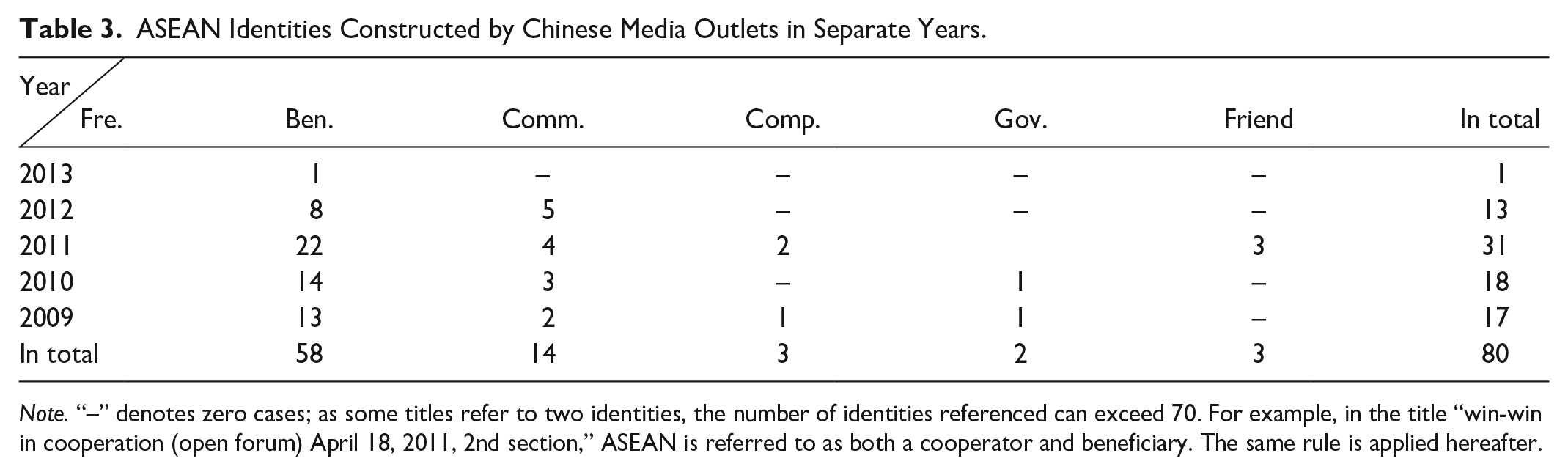
Note. “–” denotes zero cases; as some titles refer to two identities, the number of identities referenced can exceed 70. For example, in the title “win-win in cooperation (open forum) April 18, 2011, 2nd section,” ASEAN is referred to as both a cooperator and beneficiary. The same rule is applied hereafter.
Although the reality is not that rosy, People’s Daily, the most influential state-run newspaper in China, continues to beautify the image of ASEAN through politeness strategies. According to Table 3, ASEAN is most often portrayed as a “beneficiary in cooperation,” less so as a “communicator,” and the least often as a “governmental organizer.” Based on this, we can conclude that cooperation and business exchanges is a theme of China-ASEAN relations, and China adopts favorable views of ASEAN, thus constructing positive identities in referring to it.
The way People’s Daily frames ASEAN countries creates the notion of sameness in which China and the three ASEAN countries are all viewed as “us,” instead of a binary construal of “us” and “them.” Such framings thus downplay the territorial disputes and suggest that a peaceful China-ASEAN relationship, regardless of territorial disputes, is of mutual interests to all parties. In addition, People’s Daily offers precise and authoritative information of the Chinese grand strategy. Different years also show varied identities ascribed to ASEAN. First, 2013 presents the fewest identities (this is related to the research period), and the number and categories of identities referenced in 2009 and 2010 are roughly the same. Most identities are referenced in 2011, which is a year characterized by friendly China-ASEAN exchanges and the 20th anniversary of China-ASEAN dialogue. Over the past two decades, China and ASEAN have served as an example for regional cooperation for the rest of the world by benefiting one another, boosting the regional economy, and maintaining regional peace. In 2012, frequencies and categories of identities decreased slightly. This is the year in which many countries including those of the European Union experienced economic decline and the trading environment of the Asia-Pacific region did not support trade between China and ASEAN.
By referring to history, People’s Daily seeks to justify a peaceful co-existence of China and ASEAN countries, even though it is not always the case. The year of 1979 witnessed a war between China and Vietnam. Most recently, the South China Sea Issue has caused a sequence of conflicts in China-ASEAN relations. There are internal disputes within ASEAN as well. For instance, a part of Malaysia and Philippines’ territorial claims overlaps with each other (Majumdar, 2015). Nevertheless, reference to the historical neighborhood friendship is seen as one of the antidotes to the regional tension. Economic and social realms of the history are highlighted to downplay the political divergence.
Example No. 1) “China-ASEAN partnership for 20 years, a 37-fold increase in trade volume” (August 16, 2011) (中国东盟伙伴关系第二十年,贸易额增长三十七倍).
Example No. 2) As close neighbors and intimate friends, people in China and ASEAN initiated exchange a long time ago (January 16, 2011) (中国与东盟山水相连, 彼此相依, 民众间有着历史悠久的往来和传统友谊).
Example No. 3) ASEAN is home to the largest population of overseas Chinese, and the region has been economically and socially connected to China for a long period. History and geopolitical relations have determined that ASEAN is China’s first choice as a partner in free trade zone construction (December 28, 2011) (东盟是中国境外华人聚居最多的地区, 中国与东盟的经济, 社会联系长久而密切. 历史和地缘决定了东盟是中国建设自由贸易区的首选合作伙伴).
On October 3rd 2013, Chinese president Xi Jinping officially raised the concept of Maritime Silk Road Initiative during his visit to Indonesia, in which China-ASEAN industry cooperation is placed at the top of the agenda (Lu, 2016). As an official newspaper run by the central committee of the Communist Party of China, People’s Daily not only ensures a consistent and coherent reflection of Chinese diplomatic strategy, but also is responsible for guiding the public opinion. Since ASEAN countries are strategically important, especially regarding economic cooperation, it becomes necessary for the Chinese government to alleviate domestic resentment against ASEAN countries triggered by the South China Sea territorial disputes. Historical reference of neighborhood friendship via media discourse is one way to remind the general public of a possible peaceful co-existence with ASEAN countries while shelving differences. Such discursive construction of a positive national image echoes previous findings of governmental regulation on media coverage (e.g., Wang, 2018). It is used to create peace rather than representing the reality of peace.
The Chinese official newspaper portrays ASEAN countries positively, even after the South China Sea dispute and has once again reinforced China’s accommodationist diplomatic stance in the new era (Cao, 2007). Although whether the “peaceful development” discourse should be viewed as a self-binding commitment or a rhetorical trap remains under debate in global academia (Lai, 2019), it shows the Chinese discursive tradition of courtesy, which leaves the door open for future negotiations.
China’s Identities Given in Separate Years
Seven identities of China were constructed by ASEAN with frequencies shown as follows.
Table 4 shows that “cooperator” is the mostly used identity, followed by “booster” and “communicator.” The years of 2011 and 2013 present the highest variety of identities while the fewest identities are referenced in 2009. The economic development of ASEAN countries was slowed by the global economic crisis in 2009; in particular, Brunei, Cambodia, Malaysia, Singapore, and Thailand suffered negative economic growth. This also affected the trade between ASEAN and China. In 2010, ASEAN economies were revived and the construction of a foreign free trade zone was accelerated. In 2011, ASEAN for the first time became China’s third largest trade partner and China remained the largest ASEAN economy. At the same time, ASEAN became the largest investment market available to Chinese companies. This may explain the large number of identities for China constructed by ASEAN media outlets in 2011.
China’s Identities Constructed by ASEAN in Separate Years.

In recent years, China has strengthened international cooperation and made strides in its national revival. Issues related to China have become a focus of international discussions. However, due to disparities in modes of cultural transmission and the effects of international issues, China is confronted with a number of challenges that also reflect strong expectations on the responsibilities that China should assume within international society. In his speech “To build a common community between China and ASEAN hand-in-hand,” President Xi Jinping put forward a common China-ASEAN community to urge China and ASEAN to become good neighbors, friends and partners that experience similar benefits and drawbacks in forging a “common China-ASEAN destiny.” While it is true that China and ASEAN have grown more economically connected, uncertainties facing the two entities are becoming more pronounced due to the changing structure of international relations in the Asia Pacific region. For example, ASEAN is prone to moving beyond the cooperative framework of East Asian cooperation to eliminate the likelihood of China becoming superior and in developing a more balanced framework, while the American rebalance strategy and South China Sea issue further complicate China-ASEAN relations.
The few negative identities ascribed to China by ASEAN media outlets serve as a subtle reflection of this international political game. The above-mentioned international references can also be observed from the following discourse:
Example No. 5) The main goal is to reject political interference, especially the one outside of the region to form a peaceful and favorable environment for economic and trade development. Economic trade between China and ASEAN should not exclude other countries and should not be executed at the cost of the interests of developing countries (December 28, 2011) (首要原则是排除政治干扰. 尤其是要排除来自区域之外的政治干扰, 为双边经贸发展创造平和的环境. 其次, 中国与东盟国家之间的经贸往来应当是非排他性的. 双方经贸往来的发展不以不公正地牺牲第三国的利益为代价).
Example No. 6) On the one hand, ASEAN’s concerns regarding China are rational. . . On the other hand, ASEAN should realize that the adoption of such a strategy is based on incorrect perceptions and that “strong powers must have hegemony,” and that will be true for China. This also reveals an absence of mutual political trust between the two sides, which requires that both sides connect (January 3, 2011) (一方面, 东盟对中国的担心是理性的. . . 但另一方面也要看到, 东盟采取平衡中国的战略是基于一种错误的认知, 即担心“国强必霸”在中国身上应验. 这说明政治互信的水平与双方实现持久深入合作的要求还有一定距离, 需要双方共同面对).
China and ASEAN construct identities of one another based on national interests, such identities are also constantly reflected in discourse, affecting the identities constructed by each entity. It should be noted that ASEAN and China are not only involved in identity construction, but a wider range of international political references also shape China-ASEAN relations and identity construction.
Findings of the current research confirm the judgment made by constructivist international relations scholars about China’s expectation of its role on the global stage. They believe that China might conform to international norms, because it wants to be seen as a responsible global power (Kaufman, 2013). Our study also shows that cooperation and communication are themes of China-ASEAN trade. In terms of identities ascribed to ASEAN, People’s Daily ascribes five identities to ASEAN and three ASEAN media sources ascribe seven identities to China. Among these identities, the “companion in adversity,” “friend,” and “communicator” identities are commonly used to describe both entities. In addition, China identifies ASEAN as a governmental organization, while ASEAN identifies China as a booster, dissenter, and destroyer. While the “booster,” “dissenter,” or “destroyer” identities are used with varying degree, the “booster” identity is referenced most frequently, showing that ASEAN countries primarily view China as a “booster” economy. At the same time, however, we cannot overlook other identities referenced and the need for China to develop an image as a responsible and friendly nation.
2011 is the year that most identities are given. Regarding identities ascribed to ASEAN, roughly the same number of identities are given in 2009 and 2010; in 2011, we observed an increase in the number of identities referenced; in 2012, we observe a decreasing trend. Regarding identities ascribed to China, progressively more identities are given in 2009 and 2011, while in 2012 and 2013 we observed a slight declining trend. We also observed similarities in the types of identities constructed by both entities. For example, the fewest identities are given in 2009; an increase is observed in 2010 over 2009 levels; the most identities are given in 2011; and a slight drop is observed in 2012 over 2011 levels. These diachronic numbers show that identities ascribed to ASEAN by China are positive and change infrequently, while identities constructed of China by ASEAN countries are more varied with some implying the presence of passive views. In addition, only one identity is related to ASEAN in 2013, while 23 are related to China in 2013. As a result of the South China Sea conflict, this period witnessed a decline in China-ASEAN trade. However, as the number of identities (1 vs. 23) shows, this large difference may show that ASEAN is more dependent on China in terms of economy and business relations.
Conclusion
This paper has examined the relationship between discourse and national identity construction from the perspective of CDA. It discusses identities that China and ASEAN countries have constructed of one another through analysis of business news titles from mainstream Chinese and ASEAN newspapers. While identities ascribed to both entities are mostly positive, China is viewed as “dissenter” and “destroyer” by ASEAN media outlets. This difference relates not only to a discrepancy in economic power but also to geopolitical patterns and Chinese political discourse. Studies have shown that identity construction in international trade discourse can effectively predict future development, positions, and attitudes prevalent in different countries. China should take positive action in responding to negative identities constructed by ASEAN media outlets and disseminate Chinese discourse to the rest of the world through an arena with international impact to comprehensively convey its image as a friendly nation in pursuit of peaceful development.
Footnotes
Declaration of Conflicting Interests
The author(s) declared no potential conflicts of interest with respect to the research, authorship, and/or publication of this article.
Funding
The author(s) disclosed receipt of the following financial support for the research, authorship, and/or publication of this article: This work was supported by Crisis response discourse of government microblog and the construction of governance language capacity funded by National office for philosophy and social science. (20AYY009) and Zhejiang Research Institute of Education Science (2020SCG338).
