




Abstract
Despite the broad recognition that enhancing export product quality is critical for sustaining export competitiveness, its specific impact on firm-level export growth remains underexplored. This study employs a two-way fixed effects model to analyze the impact of export product quality on export volume growth, based on firm-level data from 2000 to 2015. The baseline model results show export product quality promotes the dual margin (both the intensive and extensive margins of exports), intensive margin (the growth of export scale), and extensive margin (the scope of products and markets). The subgroup analysis of extensive margin indicates that the promotion effect of export product quality exists in the subgroups of Old Enterprises-New Products-Old Markets (ONO), Old Enterprises-Old Products-New Markets (OON), Old Enterprises-New Products-New Markets (ONN), and Old Enterprises-Old Products-Old Markets (OOO). Heterogeneity test results show that the export product quality has a greater role in promoting the extensive and intensive margins of the general trading enterprises, capital and technology-intensive industries, and has a greater effect in promoting the extensive margin in the western region.
Introduction
Foreign trade is a vital part of China’s open economy and a predominant driving force of national economic development. It is a key hub for unblocking domestic and global dual circulation. Since China’s reforms and opening up in 1979, foreign trade has been flourishing. China has been the top country in the world’s goods trade for 7 years running, with a total import and export volume of $5.94 trillion in 2023, according to the UN COMTRADE (United Nations Commodity Trade) Database. From almost US $ 0.97 trillion in 2006 to US $3.38 trillion in 2023, the export volume of products has grown at an average annual growth rate of 9.41%.
The international market share of China’s exports in 2023 reached 14.2%, making it the world’s largest exporter for 15 consecutive years since it became the largest exporter in 2009. However, in recent years, the continuous weakness of global and multilateral trade friction, including frequent geopolitical instability, has brought unprecedented downward pressure on the world and China’s economy. In 2023, China’s export growth rate decreased to −5.95%, the first negative growth in nearly 7 years. Furthermore, the gradual loss of labor cost advantages and the continuous rise in raw material prices have posed increasingly severe challenges to the low-cost, high-volume foreign trade export model that has been relied upon in the past. In addition, the problems of “low quality and price,”“low added value,”“and “risk of being locked in by low-end” in China’s export products are becoming increasingly prominent (Yan et al., 2023; Yang et al., 2023), which will affect the sustainable growth of China’s export trade.
The 2024 Government Work Report on foreign trade calls for consolidating the fundamental base of foreign trade and investment, fostering new advantages in international economic cooperation and competition, and promoting quality and steady growth of foreign trade. Logically, stable export volume is an inevitable result of improved export quality. Therefore, the key to fundamentally promoting and consolidating China’s foreign trade strategy of “quality improvement and quantity stability” is to “win by quality” and promote “quantity stability” through “quality improvement.” This study follows Khandelwal et al. (2013) to measure export product quality. Based on the Constant Elasticity of Substitution (CES) demand function, we first use enterprises’ export data (price, quantity, and destination information) and provinces’ real GDP data (indicating domestic market demand size) to estimate residual and export product quality at the enterprise-product-destination country-year. Then, we normalize the export product quality and weigh it based on the export value to obtain the export product quality index at the enterprise level. The New-New trade theory indicates that a country’s export growth is mainly realized through the intensive and extensive margins, which define export volume from the perspective of export dual margin. The dual margin of export comprises intensive and extensive margins. The intensive margin refers to the growth of the export scale of existing exporting enterprises and product categories. The extensive margin refers to the expansion of the scope of export products and markets. Based on the above definition and measurement, we create Figures 1 to 3 using the China Customs Database (2001–2015), where the export dual margin and the intensive and extensive margins of the enterprises above the average quality are all larger than those of the enterprises below the average quality of export products. Figures 2 and 3 illustrate the large fluctuations in intensive and extensive margins from 2007 to 2011, probably due to the severe impact of the financial crisis on the world economy. To reduce the risks posed by concentrated export markets, Chinese enterprises focused on developing new export markets and products. Consequently, the intensive margin decreased during this period, while the extensive margin grew rapidly. Overall, export dual margins and export product quality are positively correlated. However, insufficient evidence exists to confirm whether the improvement in export quality in practice has promoted growth in enterprise export volume.
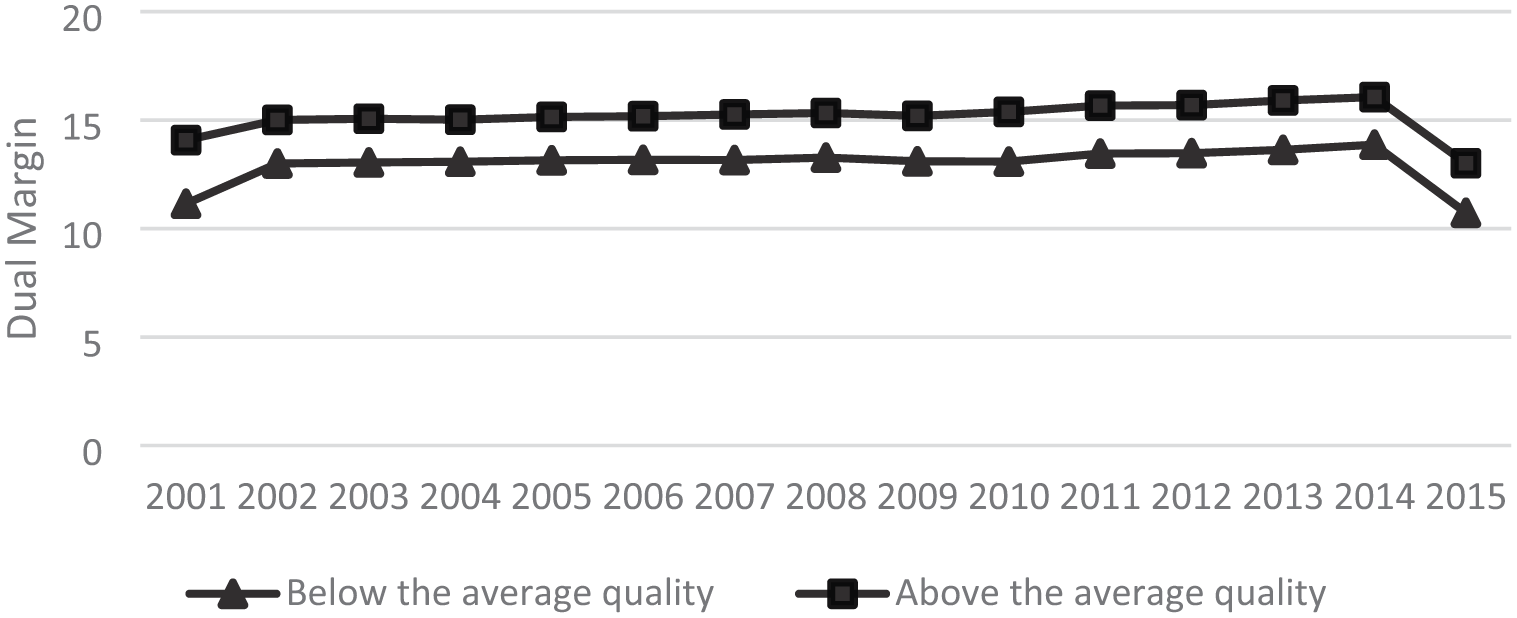
Dual margin under export product quality classification (2001–2015).
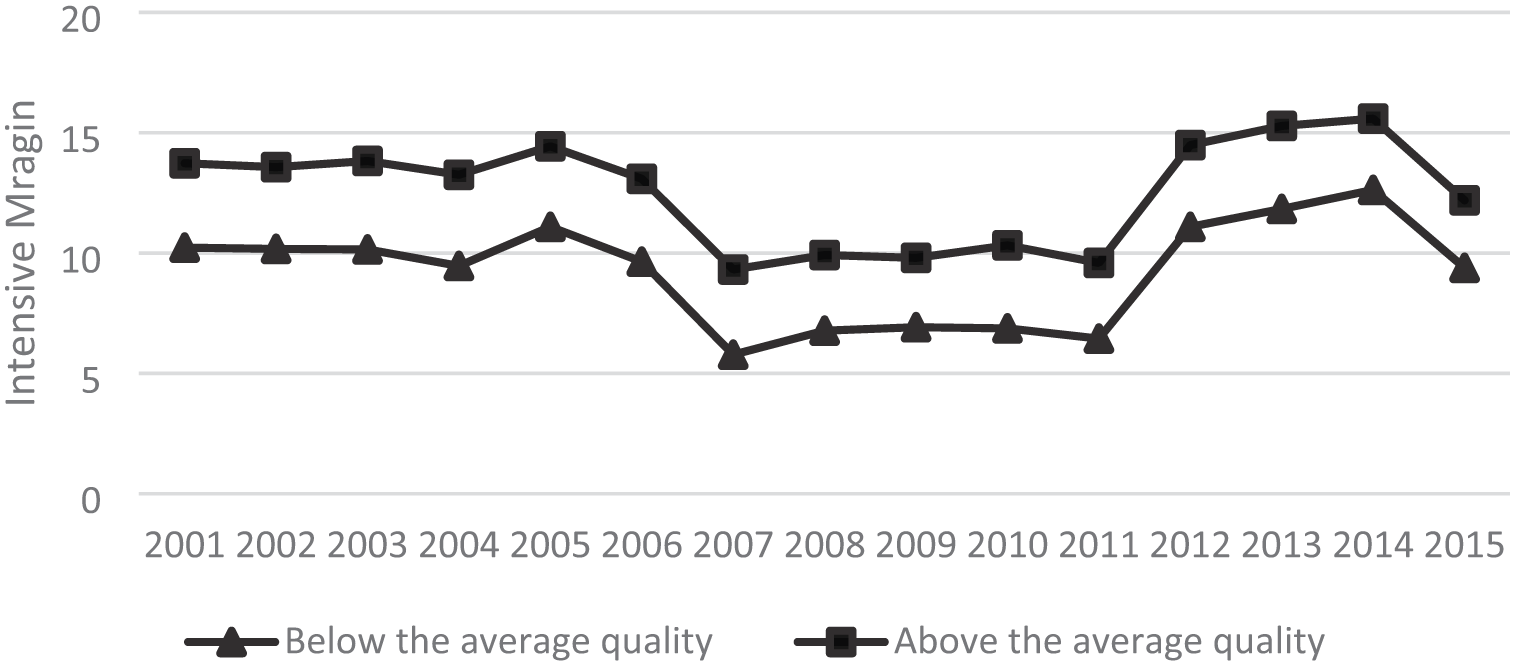
Intensive margin under export product quality classification (2001–2015).

Extensive margin under export product quality classification (2001–2015).
In the global manufacturing value chain, a country’s positioning and division of labor are often reflected in its export product quality (Wacker et al., 2025). Export product quality is usually regarded as a core dimension of enterprises’ competitiveness, reflecting the non-price advantages that enterprises develop through technical, technological, or managerial upgrades (Yue, 2023). In recent years, many scholars have empirically confirmed that export product quality can promote the improvement of performance indicators, such as a country’s GDP, employment, and wages (Guerra, 2024; Gnangnon, 2024) and also promote the growth of export scales (AbdGhani et al., 2019; Henn et al., 2020; Zhang et al., 2023). Trinh et al. (2022) found that the intricacy of superior export products appeared to be essential for countries to develop more quickly and sustainably, highlighting the importance of improving export quality in promoting international trade. Zhang and Duan (2023) believed that enriching the products’ quality that were exported was a key factor in enhancing a country’s trade competitiveness. In competitive markets, product quality serves as a powerful differentiator for exporters (James et al., 2024). Wacker et al. (2025) showed that exporting nations were better able to produce high-quality goods when their per capita income was higher, thereby promoting the export of superior products.
For the study of the export dual margin, literature exists on the influencing factors from the perspectives of technological progress (Ren & Gao, 2023; Wan et al., 2025), policies and regulations (Du & Li, 2020; Hu et al., 2024), and specific macroeconomic indicators (Qiu et al., 2020). For example, Wan et al. (2025) indicated that digital transformation positively affected the intensive margin of medical products; however, it did not affect the extensive margin positively. Hu et al. (2024) argued that digital service trade barriers dampened the intensive margin of service exports via variable trade costs. In addition, these barriers inhibit extensive expansion of service exports through fixed and variable trade costs.
Based on the existing literature, we find some research gaps. First, almost no previous studies examine the effect of export product quality on the export dual margin. Second, few studies examine export volume growth based on three dimensions: enterprise, product, and market. Therefore, this study’s marginal contribution is represented as follows. First, we explore the effect of export product quality on export volume from the perspective of export dual margin. Second, we define the growth of export volume from the three dimensions of enterprise, product, and market and then examine the impact of export quality on the growth of export volume in each dimension.
The remainder of this paper is organized as follows. Section “Theoretical Analysis” presents the specific theoretical analysis of the impact mechanism of export product equality on export intensive margin and extensive margin. Section “Methodology and Data” describes the research design. Section “Results” provides the results of empirical analysis, robustness and heterogeneity tests. Finally, Section “Conclusions and Implications” offers the conclusion and policy implications. The research framework of this study is illustrated in Figure 4.
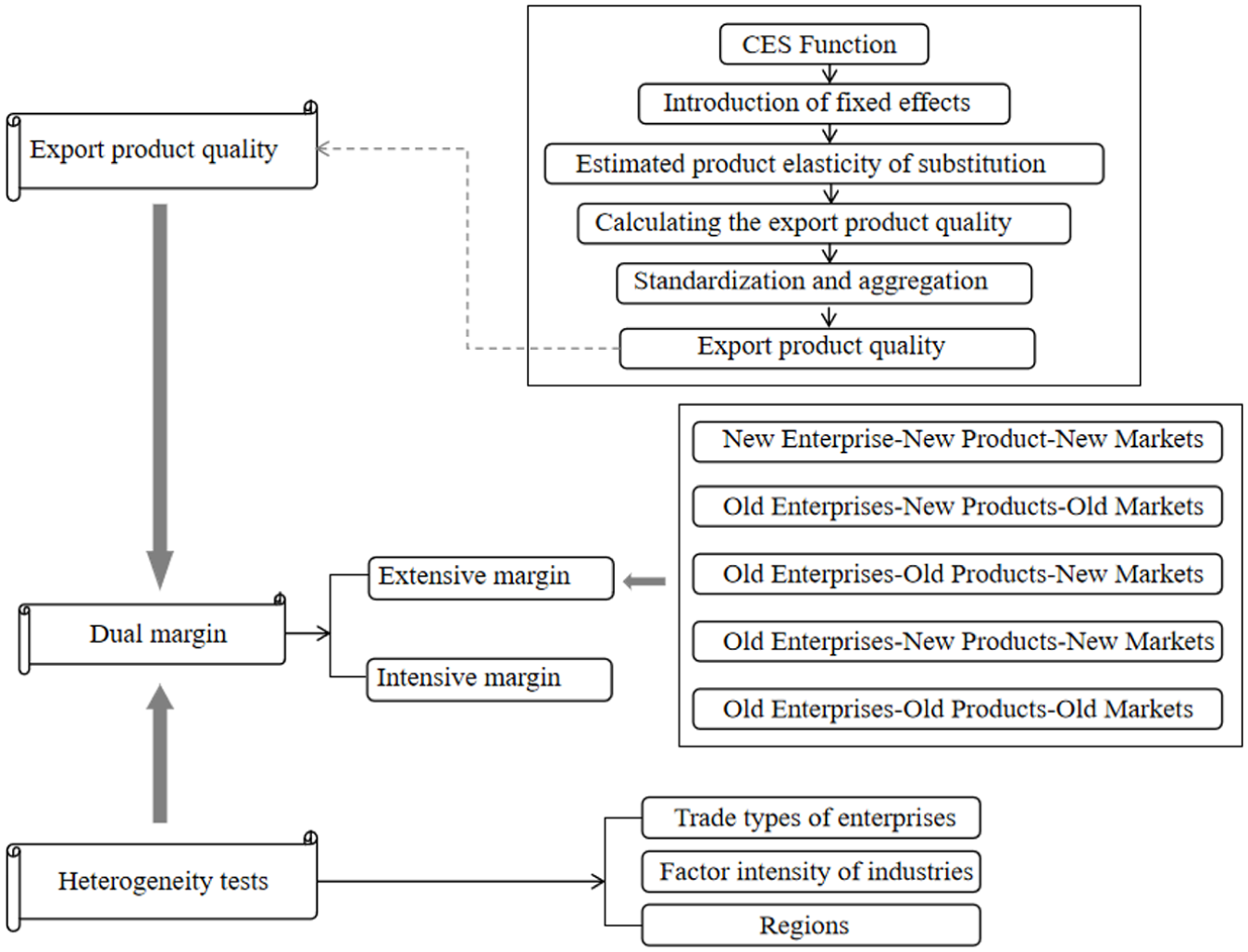
Research framework.
Theoretical Analysis
Linder’s (1961) theory of demand preference similarity was the earliest study on how export product quality affects trade, which first pointed out that quality differences determine trade direction. He believed that due to higher customer demanded for high-quality products, wealthier countries had a competitive advantage in manufacturing and exporting these products, which encouraged the export of high-quality products. Schott (2004) further suggested that the higher the per capita income within an exporting country, the more advantageous it was to have a comparative advantage in producing high-quality products, thereby promoting the export of such products. Based on Linder’s (1961) theory, Hallak (2006) used cross-sectional data of bilateral trade between 60 countries in 1995 to confirm the theoretical prediction that wealthy countries tended to import more products from countries that produce high-quality products. This conclusion once again proved that the higher the export product quality, the more it can promote the growth of export volume. A high-quality supply can bring high-quality and high-level products and services, thereby leading and creating domestic and international market demand, achieving high-quality supply-demand matching, and a virtuous supply-demand cycle.
Melitz’s (2003) trade theory of heterogeneous enterprises emphasized the role of heterogeneity of micro-enterprises in international trade. The theoretical framework suggested that the growth of enterprises’ exports can be divided into intensive and extensive margins. Wang and Ye (2023) found that the productivity level of enterprises was positively correlated with the quality upgrades and pricing premiums of their export commodities. Endris et al. (2025) indicated that enterprises with greater productivity and export products of superior quality were more adept at penetrating and maintaining stable and progressively expanding export markets within developed countries. After entering export markets, fierce competition further eliminates low-productivity enterprises while accelerating the upgrading of product quality. Predicated on the manufacturing and export of commodities with superior quality and elevated pricing markups, enterprises can derive enhanced export earnings, thereby further stimulating their export expansion. In addition to promoting the growth of the export extensive margin, high-quality products can help enterprises expand the export share of existing markets, thus increasing their export-intensive margin. Doan and Zhang (2024) found that when firms invested more resources in research and development (R&D) and improved product quality, their products meet the quality standards of more countries and regions, thereby expanding the scale of exports. Based on this, we propose Hypothesis 1:
Methodologies and Data
Data
There are two primary sources of data used in this study: the first database comprises the Chinese Industrial Enterprise Database (2000–2015), and the second database is the China Customs Database (2000–2015). First, we followed the data processing approach outlined by Cai and Liu (2009) for the Chinese Industrial Enterprise Database: (1) excluded observations that lack certain variables, such as total assets, fixed assets, sales, employees, and total industrial output value; (2) excluded observations that have fewer than eight employees; (3) excluded observations with total assets smaller than current assets and total fixed assets larger than total assets; (4) excluded observations that have paid-in capital of zero or less; (5) excluded observations with enterprise age less than 0 years or greater than 100 years. Second, we defined products based on the Harmonized System (HS) codes developed by the World Customs Organization. Following Lin et al. (2022), we processed the China Customs Database for the sample period by aggregating monthly data to the annual level, consolidating the HS 8-digit codes to the 6-digit level, and transforming the HS96, HS07, and HS12 classifications to HS02. We measured Chinese enterprises’ export product quality at the enterprise-product-market level and aggregated it to the enterprise level using export share weights. Finally, we merged the China Customs Database with the Chinese Industrial Enterprise Database using enterprise names, postal codes, and telephone numbers, resulting in matched data. We adjusted all value variables for price fluctuations and winsorized the continuous variables at the 1st and 99th percentiles to mitigate the impact of outliers.
Econometric Methodology
The baseline econometric model used in this study to examine the impact of the “quality” of exports on the “quantity” of exports by enterprises is set up as follows:

Where f stands for the enterprise, t stands for the year, and i stands for the industry;
Variables
Explained Variables
The explained variable is the “quantity” of enterprise exports, represented by the export value of dual margin (lnvalue), export intensive margin (lnvalue_inten), export extensive margin (lnvalue_exten), and their subgroups. The export dual margin is the sum of intensive and extensive margins. The intensive margin is defined as the export value of products that an enterprise continues to export to a market to which it has already exported in the previous period. However, the extensive margins are more complicated. The extensive margin is measured by the export value added of enterprises. Export extensive margins comprise three dimensions: enterprise, product, and market. If any dimension differs from the previous year, it is regarded as a new export relationship. Therefore, the five new export relationships are as follows: New enterprise-New product-New market (NNN), Old enterprise-New product-Old market (ONO), Old enterprise-Old product-New market (OON), Old enterprise-New product-New market (ONN), Old enterprise-Old product-Old market (OOO). Specifically, if an enterprise has not exported before but started exporting from the current year, we define it as an export relationship of “NNN”; ONO refers to an export relationship in which an enterprise exports new products to old markets. OON refers to an export relationship in which an enterprise exports old products to a new market. ONN refers to an export relationship in which an enterprise exports new products to new markets. OOO refers to an export relationship between the recombination of old products and markets. For example, if Enterprise A exported product B to the United States and product C to Canada in 2011, the export relationship of Enterprise A exporting product B to Canada or exporting product C to the United States in 2012 is defined as OOO. This can be regarded as a new trade relationship.
Core Explanatory Variable
The export product quality is the core explanatory factor. We refer to the study of Khandelwal et al. (2013) to measure the export product quality, which can be divided into the following five steps.
First, following Khandelwal et al. (2013), we measure export product quality using a framework based on the CES demand model, as specified in Equation 2:

Equation 2 defines
Second, Equation 3 is derived by taking the natural logarithm of both sides of Equation 2.

In Equation 3,
Third, we included each province’s real GDP, which indicated the domestic market demand size, to mitigate the estimation errors arising from horizontally differentiated items. We estimated Equation 3 using the least squares (OLS) method to obtain the residual estimates (

The value of δ in Equation 4 is taken with reference to Broda et al. (2006), who estimated the elasticity of substitution between HS 6-bit code products.
Fourth, to facilitate the summation of export product quality at the enterprise level, we standardized (4) as follows:

At the HS6 product code level,
Finally, the export product quality at the enterprise level is calculated by multiplying the proportion of export value at the enterprise-product-market level by the total export product quality. The equation used is as follows:

Other Variables
We selected the following as enterprise- and industry-level control variables: enterprise size (lnlabor), which is determined by taking the natural logarithm of the number of employees. Total factor productivity (tfp), according to Head and Ries (2003), we estimated it using the equation tfp=ln(y/l)-sln(k/l), where y is the value of all industrial output, l is the number of employees, k is the total value of fixed assets, and s is the capital contribution rate in the production function, which is 1/3. Enterprise age (lnage) can be expressed as the natural logarithm of the difference between the establishment year and the current year, whether it is a foreign-funded enterprise (type); if an enterprise is a foreign-funded enterprise, the value is 1 and 0 otherwise. Regardless of whether it is a general trading enterprise (tradetype), if the enterprise is a general trade enterprise, the value is 1 and 0 otherwise. Capital intensity (inten) is the ratio of total fixed assets to the number of employees. Financing constraint (constr), which is represented by the ratio of the difference between current assets and current liabilities to total assets. The Herfindahl index (hhi), which is the square sum of the market shares of enterprises in the CIC4 code industry, measures the degree of market competition at the industry level.
Descriptive Statistical Analysis
The descriptive statistics of the variables are presented in Table 1. The mean value of the dual margin is the highest and includes both intensive and extensive margins. Among the subgroups of enterprises’ extensive margins, the mean value of NNN is the smallest, while that of OON is the largest. This indicates that old enterprises generate a larger export volume due to market expansion, whereas new enterprises that have not previously exported face significant challenges in market development and product innovation, resulting in smaller export volumes.
Descriptive Statistics.

Statistical Detection Results
This section sequentially analyzes the statistical detection results of the dual, intensive, and extensive margins as well as the subgroups from the perspective of export product quality. The results are summarized in Table 2. We found that in samples above the median export product quality, the mean values of the dual, intensive, and extensive margins are all greater than those of samples below the median export product quality. This implies that a higher export product quality contributes to the growth of export volume. In other words, the “quality” of exports will affect the “quantity” of exports. In the statistical detection results of the impact of export product quality on the five dimensions of the extensive margin, it can be found that the mean values of the three export relations of ONO, OON, and OOO are greater under the samples above the median of export product quality. This indicates that a higher export product quality contributes to the growth of the above three export relationships. However, the mean values of the two export relationships of NNN and ONN are smaller, indicating that high-quality export products inhibit the growth of the export value of the two export relationships of NNN and ONN. The reasons for this may be that, for new or old enterprises, the higher the export product quality, the greater the superposition risk of new product development and new market development, which in turn inhibits the growth of the export volume of these two export relationships. These findings are further confirmed through regression analysis in the subsequent sections.
Statistical Detection Results.

Results
Baseline Regression Results
The Effect of Export Product Quality on Export Volume
The baseline regression results of export product quality on the dual margin, intensive margin, and extensive margin are shown in Table 3. Columns (1) and (2) show the regression results of export product quality on the dual margin; Columns (3) and (4) show the regression results of how export product quality affects the intensive margin, and Columns (5) and (6) show the regression results of the impact of export product quality on the extensive margin. Control variables are not added to Columns (1), (3), and (5), whereas they are added to Columns (2), (4), and (6). The results show that after controlling for the influence of all variables at the enterprise and industry levels, a 1% increase in export product quality resulted in 9.177%, 14.48%, and 5.957% growth in the enterprises’ dual margin, intensive margin, and extensive margin, respectively. The regression results above prove that export volume is significantly influenced by export product quality, thus verifying Hypothesis 1. This result is basically consistent with Regis (2018). The difference lies in that Regis (2018) conducted research based on developing and emerging countries.
Results of Export Product Quality on Export Volume.
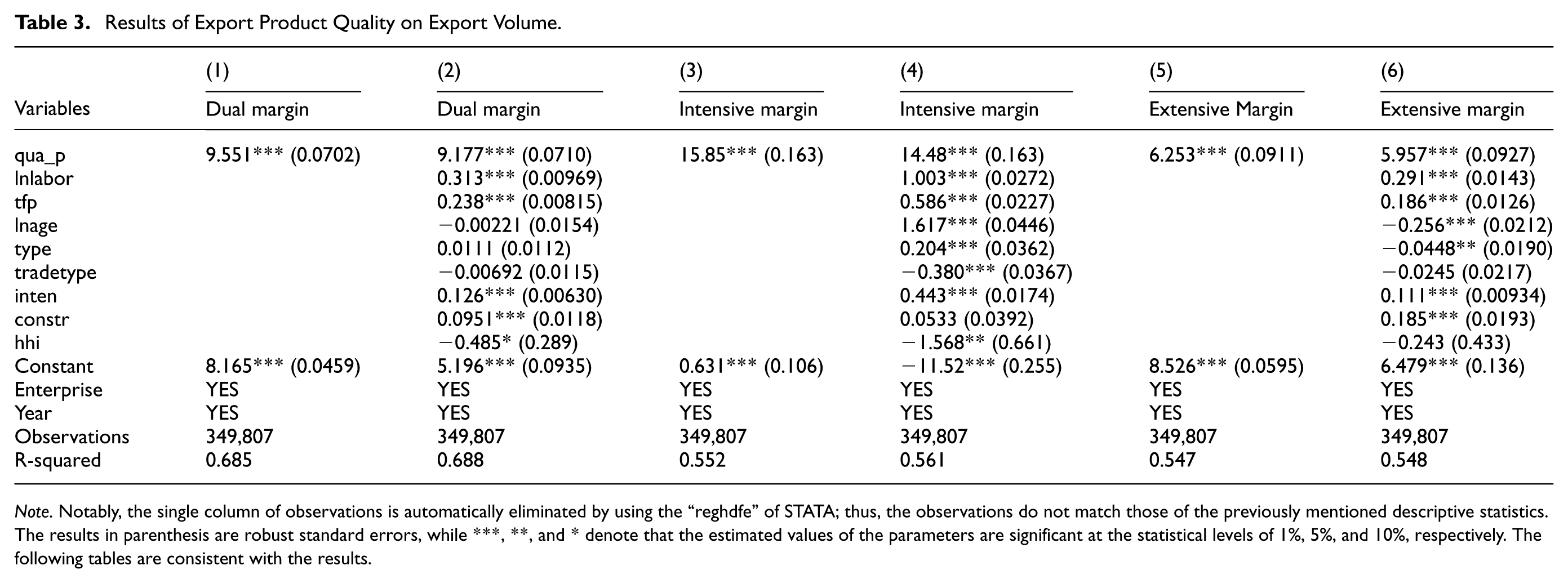
Note. Notably, the single column of observations is automatically eliminated by using the “reghdfe” of STATA; thus, the observations do not match those of the previously mentioned descriptive statistics. The results in parenthesis are robust standard errors, while ***, **, and * denote that the estimated values of the parameters are significant at the statistical levels of 1%, 5%, and 10%, respectively. The following tables are consistent with the results.
The Effect of Export Product Quality on Extensive Margin Subgroups
According to the definition of the extensive margin subgroups, we examine the impact of export product quality on the five subgroups of extensive margin. Table 4 presents the results, which show that the coefficients of export product quality for ONO, OON, ONN, and OOO are significantly positive at the 1% level. However, its impact on NNN is negative. A possible reason for this is that the first four export relationships have a certain foundation in products or export markets, whereas, in the case of NNN, enterprises must face the dual challenge of developing products and export markets, resulting in high export risks. The result indicates that export product quality impacts NNN by restricting it due to the combined effects of export risk and export product quality improvement cost. In the existing literature, Miah and Ichihashi (2024) demonstrated that NNN are most affected when facing input supply shocks, which is similar to the conclusion of this study.
Results of Export Product Quality on Extensive Margin.

Robustness Check
Replacing the Explained Variable
To confirm that the baseline regression results are robust, we used the export values of the average dual margin, intensive margin, and extensive margin as their respective proxy variables for regression. Specifically, we employed the ratio of the dual, intensive, and extensive margins to the number of trade relations. The results are summarized in Table 5. Columns (1), (2), and (3) display the effects of export product quality on the dual, intensive, and extensive margins. All results attained a significance level of 1%, demonstrating the strength of the export product quality promotion effect on the dual, intensive, and extensive margins.
Robustness Results of Replacing the Explained Variables.

Replacing the Explanatory Variable
We use the export product quality (qua_p1), estimated by the instrumental variable (IV) method, as the proxy variable in the regression, and the results are shown in Table 6. The coefficients of export product quality on the dual, intensive, and extensive margins are all extremely positive at the 1% level, which matches the baseline results and demonstrates their robustness.
Robustness Results of Replacing the Explanatory Variable.

Instrumental Variable Method
Assuming a reverse causality between the export product quality of enterprises and the dual margin, intensive margin, and extensive margin, that is, to expand their products to more markets, enterprises with higher dual margins, intensive margins, and extensive margins may independently enhance export product quality. To solve the above endogeneity problems, we selected one-period lagged export product quality as the instrumental variable for regression. While the export product quality of the current year and that of the previous one have some links, the export product quality of the prior period cannot be affected by the current year’s dual, intensive, or extensive margins. Therefore, it meets the requirements of relevance and exogeneity of the instrumental variables. Accordingly, we conducted a two-stage least squares method. The second-stage regression results, which are significant at the 1% level, are shown in Table 7. These results further support the validity of the baseline results by showing that even after applying the instrumental variable approach, the influence of export product quality on export volume continues to show a strong promotional effect.
Robustness Results of Instrumental Variable Method.

Heterogeneity Tests
Trade Types of Enterprises
Differences in trade types among enterprises lead to significant variations in their production strategies and foreign trade activities, which in turn result in certain differences in their export performance. Therefore, we categorized the samples into two subgroups based on their trade type: general trade enterprises and non-general trade enterprises (mainly divided into processing trade, barter trade, and agreement trade). Then, we estimate these groups separately. The results for general trade enterprises are shown in Table 8 in columns (1) and (3), whereas those for non-general trading enterprises are shown in columns (2) and (4).
Results of the Heterogeneity Test of the Trade Types.

The results show that the export quality of the product promotes the intensive and extensive margins of both general and non-general trading enterprises. According to the Chow test results for the difference in coefficients between the groups, the export product quality difference coefficients for the intensive and extensive margins are significantly positive. This finding suggests that the export product quality has a greater influence on the intensive and extensive margins of general trading enterprises. One possible reason is that general trading enterprises have greater decision-making power over production and operation, making it easier to improve export product quality, thereby promoting the intensive margin of enterprises. High-quality products not only enhance the attractiveness of the product itself but also make it easier to open up new markets, thus promoting extensive margins. This result is basically consistent with Tian and Yu (2015) that found general trading enterprises are more likely to achieve export intensity than non-general trading enterprises.
Factor Intensity of Industries
Given the significant variations in factor intensity across industries, this study provides additional insights into how export product quality affects the extensive and intensive margins in various industries. Referring to He and Liu (2023), we divided export product quality into two types of samples based on their factor intensity: capital and technology-intensive industries and non-capital and non-technology-intensive industries (i.e., industries that are labor- and resource-intensive) and conducted a heterogeneity test. In Table 9, the results for capital and technology-intensive industries are shown in columns (1) and (3), whereas those of non-capital and non-technology-intensive industries are shown in columns (2) and (4).
Results of the Heterogeneity Test of Factor Intensity.

The results indicate that the export product quality has a substantial promotional effect on the extensive and intensive margins of the two subgroups. Moreover, according to the Chow test results, export product quality exerts a more significant impact on intensive and extensive margins in capital and technology-intensive industries. A possible reason is that enterprises in capital and technology-intensive industries have often invested significant resources in technological R&D, and the intensity and depth of export product quality upgrades are greater, which can expand the export share of existing markets and meet the quality standards of more countries and regions, which can then better promote the growth of intensive and extensive margins. This result is basically consistent with Ito et al. (2025), which found that Japan’s export growth was dominated by the intensive margin of high-productivity enterprises, while this study indicated that Chinese capital and technology-intensive industries exhibited stronger export volume growth after quality upgrades.
Region
Compared with the western region, China’s eastern and central regions have higher levels of economic development, better infrastructure, and more convenient transportation. Therefore, export product quality can have a greater effect on export volume growth. This study divides the sample data into two subsamples for regression based on the location of the enterprises: the eastern and central regions and the western region. The results are summarized in Table 10.
Results of the Heterogeneity Test of Region.

We found that export product quality promotes intensive and extensive margins in both the eastern and central regions and the western region. The results of the Chow test for the difference between groups revealed that the Eastern, Central, and Western regions do not significantly differ in the promotional impact of export product quality on the intensive margin. However, export product quality in the western region can more effectively promote the growth of the extensive margin. The possible explanation for this are as follows: on the one hand, in recent years, the western region has undertaken industrial transfer from the eastern and central regions and introduced technical cooperation, and its export product quality has been rapidly upgraded to gradually meet international market access standards. Hence, it can significantly affect the growth of intensive and extensive margins. On the other hand, enterprises in the Western region are less involved in international trade, and there are very few export markets and product types. Therefore, quality enhancement can easily enable enterprises in the Western region to expand the export scope of markets and product types, and the promotion of quality enhancement for the extensive margin in this region has a more obvious effect. This result aligns with Zhang et al. (2022), who also found the export trade in the western region is more affected.
Conclusion and Implications
Summary of Key Findings
This study theoretically and empirically examines the relationship between export product quality and volume using matched data from the China Customs and Chinese Industrial Enterprise Databases (2000–2015). The findings suggest the following:
(1) Theoretically, the upgrading of export product quality can provide a relative advantage in exporting high-quality products to rich and developed countries, thus promoting export growth; enterprises with higher product quality usually have higher productivity and more R&D investment, which contributes to the growth of export intensive and extensive margins.
(2) Empirically, export product quality significantly enhances the dual, intensive, and extensive margins. These results remain robust after replacing the alternative variables with the instrumental variable method.
(3) The subgroup analysis of extensive margin indicates that the promotion effect of export product quality exists in the subgroups of ONO, OON, ONN, and OOO, except the NNN.
(4) The heterogeneity test results show that export product quality has a greater role in promoting the extensive and intensive margins of enterprises in general trading enterprises, capital and technology-intensive industries, and has a greater effect in promoting the extensive margin in the western region.
Policy Implications
At present, Chinese governments should prioritize qualitative export growth. Policymakers can boost export product quality by setting quality standards, facilitating tech upgrades, and supporting quality certification. Moreover, governments should adopt differentiated strategies. For general trading enterprises and capital and technology-intensive industries, the government should use subsidies or tax incentives to foster innovation, thereby upgrading the export product quality, then improving intensive and extensive margins. For enterprises in the western region, the government should upgrade infrastructure construction and the policy environment to enable the western region to undertake industrial transfers from the eastern and central regions, thereby better leveraging the promotion effect of upgrading export product quality on export volume.
Managerial Implications
First, enterprises should increase investment in R&D, strengthen technological innovation, and accelerate the development of new products. Increasing R&D investment can enhance the technical content and added value of products, increase market competitiveness and consumer preferences, and thus improve intensive margin. Further, new products spawned by technological innovation can help develop new markets and attract new customers, enhancing extensive margins.
Second, enterprises should develop new products and gradually open new markets. Enterprises can strategically choose between two main options: refining products to maturity before seeking market opportunities or gaining a comprehensive understanding of the market environment first, followed by targeted product development. This sequential approach can mitigate risks associated with simultaneous undertakings and facilitate controlled growth.
Third, enterprises must establish and enforce stringent product-quality standards that meet or exceed international market requirements. This necessitates the implementation of an integrated quality control system spanning the R&D, production, and sales channels, thereby ensuring the requisite stability and reliability of the final products.
Limitations and Future Research
First, due to data availability limitations, this study used data only from the China Customs and Chinese Industrial Enterprise databases between 2000 and 2015. Second, this study did not investigate the mechanism by which export product quality affects export volumes. Future studies can be extended from the following aspects. (1) Using the latest data to examine how export product quality affects export volume, and (2) The mechanism by which export product quality affects dual, intensive, and extensive margins.
Footnotes

Ethical Considerations
This article does not contain any studies with human or animal participants.
Consent to Participate
There are no human participants in this article and informed consent is not required.
Funding
The authors disclosed receipt of the following financial support for the research, authorship, and/or publication of this article: This study was supported by the Evaluation Committee Fund of Social Science Achievements of Hunan Province (Grant No. XSP25YBC396, XSP25YBZo90), Zhuzhou Social Science Research Project (Grant No. ZZSK2025029, 2ZSK2025027), Scientific research and innovation Foundation of Hunan University of Technology (Grant No. LXBZZ2404).
Declaration of Conflicting Interests
The authors declared no potential conflicts of interest with respect to the research, authorship, and/or publication of this article.
Data Availability Statement
Data will be made available on request.