




Abstract
This study investigates the effects of different technological progress paths on firms’ export product quality in China based on Fixed Effect and System GMM models. Using matched data from 2000 to 2010 from the Chinese Industrial Enterprise Database, the Chinese Customs Database and the list of overseas investment enterprises, we find that the four paths (OFDI, FDI, import of intermediate goods, and R&D) can all significantly improve firms’ export product quality; Among them, OFDI has the most significant effect, followed by import of intermediate goods, FDI, and R&D, in that order. The results remain robust after considering selectivity bias and sample endogeneity. The heterogeneity test shows that the path of technological progress is more significant in improving the quality of export products of private, eastern, labor-intensive and processing trade enterprises. The article suggests that Chinese enterprises should further expand OFDI levels, fully stimulate the innovation energy of private enterprises, and emphasize the key role of independent innovation in promoting the upgrading of export product quality.
Keywords
Introduction
As a world trade power, China’s export scale has ranked first in the world, but compared with the world’s advanced manufacturing powerhouses, China’s manufacturing industry faces problems including being large but not strong and lacking in core technology for the global value chain division of the labor system (Y. Hu & Yu, 2021; H. Yu et al., 2022), leading to the trap of low-quality export products (F. Lin & Qin, 2022; Q. Liu & Tie, 2020). To date, China’s economic development mode has shifted to a high-quality development stage, and relying on nonprice advantages such as quality and branding to replace traditional price advantages is the only way to achieve high-quality development (Amiti & Khandelwal, 2013; L. Cheng, 2022; G. Hu & Zhao, 2018; Z. Wu & Hong, 2022). The requirement of “improving export product quality” was put forward in the guiding opinions on promoting the innovative development of trade issued by the State Council in 2020. In the new stage of development, in the context of economic uncertainties such as the intensification of global trade frictions, the analysis of how to improve firms’ export product quality is of great significance to China’s long-term goal of building itself into a trade power by optimizing its trade structure and realizing innovative development (Lu & Cheng, 2019; S. Peng et al., 2020).
Firms achieve technological progress by means of technological innovation and technology introduction. Technological innovation includes independent research and development and imitative innovation, and technology introduction mainly refers to foreign technology introduction, the import of intermediate goods, and foreign direct investment technology spillover (S. Han et al., 2022; Y. Han & Zhao, 2020; Y. Li et al., 2021; J. Zhang et al., 2020; Z. Zhu et al., 2020). In the present study, the technology introduction paths of firms are defined as outward foreign direct investment, foreign direct investment, and the import of intermediate goods, and the technological innovation path is defined as firm research and development. In an open economy, export product quality upgrades are mainly achieved through independent technological innovation and technology spillover (Geng & Chang, 2020; Qu & Zang, 2019; Song & Zheng, 2020; Z. Xie & Li, 2020). Can the two different sources of technological progress (technological innovation and technology introduction) promote firms’ export product quality upgrades? If they can, which path is more effective? This paper attempts to answer the above questions.
In examining the single path of technological progress and export product quality, scholars have focused on the effects of outward foreign direct investment (H. Peng & Yu, 2021; Rehman & Ding, 2020; Stiebale & Vencappa, 2018; Wan et al., 2021), foreign direct investment (Anwar & Sun, 2018; Hayakawa et al., 2020; Y. Li et al., 2021; Poupakis, 2022), intermediate goods imports (Bas & Strauss-Kahn, 2015; Q. Huang et al., 2021; Song et al., 2021; Song & Zheng, 2020) and firm research and development (Crowley & McCann, 2018; Geng & Chang, 2020; Sheng & Wang, 2021). Except for K. Cheng and Yang (2019), which compare the effects of outward foreign direct investment and foreign direct investment on Chinese enterprises’ export product quality, few scholars have included various technological progress paths within a unified framework for research. Most studies have used static models; however, because the quality of firms’ export products is closely related to quality accumulation in the previous period (L. Wang & Han, 2018), there is an endogeneity problem, and traditional static regression models are inapplicable (Q. Jin & Yan, 2017). Moreover, the comparison and heterogeneity analysis of the impact effects of different paths have rarely been addressed. To supplement the above research gaps, this paper measures export product quality by using Chinese microfirm data from 2000 to 2010, incorporates four technological progress paths into the same framework, comprehensively studies the impact of different paths on the upgrading of enterprise export product quality based on fixed effects model and system generalized method of moment, and compares their differences. Heterogeneity is further examined for firm ownership, location, factor intensity, and trade mode.
The innovation of this paper lies in the following three aspects. First, based on Faruq’s (2010) quality difference model, a unified framework is introduced to analyze the impact of four technological progress paths and the influence of other factors on the export product quality of enterprises, which further broadens the scope of its model. Second, based on the findings of previous studies, a comparative analysis is conducted to examine the effect on the export product quality of Chinese enterprises of four technological progress paths: outward foreign direct investment, foreign direct investment, intermediate imports and firm research and development. Further, we test the heterogeneity of enterprise ownership, location, factor intensity and trade mode to conduct a comprehensive exploration of the main driving forces of Chinese firms’ export quality upgrading. Third, policy recommendations are proposed to provide inspirational suggestions for the rational use and utilization of various paths of technological progress in China to realize the upgrading of export product quality at the current stage.
The rest of the paper is organized as follows. Section 2 is the literature regression and summary; Section 3 is the description of methods, data, and variables; Section 4 is the empirical results and analysis; and the last section is the conclusion and policy recommendations.
Literature Review and Summary
Export Product Quality
In recent years, the use of export product quality as an indicator of whether China is a trade power has become a hot research topic (Lu & Cheng, 2019; X. Jin & Shi, 2022). There are two main types of studies that address export product quality and relevant to the present study: those that measure export product quality and those that investigate factors that influence export product quality. In terms of measurements, the export unit value approach used in earlier years was noted to ignore firms’ productivity heterogeneity (Manova & Yu, 2017; M. Yu & Zhang, 2017). In recent years, the measurement methods have been refined to the firm-product level, and dominant methods include demand inversion (Fan et al., 2018; X. Jin & Shi, 2022; Khandelwal et al., 2013; H. Liu et al., 2020; J. Yu et al., 2021) and product price separation (Feenstra & Romalis, 2014; F. Lin & Qin, 2022; M. Yu & Zhang, 2017). In terms of the analysis of factors that influence export product quality, the first stream of literature focuses on the effects of input factors, such as financing constraints (Crinò & Ogliari, 2017; X. Kong et al., 2020), intermediate goods inputs (Q. Liu & Tie, 2020), and wage standards (Brambilla & Porto, 2016; J. Liu & Wan, 2021) on export product quality. The second research category primarily approaches the issue from the perspective of government policies or changes in the external environment, such as trade liberalization (Bas & Strauss-Kahn, 2015; S. Peng & Zhang, 2022), environmental regulations (J. Xie et al., 2020; S. Zhu et al., 2022), agglomeration (L. Cheng, 2022; Zeng & Han, 2022) and exchange rate changes (Bas & Paunov, 2021). At present, the fourth technological revolution is emerging, and emerging technologies are gradually rising. Scholars have generally begun to focus on the role of the digital economy (Du et al., 2022; F. Lin & Qin, 2022), the internet (X. Huang & Song, 2019), industrial robots (DeStefano & Timmis, 2021) and technology finance (Nguyen & Su, 2021) in export quality improvement.
Technological Progress Path
Studies on technological progress paths are grouped into three main categories. The first is the definition and classification of technological progress paths. Existing studies generally classify the path of technological progress as comprising technology introduction and technological innovation, containing the four specific forms of outward foreign direct investment (OFDI), foreign direct investment (FDI), import and independent innovation (Y. Hu & Yu, 2021; Q. Jin & Yan, 2017; Y. Li et al., 2021; Qu & Zang, 2019). The second category is research on the impact generated by the path of technological progress. Technological progress is closely related to a country’s economic growth and social progress (Maiwada, 2022; Y. Y. Zhang et al., 2021), but as environmental problems become increasingly prominent in the process of economic growth, some studies have paid increasing attention to the relationship between economic growth and environmental pollution (Adebanjo & Shakiru, 2022) and focused on the impact of technological progress on sustainable development (Bakare & Okuonghae, 2022; Dar & Ahmad, 2022; Maiwada & Jamoh, 2022), carbon emissions (L. Huang et al., 2017; Kang et al., 2018) and renewable energy consumption (Jiang & Khan, 2023). However, their findings are not uniform; L. Huang et al. (2017) find that intermediate goods imports, independent research and development (R&D), and imitative innovation significantly reduce the implied carbon emission intensity of China’s manufacturing exports, but Jiang and Khan (2023) find that technological innovation increases CO2 emissions and renewable energy consumption. In addition, several studies have focused on the role of nontechnological progress factors such as financial market development (Bibi & Sumaira, 2022a, 2022b) and the banking sector (Sumaira & Bibi, 2022) in economic growth in developing countries. The third category concerns the factors influencing the path of technological progress. Jiang et al. (2022) investigate the effects of tax collection mechanisms and administration on firm innovation based on Chinese firm data, conducts tests of heterogeneity in firm location, technology level, and market environment, and finds that strengthening regional mandatory tax collection improves firm technological innovation.
Technological Progress Paths and Export Product Quality
The first category concerns OFDI and export product quality. Studies have confirmed the promoting effect of OFDI on export product quality upgrading from the firm-level and heterogeneity perspectives and have found that the reverse technology spillover effect and intermediate goods quality effect of OFDI are two important mechanisms (H. Liu et al., 2020; H. Peng & Yu, 2021; Rehman & Ding, 2020; J. Yu et al., 2021). However, some scholars have argued that OFDI inhibits the upgrading of firms’ export product quality, and Wan et al. (2021) find that cross-border M&As significantly and persistently reduce firms’ export product quality. Nevertheless, most studies have confirmed that the reverse technology spillover effect of OFDI is an important mechanism for export product quality upgrading (Fu et al., 2018; H. Liu et al., 2020; Lu & Cheng, 2019; H. Peng & Yu, 2021). The second category concerns FDI and export product quality. Most scholars have proven that FDI improves export product quality (Anwar & Sun, 2018; Hayakawa et al., 2020; Y. Li et al., 2021; Poupakis, 2022). While this result is heterogeneous for different types of FDI, S. Peng et al. (2020) find that only foreign investment deregulation in the transportation, wholesale and retail sectors is the main driver of export product quality upgrading in manufacturing. In contrast, H. Chen (2022) finds that while the vertical technology spillover of foreign capital significantly improves the quality of export products of host country firms, horizontal technology spillover is not conducive to the improvement of firms’ export quality. In the vertical technology spillover of foreign capital, the backward spillover effect significantly reduces the export product quality of firms. The third category concerns the import of intermediate goods and export product quality. The intermediate goods imported by enterprises reflect the level of foreign R&D investment and technology, and the import of high-quality intermediate goods can effectively improve the export product quality of enterprises (Bas & Strauss-Kahn, 2015; Song et al., 2021; Song & Zheng, 2020; Xu et al., 2017; Xu & Mao, 2018). Further research has found that high value-added and intermediate goods from Europe and the United States enhance the effect more obviously than low value-added and intermediate goods from Hong Kong, Macao and Taiwan (Y. Wu & Wang, 2018); capital goods imports upgrade export product quality to produce an inhibitory effect, which is most obvious for private enterprises (Shen & Yu, 2019). The fourth category concerns enterprise R&D and export product quality. Most studies have taken enterprise R&D as a mediating variable for a certain factor in influencing export product quality, such as manufacturing servitization (S. Zhu et al., 2019), human capital investment (Tong & Zhang, 2021), financial openness (Sheng & Wang, 2021), and the digital economy (F. Lin & Qin, 2022). Some scholars have also studied the direct relationship between the two, but the findings are not uniform. X. Li and Xiao (2020) argue that firm R&D improves export product quality in two ways: first, by generating new technologies that increase the exports of technology-intensive products, and second, by increasing firm productivity, reducing production costs, and expanding exports of capital-intensive products. Z. Lin (2019) finds that for firms with low product-quality ladders, there are R&D sunk costs and an innovation frustration effect, and such firms cannot effectively absorb advanced technology. Qu and Zang (2019), using empirical analysis of Chinese manufacturing data, find a U-shaped relationship between independent innovation and export product quality.
Research Methodology
Theoretical Model and Research Hypotheses
Two types of technological progress paths of firms are defined in the present study: technology introduction (OFDI, FDI, and import of intermediate goods) and technological innovation (firm R&D).
The Faruq’s (2010) quality difference model further relaxes the assumption of product homogeneity in the classical trade theory model and analyzes the quality difference of samples from the perspective of heterogeneity, which is consistent with the situation in the present study. Based on this, this study draws on Faruq’s (2010) model to analyze the role of OFDI, FDI, the import of intermediate goods, and R&D on improving export product quality from both the supply and demand sides.
If country i (i =1, 2…I) produces only one product and exports the product to country j, the consumers in country j satisfy the constant elasticity of substitution (CES) form of the utility function as follows:

The constraint condition of Equation 1 is:

where


In Equation 4,

Equation 5 indicates that the relative quality of the products of the two countries is positively correlated with their relative price and negatively correlated with the quantity demanded.
From the producer’s perspective, countries i and j produce according to the following production function:


where

By combining Equations 6 and 8 and again according to the first-order condition of profit maximization, the producer’s product price can be expressed as:


Similarly, referring to the above, the product price of the producer in country j can be obtained as:


Equations 9, 10, 11, and 12 are the producer’s pricing rules. Dividing Equation 10 by Equation 12 and then combining Equation 5 yields the ratio of consumption of countries i and j:

The above derivation is based on the assumption that a country produces only one product; therefore, the supply and demand will reach equilibrium when

By combining Equations 10, 12, and 14, the relative price of the products of the two countries can be obtained as follows:

Because product quality is not directly observable, we cannot estimate Equation 15 but can adopt an alternative strategy. Different from Faruq (2010), who only considers the impact of resource endowment on export product quality, we draw on the investigation of other factors influencing export product quality by Qu and Zang (2019), based on the analysis of the impact of the above four technological progress paths on export product quality, and hence relate export product quality to OFDI, FDI, the import of intermediate goods (med), R&D (rd), physical capital (K), human capital (L), and other influencing factors (Others) using the following expression:

where
H1: The technology introduction paths (OFDI, FDI, import of intermediate goods) of firms improve export product quality;
H2: The technological innovation path (R&D) of firms improves export product quality.
Regression Model Setting
Based on the above mechanistic analysis, the present study first uses the ordinary least squares (OLS) method to measure the impact of the four technological progress paths on firms’ export product quality and establishes the following model:

where
The impact of firms’ OFDI, FDI, import of intermediate goods, and R&D behavior on export product quality is a continuous and dynamic process, that is, improvements in export product quality are not only related to the current OFDI, FDI, import of intermediate goods, and R&D but also influenced by export product quality in the previous period (L. Wang & Han, 2018). Therefore, the present study also uses the system generalized method of moment (GMM) to establish the following dynamic model:

Data Source and Processing
The sample data in this study are derived from the China Industrial Enterprise Database, the China Customs Database, and a list of overseas investment firms from 2000 to 2010. First, the customs export data are screened and sorted using the method described by (M. Chen et al., 2021). When measuring export product quality and the import of intermediate goods, the customs data are processed according to the approach described by Song and Zheng (2020). The data for Chinese industrial firms are organized in accordance with the method described by (L. Kong et al., 2022). In the data matching process, the method described by (F. Zhang et al., 2020) is used to match the data for Chinese industrial firms and Chinese customs to determine the export firms. The matched data are then matched with the list of overseas investment firms to determine to OFDI firms. Ultimately, we obtained 94,191 export firms and 1,197 OFDI firms.
Variables Description
(1) Measurement of export product quality
In this study, the firms’ export product quality is measured by demand information regression inference (Fan et al., 2018; Khandelwal et al., 2013; Poupakis, 2022). First, it is assumed that the utility function of consuming product

where

The total expenditure of country

Thus, the demand of country

Taking the logarithm of both sides of Equation 22 gives:

where

Referring to the approach of (H. Liu & Wang, 2022), the following control variables are added in Equation 23:

According to Equation 25, the customs export data for China from 2000 to 2010 are used to perform regression by product, retain the residuals, and carry out normalization:

where

where
(2) Explanatory variables
The explanatory variables are the four technological progress paths at the firm level: OFDI, FDI, import of intermediate goods, and firm R&D. ofdi is a dummy variable, which is assigned a value of 1 if the name of a firm in the China Industrial Enterprise Database is successfully matched in the list of overseas investment firms, indicating an overseas investment firm, and 0 otherwise, indicating a noninvestment firm. The firms’ FDI (lnfdi) data are obtained from the China Industrial Enterprise Database, and the total amount of foreign investment in actual use plus investment from Hong Kong, Macao, and Taiwan in the current year is used as a measure of FDI. The firms’ import of intermediate goods (lnmed) data are derived from the China Customs Database, and the amount of intermediate goods imported in the current year is used as a measure of a firm’s import of intermediate goods. The firms’ R&D (lnrd) data come from the China Industrial Enterprise Database and are expressed as the output value of the new products of the firm because the output value of new products directly reflects the results of a firm’s R&D investment (S. Hu et al., 2022) and is a demonstration of the firm’s innovation efficiency and technology transformation ability (Yang et al., 2022). Then, the logarithm of each of the above three indicators is taken (for an indicator with a value of 0, 1 is added to the value before taking the logarithm).
(3) Control variables
The control variables include government subsidy (lnsubsidy), which is measured by the logarithm of the ratio of government subsidies to firm sales (deflected by PPI); firm profit rate (profitr), which is measured as the ratio of total profit to sales revenue; financing constraint (fincon), which is the ratio of interest expense to total fixed assets; the management level of the firm (manage), which is the ratio of the main business income to average total assets; and the age of the firm (age), which is expressed as the time the firm has been in operation. All data are obtained from the Chinese Industrial Enterprise Database. The definitions of and calculation methods for the control variables are shown in Table 1.
Definitions of and Calculation Methods for the Control Variables.

Descriptive Statistics
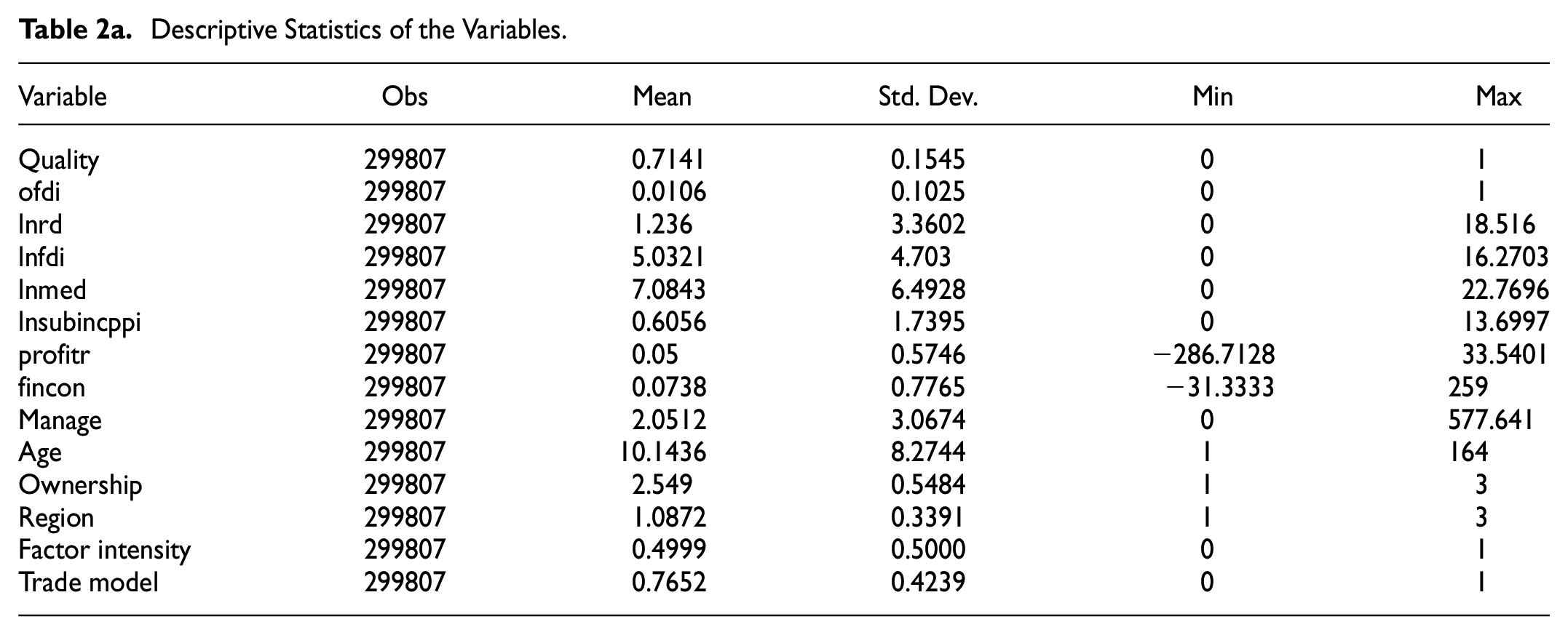
In addition, this paper distinguishes the heterogeneity of firms for subsequent heterogeneity analysis. The firms are divided into state-owned, private and foreign-owned firms according to their ownership, which are denoted by value of 1, 2, and 3. Firms are divided into eastern, central and western regions according to their location, which are denoted by value of 1, 2, and 3. Factor intensity is divided according to the ratio of net fixed assets to employees, and firms located in the top 50% are classified as capital-intensive firms and the bottom 50% are labor-intensive firms, which are denoted by value of 1 and 0. The firms will be divided into general trade and processing trade firms by trade mode, indicated by value of 1 and 0. The descriptive statistics of the variables are shown in Table 2a, and the average export product quality of heterogeneous firms in the sample period is shown in Table 2b.
Descriptive Statistics of the Variables.
Description of the Average Export Product Quality of Heterogeneous Firms.
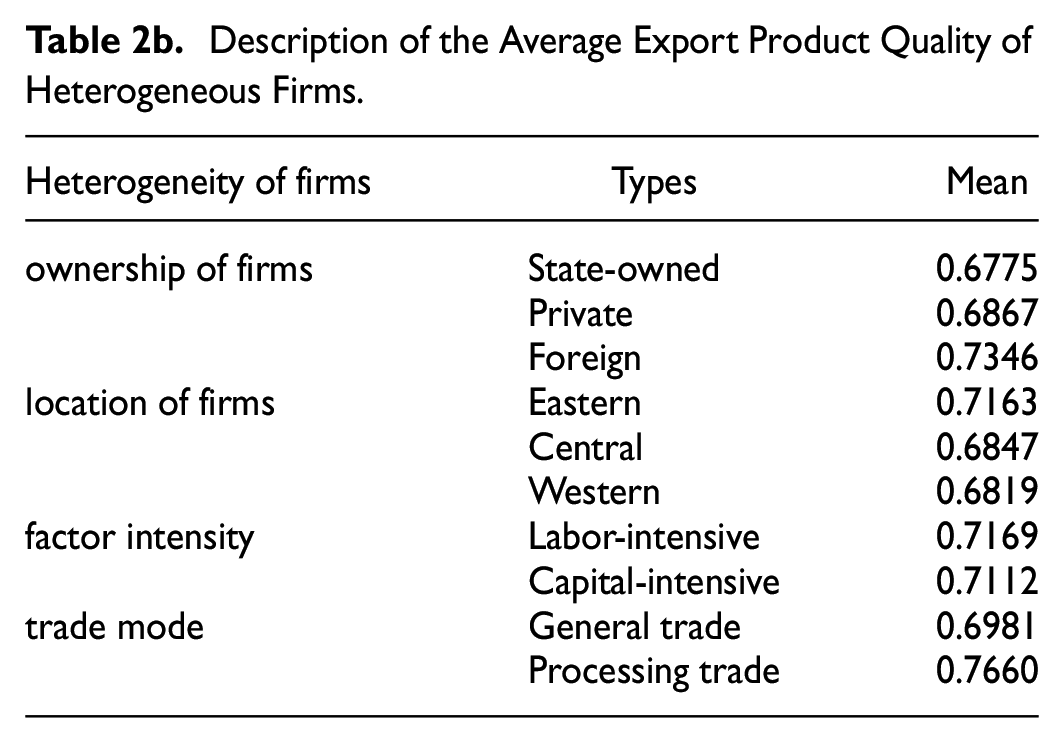
It can be seen that the average export product quality of foreign capital, eastern region, labor-intensive and processing trade firms is higher than that of private and state-owned, central and western region, capital-intensive and general trade enterprises.
Empirical Results and Analysis
Stylized Facts for Technological Progress Paths and Export Product Quality
In Figure 1, the solid lines represent firms with OFDI, R&D, FDI, and imports of intermediate goods, and the dashed lines represent firms without OFDI, R&D, FDI, and import of intermediate goods. Figure 1 shows that the kernel density curves for the export product quality of firms with OFDI, R&D, FDI, and imports of intermediate goods are skewed to the right, indicating that the export product quality of firms with OFDI, R&D, FDI, and import of intermediate goods is higher. Therefore, it is preliminarily concluded that the four technological progress paths promote improvements in export product quality. Our preliminary conclusion is also reinforced by the findings of these studies (X. Li & Xiao, 2020; H. Peng & Yu, 2021; Poupakis, 2022; Song et al., 2021).

Kernel density curves for OFDI, firm R&D, FDI, and import of intermediate goods versus export product quality.
Analysis of Regression Results
Benchmark Regression Results
Table 3 shows the basic regression results for Model (26). Columns (1)−(4) examine the impact of each technological progress path on the firm’s export product quality, Column (5) regresses all four paths simultaneously, and, on this basis, Column (6) adds all control variables.
Benchmark Regression Results.

Note. ***, ** indicate significance at the 1%, 5%, levels, respectively, and robust standard errors are shown in parentheses.
The results show that firms’ OFDI, FDI, imports of intermediate goods, and R&D significantly improve export product quality, thereby verifying the hypotheses. After adding all variables in Column (6), OFDI has the highest estimated coefficient of 0.0147, indicating that firms’ OFDI plays the most significant role in improving export product quality. This result was also found by the studies of (K. Cheng & Yang, 2019) and (J. Yu et al., 2021). China’s OFDI flows ranked first in the world in 2020, and firms improve product innovation using foreign advanced technology, capital, and the innovation environment through OFDI (J. Wang et al., 2022; Xue et al., 2021). The regression coefficient of firms’ import of intermediate goods on export product quality is higher than that of FDI, probably because China is currently the second largest importer in the world, the proportion of imports of intermediate goods is increasing, and the import of key intermediate goods is an important source of technology to improve domestic product quality. The contribution of import of intermediate goods and FDI to the firms’ export product quality was also verified by (Song & Zheng, 2020) and (Y. Li et al., 2021). Although the regression coefficient of firm R&D is the smallest, it is significant at the 5% level. Currently, China’s independent R&D level in core technologies is still insufficient. In the context of innovation-driven development, the role of R&D as an important source of technological innovation to improve export product quality cannot be ignored. The similar conclusions were found by (Geng & Chang, 2020).
Regarding the control variables, the estimated coefficients of government subsidies, firm profit rate, and management level are found to be positive and highly significant, indicating that an increase in these variables significantly contributes to improving export product quality. This finding is similar to that of (G. Hu & Yue, 2021), (Tang & Zhu, 2020) and (Bloom et al., 2018).
Dynamic Panel Regression Results
This study also uses the system GMM to develop a dynamic model. To ensure the validity of the regression results, non-autocorrelation tests are first performed on the perturbation term. The first-order and second-order autocorrelation tests indicate the presence of first-order autocorrelation but not second-order autocorrelation; therefore, the GMM estimation method can be used. The p-value of the Sargan test is .218, indicating that there is no overidentification problem.
The regression results in Table 4 show that the first-order lag term of a firm’s export product quality estimated by the system GMM has a significant positive impact on the firm’s export product quality in the current period, indicating that there is a pass-through effect between the firm’s export product quality in the current period and that in the previous period; that is, improvements in a firm’s export product quality in the previous period lays a foundation for technological improvements in the firm’s export products in the next period and stimulates the firm’s technological progress and innovation. The dynamic cumulative effect of firm’s export product quality is also confirmed by (L. Wang & Han, 2018). Regarding technological progress paths, OFDI has a significant improvement effect and the highest coefficient, and R&D also has a significant improvement effect, indicating that Chinese firms should continue to maintain an awareness of independent innovation and improve their R&D level while expanding openness.
Dynamic and Static Regression Results.

Note. ***, ** indicate significance at the 1%, 5% levels respectively.
Heterogeneity Analysis
After the benchmark regression, this study continues to examine the impacts of the four technological progress paths on firms’ export product quality from the perspective of heterogeneity in the nature of firms (state-owned, private, and foreign firms) and location of firms (eastern, central, and western regions), factor intensity (labor- and capital-intensive), and trade mode (general trade and processing trade).
Heterogeneity Test of Firm Nature and Location
Column (1) in Table 5 provides the test results for the impacts of the four technological progress paths on the export product quality for different joint-stock firms. The regression results indicate that the impact of OFDI on export product quality is the greatest for private firms, significant at the 10% level for foreign firms, and nonsignificant for state-owned firms. G. Hu and Yue (2021) and J. Liu and Wan (2021) also confirm that the effect of export product quality upgrading is more significant for Chinese non-state firms. The explanation for these results is as follows. China’s state-owned firms are more closely associated with the government, and their investment motives include the government’s will rather than purely economic purposes (Zang & Jiang, 2020), resulting in limited access to technology through overseas investment, which is detrimental to improving export product quality. In contrast, the OFDI by private firms is more economically oriented, is less likely to be subject to investment review by the host country, and has a higher capacity for imitation and learning as well as for absorption and transformation (L. Li et al., 2017; B. Wang et al., 2022), thus playing a more pronounced role in improving export product quality. The effect of firm R&D on improvements in private firms’ export product quality is small but highly significant, indicating that although Chinese private firms are small, they have a high degree of innovation activity and, hence, R&D plays a significant role in improving their technological level. This finding is also similar with the findings of (W. Liu & Huang, 2018).
Heterogeneity Test Results (1).

Note. ***, **, and * indicate significance at the 1%, 5%, and 10% levels respectively.
Column (2) provides the results for heterogeneity in the location of the firms. All four technological progress paths of firms in the eastern region play more significant roles in improving export product quality than do those in the central and western regions. The provinces in eastern China have advantages in economic development, market systems, human capital, and R&D investments. These factors were confirmed by (F. Lin & Qin, 2022) and are in line with the stylized facts for China; therefore, technological progress in eastern firms improves export product quality.
Heterogeneity Test of Factor Intensity and Trade Mode
Column (1) in Table 6 provides the results for the impacts of the four technological progress paths on the export product quality for labor-intensive and capital-intensive firms. The four technological progress paths play significant roles in improving the export product quality of both labor-intensive and capital-intensive firms, with larger regression coefficients for labor-intensive firms. This likely occurs because although capital-intensive firms are technology intensive, China is still at the low end of the global value chain, and firms are mostly concentrated in the middle and low-end technology manufacturing industries, which are highly labor intensive; therefore, their capital utilization rate is higher during technology introduction and independent R&D, and hence, their export product quality is more significantly improved by technological progress. This result is consistent with the findings of (H. Chen, 2022).
Heterogeneity Test Results (2) .

Note. ***, **, and * indicate significance at the 1%, 5%, and 10% levels respectively.
Column (2) shows the test results for firms of different trade modes. The regression coefficient of processing trade is higher than that of general trade. This is because many firms engaged in processing trade in China are foreign firms with advanced technology and research talents, their products are mostly final products, and the quality of intermediate goods required for production is higher than that of domestic general trade firms (Xu et al., 2017); therefore, the quality of improvement generated by technological progress is even higher. This conclusion was reinforced by the studies of ( F. Zhang et al., 2020) and (S. Peng & Z. Zhang, 2022).
Endogeneity Test
The system GMM estimation considers that a firm’s export product quality in the current period may be influenced by that in the previous period. However, a firm’s OFDI may have a “self-selection effect” (H. Peng & Yu, 2021), that is, the firm has higher export product quality than does a non-OFDI firm before the OFDI, thereby leading to an endogeneity problem. In the present study, the PSM-DID method is used to address the endogeneity problem in model setting. Whether a firm conducts OFDI is set as a dummy variable; therefore, OFDI firms are used as the treatment group, and non-OFDI firms with characteristics similar to those of OFDI firms are screened out by the PSM method as the control group to form a new matched sample. The new sample is subjected to regression analysis using the DID method.
Using the experimental sample reconstructed by PSM and based on the DID concept, this study compares the changes in the export product quality of firms in the treatment group and the control group before and after OFDI. If the changes in the export product quality of firms in the treatment group after OFDI are higher than those of firms in the control group, OFDI promotes improvements in firms’ export product quality.
This study uses the 1:4 nearest neighbor matching method to match the data and estimates the probability of firms performing OFDI using the logit model to match firms in the treatment group and the control group. Referring to the approach reported by (Mao & Wang, 2022), firm labor productivity (lnlabor), firm age (age), management level (manage), and capital intensity (lnkint) are selected as matching variables. Here, lnlabor is expressed as the logarithm of the ratio of the total industrial output value to the average annual number of employees, and lnkint is expressed as the logarithm of the ratio of the firms’ net fixed assets to the average annual number of employees. After matching, a total of 26,442 matched individual samples are obtained.
Two dummy variables are defined as follows: (1) a dummy variable for the treatment group and the control group with du = {0, 1}ff, where du is set to 1 for firms in the treatment group, which conduct OFDI, and 0 for firms in the control group, which never conducted OFDI between 2000 and 2010 and are matched with those in the treatment group; and (2) a dummy variable for the policy time with dt ={0,1}, where dt is set to 1 for the year when the firm performed OFDI and for the years after, and 0 for the year before the experimental period. An interaction term did=du*dt is defined to denote the policy treatment effect after a firm conducts OFDI, that is, the change in the export product quality due to OFDI.
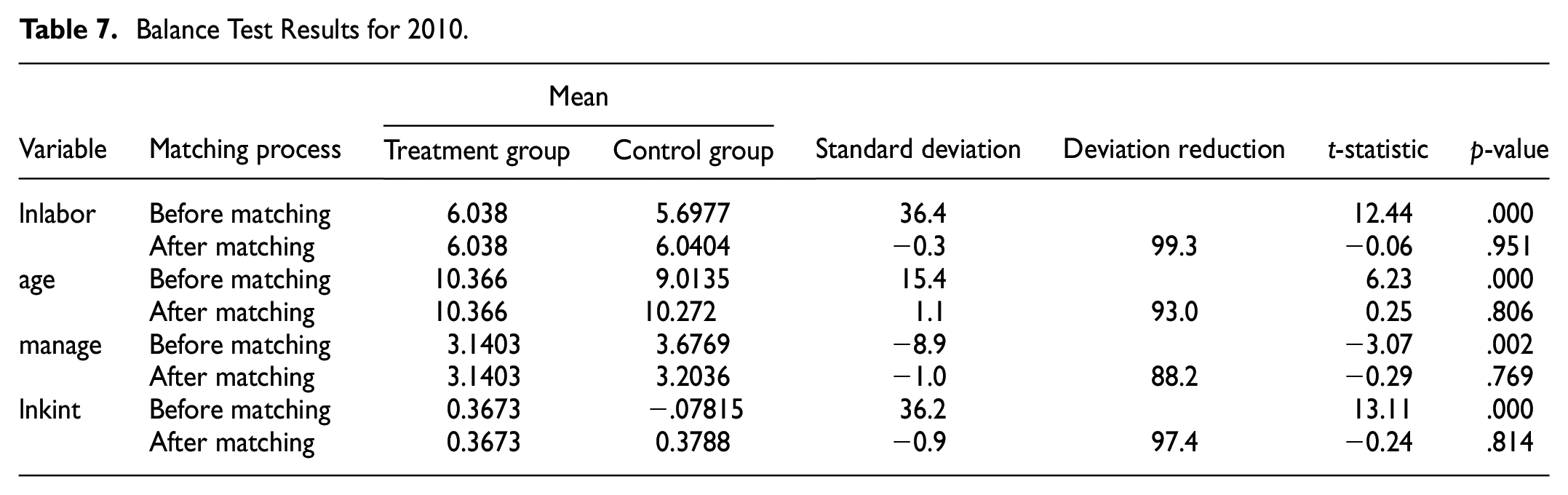
Taking the balance test results in Table 7 for 2010 as an example, before matching, variables in the treatment group and the control group are significantly different (firm labor productivity and firm age). After matching, the standard deviation of each variable is maintained within 10%. In terms of the t-value and p-value, none of the variables after matching have a significant t-statistic, indicating that there is no significant difference in each variable between the two groups of firms. In summary, the matching quality is good, enabling the subsequent DID regression. The regression results are as follows.
Balance Test Results for 2010.
The results in Columns (1)−(5) in Table 8 are consistent with the findings reported in Table 3. In the regression results reported in Column (6), the regression coefficients of did, FDI, and import of intermediate goods are significantly positive, and the regression coefficient of did remains the highest, followed by that of the import of intermediate goods, FDI, and R&D, findings that are consistent with those reported in Table 3. The regression coefficient of R&D is positive but not significant, potentially because the independent R&D capability of Chinese firms is still weak and thus has no significant effect on technological improvements in export products. However, OFDI is still an important way for firms to improve export product quality; therefore, the results of the endogeneity test are considered robust.
Regression Results of the Endogeneity Test.

Robustness Test
In the previous section, the robustness of the regression results was tested using heterogeneous subsamples and the propensity score matching with difference-in-differences (PSM-DID) method. To exclude the influence of extreme values and further present a comprehensive distribution of firms’ export products quality, another robustness test is conducted using quantile regression, and the 0.1, 0.25, 0.5, and 0.75 quantiles are compared with the OLS regression results. As seen in Table 9, the quantiles are consistent with the coefficients and significance of the OLS and benchmark regression results; therefore, the regression results are robust. In addition, comparisons of the regression results for different quantiles reveal that the regression coefficients of the explanatory variables exhibit certain trends. Specifically, OFDI, FDI, import of intermediate goods, and R&D have overall positive impacts on firms’ export product quality; however, with improvements in firms’ export product quality, the positive impact of OFDI gradually decreases, and the impacts of FDI, import of intermediate goods, and R&D all show a trend of increasing first and then decreasing. The similar conclusions were found by the study of (Ma & Wu, 2016).
Robustness Test: OLS and Quantile Regression Results.

Conclusion and Discussion
This study simultaneously examines the impacts of four technological progress paths, namely, OFDI, FDI, import of intermediate goods, and R&D, on firms’ export product quality using matched data from the China Industrial Enterprise Database, the China Customs Database, and a list of overseas investment firms from 2000 to 2010 as samples. While previous studies have demonstrated the contribution of a single technological advancement path to Chinese firms’ export product quality (Hayakawa et al., 2020; H. Peng & Yu, 2021; Sheng & Wang, 2021; Song et al., 2021), this paper not only demonstrates the contribution of each path to firms’ export product quality upgrading but also compares the contribution of each path. Unlike previous studies, which have measured China’s export technological sophistication (Zheng & Wang, 2017) and export unit value (Qu & Zang, 2019) at the macro level, this paper precisely measures export product quality by using firm and product microdata. Unlike (K. Cheng & Yang, 2019), this paper compares the role of intermediate goods imports and firm R&D on export product quality in addition to OFDI and FDI and performs heterogeneity tests for different types of firms.
The main work of this paper is as follows. First, based on the quality differentiation model described by (Faruq, 2010), the mechanisms by which technology introduction paths (OFDI, FDI, import of intermediate goods) and the technological innovation path (firm R&D) impact firms’ export product quality are analyzed. Second, Chinese firms’ export product quality from 2000 to 2010 is measured using demand information regression inference based on data from the China Customs Database, and data from the China Industrial Enterprise Database, the China Customs Database, and a list of overseas investment firms are matched to screen the research sample. Third, the four technological progress paths (OFDI, FDI, import of intermediate goods, and firm R&D) are included in a unified framework, the impact on firms’ export product quality is comprehensively analyzed using least squares and system GMM analyses, and a heterogeneity analysis of firm ownership structure, firm location, factor intensity, and trade mode is conducted. Finally, endogeneity and robustness tests are carried out using PSM-DID and quantile regression.
The paper contributes to the existing literature as follows. First, a comparative analysis is conducted to examine the effect on the export product quality of Chinese enterprises of four technological progress paths: OFDI, FDI, intermediate imports and firm R&D, which conduct a comprehensive exploration of the main driving forces of Chinese firms’ export quality upgrading. Second, based on Faruq’s (2010) quality difference model, a unified framework is introduced to analyze the impact of four technological progress paths and the influence of other factors on the export product quality of enterprises, which further broadens the scope of its model.
The empirical results show that (1) firms can significantly improve export product quality through OFDI, FDI, the import of intermediate goods, and R&D, of which OFDI has the highest improvement effect, followed by the import of intermediate goods, FDI, and R&D, in that order. (2) The results from system GMM regressions indicate that a firm’s export product quality in the current period is influenced by that in the previous period and that OFDI and firm R&D remain significant while FDI and import of intermediate goods are not significant in dynamic panel regressions. (3) The heterogeneity results indicate that all four technological progress paths play significant roles in improving private firms’ export product quality, that OFDI and R&D have no significant effect on state-owned firms, and that R&D has no significant effect on foreign firms. The four technological progress paths have higher quality improvement effects on firms in the eastern region than in the central and western regions, on labor-intensive enterprises than on capital-intensive enterprises, and on processing trade firms than on general trade firms. (4) With improvements in firms’ export product quality, the positive impact of OFDI gradually decreases, and the effects of FDI, import of intermediate goods, and R&D all show a trend of first increasing and then decreasing.
Policy Recommendations
The above research findings have important implications for China’s current rational use of various technological progress paths to improve export product quality. (1) In the context of building a domestic and international “Dual Circulation” in China, we should continuously improve the level of opening up to the outside world to promote high-quality “external circulation,” optimize the trade structure and domestic business environment, reduce the “incompatibility” effect of FDI, and attract the inflow of high-tech foreign investment and intermediate goods, so as to improve the international competitiveness of export products. (2) OFDI can significantly improve firms’ export product quality due to its reverse technology spillover effect, which can effectively improve firms’ technology. Currently, some developed countries have strictly reviewed investments in China, hindering the acquisition of technology by firms. Some developed countries have strict approaches when reviewing Chinese investments, thus obstructing firms’ access to technology. In addition to actively promoting bilateral investment agreements, Chinese firms should also develop new ideas and ways of “going out” to circumvent investment barriers in host countries with new modes of investment cooperation and should deploy new investment partners such as countries along the “Belt and Road Initiative” and the RCEP. (3) Private firms are highly active in innovation in the market, and the Chinese government should attach great importance to improving and perfecting market rules and order, not only to maintain the traditional dominant position of state-owned firms in international competition but also to fully stimulate the innovation vitality of private firms and improve the international competitiveness of their export products. (4) The quality improvement effect of firm R&D is weak but very significant. Therefore, in the future, China should pay attention to the key role of independent innovation, strengthen the awareness of innovation as the initial driving force of development and the dominant means of firm innovation, and strive to achieve independent breakthroughs in core technology, so as to lay a foundation for improving China’s export product quality.
This study also has the following shortcomings (1) Due to time and space, this study only takes Chinese data as an example to conduct research and analysis, other countries can also be studied based on this experimental method in the future. (2) The sample data of this study is selected for a short and old time frame, which weakens the external validity of the sample findings, and a longer time frame can be selected for analysis in the future, which is more accurate. (3) Further research should explore the mechanisms by which different technological progress paths affect firms’ export product quality to increase the credibility of the empirical results.
Supplemental Material
sj-dta-1-sgo-10.1177_21582440231209583 – for Selecting a Technological Progress Path and Upgrading Export Product Quality: Evidence From China
sj-dta-1-sgo-10.1177_21582440231209583 for Selecting a Technological Progress Path and Upgrading Export Product Quality: Evidence From China by Qian Feng, Hong Liu, Yuwei Liu and Hengyuan Zhao in SAGE Open
Footnotes
About the Authors
Feng, Qian (1994-), male, native of Shangqiu, Henan, China, PhD candidate, School of Economics, Capital University of Economics and Business, research interests: multinational corporations and outward foreign direct investment; Liu, Hong (1960-), male, native of Xinxiang, Henan, China, professor and doctoral supervisor, School of Economics, Capital University of Economics and Business, research interests: multinational corporations and outward foreign direct investment; Liu, Yuwei (1991-), male, native of Xinxiang, Henan, China, doctoral candidate, School of Economics, Capital University of Economics and Business, research interests: multinational corporations and outward foreign direct investment; Zhao, Hengyuan, (1991-), female, native of Shijiazhuang, Hebei, China, Ph.D. in Economics, postdoctoral researcher, China Export & Credit Insurance Corporation, research interests: international direct investment, country risk, and insurance.
Author Contribution
Conceptualization: Feng Qian. Data Curation: Feng Qian, Liu Yuwei. Investigation: Feng Qian. Methodology: Feng Qian. Supervision: Liu Hong. Validation: Feng Qian. Writing—Original Draft Preparation: Feng Qian. Writing—Review & Editing: Feng Qian, Zhao Hengyuan
Declaration of Conflicting Interests
The author(s) declared no potential conflicts of interest with respect to the research, authorship, and/or publication of this article.
Funding
The author(s) disclosed receipt of the following financial support for the research, authorship, and/or publication of this article: We are grateful the study was supported by National Social Science Foundation of China General Project “Research on the Quality of Chinese Firms’ OFDI Embedded in the Global Innovation Network under the New Dual-Circulation Development Pattern” (grant no. 21BJY241).
Ethical Approval
Not applicable.

Supplemental Material
Supplemental material for this article is available online.
Data Availability Statement
All data included in this study are available upon request by contact with the corresponding author.
References
Supplementary Material
Please find the following supplemental material available below.
For Open Access articles published under a Creative Commons License, all supplemental material carries the same license as the article it is associated with.
For non-Open Access articles published, all supplemental material carries a non-exclusive license, and permission requests for re-use of supplemental material or any part of supplemental material shall be sent directly to the copyright owner as specified in the copyright notice associated with the article.
