




Abstract
The sensitive measurement of variation in rate of attainment is an underutilized but useful indicator of individual differences in development. To assess such individuality, we used longitudinal parental diary checklists of infant attainments to estimate the ages at which ubiquitous developmental milestones like sitting and walking were reached. Parents using this diary checklist have been shown to be valid reporters of milestone attainments. Present analyses show that multiple definitions of milestone onset have high reliability as well. Babies differ considerably in their rates of development, and such individual differences in rates may be predicted from other variables with survival (event history) analysis. Ages of attainment for sustained sitting, crawling, and walking were calculated for 519 infants and predicted using 11 common covariates. Our discovery that babies of younger mothers reach these milestones sooner than those of older mothers reveals the value of an age-of-attainment (AOA) approach. A framework with a SAS program for collecting and analyzing AOA data is presented.
Keywords
The timely achievement of motor, physical, language, and cognitive milestones defines healthy development, and the developmentally delayed infant or child may be at risk of various problems (Dosman, Andrews, & Goulden, 2012; Young, 2010). Consequently, much of developmental measurement is concerned with appropriately characterizing differences among children and with identifying those who are lagging their agemates developmentally.
The typical approach to measuring individual differences in development was pioneered a century ago by Binet and Simon (1916). This psychometric approach has usually involved measuring some feature of development on one or more age-related tasks and combining the results into an overall score. Task performance could be reflected in many types of outcomes, such as the number of correct answers on a vocabulary test or the latency of response. To translate specific, but variable, outcome measures onto a developmental metric, the individual’s performance was expressed in relation to the average for others of the same age. This became the de facto way to express the developmental status of an individual, as relative to an age-based norm. There is no external criterion for development. Rather, the group average is treated as the standard of typical development.
Such an approach has been very useful in many contexts. However, a group-normed approach is limited because of the possibility of secular changes in the group average. For example, Flynn (1984, 1987) has documented an historical increase in population IQ averages in a number of industrialized countries. The causal factors responsible for a population increase could also be operative at the individual level, so the use of the mean as a standard against which to compare the individual may miss important causal influences.
A measure of individual developmental progress that is independent of group norms would be preferable, but it would require a developmental scale on which the individual could be located. There are countless concepts that develop, from expressive vocabulary size to theory of mind, and there is little professional reward for doing the painstaking work of developmental scaling for each concept. Fortunately, Wohlwill (1973) articulated an overlooked alternative approach that scales development on a readily understood and measureable metric, time to attainment. Moreover, an attainment approach can be applied to diverse developmental phenomenon, and it is to this approach that we now turn.
The Age-of-Attainment (AOA) Alternative
Many, if not most, developmental processes involve an identifiable moment when a new developmental ability or feature first appears. The more salient of these are often called milestones, such as when a first step is taken or when the first two-word sentence is uttered, but they may be subtle and largely unremarked. Wohlwill’s (1973) key idea was to incorporate chronological age with a specific milestone, so that the focus is on the age of milestone attainment. Once a specific developmental destination is identified, individual differences can be captured by the variation in the ages at which children reach the milestone. In the sections below, we describe and illustrate the AOA method. In essence, different developmental phenomena are expressed on a common metric, chronological age. This is done by identifying significant age-related events and expressing those events in terms of the age at which the child reached them.
Such an event-centered approach has been considered before (e.g., Campbell & Weech, 1941), though rarely. However, determining the age at which a developmental event occurs requires either longitudinal measurement (always difficult and expensive) or retrospective recall (suspect by many). As we shall see, methodological and technical developments are converging to make the longitudinal collection of attainment data quite feasible. Thus, stumbling blocks to the use of prospective milestone observations are receding at the same time that the advantages are becoming more apparent.
An advantage of the AOA method is its applicability to situations where interval scales of measurement are not available. Instead, all that is needed is an important observable developmental (age-related) qualitative event, and there are many: first steps, menarche, reading a sign without assistance, and becoming a parent. With an event defined, the individual’s chronological age at the date of attainment is the key outcome variable of interest. In essence, age shifts from being a predictor of other variables to being the outcome explained by those other variables (Wohlwill, 1973). The implications of such a shift are far-reaching, which we will illustrate by applying the AOA method to some key motor attainments of infancy.
Infant Gross Motor Development
Nearly all infants transform themselves from being relatively immobile and horizontal to being upright and capable of walking in two years. Bipedal locomotion is a major evolutionary adaptation and a defining characteristic of our species. Not surprisingly, the processes involved in its achievement are many and complex. From an AOA perspective, we want to identify those processes that influence rate of development (i.e., covary with AOA), and in so doing further our understanding of how development works. In the illustration that follows, we will specify various factors thought to predict the speed with which infants reach three key gross motor achievements: (a) sitting without support, (b) crawling on hands and knees, and (c) walking without support.
Many infant motor achievements are readily observable by parents, who can be recruited to make recordings. Our study utilized parents in just this way and, as we learned, parents are very interested in watching for infant accomplishments. Parents usually see more of their infant’s development than do non-family members, and our methodology capitalizes on their privileged vantage point. Thus, longitudinal study of observable milestones may be more feasible than we have assumed, and an AOA approach to differences in rate of development becomes an attractive method. An AOA method appeals, too, because a well-developed analytic procedure called survival analysis (Allison, 2010) is readily applicable to longitudinal AOA data.
Survival Analysis
This method, also known as event-history analysis, was originally developed for predicting how long persons would survive (Singer & Willett, 2003). However, survival analysis is much more generally applicable because it can be used for any time-situated event, which is defined as a qualitative change from one discrete state to another (Allison, 2010, p. 2). This type of analysis is relatively rare in developmental research, which is somewhat surprising given its emphasis on time-based events. Gross motor milestones are well suited to survival analysis because they are qualitative transitions that can be located on a time (age) continuum.
Developmental transitions do not occur instantaneously, but as long as the interval in which the transition occurs is brief relative to the total duration under consideration, they can be appropriately analyzed with survival analysis (Allison, 2010). More importantly, survival analysis can include estimates of how much a milestone is shifted in age by the presence of significant predictors (e.g., does high socioeconomic status [SES] lower the age when babies will walk?). With survival analysis, not only can we say “we are there,” we can also identify variables that may speed or slow the trip.
Daily Checklist of Motor Milestones
We needed a longitudinal checklist of easily observable developmental milestones for use by parents of pre-walking infants. We reasoned that by having prospective, rather than retrospective, reports of milestone attainment, we could minimize the potential problem of faulty recall. These requirements follow the suggestions of Fenson et al. (1994), who developed a parent-based measure for measuring language acquisition. As for format, our checklist items were modeled after those used by Adolph, Biu, Pethkongathan, and Young (2002), and we included items like those on the Denver Developmental Screening Test (Frankenburg, Dodds, Archer, Shapiro, & Bresnick, 1990) and the Alberta Infant Motor Scale (Piper & Darrah, 1994). Our checklist requested daily entries, which made the process routine for parents. With such daily recording we obtained a fine-grained longitudinal record of developmental change during infancy, a time when “even weekly observations may miss the critical transitions” (Thelen & Smith, 1998, p. 602).
A crucial question is whether parents who used our checklist could be dependable reporters of their baby’s attainments. Bodnarchuk and Eaton (2004) addressed this validity question by having home visitors, who were blind to what the parent had reported, observe 95 babies using Piper and Darrah’s (1994) Alberta Infant Motor Scale. Twelve parent checklist milestones were matched to Alberta Infant Motor Scale (AIMS)’ items to assess the level of agreement between what the parent had reported on the checklist and what the visitors saw. The checklist–visitor concordance rates ranged from 69% to 98%, and kappa’s ranged from .31 to .96. These results clearly confirmed that parents can provide dependable reports of milestone attainment.
Defining an Event
Our daily checklist approach produced for each infant an array of daily readings, each with one of three possible values, observed, not observed, or missing. To apply survival analysis to such data, one needs to define a time-situated event that represents a transition from one discrete state to another. Consequently, an initial goal was to identify appropriate criteria for event definition. The choice of an appropriate event definition depends in part on the nature of the milestone and how abruptly it is attained. For some milestones, the transition from one status to another may be gradual; for others the transition may be sudden (Bushnell & Boudreau, 1993). In part, then, the appropriateness of an event-threshold definition is an empirical question, and one that we address below by considering different event definitions and their reliabilities.
A non-walking baby might walk one day and then not do so again for many days. How is a milestone attainment to be determined if a transition is not abrupt and consistent? The first day a baby walks would be the obvious choice as the event, but a single observation is more vulnerable to errors than an event criteria based on multiple days of observations (Epstein, 1979). On the other hand, aggregation over multiple days would make the estimate of AOA less precise and more prone to loss due to missing observations. Because there are multiple ways to define an attainment, we considered different criteria for deciding that a milestone had been reached.
The Problem of Unobserved Events
Babies entered and left our study at different ages, which meant that a given infant may have attained one or more of the milestones before or after the period of parental observation. This reality leads to a complex data set, as depicted in Figure 1, which illustrates various possibilities for three milestones 1, 2, and 3. Some babies are observed to reach all three milestones, others are not. Baby B leaves the study before Milestone 3 is reached and Baby D enters the study after Milestone 1 had been attained. To exclude Baby F from analytic consideration of Milestones 1 and 2 would lead to an underestimation of the average ages at when babies reach those milestones. Cases in which the event is not observed are known as censored cases in survival analysis (e.g., Baby B Milestone 3 and Baby D Milestones 1 and 3). Because survival analysis assesses the risk of an event occurring at a specific time, both event occurrences and non-occurrences are informative, and survival analysis makes better use of the available information than more traditional analytic approaches for AOA data (see Singer & Willett, 2003, for a non-mathematical discussion of these issues).

Illustrative example of data structure for three milestones.
Predictors of AOA
Survival analysis has another advantage: It allows for the statistical evaluation of covariates’ influence on the timing of an event. We identified 11 commonly used predictors of infant development (e.g., gestational age, mother education, family income, etc.) and evaluated their potency in accounting for variation in attainment. By applying survival analysis to our diary data, we could identify factors related to individual variation in developmental rate.
Method
Event Definitions
We focused on three age-related events. For each, the baby had to sustain the posture or activity over time, as the following descriptions from the parent instructions illustrate. Drawings for each milestone were provided to the parent, and descriptions of the three milestones follow:
Sit. “Sits up alone (not propped on pillows or a chair) without using hands for support for at least 30 seconds. Back is straight. Baby often uses hands to play with a toy.” Crawl. “Uses only hands and knees for support. Baby’s back is straight and doesn’t sag. The knees are under the hips, and the elbows are under the shoulders. Only check this skill if you see your baby continuously go 10 feet or more (this will involve several consecutive crawling steps).” Walk. “Walks alone more than 10ft (3m). This item should be marked as observed when the baby uses walking as the main means of getting around, although the baby may still fall. Baby can walk across the room without your help and without holding onto furniture for support.”
Recruitment and Procedure
Participating families were recruited primarily from a brochure distributed to new mothers at the largest hospital maternity ward in the city and from a packet for new mothers at a second hospital. The brochure invited parents to call our study office. Others learned of the research in a variety of ways: from a newspaper article about the study, from a news segment on a local television news program, from attending a birth fair, and from friends and relatives.
Interested parents (N = 784) contacted the project coordinator and were told about the general nature of the study. If they agreed to participate, our coordinator recorded some initial information, which included the infant and mother’s birth dates and the sex of the infant. When the baby was 2 months old, the coordinator mailed the parent a packet containing a consent form, the checklist, and postage-paid envelopes for returning the consent forms and checklists. Those who contacted us with infants older than 2 months were sent a package of materials immediately. Parents mailed back completed forms monthly, and after they ceased reporting, we sent them a small gift and a Baby of Science diploma.
Participants
General information about the participants was obtained and covered issues such as family income, mother education, smoking and alcohol use during pregnancy, and birth order, birth weight, and gestational age. The median ages of the infants at the start and end of recording was 10.1 weeks (range = 4.1-53.3) and 44.1 weeks (range = 8.1-98.1), respectively. Information about the infants is summarized for 11 variables shown in Table 1. The infant’s birth order in the family was recorded, as was the type of delivery. Information about the pregnancy, such as maternal smoking and alcohol ingestion, was coded dichotomously, and gestational age in weeks was calculated as the difference in weeks between the actual birth date and the mother-reported due date. Other birth information used was birth length and ponderal index, a measure of infant chubbiness (birth weight in grams / birth length in cm cubed × 100).
Sample Characteristics for 11 Survival Analysis Covariates.

Note. N = 519, those with complete data on all of the above covariates.
Education categories: no postsecondary, some postsecondary, postsecondary diploma, bachelor’s degree, and postgraduate work or degree.
Income categories: <$20K, $20K-40K, $40K-60K, $60K-80K, and >$80K.
Checklist Data
Of those initially registered for the project, 78% (n = 613) completed and returned at least one monthly checklist (the median number of monthly forms returned was 7). Thus, each participant had multiple records, one for each day of recording, which produced a total of 117,354 records, each with information about 31 different milestones (3.6 million bits of milestone information). Because daily checklists produce a huge amount of data, its management requires complex data manipulation programming. The SAS programming language has the necessary procedures for such data manipulation (see Eaton & Bodnarchuk, 2013).
Attainment Event Definitions
Age of first attainment (AOF)
The simplest attainment event definition is the first observation of a milestone, and we calculated the AOF by subtracting the baby’s birth date from the day of first observation and converted to weeks. One complication arises in that the milestone may have been reached prior to the start of observation. We handled this possibility by establishing from the checklist that a milestone had not been previously seen. More specifically, we evaluated the 7 days prior to the first observed attainment; at least 4 or more of those 7 days had to have been recorded as “not observed” (up to 3 days of the 7 days could have missing observations).
The power of Proc Expand
As noted earlier, the AOF is not the only possible event definition, and one of our goals was to assess the reliability of additional threshold definitions. Given the large volume of daily observations, it is impractical to hand calculate alternatives to AOF. Fortunately, SAS software provides a solution with its Expand procedure, which is designed for the manipulation of time-series data. It enables one to select intervals of varying lengths (e.g., 3, 5, or 7 days) and to calculate a wide variety of transformations from values in the chosen interval (e.g., to identify the median value). Moreover, one can apply the transformations to successive intervals (e.g., first to Days 1 to 5, then to Days 2 to 6, 3 to 7, etc.). We used Proc Expand to calculate and test several different threshold definitions.
More stringent attainment criteria
In addition to AOF, we considered three other event definitions that used increasingly larger observational windows from which the attainment was determined. A window of an established number of days was successively applied to the date-ordered array of observations for a given baby. This moving window began when the checklist was started and ended for a particular milestone when a specified number of cases of the milestone being observed were first seen. For a 3-day window, we required that the first such window in which 2 passes were observed would encompass the threshold of attainment; we used the middle day of the three as the exact day of attainment. In a similar fashion, 5- and 7-day windows with three- and four-pass thresholds were also considered. Thus, we had a 2-of-3-day criterion, a 3-of-5-day criterion, and a 4-of-7-day criterion. From this perspective, the AOF attainment would be a 1-of-1-day criterion. The operation of the four definitions is illustrated in Figure 2, which illustrates how different patterns of observations (e.g., a pattern of saltatory change) will interact with the different definitions.
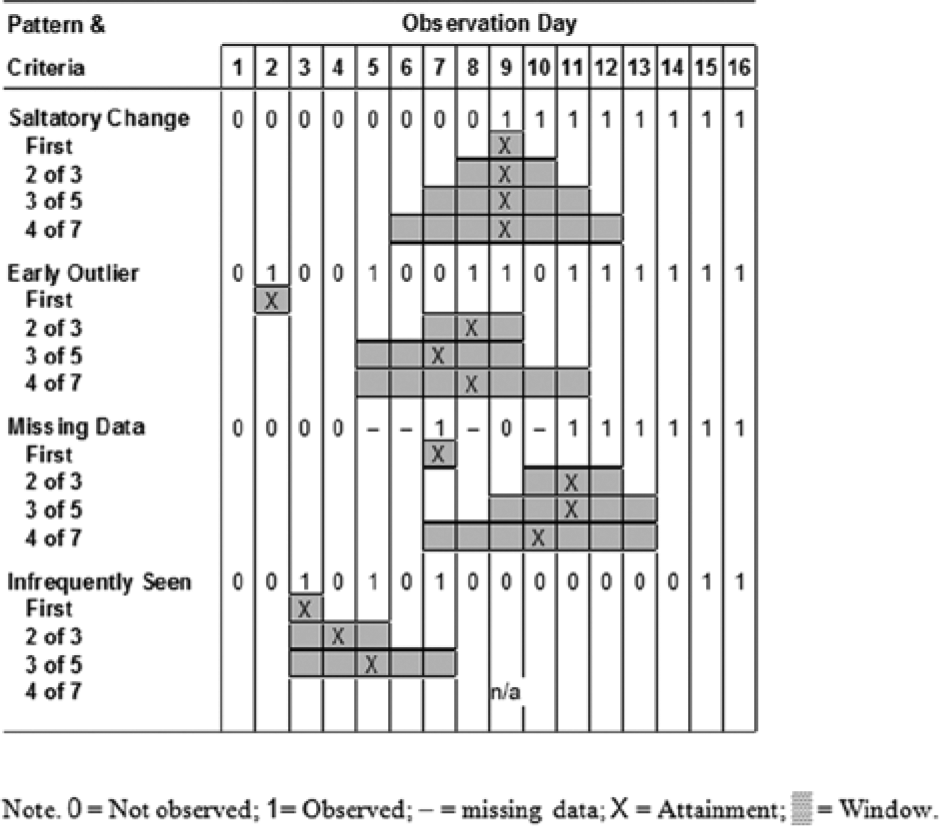
Illustrations of four event attainment criteria as applied to four different patterns of daily checklist observations.
Reliability
To assess the reliability, we divided an infant’s daily records into two samples, one from even-numbered calendar days and the other from odd-numbered days. We then applied each event definition to each sample, first to the even-days’ recordings and second to the odd-days’ recordings. With two estimated dates of attainment for each baby, we could estimate a split-half reliability coefficient. This we did for each of three milestones and four event definitions.
Predictor Variables
We identified for use in the survival analysis 11 individual difference variables that are widely used as predictors of infant development (see Table 1). Because missing values for a predictor is not permissible in our survival analysis, we considered the 519 cases with complete data. To make the parameter estimates of survival analysis more readily interpretable, all predictors were transformed to have a zero value, either by centering or by assigning zero to one level of the variable (see Table 1).
Results
Reliability Analysis
With three milestones and four event definitions each, we calculated 12 reliability estimates (see Table 2). Reliabilities for each of the three milestones are uniformly high and vary little by event definition. Apparently, once the event was observed for the first time, it was observed on most subsequent days. An abrupt onset means that the specific definition chosen does not much influence the calculated day of attainment (see Saltatory Change in Figure 2). Thus, we chose the simplest definition, AOF, for subsequent analyses because it minimizes missing data.
Split-Half Intraclass Reliability Estimates for Each Milestone by Event Definition.

Survival Analysis
Participants joined and left our study at different ages, so we used an accelerated failure time regression model implemented with the SAS Lifereg procedure. We specified the most general distribution model, gamma, because it can accommodate many distribution shapes. A key product of the analysis is the hazard function (see Figure 3), which depicts the momentary “hazard” of attaining a particular milestone by age (if one has not reached it already). A related and more intuitively useful curve is the cumulative distribution function (see Figure 4), which presents the proportion of infants estimated to reach a milestone by age. Based on our data, 50% of infants would be expected to demonstrate sustained sitting, crawling, and walking by 25.6, 38.3, and 55.6 weeks, respectively.
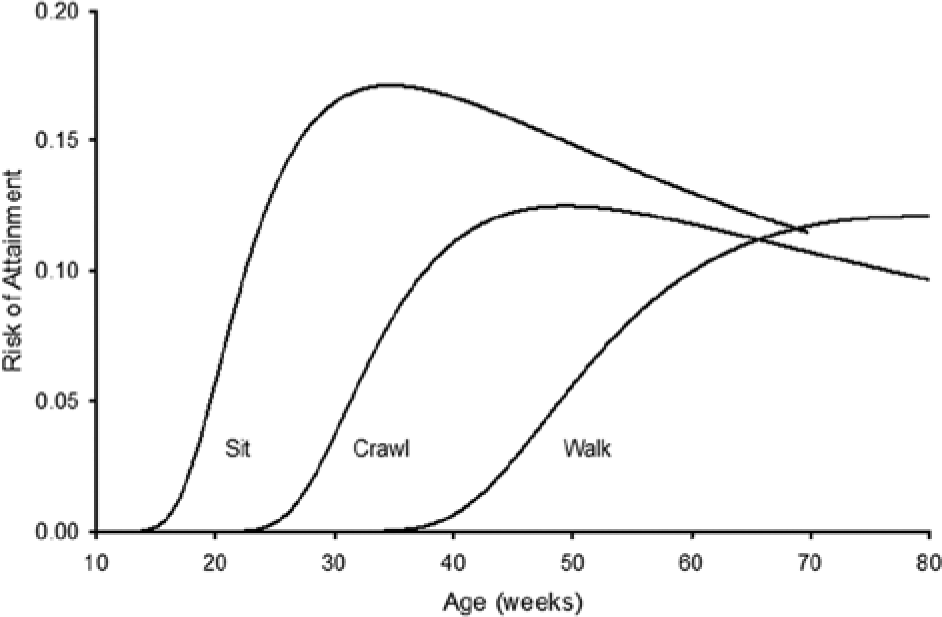
Hazard functions for three milestone events.
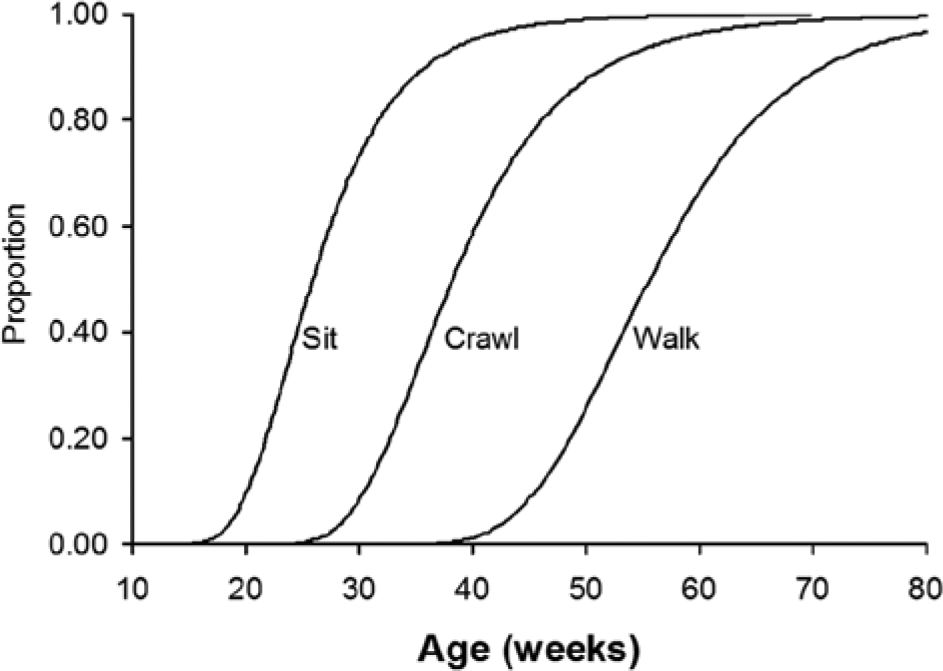
Cumulative distribution functions (inverse of survivor function) for three milestone events.
Interesting though such point estimates may be, the real advantages of survival analysis lie in its ability to relate various predictors to the age of event attainment. Parameter estimates for each of our 11 predictor variables are presented in Table 3. A positive coefficient indicates that an increase in the predictor is associated with an increase in the time to the event (later AOA), whereas a negative coefficient indicates that an increase in the predictor is associated with a decrease in time to the event (earlier AOA). Thus, for all three milestones, the positive coefficients for mother age mean that additional years of mother age predict later attainment. In contrast, gestational age has negative coefficients, which mean that later gestation predict shifts attainment to a younger age.
Summary of Survival Analysis Model and Parameter Values by Milestone.

p < .05. **p < .01. ***p < .001. ****p < .0001.
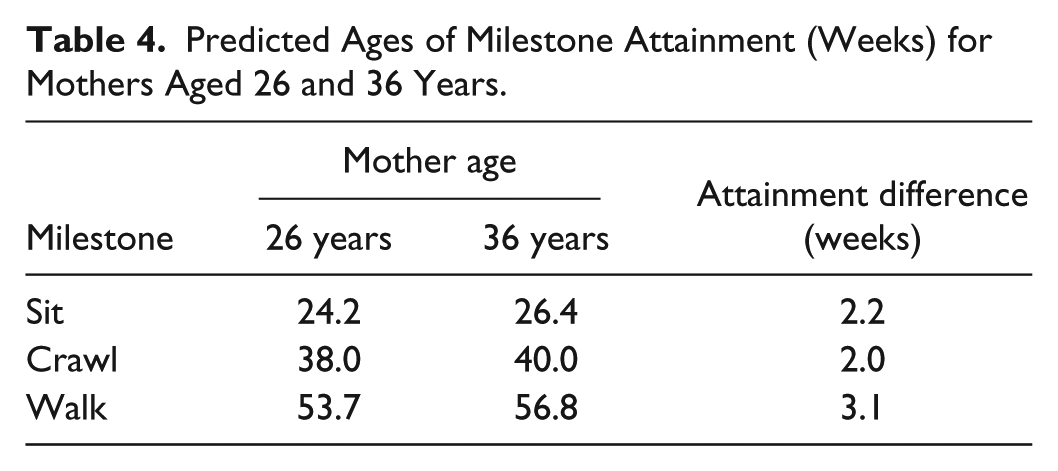
An advantage of an AOA approach is that a variable’s influence can be expressed on an easily understood metric, age. We illustrate this by estimating the ages at which the babies of different-aged mothers will sit, crawl, and walk. We selected mother ages of 26 and 36 years, which are approximately 1 SD on either side of the median mother age of 31 years. We then created two contrast observations where all covariates are constant (set to 0) except for mother age; one was set to 26 years (–5) and the other to 36 years (+5). These observations were appended to our actual data set following Allison (2010, p. 110), and PROC LIFEREG was rerun. This procedure generates predictions for the two contrast observations without influencing the estimation process. The resulting estimates are presented in Table 4, where it can be seen that the baby of the 26-year-old is predicted to reach these motor milestones earlier than the baby of the 36-year-old.
Predicted Ages of Milestone Attainment (Weeks) for Mothers Aged 26 and 36 Years.
Discussion
Not one of the methodological elements of this article is new, nor has any one of them been developed by us. Indeed, all of them can be found in the scientific literature: age of milestone attainment (Shirley, 1933), prospective diary checklists (Adolph et al., 2002), the SAS Expand procedure (Low et al., 2006), and survival analysis applied to child development data (Singer, Fuller, Keiley, & Wolf, 1998). What is new here is the combination of these elements into a framework that makes available to developmental researchers a feasible, flexible, and practical approach to (a) collect AOA data, (b) manipulate and summarize it, and (c) analyze it with appropriate statistical techniques. Furthermore, this approach has revealed substantive findings, to which we now turn.
Little methodological work has been done on the measurement of motor milestone events, and we implemented a practical split-half approach. The reliability issue highlighted for us the importance of how the onset of an event is defined, an issue central in survival analysis. Although we ultimately used the first day of attainment in our analysis, we considered other event definitions. In this regard, the SAS Expand procedure is tremendously flexible and powerful and can readily implement almost any event definition one might articulate numerically. This procedure also allows for the processing of the large volume of data generated by the longitudinal implementation of daily checklists.
Our reliability results tell us that differences due to measurement factors (odd- vs. even-day recording; or 1-, 3-, 5-, or 7-day aggregation intervals) are miniscule compared to differences among babies. Of course this conclusion is limited to the present milestones, and there may well be milestones whose onset is more gradual and intermittent. For those cases, our age-of-first-attainment event definition may be less appropriate, and reliability results may be poorer. In the case of sitting, crawling, and walking, however, our reliability results confirmed that differences among babies generalize beyond the details of the specific definitions we considered. The question then becomes, what is responsible for this variation? Survival analysis provides some new clues.
Two predictors emerged from our analysis, gestational age and mother age. The finding that later gestational age at birth is associated with earlier attainment has been reported in twin studies (Peter, Vainder, & Livshits, 1999) and is consonant with the idea that conceptual age is important. However, a 1-week difference in gestational age is associated with less than a 1-week shift in milestone attainment, which suggests that post-gestational events are influential.
More surprising was our finding of a link between mother age and gross motor attainment, a link that, to our knowledge, has not been made previously. The babies of younger mothers tended to reach these milestones sooner, even after we controlled for 10 other factors, including birth order. Mother age is undoubtedly a crude proxy for other influences, from biological variables associated with pregnancy to post-natal social factors, and we do not know which of these influences are critical. Having been alerted to the possible importance of mother age, we have found two related findings. Schum et al. (2001) reported, without comment, that earlier completion of toilet training is associated with younger maternal age, and Adams, Jones, Esmail, and Mitchell (2004) found that “the younger the mother, the sooner the baby slept through the night” (p. 98). Such results hint at some kind of general maternal age effect on developmental rate. Our initial inclusion of mother age in the analysis was a pro forma choice on our part, so we were surprised when it emerged as a predictor of motor milestones. Our findings reveal the potential of an AOA approach and buttress Bornstein, Putnick, Suwalsky, and Gini’s (2006) call for more research attention to mother age as an influence on development.
Our milestones study also uncovered another unanticipated phenomenon—parents’ great enthusiasm for observing their own baby. With little incentive, prodding, or follow-up from us, those parents who started the daily checklist procedure persisted for many months (7 on average). Of course, their enthusiasm could be a testament to the unique power of babies to capture the attention of adults, but we know that parental regard and concern extends to older offspring as well. The interest of parents in observing their infants provides researchers with an opportunity to show parents how their infant develops. Parents are often unaware of what to look for or what constitutes a change in development. The diary provides a guide that essentially translates a vague concept of motor development into specific, observable facets of behavior. Parents thus gain a greater understanding and appreciation of their infant’s progress. We believe that the milestones approach could be successfully applied to older groups if the recording task is simple and convenient. Technological developments (e.g., automated messaging, e-mail, and mobile apps) may well make feasible AOA studies that would have been prohibitively expensive in the past.
The downside of parental concern is the possibility of bias in their observations. We minimized this potential by focusing on overt behaviors, low-inference coding definitions, and same-day observations and found strong evidence for validity (Bodnarchuk & Eaton, 2004). There are reasons for optimism about the validity issue. First, there are many important developmental phenomena about which parents have few preconceived expectations. For example, a child’s ability to point to an interesting event has implications for a theory of mind, but few parents would have any expectation about when a baby “should” point. Furthermore, investigators could include checklist items designed to identify suspect or careless recording.
A parent-based AOA model has many potential applications. For example, nutrition studies typically use standardized tests like the Bayley Scales of Infant Development (Bayley, 2005) as outcome measures. Such tests are expensive and are usually restricted to one post-treatment occasion. In contrast, parental AOA checklist measures would be more economical and might well be more sensitive to nutritional interventions. This tool also has the potential to improve our methods of developmental surveillance through the development and use of simple forms that parents, with regular observations, could use to track their child’s developmental progress. Not only can children be followed and assessed before they reach school-age, as recommended by school and health practitioners, but because parents can report from a distance, the technique could be useful in remote locations. An AOA approach has the potential to identify at an earlier age children who lag their peers. Early identification could, in turn, facilitate more timely intervention.
An AOA approach to developmental differences specifies not only when a developmental event is typically reached but also what other variables may influence it, and it combines diary checklist methods with existing analytic tools that are within the reach of most investigators. Such an approach makes age part of the dependent variable (Wohlwill, 1973), and between-individual variation in rate of development then provides clues about causal processes (e.g., mother age). This method also engaged and interested parents, who maintained a high level of cooperation and enthusiasm over many months. Researchers should capitalize on such parental enthusiasm by following the examples of human enterprises that successfully harnessed volunteer contributions (e.g., Winchester, 2003). An AOA methodology has the potential to do so.
Footnotes
Authors’ Note
The participation of the parent and infant participants of the Milestone Study provided the foundation for this work, which was built upon by the combined efforts of Wendy Guenette, Kara Bazylewski, Meghan Duncan, Cori Syrnyk, Denee Ryz, Amy de Jaeger, and Carolyn Barg.
Declaration of Conflicting Interests
The author(s) declared no potential conflicts of interest with respect to the research, authorship, and/or publication of this article.
Funding
The author(s) disclosed receipt of the following financial support for the research and/or authorship of this article: This research was made possible by grant 410-2001-0467 to Warren Eaton and Harlene Hayne from the Social Sciences and Humanities Research Council of Canada and by various forms of research support from the University of Manitoba, and by the hospitality of the Department of Psychology, University of Otago, Dunedin, New Zealand.