




Abstract
With the accelerating global aging trend, ensuring age-friendly public transportation has become a pressing challenge in urban planning. While existing frameworks, such as the World Health Organization’s Age-Friendly Cities Initiative, provide general guidelines, they lack a systematic and quantitative approach to assessing the age-friendliness of rapid transit spaces. This study bridges this gap by developing an Age-Friendly Performance Index (AFPI) tailored to rapid transit environments. A mixed-method approach was employed, integrating both qualitative and quantitative research. The construction of AFPI incorporated mobile ethnography, case studies, and literature reviews, with findings systematically coded using proceduralized methods. The index was then validated through Exploratory Factor Analysis (EFA) and reliability testing, followed by the application of Analytic Hierarchy Process (AHP) and Entropy Weight Method (EWM) for weighting. The study yielded two key findings: (1) A three-layered index structure was developed, comprising the goal level, criterion level, and indicator level. (2) AFPI demonstrated strong internal consistency (Cronbach’s α = 0.929) and high structural validity, with EFA results supporting a four-factor model. AFPI provides a comprehensive and empirically validated framework for evaluating and enhancing the age-friendliness of rapid transit spaces. It serves as a critical tool for bridging the gap between policy guidelines and practical implementation, offering valuable insights for urban planners and policymakers to improve public transportation inclusivity for the elderly.
Plain Language Summary
As global aging accelerates, ensuring age-friendly public transportation is a major challenge. Existing frameworks provide guidelines but lack quantitative assessment tools. This study develops the Age-Friendly Performance Index (AFPI) to evaluate rapid transit accessibility. Using mixed-method research, AFPI integrates ethnography, case studies, and literature reviews. It was validated through factor analysis (EFA) and reliability tests, confirming strong internal consistency (Cronbach’s α = 0.929) and structural validity. AFPI provides a practical tool for policymakers and urban planners to improve transit accessibility for older adults.
Introduction
It is projected that the global elderly population (65+) will exceed 16% by 2050 (United Nations, Department of Economic and Social Affairs, Population Division, 2022), furthermore, China’s elderly population (60+) is expected to exceed 30% (Guo et al., 2025). The rapid expansion of aging populations worldwide is undeniable (United Nations, Department of Economic and Social Affairs, Population Division, 2023), placing human beings in the midst of a “Grey tsunami.”
A super-aged population structure presents significant challenges to public health and socioeconomic development, potentially leading to a decline in social vitality and overall economic output (Kawahara & Narikawa, 2015). It also poses critical challenges to the future labor market and the social welfare systems. To address these challenges, it is imperative to establish a support system that encourages elderly participation in social activities, with Age-Friendly Design in the built environment playing a crucial role (Kose, 2021).
As a vital component of environmental support, public transportation enhances social engagement among older adults and increases their access to health and well-being opportunities (Jahangir et al., 2024; Zhang & Yang, 2024). The study of age-friendly public transit design integrates research theories and practical applications from multiple disciplines, including ergonomics, environmental psychology, sociology, and design. Its primary goal is to create a more affordable, accessible and safety mobility experience for older adults (Tinella et al., 2023).
As population aging becomes a globally recognized issue, the concept of Age-Friendly Design has been extensively explored and developed across various countries. The discussions on Design the Age-Friendly Cities and Communities (AFCC) framework, introduced by the World Health Organization (2007), has been widely cited. Developed under the concept of Active Aging, AFCC provides a systematic framework for environmental optimization, aiming to enhance the livability and social participation of older adults.
Nevertheless, the application of Age-Friendly Design in public transportation still faces significant challenges as well as accessible design (Almoshaogeh et al., 2025). Compared to architectural environments or residential spaces, standards and regulations for Age-Friendly Design in public transportation are more limited and inconsistent across countries and regions, making it difficult to establish a globally applicable framework (Iwarsson & Ståhl, 2003; W. Zhou & Chen, 2022). Besides, while various assessment tools have been developed to evaluate age-friendliness (Dikken et al., 2020; Garner & Holland, 2020; Kim et al., 2022; Y. Wang et al., 2017), they primarily focus on the physical environment at the community level. Indicators specific to public transportation spaces remain insufficient. There is a lack of a comprehensive evaluation system that fully reflects the age-friendly performance of rapid transit spaces. Additionally, the development of these tools has relied heavily on expert opinions and policymakers, often overlooking the actual needs of older adults, including cognitive load, social support, and real-world mobility challenges.
Therefore, establishing a systematic and inclusive age-friendly performance index (AFPI) for public transportation spaces evaluation, along with validity and reliability testing, remains a critical research gap that needs to be addressed. This study aims to develop a comprehensive assessment framework that accurately reflects the age-friendliness of rapid transit spaces and to ensures its scientific rigor and applicability through reliability and validity testing. Furthermore, the proposed assessment index would be implemented in a pilot city’s rapid transit system, allowing for multi-dimensional data collection. It helps identify the strengths and weaknesses of current Age-Friendly Design practices and provide empirical support for future optimization of public transportation environments.
On developing an evaluation system for age-friendly performance in rapid transit, two specific research questions are proposed: Q1: What are the key components of the Age-Friendly Performance Index for rapid transit spaces? Q2: How can the reliability and validity of the AFPI be tested to ensure its applicability in evaluating rapid transit spaces?
Theoretically, this study establishes an age-friendly performance assessment index tailored to rapid transit spaces, addressing the unique needs of elderly passengers in physical environment, information accessibility, and social support. It bridges a key gap in existing age-friendliness assessment frameworks and provides a systematic foundation for inclusive transit design.
Practically, the index has been implemented in Hangzhou’s metro system to assess its age-friendliness. The empirical findings offer evidence-based insights for improving transit planning, spatial design, and targeted age-friendly upgrades.
Methodologically, the study adopts a bottom-up, interdisciplinary approach by integrating mobile ethnography, case analysis, and expert interviews to identify real user needs. It also incorporates international practices and technical standards, resulting in a comprehensive and objective assessment framework for enhancing transit accessibility and inclusivity.
Literature Review
Since the World Health Organization (WHO) launched the Global Age-Friendly Cities Initiative in 2007, the concept of Age-Friendly Design has become increasingly globalized, driving both practical applications and academic research. However, the term Age-Friendly Design has not been explicitly defined, thus subcategorized under Active Aging. Active Aging emphasizes inclusivity and diversity, spans across multiple disciplines, and acknowledges the variations in aging experiences across different geographical and cultural contexts. However, due to the lack of concrete implementation strategies, it often appears metaphysical in practical applications (Hu & Zhang, 2017). The absence of a unified and systematic interpretation of Age-Friendly Design across disciplines can be attributed to two main factors.
First, significant differences exist among countries in terms of demographic characteristics, social structures, policy paradigms, and institutional frameworks, leading to varied approaches in addressing population aging (Chen et al., 2025). Against this backdrop, scholars worldwide have actively explored the concepts tailored to their respective national conditions and policy contexts. For instance, Universal Design, widely adopted in the United States and Japan, emphasizes accessibility and usability in environments and products to accommodate individuals with varying abilities (Hedvall et al., 2025). In contrast, Inclusive Design, primarily advocated in the United Kingdom, focuses on reducing social exclusion by enhancing environmental adaptability for diverse populations (Clarkson & Coleman, 2015). Meanwhile, Design for All, promoted in Nordic countries, prioritizes social equity and sustainability, aiming to create universally accessible and user-friendly environments, ensuring that people of all ages and abilities can equitably benefit from public infrastructure (Bendixen & Benktzon, 2015).
Second, Age-Friendly Design is a multidisciplinary study, including architecture, urban planning, industrial design, ergonomics, and rehabilitation engineering. The diverse research perspectives and objectives across these fields have led to inconsistencies in concept definitions and application standards (Greer & Edelman, 2024). The United Kingdom has been at the forefront of interdisciplinary collaboration in addressing aging and Age-Friendly Design. Since 1997, the Engineering and Physical Sciences Research Council has launched several interdisciplinary and cross-sector research initiatives on aging, such as Extending Quality Life (2001), Strategic Promotion of Ageing Research Capacity (2004), and Knowledge Transfer for Equal Access (2008) (Clarkson & Coleman, 2015; Dong, 2011). In 2005, the UK Research Councils (RCUK) introduced the New Dynamics of Ageing program, further advancing interdisciplinary research on aging. These initiatives have fostered large-scale collaboration and led to significant academic achievements. They have also had a profound social impact by improving the quality of life for older adults and enhancing the accessibility of the built environment.
Many scholars argue that designing for older adults is one of the origins of various modern design concepts (Clarkson & Coleman, 2015; Persson et al., 2015). Chinese researchers have systematically reviewed and compared Age-Friendly Design theories since 1945 and identified three core pillars. They are disability-focused, elderly-focused, and all-age-inclusive (Hu & Zhang, 2017). Some scholars conducted a systematic and genealogical review of inclusive design approaches from the perspective of aging (Sun et al., 2024). Meanwhile, other scholars suggest that despite differences in the origins and developmental trajectories of Age-Friendly Design across different regions (Jia et al., 2025), these concepts have gradually converged and influenced each other over time, forming certain commonalities (Yuan et al., 2020).
The introduction of AFCC has driven scholars to develop Age-Friendly Design assessment frameworks. They aim to facilitate the enhancement of community and housing age-friendliness through systematic evaluation. A summary of these frameworks and tools is provided in Table 1. Assessment tools based on the Age-Friendly Cities framework have demonstrated effectiveness in evaluating community-level age-friendliness and have provided critical empirical insights. For instance, Menec and Nowicki (2014) found a positive correlation between age-friendly community features and both life satisfaction and self-perceived health among older adults, while housing factors showed an inverse relationship. Kim et al. (2022) revealed that improving physical and social environments significantly contributes to older adults’ well-being. Y. Wang et al. (2017) pointed out the limitations of applying the Age-Friendly Cities framework in many developing regions, highlighting the need for localized adaptations. Furthermore, Garner and Holland (2020) found that older adults’ perceptions of environmental age-friendliness are significantly associated with their quality of life and levels of loneliness, underscoring the psychological impact of Age-Friendly Design.
Framework and Tools for Aging Performance Assessment.
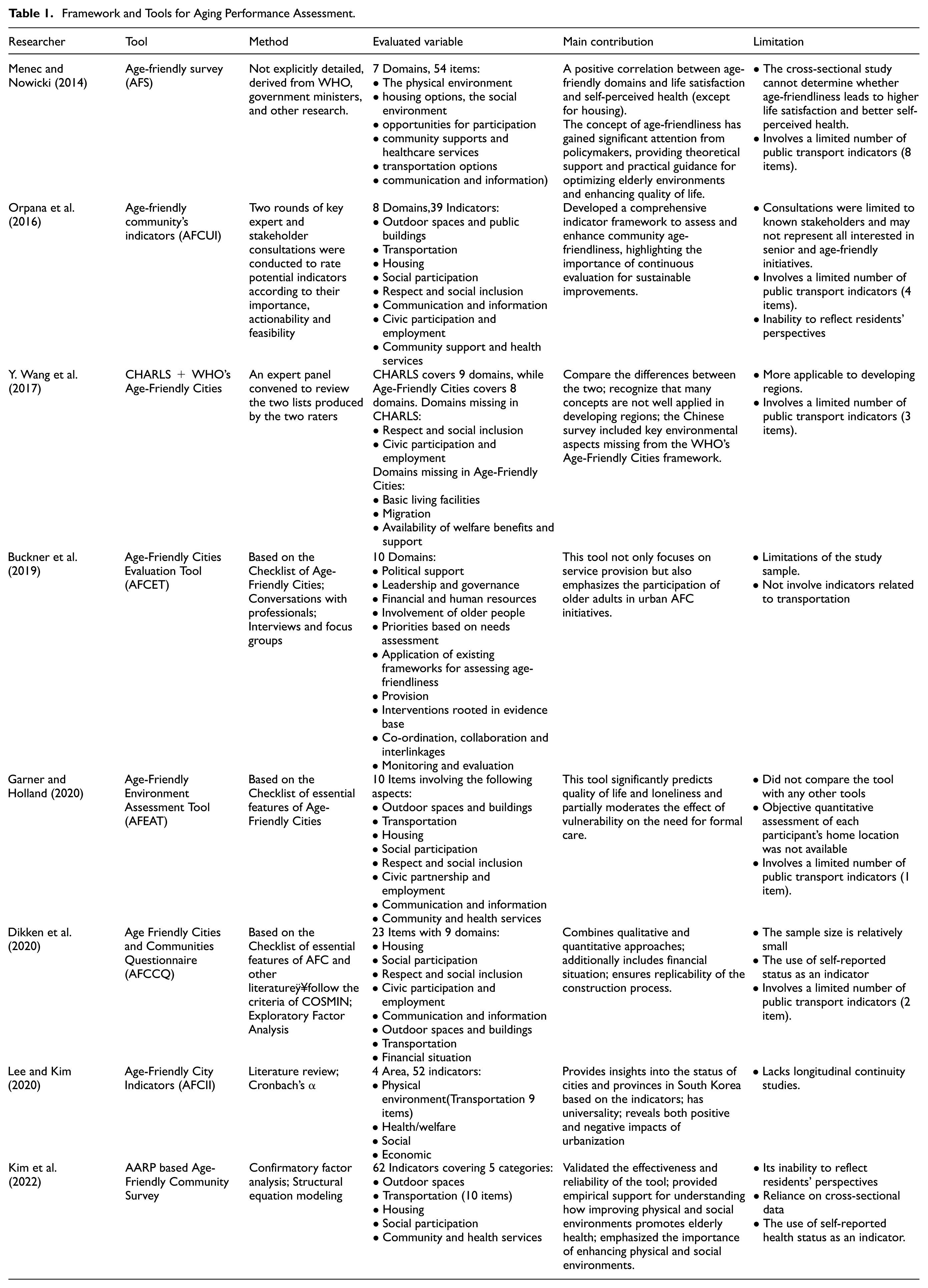
In addition, these studies have broadened the scope of Age-Friendly Cities assessment by incorporating a wider range of influential factors. For example, Y. Wang et al. (2017) expanded the assessment framework by integrating basic living facilities, migration, and the availability of welfare benefits and supports to enhance its applicability to developing regions. Dikken et al. (2020) also highlighted the significance of financial situation, emphasizing that economic factors directly impact older adults’ access to essential services and facilities. Lee and Kim (2020) examined the double-edge effects of urbanization on age-friendliness: while infrastructure modernization improves accessibility to public facilities, rapid urbanization may also lead to increased social isolation and adaptation challenges for older adults, negatively affecting their overall quality of life.
Although Age-Friendly Cities and related assessment frameworks have made progress in age-friendliness research, several critical gaps remain in the context of this study:
(1) Lack of a systematic assessment framework for age-friendly public transportation. Existing assessment systems primarily focus on community environments, with limited attention to the age-friendliness of public transportation. Current assessment indicators mainly emphasize the spatial distribution of transit stations (e.g., station distance, number of routes), but they lack a comprehensive and quantifiable assessment tool for age-friendly transit design. This fragmented indicator system fails to accurately measure the impact of public transportation environments on older adults’ travel experiences, limiting its applicability for policy and planning.
(2) Over-reliance on expert opinions while neglecting the actual needs of older adults. Most age-friendly assessment tools are developed based on expert opinions, policy documents, or international frameworks, rather than deriving directly from the real-life experiences of older adults. This top-down approach may result in an assessment bias, where evaluation criteria fail to align with the actual needs of elderly users. For example, critical issues such as navigation waiting area, and accessibility to facility in rapid transit spaces are often underrepresented in existing frameworks.
(3) Insufficient integration of self-reported data and objective measurements, affecting assessment accuracy. Many existing studies primarily rely on self-reported data from older adults, such as surveys and interviews, while neglecting objective measurements of the built environment and transportation infrastructure. However, an over-reliance on subjective data may introduce biases in age-friendliness assessments. In addition, the lack of objective data limits the ability to provide practical suggestions, reducing the effectiveness of policy implementation and real-world applications.
This study aims to develop an AFPI specifically designed for rapid transit spaces, providing a systematic and quantitative framework for assessing the age-friendliness of public transportation environments. To address these gaps, this study adopts a bottom-up approach, integrating both qualitative and quantitative research methods to ensure the scientific rigor, inclusivity, and practicality of the evaluation system.
Methodology
To address the research objectives, this study proposes two theoretical hypotheses:
Research Design
Four key phases were conducted: AFPI Indicator Identification, Testing, Implementation, and Weighting (see Figure 1). The implementation of AFPI is placed before the weighting phase for the following reasons: First, the entropy weighting method relies on data obtained from the evaluation process, which will be detailed in the subsequent sections; Second, the assigned weights do not affect the practical application of the index in evaluations.

AFPI construction process.
AFPI Indicator Identification
The process of indicator identification consists of two steps.
Step 1: Data Collection and Analysis. The coding data in this study are derived from three primary sources: Survey on Passengers, Survey on rapid transit spaces, and relevant literature. A combination of primary and secondary data was employed to ensure the comprehensiveness and timeliness of the index, thereby capturing user needs more accurately (Kim et al., 2022).
Step 2: Proceduralized Coding. Proceduralized coding is a contextualized research approach that systematizes data extraction and organization. This study applied proceduralized coding to Survey on passengers, Survey on rapid transit spaces, and relevant literature using Atlas.ti 23 for coding analysis.
The coding process followed a three-tier structure:
(1) Open Coding: Identifying initial concepts and categorizing them;
(2) Axial Coding: Establishing relationships among concepts to form key categories;
(3) Selective Coding: Integrating core categories to construct a comprehensive theoretical framework.
These levels correspond to the Indicator Level, Criterion Level, and Goal Level of AFPI, respectively. A bottom-up coding strategy was employed, using comparative analysis of similarities and differences, to ensure the systematicity and completeness of the index system. This approach facilitates the construction of a scientific and operational framework for evaluating age-friendly performance in rapid transit spaces.
AFPI Testing
To ensure the reliability and validity of the constructed indicators, a series of statistical tests were conducted. Internal consistency was assessed using Cronbach’s α coefficient. Construct validity was examined through Exploratory Factor Analysis (EFA) to determine whether the underlying factor structure aligned with theoretical expectations. All statistical analyses were performed using SPSSAU.
AFPI Implement
This study was conducted in Hangzhou due to its aging demographics, mature metro network, and diverse transit station typologies. In May 2024, the AFPI index was applied to assess the age-friendliness of rapid transit spaces in Hangzhou.
The adoption of a 5-point Likert scale enhances the operability, comparability, and applicability of the index, providing a standardized foundation for subsequent data analysis. The scale’s thresholds were established based on national standards, industry regulations, field measurements, and relevant literature, ensuring the scientific rigor, objectivity, and consistency of the evaluation system. Furthermore, expert consultations and field investigations were conducted to validate the rationality of the scale divisions, improving the accuracy and applicability of the assessment framework. The standardized AFPI scale is presented in
AFPI Weighting
To ensure both expert-driven insight and data-driven objectivity, this study integrates the Analytic Hierarchy Process (AHP), with the Entropy Weight Method (EWM). The weighting process was conducted using SPSSAU and Excel (Office 2021).
AHP is a subjective quantitative weighting method that relies on expert judgment. The EWM is an objective quantitative technique based on information entropy. It assumes that higher information content leads to lower uncertainty and entropy, which in turn influences the weight assignment process.
Data Collection and Analysis
Data for Indicator Identification
The passenger survey in this study adopted a mobile ethnography approach, with 36 elderly passengers were randomly sampled from Hangzhou’s Rapid transit spaces. Upon obtaining informed consent, their travel experiences were tracked and recorded. Analysis was conducted using spatial touchpoints (Shi & Zhao, 2022) as units of observation. Key moments were screenshot and coded in an action coding table, evaluating the frequency of behaviors and whether the user experience was positive. This process provided deeper insights into how elderly passengers interact with the rapid transit environment and identified potential accessibility issues. Specific coding examples and detailed observation records are presented in the action coding table (
According to the Consent to Participate in Research, there is no effects from participation. By taking part in this study, the participants will contribute to the advancement of Age-Friendly Design in rapid transit spaces. The participants signed informed consent forms prior to the mobile ethnography. Strict confidentiality of the information collected from this study was maintained and personal privacy was carefully protected.
This study also adopted a case study approach. It examined two representative rapid transit lines in Asia: The Nanakuma Line in Fukuoka, Japan, and the Thomson-East Coast Line in Singapore. The aim was to explore the implementation of Age-Friendly Design in transit environments (Shi & Zhao, 2022).
The selection of these two lines was based on the following criteria: (1) A large aging population; (2) Public transportation as a policy priority; (3) Advanced implementation of Age-Friendly Design concepts, making them valuable references for this study.
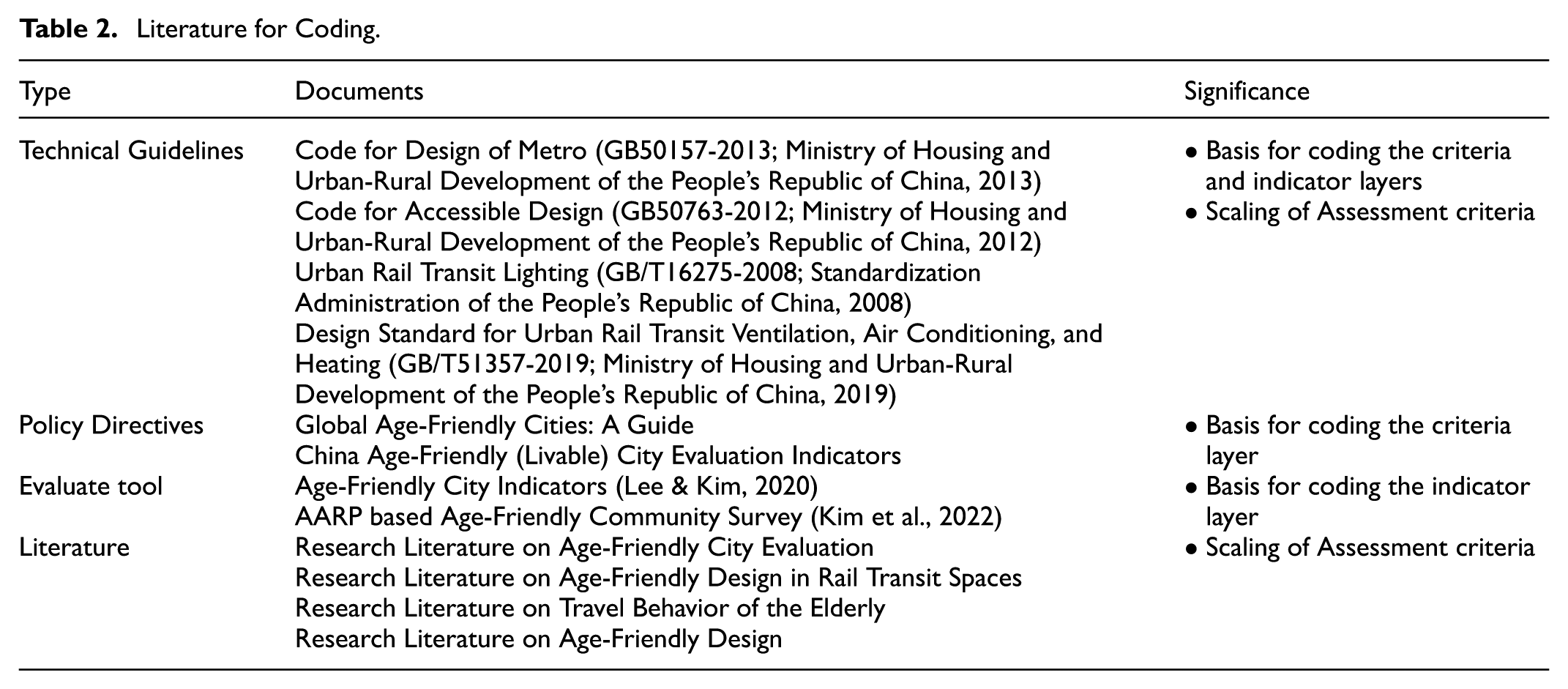
Additionally, this study conducted a literature review covering technical guidelines, policy directives, assessment tools, and related literature (see Table 2). This review aimed to refine the age-friendly performance assessment framework by drawing on existing standards, international frameworks, and previous research. The goal was to ensure scientific rigor and inclusivity during the primary data development process. Given that this study focuses on mainland China, the selection of literature carefully considered cultural influences and the universality of technical indicators, incorporating both domestic and international research and best practices.
Literature for Coding.
Data for Testing
Testing data collected from elderly respondents who assessed the importance of AFPI indicators. The study utilized a modified AFPI scale, in which each indicator was transformed into a 5-point Likert scale, requiring participants to rate its relevance to their travel experience. A total of 430 questionnaires were distributed, with 255 returned and 230 deemed valid.
Data for Implement
A stratified sampling method was employed, selecting 10% of the total stations across 12 transit lines, resulting in a sample of 38 rapid transit stations.
After determining the sample, additional station characteristics, including opening date, building area, structural features, and design themes, were identified using publicly available data. These attributes will be further explored in subsequent correlation analyses. Detailed information on the sampled stations is provided in
Data for Weighting
For AHP, a focus group of six professionals was assembled, consisting of experts in rapid transit (n = 1), inclusive design (n = 1), urban design (n = 1), and academic scholars from a design institute (n = 1), along with two experienced elderly transit users (n = 2). The focus group evaluated the relative importance of each AFPI indicator through pairwise comparisons, assigning scores using the 1/9-9 scale in a judgment matrix table. The weighting process was conducted sequentially, beginning at the indicator level, followed by the criterion level and the goal level. All scores were determined through group discussions to ensure consensus among participants, minimizing individual bias and enhancing the reliability of the weighting process.
To ensure the rationality of the AHP weighting results, a consistency test was conducted on the judgment matrix. First, the maximum eigenvalue (
After passing the consistency test, the final weights of each level




For EWM, two types of datasets were collected:
(1) Data 1 (Subjective Evaluation Data): Collected from elderly respondents who assessed the importance of AFPI indicators.
(2) Data 2 (Objective Evaluation Data): Derived from on-site assessments of Hangzhou’s rapid transit spaces based on the AFPI framework. Researchers evaluated 38 transit stations, considering factors such as operational duration, structural characteristics, and design themes.
Since Data 1 and Data 2 were measured using consistent evaluation criteria, no additional standardization(
(1) Compute entropy values
(2) Calculate the dispersion coefficient d to assess the information distribution and determine the effective information content of each indicator (
Determine the respective weights of Data 1


After determining the weights derived from AHP and EWM, this step integrates these weights (
(1) Normalize weights (
(2) Combine both weight sets to derive the final hybrid weight


Result
AFP Coding Network
The coding process in grounded theory facilitates theory construction but must be anchored in a priori knowledge. Unlike the Age-Friendly Cities framework, which focuses on the broader domains of housing and mobility, the AFPI framework is structured around human capability characteristics. Through iterative comparison and classification, a three-tiered evaluation system was developed (Figure 2).

AFP coding network.
The highest tier of this system is the Goal Level, encompassing four core dimensions: Perceptual Accessibility, Cognitive Accessibility, Motor Accessibility, and Service Accessibility. Beneath it, the Criterion Level refines these dimensions into 15 selective codes, further specifying the assessment scope. At the most granular level, the Indicator Level comprises 42 axial codes, directly determining the evaluation process. These indicators are derived through clustering and refinement of 246 open codes, synthesized from both primary and secondary data sources.
Perceptual Accessibility
Perceptual Accessibility evaluates the ease with which individuals perceive and interpret environmental information within a given space. It comprises five key elements (selective codes): Lighting system, Acoustic environment, Thermal environment, Field of view, and Contrast. These factors determine the sensory perception and information delivery, particularly for older adults and individuals with diminished visual or auditory capabilities. The five elements are further refined into 11 assessment indicators (axial codes), serving as concrete measurement criteria. These indicators, in turn, are aggregated from 59 open codes, forming a structured Perceptual Accessibility assessment framework (see Figure 3).

Perceptual Accessibility coding flow.
Cognitive Accessibility
Cognitive Accessibility refers to the ease with which individuals acquire, comprehend, and process wayfinding information in a spatial environment. It is structured around four key elements (selective codes): Guidance integration, Guidance efficiency, Identifiability, and Multipath guidance. These elements work together to present information with clarity, recognizability, and efficiency for the need of users with varying cognitive levels. The four elements are further refined into 10 assessment indicators (axial codes), serving as concrete measurement criteria. These indicators, in turn, are aggregated from 71 open codes, forming a structured Cognitive Accessibility assessment framework (see Figure 4).

Cognitive Accessibility coding flow.
Motor Accessibility
Motor Accessibility refers to the ease and accessibility of independent movement and operation within a spatial environment. It is structured around three key elements (selective codes): Physical accessibility, Horizontal movement, and Vertical movement. These elements determine the level of spatial accessibility for the needs of users with varying mobility capabilities. The three elements are further refined into nine assessment indicators (axial codes), serving as concrete measurement criteria. These indicators, in turn, are aggregated from 72 open codes, forming a structured Motor Accessibility evaluation framework (see Figure 5).

Motor Accessibility coding flow.
Services Accessibility
Services Accessibility refers to the ease of access to service resources within a spatial environment and the convenience of their utilization. It is structured around three key elements (selective codes): Service facilities, Service attitude, and Service density. These elements provide service availability, response efficiency, and coverage for individuals in diverse needs. The three elements are further refined into 11 assessment indicators (axial codes), serving as specific measurement criteria. These indicators, in turn, are aggregated from 44 open codes, forming a structured Services Accessibility evaluation framework (see Figure 6).

Services Accessibility coding flow.
Revised AFPI
Internal Consistency
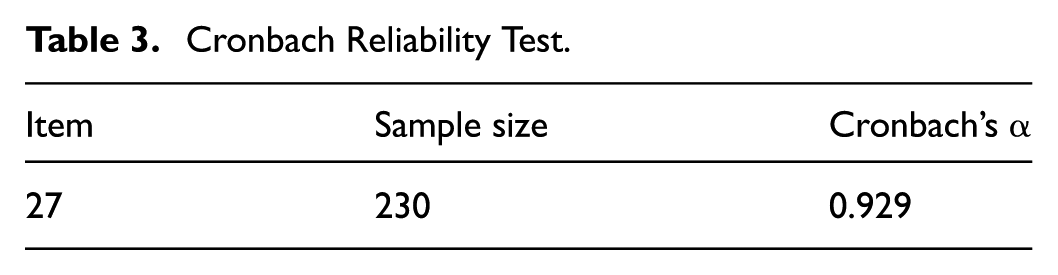
Based on the 230 valid AFPI importance rating questionnaires collected, the Cronbach’s α score for AFPI was .929 (see Table 3). A Cronbach’s α coefficient above .8 indicates excellent reliability, suggesting that AFPI demonstrates high internal consistency and is a reliable assessment tool.
Cronbach Reliability Test.
Convergent Validity
Before conducting factor analysis, the Kaiser-Meyer-Olkin (KMO) test and Bartlett’s test of sphericity were performed. The results indicated that the dataset was suitable for factor analysis (KMO > 0.6), confirming the adequacy of the sample for identifying underlying factor structures (see Table 4).
KMO and Bartlett’s Test.

Subsequently, factor analysis was conducted to validate and refine the convergent validity of the indicators. Through iterative optimization and adjustments to the elements at the criterion level, the number of indicators was reduced from the original 42 to 27, resulting in the revised AFPI framework. The factor loading results are presented in Table 5.
Final Factor Loading Analysis.


Note. In the table, numbers are colored as follows: Bold indicates factor loadings with an absolute value greater than 0.4.
The analysis revealed that all factor loading exceeded 0.4, effectively representing the expected constructs, which align with the four target dimensions.
Weighted AFPI
Through the mixed weighting method, a comprehensive weighted index system was ultimately constructed, as detailed in Table 6. This system encompasses four core dimensions: Perceptual Accessibility, Cognitive Accessibility, Motor Accessibility, and Services Accessibility. Each dimension is structured into a Criterion Level, further refined into an Indicator Level, with corresponding weight assignments.
Combined Weight Values of Each Indicator.

Discussion
Key Components and Structure of AFPI
To address the first core research question (Q1), the AFPI adopts a three-tiered structure comprising the Goal Level, Criterion Level, and Indicator Level. This structure ensures the framework is rigorous, comprehensive, and feasible for practical implementation. This structure not only enables a systematic assessment of age-friendliness in rapid transit spaces but also provides clear evaluation standards at different levels, reinforcing its theoretical foundation and practical applicability.
The Goal Level defines the core evaluation dimensions of age-friendly performance in rapid transit spaces, forming the fundamental framework of AFPI. It consists of four key dimensions: Perceptual Accessibility, Cognitive Accessibility, Motor Accessibility, and Services Accessibility. These dimensions are constructed using a bottom-up approach, ensuring the scientific rigor and comprehensiveness of the evaluation system. Compared to the WHO framework and other existing assessment models, AFPI is more targeted. It retains key elements of Age-Friendly Design while placing greater emphasis on the real user experience of elderly passengers, making it better suited for rapid transit environments. Consequently, this framework addresses the gap in systematic evaluation tools for age-friendly public transportation, in order to supply high-quality transport sevices by prioritizing people (Z. Wang et al., 2022; Zhao et al., 2020).
The Criterion Level further refines the sub-goals of age-friendliness assessment outlined in the Goal Level, enhancing both its practical applicability and operational feasibility. This level is grounded in national standards, industry regulations, existing assessment frameworks, and relevant literature, while also incorporating Age-Friendly Design elements extracted from advanced practices in Asia. Additionally, insights were gathered from mobile ethnography and semi-structured interviews with elderly passengers to ensure the framework remains rooted in real-world user experiences. This approach strikes a balance between top-down policy directives and bottom-up user needs. The conceptual foundation of AFPI aligns with the Age-Friendly City Indicators proposed by Lee and Kim (2020), emphasizing a user-experience-driven approach to evaluating and optimizing age-friendly transit environments.
The Indicator Level integrates objective quantification and subjective evaluation to ensure comprehensive and reliable assessment. Specifically, it defines the measurement methods and standards for each evaluation criterion. For example, lighting comfort is assessed through average illuminance (lx), multi-language guidance is measured by the number of languages covered by the guidance system, and escalator availability is quantified based on the number of escalators per station.
The indicators is based on national technical standards, on-site spatial measurements, and expert interviews, effectively addressing the limitations of relying solely on subjective self-assessments. This approach enhances the objectivity, scientific validity, and practical applicability of the assessment framework. Furthermore, the AFPI aligns with previous studies (e.g., Garin et al., 2014; Song et al., 2024; Wu et al., 2019) that highlight the correlation between built environments and elderly well-being. By integrating both spatial facility assessments and user experience evaluations, AFPI ensures that the assessment results accurately reflect the current state of transit infrastructure while capturing the actual needs and experiences of elderly users.
The Reliability and Validity of AFPI
The construction of AFPI demonstrates high measurement stability and internal consistency, effectively addressing the core research question (Q2). The reliability test results indicate that Cronbach’s α = 0.929, which significantly exceeds the 0.7 threshold, suggesting strong inter-item correlation and high reliability of the index. Furthermore, all sub-dimensions met acceptable internal consistency standards, confirming the coherence and robustness of AFPI in assessing age-friendliness in rapid transit spaces. These findings reinforce AFPI’s reliability as an assessment tool, ensuring consistent measurement across diverse transit environments.
To verify the validity of AFPI, EFA was conducted. Given that the study involves the development of a new index, employing EFA for validity testing is methodologically appropriate (J. Zhou & Ma, 2024). The Kaiser-Meyer-Olkin (KMO) test yielded a value of 0.914, indicating that the dataset is suitable for factor analysis. In addition, Bartlett’s test of sphericity (χ2 = 2732.838, df = 351, p < 0.001) was significant, further supporting the applicability of factor analysis. The EFA extracted four main factors, confirming the structural validity of AFPI and its effectiveness in capturing key aspects of age-friendly transit design. Furthermore, all factor loadings exceeded 0.4, signifying that the indicators were well-aligned with their respective dimensions, thereby demonstrating strong construct validity.
Overall, AFPI exhibits robust structural validity, measurement reliability, and dimensional alignment, providing a theoretically grounded and empirically validated tool for assessing age-friendliness in rapid transit systems.
A sample AFPI assessment on the age-friendliness of rapid transit spaces in Hangzhou (n = 38) was conducted, with both descriptive statistics and correlation analysis providing support for its reliability and validity.
In terms of descriptive statistics, the overall distribution of AFPI scores is presented in Table 7. The mean score across the 38 sampled stations was 3.167, indicating a notable gap from the ideal value of 5, suggesting that further improvements in Age-Friendly Design are necessary. The standard deviation was 0.286, reflecting a relatively concentrated data distribution, which helps maintain measurement stability while effectively distinguishing variations in age-friendliness across different stations. The standard error was 0.046, indicating a high level of precision in the mean estimation. In addition, the skewness value (0.167) is close to 0, indicating that the data follows a near-normal distribution without significant asymmetry. The kurtosis value (−0.626) suggests that the data distribution is flatter than a standard normal distribution, meaning the spread of scores is more evenly distributed across stations rather than being concentrated around extreme values.
AFPI Descriptive Statistics of AFPI Scores.

In terms of correlation analysis, the study identified a significant negative correlation between AFPI scores and station operational age (Month; see Table 8). The older transit stations tend to exhibit lower age-friendliness scores, whereas newer stations demonstrate better performance. This trend aligns with the evolution of rapid transit design, where age-friendly principles have become more systematically integrated into newer station designs over time. The results also suggest that AFPI is capable of capturing real-world trends and evaluating changes in the built environment, thereby providing empirical support for its criterion-related validity.
Correlation Analysis Between Operating Month and AFPI Score.

Furthermore, AFPI not only helps identify stations with lower age-friendliness but also serves as a valuable tool for guiding age-friendly retrofitting efforts. It provides valuable data for policymakers and urban planners, facilitating evidence-based decision-making for a more inclusive rapid transit system.
Application and Future Prospects
Practical Value
The AFPI serves as a comprehensive and practical tool for assessing and enhancing the age-friendliness of rapid transit spaces. It offers a multidimensional framework that fills existing gaps in design codes by guiding planners and designers across architecture, signage, and service systems. In practice, AFPI can assist authorities and transit operators in identifying underperforming stations, implementing targeted improvements, and tracking renovation effectiveness through pre-post evaluations. Furthermore, it supports early-stage project design by enabling simulation-based assessments that reduce future retrofit costs. On the policy level, AFPI can be embedded into regulatory standards, approval and acceptance processes, and performance evaluation systems, promoting data-driven governance and stratified renovation strategies see Figure 7.

Collaborative framework for inclusive transit governance.
The AFPI can be systematically applied to evaluate the age-friendliness of existing rapid transit stations, enabling decision-makers and operators to identify problems and formulate targeted improvement strategies. Specific applications are as follows.
(1) Identifying stations with poor age-friendliness performance. Low-performing stations can be prioritized for intervention based on the assessment results.
(2) Implementing facility upgrades. For example, authorities can install or upgrade accessible elevators and improve the slip resistance of floor surfaces as well as the continuity of tactile paving. They can also optimize wayfinding systems using graphical signage and audio prompts, and increase the availability of seating and resting areas to ensure sufficient waiting and transfer buffer spaces for older passengers.
(3) Evaluating the effectiveness of interventions. AFPI can be used as a comparative tool to measure pre- and post-renovation performance, quantitatively assessing improvement levels. Additionally, a renovation tracking and documentation system can be established to guide future rounds of upgrades.
The AFPI also offers a proactive reference framework for transportation planners and design teams during the early stages of station design, enabling early-stage interventions and reducing costly rework in later phases. Its practical applications are as follows.
(1) Establishing systematic Age-Friendly Design standards. The multi-dimensional structure of AFPI can guide various design disciplines to integrate age-sensitive considerations from the outset.
(2) Optimizing preliminary planning and spatial layout. Design proposals can be aligned with key performance indicators such as clear circulation routes, visual integration, and perceptual friendliness at the conceptual stage.
(3) Reducing renovation costs. By anticipating potential usability challenges for elderly passengers early on, designers can prevent high-cost post-construction modifications.
(4) Conducting pre-construction simulation assessments. AFPI can be used during the design process to simulate station performance, facilitating the adjustment of spatial configurations, facility provisions, and service allocations in advance.
The AFPI can also serve as a key decision-making tool for urban administrators and policymakers, helping drive regulatory and governance improvements. Specific applications are as follows.
(1) Informing design codes and standards: incorporating AFPI indicators into national or municipal guidelines, such as Barrier-Free Design Codes or Subway Design Standards.
(2) Establishing evaluation-based approval mechanisms: integrating AFPI scoring into project approval and acceptance phases to enhance accountability in age-friendly implementation.
(3) Supporting data-driven governance and performance appraisal: embedding AFPI within transport system assessments and fiscal performance evaluations to encourage continuous improvements.
(4) Guiding tiered renovation strategies: using AFPI scores to classify stations and formulate a stratified approach, maintaining high-performing stations, optimizing moderate ones, and prioritizing upgrades for low-scoring stations.
Research Limitations and Future Directions
Despite its applicability and practical value in assessing age-friendliness in rapid transit spaces, this study has certain limitations that warrant further refinement and expansion in future research.
First, the current field evaluations of AFPI are primarily focused on Hangzhou’s rapid transit system. Although the results provide preliminary evidence of its applicability, its generalizability remains to be further validated. Future studies should extend evaluations to different regions to refine the index’s adaptability across diverse transit environments.
Second, AFPI’s application in policy-making and practical implementation requires further development. Future research could explore ways to translate assessment results into concrete policy recommendations, offering targeted guidance for governments, urban planners, and transit authorities in optimizing age-friendly transit environments.
In the future, the AFPI framework can be further integrated with empathetic modeling and AI-based perception technologies to develop inclusive design support systems tailored for visually impaired passengers. By combining empathy-related data, such as eye-tracking and physiological feedback, with big data from transit spaces, it becomes possible to achieve real-time sensing and feedback on the behaviors of visually impaired users. This intelligent support mechanism would enable dynamic optimization of transit environments and promote enhanced inclusiveness, thereby empowering empathy-driven and personalized design interventions.
Conclusion
This study developed and validated the AFPI to systematically assess the age-friendliness of rapid transit spaces. The index is structured into a three-tiered framework-goal level, criterion level, and indicator level-to ensure scientific rigor, comprehensiveness, and practical applicability. The development of AFPI followed a bottom-up approach, integrating qualitative and quantitative research methods, including mobile ethnography, semi-structured interviews, expert consultation, and on-site measurements. Through procedural coding, the index was constructed based on older passengers’ capability characteristics, and a hybrid weighting method was employed to determine indicator weights, ensuring the robustness and validity of the assessment.
Reliability analysis indicated that the revised AFPI exhibited high internal consistency, confirming the stability of the measurement. EFA demonstrated that all indicators aligned well with their expected constructs.
The application of AFPI addresses the gap in existing age-friendliness assessment tools for rapid transit environments, providing policymakers and urban planners with a scientifically grounded, quantitative assessment framework. Findings from this study suggest that AFPI can effectively identify stations with lower age-friendliness and generate targeted recommendations for improvement, fostering the advancement of inclusive rapid transit systems.
Supplemental Material
sj-xlsx-1-sgo-10.1177_21582440251396642 – Supplemental material for A Multidimensional Index for Inclusive Age-Friendly Transit Design: Development and Practical Scenarios
Supplemental material, sj-xlsx-1-sgo-10.1177_21582440251396642 for A Multidimensional Index for Inclusive Age-Friendly Transit Design: Development and Practical Scenarios by Wenwen Shi, Gangwei Cai, Lina Jiang, Yihong Liu and Yi-Tong Cui in SAGE Open
Supplemental Material
sj-xlsx-2-sgo-10.1177_21582440251396642 – Supplemental material for A Multidimensional Index for Inclusive Age-Friendly Transit Design: Development and Practical Scenarios
Supplemental material, sj-xlsx-2-sgo-10.1177_21582440251396642 for A Multidimensional Index for Inclusive Age-Friendly Transit Design: Development and Practical Scenarios by Wenwen Shi, Gangwei Cai, Lina Jiang, Yihong Liu and Yi-Tong Cui in SAGE Open
Supplemental Material
sj-xlsx-3-sgo-10.1177_21582440251396642 – Supplemental material for A Multidimensional Index for Inclusive Age-Friendly Transit Design: Development and Practical Scenarios
Supplemental material, sj-xlsx-3-sgo-10.1177_21582440251396642 for A Multidimensional Index for Inclusive Age-Friendly Transit Design: Development and Practical Scenarios by Wenwen Shi, Gangwei Cai, Lina Jiang, Yihong Liu and Yi-Tong Cui in SAGE Open
Supplemental Material
sj-xlsx-4-sgo-10.1177_21582440251396642 – Supplemental material for A Multidimensional Index for Inclusive Age-Friendly Transit Design: Development and Practical Scenarios
Supplemental material, sj-xlsx-4-sgo-10.1177_21582440251396642 for A Multidimensional Index for Inclusive Age-Friendly Transit Design: Development and Practical Scenarios by Wenwen Shi, Gangwei Cai, Lina Jiang, Yihong Liu and Yi-Tong Cui in SAGE Open
Footnotes
Acknowledgements
We greatly appreciate the students research groups from the Environmental Design Practical Courses at Dongfang College, Zhejiang University of Finance and Economics. Special thanks go to Prof. Zhong chao Zhao from University of Jinan for guidance and assistance for research and project application.

Ethical Considerations
This study has been ethically approved by the Ethics Committee of the Department of Science and Technology Management at Zhejiang University of Finance and Economics Dongfang College (No. DFL20240624005), and informed consent was obtained from all participants.
Author Contributions
All authors contributed to the study’s conception and design. Material preparation, data collection, and analysis were performed by W.S. The first draft of the manuscript was written by W.S. Writing, review, and editing were performed by G.C. and L.J. And all authors commented on previous versions of the manuscript. All authors read and approved the final manuscript.
Funding
The authors disclosed receipt of the following financial support for the research, authorship, and/or publication of this article: This study is funded by Humanities and Social Sciences Youth Foundation, Ministry of Education of China under Grant [No. 24YJCZH251].
Declaration of Conflicting Interests
The authors declared no potential conflicts of interest with respect to the research, authorship, and/or publication of this article.
Data Availability Statement
All data generated or analyzed during this study are included in this published article.
Supplemental Material
Supplemental material for this article is available online.
References
Supplementary Material
Please find the following supplemental material available below.
For Open Access articles published under a Creative Commons License, all supplemental material carries the same license as the article it is associated with.
For non-Open Access articles published, all supplemental material carries a non-exclusive license, and permission requests for re-use of supplemental material or any part of supplemental material shall be sent directly to the copyright owner as specified in the copyright notice associated with the article.
