




Abstract
This study explored pre-service teachers’ attitudes toward inclusive education. The Sentiments, Attitudes, and Concerns about Inclusive Education–Revised (SACIE-R) scale was completed by 138 teacher candidates in a teacher preparation program in Bahrain Teachers College. The findings revealed that candidate teachers needed more opportunities to interact with and teach children with disabilities during their school practicum; they also needed more preparation and knowledge about the educational policies related to these children. Not all the candidate teachers felt confident in their knowledge and skills when dealing with these children. The sentiments of the candidate teachers were generally positive and compassionate to children with disabilities. The attitudes of the candidate teachers were generally positive as well, but there were some apprehensions in regard to including children who show aggressive behavior toward others or those who require communicative technologies in regular classes. The participants had many concerns related to certain aspects of including students with disabilities in the regular classrooms. The findings indicated that there is no significant difference among the study sample in terms of their attitudes, concerns, or sentiments toward inclusion according to the academic year variable (orientation, Year 1, Year 2, Year 3, and Year 4) and the specialization variable (no specialization, Cycle 1). There was also a significant negative relationship between level of confidence in teaching students with disabilities and the sentiment aspect, and also with the concerns. There was a significant negative relationship between knowledge of the local policy that relates to children with disabilities and the sentiment aspect.
Introduction
The importance of pre-service and in-service teacher attitudes toward inclusion has been a recent focus of research due to the potential large impact of teacher attitudes on the successful implementation of inclusive education (e.g., Astha, Sushma, & Smriti, 2012; Bhatnagar & Ajay, 2014; Dias & Cadime, 2016; Gaad & Khan, 2007; Hsien, Brown, & Bortoli, 2009; Leatherman & Niemeyer, 2005; Niemeyer & Proctor, 2002; Odongo & Davidson, 2016; Seçer, 2010; Weiner, 2003).
The purpose of this study aimed to examine the attitudes of pre-service teachers toward inclusive education during the completion of their teaching degree in Bahrain Teachers College. The study explored the candidate teachers’ attitudes in the different stages of the completion of their studies to examine whether their year of study and their previous experience with disabilities influenced their attitudes toward inclusion.
The state of inclusive education in Bahrain is relatively at its infancy. In the National Report of Education in the Kingdom of Bahrain, inclusive education was defined by the Ministry of Education with the view that all children should be subject to similar learning-teaching methods regardless of their social and cultural background and the different abilities and skills they possess. Education opportunities should be provided for all, even for those with special needs of whom the ones with certain potentials should be integrated with the normal students. All services and facilities in addition to supportive educational materials should be provided to them, taking into consideration the principle of individual differences. (Ministry of Education, 2008, p. 49)
Therefore, the notion of inclusive education in Bahrain includes the education of students who are gifted, culturally diverse, vary in social status, and have different academic abilities.
Since the establishment of Bahrain Teachers College back in 2008 with the initial purpose of improving the quality of primary public education, there have been continuous efforts to provide the best learning opportunities for children in Bahrain. The initial teacher education program was designed with the intention of providing the most authentic teaching experience for teacher candidates, including the challenges of a modern-day teacher. This view determined the program structure, which is a 4-year program; in each year, the students have teaching practice in which students are integrated in the school system for a month to practice teaching with the guidance and feedback from both a school supervisor and a college supervisor. The program is preceded with a foundation program to prepare teacher candidates with the appropriate background in education concepts, basic knowledge in mathematics, communication skills, and language skills. In Year 4, the final year of the program, students spend the entire final semester at the schools with the close supervision of a college-assigned teaching practice instructor. The initial teacher education program, at its current format, includes two courses on inclusive education offered at the second year of the program. The first course was specifically designed for Cycle 1 candidate teachers (who will teach primary school years 1, 2, and 3), whereas the second course was designed for Cycle 2 candidate teachers (who will teach primary school years 4, 5, and 6). This study focuses on investigating candidate teachers’ attitudes toward inclusive education and how these findings could impact teacher education practices in Bahrain Teachers College.
Related Literature
Definitions and practices of inclusion are distinctive, yet they support the idea of providing equal educational rights to all children (Haug, 2017). Waitoller and Artiles (2013) stated that definitions of inclusive education are different for each nation; however, in the international community, inclusion is seen as the integration of special needs students in general education classrooms. The findings of their literature reviews indicated that the majority of research in the area of professional development for inclusive education defined inclusion as a process of including and catering for disabled students, students at risk, and those with learning difficulties in the education system. Saloviita (2015) acknowledged that inclusive education not only includes the education of students with disabilities but also puts in consideration students of different cultural and religious backgrounds, students who have a different socioeconomic status, and students with behavioral problems along with those who have learning difficulties.
Regardless of the internationally varying definitions of inclusive education, this study will focus on the inclusion of students with disabilities, different cultural backgrounds, learning difficulties, and different levels of learning abilities, as consistent with the inclusive education course taught to the participants in the initial teacher training program under study.
According to Murdaca, Oliva, and Costa (2018), inclusion involves a number of changes in the curriculum, pedagogy, and assessment techniques. Although successful, inclusion depends on effective collaboration between teachers, schools, and other factors, it largely depends on the teachers’ educational backgrounds and attitudes. Teacher attitudes toward inclusion are influenced by several factors such as teachers’ gender (Alghazo & Gaad, 2004), teachers’ personal beliefs (Dupoux, Wolman, & Estrada, 2005), the severity of the students’ disability (Langdon & Vesper, 2000), as well as teachers’ training and instructional skills (Haq & Mundia, 2012). Kraska and Boyle (2014) indicated that exploration of pre-service teacher attitudes toward inclusion is crucial as it could predict their future attitudes during the period of their teaching careers.
Over the years, teacher attitudes were often associated with their previous experiences of inclusive education. Kraska and Boyle’s (2014) results indicated that participants who studied a module on inclusive education displayed more positive attitudes toward inclusive education. This supports the idea that modules on inclusive education improve pre-service teacher attitudes and help them to prepare for teaching diverse children. Specifically, inclusive education modules increase student teachers’ beliefs that they have sufficient training and competence to teach children with diverse needs (Sharma, Forlin, & Loreman, 2008; Subban & Sharma, 2005). The findings of Varcoe and Boyle (2014) also indicated that teachers who had training on special education also displayed even more positive attitudes toward inclusive education. Therefore, the authors themselves had suggested that all teachers’ training programs in the country should comprise a compulsory module on inclusive education.
Moreover, Kantavong, Nethanomsak, and luang-ungkool (2012) conducted a curricular review of their teacher training program across 16 institutes and found inconsistencies in the programs’ comprising inclusive education. Although all the teacher training institutes offered one or two courses related to inclusion and special needs education, the focus on particular issues such as the inclusion of underprivileged children varied according to the lecturer’s interests and background in the topics. These results could indicate that despite teachers being trained and educated in inclusive education, the exposure to different aspects of inclusion will largely depend on the course instructor’s circumstances.
The studies cited above emphasized the importance of teachers’ attitudes toward successful implementation of inclusion in schools. The importance of the current study lies in the idea that it could reveal potential gaps in pre-service teacher conceptions of inclusive education prior to their integration into the schools, which in this case can be addressed through their teacher training programs prior to school enrolment as full-time educators. The topic of inclusive education in Bahrain has not received adequate attention, and hopefully this study will shed some light on the importance of this area of education.
Purpose and Research Questions
The purpose of the current study is to explore pre-service teachers’ attitudes toward inclusive education in public schools in Bahrain during their studies in Bahrain Teachers College, through the following research questions:
Method
Participants
This study employed a quantitative research design. The research data were gathered through a self-report questionnaire administered randomly to one section (class) of each student cohort based on convenience (Foundation, Year 1, Year 2, Year 3, and Year 4). The sample consisted of candidate teachers who are studying in the bachelor’s program of initial teacher education at Bahrain Teachers College. The total number of participants included (n = 138) candidate teachers: males (n = 15, 10.9%) and females (n = 123, 89.1%). The number of participants from each cohort were as follows: Foundation (n = 26, 18.8%), Year 1 (n = 19, 13.8%), Year 2 (n = 39, 28.3%), Year 3 (n = 44, 31.9%), and Year 4 (n = 10, 7.2%).
Students select their specialization by the end of their first year. The college offers the following specializations for primary education: English language education, Arabic and Islamic Studies education, Mathematics and Science education, and Cycle 1 education (Years 1-3, all subjects, class teacher). Foundation and first year students participating in this study have no specialization yet. As for the participants from Years 2, 3, 4 and students of the Cycle 1, specialization was selected to participate in the study (see Tables 1 to 3).
Number of Participants According to Their Gender.

Number of Participants According to Their Academic Year.

Number of Participants According to Their Specialty.

Instrument
The questionnaire was adapted from the Sentiments, Attitudes, and Concerns about Inclusive Education–Revised (SACIE-R) scale for measuring pre-service teachers’ perceptions about inclusion, which was developed by Forlin, Earle, Loreman, and Sharma (2011). The SACIE-R scale initially included 60 items and was revised in 2011 to include 15 items. These 15 items were adapted in this study and a few more statements were added to the total 23 statements to contextualize the survey according to the nature of the program, which this study investigates. The survey included a demographical data section that is compatible with the original scale (age, gender, year of study, specialization, previous experience with disability, and knowledge of local policy relating to special needs education) followed by the 23 items. Forlin et al. (2011) reported Cronbach’s alpha reliability of 0.83 for the 15-item questionnaire.
The tool included 23 statements to measure three psychometric constructs: teachers’ sentiments or comfort levels when engaging with people of certain disabilities and general attitudes toward disability, attitudes toward inclusion and inclusive education, and concerns about implementing inclusive education. The scale statements were translated to Arabic in accordance with the educational context of the schools and the perception of inclusion in the Kingdom of Bahrain. The questionnaire that was given to the candidate teachers to fill in included, first, the statement in English followed by the Arabic translation.
The respondents rated the 23 statements on a 4-point Likert-type scale with a rating of “strongly agree,” “agree,” “disagree,” and “strongly disagree.” The first subscale concerning teacher sentiments toward people with disability included statements such as “I feel comfortable around people with disabilities,” “It hurts me when people with disabilities want to do something and can’t,” and “I am grateful that I do not have such a burden/problem.” The second subscale on teacher attitudes toward inclusive education included statements such as “Students who are physically aggressive toward others should be in regular classes,” “Students who need an individualized academic program should be in regular classes,” and “Students who have difficulty expressing their thoughts verbally should be in regular classes.” Finally, the subscale on teacher concerns about inclusive education included statements such as “I am concerned that there will be poor resources/staff available to support inclusion,” “I am concerned that it will be difficult to give appropriate attention to all students in an inclusive classroom,” and “I am concerned that I will be more stressed if I have students with disabilities in my class.”
The questionnaire was piloted on a group of 25 students before its final administration. The piloted questionnaire’s internal reliability Cronbach’s alpha was .71. After the pilot, some items in the questionnaire were adjusted and the final version was evaluated by two expert colleagues in the special education field.
Procedure and Data Analysis
After obtaining the approval of the research committee at the college, the teacher candidate groups were randomly selected and then approached to fill out the questionnaire during class time. The researcher explained the purpose of the study and the questionnaire, and the participants were assured that their anonymity will be preserved. The questionnaire took approximately 10 to 15 min to complete.
Data were analyzed using SPSS software to obtain descriptive and inferential statistics, which included frequencies, percentages, mean, standard deviation, and ranks. The t test for independent groups and analysis of variance (ANOVA) test were used for the inferential statistical procedure.
Results
This section describes the results of the data analysis followed by a discussion of the research findings, which are related to the research questions that guided the study. Table 1 shows the total number of participants in the research, which amounts to 138 students. The percentage of female students is very high (90%), whereas male students comprise a smaller percentage. This disparity is due to the small numbers of male students who are enrolled in the B.Ed program at all levels and in all specializations. Table 2 shows the distribution of the study sample according to their year of study in the program. It is noted that the number of participants from Years 2 and 3 are relatively high (28.3% and 31.9%, respectively). It is also noted that the number of participants from Year 4 are quite low (7.2%), and with that being said, it is worth mentioning that the students begin their specialized study in Year 2. Therefore, in Table 3, participants from orientation year and Year 1 are shown as not specialized yet (32.6%), whereas the rest of the participants (67.4%) are shown as specialized in teaching Primary Education Cycle 1. (More details are included in the participants section mentioned earlier.)
Research Question 1: What Are the Participants’ General Experiences in Dealing With Children With Disabilities?
Table 4 shows the participants’ responses regarding Survey Question 1 (having significant interaction with a person of a disability). Almost half of the participants thought that they have had enough interaction (47.8%), whereas the other half with a relatively higher percentage (52.2%) thought the opposite.
Participants’ Interaction With a Person of Disability.

Table 5 shows the participants’ responses regarding Survey Question 2 (knowledge of the local policy that relates to children with disabilities). A high percentage of the participants thought that they have a good (42%) or an average level (32.6%) regarding their knowledge of the local policy; only a very small percentage thought that their level of knowledge was very good (3.6%) or thought they have no knowledge in this area (4.3%), whereas 17.4% thought that their knowledge was poor. In other words, 20% of the participants considered their knowledge low, whereas 80% were recorded with their knowledge of an average and high level.
Participants’ Knowledge of the Local Policy That Relates to Children With Disability.

Table 6 shows the participants’ responses regarding Survey Question 3 (level of confidence in teaching students with disabilities). The results indicate that a small percentage of the participants thought that they have high confidence in teaching students with disabilities (4.3%—very high, 16.7%—high). Almost half of the participants (46.4%) thought they have an average level of confidence. Almost one third of the participants had low or very low confidence (25.4% and 7.2%, respectively). The results indicate that a small number of the participants had high confidence in their abilities in teaching students with disabilities, whereas the majority lack this confidence. The fluctuation in these numbers among the participants reflects a feeling of doubt in teaching these children.
Participants’ Level of Confidence in Teaching Students With Disability.
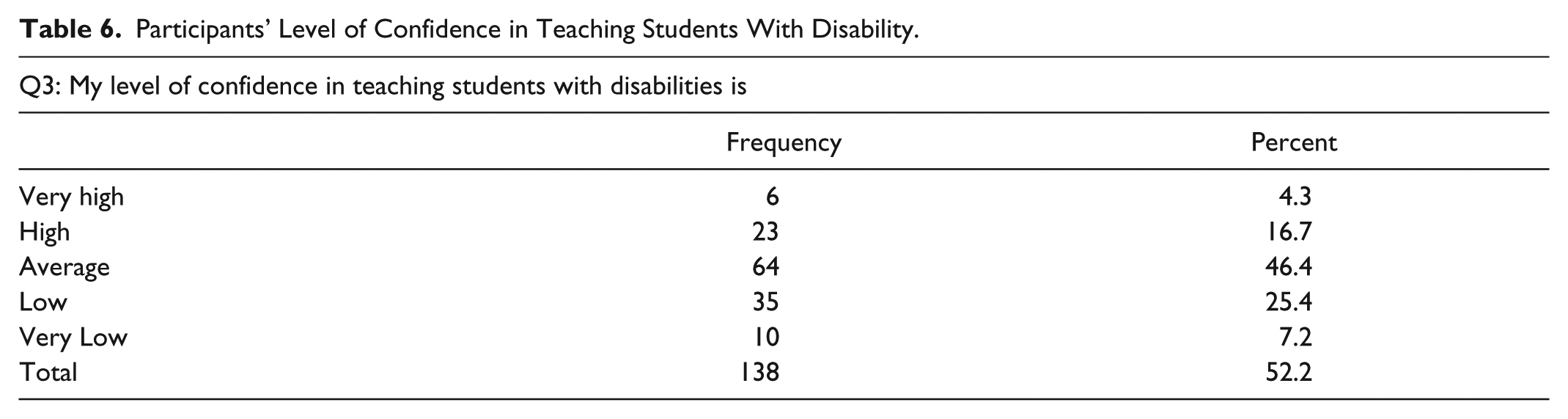
Table 7 shows the participants’ responses regarding Survey Question 4 (During teaching practice, I taught students with disabilities). The results indicate that a high percentage of the participants (71.7%) did not have the opportunity to teach or deal with children with a disability during their school teaching practicum. The remaining participants (28.3%) indicate that they had the opportunity to do so.
Participants’ Interaction With a Person With Disabilities.

To summarize the previously mentioned findings, the results indicate that the candidate teachers needed more opportunities to deal with and teach children with disabilities during their school practicum; they also need more preparation and knowledge in regard to the educational policies related to these children. Not all the candidate teachers felt confident in their knowledge and skills when dealing with these children.
Research Question 2: What Are Candidate Teachers’ Sentiments, Attitudes, and Concerns Toward Children With Disabilities?
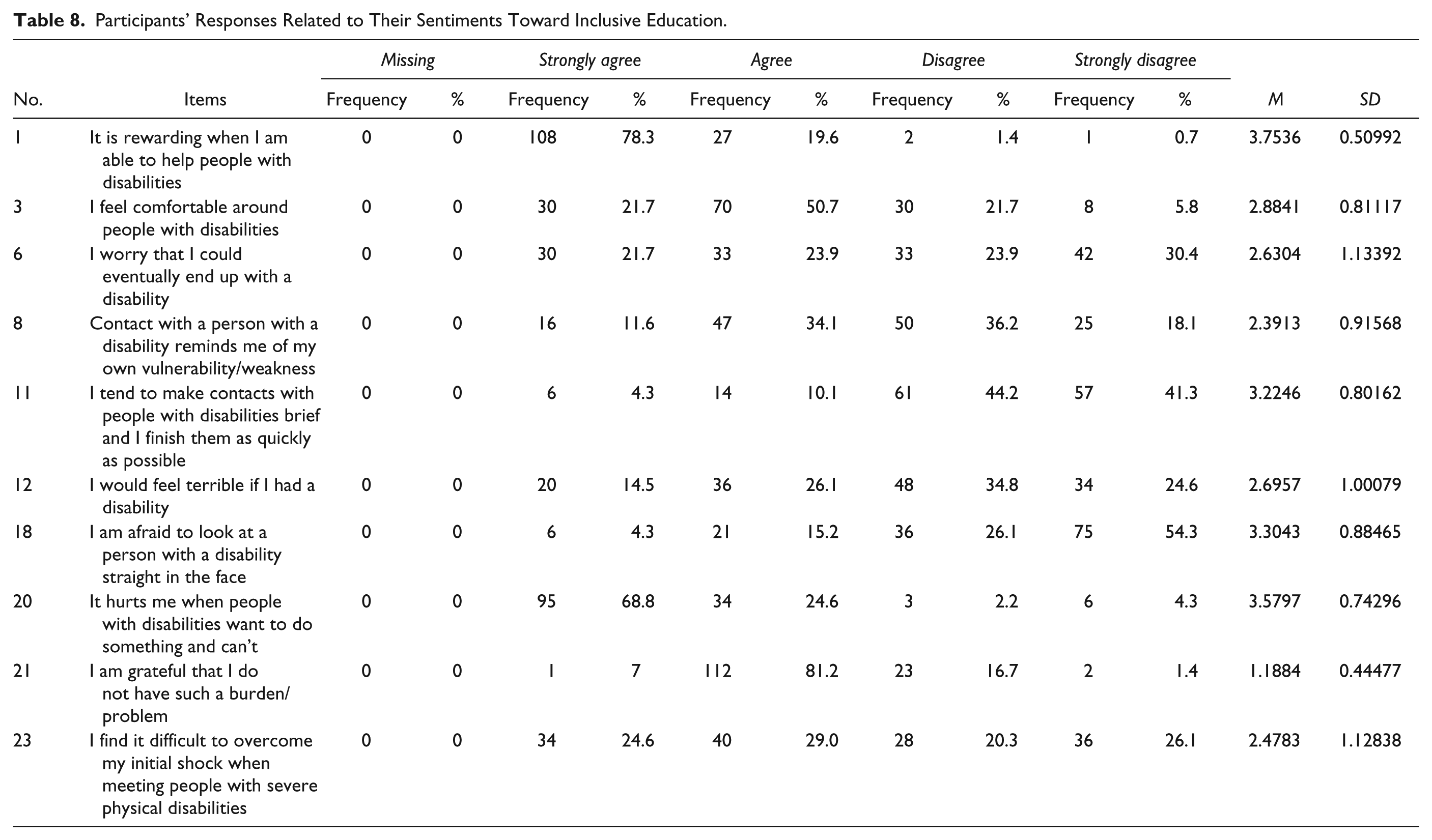
The responses of the participants on all the survey questions are divided into three subtables: Table 8 includes the items related to the sentiments, Table 9 includes the attitude items, and Table 10 includes the concerns toward items regarding teaching children with disabilities.
Participants’ Responses Related to Their Sentiments Toward Inclusive Education.
Participants’ Responses Related to Their Attitudes Toward Inclusive Education.

Participants’ Responses Related to Their Concerns Toward Inclusive Education.
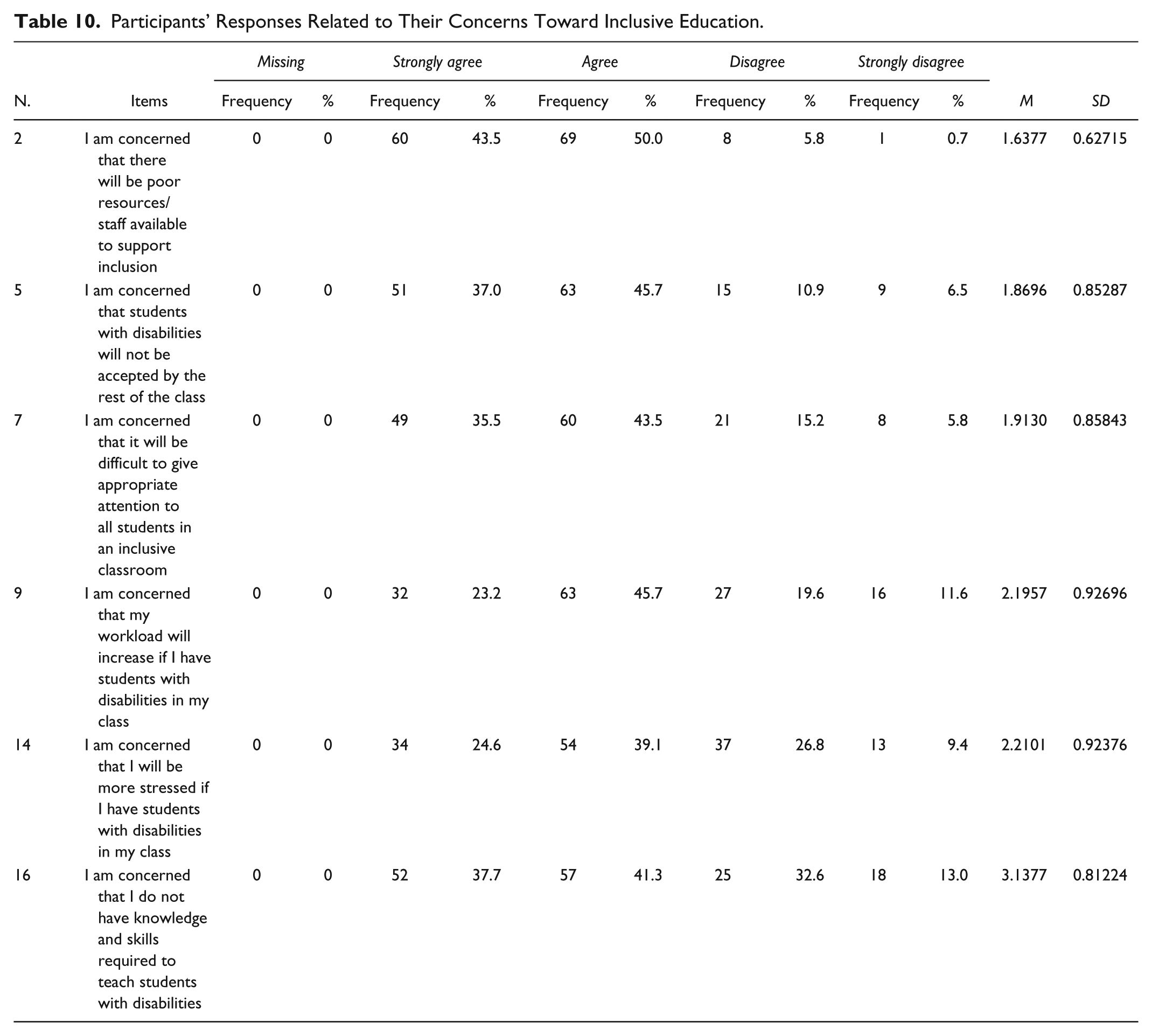
Table 8 includes the results of the participants’ responses about their sentiments regarding teaching children with disabilities. The results indicate that the majority of the participants agreed with Statement 1 (It’s rewarding when they are able to help people with disabilities), with 78.3% strongly agreeing and 19.6% of them agreeing. In addition, a high percentage of participants also agreed with Statement 3 (they feel comfortable around people with disabilities), with 21.7% strongly agreeing and 50.7% agreeing. Participants’ answers varied in Statement 6 (they worry that they could eventually end up with disability), as almost half of them strongly disagreed or disagreed with this statement (30.4% and 23.9%, respectively). Participants’ responses to Statement 8 (if their contact with a person of a disability reminds them of their vulnerability) indicated that around half of the participants were against this idea (18.1% strongly disagreed and 36.2% disagreed), whereas the other participants agreed (34.1%) or strongly agreed (11.6%) with this statement. The majority of the participants disagreed (44.2%) or strongly disagreed (41.3%) with Statement 11 (they tend to make contacts with people with disabilities brief and they finish them as quickly as possible). Around 60% of the participants did not agree with Statement 12 (they would feel terrible if they had disability), with 24.6% strongly disagreeing and 34.8% disagreeing, and around 40% of them indicated that they would feel terrible (14.5% strongly agreed and 26.1% agreed). The majority of the participants strongly disagreed (54.3%) or disagreed (26.1%) with Statement 8 (they feel afraid to look at a person with a disability straight in the face). Similarly, a high majority of the participants strongly agreed (86%) or agreed (24%) with Statement 20 (it hurts them when people with disabilities want to do something and can’t). A high percentage of the participants agreed (81.2%) with Statement 21 (that they are grateful that they don’t have such a problem or disability). The responses of the participants were almost equal on the four levels in terms of their agreement or disagreement with Statement 23 (they find it difficult to overcome their initial shock when meeting people with severe physical disabilities).
Table 9 includes the results of the participants’ responses about their attitudes toward teaching children with disabilities. A high percentage of the participants strongly disagreed (38.4%) or disagreed (31.9%) with Statement 4 (students who are physically aggressive toward others should be in regular classes). Furthermore, a high percentage of the participants strongly agreed (34.1%) or agreed (39.9%) with Statement 10 (students who have difficulty expressing their thoughts verbally should be in regular classes). Similarly, most of the participants strongly agreed (22.5%) or agreed (50%) with Statement 13 (students who are inattentive should be in regular classes). However, a high percentage of the participants strongly disagreed (26.6%) or disagreed (34.8%) with Statement 15 (students who require communicative technologies such as Braille and sign languages should be in regular classes). More than half of the participants strongly agreed (18.8%) or agreed (35.5%) with Statement 17 (students who frequently fail exams should be in regular classes). Also, more than half of the participants strongly agreed (10%) or agreed (42%) with Statement 19 (students who need an individualized academic program should be in regular classes). A high percentage of the participants strongly agreed (21.7%) or agreed (44.9%) with Statement 22 (students who need assistance with personal care should be in regular classes).
Table 10 includes the results of the participants’ responses about their concerns toward including children with disabilities in regular classes. The majority of the participants strongly agreed (43.5%) or agreed (50%) with Statement 2 (they are concerned that there will be poor resources/staff available to support inclusion). Similarly, a high percentage of them strongly agreed (37%) or agreed (45.7%) with Statement 5 (they are concerned that students with disabilities will not be accepted by the rest of the class). In addition, a high percentage of the participants strongly agreed (35.5%) or agreed (43.5%) with Statement 7 (they are concerned it will be difficult to give appropriate attention to all students in the inclusive classroom). The participants strongly agreed (23.2%) or agreed (45.7%) with Statement 9 (they are concerned that their workload will increase if they have students with disabilities in the class). A high number of the participants strongly agreed (24.6%) or agreed (39.1%) regarding their concerns about Statement 14 (they will be more stressed if they have students with disabilities in the class). Similarly, most of the participants strongly agreed (37.7%) or agreed (41.3%) that they are concerned about Statement 16 (that they don’t have knowledge and skills required to teach students with disabilities).
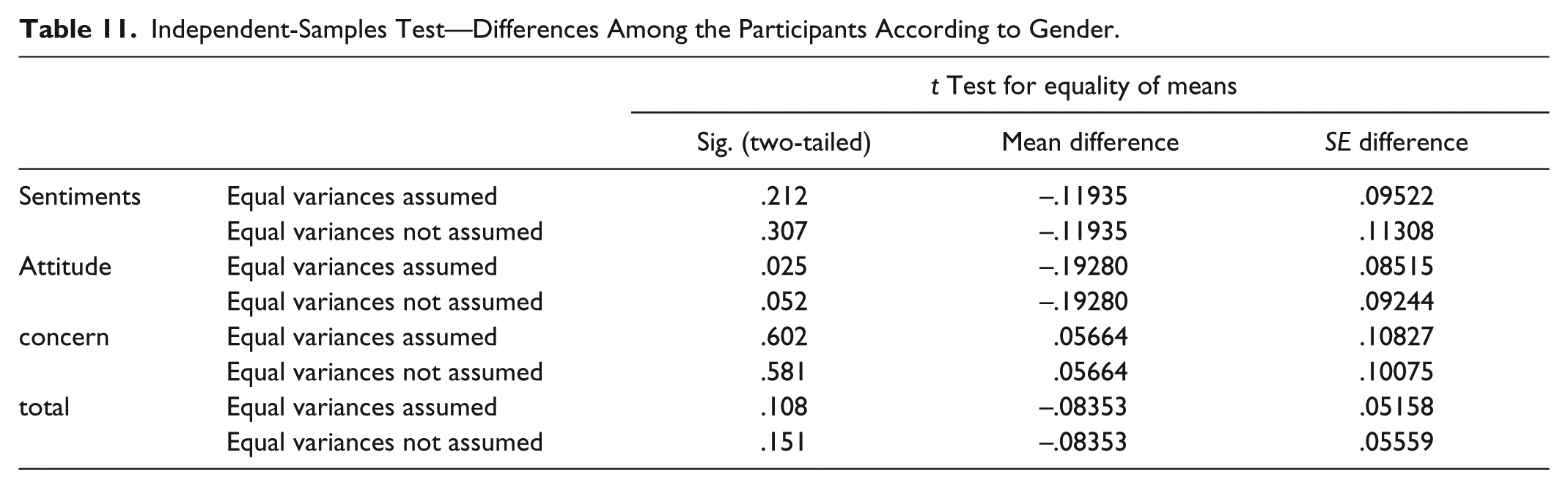
The results of t test in Table 11 indicate that there are significant differences among the participants according to gender and their attitudes toward inclusion. These differences are equivalent to 0.025 (significant on the .05 level). These differences were in favor of the female group—the female average on the attitudes scale is 2.47, whereas the male average is 2.28. This result may indicate that female attitude toward including children with disability is better than males, taking into account the small number of male participants in the study. There were no significant differences between males and females in terms of their sentiments and concerns.
Independent-Samples Test—Differences Among the Participants According to Gender.
The ANOVA test results in Tables 12 and 13 indicate that there is no significant difference among the study sample in terms of their attitudes, concerns, or sentiments toward inclusion according to the academic year variable (orientation, Year 1, Year 2, Year 3, and Year 4) and the specialization variable (no specialization, Cycle 1).
ANOVA—Differences Among the Participants According to Their Academic Year.

Note. ANOVA = analysis of variance.
ANOVA—Differences Among the Participants According to Their Specialization.

Note. ANOVA = analysis of variance.
Research Question 3: Are There Any Significant Differences Among the Participants in Their Attitudes Toward Inclusive Education Based on (a) Extent of Their Interactions With a Person With Disability, (b) Knowledge of Policies Relates to Children With Disability, (c) Level of Confidence in Teaching Children With Disability, and (d) Teaching Experience of Children With Disability?
The significant relationships between the responses of the first four questions in the questionnaire (previous interaction, knowledge of policies, level of confidence, and interaction with children with disabilities during teaching practice) and the three aspects (attitudes, sentiments, and concerns) were found. The Spearman correlation tests in Tables 14 to 17 indicate the following results:
Correlations: (Having Significant Interaction With a Person With a Disability) and (Attitudes, Sentiments, and Concerns).

Correlation is significant at the .01 level (two-tailed).
Correlations: (Knowledge of the Local Policy That Relates to Children With Disabilities) and (Attitudes, Sentiments, and Concerns).

Correlation is significant at the .05 level (two-tailed). **Correlation is significant at the .01 level (two-tailed).
Correlations: (Level of Confidence in Teaching Students With Disabilities) and (Attitudes, Sentiments, and Concerns).

Correlation is significant at the .01 level (two-tailed).
Correlations: (During Teaching Practice, I Taught Students With Disability) and (Attitudes, Sentiments, and Concerns).

Correlation is significant at the .01 level (two-tailed).
There is no significant relationship between Q1 (having significant interaction with a person of a disability) and the attitudes, sentiments, and concerns aspects.
There is a significant negative relationship between Q2 (knowledge of the local policy that relates to children with disabilities) and the sentiment aspect (equals –0.330 in level .01) and also with the concerns (equals –0.169 in level .05). This may indicate that the feeling of lack of knowledge of the policies could be linked with the increase of concerns and challenging sentiments when dealing with children with disabilities.
There is a significant negative relationship between Q3 (level of confidence in teaching students with disabilities) and the sentiment aspect (equals –0.308 in level .01) and also with the concerns (equals –0.265 in level .05). This may indicate that the feeling of lack of confidence could be linked with the increase of concerns and challenging sentiments when dealing with children with disabilities.
There is no significant relationship between Q4 (During teaching practice, I taught students with disability) and the attitudes, sentiments, and concerns aspects.
Discussion
Looking at the research question, participants’ general experience in dealing/teaching children with disabilities, results indicated that the candidate teachers needed more opportunities to deal with and teach children with disabilities during their school practicum. They also needed more preparation and knowledge about the educational policies related to these children. Not all the candidate teachers felt confident in their knowledge and skills when it came down to dealing with children with such difficulties.
The results of the study related to the research question, participants’ sentiments, attitudes, and concerns toward children with disabilities, indicated that the sentiments of the candidate teachers were generally positive and compassionate toward children with disabilities. Most of the candidate teachers indicated that they felt comfortable and satisfied when dealing with children with disabilities in their classrooms. Although the candidate teachers may have had some anxiety or tension, they are generally not afraid of tending to these children’s needs. The attitudes of the candidate teachers were generally positive but there were some apprehensions about including children who showed aggressive behavior toward others or those who required communicative technologies in regular classes. High percentages of the participants showed positive attitudes toward including special children—who have language difficulties, lack attentiveness, fail exams, need special academic programs, or need assistance with personal care—in regular classes. However, there were still some participants who did not feel comfortable including those children in regular classes. In addition, the participants had many concerns related to certain aspects of including students with disabilities in the regular classrooms. The candidate teachers were concerned about the availability of resources and staff to support these children, the lack of acceptance of children with disabilities by the other students, and increasing responsibilities and heavier workload for teachers. The candidate teachers were also worried about adding more stress on their shoulders when dealing with students with learning disabilities, in regard to whether they had the necessary knowledge and skills to include them in their regular classes. The results also showed that female attitudes toward including children with disabilities are better than males, taking into account the small number of male participants in the study. There were no significant differences between males and females in terms of their sentiments and concerns toward inclusive education.
The findings indicate that there is no significant difference among the study sample in terms of their attitudes, concerns, or sentiments toward inclusion according to the academic year variable (orientation, Year 1, Year 2, Year 3, and Year 4) and the specialization variable (no specialization, Cycle 1).
The results of the study related to the third research question: If there are any significant differences among the participants in their attitudes toward children with disabilities, a significant negative relationship between knowledge of the local policy that relates to children with disabilities and the sentiment aspect was found. This may indicate that the lack of knowledge of the policies could be linked with the increase of concerns and challenging sentiments when dealing with children with disabilities. There was also a significant negative relationship between level of confidence in teaching students with disabilities and the sentiment aspect and also with the concerns. This may indicate that the feeling of lack of confidence could be linked with the increase of concerns and challenging sentiments when teaching students with disabilities in class.
The finding of this study could impact teachers’ education practices toward inclusion of children with disabilities. For example, Bahrain Teachers College should address candidate teachers’ perspectives and attitudes in the area of inclusive education by conducting more research on a higher number of candidates in different specializations. The various preparation programs offered by the college should emphasize on engaging candidate teachers with special education children in schools as an essential part of their teaching practicum program. Each teacher candidate should have the opportunity to teach at least one student with disability during their teaching practicum. Teacher candidates should also be equipped with the necessary classroom management skills to deal with children who suffer from learning disabilities, for example, dealing with aggressive behavior, bullying, attention problems, and language difficulties. The college should also focus more on male candidate teachers’ knowledge, experiences, and attitudes toward children with disabilities, as they seem to need more support in this area from the research gathered.
The Ministry of Education also plays an important role in raising teacher candidates’ awareness about special education and inclusive education policies when they do their teaching practicum in schools. The Ministry should always offer continuous assistance and provide suitable resources to support teachers who teach children with special needs.
Limitations
A major possible weakness in this study is that candidate teachers’ conceptualizations and perception of inclusion may not be compatible with the view of this study. Particularly, the idea of inclusion in the country seems slightly incompatible with the international view of inclusive education. More research in Bahrain, as well as a reform of the current content of courses of inclusive education in the teacher education program investigated in this study, will be necessary. The SACIE scale may also not be compatible with the content of inclusion in Bahrain, as the local view of inclusion is mainly concerned with students with disabilities, rather than the view of catering for different abilities within the same classroom. It would be useful to conduct the study across all specializations in this teacher education program and not just Cycle 1 students as it may yield different results of attitudes and concerns with inclusion. Interesting findings could also be revealed if the same scale would be applied to in-service teachers to explore their attitudes toward inclusive education.
Footnotes
Declaration of Conflicting Interests
The author(s) declared no potential conflicts of interest with respect to the research, authorship, and/or publication of this article.
Funding
The author(s) received no financial support for the research, authorship, and/or publication of this article.
