




Abstract
This study explores the pedagogical competencies that Filipino in-service teachers need to possess to foster the implementation of inclusive education in the general education setting. Through a Delphi method, the research engaged 12 experts to achieve consensus on key competencies important for teachers to have to implement inclusion. The study employed three iterative rounds, ensuring a robust analysis of the identified technical skills, specific knowledge, and inclusionary attitudes required to implement inclusion. The findings revealed six critical domains, with 52 indicators, of the competency standards important in implementing inclusive education: understanding of inclusion, high regard for inclusion, pedagogy for inclusive classrooms, personal and professional development, and ethical and human rights issues. The areas highlighted by the experts contribute to the discourse on inclusive education through a framework that supports teachers in fostering equitable and inclusive learning environments. The framework also serves as a practical guide for teacher training and development. Equipping educators to create inclusive and equitable learning environments ensures the engagement, participation, and academic success of all learners. Ramifications for educational policies aligned with global goals of inclusion while addressing the unique context of the Philippines are also underscored. By identifying the gaps in teacher education and offering a structured approach, this study contributes to the enhancement of educational practice and teacher training.
Plain Language Summary
This study sought to gather consensus from 12 experts in the field of inclusive education on what they think are the most important technical skills, inclusionary attitudes, and specific knowledge that teachers need to implement inclusive education effectively. Using a three-round iterative process, the study identified 52 indicators which were then clustered into six (6) core competencies: (a) Understanding of the tenets of inclusive education, (b) High regard for diversity, (c) Pedagogy for the inclusive classroom, (d) Advocacy and networking, (e) Personal and professional development, and (f) Ethical and human rights issues. These findings highlight the significance of establishing clear standards for in-service teachers to provide equitable and quality education for all learners, particularly in an increasingly diverse educational landscape.
Keywords
Introduction
In the contemporary global landscape, the integration of diversity has become an intrinsic characteristic across micro, meso, and macro levels of communities and societies. This phenomenon reflects a dynamic shift where demographic trends are rapidly evolving, presenting manifold advantages alongside discernible challenges. Beaton et al. (2021) clarified that the incorporation of diversity is accompanied by a concomitant rise in issues related to economic inequality, marginalization, and exclusion. Individuals find themselves disenfranchised on account of various perceived differences encompassing physical, cognitive, social, economic, cultural, and linguistic dimensions.
At the micro level, manifestations of prejudice and discrimination permeate the fabric of school communities (Raguindin & Ping, 2020). Learners perceived as diverging from societal norms often encounter exclusion from educational environments, depriving them of opportunities conducive to their academic success. The complexities inherent in contemporary educational landscapes, characterized by increasingly pluralistic composition, further exacerbate the challenges of exclusion (Baglieri & Shapiro, 2017). In response to these multifaceted issues, inclusive education (IE) has emerged as a proactive measure aimed at fostering equitable educational opportunities for all learners.
IE, as a cornerstone educational agenda, acknowledges the boundless continuum of diversity, thereby emphasizing the imperative to address the multifaceted and intricate needs of individual learners (UNESCO, 1994, 2005). Central to the ethos of inclusion is the cultivation of a culture characterized by acceptance, belongingness, participation, and engagement, which serves as a foundational framework guiding the formulation of school policies and the implementation of curricular agenda (Booth et al., 2011; Forlin et al., 2014; Kuyini et al., 2020; UNESCO, 2005). IE transcends the mere provision of guidance aimed at ensuring equitable access to education as it also endeavors to mitigate the conceptual and contextual factors that foster exclusion.
Positioned as a global reform agenda intersecting the objectives of Education for All (EFA), IE is dedicated to addressing the holistic needs of every child, encompassing those who are disadvantaged, ethnic, racial, and linguistic minorities, learners with disabilities, and others perceived as differing from the norm, parallel with their peers (Ainscow, 2020; UNESCO, 1990, 1994, 2009). Beyond the EFA framework, the institutionalization of IE is enshrined in pivotal documents. These are the Salamanca Statement (UNESCO, 1994), Article 24 of the Convention on the Rights of Persons with Disabilities (United Nations, 2006), and the UN 2030 Agenda for Sustainable Development (UNESCO, 2015). The Sustainable Development Goal (SDG) 4 of the UN 2030 Agenda reflects a commitment to equity and quality education. IE under SDG 4 strengthens the principles of “leaving no one behind” and envisions an education system that accommodates diverse learners, particularly those with difficulties. On a smaller scale, SDG 4 eliminates disparities in access and ensures equitable learning outcomes by rolling appropriate support and intervention to diverse learners. In broader strokes, SDG fosters inclusive education that aims to address systemic inequalities, empower vulnerable groups, and contribute to the broader goals of sustainable development, particularly poverty reduction, gender equity, and social cohesion. These international mandates underscore the global commitment to consolidating mechanisms geared toward safeguarding the fundamental rights of every learner while advancing educational quality and equity through inclusive practices. Educational systems worldwide are called upon to fortify mechanisms geared toward upholding the inherent dignity and rights of all learners and fostering educational environments characterized by inclusivity (Kefallinou et al., 2020).
Historically, IE emerged as an alternative to segregated practices initially popularized by special education (Booth et al., 2011). It was institutionalized for learners labeled with “difficulty” and “disability” and to provide them with additional support that was not available in the general classroom. While the practice was intended for specific needs, assigning ability standards and labeling learners have been deemed to cause inequities and restrict opportunities. Critics argue that such labeling reinforces exclusionary practices and limits diverse learners’ potential to thrive in general education setting. Special education is deeply rooted in educational systems oriented toward international standards and competitive benchmarks, which give premium to measurable abilities and perpetuate a deficit-based view of certain learners (Hart et al., 2014; Tomlinson, 2017). Paradoxically, while special needs education often permeates exclusion, it can be the best option when intervention, support, and other mechanisms are not available to others of similar age. IE seeks to disrupt this paradigm by challenging the foundation of those practices. For Florian (2019), it demands structural reforms such as teacher training and deep rethinking of how educational success is defined and achieved in an increasingly diverse school community. It calls for educators, policymakers, and the broader community to recalibrate their understanding of diversity, adopt a strength-based approach, and transform systems to provide equitable opportunities for all learners, not just for those with disabilities but even for those who may be excluded or marginalized from educational opportunities. The claim was further supported by Saloviita (2018) who opined that the IE agenda is a 180° shift from the norm if schools were to be mandated to accommodate all learners in the regular classrooms, including the most disabled.
Despite the widescale concretization of IE, it is appreciated, understood, and implemented differently due to variations in culture and context (Van Mieghem et al., 2020; Yagata, 2019). The diversity underscores the intricate and multifaceted nature of IE, which is still subject to ongoing debate within educational discourse. Distinct priorities and concerns shaped by the social, political, and economic landscapes of nations influence the prevailing theoretical frameworks, policy directives, and pedagogical practices surrounding IE. For instance, Srivastava et al. (2015) delineate a contrast in implementation strategies between developed and developing countries. While Western nations prioritize pedagogical refinement and teacher training, focusing on factors such as public perceptions and legislative frameworks, developing countries concentrate on policy formulation, teacher training, and social-cultural reforms. Within the dynamic interplay of contextual variables and disparities, a salient focal point arises from concerns about teachers and their pedagogical practices in the inclusive setting.
A more general stroke about teachers implementing IE in some countries is outlined in the literature. Saloviita (2018) mentioned that Finnish teachers are into co-teaching and the use of group work. Teachers in Australia are more inclined to implement inclusion in a societal sense, while their counterparts in China are more concentrated on the inclusion of individual students (Carrington et al., 2015). Among Sri Lankan teachers, the belief is that learners with disabilities should not be admitted to the general education classroom (Hettiarachchi & Das, 2014). In Cyprus, the general practice of inclusive education is largely based on the dole-out system and charitable model (Kefallinou et al., 2020). The early works of Das et al. (2013) also reported that Indian teachers have different beliefs about inclusion, while their Filipino counterparts regard inclusion as a placement (Del-Corro - Tiangco & Bustos, 2014). In the United Kingdom, teachers were challenged with the implementation of IE due to a lack of training (Avramidis et al., 2000). IE is not a one-size-fits-all agenda. Neither does it provide a universal template befitting all kinds of educational contexts. There are unique cultural, social, and infrastructural features and realities that have to be considered for its more meaningful and sustainable implementation. Preparing teachers for this widescale agenda is a common goal that has to be realized in local settings.
At the core of implementing IE lies the imperative to reduce segregated schooling and optimize school policies and practices to cater to the varied needs of every member of the school community, with teachers serving as its primary implementers (Finkelstein et al., 2021; Forlin, 2012b; Raguindin et al., 2020; Sharma & Nuttal, 2016; Van Mieghem et al., 2020; Woodcock et al., 2022). Existing literature underscores the necessity to reassess how teachers are supported to sustain the IE agenda and address adversities they encounter (Beaton et al., 2021). Despite its complexity, the success of IE critically hinges on teachers’ embrace of inclusive principles and their perceptions of their role in its implementation within regular classroom settings (Raguindin et al., 2020).
The discourse surrounding the nature of teachers’ responsibilities, engagement, and perceptions of their roles within inclusive classrooms has long been a subject of debate and remains undocumented (Sharma & Jacobs, 2016). The advent of inclusion has introduced challenges for teachers within the general education environment, as shown by negative experiences reported by educators (Gaines & Barnes, 2017). There is ongoing discourse highlighting teachers’ perceived lack of preparedness for inclusive practices, attributed to a deficit in specific competencies required to effectively meet the needs of varied learners (Forlin, 2012c). This inadequacy is often traced back to insufficient teacher preparation and training initiatives. Consequently, the absence of core competencies and standardized guidelines further complicates the task of teacher education institutions (TEIs) in adequately equipping educators for their multifaceted responsibilities within inclusive settings. This highlights a critical gap that must be addressed to enhance the preparation and support provided to teachers in navigating the complexities of inclusive education. Ultimately, what enables an educator to become an effective inclusive pedagogue is their acquisition of specific knowledge related to implementing inclusion, a positive disposition and attitude about inclusion, and the technical skills needed to teach diverse children in the general education setting (Finkelstein et al., 2021).
Various scholarly works offer nuanced insights into teachers’ attitudes toward IE and their implications for efficacy, behaviors, and intentions to implement the agenda in their classrooms (de Boer et al., 2011; Forlin et al., 2011; Saloviita, 2022; Sharma & George, 2016; Woodcock et al., 2022). In a review of 26 papers, the early work of de Boer et al. (2011) found that most teachers have negative attitudes about IE, which are attributed to a scarcity of training and lack of experience in handling diverse pupils, while a follow-up paper claimed that teachers have an ambivalent or neutral attitude about IE (Lindner et al., 2023). Saloviita (2022) opined that there are geographical and economic disparities influencing teachers’ attitudes toward IE. For instance, educators from Western countries tend to have a more favorable outlook on inclusive education compared to their peers from developing countries (Forlin et al., 2009; Kuyini & Desai, 2007; (Loreman 2007); Saloviita, 2022; Savolainen et al., 2012; Yagata, 2019). Positive attitudes about IE are essential to attaining the goals of inclusion (Charitaki et al., 2022; Saloviita, 2020). A positive attitude about IE dictates, shapes, and reflects teachers’ level of acceptability, disposition, and behavioral choices about including diverse learners in their class and concomitantly facilitates an upward trajectory of students’ social and academic outcomes (de Boer et al., 2011). This inclusionary attitude is also anchored on the teachers’ beliefs about IE and, as a result, will likely inform their intentions to teach in the inclusive classroom setting (Sharma & George, 2016).
In terms of advancing adeptness in upholding IE, Finkelstein et al. (2021) opined that skills constitute a standard model for effective teaching in the inclusive classroom. This skill set allows inclusive learning and support for all learners and facilitates holistic learning in the heterogeneous classroom. Some forms of these pedagogical and instructional practices are promoting access to the general curriculum, peer learning and support, using assistive technologies, supporting administrative decisions and plans, participating in professional development activities, involving parents and families, implementing a universal design for learning, and individual planning (Alquraini & Gut, 2012; Finkelstein et al., 2021). Further, reforms on enhancing teachers’ knowledge about IE should be initiated as there is a compelling need for a thorough understanding of its concepts, guiding principles, landscapes, and practices in attaining the goals of the inclusive agenda (Maria, 2013).
In response to the global imperative of IE, governments may consider the development and adoption of localized inclusive teacher standards aimed at adequately preparing educators to acquire and refine the requisite knowledge, pedagogical strategies, and attitudes necessary for inclusion (Forlin, 2012a). The necessity for localized competencies arises from contextual factors that significantly influence the implementation of a universal inclusion agenda (Majoko, 2019; Srivastava et al., 2015; Yagata, 2019). Numerous studies have delineated key competencies essential for inclusive teaching, emphasizing the ongoing development and enhancement of these skills over time to foster inclusive practices (Chhabra et al., 2010; Kuyini et al., 2016; Lee & Recchia, 2016; Majoko, 2016; Pit-Ten Cate et al., 2018; Srivastava et al., 2015, 2017). This paper, however, underscores the importance of formulating a framework tailored specifically to the Philippine context, acknowledging the nuanced differences within continents, regions, and countries (Majoko, 2019). While policies for IE implementation exist in the Philippines, there remains an emerging landscape concerning practices, necessitating continued focus on teacher training and development.
Inclusive Education in the Philippine Context
As a signatory of the Salamanca Statement (UNESCO, 1994) and the EFA Framework of Action (UNESCO, 1990), the country implemented IE in the 1990s (Inciong & Quijano, 2004). However, despite this effort, challenges persist even after two decades of implementation (Muega, 2016). These challenges included a continued lack of access to education for many learners with disabilities (LWDs), such as inadequate facilities that are not conducive, limited resources and poor educational outcomes, and a general lack of clarity regarding the concept of IE (Alegado, 2018; Reyes, 2014).
The Philippine Statistics Authority (PSA) reported in 2016 that 10,000 Filipinos reported having a disability (Technical Education & Skills Development Authority [TESDA], 2020), of which women and children with disabilities have lower success and literacy rates than their male counterparts (Reyes, 2014). Further, in 2016, out of 22M Filipino learners, a total of 308,321 are LWDs (Standards & Competencies for Five-Year-Old Filipino Children, 2015). The increasing number of LWDs who struggle in regular schools was hoped to be curbed by the timely enactment of Republic Act (RA) 10533, or the Enhanced Basic Education Act of 2013, which required schools to make K-12 basic education programs accessible to diverse learners, including the LWDs (Standards & Competencies for Five-Year-Old Filipino Children, 2015). While policies pertaining to inclusive education were gradually established, there remains a lack of comprehensive understanding regarding the extent and efficacy of their implementation.
After RA 10533, the Philippines has seen recent developments in terms of implementing IE in its educational system. In 2022, the Republic Act 11650, otherwise known as “Instituting a Policy of Inclusion and Services for Learners with Disabilities in Support of Inclusive Education Act,” was instituted. The act seeks to provide learners with more comprehensive mechanisms like inclusive learning resource centers, a child find system, professional development for teachers and other child development workers, resources, awareness-raising initiatives, parental involvement, a multi-disciplinary team of professionals, and an advisory council. However, to date, the implementing rules and regulations (IRR) of the act are still being finalized (Philippine Star, 2023). A hastily formulated IRR may engender reluctance among implementing agencies to effectively execute the policy, potentially impeding their ability to fulfill their mandates. Within the micro-structure, TEIs in the country have not fully assimilated the comprehensive scope of the law, hindering their capacity to integrate its provisions into the training and development of pre-service teachers.
Implementing IE in a developing country poses multifaceted challenges encompassing economic, cultural, political, and other contextual factors (Villamero & Kamenopoulou, 2014). Nevertheless, amidst the global imperative to strengthen the implementation of IE, it becomes the Philippine government’s mandate to establish a robust, inclusive educational system within its capacities. A substantial stride toward realizing the inclusive agenda—despite scarce resources limited to mechanisms and infrastructure—can be facilitated by ensuring teacher readiness (Holmqvist & Lelinge, 2021; Woodcock et al., 2022). This underscores the pivotal role of educators in driving the transformative agenda of IE, thereby necessitating concerted efforts to enhance their preparedness and capacity to meet the diverse needs of learners.
Teacher Education for Inclusion in the Philippine Setting
Despite the existence of numerous policies aimed at advancing IE in the country, Filipino teachers continue to encounter challenges in fully realizing the objectives of the inclusive agenda. For instance, in-service teachers have expressed considerable difficulty in implementing Domain 3: Learners’ Diversity of the Philippine Professional Standard for Teachers (PPST). This struggle can be attributed to a dearth of training, limited exposure, and insufficient vicarious experiences in effectively addressing the diverse needs of learners Department of Education– Teacher Education Council. (2017) The PPST stands as the cornerstone of excellence for Filipino educators, yet its effective integration into classroom practice remains a problem, reflecting a critical gap in teacher preparedness and capacity to cater to diverse learners’ needs.
In response to the challenges posed by IE, the Commission on Higher Education (CHED), as the country’s degree-granting institution, recently enacted CHED Memorandum Order (CMO) No. 74, 75, and 76, Series of 2017 as a new guideline for elementary education, secondary education, and early childhood education, respectively. The guidelines require TEIs to include a three-unit course on the overview of special needs and inclusive education. However, this is inadequate (Slee, 2010). For Forlin (2012c), this is “tokenistic.” On the other hand, CMO No. 77 calls for TEIs to offer a Bachelor of Special Needs Education (BSNEd) within their programs. While this policy represents a proactive step toward addressing the needs of diverse learners, a closer examination of the document reveals shortcomings in adequately equipping teachers with the requisite competencies to function effectively as inclusive practitioners. Further, the specified competencies and indicators outlined in the policy fail to encompass crucial dimensions essential for preparing educators to navigate the complexities of IE. For instance, critical aspects such as advocacy and networking, which are pivotal for driving social transformation within the context of disability studies and social justice, are conspicuously absent from the document (Baglieri & Shapiro, 2017; Drawdy et al., 2014; Florian & Spratt, 2013a; Lee & Recchia, 2016; Majoko, 2016).
In the context of a developing nation like the Philippines, characterized by ongoing socioeconomic transformations, strategic investment in human capital emerges as a paramount imperative. Specifically, directing resources toward the cultivation and augmentation of teachers’ competencies in inclusive pedagogical practices represents a viable avenue for fostering equitable educational outcomes. This strategic initiative can be operationalized through the enactment of a comprehensive policy framework designed to augment the capacity of educators to effectively implement inclusive approaches within diverse learning environments. In essence, the pursuit of “education for all” necessitates a concerted effort, and chief is teacher training and development.
Theoretical Framework
In the preparation of teachers as inclusive pedagogues, a robust acquisition of technical skills, specific knowledge, and positive attitudes pertinent to inclusion stands as paramount (Kuyini et al., 2016; Chhabra et al., 2010; Krischler et al., 2019; Lee & Recchia, 2016; Majoko, 2016; Srivastava et al., 2015, 2017). Scholarly consensus underscores the indispensability of these competencies for the successful implementation of an inclusive educational agenda (Florian & Spratt, 2013b; Kuyini et al., 2020; Majoko, 2019).
The literature presents diverse perspectives on the competencies teachers need for inclusive practices; emphasis is placed on the interplay between knowledge, skills, and attitudes. For example, Pit-Ten Cate et al. (2018) opined that a successful implementation of the inclusive agenda is not solely based on teachers’ beliefs about learning, motivation, efficacy, and self-regulation. They contend that teachers’ explicit and implicit attitudes shape how they interpret and respond to inclusive settings, influencing their actions and effectiveness. However, there are contentions over the relationship between these components. For instance, some authors claimed that knowledge and skills about inclusion facilitate positive attitudes and intentions in implementing it (Majoko, 2019; Sharma et al., 2008; Sharma & George, 2016) while others believe that a change in attitude increases perceived knowledge and skills about inclusion (Carroll et al., 2004). These conflicting ideas highlight the complexity of equipping teachers for inclusion, underscoring the need for holistic approaches that integrate skills development with attitude transformation to achieve meaningful and sustainable inclusive education.
This paper looks at the amalgamation of teachers’ knowledge, skills, and attitudes under the unified concept of “competencies.”Govaerts (2008) and Albanese et al. (2008) opined that a set of competencies can serve as universal benchmarks for preparing professionals, enabling alignment among employers, employees, training centers, and institutions amidst evolving professional practice. Building on this premise, the paper critically engages with the foundational work of Hager and Gonczi (1991), who emphasized the imperative of integrating teachers’ skills, knowledge, and attitudes in the practice of the profession. The integrated approach to competency framework posits that the amalgamation of knowledge, skills, and attitudes with a given action empowers individuals to execute tasks with efficacy and productivity. This approach is characterized by its relational and holistic nature. Relationally, it establishes connections between the knowledge, attitudes, and skills of a professional, emphasizing the symbiotic relationship between competencies and task accomplishment. Moreover, it underscores the holistic nature of competency development, incorporating various elements to elucidate and cultivate successful occupational performance (Gonczi, 1996). The perspective of Hager and Gonczi (1991) challenges traditional and fragmented approaches to teacher preparation and calls instead for an integrative approach that equips educators to meet the complex demands of the inclusive agenda. By focusing on competencies, this paper argues for a paradigm shift in teacher development that prioritizes holistic readiness for inclusive practices over narrow skill acquisition. Incorporating elements of knowledge about inclusion, skills related to inclusion, and inclusionary attitudes in developing pre-service and in-service teachers optimize the mechanisms for providing quality education to diverse learners (Majoko, 2019). This integration serves as a catalyst for pedagogical efficacy, as it enables educators to navigate the intricacies of inclusive classrooms with adeptness and sensitivity.
The Delphi Study
The paucity of scholarly inquiry into teacher development for inclusive education is noticeable. To bridge the gap between theoretical underpinnings and practical application, the present research endeavors to construct competency standards aimed at enriching the resources available for preparing and involving educators in understanding and enacting of inclusive pedagogies. Specifically, the study addresses the following questions:
What core competencies are essential for teachers to implement inclusive education effectively?
What specific indicators define these competencies?
Methods
Design
To address the research questions, this paper employs the Delphi method, a methodology known for its effectiveness in eliciting expert consensus across diverse fields (Linstone & Turoff, 2002). This approach leverages the expertise of experts to iteratively explore and refine responses through a series of in-depth inquiries. The Delphi method is a deviation from the conventional focus group discussion as it imposes constraints that prevent direct interaction among experts (Adler & Ziglio, 1996; Dalkey & Helmer, 1963; Linstone & Turoff, 2002). Its effectiveness hinges on key attributes, including the involvement of experts, the provision of anonymity, iterative rounds of inquiry, deliberate and thoughtful responses, equitable input from all participants, and feedback mechanisms. Within the realm of education, numerous studies have successfully employed the Delphi method, highlighting its utility as a research and planning tool in the educational field (Martino, 1975; Skulmski et al., 2007).
The Delphi method emerges as a preferred approach, particularly in contexts where scientific knowledge about the subject of inquiry is scarce (Green, 1999). Several pieces of literature asserted the Delphi method’s suitability, emphasizing its efficacy, especially in studying future-oriented phenomena such as the formulation of competency frameworks (Battel-Kirk et al., 2009; Benjamin et al., 2000; Na, 2010; Nworie, 2011; Rickman et al., 2003). For instance, Nworie (2011) utilized the Delphi technique to probe the quality of educational technology research and identified 12 competencies essential for ICT teachers. The Delphi technique has been instrumental in exploring various themes in educational settings, including policies, standards, guidelines, and emerging trends (Green, 2014; Na, 2010; Nworie, 2011), thus reinforcing its continued relevance and utilization in educational research and practice
Delphi Experts and Panel
The Delphi technique is characterized by its reliance on expert opinions and consensus for data collection (Andranovich, 1995). In establishing a panel of experts, researchers often adhere to specific selection criteria outlined by scholars, such as Adler and Ziglio (1996), Hick et al. (2018), Lilja et al. (2011), and Na (2010). These criteria typically include: (a) involvement in teacher education preparation and training; (b) involvement in developing, implementing, and evaluating programs in teacher education preparation; (c) a record of publication or paper presentation in the field of education, disability studies, curriculum, learners’ diversity, and inclusion; (d) exemplification of professional teaching practices that showcase expertise, abilities, and attitudes in diverse classroom settings, and; (e) evidence of collaboration and networking with other organizations. These rigorous criteria ensure that panel members possess the necessary knowledge and experience to contribute meaningfully to the Delphi process.
In addition to the overarching considerations previously suggested, the researchers employed a modified criterion adapted from Na (2010) to identify potential participants for the Delphi phase. Nominees were required to meet at least four (4) of the following criteria: (a) active engagement in teacher education preparation and training, encompassing both higher and basic education, with a minimum of 5 years of teaching experience; (b) demonstrated involvement in the development, implementation, and evaluation of teacher education programs that are relevant and adaptive; (c) a track record of publication in the field of education, disability studies, curriculum development, learner diversity, and inclusion; (d) demonstration of professional teaching practices exemplifying knowledge, attitudes, and skills reflective of best practices in diverse classroom settings, and; (e) evidence of collaboration and networking with diverse educational institutions, professional organizations, and community stakeholders to enhance teaching, learning, and teacher education programs. These criteria were utilized to ensure the selection of participants possessing the requisite expertise and experience relevant to the study objectives.
In constituting the Delphi panel, it is advisable to include approximately 10 to 15 experts, a number that strikes a balance between minimizing group error and ensuring manageable data volume. This size can generate a reliability correlation of .9 (Baldwin & Trinkle, 2011). As the panel comprises experts who have vast knowledge about the topic under study, the group size can be smaller (Skinner et al., 2015). Further, Trevelyan and Robinson (2015) noted that a smaller size can often be justified by the homogeneity of the participants. For instance, in their study, they included 8 to 15 participants. In contrast, other studies have included a larger number of experts particularly when exploring group consensus within heterogenous groups, such as those representing different countries (Bacon & Fitzgerald, 2001; Nambisan et al., 1999; Schmidt et al., 2001).
For this study, a total of 18 experts were recruited through personal invitation. However, only 12 participated in the study: two researchers in the field of teacher education and inclusive education, one TEI administrator, two TEI faculty members, five practitioners, and two community development workers in the academe immersed in disability advocacy and studies (See Table 1). To establish a clear relationship between the researcher and the panel, consent to take part in the study was collected, stating the purpose of the study, the rights of the research participants, and data storage and utilization.
Profile of the Delphi Experts.

HEI = Higher Education Institution; TEI = Teacher Education Institution; E = expert; SNEd = special needs education.
Data Collection and Analyses
One of Delphi’s strengths is its comprehensive data collection and analysis process (Turoff & Hiltz, 1996). This paper followed the process suggested by Andranovich (1995), Linstone and Turoff (2002), Skinner et al. (2015), and Stewart and Shamdasani (1980). The exploratory stage is the preparation phase of the Delphi process, which involves developing the Delphi probe. The researcher reflected on and considered the main issue and the central purpose of the Delphi. The researcher pre-determined the expert pool’s qualifications and size (Andranovich, 1995) and applied the criteria in determining the panel. The distillation stage is the second stage of the Delphi process. This is the stage where the questionnaire is developed, an expert’s opinion is asked, and consensus is finalized. Through an iteration of three rounds, panelists engaged in a collaborative process aimed at refining and validating these competencies. The result of each phase informed the succeeding rounds. Considering that saturation and consensus do not significantly improve after three rounds, the iteration is ended (Clayton, 1997). Questionnaires were constructed for each round and were sent to the panel through e-mail. The utilization stage is the final stage of Delphi. In this stage, results are shared to improve practical and theoretical understanding of the theme under study. To ensure the robustness of each phase, several measures were implemented to establish the trustworthiness and authenticity of the study.
In a Delphi technique, the initial round gathers the panel for a brainstorming session. During Round 1, experts were asked to answer an open-ended prompt by identifying skills, attitudes, and values they believe teachers should have to become an effective inclusive pedagogue. The participants were sent an email that included a brief overview of the study (background, theoretical framework, and methods) and were asked to complete the online form.
The results of the initial round were refined through qualitative content analysis. All the responses were returned after 3 weeks, with an excellent response rate of 100%. The raw data gathered from the experts yielded a total of 87 competencies. To refine the constructs, data coding and categorization were conducted. The refined data were reduced to 6 core-competencies and 52 indicators.
The coded data were also sent back to the panel to confirm their insights in each statement. Member checks were conducted to verify the consistency and accuracy of the data yielded and the codes and themes generated. Further, external coders were also invited to independently audit the analyzed segments and confirm their alignment with the identified core competencies and indicators. The results of Round 1 were subsequently returned to the panel for a confirmability audit (Lincoln & Guba, 1985).
The second phase of this Delphi study was conducted to ascertain the consensus among experts regarding the items that emerged from the preceding round. This stage achieved a commendable response rate of 100%. Participants were requested to express their level of agreement regarding the relevance of each competency using a five-point Likert scale (1 = not necessary; 5 = very essential). Furthermore, experts were encouraged to propose competencies that had not been identified in the initial round and provide open-ended comments on each competency as necessary. Subsequently, the data from the second round were collated and analyzed in accordance with established protocols, as recommended by Na (2010). This analysis involved computing statistical measures such as the median, the interquartile range (IQR), and frequency, which are detailed in Table 2. The IQR, representing the range between the 25th and 75th percentile ranks, serves as an indicator of experts’ consensus, with lower values indicating higher consensus and higher values indicating greater disagreement among experts. The median was utilized to gage the level of agreement or disagreement among panel members regarding each item, while frequency was assessed to determine the number of experts concurring on each item. Communications were sent to the panel via email to solicit their responses during this phase.
Definition of Consensus (Na, 2010).

Subsequently, a third round was deemed necessary due to the identification of additional competencies that were dropped during the second round. Participants were tasked with achieving consensus regarding the inclusion of three additional competencies. To facilitate this process, participants were contacted via email to collect their responses. During the third round, a total of 11 experts participated, representing an impressive response rate of 91.7%. Their engagement resulted in a substantial consensus regarding the ranking of competencies, with overwhelming agreement observed among the participants.
Results of the Delphi Study
This study sought to establish standards and indicators of a teacher-competency framework for inclusive practices. A total of three iterations were conducted until an expert consensus was established. The Delphi panel is composed of 12 knowledgeable and experienced experts who are academicians, researchers, social workers, and practitioners.
The Delphi study’s first round was conducted to facilitate the brainstorming of selected experts on an inclusive practitioner’s indicators of competencies. The raw data gathered from the experts yielded a total of 87 competencies. To refine the constructs, data coding and categorization were conducted. The refined data were reduced to six core competencies and 52 indicators. As the context of the study is an inclusive practitioner in the school setting, core competency number three garnered the greatest number of indicators. Results of the core competencies and indicators listed by the experts are displayed in Table 3.
List of Competencies and Indicators Generated from the Delphi Study (Round 2).

The second phase of the Delphi study aimed to achieve consensus among experts regarding all the indicators listed previously. Consensus among the experts was identified by computing statistical measures such as the median, interquartile range, and frequency. The outcomes of this consensus among experts during Round 2 are presented in Table 4.
Summary of Panel Rating Yielded on the Indicators Generated in the Delphi Study (Round 2).
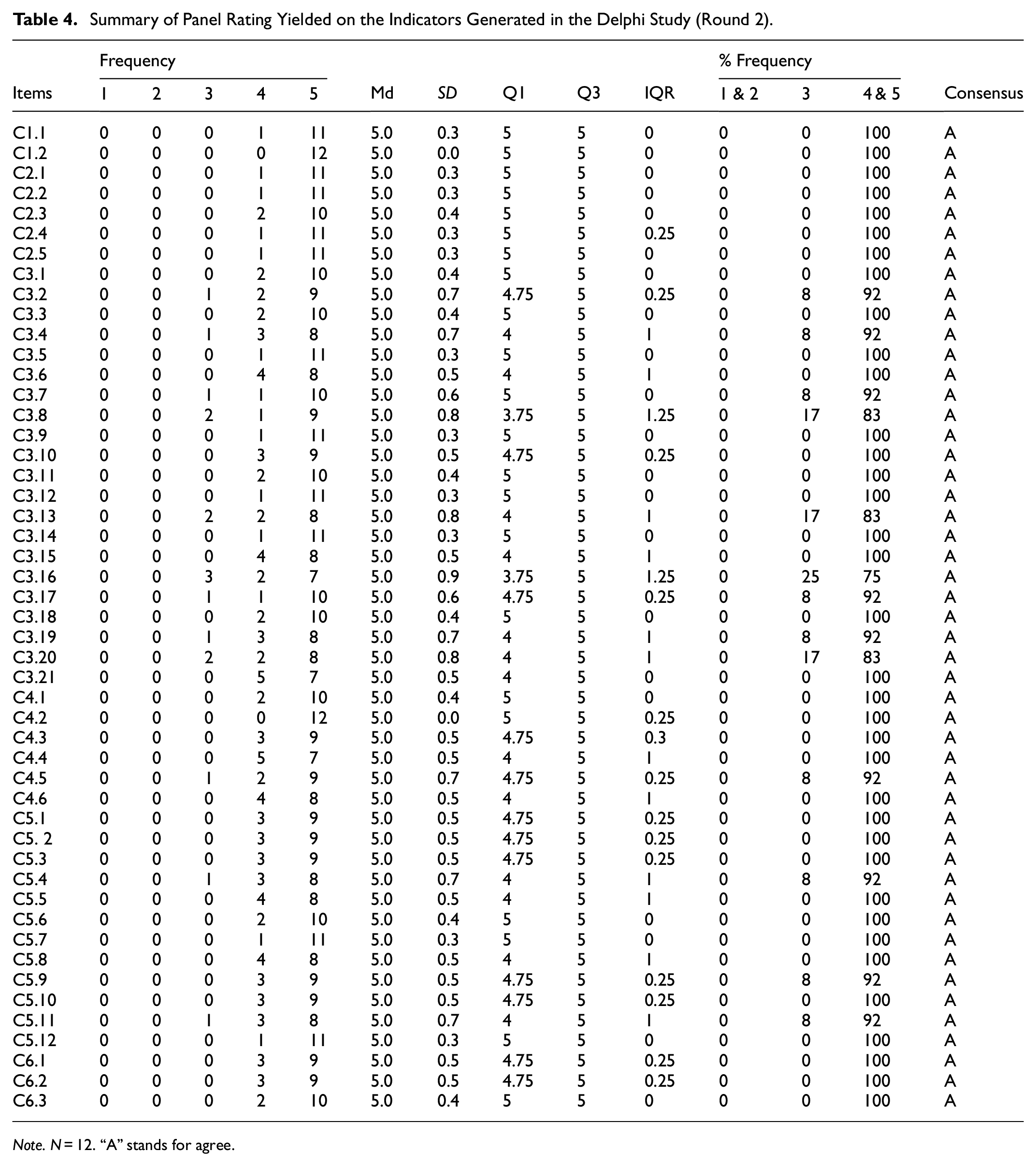
Note. N = 12. “A” stands for agree.
The median (Md) represents the midpoint of the panel’s ratings. This indicates the most typical response for a given indicator. For instance, a median of 5.0 indicates unanimous agreement that this is a “very essential” competency. The standard deviation (SD) measures the variation in response. With smaller values like 0.3, C1 for instance, it shows that there is a strong consensus among experts. The first quartile (Q1) and third quartile (Q3) indicate the range where the middle 50% response lies, highlighting the central tendency of the ratings. For example, Q1 and Q3 values of 5 for C1 suggest a compact agreement. The interquartile range (IQR) reflects the spread of central ratings. An indicator with an IQR of 0 indicates a near-universal agreement among the panel. A consistent median of 5.0 and low IQRs confirm strong alignment on the importance of an indicator.
During the second round of the Delphi study, when deemed necessary, experts were asked to give their comments about the sub-competencies. The experts’ opinion provides a better understanding of how they give weight to the constructs measured. One expert gave their insight on sub-competency C2.5 (See Table 3). The comment highlights a profound perspective on what it means to “celebrate diversity” in an inclusive classroom.
Item 2.5 is essential; however, ‘celebrate’ must be clarified. I would not consider it as a simplistic celebration of diversity, but really coming up with creative and innovative solutions to manage differences and diversity with the end in view of developing our potential to live together as one people.
During the second round of the Delphi technique, further competencies were identified and added to the initial list generated from Round 1. These additional competencies were deemed essential for inclusive practitioners to acquire and were primarily clustered under the categories of “Pedagogy for Inclusive Classroom” and “Personal and Professional Development.” Consistent with the outcomes of Round 1, the category of “Pedagogy for Inclusive Classroom” continued to receive the highest number of competency rankings. The added indicators are detailed in Table 5. Subsequently, the inclusion of these additional indicators necessitated a third round of the Delphi study. Experts engaged in deliberations to achieve a consensus regarding the inclusion of these newly identified competencies. Table 6 provides a summary of the experts’ consensus on the additional competencies ranked during the third round, thereby contributing to the comprehensive delineation of essential competencies for inclusive practitioners in educational settings.
Additional Indicators Yielded During the Final Round of the Delphi Study (Round 3).

Summary of Panel Rating on the Additional Indicators Yielded in the Delphi Study (Round 3).
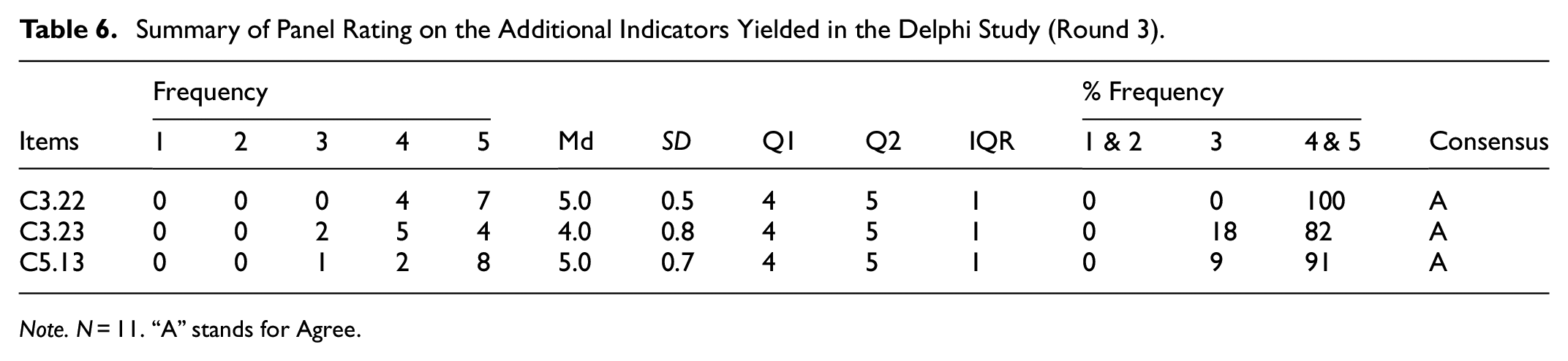
Note. N = 11. “A” stands for Agree.
The rigid consistency in the consensus of the experts warrants nuanced discussion. While low variability might suggest an artificial consensus, it equally underscores the high level of agreement among experts, bolstering the reliability of the identified competencies. The Delphi method’s iterative nature inherently fosters convergence, and the statistical measures employed as median, standard deviation, and interquartile range ensure that the consensus is systematically validated rather than arbitrarily achieved. Additionally, the detailed process of refining competencies through expert feedback mitigates risks of bias, enhancing the validity of the framework by aligning it with professional expertise and contextual relevance. Rather than undermining the standards, this consistency demonstrates its robustness and utility as a reliable guide for teacher training in inclusive education.
Discussion
The imperative of equipping teachers with adequate knowledge, skills, and attitudes to effectively implement inclusive practices has garnered significant attention within the realm of theory and methodology, as evidenced by a plethora of scholarly works (Barnes & Gaines, 2018; Beaton et al., 2021; Creemers et al., 2013; Deng et al., 2017; Drawdy et al., 2014; Finkelstein et al., 2021; Florian & Spratt, 2013b; Gaines & Barnes, 2017; Kielblock & Woodcock, 2023; Lee & Recchia, 2016; Majoko, 2016, 2019; Mu et al., 2015; Saloviita, 2020, 2022; Sharma & Nuttal, 2016; Srivastava et al., 2015; Tait & Mundia, 2012; Van Mieghem et al., 2020). The present study endeavors to contribute to the field by elucidating a framework aimed at guiding teacher training and preparation for inclusive practices. In light of the evolving educational landscape characterized by diverse learner needs and the imperatives of post-COVID educational reforms, the exploration of such frameworks holds paramount significance in ensuring the effective implementation of inclusive education principles.
The consensus reached by the panel underscores the critical importance of internalizing the foundational principles of inclusion for inclusive practitioners to implement inclusive practices effectively. It is imperative for educators to possess a thorough understanding of the theoretical, philosophical, and legal underpinnings of inclusion to imbue their practice with meaning and efficacy. This assertion finds strong support in a wealth of imperial studies examining the competencies requisite for inclusive practitioners (Andreasen, 2014; Deng et al., 2017; Forlin, 2012c; Ke et al., 2017; Lee & Recchia, 2016; Mu et al., 2015), including Western literature, which emphasizes the centrality of this knowledge base (Mu et al., 2015). Andreasen (2014) particularly emphasized that pedagogical decisions in inclusive settings are profoundly influenced by educators’ depth of understanding of inclusion’s foundational tenets.
In tandem with foundational knowledge about inclusive education is a paradigm shift toward strength-based ideologies essential for fostering social cohesion. For the Delphi experts, the focus on what learners can do rather than what they can’t do empowers educators to design and implement curricula that address diversity. By embracing a strength-based approach, inclusive practitioners are better equipped to create learning environments that nurture the diverse strengths and abilities of all learners, thereby fostering inclusive practices grounded in equity and empowerment. This strength-based perspective further enables educators to uphold children’s right to education by anchoring their practice in dimensions such as availability, accessibility, acceptability, and adaptability, as delineated by Forlin (2012). A strength-based approach to inclusion is entrenched in the human rights framework (Baglieri & Shapiro, 2017; Pantić & Florian, 2015). Asserting and advocating for the rights of learners in vulnerable groups for equal access and opportunity is ingrained in the social dimension of inclusion. Kantavong et al. (2017) mentioned that inclusive practitioners should champion inclusion as a social agenda, with teachers assuming powerful advocacy roles. Further, Lee and Recchia (2016) assert that teachers who frame inclusion as the normative curriculum should proactively advocate for inclusive practices, challenging exclusionary cultures and discriminatory practices. Deng et al. (2017) similarly incorporate advocacy in their framework, albeit focusing primarily on promoting caring and accepting cultures. Another crucial aspect of advocacy lies in inclusive teachers’ collaboration with key stakeholders—including parents, school personnel, profit and non-profit organizations, and other institutions—to address barriers to inclusion and ensure the affirmation and implementation of inclusive policies (Florian, 2012; Majoko, 2019). Ultimately, the discourse on inclusion as a means of social transformation underscores the pivotal role of teachers in championing inclusion, necessitating the acquisition of specific competencies tailored to advocacy and networking domains (Naraian, 2013). It underscores the imperative for inclusive practitioners to not only develop their technical skills but also serve as agents of change within their educational spheres (Pantić, 2015) while embracing ethical values (European Agency for Special Needs and Inclusive Education, 2014). However, despite the literature’s emphasis on teachers anchoring inclusion through advocacy, recent educational policies such as CMO 77, s. 2017 show insufficient incorporation of this aspect and highlights the need for greater attention to advocacy in inclusive education initiatives (Policies, Standards and Guidelines for Special Needs Education (BSNEd), 2017).
Fundamentally, education should serve as a vehicle for realizing human rights through the provision of quality and equitable education. It should also serve as a platform for challenging entrenched practices that perpetuate segregation, marginalization, and exclusion within school communities (Heng et al., 2019). Neglecting to address the structural, procedural, and systemic barriers to inclusion contradicts the principles of educational quality, accessibility, and equity (Shevlin et al., 2013), thus positioning teachers as essential advocates for reform within the educational landscape. For the Delphi experts, advocacy is an essential part of teacher standards for inclusive practices. How teachers interpret and uphold children’s educational rights fundamentally shapes their approach to education and consequently influences the learning experiences they provide.
At the micro level, teachers’ acknowledgment, respect, acceptance, and affirmation of learners’ diverse backgrounds and contexts form the cornerstone of meaningful inclusion. High regard for heterogeneity and a positive attitude toward diversity (Charitaki et al., 2022; Raguindin et al., 2020; Saloviita, 2022), a critical theme that has been explored by the Delphi panel, reflect a fundamental shift in educators’ attitudes and thinking patterns toward learners’ uniqueness, readiness, and potential. The foundational work of Sharma and Jacobs (2016) solidifies the significance of teachers’ attitudes about inclusion and their intentions in the inclusive classroom setting. The authors contend that a positive outlook toward diversity, coupled with a strong commitment to inclusive principles, correlates with efficacy and contributes to the success of the inclusive agenda. If a teacher has a positive attitude about inclusion, there is a great likelihood that the teacher has positive intentions about inclusive pedagogies (Raguindin et al., 2020). Positive attitudes and intentions about inclusion align with a comment of one of the experts that providing for learners does not rest on tokenistic views and practices but requires more symbolic gestures. It demands deliberate inclusive strategies that align with the pedagogical practices and principles of equity. Teachers championing inclusive diversity enhance academic achievement, social cohesion, and an inclusive ecosystem (Kuyini & Desai, 2008; Sharma & George, 2016; UNESCO, 2009).
The consensus reached by the Delphi panel strongly resonates with the existing literature, as the majority of acknowledged and ranked sub-competencies align with teachers’ inclusive pedagogies. For the Delphi panel, some examples are differentiation, conceptualization and implementation of IEP, assessment and feedbacking, record keeping, classroom management, and behavior modification, among others. Most findings of the study are in the same vein as the paper of Majoko (2019) and Deng et al. (2017). Loreman (2007) further emphasizes the importance of reflection as an essential pedagogy in inclusive settings, guiding inclusive teachers to judiciously inform their strategies by examining education trends, interpreting assessments, and monitoring learners’ progress. Screening and assessment emerge as critical components of inclusive settings, spanning from identifying learners’ multi-domain needs to informing instruction based on class performance (Majoko, 2019). Additionally, Deng et al. (2017) advocate for teachers’ competency in developing clear development plans, including objectives, content, and approaches for inclusive practices, although these competencies were not fully captured in the Delphi study. Psychodynamic strategies within the classroom and behavior management contribute to responsive interventions addressing learners’ diverse needs, guiding teachers to create conducive learning environments even for those with the most challenging behaviors (Deng et al., 2017; Majoko, 2019). The Delphi panel highlights competencies such as counseling, classroom routines, behavior management, coaching, and classroom management as essential for promoting inclusive environments. However, some of the glaring missing pieces in this study are the teachers’ knowledge and efficacy in utilizing the principles of Universal Design for Learning (UDL) in crafting learning experiences for learners and competencies related to supporting learners during transition. The use of UDL and skills related to transition are important aspects for the success of vulnerable groups in the classroom (Levey, 2023; Wu et al., 2023).
At the meso level, the study emphasized networking and development. As a commitment to quality and equitable education, teachers who internalize their roles as change-makers are more inclined to actively engage in personal and professional development, collaboration, and networking (Frost, 2012; Pantić, 2015; Pantić & Florian, 2015). Establishing effective partnerships with multidisciplinary teams enhances instructional capacities, fosters ownership and involvement in curricular implementation, and serves as teachers’ key coping strategy for inclusion (Copfer & Specht, 2014; Majoko & Dudu, 2022) and for navigating inclusion challenges (Gutierez & Kim, 2017). Majoko (2019) advocates for formal collaboration within the professional community to cultivate a diverse range of competencies, such as critical thinking, problem-solving, decision-making, self-awareness, and self-reflection. Such collaboration facilitates the development of responsive pedagogy tailored to meet the individual needs of diverse learners.
The experts also prominently bank on positive attitudes toward lifelong learning. A positive attitude toward lifelong learning is an important competency. For example, the panel believes that the inclusive practitioner should strive toward proficiency in communicating with the key stakeholders, exhibit professionalism, commit to effective collaboration, and work toward development, learning, and discovery. Also, an inclusive practitioner should exemplify professionalism, internalize their role as a facilitator of learning, develop and practice resilience and patience, recognize their feelings, exhibit critical thinking, show principled instructional leadership, and be conscientious in building a society that is more inclusive. The evolving complexities and multi-layered demands placed on teachers necessitate a parallel focus on their personal growth and professional development, which aligns with the burgeoning literature on human capital development in education (Deng et al., 2017; Drawdy et al., 2014; Mu et al., 2015; Sharma & Nuttal, 2016; Sharma & Sokal, 2015; Snoek et al., 2019). As Day (2017) asserts, an adept teacher embodies not only skill but also personal commitment, care, experience, passion, emotional understanding, and a strong sense of value for their profession.
The synthesis of findings from the Delphi study alongside existing literature offers a comprehensive conceptual understanding of the competency framework essential for inclusive practices. This framework is illuminated through an integrative lens, which posits that professionals’ knowledge, skills, and attitudes are intricately interconnected (Hager & Gonczi, 1991). The core competencies identified for teachers to implement inclusive education exemplify this interconnectedness, with each standard encompassing a blend of knowledge, skills, and attitudes essential for effective inclusion. Moreover, these core competencies are not isolated but are rather mutually reinforcing, with development in one area contributing to enhancements in other areas. For instance, proficiency in understanding the theoretical underpinnings of inclusion is closely linked to the ability to implement inclusive approaches effectively. Similarly, the cultivation of attitudes such as empathy and respect toward diverse learners is intertwined with the development of pedagogical skills tailored to meet their needs. Thus, the integrative nature of these competencies underscores the holistic preparation required for educators to embody inclusive philosophies and approaches effectively.
Conclusions
The Delphi panel consensus is a collective call to intensify teachers’ training and development to provide high-quality education through the acquisition of a set of knowledge about inclusion, skills for inclusive pedagogies, and inclusionary attitudes for the successful implementation of IE. Today’s educational system is in demand of pedagogues with competencies in these areas: (a) Understanding of the tenets of inclusive education; (b) High regard for diversity; (c) Pedagogy for the inclusive classroom; (d) Advocacy and networking; (e) Personal and professional development; and (f) Ethical and human rights issues. The study establishes a comprehensive framework by forwarding key competencies that not only advance the discourse on inclusive education but also provide practical guidance in designing teacher education programs. The competencies and indicators serve as strategic and actionable tools for policymakers, stakeholders, and educators, enabling the training and development of educators to create equitable learning environments.
In light of the global efforts to carry on and sustain inclusive education, this study narrows the chasm by tailoring its findings to the Philippine context, addressing its unique cultural and systemic challenges while aligning with international standards. The proposed standards pave the way for the development of comprehensive educational policies and practices that give premium to accessible, equitable, and quality education. As the education sector continues to evolve, the framework serves as a baseline for fostering teacher readiness and resilience to meet the changing needs of diverse learners.
Limitations and Practical Implications
This study has its limitations. The relatively small number of experts involved and the lack of representation raise concerns regarding the potential for indicator exclusion due to disagreements among experts. The composition of the Delphi panel lacks representation from other regions, such as Southeast Asia and developed countries, which might have limited the breadth of perspectives considered. Incorporating participants from different geographical regions could yield valuable insights and help overcome contextual differences, thereby enriching the conversation on inclusive practices. Further, most of the indicators yielded in the study are aligned with the context of LWDs and those with exceptionalities and failed to include the context of learners with gender, ethnic, economic, language, and other perceived differences.
It is recommended that this framework be disseminated widely and adopted by local educational institutions to facilitate the evaluation and enhancement of in-service training programs and other supportive mechanisms aimed at bolstering the implementation of inclusive pedagogies. Furthermore, a survey instrument based on the identified competencies and indicators can be developed to assess the proficiency of in-service teachers in integrating inclusive practices. The insights gleaned from the Delphi experts’ input also hold the potential for informing the continual refinement of teacher education curricula within TEIs, ensuring the provision of comprehensive and meaningful training for pre-service teachers. Additionally, researchers can utilize these findings to explore the existence of contextual nuances and variations therein. Such endeavors collectively contribute to the advancement of inclusive education on both local and global scales.
Footnotes

Ethical Considerations
Ethical permission from accredited IRB was not secured. However, the School of Education of Shaanxi Normal University has approved the protocol of the study. Further, there is no known risk in participating in the study. The experts were asked of their insights through responding to an email. The study is classified as low risk. A consent to take part in the study was collected from the experts. They were obtained before the start of each round.
Funding
The author(s) received no financial support for the research, authorship, and/or publication of this article.
Declaration of Conflicting Interests
The author(s) declared no potential conflicts of interest with respect to the research, authorship, and/or publication of this article.
Data Availability Statement
Data will be available upon request from the first author.