




Abstract
Kazakhstan has adopted the idea of inclusive education. The country has embarked on transforming its education at all levels of schooling to reflect the ethos of equity and inclusion. Tremendous success has been registered so far; however, the language used in the realm of its special/inclusive education has not changed much, as it still bears the hallmarks of the past Soviet vocabulary. Therefore, this article provides an analytic perspective on exclusive terminology and vocabulary still being used, which in one way or another perpetuates misconceptions and stereotypes about diversity and difference. The researcher of this study interviewed school principals, teachers, professionals, and parents in 12 inclusive schools. Reviewed literature includes Kazakhstani education policies, research papers, and speeches delivered by education administrators, politicians, educationists, and experts in the field of special/inclusive education. The implications of the use of language and terminology are discussed in the context of transforming education toward an inclusive education system. Lessons are drawn from the empirical study and literature review, thus making recommendations on how to move forward with the language and terminology change process within the emerging discourse of inclusive education in Kazakhstan.
Introduction
The implementation of inclusive education globally is driven by ideals that the inclusion of students with diverse abilities and needs is a human right and a necessity to make education accessible to all (Slee, 2018). The implementation of inclusive education focuses not only on changing pedagogical methods, curriculum delivery, and schools’ infrastructure (Ainscow, 2005) but also on how things are said and how language and terminology have to change to embrace these transformations. The United Nations Educational, Scientific and Cultural Organization (UNESCO, 2013) has published some important concepts used in the language of the curriculum and education. The significance of the choice of language is based on the fact that some language and terminology used in the past did not recognize the inherently exclusive nature of the concepts and words. While there has been some shift to a more inclusive language, the world is also learning from the process and it seems as though more still has to be done. The question on the use of concepts such as “disability” and “special needs” raises many debates in the field of inclusive education. For instance, Makoelle (2015), in a chapter titled, “Disability a social discourse: who is disabled?” argues that the concept of disability is a social construct and its use is inherently exclusive, as it presupposes that people with a disability lack an ability. In this argument, it is suggested that the concept “differently abled” would be more appropriate to accommodate diversity of ability rather than disability. In the same breath, Makoelle alludes to the fact that the concept “special needs” used to classify certain students could also be problematic, as all needs of the student in the classroom should be deemed special.
The debate about the appropriateness of language and terminology in the field of inclusive education remains a bone of contention for global conversation. In this article, this discussion is brought to the fore using Kazakhstan as a case study. As all countries and regions of the world have unique contexts and backgrounds dictating the direction of the debate, it is important to put the debate into perspective, given the diversity of contexts.
Problem Statement
Kazakhstan is a signatory to some international declarations, such as the Salamanca Statement (UNESCO, 1994), the UN Convention of Rights of Persons with Disability (2006), and the Convention against Discrimination in Education (UNESCO, 1961), which all obligate Kazakhstan to provide quality education for all, including those with disability.
The signing of these declarations was a signal that Kazakhstan had embraced the notion of inclusive education. After the fall of the Union of Soviet Socialist Republics (USSR) in 1991, Kazakhstan became an independent country on the southern border of the Russian Federation. It adopted a progressive constitution, which guarantees some human rights, including the right to education. The constitution of Kazakhstan Article 14 subsection 2 states “that no one in Kazakhstan shall be a subject of any discrimination for reasons of origin, social, property status, occupation, sex, race, nationality, language, and attitude towards religion, convictions or any other circumstances” (Kazakhstan, 1995: 14). The translation of this constitutional imperative is very prominently featured in the Education Law of Kazakhstan (Kazakhstan, 2007) and the policy document entitled the State Program 2019–2020. According to the State Program, Kazakhstan has the ambition to have 70% of schools inclusive by 2020. The initial processes of implementing inclusive education started in 2009. Several actions have already been taken, such as the establishment of pilot inclusive schools in which children with disabilities are educated alongside their nondisabled peers. For instance, according to an Organisation for Economic Co-operation and Development (OECD; 2018) report, “the proportion of schools with facilities to accommodate children with special needs rose from 10% in 2010 to 55% in 2017. In 2017, 23.3% of students with special educational needs aged 7-18 were covered by inclusive education facilities” (p. 9) There have also been attempts to train and retrain teachers on inclusive education, thus trying to change beliefs and attitudes about diversity in inclusive classrooms of Kazakhstan. The training of teachers is done as part of teacher professional development by the National Center for Professional Development called “Orleu”; however, the effectiveness of this training has not been determined. The implementation of criterion-based assessment serves as a signpost to demonstrate that the transition to inclusive education is not reversible (Nazarbayev Intellectual Schools [NIS], 2016). Criterion assessment is thought to be the process of correlating the learning outcomes actually achieved by students with the expected learning outcomes based on the specified criteria (NIS, 2016). While Kazakhstan has made tremendous progress in this regard, the shadow of USSR education still lingers on. The language and terminology used in the education system still mirror those of the USSR, which were heavily based on medical classification and on corrective and remediation discourse. This article, therefore, argues that more change is required in the way language and terminology are used in the special and inclusive education fraternity. The article articulates a position that more inclusive language and terminology are required to make the transition to more inclusive thinking. Therefore, the following research question was a compass that guided this study: To what extent are the current language and terminology appropriate for inclusive education in Kazakhstan and, if necessary, how can these be improved or maintained?
In this article, the relationship between society and language becomes indispensable, as language is a sociocultural artifact that has an impact on how people would make meaning of and interpret their interactive situations.
Literature Review
Language and Education
In every society, language is used as a tool for communication between people. A specific language uses a particular kind of terminology and vocabulary to convey messages or meaning to other people. Each and every science discipline adopts a specific language and terminology unique to it. This is what Bernstein (1999) refers to as the language of description. Every scientist needs to be socialized into this language to able to share meanings with coscientists. The same principle is applicable to the socialization of people in a culture or societal practices. Language and terminology could have connotative meaning (unique to the individual) or denotative meaning (common to a group of people). The sharing of meaning is crucial for communication, knowledge production, and transmission. The ability of a person to master language has an impact on how successful the individual will be in socialization in a specific language. Therefore, in education, in the quest to provide knowledge, certain forms of terminology and vocabularies are privileged more than others. Privileging some forms of terminology and vocabulary offers the language user the opportunity to control what to covey and what not to. Therefore, for a person who is learning, the application of language could arguably be used to control the student’s knowing process, that is, what to know and not to.
It is apparent that language can be a powerful tool to influence what people know or do not know. The power of language produces discourses that influence people’s behavior and actions. According to Fairclough (1995), once the discourse is produced, it carries with it a powerful influence on people. A discourse involves social conditions and interpretations (Fairclough, 1995). Therefore, languages as discourse are produced discursively within a specific social condition and milieu. These then lay the basis for how people will derive meanings and interpretations of situations. The discourse can reproduce itself over and over again until an alternative discourse is produced by different sets of social relations and discursive social practices. According to Wilson and Lewiecki-Wilson (2001), there seems to be a link between disability studies and rhetoric. In their book comprising a collection of essays, a connection is made between disabilities as a deviation from cultural norms, and thus, exclusive language is used to cast disabled persons as not fitting the normative societal framework because their bodies are associated with that which is not acceptable. Therefore, the embodied rhetoric demonstrates how bodies of disabled persons are an embodiment or a representation of deviant pedagogy and identity.
Understanding Sociolinguistics as a Theoretical Lens
According to Paoletti (2011), sociolinguistics is a young theory, as its meaning is still evolving and being developed, yet the general understanding has been that sociolinguistics focuses on language and society. The understanding of language has to be considered in a historical–cultural context (Wardhaugh, 2006). Therefore, sociolinguistics provide a multidisciplinary approach to understanding language and those who use it. It is a discipline that is regarded by its proponents as sociocultural, as it creates an intersection between social and cultural aspects of human existence. Language development in many regions of the world has taken place independently; however, globalization has led to the movement of people from across the spectrum of the world, prompting a different approach to language inclusivity. Therefore, sociolinguistics helps one understand how language develops as a societal structure, how the dualism between language and society unfolds, and the influence that has on the language user. The significance of sociolinguistics in this article is to support understanding that language has a historical meaning and that unless that is understood, the importance of concepts, terminologies, and words cannot be fully comprehended. More of the concepts used in special education and inclusive education have evolved over time. In his article titled, “How the language of special education is evolving,” Drummond (2016) postulates that there has been increasing debate on what people of a specific disability or race are called in communication, as this could mirror and shape people’s perceptions, attitudes, and behavior. The discussion on language and society during the USSR era becomes the central focus in this article because the emergence of language and terminology in special and inclusive education continues to influence the historical conceptualization held during the USSR period. This article, therefore, adopts a sociolinguistic approach to deconstruct the evolution of special education language. The deconstruction is done in the context of language and education.
The History of Special and Inclusive Language and Terminology in Kazakhstan
Kazakhstan, similar to other countries in the world, is bound by history in space and time. To understand the concept of inclusive education, a thorough analysis of the previous system of education provision for students with perceived special needs is necessary. Therefore, this section analyzes some of the concepts that formed the core of the Soviet language in special education. Kazakhstan was part of the USSR until the collapse of the Soviet Union in 1991. The notion of special education has always been a government responsibility during the Soviet era. Special education or Defectology (literal translation from Russian) (Csapo, 1984) evolved over years before and after the Second World War and became the core of education delivery to the “handicapped” (a concept referring to students with disabilities) in the Soviet Union. The evolution of Defectology (Soviet approach to pedagogical science for students with disabilities) over years was influenced by educationists such as Makarenko, who in 1955, based on practical experience, dealt with children with behavioral difficulties assuming that their “disorder” (Soviet way of referring to a disability) was based on a social condition, which could be changed by what he called nonaggressive education means. He was convinced that a group has a profound influence on an individual and that any positive stimulus had the potential to change the behavior of students (Csapo, 1984).
Perhaps the most influential figure in Soviet Union special education was Vygotsky, whose views were based on the premise that segregation was not an answer to dealing with the physically and psychologically handicapped (as referring to students with disability in the Soviet Union). He advocated what he termed “social rehabilitation,” which simply meant (according to Soviet terminology) teaching the handicapped to participate in social life and the community (Csapo, 1984). School psychologists consulted pediatricians and psychiatrists in the assessment of handicapped students. Psychometric testing played a pivotal role in placement of students in either auxiliary (special) schools or mainstream schools. A special medico-pedagogical committee was responsible for the placement of students. The fact of the matter is that there was a strong and unwavering belief that special education could “correct” (or do away with) social and psychological “deficits” (or disability). According to Csapo (1984), In the Soviet Union it is generally accepted that handicapped children are best served by programs carefully designed for them by specialists and those special schools can provide the atmosphere most conducive to learning. (p. 10)
In this context, the emphasis was on practical activities to prepare the students with disabilities (referred to as handicapped in the Soviet Union) for the world of work. In the late 1950s, education for the gifted was established in the Soviet Union, culminating in the opening of physics and mathematics schools in 1963. The provision of special education in the Soviet Union was evident in institutions such as kindergartens, special schools that provided corrective/remedial education through a differentiated curriculum to match students’ deficit, secondary and vocational schools, as well as adult and continuing education. While special education was visible in lower levels of education, the higher education level was based on principles such as access to higher education based on talent rather than race, property, or social status. Tuition in institutions of higher learning was free, including lectures, laboratories, and practical training. Students got accommodation and meals at reduced cost. The government provided stipends to assist needy students (Prokofiev et al., 1961).
The use of specific language and concepts as described above illustrates that the system of Soviet Union special education continues to resonate in post-Soviet countries, including Kazakhstan. The use of concepts such as handicapped, defectology, disorder, corrective, and deficit is evidence of how segregating and exclusive language was during the Soviet era. Some features of Soviet education provision continue to influence Kazakhstan education practitioners and their thinking, attitudes, and beliefs about special education. Therefore, the quest to transform the system toward inclusive education will require careful consideration.
Method
Research Design
Generic qualitative research design was instrumentalized through semistructured interviews conducted with school directors, teachers, professionals (defectologists), and regional representatives of the department of education, as well as a representative of the Psychological Medical and Pedagogical Commission (PMPC; which conducts medical and pedagogical assessments of children with special needs/disabilities and issue a recommendation for placement in different categories of schools) and parents.
Participants and Research Sites
The participants were selected purposefully, meaning that they were selected because they could provide rich data for the study (Welman et al., 2005). The criteria were that they should have worked or been involved in a school with special or inclusive education services for more than 3 years. Only parents whose children had been enrolled for more than 3 consecutive years at these schools were selected. Twelve schools participated in the study. These schools were from one northern region and one southern region of Kazakhstan. Only schools regarded as inclusive by definition of the education department were eligible to take part in the study. The definition of the education department stated that inclusive schools were responsible for providing education to children with special educational needs in regular classrooms (Kazakhstan, 2007). This definition is consistent with the glossary definition of an inclusive school by UNESCO (2007).
The distribution of participants was as follows:
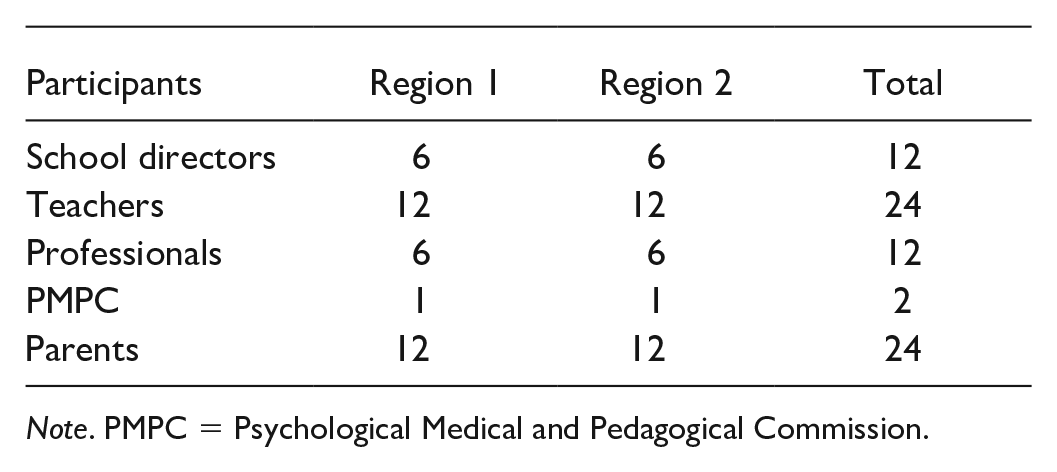
Note. PMPC = Psychological Medical and Pedagogical Commission.
Data Collection and Analysis
Semistructured interviews were conducted at research sites, using open-ended questions. Questions were asked on different aspects of inclusive education, including pedagogical aspects, collaboration, assessment, curriculum, leadership, systemic issues, and the role of parents and the community. The following is a sample of questions that were asked during the interviews:
In your opinion or to your knowledge, how would you define the concept of inclusive education?
What is your general experience of or involvement in implementing and managing inclusive education at the school?
What challenges and opportunities have there been in this process?
What would you regard as the main recommendations to make inclusive education quite efficient?
The interviews were conducted in Russian, audiotaped (with consent from participants), and transcribed and translated into English (by a qualified Russian–English translator) after the interviews. Interviews lasted for approximately 1 hr. The interviews were held in a designated room away from disruptions. Data from translated texts were analyzed using a textual discourse analysis framework, from which themes were derived and used to harvest findings and draw some conclusions. Data from interviews and documents (policy documents) were subjected to textual analysis. The policy documents analyzed included school policies; speeches by politicians, educationists, and experts in special education; a state program; the Law on Education; and the Constitution of the Republic of Kazakhstan. In this study, a discourse was regarded as a social practice (Fairclough, 2003). To identify the discourse, the following criteria were used: cohesion, grammatical agreement between parts of sentences essential for interpretation; coherence, the order of statements and how they related to one another by sense; intentionality, the conscious and deliberate conveyance of a message; acceptability, indicating that the communicative product is regarded as satisfactory and approved by the audience; informativeness, new information included in the discourse; situationality, circumstances under which remarks are made; and intertextuality, the peripheral view of the world outside the text. To identify the discourse during the analysis, the patterns in meanings and the connections between these textual meanings were taken into consideration. The text was interpreted in relation to the sociohistorical and cultural context and power relations involved (Janks, 1997).
Ethical Considerations
Ethical procedures were followed and participants were made aware of their rights in the study, that is, voluntary participation, that no names of participants or schools would be made known and that data were only meant for the study. Participants were made aware that they could withdraw from the study at any given point.
Findings
During the analysis of the pattern of meanings, these were coalesced into coherent themes. Themes were derived in such a manner that they provided answers to the overarching research question: To what extent are the current language and terminology appropriate for inclusive education in Kazakhstan and, if necessary, how can these be improved or maintained?
Special Education Versus Inclusive Education
The analysis of documentary data seems to point out that the understanding or conceptualization of inclusive education is premised on the notion of special education, which focuses narrowly on support to students with disabilities. For instance, the definition of inclusive education in the law of education (Section 21-3) reads thus: “inclusive education—coeducation and training of individuals with disabilities, providing equal access with other categories of students to the relevant educational training programs of education, special pedagogic and social support of development by providing special conditions.” This is corroborated by Article 19 of the Law on Education, which makes reference to the following:
Special educational training programs shall be developed on the basis of educational training programs of primary, basic secondary, general secondary, technical, and professional education and directed to education and development of persons with disabilities and shall consider psychophysical peculiarities and cognitive capabilities of students and pupils, determined in recognition of recommendations of psychological, medical, and pedagogical counseling.
Special correctional general education training programs shall be developed and introduced for persons in need of continuous care, as well as for persons and teenagers with disabilities in development.
Special general education training programs shall be realized in the special educational organization, provided by the laws of the Republic of Kazakhstan, in the general education schools or at home.
In the State Program 2011–2020, emphasis is put on disability rather than on other forms of diversity. For example, this statement sums it up: “Out of 149 246 children with disabilities 29 212 or 19.5% are preschool-age children. Ten thousand of these children, that is 32.8%, are covered by preschool education and training in 37 special kindergartens and 240 special groups.” The professional development of teachers still seems to be framed within the scope of special correctional pedagogy. For instance, a report of the OECD, quoting the Act on Social and Medical-Pedagogical Correctional Support of Disabled Children (Kazakhstan, July 11, 2002), states the following: The in-service training (INSET) of teachers in special education is provided for by the Law on Education and by the regulations on professional development and personnel retraining in the Kazakhstan. It is provided by the NARC CP Institute of Professional Development, at the Department of Correctional Pedagogy of the Republican Institute of Professional Development, and also at the oblast (administrative division/region in Slavic countries) institutes of professional development.
Defectology as Special Education Method
The analysis of interview and documentary data seems to suggest that defectology is a field of study for expects in special education, and therefore, the defectologist is a trained professional. The following quotation from one PMPC official attests to this: “I studied at a defectology faculty for five years. Now people study four years in theses faculties (full-time); I do not know how long students study at the extension department.” Asked about their role, it became evident that defectologists are professionals who have the responsibility, according to the special education system, to remedy defects with which the child or student is diagnosed. This extract from one of the parents supported this assertion: “And you will have courses of treatment, you take the child to a defectologist.” The implication of all this is that all barriers to learning are primarily learner centered. The model is based on the fact that the student has to undergo some form of remediation to fit into the normative education context.
Barrier to Learning as Disorder
The general impression from the analysis of interview data is that all barriers students encounter are branded as disorders. The model heavily assumes a medical approach in dealing with barriers. The following quotation from one of the PMPC officials is an example on how barriers are conceptualized as disorders: Until a logopedist (specialist who deals with the correction of speech sounds and disorders in writing and reading) can correct the speech defect. A speech defect can be eliminated before the age five years, so it is important to recognize it in the first year, especially in children with peripheral disorders.
It is, therefore, important to diagnose a particular disorder early. The following statement from a representative of the PMPC attests to how the label “disorder” is being conceptualized: “We diagnose disorders such as ‘emotional and communicative delay’ or ‘specific language development up to 12 years’; a diagnosis of autism can only be made by the Medical Center of Mental Development. We just assume it.” It is evident that some disorders do not qualify the student to attend a regular school or classroom. For instance, according to one of the teachers, some students are home schooled, based on the severity of the disorder or health challenge. Asked to give an example of who can be home schooled, the teacher cited, “I have two children studying at home. The boy with cerebral palsy, he is sitting in a wheelchair, he has a disorder of the locomotor system.”
Rehabilitation as Prerequisite to Dealing With Barriers
The analysis of interview data shows that the concept of rehabilitation plays an important role in dealing with barriers student might be experiencing. All places where students are given support are deemed to be rehabilitation areas. For instance, asked about places designated for support, one of the PMPC officials alluded to rehabilitation centers and correctional facilities the following: There were rules for rehabilitation centers, correctional facilities. In 2013 order No 258 was adopted; all standards were united in one document, whereas there was only one line before 2013. Everything was good, we worked according to these rules, they described very well how we should work, who should work, the organization of activity, including documentation; for example, for rehabilitation center, correctional facilities or logopedic facilities.
Therefore, rehabilitation centers are still the hallmarks of the special education framework where students are tested and diagnosed for perceived disorders. A representative of the PMPC stated, “We have rehabilitation centers in our structure, which are testing sites. Four hundred and twenty children attend our center every year.” Asked about their role in rehabilitation, the PMPC official suggested the following: In addition, our center has an information and guidance department in its structure, which is focused on all monitoring in special education, that is, we are the entity that provides data on the scope of activities of offices for psychological and pedagogical correction, rehabilitation centers, teaching staff and learning and teaching support.
The implication is that the PMPC monitors the special education support processes. It is clear from this that the assumption is that provision of education is based on an understanding that barriers to a large degree stem from the student and that structures are important to rehabilitate the student.
Correctional Pedagogy Versus Inclusive Pedagogy
The analysis of interviews and documents indicates that correctional pedagogy is a pedagogical and methodological strategy to deal with barriers. Asked about which pedagogy is applied to support students experiencing barriers, one of the inclusive education coordinators had this to say: “We also plan methodical days in the correctional classes where we watch over the work of teachers at these classes.” Therefore, the theory applied in dealing with learning barriers is branded correctional education. One of the school principals suggested the following: My deputy director will give you exact figures. We are a mainstream school, we have 32 classes, among them only three classes with correctional developing education. They are Grade 4, that is primary education, Grade 5 and Grade 9; the latter will graduate this year. Of course, in addition to correctional classes of our secondary school, we have children with special educational needs; there are three pupils in each class. There are only children with a delay in mental development in the correctional section in general and also children with a different similar diagnosis; we have all their medical documents.
The notion of correction seems to be classified into two dimensions, that is, correctional school or correctional classroom. The following quotation from PMPC official confirms the concept of a correctional school: We have a specialized institution, where wheelchair users are taught. We do not have any wheelchair invalids. There is a primary school, there is a correctional school as well, and there is also a boarding school for children with severe sensory impairment. And we have developmental delay and corrective training classes only.
The notion of correctional teaching methodology seems to form the core of the teaching and learning strategy to deal with barriers. Asked about how they instrumentalized correction, one of the teachers said, And when we prepare our lesson in a standard class, we have correction and developing work in the column of lesson planning. And there we set apart from the main objective of the lesson correctional and educational aims of the lesson as well.
It is clear that correctional pedagogy entails not only theory, but also carrying out certain sets of pedagogical activities in the classroom. These sets of activities focus not only on teaching but also on the assessment of students, as one of the inclusive education coordinators suggests the following: Probably what I mentioned before, we need to develop criteria for assessment for these children, it is necessary to introduce additional correctional lessons when the child can come if he had noticed or any teacher noticed that he didn’t learn something.
Disability as Being Unhealthy
The analysis of interviews suggests that experiencing a barrier is regarded as being unhealthy. Students experiencing barriers are unhealthy and, therefore, need to be treated. The model emphasizes that students should be medically examined to diagnose a perceived health problem or disorder. Asked about how they identify unhealthy students, a PMPC official said, “We do initial examination of children who come to us from the health centers, medical centers or clinics. We also have cabinet (classroom) of healthy child.”
Discussion of Findings
Inclusive education refers to the process of making education equitably accessible to all students in the same learning environment, regardless of their differences, which may include disability (Norwich, 2002). It is important that the conceptualization of inclusive education be fundamentally about widening participation and providing education for all. The fact that inclusive education is considered to be the renaming of special education is problematic (Florian, 2008). It is important that the use of the concept of inclusive education be coupled with the transformation of practice from special needs pedagogy to the pedagogy that advocates education for all. This pedagogy rests on the premise that diversity of students entails not only disability but also aspects such as socioeconomic status, language differences, religion, culture, gender, ethnicity, and others. While defectology might be a field offering an approach to supporting learners experiencing barriers, the conundrum is that it is premised on the assumption that barriers to learning stem mostly from the student. It assumes that students have to be corrected in some way to enable them to fit into the normative education process. The use of the concept defectology militates against the values of inclusion because it assumes that student have defects, which is a very controversial view, given current trends in inclusive, special, and supportive education models.
The dictionary meaning of disorder is that a person is functionally abnormal. However, a disorder is a social construct discursively produced by a set of thinking. The fact that students are assumed to have a disorder presupposes that a universal framework is used to determine how they should fit in. The fact that some of the students’ needs are branded as disorders is inherently exclusive, and there is the potential for emphasizing differences at the expense of similarities.
The fact that dealing with student barriers calls for rehabilitation or remediation means that in most cases, barriers are associated with student inadequacies. The use of the concept rehabilitate could imply that barriers can be removed and be remedied so that the student can fit into the normative education provision system. The significance of inclusive education lies in the fact that systems, models, and methods are adapted to include the student in the provision of education and give the necessary support that can respond to students’ individual needs in an inclusive education environment so that they are not segregated. Therefore, the use of the concept rehabilitation seems to be inconsistent with the ideals of inclusive education.
The central tenet of inclusive pedagogy is widening the participation of students in the process of teaching and learning in such a way that teaching and learning cater for their individual needs. Therefore, the emphasis is not on the student, but on the way in which the teaching and learning process is designed to include the student. Inclusive education rejects the use of labels, but advocates changing systems and methods to support learning (Lauchlan & Boyle, 2007). Therefore, the assumption by correctional pedagogy that the student needs to be corrected and rehabilitated is inherently problematic. The educative process should be designed in such a way that diversity is celebrated and becomes central to pedagogical planning and processes. There are different categories of barriers to learning, such as disability, communication, attitudinal, social, economic, and health barriers. The mere fact that students are experiencing barriers to learning does not necessarily mean they are unhealthy. However, there are instances where health could be a barrier to learning, that is, when a student experiences a chronic disease affecting his or her functionality. However, care should be taken not to regard every barrier that students experience as a health issue; a barrier should rather be seen as a difference.
Conclusion
It is evident from the study that the understanding of inclusive education as a concept has not been clearly conceptualized in Kazakhstan. It is important not only to make a shift in terms of concepts but also to maintain balance between theory and practice. Care should be taken not to brand inclusive education as the renaming of special education. The use of the concept defectology perpetuates thinking and attitudes about differences, and therefore, an appropriate concept needs to be used instead. It will be important to review the use of some terminology and their contrast to the values of inclusive education. It is essential to reconsider correctional pedagogy, as it contradicts the very essence of inclusive education. In this study, I argue that rather than focus energies on rehabilitation, there should be a refocus on changing systems, models, and methods to respond to the needs of all students. These need to provide support on an equitable basis to enhance and widen the participation of all learners in teaching and learning, regardless of their differences. It is also important to be mindful of the fact that not all barriers to learning are health related; therefore, referring to learners with special needs as unhealthy might not be appropriate.
While this article cannot claim to have addressed all exclusive vocabulary and terminology aspects of the transition of Kazakhstan toward inclusive education, it lays the basis for constructive discussion among experts, researchers, and practitioners in inclusive education to come up with a more inclusive glossary that will be consistent with the values and principles of inclusive education.
Footnotes
Declaration of Conflicting Interests
The author(s) declared no potential conflicts of interest with respect to the research, authorship, and/or publication of this article.
Funding
The author(s) received no financial support for the research, authorship, and/or publication of this article.
