




Abstract
To gain a clear understanding of the current state of research on the reproduction of language style in translation, we systematically analyzed 61 relevant academic studies conducted over the past decade (2014–2024). Stylistic reproduction highlights the importance of conveying the original style in translation, focusing on how to preserve and reflect the style. Driven by the characteristics of the times, the expansion of academic background, the deepening of translation studies, and the practical demands of translation practice, research on stylistic reproduction has garnered increasing interest from scholars. Fruitful results have been yielded in terms of research content, which covers general trends, topics and areas of focus, types and challenges of style, as well as applied theoretical frameworks, translation principles and strategies. However, deficiencies have also emerged. These issues include repetitive research topics and content, findings that lack analytical completeness and reasonability, conceptual confusion regarding translation terminology, the limited range of languages examined, and the absence of effective evaluation mechanisms for stylistic reproduction. This study suggests that future research should adopt diverse perspectives, identify new materials, and strengthen both theoretical and textual analysis. It should also innovate research methods and instruments to enhance the reliability and originality of findings. Current research highlights the need for future investigations to address the international dissemination of high-quality translations and the stylistic reproduction of non-literary styles. The findings of this study aim to illuminate existing challenges and gaps in the field, offering fresh perspectives and approaches for future research on stylistic reproduction in translation.
Keywords
Introduction
Due to regional and historical differences, as well as the diversity of civilizations, language differences are widespread. Bloom and Keil (2001) indicated that language has been said to affect our online perception of the world, to shape the categories we form, to enable us to perform logical inference and causal reasoning, to underlie social reasoning, and to structure our basic ontological commitments about time, space, and matter. A shared language is essential for enabling the growing human connections across the globe. In building a “bridge” through language to truly facilitate global communication and exchange, translation has been endowed with a mission and significance for the times. As Janfaza et al. (2012) argued, translation plays an important role in crossing different cultures and facilitating communication. Therefore, translation is one of the essential, fundamental, and adequate ways of transferring culture.
In the 20th century, due to the rapid development of linguistics, translation studies were still considered a subfield of linguistics. Catford viewed translation as a process of shifts, in which the translator can find equivalent mechanisms within different language systems to convey the same message. This naturally led to the pursuit of equivalence and equivalent values (Catford, 1965). The sole, true object of linguistics is language studied in and for its sake (De Saussure, 2006, p. 323). Linguistics is a science that studies language, while translation is a cross-cultural communication activity that involves the transfer of meaning between languages. Therefore, there are numerous intricate connections between linguistics and translation (Ou, 2012).
As times have progressed, the scope of translation studies has expanded significantly. Research on translation theory and practice, the contributions of translation scholars, and the intersection with various disciplines have gradually allowed translation to break free from the traditional constraints of linguistics. This has led to the understanding that translation should no longer be viewed merely as a subfield of linguistics, but rather as a discipline founded on cross-linguistic, cross-disciplinary, and cross-cultural principles. According to Komisanov (2006), in the era of globalization, the scale of translation activities worldwide has increased, and the development of science, technology, and new media has resulted in frequent cross-linguistic communication, which has further driven the growth of translation studies. Moreover, the frequent occurrence of translation activities has sparked scholarly interest in translation theory, translation practices, and the role of the translator, further promoting the flourishing of the field of translation.
Researchers have delved into various fields and themes within translation studies, and the reproduction of language style has heightened interest in this area of research. An increasing number of scholars are focusing on translation from the perspective of style. Boase-Beier (2004) illustrated how the essential ambiguity of the source poem can be rendered in English translation with a case study of holocaust German poetry. To preserve the emotional depth and inherent ambiguity of the original poem, the translator needs to be sensitive to the stylistic features of the original text and make informed choices in the translation. Shiyab and Lynch (2006) believed that style in literary works, at least, can be partially reproduced. During the process of translation, the translator is required to navigate and balance linguistic norms, cultural context, and the stylistic features of the source. Zhao (2019) explored a Chinese prose Moonlight over the Lotus Pond from multiple perspectives, including phonology, rhythm, vocabulary, syntax, structure, rhetoric, and register, and evaluated whether the translation effectively reproduces the original style. As stylistic reproduction research has been increasing, the development of translation theory has contributed to an expanded understanding of how linguistic, rhetorical, and stylistic elements interact in cross-linguistic contexts.
Style in translation has long been recognized as one of the major challenges. A good translation must reflect the author’s intent (Newmark, 2001). Style can be reproduced but yet it is frequently “rewritten” (Munday, 2013). Sustained interests in stylistic reproduction can be attributed to four main reasons: first, the influence of the current era. With the increasing frequency of cultural and linguistic exchanges, translation is no longer merely about finding linguistic equivalence but must also consider cultural differences, artistic style, and emotional expression in the process of conveying information. In this context, the significance of stylistic reproduction has become more prominent, especially in fields like literature, advertising, and film, where style directly affects the audience’s understanding and reception. Second, the expansion of academic background. As translation studies have gradually evolved from being a subfield of linguistics to a multidisciplinary area of research, translation theory now encompasses not only linguistics but also fields such as literary studies, cultural studies, psychology, and semiotics. The study of stylistic reproduction is a product of this multidisciplinary context. From a semiotic perspective, translation is no longer simply a transformation of vocabulary or syntax; style, as a symbolic system, conveys emotions, attitudes, and social identity. Third, it reflects the deepening of translation studies. Stylistic translation is not merely a formal transformation but involves a deep understanding of the source language’s culture, the author’s emotions, and the creative background. Finally, it stems from practical needs in translation. In real translation practice, the reproduction of style can enhance the acceptance and impact of the translated text. Whether it is a literary work, legal text, political commentary, or news report, style affects the reading experience of the target audience. Especially with the increasing frequency of international literary exchange today, stylistic translation has become a significant challenge for translators.
In the context of translation, to achieve the desired communicative effect, the translator, as the recipient, must decode, experience, understand, and interpret the stylistic features of the source language. However, existing researches on stylistic reproduction lack a clear and precise understanding of what constitutes style. The criteria for distinguishing different styles are often vague, leading to misunderstandings and inaccuracies in translation practices where the essence of the style is not fully perceived. At the same time, most research on stylistic reproduction lacks an appropriate theoretical framework. As a result, some studies rely on general translation theories, which often do not address the translatability of style in depth. The quality of stylistic reproduction is judged as part of the overall evaluation of the translation, making it difficult to assess the accuracy of stylistic reproduction. For a long time, theoretical research on stylistic reproduction did not receive sufficient attention within the translation field.
In addition, Baker (2000) proposed that translations reveal the style of the translator and advocated for the use of corpus-based research to study translator/translation style, which sparked significant interest among scholars. Saldanha (2011) raised a mixed method combining corpus linguistics and text analysis, emphasizing quantifiable and verifiable research approaches. He clearly defined translator style as the translator’s own language choice, rather than passively reflecting the source text, providing a reliable analytical framework for future research on the translator’s identity and the manifestation of ideology in translation. Mastropierro (2018) studied two Italian translations of H.P. Lovecraft’s novel through key clusters in a corpus way. Key word clusters show the translator’s preferences for language style, sentence structure, and cultural appropriateness, and they can help explain the translator’s ideological stance or tendency in translation strategy. The corpus-based approach to translation studies has since emerged as a new research paradigm, leading to a surge in related studies. However, researchers have often focused more on the style of the translation itself than on reproducing the stylistic features of the original text. This confusion between “translator/translation style” and “stylistic translation” as distinct terms, to some extent, hinders progress in stylistic reproduction in translation research.
In general, stylistic reproduction refers to the process of mirroring or recreating the stylistic features of a source text in another linguistic or communicative form. It emphasizes how stylistic elements including tone, rhythm, rhetorical devices, and discourse patterns are largely preserved, reshaped, or reinterpreted rather than merely transferred at the linguistic level. Within the field of translation studies, stylistic reproduction specifically concerns how translators convey the author’s stylistic intentions, ideological stance, and communicative effects across languages and cultures. It involves not only linguistic choices but also strategic decisions that balance fidelity with creativity, aiming to reconstruct the stylistic identity of the source text within the target language. The study of stylistic translation holds significant importance in the context of cultural exchange and academic research in the era of globalization. It not only expands the theoretical depth of translation studies and enhances the diversity and complexity of the discipline but also addresses the practical need for precise transmission of culture, emotion, and style in modern society. Therefore, it is essential to thoroughly explore the current state of research on stylistic reproduction and to understand its development steps.
An Overview of Translation Studies of Language Stylistic Reproduction
Non-Chinese Translation Studies of the Reproduction of Language Style
With the increasing interest in translation studies with language style as a research view, not a few related published works on a combination of different languages exist. One of the earliest studies that explored language style from a translational perspective was conducted by Wakabayashi (1992). He outlined and examined a few of the characteristics of Japanese language style and believed that even if a stylistic feature can be reproduced in the translation, it clarifies the translatability of style in two languages, but does not provide a specific case analysis on how to reproduce style. Similarly, Puurtinen (1994) studied two Finnish translations of The Wizard of Oz, a famous American classic, and found that the acceptability of a translation in terms of language and style depends on the extent to which the translated text adheres to the common norms and conventions of the target language’s literature. She concluded that there is an obvious connection between style and readability and assumed the great importance of stylistic reproduction in translating children’s literature. However, her analysis remains largely focused on norm conformity and does not fully engage with how individual stylistic markers are operationalized in translation. This suggests a need for further studies that explore style beyond readability and examine how different stylistic features and functions vary across text types and audiences. Baudry (2013) analyzed translation strategies employed by two French translators in their translation of James Macpherson’s Ossian. By comparing these strategies, he examined how the translation process balances fidelity to the original text with adaptation to the target language culture, and how this balance influences the reception and impact of Ossian in France. This study primarily centers on macro-level strategy selection. It provides limited insight into how specific stylistic elements, such as emotional color, rhythm, are preserved or reproduced in the translation process. But it opens space for further investigation into the micro-level mechanisms of stylistic reproduction.
Moreover, Almanna and Farghal (2016) explore a stylistic approach, including linguistic stylistics, literary stylistics, affective stylistics, and cognitive stylistics to translating literary texts from Arabic into English and vice versa. While the study identifies multiple stylistic perspectives, it fails to adequately illustrate their practical implementation in translation. This points to the necessity of integrating stylistic theory with practice through close textual analysis and illustrative examples. Venuti (2018) underscored that stylistic reproduction is closely related to culture, ideology, and power. Foreignization is supported to a certain degree as an effective way to maintain originality, voice, and rights of the style in source texts. Yu and Mao (2022) took Jay Rubin’s English translation of 1Q84 by Murakami as research objective, and the difficulties and strategies of translating Haruki Murakami’s near-English-styled Japanese works into English. The study sheds light on how the translator negotiates a balance between preserving the author’s style and ensuring readability when dealing with the English-style features of the source text. However, it offers limited analysis of how Rubin’s specific translation strategies contribute to stylistic reproduction, leaving room for further exploration into the pathways of cross-linguistic stylistic translation.
Other scholars have also explored style-related phenomena in translation studies theoretically. Boase-Beier (2006) discussed the nature and importance of style on the effect of literary and non-literary texts. She primarily outlines theoretical possibilities without providing in-depth textual analysis to illustrate how stylistic effects are negotiated in translation. Al-Qinai (2009) researched stylistic shifts in translated texts, which are mainly decided by textual incompatibility in terms of rhetorical asymmetry and divergence at the formality level. This study effectively identifies structural sources of stylistic change, but it offers limited insight into the translator’s efforts in resolving these mismatches. Babaee et al. (2014) drew attention to the translator’s role in maintaining and reproducing the original style. The translation of style is not merely a faithful rendering at the linguistic level, but also a reflection of the fusion between culture and creativity. This perspective usefully broadens the scope of stylistic translation, though its conclusions are more conceptual than operational. Cífka et al. (2019) focused on the stylistic translation of symbolic music accompaniment with their developed supervised algorithm, providing interesting research directions as well as an excellent resource for music stylistic reproduction. However, although their contribution delivers new approaches, its applicability to broader stylistic types, such as literary translation, remains to be clarified. Chita and Stavrou (2020) highlighted the literary style—metaphor is one of the challenges in translation. Translators must draw on cross-cultural understanding and creative strategies to preserve the metaphorical style of the original text, thereby achieving the overall reproduction of its stylistic features. Nevertheless, the study does not provide a systematic framework for identifying and translating such features across genres.
In conclusion, translation studies focused on style have consistently been a key area of interest for foreign scholars. Researchers’ exploration from various perspectives has enriched the development of stylistic reproduction in translation studies and provided valuable insights and inspiration for future studies in the field. However, many remain fragmented in scope or lack integrative frameworks that link theoretical perspectives with practical strategies. This suggests a continued need for comprehensive syntheses that bridge theory, practice, and empirical analysis in stylistic translation studies.
Chinese-English Translation Studies of the Reproduction of Language Style
Contrary to the West, stylistic reproduction has also been explored in China. Even though there is no clear consensus on when precisely the Chinese-English style translation investigations commenced in academic circles, research of relevant literature indicates that since the early 1960s, which is earlier than in the West. According to the searching result of China’s largest and longest academic database, CNKI, research in this area started when Zhang Zhongying, a Chinese translator and litterateur, discussed the style in translation studies and advocated that style can be sacrificed to some extent (Z. Y. Zhang, 1961). But he predicted that there will eventually come a day when style is no longer a translation issue as time progresses. However, the same year, Liu Longhui considered style as compulsory in literary texts. Style is simply difficult to translate, not impossible to translate. Difficulty in translation does not equate to leaving it untranslated (Liu, 1961). His view is different from Zhang’s, and he stated that as long as we approach the work as a whole and achieve the same artistic impression as the original, and if readers of the translation recognize the author’s style in the same way as readers of the original, then it is a success. In a similar way, Xu Jun discussed stylistic reproduction issues and asserted that the style of the original must be reproduced, as this is determined by the essence of translation (J. Xu, 1986). The above studies further clarify the translatability of style. Although they do not offer concrete steps for stylistic reproduction, they point the way for future research into how style can be effectively translated.
Before long, Liu Miqing put forward the stylistic markers theory and argued that style can be translated (Liu, 1990a; 1990b). It is a theory that helps to further clarify the style of a translated work and proposes translation strategies and patterns for stylistic transformation. Guided by this theory, researchers have conducted several studies on stylistic reproduction of translation works of Chinese-English and vice visa (Hao, 2013; Wang & Gao, 2022; Zhou, 2015). This theoretical framework introduces how to identify styles, the transformation patterns of styles, and effective stylistic translation strategies, promoting concrete steps for stylistic reproduction. Furthermore, since the 18th National Congress of the Communist Party of China, the Party Central Committee, with Xi Jinping at its core, has placed great importance on the inheritance and promotion of China’s outstanding traditional culture, which has also stimulated research into the translation and reproduction of the styles found in ancient Chinese literary works (Gong, 2015; Li, 2013; Y. Q. Zhang, 2016; Zhao, 2019; Zhao, 2020). A review of Chinese literature clearly shows that Chinese scholars place greater emphasis on stylistic reproduction based on functional needs (e.g., responding to the call of the times) and its practical value.
Overall, both Chinese and Western scholars have extensively studied the reproduction of style in literary texts. The difference lies in the fact that Chinese scholars tend to focus more on the practical application of theories in stylistic reproduction, whereas Western scholars tend to focus more on the ontological significance of style and its theoretical construction within translation studies. In addition, Western scholars have broadened the investigation of stylistic translation to include non-literary fields such as legal and musical texts, a direction that has received limited attention in Chinese research.
Despite new findings, stylistic reproduction in translation studies—both in Chinese and Western contexts—still exhibits some of the limitations discussed above. At present, research on stylistic reproduction in translation remains limited in visibility in terms of academic interest and overall development, and its research topics and areas of focus have yet to form a clear picture. Existing research on stylistic reproduction in translation tends to concentrate on theoretically driven approaches, while overlooking analysis of distinctive features and functions of different styles and their impact on translation challenges in practice. Also, the feasibility of the adopted theories in these studies, as well as their explanatory strengths, have rarely been properly addressed. Moreover, the lack of synthesis of translation principles and strategies, coupled with insufficient evaluation of stylistic reproduction outcomes, has resulted in generalized conclusions that offer little practical reference.
Therefore, it is crucial to conduct a systematic review of existing research on stylistic translation. By analyzing existing related studies, researchers can address current problems in stylistic reproduction. More importantly, this study allows for a systematic accumulation of knowledge, enabling researchers to build upon existing achievements and propose new theories or methods, ultimately driving innovation in translation and stylistic studies. According to Gough et al. (2017), a systematic review is the “review of existing research using explicit, accountable and rigorous research methods” to analyze literature. Traditional review mainly relies on manual search and screening of relevant literature for induction, summary, and evaluation, while systematic literature review is more scientific and objective, to draw more accurate and comprehensive research discoveries. Thus, this current research aims to synthesize stylistic reproduction in translation studies by conducting a systematic review of relevant data from 2014 to 2024. The specific research questions to investigate are as follows:
What are the general trends in research on stylistic reproduction in translation studies?
What are the research topics and areas of focus in studies on stylistic reproduction in translation?
What styles have been identified in the data, and what are the linguistic features and functions of each?
Which translation and interdisciplinary theoretical approaches underpin current research on stylistic reproduction in translation studies?
Which translation principles or strategies (methods & techniques) have been used to achieve stylistic reproduction in translation research?
Materials and Methods
Searching Strategy
To answer the research questions above, related stylistic reproduction researches were searched to meet the research requirements. A thorough search was conducted across the following electronic databases: CNKI (China National Knowledge Infrastructure), Web of Science (WoS), Scopus, PreQuest, as well as other resources like Google Scholar, to identify relevant studies for this review. Boole (1854) introduced Boolean logic in the 19th century. The fundamental principle of Boolean logic involves using logical operators (such as AND, OR, and NOT) to combine keywords, allowing for precise control of search results. Therefore, Boole logic advanced searching was adopted within this research, and searching terms were (语言风格再现 + 风格再现 + 风格特征 + 语言风格 + 风格翻译) * (翻译研究 + 翻译理论 + 翻译) (for CKNI); ((“language stylistic reproduction” OR “stylistic reproduction” OR “stylistic feature” OR “linguistic style” OR “stylistic translation” OR“ style translation”) AND (“translation study” OR “translation theory” OR “translation”) (for WoS/Scopus/PreQuest)). As for literature from Google Scholar, because there is no advanced searching function, extra manual selection and screening for a list of references was also employed.
Exclusion and Inclusion Criteria
To accurately obtain literature aligned with the research need, explicit inclusion and exclusion criteria were established to ensure a scientifically sound and unbiased literature search, thereby enhancing the reliability and validity of the review. Research literature is deemed eligible if (a) It is an academic article; (b) It falls into searchable published time range from 2014.01 to 2024.12; (c) It was written in either in English or Chinese; (d) It must be a study to discuss stylistic reproduction (stylistic translation) in the translation fields. And it was excluded if it met one or more of the exclusion criteria mentioned below: (a) It is a dissertation/master or doctoral thesis/unpublished paper/meeting paper/periodical/interview record/one of chapters of a book/book review/newspaper; (b) It is published out of the time range from 2014.01 to 2024.12; (c) It is not written in English or Chinese; (d) It does not fit the research theme: stylistic reproduction (stylistic translation), for example, it studies translation style/translator style; (e) It is not available online or as an open access for full-text. (f) It is not a valuable journal as a reference, such as journals in vocational colleges and primary education; (g) It provides less information about the research subject, or its research results/conclusions are unclear and ambiguous. The time frame of 2014 to 2024 was chosen for this study because it aims to provide a review of stylistic reproduction research over the past 10 years. There was a surge in studies on stylistic reproduction during this period compared to earlier times, indicating that researchers have since paid more attention to the reproduction of style in translation. Therefore, reviewing literature from this timeline offers greater research value.
Data Extraction
This study was conducted with a systematic review and PRISMA guidelines. The research progress was displayed as Figure 1, manifesting the whole process of literature selection. The author, with another two PhD candidates from UPM, jointly extracted the data by following the standardized protocol and procedure for data extraction. The platform Rayyan for systematic review was used in this study for English literature selection and duplication detection from WoS/Scopus/PreQuest. For Chinese articles from CNKI and English ones from Google Scholar, the manual screening was adopted. In order to guarantee the trustworthiness of literature searching, any troubles and difficulties were resolved through discussions with one translation expert and the two PhD candidates, and by applying the predefined inclusion and exclusion criteria. Once research searching was completed, the following data were then extracted from eligible studies: (a) publishing year; (b) publishing country and journal; (c) research type; (d) ST&TT; (e) research topic; (f) area of focus; (g) style and their features and functions (h) theoretical framework; (i) translation principle and strategy (method & technique); (j) technology/instrument; (k) major findings; (l) limitations and gaps (m) future research agendas. The criteria above systematically help analyze the overall framework and research approaches in stylistic reproduction studies, providing a clear view of the current state in this field. It also offers valuable insights for the development of future research.
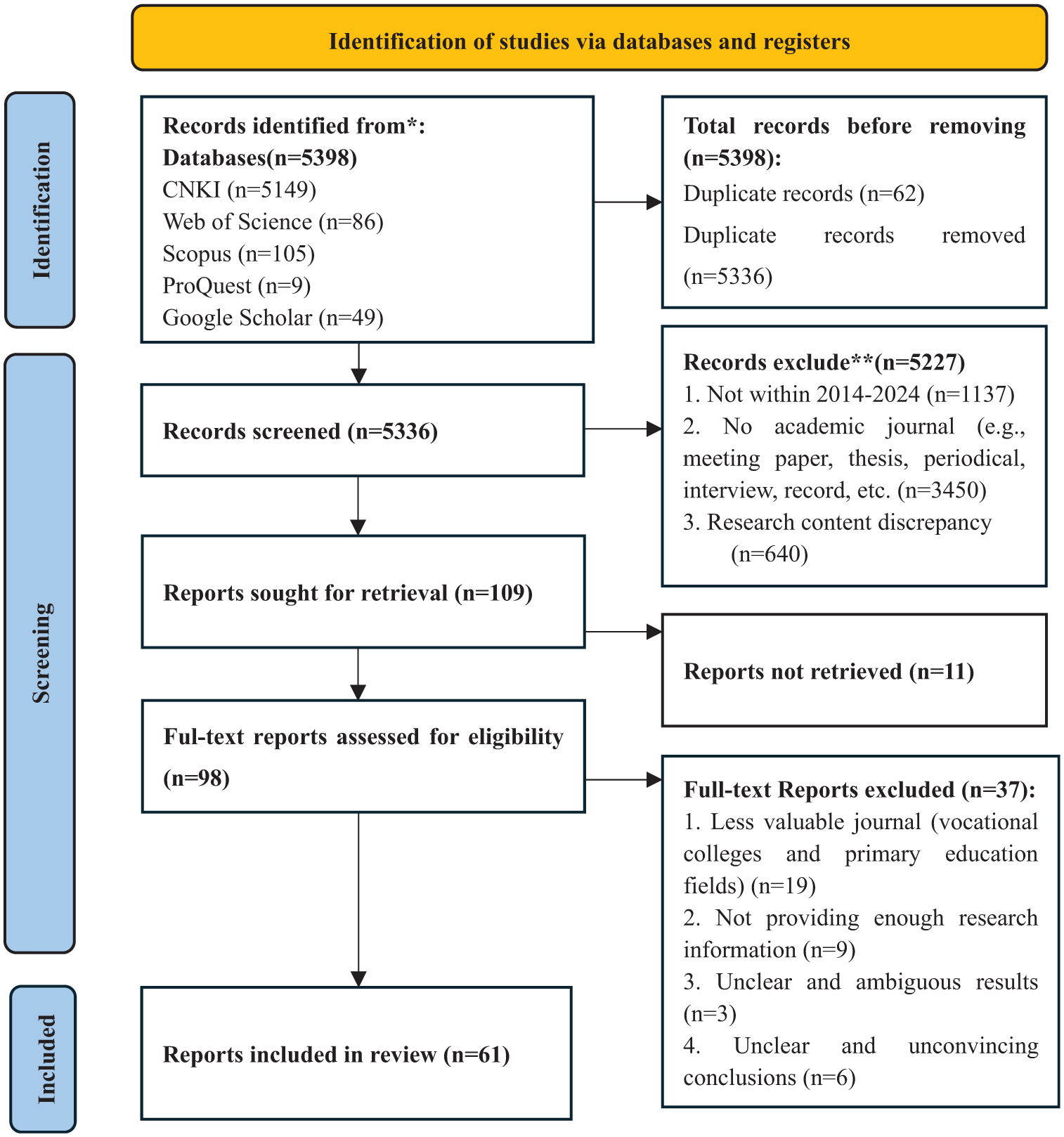
A Prisma diagram of literature selection for review.
Results and Analysis
Overall Characteristics of Stylistic Reproduction in Translation Studies
In order to understand the specific situation of the literature search, this study first conducted a pilot study. The author first searched the articles from 2009 to 2024 (by the end of 2024.7.8). Given the large volume of available literature and rather outdated publication dates of some sources, not all of them may hold significant reference for current research. Therefore, this study narrowed the search scope to a review of stylistic reproduction translation studies in the past 10 years from January, 2014 to December, 2024. More selected publication details are presented in Figure 1, the flow diagram (Moher et al., 2015). With a series of repetitive searching items, a total of 5,398 literature items were retrieved from various databases through extensive manual and automatic searches. After removing 62 duplicate studies, 5,336 were available for further screening. According to the exclusion and inclusion criteria, 1,137 studies were excluded for the wrong time range of 2014 to 2024, and 3,450 articles because they were meeting papers, dissertations, theses, interview records, and periodicals. In addition, 640 were removed due to their discrepancy in research content. A new round of inclusion was conducted within 109 studies. Results have shown that 11 were not full-text and open access, 37 of the total 98 were excluded for the reasons of being fewer valuable references, providing no research information, unclear results, as well as unconvincing conclusions. Therefore, 61 reports were finally included so as to implement a review.
General Trends of Stylistic Reproduction in Translation Studies
Translation studies on stylistic reproduction have been increasing. Figure 2 below reveals a distribution of reviewed literature in the past more than 10 years, displaying the scholarly attention of stylistic reproduction translation studies. The first peak of included literature is 2015 with 9, then there was a sharp decline with only 1 in 2016, since then, a gradual recovery has been seen in 2017 to 2020, and another peak with 10 is shown in 2023. However, there is a slight drop back to 3 in 2024. From 2014 to 2024, it shows a general increase in stylistic reproduction with significant fluctuations across the years. In terms of published journals and country, a content analysis of the studies used in this study. As Figure 3 displays, most studies were conducted in China, while a smaller number were carried out in other countries such as the UK, Italy, the Netherlands, the Republic of Korea, the Republic of Belarus, Egypt, Jordan, Saudi Arabia, Ukraine, and Iraq. This suggests that Chinese scholars draw greater attention to the translation of style, whether the texts under study originate from Chinese or non-Chinese contexts. China is also one of the earliest countries to discuss stylistic translation, with a long history of translated works across various fields. Naturally, the reproduction of style has become a key focus of research. Notably, 17 of the 61 were published in Scopus, A&HCI, and CSSCI & CJC journals (Chinese high & core value journals), accounting for 27.8% of the total. This indicates research on stylistic reproduction remains a vibrant and significant field.
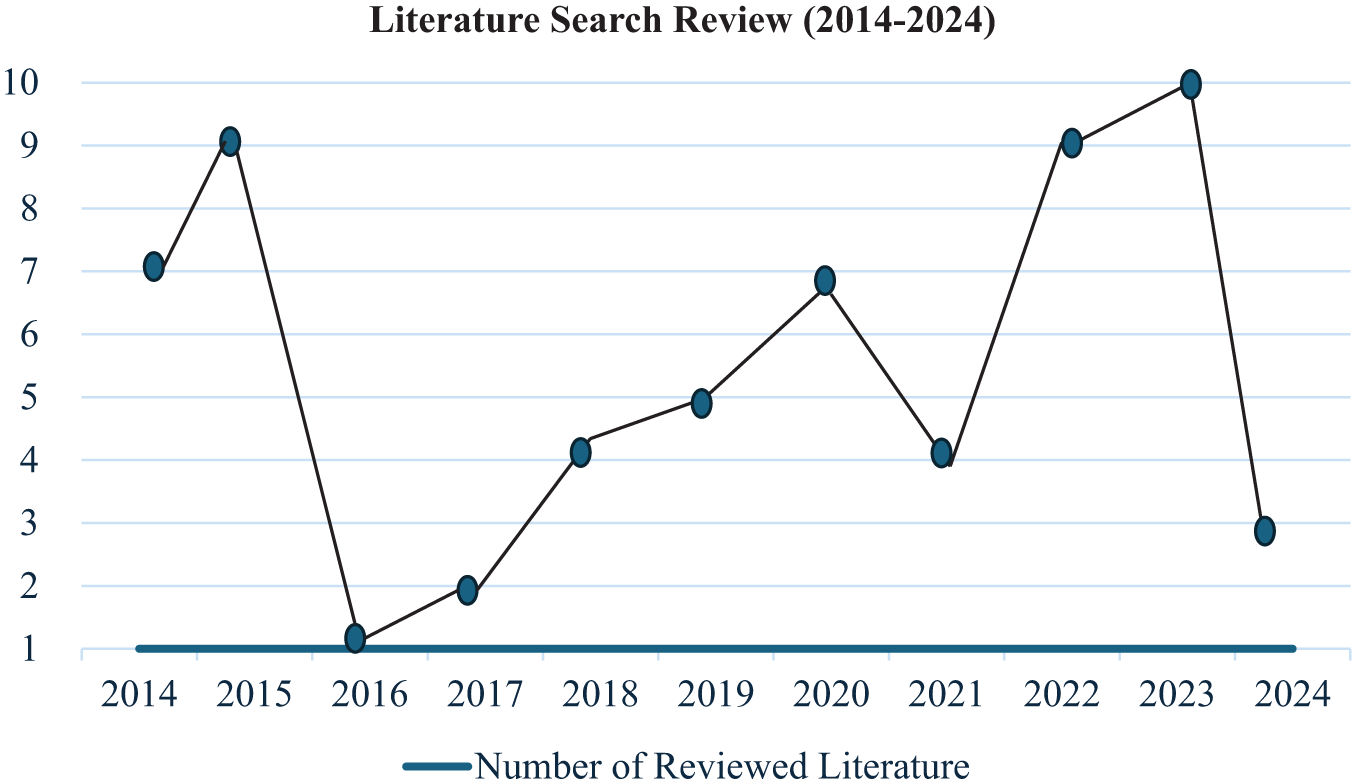
A diagram of the literature search review.

The distribution of published journals and countries.
As the global lingua franca, the importance of research on English translation is necessary. Furthermore, China’s voice on the international stage is growing stronger. In 2010, the National Social Science Fund of China established the Chinese Academic Translation Project to expand academic exchanges between China and foreign countries and promote the global presence of Chinese philosophy and social sciences. As a result, the majority of studies on stylistic reproduction in translation have focused on English-Chinese and Chinese-English translation, reflecting the strong research traditions established within these linguistic and cultural contexts. However, studies involved other linguistic contexts such as Korean, French, Italian, Dutch, Arabic, Russian, Ukrainian, Japanese, Vietnamese have been gradually increasing. This emerging trend suggests a growing scholarly interest in exploring how stylistic features are reproduced across diverse linguistic systems and cultural frameworks. Such diversification not only broadens the empirical scope of stylistic research but also contributes to a more comprehensive understanding of cross-linguistic stylistic transfer. Additionally, it offers valuable insights into the universality and variability of stylistic representation in translation practice worldwide.
In addition to the publication dates, countries, journal profiles and language, this study also analyzed the research types and the source and target languages (ST & TT). Figure 4 shows that, among the 61 included articles, 54 (89% of the total) are qualitative studies, while a small number employ mixed methods, as well as the corpus method (2 and 5 studies respectively, together accounting for 11%). There were no studies based purely on quantitative analysis. To further clarify the specific types of research in the included literature, articles were reviewed and coded, revealing that the 61 studies could be divided into three main categories: 25 discussed the practice of stylistic reproduction, another 22 applied translation theories to guide stylistic reproduction, and 14 explored the theoretical perspectives of stylistic reproduction. Research on stylistic reproduction not only examined the translatability of style and the theoretical foundations for its reproduction but also explored how such theories can inform practice and guide specific strategies for stylistic translation.

Research type of included literature.
Research Topics and Areas of Focus
The body of research on stylistic reproduction demonstrates a progression in topics, ranging from preparatory questions of translatability to detailed investigations of stylistic reproduction and, finally, to reflective analyses of functions, challenges, and prospects. This evolution can be broadly categorized into five thematic points. First, scholars (Fan, 2014; Li et al., 2015; Jia & Qi 2019; Wang & Gao, 2022) studied the feasibility of stylistic reproduction, that is, the translatability or untranslatability of stylistic features. Second, they examined the effectiveness of stylistic reproduction in translation from a specific angle or a broader approach. Comparison between the source text and the target text reveals the signification of stylistic reproduction, and triggers discussions on translation behavior norms. For instance, Mastropierro (2020) took the English-Italian translation of Harry Potter as an example, examined stylistic variations in the translation of reporting verbs, thereby highlighting an important insight: the delicate balance of linguistic features within a text must both adhere to linguistic norms and skillfully preserve the stylistic effects of the original. Third, several studies focused on verifying theories of stylistic reproduction and summarizing or analyzing corresponding translation strategies (methods & techniques). For example, Wang (2018) studied stylistic translation strategies of Zhang’s Selected Modern Chinese Prose Writings and Liu (2023) analyzed methods for stylistic reproduction of a Chinese novel Happy Dreams. Fourth, function and purpose of stylistic reproduction were fully considered, such as in the studies of Lian and Wang (2014), Cheng (2015), Chen (2020), and Abed and Ahmed (2024), along with a dialectical approach to the relationship between style and form. Fifth, topics of stylistic features, challenges and issues, and prospects of stylistic reproduction are emerging one from another (Akan et al., 2019; Astreiko, 2024; Сливка & Сливка, 2019; Elsheemi, 2014; Morini, 2014). For example, Elsheemi (2014) found that the translator’s own competence contributed to the difficulty of reproducing style when translating Arabic novels into English. The translator’s limited understanding of Arabic rhetorical devices, such as metaphors, and cultural differences led to an inaccurate conveyance of the original stylistic effects in the translation.
The selected studies also vary in their specific areas of focus. Based on contexts, these studies can be divided into areas such as linguistic and pragmatic functions, aesthetic and emotional attitudes, social and cultural cognition, and process-oriented considerations. Each focus reflects different aspects of how style is reproduced and understood in translation studies. Among these, studies on language and pragmatic functions are the most prevalent. For instance, Song (2015) found that to convey the original style of a text, it is essential to translate its artistic conception rather than merely providing a word-for-word translation that focuses solely on formal similarities. This enhances the importance of the pragmatic function of context in stylistic reproduction. Furthermore, other researchers focus on the reproduction of style in terms of aesthetics and emotional attitudes. Morini (2014) found that in the original text of To the Lighthouse, the author sought to break boundaries and create a sense of “intimacy” between the reader and the characters. It is a goal achieved through continuous and almost direct deictic shifts. However, in the examined translation, the mediating role of the narrator was often reintroduced, and the delicate emotions of the original text seemed not to be fully reproduced. Additionally, Elsheemi (2014), Muhaidat and Abu-Joudeh (2023), Sun and Liu (2023), Van Poucke (2020), Wang (2023), and Xu and Wang (2017) explored the reproduction of style about socio-cultural aspects. In addition, researchers (Abed & Ahmed, 2024; Cheng, 2018; Qin, 2018; Sun, 2021; Yan, 2014) have also approached the study of stylistic reproduction from the perspective of translation itself. They focus on strategies and methods used to reproduce styles, gains, and losses involved in stylistic reproduction in translation, and the impact of both interlingual and intralingual differences on style.
These topics and areas of focus not only represent different academic concerns but also reflect a paradigmatic shift from prescriptive and philosophical inquiries into translatability to more empirical, functional, and critically reflective explorations of stylistic transfer in translation. A clear progression can be observed from foundational questions on stylistic reproduction to multi-dimensional investigations, and from single-text analyses to broader multilingual translation practices. This suggests the field’s gradual maturation from basic theoretical inquiry to methodological refinement and critical self-assessment.
Identified Styles and Their Linguistic Features and Functions
Stylistic features are a vital part of language, but they are often constrained by the translatability between languages and cultures. Challenges of stylistic reproduction lie in how to accurately represent these stylistic features and functions across linguistic and cultural boundaries. Therefore, the identification of different styles and their associated linguistic features and functions is of primary importance for stylistic reproduction. The concept of style has been identified from various perspectives. Newmark (1988) defined style as the individual expression of a writer, shaped by textual function and linguistic features. Halliday and Hasan (1989) viewed style as a product of register, determined by field, tenor, and mode. These frameworks enable translators to identify and analyze styles, their linguistic features, and functions across different text types. While such frameworks offer useful guidance for stylistic recognition, the actual stylistic categories in this review are analyzed from selected studies, which cover a diverse range of genres and cultural contexts. After a synthesized analysis of these studies, it is concluded that there are generally two macro styles: literary or informative. Specifically, literary styles can be divided into six micro styles, namely narrative-descriptive style, classic-philosophical style, poetic style, performative-narrative style, artistic-reflective style, and educational/children’s style. For informative style, it includes political style, legal style, economic style, and general informative style.
Diverse forms and genres of literary works give rise to a wide variety of styles, each with its distinct features and functions. Among literary styles, the narrative-descriptive style is usually found in novels and literary books (Chu, 2023; Feng, 2022; X. L. Li, 2015; Lu et al., 2023; Mastropierro, 2020; Mudaghmesh & Allawzi, 2023; Ryu et al., 2023; Xiao, 2014). These works feature a clear narrative structure and descriptive language, often employing varied sentence patterns and rhetorical devices to portray characters and their inner thoughts. In contrast, China’s classical texts such as ancient prose, philosophical works, and historical records, are written in classical Chinese, characterized by stylistic traits of dense logic and semantics, and a rich use of allusions. For example, Xiong and Zhang (2022) investigated the translation of register-based humor in the Chinese classical text Records of the Grand Historian (Shiji). Their study found that the original language is featured by balanced and concise expressions, often employing Chinese four-character structures. The humorous language, used to portray characters and describe events, also reflects the author’s distinctive attitude and conveys profound meanings. Also, the poetic style, with its careful word choice and varied sentence structures, displays distinctive rhyme features, rhetorical devices, and aesthetic imagery. Studies such as Chen (2020), Qin (2018), and Ye and Li (2015) fully discussed this style from English and Chinese poetry. Furthermore, the performative-narrative style is often reflected in genres such as opera, ballad, graphic novels, and films (Lee, 2021). It blends real-life language, regional dialects, and elements of popular culture with multimodal features including visuals, sound, and text, resulting in a highly expressive linguistic style. As for artistic-reflective styles are commonly found in modern prose, essays, and reviews (Huang & Wang, 2020; Liu & Tan, 2023; Wang, 2018; Wang & Gao, 2022;Zhai & Liu, 2015; Zhao, 2019). These genres, often with flexible structures, are typically written from a first-person perspective and reflect on personal experiences or express emotions and viewpoints. As for educational/Children’s literature style (Sun, 2021; D. R. Xu & Wang, 2017), the target audience naturally determines its language to be simple, vivid, and readable. Emotional expression, along with moral and educational significance, forms the core of this style.
Informative styles have a clearer functional orientation. Political styles reveal formal language, often employ four-character phrases, and slogan-like expressions to assert authority. Legal style is marked by heavy use of terminology and ancient vocabulary, with a strong emphasis on logic and coherence. For instance, Chen (2015) conducted a study on the legal text UCP600, exploring how legal English is rendered into Chinese, particularly in terms of reproducing the original words and the style of long sentences. Economic style is featured by concise and accurate expressions of economic topics, high information density, logical clarity, and minimal rhetorical decoration (Astreiko, 2024). General informative texts aimed at the public, such as popular science books and handbooks, serve as accessible channels for acquiring knowledge and understanding of science and information. Although informative styles primarily focus on information perception, these styles still affect readability and often reflect cultural and social norms, as well as the values specific to certain fields. Such styles influence both the reader’s comprehension and the text’s functionality as well. Table 1 below clearly presents various styles identified, their stylistic features, and functions.
Identified Styles, Text/Examples, Stylistic Features, and Functions.

Translation and Interdisciplinary Theoretical Approaches
A statistical analysis of the translation studies focused on stylistic reproduction reveals that 23 of 61 articles did not explicitly mention the use of any theory. Possible reasons can be explained below. Firstly, these studies primarily focused on specific translation practice issues or case analyses. They were typically descriptive, paying more attention to practical strategies, methods, and techniques, rather than employing theoretical frameworks to explain phenomena (such as Du & Huang, 2022; Fu & Lu, 2020; Lee, 2021; Mudaghmesh & Allawzi, 2023). Secondly, the focus of these studies was not on translation practice itself, but on the perspectives, insights, or discussions of translators or researchers (Qin, 2018; Sun, 2021; Sun & Liu, 2023; Van Poucke, 2020). For instance, Qin (2018), discovered a divide between Lin Yutang and a group of theorists and translators represented by Walter Benjamin regarding their understanding of how to reproduce the style of the original work. The root of this disagreement lies in whether they recognized the distinction between inter-lingual and intra-lingual differences. Thirdly, these studies without theoretical analysis (Chen, 2015; Wang, 2024; Yang, 2014) reflect differences in the translation fields, such as technical and legal translation, where the emphasis tends to diminish the perceived importance of theoretical frameworks.
Among the rest studies, 17 applied Western theories, and 21 employed Eastern theories. Based on the 13 major theories discussed in the literature, the analysis across four dimensions—applicability to stylistic reproduction, explanatory power, strengths, and limitations—is presented in Table 2 to illustrate the guiding role of theories in the included studies. The reviewed literature demonstrates a wide range of theoretical approaches to stylistic reproduction in translation, reflecting the interdisciplinary nature of this field. Functionalist theories, such as Nida’s dynamic/functional equivalence (1964), Newmark’s semantic and communicative translation theory (2001), and Nord’s instrumental theory (2005), emphasize communicative purpose and target audience orientation. While these approaches offer clear guidelines for translation decisions, they tend to underplay the stylistic and aesthetic values of the source text. In contrast, stylistic and literary approaches, for instance, stylistic translation theory by Liu (1988), stylistic markers theory by Liu (1990a; 1990b), theory of recreation and translation style by Y. C. Xu (1999), compositional translatology by Pan (2011), prioritize the recreation of authorial voice, tone, textual rhythm and emotional experience, making them particularly suitable for literary translation. However, these models often lack operational clarity when applied to non-literary genres (such as information or technological texts). Notably, Rubin’s figure-ground theory (2001) is applied to stylistic reproduction in translation studies (such as image-text or subtitle translation), as style is manifested through prominent linguistic features and cultural symbols. Style reflects information structure and focus management, which parallels the translator’s effort in stylistic transformation from the source to the target. Social semiotic translation theory, as developed by Ke (1996), provides a framework to understand how translators (re)construct macro-cultural context and ideological positioning, thus offering a sociologically sensitive lens for analyzing stylistic shifts.
Comparison of Theoretical Approaches.
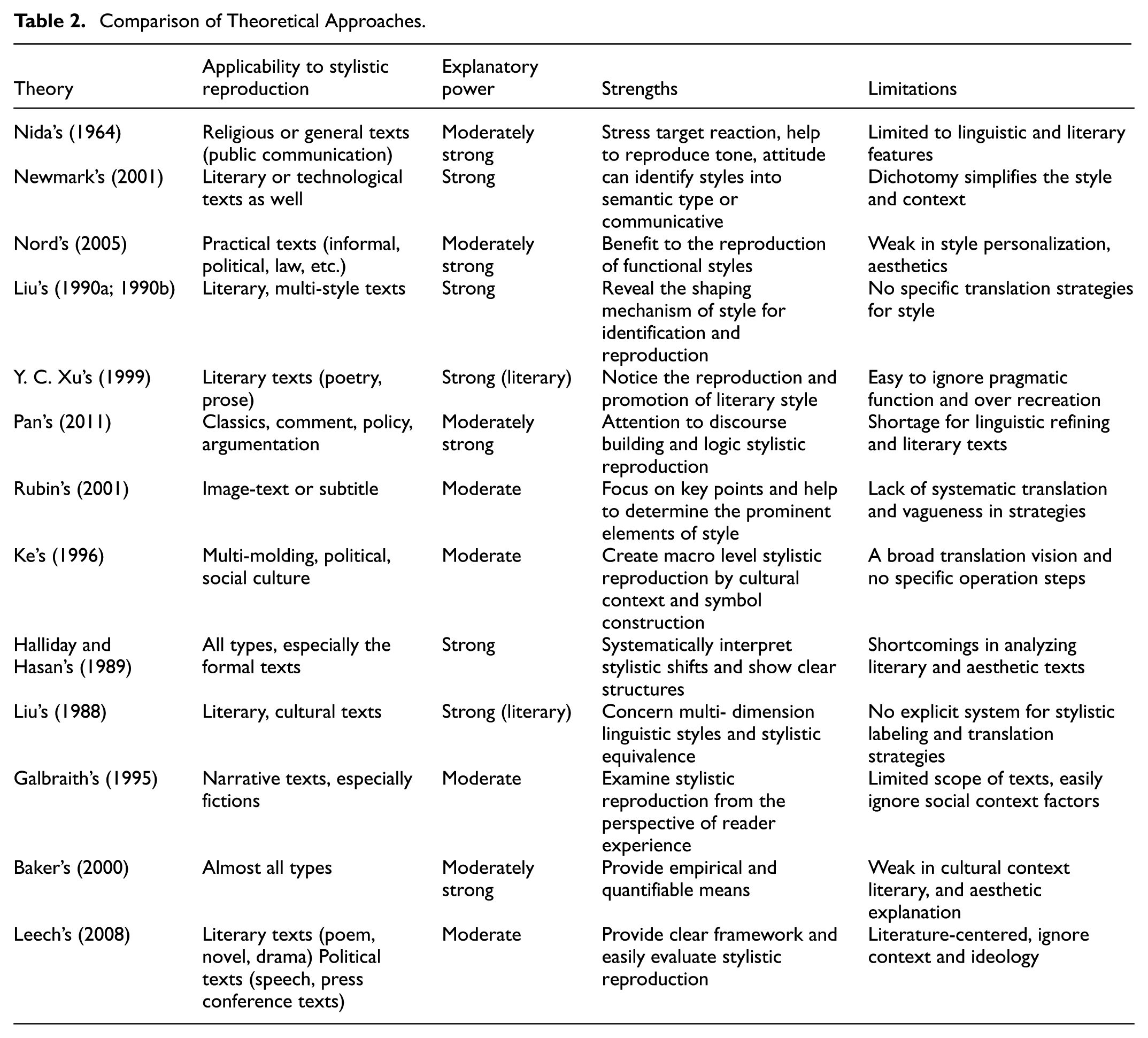
Meanwhile, Halliday and Hasan’s register (cognitive stylistics) framework (1989) brings to context (field, tenor & mode) and political dimensions (power relation & manner) of stylistic choices. Although it sometimes prioritizes a systematic interpretation of detailed textual structures and styles over macro-level analysis. Moreover, Baker’s corpus-based paradigm (2000) provides an empirical basis for detecting stylistic patterns and shifts in translation. Leech’s contribution to tertiary deviation theory (2008) highlights how translators negotiate deviations from linguistic and stylistic norms. Galbraith’s deictic shift theory (1995) explains the cognitive repositioning of viewpoint between source and target discourse worlds. These frameworks offer complementary empirical, formal, and cognitive insights for analyzing how stylistic effects are reproduced or transformed in translation.
Principles & Strategies (Methods & Techniques)
Principles and strategies (methods & techniques) applied in stylistic reproduction research hold significant practical and social value. It contributes to enhancing the translator’s control and awareness, facilitates the integration of theory and practice, and ensures that the communicative functions of the source text are effectively fulfilled. Translation principles are general norms or theoretical commitments that guide the translator’s work, while translation strategies are specific procedures or decisions made to cope with translation problems or to realize those principles in practice (Newmark, 1988; Nida, 1964). The relationship between “strategies,”“methods,” and “techniques” is hierarchical, moving from top to bottom. Zhang (2022) also discussed that “translation strategy” is a broader concept encompassing “translation methods.” The use of methods is based on a particular strategy, and their application requires certain translation techniques. The use of translation techniques, in turn, reflects a particular method.
Scholars have proposed various effective translation principles and strategies (methods and techniques), primarily based on textual characteristics, stylistic features, and functional demand. Various genres with strong stylistics, including Chinese classics and ancient records (Jiang & Li, 2022; Ye & Li, 2015; Zhou, 2017), non-Chinese poetry and novels (Chen, 2020; Elsheemi, 2014; Mastropierro, 2020; Mudaghmesh & Allawzi, 2023) present strategies of foreignization, domestication, and methods such as paraphrase, free translation, and literal translation. Among them, Ye and Li (2015) analyzed the English translation of Dgeldan Gnomic Verses in Tibetan proverbs. In terms of reproducing the aesthetic beauty of the original form, the sound and rhythm, and cultural transmission, methods like imitation and translation techniques, such as rhyme and sentence structure adjustment, were adopted. For culturally loaded terms related to Buddhist culture, methods like free translation and annotation were adopted. Also, Akan et al. (2019) explored Arabic-to-English translation and argued that translation strategies should consider textual and stylistic orientations such as the text type, gender, macro- and micro-linguistic contexts, types of relationships, areas of interest, and fields of expertise. From a functional perspective, a few studies (Astreiko, 2024; Lee, 2021; Wang, 2018; Zhai & Liu, 2015) have emphasized that stylistic reproduction in translation should not be pursued as a mere formal imitation, but as a means of achieving equivalent communicative effects in the target context. Therefore, principles of equivalence (Astreiko, 2024) correspondence (Wang, 2018) remodeling (X. Y. Zhang & Wang, 2021) are employed, strategies such as communicative translation, methods such as free translation, creative translation, techniques such as adaptation, the selective use of stylistic devices, semantic shifts are adopted to ensure that the target text functions effectively in its new cultural and communicative setting.
In addition to traditional translation strategies (methods and techniques), strategies characterized by culturally heterogeneous and non-translation features reflect another starting point in stylistic reproduction research: cross-cultural communication. The emphasis on communication over fidelity in some studies reflects a shift toward target-culture-oriented translation paradigms (Morini, 2014; Van Poucke, 2020; Wang & Gao, 2022; Zhou, 2017). For instance, Morini (2014) proved the feasibility of stylistic reproduction of To the lighthouse, to display its original linguistic characteristics, strategies such as explicitation, ennoblement, conventional narrativization, methods like variation translation, transliteration, techniques like the use of quotation marks and logical words are employed. Furthermore, micro techniques involving text-form, rhyme, and figures of speech have been selected as effective approaches to deal with poetry, novel, law, and political stylistic issues (Abed & Ahmed, 2024; Peng & Shen, 2021; Zhang, 2022).
Due to the lack of conventional equivalence between linguistic sign systems and the presence of unbridgeable interlingual differences, the reproduction of style in translation is often affected. These effective translation approaches are not selected at random. Scholars differ in principles and strategies (methods/techniques) depending on the various areas, perspectives, and dimensions of investigation. What is clear and reasonable practice so far is that the use of principles and strategies (methods/techniques), by and large, is based on the identification of styles, research, or the text’s purpose and features. It is also evident that approaches adopted for stylistic reproduction, as per the data under investigation, are extrapolated from the various theories applied in the study or from experiences and learning of pure translation practice. The formulation of translation principles and strategies not only provides rules to follow for achieving stylistic reproduction but also serves as a guide for addressing similar challenges that may arise in future translation practice. Figure 5 summarizes the translation principles and strategies employed in stylistic reproduction studies.

Summary of translation principles and strategies (methods & techniques).
Discussion and Recommendation
The study synthesized data from 61 publications to clarify the development of stylistic reproduction research in the translation field. It was found that over the past decade, studies on stylistic reproduction in translation have generally been on the rise, and abundant achievements have been gained despite some limitations and research gaps. Overall, the research results present the following characteristics:
Diverse Research Perspectives and Fruitful Results
From 2014 to 2024, the field of stylistic reproduction has witnessed rapid growth and significant advancements, leading to a wealth of research findings and a range of diverse perspectives that have shaped current understandings. First, the view of style is translatable has been gradually validated and accepted in previous research, challenging traditional perspectives such as the “untranslatability of style” and the “inevitability of stylistic loss” (Jia & Qi, 2019; Xiong & Zhang, 2022). Synthesized studies have instilled greater confidence in the feasibility of stylistic reproduction and shifted the focus of researchers from questioning whether style can be translated to exploring how it can be effectively reproduced.
From theoretical and methodological aspects, studies have expanded beyond traditional equivalence-based or linguistic models to incorporate discourse analysis, narratology, aesthetics, and stylistic retranslation, allowing for more elaborate engagement with source text features (Cheng, 2018; Morini, 2014; Van Poucke, 2020; Zhou, 2017). Eastern and Western translation theories have provided practical stylistic translation strategies, methods, and techniques tailored to different text types and features, helping to guide both future research and translation practice. While qualitative textual analysis remains dominant, stylistic translation studies are increasingly intersecting with modern technology, reflecting an interdisciplinary approach. Tools like python and corpus analysis softwares are becoming prevalent in stylistic research (Сливка & Сливка, 2019; Mastropierro, 2020; Ryu et al., 2023; Wang, 2024). Theoretical contributions and methodological innovations have driven the development of stylistic reproduction research from simple to more sophisticated approaches, keeping pace with the times. These advances have provided feasible theoretical frameworks and concrete translation practices to support the analysis of stylistic reproduction, improving analytical transparency and credibility.
Thirdly, research focuses are various, with scholars examining stylistic reproduction in terms of translation effectiveness, feasibility, strategies, and methods. Further, studies explore the value of stylistic reproduction in linguistic, aesthetic, emotional, attitudinal, sociocultural, and translation-based dimensions. For example, Fan (2014) studied the equivalence of style in a Chinese prose translation from phonological, lexical, and syntactic aspects, in which the beauty of sound and rhythm as special stylistic features was fully discussed. Furthermore, synthesized studies go beyond examining the target text, translator, source text, and author. It delves into differences among multiple translations, pragmatic meaning, context, historical background, and the translator’s knowledge base. It has facilitated the transition in stylistic reproduction research from impressionistic evaluation to analytical argumentation, which lays the groundwork for the development of a methodological framework for style studies. This overall broadened scope adds depth and layers to the understanding of stylistic reproduction.
Fourthly, for identified styles, the reviewed studies have diversified from literary styles (represented in novels, dramas, poetry, prose, essays, books, and ancient records) to informative styles (found in aphoristic texts, graphic novels, political texts, art-related texts, and legal documents), reflecting a growing awareness of genre-specific stylistic demands. Languages in research on stylistic reproduction are multiple; although English and Chinese predominate, several other languages are also represented. It indicates that research in stylistic reproduction is becoming internationalized, with increasing attention to stylistic shifts across languages. Studies with various languages and text types have examined the applicability of existing theories across different linguistic structures and cultural backgrounds. Thereby, they have made findings of stylistic reproduction studies more generalizable and widely practicable. They also offer valuable insights for researchers to develop more targeted tools and methods for stylistic analysis.
In addition, the studies discussed above explicitly present factors that affect stylistic reproduction in the translation process. The reproduction of style is influenced by the adoption of different translation strategies, methods, and techniques (Tang & Zhu, 2022; Wang, 2024; Zhao, 2022). Applicable translation and linguistic theories show a high degree of applicability in guiding stylistic reproduction, with evident results (Cao, 2016; Fan, 2014; L. Xu & Yu, 2023). Besides, the effectiveness of stylistic reproduction varies across translations by different translators, highlighting the significant function of translators’ subjectivity in reproducing styles (Cheng, 2018; Elsheemi, 2014; Mudaghmesh & Allawzi, 2023; Sun, 2021). A typical example by Muhaidat et al. (2023) believes that the difficulties in translating stylistic features in the Lifted Veil into Arabic emerged from several reasons, and one of the reasons is the researcher’s lack of knowledge of the Latin and French languages, which are used in the novella. It indicates that the translator’s knowledge and ability are also paramount. Also, apart from linguistic and translation considerations, elements such as context pragmatic meaning, inter-lingual and intra-lingual difference, though, emotion, aesthetic characteristics, cultural difference, play a crucial role (D. R. Xu & Wang, 2018; Zhang, 2020). A profound understanding of the factors influencing stylistic reproduction can enhance comprehension of the complexity of styles. It improves the relevance and operability of translation strategy formulation in future research, in turn, providing strong explanatory power and analytical depth.
Critical Reflections (Research Gaps and Future Agendas)
Although the translation studies on stylistic reproduction are commendable and have yielded significant results, critical analysis of synthesized studies reveals some phenomena and issues across multiple dimensions that warrant further reflection. A major research design gap observed across several studies lies in the lack of transparency and completeness in data presentation. For instance, the research corpus of Astreiko (2024) is quite limited, as it includes only a small number of economic news reports for comparative analysis. In examining cultural contextual dislocation and stylistic weakening in Arabic translation, most work of Elsheemi (2014) relies on case studies, making the evaluation of stylistic significance less representative. In some cases, key translation concepts lack clear criteria (such as “strategies,”“methods,” or “techniques”), which are either vaguely defined or used interchangeably, reflecting conceptual inconsistency that further undermines analytical clarity. Molina and Hurtado Albir (2002) and Chesterman (2005) have written extensively on this issue, pointing out that apart from “strategy,” other terms like “technique,”“method,”“transformation,” and “variation” are also used to describe text-handling processes. The inconsistent use of these terms has led to considerable “confusion” for specific translation criteria and approaches, and they advocate for the strict criteria to clearly and accurately describe translation phenomena. To enhance research reliability and academic norms, future studies should provide detailed analytical steps and explicit translation criteria, so as to clearly define key terms and maintain a coherent conceptual framework throughout the analysis.
Empirically, the over-reliance on a narrow set of frequently cited texts points to a lack of diversity and a tendency toward repetitive case selection. It is especially evident in the literary translation, where many case studies focus on the same literary work. For example, both Zou (2021) and Cheng (2022) explored the stylistic reproduction effects in the English translation of The Moon and Sixpence. Similarly, Fan (2014) and Zhao (2019) analyzed Zhu’s essay Moonlight over the Lotus Pond, while Qiao and Zhang (2015) and Zhai and Liu (2015) focused on Zhu’s essay Rush. While these texts are stylistically rich, such repetition restricts the empirical breadth of stylistic reproduction research. It creates a textual bias that hinders the exploration of stylistic variation across genres, registers, and historical contexts. As a result, findings derived from these studies lack representativeness and diminish the potential for theoretical generalization. To strengthen empirical validity, future research should broaden the selection of source texts, especially for non-literary translation, such as legal, political, artistic, and tourism texts. It avoids excessive, twice-told cases to provide forceful and universal insights into stylistic reproduction.
Theoretically, some studies misinterpret frameworks or fail to harmoniously connect theoretical perspectives with translation practice. A typical example is the application of Liu’s stylistic markers theory, which has six formal markers. However, in Zhao’s (2019) study, she divided the formal markers into seven categories. Wang (2018) stated that the strategies for stylistic reproduction supported by the stylistic markers theory include corresponding, recasting, and decolouring. However, according to Liu (1990b), these are three patterns of stylistic transformation, not translation strategies. Moreover, few studies (Chen, 2015; Ye & Li, 2015) attempt to bridge translation theory with actual translator choices, and interdisciplinary perspectives remain largely absent. This lack of depth and innovation in theoretical engagement limits both the explanatory power and practical relevance of current research. Future studies should ensure clearer theoretical justification, deeper operation, and better integration with stylistic analysis.
Methodologically, a few corpus-based analyses focus heavily on the style examination of language parameters, lacking cross-text and cross-language comparisons, may lead to the neglect of the function and effect of style in specific contexts, resulting in insufficient examination of the implicit styles of style reproduction (such as satire, symbolism, tone, and perspective transformation). For example, Ryu et al. (2023) relied solely on multilevel linguistic measures within a corpus-based framework to analyze the stylistic correspondence and deviation. On the contrary, the dominance of qualitative textual analysis, combined with a lack of innovation and an absence of reader response or reception-based studies, results in a weak evaluation of stylistic effectiveness. For reviewed studies, limited articles employed corpus-based methods, Python, or quantitative analysis techniques. Most of them are purely qualitative, with their findings, derived from the authors’ argumentation, holding significant academic value. However, incorporating empirical studies on stylistic reproduction would enhance the practical and functional value of translation. Such studies could provide clearer insights into whether the original style is reflected in the translation and offer more precise evaluations of the effectiveness of stylistic reproduction. To this end, various methods such as sample studies, surveys, focus group interviews, and mixed-method approaches that combine both qualitative and quantitative validation should be actively adopted in the future.
In terms of linguistic scope, a clear imbalance exists, with disproportionate attention paid to Chinese-English translation, limiting the cross-linguistic applicability of the stylistic reproduction.
In contrast, studies from other countries are relatively fewer, indicating that over the past decade, there has been a regional disparity in stylistic reproduction translation research. Although the final pool of included studies predominantly consists of research conducted in China, it is worth noting that several English language studies from other regions were identified during the initial stage. However, due to criteria such as unsatisfactory language or time range or journal type (Almanna, 2013; Baudry, 2013; Lee, 2011; Lopes, 2013; Masanovets, 2021), or non-highly relevant topic (Pavlovna Soboleva et al., 2019; Salamina, 2009), or unavailability of full text (Al-Mansoob, 2017; Muhaidat, 2021; Qassem, 2021), these studies were excluded. This reflects a broader trend: while international literature does address translation studies, investigations specifically focused on stylistic reproduction remain relatively limited globally during 2014 to 2024. Further cross-linguistic and international research in this area would be valuable.
Finally, from the analytical dimensions and depth, a few studies fail to account for the nature of style in multiple dimensions, either overlooking core stylistic features or omitting case-based analysis altogether. They concentrated on reflecting a gap in analytical scope. Some studies (such as Cheng, 2022; Liu, 2023; Wang, 2023) examine stylistic reproduction of certain works under the guidance of stylistic markers theory. These studies focused on a few formal markers, however, only Wang (2023) analyzed non-formal markers, particularly the expression form of the work and the writer’s spiritual temperament. Liu’s stylistic markers theory includes six categories of formal markers and four categories of non-formal markers, but these studies only discuss a few aspects, without fully exploring the reproduction of other stylistic categories under this theoretical framework. However, their claim that the original style is largely preserved is drawn from a limited number of analytical dimensions. Such an incomplete analysis undermines the comprehensiveness of the findings, and the issue of whether stylistic reproduction has truly been achieved remains unresolved. These issues collectively highlight the need for accurate research findings with complete analytical dimensions in future research.
Conclusion and Limitations
Stylistic reproduction, as one of the important topics in translation studies, focuses on mirroring the unique style of the original text in the target language, ensuring that translation remains faithful in terms of content and style of the source. In this way, the expressive effect and cultural value of the translation can be enhanced. The effective reproduction of style not only promotes readers’ emotional resonance and aesthetic experience but also facilitates a deeper understanding across cultures. The present study systematically reviews the historical development of stylistic reproduction in translation studies, highlighting its remarkable contributions as well as deficiencies and future agendas discussed above. Through the comparative analysis of stylistic handling across languages, it is possible to uncover the universal principles and culturally specific characteristics underlying stylistic reproduction strategies. The continued deepening of research on stylistic reproduction will further promote the multidimensional development of translation theory and enhance both the artistic quality and accuracy of translation practice.
Of course, this review is not without its shortcomings. One limitation is that the included studies are mostly from China, which may reflect the current research distribution on this topic. While the search strategy covered international databases, it was found that comparable research from other regions remains scarce or only tangentially related to the specific focus of stylistic reproduction. Future studies may benefit from a broader international comparative framework to enhance the generalizability of findings and to explore cultural or stylistic variation across translation contexts. In addition, conference papers and non-open-access journal articles were excluded from the review. Future systematic reviews could expand the timeframe, increase the sample size, and continue to explore stylistic reproduction in translation.
Footnotes
Acknowledgements
We greatly appreciate the valuable contributions of our teachers and friends.

Ethical Considerations
This study did not involve human participants and therefore did not require ethical approval.
Consent to Participate
This study did not involve human participants, and therefore ethical approval and informed consent were not applicable.
Author Contributions
Guangyao Ma is a PhD student from Universiti Putra Malaysia (UPM). He is responsible for the research title, data collection, data analysis and drafting & revising the manuscript. Dr. Salina Husain and Dr. Wan Muhammad Wan Sulong supervised and guided the research design and methodology as well as the revision and proofreading of the manuscript. All authors contributed equally to the study and all authors read and approved the final manuscript.
Funding
The authors received no financial support for the research, authorship, and/or publication of this article.
Declaration of Conflicting Interests
The authors declared no potential conflicts of interest with respect to the research, authorship, and/or publication of this article.
Data Availability Statement
Data and Figs supporting the findings of this study are available from the corresponding author upon reasonable request.