




Abstract
To understand the current status of Chinese-English public sign translation research in China, we analyzed 137 published studies in the past 15 years and found that public sign translation research in China has developed progressively from the nascent stage in 2005 to its climax in 2014 and then began to decline to date. Public signs translation research has attracted the attention of many scholars, and fruitful results have been achieved in terms of research content, which covers the definition, features, functions, translation errors, translation principles, strategies, and the theories applied to C-E public signs translation. However, there are still many deficiencies in related research, such as the repetition of research content, the limited scope of investigation, and the lack of a clear distinction between what constitutes a feature and a translation principle of public signs. The study suggests that future research content on public sign translation should be in-depth and more diversified. Also, more public sign translation experts should be trained to improve their translation quality, and the related supervisory body should intensify their supervision. Future researchers should extend their investigations to include other public signs in thematic areas such as menus, museums, folk gardens, culture-specific items, and theory development as studies in these areas are limited. It is hoped that the research findings will offer insight into the problems and gaps in related research and help facilitate the development of relevant language policies, translation theories, and methods for the translation and study of public signs.
Keywords
Introduction
With the advent of globalization and migration, the interaction between languages and cultures have become inevitable. For this reason, translation, whether spoken, written, or in audiovisual form, is not only desired but necessary for bridging the gaps between the varying languages and cultures of the world. Cronin (2006) rightly posits that the bilingual and multilingual spaces that we increasingly engage with, in an urban context are, first of all, a translation space. It, therefore, follows that a country or city is a translation space, and its analysis should be conducted in a way that recognizes the global significance of the “local, and the mundane” (ibid, p.15). The use of languages in public spaces is one of such local and mundane elements. Signs are a tangible reflection of a region’s linguistic policies and norms (Koskinen, 2012, p.73).
China’s economic development is aided by the growing popularity of English in the country (Botha, 2014; Zhang, 2012). English is currently widely utilized across China in various sectors and settings. This phenomenon is unsurprising considering the prevalence of English worldwide serving as a lingua franca (Bilá & Vaňková, 2019). English, which is increasingly used in tandem with many other languages including Japanese/Spanish/Russian/Italian/German/French/Chinese, etc., to merge and integrate local and global attraction, serves “as an index of modernity, progress, internationalism and globalization, a symbol of success, sophistication and projection into the future” (Vettorel, 2013, p. 262). One of the indexes of this phenomenon is the extensive usage of public signs. Some scholars have argued that the utilization of bilingual and multilingual signs has culminated in the construction of an “attractive linguistic landscape” (Yang & Liu, 2008, p.79; Hu, 2016). As a result, research on public signs, especially, Chinese-English public signs, have been a “hot subject in the translation field” (Zou et al., 2011, p.27), garnering the interest of an increasing number of researchers (e.g., Chen, 2014; Hu, 2016; Ko, 2012; Lü, 2005, etc.).
Nevertheless, most public sign research, especially in the West, tends to straddle the fields of (socio) linguistics (Nash, 2016) by focusing on the information written on signs in a given place—a perspective referred to as linguistic landscape study (Landry & Bourhis, 1997). It is worth noting that in Landry and Bourhis’s original study, the term “public sign” was used extensively as a substitute for “linguistic landscape.” However, in their abstract, they again used the term “public sign” in contrast to “private sign,” both of which constitute the overall linguistic landscape, which somewhat creates a misunderstanding of the term “public sign.” Therefore, in this study, the terms “linguistic landscape” and “public signs” are considered to have the two notions posited by Landry and Bourhis (1997) and may be used interchangeably.
Among the existing social communication networks, public signs play an essential role in our daily lives and can be found at various places. Signs such as “EXIT/Exit (出口;安全通道); First Aid Call 120 (紧急救护电话120); Danger! Keep Away (危险,请勿靠近); Transit (换乘)”; etc., do not only provide people with comfort in offering information but they can also be viewed as guidelines for controlling the conducts and activities of individuals in today’s multi-linguistics and multicultural environment and as contact between languages, “systems” and people. In other words, bilingual or multilingual public signs eliminate language barriers to communication, promote accessibility (Koskinen, 2012, p.81; Bilá & Vaňková, 2019), national development (Amenador et al., 2020; He, 2019; Nash, 2016), as well as “serves as an indicator of the status, power relations, and cultural identity of the indigenous” (Yuan, 2019, p.20).
Some scholars have noted that signs can have a semiotic meaning (Backhaus, 2007, p.5; Yuan, 2019). However, in public sign research, signs tend to be more concrete and literal (Nash, 2016) and are considered as a type of language, projected in public places (Gorter, 2006, p. 2) and “private business in a given geographical location” (Ben-Rafael, 2009, p.14), which include, street names, road signs, slogans, public notices, commercial shop signs, advertising boards, tourism brochures, product labels, among others, displaying a unique linguistic style designed to serve a specific communicative function (e.g., Chen & Lan, 2015; Ko, 2012; Landry & Bourhis, 1997; Li, 2018; Luo & Li, 2006; Qiannan, 2012; Niu, 2007; Shao, 2009; He, 2006, etc.). Lü (2005, p. 22) indicates that “a public sign is publicly displayed information in written or symbolic form, which is closely related to public lives, works, and the environment [. . .].” Backhaus (2006, p. 55, 2007, p. 66) notes that a sign is “any piece of the written text within a spatially definable frame.” Signs described as such would include any visible inscriptions on any tangible medium (wall, paper, banner, etc.). However, this definition is somewhat restrictive, since notions of signs transcend the limits of those in written form to include audiovisuals and those in symbolic form (Lü, 2005), which “reveal how ideological and cultural factors express themselves in a given territory” (Yuan, 2019, p.20).
One of the most important variables in sign studies is the distinction and categorization of signs. Traditionally, signs have been divided into two kinds: “government” (public) and “private” (Landry & Bourhis, 1997, p.25), “unofficial” and “official” (Backhaus, 2006, p.52), “top-down” and “bottom-up” (Bernard, 2009, p.28; Ben-Rafael, 2009, p.49), and “public” and private (Shohamy et al., 2010). These various types all share similar scope and definitions: those “designed by experts appointed by functionaries and are committed to serving official policies and the ‘dominant culture,’ that is, the culture represented by the authorities” (Ben-Rafael, 2009, p.49) and those “designed much more freely by autonomous actors” (ibid), in the confines of authorized regulations (Shohamy et al., 2010). However, this ostensibly resolute classification does not take cognizance of the multi-faceted characteristics of signs. As Huebner (2009, p. 74) argues, the differentiation between “top-down” and “bottom-up” signs fail to capture the concept of agency and its impact on linguistic structures in the linguistic landscape. He argues that there is a significant distinction between a sign created by the government and international corporations, privately operated enterprises, and handwritten notices. Thus, a more detailed analysis of the various forms of signs types can be explored by a clearer segmentation of the linguistic landscape. A broader distinction and categorization offered for a sign can be seen in the Chinese-English public signs dictionary, a reference book on the standardization of the translation of signs which covers several subject areas ranging from transportation, catering, businesses, sports, technology, education, medical service, tourism, housing, immigration among others (Lü & Shan, 2004).
Deducing from the various descriptions, distinctions, and the interpretation of signs provided by scholars, the notion of a public sign in this study are those created by both government and private individuals and are made of written words with/out graphic images inscribed on a board, paper, wall, a piece of cloth, metal, or in an audiovisual form, displayed in public places or commercial buildings, primarily designed to serve the function of conveying some information, instruction or knowledge, providing convenience to both locals and internationals.
An Overview of Public Signs Studies
Non-Chinese Public Sign Studies
With the increasing interest in public signage studies, dozens of related published works on a combination of different languages exist. We do not claim to be in a position to synthesize the breadth of studies here, although it is vital to identify some areas of inquiry to which LL research has contributed. Some of the notable works include the volumes edited by some scholars of LL studies (see Güven et al., 2016; Laskurain-Ibarluzea, 2020; Shohamy & Gorter, 2009; Shohamy et al., 2010); and a few country-specific monographs, including Backhaus’ quantitative approach to investigating the languages in Tokyo (2007), which offers an in-depth overview of LL study up to the time when it was formally organized under the name “linguistic landscape” (pp. 12–39); Blommaert’s ethnography study of LL conducted in Blommaert (2013), Tufi and Blackwood’s (2016) investigation of the coastal cities of France and Italy; etc., all of which focuses on different areas of investigation. For instance, Marten et al. (2012, p. 7) examined the role of minority languages in the LL market and the extent to which language visibility equates with prestige, functionality, and symbolism. Likewise, the questions of visibility, language policy, and vitality have been addressed by Barni and Vedovelli (2012), to name but a few. However, as aforementioned, even though the object of investigation in the above-cited studies are translated signs, the studies are more sociolinguistic oriented, overlooking issues in the landscape that bothers on the quality of translated language projected in public space, errors in translations of signs, strategies adopted in rendering public signs, among others, which require a translation tailored perspective in their analysis.
One of the earliest studies that explored public signs from a translational perspective conducted in 1995 is by Vinay and Darbelnet (1995) in their book, Comparative Stylistics of French and English: A Methodology for Translation. They examined the parallel text of French-English road signs in Canada and the reader’s response to poor translations and expressed their disappointment with the translation inconsistencies in the English versions of the French road signs. Similarly, Snell-Hornby (2001) also investigated English-German public sign translations collected from countries where English and German were mother tongues. After analyzing the public signs, she concluded that context is a crucial factor to consider when translating public signs because of the vast differences between various cultures, indicating that the translation of public signs is a cross-cultural activity. Also, Radtke (2007), intending to inform and prepare travelers to embrace well the existing linguistic and cultural shock in case they visit China, presents several photos of poorly-translated Chinese linguistic signs (public signs) in the book: Chinglish Found in Translations, where he posits that poor translations result into Chinglish which consequently poses comprehension problems. He notes: “Chinglish is not idiomatic English and. . .sometimes leads to ludicrous mistakes.” Radtke indicates that the translation problems found were not resulting from errors in language but attributable to a lack of understanding of the cultural context within which one has to translate. Blake (2013), in a similar vein, also collected photos from visitors on his blog on linguistics signs to demonstrate wrong translations, which are impossible for foreigners to understand. He cited the example of a Chinese-English public sign displayed at the airport with the inscription: “Landslides in Lounge” for “小心地滑” (xiao xin di hua) which was very confusing and incomprehensible, instead of “Caution! Slippery/Wet floor.”
Other scholars (see Edelman, 2010; Reh, 2004:) have also explored translation-related phenomena in LL studies and have introduced a classification of translation strategies for multilingual writing. Edelman (2010, p.99), for instance, expanded on Reh’s classification, subdividing the duplication translation strategy into “free translation” and “word-for-word translation,” naming fragmentary translation as “partial translation,” and introducing the category of “no translation,” and annotating this category under complementary multilingual writing (Koskinen, 2012). Nevertheless, this sort of division has been criticized for being overly simplistic in translation studies. Thus, to grasp the various strategies, a more detailed understanding of the available options for translators is required (ibid, p.80). Moreover, Koskinen (2012) argues that any classification of strategies for multilingual writing must be tailored toward the target reader and the language pair under investigation (ibid). With this suggestion in mind, Bilá and Vaňková (2019) analyzed the discourse of Slovak tourist notices with a focus on translation modifications that take into account target readers from diverse “languacultures.” They suggested that translated texts existing in a linguistic landscape should be target-oriented. Thus, communicative translation strategies should be employed, and any translation modifications that appear necessary to provide information to the readership should be carried out.
Despite the profusion of outputs in public sign (Linguistic Landscape) studies, there are relatively few studies in this field that straddles the domain of translation studies in the west. We also concur with Koskinen (2012), who claims that while Reh’s (2004) strategy classifications have proven to help in LL studies, it also seems mandatory to account for the functions, features, and problems associated with public sign text which can only be explained by examining the indicated components in translation. Therefore, the focus of this article is translated public signage. Our goal is not to favor or condemn which rendition of public signs is right or wrong, or enumerate the numbers of different languages visible in public signs or the power relations among languages on public signs, but study particularly Chinese-English public signs translation research.
Status of Chinese-English Public Signs Translation Research
Contrary to the West, a myriad of public signs research under the field of translation studies exists in China. Even though there is no clear consensus on when precisely the Chinese-English public signs investigations commenced in academic circles, a search of relevant literature indicates that since the late 1990s, research in this area started when Zeng Shiying, a cartographer, discusses and advocates the translation and standardization of place names in his articles: “Roman Alphabet Spelling of Place Names,” and “Discussion on the Pinyin for Place Names” in 1987 and 1989 respectively (Zeng, 1987, 1989, as cited in Li, 2013). Similarly, Xiang Yang focused on the standardization of Chinese names translated into English and proposed that special attention be paid to the English translation of the street names (Xiang, 1994, as cited in Zhang & Wang, 2018). Although these studies are not conducted under the umbrella name of “public signs,” they can be regarded as the initial research involving the English translation of signs in China. In their article entitled “On the Analysis of the Principles and Examples of English Translation of Public Signs,” Ni and Liu (1998) outlined some principles to adopt in the process of public sign translations which included being simple, straightforward, use of appropriate tone and moderate humor. Thus, this research can be considered the first attempt to research public signs translation in China theoretically. However, it is practically difficult, if not impossible, to explicitly and concretely define the intended proper tone and medium humor stipulated since these indicators are somewhat subjective and sometimes culture-specific. Moreover, studies on public signs translation studies had just taken off at the time and had not yet attracted the attention of scholars in the translation field (Zhang & Wang, 2018). It was not until the first National Seminar on Public Sign Translation in Beijing in 2005 that research on public sign translation in China gradually assumed a hot spot in translation research as aforementioned (Ko, 2012; Yang, 2009), attracting many Chinese scholars’ attention from diverse domains and perspectives, resulting in the published works of public sign translations in journals, books, book chapters, among others.
With the proliferation in C-E public sign translation research, it is necessary to use the relevant publications as samples to analyze and discuss the actual research status in China. Thus, this current research aims to synthesize Chinese-English public sign studies by conducting a systematic review of relevant data from 2005 to 2020. According to Gough et al. (2017), a systematic review is the “reviews of existing research using explicit, accountable and rigorous research method” to analyze research literature. The specific research questions to investigate are as follows:
What are the general trend and the research content of Chinese-English public sign translation studies?
What public sign language features and functions have been identified in the data?
Which translation theories are mostly employed as a guide in investigating public sign translation-related issues?
What taxonomy of translation problems have been identified in the various studies
Which taxonomy of translation strategies have been suggested for addressing related problems?
As far as the authors are concerned, this research exercise has not yet been conducted in English, and it will hopefully reveal the areas covered thus far in Chinese-English public sign translation studies. It will offer insight into the gaps in research, and it might prove inspiring and a valuable starting point for future research and the development of relevant language policies, translation theories, and methods for public sign translation research that should be permeable to new trends in TS.
Material and Method
Corpus Search Strategy
A thorough and systematic search was conducted in the electronic databases: CNKI (China National Knowledge Infrastructure), Google Scholar, Modern Language Association Linguistics Abstracts, Scopus, Bibliography of Interpreting and Translation (BITRA), Researchgate, library genesis, and Translation Studies Bibliography (John Benjamins) to identify the relevant studies for this review. Search terms: “public signs translation” (公示语翻译), “C-E public signs translations” (汉英公示语翻译), “public signs” (公示语), “translation” AND “public signs,” <public sign> AND “China” were used. Additionally, manual checking of a list of references was also employed.
Exclusion and Inclusion Criteria
In order to capture all related research on the translation of public signs, explicit inclusion and exclusion criteria were created to help avoid biases and to ensure that the review conclusions drawn are a true reflection by applying the same criteria to each study and recording the process (Gough & Richardson, 2018). The study focused on works published from 2005 to 2020, written either in Chinese or English since the researchers have an appreciable level of command over the two languages involved in this study, and also because most of the studies on C-E translation of public signs are written in Chinese. The period of 2005 to 2020 was chosen because the year 2005 is acknowledged by scholars (e.g., Ko, 2012) as when awareness for research on public sign translation in scholarly circles increased. It is therefore reasonable to begin our analysis from 2005 to the end of 2020 when the data was collected.
Also, to delimit the scope of what constitutes a public sign in this review, the researchers focused on signs in the public domain, e.g., on transportation signs (road, airports, train and bus station, etc.), tourism signs, signs in hospitals and schools, signs located in parks, malls, market, museums, and provincial, city or community situation base studies.
The studies were deemed eligible if: (1) They are journal articles, books, and book chapters that reported data from 2005 to 2020; (2) The study was written in either English or Chinese but on Chinese-English public sign translations; and (3) The study was published as a journal article, a book, or a book chapter. Studies were excluded if they met one or more of the following exclusion criteria: (1) The study was part of a dissertation, conference proceedings, unpublished study, a review or commentary, or any other write up that fall outside the inclusion criteria; (2) The study was not on the translation of C-E public signs. In order words, if the study involved a bilingual sign of Chinese and other languages (e.g., Chinese-Korean/Japanese/Russian) or a multilingual public sign of Chinese and other languages, or Chinese-English and other languages, it was exempted; (3) the study published does not fall within the stipulated time range.
Data Extraction
The two authors independently extracted the data by following the standardized protocol and procedure for data extraction. Any disagreements and discrepancies were resolved through discussion and applying the criteria set for inclusion and exclusion. When there was a lack of consensus between the authors, a neutral authority, a translation expert, was consulted. The extracted information included authors’ names, year of publication, the research focus area (transportation public signs, tourism signs, etc.,) content analysis, that is, translation problems, strategies, public sign features and functions, and the theoretical frameworks adopted as a guide to the public sign translation.
Results and Analysis
Characteristics of the Selected Publication
Figure 1 represents the selected publication’s flow diagram (Moher et al., 2015). With the search terms “public sign translation,” “public signs,” etc. (see section 3.1), a total of (2,278) articles were obtained from various data repositories through extensive searching. After removing duplicate studies, 554 were available for the titles and abstracts glancing and screening. We further excluded 409 after title and abstracts reading (non-relevant studies) and 7 full-text articles because some were conference articles, masters’ theses, and newspaper articles. Our inclusion criteria were met by 6 books (4.4%) and 131 articles (95.6%). Therefore, 137 studies were used as a research corpus in this study, with an excel spreadsheet created to document these studies. See Supplementary Appendix 1 for details of the characteristics of studies included in the study.
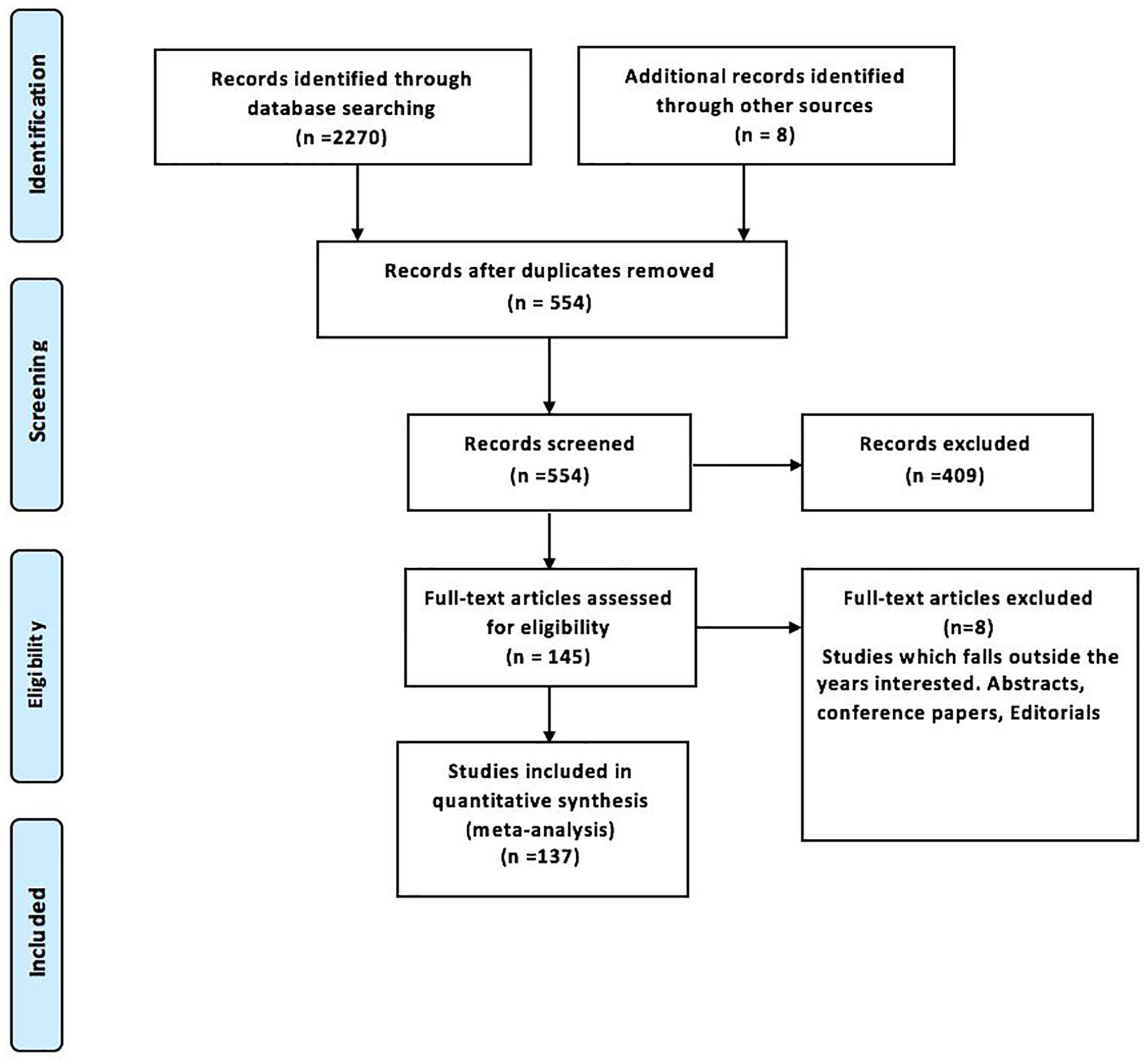
A Prisma diagram of the selected works.
We found that the main research focus of public sign translation studies published in the past 15 years focused on various areas of discussions and theoretical applications through sorting out and summarizing. The specific results are as follows:
General Trends of C-E Public Signs Translation Research
As aforementioned, research on the translation of C-E public signs in China has enjoyed scholars’ perennial attention over the years. A general analysis of Figure 2 below indicates a continuous rise in scholarly attention of public signs research in academic circles from 2005 to 2012 with a corresponding rise in publications. Ko (2012) asserts that the increase in public sign research during this phase is a result of China’s hosting of various significant international events such as the Beijing Olympic Games in 2008 the Shanghai World Expo in 2010, which necessitated the translation and standardization of public signs and the sanitization of the language environment to serve better foreign participants and visitors that patronize the events. However, 2013 witnessed a slight decline in research publications but increased to the peak in 2014. Publications during the final phase (2015–2020) on the subject also witnessed a rise and fall in number and its concomitant degree of attention to public sign translation.

Frequency diagram of the selected articles.
A content analysis of the studies used in this study revealed that most public sign studies conducted during the period under investigation cover four main thematic areas. Figure 3 below shows that out of the 137 studies, 83.9% (115) examined the linguistics features of public signs (PS); 75.9% (104) discussed PS functions; 94.8% (130) investigated PS translation problems; 97.8% (134) of works explored the translation solutions employed to resolved PS translation problems. In summary, analysis of the trends portrays that C-E public sign translation research has attracted more scholars’ attention, and the number of studies is generally on the rise, covering diverse thematic areas for the period under investigation.
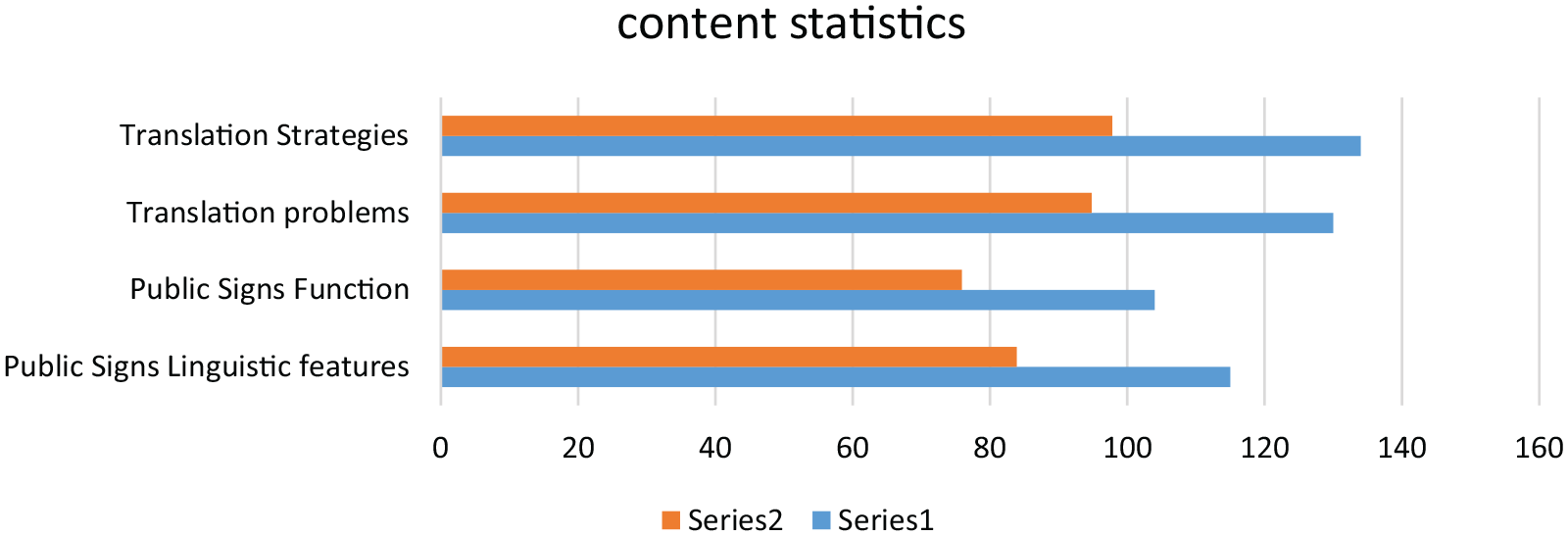
Percentage distribution of research content of public sign translations.
Theoretical Application/Approaches to C-E Public Sign Translation Studies
The theoretical foundations of every translation study influence the overall orientation of translation and its corresponding strategies marshaled to resolve related problems, that is, whether the translation would be source-oriented, focusing on preserving the source text culture and language characteristics or a target-oriented, focusing on the target audience and satisfying their needs and expectation in the translation. Figure 4 below indicates that out of the 137 publications analyzed, 55.5% (76) investigated public signs translation from various theoretical perspectives, while the rest of the 44.5% (61) did not apply any theory. It was found that most of the studies that had no theoretical frameworks were conducted during the early stages of public sign translation investigation in the country, and therefore the lack of theoretical application is logical since the domain may now be taking shape. We also found that 93.8% (15) out of the 16 theories employed by the various studies are Western translation theories and approaches, and only one is a Chinese propounded theory-Hu Gengshen’s (2008, 2011) theory of Eco-translatology. The first two widely utilized theories in the studies analyzed include functional translation theories (11%) (Nord, 2013, 2014; Reiss & Vermeer, 2014) and Skopos theory—a variant of functional theories (Nord, 2013, 2014; Vermeer, 1989) occupying 12%. This implies that scholars advocate that priority and attention are given to the text’s function and the target readers and their communicative needs when translating public signs-a target-oriented strategy. For instance, Jin (2016), on studying logo signs from the perspective of functional translation theory, proposed that translators should give much attention to the cultural background, language characteristics, as well as the communicative norms of the target languages/audience when translating public signs, a stance which is consistent with the position held by scholars such as Koskinen (2012), and Bilá & Vaňková (2019). They suggest that the target readers should be the center of focus of LL text (public signs) translations, and modification necessary to furnish the readers with information should be conducted.

Percentage distribution of theories applied in translated public sign studies.
The theory of eco-translatology (Hu, 2011) is the third widely applied theory (9%) in PS translation studies. This alerts us on the phenomenal awakening and shift of focus to an ecologically oriented translation, which advocates for the consideration of the text and its environment, the translator’s selection and adaptation, the target reader and their environments from the three dimensions of language, culture, and communication, when rendering and analyzing public signs (ibid). As a result, Ma and Cao (2019), after analyzing transportation signs from the three-dimensional perspective of eco-translatology, suggested relevant principles including spelling check, proofreading of the translation, and avoidance of mistranslation caused by spelling mistakes and omissions. They also suggested strengthening the supervision and regulation of PS writing formats to avoid linguistic and cultural misunderstanding and to ensure that the original text’s communicative intention is reflected in the translation.
The rate of utilization of the other theories such as memetic, relevance theory, social semiotics, etc., were very low, not exceeding 5%, as is evident in Figure 4 displayed below.
The noteworthy conclusion to be drawn from the results is that functional translation theories, which advocate for a target-oriented translation, and the theory of eco-translatology, which we believe suggests a neutralized (balanced/harmonized) translation approach, are the primary theoretical foundation of most public sign translation studies in China.
Linguistic Features and Functions of Chinese-English Public Signs
As a core part of public life, it is essential to study public signs’ language characteristics and functions because specific and clear language characteristics are conducive to translators solving related translation problems more accurately and effectively.
C-E Public Signs Translation Language Features
It is discovered that different scholars have identified the linguistic features (75.9% of publications) of public signs as being concise, straightforward, conventional, clear, standard, easy to comprehend (Jin, 2008; Luo & Li, 2006; Pan, 2011; Xie, 2014; Yang, 2005; Zhang, 2012; Zhu, 2020), “convenient (方便), consistent (统一), and conspicuous (醒目)” (Ding, 2006). Pan (2011) notes that public sign expressions are concise due to the constraint of space, time to read, and are extensively composed of nouns (exit—“出口”), verbs (“结账离”-check out), gerunds, noun phrases, etc. He cited the example of a sign mostly found at Chinese hotels, “创一流服务,迎四海宾客” translated as “Welcoming our honored guests from all over the world with the first-class service,” instead of “First-Class Service to All Guests” as an instance of not taking into consideration the succinctness of a public sign, and argues that signs that are a part of our everyday life should be concise in language. It is argued here that a succinct public sign can effectively and adequately convey its information only if the written text is accompanied by pictures such as those found on the door of, say, washrooms. Moreover, in reality, except for transportation signs, shop/mall signs, and service signs, there are a conspicuous number of signs found at tourist sites, immigration offices, banks, hospitals, etc., that are made up of many lines of sentences or even paragraphs. Qiannan (2012), in a more detailed study, identified the language of public signs to typically use a combination of words and symbols/pictures, capital (e.g., “勿踏草坪”—KEEP OFF THE GRASS), and small letters (e.g., “禁止吸烟”—smoking is prohibited), present tense, use of pinyin (alphabets of a Chinese character) and some native languages, and the use of imperatives. Hu (2011) indicates that the imperative voice such as “禁止抽烟” (No smoking) “禁止入内” (No Entr) in signs are usually employed to restrict and control the conduct of the public. Yang (2019) discovered other language features exhibited by public signs to include exaggeration, esthetics, and rhetorical devices, such as personification (e.g., the Chinese public sign mostly found on grasses/lawns, “小草微微笑,请不要踩它”-the small grass is smiling, do not step on), in communicating their message.
On the whole, the language of public signs can be said to be largely prescriptive—explicitly transmit information on the do’s, the don’ts, the whereabouts, and the what in public spaces.
Functional Classification of C-E Public Signs Translation
The analyzed data set shows that public signs perform restrictive, suggestive, indicative, and mandatory functions (Jin, 2016; Lü, 2005; Qiannan, 2012; etc.). Zhang and Zhang (2019) investigated Hengyang community public signs, and identified that public signs that performed indicative function only prompt the public on information services without any coercive meaning (e.g., “急救部”—Emergency Unit), while those that are restrictive, as in “请勿打扰” (please do not disturb), “请排队” (Please join/form the/a queue), “请关闭手”( Please Switched off Your Mobile Phone), regulates behavior and ensures order, by making use of polite words to achieve the intended goal (Jin, 2016). Zhu (2017, pp.9–11) identified two broad categories of public sign functions, with their subdivisions to include: application function (i.e., reminding, indicative, restrictive, compelling, commentary, educative, supervisory, etc. functions), and specialized function. He states that the application function of a public sign is achieved when translated signs meet the public’s social and psychological needs and effectively communicate their behavioral responsibilities. Those with specified functions are meant to arouse interest (e.g., “特卖”-Promotion Sale), prevent crime(e.g., “电子监控”—CCTV), provide information, deepen understanding, promote operations, etc. A critical analysis of the public sign functions identified shows an overlap, as some signs such as “应急避难所” (Emergency Shelter), “取票区” (Ticket Center), “厕所” (Washroom) may be performing multiple tasks of providing information, directing, as well as prompting on what to do, where to go, etc.
Analysis of Translation Problems Found in C-E Public Signs
Problems in translation occur when “something has gone wrong during the transfer and movement from ST to TT” (Hasen, 2010). Inaccurate representation of ST’s meaning, factual errors, misconstruing the translation brief, stylistic errors, or interferences between ST and TT are possible causes of translation problems. Because translation problems or errors are ST-TT relationship based, there are different categorizations in the English translation of public signs errors, depending on different theoretical perspectives.
The significant types of translation errors identified in the various corpora include irregular language forms, incorrect semantic information, inappropriate styles, cultural and pragmatic errors, with the subcategories including spelling errors, wrong word selection, grammatical errors, format errors, information omissions, word redundancy, semantic misinterpretation, esthetic loss, improper selection strategies, Chinglish, lack of intertextuality, use of rigid tone, contextual errors among others (e.g., Luo et al., 2014; Zhang, 2016; Cheng, 2018; Liu et al., 2018; Pan & Liu, 2019; etc.). For instance, Wan (2016), in his study, identified four types of errors —Chinglish, spelling mistakes, grammatical errors, and incorrect usage of words, explored the reasons for mistranslations as being a result of translator related factors, differences in culture, and social factors, and proposed solutions to improve the standard of the translation of public signs in tourism destinations. Wang (2020) investigated English translation of public signs in Xi’an colleges and universities from the perspective of the Socio-semiotic approach and identified translation problems such as errors in referential meaning, inaccurate intralingual meaning, pragmatic errors, and the lack of coherence, suggesting the consideration of these dimensions when translating public signs to realize their intended functions and enhance the quality of service and guidance for international students in higher education. Through analysis of the bilingual public signs of five large hospitals in Tai’an city, Zhu (2020) found that even though the English translations of public signs in three of the hospitals were accurate, standard, and the font size reasonable, those in the other hospitals were unsatisfactory and failed to achieve their purpose. There was also the problem of zero translations, the use of pinyin, spelling errors, printing errors, and wrong translation, and proposed that hospital public signs should be translated by utilizing the principle of three-dimensional transformations (linguistics, culture and communication) proposed by the theory of eco-translatology. In 2007, the Public Sign Translation Research Center of Beijing International Studies University, in the article: “Investigation and Analysis of the Status of Translation of Public Signs in China,” analyzed the non-standard English public signs samples in many parts of the country and divided the existing errors into 25 categories. The top three common errors included are inaccurate meaning, spelling errors, and unclear or indistinct types of errors.
Additionally, Tian et al. (2016) divided the common errors in the English translation of public transportation signs into three categories: the first is lexical errors that are caused by spelling errors, indiscriminate capitalization, and inappropriate use of words; the second is syntactic errors, including grammatical errors and sentence patterns error; and lastly, pragmatic errors composed of word-for-word translation and Chinglish. Likewise, Pan and Liu (2019) segregated the existing errors into surface errors (spelling and grammatical errors) and deep-level problems. The latter type includes the influence of Chinese language habits and thinking mode of the translator and their lack of cultural consciousness when translating public signs. They propose that the translator’s comprehensive ability, cross-cultural translation ability, and competencies must be enhanced to achieve effective translations. Likewise, the management and supervision of translation bureaus and other players in the industry have to be tightened (Zhu, 2020). Figure 5 below is a classification of the translation problems found in the C-E public sign translation, and Table 1 is the examples of errors.
Some examples of C-E public sign translation errors.


summary of the translation problems in C-E public signs.
In summary, the errors of public sign translations can be classified into linguistics, pragmatics, cultural translation errors, and the problem of zero translation—the lack of translation for the public signs with vital information to the public (see Figure 5 for the details of the subcategories).
To address the existing translation problems in C-E public signs and achieve quality translations, scholars have put forward certain principles, strategies, and methods discussed below.
Principles and Strategies of Public Sign Translation
Exploring what principles and strategies to apply in translating public signs is a question of far-reaching practical, theoretical, and social significance. Translation strategies refer to “the procedures used by the translator to resolve problems that emerge when carrying out the translation process with a specific objective in mind” (Molina & Hurtado Albir, 2002, p. 508)
Scholars have proposed many principles and strategies based on the features, functions, and errors in public signs translations. Among them, Dai and Lü (2015) examined the functional characteristics of public signs and proposed that the back-translation strategy should be adopted in C-E public signs translation. One of the worth mentioning models from the communicative translation approach to address the public sign translation problem is Ding Hengqi’s A-B-C model: the Adapt-Borrow-Create approach, which emphasizes imitating existing patterns of public signs or borrowing corresponding English expressions to refer to similar expressions in Chinese or creatively translating according to the target’s audiences’ thinking pattern. This model can be regarded as the classic model of public sign translation in that many other scholars put forward their principles based on this model, for example, the principle of borrowed translation, imitation translation, and recreative translation (Ding, 2006; Feng, 2017; Liu, 2011; Lu, 2011; Niu, 2007, 2008; Shao, 2009; Xue, 2010; Zhang, 2015; Zhang et al., 2012). Other principles that should be adhered to in the English translation of PS include prioritizing context, being concise, accurate, polite, and imperative (Duan & Tang, 2018; Wan, 2017). These types of principles posited by the scholar are based on the features and functions of public signs. Niu (2008) pointed out that when translating public signs, the inspiring function of public signs should be taken into account, with readers as the center and the communicative effect as the purpose, to realize the interaction between readers and text.
Some scholars investigated the cultural classification of public signs translations from a cross-cultural communication perspective, and distinguished between general public signs and cultural base signs (e.g., museum, tourism signs, etc.) in the employment of strategies. For instance, Li (2020) proposed borrowing already existing English translations in Western countries when translating the former type and employing free translation (Jin, 2016) or transliteration method (supplemented by explanatory information) for proper nouns of short phrases of cultural signs. Additionally, one needs to consider the language expression norms of the target language readers’, esthetic orientation, target textual forms, as well as translating in a way that reflects the unique culture of the original text as much as possible in content when dealing with the later type. Also, Chen (2013) believes that the translator must not only ensure the accuracy of the content at the word and sentence level of the language but, more importantly, consider many dynamic and pragmatic factors of the cultural context. On studying railway station public sign translations, Wang (2017), suggested using literal translation, transliteration, and transliteration + literal translation procedures when translating signs at rail transit sites. Other scholars have put forward two principles from a cultural point of view to be adhered to when translating Chinese public signs into English: the first is to thoroughly recognize cultural nuances and strive to compensate for the cultural disparity, and the second is to grasp foreign language communicative norms and language patterns to avoid producing mistranslations. They, however, advocate for the application of the domestication strategy when translating cultural base signs (Chen, 2017; Pi, 2010; Shen & Li, 2008, etc.).
Despite the advantages of cultural retention that a foreignization strategy offers, the authors of the present study argue that the stereotypical function of translation might be to make available some unknown information, propagate knowledge, etc., to the target reader. Therefore, employing pure source-orientated strategies that often do not bridge the gaps between the two languages and culture may result in the production of distorted and incomprehensible renditions that may defeat the traditional purpose of a translation in the first place. Considering extratextual factors, Zhang Hongmei splits the translation process for public signs into three phases and points out the translation principles for each phase. She indicated that translators must, before translation, be well informed about their responsibilities and plan for translation, including the observation of the principles of multidimensional selective transformation (from the language, communicative and cultural dimensions); “balanced harmony”; and the work should be evaluated based on the translation parameters after translating (Zhang, 2015). A group of scholars have suggested a macro-level strategy where government, tourism bureaus, and publicity administration departments unite, regulate, supervise, and uniformly formulate national and industry standards suitable for translating public signs (Amenador et al., 2020; Chen, 2016; etc.).
It is evident from the findings that scholars differ in the principles and strategies proposed for translating C-E public signs depending on the various areas, perspectives, and dimensions of investigation. What is clear and reasonable practice so far is that the type of strategies to adopt should be based on the sign or text’s purpose and nature. It is also clear that the strategies adopted for public sign translation as per the data under investigation is extrapolated from the various theories applied in the study. In other words, the principles and strategies put forward do reflect the core tenets of the theoretical frameworks utilized.
In short, formulation of translation principles and strategies does not only play the significant role of providing translators and all players involved in public sign translations with rules to follow, but they also serve as a guide in resolving similar or future translation problems they would encounter. Figure 6 below summarizes the translation principles and strategies put forward for Chinese-public sign translation.

Public signs principle and strategies.
Discussion and Recommendation
The study presented synthesized data from 137 publications to examine the Chinese-English public signs translation studies in China. We found that the study of public signs translation in China has been on the ascendant so far, and quite fruitful results have been achieved despite some limitations. Overall, the research results mainly have the following characteristics:
Deepening of Research Levels, and Diversification in Perspectives
We found that early studies on the translation of public signs focused on analyzing only translation errors, classifying the mistranslation at the syntactic and semantic level, with suggestions for revision made. With the widening research scope as the years progressed, especially in the past 10 years, new areas have been explored with an interdisciplinary interpretation offered for basic concepts. The most obvious observation is that researchers have employed numerous translation theories as a guide to discuss the translation problems and put forward principles and strategies for rendering Chinese-English public signs, even though most of these are western theories. According to the statistics (see section 4.3), the top three cited theories include the functional translation theories (Nord, 2013, 2014; Reiss & Vermeer, 2014), Skopos (Nord, 2013, 2014; Vermeer, 1989), (also a core functional theory), and the theory of eco-translatology (Hu, 2008, 2011).
Additionally, the language style utilized in Chinese-English public signs has several distinctive characteristics (see section 4.4) that present a challenge (see Figure 5) to their translation. As a result, several strategies have been put forward (see Figure 6) to address the problem. Nevertheless, the suggested strategies are either source-oriented or target-oriented such as literal and free translation methods, which all have their drawbacks in transferring information from Chinese to English coherently and naturally. Similarly, principles such as borrow, imitate, adapt, among other concepts, leave the translator confused and may be torn between the decision to transfer public sign messages naturally while ignoring the content of the Chinese ST or transmit information literally at the risk of creating inappropriate or incorrect translations that appear strange to foreigners. Therefore, there does not appear to be any approach that does not require some compromises, such as explicating or omitting some details from the ST or convincing the target readers to embrace the Chinese public signwriting or style of expressions. We advocate that further and in-depth research is conducted in various areas to determine which strategies are effective for translating which area of the Chinese-English public signs genre and what compromises or adaptations, should there be any, are made in these translations. For instance, is such figurative or descriptive style of writing proposed by the esthetic translation theory, found in some types of Chinese public signs, more effective at influencing readers than the direct and succinct style advocated, or is it just for show? This question is appropriately directed to how public signs are produced than how they are translated, the response of which will assist public sign creators in deciding if the figurative or descriptive expressions are needed in Chinese public signs and whether these writing forms are utilized in western countries as well? Will a free translation strategy involving omission, explication, or modification of information provide readers with a varied message and have a different effect on them? The majority of the studies indicated are observational. Their findings will be helpful not just in the creation of Chinese public signs but also in the theoretical development of public sign translation.
Drawing from the theoretical analysis aspect, we are quick to suggest that more attention is given to the theory of eco-translatology, which seems promising in presenting a more balanced and harmonized approach to translations and resolving translation problems. It considers both the source and target environment, requiring the translator to consider the three dimensions of language, culture, and communication in selecting and adapting translations (Hu, 2011), as noted earlier. In other words, the translator is required to give equal attention to both the source and target in producing a translation that carries traces of the source on the one hand and satisfies the communicative need of the target readers on the other hand. However, this should not be done exclusive of western developments on the theory of eco-translation put forward by Cronin (2017), since an integrated studies on the two diverse perspectives of ecological approach to public sign translation may offer new knowledge and literature in translation studies.
Existing Problems in the Application of Public Signs
Although academic research on the English translation of Chinese public signs is in full swing, it is evident from the data analyzed that problems (see Figure 5) still do exist in the actual language environment, and mistranslations are still persistent despite scholar’s perennial attention for decades to the subject. A part of this problem could be attributed to failure at the macro and meso levels of cooperation and supervision in attaining effective and efficient translation. At the meso level, there seems to be a lack of competence on the path of translators and/or with public signs makers/actors, and there may be limited supervision at the macro level. That is, government functional departments’ attention to the construction of Chinese-English translation norms and standards for public signs is still not enough, and the related quality testing and evaluation systems, related laws, and regulations may also be insufficient.
The translation problems synthesized in this study may serve as a pointer to all the translation agents about the status of the language environment. Thus, to achieve a language environment that projects a positive image of the country, there is the need for coordination and collaboration between academic research and the institutions responsible for formulating national and local standards. Research results should be actively and effectively applied to social reality so that the C-E public sign translations would be consistent across to play their expected application value and social functions. Also, institutions involved in public sign translations issues, as previously mentioned, need to be strengthened.
Furthermore, the studies analyzed indicate that there is little work on reader reception feedback in China regarding public sign translation issues, which could help attain pragmatically or functionally valuable translations. Therefore, various methods such as sample research, questionnaire surveys, qualitative and quantitative assessments of mistranslations should be actively used to fully understand through feedback the opinion of foreign readers’ regarding the public signs, to complement findings or discoveries based on examination of the genre.
Another obvious problem found is that repeated research is prevalent, that is, the phenomenon of repetition of research content and examples exists. By extension, the domain of public sign translation studies in China seems to be needing innovation and diversity, where one would rely on previous research results as stepping stones to explore and discover unexplored areas and functional public sign translation methods. The interesting questions regarding some of the novel topics may be: what are the cognitive and psychological effects of public sign translations on readers? How do readers perceive the English renditions of Chinese public sign (reader response)? Do they accept or reject the translations? How does the employment of a particular translation orientation to public signs studies, influence image building, inclusion and exclusion of foreigners in the translation space? How does translation determine the power-relations, existent between language of multilingual public signs translations? The results of these areas, no doubt, have a direct bearing on translation studies, language planning and policy formulation to consciously shape and regulate languages in public space and project a positive image of the country. It will also be interesting to explore new thematic areas such as menus, folklore, museums, historical gardens, etc., which are classified as public signs in China. These areas are highly cultural-specific, and therefore, a probe into how they are manipulated in translations, the factors that impinge on the translator’s choice of strategy, among others, will provide insight into whether “the significant others” in the country are acknowledged or eliminated through translation. Methodology wise, we found that most of the studies employed primary data, collected through traditional public signs sample collection method (taking photos at the various site investigated. Inasmuch as this approach is also authentic, it is needful that future studies will transcend this traditional way of investigating public signs translations by employing innovative methods including interviews of sign makers, surveys, ethnographic methods (see Blommaert, 2013), and corpus analysis methods to diversity the methodology examining the translations of public signs.
Conclusion and Limitation
C-E translation of public signs is related to the language environments and closely related to national language standardization, national image building, and national language policies formulations. A review of the research status of Chinese-English public signs translations in China indicates that great strides have been made. Nevertheless, judging from the current research results, there are many undoubted shortcomings in the English translation of Chinese public signs-translation errors persist, a lack of adequate supervision mechanism, and the lack of qualified translators. Therefore, it is necessary to review and formulate the translation and writing standards, translator qualifications, management system, monitoring and correction of public signs translation to purify the language environment and optimize international communication. Additionally, in-depth theoretical and methodological research on public sign translation and reader reception of C-E public signs studies need to be strengthened. Not only should there be pure theoretical research, but also theoretical research should be combined with translation practice, so that translation theory can effectively guide practice.
This study is not without shortcomings. The significant limitations lie in its restriction to investigate only Chinese-English bilingual public signs, exempting multi-lingual signs and those made of Chinese and other languages. Likewise, thesis and dissertations, as well as conference works, were excluded. Therefore, future review studies on Chinese public sign translations should mitigate these lapses to increase the research sample and enable a comparative study, and the exploration of power relations between translated multilingual signs.
Supplemental Material
sj-docx-1-sgo-10.1177_21582440221094611 – Supplemental material for A Systematic Review of the Chinese-English Translation of Public Signs
Supplemental material, sj-docx-1-sgo-10.1177_21582440221094611 for A Systematic Review of the Chinese-English Translation of Public Signs by Kate Benedicta Amenador and Zhiwei Wang in SAGE Open
Footnotes
Declaration of Conflicting Interests
The author(s) declared no potential conflicts of interest with respect to the research, authorship, and/or publication of this article.
Funding
The author(s) received no financial support for the research, authorship, and/or publication of this article.

Supplemental Material
Supplemental material for this article is available online.
References
Supplementary Material
Please find the following supplemental material available below.
For Open Access articles published under a Creative Commons License, all supplemental material carries the same license as the article it is associated with.
For non-Open Access articles published, all supplemental material carries a non-exclusive license, and permission requests for re-use of supplemental material or any part of supplemental material shall be sent directly to the copyright owner as specified in the copyright notice associated with the article.
