



Abstract
This study investigates the mechanisms influencing young consumers’ perceptions of authenticity, vicarious nostalgia, and repurchase intention in nostalgic consumption spaces, using Changsha Wenheyou as a case study. Through structural equation modeling (SPSS 22.0 with Mplus) of 554 valid questionnaires, the results show that: (1) Perceived authenticity positively promotes vicarious nostalgia, with significant contributions from cultural, atmospheric, and food perceptions; (2) vicarious nostalgia elicits both positive and negative emotions, but has a stronger impact on positive emotions, which in turn drive repurchase intention; (3) Perceived authenticity indirectly affects repurchase intention through the dual mediation of vicarious nostalgia and positive emotions; (4) Seeking novelty negatively moderates the relationship between perceived authenticity and vicarious nostalgia. By distinguishing vicarious nostalgia from traditional types, this study reveals how young consumers realize identity through non-experiential emotional projection and provides insights for cultural tourism scene design and marketing in China.
Plain Language Summary
This study explores how nostalgia influences young consumers’ decisions to visit and revisit the place. We found that the perceived authenticity of the nostalgic experience positively impacts their emotions and repurchase intentions. The results suggest that creating an authentic and emotionally engaging environment can attract more customers. This research helps businesses understand how to use nostalgia to enhance customer loyalty and satisfaction.
Keywords
Introduction
In recent years, nostalgic catering spaces (represented by Changsha Wenheyou, a 20,000-square-meter mega-restaurant) have become “must-visit attractions” in tourist destinations. Unlike traditional dining, these spaces integrate multi-sensory experiences (sight, sound, taste, smell) to evoke nostalgic emotions, transforming dining into a form of “time travel” for consumers (Buzova et al., 2020) . However, existing research on nostalgic consumption has three critical gaps: first, most studies do not distinguish between nostalgia types (e.g., personal vs. vicarious), leading to inaccurate interpretations of specific groups’ behaviors; second, research on young consumers— the core group of nostalgic catering patrons—lacks analysis of their interactive experiences with nostalgic spaces; third, Chinese studies mostly follow Western frameworks, with weak feedback from theory to local practice (Gonzalez-Cavazos et al., 2025).
Vicarious nostalgia, defined as a non-personal emotion triggered by collective memory (e.g., imagined “golden ages” or cultural heritage) rather than direct personal experience (Z. Liang & Bao, 2020; Sierra & McQuitty, 2007; Tsai & Wang, 2017), is particularly prevalent among young consumers who have no first-hand memory of the 1970s–1980s scenes depicted in Wenheyou. Perceived authenticity, as a key stimulus for nostalgia, has traditionally been studied in macro contexts (e.g., cultural heritage sites), but its role in micro commercial catering spaces remains underexplored.
Against this backdrop, this study focuses on 18 to 34-year-old consumers at Changsha Wenheyou, aiming to address two core questions: (1) How does perceived authenticity (cultural, atmospheric, food dimensions) influence vicarious nostalgia and further affect repurchase intention? (2) Do newness seeking and cultural distance moderate this mechanism? By answering these questions, the study complements authenticity and nostalgia theories in Chinese service contexts and provides practical guidance for nostalgic catering operations.
Literature Review
Theoretical Foundations of Authenticity in Tourism Studies
Authenticity (authenticity) is derived from Greco-Roman, and the word was first included in the Venice Charter for deficiencies in heritage conservation (Wu et al., 2024). Authenticity is rich in meaning and has now been derived to mean authenticity, credibility, truthfulness, actuality, degree of accuracy, beginnings, originality, and so on. The study of authenticity experiences in tourism has been progressively deepened since the growing development of MacCannell’s theory of staging and Boorstin’s theory of pseudo-events (Shi & Qi, 2024). Although MacCannell and Boorstin have initially explored and implicitly touched on the multidimensional conceptual system including objective authenticity and interpersonal authenticity, they both limit authenticity to the objective reality of tourism objects, such as objects, structures, and scenes (J. Gao et al., 2017; Priyanthini & Rebecca, 2025). Viewed from life experience, the experience of objective authenticity is actually a kind of epistemology. For example, different tourists may have different experiences in St. Mark’s Square in Venice. Photographers pay attention to the light and composition of the real, historians pay attention to the architectural style, ordinary tourists may feel the atmosphere. The same objective scene is perceived differently by different subjects, reflecting the subject-object interaction, that is, the intentional structure in phenomenology.
Constructivism reveals that the search for authenticity by tourists in the tourism arena is essentially a symbolic cognitive practice. Its core argument lies in the fact that authenticity is not an intrinsic property inherent in the object, but a symbolic system dynamically constructed through subject-object interaction. This constructed authenticity presents a threefold feature: first, negotiation. In the producer-consumer dichotomous framework, operators encode landscape symbols based on tourists’ cognitive schemas (e.g., cultural imagery, esthetic expectations; Cohen, 1988), and tourists assign authenticity to the experience through preexisting cultural filters. The second is theatricality. The production of authenticity extends from the material space to the social performance dimension, forming an immersive cognitive contract co-created by the host and the guest through ritualized participation (e.g., folklore experience activities). Third, ephemerality. The criterion of authenticity is culturally recursive, and the “pseudo-folklore” of the past may gain cultural legitimacy through intergenerational memory remodeling, confirming its nature as a product of social construction (Yeoman et al., 2023). By deconstructing the metaphysical presupposition of “objective truth,” the paradigm establishes the logic of the coexistence of multiple truths: from symbolic manipulation at the production end (e.g., landscapes) to cognitive decoding at the consumption end (e.g., the Orientalist gaze) to the reconstruction of meanings over time (e.g., the evolution of heritage discourse). Authenticity is always fluidly generated in the network of object interness (Han & Bae, 2022; Lin et al., 2020). This dynamic cognitive mechanism ultimately transforms the tourist experience into a continuously written symbolic text. With the change of technology, postmodern authenticity began to abandon the object reality and turn to the subject perception. Eco (1986), Xie and Wu (2000), Wei et al. (2015), etc. successively pointed out that the objective reality has already been disintegrated, and “hyper-reality” realized by modern technology represented by “simulation” has become a new form of “hyper-reality,” and “hyper-reality” realized by modern technology represented by “simulation.” The “hyper-reality” realized by modern technology as represented by “simulation” can be false and people are happy to accept the “hyper-reality” from nothingness (Shi & Qi, 2024). In other words, what consumers perceive as true or false from a constructivist perspective is true or false (Sedikides & Wildschut, 2019) . In theme parks, travel photography, and traditional festivals, although consumers carry a truth-seeking toolkit for determining authenticity, they strategically activate the cognitive suspension mechanism and voluntarily inhabit a state of “truth suspension” (Cohen, 1988). In this way, the real may be constructed (Doi et al., 2025). In postmodern deconstruction, there is the possibility that the objective truth is not experienced.
Originating from the concept of vicarious nostalgia analyzed by Appadurai in 1996, in deconstructing the affective substrate of nostalgia, academics have stripped out the core quality of “non-personality” through phenomenological analysis, and then applied conceptual archeology to epistemologically criticize the traditional paradigm of nostalgia (Appadurai, 1996; Halbwachs, 1950/1992). The formation of the concept of vicarious nostalgia is essentially a reinterpretation of the phenomenon of intergenerational transmission in the mechanism of collective memory construction—it reveals the cognitive paradigm of the subject’s affective projection on the uninitiated historical space and time through the intermediary system of cultural texts, collective narratives and material remains (Baudrillard, 1981/1994). This theoretical breakthrough not only expands the boundaries of “symbolic nostalgia,” but also forms a dialog with the theory of collective memory, and identifies a new way of recognizing the individual’s historical cognition through hyperreal mimetic systems in the era of digital economy. Its methodological value lies in the fact that it breaks through the interpretive framework of Boym’s dichotomy and provides a new analytical dimension for analyzing the politics of memory in the postmodern context. In a sense, all the “new” today is nothing but the “old” repackaged, repeatedly consuming the cultural commodities laid down by modernist pop esthetics, becoming the mimesis of the mimesis, the consumption of the consumption (L. Liang et al., 2020; Wildschut & Sedikides, 2022). vicarious nostalgia continues to emerge in the fields of commodity production, movie and television production, spatial design, accommodation, and catering. Whether it is the classic movies of the 1970s, the geek culture of the 1980s, or the global popular culture scenes spanning the entire century, they all precisely echo Appadurai’s definition of vicarious nostalgia: a scene or situation that the main character of the story has not personally experienced, and which creates an imaginatively constructed nostalgia for the majority of the audience. Repetition creates nostalgia, and nostalgia generates consumption. The relationship with the scene or situation, both for the storyteller and the consumer, is not limited to the imaginary dimension. Thus, vicarious nostalgia can be defined as a non-personal emotion driven by collective memory and triggered by historical events or traditional culture (H. H. Gao & Lin, 2024).
A Study of the Relationship Between Authenticity and Vicarious Nostalgia in Food Scenes
The Influential Relationship Between Authenticity and Vicarious Nostalgia
Authenticity is seen as a stimulus variable capable of triggering nostalgia in consumers. Nostalgic consumption is closely linked to the geographical environment, which contributes to the effective practice of the meaning embedded in the consumption space through the construction of local characteristics (Agnew, 1999). As far as the construction of place is concerned, space is the representation of geographical elements, playing the role of the bond between people and place. Among them, sense of place, location and field are three specific elements. There is a close three-dimensional relationship between consumption space and place, which can be roughly categorized as “consumption in a specific space and place” and “space and place dimension of consumption” (Yang & Lu, 2024). In the nostalgic restaurant field, geographical location and site environment constitute the key elements for the construction of physical space, and designers and operators are the main creators of this space. The perceived experience of customers, on the other hand, is an important foundation for constructing the material space of nostalgic restaurants and giving them their characteristics (Chi et al., 2023; Davidson, 2004). From the perspective of consumption, human being as the main body of space construction, consumers form a series of emotional interactions such as place attachment and place identity in the process of physical and mental interactions, which in turn endows the material space with local meanings (F. Li et al., 2015). There is a consensus that the bearing of local memory requires both semiotic display and outlining in the material space, as well as the creation of an atmosphere that awakens consumers’ local emotions and realizes the value of the emotional space (Fei et al., 2021). To further elaborate, the reproduction of local memory essentially relies on the cultural memory of the place, which evolves into a kind of symbolic capital closely related to the construction of local identity (Chi et al., 2023). Obviously, those nostalgic places that integrate material and emotional spaces have undergone a process of “modification” or reconstruction, combining the multiple characteristics of reality and fiction. For nostalgic restaurants, physical elements such as food and space are typical physical space elements, while atmosphere and culture, including service, branding and furnishings, are typical cultural elements. This leads to the hypothesis:
The Relationship Between Vicarious Nostalgia and the Effects of Mood
Tourists can experience the expected nostalgia during the peak moments of the trip (e.g., enjoying a beautiful view from the top of a mountain), but a sense of loss when thinking about resuming daily life the next day. It can be seen that although nostalgic emotions may be negative and negative, nostalgic feelings still provide a reflection that encourages consumers to enjoy the present moment during the travel experience. Previous studies have looked more at the characterization of nostalgic emotions, describing nostalgia as a bittersweet memory. There is a general consensus among scholars that nostalgic memory is filtered, not just a selective patchwork of the past. It undergoes a kind of “rose-colored glasses” filtering process, and overall tends to retain positive emotional content (Lee et al., 2020). People tend to feel nostalgic for positive past experiences, while they tend to avoid negative memories, as depressing past experiences do not provide comfort and are best dealt with by letting them fade into memory (C. Li & Yu, 2024; Bergs et al., 2020).
Similar to nostalgia, people use food as a resource to cope with adversity. Individuals report the highest frequency of positive emotions and the lowest frequency of negative emotions in their memories of food experiences and food consumption, especially for self-selected foods (Desmet et al., 2011a). Some empirical studies have also found that negative emotions do not seem to constitute a significant effect on nostalgic attitudes in nostalgia-themed restaurant settings. Although nostalgia is essentially a glorified emotional memory, it cannot be completely ruled out that negative emotions sway consumers’ willingness to revisit (Desmet et al., 2011b). It can be deduced from this:
A Study of the Relationship Between Emotions, Vicarious Nostalgia and Repurchase Intention
Relationship Between the Influence of Emotions and Repurchase Intention
As mentioned earlier, the fuller and more detailed the mental imagery that consumers generate about nostalgic triggers, the more positive attitudes they hold toward the product. Further, nostalgia acts indirectly on consumers’ goodwill toward consumption behaviors and products by stimulating rich imagery associated psychologically with a product or brand, catalyzing their purchase intentions (Marchegiani & Phau, 2010). Extensive research has clearly indicated a strong link between nostalgia and food consumption. For example, Havlena & Holak’s study explored participants’ nostalgic tendencies using homemade collages and showed that all entries invariably included the dessert M&M’s chocolate beans (Havlena & Holak, 1996). Vignolles & Picho found that from 300 individuals with nostalgic feelings, more than a third mentioned food consumption and nearly half of the memories were intertwined with their childhood memories. Deeper analysis reveals that foods that evoke fond memories and positive emotions tend to be of the high-calorie variety. In addition, established academic research has empirically demonstrated that nostalgia, as a marketing strategy, appears frequently in advertisements for food and beverages, further corroborating the potential influence of emotions in guiding consumers’ nostalgic preferences and repeated choices. Based on this, the following hypotheses are proposed:
The Relationship Between Vicarious Nostalgia and the Influence of Repurchase Intention
As mentioned earlier, there are few discussions on individual perception and repurchase in vicarious nostalgia contexts. In recent years, scholars have gradually verified its significant positive influence on consumers’ repurchase intention from the perspectives of emotional connection, brand identity and social psychology. At the level of emotional connection, the theory of “historical nostalgia” points out that the “collective memory” scenarios constructed by brands through advertising or marketing activities (such as vintage design and reproduction of classic products) can awaken consumers’ imaginations of the idealized past, which can stimulate consumers to re-purchase even if they are not related to their personal experiences. This kind of imagination, even if it has nothing to do with personal experience, can inspire emotional resonance, and thus increase the willingness to buy. Experiments have shown that positive emotions (e.g., warmth, security) triggered by vicarious nostalgia can enhance consumers’ emotional attachment to the brand, which has been proved to be a key predictor of repurchase behavior (Han & Bae, 2022; Lin et al., 2020). In terms of brand loyalty, by telling the story of “centuries of inheritance,” long-established brands make consumers regard the brand as a cultural symbol, thus forming a preference among similar products. Social identity theory provides an additional explanation for this phenomenon: vicarious nostalgia often triggers consumers’ sense of social connection through group memories (e.g., music and movies of a specific era), which leads them to integrate into a certain cultural group (e.g., “vintage enthusiasts”) through their purchasing behaviors, and thus enhances the likelihood of repeat purchases. The marketing effect of vicarious nostalgia is more significant in products with strong emotional attributes (e.g., food, apparel) is therefore proposed (Reisenwitz et al., 2004):
The Relationship Between Authenticity and the Effect of Repurchase Intentions
Consumers’ demand for authenticity stems from the pursuit of trust, emotional connection and self-expression value, and its mechanism of action can be realized through the paths of brand trust, emotional attachment and social identity. From the perspective of brand trust, authenticity strengthens consumers’ trust in the brand’s promise, reduces the perceived risk in the purchase decision, and thus enhances repurchase intention. For example, brands that emphasize “handmade” and “traditional craftsmanship” (e.g., craft beer, handmade leather goods) have product authenticity that enhances consumers’ confidence in quality consistency. Emotional attachment theory further suggests that authenticity triggers emotional resonance in consumers. When consumers perceive brand stories or product histories as “authentic” (e.g., the heritage narratives of long-established brands), they will develop stronger brand attachments due to emotional projection, which has been shown to be a core driver of repeat purchases. The social identity path, on the other hand, emphasizes that authenticity helps consumers express an idealized self-image or group affiliation through the brand. For young consumers, nostalgic restaurants can inspire repeat purchases because eating is both a personal and social behavior. As Sedikides and Wildschut (2019) argue, sociality is a central function of nostalgia, and food is central to the development of collective and individual identities. Taken together, the existing literature generally supports that authenticity positively influences repurchase intentions through trust reinforcement, emotional connection, and identity expression pathways, but the boundaries of its effects still need to be further explored in relation to product type (e.g., real vs. hedonic) and consumer values. This leads to the hypothesis:
The Moderating Influence of Consumption Characteristics Such as Cultural Distance and the Search for Newness and Differences on the Willingness to Repurchase
The effect of vicarious nostalgia on repurchase consumption is moderated by cultural background and consumer characteristics. For example, in collectivist cultures, vicarious nostalgia is more likely to influence consumption decisions through the group identity path, and the enhancement effect of repurchase intention is more prominent among young people, who are more inclined to construct an idealized self-image through nostalgic symbols (Reisenwitz et al., 2004). To summarize, existing studies reveal that vicarious nostalgia acts on repurchase intention through the paths of emotional arousal, brand trust reinforcement, and self-consistency, but the boundaries of its effects need to be further explored in the context of product types, cultural contexts, and generational differences. Nostalgic restaurants are mostly localized. The scenes created by nostalgic restaurants mostly epitomize the characteristics of regional culture, national culture, and social values. The concept of cultural distance deals with the degree of distinction between different cultural groups in terms of cultural norms and practical activities. Such differences arising from geospatial separation may constitute barriers to communication, exchange and knowledge transfer between different cultural groups. Chinese scholars, such as Lai Yiu-chi, have also pointed out that cultural distance increases the cost of R&D and innovation activities and hinders the absorption and transformation of knowledge (Lai & Jiang, 2023). In view of the above empirical results of cultural distance in organizational behavior, this study concludes that geographical distance is an important causative factor in the formation of cultural distance. And, cultural distance is the integrated embodiment and core attractor of nostalgic restaurant creation. This leads to the following hypothesis:
The search for novelty focuses on the association between perceptions of authenticity and consumption motives, and the degree of perceived novelty varies with different motives (Y. Wang et al., 2018). On the one hand, novelty-seeking behavior may have a positive or negative effect on nostalgia (Zhang et al., 2006). On the other hand, when the tourist’s novelty seeking behavior is similar to the characteristics of the destination, novelty seeking behavior has a significant positive effect on revisit and repurchase behavior (Schifferstein et al., 2023). According to the empirical results of Fodness’s motivation scale with modification, novelty seeking moderates authenticity and pleasure (Spada et al., 2024) (Figure 1). Therefore, the following hypothesis is proposed:

Research model.
Research Methodology
Case Site
In his study of Changsha Wenheyou, He Xiaorong found that the historical scenes created by the restaurant were largely irrelevant to the consumers who visited (He et al., 2023) . The 1980s setting is rarely experienced not only by foreign tourists, but also by Changsha’s local consumers. Unlike traditional food consumption, Wenheyou’s scenario-based consumption experience mobilizes a full-sensory food consumption experience that integrates sight, sound, taste and smell, and recaptures the associations in the depths of consumers’ memories. The study chose Changsha Wenheyou as a case study for two reasons: firstly, Changsha has emerged as a vibrant, youth-attracting social media-famous city in China, with an abundant number of tourists. Public data shows that during the Spring Festival of 2024 alone, Changsha received 2,789,400 tourists, up 109.25% year-on-year, and realized a tourism revenue of 2.969 billion yuan, up 93% year-on-year. Second, as the largest volume of nostalgic food experience space in China, Changsha Wenheyou provides a rich sample base for research to be conducted.
Research Methodology and Process
The study focuses on the youth group because it fits the limitations of the concept of vicarious nostalgia, because this age group has never or only rarely experienced the nostalgic atmosphere of the late 70s and 80s created by Wenheyou, which is a better match for the definition of vicarious nostalgia. The study uses the official statistics of the National Bureau of Statistics for youth as the definition, and selects the 18–34 year olds who visit Wenheyou in Changsha as the study population, and the interviewees are the actual consumers who have finished their meals. Considering the controllability of cultural distance, the study does not specifically “ever visited” Wenheyou, and only excludes non-Chinese visitors, avoiding the cross-cultural psychological adaptation process due to large country differences.
The study mainly used structural equations to test the theoretical hypotheses. Although many nostalgia scales have been publicly applied and their reliability and validity have been empirically tested many times. However, research on vicarious nostalgia in the Chinese context is still an emerging topic. In the process of borrowing existing scales, the study follows the following two principles: first, to choose as much as possible the scales or questions that appear in the literature with high relevance in the field of gastronomic nostalgia; and second, to choose as much as possible the classic scales that have been validated, have high reliability and validity values, and have been applied more widely. Compared to Western research contexts, there is still a great deal of variability among young Chinese consumers and more micro research fields. Considering that the applicability of the same conceptual scale may be inconsistent in different contexts, in order to make the scale developed in this study more adaptable, the study designed a pre-test session to adjust the specific expressions of the questions, and then formed the research questionnaire. Considering the constraints of low adherence to on-site questionnaire collection, the study expanded the sample size of the questionnaire distribution by 20%, that is, 600 copies were distributed offline. The study was conducted in February 2022 and July–August 2023, and lasted nearly 2 months.
Common Method Bias (CMB) Control and Testing
Given that this study employed self-administered questionnaires for data collection, with all variables reported by the same respondents at the same time point, there is a potential risk of common method bias (CMB). To mitigate the impact of CMB on the results, the following procedural and statistical measures were implemented during the data collection and research design stages.
Procedurally, the questionnaire design incorporated reverse-scored items (e.g., including both positive and negative affect items in the emotion scale) to reduce response bias. Participants were asked to complete the survey anonymously and were explicitly informed that the data would be used solely for academic purposes, thereby minimizing social desirability bias. Additionally, section breaks with prompt messages were inserted between different parts to help respondents distinguish between measurements of different constructs.
Statistically, Harman’s single-factor test was conducted through exploratory factor analysis (EFA) including all measurement items. The results showed that the first factor accounted for 26% of the variance, indicating that no single factor explained the majority of the variance, and thus common method bias was not a serious concern.
Furthermore, the unmeasured latent method construct (ULMC) approach was employed by constructing a common method factor model incorporating all items. The changes in model fit indices (e.g., CFI, RMSEA) before and after adding the method factor were compared. The results indicated that the improvement in model fit was not significant (ΔCFI < 0.01), providing further evidence that CMB does not pose a substantial threat.
Empirical Analysis
Demographic Analysis
A total of 598 questionnaires were collected for the study. Among them, 44 questionnaires were invalid, and the validity rate of the questionnaires was 92.64%. Table 1 presents the general demographic results. Among the respondents, there were more young males than young females. In terms of age grouping, the age groups of 24 to 29 and 30 to 35 accounted for an absolute number of 84.8%. Analyzing the marital status, married accounted for 48.9% and unmarried accounted for 51.1%, similar numbers. Analyzing from the education level, higher education level is the general characteristic of the respondents. College and above accounted for 76%. Analyzed by monthly income, the median income group of RMB 6,000 to 7,999 has the largest number of 242 people, accounting for 43.7%.
Demographic Analysis.

Source. Statistical analysis of the study.
Normality Test
Table 2 shows the normality test performed on the data of the questioned items. It is generally believed that the data basically conform to normal distribution when the absolute value of skewness of all measurement question items is less than 3 and the absolute of kurtosis is less than 8. The empirical evidence shows that the absolute value of skewness of all measurement items is 0.017 at the minimum and 0.291 at the maximum, which are in the reasonable range. Meanwhile, the absolute value of kurtosis of all question items is between 0.686 and 1.327, which is suitable for parameter estimation of the data using the maximum likelihood method in structural equation modeling.
Normality Tests.

Source. Research calculations.
Convergent and Differential Validity Tests
Table 3 lists the component reliabilities and convergent validity of the first-order factor model and the second-order factor model of perceptions of authenticity. The standardized factor loadings of each criterion in the second-order model are greater than 0.7, the item reliabilities are above 0.5, and the dimensions have strong explanatory power for the questions. The above empirical results indicate that the second-order factors can explain the higher variance of the first-order factors, supporting the existence of second-order factors in the study. Specifically, the AVE is 0.692, which is close to 0.7, and the average explanatory power of the dimensions for the topics is high. the CR value is 0.870, and the internal consistency of the second-order factor is strong. The study supports the use of a second-order factor model through the second-order factor reliability and convergent validity analyses.
Reliability and Convergent Validity of First-Order and Second-Order Factor Models of Perceived Authenticity.
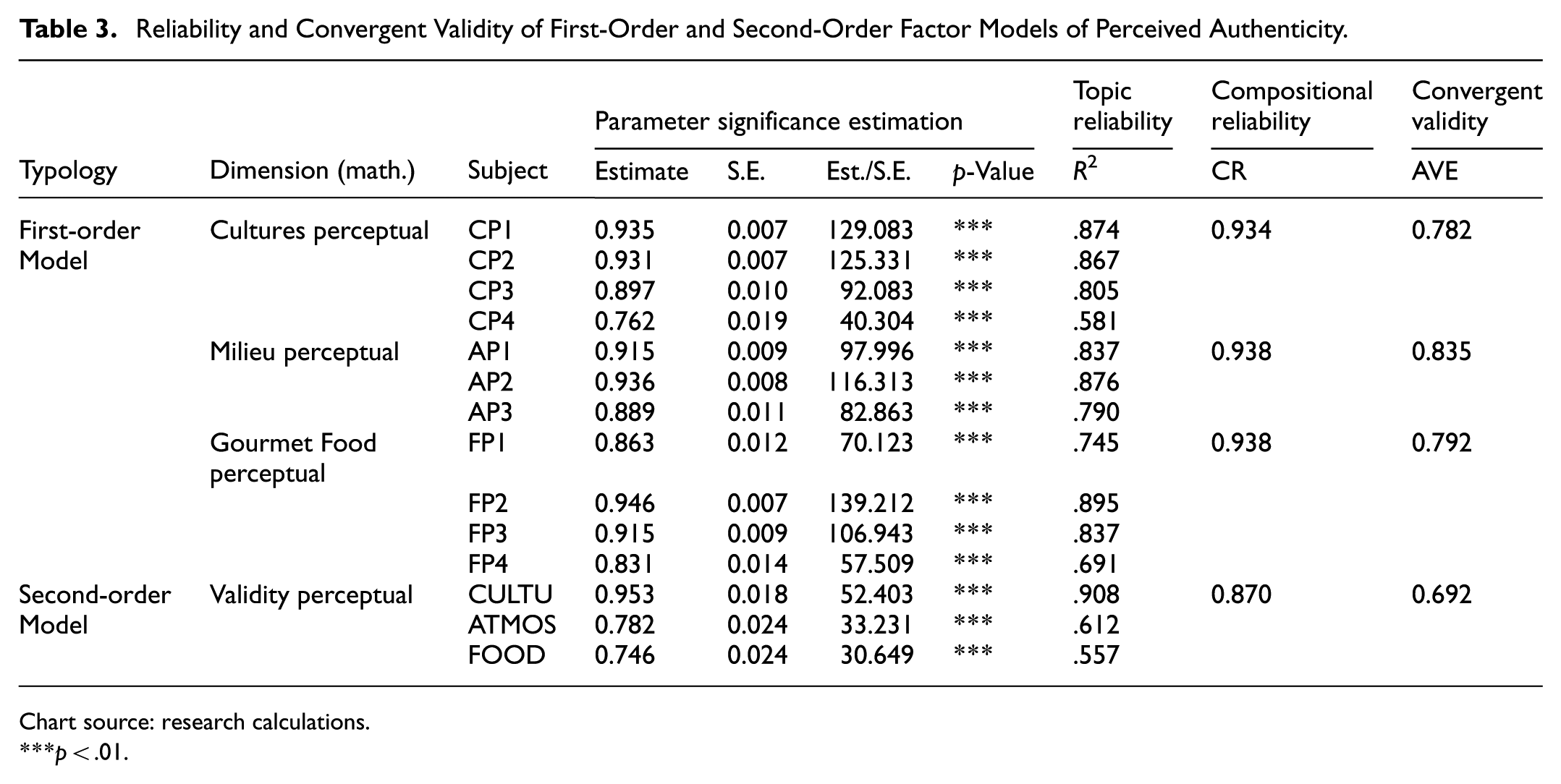
Chart source: research calculations.
p < .01.
Table 4 presents the reliability and convergent validity of the remaining dimensions. From the results, the item reliabilities ranged from 0.539 to 0.908, the component reliabilities ranged from 0.931 to 0.957, and the convergent validities ranged from 0.772 to 0.849. The model reliability, component reliability and convergent validity are all relatively satisfactory.
Factor Reliability and Validity Except for Perceived Authenticity Dimension.
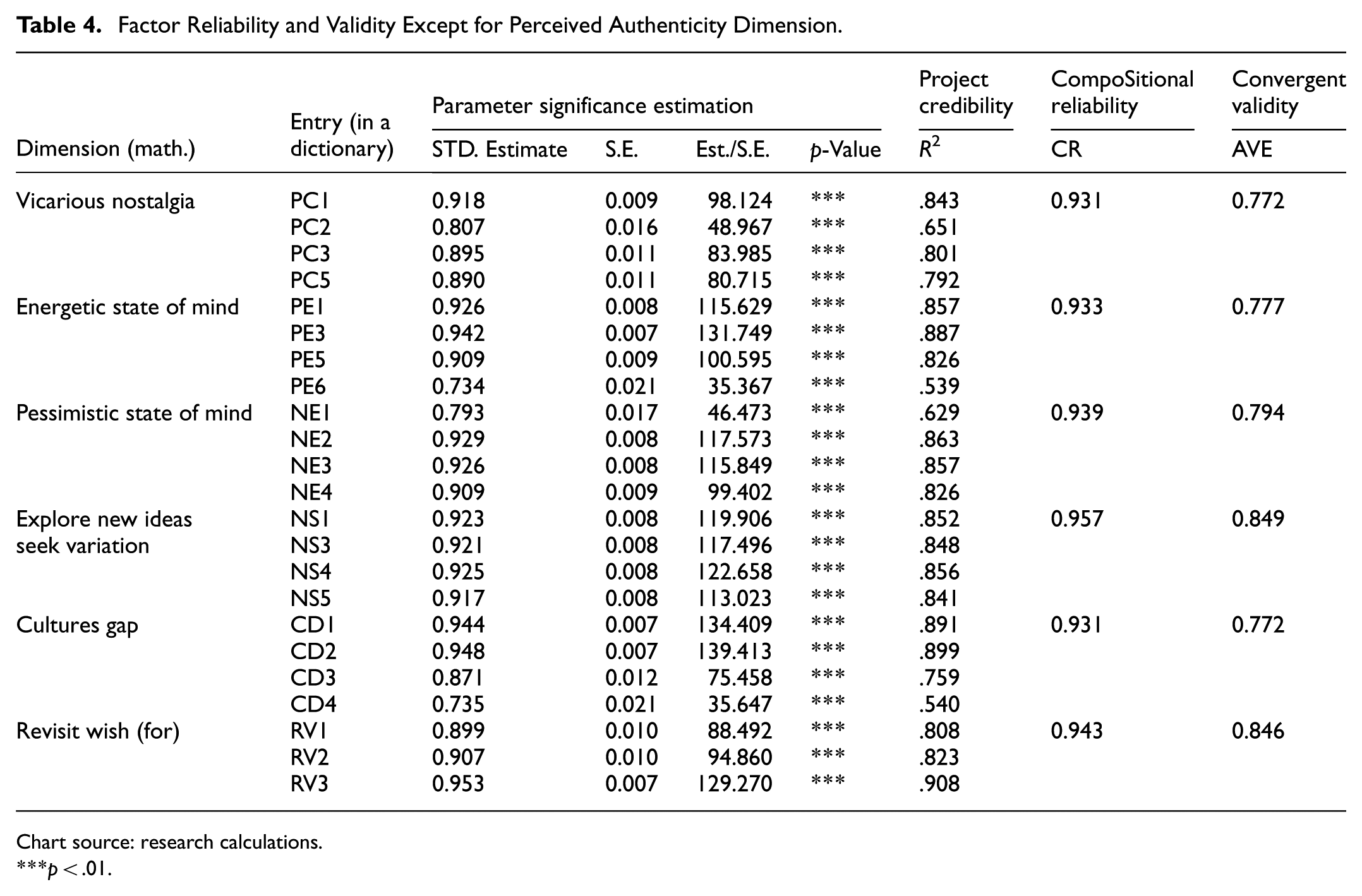
Chart source: research calculations.
p < .01.
Structural Modeling Equation Analysis
Path Analysis
Table 5 shows that p < .001 and standardized regression coefficient of 0.179 in the results of authenticity perception as independent variable, indicating that authenticity perception has a positive promotion effect on vicarious nostalgia, and the higher the degree of authenticity perception, the deeper the vicarious nostalgia feeling, and
Path Analysis.

Chart source: research calculations.
p < .01.
Analysis of Mediating Effects
The mediating effects were analyzed using the Bootstrap method of Mplus software, with times assigned to 1,000, and the table listing both the Percentile and Basic correct for the 95% confidence intervals. According to the research model, the mediating effects of the study were three in total, namely, Perceived Authenticity—vicarious nostalgia—Positive Emotions—Willingness to Repurchase, Perceived Authenticity—vicarious nostalgia-Negative Emotions-Repurchase Intention, and Authenticity Perception-vicarious nostalgia-Repurchase Intention. The total effect of the empirical analysis was .123, which corresponds to a p-value of .039, a significant result. The total indirect effect was .031, corresponding to a significance of .012, with a significant result, indicating the presence of mediating effects. The direct effect was .091, with a significant result, indicating that authenticity perception is a partial mediating effect on repurchase intention. Specifically, the authenticity perception-vicarious nostalgia-positive emotion-repurchase intention path is .006, corresponding to a p-value of .033, with a significant result, indicating that the mediating effect of this path is established.
Authenticity perception-vicarious nostalgia-negative emotion-repurchase intention path is .004, corresponding to a p value of .062, the results are not significant, the path mediation effect does not hold. Authenticity perception-vicarious nostalgia-repurchase intention is .021, corresponding to a p value of .021, the results are significant, the path mediation effect is established. Further comparative analysis of the mediation effect shows that the mediation effect of
Analysis of Mediated Effects Results.

Source. Research calculations.
Analysis of Moderating Effects
Table 7 shows the specific values analyzed for moderating effects. Perception of authenticity* cultural distance was −0.022 with a significance of 0.495 and a significant result, indicating that cultural distance has no moderating effect on the perception of authenticity and vicarious nostalgia, and
Regulatory Effects Analysis.

Source. Research calculations.
ANOVA
Analysis of variance (ANOVA) was conducted to quantify the differences in the dimensions of gender, age, education, marriage, monthly income, and whether or not one had previously visited Changsha Wenheyou. The study first averaged the nine dimensions of perceived authenticity, including perceived culture, perceived atmosphere, perceived food, and alternative nostalgia, positive emotions, negative emotions, cultural distance, search for newness and difference, and willingness to repurchase, to form a single indicator. The analysis was then performed one by one, and the LSD method was used for reorganization and comparison. In the correlation analysis between demographic characteristics and core variables, the following key differences were observed:
Gender dimension: Males showed significantly higher scores in cultural perception (mean value of 4.283 vs. 3.970 for females, p = .016) and repurchase intention (mean value of 4.257 vs. 3.970 for females, p = .026). This may be associated with the traditional perception that males tend to pay more attention to cultural inheritance.
Age dimension: The 18 to 23 age group had significantly higher cultural perception (mean value of 4.640) and newness seeking (mean value of 5.259) than the 24 to 29 and 30 to 35 age groups (p < .001), reflecting a stronger desire for exploration among younger groups toward nostalgic scenes they have not experienced personally. In contrast, the 30 to 35 age group scored slightly higher in atmospheric perception, food perception, and vicarious nostalgia, indicating the subtle impact of age on nostalgic experiences.
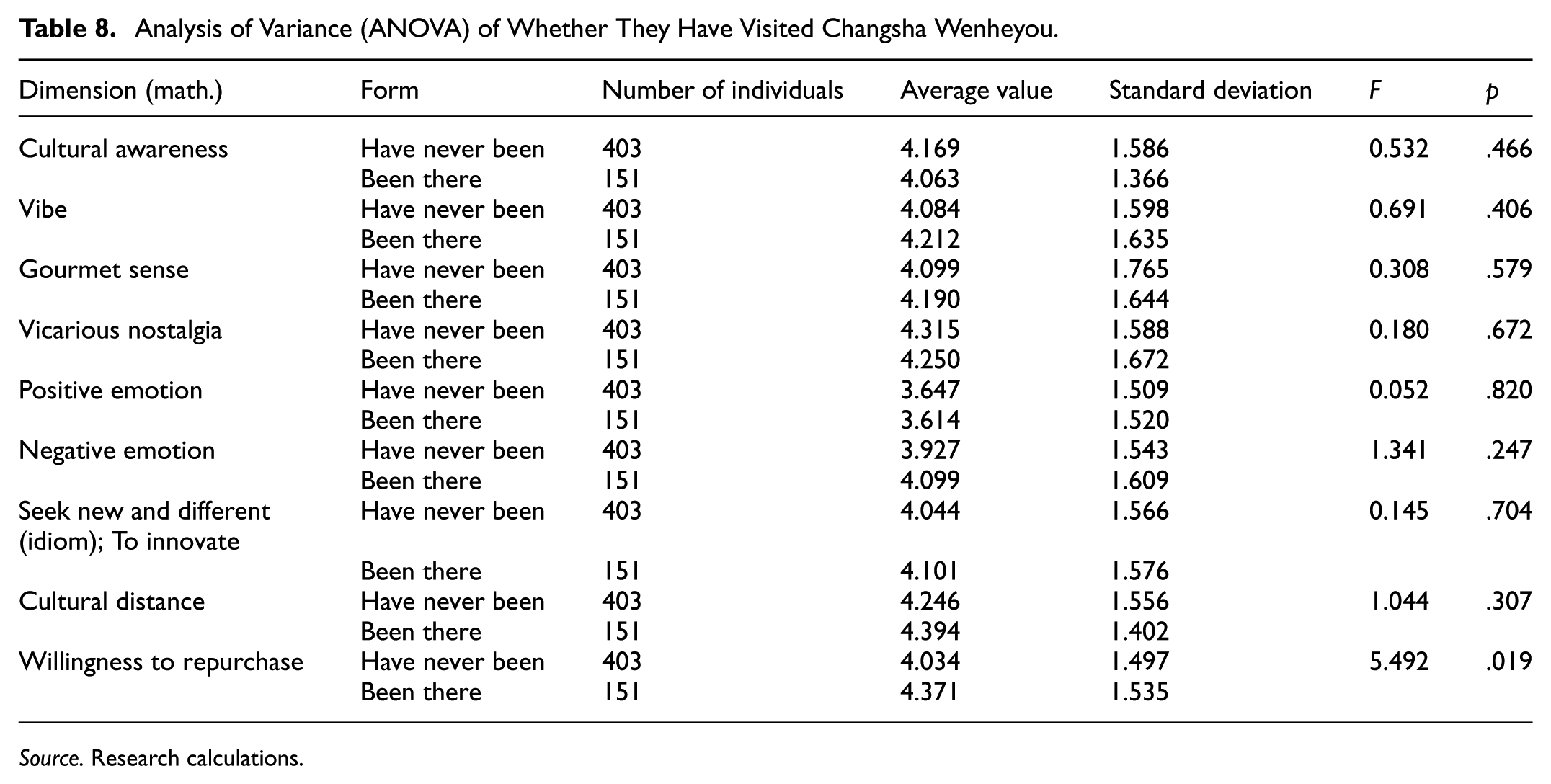
Consumption experience: Young consumers who had previous consumption experience at Wenheyou demonstrated significantly higher repurchase intention (mean value of 4.371 vs. 4.034 for those without such experience, p = .019), verifying the positive effect of experiential consumption on loyalty.
Other demographic characteristics (e.g., education level, marital status, monthly income) showed no significant correlation with core variables and did not interfere with the core mechanism of the study.
In the item of whether or not they have visited Changsha Wenheyou before, the repurchase willingness has a sharp significance of 0.019. The rest of the dimensions have no difference on this item. Regarding the repurchase intention of the two groups, the repurchase intention of the youth group who had visited Changsha Wenheyou was higher than that of those who had not (4.371 > 4.034; Table 8).
Analysis of Variance (ANOVA) of Whether They Have Visited Changsha Wenheyou.
Source. Research calculations.
Conclusions
Findings
Based on questionnaire data from young consumers in the context of nostalgic catering spaces, this study reveals the mechanism between perceived authenticity, vicarious nostalgia, and repurchase intention. A comparative analysis with existing literature is conducted to clarify the academic positioning and innovative value of this study as follows:
Positive Driving Effect of Perceived Authenticity on Vicarious Nostalgia
The study verifies that the three dimensions of perceived authenticity (cultural perception, atmosphere perception, food perception) have a significant positive impact on vicarious nostalgia (β = .179, p < .001). This conclusion is consistent with the view proposed by Z. Liang and Bao (2020) that “heritage carriers such as intangible cultural heritage and local history can stimulate vicarious nostalgia”, but further refines it from macro cultural scenarios to micro catering spaces, confirming the key role of concrete elements (e.g., food, scene atmosphere) in triggering nostalgia.
However, the conclusion of this study differs from Cohen’s (1988) traditional view that “objective authenticity is the core of triggering nostalgia.” From a constructivist perspective, this study finds that young consumers’ perception of the authenticity of the “1980s scene” does not rely on the restoration of objective history, but is formed through the subjective construction of cultural symbols (e.g., old Changsha dialect slogans) and multi-sensory atmospheres (e.g., retro music, decorations). This is consistent with Eco’s (1986)“hyperreality” theory and the research conclusion of Wu et al. (2024) on “existential authenticity” in creative nostalgic spaces, supplementing the application gap of authenticity theory in micro-service scenarios. Different from previous studies (e.g., Cohen, 1988) focusing on the objective authenticity of cultural heritage sites and historical relics, this study confirms that “subjectively constructed authenticity” in commercial catering spaces is more likely to stimulate vicarious nostalgia among young consumers, which is one of the core innovations of this study.
Mediating Role of Vicarious Nostalgia Between Perceived Authenticity and Repurchase Intention
Bootstrap analysis shows that vicarious nostalgia plays a complete mediating role between perceived authenticity and repurchase intention (95% CI [0.032, 0.097], excluding 0). This finding is consistent with Zhang and Tao’s (2022) research that “nostalgia, as an emotional bridge, can transform consumers’ cognitive perception of the service environment into behavioral intentions,” but contradicts J. Wang et al.’s (2021) view that “perceived authenticity can directly affect repurchase intention without emotional mediation.”
The reason for the discrepancy lies in the scenario characteristics of the research objects: J. Wang et al. (2021) focused on daily catering spaces, where consumers’ decisions are dominated by functional attributes (e.g., taste, price); while this study targets nostalgic catering spaces, where the core driving force for consumer consumption is emotional needs (e.g., seeking emotional resonance, awakening collective memories). Therefore, the mediating effect of vicarious nostalgia highlights the “emotional priority” logic of consumer behavior in nostalgic service scenarios, enriching the boundary conditions of the “perception-intention” theoretical model.
Theoretical Implications
Expanding the Application Boundary of Authenticity Theory in Service Marketing
This study breaks through the limitation of previous authenticity research focusing on macro cultural fields (e.g., cultural heritage, tourism destinations) and extends its application scenario to micro commercial catering spaces. By confirming that “subjectively constructed authenticity” (rather than objective historical restoration) is the key to stimulating vicarious nostalgia, it supplements the constructivist branch of authenticity theory and provides a new theoretical perspective for explaining consumer responses in nostalgic service environments.
Enriching the Nostalgia-Driven Consumer Behavior Model
Most existing studies regard nostalgia as a unidimensional emotional variable, while this study further clarifies the role of vicarious nostalgia (a type of “incidental nostalgia” not directly related to personal experience) in the “perceived authenticity-repurchase intention” chain. The verification of its complete mediating effect fills the theoretical gap in how “second-hand nostalgia” affects consumer decisions, and expands the application scope of nostalgia theory in the context of Generation Z consumers.
Practical Implications
Optimization Directions for Nostalgic Catering Space Design
For operators of nostalgic catering brands, the study suggests that the design of space elements should focus on “subjectively constructed authenticity” rather than rigidly restoring historical scenes:
Cultural symbol implantation: Integrate local cultural symbols (e.g., dialect slogans, regional traditional patterns) into space decoration to enhance consumers’ cultural identity; Multi-sensory atmosphere creation: Combine retro music, classic food flavors, and nostalgic tableware to build a multi-sensory experience scene, thereby stimulating vicarious nostalgia;Balancing nostalgia and commercial attributes: Excessive addition of modern commercial elements (e.g., flashy advertisements) may damage the perceived authenticity of the nostalgic scene, so a balance between nostalgic atmosphere and practical functions should be sought.
Improvement of Consumer Loyalty Enhancement Strategies
Given that vicarious nostalgia is the core mediating variable of repurchase intention, operators can design targeted marketing activities to strengthen the emotional connection between consumers and the brand:
Nostalgic theme events: Regularly hold theme events such as “1980s Movie Nights” and “Classic Game Experiences” to trigger consumers’ vicarious nostalgia and increase the frequency of store visits; Emotional story marketing: Spread brand stories related to collective memories (e.g., “the evolution of old Changsha street food”) through social media platforms such as Xiaohongshu and Douyin to enhance emotional resonance with young consumers.
Limitations and Outlook
This study has several limitations that should be acknowledged. Firstly, the sample was focused on Changsha Wenheyou, a specific case, and mainly targeted 18 to 34-year-olds, sampling bias exists.. While this concentration is somewhat reasonable as the study aims to delve into the behavior characteristics of a particular group, the limitations of the sample may still affect the generalizability of the study results.
Future research should address these limitations by expanding the sample range to include different regions and age groups, which would enhance the representativeness and applicability of the findings. Additionally, future studies could explore the potential of meta-universe and AIGC technologies in nostalgia consumption scenarios, optimizing the universality of the model while promoting “digital nostalgia” as a new engine of growth for cultural tourism. Inclusion of cross-cultural samples in real time could also provide valuable insights into the emotional impact of cultural distance, generational memory differences, social media intensity, and other variables on youth nostalgia.
Footnotes
Acknowledgements
We are deeply grateful to all the interviewees who participated in the interviews for this study. Thank you for taking the time out of your busy schedules. Your valuable opinions have provided rich data for our research, making the results more vivid, accurate and profound.
Authors’ Note
The conduct of this study, data collection and analysis, interpretation of results, and writing of the paper have not been influenced by any external factors.

Ethical Considerations
This study did not involve any animal or human experiments, only anonymous, one-time questionnaires.
Funding
The authors received no financial support for the research, authorship, and/or publication of this article.
Declaration of Conflicting Interests
The authors declared no potential conflicts of interest with respect to the research, authorship, and/or publication of this article.
Data Availability Statement
All relevant data is within the article.