




Abstract
Awareness among consumers in determining purchase intention (PI) and repurchase intention (RI) for energy drinks plays an important role. However, it has been overlooked in previous studies. In order to bridge this knowledge gap, we investigate the role of awareness of the potential negative effects of energy drinks (PAEEDs) as a moderating variable in the relationship of promotional activities with PI and RI among different young people. The data were collected from 415 students from Yemeni universities and analyzed using structural equations modeling via SmartPLS software. The results revealed that promotional activities affect PI among students with low awareness of the PAEEDs more than students with high awareness. In contrast, promotional activities affect RI among students with high or low awareness of the PAEEDs. This study provides additional evidence about the effects of energy drinks (EDs) promotional activities on PI and RI among young people in light of the awareness of these products and, thus, the urgent need for regulation and restrictions on youth consumption of EDs. Implications for theory and practice are discussed.
Plain Language Summary
Purpose: Awareness among consumers in determining purchase intention (PI) and repurchase intention (RI) for energy drinks plays an important role. However, it has been overlooked in previous studies. In order to bridge this knowledge gap, we investigate the role of awareness of the potential negative effects of energy drinks (PAEEDs) as a moderating variable in the relationship of promotional activities with PI and RI among different young people. Methods: The data were collected from 415 students from Yemeni universities and analyzed using structural equations modeling via SmartPLS software. Conclusions: The results revealed that promotional activities affect PI among students with low awareness of the PAEEDs more than students with high awareness. In contrast, promotional activities affect RI among students with high or low awareness of the PAEEDs. Implications and limitations: This study provides additional evidence about the effects of energy drinks (EDs) promotional activities on PI and RI among young people in light of the awareness of these products and, thus, the urgent need for regulation and restrictions on youth consumption of EDs. Implications for theory and practice are discussed.
Introduction
Energy drinks (EDs) are defined as “non-alcoholic beverages that contain at least 150 mg caffeine per liter, in addition to sugar combined with one or more substances known to have stimulant properties” (Bruzell et al., 2019, p. 19). The EDs market has grown rapidly in recent years (Al-Shaar et al., 2017; Phillips et al., 2021), with global sales of around $53.01 billion and growing (The Geeky Griffin, 2020). In Yemen, a less developed country (Al-Hakimi, Goaill et al., 2023), the value of imported EDs into the Yemeni market increased by more than 30% from 2018 to 2021 (Trade Statistics for International Business Development, 2021). This is a concern for many countries and professional organizations due to the potential health dangers linked with the consumption of EDs. This made them try to restrict this expansion and growth, but these attempts were limited; for example, the Norwegian Food Safety Authority has ruled that children and adolescents should not consume more than 2.5 mg/kg of caffeine per day (Kaldenbach et al., 2021). In addition, some European countries (e.g., England, Latvia, and Lithuania) have imposed age limitations on selling EDs (Nuss et al., 2021). Similarly, some nations have made steps to control or prohibit ED sales (Phillips et al., 2021; Seifert et al., 2011). However, if the focus is on awareness increases of the potential harms of EDs for people, especially young, the results of restraining the growth of the ED market may be better.
EDs companies market their products as a booster of mental and physical capacity for consumers. These companies use many elements of promotion, such as advertising, personal selling, and sales promotion, to achieve their marketing objectives. Recent research has shown that viewers of TV channels that broadcast more ED advertisements have increased the likelihood of EDs consumption (Emond et al., 2015; Wiggers et al., 2019). Hossain et al. (2014) found that advertisement greatly influences the expansion of EDs companies. ED marketing is often geared toward young people (Harris & Munsell, 2015; Pomeranz et al., 2013), especially young adults between the ages of 18 and 34, who are a key target demographic (Heckman et al., 2010). However, the potential adverse effects of consuming EDs are of concern due to the high quantity of caffeine, sugar, and other chemicals (such as taurine, guarana, … etc.), which can cause palpitations, hypertension, diuresis, … etc. (Breda et al., 2014; Pomeranz et al., 2013).
The consumption of EDs by college students is especially concerning because this cohort of young adults, who are busy with academic work, is a perfect target for people who sell EDs, with promises to give them more energy and physical performance (Heckman et al., 2010; Kaur et al., 2022). Previous studies have demonstrated that ED use is frequent in this population worldwide. Among U.S. undergraduate college students, 39% to 80% had consumed at least one ED in the past (Malinauskas et al., 2007). The study by T. Y. Kim et al. (2018) also found that 76.9% of students were experienced in consuming EDs at Cheongju. The primary reason for using EDs was to stay awake, and the primary place they were used was on campus or in the library. Kopacz et al. (2013) revealed that 49% of university students in Poland consumed EDs and highlighted that the amount of EDs consumed during exams was much higher than during the academic year. In Yemen, the head of the Yemeni Consumer Protection Association stated that there is a high demand for EDs, especially among university students (youth group)—who are considered the main target group in advertising campaigns by ED companies (Mansour, 2015). However, do those students who consumed EDs still have the intention to repurchase?, on the other hand, students who did not use EDs, do they intend to purchase?
Past research has demonstrated that college and university students are unaware of the harmful effects of EDs. (Attila & Çakir, 2011; T. Y. Kim et al., 2018). In a recent study conducted by Chaudhry et al. (2022), it was determined that while EDs can have both positive and negative impacts on physical performance, they can also have negative health effects. Many students are unaware of the main constituents and side effects of EDs. In addition, Kelsey et al. (2019) stated that although EDs can have detrimental effects on the cardiovascular system, youth are still not sufficiently aware and continue to consume these drinks significantly. According to their findings, T. Y. Kim et al. (2018) also recommend that college students be taught the potential health risks of EDs. Mohammed et al. (2022) concluded that ED consumers did not know much about them. As a result, the Ministry of Health should pay attention to the major side effects that ED consumers experience, such as palpitations and nervousness, and raise awareness about them. Similarly, Kaur et al. (2022) noted that there is still a considerable amount of unknown information about EDs, necessitating additional study, explicit labeling of adverse effects, and, most importantly, consumer education. Although awareness of the PAEEDs is much needed among consumers in general and youth in particular, it is surprising that awareness of the PAEEDs in young people and its implications in the context of promotion and purchase intention (PI) has been ignored in prior studies. Therefore, this study seeks to fill this gap.
According to the literature review, several studies have investigated the effects of promotion on purchase and repurchase intention (RI); however, they have shown contradictory results. For example, some researchers (e.g., Ji & Ha, 2021; Wang, 2021) indicated that promotion significantly affects RI. In contrast, others found that the promotion has no significant effect on RI (Sanam & Sartien, 2019; Tian et al., 2022). In addition, it was found that promotion has a significant effect on PI (Nursyirwan & Ardaninggar, 2020; Pai et al., 2017), whilst advertising, as one of the promotion dimensions, does not have a significant effect on PI (Khaleeli, 2020). The promotion also had no substantial impact on PI, with consumer trust intervening (Nursyirwan & Ardaninggar, 2020). Based on the inconsistencies found in a few of the previous literature, it is obvious that a moderating variable can be inserted to moderate the link between these constructs, as suggested by Baron and Kenny (1986). Thus, it is interesting to consider the awareness level of the PAEEDs and the consequent impact of promotion practices on purchasing and repurchasing intention. Moreover, the awareness of the PAEEDs has become a global phenomenon, necessitating a deeper understanding of consumer responses in both developed and developing or even less developed countries’ markets. In order to fill this gap in the literature, the current study analyzes the moderating effect of awareness of the PAEEDs on the relationship between promotion, PI and RI in the context of Yemen.
With data obtained—through a questionnaire tool developed from the previous literature—from 415 students from Yemeni universities, this study seeks to fill the gaps identified above by investigating the role of awareness of the PAEEDs as a moderator variable in the relationship between promotional activities and both PI and RI among young people.
This study has several contributions. First, it explores the moderating role of the awareness of the PAEEDs in the relationship between promotional activities and PI among young people who did not consume EDs and the relationship between promotional activities and RI among young people who consume EDs. Second, it explores whether awareness of the PAEEDs moderates the relationship of promotional activities to PI and RI among young people. In doing so, we respond to many calls made by Chaudhry et al. (2022) and Kaur et al. (2022) for further investigations into awareness of the PAEEDs. Third, we examine the relationship between promotional activities and both PI and RI in the context of less developed countries, such as Yemen, which has not received attention in previous studies.
Literature Review
Theory of Planned Behavior
This study relied on the theory of planned behavior (TPB; Ajzen, 1991) to predict PI and RI for EDs under the influence of awareness of their potential effects. The TPB framework, an extension of the theory of reasoned action (Azjen, 1980), is an expectancy-value model that addresses the problem of incomplete volitional control (Kassem & Lee, 2004). According to TPB, behavior is predicted by intention. The intention is determined by “attitude toward the behavior (favorable or unfavorable), subjective norm (perception of social pressures to perform or not perform the behavior) and perceived behavioral control (perception of ease or difficulty of performing the behavior)” (Kassem & Lee, 2004, p. 276). Numerous previous studies have adopted the TPB model to explore consumers’ behavioral intentions (Abdin, 2023; Hsu et al., 2017; J. H. Kim & Lee, 2019; Samoggia & Rezzaghi, 2021; Shahid et al., 2023; Sun et al., 2022). Accordingly, this study uses the TPB model to measure consumers’ PI and RI of EDs.
Purchase Intention and Repurchase Intention
PI is the psychological state of a consumer who plans to consume a certain brand within a certain time frame in addition the likelihood and potential for a consumer to take or exhibit an actual buying reaction (Al-Adwan et al., 2022; Al-Hattami, 2021; Alsoud et al., 2022; Wong & Tzeng, 2021). Bobadilla et al. (2009) indicated that intent can predict the behaviors used by consumers to predict intent to buy in practice. Purchasing behaviors constituted the psychological decision-making process (Defever et al., 2011; Dewi et al., 2019). To meet requests, a customer would seek out information pertinent to their personal experiences and external contexts (Mettas, 2011). Once sufficient information was gathered, the consumer preceded reviews and considerations and decided to purchase a product after comparison and judgment. That was the consumer purchasing decision-making process (Dhar & Varshney, 2011). According to TPB, PI is directly tied to the attitudes, perceptions, and behaviors of consumers (Hoque & Hossan, 2020; Ling et al., 2021). In addition, they typically have a strategy or procedure or analyze their desire to purchase a product offered (Sjabadhyni et al., 2021). In the decision-making process, a consumer could possibly take purchasing behaviors on some products when there are requests and preferences for products. Moreover, Majali et al. (2022) and Stever (2011) noted that measuring intention to purchase based on the consumer’s intention to purchase certain products reveals the highest likelihood of purchase. Based on this literature review, Lu et al. (2014) suggested that consideration, possibility, and need to purchase a product are dimensions for measuring PI.
According to Tsai and Huang (2007), repurchase intention (RI) is a type of consumer purchasing behavior in which there is a correlation between the values of goods or services that may generate the consumer’s intention to consume them again in the future. Specifically, RI describes the consumer’s desire to repurchase an item based on the confidence and value associated with the use of the item. In other words, RI is the consumer’s PI that is seen from the purchase experience made in the past. By the views expressed, it is often understood that RI is the tendency of consumer purchasing attitudes toward products repeated over a certain timeframe in light of previous experience. Similarly, Sanam and Sartien (2019) stated that the consumers’ interest in repurchasing is the desire that arises to repurchase the same product (service or good) because of the satisfaction they have felt. Repurchase can result from purchasers’ desire to repeat-buy specific products to derive additional advantages (Tian et al., 2022). Moreover, Tsai and Huang (2007) determined the measure of RI depending on the consumer’s intent to repurchase a specific product and suggested the dimensions of the consumer’s RI measure are as follows: continue to purchase, anticipate repeat purchasing, expect to repeat purchase, like to recommend.
Promotional Activities
Companies need to stimulate and disseminate information about their products regarding their existence, availability, characteristics, status, benefits or uses by existing and potential customers. This is described as a promotional activity. Promotion is primarily any presentation of non-individual communication that promotes products given by businesses to influence clients to purchase these products (Murshid & Mohaidin, 2017). Through promotion, the companies declare the brands of the products and persuade customers to purchase them by saying that the brands of the products have various benefits according to marketing ethics. Consistent with Pai et al. (2017), promotion is a form of persuasion involving quantitative incentives to increase product sales through attractiveness, repeatability, and reach.
The company’s promotional mix can produce a separate assessment on the customer’s mind so that the customer’s assessment of the merchandise promotion can directly or indirectly produce a product image. The term promotion is defined by Luk and Yip (2008, p. 455) as “a direct flow of information or persuasion created to direct an individual or organization to actions that make exchanges in marketing.” As stated by Kotler and Keller (2012) that promotions are various ways to inform, convince and remind customers directly or indirectly about an offered brand or product.
Each company has a different promotional mix based on its objectives, marketing strategies, particular techniques, product characteristics and target market characteristics. There are four main elements of the promotional mix “Advertising, Sales promotion, Public Relations and Personal selling” based on most authors. Whereas Kotler and Keller (2012) determined the promotional mix with five elements: (1) Advertising reflects all costs incurred to make non-personal presentations and promote ideas, products, or services. (2) Personal selling is a salesperson’s personal presentation to create sales and develop customer relationships. (3) Sales promotion is a brief incentive to support the transaction. (4) Public relations is establishing honest contact with the general public to construct a firm’s image and handle all negative events within the organization. (5) Direct marketing is communicating directly with target customers to obtain immediate replies. To achieve the objectives of this study more realistically, the researchers interviewed some marketing and sales managers of ED companies in the Yemeni market about the most important elements of the promotional mix that they practice; most of them emphasized that: (advertising, personal selling, and sales promotion). Thus, only these three elements were relied upon.
Awareness of the PAEEDs
Awareness is defined as “a state wherein a subject is aware of some information when that information is directly available to bring to bear in the direction of a wide range of behavioral actions” (Chalmers, 1997, p. 28). In other words, it refers to the capacity to immediately know and experience, to feel, and to be aware of occurrences. As such, Awareness of the PAEEDs reflects knowledge and realization of some potentially harmful effects on consumers due to the use of EDs.
According to a recent study by Chaudhry et al. (2022), even while EDs may have positive and negative effects on physical performance, they may also have negative health repercussions. They also found that many students are ignorant of the main constituents and side effects of EDs. Regarding that, a study by Aluqmany et al. (2013) proposed that a health education intervention program is needed to extend the awareness of students regarding the composition of EDs and their effects on health. T. Y. Kim et al. (2018) found that over 70% of ED users didn’t peruse the caffeine contents of EDs, and after consuming EDs, 31.3% experienced adverse effects, the most serious being sleep disturbance. And their study recommended that college students be taught the potential health risks of EDs.
However, it is difficult to identify the potential adverse effects of EDs. Many studies have reported many adverse effects in different consumer environments. To determine the possible effects of measuring the awareness, the researchers presented the side effects mentioned in 14 previous studies, with the percentages of consumers’ confirmation of these effects, and then determined the average (see Table 1). Accordingly, it is possible to identify the 10 most potentially adverse effects of EDs with the largest averages: lack of rest, heart palpitations, nervousness, confusion, addiction, insomnia, increased urination, high blood pressure, tooth decay and chronic fatigue, respectively. However, after judging by three specialists in this list, three effects (Lack of Rest, Confusion and Chronic Fatigue) were excluded, and three others were added (Headache, Tremors and Others) due to the difference in the culture and understanding of medical terms in Yemeni society. Thus 10 potential adverse effects of EDs were identified to measure the awareness of the PAEEDs. They are as follows: Increased Heart Rate, Nervousness, Addiction, Insomnia, Increased Urination, High Blood Pressure, Tooth Decay, Headache, Tremors, and Others.
Potential Adverse Effects of Energy Drinks.

Hypotheses Development
Promotional Activities and Purchase Intention
Regarding the relationship between promotional activities and PI, Kotler and Keller (2012) mentioned that advertisements give customers a purchase reason, while promotion offers customers a purchase incentive. Luk and Yip (2008) stated that merchandising could make salespeople work to promote products and encourage customers to purchase. Andrews et al. (2010) also concluded that discount promotion could provide economic incentives to purchase, thus enhancing and attracting PI to consumers. As a result, consumer purchases are usually planned, but stimulating promotional activities provides economic and psychological incentives to enhance purchases of the promoted products to obtain the benefits offered (Shin & Leigh, 2005). The following hypothesis is therefore proposed:
Promotional Activities and Repurchase Intention
Besides the effect of promotional activities on the intent to purchase through the knowledge that promotional offers provide for product analysis (Raghubir, 2004), many studies indicate that it also affects the intent to repurchase. A study by (Huang et al., 2014) concluded that a significant effect of promotion on RI, promotion encourages non-frequent customers to return and purchase again. Moreover, Lee and Ahn (2016) found that promotions affect customer’s RI. As an outcome, customers’ purchase is typically planned, but the stimulation of promotion activities provides economic and psychological incentives to change the first intention and behaviors so that customers re-evaluate the present choice and new alternative and enhance the purchase of the promoted product to get the extra benefits provided within the promotion (Shin & Leigh, 2005). Accordingly, we assume that:
The Moderating Role of the Awareness of the PAEEDs
This study also explored the role of awareness of PAEEDs as a moderating variable on the relationship between promotional activities and the intention to purchase or repurchase EDs. While many previous studies investigated the relationship between promotional activities and the intention to purchase or repurchase EDs, they revealed inconclusive results. Accordingly, awareness of the PAEEDs was presented as a moderating variable, which may explain the discrepancy in previous findings. Awareness can be considered a moderating variable and can be entered to moderate the relationship between the promotion, purchase and RI. Furthermore, Mohammed et al. (2022) propose that future research be conducted in multiple nations to raise awareness of the adverse health effects of excessive ED intake. Similarly, Y. J. Kim et al. (2015) claim that positive awareness of EDs facilitates consumption more than negative awareness under the justification of incorrect recognition. Thus, they recommended that it is necessary to provide accurate knowledge about awareness of ED consumption in future studies. Even though the moderating effect of awareness of the PAEEDs has been ignored in the prior studies, the current study seeks to fill this gap by investigating the moderating effect of awareness of the PAEEDs that may maximize or minimize the promotion effect on PI and RI. According to the study’s conclusions by Subaiea et al. (2019), a higher awareness of the potential harms of EDs may reduce purchasing decisions for EDs by the general public. From these, we can conclude that the greater the awareness of the PAEEDs, the less intent is to buy EDs. This is with the continuation of promotional activities of EDs. The following hypothesis is therefore proposed in this study:
According to the recommendations of Tóth et al.’s (2020) study, recognizing the negative health impacts of EDs and preventing their consumption are crucial since people who use these products are more prone to develop a habit of regular, even excessive, intake. From these, we can conclude that the greater the recognition of the potential harms of EDs, the less intent is to repurchase EDs. This is with the ED companies continuing their promotional activities. The following hypothesis is therefore proposed in this study:
Based on the objectives of the study, the Hierarchy of Effects Theory, which was created by Lavidge and Steiner (1961) (marketing communication model), suggests that there are five steps from seeing a product promotion to product purchase, the models of the previous studies, and the formulated hypotheses of the study mentioned above. All of these can be summarized into two conceptual models: (1-a) PI Model for those who had not consumed EDs (Conceptual model-PI) and (1-b) RI Model for those who had consumed EDs (Conceptual model-RI), as described in Figure 1.

Conceptual model.
Methodology
Population and Sample
This study focuses on university students because they are of particular interest and a major target demographic for ED companies (Heckman et al., 2010). In line with the objectives of this study, the quantitative approach was used. The data was collected using random sampling from the students at Thamar University and the University of Science and Technology. Most of the students of these universities have inclusiveness from all the provinces along.
After obtaining approval from them, five hundred (500) questionnaires were distributed among the students, during the period from 1 to 30 March 2022, based on Roscoe’s (1975) rule that the appropriate sample size range for good research is from 30 to 500. The data were collected using the simple random sampling technique at the campus as a convenient location that provides the opportunity for all students to participate. The inclusion criteria for this study are students aged 18 to 39, Yemeni, and any student who desires to participate, whether or not they consumed EDs.
Out of 500, only 432 students completed the survey. But eight questionnaires were excluded because they were not filled by students aged 18 to 39. In addition, nine questionnaires were discarded because more than 50% of them were incomplete. All in all, the total usable responses for further analysis stood at 415, constituting 83% valid response rate. Of these, 211 questionnaires were filled out by students who had used EDs even once, while 204 questionnaires were filled out by students who had never used EDs. Table 2 shows the characteristics of the respondents.
Sample Characteristics.

Research Instrument
To achieve the current study objectives, the data required has been gathered using the survey questionnaire instrument, which was developed on the basis of the relevant previous studies, with the exception of the items that measure the variable of Awareness of the PAEEDs, which were developed by the authors. Then pretesting of the initial questionnaire was done among 30 students at Thamar University who were randomly selected and not included in the final data collection process. Necessary corrections and modifications were done based on the field-testing responses. Appendix 1 shows the measurement items for each variable with the references.
Data Analysis and Results
In this study, SEM via SmartPLS 3 was used to evaluate the relationship between factors that take account of unobservable variables within two separate models simultaneously, with similar analysis and presentation followed in SEM (e.g., Okada et al., 2019), where we classified the sample as ED consumers and non-ED consumers. Accordingly, two models were built for the RI of ED consumers and PI of non-ED consumers. Figure 1 shows the PI of respondents who do not consume EDs is shown (Model 1-a) and the RI of respondents who consume EDs (Model 1-b).
Depending on SEM, the first and third hypotheses for the conceptual model-PI and the second and fourth hypotheses for the conceptual model-RI were tested. PLS-SEM offers a variety of advantages that contribute to its extensive application in management research (Al-Hakimi et al., 2021; Al-Hattami et al., 2022; Gelaidan et al., 2023; Goaill & Al-Hakimi, 2021). Both the measurement model and the structural model were evaluated depending on Hair et al. (2017) and Henseler and Fassott (2009).
Measurement Model
We created two models in SmartPLS 3, the first model with three variants (Promotional activities, PI and Awareness of the PAEEDs) (The model-PI) and the second model with three variants (Promotional activities, RI and Awareness of the PAEEDs) (The model-RI). Since promotional activities consist of three dimensions: Advertising (Adv), Personal Selling (PS) and Sales Promotion (SP); hence, we have reflective-reflective type of higher-order construct. To establish the reflective-reflective higher-order construct of promotional activities, we have used the repeated indicators approach. The constructs Adv, PS and SP represent the lower-order constructs of the more general higher-order construct promotional activities (PA), which is measured with the twelve indicators. According to the guidelines of Sarstedt et al. (2019), Mode A was used to estimate the higher-order component for the model-PI and the model-RI. Consistent PLSAlgorithm has been run to assess the measurement models. Initial outer loading ranged from 0.578 to 0.976. Based on Hair et al. (2011) state that items with loading falling in the range of 0.4 to 0.7 should be removed, thus only one item (AwarPA3 = 0.589) in the model-PI and two items (AwarPA3 = 0.578 and AwarPA8 = 0.588) in the model-RI were removed correctly. With these removals, the composite reliability (CR) and average variance extracted (AVE) improved in both models. Therefore, all the loadings are significant (p-value < .001) with values over .71, attesting to the reliability of the items.
In Table 3, the cross-loadings of the items indicated that all items loaded more on their corresponding constructs than others. As shown in Table 4, the Cronbach’s alpha, rho_A, and CR values are higher than the value of .70, which were between .887 and .978 in the model-PI, .813 and .969 in the model-RI, proving the reliability of the scales (Hair et al., 2017). Moreover, the convergent validity in both models was proven as all the AVE values exceeded 0.5 (Hair et al., 2010).
Cross Loadings.

Note. Adv = advertising; PS = personal selling; SP = sales promotion; PI = purchase intention; RI = repurchase intention; APAEEDs = awareness of the potential adverse effects of energy drinks. Loadings of the indicators of each model construct are denoted with bold.
Convergent Validity and Reliability.

Note. Assessing the higher-order construct’s reliability and validity were calculated manually by using statistical equations and following the steps mentioned in the study of Sarstedt et al. (2019). CR = composite reliability; AVE = average variance extracted; PA = promotional activities.
Italics used for higher-order construct values.
The discriminant validity was verified using two methods: cross-loading and HTMT. As shown in Table 3, all items loaded more on their corresponding constructs than others, as mentioned previously. The second method, HTMT statistics, was used for the two models; as Table 5 shows, all values are below 0.90, and thus there is discriminant validity (Henseler et al., 2015).
HTMT Values—Discriminant Validity.
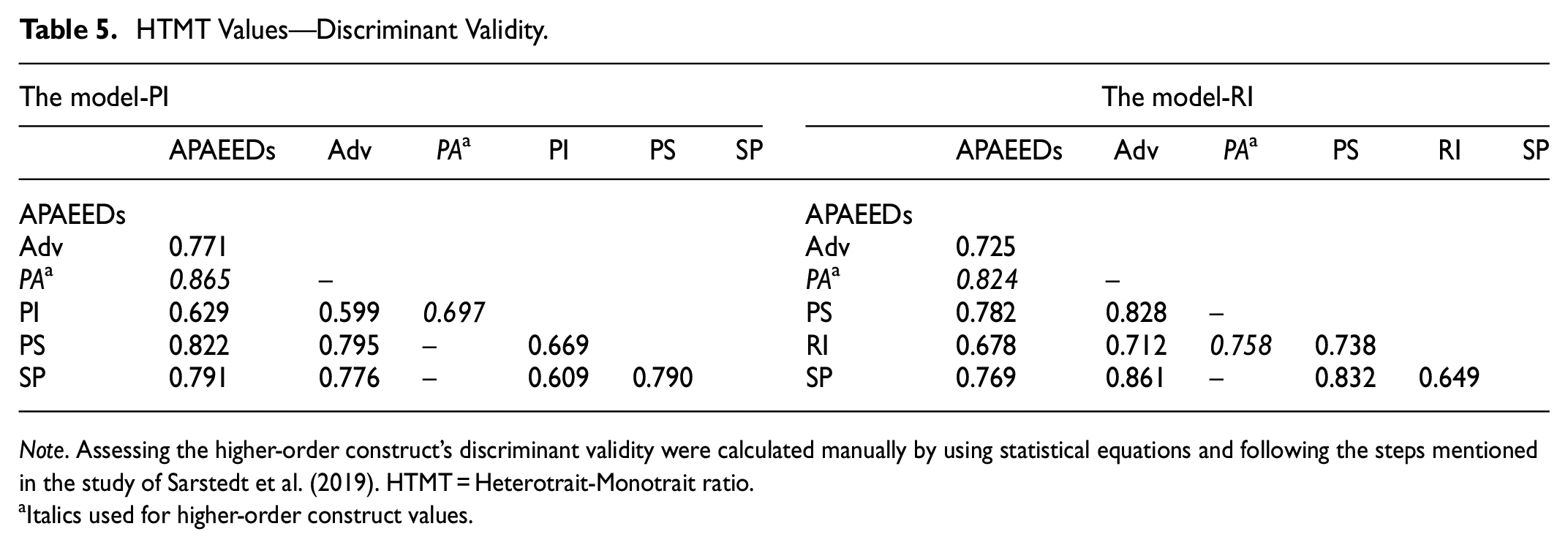
Note. Assessing the higher-order construct’s discriminant validity were calculated manually by using statistical equations and following the steps mentioned in the study of Sarstedt et al. (2019). HTMT = Heterotrait-Monotrait ratio.
Italics used for higher-order construct values.
Structural Model
The structural model was analyzed to confirm or deny the hypotheses after reliability, convergent validity, and discriminant validity tests had validated the measurements. First, we looked at diagnostic statistics for collinearity. Table 6 shows that all Variance Inflation Factor (VIF) values were determined to be <3, indicating that multicollinearity is not an issue.
Structural Model Results.

Note. VIF = variance inflation factor.
Next, we ran bootstrapping (5,000 subsamples) to assess the significance and relevance of the relationships between the three lower-order components and their higher-order components for the two models to correctly test hypotheses H1 and H3 in the model-PI and hypotheses H2 and H4 in the model-RI as shown in Figure 2.
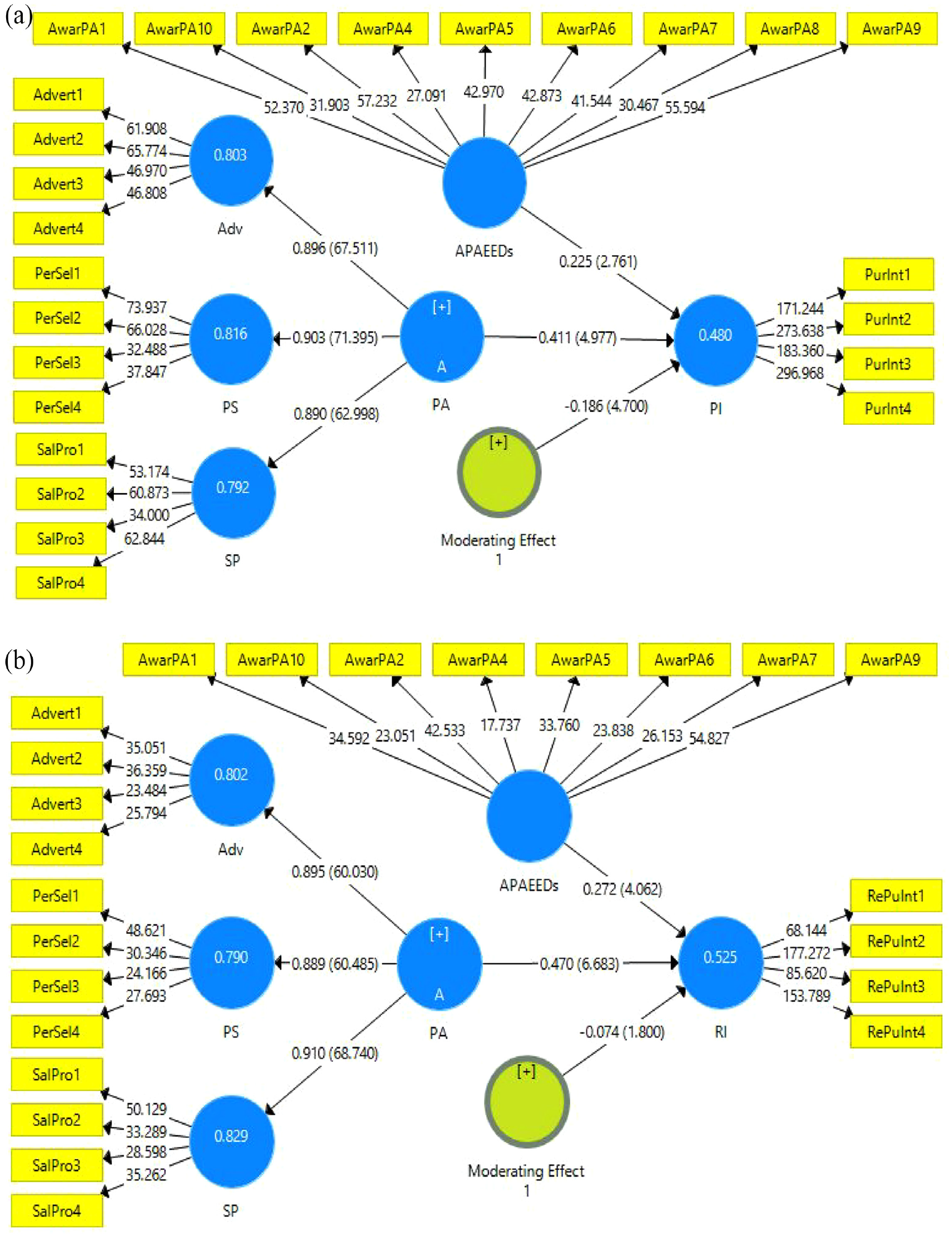
Bootstrapping (repeated indicators approach reflective-reflective): (a) the model-PI and (b) the model-RI.
To measure the predictive efficiencies of the models and the correlations between the constructs, predictive correlations R2 and Q2 were measured. Table 7 indicates that the R2 for PI was .480 in the model-PI, also .525 for RI in the model-RI, thus displaying a moderate explanatory power for the two models (Chin, 1998). In the same table, the Q2 value of PI was 0.427 in the model-PI as well as 0.457 for RI in the model-RI. These two values are greater than zero; thus, the two models have adequate predictive quality, as suggested by Hair et al. (2011).
Results of the Structural Model and Hypotheses Testing of the Model-PI.

p < .001.
Besides, the value of f2 denotes effect size and identifies the impact of independent variables on the dependent variable. If f2 is 0.02, the effect is considered small, while 0.15 signifies a medium effect and 0.35 indicates a relatively large effect (Cohen, 2013). Table 7 shows that the effect size of APAEEDs, PA and PA × APAEEDs were small on PI (0.032, 0.106, and 0.067), respectively, in the model-PI. As for the model-RI, the effect size of PA was medium on RI (0.202), and the effect size of APAEEDs was small (0.070), while that of PA × APAEEDs was very small on RI (0.013).
Finally, the results shown in Table 7 and Figure 2a (the model-PI) indicate that promotional activities have a significant positive effect on PI, while awareness of the PAEEDs moderates the impact of promotional activities on PI. Hence, H1 and H3 were supported.
Furthermore, the results shown in Table 8 and Figure 2b (the model-RI) indicate that promotional activities significantly positively affect RI. At the same time, awareness of the PAEEDs not significantly moderates the effect of promotional activities on RI. Hence, H2 was supported while H4 was not supported.
Results of the Structural Model and Hypotheses Testing of the Model-RI.

p < .001.
Figure 3 shows that awareness of the PAEEDs dampens the positive relationship between promotional activities and PI (the model-PI). In contrast, awareness of the PAEEDs not significantly dampens the positive relationship between promotional activities and RI (the model-RI). Meaning that promotional activities do not affect the PI among students with high awareness of the PAEEDs more than students with low awareness, while promotional activities do affect the RI among students with high or low awareness of the PAEEDs.

The interaction between the awareness of the PAEEDs and promotional activities.
Discussion
Depending on TPB, the current study explores the moderating role of the awareness of the PAEEDs in the relationship between promotional activities and both PI and RI among young people. The results of the current study contribute to enhancing knowledge on EDs consumption by using an empirical approach that yields theoretical and practical implications and opens potential research areas for the future.
The findings suggest that promotional activities have a positive effect on the PI. This result is consistent with the study by Pai et al. (2017), who concluded that promotional activities positively impact PI through increasing perceived value. However, the results of the present study were unique in finding that awareness of the PAEEDs dampens the positive relationship between promotional activities and PI.
Our results also suggest that promotional activities have a positive effect on RI. Although some studies show that promotional activities do not significantly affect RI (e.g., Sanam & Sartien, 2019; Tian et al., 2022), our research reveals the contrary, as the evidence offered herein emphasizes that promotional activities positively affect RI of EDs. This supports the results of Ji and Ha’s (2021) and Wang’s (2021) studies, which found that promotion encourages non-frequent customers to return and purchase again.
Finally, and unexpectedly, the results showed that awareness of the PAEEDs did not dampen the positive relationship between promotional activities and RI for students who consumed EDs.
Theoretical Implications
In theory, this study has many implications. First, it reveals the role of awareness of the PAEEDs (as a moderate variable) in the relationship between promotional activities and PI among youth who did not consume EDs. By doing so, we respond to many calls for further investigations into awareness of the PAEEDs (Chaudhry et al., 2022; Kaur et al., 2022). With the rapid growth of the ED market in recent years in many countries (Al-Shaar et al., 2017; Phillips et al., 2021), including Yemen as a less developed country (Kaldenbach et al., 2021), promotional activities are still practised by EDs companies, targeting young people in particular (Wiggers et al., 2019). As for the effect of awareness of PíAEEDs on the consumer’s PI driven by promotional activities, the results indicated the inhibitory role of awareness. In this study, a consumer would show awareness of PAEEDs or have knowledge of PAEEDs that was negatively assessed; thus, awareness of PAEEDs is a vital determinant of consumers’ PI. Therefore, this result shows the real value of awareness of the PAEEDs and its importance among the targeted youth as EDs customers, which may be reflected positively in order to limit the growth of the EDs market. On the other hand, this result may explain the discrepancy in the results of previous studies about the relationship between promotional activities and PI (e.g., Khaleeli, 2020) due to the presence of a moderate variable, such as awareness, that dampens this relationship.
Second, this study made a contribution to revealing the role of awareness of the PAEEDs in the relationship between promotional activities and RI among youth who consumed EDs. Among the study results that attract attention and arouse interest is that awareness of the PAEEDs did not dampen the positive relationship between promotional activities and the intention of repurchasing for students who consumed EDs. This result reveals the different strengths of the influence of promotional activities on the intent of existing and prospective customers. In addition, this result may explain the findings of the study by Y. J. Kim et al. (2015) that those with a positive awareness of EDs would consume more than those with negative awareness, Kim and his co-workers justify that because of the incorrect recognition that EDs are a fatigue recovery agent and that major elements of EDs would be of help for fatigue recovery. In fact, this improper recognition results from the promotion’s effect on those who have consumed EDs before. Still, this result might be different if it was by students who had yet to consume EDs and their levels of awareness were high. Thus, awareness of the PAEEDs for their users may be of little interest in reducing consumption.
Practical Implications
This study has many valuable practical implications. First, since the promotional activities of EDs significantly impact the intention of purchase and repurchase, the relevant authorities must enact stricter regulations and laws to control the promotion activities of EDs in all countries and Yemen in particular.
Second, the findings highlight the significance of awareness of the PAEEDs as a moderator in the relationship between promotional activities and PI. Moreover, our study found that awareness of the PAEEDs has no significant influence on consumer’s RI driven by promotional activities. Nevertheless, we felt that it is necessary to have awareness campaigns to raise the levels of awareness of the PAEEDs among all young people in general and young people who have not been consumed before. This can be done with the help of the Consumer Protection Association, the Public Authority for Standardization and Metrology, the Ministry of Health, the Ministry of Higher Education and Scientific Research, and others.
In addition, the authors hope not to exploit the results of this study that showed the strong influence of promotional activities on the intent to purchase and repurchase without the consumer awareness of the PAEEDs by the producing companies through intensification of promotional campaigns for young people; these companies should consider the ethical principles and values in their various products and activities (Al-Hakimi, Saleh et al., 2023; Saleh & Al-Hakimi, 2022). All young people are our responsibility everywhere on the globe.
Conclusions, Limitations, and Future Research
This paper made a unique contribution in that promotional activities have a positive effect on PI, while awareness of the PAEEDs dampens the positive relationship between promotional activities and PI. In addition, promotional activities have a positive effect on RI, while awareness of the PAEEDs not significantly dampens the positive relationship between promotional activities and RI.
Like other studies, this study has some limitations, making it important to confirm the findings and expand the research scope in the future. First, the sample scope was limited to students in public and private universities; therefore, researchers in the future can expand the sample range to include students of public and private schools. Second, the current study relied on cross-sectional data, which precludes causal inference, as there are temporal effects among promotional activities, purchase and RI and awareness of the PAEEDs that are not accommodated in this empirical framework. Therefore, future research should be aimed at generating longitudinal data to capture conditional effects. Third, the study measured promotional activities through only three dimensions according to the reality of EDs promotion in the Yemeni market; therefore, it may be better to measure it through the five dimensions mentioned by Kotler and Keller (2012) in future studies. Fourth, while the present study has addressed promotional activities as a composite construct, it may be important in future studies to analyze the individual effects of promotional activity dimensions because of their different roles. Fifth, there is a need to study more intervening variables to interpret the promotional activities–purchase and RI relationship more accurately, such as knowledge level and income rate. Finally, this proposed study framework can be tested in the context of developing and developed countries because the issue of the growing ED market is realistic in all countries of the world despite different cultures.
Supplemental Material
sj-docx-1-sgo-10.1177_21582440231221353 – Supplemental material for The Impact of Promotional Activities on the Purchase and Repurchase Intention of Energy Drinks in Yemen Under Different Levels of Awareness of the Potential Adverse Effects
Supplemental material, sj-docx-1-sgo-10.1177_21582440231221353 for The Impact of Promotional Activities on the Purchase and Repurchase Intention of Energy Drinks in Yemen Under Different Levels of Awareness of the Potential Adverse Effects by Majid Mapkhot Goaill, Mohammed A. Al-Hakimi, Hamood Mohammed Al-Hattami, Mohsen Ali Murshid, Amal Al-Mogahed and Sharf Obad in SAGE Open
Footnotes
Declaration of Conflicting Interests
The author(s) declared no potential conflicts of interest with respect to the research, authorship, and/or publication of this article.
Funding
The author(s) received no financial support for the research, authorship, and/or publication of this article.

Data Availability Statement
Data will be available upon request.
Supplemental Material
Supplemental material for this article is available online.
References
Supplementary Material
Please find the following supplemental material available below.
For Open Access articles published under a Creative Commons License, all supplemental material carries the same license as the article it is associated with.
For non-Open Access articles published, all supplemental material carries a non-exclusive license, and permission requests for re-use of supplemental material or any part of supplemental material shall be sent directly to the copyright owner as specified in the copyright notice associated with the article.
