




Abstract
Ethics in e-commerce is one of the most crucial factors that significantly influence consumer behavior. Hitherto, most of the studies have been executed in developed countries while few research has been conducted in developing countries. The main aim of this research is to explore the roles of e-retailers’ ethics to fit in with the development in developing countries. To reach this end, this research developed and tested a research model that explains the relationship between consumers’ perception regarding the ethics of online retailers (CPEOR) and consumer repurchase intention (RPI). Partial least squares (PLS) approach with data collected from a survey of 518 online shoppers in Vietnam was employed to test this research model. The results showed that CPEOR has an indirect effect on consumer RPI through the mediation of consumer trust and perceived uncertainty. Furthermore, this research concretized the moderating effect of consumer online shopping habit in the relationship between RPI and its determinants.
Introduction
Internet, one of the most remarkable inventions of 20th century, has been extensively applied in several fields in our daily lives. Since the boom of the Internet in the 1990s, electronic commerce (e-commerce [EC]) has been developed extensively all over the world. EC is one of the most important Internet applications (Kim, Ferrin, & Rao, 2009; M.-H. Yang, Lin, Chandlrees, & Chao, 2009), as it has dramatically revolutionized the way we shop. EC provides consumers the flexibility in terms of time and place. It can be defined as the utilization of the Internet to facilitate and execute business transactions (Choi & Mai, 2018; DeLone & McLean, 2004). It has become a strong alternative way of brick-and-mortar commerce that means consumers no longer need to go to physical stores to buy the goods and services (Moslehpour, Pham, Wong, & Bilgiçli, 2018; Wind & Mahajan, 2001). According to the Vietnam EC Market Survey 2016 (Asia Plus Inc, 2017), the Internet has more than 3.4 billion users all over the world in 2016, in comparison with 2 billion (2010), 1 billion (2005), and about 0.414 billion in 2000. In the developing countries, 31% of the population is online, compared with 77% in the developed ones. There are many types of EC, and in this research, we focus only on the B2C (business to consumer).
Vietnam is one of the developing countries in Asia-Pacific region having the highest economic growth rate in the world in recent years. According to Vietnam EC and Information Technology Agency, in 2017, Vietnam had about 50.05 million Internet users in comparison with more than 94.93 million of population (in which 31% in urbanization), the yearly penetration rate was about 3.3%, 58% Internet users purchase online, US$4.07 billion in total of EC market (2016) and it is expected to rise 20% per year to reach US$10 billion in 2020. B2C EC marketing is led by some major websites such as Lazada.vn, Sendo.vn, Tiki.vn, Thegioididong.com, and Adayroi.vn. Despite immense potential development, there are also a lot of problems that B2C EC in Vietnam as well as in developing countries have to face, namely, lack of consumer trust and high level of uncertainty due to its inconveniences (faceless, or information asymmetry, the opportunism of sellers). In recent years, ethical issues have become one of the most important issues as EC is the environment for unethical actions such as misleading/untruthful advertising, bad product quality, cheating, intrusion of privacy, information misuse, and betrayal of trust (Choi & Mai, 2018; Elbeltagi & Agag, 2016; Leonidou, Kvasova, Leonidou, & Chari, 2013; Limbu, Wolf, & Lunsford, 2012; Román, 2007). Moreover, in comparison with studies in the conventional shopping, studies into ethics relating to e-retailing is less advanced. Román (2007) developed a scale for measuring consumer perceptions regarding the ethics of e-retailers, which includes four components: privacy, security, non-deception, and fulfillment. In fact, most previous research on this issue has been conducted in developed countries while there is few research in developing ones (Elbeltagi & Agag, 2016). Generally, it is believed that the main reason for these problems is the faceless interactions and the opportunism of some retailers.
Repurchase intention (RPI) refers to consumer’s probability of return to a specific retailer to buy products and/or services (Wu, Chen, Chen, & Cheng, 2014). To assure the sustainable development, e-retailers have to attire new consumers and encourage them to become loyalty consumers (Pee, Jiang, & Klein, 2018). It costs more time and effort to acquire new consumers than to retain existing consumers. Previous research showed that only about 1% of online consumers carry out repeated purchase (Gupta & Kim, 2007; Zhang et al., 2011). So repeating consumers can be considered as a crucial factor of competitive advantage and sustainable performance in B2C EC (Choi & Mai, 2018; Zhang et al., 2011). Previous researchers found out the determinants of consumer RPI such as consumer satisfaction (Liao, Lin, Luo, & Chea, 2017; Wu et al., 2014; Zhang et al., 2011), consumer trust (S. Chou & Chen, 2018; Fang et al., 2014), the perceived service quality (S. Yang, Lu, Chau, & Gupta, 2017), and the ethics of e-retailers (Elbeltagi & Agag, 2016; Limbu, Wolf, & Lunsford, 2011). Moreover, in the EC context, with the faceless interactions with retailers, there exists always a level of perceived uncertainty (Fang et al., 2014; Pavlou, Liang, & Xue, 2007) but hitherto very few research explores the effect of perceived uncertainty on RPI such as Cheng, Liu, and Du (2017) and Chiu, Chih, Ortiz, and Wang (2018). It is necessary to do more research on the correlation between perceived uncertainty and RPI. As a consequence, this article fill the above gaps by answering the following research questions:
The structure of this article is organized as follows: The “Literature Review” section sheds light on literature review. The “Hypothesis Development” section presents the research model as well as hypothesis development. The section “Research Methodology” stresses on the methodology. The “Data Analysis and Results” section presents statistical data analysis and results. The article concludes with the discussion and conclusion.
Literature Review
B2C EC in Vietnam
Vietnam is a developing country in Asia-Pacific region that has a high economic growth rate in recent years. Internet has been applied in Vietnam since 1995 and in 2017 it had 50.05 million users in comparison with the population of about 94.93 million with about 35.4 million users buying online. But their most common action in buying online was to compare products/prices/features online (60%) and look for opinions/reviews/advice online (39%); only 13% made online purchases (about 4.6 million online shoppers) and it is also predicted that there will be 6.6 million online shoppers by 2021. However, EC sales occupied only 2.8% of the retail market sales (Choi & Mai, 2018). The average purchase per user currently amounts to US$160 in comparison with the income more than US$2,000 (2017) and it is increasing very fast year by year. So the potential of development is enormous but that requires a lot of conditions to reach it. The sales of B2C EC was US$4.07 billion in 2015 and is forecasted to reach US$10 billion in 2020 with 20% growth per year. B2C EC in Vietnam has a tremendous potential in the future (Choi & Mai, 2018).
As noted above, besides potential, there are still a lot of problems that B2C EC in Vietnam has to face such as gaining trust, consumer satisfaction and loyalty, and the uncertainty and the unethical actions of some e-retailers. Moreover, Vietnamese consumers, especially in rural regions, still prefer buying at physical stores (Choi & Mai, 2018).
Consumer RPI
Consumers’ buying behaviors, in general, include two stages: purchase and repurchase. This research defines online consumer RPI as a consumer’s intention to re-use a specific retailer’s website to buy products or services (S.-W. Chou & Hsu, 2016). Marketing research highlighted the importance of consumer RPI as one of the success factors of EC (Liao et al., 2017; Pee et al., 2018; Zhang et al., 2011). Consumer RPI is one part of consumer loyalty which is defined as the favorable attitudes of consumers from a specific retailer (Choi & Mai, 2018). Understanding consumers’ willingness to RPI is an important issue for the marketers and researchers. Prior research of B2C EC used social-psychological theories to explain the formation, antecedences as well as the consequences of RPI. Among them, the expectancy confirmation theory (ECT) (Liao et al., 2017) is one of the most frequently used theories. This theory indicated that satisfaction, a crucial factor influencing consumer RPI, based on dis/confirmation by comparing between expectation and performance. This research supposes that e-retailers’ ethics are the main object of consumer expectation before purchasing and dis/confirmation after purchasing (M.-H. Yang et al., 2009). Besides, researchers used IS (information system) continuance theory and found that consumers’ intention is mainly driven by emotional evaluation (satisfaction) (Bhattacherjee, 2001). Previous research also utilized other theories to examine consumer RPI such as the theory of planned behavior (TPB) (Pavlou & Fygenson, 2006), the social exchange theory (SET) (S.-W. Chou & Hsu, 2016), and the technology acceptance model (TAM) (Chiu, Chang, Cheng, & Fang, 2009).
CPEOR
Ethics is to evaluate whether the behaviors are right or wrong (Gaski, 1999). It strives to answer the general question “what is right?” (Cowan, 2015; Lin, 1999; Pires & Stanton, 2002). In the condition of emerging ethical issue in marketing, many researches have been conducted on the ethical marketing and decision making (Hunt & Vitell, 1986; M.-H. Yang et al., 2009); Mason proposed a framework about the ethical issues in the information era including four components: privacy, accuracy, property, and accessibility, called PAPA (Mason, 1986); Radin, Calkins, and Predmore (2007) listed privacy, security concerns, website advertising, cyber squatters, online marketing of children, conflicts of interest, and manufacturers competing with intermediaries online as the ethical issue components (Radin et al., 2007).
Internet is a new environment for non-ethical behaviors and the easiest way to damage any relation (Fisher, Taylor, & Fullerton, 1999). It is of great importance to gain clarity on how consumers tend to perceive e-retailers’ ethics performance (Eryandra, Sjabadhyni, & Mustika, 2018). In this research, CPEOR, is defined as “consumers’ perceptions about the integrity and responsibility of the company (behind the website) in its attempt to deal with consumers in a secure, confidential, and honest manner that ultimately protects consumers’ interest” (Román, 2007). CPEOR has strong influence on the attitude and trust in a website (Limbu et al., 2011; Limbu et al., 2012), on the purchase intention (Limbu et al., 2012), on consumer loyalty (Limbu et al., 2011), on the satisfaction (Elbeltagi & Agag, 2016; Limbu et al., 2011), on the RPI (Elbeltagi & Agag, 2016), and on the word-of-mouth (Román, 2007). Román (2007) proposed a measure scale of CPEOR that includes four components: security, privacy, non-deception, and fulfillment. Agag, El Masry, Alharbi, and Almamy (2016) developed a new scale to fit well with EC in developing countries context including six factors (privacy, security, reliability, non-deception, service recover, and shared value). Nonetheless, with more than three quarters countries in the world being classified as developing countries according to World Bank in 2017 and with the abundant of cultures, geography, and others conditions influencing EC in each country, it is necessary to have deeper research on the ethical issues in developing countries. By synthesizing the literature in combination with online consumers and as suggested of Agag et al. (2016), the authors recognized that consumer services is a very important factor that is needed to adjust into CPEOR’s scale with the aim of fulfilling the gaps in the literature in this issue.
Security policy
Previous research confirmed security policy as the most important factors of ethical issue in EC (Belanger, Hiller, & Smith, 2002). In EC, security refers to consumers’ perceptions about the protection of online transaction and financial information from illegal access (Román, 2007). Earlier studies suggested that consumers have complicated concerns about the risk of providing their financial and personal information to e-retailers (Miyazaki & Fernandez, 2001). If e-retailers manage consumer data carelessly, or purposefully leak, or put forward consumer information to other retailers, it can make consumers to perceive the retailers negatively.
Privacy policy
Privacy in EC can be defined as the perceptions of the online consumers about the protection of the sensitive individual information on the Internet (Bart, Shankar, Sultan, & Urban, 2005) or the willingness to share the information over the Internet of online consumers (Belanger et al., 2002). Privacy is an important concern in EC (Shergill & Chen, 2005), because while sharing the personal information with e-retailers, consumers always expect that they are treated confidentially by the retailers. Previous researchers indicated that consumers experienced e-retailers’ ethics practices that invaded on consumers’ privacy (Taylor, Vassar, & Vaught, 1995). They also confirmed the importance of privacy in EC, particularly in reaching consumers’ loyalty and in gaining consumer trust and satisfaction (Lauer & Deng, 2007; Román, 2007).
Non-deception
Perceived non-deception refers to consumer belief that e-retailers do not utilize deceptive actions with the intent to persuade consumers to purchase their products and/or services (Román, 2010). In contrast, deception can be defined as the “ethical and fair to the honest” (Aditya, 2001) or “the exaggeration of the features and benefits of a product” and “selling items through high-pressure selling techniques” (Riquelme & Román, 2014). This is also an important factor of ethical issue in EC as confirmed by previous researchers.
Fulfillment
Fulfillment refers to consumer belief that an obligation of e-retailer will be fulfilled. Consumers always expect e-retailers to act in consumers’ interest. This refers to the price listed in the website (Román, 2007), to the availability of the products ordered, and to the consistency of performance (Parasuraman, Zeithaml, & Malhotra, 2005). It is necessary to make consumers understand that e-retailers would fulfill their obligation and their commitments (Wolfinbarger & Gilly, 2003). Fulfillment expresses the consistency and credibility of a retailer (Limbu et al., 2012; Román, 2007), especially in the context of disparity in time between order procurement and order fulfillment (Cho, 2015). Fulfillment is confirmed as an indispensable factor of ethical issue in EC (Farooq, Fu, Hao, Jonathan, & Zhang, 2019).
Consumer services
Consumer service relates to the feedback, the willingness to help and to quickly satisfy consumer requirements (Wolfinbarger & Gilly, 2003). It is a part of online retailing services that is defined as the degree to which a website facilitates effective purchase (Clemes, Gan, & Zhang, 2014; Wolfinbarger & Gilly, 2003). It includes all the services in the process of contact with consumers before, during, and after purchasing which are commonly performed via the chat software or application integrated in the website (Murali, Pugazhendhi, & Muralidharan, 2016). Consumer services and low prices are indicated as the success factors achieving good results in EC (Murali et al., 2016; Radin et al., 2007). Most Vietnamese consumers prefer chatting directly with online retailers to get more details about the products and services (Choi & Mai, 2018). Previous research confirmed the importance of consumer services on consumer trust, satisfaction, and loyalty (Clemes et al., 2014; Cristobal, Flavián, & Guinaliu, 2007; Murali et al., 2016; Wolfinbarger & Gilly, 2003).
Hypothesis Development
CPEOR and Consumers’ Trust
This research defined trust as the willingness to depend on a specific retailer (Mayer, Davis, & Schoorman, 1995). Trust occurs when one party has the confidence in a partner’s reliability and integrity (Morgan & Hunt, 1994). Trust is the basis of both traditional commerce and EC (Boadi, He, Bosompem, Say, & Boadi, 2019). But the level of risks and uncertainty in EC is higher than in conventional commerce because consumers have to offer the sensitive information to the retailers. This can negatively affect consumers’ trust in online retailers (Anderson & Srinivasan, 2003; Limbu et al., 2012). When perceiving online retailers are ethical, consumers’ perception of the risks can be reduced and their perception of trust is increased. Culnan and Armstrong (1999) confirmed that privacy policies posted on a website reduce consumers’ perceptions of risk, result in positive experiences with a firm, and increase consumers’ perceptions that the firm can be trusted (Culnan & Armstrong, 1999). Román (2007) showed that CPEOR has positive effect on consumer trust. In the same vein, M.-H. Yang et al. (2009) indicated that consumers trust a retailer if they perceive that retailers maintain the ethics. Much previous research also showed the positive impact of retailers’ ethics on consumer trust (Elbeltagi & Agag, 2016; Limbu et al., 2012). Hence, we hypothesize that
Consumers’ Trust and Their Perceived Uncertainty
Uncertainty refers to the future states of the environment that cannot be anticipated due to asymmetry information (Salancik & Pfeffer, 1978). In the business, perceived uncertainty is understood as the degree to which the outcome of a transaction cannot be accurately anticipated due to the retailer- and product-related factors (Pavlou et al., 2007). The perceived uncertainty comes from the fact that retailers are not fully predictable whereas consumers have a natural need to understand supplier actions. Perceived uncertainty can be divided into two types: retailer quality uncertainty and product quality uncertainty. Retailer quality uncertainty refers to the retailer’s actions such as seller hiding their true characteristics, making false promises, or defrauding. Besides it, product quality uncertainty concerns the product quality in the practice (Pavlou et al., 2007). Previous research indicated that trust is one of the most effective factors of reducing uncertainty (Chiu, Hsu, Lai, & Chang, 2012; Pavlou et al., 2007) because trust will decrease when the conscious consideration of uncertainty becomes silent. The impacts of trust may depend on the uncertainty level presented when an event occurs (Chiu et al., 2012). For example, when the perception of uncertainty is high, consumers have no clear guidance or useful cues to enable them to understand retailers’ behavior, and thus trust exerts a strong influence in that situation (Pavlou et al., 2007). Trust is confirmed as one of the four uncertainty mitigators in EC (Pavlou et al., 2007). So, we hypothesize that
Consumers’ Perceived Uncertainty and Their Purchase Intention
As noted by previous researchers, due to the faceless between consumer and retailer, it is really difficult for consumer to predict these problems in EC. Unless the uncertainty is reduced, consumers cannot carry on commerce with retailers.
When consumers perceive the high level of uncertainty, they feel more risks which refer to the losses (Chiles & McMackin, 1996; Pavlou et al., 2007). Risks perception itself has been confirmed as one of the obstructions for consumer behavior such as purchase intention, RPI (Jarvenpaa, Tractinsky, & Vitale, 2000; Liebermann & Stashevsky, 2002). So, this research hypothesizes that
Moderating Role of Consumers’ Shopping Habit
In EC context, habit is defined as “an automatic behavioral reaction that is stimulated by condition/environment cause without a thinking or conscious mental process due to the past experience” (Hsu, Chang, & Chuang, 2015). Habit is to explain the formation of consumers’ beliefs and consumption behavior in both traditional commerce and EC (Gefen & Straub, 2004). In this research, we use SET and dedication-constraint mechanisms to explain the relationship between online consumers’ evaluation of retailers’ ethics and RPI via their trust, which in turns influences perceived uncertainty. Dedication reflects online consumers’ evaluation and maintaining the relationship with the retailer because of its attraction and benefits gained from the relationship (S.-W. Chou & Hsu, 2016). The higher the level of experience, the level of uncertainty is likely decreased (S.-W. Chou & Hsu, 2016). Few research has been executed to examine the moderating effect of habit in the relationship between CPEOR and consumer trust. This research explains the moderating impact of consumer habit in the relationship between CPEOR and consumer trust and its consequences such as those confirmed by Agag and El-Masry (2016). Previous research confirms that when consumers’ uncertainty perception decreased, their trust is increased (Pavlou et al., 2007), which in turns increased RPI (Fang et al., 2014). For the same level of uncertainty, higher habit leads to better level of RPI (Chiu et al., 2012; S.-W. Chou & Hsu, 2016). Moreover, consumers without shopping habit may be influenced more by the perception of uncertainty (Leonidou et al., 2013; Limbu et al., 2012). So, this research proposes that
From these above evidences, the research model can be depicted as follows (Figure 1):
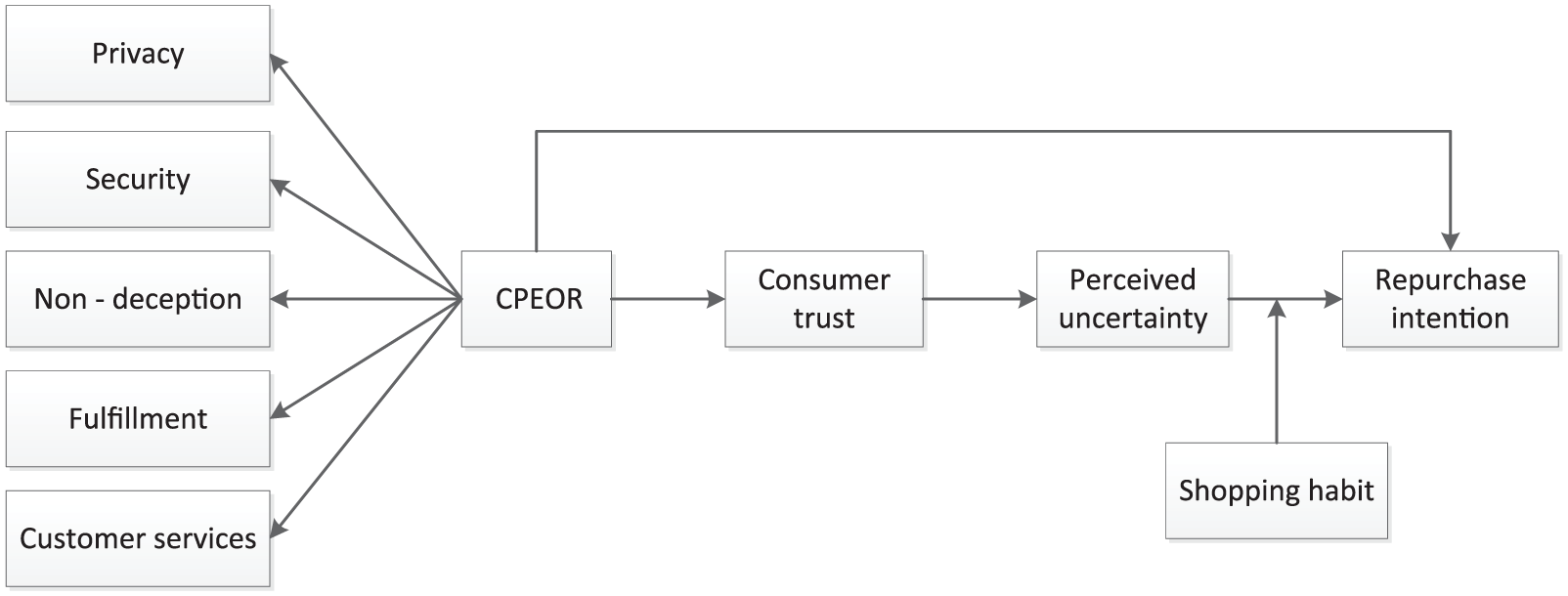
Research model.
Research Methodology
This research applied survey research methodology to test the research model. In this section, we report the details of survey design questionnaire distribution and data collection procedures.
Questionnaire Design
To measure the scales in this research, we review and adapt the relevant previous studies to develop a questionnaire with multiple 5-point Likert-type options ranging from 1 = strongly disagree to 5 = strongly agree. To simplify suitable measurement, the items were translated into Vietnamese from the original English version. CPEOR includes four components (security, privacy, non-deception, and fulfillment) adapted from Román (2007) and consumer services from Wolfinbarger and Gilly (2003); consumer trust construct from Bart et al. (2005); perceived uncertainty scale is adapted from Pavlou et al. (2007), online shopping habit is adapted from Hsu et al. (2015), and consumer RPI scale adopted from S.-W. Chou and Hsu (2016).
Data Collection
The target population comprises consumers 18 years old and above who have purchased at least one product/service online in the last 3 months. In selecting the sample, this research assumed that the case data are normally distributed; hence, at least five cases per parameter are sufficient (Bentler & Bonett, 1980). This research needs at least 145 cases for the 29 items in the final questionnaire. This research collected survey data among consumers from Lazada Vietnam (www.lazada.vn). Lazada (a member of Germany Rocker Internet) has been established in Vietnam, apart from Indonesia, Malaysia, the Philippines, Singapore, and Thailand, since 2012 and it is currently among the most frequently used and leading B2C websites in Vietnam (Choi & Mai, 2018). In April 2016, the Alibaba Group bought the dominant shares of Lazada Vietnam to expand the former’s activities in Southeast Asia.
The authors selected two of the largest cities in Vietnam (Hanoi and Ho Chi Minh City) to conduct the survey from September 1 to November 30, 2017, using convenience sampling approach. The authors chose Hanoi and Ho Chi Minh City because these are two main cities in Vietnam where the economies are the most developed and dynamic. This two cities have big universities and companies, which attracted a lot of students and people from other provinces/cities coming to study and work. This research used a part of consumer data of Lazada.vn, which includes more than 600,000 consumers. According to Saunders, Lewis, and Thornhill (2009), the sample size required (Na) can be calculated by using the equation as follows:
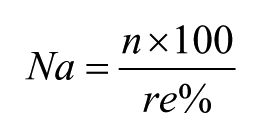
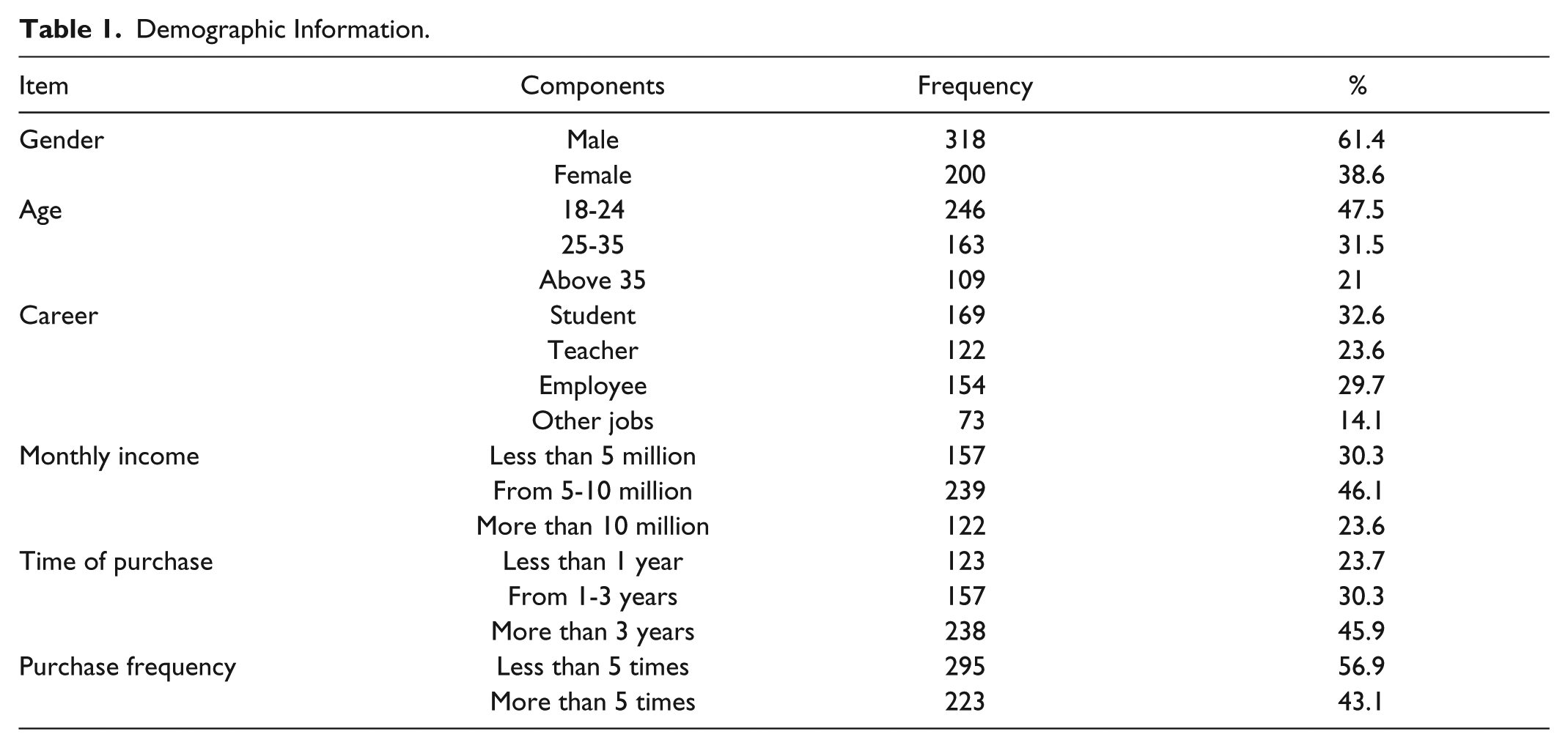
where Na is sample size required, n is the adjusted minimum (or minimum) sample size, re% is the estimated response rate. Based on Saunders et al. (2009) formula, if the margin of error is selected to be 5% and the total population is between 100,000 and 1,000,000, the minimum sample size is 384. To increase the response rate, after completing the questionnaire, consumers can receive a 10% of discounts for the next purchase from Lazada.vn. Therefore, the authors consider the response rate is 75% as suggested by Neuman (2013). Based on the formula, sample size required is 512. The authors randomly selected and sent the email with the questionnaire link to 650 consumers asking them to fill out the questionnaire. Finally, 518 questionnaires were acceptable and valid, thereby corresponding to 79.7% of acceptance rate. Table 1 shows further details of the demographic information of the respondents.
Demographic Information.
Data Analysis and Results
This research applied PLS-SEM (partial least squares–structural equation modelling) path modeling to test the hypothesis, by using the software SmartPLS 2.0.M3. The PLS-SEM path modeling is the most suitable to this research model because this study focuses on prediction and explanation of constructs variance; this research model has a complex structure with the second-order construct of CPEOR which includes five components; and the relationship of CPEOR on consumer RPI both directly and indirectly through the mediation of consumer trust and perceived uncertainty; moreover, this research also tests the moderating effect of online shopping habit in the relationship between consumer perceived uncertainty and RPI. Furthermore, PLS-SEM approach which does not require a normal distribution, as opposed to covariance-based approaches, is more suitable to the distribution.
Non-Response Bias and Common Method Bias (CMB)
The current research utilized t test to examine the difference between the early and late respondents of the survey. The results (p < .05) indicated that there is not a significance between the two groups of respondents (early response and late response), as well as gender or age. Hence, the sample of this research excluded the potentiality of non-response bias. Moreover, as noted above, the authors already increased the understanding by back translation technique (Brislin, 1970) and using short and concise items in the questionnaire. In addition, a pre-test was also performed to check the questionnaire. Finally, before evaluating the correlation between variables, Harman’s single-factor test was performed to test CMB. Unrotated factor analysis using the eigenvalue-greater-than-one criterion revealed six factors, the first explaining 21.54% of the variance. This result suggests that CMB is not a threat to the validity of our study (Podsakoff, MacKenzie, Lee, & Podsakoff, 2003).
This research then tested and explained the PLS-SEM results by assessing the measurement model and examining the structural model.
Measurement Model Results
The measurement model was analyzed by using Cronbach’s alpha (CA), composite reliability (CR), and the average variance extracted (AVE) values. Here, all factor loadings are higher than 0.811, which is satisfactory for the 0.5 cut-off. Second, CA and CR values are higher than .7 (Bagozzi & Yi, 1988) which showed that the scale is consistent and reliable. Third, AVE values of all constructs are higher than 0.5 threshold (Fornell & Larcker, 1981), showing an adequate convergent validity of all constructs used in this research. These results are depicted in Table 2.
Measurement Model.

Note. CA = Cronbach’s alpha; CR = composite reliability; AVE = average variance extracted.
To test the discriminant validity, first, this research showed that the AVE should share more variance with its assigned indicators than with any other construct (Fornell–Larcker criterion). Second, all square root of AVEs greater than inter-construct correlations indicated the discriminant validity. All results are expressed in Table 3.
Latent Constructs Correlation (Fornell–Larcker Criterion).

Structural Model Assessment
After validating the measurement model, a second-order model is created, where CPEOR is considered as second-order construct which includes five components: security, privacy, non-deception, fulfillment, and customer services. Results of reliability, convergent validity, and discriminant validity that are shown in Table 4 confirmed the suitability of the model.
Convergence, Reliability, and Discriminant Validity of the Second-Order Model.
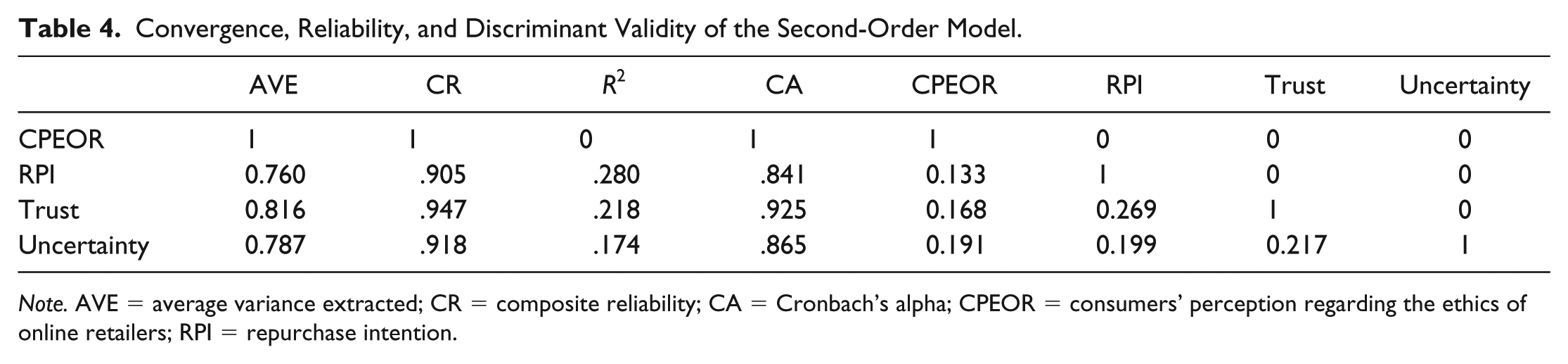
Note. AVE = average variance extracted; CR = composite reliability; CA = Cronbach’s alpha; CPEOR = consumers’ perception regarding the ethics of online retailers; RPI = repurchase intention.
This research utilizes variance inflation factor (VIF) to test the possible multicollinearity. The results showed that the VIF value of all constructs was less than 1.868, which is lower than the 3.3 threshold. This results showed that multicollinearity is not the threat to this research as suggested by Hair, Hollingsworth, Randolph, and Chong (2017). Then, this research utilizes path model analysis to test coefficients’ magnitudes. The results are expressed in Figure 2 that showed the second-order construct of CPEOR scale that includes five components.

PLS testing results.
Customer services, non-deception, fulfillment, security, and privacy explain 57.1%, 38.2%, 33.8%, 31.5%, and 11.0% (p < .05) for CPEOR, respectively. CPEOR explains significant effect on consumer trust (β = .356; p < .05), which in turn decreased perceived uncertainty (β = .423; p < .05). Interestingly, CPEOR has no direct effect on CPI (β = .070, p > .05) but CPEOR indirectly influences RPI through consumer trust, perceived uncertainty with 25.4% (p < .05).
Moreover, Table 5 depicts the testing results of the structural model path coefficients to test the proposed hypothesis. Considering the relationship between the CPEOR and RPI, the results showed that H1 is not supported (β = .135; p > .05). On the contrary, CPEOR has significant effect on consumer trust (β = .467; p < .001), which in turns influences perceived uncertainty (β = .420; p < .05). That means, H2 and H3 are supported. In the same vein, perceived uncertainty significantly relates to RPI (β = .491; p < .001). Moreover, the results demonstrated that consumer trust has influence on perceived uncertainty (β = .419; p < .001), and RPI (β = .206; p < .001). In addition, CPEOR does not show the direct effect on perceived uncertainty (β = .196; p > .05).
Structural Model Path Coefficients.

Note. CPEOR = consumers’ perception regarding the ethics of online retailers; RPI = repurchase intention.
p < .05. **p < .001. ***ns.
Moderating Effect Testing
To test the moderating role of habit, we used the formula suggested by Chin, Marcolin, and Newsted (2003) to evaluate the difference in path coefficients between high habit group and low habit group; t-statistics has been estimated by applying Chang, Hsu, Hsu, and Cheng (2014). The testing result supported the hypothesis with low habit group (n = 218) and high habit group (n = 300). The results in Table 6 showed the difference between two group low habit and high habit (p < .001). Hence, the higher level of online shopping habit decreases the influence of perceived uncertainty on RPI, β = .702 in low habit group in comparison with β = .307 in high habit group.
Difference in Slopes Test.

Conclusion
Discussion and Implications
With the fast development of EC, the competition in this field is more and more cutthroat that requires managers to understand what factors influence consumer behaviors in general, and RPI, in particular. The main purpose of this study is to provide a better understanding of the importance of CPEOR. To be specific, this research examined the impact of CPEOR on CPEOR through the mediation of consumer trust and perceived uncertainty. In addition, in EC field, there is few research that has focused on the relationship between perceived uncertainty and RPI. As a consequence, this research fills this gap by examining the effect of perceived uncertainty on RPI, as well as the moderating role of online shopping habit in this relationship. To reach these ends, the current research proposed and empirically tested a model in the context of B2C EC in Vietnam which represents the developing countries where the Internet in general and EC in particular are in the fast development. This research contributes a number of findings both in theoretical and practical implications.
First, based on the literature review and suggestions of previous researchers (Elbeltagi & Agag, 2016; Román, 2007), we find that almost all research in e-retailers’ ethics issue has been executed in developed countries while few have been carried out in developing countries where there are a lot of different elements in comparison with developed countries such as economic development, technology, culture, and consumer buying habit. The results confirmed the importance of e-retailers’ ethics effect on consumer behaviors. In the context of developing countries, consumer service is the new component that was adjusted in the construct of CPEOR. In combination with the original four components (privacy, security, non-deception, and fulfillment) of Román (2007), consumer services component is ranked in the second position (β = .617; R2 = 38.0%). Marketers have to understand that to take consumers to the level of making purchases, their websites must offer superior consumer services.
Second, CPEOR indirectly influences RPI through the mediation of consumer trust and perceived uncertainty. This evidence reconfirmed the findings of Elbeltagi and Agag (2016) and Limbu et al. (2012) that trust is full mediation between CPEOR and consumer RPI. As confirmed by previous marketing scholars, RPI and word-of-mouth are two main components of consumer loyalty in EC. This research also supported the finding of the direct link between CPEOR and trust such as Román and Ruiz (2005) and M.-H. Yang et al. (2009). Interestingly, in contrast with previous research (such as Sharma & Lijuan, 2014), this research showed that CPEOR does not directly influence RPI. These findings suggested marketers that online consumers could be easier to trust in e-retailers and to return to purchase if they perceive partners well perform the ethics in their actions.
Third, the previous research in EC often listed consumer perceived uncertainty as a barrier but most of them considered uncertainty in the same meaning with risks, Pavlou et al. (2007) focused on this issue. This research focused on the online consumers who have purchased online in the last 3 months to have a thorough grasp of what factors can affect and lead them to repurchase from a specific retailer who they have transacted with. The findings showed that perceived uncertainty negatively affects RPI. This research contributes to the theory that CPEOR indirectly mitigates the negative impact of perceived uncertainty through consumer trust. According to Pavlou et al. (2007), CPEOR and consumer trust can be considered as “uncertainty mitigators” (Pavlou et al., 2007).
Fourth, the findings indicated the crucial role of consumer trust in mitigating uncertainty perception (β = .4195; p < .05). Moreover, consumer trust also contributes as a mediating factor between CPEOR and perceived uncertainty. That means, ethics does not directly decrease consumer uncertainty but indirectly via consumer trust. In addition, consumer trust has both direct (β = .2061; p < .01) and indirect effect on RPI through perceived uncertainty (β = .151; p < .01). This finding supports the confirmation of previous research such as Agag et al. (2017) and Sullivan and Kim (2018).
Finally, consumer online shopping habit is the important factor in EC as confirmed by previous research, especially in developing countries, with the lack of trust, high level of risks, consumers prefer to buy in brick-and-mortar stores than in e-store (Choi & Mai, 2018). In the sample, there are 218 respondents in the low-habit group in contrast with 300 in the high-habit with online shopping. This result is not contradictory with the argument of Choi and Mai (2018) because this research was deployed in Hanoi and Ho Chi Minh city—the two biggest cities in Vietnam and as mentioned above, the focusing respondents were the online consumers who have bought at least one product on the www.lazada.vn in the last 3 months. The finding showed that the higher level of online shopping habit, the lower influence of perceived uncertainty on RPI happens. This research supported the arguments indicated in Chiu, Wang, Fang, and Huang (2014). This finding suggests marketers deploying loyalty programs to foster shopping online habit of consumers.
Limitations and Future Research
Despite the findings, there are some limitations to this research. First, data collection in this study was constrained to data pertaining to online shoppers who already had the experience in EC by purchasing in the last 3 months from a specific online website (Lazada.vn). The selection of the two biggest cities in Vietnam (Hanoi and Ho Chi Minh City) may not represent the total population of Vietnam. Future research can focus on both experiential consumers and non-experiential consumers in other cities both in urban and rural areas in Vietnam. Moreover, the aim of our research is to discover consumer behavioral intention in developing countries, but we executed only in Vietnam so other researchers could focus in two or more countries to have a deeper understanding about the RPI and its antecedents. Second, this research considered CPEOR as a second-order construct and examined the consequences such as trust, uncertainty, and RPI. Therefore, future research could examine other consequences to have a comprehensive understanding about this issue. Third, consumer trust here is considered as a one-dimensional construct but other research such as M.-H. Yang et al. (2009) suggested that trust is a complex construct. Thus, future research could consider trust as a multi-dimensional construct to better explain its roles because it is a crucial factor of EC (S. Chou & Chen, 2018; Gefen & Straub, 2004). In conclusion, by the arguments and explanations above, this research confirmed the sustainable role of CPEOR. Finally, this research did not focus on how product types could have an effect on the relationship between CPEOR and its consequences. This gives the opportunity to the future research.
Footnotes
Declaration of Conflicting Interests
The author(s) declared no potential conflicts of interest with respect to the research, authorship, and/or publication of this article.
Funding
The author(s) disclosed receipt of the following financial support for the research, authorship, and/or publication of this article: The authors thank the funding that supported them to conduct this research: HNSSKP (2017ZK3054) and HNSSKP (2015ZK3098) from the Soft Science Key Project of Hunan Province for this project.
