



Abstract
This study conducted a bibliometric analysis of 597 publications on the integration of digital technology into physical education (PE), sourced from the Web of Science Core Collection (2010–2024), using CiteSpace for visualization. The aim was to identify the current research status, hotspots, and trends in this field. The results revealed that a steady growth in publications, with the United States, Spain, the United Kingdom, and South Korea playing leading roles. Research hotspots have become increasingly diverse and specialized, focusing on five key areas: PE curriculum and teaching in primary and secondary schools supported by digital technology, integrating technology for PE learning performance assessment and enhancement, integrating technology for children’s physical health promotion, PE teacher education supported by digital technology, higher PE supported by digital technology. The development of this field has gone through stages of initial exploration, in-depth development, and mature stability, each characterized by shifting research emphases that reflect broader technological advancements.
Plain Language Summary
This bibliometric study examines 597 publications (2010–2024) from the Web of Science Core Collection to map the evolution of digital technology applications in physical education (PE). Using CiteSpace for co-occurrence, collaboration, and burst analysis, the research identifies five key themes: (1) technology-enhanced K-12 PE pedagogy, (2) performance assessment tools, (3) digital interventions for children’s health, (4) teacher training in digital literacy, and (5) innovations in higher education. Findings highlight accelerated growth post-2020, driven by the COVID-19 pandemic and advancements in AI, wearables, and blended learning. Leading contributors include the U.S., China, Spain, and South Korea, though institutional collaboration remains sparse. The field progressed through exploratory (2010–2017), developmental (2018–2021), and mature (post-2022) phases, shifting focus from engagement to educational innovation. The study underscores the need for interdisciplinary collaboration, evidence-based practices, and balanced integration of technology to avoid over-reliance while addressing equity and pedagogical alignment. This synthesis provides a foundational framework for researchers and policymakers to advance PE’s digital transformation sustainably.
Keywords
Introduction
Technological innovation has consistently driven social change. Since the emergence of computers in the 1950s, society has experienced a steady evolution from informatization to digitization, accompanied by a transformation in how information is recorded and stored—from reliance on paper-based media to the ubiquity of digital networks. This shift has dramatically enhanced the capacity for data conversion and processing. Today, with the intelligent application of cutting-edge technologies such as big data, cloud computing, generative artificial intelligence, and the metaverse, digital innovations have profoundly reshaped productivity and everyday life. Education, as a key domain of societal development, has likewise been transformed. Policymakers worldwide have recognized the strategic value of educational digitalization, promoting innovation in instructional models and optimizing the allocation of educational resources (Selwyn & Facer, 2014). In the United States, for example, the Department of Education has issued initiatives targeting digital access, instructional design, and usage (U.S. Department of Education, 2024). The European Union has implemented its Digital Education Action Plan with a focus on digital competencies (European Commission, 2021), while Russia’s Digital Education Environment Project proposes to build modernized digital education platforms (ПравительствоРоссии, 2017).
Physical education (PE), as an iintegral component of school curricula, aims to enhance students’ physical fitness, develop motor skills and foster holistic growth through physical activities and sports exercises. The growing availability of digital tools provides unprecedented opportunities to support high-quality development in PE. Contemporary PE classerooms are significantly different from those of the past. Digital technologies facilitate adaptation to evolving conditions and open avenues for pedagogical innovation and reform (Varea et al., 2022). As such, the integration of digital technology into PE has emerged as a research topic of substantial significance and value.
Beyond improvements in physical activity and performance, recent scholarship has highlighted the psychological implications of digital technology in PE. Exergames and interactive platforms have been found to stimulate situational interest and intrinsic motivation by transforming exercise into playful and engaging experiences (Fogel et al., 2010; Potdevin et al., 2018). Wearable devices and feedback systems can strengthen self-regulation and promote activity, though concerns remain regarding their effects on body satisfaction and sustained motivation, particularly among adolescents (Kerner et al., 2019). Mobile application–integrated PE programs have been shown to enhance self-efficacy and psychosocial beliefs, reinforcing children’s long-term commitment to active lifestyles (Lee & Gao, 2020). Furthermore, longitudinal interventions embedding digital monitoring systems into school contexts have demonstrated not only short-term gains in participation but also enduring benefits for cardiovascular fitness, engagement, and psychological well-being (Hartwig et al., 2019; Zach et al., 2016). These findings indicate that the psychological dimension constitutes a critical facet of digital technology’s role in PE, complementing its physical and pedagogical contributions.
Although several narrative and systematic reviews have examined the role of digital technology in physical education, most prior works have been limited in scope, focusing either on specific tools (e.g., exergames, wearables) or short time periods, and often lacking large-scale quantitative mapping of the field (Osterlie et al., 2023; Sargent & Calderon, 2022). Moreover, previous reviews rarely employed bibliometric visualization techniques. Against this backdrop, the study conducts a systematic bibliometric review of research on integration of digital technology into PE, visually revealing the developmental trajectory, hotspots, and future directions of this field, with the intention of providing a clear and comprehensive perspective to promote the in-depth and sustainable development of research on integration of digital technology into PE.
Methodology
Method and Data Source
Scientometrics provides comprehensive and in-depth quantitative analyses of scientific literature, with applications that include identifying the essence of scholarly contributions, exploring the structure of fundamental research, tracing citation development trends, and revealing knowledge frameworks and emerging trends (Rawat & Sood, 2021). Knowledge mapping is the key technology in the field of scientometrics, presenting valuable information from massive literature data in an intuitive and easily understandable format, including citation network visualization, collaboration network visualization, topic evolution analysis, and research hotspot analysis (C. Chen, 2006). Keywords serve as concise representations of a publication’s core content, which can accurately reflect the theme, research scope and core viewpoints of the literature. CiteSpace extracts the keywords in the corresponding literature and presents their frequency distribution and clustering relationship in the form of visualization, so as to analyze the developmental trends and research hotspots (J. Li & Chen, 2022). In addition, keyword citation burst analysis helps to identify emerging frontiers within the field (Y. Chen et al., 2015).
The data for this study were retrieved from the Web of Science Core Collection, including the SCI, SSCI, AHCI, and ESCI databases. The search strategy was defined as TS = (digital* OR technolog*) AND TS = (“physical education”), with the time span set from January 2010 to March 19, 2024. This query initially identified 1,349 records. To ensure transparency and reproducibility, we applied explicit inclusion and exclusion criteria in a stepwise process. As for the inclusion criteria, only peer-reviewed journal articles and reviews written in English were considered eligible, provided that they explicitly focused on the integration, application, or evaluation of digital technologies in the context of PE. Publications addressing teaching, learning, health promotion, assessment, or teacher training within PE were retained. As for the exclusion criteria, non-research items such as conference abstracts, book reviews, editorial materials, news reports, letters, and retracted publications were excluded (n = 101), as were records that were duplicates (none were identified in this case). We also excluded studies in which the title, abstract, or keywords indicated irrelevance, such as those focusing on general physical activity without a digital technology component, or those discussing digital technology in education without a clear connection to PE. For ambiguous cases, full texts were carefully examined, and when necessary, a third researcher was consulted to resolve uncertainties. Following this process, 651 irelevant records were excluded, and a total of 597 publications that met all criteria were ultimately included for bibliometric analysis.
CiteSpace
CiteSpace is a powerful Java-based visualization tool for scientific knowledge (C. Chen et al., 2014), which can be employed to obtain the quantitative and visual information across diverse research domains (C. Chen et al., 2012). It generates knowledge maps in the form of node-and-link diagrams, where nodes represent countries or regions, institutions, authors, or keywords. Node size indicates the frequency of publication or citation, while connecting lines indicate relationships between nodes. Line colors correspond to specific years, and line thickness denotes the strength of the relationship. Purple rings around nodes illustrate betweenness centrality, which is measured by the number of shortest paths that pass through a given node (Wei et al., 2015). The thicker the ring, the higher the betweenness centrality.
To conduct a systematic review of research on integration of digital technology into PE, the study utilized CiteSpace to visualize five types of scientometric analysis networks: country/region collaboration, institution collaboration, co-authorship, keyword co-occurence and keyword timeline. Furthermore, keyword citation burst analysis to determine the research hotspots that received considerable attention within specific was performed to identify research hotspots that attracted significant attention during specific periods. Burst strength indicates the intensity of keyword activity, while the beginning and ending years mark critical turning points in scholarly focus. Table 1 provides the parameter settings used in CiteSpace, including time slice, node types, selection criteria (g-index and scale factor), and pruning methods.
Parameter Setting of CiteSpace.

Note. To keep the number of nodes in the keyword co-occurrence network at about 100, the years per slice is set to 2 and k is 5. The remaining parameters were the default settings.
Results
Analysis of Annual Publications
Figure 1 presents the annual distribution of publications on digital technology integration in PE. Research in this field began in 2010 but entered a dormant phase that lasted for 7 years. A notable increase in publications emerged in 2017, and particularly since 2020, the field has experienced an “explosion” in the number of publications, marking a period of rapid development. In 2022, the number of publications in this research field peaked at 185 before showing a slight decline. As the data collection for this study extended only to the first quarter of 2024, the figure of 23 publications reported for that year does not reflect the full research output for 2024.

Annual number of published articles from 2010 to 2024.
Analysis of Country or Region Distribution
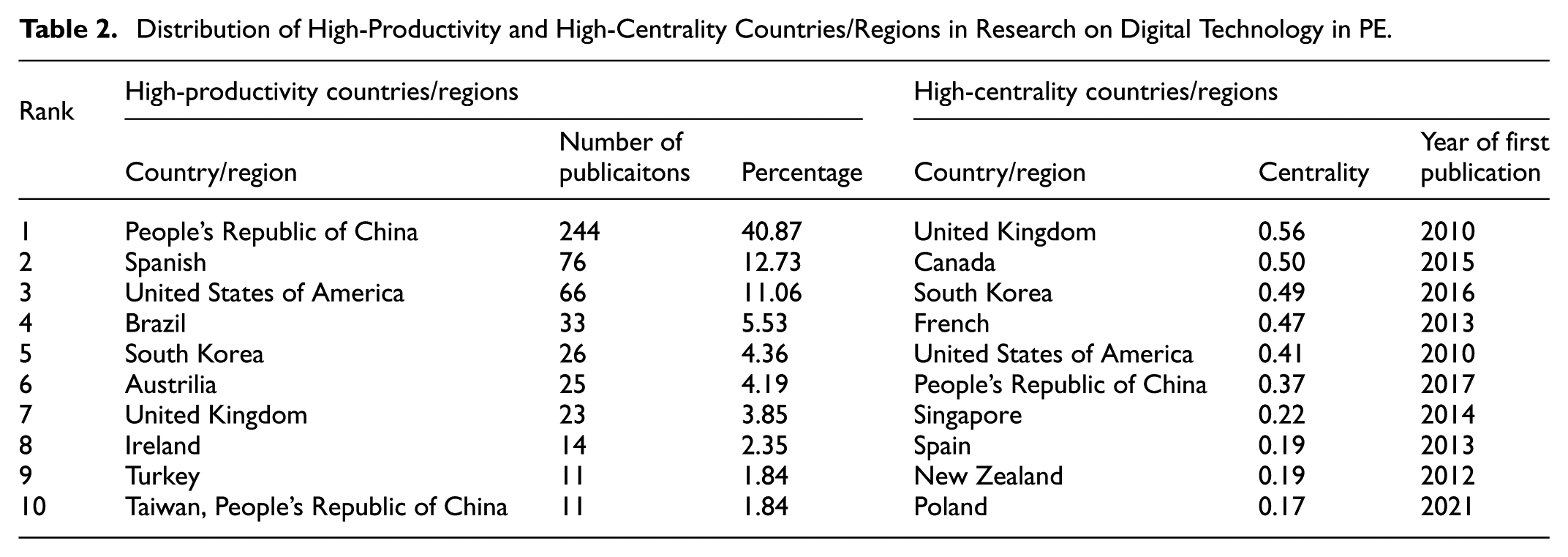
To find out which countries or regions contribute most to research on integration of digital technology into PE, a country or region collaboration network was generated (Figure 2). Table 2 presents the top 10 countries/regions ranked by research output and network centrality. China leads with 244 publications, accounting for 40.87% of the total, followed by Spain, the United States, Brazil, South Korea, Australia, the United Kingdom, Ireland, Turkey, Taiwan. These countries or regions demonstrate strong research capacity and have made significant contributions to the advancement of research on integration of digital technology into PE. In the collaboration network, betweenness centrality indicates the extent of a country’s connections with others and its overall position in the research landscape (Wu & Li, 2018). The top 10 countries or regions with the highest betweenness centrality are the United Kingdom, Canada, South Korea, France, the United States, China, Singapore, Spain, New Zealand, and Poland. Their central roles highlight their importance as hubs in the global collaboration network, exerting considerable influence on the development of research in this field.

Country/region collaboration network in research on digital technology in PE.
Distribution of High-Productivity and High-Centrality Countries/Regions in Research on Digital Technology in PE.
Analysis of Institution Distribution
To identify which institutions contribute most to research on integration of digital technology into PE, an institutional collaboration network was generated (Figure 3). The results indicate limited inter-institutional connections and the absence of a well-established international collaboration network. Table 3 presents the top eight institutions with the highest publication output in this research area. Although 14 institutions produced four publications each, only the eight most productive are reported here, in descending order: the University of Granada, University of Limerick, Ministry of Education & Science of Ukraine, Universidad de Alicante, Chengdu Sport University, California State University System, Arizona State University and University of Valencia.
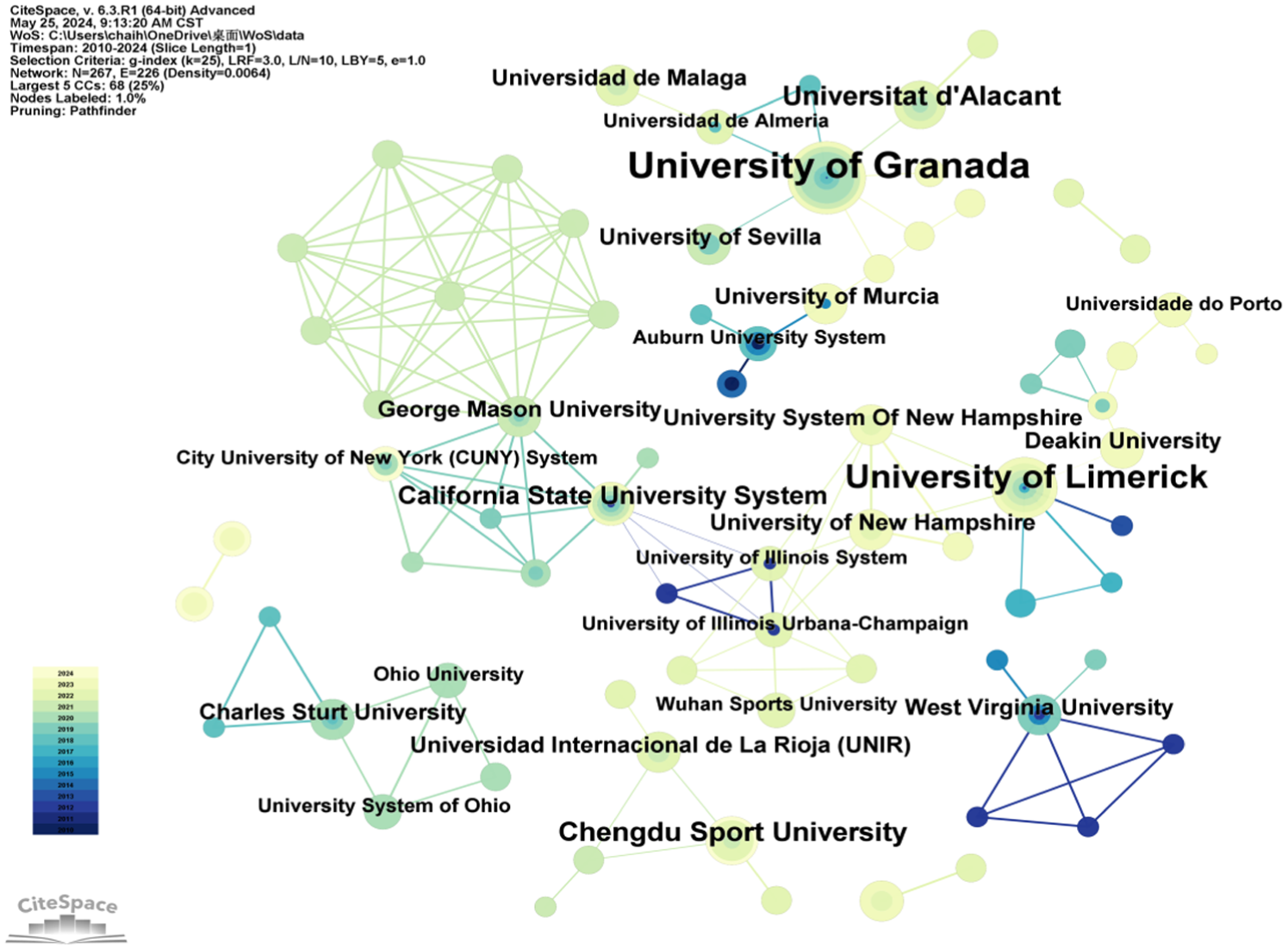
Institution collaboration network in research on digital technology in PE.
Distribution of High-Productivity Institutions in Research on Digital Technology in PE.

Analysis of Author Distribution
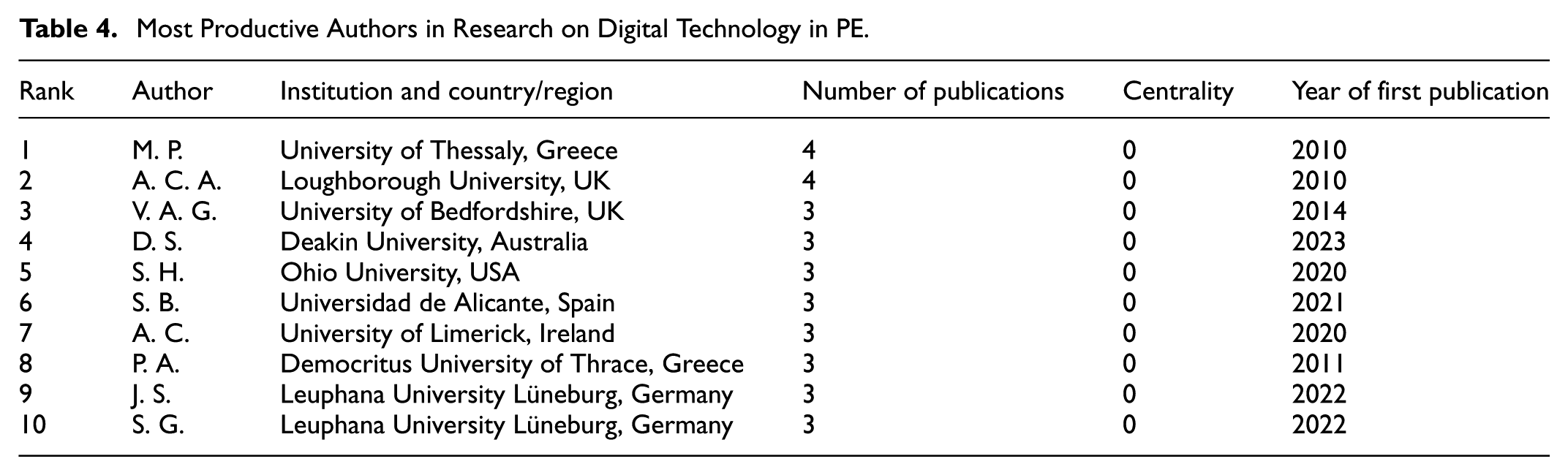
The author distribution network is shown in Figure 4. A total of 308 nodes and 227 links are identified, yielding a density of 0.0048. Table 4 lists the top 10 most productive authors in the field. To comply with the General Data Protection Regulation (GDPR), only the initials of author names are presented in Figure 4 and Table 4. The leading contributors are M. P. and A. C., each with four publications. M. P. has examined the development of students’ information and communication technologies (ICT) skills, and the educational potential of ICT in PE, particularly its influence on students’ intrinsic motivation. A. C. has investigated the benefits of integrating digital technology into PE and PE teachers’ attitude and capacity to use digital technology. However, all authors recorded a betweenness centrality of 0. The high number of authors shows a broad participation in the field of research, while the low network density and absence of central figures suggest a loosely connected author network with no single scholar occupying a pivotal role in knowledge flow or information exchange.

Co-authorship network in research on digital technology in PE.
Most Productive Authors in Research on Digital Technology in PE.
Analysis of Co-Occurring Keywords
The keyword co-occurrence networkis displayed in Figure 5. Table 5 identifies the top keywords based on frequency and centrality in the co-occurrence analysis. High-frequency keywords (e.g., “physical education,”“technology,”“health”) reflect popular research themes, while high-centrality keywords (e.g., “children,”“performance,”“motivation”) indicate terms that bridge multiple thematic clusters. The high-frequency and high centrality keywords reveal the conceptual structure and core topics in this research domain.

Keyword co-occurrence network in research on digital technology in PE.
High Frequency and High Centrality Keywords in Research on Digital Technology in PE.

Clustered network analysis was performed using log-likelihood ratio (LLR) algorithm to identify cluster labels, and the keyword timeline map was generated further (Figure 6). The timeline illustrates the emergence and evolution of keyword clusters over time. The results show that nine clusters were identified with a modularity value of 0.7516 (above 0.3) and a mean silhouette value of 0.8679 (above 0.7), which indicates that the clustering results of this study is efficient and convincing, and that keywords within each cluster exhibit high homogeneity. The solid lines in the figure denote the active periods of each cluster. Since 2010, four clusters have emerged in the field: cluster #0 (physical education), cluster #4 (interactive learning environments), cluster #7 (social robotics), and cluster #8 (blended learning). These represent the early stages of research in this field. Among them, cluster #0 and cluster #4 have remained highly influential to the present day. Additional clusters have appeared over time: cluster #3 (teacher education) and cluster #5 (smartphones) in 2014; clusters #1 (information) and #2 (new network interconnection technology) in 2016; and cluster #6 (digital technology) in 2019.

Keyword timeline map of research on digital technology in PE.
By combining keyword co-occurrence network, clustered network analysis, and qualitative analysis of key publications, the major research themes can be summarized as follows: (1) PE curriculum and teaching in primary and secondary schools supported by digital technology, (2) integrating technology for PE learning performance assessment and enhancement, (3) integrating technology for children’s physical health promotion, (4) PE teacher education supported by digital technology, and (5) higher PE supported by digital technology.
Analysis of Keyword Citation Burst
CiteSpace keyword citation burst identified 25 burst keywords related to the integration of digital technology into PE (Figure 7). The strongest burst was observed for the keyword “digital technology” (strength = 4.48), lasting from 2022 to 2024. Regarding duration, keywords such as “participation,”“self efficacy,” and “model” exhibited high intensity with four-year cycles, whereas most other high-strength keywords persisted for only about 2 years. Additionally, it is worth noting that “digital technology,”“video feedback,”“educational innovation,”“acceptance,” and “elementary school” have emerged within the past 3 years, indicating that these themes are new directions for research on integration of digital technology into PE.

Citation burst keywords of research on digital technology in PE.
Discussion
Overview of Research on Integration of Digital Technology into PE
This scientometric study provides a comprehensive overview of 597 articles indexed in WoS between 2010 and 2024, outlining the research landscape of digital technology integration in PE. The results reveal a fluctuating yet generally upward trajectory of publications in this field. In its early phase, research remained relatively limited due to the immaturity and low penetration rate of technological tools and infrastructure. As digital technologies matured and became increasingly accessible, the PE field began to explore the diversified application scenarios and pedagogical innovations. A particularly notable turning point occurred in 2020 with the outbreak of the COVID-19 pandemic, which disrupted conventional face-to-face PE instruction worldwide. A UN report indicates that 94% of learners in more than 200 countries were affected, with 1.58 billion students ranging from preschool to higher education facing pandemic-related educationsl needs (United Nations, 2020). Online and remote learning rapidly became the default mode of instruction. For PE, this unprecedented situation not only challenged traditional teaching approaches but also accelerated the adoption of digital technologies. Schools and educators were compelled to employ interactive video platforms, wearable monitoring devices, and gamified applications to sustain students’ physical activity and engagement during lockdowns (Varea et al., 2022; Zheng et al., 2021). Beyond this immediate shift, the pandemic has left a lasting imprint on the trajectory of PE digitalization. It normalized digital platforms as essential rather than supplementary teaching tools, stimulated policy-level support for educational digitalization, and encouraged researchers to explore long-term outcomes, including impacts on students’ physical health, psychological well-being, and social connectedness.
Overall, the integration of digital technology into PE has attracted substantial scholarly attention and is likely to remain a prominent area of global research in the coming years. However, the findings reveal that large-scale cooperative networks among institutions or authors have not yet emerged in this domain, which indicates that the field is still in a formative stage, offering considerable scope for future development and collaboration. The relative looseness of existing networks may be attributed to multiple factors, including cultural differences, language barriers, resource constraints, and policy-related obstacles, all of which merit further consideration in advancing international cooperation.
Critical Reflection on Methodologies in Selected Studies
While these findings outline the overall landscape of digital technology integration in PE, it is equally important to critically reflect on the methodologies employed in the selected studies. Different research designs have generated complementary yet uneven forms of evidence (Sargent & Calderon, 2022), and a closer examination of their strengths and limitations helps to clarify how the efficacy of digital technologies in PE should be interpreted.
The reviewed studies employed diverse methodological approaches to assess the efficacy of digital technology in PE. Experimental and quasi-experimental designs provided robust evidence for short-term improvements in students’ motivation, motor skills, and engagement, as digital interventions could be directly compared with conventional instruction (Papastergiou et al., 2021; Quintas-Hijós et al., 2020). However, such designs often relied on small or convenience samples, limiting their external validity (Lee & Gao, 2020). Longitudinal studies, though fewer in number, offered valuable insights into sustained effects on physical fitness, cardiovascular health, and psychosocial outcomes (Hartwig et al., 2019; Zach et al., 2016); yet these studies faced challenges of participant attrition and contextual variability across school environments (Kerner et al., 2019). In addition, qualitative and mixed-methods research enriched the field by capturing students’ and teachers’ lived experiences, thus complementing quantitative findings with nuanced perspectives on motivation and digital literacy (Phelps et al., 2021). Nonetheless, these studies may be constrained by subjectivity in interpretation and limited scalability. Collectively, these methodological strengths and limitations suggest that while current evidence underscores the promise of digital technologies in enhancing PE, a more balanced integration of rigorous experimental, longitudinal, and mixed-method approaches is necessary to generate comprehensive and generalizable conclusions about their efficacy.
Research Hotspots on Integration of Digital Technology into PE
The study found that the research hotspots in integration of digital technology into PE are mainly concentrated on five themes.
Theme 1: PE Curriculum and Teaching in Primary and Secondary Schools Supported by Digital Technology
Theme 1 mainly focuses on how multimedia technology, ICT, wearable devices, virtual reality, augmented reality, and artificial intelligence are integrated into primary and secondary school PE to enrich instructional resources and improve teaching methods. In terms of resource integration and utilization, digital technologies have facilitated the creation of a “24/7 PE classroom” to expand opportunities for continuous learning (Hastie et al., 2010). Researchers have also developed a data mining tool to guide sports training and support technical and tactical analysis (Pan, 2019), designed a mobile sports game to improve student learning efficiency, engagement, and exercise intensity (Lindberg et al., 2016), and investigated interactive video games as a resource for PE curricula (Conde-Cortabitarte et al., 2020). With regard to PE teaching approaches, flipped classroom and blended learning models have been widely adopted. Empirical evidence suggests that flipped classrooms in PE provide more practice time for motor skills (Campos-Gutiérrez et al., 2021), enhance students’ comprehension of sports-related concepts (Ferriz-Valero et al., 2022), and foster stronger learning motivation (Osterlie et al., 2023). Blended models have also been explored for their potential advantages and limitations (López-Fernández et al., 2021; Yang et al., 2020). Additionally, collaborative learning approaches have been adapted to include digital components (Bodsworth & Goodyear, 2017). Furthermore, the COVID-19 pandemic catalyzed the expansion of remote PE, which has stimulated new research into digital and hybrid instructional models (Rutkauskaite et al., 2022).
The integration of flipped classrooms, blended learning, and immersive digital tools reflects a paradigm shift toward student-centered and constructivist pedagogies in PE. This trend reveals the importance of investigating how digital interventions reshape engagement, collaboration, and self-regulated learning, which highlights the need to prepare pre-service and in-service teachers to design and teach technology-enhanced lessons that balance motor skill development with interactive, digitally mediated learning experiences. The findings also imply that PE should systematically integrate digital resources and flexible instructional models, positioning technology as a core structural element that supports diverse learning needs and evolving educational contexts.
Theme 2: Integrating Technology for PE Learning Performance Assessment and Enhancement
Theme 2 explores how digital technologies are employed to assess and enhance student performance in PE. A growing body of research demonstrates that the integration of technological tools can strengthen outcomes such as health, learning motivation, interest in physical activity (Botagariyev et al., 2024; O’Loughlin et al., 2013; Papastergiou et al., 2021; Potdevin et al., 2018; Roure et al., 2019; Sargent & Calderon, 2022; Varga & Révész, 2023). For instance, digital video analysis and gamified learning environments have been shown to provide timely feedback, increase engagement, and improve motor skill acquisition (Quintas-Hijós et al., 2020). However, Lee and Gao (2020) also suggest that short-term integration of digital technology may not be sufficient to produce sustained improvements in students’ PE performance (Lee & Gao, 2020).
The growing reliance on digital assessment tools reflects a broader shift toward evidence-based pedagogy in PE. Educational research should investigate how data-driven feedback mechanisms shape not only immediate performance outcomes but also students’ motivation, self-regulation, and long-term learning trajectories. For teacher education, it highlights the necessity of equipping pre-service and in-service teachers with data literacy skills, particularly the ability to interpret digital performance metrics and adapt instruction accordingly. Moreover, the findings also suggest that assessment frameworks should evolve to incorporate digital tools capable of capturing cognitive, motivational, and psychosocial dimensions of learning.
Theme 3: Integrating Technology for Children’s Physical Health Promotion
The increasing prevalence of overweight and obesity among children has raised concerns about their physical health, making it a key research focus in the integration of digital technology within PE. Studies have shown that the introduction of digital tools, such as exergames, wearable devices, and interactive platforms, can make physical exercise more engaging, while enabling real-time monitoring and feedback that increase opportunities for active participation (Fogel et al., 2010; Hartwig et al., 2019; Nation-Grainger, 2017; Zach et al., 2016). These features contribute to short-term improvements in motivation and physcial activity level. However, beyond these short-term effects, longitudinal evidence reveals a more complex picture of the lasting impact of digital technologies on children’s physical fitness and overall well-being. On the one hand, research indicates that extended use of health wearables may diminish autonomous motivation and reduce sustained engagement in high-intensity activities, thereby limiting the durability of initial benefits (Kerner et al., 2019). On the other hand, longitudinal interventions embedding digital monitoring systems into school and family contexts have reported enduring improvements in body composition, cardiovascular fitness, and regular activity patterns (Hartwig et al., 2019; Zach et al., 2016).
These contrasting findings indicate that long-term effects are shaped not only by technological tools but also by pedagogical design, contextual support, and the balance between external monitoring and intrinsic motivation. Sustainable outcomes therefore depend on how digital interventions are embedded within broader educational environments rather than on the technology alone. To strengthen this alignment, greater attention should be given to fostering digital health literacy and self-regulation skills in PE programs. When students are equipped to critically engage with digital tools and manage their own activity behaviors, technology becomes more than a short-term motivator; it evolves into a catalyst for enduring health improvements and the cultivation of active lifestyles.
Theme 4: PE Teacher Education Supported by Digital Technology
Teacher education has become a pivotal theme in the digital transformation of PE, as the effectiveness of technology integration ultimately depends on teachers’ capacity to employ digital tools in meaningful ways. Existing studies have investigated multiple dimensions of this issue, including teachers’ ability to apply game design principles or interactive platforms in classroom practice (Pill et al., 2021), digital literacy levels (Belmonte et al., 2020), attitudes and knowledge levels towards digital applications (Barahona et al., 2020; Tou et al., 2019). PE teachers need professional preparation that addresses both technical proficiency and pedagogical integration, ensuring that digital innovations are not used superficially but aligned with broader educational goals (Krause et al., 2020). The emphasis on teacher competence reflects a recognition that digital technologies reshape not only instructional tools but also the professional identity of PE teachers. Training programs that embed authentic digital teaching scenarios and encourage reflective practice have shown promise in helping teachers integrate technology in ways that enhance student engagement and learning outcomes (Calderón et al., 2020; Hyndman & Harvey, 2020). Strengthening these programs with structured opportunities to develop technological pedagogical content knowledge (TPACK) is particularly important, as it enables teachers to harmonize subject knowledge, pedagogy, and digital innovation (Gawrisch et al., 2020; Phelps et al., 2021).
By cultivating such competencies, PE teacher education can establish a foundation for sustainable digital transformation. When PE teachers are able to critically evaluate emerging technologies, adapt them to diverse classroom contexts, and align them with curriculum objectives, technology adoption is more likely to move beyond experimental trials and become a stable, integrated component of everyday practice. This, in turn, enhances the quality and inclusivity of PE instruction while fostering a professional culture that embraces innovation as a continuous process.
Theme 5: Higher PE Supported by Digital Technology
The integration of digital technology in higher PE ihas generated innovative approaches to teaching, learning, and assessment. Recent studies have explored blended learning methods that combine online courses with digital communication platforms (Zheng et al., 2021), reflective practices supported by motion-tracking sensors (Yu et al., 2020), and mobile flipped learning strategies that promote deeper engagement with subject content (Lin et al., 2022). In addition, advanced technologies such as artificial intelligence and neural networks have been applied to design autonomous learning systems and predictive evaluation models, offering new ways to monitor and enhance student performance (Ge et al., 2018; Xu & Rappaport, 2019; Zhang, 2021). Empirical findings indicate that these digital interventions can increase student motivation, improve physical fitness, and strengthen academic achievement (Hung et al., 2018; Z. H. Li & Wang, 2021).
Beyond their immediate impact on performance, these developments point to a broader transformation in how higher PE is conceptualized. Digital tools not only provide novel instructional resources but also encourage a shift toward more flexible, learner-centered models of education. The incorporation of AI-based systems and sensor technologies highlights a move toward personalized learning environments where feedback is continuous, data-driven, and tailored to individual needs. At the same time, these innovations call for critical reflection on issues such as equity of access, ethical use of data, and the balance between technological efficiency and pedagogical depth. Sustainable integration of digital technology in higher PE depends on embedding these innovations within coherent curricular frameworks. When thoughtfully designed, digital platforms can enhance traditional instruction rather than replace it, creating hybrid models that combine the strengths of in-person practice with the adaptability of digital environments. Such an approach not only equips students with physical skills and knowledge but also cultivates digital literacy, critical thinking, and the capacity to engage with technology as future professionals in an increasingly digitized world.
Research Trends on Integration of Digital Technology into PE
The development of research on integration of digital technology into PE shows distinct stage-specific features. The first stage, initial exploration (2010–2017), marked the early adoption of digital tools in PE, driven by their advantages in processing, transmitting, and connecting information. Research during this period mainly concentrated on applying these technologies to enhance students’ engagement in PE, promote physical activities, and imporove learning motivation. The second stage, in-depth development (2018–2021), built on earlier experiences and was fueled by the rapid development of new technologies. Researchers began to pay more attention to include self-efficacy, teaching evaluation, sports monitoring and feedback, and digital literacy, reflecting more diverse and sophisticated applications of technology. The third stage, matuity and stability (after 2022), has been characterized by exploration of new directions. Current researches focus on educational innovation supported by digital technology and the development of new pedagogical concepts and models tailored to the digital age.
Shifts in research hotspots are mainly driven by continuous technological progress and updates, which stimulates innovation and directs short-term attention to emerging issues in PE. In addition, the ultimate goal of research on integration of digital technology into PE remains to better serve educational practice. Consequently, evovling educational needs and feedback from practice will continue to reshape research priorities in this field.
Educational Theories Underpinning Digital Technology Integration in PE
While the bibliometric analysis has revealed distinct research hotspots and developmental stages in the integration of digital technology into PE, these patterns gain deeper meaning when interpreted through broader educational theories of technology integration. The constructivist learning perspective helps explain why immersive tools such as exergames, virtual reality, and flipped classrooms have become recurring hotspots: they operationalize the principle that knowledge is actively constructed through interaction and experience, thereby enhancing engagement and motivation in PE contexts (Selwyn & Facer, 2014; Varea et al., 2022). The emphasis on ICT, gamification, and mobile applications observed in our results can also be understood through the lens of digital literacy, which highlights the competencies required by students and teachers to effectively access, evaluate, and apply digital resources; in this sense, the identified hotspots represent not only technological innovations but also the cultivation of essential twenty-first century literacies (Belmonte et al., 2020). Furthermore, the growing attention to PE teacher education and teacher digital competence, as revealed in the bibliometric clusters, resonates strongly with the TPACK framework, which conceptualizes how technology, pedagogy, and content knowledge must be integrated for meaningful teaching practice (Gawrisch et al., 2020; Krause et al., 2020). Taken together, these theoretical perspectives do not merely validate the bibliometric findings but also clarify why certain themes, such as immersive learning, digital competencies, and teacher training, have become focal points, thereby demonstrating how the integration of digital technologies in PE both reflects and advances broader pedagogical transformations.
Limitations and Future Research
Although this study provides a comprehensive overview of global research trends in the integration of digital technology into PE, several limitations should be acknowledged. One important limitation concerns the scope and representativeness of the dataset. This single-source reliance may privilege research outputs from English-speaking and resource-rich regions, thereby underestimating contributions from less visible or regionally significant contexts. Moreover, bibliometric analyses are inherently shaped by structural imbalances, as publication and citation patterns often privilege countries and institutions with greater resources, stronger international visibility, and English-language advantages. These constraints may lead to the overrepresentation of certain regions while underestimating valuable contributions from less visible or resource-constrained contexts. Therefore, future bibliometric research should expand to multiple databases, incorporate non-English publications, and adopt comparative regional perspectives to more accurately capture the diversity of global scholarship.
Another limitation lies in the methodological scope. Although CiteSpace provides powerful visualization and clustering functions, bibliometric approaches cannot fully capture the qualitative dimensions of digital technology integration in PE, such as pedagogical innovations, classroom practices, or the lived experiences of teachers and students. Furthermore, keyword-based retrieval and clustering involve a degree of ambiguity, as different indexing terms, synonyms, or translation practices may affect which studies are included or how clusters are labeled. This methodological uncertainty may lead to the over- or under-representation of specific topics. These constraints highlight the need for mixed-methods approaches that combine large-scale bibliometric mapping with qualitative or case-based studies, thereby generating a richer and more context-sensitive understanding of technology use in PE.
Finally, the rapid pace of technological innovation also raises new questions that extend beyond the scope of this study. One promising avenue is to explore the pedagogical impact of immersive technologies such as virtual reality and augmented reality on motor skill development, student motivation, and inclusivity, while also considering challenges of accessibility and practical implementation. Another important direction involves artificial intelligence, which has the potential to personalize PE instruction through adaptive feedback and individualized learning pathways, though further research is needed to address ethical and privacy issues. In addition, the use of wearable devices, while shown to promote short-term motivation, requires longitudinal investigation to assess their long-term effects on physical fitness, body image, and health behaviors. Equally important is the preparation of teachers, and future studies should examine effective training models that embed digital competence frameworks such as TPACK, ensuring that teachers are equipped to meaningfully integrate technology into practice. Finally, questions of equity and inclusion deserve greater attention, particularly how socio-economic and cultural differences shape access to and outcomes of digital PE interventions, and how strategies can be designed to bridge the digital divide.
Conclusion
The study conducted a scientometric analysis of the 597 related articles indexed by the WoS Core Collection from 2010 to 2024, using CiteSpace to reveal publication distribution, research hotspots, and developmental trends in research of integration of digital technology into PE. Overall, with the rapid development of digital technology and the support of relevant policies and systems, the number of publications in the field has grown steadily and continue to attract scholarly attention. From the distribution of publications, China, the United States, Spain, the United Kingdom, and South Korea occupy leading positions in this field. However, institutional and author collaboration networks remain relatively fragmented, with most scholars still conducting independent research.
The research scope includes basic education, higher education, and teacher education. Research hotspots include (1) PE curriculum and teaching in primary and secondary schools supported by digital technology, (2) integrating technology for PE learning performance assessment and enhancement, (3) integrating technology for children’s physical health promotion, (4) PE teacher education supported by digital technology, and (5) higher PE supported by digital technology. In terms of developmental stages, research has progressed through the initial exploration, in-depth development, and maturity and stability. The focus of research in each stage has shifted in line with continuous technological innovation, reflecting the evolving role of digital technology in reshaping PE.
Implications
From the perspective of advancing academic research, the integration of digital technology into PE has demonstrated significant benefits, yet advancing research in this field requires closer alignment with the practical needs of PE as well as more diversified, interdisciplinary, and comprehensive approaches. The research system surrounding digital technology in PE should therefore be further innovated and enhanced. First, reducing the current disparity in collaboration among institutions and authors calls for deliberate efforts to build interdisciplinary and cross-sector partnerships. Collaborative initiatives that connect education with psychology, public health, sports science, and information technology can generate more comprehensive insights and foster innovative practices. Establishing international research consortia, shared digital platforms, and multi-country longitudinal projects would further strengthen institutional linkages and author networks. Second, research should adopt an evidence-based perspective and be grounded in the actual needs of “teaching” and “learning” to bridge theory and practice and address pressing challenges in PE. Finally, the goal of integrating digital technology into PE should be to serve the holistic, free, and individualized development of students. This requires balancing technological tools with sound educational concepts to avoid the pitfalls of “technology determinism,” while also translating research findings into practical applications that support both precise “teaching” and personalized “learning.”
Beyond academic insights, this study offers certain guidance for practice. First, the growing prominence of flipped classrooms, blended learning, and wearable technologies underscores their potential to increase student engagement, extend practice time, and provide real-time feedback in PE lessons. Educators should therefore integrate these digital strategies into lesson planning, ensuring that technology enhances rather than replaces physical activity. Second, teacher education programs must embed frameworks such as TPACK to prepare teachers to critically evaluate digital tools and align them with curriculum objectives. This involves cultivating not only technical proficiency but also pedagogical creativity, enabling teachers to tailor digital interventions to diverse student needs, motivate learners, and foster digital health literacy. At the policy level, the study underscores the importance of creating enabling environments for sustainable digital transformation in PE. Investment in digital infrastructure and equitable access to devices and platforms is crucial to avoid widening the digital divide between regions and schools. Policymakers should also prioritize professional development programs that enhance teachers’ digital competence and incentivize innovative pedagogical applications. Furthermore, international collaboration should be encouraged through the establishment of cross-border research projects and policy dialogues, ensuring that best practices are shared globally. Attention should also be given to issues of inclusion, privacy, and ethical use of digital technologies in educational contexts, so that digital PE advances educational equity rather than exacerbating existing disparities.
Footnotes

Author Contributions
Conceptualization, Hongqin Chai, Qiang Xue and Qi Wang; methodology, Hongqin Chai and Qiang Xue; software, Jiapeng Liang; validation, Minxu Jiang and Songtao Li. and Rui Li; data cu-ration, Minxu Jiang and Songtao Li. and Rui Li; writing—original draft preparation, Hongqin Chai, Qiang Xue and Rui Xue; writing—review and editing, Hongqin Chai, Qiang Xue and Rui Xue; visualization, Jiapeng Liang; supervision, Qi Wang; funding acquisition, Qi Wang. All authors have read and agreed to the published version of the manuscript.
Funding
The authors disclosed receipt of the following financial support for the research, authorship, and/or publication of this article: This work was supported by the National Social Science Foundation Late Grant Program. Project No.: 22FTYB001, Project leader: Qi Wang.
Declaration of Conflicting Interests
The authors declared no potential conflicts of interest with respect to the research, authorship, and/or publication of this article.
Data Availability Statement
The datasets generated during and analyzed during the current study are available from the corresponding author on reasonable request.