




Abstract
Coping with evolution and the changes it brings to the workplace remains a major concern for organizational leaders. This study explores the hotspots, trends, and future directions of the field of organizational unlearning to complement the extant research. A bibliometric analysis based on the literature collected by the Web of Science database was used to categorize or cluster different authors, their countries, institutions and different keywords (cooperation among authors, co-citation, co-occurrence of keywords), to discover their uniqueness or determine the relationship between them while using CiteSpace software to draw knowledge graphs and then results. This study advances the debate on sustainable knowledge acquisition in organizations and its interaction with organizational unlearning. It directly aids the process of radical change in workplace learning and training models and provides a clear view of the previous literature on organizational unlearning by laying a solid foundation for future research in the field of learning.
Plain Language Summary
Purpose-This paper aims to explore the hotspots, trends, and future directions of the field of organizational unlearning to better complement the research done on organizational unlearning. Methodology-A bibliometric analysis based on the literature collected by the Web of Science database is used to perform categorization or clustering of different authors, their countries or regions, and different keywords (or cooperation between authors, co-citation, co-occurrence of keywords), to discover their uniqueness or determine the relationship between them while using CiteSpace software to draw the knowledge graphs that are then displayed as results. Conclusions-Based on the findings of CiteSpace, this study has detected a positive collaboration between countries and this collaboration is more perfect between all countries, institutions, and cited authors. Implications-It is hoped that organizational unlearning will be a more frequent topic in the future, as the world of business is more and more in constant change, and the individual or organization needs more than ever to unlearn in order to better adapt and remain competitive. Therefore, the present study is based on the exploration of the intellectual structure of organizational unlearning in business management in the existing literature, it leads us to discover the emerging trends in the performance of articles, their collaborative patterns and their research constituents. This is obviously to indicate the importance and impact of the research work done by different authors in their institutions, and thus to make an assessment of its value to the wider research community. Limitations-Firstly, CiteSpace simply analyzes literature data from WOSCC, therefore, our data may not represent all of the available literature. Secondly, our study defined certain keywords that could lead to data reduction. Finally, due to the existence of multiple synonyms, there may be some overlap between different content categories in keyword grouping.
Introduction
Unlearning is one of three pillars of rapid acquisition of new sustainable, efficient, and effective knowledge and has become the most appropriate theme of study for research within our structures. Accordingly, creating an environment in which old and obsolete knowledges is regularly challenged and excluded from organizational memory becomes an imperative duty for organizations. The exercise of eliminating or modifying these old practices is referred to as “organizational unlearning.” This process allows new knowledge to be “relearned” (Easterby-Smith et al., 2012; Hedberg et al., 1976). Recent research indicates that, before the 21st century, change constituted a central aspect of contemporary organizational practices in the face of an unstable environment. However, pre-existing knowledge may impede the capacity to adapt to novel circumstances, assimilate new information, and achieve literacy (Wang et al., 2017). In a similar vein, Alvin Toffler, a prominent American futurist and businessman, posited that illiteracy in the 21st century would not be restricted to the traditional lack of reading and writing skills, but would rather encompass the inability to engage in learning, unlearning, and relearning. As the 21st century is characterized by significant alterations and developments across various organizational and institutional sectors, comprehending the progression of discussions on sustainable knowledge acquisition and its interplay with organizational unlearning becomes imperative. Moreover, acquiring a solid understanding of the extant literature on organizational unlearning is crucial for future researchers and industry leaders, as it lays the groundwork for generating ideas and identifying solutions to fundamentally transform learning and training approaches in professional settings. To investigate the knowledge structure of organizational unlearning in the field of business management as represented in existing literature, we have employed bibliometric analysis.
Bibliometric analysis is defined as a cross-disciplinary science that quantitatively analyzes all knowledge media using mathematical and statistical methods (Han et al., 2020). It can measure the evolution and development of a topic or theme over time, and identify hot topics and their authors, hot region or institutions, trending keywords, and references. It can also evaluate the correlations or links between authors, their regions of publication, their references, their journal co-citation network, and the different keywords most used in the searches on topics. To carry out this analysis, we opted for the Web of Science Core Collection (WOSCC) database for data collection, adhering to the standard principles of bibliometric analysis. As one of the most extensive databases, WOS features numerous journals and publishers, encompassing research findings in the form of academic articles, reviews, and conference proceedings. The database is also renowned for its diverse listings, up-to-date and high-quality abstracts, and bibliographic references from the scientific literature. In the same way, this paper evaluates the publications made on the theme of organizational unlearning from 1984 to 2022. Out of approximately 141 management category publications gathered from the Web of Science, a total of 137 were selected and subjected to CiteSpace analysis.
This work aims to delve much deeper into the research done on “organizational unlearning,” placing “unlearning” at the center of the knowledge acquisition cycle. Bibliometric studies, which first emerged in the late 19th century, utilize statistical techniques to analyze books, articles, and other types of publications, particularly in the scientific realm. As a result, the present study will employ CiteSpace, a Java-based program, to conduct bibliometric and visual analyses after providing an overview of its theoretical underpinnings.
This study contributes to the literature on organizational unlearning in several ways. First, it is based on the exploration of the intellectual structure of organizational unlearning in the field of business management as represented in the existing literature; second, it leads us to discover the emerging trends in the performance of articles, their collaborative patterns, and their research constituents. Third, it also allows scholars, based on the obtained cluster-IDs, to identify, group, and propose research themes associated with organizational unlearning and the different management theories to adopt. Finally, it serves to highlight the importance and impact of research conducted by various authors in their respective institutions, enabling an evaluation of its value to the broader research community. In other words, this article serves as a comprehensive summary of previous literature, clarifying areas that have received less attention and require further exploration and development in the future. We hope and expect that it will also serve as a foundational reference for future research on organizational unlearning.
The remainder of the paper is organized as follows: we first present the literary background on the study of organizational unlearning. Then, we elaborate on the methodology and analytical strategy used in the research, as well as the analytical tools employed. Third, we present the results of the bibliometric analysis conducted on CiteSpace in the form of tables and graphs. Finally, we discuss the implications of our findings and provide the conclusion in the final section.
Research Background
Hedberg (1981) was one of the first scholars to research organizational unlearning, and was considered one of the founding fathers of this study topic. The publication of the chapter “How organizations learn and unlearn” (Hedberg, 1981) in one of his seminal books generated a great deal of interest among academics, researchers, and practitioners from a variety of theoretical and empirical backgrounds. Similarly, it is important to understand that one unlearns what one does not know, and that one unlearns acquired knowledge that has become obsolete. Unlearning helps us build a base or foundation for things. We can, therefore, unlearn by questioning our acquired knowledge, beliefs, and personal knowledge, being able to analyze the phenomena that occur, and trying to understand the logic that these phenomena take without putting our opinion or point of view into it. We also ought to be able to adapt to new situations or change, and at the same time be flexible in the points of analysis of our processes. To receive and share information with our environment are the key principles of the practice of unlearning. In short, we need to unlearn when the context changes to cope with change and adapt to the new environmental norms.
According to the analyses, the first researchers to present the concept of organizational unlearning in management literature were Hedberg, Nystrom, and Starbuck in the late 1970s. However, most previous studies have concentrated on “unlearning in extremity management” (Hedberg et al., 1976; Nystrom & Starbuck, 1984; Starbuck & Hedberg, 1977). Notably, organizational unlearning is considered a prerequisite for acquiring behaviors and substituting knowledge (Bettis & Hitt, 1995; Hamel 1991; Starbuck 1996). Different themes in the extant literature remain applicable and present several arising aspects, including the unlearning process (Azmi, 2008; Wensley & Navarro, 2015), controversies between casual forgetting and unlearning (Tsang & Zahra, 2008), unlearning as a catalyst for change (Azmi & Hussain, 2008), innovation (Becker, 2010), and knowledge transfer in transnational enterprises (Tsang & Zahra, 2008; Wang et al., 2019). Many studies have also explored the links between unlearning and other themes in the areas of new product development (Lyu et al., 2020), environmental knowledge (Martelo-Landroguez et al., 2019), and health (Cegarra-Navarro et al., 2012; Rushmer & Davies, 2004). Moreover, topics such as “learning, forgetting and relearning” have directly or indirectly linked unlearning with other research streams such as general innovation, learning and change management (Klammer & Gueldenberg, 2019).
Unlearning provides a knowledge base for distinctive concepts that explosively linked. Its study, however, has evolved in a fractured way, making it difficult to grasp the full range of organizational unlearning. Because of the phenomena of diversity and fragmentation, researchers have accepted traditional and methodical reviews of the literature on unlearning to synthesize the being body of knowledge. The review papers on unlearning have thus been distinguished by Azmi (2008), Becker (2005), and Tsang and Zahra (2008), whose works belonging to the order of traditional journals, and the analyses by Hislop et al. (2014), while Howells and Scholderer (2016) on unlearning are distributed as methodological reviews. Both categories of review papers have made an inestimable contribution to the current state of knowledge and rapidly advance our understanding of exploration of unlearning. Nevertheless, several gaps are apparent. First, none of the previous studies have addressed the main topics or research groups that have helped shape exploration of unlearning (Sharma & Lenka, 2019). General ties consistently associated with unlearning are organizational learning, innovation, and organizational transformation. For Raghuram et al. (2019), both categories of previously published review papers did not grease the integration of unlearning into the forenamed exploration areas and prevented researchers from taking advantage of developments from one sphere to another. Second, no bibliometric studies have been conducted on major management journals with respect to unlearning. The recent study by Sharma and Lenka (2022) is among the first to specify the characteristics of the authors, the network of collaboration between them, the methodological questions applied in research on unlearning, the dimensions of unlearning, and to conduct an analysis of the most influential articles, books, and book chapters on unlearning. In their latest bibliometric research done on “organizational unlearning,”Sharma and Lenka (2022) divide the consequences of organizational unlearning into positive issues (relearning, adaptation, learning organizations, new product development, innovation, and change) are favorable results of unlearning, while negative outcomes (resistance to change, critical knowledge loss, and conflicts) are inevitable by-products of unlearning.
This paper explores the research conducted on the theme of “unlearning” or “organizational unlearning” from 1984 to the present. The literature, both Chinese and foreign, has led us to focus mainly on “unlearning” in the organizational and management field. In this process, we have noticed that: the concepts of “unlearning” as well as “learning” and “relearning” have different meanings in different environments. Additionally, we distinguish between “individual unlearning” and “organizational unlearning.” Unlearning can also lead to changes in the prior knowledge of a particular issue. Some study results show that the occurrence of unlearning does not necessarily mean new learning. Individual unlearning continues to be a factor in managing personal resistance to organizational change, innovation, and problem-solving.
Unlearning in “Organizations”
Considered a prerequisite for successful adaptation to environmental changes, organizational unlearning is a useful tool for promoting organizational learning and its application improves company performance (Tsang & Zahra, 2008). In our review, more than 20 classic topics were explored on the theme of “organizational unlearning” from 2019 to 2022. The types of organizations studied included community sports clubs, corporations, social media, transitional economies, multinationals in emerging and developed markets, beneficiary companies, Chinese companies, arts organizations, and strategic flexibility. An important finding was that: whenever the topic of “unlearning” is discussed, it always refers to other terms such as “learning,”“relearning,”“forgetting,”“knowledge acquisition,” and its definition varies depending on the context of use. In examining “organizational unlearning” by category or type of organization, previous research has distinguished the following.
Business, Markets, Transition Economies, and Strategies
The radical development of an innovative spirit in companies requires a change or abandonment of routines and beliefs and modification of old knowledge in the memory of different managers and employees. Thus, there is a clear break between radical innovation and the existing practices. To stimulate economic development, China has opted to adopt market-based policies. Technological development and rapid market growth are prevailing phenomena in most industrial sectors (Zhang & Zhu, 2021). This type of business environment, characterized by dynamism and unpredictability, leads to constant change and rapid obsolescence of products, services and knowledge of different companies (Hung & Chou, 2013). Therefore, the most critical question for most companies is how to remain competitive and profitable in highly turbulent environments.
The exploration of the two antecedents of “organizational unlearning” which are 1) the agitation of the environment and 2) entrepreneurial orientation between “organizational unlearning,” and the exploration of innovation are among the main objectives of previous studies. One of the questions raised in these studies is how firm size moderates or regulates the relationship between its antecedents and “organizational unlearning.” Questionnaire surveys and empirical test methods were used for data collection. In sum, there is a positive relationship between environmental agitation, entrepreneurial, and organizational unlearning. The latter represents an important means of promoting innovation through the impact of environmental unrest. This suggests that leaders and managers dealing with environmental turbulence should focus on changing their routines and beliefs.
Sports, Media, Art, and Small and Medium Enterprises (SMEs)
Scholars of “organizational unlearning” have repeatedly called for the identification of ways in which an escape from established knowledge structures can be achieved (Klammer & Gueldenberg, 2019; Rupčić, 2019). Therefore, the implications of artistic “organizational unlearning” may be particularly interesting. Artistic organizing focuses on three important points of “unlearning”: 1) the collective nature of “unlearning” as a practice (Important questions to ask include: What do we want to “unlearn”? How do we “unlearn” and under what conditions? and Who is “we” in context-specific role changes?); the (non)transferability of the “unlearn” exercise, and the suppression of commitment to unlimited economic progress and growth.
Here, we report the results and methods of the “Sites for Unlearning” art project (an art organization) in collaboration with a team, and by comparing managers’ managerial skills before and after their promotion to management positions. We study the process of managers’ unlearning by using interview data with male managers in large and medium-sized Japanese companies. A feminist, neocolonial, and art-based approach is using to discuss “unlearning organizational habits” through a long-term project. A mixed-methods research approach was used to collect and analyze quantitative and qualitative data, and open-ended and axial coding was conducted to extract the categories of unlearned management skills. In this way, managers continuously forgot learning managerial skills such as “decision making,”“delegation and motivation,” and “information gathering.”
Unlearning in “Management”
The year 2000 was marked by the introduction of the concept of “individual unlearning” in public debates and discussion of different forms of studies within the organization. According to the published results of some studies, “individual unlearning” is mainly considered in the relationship between learning and unlearning processes. Specifically, it is defined as a distinct learning process by which individuals and/or organizations adapt to change while acquiring new information, knowledge, and behaviors (Becker, 2019).
The relationship between unlearning and strategic flexibility from a bottom-up change perspective was explored, as well as the definition of unlearning and how it relates to learning. These studies examined the perspectives of managers or leaders who have experienced unlearning from the perspective of merging and knowledge acquisition events. Using a daily renewal process, this study developed and tested a theoretical model using survey data from a few hundred Chinese companies. Narrative analysis is an input to the methodology focused on understanding and highlighting the need to extend theoretical, empirical, and qualitative investigations on the subject of unlearning (Antonacopoulou, 2006). Finally, the following conclusions were drawn. First, unlearning is a contributing factor to strategic flexibility. Specifically, individual and organizational unlearning positively impacts strategic flexibility. Second, managers’ awareness of unlearning is reflected in the way they interrupt the practice of old knowledge with suggestions to adapt to new working environments. Third, recent approaches in management and organizational studies have recognized individual unlearning as a means of escaping the barriers created by acquired learning. These approaches have also proposed processes that encourage the acquisition of new knowledge (Becker, 2005; Cegarra-Navarro et al., 2012; Cepeda-Carrión et al., 2011).
In conclusion, unlearning is the process of an individual or organization acquiring new knowledge. Organizational unlearning is the accumulation of unlearning by each individual in the organization from senior managers to lower-level employees. In this process, managers, leaders, and individuals in their workplaces are called upon to continuously learn to cope with multiple changes and remain competent and effective. To do this, everyone must go through the process of abandoning, eliminating, or modifying old knowledge and beliefs in order to achieve continuous and unconditional learning. For an example, when we are given the task of updating an application, we do not need to remove the original form completely; therefore, we find that the updated application is exactly the same as the old one, but only a small part of its functions has been improved. Likewise, people’s thoughts and behaviors also need to be revised according to the evolution of society and technology.
Research Method and Data
Method
Like most literary analyses, bibliometrics refers to a quantitative and objective analytical approach frequently used to organize the evolving information in a specific field of study. It is done using visualization software and provides information about publications, their content (keywords, authors, journals, country references), as well as potential trends in further research.
Visual analysis is a form of reasoning that employs an interactive visual interface. Visual analysis uses data analysis and interactive visual representations of data as well as dashboards to allow users to interpret large amounts of data. The power of visual analysis can take you deeper into your data and help you quickly create different views and different types of visualizations of your data to find answers outside the confines of typical dashboards and to better understand trends and answer your questions.
A knowledge graph, also called knowledge mapping or knowledge visualization in the library intelligence community, is a series of different graphs illustrating the development process and structural relationship of knowledge. It describes knowledge resources and their support with visualization techniques, including extracting, analyzing, constructing, mapping and displaying knowledge and its interconnections (Berners-Lee et al., 2006). Knowledge graphs are modern theories that achieve multidisciplinary integration by combining theories and methods from various disciplines, such as applied mathematics, graphic design, information visualization technology, and information science, with methods such as metrological citation and co-occurrence analyses and by using visual maps to graphically display the basic structure, developmental history, boundary areas, and overall knowledge architecture of a discipline. According to H. J. Chen (2021), the development history of knowledge graphs has a long history from knowledge engineering, the core proposition of classical AI, to the semantic Web in the Internet era, to hundreds of billions of modern knowledge graphs built in many fields. A knowledge graph combines multiple technical genres of artificial intelligence, big data, and the Internet and is a comprehensive integration of technologies in multiple fields, including knowledge representation, representation learning, natural language processing, graph databases, and graph computing.
Data Source
Based on the reliable Web of Science Core Collection (WOSCC) database, it is essential to note that the literature data used in this article were retrieved in the form of index citations and, subsequently analyzed using the CiteSpace visualization software. All data were acquired in May 2022 to avoid the detriment of updating the database, and 141 results were obtained. The search period was from the beginning of the study (1945) to May 2022. However, the first publication in this research area was published in 1984. The search engine on WOSCC was launched under the following terms: “Organizational unlearning” or “Unlearning” or “Individual unlearning” or “Unlearning on management.” Articles, journals, and editorial material in all languages were searched. The inclusion criteria were as follows. Given the type of material, only articles, reviews, and editorial material in any language were included. Of the 141 publications, 4 unique publications were detected and removed, resulting in a total of 137 publications being analyzed. After a strict review of titles and abstracts, 137 unique publications remained (Table 1).
Data Source Summary.

Search Strategies
The different strategies used to refine the data are as follows: 1) given globality, all languages were considered, but our explanations are provide in English; 2) regarding the types of documents, the choice was made between articles (107), “early access” articles (5), “proceedings paper” articles (2), reviews (14), “early access” (4) and editorial materials (4) because they are strictly reviewed and judged by experts; 3) we limited ourselves to social science categories, such as “Business, Management, Economics, and Organizational Behavior.” Since this study focuses on “unlearning,” it includes all managerial sciences in general and organizations in particular. It places the individual at the center of the domain of acquiring new sustainable knowledge in its exercise within the organization, despite frequent changes in the workplace. Organizational unlearning in this study is limited to business administration and is considered an important subject in economics and management. Thus, these categories were included to cover a wide range of studies. We obtained 141 “plain text” file records which were then downloaded as “full records and cited references”; and 4) all articles retained after evaluation and manual examination of their titles and abstracts cover the subject of “organizational unlearning, individual unlearning, or unlearning tout court.” Those that did not mention these different evaluation objects were excluded. Articles without abstracts or cited references were removed during the review process. Finally, we obtained a sample of 137 articles that closely relate to our research objective.
A body of knowledge uses quantitative methods by integrating mathematical and statistical calculations of bibliographic data simultaneously (Tranfield et al., 2003). It focuses on the quantity or volume of literature (publications, journals, articles, and citations), authors (individuals or groups), and multiple keywords, and is centered on several empirical statistical laws, including Lotka’s law (1926), which characterizes the distribution of authors in scientific and technical literature; Zipf’s law (1948), which characterizes the distribution of word frequencies in the literature; and Bradford’s law (1934), which determines the distribution of articles in journals of a given discipline. This study focuses only on CiteSpace as an analytical tool. CiteSpace is then used to identify key documents, evaluate publications, examine document usage, and manage scientific libraries and information services. As a macroscopic application, CiteSpace also provides insights into the design of more cost-effective intelligence systems and networks, improvements in intelligence processing efficiency, discoveries of gaps and deficiencies in document services, predictions of publication direction, and development and advances in basic intelligence theory.
Analysis Tools
In this study, CiteSpace was used as the only analytical tool. Designed as a progressive knowledge domain visualization tool, CiteSpace is a Java application that enables the visualization and analysis of trends and patterns in the scientific literature by focusing on finding critical points in the development of a domain or field, particularly intellectual turning points and pivot points (I. J. Chen & Paulraj, 2004). Data from the Web of Science are fed into CiteSpace, which then supports the structural and temporal analyses of collaboration, author co-citation, and document co-citation networks. It also supports networks of hybrid node types (terms, institutions, and countries) (Abramo & D’Angelo, 2011), as well as hybrid link types (co-citation, co-occurrence, and directed citation) (Díez-Martín et al., 2021). In this case, CiteSpace helps us perform a search on “organizational unlearning” and downloads the search results (including full records and references). After processing the data, CiteSpace also provides simple interfaces to obtain data from PubMed, arXiv, ADS, NSF Award Abstracts, and knowledge graphs.
For clarity, the links between different countries or institutions, authors, keywords, and so on are presented in various CiteSpace visualization knowledge graphs. These links are always represented through nodes that are characterized by high centrality and are generally qualified as influential points or hot spots in the studied domain. The recorded data retrieved by WOSCC were converted to raw text data, including full records and references, before being exported for analysis on CiteSpace. CiteSpace also allows us to analyze the co-occurrences existing between the keywords in what is generally called a “cluster.” The clusters of different keywords are most often evaluated according to their silhouette, which is denoted by “S” (Tryon, 1939). In general, the value of the silhouette is important for measuring the significance of a cluster. Thus, if “S” is greater than 0.7, it can be concluded that the cluster result is significant and that all its members have high homogeneity. On the other hand, if “S” is greater than 0.5, clustering is highly reasonable. The data used for the visualization of CiteSpace are as follows: total records found: 141, references found: 9,767 and unique records exported: 137.
Research Results
Bibliometric Analysis and Visualization of Publication Years
Figure 1 presents the visual results of 137 unique publications downloaded from the WOSCC database. As we can see, the field of study of organizational unlearning continuously developing with increasing value trends over time. These values fluctuate strongly from 2019 to 2021, with 16, 15, and 25 publications each year, respectively, and only 5 publications until May 2022. As a side note, there was rapid growth in the years 2019 to 2021, with a frequency of 11.679% in 2019 and 10.949% in 2020 for publications compared to 18.248% in 2021. This indicates that this area of business received increased attention in 2021. Possible reasons, include multiple sudden changes in the workplace that affect the learning process in an organization. Figure 1 presents the number of publications in the field of organizational unlearning each year since 1984, as well as the development trend of studies on this theme from a macro point of view. Figure 1 also reveals that the volume of relevant literature produced regarding organizational unlearning shows an upward trend, rising from 1 in 1984 to 25 in 2021. This could be related primarily to the effects of globalization and digital transformations of work, and secondly to the need for constant and continuous acquisition of new knowledge to ensure the organization remains on top and to face competition.

Trend of annual evolution of citations according to the given time interval (1984–May 2022).
Analysis and Visualization of Countries and Institutions
Figure 2 shows the distribution by country and Figure 3 shows the distribution of publication time zones by institution. These two figures show the chronology of the main research groups on organizational unlearning from 1984 to 2022. It is relevant to note that the number of institutions involved in organizational unlearning research has increased over time and gained momentum since 2017. However, given the publication cycles over the past decade, this is not an absolute chronology of the poles of research on organizational unlearning, but a chronology of the importance of production on the topic in the different years of the decades considered. A qualitative analysis of key publications shows that organizational unlearning is an emerging theme in international research. For a more in-depth explanation the analyses, it was preferable to select the top ten countries and institutions most interested in organizational unlearning research. Table 2 contains the detailed data (rank, number, and name) of the top 10 most productive countries and institutions. These top 10 countries and top 5 institutions contributed 121 papers (88.321%) and 27 papers (19.708%), respectively. The top ten countries are the USA, Spain, People’s Republic of China, England, Canada, Australia, Turkey, the Netherlands, India, and Japan. The top five institutions are the University of Politecn Cartagena, Seville University, the University of Texas Dallas, the University of Toronto, and Jilin University. According to the results, countries and institutions, especially in the USA, Europe and Asia, actively cooperate.

The network of countries visualization.

Visualization of the connection network between countries and/or institutions.
Top Ten Countries and Five Institutions of “Organizational Unlearning” Research.

Analysis and Visualization of the Different Authors
Analysis of co-citations is considered a high-powered means of bibliometric research to obtain a reliable structure of information in a determined field of study (Lopes et al., 2022). In this analysis process, the selection of articles, authors, and types of journals is done in relation to their frequency and centrality, which is considered the intellectual base in the field of study. Table 3 shows the analysis of author co-citations, publication rank, and the number of previously published articles. Therefore, this is a fixation on the intellectual basis of organizational unlearning. Author co-citation analysis occurs when two (or more) authors are cited at the same time in the literature of a third author, regardless of their works (White & McCain, 1998). A “co-citation” relationship exists between two or more authors when they are cited simultaneously in the literature of a third author, regardless of their work. Figure 4 shows the different frequencies of the relationship between the authors through the different colored connecting lines. The thickness of the dark colored lines connecting the authors indicates the extent or degree of cooperation of the academic relationships between these authors. Using the distribution of authors by focusing on citations, the objective is to better locate them according to their influence and easily follow the evolution of the attention given to them over time. As shown in Figure 4, CiteSpace has made it possible to obtain the so-called “co-author network” between different authors. These linkage networks form nodes connecting different authors, and the size of these nodes makes it possible to determine the number of publications by each author. It can be seen that the size of the circle of nodes is a function of the influence of the author in relation to the number of publications. Therefore, 33.577% is the overall average contribution in the publications of the first 10 authors (Table 3). The most prolific authors are LYINN G, ERIC W. K., TSANG, ERIC W. K., and AKGUN A. with six publications and a percentage of 4.3796% each, followed by GABRIEL CEGARRA-NAVARRO J. with five publications (3.6496%). The thickness of the different circles is a function of the volume of publications per author and the lines linking them indicate existing collaborations between the authors. The larger the circle, the greater the volume of publications (see Figure 4). It is obvious that the stability of authors’ collaboration depends strongly on their productivity.
Top Ten Authors of “Organizational Unlearning” Research.


Co-authors network visualization.
Analysis of Keywords and Cluster Visualization
In isolation, the top 10 keywords used in the search for “organizational unlearning” from 1984 to 2022 are performance (36 publications), organizational unlearning (32), innovation (30), knowledge (29), organizational learning (26), product development (25), management (22), model (18), impact (18), and routines (16). Figure 5 shows the search boundary and shows the top keywords with the strongest citation bursts. These keywords have been classified and grouped into nine large groups called “clusters” and are therefore influential words directly related to organizational unlearning research. Figure 5 lists the keywords according to their frequency and importance. The importance assigned to the keyword depends on the size of its representation point in the figure. Thus, the literature on organizational unlearning is becoming increasingly topical. The reasons for its popularity are explained through the term “performance,” while its impact on the organizations of the source regions and institutions can be seen mainly as a “new model of knowledge acquisition” to cope with change and turbulence in the workplace. Nowadays, it is imperative for all sectors of activity to stay abreast of the multiple changes of the 21st century brought about by the digitalization of work. Leaders, managers, and employers’ strong performance is important to ensure the organization constantly innovate (Tsang & Zahra, 2008).
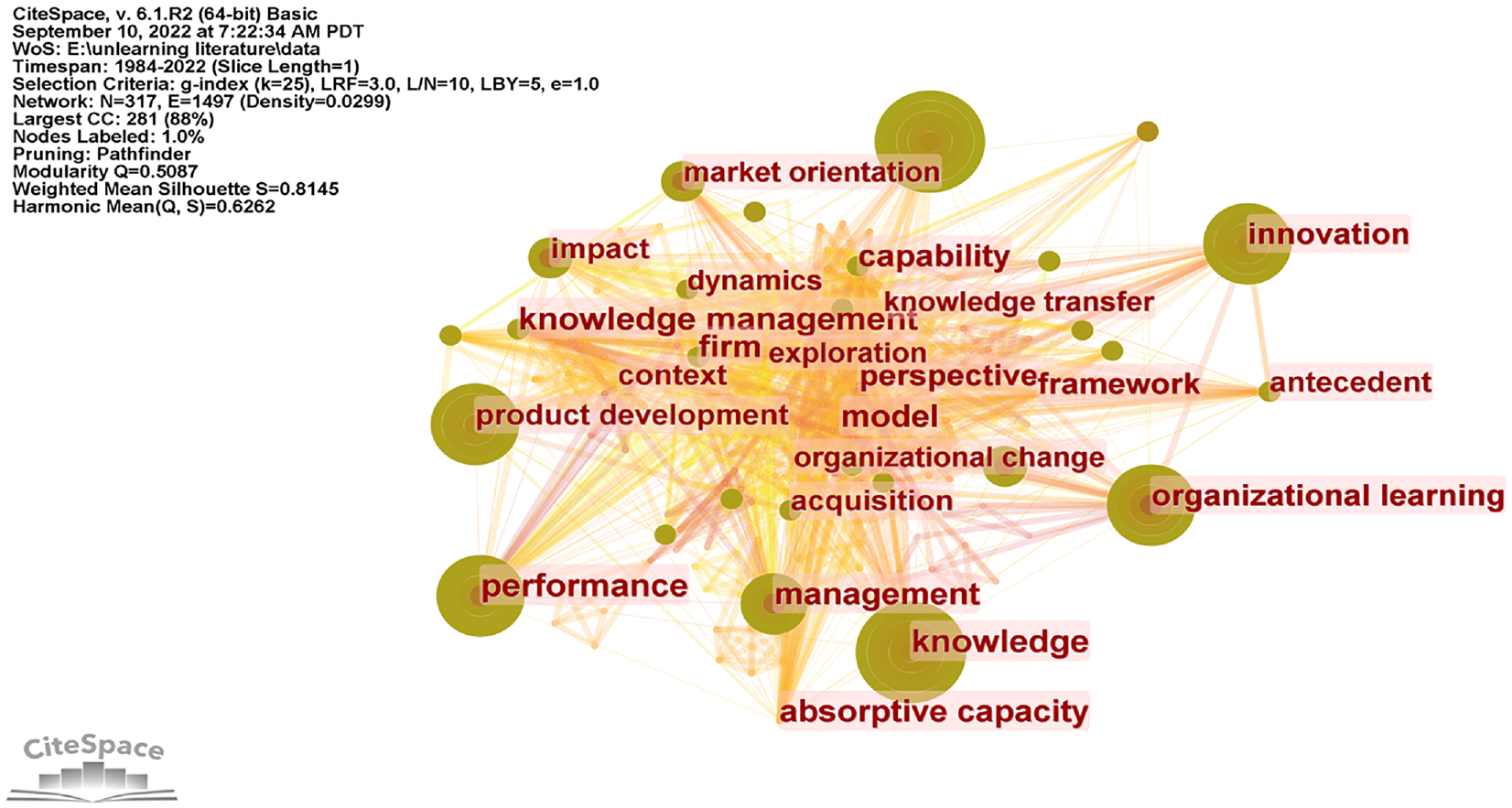
Top keywords of “organizational unlearning” research.
Clustering
Clustering primarily seeks to create thematic clusters that enrich the present bibliometric analysis. Observation of the development of network clusters formed by clustering has been useful for understanding the manifestation and development of organizational unlearning in recent years. The decreasing ranking of themes underlying the intellectual structure of organizational unlearning and its development in the field of business management (from high to low) is as follows: information, organizational learning, knowledge loss, unlearning context, knowledge transfer, entrepreneurial orientation, change management, upper echelons, learning climate, trans-active memory and firm. In Figure 6, 11 clusters (information, organizational learning; knowledge loss; unlearning context, knowledge transfer; entrepreneurial orientation, change management, upper echelons, learning climate, transactive memory, and firm) were detected, numbered from 0 to 10, from 2005 to 2018. In ascending order, the largest cluster was #0, and the smallest cluster was #10. The smaller the number, the more keywords the cluster contains and these keywords are closely related to each other. We can see that the most important cluster is “information” colored in red. This indicates that the most popular research concerning organizational unlearning concerns the quality of information that can be perceived, analyzed, and diffused by the individual’s memory for decision-making within the organization. The memory of the company as well as that of its employees must be able to adapt to change and continuously acquire sustainable knowledge for it grow and remain competitive. The silhouette function is generally used to evaluate clusters (Tryon, 1939). In the present study, the silhouette value is S = 0.8145, which is greater than 0.7; therefore, the cluster members have high homogeneity, which indicates that the clustering result is reasonable (S > 0.5) and significant (S > 0.7).

Cluster analysis and visualization of keyword co-occurrences.
Citation Burst
Hierarchical clustering, performed at the beginning, led to the formation of identity classes of citations. These co-citations, otherwise called clusters, are distributed and differentiated by their size or magnitude, year of publication and finally, by their labels. The main purpose of a burst is to determine the evolutionary trend of the magnitudes of a variable in the short term. Using CiteSpace as the main visualization tool, it helps to identify keyword bursts. It also allows us to match keywords according to their frequency of appearance on the visualization graph, which, in turn, helps describe the knowledge model being focused on and visualize predictions of future trends (Wei et al., 2011). The same software visually examines the keywords of articles in the field of organizational unlearning and simultaneously produces knowledge graphs of keyword co-citations by time zone to determine changes in the research focus.
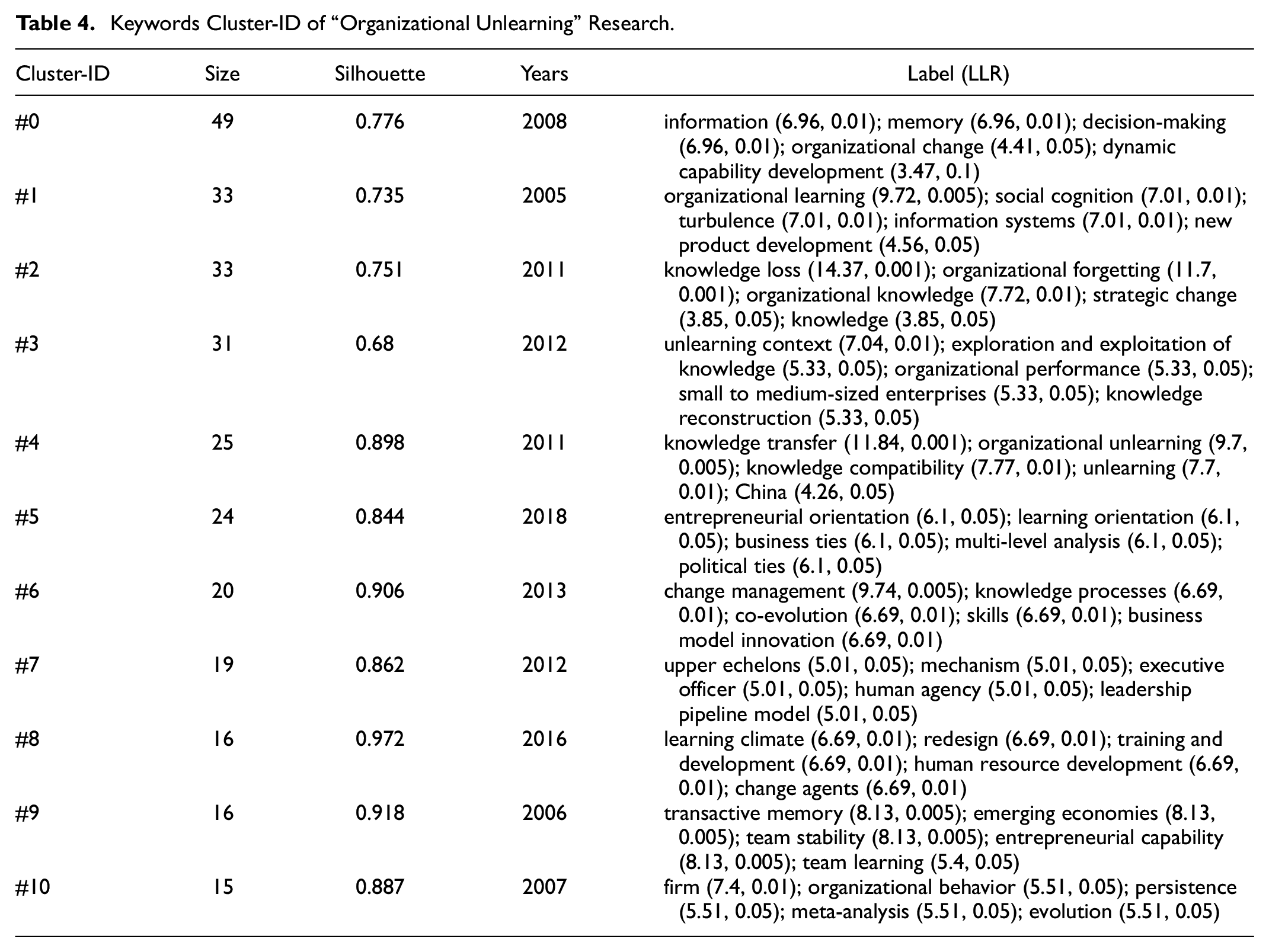
The first cluster-ID (#0) in Figure 7 shows that “information” experienced the largest explosion of citations (6.96, 0.01) from 2008, follow by the word “memory.” This means that in 2008, “information” and “memory” gradually became the first hot spots of research in terms of organizational unlearning. Memory is the source of storage and transformation of individuals or organizations’ information. There is no doubt that these two words are at the center of the debates on organizational unlearning by modifying the content of the memory so that one can reduce routines and acquire new knowledge. In other words, the quotes forming the first cluster (information (6.96, 0.01), memory (6.96, 0.01), decision-making (6.96, 0.01), organizational change (4.41, 0.05), and dynamic capability development (3.47, 0.1) represent a system of reconstruction of organizational thinking affected by environmental changes that weaken the capacity of its memory. Such a system develops dynamic capabilities through unlearning and renews and progressively improve the quality of the information-known or collected good decision-making. This system of reflection is recommended by several researchers for organizational management and continuous learning methods. Provided we keep our illustration brief and to the point, the 11 cluster groups have been reduced and classified into six major groups that are noted in the discussion section.
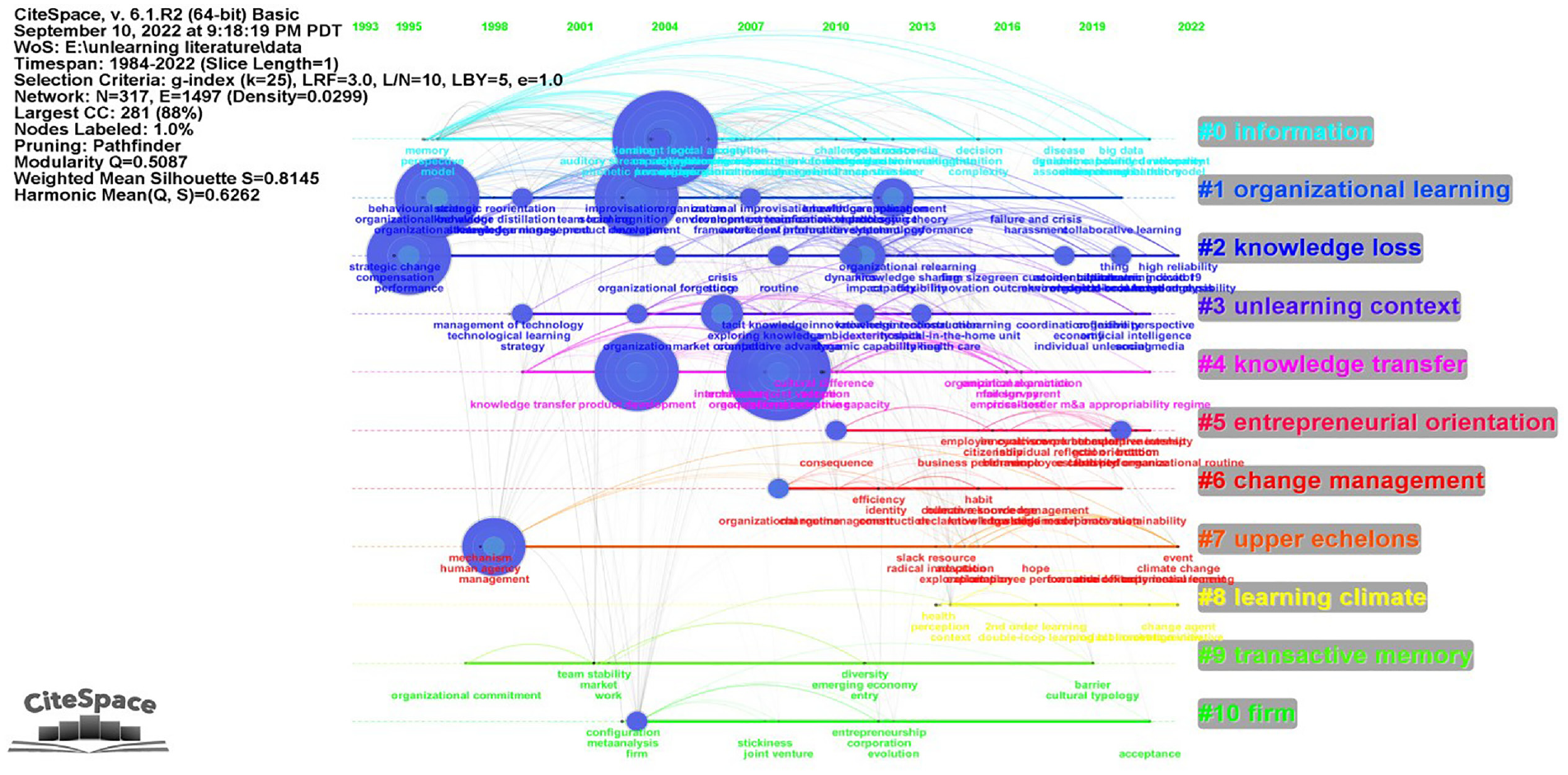
Timeline view of cluster ID.
Table 4 represents the identities of the keywords in relation to different clusters, thereby allowing for an opening of the debate between unlearning and other fields of study among future researchers. Moreover, the 11 clusters formed in Figure 6 and submitted to our illustration allow us to obtain six major groups or fields of study related to unlearning (Sharma & Lenka, 2022).
Unlearning and knowledge aspects (Clusters #2 and #4)
This is the combination of knowledge loss and transfer in the knowledge management system. Thus, unlearning plays an important role in reconstruction, development, compatibility, exploration, and exploitation, and the transfer of knowledge from one unit to another in relation to organizational memory. Future research can focus on the important role that unlearning plays in the above-mentioned knowledge acquisition processes in organization.
Unlearning and organizational learning (Cluster #1 and #8)
The question here is how to establish a reversible link between learning and unlearning. The results of unlearning and learning can be subjected to a comparative study with respect to their processes, mechanisms, roles, and stimulating factors in the development of a learning organization.
Unlearning and change management (Clusters #6 and #0)
Unlearning and change management is the combination of change management and information; that is, the set of obstacles or barriers that can negatively influence the unlearning process within the organization. The introduction of information as a key theme opens a new research topic issue involving the management, processing, and dissemination of information from one entity to another. It is also a place to discuss the differences in the drivers, outcomes, barriers, type, intensity, and degree of unlearning in radical and continuous change and its role in reducing employee resistance to change.
Unlearning and leadership (Cluster #7)
Unlearning and leadership are represented by the upper echelon, a theme involving the management of decision-making in relation to unlearning within the organization. It is, therefore, desirable that ongoing studies be conducted to determine the role, type, and style of leadership that can motive different levels of management. The findings can then challenge outdated and misleading knowledge and demonstrate the impact of organizational leadership on organizational performance through the unlearning of prior experience.
Unlearning and entrepreneurship (Clusters #5 and #10)
This cluster combines entrepreneurship and firms. In this era of digitalization, entrepreneurs and business managers are undergoing new ways of collecting, analyzing, and using information. To help them find reliable solutions for the multiple problems of orientation within the organization, future research can examine the contribution of unlearning in the methods of collection, processing, data use, and methods of analyzing results.
Unlearning and its inhibitors (Clusters #3 and #9)
This group included both enabling and disabling factors for unlearning. Therefore, future research can focus on methods to stimulate and develop an unlearning process in different types of organizations. The same research can be segmented by the departments and business areas of the company to assess the performance of each department in unlearning.
Keywords Cluster-ID of “Organizational Unlearning” Research.
Analysis and Visualization of Publication References
Figure 8 below shows the top 10 references with the highest citation bursts. Of the 137 articles submitted to the CiteSpace analysis, 6,303 valid references were detected. From the merged network, we obtained 619 nodes and 1960 links between several institutions and authors around the world. According to the ascending ranking we have in first position Hislop D, 2014, MANAGE LEARN, with an evaluated strength of 6.37 during the time interval from 2016 to 2019; then Wang XY, 2017, J KNOWL MANAG with an average of 4.69 from 2020 to 2022; In general, the period from 2016 to 2022 remains favored and encompasses the majority of references with more citation bursts. It is clear that the 21st century is an era of light for research in the field of organizational unlearning.
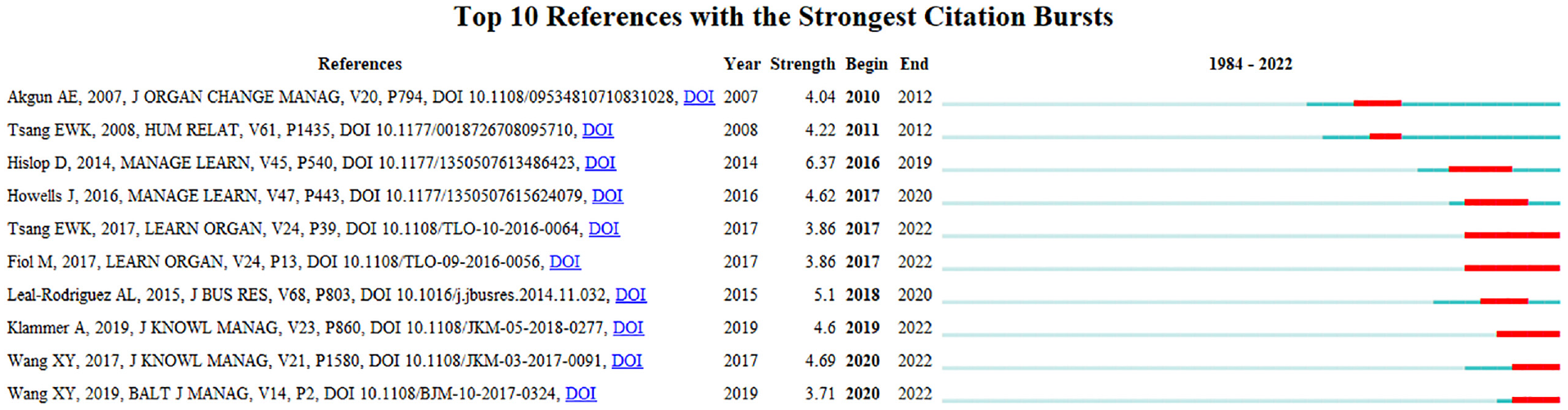
References with the strongest citation bursts.
Analysis and Visualization of Cited Journals
Similarly, Figure 9 represents the visualization of the results of the funding agencies found in the dataset, and following an increasing ranking we distinguish: National Natural Science Foundation of China (cited 4 times); JSPS KAKENHI (3 times); Fundamental Research Funds for the Central Universities, Humanity and Social Science on Foundation of Ministry of Education of China and Natural Science Foundation of Guangdong Province (cited 2 times respectively); AITIA Institute Singapore, American University of Sharjah, BMN, Belgian Science Policy and Bolsa Produtividade em Pesquisa-PQ (cited 1 time respectively). It is impressive to note that the largest funding agencies cited are all based in Asia, specifically China, followed by the USA and Europe.

Journal co-citation network.
Moreover, given that the period from 2016 to 2022 is the subject of explosive publication and current debate on organizational unlearning, it remains a topic of hope for organizations and a topic of exploration for future researchers, which is all the more reason why developing economies continue to invest in it. According to the data submitted to our analysis, the top four journals cited with the highest citation bursts during 1984 to 2022 are MANAGE LEARN, 2001, with a citation strength of 6.85 over the period 2015 to 2019; second in the ranking is LEARN ORGAN, 2006 with 5.41 from 2019 to 2022; third is J KNOWL MANAG, 2011, with 5.16 from 2018 to 2022; and IND MARKET MANAG, 2014 ranks fourth in the 2020 to 2022 space with a citation strength of 5.1 (see Figure 10).

Cited journals with the strongest citation bursts.
Discussion
Unlearning has gained significant attention in debates on organizational unlearning, change management, innovation, knowledge management, and new product development, as indicated by Sharma and Lenka (2022) in their article “On the shoulders of giants: Uncovering key themes of organizational unlearning research in mainstream management journals.” An infographic of the organizational unlearning timeline (1976–2019) indicates that there are three main phases in the evolution of research on organizational unlearning exploration. The period from 1976 to 1990 was characterized as “precursors to unlearning,” the period from 1991 to 2000 was considered an “early development” phase, and from 2000 onwards the “consolidation and rigorous growth” phase emerged. Similar phases have been subsequently proposed by Furrer et al. (2008) and Gaviria-Marin et al. (2019). As an illustration, the development of knowledge management has also been divided into four ages or generations: 1960, 1990, 2000, and 2010 (Gaviria-Marin et al., 2019). From 2019 to 2022, the arrival of the COVID-19 pandemic, which has differently impacted organizations, has led to the rapid development of computer technologies and digital transformation. These abrupt changes have driven the need for continuous learning within organizations. The growing interest in research on “organizational learning” is multiplying, leading to the so-called “consolidation and continuous growth” phase.
The generation of connection links or distribution networks between countries, institutions, authors and keywords of different publications over time was also an important part of the present study. This has allowed us to create graphical representations, called “knowledge graphs,” and to identify the most productive countries and institutions despite their strong independence. The description of the hotspots and the definition of the research frontiers were obtained through the co-occurrence network of the multiple keywords detected. The same description helped clarify the distribution of the leading journals according to the following results.
In fact, this bibliometric study is not the first and will not be the last to examine the evolution of research on organizational unlearning using CiteSpace visualization software to determine the associated research hotspots and boundaries. As a reminder, the WOSCC database has collected a total of 137 unique publications related to “organizational unlearning” over a period of 38 years or less from 1984 to 2022. During this period, research trends in the field of organizational unlearning fluctuated over time. The period from 2018 to 2022 alone had 69 publications, almost 50.36% of the total publications over the 38-year study period. It is clear that in only 4 years, the theme of “organizational unlearning” in management registers more than half of the publications in only 4 years. Thus, it is clear that interest in this topic is growing rapidly as we approach the 21st century.
During the period 1984 to 2022, although the number of papers authored by multiple authors increased, only 10 countries accounted for 88.321% (121 published articles) of all organizational unlearning” studies. The USA, Spain, People’s Republic of China, England, Canada, Australia, Turkey, the Netherlands, India, and Japan contributed 41, 18, 11, 11, 10, 7, 6, 6, 6, and 5 articles, respectively, reflecting their dominant position in the study of organizational unlearning. These results justify the importance of the knowledge acquisition process not only in our society but also in our workplaces in the 21st century.
Institutions of higher education, such as universities are areas of concentration in scientific and social research. This is the case for research on organizational unlearning, which accumulates many publications and has a great influence in university field. In the present study, 27 articles were published by the first five institutions cited, representing a participation rate of 19.708%. These main institutions are grouped in the top ten most influential sub-cited countries: the USA, Spain, People’s Republic of China, England, Canada, and Australia. According to the analysis of the results, there is a strong alignment between the contributions of countries and different institutions in the field of “organizational unlearning.” The harmony between countries and institutions describes the gap in conception and perception between organizational unlearning development in these countries and underdeveloped countries.
The top 10 authors published 46 papers, representing 33.577% of all the papers. LYINN G, TSANG, ERIC W. K., and AKGUN A. were the most prolific authors, with six publications and a percentage of 4.3796% each. These authors are often co-authors of several publications. The principle of “strength in numbers” or collaboration allows them to further strengthen cooperation with other scientific research institutions, to promote progress in the field of organizational unlearning, and to improve the article quality. These results provide a better understanding of trends, subjects, and hotspots in organizational unlearning research from a diachronic perspective.
Visualizing the literature on organizational unlearning through a graphical and unequivocal approach aids explorers and scholars in tracking and covering study progress. In relation to the results, it is possible to develop organizational unlearning research in the future. As that the world of business is constantly changing, and the individual or organization needs more than ever to unlearn to acclimatize and remain competitive, it is hoped that organizational unlearning will be a more frequent study topic in the future. In particular, given the addition of digitalization and the emergence of new ways of working that result in constant renewal of individual and organizational knowledge, unlearning should be further researched.
The ten most cited countries or regions are the USA, Spain, People’s Republic of China, England, Canada, Australia, Turkey, the Netherlands, India, and Japan, indicating their high productivity in organizational learning. Future research on organizational unlearning should explore specific causes such as why research on organizational unlearning more frequently observed in some countries and institutions, and less frequently elsewhere.
Since unlearning involves research in a variety of disciplines, including education, business, culture, management, and information science, and current studies of organizational unlearning are conducted independently in each discipline, we recommend future studies theorizing unlearning across organizations in any type of discipline. LYINN G, TSANG, ERIC W. K., and AKGUN A are the most prolific authors in the field of organizational unlearning. They are at the top of the exploration of organizational unlearning topics, which is why they can be considered as reference authors for new and future researchers and even for leaders or policymakers.
Implications
Organizational unlearning facilitates the reconstruction of an organization’s memory by striking a balance between established and novel knowledge while eliminating the knowledge that has become useless and managerial routines. This process ultimately leads to the acquisition of innovative, sustainable, and efficacious knowledge, which is essential for the organization’s survival and competitive advantage. In light of its significance, research on organizational unlearning has experienced rapid growth and has become a topic of considerable discussion within the field. The study we have undertaken using the bibliometric analysis is an aid to scholars in (1) understanding the evolution of the literature on organizational unlearning, as it provides sources of the most prolific publications; (2) directing future research in the area of organizational management related to unlearning by listing opening points as well as associated theories; (3)The keywords cluster-ID of organizational unlearning resume above as six themes of study can be explored and developed in future research through several theories, such as knowledge-based view, internal stickiness theory, and congruence theory for unlearning and knowledge aspects; organizational learning theory, situated learning, experiential learning, and action learning can be employed for unlearning and organizational learning; Lewin’s model of change, path dependence, and imprinting theory can be applied for unlearning and change management; upper echelon theory, imprinting theory, and threat rigidity effects theory for unlearning and leadership; Joseph Schumpeter’s theories of innovation and entrepreneurship for unlearning and entrepreneurship; and stimuli-response decoupling, parenthetic learning theory, and interference theory can be utilized for unlearning and its inhibitors research.
Limitations
According to Sharma and Lenka (2022), bibliometric and visualization type research using CiteSpace is frequently observable on the subject of organizational unlearning, and operated within the framework of studies of its hotspots, literary co-citation and collaborations between countries, institutions and authors. This study was limited to “organizational unlearning” as documentary research. The clarification of the evolutionary situation of the study of “organizational unlearning” and the prediction of the present and future frontiers of its research were operationalized through data from the WOSCC database. These data are reliable and contain the vast majority of articles in this field, which is why their analyses are relatively objective and complete. However, similar to most scientific studies, this study has several limitations.
First, the literature data used were limited: only data from WOSCC were analyzed.
Second, the keywords were limited: the definition of some keywords can be a source of data reduction.
Finally, synonyms exist: this leads to instability in the order of grouping of categories as there may be some overlap between different content categories in the grouping of keywords.
Conclusion
The particularity of this study lies in the fact that it is based on the conclusions from the visual analysis of CiteSpace. This analysis makes it possible to detect positive collaborative links between different countries, institutions, and others. This collaboration is effective and perfect among countries, institutions, and authors. Changing current research trends include that the period from 1984 to 2000 is a dark time for studying “organizational unlearning.” After that period, people realized the importance of unlearning, and several economic agents, researchers, leaders, and educators brainstormed measures that could be adopted for the survival, learning, adaptation to change, and technological development in the era of digitalization and prospects for the future. The above-mentioned countries are countries with constant development and frequent changes in the workplace due to multiple advances in technology. Therefore, continuous learning through “unlearning” is imperative to maintain competent and effective staff. This can also be explained by the level of importance that developed countries give to research allowing access to research tools and financial means to maintain a permanent level of regular and stable learning in structures and organizations. Finally, organizations need to unlearn because “the illiterate of the 21st century are not those who cannot read and write, but those who cannot learn, unlearn and relearn.”
Footnotes
Declaration of Conflicting Interests
The author(s) declared no potential conflicts of interest with respect to the research, authorship, and/or publication of this article.
Funding
The author(s) disclosed receipt of the following financial support for the research, authorship, and/or publication of this article: This research was supported by Hainan Provincial Natural Science Foundation of China [grant number 623RC478, 722QN307], and the Education Department of Hainan Province [grant number Hnjg2022-51].

Data Availability Statement
Data sharing not applicable to this article as no datasets were generated or analyzed during the current study.