



Abstract
Digital transformation is a new engine for manufacturing enterprises to break through innovation, and digital transformation policies can effectively stimulate the homogeneity, reshaping and available utilization of digital technologies, empowering the transformation and upgrading of manufacturing enterprises, thus playing a crucial role in the innovation performance of manufacturing enterprises. However, most of the studies still remain in the theoretical level of qualitative analysis, treating government policies and innovation performance as a “black box” of inputs and outputs, without revealing their key mechanisms. Therefore, analysing how government policy affects innovation performance is crucial for promoting the high-quality development of the manufacturing industry. Based on this, Regarding the theories of technological innovation, government intervention, and dynamic capability, we construct a “digital transformation policy-digital transformation state-organizational resilience-exploratory innovation behaviour-innovation performance” model and apply PLS-SEM to analyse the influence of each factor on the innovation performance of manufacturing enterprises in an exploratory way. The results reveal the following. (a) Digital transformation policies significantly stimulate the innovation performance of manufacturing enterprises. (b) The digital transformation state is the most direct influencing factor on the innovation performance of manufacturing enterprises, with policy support playing an important supporting role. (c) Although organizational resilience cannot directly affect innovation performance, it plays an important role in the mechanism of innovation performance influence and is the precursor of exploratory innovation behaviour, which plays a key role in influencing innovation performance. (d) The digital transformation state, organizational resilience, and exploratory innovation behaviour play a chain mediating role in the relationship between digital transformation policies and manufacturing firms’ innovation performance. The findings of this study reveal the process of the influence process of digital transformation policies on the innovation performance of manufacturing enterprises and provide a reference basis for the government to formulate policies to promote the accelerated growth of innovation performance.
Keywords
Introduction
With the accelerated evolution of the world’s unprecedented changes, the high-quality development of the manufacturing industry is the “ballast” of China in coping with all kinds of risks and challenges, and it is an inevitable move to promote the modernization of the Chinese style. However, in the face of the challenge of core technology constraints, China’s manufacturing industry urgently needs to rely on digital empowerment to overcome the innovation bottleneck (Cordero, 1990). How manufacturing enterprises can improve the level of innovation and accelerate the output of innovation results have become the focus of attention in both academic and practical circles. Digital transformation policy, as a key strategy through which to promote China’s accelerated construction of a manufacturing powerhouse, aims to enhance the innovation capability and overall level of the manufacturing industry and plays a crucial role in accelerating the breeding, growth, and deepening of innovation output (Usai et al., 2021). Therefore, an in-depth analysis of how digital transformation policy affects the innovation performance of enterprises and an exploration of its role mechanism and path are of practical significance for encouraging manufacturing enterprises to achieve high-quality development. Exploring the innovation incentive effects of government policies has been the focus of current academic and practical attention. Existing research on digital transformation policies has focused mainly on the application of policy tools, emphasizing the role of strategies such as financial subsidies (Peng & Tao, 2022), resource inputs (Feyen et al., 2021), organizational incentives (Zhao et al., 2023), and the business environment (Oei et al., 2020) in promoting the innovative development of enterprises. Nevertheless, studies have shown that policies such as subsidies and tax incentives play only a limited role in the early investment in R&D among manufacturing enterprises, which makes it difficult to meet their actual financial needs, and their role is more reflected in conveying the intention of support for specific areas to society (Aghion et al., 2015). In addition, from the “government failure” and “resource curse” perspectives, some scholars have questioned the effectiveness of industrial policies, arguing that certain policies may provide a breeding ground for rent-seeking and corruption behaviour (Criscuolo et al., 2019), resulting in the industry’s overall level of innovation not improving. Therefore, digital transformation policy as a guiding industrial policy, its impact on the innovation performance of manufacturing enterprises, and the mechanism of its role still need to be further explored. Moreover, the value of digital transformation policies has received attention and discussion from scholars, but most of the studies still remain in the qualitative analysis at the theoretical level, treating government policies and enterprise innovation performance as a “black box” of inputs and outputs, and failing to reveal the key mechanism of its role (Guo et al., 2023; H. Wang et al., 2023). Some studies focus on the formulation and implementation of policies but do not explore how digital transformation policies can be effectively matched with enterprise innovation activities (H. Wang et al., 2023), and the specific path of their impact on enterprise innovation performance is still unclear.
Given the obvious research opportunities in the literature on digital transformation policies and corporate innovation performance, this paper aims to analyse the essential links between the two and elucidate their intrinsic mechanisms. First, based on the theory of technological innovation, government intervention, and dynamic capabilities, we construct a “digital transformation policy-digital transformation state-organizational resilience-exploratory innovation behaviour-innovation performance” influence mechanism model to explain the role of digital transformation policy in the formation process of enterprise innovation performance. Then, the actual sample data of the manufacturing industry are collected for chain-mediated exploratory factor analysis (EFA) to explore in depth the key paths through which digital transformation policies drive the formation and development of innovation performance in manufacturing enterprises. This paper helps expand the scope of innovation performance research, which can provide ideas for manufacturing enterprises to accelerate their innovation output and enrich the exploratory research on the digital transformation of manufacturing enterprises.
Theoretical Basis and Research Hypotheses
Theoretical Basis
Government Intervention Theory
Stiglitz (2002) emphasized the rationale for government intervention. Where market failure is a necessary but not sufficient reason for policy intervention (Bleda & Walrave, 2013). Therefore, there is a market failure in the market environment for enterprise transformation and innovation, and the government should intervene reasonably through policy-led incentives and regulatory constraints (Raven &Walrave, 2020).
Scholars have elaborated the driving mechanism of enterprise innovation performance from the aspects of technological empowerment, factor empowerment, and institutional empowerment, and argued the important role of the heterogeneity of market mechanism institutions and government intervention. For example, Deng et al. (2020) argues that government intervention is a need for late-developing countries to respond to the great power game, which contributes to the improvement of enterprise innovation performance.
In this paper, we follow the above viewpoints, and specify government intervention as the driving effect of government policy on innovation performance, and construct a path model of “digital transformation policy—digital transformation state—innovation performance.” Among them, digital transformation policy is defined as the government’s actions to promote enterprise digital transformation through a series of policy measures. The state of digital transformation represents the degree and effect achieved by enterprises in the process of digital transformation. Innovation performance is an important outcome of digital transformation policy, which reflects the enhancement of innovation capability achieved by enterprises through digital transformation.
Technological Innovation Theory
The classic of technological innovation theory is Schumpeter’s (1935)“new combination” of factors of production. In recent years, scholars have inherited and developed the Schumpeterian school, such as Pan et al. (2022) in the context of the digital economy discussed the existence of the combination of innovation factors in the process of digital transformation of enterprises, revealing that digital transformation empowers the innovation factors and thus promotes the development of enterprise innovation performance. Lay the theoretical foundation for the research on the mechanism of enterprise innovation performance driven by digital transformation in this paper.
After that, the development of dual innovation provides a new winning way for the high quality development of manufacturing enterprises, especially the proposal of green innovation, which empowers enterprises to improve their innovation performance from the innovation chain, supply chain, value chain, and financial chain (Parmigiani et al., 2022). Appio et al. (2021) argued that digital transformation helps enterprises to carry out exploratory innovations so as to disrupt the existing technology and produce disruptive innovations, thus leading the development of high-performance and high-quality innovation performance.
Therefore, this paper starts from the perspective of exploratory innovation, that is, emphasizing the acquisition of new technologies and equipment, the output of new products, the introduction of new management processes, etc., to achieve the enhancement of innovation performance, which is manifested in the path model of “exploratory innovation behaviour-innovation performance.” With the deepening of digital transformation, enterprises have enhanced their real-time data collection and analysis capabilities, and are able to try new strategies with lower risks, break through knowledge barriers, and cope with uncertainty in an innovative way, thus promoting innovation performance (Pan et al., 2022). Therefore, this paper constructs a path model of “digital transformation state-innovation performance.”
Dynamic Capabilities Theory
Dynamic capabilities highlight an enterprise’s ability to adapt to environmental changes by rapidly integrating and structuring internal and external resources in a rapidly changing environment (Ghosh et al., 2022). Organizational resilience, as an important dynamic capability, is the ability of a firm to react, adapt, and change quickly in the face of unexpected shocks (Nielsen et al., 2023). Therefore, this paper expands the boundary of organizational resilience process research from the perspective of digital transformation, and constructs a path model of “digital transformation state-organizational resilience.” Organizational resilience enhances the ability of enterprises to adapt to and resist external shocks, and promotes the development of exploratory innovation, based on which, this paper constructs the path model of “organizational resilience-innovation performance.”
Research Hypotheses
Digital Transformation Policies and the Innovation Performance of Manufacturing Firms
Digital transformation policy has been identified as a key industrial policy for enhancing and facilitating the development of the digital economy and the transformation of manufacturing industries (Zhao et al., 2023). Based on government intervention theory, this paper integrates and analyses the literature and finds that policy plays a positive role in the output of manufacturing enterprises’ innovation performance. According to the resource-based view, digital transformation policy provides abundant resources for the innovative development of manufacturing enterprises, especially in the form of financial support, which helps enterprises increase their R&D investment and innovation output, improve innovation efficiency, optimize the allocation of innovation resources, and create an institutional environment that promotes innovation. Therefore, by encouraging manufacturing firms to engage in exploratory innovation, digital transformation policies can be effective in improving firms’ innovation performance, thereby promoting high-quality development.
According to signalling theory, the existence of positive signals from industrial policies to external investors is crucial (Andreoni & Chang, 2019). Under this framework, digital transformation policy releases clear signals that the government has implemented strict regulations and encourages the development of key industries, and these signals can significantly enhance the confidence of the capital market in the long-term growth potential of enterprises and stimulate enthusiasm among investors (Murphy & Gouldson, 2020). This situation eases the shortcomings owing to the lack of resources for enterprises to engage in innovation activities independently and increases the incentives for enterprises to innovate independently. Digital transformation policy provides the basic conditions for the leap in innovation performance and strongly promotes the construction of the future innovation ecology of the manufacturing industry.
Although some academics have questioned the effectiveness of industrial policy based on the “government failure” and “resource curse” perspectives, pointing out that the resource advantage granted by such policy may be transformed into a medium for rent-seeking and corruption behaviour (Murphy & Gouldson, 2020), it is difficult to ensure sustainable development and long-term social benefits if we rely on the innovation drive provided by market competition alone (H. Zhang et al., 2023). However, although such policy can have a certain driving effect on the formation of the innovative performance of manufacturing firms, it faces difficulty in ensuring their sustainable development and long-term social benefits (H. Zhang et al., 2023). Historical experience shows that even the Industrial Revolution and technological innovation in Western countries did not follow the path of complete marketization, often relying on the organic combination of market forces and government intervention, and that many key innovation breakthroughs have even been achieved under the impetus of industrial policy (Lawton et al., 2013). Therefore, in the process of scientific and technological progress, industrial upgrading, and innovation leapfrogging, coordinated interactions between the government and the market play a critical key role. The benign interaction between the two injects multiple dynamics into industrial development and promotes the organic integration of the government and the market (Frenz & Ietto-Gillies, 2009). Therefore, this paper proposes the following hypothesis:
Mediating Role of the Digital Transformation State
To explore in depth the mechanism by which digital transformation policy promotes the formation and development of innovation performance in manufacturing enterprises, this paper argues that the digital transformation state may play a mediating role in this relationship. The theory of policy tools provides a theoretical basis for this argument, emphasizing that the core goal of digital transformation policy is to improve the efficiency of digital transformation, promote the integration of the digital and real economies, and build a new state-raising system for the digital economy (Aghion et al., 2015). At the same time, scholars have proposed the concept of “transformation failure” to explain the obstacles that enterprises may encounter in the process of transformation, pointing out that government intervention should provide appropriate “targeted” policy support for enterprises to address these dilemmas to unlock the potential effects of digital transformation policies (Gao & Rai, 2019). This approach provides a reasonable intervention logic and specific objectives for the design of policy tools in different transformation states to play a positive role in promoting the transformation and upgrading of enterprises through digital transformation policies (Diercks et al., 2019). From the perspective of enterprise resource dependence, digital transformation, as a high-level technological innovation activity, depends on continuous financial support and stable environmental security for its successful implementation (Lashkaripour & Lugovskyy, 2023). In this context, digital transformation policies influence the transformation and upgrading of manufacturing enterprises and the digital transformation state through innovation-driven, financing-promoting, and agglomeration effects (Aghion et al., 2015).
In turn, the continuous improvement in the digital transformation state of manufacturing enterprises plays a significant role in promoting the catalytic effect of innovation performance. On the one hand, the enhancement of enterprise innovation performance cannot be separated from the high-quality development of traditional industries (DiPrete, 1993). The optimization of the digital transformation state can strengthen the ability of manufacturing enterprises to integrate digital technology with production and operation activities in depth and then give full play to the potential of digital technology for improving production efficiency, optimizing processes, etc., to achieve the strategic goal of high-quality development (Chanias et al., 2019). On the other hand, the cultivation and enhancement of innovation capacity need to be realized by promoting the technological renewal and industrial upgrading of leading and pillar industries (H. Zhang et al., 2023). The increasing enterprise digital transformation state not only represents the deepening of the application of digital technology and the innovation of production methods but also reflects the fundamental change in the organizational model from the individual level to the industrial level (Chanias et al., 2019; Zhuo & Chen, 2023). This change is a dynamic process of enterprise transformation from the traditional mode to the digital mode of industrial activity, which provides conditions and dynamics for the formation of innovative performance.
Therefore, this paper proposes the following hypotheses:
Digital Transformation State and Organizational Resilience
Organizational resilience, as a key component of the dynamic capabilities framework, reflects the resilience of an organization when it encounters adversity and its potential for growth against the current (Do et al., 2022). According to dynamic capability theory, digital transformation is a strategic choice for enterprises in the digital economy; enterprises integrate, reorganize, and reallocate internal and external resources to ensure that digital transformation achieves significant results and that the gradual optimization of the digital transformation state and increasing maturity positively affects the strengthening of organizational resilience (Xie et al., 2022). Accordingly, this paper infers that the digital transformation state facilitates the development of organizational resilience. First, the process of digital transformation is accompanied by the iterative upgrading of organizational capabilities (Tan et al., 2015). Among these capabilities, the effectiveness enhancement, social collaboration, and resource allocation optimization brought about by digitalization can accelerate the recovery and resilience of organizations in the face of adversity (Sajko et al., 2021). Second, the process of upgrading organizational capabilities under the traditional logic of digital transformation shows a progressive character (Mohebbi et al., 2020), indicating that organizational resilience is enhanced as the digital transformation state deepens. Again, in the field of organizational management, the application of digital technology promotes the transformation of the management mode to flattening and networking (Mohebbi et al., 2020), maximizes the degree of elimination of the defects of traditional management, and effectively solves the many difficulties in organizational management, thus enhancing the organizational resilience of enterprises. Finally, through digital transformation, manufacturing enterprises have transcended the limitations of the traditional business model of pure product production and supply and, through the technology-driven construction of data platforms such as the industrial internet, have achieved business and service model innovation and advantageous reconfiguration, which in turn have improved their overall competitiveness and organizational resilience (Xie et al., 2022). Therefore, this paper proposes the following hypotheses:
Organizational Resilience and Exploratory Innovation Behaviour
Depending on the nature of binary innovation, innovation behaviour can be classified into the following two categories: exploratory and exploitative innovation (Phelps, 2010). Exploratory innovation is a high-level innovation behaviour characterized by the need for a longer time horizon and a greater risk of failure faced by the innovator (C. Wang et al., 2014). Organizational resilience, as a capability that encompasses the characteristics of dynamic coordination, reconfiguration, and learning, can help firms recover and adapt to adversity and cope with diverse adversity challenges (Alexiev et al., 2010; Do et al., 2022) and thus bear the failure risk inherent in exploratory innovation. Following this logic, this study argues that organizational resilience positively contributes to the implementation of exploratory innovation.
Specifically, firms with weak organizational resilience often exhibit more rigid organizational structures and deficiencies in core competencies than do those with strong organizational resilience, and firms in this state often find it difficult to respond effectively to changes in the external environment and the challenges they bring forth; therefore, firms with weak organizational resilience tend to be reluctant to engage in exploratory technological innovation behaviours (J. X. Chen et al., 2019). Conversely, enterprises with stronger organizational resilience have the advantages of rapid response to environmental changes, flexible organizational management structures, strong workforce construction, and highly adaptive business models (Alexiev et al., 2010; Slavova & Jong, 2021). Even if exploratory innovation suffers from failure, such enterprises can still recover from adversity at a faster speed and adjust their innovation strategies to promptly adapt to environmental changes. Therefore, this paper proposes the following hypotheses:
Exploratory Innovation Behaviour and Innovation Performance
Exploratory innovation is a behaviour of constructing a new knowledge system based on existing knowledge, and its essence lies in acquiring and mastering new knowledge and skills through technological breakthroughs and paradigm shifts (C. Wang et al., 2014). This type of innovation not only involves the design of new products but also, more critically, plays a crucial role in enhancing the independent innovation capability of enterprises. According to the framework of technological innovation theory, exploratory innovation is regarded as a powerful driving force that promotes the formation and development of innovation performance in manufacturing enterprises. The innovation performance of enterprises through technological innovation activities, especially those original innovations, can result in fundamental changes (Lawton et al., 2013). The importance of exploratory innovation behaviour in this process is self-evident. More importantly, through continuous exploratory innovation activities, enterprises can realize a series of original innovations and key technological breakthroughs, which can not only greatly promote the formation of enterprise innovation performance but also bring about long-term competitive advantages for enterprises. Therefore, this paper proposes the following hypotheses:
Chain Mediation of the Digital Transformation State, Organizational Resilience, and Exploratory Innovation Behaviour
Based on an in-depth discussion of Hypotheses 1 to 11, this paper constructs a chain mediation model that takes digital transformation policy as the starting point and influences innovation performance through the digital transformation state, organizational resilience, and exploratory innovation behaviour. In the model, digital transformation policy plays a fundamental safeguarding and guiding role and provides a foundation on which organizational resilience can be cultivated and strengthened. As a bridge connecting the digital transformation state and innovation performance, organizational resilience plays a crucial role in the digitalization process of enterprises. With the continuous deepening of digital transformation, organizational resilience has been given new connotations and vitality, and its role in the process of enterprise transformation can be seen as “carrying forward and starting back.” This enhanced organizational resilience further facilitates the development of exploratory innovation behaviours, providing an impetus and support for enterprises in carrying out original innovation, technological innovation, and product and service innovation in the ever-changing market environment. The implementation of exploratory innovation behaviour not only directly promotes the formation of innovation performance but also provides enterprises with sustained competitive advantages through continuous innovation activities. Therefore, this paper proposes the following hypothesis:
In summary, the conceptual model and hypothetical path proposed in this paper are shown in Figure 1.

Conceptual model.
Study Design
Research Methodology
To accurately assess the proposed model and conduct EFA, this paper adopts the partial least squares-structural equation modelling (PLS-SEM) method for data processing and empirical analysis. Unlike traditional covariance-based structural equation modelling analysis (CB-SEM), PLS-SEM has more obvious advantages when dealing with datasets with smaller sample sizes and more complex model structures and is especially suitable for predictive studies (Hair et al., 2019; Liu, Li, et al., 2023; Z. Zhang et al., 2023). Given the complexity of the model in this paper, we plan to use Smart PLS 4.0 to specifically analyse the constructed structural model.
Questionnaire Design and Variable Measurement
To ensure the scientific design of the questionnaire and the accuracy of the empirical analysis, the questionnaire in this paper adopts a 5-point Likert scale to quantify the answers to the questions (except for the basic information of the enterprise), in which scores of “1” to “5” represent feelings ranging from “strongly disagree” to “strongly agree,” respectively. To ensure the high degree of reliability and validity of the study, the scale in this paper is based on typical questions used in domestic and international literature as much as possible, and based on the standardized scale, targeted improvements are made according to the situation of the researched enterprises. This approach ensures the rigour and applicability of the final scale used. On the one hand, digital transformation policy, as an industrial policy, has intangible factors in addition to tangible support. For example, it has the same signalling and authentication functions as those mentioned in “signalling theory” (J. Chen et al., 2018), including releasing information about the innovation capability of supported enterprises, distinguishing policy-supported enterprises from unsupported enterprises, and reducing the risk of information asymmetry in the identification of enterprises by the capital market (Pierce et al., 2014). Digital transformation policies, on the other hand, are a set of policy portfolios that are not limited to the role of a single policy instrument. Considering the numerous categories of policy instruments in practice, it is difficult to completely exclude the influence of the intangible factors of other instruments. For this reason, this paper does not identify the policy support received by enterprises from a specific policy tool but rather takes the digital transformation policy as a whole as a “resource provider” and explores the specific mechanism of the effect of policy support on innovation performance. Thus, this paper refers to the scales of Pierce et al. (2014), Chenguang et al. (2018), and other scholars (Hobday et al., 2012) and measures digital transformation policy variables based on the perspectives of policy practicality and ease of use.
Therefore, the questionnaire used in this study is divided into the following six sections: basic corporate information, digital transformation policy, digital transformation state, organizational resilience, exploratory innovation behaviour, and innovation performance. In total, five latent variables are used. To ensure the rationality of the questionnaire structure, the questionnaire is designed by expert review, questionnaire pretesting, and questionnaire revision and is finally transformed into a formal research questionnaire. The specific measurement indicators are shown in Table 1.
Variable Definitions and Measurement Question Items.

Sample Selection and Data Collection
This study adopts a questionnaire survey method to collect relevant data, and the target respondents are advanced manufacturing and automation enterprises in China. To ensure the validity and credibility of the questionnaire, the first targeted research was entrusted to a well-known data organization, the Zhuowen Data Platform. This research was completed in September 2023, 103 questionnaires were recovered and analysed in the presurvey, a high and low grouping test of variance was performed for all the questions (taking the values at the 27% and 73% critical points as the high and low grouping critical points, respectively), and the results were significant (p values of less than .05 and absolute values of t values greater than 1.96). Therefore, all questions of the questionnaire were retained.
According to the results of the presurvey on the nature of the designated enterprises and digital affairs managers, the second survey was conducted jointly with the National Center for Materials Service Safety Science from October to November 2023, and a total of 316 questionnaires were recovered. After analysis, it was found that the samples were distributed mainly in the fields of advanced manufacturing processes and equipment and high-performance and intelligent instrumentation. In December 2023, 230 samples continued to be recovered, and the descriptive statistics were found to cover advanced manufacturing and automation enterprises in multiple technology fields.
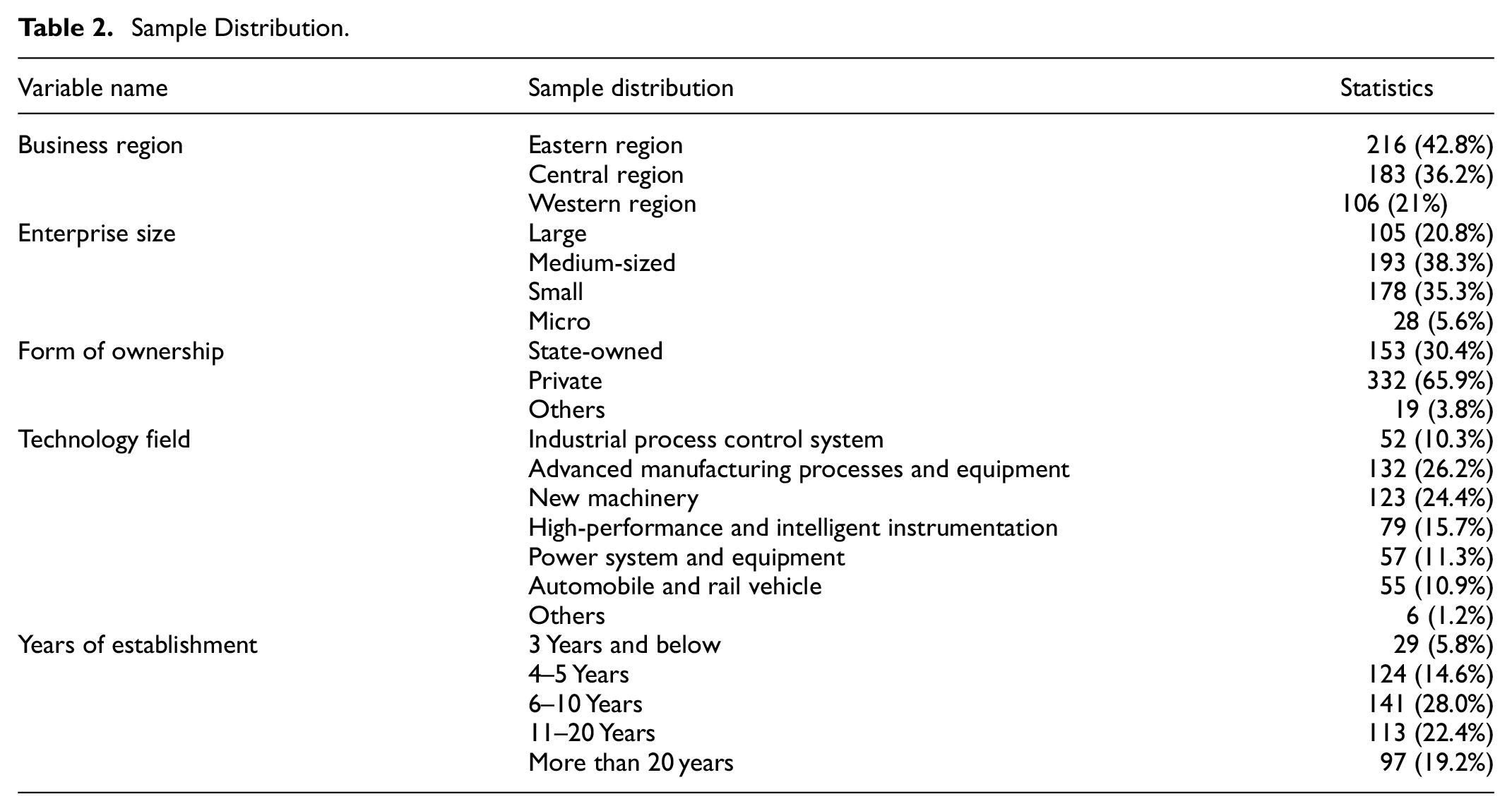
After three rounds of research, a total of 649 questionnaires were distributed and recovered; after excluding the questionnaires that did not meet the requirements of the data analysis, 505 valid questionnaires were recovered, for an effective recovery rate of 78%. The sample distribution is shown in Table 2.
Sample Distribution.
Empirical Tests and Analysis of Results
Reliability and Validity Tests
First, this paper analyses the model and data for reliability and validity with the PLS-SEM reliability and validity test proposed by Hair et al. (2019). As shown in Table 3, the Cronbach’s α coefficient, composite reliability (CR) value, and factor loadings are all greater than the standard value of 0.7, and the p value is less than .001. Therefore, the content of the questionnaire in this paper and the sample data are highly reliable. In addition, the average variance extracted (AVE) of each latent construct is greater than the standard value of 0.5, and thus, the indicators in this paper have good convergent validity for the target latent variables (Chin, 1998; Fornell & Larcker, 1981).
Results of Reliability and Convergent Validity Tests.

Second, in terms of discriminant validity, the factor loadings of all indicators in this paper for their target latent variables are much greater than those for other latent variables, and thus, measures within the same construct have strong explanatory power only for their latent variables. According to the Fornell–Larcker (Fornell-Larcker) criterion, the square roots of the AVEs of the different latent variables in this paper are greater than the correlation coefficients between the latent variables (as shown in Table 4); therefore, the model has high discriminant validity.
Differential Validity Tests.

Note. The diagonal is the square root of each factor AVE.
Finally, through the R2, Q2, and goodness-of-fit (GoF) coefficient indicators for structural model fit detection, the value of each indicator and the regression coefficients of each path are shown in Figure 2.
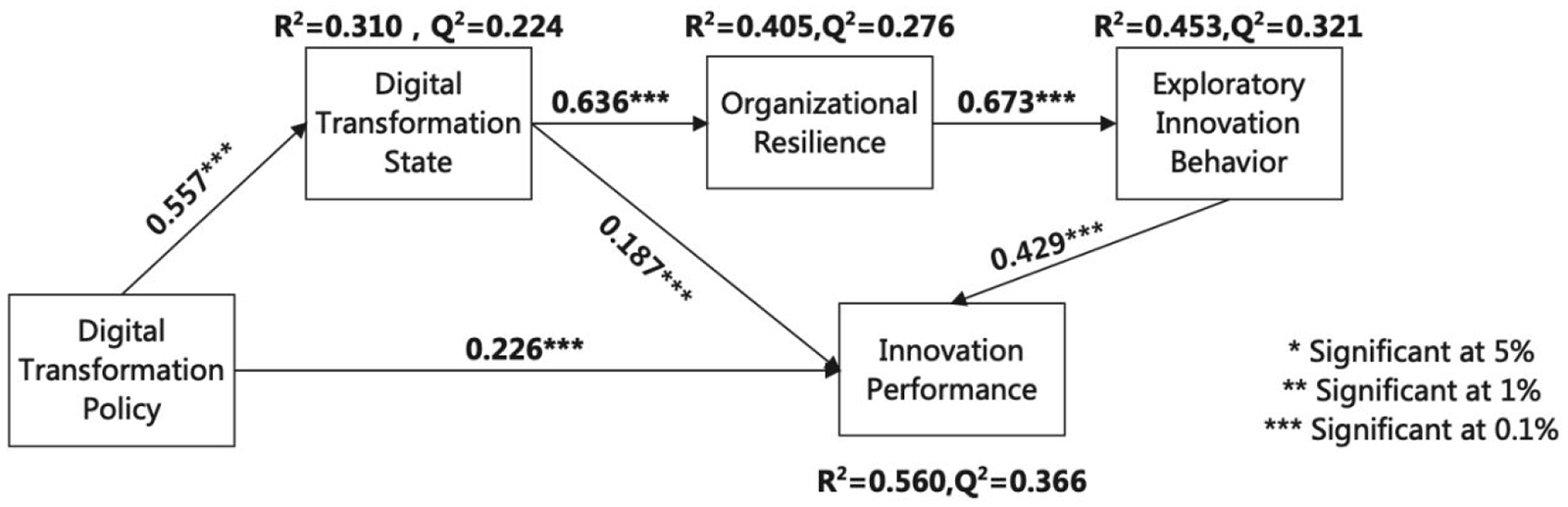
Regression results and structural validity.
According to the R2 values of the explanatory variables, the GoF values of the digital transformation state, organizational resilience, exploratory innovation behaviour, and innovation performance are all greater than the minimum accepted value of 0.19 and are all high (0.310, 0.405, 0.453, and 0.560, respectively) (Henseler & Sarstedt, 2013). In terms of the Q2 predictive relevance index, the Q2 values are all well above 0, indicating that the exogenous independent variables have some predictive relevance for the explanatory variables (Henseler & Sarstedt, 2013). Finally, the GoF can represent the GoF of the PLS-SEM approach, which can be calculated by the following formula: GoF =
Model Fit Test
To rigorously verify the model fit, this paper conducts two tests. First, a total of nine indicators, including the parsimony fit index, the absolute fit index (AFI), and the value-added fit index, are selected to test the model fit. The results in Table 5 show that the theoretical model in this paper meets the requirements of the fit index.
Results of the Overall Model Fit Test.

Cross-validation analysis is further used in this paper to determine whether the model is stable and generalizable. The samples are randomly divided into a sample group and a calibration group with as similar a sample size as possible. As shown in Table 6, the p value is greater than .05, and the absolute ΔTLI value is less than .05, indicating that there is no difference in the factor loadings, path coefficients, factor variance, or variable residuals between the two groups. Therefore, the results of the cross-validity test prove that the theoretical model in this paper meets the consistency requirements and has rigorous model fit.
Cross-Validity Test.

Analysis of Results
Direct Effects Test
In this paper, each path in the model is statistically analysed by a bootstrapping test, the sample size is set to 5,000, and the direct effect test results are shown in Table 7. At the .001 significance level, the regression path coefficient of digital transformation policy and innovation performance is significant, and thus, digital transformation policy is conducive to the formation of innovation performance, hence verifying Hypothesis H1. The regression coefficient of digital transformation policy and the digital transformation state is significant, and thus, digital transformation policy has a facilitating effect on the deepening of an enterprise’s digital transformation state, hence verifying Hypothesis H2 . The regression coefficient of the digital transformation state and innovation performance is significant, and thus, enterprise transformation and upgrading are conducive to the formation of innovation performance, hence verifying Hypothesis H3. The regression coefficient of the digital transformation state and organizational resilience is significant, and thus, the deepening of the digital transformation state strengthens enterprise organizational resilience and contributes to its formation, hence verifying Hypothesis H4. The regression coefficient of organizational resilience and exploratory innovation behaviour is significant, and thus, the formation of organizational resilience contributes to the formation of exploratory innovation behaviour in enterprises, hence verifying Hypothesis H5. The regression coefficient of exploratory innovation behaviour and innovation performance is significant, and thus, the development of exploratory innovation behaviour in enterprises contributes to the formation of innovation performance, hence verifying Hypothesis H6.
Direct Effect Test Results.

indicate significance at the 10% levels, respectively.
Indirect Effects Test
In this paper, each path in the model is statistically analysed by the bootstrap test, the sample size is set to 5,000, and the corresponding test results are shown in Table 8. The value of the indirect effect of the digital transformation state on the relationship between digital transformation policy and innovation performance is 0.104, with a significant p value, and none of the CIs contain 0; therefore, Hypothesis M1 is verified. Similarly, the value of the indirect effect of the digital transformation state on the relationship between digital transformation policy and organizational resilience is 0.354, with a significant p value, and none of the CIs contain 0; thus, Hypothesis M2 is verified. The value of the indirect effect of organizational resilience on the relationship between the digital transformation state and exploratory innovation behaviour is 0.428, with a significant p value, and none of the CIs contain 0; thus, Hypothesis M3 is verified. The value of the indirect effect of exploratory innovation behaviour on the relationship between organizational resilience and innovation performance is 0.289, with a significant p value and none of the CIs contain 0; thus, Hypothesis M4 is verified. In the path DTP → DT → OR → EIB → IP, the p value is significant, and none of the CIs contain 0, indicating that the digital transformation state, organizational resilience, and exploratory innovation behaviour have a significant chain mediating effect on the relationship between digital transformation policy and innovation performance; therefore, Hypothesis M5 is validated. VAFDTP → DT → IP = 24.07%, and VAFDTP → DT → OR → EIB → IP = 23.61%, which suggests that 24.07% and 23.61% of the impact of digital transformation policies on innovation performance can be explained by the mediating effect of the digital transformation state and the chain mediating effect of the digital transformation state, organizational resilience, and exploratory innovation behaviour, respectively.
Results of the Mediation Effect and Chain Mediation Effect Tests

indicate significance at the 10% levels, respectively.
Discussion
Based on the theory of technological innovation, government intervention, and dynamic capability, this paper constructs a heterogeneous path with “digital transformation policy—digital transformation state -organizational resilience-exploratory innovation behavior—innovation performance” as factors. as the factor of the heterogeneous path. It analyzes the internal mechanism of digital transformation policy affecting the innovation performance of manufacturing enterprises. In the following, we relate the conclusion to the existing literature as a basis for discussing our contribution.
While most studies in the existing literature focus on the direct effect of digital transformation technologies and states on firms’ innovation performance, this study further analyzes the driving role of policy factors. The results of our study suggest that digital transformation policies significantly stimulate innovation performance in manufacturing firms. For example, Adler-Milstein (2021) emphasized the key role of policy support in driving digital transformation and innovation in firms, which is consistent with the positive impact of policies on innovation performance found in this study. Moreover, as Ardito et al. (2021) argue, from the perspective of resource endowment given by policy, industrial policy plays an important positive role on firms’ innovation performance through financial subsidies, resource inputs, organizational incentives, and the business environment.
Digital transformation state enhancement has a significant positive impact on the formation of organizational resilience and innovation performance in manufacturing firms. These findings are highly compatible with the findings of the existing literature, thus confirming the value creation resulting from the enhancement of the state of digital transformation of the enterprise, including the output of technology, tasks, and organization (Chi et al., 2025; Zhang et al, 2025). However, some scholars have pointed out that there is significant heterogeneity in the release of transformation value, and some studies have shown that the effect of digital transformation on the enhancement of enterprise innovation performance is moderated by factors such as the degree of competition in the industry, and that the positive effect of digital transformation on innovation performance is not significant in some specific contexts (H. Zhang et al., 2024). It can be seen that there is theoretical heterogeneity in the organizational effects brought about by the digital transformation state. However, for manufacturing enterprises, their industrial characteristics (technology-intensive, industry chain synergies) determines the value of their transformation has a stronger certainty. For example, the essence of competition among manufacturing enterprises is the competition of technical barriers, regardless of the intensity of competition, the improvement of digital transformation state will realize the improvement of innovation performance by “shortening the technology gap” or “building a technology moat” (Meng & Wang, 2023), so its positive impact is universal. Based on this, the positive impact of digital transformation state in this paper is consistent with the findings of existing studies.
Organizational resilience has a significant positive impact on the development of exploratory innovation behaviours, which is consistent with the findings of existing literature on organizational resilience. For example, enterprises with stronger organizational resilience have the advantages of rapid response to environmental changes, flexible organizational management structures, strong workforce construction, and highly adaptive business models (Alexiev et al., 2010; Slavova & Jong, 2021). This conclusion is supported by dynamic capabilities theory, with Teece (2007) emphasizing that organizational agility in response to environmental changes is a key driver of exploratory innovation, and that organizational resilience is a core manifestation of this dynamic capability.
The results of our research also show that exploratory innovation behaviour is more important for digital transformation policies to drive innovation performance in manufacturing firms. This observation is puzzling and undoubtedly requires further in-depth research. Although Kraus et al. (2022) have already suggested that digital transformation is crucial for the improvement of enterprise innovation performance and that the improved state of digital transformation brings about the deepening of digital technology applications and innovation in production methods, but is not sufficient to break the rigidity of practices and technological barriers in manufacturing enterprises, and that exploratory innovation behaviours are better empowered to improve innovation performance through the realization of the internalization of digital transformation policies, and the generation of breakthrough innovation results (Farzaneh et al., 2022; Malibari & Bajaba, 2022). The behaviour of exploratory innovation better empowers innovation performance improvement by internalizing digital transformation policies and generating breakthrough innovations.
In terms of mediating effects, the two path models of “Digital Transformation Policy-Digital Transformation State-Organizational Resilience-Exploratory Innovation Behavior-Innovation Performance” and “Digital Transformation Policy-Digital Transformation State-Innovation Performance” proposed in this study validate the logic of the three-stage mechanism model of “Sensing-Seizing-Transforming” proposed by Teece et al. (1997) for dynamic capabilities. First of all, the Sensing stage is reflected in the policy-driven environmental scanning and resource identification, the government through the use of policy tools, digital transformation incentive signals and resource inputs to the enterprise, at this time the enterprise based on the “policy ease of use”“policy practicality” two elements of the policy for the perception, and form a prejudgement of market opportunities and technology trends. Second, the Seizing stage includes the deepening of the digital transformation state and the building of ability: on the one hand, the digital transformation policy through the seizing and injection of resources for the deepening of the digital transformation state of the enterprise empowered by resources, such as financial subsidies, digital infrastructure, elemental integration, and other resource injection (H. Zhang et al., 2024), on the other hand, the deepening of digital transformation state promotes the formation of enterprise organizational resilience through technological empowerment, which is manifested as the construction of enterprise capabilities; Finally, the conduct of exploratory innovation behaviour forces the transforming of organizational structure adjustment, and subversion of existing technologies, such as new technologies, new models, new products, etc. (Malibari & Bajaba, 2022), which drives the enhancement of corporate innovation performance, embodied in the transforming stage.
Conclusions and Study Outlook
Conclusions
Combining the theories of technological innovation, government intervention, and dynamic capabilities, this study constructs a chain mediation model for the process of enterprise innovation performance formation. According to the EFA results, the following conclusions are drawn. (1) Digital transformation policy plays a significant role in promoting the formation and development of innovation performance and enhancing the digital transformation state. (2) The digital transformation state is the most direct influencing factor of manufacturing enterprises’ innovation performance, and policy support plays an important supporting role. The digital transformation state not only significantly promotes the formation and development of innovation performance and enhances organizational resilience but also plays a mediating role in the relationships among digital transformation policy, innovation performance, and organizational resilience. (3) Although organizational resilience cannot directly affect innovation performance, it plays an important transduction role in the mechanism of innovation performance influence and is a precursor to exploratory innovation behaviour playing a key influencing role. (4) The digital transformation state, organizational resilience, and exploratory innovation behaviour play a chain mediating role in the relationship between digital transformation policy and innovation performance.
Theoretical Contributions
The theoretical contributions of this paper are summarized as follows. (1) By combining the theories of technological innovation, government intervention, and dynamic capabilities, this paper reveals the intrinsic link between digital transformation policy and innovation performance and elucidates the underlying mechanisms of how digital transformation affects innovation performance. (2) Despite the widespread controversy regarding the effectiveness of industrial policy in the manufacturing industry, this paper both theoretically and empirically extends the literature on the effectiveness of industrial policy implementation and provides a unique research perspective on innovation performance by examining the impact of digital transformation policy, a key industrial policy, on the innovation performance of manufacturing firms. (3) This paper reveals the chain mediating role played by the digital transformation state, organizational resilience, and exploratory innovation behaviour in the relationship between digital transformation policy and innovation performance. Existing studies have focused mainly on the relationships between two separate variables and have failed to establish the exact causal chain between the abovementioned three variables. Based on dynamic capabilities theory, this study not only deepens the understanding of the value of digital transformation for firms at the outcome level but also explicates its intrinsic link with innovation performance.
Management Implications
This study delves into the impact of the digital transformation state, organizational resilience, and exploratory innovation behaviour on the formation of innovation performance; reveals the key factors and their interactions to which enterprises should pay attention in the process of digital transformation; and provides practical guidance for enterprises in achieving high-quality development.
First, the digital transformation state plays a crucial bridging role in the multiple paths that promote innovation performance. In the practice of digital transformation, enterprises often face the triple dilemmas of “unwillingness,”“not daring,” and “not knowing.” To overcome this limitation, it is necessary for the government and the market mechanism to work together to strengthen the effect of digital transformation policies, provide clearer support and guidance, help enterprises establish confidence in digital transformation, improve digital skills, and accelerate the formation of innovative performance. Enterprises should deepen their understanding of digital transformation, actively respond to government policies, strengthen organizational resilience, and promote exploratory innovation behaviours through the dual-wheel drive of internal management and technological innovation to achieve digital transformation in reality.
Second, organizational resilience and exploratory innovation behaviour are the keys for enterprises to achieve breakthrough growth in innovation performance. Although the digital transformation state directly impacts productivity, organizational resilience and exploratory innovation behaviour have a more significant indirect effect on the formation of innovation performance. In particular, the importance of exploratory innovation behaviour, as the core driving force of innovation performance in manufacturing enterprises, cannot be overstated. Enterprises should pay attention to the cultivation of organizational resilience not only to maintain survivability in the face of adversity but also to seek transcendence amid challenges, to actively explore opportunities in crises, and to develop new capabilities to adapt to and promote market changes.
Finally, based on the above findings, this paper proposes the following three policy recommendations. (1) Policy support and guidance for digital transformation should be strengthened. The threshold and risk of digital transformation can be lowered by providing financial and tax incentives, special fund support, technical training, consulting services, etc., to improve the willingness and ability of enterprises in terms of digital transformation. Enterprises should also be encouraged to increase their R&D investment, cultivate digital talent, promote technological innovation and application, and accelerate the formation of innovative performance quality through digital transformation. (2) The synergistic development of organizational resilience and innovation capability should be promoted. Manufacturing enterprises should pay attention to and improve organizational resilience so that they can remain stable in the face of market changes and external shocks and quickly adapt and rebound. The government can enhance the resilience and self-innovation capacity of enterprises by building a platform on which to provide services such as resource sharing, risk assessment, and crisis response training. At the same time, the government should encourage the internal culture construction of enterprises to form an atmosphere of daring to explore and innovate to facilitate the emergence of exploratory innovative behaviour, thus promoting the formation of innovative performance. (3) A diversified incentive mechanism for technological innovation should be constructed. A multilevel and wide-ranging incentive mechanism for technological innovation, including support for innovation funds, tax incentives, intellectual property protection, market access, and other aspects, should be built. In addition, cross-industry and cross-field cooperation and exchanges are encouraged to accelerate the transformation of achievements and stimulate the innovation vitality of manufacturing enterprises through the combination of industry, academia, research, and application. At the same time, enterprises should be supported in establishing an open innovation system oriented to market demand, promoting the effective flow and utilization of innovation resources, improving the conversion rate of innovation results, and ultimately realizing the growth of innovation performance.
Shortcomings and Outlook
This paper has the following shortcomings. On the one hand, this study explores the impact of digital transformation policies on the innovation performance of manufacturing firms from the perspective of policy ease of use and practicality. However, there may be other policy evaluation perspectives that can develop and optimize digital transformation policy measurement and evaluation methods in the future. On the other hand, there may be moderating elements such as the external environment between digital transformation policies and innovation performance that can further explore the possible moderating variables therein.
Footnotes

Ethical Considerations
This study employed a questionnaire survey methodology to collect data. All participants voluntarily engaged in the survey, and the entire process was conducted anonymously. Identifying information, such as names, personal identifiers, or any other details that could potentially link responses to specific individuals, was neither collected nor recorded during the survey. As a result, there is no risk of individual participants being identified or experiencing potential harm from the dissemination of study results. Given the anonymous and voluntary nature of this survey, as well as the minimal risk involved, the researchers determined that the standard ethical review and formal informed consent procedures were not necessary for this study. Therefore, this research does not involve traditional ethical issues.
Funding
The author(s) disclosed receipt of the following financial support for the research, authorship, and/or publication of this article: This research was funded by the National Social Science Foundation of China, grant number 23BGL055.
Declaration of Conflicting Interests
The author(s) declared no potential conflicts of interest with respect to the research, authorship, and/or publication of this article.
Data Availability Statement
The data are available from the corresponding author on reasonable request.