




Abstract
The study analyzes the current state of research, frontiers, and trends in tolerance studies in multicultural contexts. The Web of Science Core Collection database was used to retrieve relevant literature from 2000 to 2022. CiteSpace and VOSviewer software were employed to analyze keywords through co-occurrence networks, co-polymerization classes, and burst terms, with a corresponding visual atlas created for analysis. A total of 705 valid articles were included. The results revealed that Maykel Verkuyten authored the highest number of articles (n = 12). The United States contributed the highest number of articles (n = 376, 53.33%). The Interpersonal Journal of Intercultural Relations published the most articles (n = 38, 5.39%). The most highly cited author was Shelly P. Harrell (n = 876) in the American Journal of Orthopsychiatry. The keyword with the highest frequency, surpassing 200 mentions, was “prejudice” (n = 205). The top three keywords in terms of centrality were “culture” (n = 0.13), “attitude” (n = 0.12), and “discrimination” (n = 0.11). Major research topics and hotspots in the field of Tolerance in Multicultural Contexts included the Color-blind perspective, Prejudice reduction practices, Tolerance education, and Ethnicity. The study highlights a growing interest in the effectiveness of education as an intervention to reduce prejudice among young people. Further research in this domain should combined the Internet and transcend the confines of prejudice.
Cultural diversity has emerged as an undeniable trend in social development. Multicultural exchanges have significantly contributed to the world’s rapid economic growth. Nevertheless, individuals residing in diverse cultural contexts may not always share identical beliefs, preferences, or behaviors, which can potentially lead to conflicts on the path to fostering multicultural harmony. Consequently, global leaders, including the European Union, the United Nations, and various NGOs, have underscored the significance of implementing policies that promote tolerance
Tolerance is often defined in social psychology as “openness, positive attitudes toward cultural others, or generally favorable attitudes toward cultural diversity” (Verkuyten et al., 2019). However, there are two distinct ways to conceptualize tolerance. In the first perspective, tolerance emerges from the notion that one refrains from disliking or opposing someone or something (Rapp & Freitag, 2015). Here, tolerance implies that individuals endure things they may not necessarily like. Much of the research within this framework seeks to determine whether a society becomes more tolerant by examining reductions in social prejudice (Rapp, 2017; Sullivan et al., 1979). However, this definition can blur the distinction between tolerance and prejudice and has often influenced the selection of research subjects in previous studies (e.g., immigrants, sexual minorities, Muslims) (Andersen & Fetner, 2008a, 2008b; Jasperse et al., 2012; Licata & Klein, 2002).
Hjerm et al. (2020) have identified several limitations in prior tolerance research, including (1) conceptual overlap between tolerance and prejudice; (2) operational overlap between tolerance and prejudice; and (3) a lack of precision in conceptualization and operationalization of tolerance. They propose a new approach to defining tolerance. The second conceptualization views tolerance as a value orientation toward diversity, encompassing three dimensions: acceptance of diversity, respect for diversity, and appreciation of diversity. We believe that a truly tolerant individual is not only accepting of diverse races, colors, and creeds but also demonstrates respect and appreciation for others. The field of tolerance scholarship has entered a new phase with the emergence of these alternative definitions of tolerance. According to Shneider’s (2009) theory, this shift will lead to a deeper understanding of the scope and nature of tolerance, resulting in a surge of original research based on these new conceptualizations. Consequently, a systematic review of past tolerance studies is warranted in anticipation of this transformative phase.
In the context of globalization, attitudes toward cultural diversity play a pivotal role in shaping cooperation and interaction among diverse groups. Globalization has yielded numerous benefits, such as cultural exchange and economic development. However, it has also given rise to challenges that can potentially undermine national security, including issues like racial discrimination and cultural conflicts. Consequently, while striving to achieve peace and stability, the importance of fostering tolerance becomes increasingly apparent.
Tolerance plays a crucial, positive role in fostering harmonious intergroup relations within diverse societies (Verkuyten et al., 2023). Contact theory posits that diversity tends to lead to more favorable attitudes toward outgroups (Brown & Hewstone, 2005). Moreover, tolerance and multiculturalism often reinforce each other, particularly in prosperous economic regions (Lee, 2021). Research indicates that diverse and open societies tend to attract talented individuals (Chen, 2011). In economically thriving societies, individuals shift their focus from basic needs to self-fulfillment, resulting in greater respect for minority rights (Inglehart, 2008). Furthermore, scholars have begun to explore ways to enhance the well-being of multicultural markets, which have emerged in many societies. Multinational companies must consider different cultures, values, and behaviors when developing products. Researchers have contributed valuable insights to guide institutional practices and policy development aimed at promoting diversity and inclusion in marketing strategies (Kipnis et al., 2021). Although some research explorations have been conducted, few studies have systematically investigated the comprehensive knowledge patterns of tolerance in multicultural contexts.
Bibliometrics is a method that systematically collects all literature within a specific field over a designated time frame, constructing a comprehensive review based on various data elements from this literature. Its evaluation process is characterized by objectivity, authority, simplicity, and repeatability (Yin et al., 2020). In recent years, CiteSpace developed by the distinguished Chinese scholar Professor Chaomei Chen, has emerged as a powerful tool for visual information retrieval analysis in various domains, including psychiatry (Lin et al., 2022), environment and public health (Che et al., 2022), and psychology (Wu & Wei, 2022). CiteSpace is a citation visualization analysis software tool that focuses on analyzing the potential knowledge contained in scientific analysis, and has gradually developed against the background of scientometrics and data visualization. CiteSpace can use a lot of information in the literature to explore a certain field, such as using the information of author, institution, and country information to describe authors, institutions, and countries that have made significant contributions to the area over previous decades. It can also use keywords to systematically tease out research topics, hotspot evolution in a field, and probe frontiers in development. Overall, the analysis of CiteSpace software is more comprehensive and has certain advantages, so we chose this software as our main research tool. Additionally, we employed VOSviewer for keyword analysis. By organizing and reviewing existing literature, our aim is to assist researchers in quickly grasping the current state of research regarding individuals’ tolerance in the face of diversity. This, in turn, should enhance researchers’ efficiency, saving them considerable time and effort. Based on previous work, this study proposes the following objectives:
To explore the turning points in the evolution of Tolerance in Multicultural Contexts;
To identify the current state of cooperation at the national and individual levels in the Tolerance in Multicultural Contexts area as well as the most productive countries and authors;
To discover major research topics in the Tolerance in Multicultural Contexts field;
To determine future research trends on Tolerance in Multicultural Contexts.
Methods
The research methodology flow is shown in Figure 1 and consists of data collection, data processing, and data analysis three steps.
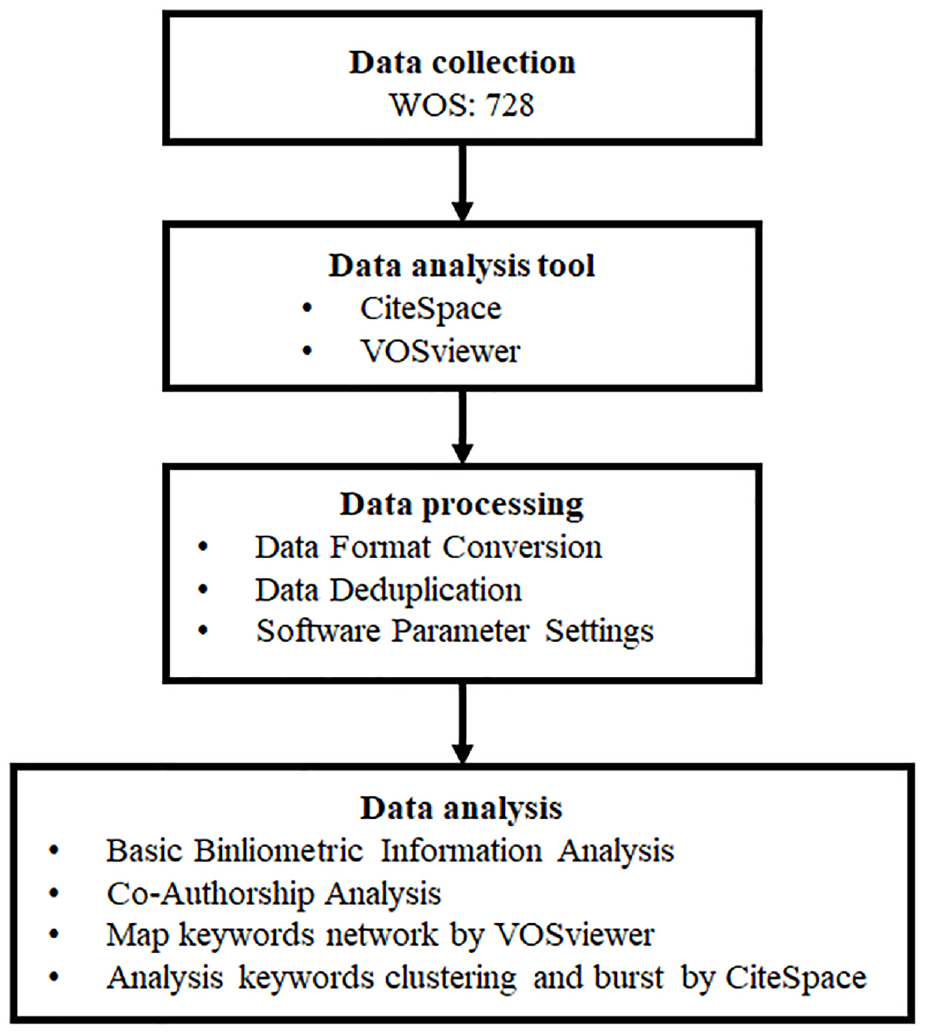
Research method flow chart.
Data Collection
The purpose of this study was not to offer a highly comprehensive and systematic overview but to observe the dynamics of the field via the core literature and capture vital research frontiers. Studies published during the period from January 2000 to December 2022 (until December 31, 2022) were retrieved from the Web of Science database, and the data source was “WOS Core Database.” Because this database includes a large number of reliable sources of literature data, especially in the fields of psychology, sociology and other social sciences (Apriliyanti & Alon, 2017). To ensure the quality of the articles, the citation index was set as “SSCI” and “SCIE.” The search formula has been fine-tuned as follows: TS = ((“prejudice” OR “discrimination” OR “toleran” OR “intoleran”) AND (“multicultural”)). A total of 728 studies were retrieved.
Data Analysis Tool
CiteSpace is an information visualization software developed by Chaomei Chen (Synnestvedt et al., 2005), which aims to support the visualization and analysis of scientific literature and has been widely used in bibliometric analysis. In this study, the author and title information of the literature were exported in RefWorks format, followed by author analysis, collaboration network analysis, emergent word analysis, and keyword clustering analysis using CiteSpace version 5.6.R3 Basic. Besides, we used VOSviewer (version 1.6.19, Leiden University, Leiden, Netherlands) to extract the keywords.
Data Processing
The complete record of these documents and the cited literature data were downloaded in plain text format from the export section of the database. All records and references were exported in plain text format. We used CiteSpace to remove duplicated data. During this process, 23 duplicate records were deleted; 705 unique records remained in our revised dataset.
After data processing was complete, we imported the dataset into CiteSpace for exploration and analysis. The specific parameter settings used in CiteSpace are listed below: Time slices include “Time” and “Year per slice.”“Time” specifies the range of years in which the paper was published. This study starts in January 2000 and ends in December 2022. “Year per slice” divides the data time zone in years, which is set to 1 year for this study (Che et al., 2022).
Results
Publication Years
After cleaning and converting the dataset, a quantity chart of Tolerance in Multicultural Contexts publications per year was acquired. As shown in Figure 2, the annual number of published studies on tolerance from 2000 to 2022. Overall, the number of papers published on tolerance studies from 2000 to 2022 shows an increasing trend year by year, with the largest increase in 2016.

Statistics and trends of annual publications from 2000 to 2022.
The study can be roughly divided into three stages: the first stage was from 2000 to 2007, the number of papers published was relatively stable, and the average annual publication papers is 9.13. The second stage, from 2008 to 2015, showed a steady upward trend. The average annual publication papers rose to 30.88, which is the 3.38 times of articles issued in the previous period. The third stage is divided into 2016 to 2022. The overall number of papers published in this stage shows a significant growth trend, with an average annual number of 55 papers, nearly 1.78 times more than in the previous stage, and nearly 6.02 times more than in the first stage. According to the above results, the study of social tolerance has gradually received widespread academic attention in recent years.
Co-Authorship Analysis
Co-authorship refers to the association between two or more researchers who work together to report their findings on a particular topic. The term can be seen as an expression of a social network of collaboration between researchers. The primary use of co-authorship networks is to investigate the structure and evolution of scientific collaboration. The co-authorship analysis in this study includes both author co-authorship analysis and country co-authorship analysis (Che et al., 2022).
Author Co-authorship Analysis
The 705 studies in this search contained 514 authors. The node type in CiteSpace was selected as Author, the author partnership map of tolerance research is shown in Figure 3. With 514 nodes (N), 283 connections (E), and a network density (Density) was 0.0021. The density describes the strength or tightness of connections between nodes in a network. The values of density range from 0 to 1. When all nodes in the network are connected, the density equals one. Each node represents one author, and the larger the node size, the more articles published by the author. The more connections between nodes, the greater the density of the network is, and the greater the network’s density, the greater the influence of the network between nodes is. The thicker the line between authors means the closer they cooperate, and the closer the color of the circle is yellow means the more recent the posting time. The results show that while a certain network of author partnerships was currently forming, the overall cooperation was relatively loose.

The network of co-authors.
The author with the highest number of publications was Maykel Verkuyten, who had published 12 articles in the related fields. Price’s Law (also known as Price’s Square Root Law) states that about 50% of the work is done by the square root of the total number of people who are participants in it. According to Price’s law, the number of core authors can be calculated from the highest number of published authors. According to the formula N = 0.749√Mmax (N is the minimum number of core authors’ publications and Mmax is the maximum number of authors’ publications), N was calculated to be about 2.59. So, the authors with the number of publications ≥2 were the core authors in the field of tolerance research. A total of 55 authors were core authors and 143 papers were published, accounting for 20.28% of the total number of publications. Specifically, only Maykel Verkuyten (12) publishing more than 10 articles. The remaining authors with more publications were Jochem Thijs (5) and Catherine Demangeot (4), Fons J.R.Van De Vijver (4), Collen Ward (4), Ana Urbiola (4). These authors became the key points in the author partnership network map.
From the point of view of the research team, the Michele J. Gelfand research team, with a total of 45 people, was the largest. They explored the differences in social norms and tolerance in a loose-tight cultural context using data from 22 countries (Gelfand et al., 2011). The team of Maykel Verkuyten, Levi Adelman and Kumar Yogeeswaran has published the most in recent years and produced more. Most of the rest were research teams with 2 to 4 members and have published 2 to 4 papers.
Country Co-authorship Analysis
The node type in CiteSpace was selected as Country, and the country/region collaborative relationship network mapping was obtained, as shown in Figure 4. The number of nodes (N) in the figure was 454, the number of connections (E) was 476, and the density (Density) was 0.0046, suggesting a wider range of tolerance studies and closer cooperation between countries and regions. A circle in the figure represents a country, and the larger the circle means the higher the frequency of posting in that country, and the closer the color of the circle to red means the more recent the posting time.

The network of countries and regions.
Specifically, among the countries and regions, the most frequently published country was the United States, with a total of 376 (53.33%) articles. The remaining countries and regions with relatively more articles (frequency > 40) were the United Kingdom (71), Canada (61), the Netherlands (60), Australia (56), and Germany (42). The results show a very close cooperation between the countries.
Journal Analysis
Table 1 shows the top 10 journals. Interpersonal Journal of Intercultural Relations published the most articles. Cultural Diversity Ethnic Minority Psychology, Frontiers in psychology and other journals also published a high number of articles. Most journals had an impact factor of 2 to 4 for 2021, and the Journal of Counseling Psychology was the only journal that exceeded an impact factor of 5.
Summary of the Publications of the Top 10 Journals.

Cited References Analysis
Table 2 covered the top 10 most cited publications in this field. Among them, 3 publications are review, and the remaining publications are original articles. The most cited article (876) was published by Shelly P. Harrell in American Journal of Orthopsychiatry, entitled “A multidimensional conceptualization of racism-related stress: Implications for the well-being of people of color” (Harrell, 2000). In this article, the author integrates existing theory and research on racism, multicultural mental health, and the stress process. Specifically, Social identity theory was the powerful explanations of ingroup bias, responses of subordinate groups to their unequal status position, and intragroup homogeneity and stereotyping (Brown, 2000). Additionally, most of the articles are about the racial discrimination and the benefits of multiculturalism (Banks, 2008; Duffy et al., 2016; Harrell, 2000; Nguyen & Benet-Martínez, 2013; Ratts et al., 2016; Richeson & Nussbaum, 2004; Sue et al., 2009; Wolsko et al., 2000).
Top 10 Most Cited Publications.

Co-Occurring Keywords Analysis
Figure 5 shows the results of the cartographic analysis performed through the VOSviewer software. This type of analysis helps to identify the level of importance of each keyword in the study area. The minimum co-occurrence selection scale for keywords was set to 15. Out of the 3,114 keywords used by the authors, only 72 met the threshold (criteria).

The density of keywords.
The top 13 hot keywords of tolerance from 2000 to 2022 are shown in Table 3. It can be seen that the top 13 keywords were more than 40 times, the keywords with the highest frequency and breaking 200 times was “prejudice” (205 times), the keywords with the second and third frequencies were “discrimination” (167 times) and “attitude” (117 times). Betweenness centrality is an indicator of a node’s importance based on the number of shortest paths that pass through it. The higher centrality, the greater the degree of connectivity of the keyword with other keywords. The top three keywords in terms of centrality were “culture” (0.13), “attitude” (0.12), and “discrimination” (0.11).
Top 13 Keywords in Terms of Frequency and Centrality.

Keywords Clustering Analysis
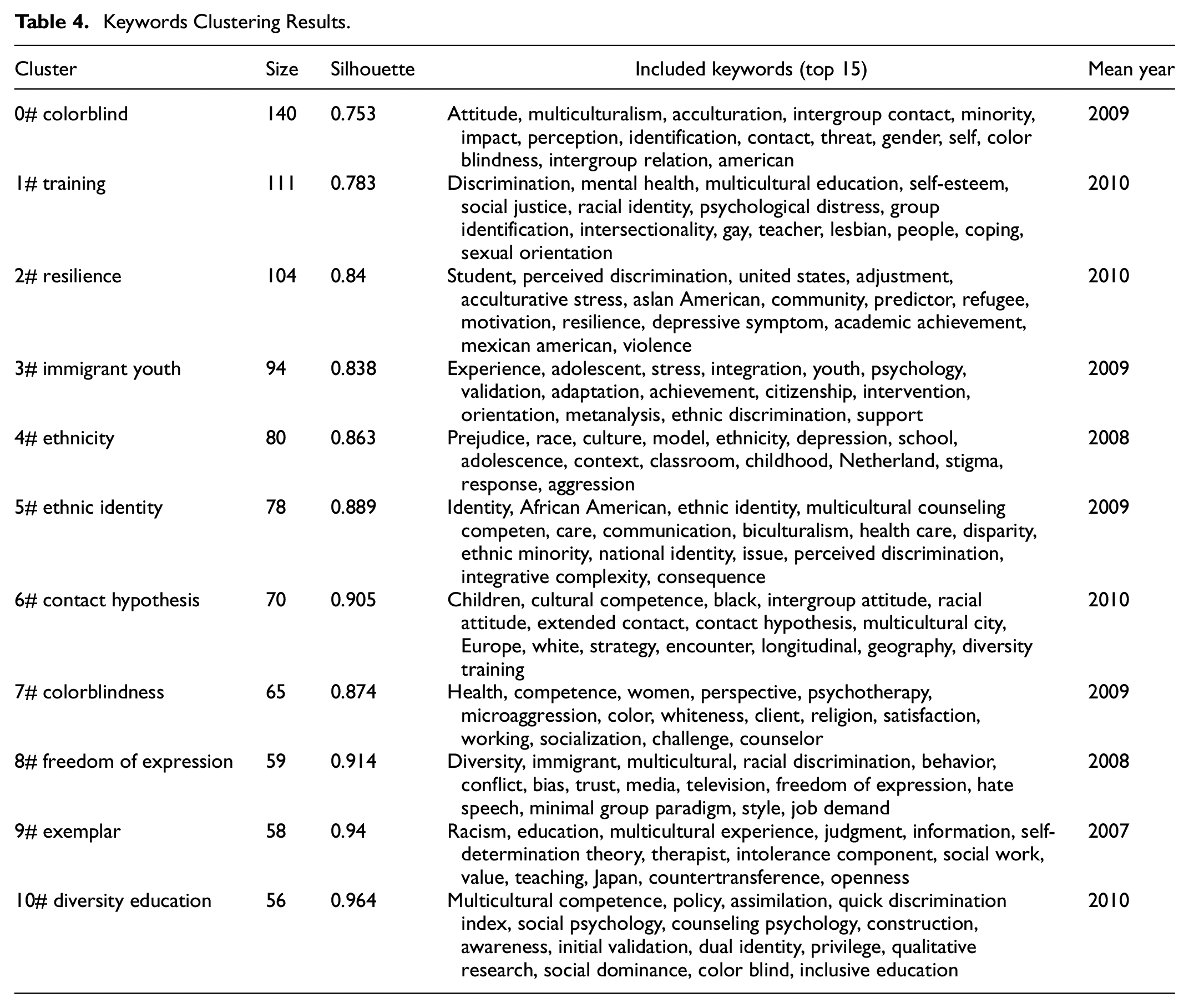
Naming by LLR clustering gives 11 keyword clustering labels. In the clustering map, Modularity Q indicates the degree of closeness of the node connection, and the value ranges from 0 to 1. When the value is closer to 1, it is considered that the clustering result is better. In this paper, the Modularity Q of the keyword co-occurrence network in the study of inclusion in multicultural context is 0.6292. It is generally considered that Q > 0.3 indicates that the network modular structure is more significant and the clustering effect is great. The silhouette (S) value is a measure of network homogeneity, and the value ranges from −1 to 1. When the value is taken closer to 1, the network is considered to be more homogeneous, the clusters are more closely connected to each other, and the clustering results are more credible. S > 0.5 represents valid clustering in the network; S > 0.7 indicates high homogeneity of the network. The silhouette value for all 11 keyword clustering labels in this study is greater than 0.7, indicating that the clustering results have a high confidence.
According to Table 4, it can be seen that the main themes of tolerance research since the 20th century include 0# colorblind, 1# training, 2# resilience, 3# immigrant youth, 4# ethnicity, 5# ethnic identity, 6# contact hypothesis, 7# colorblindness, 8# freedom of expression, 9# exemplar, and 10# diversity education.
Keywords Clustering Results.
Keywords With Citation Bursts
With CiteSpace software, it is possible to detect the sudden growth or fading of a large number of keywords in the burst literature over a certain period of time. The identification and tracking of keywords can visualize the development direction and frontier hotspots of the research field over time, and provide reference for future research directions. A total of 18 bursts words were obtained from the bursts analysis of tolerance research. There were no burst keywords in 2005 or earlier, which may be related to the low publication volume during this period. As shown in Figure 6, with the red part being the bursts words in that year and the blue part are not the bursts words.

Top 18 keywords with the strongest citation bursts.
Discussion and Conclusions
General Information
Based on an analysis of fundamental paper data, research on tolerance has exhibited a gradual growth trend since the year 2000. Notably, there was a minor peak in 2016, potentially attributed to the emergence of new waves of immigrants and their impact on the field. According to Shneider (2009), framework, the development of a discipline typically unfolds in four sequential stages. Initially, the discipline introduces its foundational terminology, followed by the innovation and adoption of new methodologies and tools. This phase leads to a surge in research, often characterized by the application of novel methods to explore emerging phenomena. Ultimately, as scientific knowledge matures, multiple studies start adopting similar methodologies. Therefore, despite the recent increase in the number of studies on tolerance, the scientific literature on tolerance is still in its infancy for new concepts.
The 705 articles included in this study were published in 206 journals, mainly focuses on social psychology, human geography, education, gender studies, political science, religion and other disciplines. The knowledge base of this field came primarily from social psychology. As globalization accelerates, tolerance in the context of multiculturalism may be receive more attention.
In terms of the network of countries, authors, and journal collaborations, several key figures have made significant contributions to the field. First, Maykel Verkuyten, Jochem Thijs, Catherine Demangeot, Fons J.R.Van De Vijver, Collen Ward, and Ana Urbiola play an important role in this field. The team consisting of Maykel Verkuyten, Levi Adelman and Kumar Yogeeswaran were the most productive. Furthermore, the major contributions to tolerance research have come from countries such as the USA, United Kingdom, Canada, and the Netherlands. These nations have made substantial strides in advancing the understanding of tolerance-related topics. Regarding journals, the Interpersonal Journal of Intercultural Relations stands out with the highest number of publications. Additionally, there are prominent high-impact journals in this field, including Cultural Diversity Ethnic Minority Psychology, Frontiers in Psychology, and the Journal of Counseling Psychology. One noteworthy article, authored by Harrell, S. P and published in the American Journal of Orthopsychiatry, has garnered significant attention, accumulating 876 citations. In this article, Harrell presents a multidimensional conceptualization of how racism is experienced and explores its potential effects on the well-being of its target groups. However, it is important to acknowledge that our study’s scope is limited, which may result in the omission of some prominent scholars from our analysis.
Research Topic Analysis
The study presents the knowledge structure of research related to tolerance in a multicultural context in terms of key keywords and most cited publications. The results show a gradual change in the topics studied in this particular area. The following section extends the keyword analysis by creating clusters and discusses it briefly.
Color-blind perspective (Cluster 0# colorblind and 7# colorblindness). The primary keywords are “attitude,”“multiculturalism,”“health,”“competence.” Many studies have explored the negative effects of color-blind perspective. As early as 2000, the scholars have combed through the previous studies and proposed the models of diversity (e.g., color blindness and multiculturalism). What emerges is a nuanced picture where both models possess the potential to either promote or hinder equality (Wolsko et al., 2000). However, subsequent research in 2004 introduced a viewpoint, suggesting that a color-blind perspective might actually exacerbate racial attitude biases (Richeson & Nussbaum, 2004). These findings raise intriguing questions about the boundary conditions that influence the impact of multiculturalism on individuals. Yet, the precise mechanisms through which these models exert their influence remain a subject of ongoing exploration. In this evolving landscape of tolerance research, there is a growing need to delve deeper into the intricacies of these models and their real-world implications. A more comprehensive understanding of how color-blind perspectives intersect with attitudes and multiculturalism will undoubtedly contribute to a richer and more nuanced discourse on tolerance.
Prejudice reduction practice (Cluster 1# training, 6# contact hypothesis and 10# diversity education). The primary keywords are “discrimination,”“children,”“multicultural competence.” What effective interventions exist to reduce bias?
Scholars have delved into the factors influencing bias from a multicultural perspective, shedding light on potential strategies. For instance, multicultural ideology has been identified as a potent force in reducing prejudice (Urbiola et al., 2017). Additionally, the Achieving Multicultural Integration of Groups Across Society (AMIGAS) model suggests that fostering a commitment to multiculturalism can effectively diminish intergroup prejudice (Urbiola et al., 2022). However, contact with individuals from diverse cultures remains one of the most direct and potent approaches to bias reduction. Paluck and Green (2009) conducted a comprehensive review of existing research and found that intergroup contact and collaborative interventions emerged as viable and impactful approaches.
Within the realm of education, researchers have embarked on efforts to mitigate interracial bias through multicultural training and programs (Engberg, 2004). Remarkably, even brief video interventions have demonstrated significant results (Soble et al., 2011), while online training has shown similar benefits (Robey & Dickter, 2022). It is worth noting that all these interventions share a common thread—they are inherently intertwined with contact with different cultures, whether experienced in reality or imagined. The Intergroup Contact Hypothesis posits that interactions between members of opposing groups foster positive interpersonal relationships among individual group members, challenge stereotypes, and ultimately reduce prejudice against the group as a whole (Allport, 1954). However, it is essential to acknowledge that the valence of participants’ contact (whether negative or positive) can significantly influence its impact (Zingora et al., 2021).
In essence, prejudice reduction practice represents a dynamic field where researchers continue to explore multifaceted approaches aimed at fostering greater tolerance and inclusivity in diverse societies.
3. Tolerance education (Cluster 2# resilience, 3# immigrant youth, and 9# exemplar). The primary keywords are “student,”“education,”“racism,” and “experience,” highlighting the pivotal role of education in shaping values during the formative years of youth. The student years represent a crucial stage in the development of values for young individuals. It is a period marked by exposure to diverse experiences, especially for those studying abroad. Simultaneously, adolescence emerges as a pivotal juncture for the cultivation of social and ethnic identity, moral reasoning, and intergroup attitudes. Consequently, young people have emerged as a primary focus for tolerance education initiatives.
Teachers, who serve as role models, wield significant influence over students’ attitudes toward multiculturalism (Baker et al., 2023; Wang et al., 2022). Moreover, the attitudes exhibited by educational institutions and teachers play a substantial role in shaping the cultural adjustment and mental well-being of minority groups (Geerlings et al., 2017; Nishina et al., 2019; Schachner, 2019). The establishment of norms within educational environments is equally crucial. Research indicates that norms promoting equality, inclusion, and cultural pluralism can foster positive relationships between students from immigrant and non-immigrant backgrounds (Schwarzenthal et al., 2018).
The endeavor to reduce prejudice through education, especially during the formative years, has emerged as an effective approach. It instills in students the belief that tolerance and respect for cultural diversity represent not just an option but the right behavior and attitude. This early exposure to the principles of tolerance sets the foundation for a more inclusive and harmonious society.
4. Ethnicity (Cluster 4# ethnicity, 5# ethnic identity, and 8# freedom of expression). The primary keywords are “prejudice,”“identity,”“diversity,” underlining the significance of addressing racial discrimination. Racial discrimination remains a pressing issue that demands attention, as individuals are often categorized based on factors like skin color, ethnicity, and religious beliefs. Social Identity Theory, as elucidated by Brown (2000), provides a robust framework for understanding phenomena such as intergroup prejudice, the responses of marginalized groups to their unequal status, and the development of in-group homogeneity and stereotypes.
Multicultural experiences offer individuals valuable opportunities to explore and embrace other cultures, potentially enhancing their identification with different cultural groups and, consequently, reducing prejudice (Sparkman & Eidelman, 2018). Despite policy incentives in some countries aimed at curbing bias, the problem of racial discrimination persists, and the actual impact of such policies remains subject to ongoing observation (Blinder et al., 2019). Additionally, the COVID-19 pandemic has shed light on novel dimensions of prejudice, with discrimination against Chinese individuals and COVID-19 patients gaining prominence (Ferrante et al., 2022; Li et al., 2021).
In summary, the merits of multiculturalism are not absolute, and researchers continue to explore its nuanced implications. Reducing prejudice remains one of the paramount research themes in this domain, particularly given the increasing prevalence of cultural diversity in schools and society. While some factors influencing prejudice at the institutional and societal levels have been explored to some extent, transforming the values of older generations may prove a challenging endeavor, making youth the focal point of intervention efforts. Two pivotal theoretical pillars, Social Identity Theory and the Intergroup Contact Hypothesis, underpin this field’s exploration. Moreover, in addition to addressing traditional prejudices, such as the problem of racial discrimination, it is important to turn attention to new issues that arise in an evolving social environment.
Research Trends Analysis
As revealed in the burst keyword mapping, earlier research predominantly centered on prejudice against black individuals and issues of race. However, the landscape has evolved significantly in the last decade. Post-2010, there has been a pronounced shift toward emphasizing cultural competence and multicultural competence as pivotal components for fostering tolerance at an individual level. Moreover, recent years have witnessed an increasingly critical examination of the mental health implications stemming from prejudice and discrimination. Concepts such as acculturation and cultural stress have come into sharper focus, underscoring their potential to exacerbate prejudice and its detrimental effects.
The timeline above illustrates a notable surge in research dedicated to interventions at both the school level (e.g., school climate, teachers’ attitudes) and the broader social sphere (e.g., policy initiatives). This surge suggests a burgeoning interest in addressing the root causes of prejudice. Furthermore, the evolving conceptualization of tolerance opens doors for diversifying the spectrum of research subjects, exploring tolerance from the vantage point of respecting, accepting, and appreciating diversity.
Lastly, the omnipresence of the internet has facilitated global connections from the comfort of one’s home. Consequently, the topic of utilizing the internet to combat and mitigate prejudice may poised to emerge as a significant research theme in the near future.
Limitations and Future Trends
Nonetheless, certain limitations exist in this study. Due to software requirements and data source constraints, our study exclusively drew from the core database of Web of Science for SSCI and SCIE journals to ensure the quality of selected literature. Consequently, other databases were excluded, potentially resulting in the oversight of valuable insights.
Future research avenues could be pursued in several directions. Firstly, there is an opportunity to broaden the scope of literature selection to gain a more comprehensive understanding of evolving research trends and focal points. Secondly, considering the pervasive influence of the Internet and the ramifications of the ongoing pandemic, it is highly relevant to explore the tolerance within the realm of online interactions. Lastly, in consonance with the novel definition of tolerance, research in this domain should transcend the confines of prejudice and examine the manifold impacts of diversity.
Footnotes
Author Note
This research was conducted while Shilong Bai was at Fuzhou University. He is now at Jimei University and may be contacted at
Declaration of Conflicting Interests
The author(s) declared no potential conflicts of interest with respect to the research, authorship, and/or publication of this article.
Funding
The author(s) disclosed receipt of the following financial support for the research, authorship, and/or publication of this article: The work in this article was supported by the National Social Science Fund of China (No. 21BSH096).
Ethics Statement
This article does not contain any studies with human or animal participants.
Data Availability Statement
The data that support the findings of this study are available from the corresponding author upon reasonable request.
