



Abstract
Financial services are significantly impacted by digital transformation, which has been believed as one of the primary trends reshaping society and industry. A comprehensive understanding of digital transformation from an academic and management perspective is required, and it is crucial to close the knowledge gap using bibliometric and qualitative research techniques. Hence, the purpose of this paper is to identify the extensive research themes in digital transformation in financial services from 2000 to 2021, their significance and interdependencies, to determine which trending topics seem to be the most influential, to trace the evolution of digital transformation in the financial service, and to address new and under-researched field of research that is intriguing for future research. This study used a bibliometric analysis of 288 peer-reviewed research articles published over the last 22 years in digital transformation in financial services. The data were extracted from the Scopus database and used various bibliometric analyses such as conceptual structure analysis, co-citation network analysis, social structure, and keyword analysis using R software. The findings show an overall increasing trend in journal publications, author productivity, collaborative research by institutions, and countries’ collaboration from the year 2019, as well as major insights from co-citation analysis. According to Lotka’s law, most authors (769, or 95.77%) contributed only one article. In addition, the study assesses multiple research areas, such as the effects of digital transformation in financial services, applied technology and insights, and digitalization processes, comprising the latest trending topics in this research stream that extensively cover up in financial services. One of the limitations of this study is that it used only a single database. The author recommends that the findings of this research be reinforced with more targeted and extensive qualitative literature in this field of study. This study establishes a framework for policymakers, academics, and researchers to investigate the areas where digital technologies influence financial services. This study also highlighted several cutting-edge digital technologies used for different functions of the financial services of an organization. This study illustrates the bibliometric structure of the digital transformation literature in financial services and provides insights into the literature’s growth year over year. It provides a comprehensive understanding of this evolving field, guiding future research and facilitating informed decision-making in the financial industry.
Plain language summary
Purpose: Financial services are significantly impacted by digital transformation, which has been believed as one of the primary trends reshaping society and industry. A comprehensive understanding of digital transformation from an academic and management perspective is required, and it is crucial to close the knowledge gap using bibliometric and qualitative research techniques. Hence, the purpose of this paper is to identify the extensive research themes in digital transformation in financial services from 2000 to 2021, their significance and interdependencies, to determine which trending topics seem to be the most influential, to trace the evolution of digital transformation in the financial service, and to address new and under-researched field of research that is intriguing for future research. Design/methodology/approach: This study used a bibliometric analysis of 288 peer-reviewed research articles published over the last 22 years in digital transformation in financial services. The data were extracted from the Scopus database and used various bibliometric analyses such as conceptual structure analysis, co-citation network analysis, social structure, and keyword analysis using R software. Findings: The findings show an overall increasing trend in journal publications, author productivity, collaborative research by institutions, and countries’ collaboration from the year 2019, as well as major insights from co-citation analysis. According to Lotka s law, most authors (769, or 95.77 %) contributed only one article. In addition, the study assesses multiple research areas, such as the effects of digital transformation in financial services, applied technology and insights, and digitalization processes, comprising the latest trending topics in this research stream that extensively cover up in financial services. Research limitations/implications: One of the limitations of this study is that it used only a single database. The author recommends that the findings of this research be reinforced with more targeted and extensive qualitative literature in this field of study. Practical Implications: This study establishes a framework for policymakers, academics, and researchers to investigate the areas where digital technologies influence financial services. This study also highlighted several cutting-edge digital technologies used for different functions of the financial services of an organization.
Introduction
Unifying industries through digital transformation is undoubtedly a significant effort. By using digital technology, any industry may work to provide more effective and efficient results. Developing a broad range of digital capabilities is necessary for adapting to disruptive processes. These competencies enable implementing various digital transformation initiatives, promoting a technology innovation culture (Marino-Romero et al., 2023). Big data, artificial intelligence (AI), and the Internet of Things (IoT) have recently caused significant changes in many industries (Papathomas & Konteos, 2023; Qiu et al., 2018; Qi et al., 2017). However, financial institutions’ digital transformation has not been measured, so it is still unclear whether this will increase banks’ competitiveness (Xie & Wang, 2023). The banking industry has transitioned from traditional paper transactions to touchpoints on a screen. Ecosystems constantly evolve due to the digital revolution, which compels established companies to rethink their value propositions (Riasanow et al., 2021). Blockchain, machine learning, and AI are just a few emerging technologies opening up new opportunities in business intelligence. Big data and analytics, technology-enabled wealth management, and real-time customer information can improve customer engagement. The term “digital transformation” refers to the changing nature of society and business as a result of the use of digital technologies (Abdulquadri et al., 2021). In contrast to earlier technological revolutions, the contemporary situation is defined by the quick expansion of innovation, which has had diverse effects on organizations. To adapt their business models to the external demands generated by competitors and regulators, many firms specifically improved their management control systems (Pizzi et al., 2021). As a result of digital transformation in financial services, practitioners and researchers might deal with swift changes in everyday processes and the restructuring of business models (Russo-Spena et al., 2022).
Digital transformation necessitates seamless compatibility between all enterprise interoperability (Sia et al., 2021). However, although digital interactions open up new business opportunities, they also introduce new concerns, such as pressures on back-office processes (Angelopoulos et al., 2019). With an emphasis on evolving the flea market, the digital revolution in financial services introduces business opportunities to transform its business model for social and economic development for a better customer experience (Abdulquadri et al., 2021). This research problem is exacerbated by the fact that information communication technology (ICT) and research on digital transformation have traditionally been conducted in academic silos (Thottoli, 2021a, 2021b, 2022). Thus, theoretically significant insights on what are the emerging topics in the field of digital transformation in financial services are currently unavailable. As a result, researchers have become more interested in this field, believing that a better understanding of digital transformation in financial services will lead to better contributions in the current research field.
In addition, studies on digital transformation in financial services have been reviewed (Vaska et al., 2021; Zaoui & Souissi, 2020) since no additional study utilizing bibliometric approaches has been done on the entire domain. Although the relevance of changes in organizational structure and restructuring in response to technological advancements have been highlighted by digital transformation, academic research is still lacking a thorough understanding of how the development of digital technologies influences the redesign of organizations and the transformation of firms (Plekhanov et al., 2022). Through qualitative research, Werth et al. (2020) investigated the driving elements of digital transformation in the financial services industry. However, there could potentially be a need for a more thorough and current analysis of the most influential and trending topics in this field. In the subject of Fintech, Breidbach et al. (2020) have investigated possible study avenues to look at how financial service systems are becoming more digital, while Werth et al. (2020) have looked into the elements that are impacting digital transformation in the financial services industry. Understanding the historical development of this phenomenon and the elements that have aided in its growth and evolution over time may still leave some questions unanswered.
Furthermore, researchers have not examined the co-authorship network to expound on the digital revolution in financial services. As a result, academic and managerial perspectives on digital transformation in financial services are missing an entire holistic understanding of the research. This gap in the literature necessitates a comprehensive investigation to establish the multidimensionality of digital transformation in financial services. This study tries to bridge that gap by applying bibliometric analysis approaches, a research method for summarizing publications on a certain topic. Further, qualitative research can help develop a better understanding of the dynamic nature of digital transformation, benefiting academics and practitioners. This understanding can be achieved by knowing the longitudinal outcomes and advancements of digital transformation in the financial sector (Werth et al., 2020). This motivates the researchers and aims to identify the extensive research themes in digital transformation in financial services from 2000 to 2021, their significance and interdependencies, to determine which trending topics seem to be the most influential, to trace the evolution of digital transformation in the financial service, and to address new and under-researched field of research that is intriguing for future research.
By reviewing the existing literature, the researchers intend to provide a comprehensive overview of knowledge structure, most renowned authors, most cited journals, co-citation network, most affiliated countries, prominent affiliated institutions, trending topics, and significant research streams. In turn, the current research tries to answer the below research concerning digital transformation in financial services research:
What are the most significant journals in digital transformation in financial services?
How are publications about digital transformation in financial services clustered?
Which scientific study has received considerable attention regarding citations?
Who are the highly prominent authors in digital transformation research in financial services?
Which are the highly recognized affiliations in the research field of digital transformation in financial services?
What are some new trending topics that scholars might use to focus their research in the future?
Those research questions aim to identify the extensive research themes in digital transformation in financial services from 2000 to 2021, their significance and interdependencies, to determine which trending topics seem to be the most influential, to trace the evolution of digital transformation in the financial service, and to address new and under-researched field of research that is intriguing for future research.
Bibliometric analysis using R software was employed to achieve the objectives of this study. The current research provides a valuable tool, specifically exploring the latest topics, including servitization, robotic process automation, and Fintech, while offering insights from experts in the field. To further improve understanding of the digital transition in financial services, knowing prominent authors, institutions/affiliations, and country collaboration networks in the future will be critical. By doing this, the researchers can continue to expand their understanding and make judgments regarding the industry’s future that are more enlightened. This study proposes a framework for future research and offers insights on how the financial service sector is undergoing digital change. When it comes to understanding digital transformation in the financial services industry, the research can serve as a guide for future research initiatives and as guidance for practitioners and policymakers.
The current study provides an in-depth analysis of current research goals, global trends, and prospects of digital transformation in financial services research. The literature review is described in the second section, followed by research methodology in the third section, along with the databases used, how the data was collected, and which bibliometric techniques were used. The results of the data analysis are presented in the fourth section, which also includes a thematic analysis and information on the increasing number of publications that cover prominent areas. The fifth section includes a conclusion with future research directions, while the sixth section discusses the implications and limitations of the study.
Review of Literature
Employees will be encouraged to support digital workplace transformation if they have favorable expectations that it will improve their performance and increase their satisfaction and well-being. Hence, Selimovic et al. (2022) focused our research on the issue of whether employee welfare, support, and engagement in the digital workplace speed up the shift to the new working environment. The corpus of research suggests that people working in the financial industry frequently are unaware of the value and guiding principles of sustainable development and how these factors directly affect their line of work. On the other hand, experts working in pertinent research and policy fields frequently fail to recognize the essential part that the financial sector plays in advancing sustainable development (Rahimi et al., 2022). Although Abdulquadri et al. (2021) study highlighted the chatbot’s function as a revolutionary tool for business models, customer experiences, and financial inclusion in emerging markets, there is a substantial knowledge gap about the use and deployment of chatbots by banks in various nations. Using literature sources from the Web of Science database, Li et al. (2020) did research using exploratory scientometric analysis. The analysis looked at yearly topic’s publications, trends, and fields relevant to blockchain.
The majority of incumbents concentrate on consolidating and updating their backend systems. It was intended to prepare them for brand-new customer-focused services. The threat of a larger market incursion by BigTechs was one of the leading forces behind the digital revolution. Hence, using quotes from subject-matter experts, Werth et al. (2020) research offers a thorough overview of the aspects that affect digital transformation. Demirbas et al. (2018) emphasized how the financial services industry’s sourcing strategy is impacted by digital transformation, with changes in one dimension impacting others. Even if a digital transformation disrupts some parts, its overall impact is evolutionary rather than revolutionary, signaling a subtle shift in the overall corporate sourcing strategy. Yu and Gu (2022) claimed that the path to digital transformation for financial shared services, which draws on the key elements of enterprise digital transformation, entails six steps: developing a clear digital transformation strategy, fostering a culture of transformation, talent assurance, implementing service-based data collection, and connectivity. With the use of an interpretive case study, Chanias et al. (2019) filled in the knowledge gap about how pre-digital firms develop and carry out a digital transformation strategy, and their research found that digital transformation strategy development departs from conventional planning methodologies and entails a constant and dynamic process of learning and action.
Studies that use bibliometric and qualitative research methods to pinpoint knowledge gaps in digital transformation in financial services are scarce in the available literature. These methods can offer a thorough understanding of the research landscape by examining qualitative insights and publishing trends. The Scopus database is a frequently used and extensive source of scholarly literature. However, there is very little research that uses it.
Research Methodology
Analysis for the current research begins with identifying the database by applying Boolean search in the Scopus database, followed by data extraction, synthesis, results, and reporting (Figure 1).
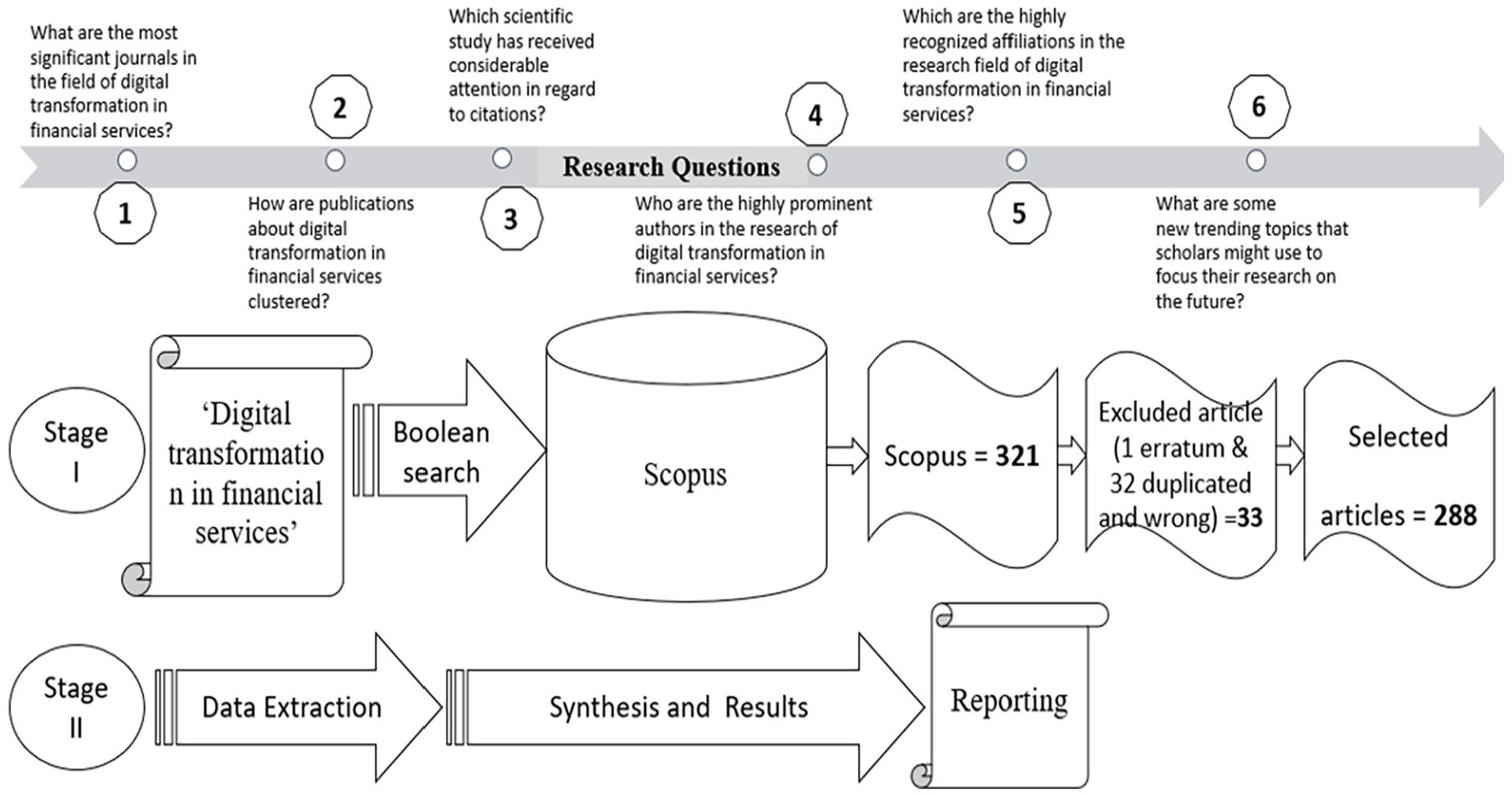
Data collection.
Database Selection
In bibliometric analysis, highly indexed journal articles in the database are carefully described.
Data is collected from the Scopus database, considering article coverage, journal categorization, and the database’s compatibility with the Bibliometrix tool in R-studio. Scopus offers a wide range of articles on social science research conducted globally (Baas et al., 2020). The authors decided to limit their investigation to the Scopus database and not include WoS since the Scopus database is comparatively thought to be more precise (Franceschini et al., 2015). Most studies (El-Baz & Iddik, 2022; Zainuldin & Lui, 2022) have chosen to explore the Scopus database for bibliometric analysis. Scopus database is preferred in the current study over other databases since it includes highly indexed journals from a wide range of categories by excluding publications from periodicals and non-scientific articles.
Data Pre-processing
Increasing the dataset’s quality is important because poor data can largely reduce accuracy and result in inaccurate predictions. Therefore, data pre-processing is the most effective way to handle such issues. Using cleaning, integration, transformation, and reduction techniques, knowledge may be extracted from the data collection much more quickly. As information is gathered from many sources and real-world applications, there is always a problem with data missing and large discrepancies in the range of data (Maharana et al., 2022). The study search covers global trends and digital transformation prospects in financial services. The initial data were retrieved from the Scopus database, and the articles were extracted on 28th January 2022.
Search Strategy and Data Collection Processes with Inclusion and Exclusion Criteria
The preliminary search under “article title, abstract, keywords” was found 321 articles. But the authors also followed the guidelines provided by Block et al. (2020) in order to present a compelling bibliometric analysis and evaluate the organization of a specific research area. This procedure will enable the researchers to better comprehend digital transformation’s development in the financial services sector (Alsharif et al., 2021). The authors likely chose “digital,”“transformation,”“financial,” and “services” as they are central to the study’s topic and help capture relevant studies on digital transformation in financial services. To ensure transparency and replication, the study precisely outlined the specific search words and filters utilized in the search procedure. According to Kreimeyer et al. (2009), there are a number of Boolean operators, including AND, NOT, and OR, to find specific topics. Hence in the current study, the keywords such as “digital AND transformation AND financial AND services” were typed to search in the article title, abstract, and keywords of the articles published in the Scopus database. The search showed 321 articles spanning the years 2000 to 2021.
The authors collected data on Jan 11, 2022; hence limited data collection from 2000 to 2021 and excluding 2022 ensured consistency and avoided potential biases in the analysis. Since English is the language most commonly used for academic communication, the author excluded documents written in other languages for analysis. By concentrating on a single language, authors can keep their analysis consistent and avoid potential linguistic misunderstandings or inconsistencies. For this study, defining academic output to encompass book chapters, books, and conference proceedings was essential and justifiable. The current study has included articles, conference papers, book chapters, conference reviews, and book and review articles published in the Scopus database. Even though bibliometric analysis is simpler for peer-reviewed journal articles, focusing only on journal articles would have left out a sizable portion of the research output in the particular research field under consideration, and books and book chapters are significant academic outputs in many subjects (Ellis et al., 2019). After eliminating 33 articles (1 erratum and 32 duplicates and or unusable) from the search, 288 suitable articles were selected for the study. Figure 1 depicts the data collection processes.
Bibliometric Tool Selection
The present study adopts a bibliometric approach to map out the entire body of knowledge. For digital transformation research, bibliometric analysis is considered the best alternative (Apriliyanti & Alon, 2017; Chawla & Goyal, 2022). Bibliometric studies have previously been conducted using tools such as Publish or Perish, BibExcel, and so on (Muñoz et al., 2020). VOSviewer is another tool for bibliometric analysis research (Huang et al., 2020). This research uses the Bibliometrix R-package application, an approach built in R by Aria and Cuccurullo (2017). This Bibliometrix R-package makes conducting a thorough bibliometric study that includes visualization and complex data analysis easier. Because of the R-package’s higher versatility, adaptability for various academic output, and the author’s experience with the software was chosen for bibliometric analysis rather than VOSviewer. According to Muñoz et al. (2020), bibliometric software, Bibliometrix “stands out since it integrates a great variety of diverse analyses” and for the usability of the Biblioshiny web interface. The majority of the bibliometric analysis is complicated due to challenges in accessing software tools and necessitate broad assessment training of researchers. Bibliometrix, on the other side, is an open-source program developed for extensive science mapping investigation. It can be regularly upgraded and integrated with several other statistical R packages (Ingale & Paluri, 2020). Therefore, it is very well appreciated by clients and becomes increasingly important in the rapidly evolving field of bibliometric analysis, both descriptive and network analysis. According to the author’s limited knowledge, no prior study has applied bibliometric methodologies to assess digital transformation in financial services. This work intends to fill this gap by using bibliometric analysis to summarize publications on this issue. By giving a comprehensive overview of the research through the use of bibliometric analysis and qualitative research techniques, this study seeks to bridge that gap. The previous study by Werth et al. (2020) used qualitative research to examine the factors influencing digital transformation in the financial services sector. However, the current study acknowledges the value of qualitative research in understanding digital transformation dynamics.
Data Analysis and Findings
The data were analyzed using descriptive as well as scientific mapping techniques. This section describes the overall findings after thoroughly analyzing all of the articles selected in the sample. In addition to prior bibliometric studies on the field, the study examined bibliographic coupling, most relevant authors, most relevant documents, co-authorship networks, co-citations, intellectual structure, and social structure.
Descriptive Analysis
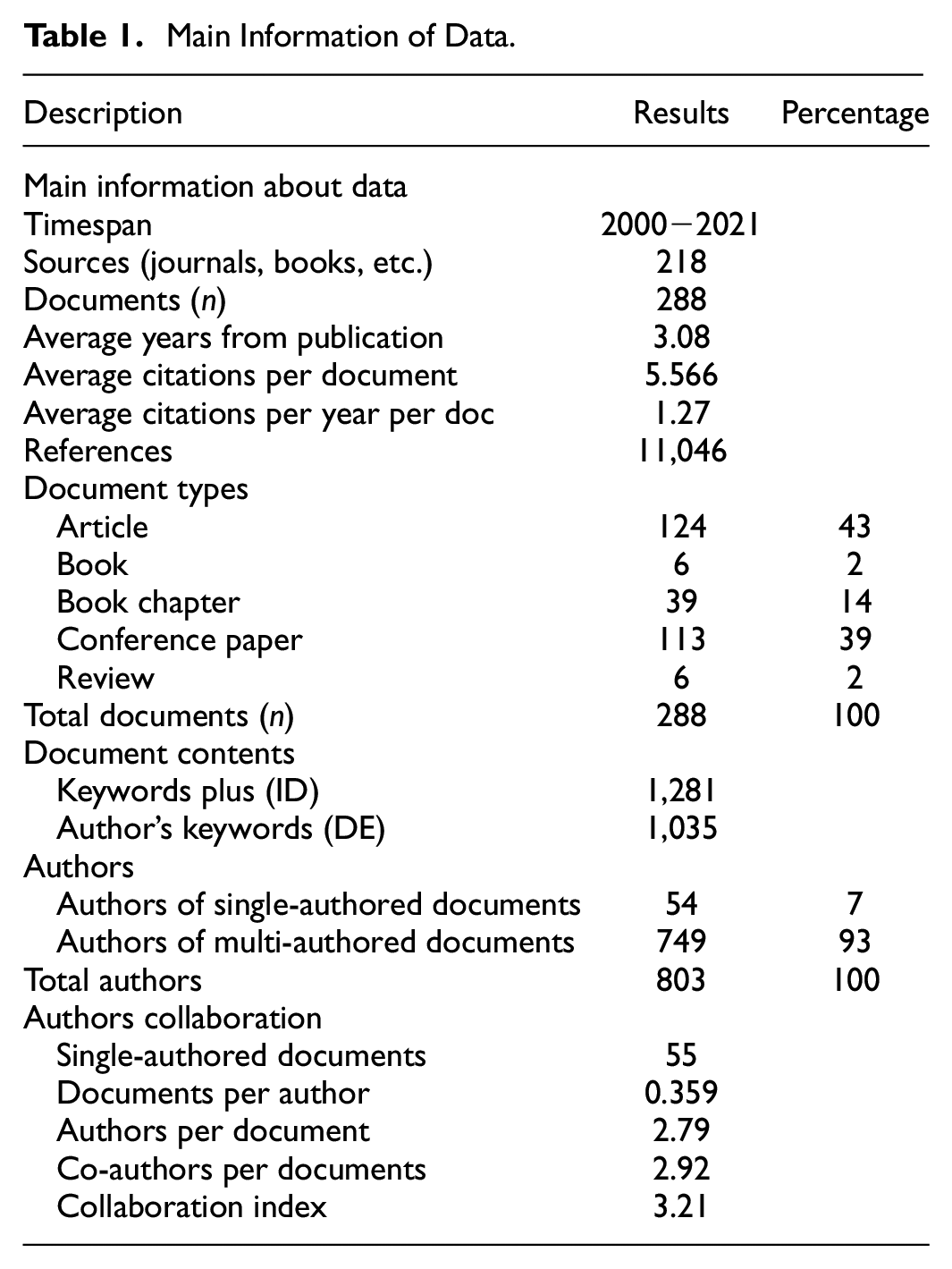
Table 1 shows the results of the main information about data, document types, document contents, authors and authors’ collaboration. The total number (n) of documents is 288. The results show that there are 124 (43%) articles, 6 (2%) books, 39 book chapters (14%), 113 conference papers (39%), and 6 reviews (2%) papers. There are 54 (7%) authors of single-authored documents; however, 749 (93%) authors of multi-authored documents have been identified.
Main Information of Data.
Annual Scientific Production
Figure 2 depicts the annual scientific production of research publications in financial services digital transformation. Only a few articles were published between 2000 and 2016, indicating that this is a relatively new field of study. The number of articles has progressively increased just in the last few years. There was only one publication in 2000, 2003, 2004, and 2006, which shows an extremely low compounded annual growth rate of research articles in this field. Whereas no articles were published in 2001, 2002, 2005, 2008, 2009, and 2013. However, 260 (90.28%) articles were published over the period 2017 to 2021. This shows that there is a growing interest in this topic.

Annual scientific production.
Average Citation Per Year
Table 2 shows that in 2000, one article received an average of 7.00 citations per article and 0.32 average citations per year. In 2012, six articles were published, having an average of 17.17 citations for each article and 1.72 average citations per year. No articles were published in 2001, 2002, 2005, 2008, 2009, and 2013. However 2014, there was a significant increase, with six publications receiving an average of 112.5 citations each and 14.06 citations per year. The findings reveal a low trend during the first decade (2000−2010) with regard to the average number of citations per year and an increasing trend in the following decade (2011−2021), as indicated below in Table 2.
Average Citation Per Year.
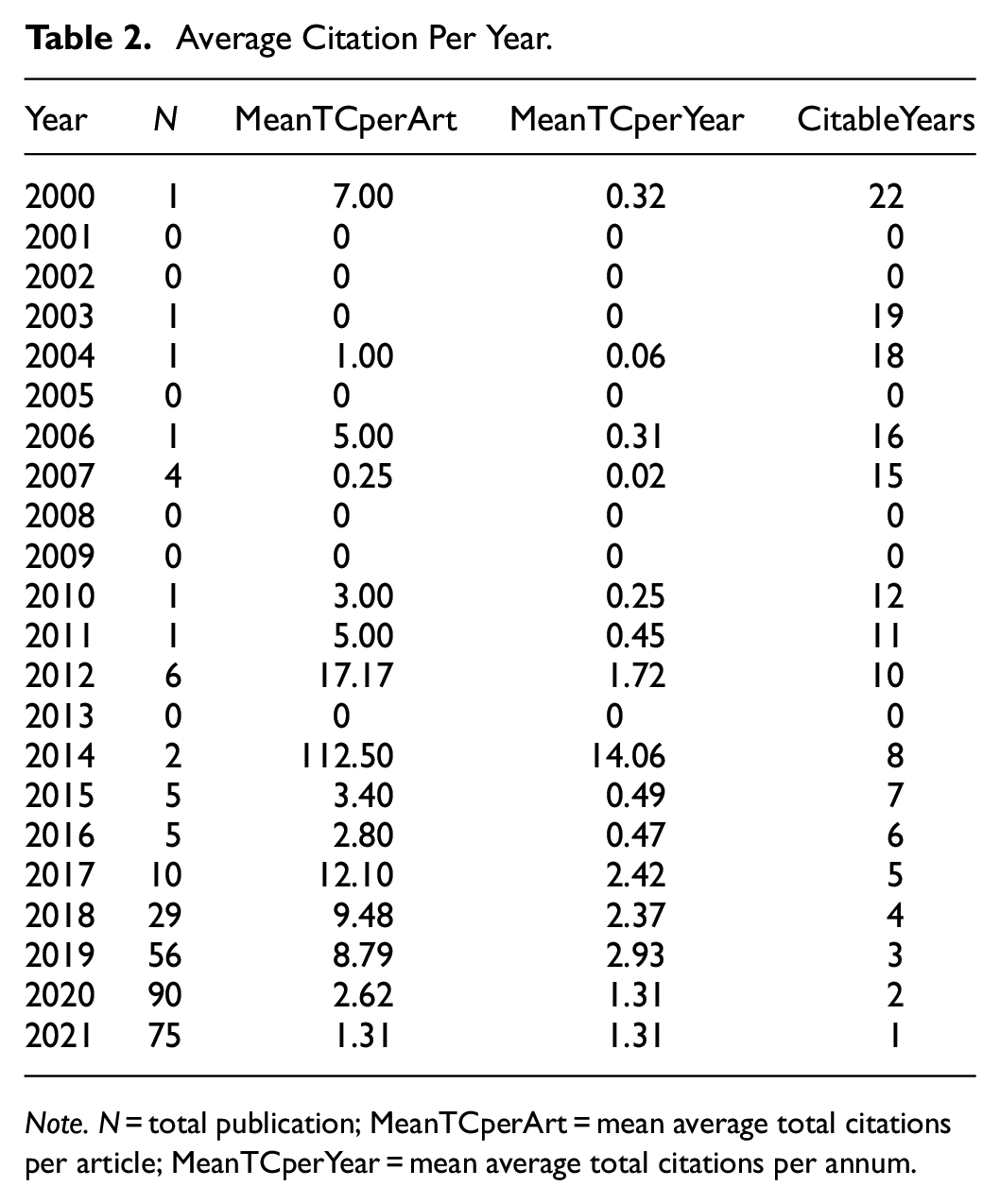
Note. N = total publication; MeanTCperArt = mean average total citations per article; MeanTCperYear = mean average total citations per annum.
Three-Fields Plot
Figure 3, three field plot, shows the connection among three fields applying Sankey Plots (Riemann et al., 2005), in which the size of the section is relational to the node’s value. The authors’ names appear on the left part of the Sankey Plot, the keywords appear in the center, and the sources chosen for the study appear on the right side of the Sankey Plot. Each of the 10 items displayed essential keywords such as digital transformation, digital economy, Fintech, blockchain, digitalization, digitization, financial services, digital technologies, innovation, and banks along with the most relevant sources and authors. The “digital transformation” topic was covered in all 10 major publications, suggesting its critical importance in influencing “financial services.”

Three-fields plot.
Most 20 Local Cited Sources
Further examination, Figure 4. Most 20 local cited sources reveal that MIS Quarterly, published by the Management Information Systems Research Center, is the most locally cited source, with 92 local citations. The Journal of Business Research, published by Elsevier Inc., is the next most highly cited source in the research field. Harvard Business Review has a total of 51 local citations as per the dataset, and the remaining sources and corresponding citations are shown in Figure 4.

Most 20 local cited sources.
Source impact
Table 3, Source impact, shows 20 source impacts along with its h_index, g_index, m_index, total citation (TC), number of publications (NP), and publication year start (PY_start).Advances in Intelligent Systems and Computing and “Americas Conference on Information Systems 2018: Digital Disruption, AMCIS 2018” has a 2 h_index/g_index each, whereas all 18 remaining sources have only a 1 h_index/g_index.
Source Impact.

Most 20 Relevant Authors
The bibliophile results show that the 20 most relevant authors with the maximum number of articles published by Fedotova GV with four articles (articles factionalized 0.85) followed by LI J, Pantielieieva N, and Potapenko L having three articles each (articles fractionalized 0.71, 0.70, and 0.70 respectively). The third most relevant authors include Agarwal S, Arefjevs I, Chanias S, Galazova SS, Gontar AA, Inshakova AO, Kauffman RJ, Khan RA, Khuntia J, Khutorna M, Krynytsia S, Kumar R, Kuzmina EV, Manser Payne EH, Matt DT and Mavlutova I having two articles each (see Table 4).
Most 20 Relevant Authors.

Author Productivity
A total of 769 authors contributed to the articles investigated. Table 5 shows that the majority of the authors (769, or 95.77 %) contributed only one article to the total publications, whereas thirty (3.74%) authors have produced two articles, three (0.37%) authors have published three articles, and one (0.12%) author has published four journal articles. Consequently, the publication of more than one article is significantly smaller in number, that is, 34 (4.23%).
Author Productivity.

According to Lotka’s law (Lotka, 1926), the number of authors who make n contributions equals about 1/n2 the number of authors who produce one article, where n is typically near 2. 1/n2 is roughly equivalent to the number of authors that produce n articles. If 100 authors each produce one paper over a period of time, 25 authors will contribute 2, 11 will contribute 3, and so forth. As a result, Lotka’s formula was employed in the present study to determine the number of anticipated authors for a given number of published articles. Considering that each of the 769 authors produced only one article, the value of n can be easily calculated. Setting the value of “n” to 2 yielded the expected number of authors’ results in Table 6.
Number of Expected Authors Derived With the Value of n = 2.

Most Relevant Affiliations
BA School of Business and Finance, University College London, and Volgograd State University were highly relevant affiliations having six articles each. ITMO University, Rostov State University of Economics, State University of Management, and Volgograd State Technical University were highly relevant affiliations, in which each of those universities contributed five documents. As indicated in Figure 5, the remaining universities have submitted four, three, and two publications, respectively.

Most relevant affiliations.
Corresponding Author’s Country
Table 7 lists the top 20 contributing corresponding author’s countries in the research field of digital transformation in financial services. To examine the countries of the corresponding author, single-country publications (SCP) and multiple-country publications (MCP) were investigated. USA and China were the prominent corresponding authors’ countries, with 13 and 11 articles on digital transformation in financial services. Germany, India, Spain, and the United Kingdom each have seven articles as corresponding author countries.
Corresponding Authors Country.

Most Locally Cited Documents
Table 8 lists the top 10 papers and articles on digital transformation in financial services that have received the most local citations. The term global citation (GC) refers to the number of citations an article has received across the whole Scopus database. The local citation (LC) implies the citation obtained by articles as of selected articles.
Most Locally Cited Documents.

Most Frequent Author’s Keywords
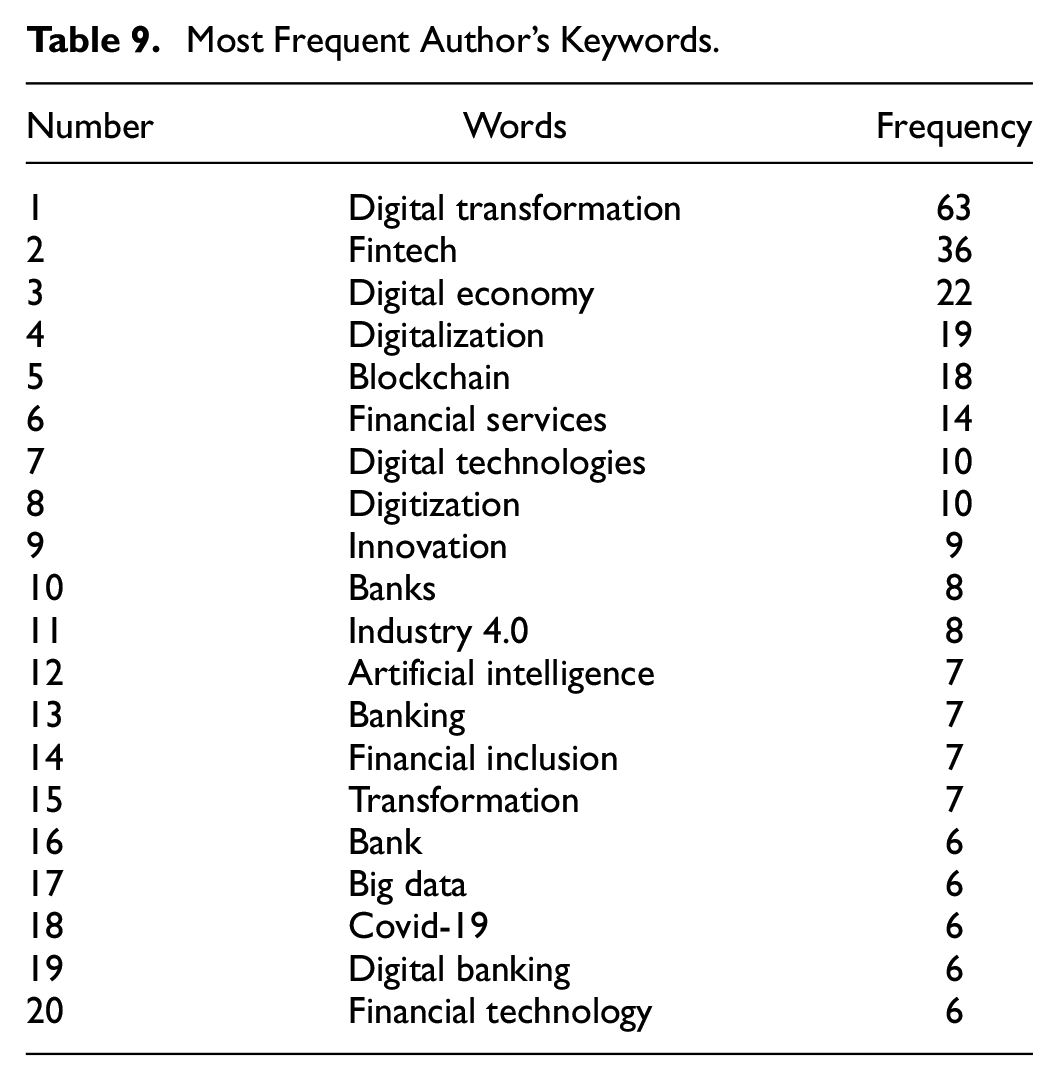
The top 20 author’s keywords derived from the keyword analysis using bibliometric analysis are summarized in Table 9. The findings highlight the significance of digital transformation in financial services such as digital transformation, Fintech, digital economy, digitalization, blockchain, financial services, digital technologies, digitization, innovation, banks, industry 4.0, AI, banking, financial inclusion, transformation, bank, big data, covid-19, digital banking, financial technology. The emergence described above can be attributed to the fact that digital transformation (frequency 63), Fintech (frequency 36), digital economy (frequency 22), digitalization (frequency 19), and so on are some of the most commonly searched keywords by authors.
Most Frequent Author’s Keywords.
Trend Topic
The author’s keyword trend is shown in Figure 6 beginning from 2018, the key focus of digital transformation with the research emphasis on financial sectors, Fintech, digital economy, digitalization, blockchain, Covid-19, etc., as indicated in the year 2020. However, financial services, digitization, innovation, AI, big data, etc., are shown in the year 2018 which are depicted in Figure 6 below. As a result, the period from 2018 to 2021 is significant in the current study domain, as numerous trending topics have emerged with a high frequency.
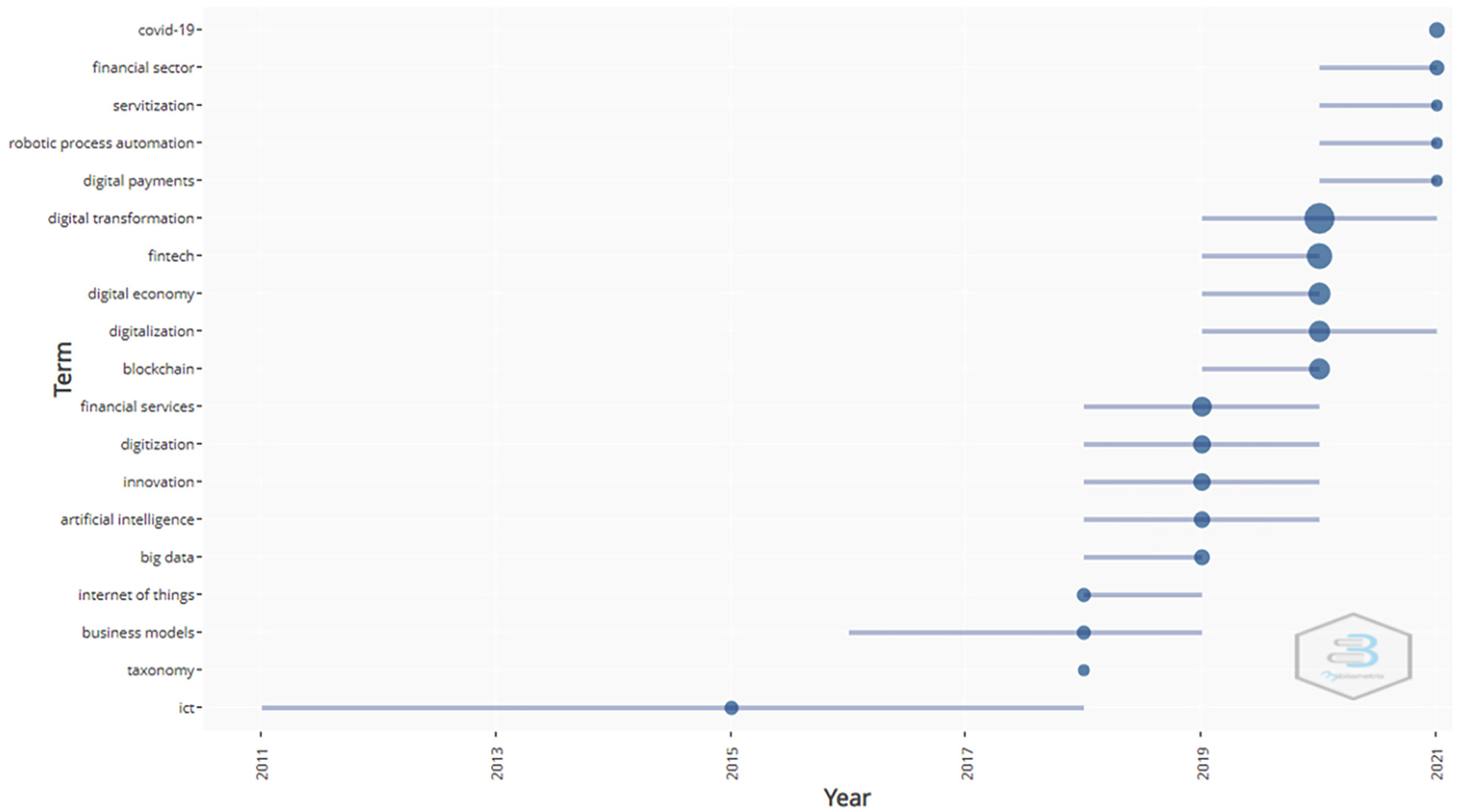
Trend topic.
Cluster by Documents Coupling
The research was then used to create a bibliographic coupling network. According to D. Zhao and Strotmann (2008), the bibliographic coupling is another extensively used method when visualizing networks considered in the study domain. Vogel (2012) believed that the resulting bibliographic clustering by document coupling might give key information for identifying emerging research topics and future directions in a discipline. The upper left quadrant, on the other hand, stands out as a distinctive, fast-developing subject with high density but low centrality. On the other side, the lower right quadrant includes fundamental concepts with high centrality but low density, whereas the lower left quadrant contains motifs that exhibit a downward trend. The centrality and influence of document coupling clustering as measured by quadruple nodes are shown in digital transformation—conf 41.8%, Fintech—conf 25.7%, and blockchain—conf 41.2%. The other clusters related to digital transformation in financial services can be found in Figure 7.

Cluster by documents coupling.
Keyword Networks
Figure 8 depicts a cooccurrence author’s keyword network. The researchers have found six authors’ keyword clusters. Among these clusters, four dominantly noted are: (1) fintech networks (red cluster) focusing keywords are blockchain, innovation, transformation, digital banking, financial technology, crowdfunding, Internet of technology (IoT), regtech, and AI; (2) digitalization (blue cluster) focusing keywords are digital technologies, bank, commercial banks, finance, insurance, and e-government; (3) digital economy (green cluster) focusing keywords are digital economy, financial services, digital divide, financial technologies, digital transformations, and financial innovation; (4) blockchain technology (purple cluster) focusing keywords are financial service and service delivery; (5) digital transformation (orange cluster) focusing keywords are banks, industry 4.0, AI, banking, financial inclusion, covid-19, digital innovation, digital platforms, governance, and the IoT; (6) digitization (blue cluster) focusing keywords are smart city and customer experience.

Keyword networks.
Conceptual Structure Map
Figure 9, the Conceptual structure map, portrays two key dimensions of the field of the author’s keyword using multiple correspondence analysis (MCA). In order to find independent latent keywords, the authors depict variation among associated keywords in Figure 9 with a probable smaller number of unobserved keywords (factors). Alternatively said, the authors sought to decrease the number of keywords in the data records (Radanliev et al., 2020). Digital transformation in relation to Fintech is the most impactful dimension in terms of relevance and breadth of the MCA mapping. The second important dimension covers topics of e-governance with information technologies in the commercial banking sector. To a smaller extent, for dimension one with e-government (blue color dimension) as the principal consideration, the other dimension is not completely orthogonal. There are considerable ways of interrelationships among the red color dimension. Overall, Fintech, financial services, innovation, AI, technology innovation, IoT, technological innovation, digital economy, digitalization, technology, and industry 4.0 are observed to be robust drivers for digital transformation in financial services.

Conceptual structure map.
Co-citation Network
The results of the co-citation network analysis are presented in Figure 10. Examining the analysis over time makes it possible to uncover shifts in fundamental schools of thought, as Small (1973) demonstrated. The analysis identified three distinct clusters based on the modularity rating, with each cluster represented by a different color in the figure. The labels for the largest clusters are highlighted in blue text for emphasis. The first authors’ names, who received the most citations, are highlighted in black text. The following clusters were identified in relation to study themes: Cluster #1: Bharadwaj A. 2013, Teece D.J. 2010, Gregor S. 2006, and Adner R. 2017. Cluster #2: Matt C. 2015, Hess T. 2016, Westerman G. 2014, Yoo Y. 2012, Nambisan S. 2017, Sebastian I.M. 2017, Vial G. 2019, and Besson P. 2012. Cluster #3: Anagnostopoulos I. 2018, Lee I. 2018, Chishti S. 2016, Drasch B.J. 2018, Gai K. 2018, Gomber P. 2018, and Buchak G. 2018. These clusters represent different research themes or topics within the study domain.

Co-citation network.
Collaboration Network
A network is made up of nodes and the connection between them. As part of the scientific production process, a social platform with a similar structure is established around highly cited authors who serve as hubs, bringing together researchers from other scientific fields (Y. Zhao & Zhao, 2016). The collaborative network of 7 clusters with the top 20 most highly cited authors was presented using Biblioshiny (Figure 11). There are numerous interconnections between the different color dimensions under the collaboration networks of authors. The author’s collaboration network (red cluster) includes Pantielieieva N, Potapenko L, Khutorna M, and Krynytsia S; (blue cluster) includes Fedotova Gv and Gontar AA; (green cluster) includes Khan RA, Kumar R, and Seh AH; (purple cluster) includes Arefjevs I, Mavlutova I, Natrins A, Spilbergs A, and Volkova T; (brown cluster) includes Misuraca G and Pasi G; (gray cluster) includes Manser Payne EH and Peltier J; and (pink cluster) includes Ranti B and Shihab MR.

Collaboration network.
The top 20 most productive institutions’ collaborative networks are shown in Figure 12. Each vertex symbolizes a single institution, with the width of the vertex determined by vertices and the density of interconnecting links indicating the level of collaboration (Shah et al., 2022). Only one cluster (red cluster) is shown in Figure 12, the Collaboration network (institutions). The Volgograd State University, Volgograd State Technical University, and Chechen State University were highly collaborative institutions. As per the collaboration network of the top 20 most productive institutions, no productive institutions/universities have collaborated with other productive institutions/universities. Thus, increased research collaboration across different universities is required.

Collaboration network (institutions).
Collaboration between the leading 20 major countries was intermittent, as indicated in Figure 13. Germany was the most collaborative country and took a central position in the collaborative network because it was the major collaborator with the most productive countries, including the United Kingdom and Greece. India only collaborates with Saudi Arabia, and The Netherlands collaborates with only Finland. The USA collaborates with Singapore and Switzerland. The increased international research collaboration will promote the establishment of more globalized and structured research networks, with much more sophisticated and articulated research networks. Thus, increased research collaboration across different countries is also required.

Collaboration network (countries).
The data analysis and findings presented above provide answers to the research questions (RQ1−RQ6) in the current study. RQ1 tries to answer what are the leading journals for the study of digital transformation in financial services. Researchers can evaluate the distribution of research output and the relative value of various journals within their field of interest by identifying the top journals. MIS Quarterly—Published by the Management Information Systems Research Center, it is the most locally cited source with 92 local citations. Journal of Business Research—Published by Elsevier Inc., it is the next highly cited source in the research field.
RQ2 explores the clustering of publications on digital transformation in financial services. Publications on digital transformation in financial services were clustered using bibliographic coupling. The analysis identified distinct clusters, including a fast-developing subject, fundamental concepts, and declining topics. Digital transformation, Fintech, and blockchain were key clusters with high centrality and influence.
RQ3 seeks to pinpoint the scientific study that has received a significant number of citations. In 2014, six publications received significant attention, with an average of 112.5 citations each and 14.06 citations per year. The trend shows a low number of citations in the first decade (2000−2010) and an increasing trend in the following decade (2011−2021).
RQ4 seeks to identify the most eminent authors in the field of financial services research related to digital transformation.The highly prominent authors in digital transformation research in financial services include Fedotova GV with four articles, LI J, Pantielieieva N, and Potapenko L with three articles each.
In the sphere of financial services research, RQ5 looks to identify the most prominent affiliations. Some highly recognized affiliations include BA School of Business and Finance, University College London, and Volgograd State University, each having contributed six articles. ITMO University, Rostov State University of Economics, State University of Management, and Volgograd State Technical University are also notable affiliations with five articles each.
In the area of digital transformation in financial services, RQ6 looks into current trending topics that academics can use as the basis for their future work. In the future digital transformation in financial services can explore several trending topics. From 2018 to 2021, the key focus has been on areas such as digital transformation in financial sectors, Fintech, digital economy, digitalization, blockchain, and the impact of Covid-19. Other relevant topics that emerged during this period include financial services, digitization, innovation, artificial intelligence, and big data. These trends indicate the significant opportunities for research exploration in the field of digital transformation in financial services.
However, previous studies have focused on different research questions, such as the impact of digital workplace transformation on employee welfare and performance (Selimovic et al., 2022), the role of the financial sector in sustainable development (Rahimi et al., 2022), or the use of chatbots in business models and financial inclusion (Abdulquadri et al., 2021).
Conclusions
The research findings reveal that digital transformation in financial services is a vast arena that includes a variety of organizations, such as banks, financial institutions, investment companies, insurance companies, brokerage firms, and mortgage companies that use digital applications. Hence the study of digital transformation is multidisciplinary. The use of R software for bibliometric analysis has great potential for quantitative and statistical validation of established classes in published journals. The Bibliometrix R software package offers access to powerful statistical algorithms, significant statistical methods, and high-quality numerical techniques (Aria & Cuccurullo, 2017). Bibliometric analysis is used to examine the research area and determine the characteristics of important trends in a particular field. This research aimed to organize and rationalize the publication flow of digital transformation in financial services. To ensure that this study’s main objectives are accomplished, the researchers analyzed and presented the research issues explained under literature review within digital transformation in financial services.
As described by the researchers, digital transformation is indeed the application of current technology to support financial services as well as to improve operational efficiency with the use of the latest technologies in the current Industrial 4.0 era (Thottoli & Thomas, 2022). This research was done first to discover the most significant journals in the field of digital transformation in financial services, followed by understanding publication clusters of digital transformation in financial services, identified scientific study with considerable attention in regard to citations, highly prominent authors in the research field, highly recognized affiliations in the research field were identified and to know the trending topics that scholars might use to focus their research on the future. In addition, the researchers hope to report certain concerns often questioned in the literature.
The findings show an overall increasing trend in journal publications, author productivity, collaborative research by institutions, and countries collaboration from the year 2019, as well as major insights from co-citation analysis. The keywords used by the author in this research title indicate that top author keywords for journal publications in this research field are the keywords related to “digital AND transformation AND financial AND services,” which allow digital transformation such as digital transformation, Fintech, digital economy, digitalization, blockchain, financial services, digital technologies, digitization, innovation, banks, industry 4.0, AI, banking, financial inclusion, transformation, bank, big data, covid-19, digital banking, financial technology. According to Lotka’s law, the majority of the authors (769, or 95.77 %) contributed only one article. In addition, the study assesses multiple research areas, such as the effects of digital transformation in financial services, applied technology, and insights, digitalization processes, comprising the latest trending topics in this research stream that extensively cover the field of financial services.
Implications
The findings have significant academic and managerial relevance. In terms of theoretical contributions, Digital transformation in financial services is an area of multidisciplinary research. This means that academics and practitioners from a wide range of disciplines, including finance, technology, and management, must collaborate and give their expertise in order to adequately understand and take advantage of the challenges and possibilities in this field. In published journals, the use of R software for bibliometric analysis is highlighted as having significant promise for quantitative and statistical affirmation of existing field. This suggests that utilizing bibliometric analysis can aid in identifying and validating the significance of major research streams in the area of digital transformation in financial services. A structured and systematic approach to studying and disseminating research in this field is suggested by the research mentioned to organize and rationalize the publication flow of digital transformation in financial services. This can help to consolidate knowledge and lay the groundwork for further advancements. Through conceptual structure analysis, co-citation network analysis, social structure, and keyword analysis, it stems and consolidates the insights on affiliated institutions, most influential authors, highly contributing journals, most relevant author’s terrestrial networks, and highly used keywords that have significantly formed to explore research on digital transformation. Additionally, the study extensively infers the research fields and developing research topics on digital technologies and their use emerge among financial institutions. A growing interest in and understanding of the significance of digital transformation in financial services, which can have theoretical implications in terms of the field’s development, knowledge dissemination, and potential impact on practice, motivates this study’s aim to address existing gaps, questions, or areas of uncertainty in the current body of knowledge. This study also contributes to theoretical discussions. Hence future research studies can extend further to enrich the literature on digital transformation. Another contribution of this research is the application of network and bibliometric analysis, which academicians and researchers can utilize to gain insights on key issues and evolving research trends from similar interesting research fields. Hence this study establishes a framework for policymakers, academics, and researchers to investigate the areas where the latest digital technologies are influencing financial services. This study also highlighted several cutting-edge digital technologies that use for different functions of financial services of an organization. The digital transformation, which is connected to Fintech, the digital economy, blockchain, and AI, offers perspectives into the study issues that are most significant and commonly researched in the field, potentially directing theoretical frameworks and prospective research aims. This demonstrates that the theoretical implications of the research go beyond a particular emphasis and span a wide range of subjects that help to provide a full understanding of the financial services industry’s digital revolution.
In terms of practical implications, this research provides numerous paths for future research as well as the complexity of the data analytical framework stated by the researchers (e.g., Schöbel et al., 2021). The research routes point to a move toward digital transformation studies by prospective researchers using advanced analytics in collaboration with organizations such as banks and other financial institutions. Instead of aiming at the technology’s practical aspects, this research proposes further theory-driven quantitative research studies. This strategy could help researchers get published in top-tier, general-interest business journals. This idea does not undermine the relevance of specialist journal publications. This study serves as the foundation for the understanding of digital transformation in financial services.
For both academics and professionals, it offers direction on where to obtain current and important studies in the field and helps them match their research preferences with strong emerging topics in the financial services industry’s digital transformation. It can serve as a guide for choosing research questions, planning research studies, contributing to the field’s ongoing advancement, and locating experts in the area and possibly working with them. It can shed light on organizations that are at the forefront of this industry’s innovation and research. Practitioners have access to key references, comprehend the conceptual framework of the field, have a broad awareness of the various dimension and topics within the digital transformation of financial services, and contribute to the growing body of knowledge in this area. Practicioners can stimulate interdisciplinary cooperation, support decision-making processes, and help steer research agendas. The efforts of scholars, practitioners, and decision-makers to advance and thrive in the field of digital transformation in financial services can be guided by these implications.
Limitations and Future Research Directions
Limitations
One of the limitations of this study is that it used only a single database. The author recommends that the findings of this research be reinforced with a more targeted and extensive qualitative literature in this field of study. Yet, the study presented in this article, which includes bibliometric analyses and mapping analysis, intends to be kept up to date when new information about the issue becomes available. The latest technology of digital transformation in financial services is a continuously growing field since the adoption and use of technology is disruptive. The current study depended on a single database, which might have constrained the research’s scope and coverage. The whole context and qualitative features of research may not be fully captured by bibliometric analysis, despite the fact that it offers quantitative insights. Another drawback is the scant attention paid to the societal implications of financial services’ digital transformation.
In addition, there are only a few studies on the social side of financial services digital transformation. The financial services and other services of any organizational operations of digital transformation have a great deal of potential to be established. This topic has been gaining traction as a fundamental necessity as part of long-term digital transformation, as well as a promising future research field.
Future Research Directions
This study’s recommendations for future research encourage participants to work with institutions like banks and financial institutions to perform advanced analytics studies in the area of digital transformation. Future research can conduct a more focused and thorough qualitative literature review to acquire thorough insights into the study’s field to support the research findings. Future researchers may broaden their research to examine the possibility of digital transformation in other industries, organizational processes, and financial services.
Finally, this research article highlights knowledge gaps and makes recommendations for further research that will significantly impact digital transformation in financial services.
In summary, global trends and prospects of digital transformation in financial services are tabulated in Table 10.
Global Trends and Future Prospects of Digital Transformation in Financial Services.

Footnotes
Declaration of Conflicting Interests
The author(s) declared no potential conflicts of interest with respect to the research, authorship, and/or publication of this article.
Funding
The author(s) received no financial support for the research, authorship, and/or publication of this article.
