




Abstract
In the research on unconscious information processing using the masking priming method, there are still controversies regarding whether participants truly unconsciously processed the presented stimuli. The reasons for the controversies mainly stem from the intensity of the masking and the consistency of criterion adopted among different researchers. Two recent studies found that two sources of unconscious stimuli could produce an additive priming effect on the response to the target. This conclusion provides some insights into addressing the aforementioned issues. Based on the results of the additive priming effect, the present study explored the possibility of enhancing the unconscious priming effect by simultaneously presenting multiple, identical subliminal stimuli in future research characterized by strong masking and consistent criteria for unconscious processing. Unexpectedly, we found that multiple, simultaneously-presented subliminal arrows produced no additive unconscious priming effect on the response to the target except when the multiple prime arrows did not point in the same direction. Through the combined results of four experiments, we suggested that only when multiple prime stimuli have different perceptions associated with the response, can the additive effect emerge, which was explained from the perspective of neural mechanisms in the discussion. The exact- and general- additive priming effects were also distinguished and discussed.
Plain Language Summary
In the studies about unconsciousness, it is crucial to enhance the intensity of the unconscious state of the stimuli, as unconsciousness of stimuli is a fundamental premise of these research. Additionally, strengthening the processing intensity of unconscious stimuli is essential because adequate processing intensity can elicit observable experimental effects. However, these two aspects are somewhat contradictory, posing a significant challenge in research of unconsciousness. Recently, research has found that two subliminal arrows can have independent and additive effects on reactions to a target. This provides a new perspective for enhancing the processing intensity of unconscious stimuli under strong unconscious intensity. This approach suggests that presenting multiple identical copies of subliminal stimuli simultaneously can amplify the unconscious effect. Following this approach, our study used the same subliminal arrows from previous additive-unconscious-influence research as stimuli, exploring whether multiple identical subliminal arrows have a greater impact on behavior than a single subliminal arrow and whether they adhere to the additive principle. After controlling for additional influencing factors (such as stimulus-response bindings and sensory adaptation), the integrated results of our four experiments revealed that multiple subliminal arrows only produce additive effects on the response to the target arrow when they do not point in the same direction (i.e., different perceptions). We hypothesized an explanation based on neural mechanisms, suggesting that the processing of relationships between subliminal arrows and target arrow, whether pointing in the same or different directions, involves distinct neural pathways. These pathways process information in parallel and are integrated during the response phase, which may also be part of the neural mechanism by which our diverse learning impacts our behavior.
Keywords
Introduction
Conscious Contamination in Research on the Unconscious Processing
Unconscious information processing is of significant importance for understanding the mechanisms of conscious mental processes. However, due to methodological limitations in most commonly employed techniques such as backward masking, meta-contrast masking, and continuous flash suppression, there exists ongoing debate regarding whether participants actually engage in unconscious processing of the presented stimuli (Peters et al., 2017; Rohr & Wentura, 2021). The visual intensity of the stimuli could be reduced due to reasons such as short presentation time, lack of higher-level attention, or disruption of re-entrant visual signals by masking stimuli (Harris et al., 2013). In experiments designed to allow the brain to process information with reduced visual intensity, it is not easy to insure that stimuli are indeed below the threshold of consciousness. For instance, some researchers argue that the subliminal priming paradigm may underestimate the contribution of conscious processing (Micher et al., 2024; Stockart et al., 2024), and that the observed effects of unconscious processing may actually be contaminated by the result of conscious processing.
As research delves deeper into unconscious processing, such as integration of multiple unconscious stimuli, it inevitably leads to similar debates as mentioned above. While numerous studies have identified the phenomenon of unconscious information integration, such as unconscious arithmetic addition of two subliminal numbers (Ric & Muller, 2012), and integration between the attributes of two unconscious stimuli (Ching et al., 2019; Mudrik & Koch, 2013; Van Opstal & Rooyakkers, 2022), replications of these findings often failed. For instance, the veracity of unconscious arithmetic operations has recently been questioned (Tal & Mudrik, 2024). Even within the same-different task paradigm, which is considered a good method to study unconscious integration (Van Opstal, 2021), some experiments have shown weak evidence for these high levels of unconscious information processing (Tu et al., 2013; Zher-Wen & Yu, 2023a, 2023b). Therefore, reaching a consensus on methods to determine whether participants are truly unaware of the stimuli is an urgent need in the field of research on unconscious information processing.
Using Uniform Experimental Parameters to Ensure Strong Masking
In the commonly used unconscious masking priming paradigm, generating an unconscious priming effect requires the brain to process the masked stimuli with sufficient visual intensity at the unconscious level. To achieve this goal, various factors must be precisely manipulated, such as the presentation duration of the priming stimuli (Barbot & Kouider, 2012), the composition of the mask (Van Opstal et al., 2005), and the timing between the presentation of the target stimuli and the mask (Weibel et al., 2013), to obtain the right processing strength of the priming stimuli and the desired magnitude of the resulting unconscious priming effect. Even so, because different researchers likely use various experimental parameters, for example, different presentation times for the priming stimuli and different types of masking, along with different criteria for awareness assessment, these methodological variabilities can lead to different (un)conscious states for the priming stimuli, making it difficult to compare the results across different studies.
In the unconscious masking priming paradigm, to ensure participants’ unconscious perception of the priming stimuli, researchers can actually employ relatively conservative criterial settings, such as short presentation duration of the priming stimuli and stronger masking stimuli. Further, in order to avoid differences in criteria among different researchers, it is even possible to use the same masking stimuli, at least for certain types of stimuli, and the same presentation duration of the priming stimuli. This procedure could possibly be proposed by the leading researchers in the field, where investigators collectively and rigorously select relevant experimental parameters or materials, such as the shortest feasible presentation duration of the priming stimuli and appropriate masking stimuli with strong masking for certain types of stimuli. Ideally, everyone will adopt the same experimental settings in their studies.
The Possibility of Modulating the Intensity of Unconscious Processing Under Strong Masking
However, under the premise of a strict assessment of awareness, the attempts to ensure the unconscious processing of the stimuli using the above method may lead to a weakening or even disappearance of the unconscious priming effect. Some measures may be employed to regulate the intensity of unconscious processing of the priming stimuli without sacrificing the strong masking and parameter uniformity mentioned above. Recent findings from two studies provided this possibility. The term “intensity of unconscious processing” here refers to the degree or capability of an individual to process information without consciousness. For instance, different presentation times of masked stimuli or varying intensities of masking can result in different levels of visual processing intensity for the masked stimuli, leading to varying unconscious processing intensities. A higher unconscious processing intensity indicates a broader range of neuronal activity, allowing individuals to more effectively integrate unconscious information and influence conscious behavior (Breitmeyer, 2015).
Recent research findings of two studies showed that two unconscious stimuli can produce independent and additive unconscious priming effects (Tu et al., 2025; Wang et al., 2024). To say that the priming effect is additive means that the size of the total priming effect can be derived from summing over the respective priming effects of each subliminal stimuli (Ovando-Tellez et al., 2021). Different analysis methods were used between these two studies. Wang et al. (2017) used a common two-factor design (the congruency relation between a masked prime arrow and the target arrow, as well as one between two masked flankers and the target arrow) and obtained additive (or independent) priming effects from the masked arrow and masked flankers. The additivity of the priming effect derived from an insignificant interaction between the congruency effects from the masked arrow and from the masked flankers. In the second of the above two studies (Tu et al., 2025), the additive priming effects were based on a direct calculation of priming effects in different experimental conditions. Specifically, the overall priming effect produced by two arrows presented simultaneously but pointing in opposite directions was equal to the summed net effect of the two individual arrows (i.e., the sum of the congruent and the incongruent effects produced by each arrow separately). Therefore, it seems highly likely that the repeated presentation of a single prime stimulus can produce additive priming effects. If this is indeed the case, we can regulate the intensity of unconscious processing of our focused priming stimuli while using relatively conservative criterial settings, without sacrificing the strong masking and parameter uniformity mentioned earlier.
The Experimental Hypotheses and Designs
Therefore, based on the independent and additive unconscious priming effects found in previous studies, in this study we hypothesized that repeated presentations of the same prime stimulus can produce additive priming effects and tested this hypothesis. It is noteworthy that a sequential presentation of two sources of subliminal stimuli was used in one of the two aforementioned studies (Wang et al., 2024), but that a simultaneous display of two opposite pointing subliminal prime arrows used in the other study (Tu et al., 2025). Previous studies have found that a repeated, sequential presentations of the same prime stimulus could increase the priming effect or perceptual awareness in a subliminal priming paradigm (Atas et al., 2013; Marcel, 1983), or increase the speed of the information entering consciousness in a continual flash suppression paradigm (Stein, 2019). However, these studies only examined the overall effects without analyzing the specific cumulative mechanisms involved in the generation of the effects. In this study, we chose to explore the possible accumulation mechanism in the generation of unconscious priming effects under another stimulus presentation method, specifically, the simultaneous repeated presentations of a priming stimulus. There was evidence that reaction times were faster to a pair of identical stimuli than to one stimulus alone when the stimuli were supraliminal (Savazzi & Marzi, 2002), which somewhat supported our hypothesis. If the hypothesis is confirmed by the results, both simultaneous presentation and sequential presentation will provide two methodological options for future studies using masking paradigm.
In experiment 1 of this study, we first tested whether simultaneous repetition of a same prime arrow would produce an additive priming effect by manipulating the number of the repeated prime arrows (one, two, and three) and the congruency relation of the pointing directions of the prime arrows and the target arrow (congruent, incongruent, and neutral). Experiments 2 to 4 further studied the conditions under which the additive priming effects might possibly occur by controlling the potential extraneous factors of stimulus-response bindings, sensory adaptation, and perceptual adaptation. A stimulus-response binding is when a specific response to a visible target arrow becomes automatically retrieved during the presentation of the prime arrows without processing the details of the direction information of the prime arrows, Naccache & Dehaene, 2001). A sensory adaptation is the process by which the sensory system gradually diminishes its response to a stimulus after prolonged exposure (Wark et al., 2007). A perceptual adaptation is a mental process which involves higher-level cognitive processing and refers to a mechanism by which psychological processes adjust the interpretation and response to information through learning and experience (Wei et al., 2015).
Lastly, it is necessary to distinguish between two concepts, that is, “additive” and “independent”. As noted above, to say that the priming effect is additive means that the size of the total priming effect can be derived from summing over the respective priming effects of each subliminal stimuli. By doing so, congruent and incongruent primings can cancel each other out and add up to the size of the final priming effect. Also, the additive effect can be differentiated into exact-additive and general-additive according to whether the accurate arithmetic operation is satisfied. For example, if the congruent priming effect is −10 ms, the incongruent priming effect is 20 ms, and the overall priming effect is roughly −10 + 20 = 10 ms, then it is considered to be exact-additive. If the overall priming effect turns out to be close to canceling each other out, say, 5 ms, then it does not satisfy the arithmetic operation. It is considered to be general-additive. The idea of the priming effect being independent is based more on processing mechanisms. When the multiple priming effects are independent of each other, they are necessarily additive. But their being additive does not necessarily imply that they are independent of each other.
Experiment 1
This experiment was designed to investigate whether different numbers of identical primes generate different unconscious priming effects. Based on the results of the exact-additive unconscious priming effect caused by two simultaneously-presented prime arrows of opposite directions in Tu et al.’s (2025) study, it might be possible that (a) more identical priming stimuli may produce greater unconscious priming effect than fewer priming stimuli, and (b) multiple identical priming stimuli may even produce independent priming effects. In order to conceptually replicate the findings in Tu et al.’s (2025) study, this experiment employed the same prime and target arrow symbols used in their study.
Method
Participants
The computed priori sample size was 18 with the effect size f = 0.25, the power (1 − β) = .9, and the alpha value = .05 (G*Power software V3.1; Faul et al., 2007). Due to the possibility of some participants being excluded from the final analysis based on the results of the visibility test, a moderate increase in the number of participants was made in the experiment. Additionally, based on the effect size values from previous studies, typically around 20 participants are sufficient to achieve adequate power. Twenty-five participants from the Guizhou University of Finance and Economics volunteered for this study (14 women, 11 men; with a mean age of 20.2 years, ranging from 19 to 24). All participants gave a written informed consent before the experiment, had normal or corrected-to-normal vision, and were right-handed. They were paid for their participation. The current study was approved by the Ethics Committee of the Guizhou University of Finance and Economics.
Materials and Design
In order to replicate the findings in Tu et al.’s (2025) study as closely as possible, this experiment employed the same prime and target arrow symbols, that is, “<” and “>,” as used in their research. See the actual stimulus display in Supplemental Table S1.
Because this experiment investigated whether different numbers of identical primes generate different magnitudes of unconscious priming effects, two factors were manipulated in a within-subjects design. One factor was congruency between the prime arrow(s) and the target arrow (congruent, incongruent and neutral), with “×”(s) as the prime symbol in the neutral condition. The other factor was the number of the prime arrows or “×”s (one, two or three) that were presented side by side simultaneously. The two or three prime arrows in a trial pointed in the same direction. When there was one prime arrow, the prime arrow was presented in the center of the screen; when there were two prime arrows, the arrows were located on the left and right sides of the visual field; when there were three prime arrows, the third one was placed between the two side arrows. The size of one prime symbol was 0.8 (height) × 0.8 (width) degrees of visual angle, and the paired two or three prime symbols was approximately 0.8 (height) × 3.2 (width) degrees of visual angle. Each condition was named by three letters plus a number (i.e., Con1, Con2, Con3, Inc1, Inc2, Inc3, Neu1, Neu2, and Neu3). The letters Con, Inc, and Neu denoted congruent, incongruent, and neutral priming, and the numbers 1, 2, and 3 represented the number of prime symbols.
Procedure
The stimulus presentation procedure was shown in Figure 1. Participants were first trained in eight practice trials. In each trial, a fixation cross, the prime, and a backward mask appeared in the center of the screen for 200, 32, and 50 ms, respectively. The presentation time of stimuli in the backward masking paradigm was consistent with previous research (Boy et al., 2010; van Gaal et al., 2014). Subsequently, a target arrow was displayed for 1,500 ms or until participants responded, whichever came first. Participants were asked to indicate whether the target arrow pointed to the left or right by pressing one or two with their right index and middle fingers, respectively, as quickly and accurately as possible. They were also told that the stimuli before the target were distractions and should be ignored. Because participants pressed both one and two keys in each condition, it was not necessary to counterbalance response key assignment across participants. Lastly, a blank screen appeared for 1,000 ms before the next trial started. The experiment proper was divided into 3 experimental blocks with each block consisting of 144 trials. There was a total of 48 trials per condition. The nine different conditions were displayed randomly in each block.

Stimulus presentation procedure in the first experiment. The figure showed the prime stimuli corresponding to the three conditions Neu1, Con2, Inc3 in relation to the right-facing target arrow. In experiments 2 to 4, while the prime and target stimuli varied according to the design, the presentation procedure for the stimuli remained the same as in experiment 1.
To test for the visibility of the masked arrows, participants were asked to report whether they saw anything other than the target arrow after the above priming experiment, and then took an objective forced-choice discrimination (Micher et al., 2024; Schmidt & Biafora, 2024; Tu et al., 2023). The procedure of the objective forced-choice discrimination task was the same as that of the priming experiment except that the target arrow was removed and replaced with two choices (i.e., two words “向左” [pointing to the left] and “向右” [pointing to the right] in Chinese were displayed on the left and right sides of the screen, respectively) after the mask for a response. Participants were asked to determine or guess whether the three masked arrows pointed to the left or right. They were informed that the three masked arrows pointed in the same direction and the probability of their pointing left or right was equal and that only the accuracy and not the speed of the response was important. This visibility test should be easier than the one in the formal experiment because the participants could make a correct pointing-direction judgment according to any one of the three arrows. Therefore, if they could not see anything in this easier condition, then their chance of seeing anything in the formal experiment would be even lower. There was a total of 96 forced-choice trials, with the prime arrows pointing left and right 48 times each.
Results
Visibility
All participants reported that they could not detect anything except the target arrow. However, in actual individual performance, three participants scored above the chance level, that is, above or equal to 58%, p < .05, by a one-tailed binomial test (values that were lower than 58% were not significantly above chance level). These participants’ data were not included in the following analyses. All the remaining 22 participants performed at the chance level in the discrimination task, with the percentage of correct recognition ranging from 45% to 58%. At the group performance level, the mean percentage of correct recognition was 51.3% ± 0.7% (mean ± SE), not significantly different from chance level, t(21) = 1.818, p = .083, nor was the mean d′ value (mean = 0.072, SE = 0.048) significantly different from zero, t(21) = 1.504, p = .147. In the calculation of d′, one direction of the prime arrows (e.g., pointing left) is treated as the signal, while the other direction (e.g., pointing right) is treated as the noise. However, the group analysis result pattern for the priming effects was the same as if these three participants’ data were kept.
Unconscious Priming Effect
A two-way repeated-measures ANOVA on the mean RTs of the correct responses was conducted with the congruency between the prime symbol(s) and the target arrow and the number of the prime symbol(s) as two within-subjects factors (see the left side of the first row in Figure 2). The results revealed a significant main effect of the congruency, F(2, 42) = 40.563, p < .001, ηp2 = .659. Post-hoc tests showed that the mean RT in the congruent condition (451 ms) was significantly shorter than that in the neutral condition (467 ms), t = −4.011, pbonf < .001, Cohen’s d = −0.403, and the mean RT in the neutral condition significantly shorter than that in the incongruent condition (488 ms), t = −4.979, pbonf < .001, Cohen’s d = −0.501. However, neither the main effect of the number of the primes (F[2, 42] = 0.445, p = .644) nor its interaction with congruence (F[4, 84] = 1.002, p = .411) was significant. It is worth mentioning that some results of ANOVAs indicated a violation of the assumption of sphericity; however, the Greenhouse-Geisser corrected results showed that the significance of differences was consistent with the uncorrected results. Therefore, we still reported the uncorrected results of all ANOVAs in the main text, while all the results, including the corrected results, of all ANOVAs can be found in Supplemental Table S3. The results of the post hoc tests for all ANOVAs in experiments 1 to 3 are presented in Supplemental Table S4.

Mean RTs (ms) and accuracy (%) under each condition in experiments 1 to 4. The error bar represents one standard error of mean.
A same ANOVA on the accuracy (see the right side of the first row in Figure 2) indicated that the main effect of the congruency was significant, F(2, 42) = 9.391, p < .001, ηp2 = .309. Post-hoc tests revealed that the accuracy in the congruent condition (96.5%) was significantly higher than that in the incongruent condition (94.3%), t = 3.973, pbonf < .001, Cohen’s d = 0.243, and the mean accuracy in the neutral condition (96.2%) was significantly higher than that in the incongruent condition (94.3%), t = 3.486, pbonf = .003, Cohen’s d = 0.213. However, the difference between the congruent and the neutral condition was not significant, t = 0.486, pbonf ≈ 1.000. Again, neither the main effect of the number of the primes (F[2, 42] = 1.001, p = .376) nor its interaction with congruence (F[4, 84] = 2.012, p = .100) was significant.
In conclusion, the results did not replicate the exact-additive unconscious priming effect as demonstrated in Tu et al.’s (2025) study. In other words, one, two or three simultaneously presented identical prime arrows produced unconscious priming effects of equal strength.
Experiment 2
A possible reason for failing to obtain the expected additive priming effect in experiment 1 might have been due to a process known as stimulus-response bindings, in which a specific response to a visible target becomes automatically retrieved during the presentation of the prime arrows without processing the detail direction information of the prime arrows (Rohr & Wentura, 2021). In experiment 1, the same arrow was used in both the prime and the target, which might have led to stimulus-response bindings. Therefore, the number of prime arrows, which were identical and simultaneously presented, might not have affected the response and not influenced the strength of the observed priming effect. Hence, experiment 2 was designed to test the stimulus-response binding hypothesis for the absence of the additive priming effect by using different forms of arrows for the primes and the target.
Method
Participants
Twenty-two participants from the Guizhou University of Finance and Economics volunteered for this study (13 women, 9 men; with a mean age of 21.3 years, ranging from 19 to 25). All participants gave a written informed consent before the experiment, had normal or corrected-to-normal vision, and were right-handed. They were paid for their participation. The current study was approved by the Ethics Committee of the Guizhou University of Finance and Economics.
Materials and Design
To avoid the possible stimulus-response bindings, different forms of arrow were used in this experiment for the primes and the target. The arrows “→” and “←” were used as the primes, and “<” and “>” as the target which was a bit flatter (i.e., the angle within the arrows was smaller) than that in experiment 1. The arrows “<” and “>” in experiment 1 were actually a less-than sign or a greater-than sign. They were flatter in this experiment to make them more like an arrow (see the actual stimulus display in Supplemental Table S1).
The design was the same as in experiment 1, that is, a two within-subjects factors with one being the congruency between the prime symbol(s) and the target arrow and the other the number of the prime symbol(s) (one, two and three). In the two or three prime arrows conditions (Con2, Inc2, Con3, and Inc3), the arrows all pointed in the same direction.
Procedure
The procedure was the same as that in experiment 1 (see Figure 1).
Results
Visibility
No participants reported that they could detect anything except the target arrow. However, at the individual performance level, one participant scored above the chance level, that is, with the percentage of correct recognition above or equal to 58%, p < .05, by a one-tailed binomial test. This participant’s data were not included in the further analyses. Regardless of whether this participant was excluded, the result pattern of the subsequent analyses was the same. All remaining 21 participants performed at the chance level in the discrimination task, with the percentage of correct recognition being from 42% to 56%. At the group performance level, the mean percentage of correct recognition was 49.9% ± 0.8% (mean ± SE), not significantly different from chance level, t(20) = −0.190, p = .852, nor was the mean d′ value (mean = 0.022, SE = 0.048) significantly different from zero, t(20) = 0.459, p = .651.
Unconscious Priming Effect
A two-way repeated-measures ANOVA on the mean RTs of the correct responses (see the left side of the second row in Figure 2) revealed a significant main effect of congruency F(2, 40) = 25.443, p < .001, ηp2 = .560. Post-hoc tests showed that the mean RT in the congruent condition (426 ms) was significantly shorter than that in the neutral condition (436 ms), t = −2.780, pbonf = .025, Cohen’s d = −0.167, and the mean RT in the neutral condition was in turn significantly shorter than that in the incongruent condition (451 ms), t = −4.299, pbonf < .001, Cohen’s d = −0.258. However, neither the main effect of the number of the prime symbols (F[2, 40] = 0.169, p = .845) nor its interaction with congruence (F[4, 80] = 1.920, p = .115) was significant.
The same ANOVA on accuracy (see the right side of the second row in Figure 2) indicated that the main effect of the congruency was significant, F(2, 40) = 8.364, p < .001, ηp2 = .295. Post-hoc tests revealed that the accuracy in the congruent condition (97.8%) was significantly higher than that in the incongruent condition (95.8%), t = 3.728, pbonf = .002, Cohen’s d = 0.422, and the accuracy in the neutral condition (97.6%) significantly higher than in the incongruent condition (95.8%), t = 3.321, pbonf = .006, Cohen’s d = 0.376. However, the difference between the congruent and the neutral condition was not significant, t = 0.408, pbonf ≈ 1.000. Neither the main effect of the number of the prime symbols (F[2, 40] = 0.761, p = .474) nor its interaction with conguence (F[4, 80] = 2.342, p = .062) was significant.
Thus, the results were consistent with those in experiment 1 when the possibility of stimulus-response binding was excluded. They revealed that the direction of the prime arrow(s) was probably processed at the semantic level without stimulus-response binding and verified that one, two or three simultaneously presented identical prime arrows produced unconscious priming effects of equal strength.
Experiment 3
The results of experiments 1 and 2 were similar in that neither one revealed a significant exact- or general-additive unconscious priming effect when different numbers of simultaneously presented identical primes were used. These results were different from those in Tu et al.’s (2025) study where an exact-additive unconscious priming effect was found. The discrepant results could be due to a difference in the prime presentation between the above two experiments and Tu et al.’s (2025) study. In Tu et al.’s (2025) study, the two simultaneously presented prime arrows pointed in the opposite directions, which presumably resulted in different sensation and perception from the two prime arrows. In experiments 1 and 2, the two or three simultaneously presented prime arrows were identical and pointed in the same direction, which supposedly led to the same sensation and perception from the two or three prime arrows. This might have led to a sensory or perceptual adaptation effect (Kohn, 2007). Thus, experiments 3 and 4 were conducted to exclude possible sensory and perceptual adaptation likely present in experiments 1 and 2 as the potential cause of the absence of the additive priming effect.
In experiment 3, two or three different forms of prime arrows were used in a trial to reduce the likelihood of sensation adaptation as much as possible. As we all know, sensation and perception are different (Damasceno, 2020). Perception is the process whereby sensory stimulation is translated into an organized experience, and has semantic properties. Compared to experiments 1 and 2, the two or three prime arrows in experiment 3 had different forms, such as,  although they all pointed in the same direction. We suggest that the different forms of prime arrows in experiment 3 might be able to prevent sensory adaptation more than perceptual adaptation. The reason for this assumption was discussed in experiment 4 in which the three prime arrows pointed in inconsistent directions.
Method
Participants
Because we examined both factors in experiments 2 and 3 at the same time, the participants in this experiment were the same as in experiment 2. The order of the two experiments was counterbalanced between participants.
Materials and Design
To reduce the likelihood of sensory adaptation, three different forms of arrows were used as the prime arrows, that is, (see the actual stimulus display in Supplemental Table S1). In the one-prime condition, each of these forms of arrows was used as the prime for the Con1 and Inc1 conditions. In the two-prime condition, two of the three primes were paired, resulting in three different pairings in the Con2 and Inc2 conditions. The left and right positions of the two arrows were balanced. The positions of the three arrows were also balanced in the Con3 and Inc3 conditions. In the multiple-arrow conditions, the two or three arrows all pointed in the same direction.
The target arrows “<” and “>” were the same as in experiment 2.
The design was also the same as in experiments 1 and 2.
Procedure
The procedure was the same as in experiment 1 (see Figure 1).
Results
Visibility
All participants reported that they could not detect anything except the target arrow. All participants scored at the chance level by a one-tailed binomial test at p < .05 in the discrimination task, with the percentage of correct recognition ranging from 44% to 57%. It is worth noting that experiment 2 and experiment 3 shared the same participants. In experiment 2, one participant had a forced-choice accuracy higher than chance level. In order to ensure the unconsciousness of the masked arrows, the data from that participant were not included in the analysis of experiment 3. Regardless of whether that participant was excluded, the result pattern of the subsequent analyses was the same. At the group performance level, the mean percentage of correct recognition was 50.6% ± 0.7% (mean ± SE), not significantly different from chance level, t(20) = 0.847, p = .407, nor was the mean d′ value (mean = 0.048, SE = 0.044) significantly different from zero, t(20) = 1.086, p = .290.
Unconscious Priming Effect
A two-way repeated-measures ANOVA on the mean RTs of the correct responses (see the left side of the third row in Figure 2) revealed a significant main effect of the congruency, F(2, 40) = 33.849, p < .001, ηp2 = .629. Post-hoc tests showed that the mean RT in the congruent condition (409 ms) was significantly shorter than that in the neutral condition (418 ms), t = −3.098, pbonf = .011, Cohen’s d = −0.227, and that of the neutral condition significantly shorter than in the incongruent condition (432 ms), t = −5.052, pbonf < .001, Cohen’s d = −0.370. Neither the main effect of the number of prime symbols (F[2, 40] = 1.658, p = .203) nor its interaction with congruence (F[4, 80] = 1.584, p = .187) was significant.
The same ANOVA on accuracy (see the right side of the third row in Figure 2) indicated that the main effect of the congruency was significant, F(2, 40) = 14.294, p < .001, ηp2 = .417. Post hoc tests revealed that the accuracy in the congruent condition (98.8%) was significantly higher than that in the incongruent condition (96.4%), t = 5.218, pbonf < .001, Cohen’s d = 0.928, and that of the neutral condition (98.1%) significantly higher than in the incongruent condition (96.4%), t = 3.618, pbonf = .002, Cohen’s d = 0.644. However, the difference between the congruent and the neutral condition was not significant, t = 1.600, pbonf = .352. Neither the main effect of the number of the prime symbols (F[2, 40] = 0.676, p = .514) nor its interaction with congruency (F[4, 80] = 0.958, p = .435) was significant.
Thus, basically, the results of this experiment proved once again that, even after controlling for possible sensory adaptation, one, two or three simultaneously presented prime arrows uniformly pointing in the same directions still produced no differential unconscious priming effects.
Experiment 4
In this experiment, we changed the pointing directions of some of the three priming arrows in the Con3 and Inc3 conditions to see whether the exact- or general- additive unconscious priming effect could be obtained. In Tu et al.’s (2025) study, they found that when two simultaneously-presented prime arrows were pointing in opposite directions, they influenced the response to the target exact-additively. However, in this study, experiments 1 to 3 did not reveal any exact- or general- additive priming effect where the multiple prime arrows all pointed in the same direction. Considering the distinction between sensory and perceptual adaptation mentioned in Experiment 3, it might be suggested that the exact- or general- additive priming effects may only occur when the simultaneously presented multiple arrows were pointing in inconsistent directions, or in other words, when the simultaneously presented multiple arrows generated different perceptions and consequently could not lead to perceptual adaptation. When the multiple priming arrows pointed in unison as in experiments 1 to 3, perceptual adaptation could be possibly generated and rendered the same directional information to the semantic level.
Method
Participants
In comparison to the nine experimental conditions in the previous three experiments, the number of experimental conditions was reduced to six in Experiment 4, leading to an appropriate increase in the number of participants. Thirty-two participants from the Guizhou University of Finance and Economics volunteered for this study (17 women, 15 men; with a mean age of 20.7 years, ranging from 19 to 24). All participants gave a written informed consent before the experiment, had normal or corrected-to-normal vision, and were right-handed. They were paid for their participation. The current study was approved by the Ethics Committee of the Guizhou University of Finance and Economics.
Materials and Design
In experiment 4, we wanted to investigate the possible exact- or general- additive priming effect under the condition when the multiple prime arrows did not point in the same direction, as well as to avoid possible stimulus-response bindings as might have occurred in experiment 1 and the interference which could be possibly caused by the perceptual sameness of the multiple prime arrows in experiment 3. Therefore, in experiment 4, the arrows “→” and “←” were used as the prime and the arrows “<” and “>” as the target, which was the same as in experiment 2. See the actual stimulus display in Supplemental Table S2.
This experiment was a one-factor within-subjects design. Firstly, Con3, Inc3 and the corresponding Neu3 conditions were included to get the basic priming effect. In order to further study the possible exact- or general- additive priming effect when the simultaneously presented multiple arrows had different perceptions, three more conditions were added: center-incongruent, two-sides-incongruent, and one-side-incongruent conditions. In the center-incongruent condition, the middle of the three prime arrows pointed in the opposite direction of the target arrow whereas the bilateral prime arrows pointed in the same direction as the target arrow. In the two-sides-incongruent condition, the bilateral prime arrows pointed in the opposite direction of the target arrow whereas the middle prime arrow pointed in the same direction as the target arrow. In the one-side-incongruent condition, one of the bilateral prime arrows pointed in the opposite direction of the target arrow, and the other one of the two side prime arrows and the middle prime arrow pointed in the same direction as the target arrow.
Procedure
The procedure was the same as in experiments 1 to 3 (see Figure 1). Because there were six conditions (Con3, Inc3, Neu3, center-incongruent, two-sides-incongruent, and one-side-incongruent conditions) in this experiment, the experiment was divided into two experimental blocks. The six different conditions were displayed randomly in each block.
In experiment 4’s formal priming task, the orientations of the three priming arrows were not completely consistent. However, in the forced-choice task, the pointing of the three priming arrows was consistent. Participants were told that the three masked arrows all pointed in the same direction, with an equal probability of pointing left or right, and that only response accuracy mattered, not response speed. They were also informed that their judgment could be based on any one of the three masked arrows. This visibility test was more conservative than that in the formal experiment, as participants could make correct judgments based on any one of the three masked arrows. Consequently, if participants were unable to perceive anything under these easier conditions, their likelihood of perceiving anything during the formal experiment would be even lower.
Results
Visibility
No participants reported that they could detect anything except the target arrow. However, at the individual performance level, two participants scored above the chance level, that is, with the percentage of correct recognition being above or equal to 58%, p < .05, by a one-tailed binomial test. These two participant’s data were not included in further analyses. But regardless of whether this participant was excluded, the result pattern of the subsequent analyses was the same. All remaining 30 participants performed at the chance level in the discrimination task, and the percentage of correct recognition ranged from 45% to 56%. At the group performance level, the mean percentage of correct recognition was 50.2% ± 0.5% (mean ± SE), not significantly different from chance level, t(29) = 0.436, p = .666, nor was the mean d′ value (mean = 0.020, SE = 0.037) significantly different from zero, t(29) = 0.527, p = .602.
Unconscious Priming Effect
A one-way repeated-measures ANOVA on the mean RTs of the correct responses (see the left side of the fourth row in Figure 2) revealed a significant main effect of condition, F(5, 145) = 20.549, p < .001, ηp2 = .415. Post-hoc tests showed a basic priming effect (Table 1): (1) the mean RT in the congruent condition (445 ms) was significantly shorter than that in the neutral condition (457 ms), t = −2.912, pbonf = .062 but pholm = .029, Cohen’s d = −0.289; (2) the mean RT in the neutral condition (457 ms) was significantly shorter than that in the incongruent condition (482 ms), t = −5.964, pbonf < .001, Cohen’s d = −0.591.
Post Hoc Comparisons for Mean RT in Experiment 4.
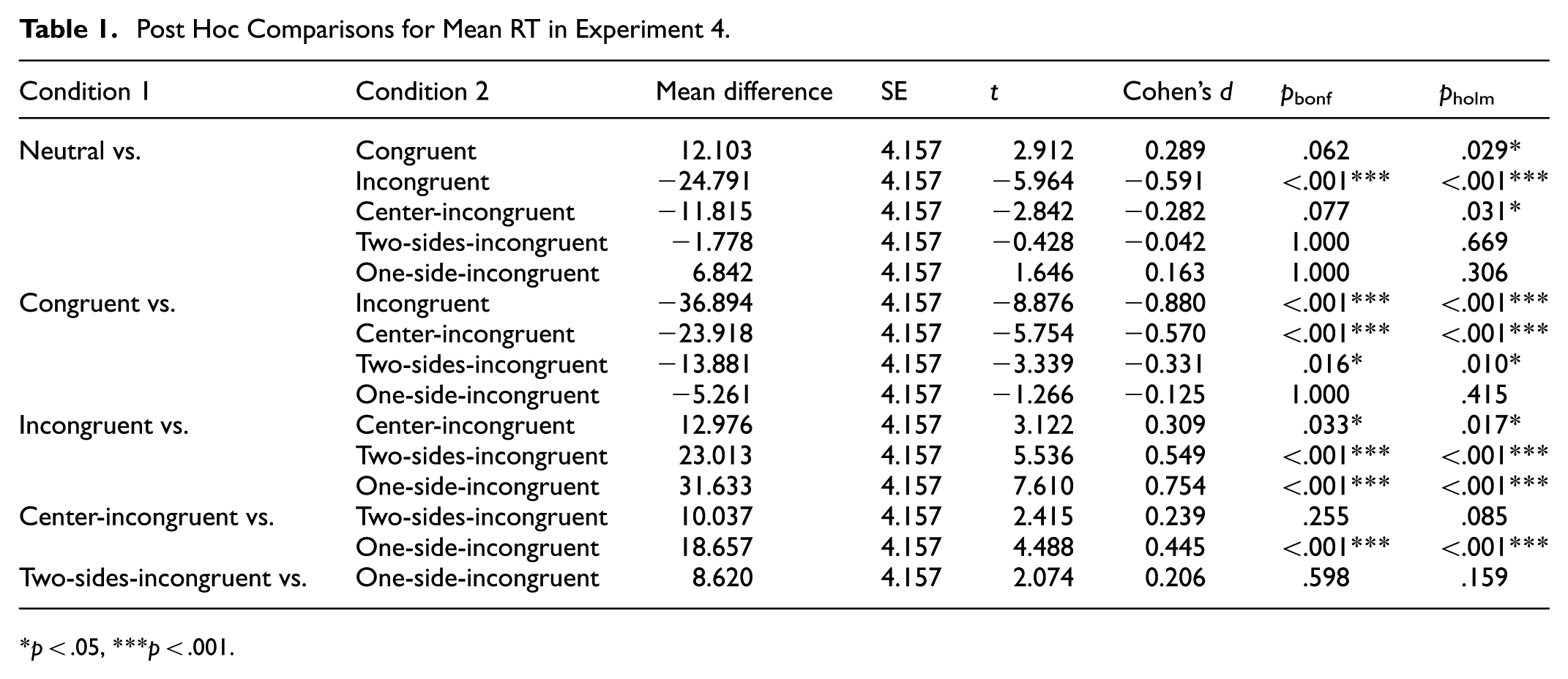
p < .05, ***p < .001.
In addition, the mean RT in the center-incongruent condition (469 ms) was significantly shorter than that in the incongruent condition (with all three prime arrows pointing in the opposite direction from the target; 482 ms), t = −3.122, pbonf = .033, Cohen’s d = −0.309, but significantly longer than that in the congruent condition (with all three primes pointing in the same direction as the target; 445 ms), t = 5.754, pbonf < .001, Cohen’s d = 0.570. The same pattern of results was observed for the mean RT of the two-sides-incongruent condition (459 ms) (see detail results in Table 1). For the one-side-incongruent condition, the mean RT (450 ms) was significantly shorter than that in the incongruent condition (482 ms), t = −7.610, pbonf < .001, Cohen’s d = −0.754, but not significantly different from that in the congruent condition (445 ms; see Table 1 for the results of all the post hoc test results). In short, because some of the three prime arrows were pointing in the same direction as the target arrow, whereas others in the opposite direction from the target arrow in these three conditions, their reaction times were between that of the congruent condition (Con3) and incongruent condition (Inc3), which seemed to be a counteracting priming effect (i.e., exact- or general- additive).
A same one-way repeated-measures ANOVA on accuracy (see the right side of the fourth row in Figure 2) showed a significant main effect of condition, F(5, 145) = 6.315, p < .001, ηp2 = .179. See Table 2 for the results of all the post hoc test results.
Post Hoc Comparisons for Accuracy in Experiment 4.

p < .05. ***p < .001.
The exact-additive unconscious priming effect could be obtained from directly superimposing the congruent on the incongruent priming effect. The size of the congruent priming effect can be calculated by subtracting RT of neutral condition from the RT of congruent condition, that is, 445 to 457 ms = −12 ms. Similarly, the size of the incongruent priming effect can be obtained by subtracting the RT of neutral condition from the RT of incongruent condition, that is, 482 to 457 ms = +25 ms. If the difference was a positive value, it meant that the RT was longer than the neutral condition, and if it was a negative value, it meant that the RT was shorter than the neutral condition.
According to the results of experiments 1 to 3, the size of the congruent priming effect induced by single one middle prime arrow was almost the same as that induced by two identical bilateral prime arrows or three combined identical arrows. The result pattern was the same for the size of the incongruent priming effect across experiments 1 to 3. These stable effects were also expected in experiment 4. Therefore, the size of the priming effect in the center-incongruent condition in this experiment (RTcenter-incongruent − RTneutral = 469–457 ms = 12 ms) can be obtained by taking the difference between the above congruent and incongruent effects (25–12 ms = 13 ≈ 12 ms). In addition, using the analytical method similar to those in Ovando-Tellez et al.’s (2021) and Tu et al.’s (2025) studies, we could test whether the prime arrows in the center-incongruent condition influenced the response to the target exact-additively by comparing the priming effect size in the center-incongruent condition (RTcenter-incongruent − RTneutral) with the size of the synergistic effect of congruent and incongruent conditions ([RTincongruent − RTneutral] + [RTcongruent − RTneutral]). The comparison did not show a significant difference, t(29) = −0.202, p = .842. The result of a separate Bayesian paired-samples t-test using JASP also did not support the alternative hypothesis, BF10 = 0.198 (moderate evidence for H0). It seems that the principle of exact-additive priming process in Tu et al.’s (2025) study was upheld here.
As for the one-side-incongruent and two-sides-incongruent conditions, although it seems that there was a counteracting priming effect as discussed above, we cannot get the exact size of unconscious priming through superimposing calculation of the priming effects of other relevant conditions. In other words, no exact-, but only general-, additive priming effects were observed in these two conditions. One-side-incongruent condition can be created by changing the direction of one of the side prime arrows in the congruent condition (Con3). Therefore, the mean RT of the one-side-incongruent condition (450 ms), which was a bit longer than that of the congruent condition (445 ms), is reasonable due to the inconsistent pointing direction of one of the bilateral prime arrows.
It is interesting that the two-sides-incongruent mean RT was 10 ms shorter than the center-incongruent mean RT (459 ms vs. 469 ms). Although the post hoc results indicated that the differences were not significant, the 10 ms difference was very close to the significant difference of 11.8 ms between the RTneutral and RTcenter-incongruent. Moreover, a Bayesian statistical analysis focusing specifically on the reaction time differences between the two conditions showed BF+0 >5 (moderate evidence in favor of H1), with the alternative hypothesis RTcenter-incongruent > RTtwo-sides-incongruent. Therefore, pholm = .085 might be considered as marginally significant. According to the results in experiments 1 to 3, the facilitating priming, which was caused by the middle prime arrow in the two-sides-incongruent condition and the bilateral prime arrows in the center-incongruent condition, should be comparable. The same was for the impeding priming caused by the bilateral prime arrows in the two-sides-incongruent condition and the middle prime arrow in the center-incongruent condition. Therefore, the final priming effect between two-sides-incongruent and center-incongruent conditions should also be comparable. We have a suggested explanation for this result in the discussion section.
In short, the exact- (and general-) additive unconscious priming effects were observed again when the simultaneously presented multiple arrows were pointing in inconsistent directions.
Discussion
Based on the exact-additive priming from two previous studies (Tu et al., 2025; Wang et al., 2024), which was distinguished from general-additive priming in the last paragraph in the introduction part, this research explored the possibility of enhancing the unconscious priming effect by repeatedly presenting the same subliminal stimulus simultaneously. However, the results showed that the multiple simultaneously-presented subliminal arrows had an additive unconscious priming effect on the target arrow only when the prime arrows were pointing in different directions. The results further validated that the method of simultaneous presentation could be used to study the priming effects of different subliminal stimuli on the same response, but not to support the hypothesis of enhanced unconscious priming effect when repeatedly presenting the same subliminal stimulus.
The Additive Priming Effect Occurred Only When the Prime Stimuli Had Different Perceptual Characteristics
In one of the two previous studies, the exact-additive priming was obtained based on an insignificant interaction between two factors in a two-factor design (Wang et al., 2024). In the other study, the exact-additive priming was derived through a direct calculation of priming effects in different experimental conditions (Tu et al., 2025). Both studies used experimental conditions in which the two (sources of) prime arrows pointed in opposite directions. However, in experiments 1 to 3 of present study, the two or three prime arrows all pointed in the same direction, and these two or three simultaneously presented prime arrows produced unconscious priming effects of equal magnitude compared to a single prime arrow even after controlling for the potential extraneous factors of stimulus-response bindings in experiment 2 and sensory adaptation in experiments 3. Most importantly, consistent with the results in the two previous studies, the additive priming was again observed when changing the pointing directions of some (not all) of the three priming arrows in experiment 4.
Therefore, in experiments 1 to 3 the perceptual adaptation caused by the same directional information at the semantic level might be responsible for the absence of additive priming effect. It seems that only when the multiple prime stimuli have different perceptions associated with the response, can the additive effect emerge. In terms of neural mechanism, there was neural dissociation between unconscious motor response facilitation and conflict (D’Ostilio & Garraux, 2012; Ulrich & Kiefer, 2016). Based on our experimental results, it seems plausible that the perceptual adaptation possibly caused by multiple same prime arrows pointing in the same as or different directions from the target arrow could potentially take place along two distinct neural pathways, which might be processed in parallel. Ultimately, it appears that these two neural activities, having opposite polarities, could be superimposed during the response stage, contributing to the observed additive priming effect.
Under What Conditions Did an Exact-Additive Priming Effect Occur?
Even though the additive priming was observed when the three priming arrows did not point in the same directions in experiment 4, the exact-additive priming effect was not obtained in any conditions. Logically speaking, center-incongruent condition and two-sides-incongruent condition in experiment 4 should have produced the same size of priming effect because they both include the same size of congruent priming and incongruent priming effect as demonstrated in experiment 1 to 3. From a different perspective, the center-incongruent condition had two side prime arrows that pointed in the same direction as the target arrow whereas the two-sides-incongruent condition had only one center prime arrow pointing in the same direction as the target arrow. Thus, the center-incongruent condition’s mean RT should have been shorter than the two-sides-incongruent condition, if more congruent primes produced larger facilitating effect than fewer. But, center-incongruent condition’s mean RT was actually longer than that of the two-sides-incongruent condition by 10 ms. Statistically, mean RT of center-incongruent condition was significantly longer than that of the neutral condition, whereas the mean RTs of the two-sides-incongruent condition was not much different from that of the neutral condition.
This might be related to attention and processing resource allocation. In the judgment task, because the target was always positioned in the center of the visual field, middle prime arrow might have had the benefit of priority processing than the side primes (Kok et al., 1985; Wang et al., 2024). On the other hand, the incongruent priming effect of 25 ms was obviously larger than the congruent priming effect of 12 ms in experiment 4, which was also observed in the majority of conditions in experiments 1, 2, and 3 (see Figure 2). Therefore, the processing of the incongruent relation seemed to demand more attention and resource than the processing of the congruent relation. There was evidence that showed an increase in functional connectivity under congruent compared to incongruent relations, indicating reduced demand and enhanced efficiency in processing for congruent relation (Ulrich & Kiefer, 2016).
In the center-incongruent condition of present study, due to its center position and its opposite pointing direction from the target, the center incongruent prime might have had a prioritized processing status. Although the two side prime arrows were in disadvantaged positions, the congruent relation might not require the same level of processing resources as an incongruent relation, hence they might still have obtained enough processing, leading to an additive effect. In the two-sides-incongruent condition, the middle congruent prime arrow might have taken a large amount of processing resources due to its privileged position, leaving limited resources for the two side primes which pointed in the opposite direction of the target arrow and needed more resources. Therefore, the increase in RT caused by the two side incongruent primes was reduced, which led to a shorter mean RT of the two-side-incongruent condition compared to that of the center-incongruent condition.
In the one-side-incongruent condition, one of the two primes in the two-sides-incongruent condition was changed to pointing consistently with the target. Therefore, in overall effect, the RT decreased.
Discussion from a Theoretical Perspective
Firstly, there has been considerable debate regarding the source and mechanisms underlying the unconscious priming effect. For example, whether the priming may arise from visual priming, categorical priming, or motor response priming (Atas et al., 2013; Li et al., 2024). In this study, despite efforts to eliminate stimulus-response bindings and sensory adaptation in experiments 2 and 3, the priming effect was still observed, demonstrating that the unconscious priming effect should occur at the level of motor response processing.
Secondly, although no additive unconscious priming effect was found in experiments 1 to 3, experiment 4 observed an additive unconscious priming effect when the priming stimuli had different perceptual characteristics. This may support the recently proposed hypothesis of “independent unconscious influence” (Tu et al., 2025; Wang et al., 2024). This has already been explained from a neural processing perspective in the earlier discussion.
Finally, the results of this experiment also supported the “reverse unconscious selection” hypothesis, which posits that subsequently presented information can lead to selective processing of prior unconscious information (Tu et al., 2025). By using the same-different method to study unconscious integration, it was found that the consistency of pointing directions between two simultaneously presented prime arrows affected the judgment of the pointing-direction consistency for the following two target arrows (Wang et al., 2017). In experiment 4 of this study, it was observed that multiple priming arrows could produce an additive priming effect on the response to a single target arrow.
Taken together, in a multiple priming items experimental paradigm, participants were found to be able to selectively make use of the different aspects of the multiple priming items depending on the specific response they were required to make to the target. For example, in experiment 4, they were required to indicate the pointing direction of a single target arrow. To achieve this goal, they might have to extract information from each prime. But in a same-different response experiment, they had to indicate whether the two arrows in the target were pointing in the same or different directions. In that case, they might have to extract the relational information between the two primes or the consistency of the pointing directions of the two arrows.
Summary and Outlook
In sum, this study found that by simultaneously presenting multiple uniform primes, one cannot obtain an additive priming effect. Only when these multiple prime stimuli have different perceptions associated with the response, can the additive effect emerge. Experiment 4 used the same arrows and masking as experiment 2. The only difference was the change in the pointing directions of the three prime arrows, which led to different results, further validating the reliability of above speculation.
The result of center-incongruent condition in experiment 4 supported the exact-additive priming effect which was also observed in Tu et al.’s (2025) and Wang et al.’s (2024) studies. However, the results of two-sides-incongruent and one-side-incongruent conditions revealed general-additive priming effects. We think that if the attention factor can be strictly controlled, we should be able to obtain an exact-additive priming effect in these conditions. This is worth studying in the future. In addition, previous studies have found that a sequential presentation of the same prime stimulus could increase the priming effect or perceptual awareness, but with its detail mechanism undetermined (Atas et al., 2013; Marcel, 1983). Recently, Wolkersdorfer et al. (2020) conducted a study examining the temporal dynamics of sequential motor activation within a priming experiment. In their research, they utilized two sequential primes, each of which was either consistent or inconsistent with the target. Future research can investigate whether the masked stimuli presented sequentially have an exact-additive priming effect. Sequential presentation of repeated stimuli may be another option to modulate the intensity of unconscious processing, as outlined in the introduction section. Finally, the arrow stimuli used in this experiment were relatively simple; it remains to be seen whether other, more complex stimuli, such as image stimuli, can resist perceptual adaptation and produce an additive priming effects.
Supplemental Material
sj-docx-1-sgo-10.1177_21582440251395377 – Supplemental material for Under What Condition Does Additive Unconscious Priming Only Occur?
Supplemental material, sj-docx-1-sgo-10.1177_21582440251395377 for Under What Condition Does Additive Unconscious Priming Only Occur? by Shen Tu, Jieyu Lv, Jerwen Jou, Lin Tian, Chengzhen Liu, Lei Song and Simin Wan in SAGE Open
Footnotes
Acknowledgements
We appreciate all participants for supporting this study.

Ethical Considerations
This study was approved by the Institutional Review Board of Guizhou University of Finance and Economics (approval number: 2023014), and it was conducted in accordance with the ethical standards of the Declaration of Helsinki. Participants were enrolled in the study on a voluntary basis, and informed consent was obtained from all participants.
Funding
The authors disclosed receipt of the following financial support for the research, authorship, and/or publication of this article: This work was supported by the Construction Plan for Guizhou Provincial Innovative Teams in Philosophy and Social Sciences [Grant Number: CXTD2024007] and the Central University of Finance and Economics “Red Leadership, Longma Action” Faculty Ideological and Political Education Plus Special Project (Grant Number: SZJ2504).
Declaration of Conflicting Interests
The authors declared no potential conflicts of interest with respect to the research, authorship, and/or publication of this article.
Data Availability Statement
Supplemental Material
Supplemental material for this article is available online.
References
Supplementary Material
Please find the following supplemental material available below.
For Open Access articles published under a Creative Commons License, all supplemental material carries the same license as the article it is associated with.
For non-Open Access articles published, all supplemental material carries a non-exclusive license, and permission requests for re-use of supplemental material or any part of supplemental material shall be sent directly to the copyright owner as specified in the copyright notice associated with the article.
