




Abstract
Perceived equity poses challenges in addressing tensions and safeguarding human rights in socio-economic development, but remains unexplored in the whole acquisition process, especially in the unique land ownership of the entire people in Vietnam. This study employs a quantitative approach to assess the equity perceptions of farmers who had lost agricultural land in the expanded Dai An industrial zone project in Hai Duong province, from both outcomes and the process leading to them. The study reveals that perceived equity is driven by Procedural Justice, Fair Personal Treatment, and Distributive Justice, which follow this order. Those findings emphasize transparency, care, and understanding in accountability and complaint solutions and a more comprehensive assessment of real objectives from diverse perspectives. These findings propose policy implementation recommendations, such as increasing farmers’ involvement and considering good governance, which are helpful for policy-makers, local Government, and land managers.
Keywords
Introduction
To acquire land for accelerated urbanization and industrialization, Governments often employ the mechanism of compulsory land acquisition, a fundamental phenomenon in most developing countries (Tyagi & Shinde, 2016). Although land acquisition is based on the principles of legitimacy and equity (FAO, 2008; Phan & Spitzer, 2022; Tagliarino, 2017), it is difficult to avoid inequity perceptions of land-acquired people in practice. Equity is tied to justice and is influenced by other behaviors, which are assessed against standards set by legislation, social expectations, and individual experiences. An individual’s experiences shape their perception of equity and directly influence their attitude (Cheng et al., 2024; Gooden, 2015; Greif, 2014). When these perceptions are negative, they contribute to numerous social tensions, affecting the success of land acquisition projects and broader societal trust in governance (Ghatak et al., 2013; Holtslag-Broekhof et al., 2016).
In response to this issue, a growing body of research has focused on fairness in land acquisition such as “just compensation payment” (Holtslag-Broekhof et al., 2016); assessment of the procedural fairness of compulsory land acquisition process (Rao et al., 2020; Shukla, 2021); the mediating role of perceived fairness relating to farmers’ attitude within land acquisition negotiation (Cheng et al., 2024), and equity in land valuation over compensation amounts (Caldas et al., 2011; Rao et al., 2020). Similarly, Vietnam’s research mainly concentrates on the outcomes of land acquisition, such as inadequate compensation, income, and transparency (Ha et al., 2016; Phuc, 2015; Thao, 2015; Tuan, 2021), or land valuation for compensation price (Lap & Hien, 2022; Tuan & Hegedűs, 2022). These studies, mainly from a legal perspective on compensation issues, are necessary but insufficient for “equity” when neglecting consideration of other aspects of the land acquisition process. Equity is not only determined by legal compensation but also by individuals’ expectations and actual experiences throughout the process. Hence, understanding the concerned people’s behaviors is important (Guo, 2001; Holtslag-Broekhof et al., 2014), ensuring social sustainability (Durant & Rosenbloom, 2017; Langhelle, 2000). While much research has focused on monetary compensation, there is a critical gap in examining how procedural shortcomings and human interactions influence perceived equity in land acquisition.
Compulsory land-taking practices vary globally, leading to different individual perceptions of equity due to distinct social and political contexts (Holtslag-Broekhof et al., 2016), including the legislation governing land acquisition (Van Assche, 2007) and social systems (Cooper et al., 2005). Most research on perceived equity has been limited to countries accepting private land being acquired through the market mechanism, including Australia (Rao et al., 2018), Scotland (Rao et al., 2020), the Netherlands (Holtslag-Broekhof et al., 2016), and India (Shukla, 2021). However, Vietnam operates under a unique land ownership regime, where land belongs to the “entire people”, and the State plays a role as its representative (Hien & Spitzer, 2023). Unlike in dual-landownership systems, Vietnamese citizens do not own land but are granted land use rights, which function as a preferential right rather than full ownership (Verdery, 2004). This singular approach raises concerns about fairness in compulsory land acquisition. The imbalance of rights and obligations between the State and land users often leads to dissatisfaction, especially when compensation alone fails to address underlying concerns about land valuation and procedural justice (Lap & Hien, 2022; Nguyen, 2022; Phuc, 2015). While Vietnam’s land policy is currently under review, limited research has examined how this unique land ownership model influences perceptions of equity in land acquisition. Understanding these dynamics is critical for shaping future land governance reforms.
While compensation payments in compulsory land acquisition are widely debated, deeper concerns persist regarding the underlying processes and regulations (Cheng et al., 2024; Holtslag-Broekhof et al., 2014; Rao et al., 2020; Shukla, 2021). This study shifts the focus from compensation amounts to how land acquisition is implemented, particularly the role of human interactions, transparency, and procedural fairness in shaping land users’ perceptions. The statement that procedural shortcomings contribute to dissatisfaction will be explored through a case study of compulsory land acquisition for socio-economic projects in Vietnam. This will be supported by interview transcripts from land users whose properties have been designated for acquisition.
This study investigates how affected land users perceive equity in compulsory land acquisition in Vietnam, with a particular focus on distributive justice (fairness of outcome), procedural justice (fairness of process), and interaction fairness (treatment by officials and authorities). By analyzing farmers’ experiences in an industrialization project in Hai Duong province, this study explores the following research questions: How do affected land users perceive equity in the compulsory land acquisition process under the unique land ownership system in Vietnam? What factors influence the perception of fairness in land acquisition, particularly regarding procedural justice, distributive justice, and human interaction in fair? How can equity principles be better integrated into Vietnam’s land acquisition policies to enhance social acceptance and minimize conflicts?
By employing a case-study approach, this study contributes to the broader understanding of equity in land management, ultimately reducing land users’ perceptions of inequity in the compulsory acquisition process. Unlike previous studies that focus primarily on compensation amounts, this study prioritizes the mechanisms and strategies used to implement land acquisition policies. The findings will provide quantitative and qualitative insights into how land acquisition policies can be improved to enhance equity, social acceptance, and land governance effectiveness. Ultimately, this research aims to contribute to policy improvements that reduce social tensions and increase equity in Vietnam’s land acquisition process, offering practical recommendations for enhancing procedural justice, distributive justice, and fair personal treatment in land governance.
Literature Review
Compulsory Land Acquisition Procedure in Vietnam
In Vietnam, land ownership is expressed as the State’s rights as the representative of the land’s entire people to hold all land capital in the country (National Assembly of Vietnam, 2013). All people only have land use rights for their allocated land parcels rather than full land ownership, for which the State issues land use right certificates. Thus, the State will recover land through the management authorities when they need it for socio-economic development in the national or public interest and national defense or security purposes (National Assembly of Vietnam, 2013). There are two forms of land acquisition: compulsory and voluntary, with the latter being accepted for the first time in the Land Law 2013.
Interestingly, voluntary land transformation is well-specified in Vietnam, which mechanism is based on negotiations between users and investors under the direct management of the State in the context of converting for domestic investment projects, and investors highly appreciate these procedures as they help minimize arbitrariness in practice, thereby protecting the rights of land users. On the other hand, the rest form is used for public purposes through compensation and support mechanisms that ensure the welfare of all affected households after land recovery. However, most needed land projects in Vietnam prefer compulsory land acquisition through the State, leading to many shortcomings that cause social conflicts and tensions. This process, while intended to ensure fair distribution of benefits, has led to significant social tensions and disputes due to perceived inadequate compensation and limited public participation in decision-making.
The Land Law 2013 was adopted by the National Assembly, aiming to more clearly define the rights and responsibilities of State agencies and land users. The State can take land from current land users for national security and public interests, providing compensation packages to the affected land users. According to Decree 47/2014/ND-CP issued on 15 May 2014 by the Government and Consolidated document 03/VBHN-BTNMT consolidates the Decree regulating compensation, support, and resettlement when the State recovers land issued on 04 May 2021 by the Ministry of Natural Resources and Environment, these documents regulate compensation, support, and resettlement when land is recovered. Figure 1 provides further details on compulsory land acquisition procedures in Vietnam.
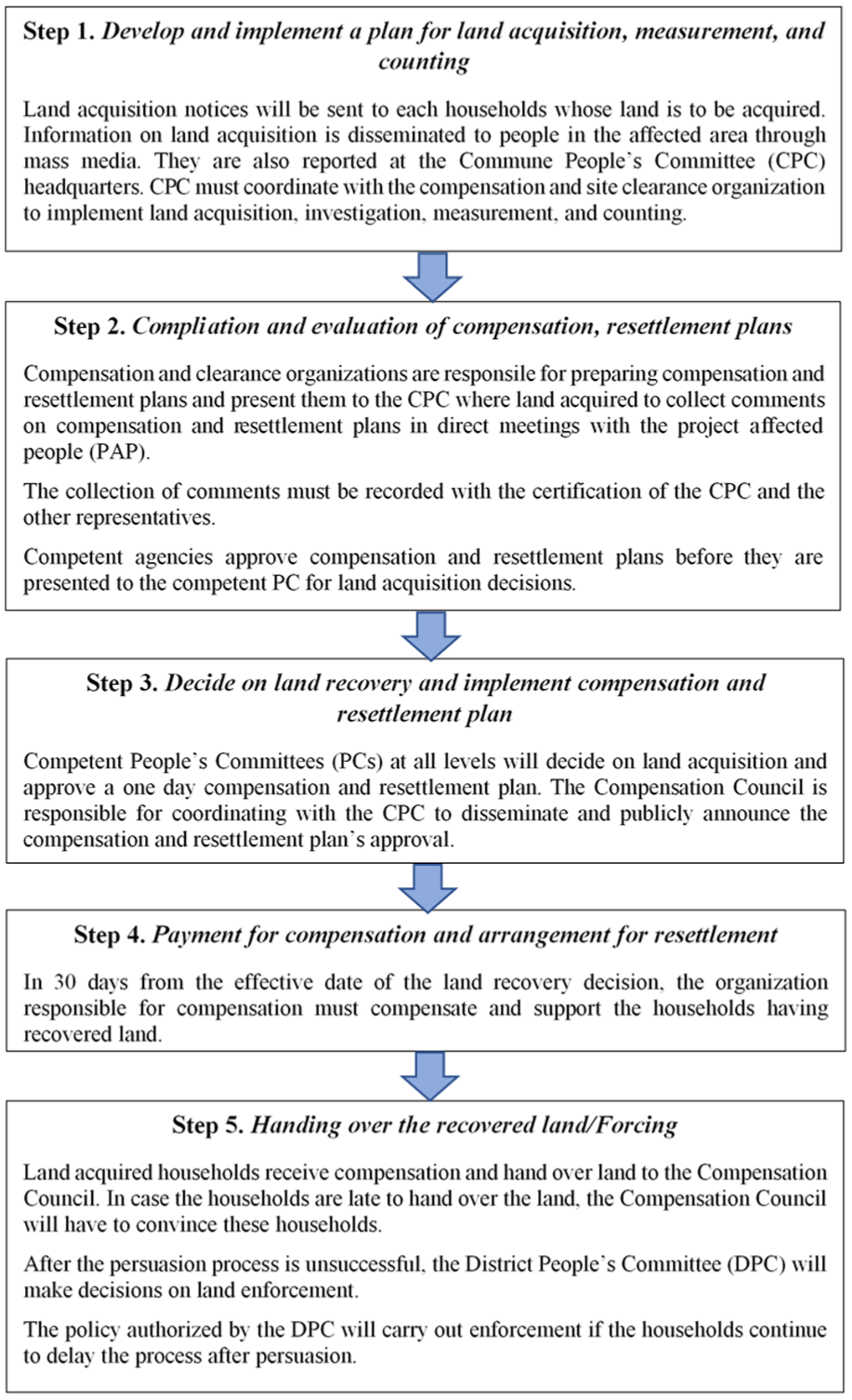
The compulsory land acquisition process in Vietnam.
These steps in the compulsory land acquisition procedure display the State’s effort to distribute benefits to all stakeholders, including land users. However, this process still leads to significant social tension and conflicts. These conflicts and social tensions arise from the land compensation and support mechanisms and the policies before and after land recovery, which do not align with the market and the actual benefits of the recovered land. It represents a significant inadequacy in the implementation of land acquisition policy. More than 70% of complaints relate to land law, particularly land acquisition, compensation, support, and resettlement (Dang, 2015). Moreover, land users also see the compensation levels as unfair due to inconsistencies across projects, administrative boundaries, and different periods. Even when households move out at different times, the compensation payments may vary (Bui, 2009). Admittedly, there are countless inconsistencies in land compensation and resettlement subsidies. Such inequity in compensation contributes to rising tensions and distrust between residents and the Government.
Vietnam’s approach to land acquisition contrasts with frameworks in other countries, which provide alternative mechanisms for balancing state control, private ownership, and compensation fairness. China, for example, follows a similar state ownership model, but recent legal reforms have allowed collective landowners in rural areas to negotiate compensation directly, increasing stakeholder participation (Wang et al., 2017). Moreover, China has expanded compensation policies to include long-term social security benefits, enabling the transition for displaced land users (Tilt & Chen, 2021; Yang, 2012). In contrast, India adopts a mixed land ownership system, where both state and private ownership coexist. The Land Acquisition, Rehabilitation, and Resettlement Act (2013) commands higher compensation rates of up to four times the market value in rural areas, and requires public consent for many acquisition projects, thus ensuring stronger protections for landholders (Gogoi, 2018). Meanwhile, Germany operates under a full private ownership model, where expropriation is strictly regulated and allowed only for public interest purposes. Compensation in Germany is determined by fair market value, and landowners have strong legal protections to challenge acquisitions in court (Davy, 2024; Schhfer, 2015).
While Vietnam’s Land Law 2013 and related regulations have attempted to address concerns about fairness, ongoing challenges in compensation levels, public participation, and legal safeguards continue to generate social tensions. Comparative insights suggest that strengthening negotiation rights, aligning compensation with market values, and ensuring legal protections could significantly enhance Vietnam’s land governance framework, leading to more equitable and socially accepted land acquisition practices.
Equity Theory
In the reviewed studies, various terms are interchangeably used to convey the concept of equity, such as “equity”, “justice”, and “fairness”. D. K. Hart indicated that equity is synonymous with justice from an ethical approach (Hart, 1974), while Blanchard asserted that equity and fairness can be used interchangeably (Blanchard, 1986). Interestingly, Chiu confirmed that “equity” can alternate with “justice” and “fairness” (Chiu, 2002). Therefore, for this study, these terms can be employed with the same meaning without causing any misunderstanding.
As defined by Adams (1965), equity relates to people’s sense of fairness or unfairness. It refers to the distribution of benefits and costs and the assessment compared to others. In compulsory land acquisition, outcomes encompass tangible and intangible values provided by the State and agencies, such as compensation prices, support strategies, accountability, settlement complaints, etc. According to social psychology theory, those affected by land acquisition desire fair outcomes, fair processes, and strategies to achieve those outcomes (Folger & Cropanzano, 2001; Van Den Bos et al., 1998). In real life, even when the procedural process is carefully followed and proceedings are fairly conducted, the outcome may not always be perceived as fair, and vice versa. The perception of equity in land acquisition is not experienced through legislative drafting, but shaped by actual experiences of human interaction, which are influenced by past interactions and expectations regarding the behavior of others, which in turn have been influenced by the individual’s experiences concerning justice (Greif, 2014). Thus, equity in land recovery, as an aspect of public policy, is emphasized as a product of social construction. It implies fair treatment and public participation in planning and decision-making processes (Durant & Rosenbloom, 2017; Johnson & Svara, 2015) and the management of conflicts of interest among stakeholders (Bøggild & Petersen, 2016). These aspects are rooted in personal perceptions (Akan et al., 2009).
According to more recent scholars, equity theory has primarily focused on the distribution of outcomes, neglecting the procedures involved in decision-making regarding outcome allocation (Holtslag-Broekhof et al., 2016; King & Murphy, 2012). Procedural justice is considered more fundamental than distributive justice and affects fairness in distributive (Konovsky, 2000). The foundational theory of Adams (1965) emphasized distributive justice and integrated later theories that focus on procedural fairness, such as the fairness theory of Folger and Cropanzano (2001), which examines how outcomes are achieved. This broader perspective on equity suggests that justice in land acquisition does not solely depend on outcomes (i.e., compensation), but also on the fairness of the processes and rules that govern it through which land acquisition takes place (Goodwin & Ross, 1992; Rao et al., 2020; Shukla, 2021). Additionally, ensuring equity should involve considering procedural and distributive justice in communication with stakeholders (Dore & Lebel, 2010). More recently, interaction justice has emerged as the third dimension of equity, involving interpersonal relationships and communication between decision-makers and recipients, characterized by modesty and respect (Hart et al., 2016; Roberts, 2015; Yaseen et al., 2015). As mentioned earlier, three key elements are selected to define equity for this study: (1) distributive equity, involving the fair allocation of costs and benefits shared; (2) procedural equity, about how the levels of involvement, voice, and representation afforded to land users in this process; (3) fair personal treatment, considering the respect, responsibility of attitudes, behaviors.
Research Sites and Methodology
Research Framework
This paper, through a review of the literature and an investigation of the current situation in the study area, aims to analyze the perceived equity of claimants within the land acquisition process for an industrialization project in Hai Duong Province. Each claimant will have his or her perception of equity, which is shaped by an individual’s experiences with the actual land acquisition by other behaviors, which are assessed against standards set by legislation or social expectations (Cheng et al., 2024; Gooden, 2015; Greif, 2014). Recognizing and understanding these different perceptions of equity is essential in conflict situations that involve democratic principles, including land administration management. The dimensions of perceived equity are progressively improving. Colquitt analyzes fairness across the dimensions of outcome fairness, procedural fairness, interpersonal fairness, and informational fairness (Colquitt et al., 2001) while Gross focuses on procedural fairness and outcome fairness dimensions, highlighting their equal significance (Gross, 2008). With the application of lay perspectives to all dimensions of justice, the discussion departs from the view of traditional equity applied solely to distributive justice, to modern equity applied to all three levels of justice (Hart et al., 2016; Syme et al., 2006; Yaseen et al., 2015) which includes distributive justice (just compensation), procedural justice, and fair personal treatment (interactional justice) which can be interpreted in the context of land acquisition process, as outlined below.
Distributive justice (D) focuses on the perceived fairness of outcome distribution (Greenberg et al., 2007). Achieving fairness in this context requires equitable resource allocation for individuals. As a result, claimants must reach a consensus on the allocation standards and methods to be applied. This factor examines critical components of perceived outcomes, encompassing economic, societal, environmental, and spiritual dimensions. The study will utilize questionnaires related to land acquisition issues, including compensation, living standards, and job opportunities (He, 2023; Kabra, 2016; Nkansah-Dwamena & Bonnie Raschke, 2021; Wang & Sun, 2016); family disunity (Maharjan, 2017; Wilmsen, 2016); environmental resource quality and ecology (Kusiluka et al., 2011; Timko et al., 2014), and religious connections and spiritual well-being (Kaida & Miah, 2015; Mohamed-Katerere, 2022) that may be affected by land acquisition performance.
Procedural justice (P) refers to the perceived fairness of the decision-making process and the procedures used in the allocation. Procedural justice is derived from the completeness of information for the participant, the opportunity for a participant to contribute additional information, the extent to which the decision-maker uses this information, and the extent to which the participants feel that their voice has influenced the final result (Caldeira et al., 1976; Cheng et al., 2024; Goodwin & Ross, 1992). In the context of land acquisition, procedural justice comprises several key principles, including consistency (ensuring uniformity in procedures for land-acquired households throughout the project’s timeline, as well as equitable financial support), bias-suppression (maintaining transparency in land acquisition procedures, independence in determining land pricing compensation, and appraise compensation payment as well as addressing petitions), accuracy (ensuring the reliability of the information used in the procedures and the quality of information processing practices), representativeness (measuring the level of participation and the extent to which households can voice their concerns during the process), and ethicality (correcting any wrongdoing in handling complaints, with competent agencies assessing the role and capacity of those responsible for resolving such issues (Cheng et al., 2024; Colquitt et al., 2001; Jiang et al., 2022; Shukla, 2021).
Fair personal treatment (F) pertains to the quality of interaction among stakeholders (Cohen-Charash & Spector, 2001) and the fairness of information (Huang & Huang, 2016). This element contributes to some criteria in land acquisition, such as politeness and respect (Caldwell, 2014; Huang & Huang, 2016; Stivers et al., 2023), the reliability of the information provided by agencies in their interactions (Tuan, 2021, 2023), the reasonableness of explanations provided by relevant officers (Colquitt et al., 2001; Truong & Trinh, 2024), the adequacy of information provided, and timeliness (Hart et al., 2016; Huang & Huang, 2016; Phan & Spitzer, 2022).
According to the determined variables, this study explains how the relevant factors will affect farmers’ perceived equity within the compulsory land acquisition process using a linear regression model (Figure 2). The figure illustrates that the rules, processes, as well as the outcomes of government activities in land acquisition, shape predictive and normative expectations regarding land acquisition. These expectations are grounded in both legislative frameworks and individuals’ actual experiences with land acquisition. The evaluation of these issues will be approached through three dimensions of equity, as outlined above. The gap between these expectations and an individual’s perception of the actual land acquisition influences their sense of equity. When there is alignment between people’s normative and predictive expectations and their actual experiences, they are likely to perceive the acquisition as equitable. Conversely, discrepancies between expectations and perceptions will lead to a perception of inequity.

The research framework.
Research Area
Hai Duong province, within Vietnam’s Northern key economic zone, has a competitive advantage in attracting investment projects due to its abundant industrial land resources and the beneficial location connecting with the North’s economic triangle region, approximately 60 km Hanoi (Figure 3). Since the initial approval of 5 industrial zones with an area of 440 ha for planning in 2002, Hai Duong has seen remarkable growth recording by 21 industrial zones and three expanded ones with 4,508 ha according to the industrial zone planning in 2021. Hence, the Government and Committee of Hai Duong Province will continue to promote industrialization and modernization of the province until 2030, with a vision to 2045, aspiring to become a dynamic industrial center of the Red River Delta.

Location of the study area in the survey.
According to the master planning from 2021 to 2030, Hai Duong aims to establish 32 industrial zones, covering a total area of approximately 5,661 hectares. This rapid industrialization has a significant impact on agricultural land areas and the rural labor structure. Consequently, this study selects the expanded Dai An industrial zone with a total area of 415.02 ha in Hai Duong city and Cam Giang district according to Document 1059/TTg-CN issued on 07/7/2006 by the Government. It is the first large-scale industrial zone in Hai Duong province with the most significant agricultural recovery and belongs to the core of the province.
Methodology
Questionnaire Design
The questionnaire involved a set of closed questions mainly focused on demographics.Characteristics such as the age of the head of the household, gender, education, family size of claimants, and the number of workers per household. Additionally, there were open-ended questions related to the claimants’ perspectives on equity. These open-ended questions aimed to gather in-depth insights into their views on the issues surrounding land acquisition practices. The information collected from these questions formed the foundation for providing suggestions to address the topics under discussion.
Our dependent variable, “equity”, is measured by the subjective perception of affected households regarding fairness issues in the context of procedures, distribution, and treatment. Farmers express their opinions based on sharing benefits, including compensation payments, financial support, and conflict resolution by relevant agencies. Therefore, the potential explanatory factors in the questionnaire include 1) distributive justice, 2) procedural justice, and 3) fair personal treatment, along with 17 independent variables. Table 1 lists the variables and questions used to explore the factors influencing the perceived equity of affected households. Social equity was measured with a five-point Likert scale: a score of “5” indicates a strongly positive attitude, signifying that claimants feel that equity has been fully achieved in land acquisition practices; a score of “4” shows equity; a score of “3” depicts a neutral stance on fairness; a score of “2” indicates that farmers perceive inequity in land acquisition performance; and a score “1” suggests a strong perception of inequity.
Variables Used to Analyze the Perception of Claimants on Equity in Land Acquisition Practice.

Data Collection and Analysis
A field survey to collect data on farmers’ perceptions about equity in land acquisition practices was conducted between March and May 2023. We collected the necessary legal documents and the list of agricultural land acquired by households of the expanded Dai An industrial zone project from the Department of Natural Resources and Environment in HaiDuong province. This large-scale project acquired almost all agricultural land in Cam Giang District and Haiduong City, affecting 1,388 households with the required area of 415.02 ha. Among them, 962 households experienced a loss of more than 70% of their total agricultural land. The study involved selecting respondents and appropriate criteria suitable for the study’s context. This selection process was guided by consultations with local officers who are leaders and have directly participated in the land acquisition projects. Subsequently, we randomly selected 255 households that have been acquired, comprising more than 70% agricultural land, including those where farmers experienced land loss and had a livelihood with a solid attachment to agricultural activities (purely agricultural households), as well as those with additional sources of income. Notably, this survey focused on the heads of each household who were decision-makers and encountered various land acquisition issues. Finally, a total of 200 respondents’ data was considered for further analysis, with a response rate of 78.43%.
The SPSS version 20. was used to analyze the data and examine the correlation between equity perceptions and observation variables. For this purpose, measurement and multiple linear regression models were used. (Hair, 2010) stated that for exploratory factor analysis (EFA) to be valid, the sample size should be at least 50, with a preferred minimum of over 100. Additionally, the ratio of observations to measurement variables should be 5:1, meaning each factor requires at least five observations. In the proposed research model, there were 17 measurement items (Table 1), requiring a minimum sample size of 85 (17 × 5). Therefore, this study collected data from a total of 200 respondents through interviews, which is acceptable. Each of the 17 items was evaluated using a five-point Likert scale.
Respondent’s Characteristics
The survey revealed that the heads of households are predominantly male, accounting for approximately 69.5%, while females make up only 30.5%. This observation mirrors the prevailing cultural issues in Vietnam, where men often hold primary household decision-making roles. Most respondents, 83.5% are married. There is a variation in the age groups of household heads, with those below 30 years constituting 10.5%, those aged 31 to 40 years being 25.5%, those aged 41 to 50 years comprising 36%, and those over 50 years representing 28% of the respondents (Table 2).
Demographics of the Respondents (N = 200).

The educational levels within the households exhibit significant diversity. Approximately 49% of household heads have educational qualifications below a bachelor’s degree. Those holding a bachelor’s degree constitute 41%. In contrast, individuals with higher degrees remain a minority, accounting for only 10%.
The average household size is 4.5 people, and each household consists of 2.7 primary laborers. The family’s member count signifies the potential labor force within the household, and the involvement of these individuals in the household’s production activities substantially influences the household’s income.
Ethics and Participant Consent
This study involved over 250 affected respondents who participated in structured surveys and semi-structured interviews with households and local informants. Ethical approval was granted by the Research Ethics Committee. To minimize potential harm, the design excluded any sensitive interventions; data collection focused solely on policy-relevant perceptions and experiences without recording identifiable or sensitive personal data. All responses were collected anonymously and stored securely with access restricted to the research team. Participants were fully informed about the study’s purpose, procedures, confidentiality safeguards, and their right to withdraw at any time. Written consent was obtained for the household survey, while verbal consent was recorded for all interviews. The potential benefits, advancing evidence for more equitable and sustainable land acquisition policies, and improving livelihood protection, clearly outweigh the minimal risks associated with participation.
Results
Reliability Analysis of Questionnaires
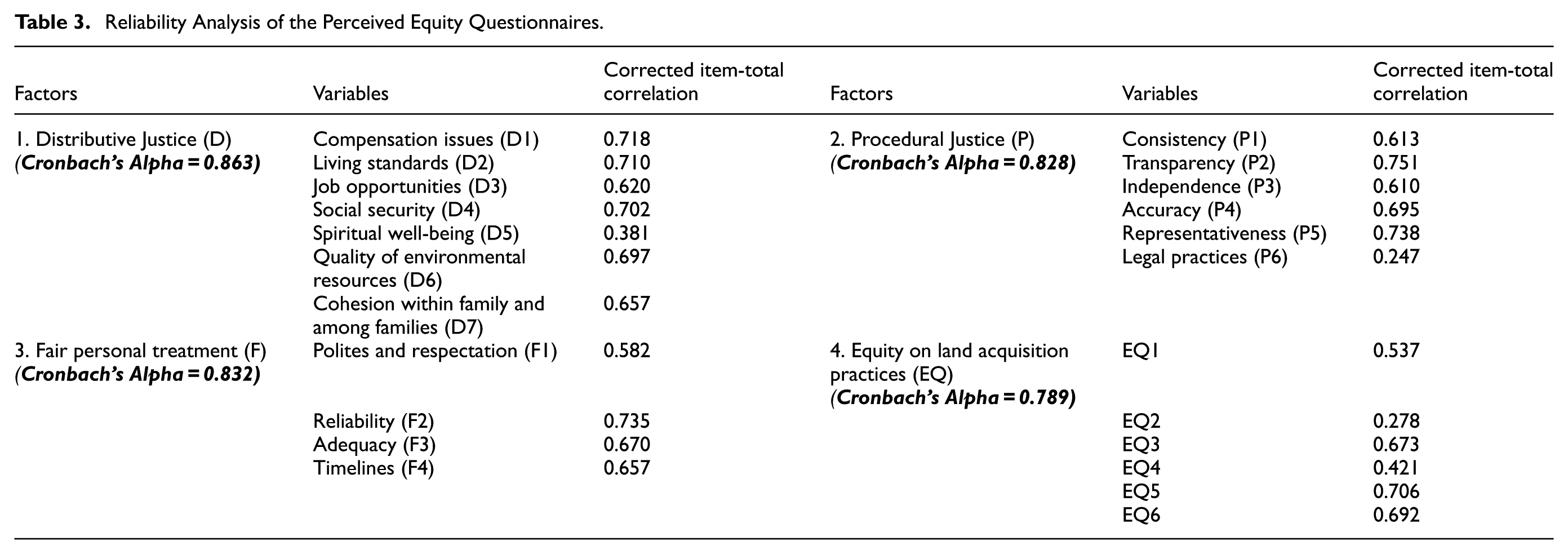
Cronbach’s Alpha evaluates whether the observed variables in a scale are strongly interrelated to a similar underlying construct. A Cronbach’s Alpha coefficient that falls into the range of 0.5 and 0.9 signals a potential issue. When scales display this inconsistency, it is advisable to consider the removal of specific variables.
The reliability test results showed that certain variables are under requirements with a value lower than 0.5, including Spiritual well-being (D5), Legal practices (P6), EQ2, and EQ4. These variables were excluded from the list of indicators in Table 3. All appropriate variables were run again after being deleted. The outcomes are shown in Table 4, where it is demonstrated that a total of 15 independent variables and 4 dependent variables exhibit consistency and meet the criteria for acceptance in the questionnaire survey.
Reliability Analysis of the Perceived Equity Questionnaires.
Reliability Analysis After the Item is Deleted.

Validity of the Questionnaire
The reliability test results in Table 5 show that the alpha coefficients for the factors all exceed 0.8, ranging from 0.835 to 0.885, while Cronbach’s Alpha values for the variables are all above 0.5, ranging from 0.594 to 0.758. Consequently, all variables demonstrate internal consistency and possess sufficient reliability for conducting an Exploratory Factor Analysis (EFA). The Kaiser-Meyer-Olkin (KMO) coefficient scores at 0.923 (more than 0.5), and the significance level of Bartlett’s test of sphericity is less than 0.05, confirming the suitability of factor analysis for the study’s dataset. It indicates that the observed variables within the factors are correlated. Eigenvalue is the criterion used to determine the number of factors in EFA, and the results in Table 5 demonstrate that all factors have Eigenvalues more significant than 1.0. Therefore, all three factors are retained in the research model. Furthermore, the Total Variance Explained exceeds 50%; these three factors account for 66.378% of the variation in the data.
Validity Test of KMO and Bartlett in the Perceived Equity Questionnaire.
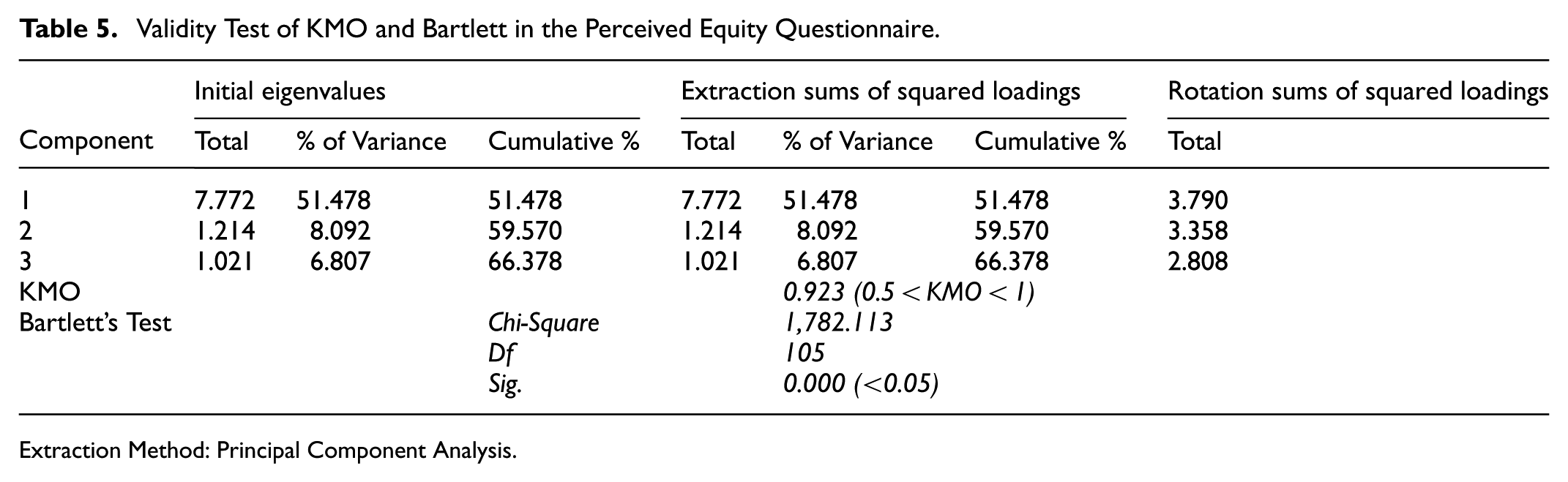
Extraction Method: Principal Component Analysis.
Exploratory Factor Analysis
The rotation matrix results reveal that the 15 observed variables can be categorized into three distinct factor groups, with all observed variables exhibiting factor loadings exceeding 0.5 (Table 6).
Rotated Component Matrix a .

Extraction Method: Principal Component Analysis.
Rotation Method: Varimax with Kaiser Normalization.
Rotation converged in 6 iterations.
The observed variables exhibit strong intercorrelations. Following the application of a rotation matrix, it becomes evident that all variables possess factor loadings exceeding the 0.5 threshold. The 15 initial observed variables are subsequently grouped into three distinct categories without any specific order. Consequently, the research model is presented as follows:
Pearson and Linear Correlation Analysis
The Pearson analysis outcomes reveal that all significance values are below 0.05, signifying that the independent variables demonstrate a linear correlation with the dependent variable (Table 7).
The Pearson Correlation Analysis.

Correlation is significant at the 0.01 level (2-tailed).
The adjusted R-squared value of 0.784 confirms that the affected households’ perception of equity in the land acquisition process is influenced by Distributive Justice, Procedural Justice, and Fair Personal Treatment. Notably, the Variance value with a significance level of Sig. = 0.000 (<0.05) suggests the multivariate linear regression model is well-suited for this study. The Variance Inflation Factor (VIF) for all factors is relatively low, with values under 2, and the Durbin-Watson statistic is 1.895, falling within the range of 1.5 to 2.5, indicating the absence of multicollinearity. The multivariate regression analysis reveals that the regression coefficients are statistically significant and demonstrate a positive correlation with the independent variables in the following descending order: Procedural Justice (0.49), Fair Personal Treatment (0.46), and Distributive Justice (0.37) (Table 8 and Figure 4).
The Linear Regression Analysis.


The relationship between the factors and the perceived equity.
Discussions and Recommendations
Impacts of Procedural Justice on the Farmers’ Perceptions of Equity
The perception of equity in land acquisition processes is significantly influenced by Procedural Justice, which encompasses aspects like Consistency (P1), Transparency (P2), independence (P3), Accuracy (P4), and Representativeness (P5). Procedural Justice plays a crucial role in shaping claimants’ equity perceptions in the land acquisition process, consistent with previous findings by Shukla (2021) and Bøggild and Petersen (2016). However, its relationship with distributive justice remains debated. While some studies argue that procedural fairness determines the legitimacy of distributive outcomes (Konovsky, 2000), others ignore the impact of fair procedure and only support distributive justice (Hayibor, 2012). These studies argue that fair procedures can serve as a criterion for determining just distribution rather than being inherently valuable.
In the situation of Vietnam, the issue of consistency in procedures becomes a critical factor. The procedures should be consistently applied over time and across all individuals. However, the study has identified perceived violations of the consistency rule, creating negative perceptions among people. The latter perspective downplays the role of procedural integrity in shaping equitable outcomes, despite evidence that violations in procedure often lead to broader dissatisfaction and mistrust in governance (Fortin et al., 2016; Jones & Skarlicki, 2013). The change in compensation payment for land acquired in later stages, based on different K-coefficients and land-price frameworks, has led to perceptions of procedure inconsistency. Independence in determining compensation prices is another significant aspect of Procedural Justice. Respondents noted a lack of total independence in determining the compensation price, as the process involves only leaders of state agencies and consultancy organizations. This, along with the absence of an appraisal agency and the extremely low compensation compared to the land market value, has raised negative concerns about fairness.
Independence in compensation determination is another key procedural concern. Respondents highlighted the lack of a truly independent valuation mechanism, as compensation prices are primarily determined by state agencies and consultancy organizations. The absence of an independent appraisal body and the unambiguous discrepancy between compensation rates and market values have further fueled public concerns about fairness. This contradicts international best practices, where countries like India (Land Acquisition Act 2013) and Germany (independent land courts) ensure third-party evaluation to increase trust in compensation processes and ensure long-term economic stability for affected households (Gogoi, 2018; Schhfer, 2015; Tagliarino, 2017; Wahi, 2017). Thus, Vietnamese policymakers should consider establishing an independent land valuation body, separate from state agencies, to improve procedural fairness and reduce conflicts.
Transparency plays a vital role in claimants’ perceptions of equity. Providing clear information on proposed projects, including their nature, extent, design, financials, impacts, and plans, is essential for a significant impact on lives and livelihoods, similar to the study in Hue City (Phuc, 2015). Transparent communication ensures informed decision-making by land users, especially when their consent is required for a project, as per the Land Law of 2013 (National Assembly of Vietnam, 2013), and mitigates mistrust in the government (Grimmelikhuijsen, 2012; Wu et al., 2017).
Furthermore, data accuracy in land acquisition is crucial for ensuring fair compensation and minimizing disputes. Discrepancies between official land records and actual measurements have led to numerous conflicts and tensions between households and state agencies, contributing to perceived inequity. These challenges arise from outdated legal administrative records, technological limitations, and inconsistencies in land measurement methodologies and calculation processes. Addressing these issues requires regular data updates and improved technical capacity among land management personnel to enhance procedural accuracy.
Finally, representativeness is needed to improve equity perceptions in the aspect of procedural fairness. Unequal participation and lack of involvement in decision-making lead to negative opinions of households. In many cases, local governments often make arbitrary decisions without involving those who stand to lose their land and livelihoods. This exclusion mainly concerns vulnerable groups such as the elderly, widowed, and those with physical limitations. Many scholars, such as Shukla (2021), Nyarko (2019), Phuc et al. (2015), and Thao (2015), reported the same problems across different countries. They highlighted that human rights are vague in land acquisition plans, and no mechanism is upheld to collect the opinions of land-acquired households. Ensuring inclusive participation in land acquisition planning is not only a matter of procedural justice but also aligns with Vietnamese political principles, as outlined in Ordinance 34/2007/PL-UBTVQH11 and Articles 199 and 200 of Land Law 2013 (National Assembly of Vietnam, 2013). Despite these legal provisions, enforcement remains inadequate, highlighting the disconnect between policy and practice. Similarly, in China, some local governments allow collective negotiations, but decision-making remains top-down, with discontent managed through compensation rather than participatory reforms (Froissart, 2014; Stromseth et al., 2017). In contrast, countries like South Korea, India, and Germany have introduced participatory land acquisition models, where affected households have a say in compensation negotiations, reducing disputes (Gogoi, 2018; Nizwar et al., 2024; Schhfer, 2015).
Impacts of Fair Personal Treatment on Equity Perceptions
The second major factor is recorded by “Fair Personal Treatment”, which encompasses respect, reliability, adequacy, and timelines. This factor was found to have a coefficient of 0.46, indicating its substantial impact on the perception of land-lost farmers. However, this study contradicts that claim, showing that how people are treated matters as much as what they receive. This can be linked to Vietnam’s historical land administration culture. During the centralized economy era, bureaucratic land governance often operated with top-down decision-making, where public consultation was minimal. Today, remnants of this culture persist, with citizens often feeling powerless in interactions with state officials.
The respondents confirmed several issues, including the perceived reliability of interactions with some officers, prolonged waiting times for responses to complaints and problem resolution, and the manners and behaviors of officials in treating the claimants with respect. How claimants are treated by the State and their staff can significantly affect their perceptions of equity. Respectful and empathetic interactions were found to mitigate dissatisfaction, whereas dismissive or bureaucratic attitudes worsened perceptions of inequity. This study emphasized the essential role of “Fair Personal Treatment” in the context of land acquisition, contrasting with Alrousan and Ahmad (2015) and Hart et al. (2016). These previous studies suggested that “Fair Personal Treatment” serves only a mediating role, subordinate to “Distributive Justice”. In contrast, our findings suggest that positive personal treatment by officials can directly shape claimants’ equity perceptions, particularly when procedural and distributive fairness are perceived as lacking.
This discrepancy in findings may be attributed to the Vietnamese political and administrative land management, where public perception is not solely based on tangible compensation but also on the perceived sincerity of government engagement. Unlike in Vietnam, where affected communities have limited options in challenging land acquisitions, other countries offer stronger institutional safeguards to ensure equity. In India, affected communities can seek judicial review, and courts have canceled unfair acquisitions in several cases, providing stronger protection against land grabs (Sinha, 2019; Wahi, 2017). Similarly, in Germany, landowners have the right to independent arbitration or court appeals, ensuring a fair resolution process that prioritizes negotiation over forced acquisition (Davy, 2024). These mechanisms not only offer a legal avenue for redress but also reinforce public trust in the land acquisition process.
Given these international examples, enhancing training programs for State officials, focusing on ethical conduct, active listening, and conflict resolution, can significantly improve claimants’ overall experiences and trust in Vietnam’s land acquisition processes. Additionally, the State should implement stricter ethical standards for land officials through regulatory institutions that oversee public administration conduct, as seen in Indian and Germany. A similar ombudsman system in Vietnam could provide affected farmers with a formal complaint mechanism, preventing potential abuses of power by officials and improving perceptions of equity in land acquisition. Strengthening these institutional safeguards would not only reduce social tensions but also align Vietnam’s land acquisition process with international best practices.
Impacts of Distributive Justice on Perceived Equity
“Distributive Justice”, which comprises indicators related to social, economic, environmental, and community cohesion issues, is valued as the third factor with a coefficient of 0.37. Similarly, Rao et al. (2020) and Hayibor (2012) emphasized the role of distributive justice in ensuring adequate compensation and granting a fair opportunity to the affected households to negotiate. The affected households are compensated for the loss of land use rights and assets on land, including compensation payments, financial support for occupational change, and vocational training. This monetary is expected to improve or at least restore the households’ livelihood options and living standards after land loss. While such measures are intended to restore or improve households’ livelihoods, this study reveals that claimants often perceive these efforts as insufficient or misaligned with their needs. Interestingly, this study found that households did not highly appreciate other potential benefits estimated by investors and agencies, such as potential job opportunities and savings in commuting time and costs, which aligns with findings from Phuc et al. (2014) and Tuan (2023). Such outcomes will create negative perceptions about equity. The existing compensation policy is overly focused on a simple financial transaction. It does not pay sufficient attention to the real objectives and the efficiency of payment and support in establishing new livelihood sources. Indeed, the recent compensation mechanism does not fully acknowledge the properties that suffer damages and should be properly compensated. It includes tangible interests like land and intangible interests that are other properties linked to the land (Tagliarino, 2017, Phan & Spitzer, 2022). Thus, compensation should be fair and guaranteed for private interests in the legal, economic, and society. As such, there is a need for a broader definition of acquired interests in Vietnamese law, particularly a mechanism to determine land prices based on market price (Lap & Hien, 2022). Experiencing countries like Japan use market-based land pricing models to ensure fair compensation, preventing government undervaluation (Boro, 2022). Vietnam could adopt a hybrid model, where state-set compensation is verified against actual market transactions, ensuring affected farmers receive an appropriate price for their land.
The level of perception varies depending on different users’ perspectives, as Hayibor (2012) described. Conversely, the land-acquired users deeply attached to farming activities paid more attention to the acquisition impacts, especially compensation amounts, sufficient social security, and Government support mechanisms. Their livelihood and lives rely on land, which is their survival and gives them a sense of security, joy, and belonging. This result has practical highlights for authorities, as it provides a better understanding of the diverse perceptions of land loss farmers. This understanding can lead to more equitable contributions in land acquisition practices. Furthermore, from a family perspective, the positive aspects include harmony, cohesion, and the potential evolution of the future generation. These were recognized as advantages resulting from the financial support and the care provided by the local State in terms of preserving cultural and psychological values.
Recommendations
Drawing inspiration from the observations of perceived equity during the compulsory acquisition of land using the State’s powers in Hai Duong, the following recommendations are presented under the consideration of fairness criteria identified in the land acquisition process.
The State should consider a more suitable approach to the land acquisition process and compensation, strengthening the involvement of affected people at both the pre- and post-acquisition stages, composing land acquisition planning, land valuation for compensation price, and decision-making. By allowing affected households to have a say in these matters, their voices can be heard, and their human rights protected. Additionally, there should be an institution that conducts an independent land valuation process and decision-making based on the accuracy of legal documents and updated information. It can help reduce complaints from perceived unfairness in the land acquisition process.
All information and regulations related to compulsory land acquisition projects should be clear and accessible to all people. Conflict can be minimized by having well-defined policies that specify the purposes for which the government may acquire land and by ensuring transparency and fairness in land acquisition processes. Adequate and equitable compulsory land acquisition depends on good governance and adherence to the rule of law. Hence, the State needs to develop a comprehensive strategy for good governance (Phung et al., 2021), which focuses on increasing the ethics and capacity of competent agencies regarding accountability and settlement of complaints for the affected households (Chien & Thanh, 2022). Ethical principles should be based on understanding and respecting the feelings of others and upholding a high level of social responsibility, which will create positive forces in the affected households and contribute to their fair welfare and interests.
Before land acquisition, a comprehensive socio-economic survey is necessary to understand the existing circumstances clearly. This survey should help identify the actual situation, social differentiation among affected households (such as the variations in their capacity to deal with land loss and livelihood reconstruction), and people’s innovative ideas regarding their plans after land loss. This information will be valuable for local governments to formulate and execute realistic compensation policies that align with the abilities and expectations of the affected households. Toward this end, policymakers should consider the concepts of selective compensation and design support plans that match the capacity of affected people to adapt to new conditions.
Enhancing public awareness about the land acquisition process through public education is crucial. It can help build trust in the State and promote an understanding of the rationale behind projects for the public interest rather than individual interests.
Conclusion
The compulsory nature of land acquisition by the State’s power has been a source of tensions concerning equity in Vietnam’s perception of land users. Much of the existing global literature has primarily contributed to equity issues in countries where private land ownership for public purposes is to be acquired, failing to consider the land acquisition process of the unique regime of the whole people’s land ownership. Therefore, this study seeks to improve the literature on equity, particularly in the context of Vietnam.
In the case study of land acquisition projects, during the pre-acquisition stage of project identification, planning, and design, the affected land users were largely excluded from their initial decisions. They had sought to exercise their “Right to Information” to access basic information about the project and understand its purported “public purpose”. Admittedly, more than 70% of the complaints were related to compulsory land acquisition projects. These concerns were primarily rooted in the perception of inequity in the practical processes, which triggered rising tensions and distrust between residents and the Government.
According to the quantitative analysis, this study expressed three factors contributing to the perceived equity of the claimants regarding the land acquisition process. The foremost factor, “Procedural Justice”, was found to have an essential impact on the perception of equity. It is worth noting that a lack of information about the projects further reduced the confidence and empowerment of claimants to object to inaccurate and biased assessments by the acquiring agency. The second factor, “Fair Personal Treatment”, was shown to be interrelated with perceived equity through considerations like good manners, responsible attitude, and the adequacy and timeliness of responses from competent agencies in addressing problems and protecting the interests of the affected households throughout the land acquisition process. This discovery is significant, as many other scholars have overlooked the importance of fair treatment. Finally, the third factor, “Distributive Justice”, includes provisions related to the issues of society, the economy, the environment, and the cohesion of families. Specifically, the construction of labor before and after agricultural land recovery substantially influences the attention paid by the land-acquired users. In short, a better understanding of equity perceptions from various aspects can be valuable in proposing more effective solutions in land acquisition practices.
Limitations and Future Research
While this study provides valuable insights into perceived equity in land acquisition, certain limitations should be acknowledged. First, the research is based on a single industrial project in Hai Duong Province, which may limit the generalizability of the findings. Although this case study offers an in-depth understanding of equity perceptions within Vietnam’s specific land governance framework, equity perceptions may vary across different regions and types of land acquisition projects, regarding the cultural characteristics and land acquisition regime of each type of project. Future research should expand the scope to include comparative studies across multiple regions and different types of land acquisition projects, such as urban expansion, infrastructure development, and special economic zones. A broader geographical focus would enhance the representativeness of findings and provide a more comprehensive understanding of how equity perceptions differ based on local cultural-social-economic conditions and types of land acquisition projects.
Second, while our study employs a quantitative approach to assess equity perceptions, it does not fully capture psychological and socio-emotional factors, such as emotional distress, trust in government, and cultural attachment to land. Future studies could adopt a new approach, integrating psychological assessments and ethnographic research to explore the subjective experiences of affected individuals. This would provide a holistic understanding of how fairness is perceived beyond procedural, distributive, and interpersonal justice dimensions.
Furthermore, to provide a more balanced and policy-relevant analysis, future research should take a multi-stakeholder approach. This would not only strengthen the academic discourse on land equity but also serve as a critical policy tool for improving land acquisition and management practices.
By exploring these areas in future research, scholars can develop more nuanced and diverse approaches to understanding equity in land acquisition. This, in turn, will provide a crucial policy tool for improving land acquisition and management practices.
Footnotes

Ethical Considerations
Ethical approval for this study was granted by Vietnam National University of Agriculture (VNUA) Research Ethics Committee. All research involving human participants in this study was conducted in accordance with relevant ethical guidelines and regulations. Specifically, the study adheres to the principles outlined in the Declaration of Helsinki and follows all applicable institutional and national ethical standards. All participants provided their consent before participating in the survey. Participant recruitment was implemented from March to May 2023, through sending emails, phone calls, and purposive sampling. The survey was anonymous, meaning that identifying information was not collected. Participants had the right to withdraw from the study at any time.
Consent to Participate
Written informed consent was obtained from survey respondents. Verbal informed consent was obtained from interview participants. All participants were informed about the voluntary nature of participation and their right to withdraw at any time.
Authors Contributions
All authors contributed to the study conception and design. Conceptualization, Ngo Thi Ha and Duong Van Khanh; Methodology, Ngo Thi Ha, Zhou Ting and Duong Van Khanh; Software, Ngo Thi Ha and Zhou Ting; Validation, Zhou Ting and Phan Thi Thanh Huyen; Formal analysis, Ngo Thi Ha and Phan Thi Thanh Huyen; Investigation, Ngo Thi Ha and Phan Thi Thanh Huyen; Resources, Ngo Thi Ha and Duong Van Khanh; Data curation, Ngo Thi Ha and Duong Van Khanh; Writing-original draft preparation, Ngo Thi Ha; Writing-review and editing, Ngo Thi Ha, Ke Xinli, and Zhou Ting; Visualization, Ngo Thi Ha; Supervisor, Ke Xinli. All authors read and approved the final manuscript.
Funding
The authors received no financial support for the research, authorship, and/or publication of this article.
Declaration of Conflicting Interests
The authors declared no potential conflicts of interest with respect to the research, authorship, and/or publication of this article.
Data Availability Statement
Data are available upon request.