




Abstract
Thirty years after the fall of the inefficient communist-run economy, the agriculture of the European Union’s Eastern states is still heavily dependent on external financial aid, which is currently forming tools for supporting the development of agriculture and rural areas of the Common Agricultural Policy. This contribution aims to assess the significance of government subsidies from the farmer’s point of view and their relevance for agricultural enterprise management, using the example of the Czech Republic. To do so, 60 interviews with farmers and analyses of the management of 10 enterprises over the past 10 years were used. According to the findings, it can be concluded that a substantial number of farmers view these subsidies as a purely commercial instrument intended to assist them in running their operations. The emphasis on rural development or food security is minimal. Subsidies are a discussion topic mainly for small-scale farmers who envy the large amounts of subsidies received by their large-scale counterparts; thus, dissatisfaction and perceived injustice resonate significantly among most farmers. A look at economic data completely contradicts these views; however, subsidies play the most important role for small businesses, constituting up to four times their assets. As for the amount of subsidies received, they do increase according to the company’s size, but this increase is logarithmic and not linear. A deep discrepancy in the perception and reality of the meaning of subsidies was thus identified as an important element of dissatisfaction in post-socialist agriculture.
The European Union’s Common Agricultural Policy (CAP) is a dynamic entity that hastransformed into a valuable tool to support farmers in the fight against climate change and their efforts to manage natural resources sustainably (Oliinyk, 2022). It has undergone a series of reforms to emerge as a major driving force for promoting sustainable development in rural areas and promoting environmentally friendly agricultural practices at the European Union (EU) level (Germond & Geronymaki, 2022). The CAP gradually diversified its approach to creating agricultural policies, incorporating different ideologies such as productivism, neoliberalism, and multifunctionality (Bradfield et al., 2022).
The 2023 CAP reforms emphasize eco-schemes and targeted subsidies to support organic farming. The CAP framework now allocates significant funding to environmental objectives with the aim of increasing the share of organically managed agricultural land to 25% by 2030 (European Commission, 2022). This new Action Plan is seen as a key step to promote green practices and includes significant financial support, research initiatives and consumer engagement strategies to promote demand and adoption of these methods among farmers in Central and Eastern Europe (CEE).
However, there is resistance from farmers in CEE countries who are involved in the CAP (Jităreanu et al., 2022) to sustainable development and organic farming. This is also proven by van Grinsven et al. (2019), which considers the Czech Republic, Estonia, Latvia, Ireland and Poland as countries with the lowest level of eco-efficiency. Countries like Czech Republic, Estonia, Latvia, Poland, and Romania are specific examples of such resistance.
The willingness of farmers to accept changes in the subsidy policy is minimal and has hampered the economy of the European Communities ever since their founding (Klusáček et al., 2022). As an example, in 2018, farmers in Slovakia, as well as in the Czech Republic, took part in mass protests against the planned reduction of subsidies for large farms, as these subsidies make up a substantial part of their income (Bielik & Sojková, 2012). Over the years, the Baltic countries have repeatedly participated in protests at the European level, demanding a more equal distribution of CAP funds (Heyl et al., 2022).
On the other hand, CAP subsidies play a vital role in the economic stability of agricultural enterprises in CEE countries (Mohr et al., 2023). Current efforts to redirect subsidies towards smaller farms and environmental measures have contributed to disputes over the fairness and sustainability of the CAP, leading to increased protests by large agribusinesses (Kravčáková Vozárová & Kotulič, 2024).
The positive contribution of smaller family farms is visible in the closer connection between the farmer and the land compared to large farms (Redlichová et al., 2023). Small farms can also better establish social relationships within the rural community. A big potential lies in closer ties with customers through shorter supply chains.
Subsidies were and are intended to make agriculture competitive within the framework of the agricultural multifunctionality concept (Biczkowski et al., 2021). Operational subsidies are usually the only way how to keep economies of agricultural farms in profit (Institute of Agriculture Economics and Information, 2011).
This contribution aims to assess the diversity of perspectives among farmers in the post-communist CEE countries, now part of the EU, using the Czech Republic as an example, regarding subsidies, how they are understood, and what their actual implications are for the agricultural industry.
Conceptual Background and Hypotheses
Perception of Subsidies by Farmers
Farmer preferences are driven by a set of mutually interrelated factors that are based on local socio-cultural context and individual experience. Simply put, institutional and socio-cultural factors tend to overshape decision making process. Different types of farmers are adapting differently to the changes in payments. Good governance requires improved understanding of farmer preferences concerning the payments. There has been a lot of work done concerning the preferences for agri-environmental payments across Europe (BlancoVelázquez et al., 2020; Guillem & Barnes, 2013), including motivation of farmers for agro-environmental activities (Lastra-Bravo et al., 2015), but a wider topic of farmers’ preferences of the payments in the CEE realm is rather poor (Rijswijk et al., 2021; Vávra et al., 2019).
Anderson (2009) argues that the historical context of agriculture in this region, particularly the transformation from a planned economy to a market economy after the fall of communism, has meant that most research has focused on the restructuring and stabilization of the agricultural sector rather than the preferences of farmers themselves. Research has often focused on macroeconomic impacts and structural changes, rather than microeconomic aspects, such as individual farmers’ preferences for subsidies. Boufous et al. (2023) argue that farmers in Central and Eastern Europe are still heavily dependent on state support and subsidies, which often leads to a situation where it is difficult to reveal their true preferences or attitudes. According to Lososová et al. (2023), dependence on subsidies for agricultural enterprises, which are generally considered to be medium and large, is increasing. Subsidies per hectare of used agricultural land increase over time (monitored period 2004–2020 in the territory of the Czech Republic) but decrease with the size of the farm. Individual farmers are often not fully informed about the various alternatives or are unable to influence policy, which reduces their motivation to engage in research focused on their preferences. Gatzweiler and Braun (2016) argue that structural problems, such as small farm sizes and low labor productivity, mean that research is often focused on technological innovation and the efficiency of agricultural processes, instead of examining farmers’ attitudes towards subsidies.
The integration of environmental factors into agricultural practice is necessary due to the negative environmental impacts of intensive agriculture, such as soil degradation, water pollution and loss of biodiversity (Tilman et al., 2011). Agriculture is also a significant source of greenhouse gas emissions, which contributes to climate change (Smith et al., 2014). By adopting sustainable agricultural practices, these impacts can be mitigated, but this requires financial investment and a change in established practices. Financial factors play a critical role in farmers’ decisions to adopt sustainable practices. However, the effectiveness of financial incentives to promote sustainable farming depends on their adequacy and ability to cover the additional costs associated with sustainable practices (Severini & Tantari, 2015). Farmers often face economic pressure to maximize yields, which conflicts with environmental goals (Pe’er et al., 2017). Social factors, including demographic changes and social cohesion in rural areas, affect the ability of farmers to adapt to new policies and technologies (Zagata & Sutherland, 2015). The ageing of the agricultural population and the outflow of young people from the countryside pose significant challenges for the future of agriculture. Community education and engagement can promote the adoption of sustainable practices and strengthen social capital (Koutsou et al., 2014). Many studies have shown a relationship between farmers’ agri-environmental attitudes and their participation in agri-environment schemes (AES) (Evans et al., 2002).
Dupraz et al. (2003) point out that environmental awareness positively influences farmers’ decisions to participate, although they do argue against a generalization of this behavior. They contend that, in some cases, the willingness to adopt AES does not necessarily reflect altruistic behavior because farmers might also derive benefits (satisfaction) from providing public goods.
Examining farmers’ decision-making is a powerful tool for policy-making, especially in the context of agro-biodiversity conservation.
Berger et al. (2006) suggest that AES payments signal societal recognition of farmers’ efforts to contribute to the provision of ecosystem services. Wilson and Hart (2000) note that conservation-oriented incentives for AES participation play a significant role in farmers’ decision-making processes regarding registration. Other studies have shown that adopting environmentally friendly agricultural practices and having favorable environmental attitudes significantly influence farmers’ willingness to participate in AES. In addition, several studies have shown that farmers’ previous experiences with AES and environmentally friendly agricultural practices have a significant effect on their willingness to adopt new AES (Lastra-Bravo et al., 2015).
Recent studies have shown that European agricultural subsidies are increasingly focused on supporting ecologically sustainable and risk-oriented solutions. Younger farmers, who are more technologically savvy, especially prefer subsidy programs focused on innovative forms of crop insurance, such as multi-peril crop insurance (Michels et al., 2024). CAP support not only helps young farmers enter the industry, but also increases their involvement in innovation and networking (Carbone et al., 2024). A study conducted in Bavaria found that 66% of farmers there who participate in AES favor subsidy programs aimed at protecting ecosystem services and improving biodiversity (Zindler et al., 2024).
Barreiro Hurlé et al. (2010) point out that farmers who are more open to innovation and change are more willing to accept measures involving new contractual arrangements. Peerlings and Polman (2009) identify three characteristics of farmers’ openness to landscape and wildlife: high levels of education, participation in non-agricultural activities, and trust in government. They suggest that these characteristics may increase farmers’ willingness to adopt AES. The simplicity of implementing the required measures influences the likelihood that farmers will adopt AES, suggesting that adoption costs are low. Cattle and dairy farmers are more likely to implement AES because measures to protect the biodiversity of rangelands are perceived as relatively easy.
However, several important gaps appear in the issue of support for non-intensive farming areas within the AES. CAP support often does not sufficiently take into account the specific needs of non-intensive areas such as mountain areas or regions with low soil productivity. The measures are mostly designed to apply to the entire EU territory, regardless of the intensity of agricultural activity. This one-size-fits-all approach leads to overlooking problems specific to non-intensive agricultural areas (Salvan et al., 2022). For farmers in non-intensive areas, rewards for involvement in agri-environmental programs are often not attractive enough. Given the low productivity of these areas, farmers may perceive that financial rewards do not cover the costs associated with sustainable practices, discouraging them from participating (Cortignani & Dono, 2019). Farmers in non-intensive areas may face complex administrative requirements and high bureaucratic burdens when applying for support, leading to lower participation in these areas where resources are often limited (Namiotko et al., 2022).
This review (summarized in Table 1) illustrates that despite extensive expertise on the causes of land degradation and the multifunctionality of rural areas, a productivist approach is still common. Based on the previous findings, we can state the following hypotheses:
Review of Literature Dealing with of Authors’ Opinions on Perception of Subsidies by Farmers.

Source. Own processing.
The Impact of Subsidies on Agricultural Business
The main intention of the subsidies is to contribute to overcoming technical and economic obstacles and to ensure risk protection, especially in the context of current environmental policies (Heyl et al., 2022).
The uneven distribution of subsidies across the EU has serious consequences for farmers and agricultural enterprises. Policy subsidies are designed to guide farmers in reducing technical barriers, overcoming economic obstacles, and ensuring risk protection. Most subsidies do not require production obligations but rather compliance with landscape and environmental protection measures, leading to a high amount of subsidies that can exacerbate negative trends in the countryside and further accumulation of land holdings (Lipcsei, 2022). However, the predominance of specific types of farming systems, such as arable cropping and cattle farming, contributes to unequal access to subsidies, with larger-scale and younger farmers having better access to subsidies (Dinis, 2023). The unequal access can create technical barriers for smaller or less modernized farms (Ciaian & Kancs, 2012).
The 2013 CAP reform partially reduced disparities in the distribution of subsidies, but disparities persist nonetheless, with small farms benefiting and large farms losing (Espinosa et al., 2019). However, further reforms are necessary to address economic obstacles faced by disadvantaged farmers (Swinnen, 2018). Subsidy distribution in selected CEE member states of EU is highly unbalanced, attempting to achieve a more even distribution through the occasional employment of redistribution tools(Sadłowski et al., 2022).
Agricultural subsidies have different effects on the market competitiveness of farmers. While some studies suggest that subsidies can help reduce fertilizer use intensity and increase farmers’ profits (He et al. 2022), others argue that increased domestic policy support is needed to increase agricultural productivity. The degree to which agricultural subsidies can boost farmers’ competitiveness relies on several variables, such as internal terms of trade and estimates of producer support, and should be carefully evaluated and customized for the specific situation. (Arisoy, 2020)
Agricultural subsidies have been found to have a positive effect on farmers’ productivity. An average 18% increase in yields and a 16% rise in farm household income were linked to subsidies, such as subsidized fertilizer and improved seeds. Both direct subsidies and tax benefits in the form of special VAT schemes have been found to reduce the likelihood of farmers exiting the market (Neyter & Nivievskyi, 2023). Different types of subsidies, such as planting subsidies and harvesting subsidies, can have different consequences for farmers’ production and profit distribution. An appropriate level of planting subsidies helps to balance the distribution of production and farmers’ profits (Malimi, 2023). Subsidies for agricultural inputs and ancillary services in agriculture have been found to be effective in increasing both farm labor productivity and land productivity. Nevertheless, depending on the country and type of subsidy, the effects of subsidies on total factor productivity may differ, indicating a potential for policy changes to boost agricultural production (Biagini et al., 2022).
Direct financial support provided by the EU impacts especially the net income of farmers, while payments from the second pillar have no such effect. Current subsidies also function as a financial cushion increasing farmers’ incomes, expanding their decision-making options and reducing income variability (Galluzzo, 2019).
Some studies examine the disadvantages of individual farmers in the context of obtaining subsidies. Receiving subsidies can exacerbate farmer differences, particularly in the case of overly compensatory planting or harvest subsidies. In addition, subsidies that are primarily beneficial to large operations and agribusinesses may crowd out small or medium-sized farms (Mandanas et al., 2022). This highlights the need for policy adjustments to reduce technical and economic barriers for smaller farms (Bartolini & Viaggi, 2013). However, subsidies can also help equalize the distribution of farmers’ output and profit if a sufficient amount of planting subsidies is offered. Overall, the impact of agricultural subsidies on the unfavorable conditions of farmers depends on the specific type of subsidy, the target beneficiaries and the overall policy framework (Ebadi et al., 2023).
In 2013, the CAP amendment included a revamped redistributive payment structure that permitted farmers to redistribute direct support by receiving additional payment for their initial hectares up to a set limit. As of 2021, only 15% of direct payments went to more than 75% of European farms (Chartier et al., 2023). The 2023 CAP reform then made this system mandatory under the name Complementary Redistributive Income Support for Sustainability (CRISS). However, CRISS payments are not exclusively aimed at the smallest farms, suggesting a need for further policy refinement to effectively reduce economic obstacles for the most disadvantaged farmers (Chartier et al., 2023).
From the subsidy schemes and published assessments (Table 2), it is clear that the influence of subsidies on agricultural enterprises is diversified, and the size of the enterprise will play a significant role. This prompts us to formulate theories regarding the true purpose of agricultural enterprise subsidies:
Review of Literature Dealing with Authors’ Opinions on the Impact of Subsidies on Agricultural Business.

Source. Own processing.
Materials and Methods
To fulfil the goal of this contribution, it was necessary to obtain two types of primary data. The first group consists of qualitative data with information on farmers’ preferences, and the second group consists of quantitative data with information on the importance of subsidies for business management. Thus, two types of research were carried out: first, guided interviews with representatives of agricultural enterprises, and then obtaining accounting records.
Study Area and Respondents
The set goal of the work was addressed in the territory of the Czech Republic, as a typical example of a post-communist country with a high level of collectivised subsidies-based agriculture, which underwent a total transformation after the fall of the Iron Curtain, the opening of the market, the end of subsidies in the first half of the 1990s, and becoming an EU member state in 2004 (Navrátil et al., 2020). Respondents were selected from three neighbouring regions located in the southern part of the Czech Republic (NUTS 3: South Moravia, South Bohemia, and Vysočina).
The regions of South Moravia, South Bohemia and Vysočina were chosen on the basis of their representativeness for agricultural production within the entire Czech Republic. These three territories cover almost a third of the country’s total area and include all major areas of agricultural production. Within the study area, excellent natural conditions for crop production can be found, mainly located in the lowlands of South Moravia, where typical crops include grapes, corn, sunflower, and sugar-beet. Highly located (but without mountains) Vysočina Region is especially known for the cultivation of wheat and potatoes. South Bohemian Region is more differentiated with a large share on area of mountainous terrain, vast areas of pastures and meadows are present here with nationally important production of milk and beef.
In addition to geographical representativeness, different types of farms were also taken into account as diverse natural conditions for agriculture are reflected in distinct ways of organization of agriculture in these regions (e.g., size of the farm, type of production, etc.). The selection of businesses was based on their size, including large joint stock companies, medium and small limited companies and family farms. This selection, therefore ensures diversity in both production methods and socio-economic conditions (please see next paragraphs).
From the point of view of the different operating models of large and small agricultural enterprises, the size of the enterprise significantly affects the acceptance and use of agricultural subsidies, which is also mentioned in the text. Small businesses are much more dependent on subsidies, while for large businesses subsidies are less important. This variability between different types of businesses and their access to subsidies is an important part of the analysis and was taken into account in the selection of study regions and businesses.
Enterprises were primarily selected according to size: large joint-stock companies (JSC), medium-sized limited liability companies (Ltd), small limited liability companies (Ltd), and family farms. When considering businesses for selection, owners who practice organic farming were also part of our sample. The agricultural entrepreneurs from the three aforementioned regions were selected at random from the registration system to guarantee diversity in the sectoral focus of the businesses (Navrátil et al., 2019). Two hundred and fifty farmers were contacted via mail in May 2022 with a request to participate in a controlled survey on the topic of subsidy preferences in agriculture. A reminder letter was sent out in September 2022. Eighty four enterprises responded by December 2022. If the enterprise representative refused the interview, they were asked to contact an agricultural entrepreneur similar in terms of geography, size, and typology, with whom it would be possible to conduct an interview (application of a snowball methodology). Subsequently, individual interview dates were agreed upon, and the interviews themselves were conducted face-to-face or via online channels throughout 2023. These interviews were recorded, and subsequently transcribed by trained university students. In conclusion, 62 representatives of agricultural enterprises were interviewed. The data collected by this research was used to assess hypotheses H1 and H2 by quantitative means of research (please see Section “Questionnaire and Qualitative Data Processing”). For qualitative research, the sample size is often smaller than in quantitative research, as the goal is a deep understanding of the phenomenon under investigation rather than statistical generalization (Bryman, 2016). An important concept in qualitative research is data saturation, that is, the point at which further data collection no longer yields new information or topics. According to a study by Guest et al. (2006), thematic saturation is reached after only 12 interviews, while the basic elements of the main themes can be identified after only 6 interviews. In his analysis of doctoral theses using qualitative interviews, Mason (2010) found that the average sample size was 31 respondents, with a range between 5 and 50 participants. In our research, 62 representatives of agricultural enterprises were approached and subsequently interviewed in detail, which is significantly more than the average numbers reported in the literature. This number of respondents is therefore considered sufficient for qualitative analysis, especially with regard to achieving data saturation and the variety of information obtained.
The latest 10 years of available accounting documents for these 62 companies were then requested from their representatives (2012–2021). Out of these 62, 12 agreed; and 10 companies provided comprehensive financial data to evaluate hypotheses H3 and H4 (Tables 3 and 4). Under strict data anonymization guidelines, the data were taken over and processed by the first author (please see Section “Accounting Data and Their Quantitative Processing”).
Overview of the Primary Data.

Source. Own processing.
Characteristics of Respondents for Quantitative Survey.

Source. Own processing.
Questionnaire and Qualitative Data Processing
The questionnaire form to obtain data to assess H1 and H2 was prepared based on the previous literature analysis, other sources, and the second and third authors’ personal experiences. The interview questions focused on (1) how farmers perceive the role of subsidies and payments in agriculture, (2) the implementation of subsidy support in their agricultural operations, (3) their opinions regarding the targeting and limitation of subsidies, and (4) the social and environmental aspects of agricultural subsidies. After the test, which took place on a five-member sample in February 2022, the questionnaire form contained three problem areas relating to the hypotheses presented above:
Agricultural support in the form of subsidies and payments
The role of agricultural subsidies and payments
Limiting/expanding subsidy support for farmers
At the end of the questionnaire survey, respondents were asked to introduce their agricultural business to obtain basic information about the farm, such as size, location, hours of operation, and number of employees. The duration of the interview presented here was approximately 25–30 min.
Before the processing, the data was anonymized, meaning the answers were separated from the information about the name of the company, the location of the company, and the name of the respondent. All data, that is, the interview questions and answers, were first transcribed. Automatic voice input of text in Google Documents was used, followed by manual editing to ensure accurate transcription. The data prepared in this way were processed through a standard three-phase process of coding, categorization, and thematization. Here, the in-vivo coding method was applied.
All transcripts were copied into a single docx file (each interview was identified by a known page numbering range). Coding was done by the last author in an MS Word environment using comments, allowing one phrase to be coded into multiple codes. Using a script, the coding and coded texts were exported and transformed to the xlsx format. There, an anonymized interviewee was first assigned to the comment according to the page number of the comment. Within the MS Excel environment, codes were conceptually categorized through an iterative process. Subsequently, codes were analyzed for emergent theoretical constructs, themes, and patterns that elucidate the similarities and differences between codes among issues related to digitalization and technology adoption. Categorization and thematization were done by the first author. Using MS Excel text tools, an export of all quoted texts from the interview to individual emerging themes resulting from this analysis was prepared. This export was used to prepare the conceptual model of organizing categories and the results section of our paper presents the studied themes.
Accounting Data and Their Quantitative Processing
As mentioned above regarding the importance of subsidies for businesses, information was gathered from 10 companies. Relevant data were obtained from balance sheets and profit and loss statements. Values were obtained for the following total asset items: fixed assets, land and buildings, tangible movables, adult animals, farming units, current assets, stocks, receivables, short-term and long-term receivables, and cash. These values were taken from the asset section of the balance sheets. From the portion of liabilities in individual years, the valuations of foreign resources, reserves, long-term liabilities, bank loans, and short-term liabilities were determined. The profit and loss accounts were utilized to obtain sales data for goods, services, and products sold, as well as performance consumption, sales costs, staff expenses, taxes and fees, depreciated assets, revenue from asset sales, other operational income, operating profit, interest expenses, other financial income, financial result, and total sales and costs. Data that represented the size of the company was initially calculated for the years 2012 to 2021 using the gathered information. These data can be represented by several indicators; the main ones include sales and asset size. Sales and asset size are commonly used as measures of business size. Sales growth is often considered an indicator of a company’s ability to increase sales over time, reflecting market share and overall company performance (Lazăr, 2016). On the other hand, asset size—particularly total assets—is used to evaluate the size and scope of a company. Asset size includes both tangible assets, such as real estate, facilities, and equipment, and intangible assets, such as intellectual property and brand equity. According to Rahman et al. (1994), the size of assets showcases the ability of a business to generate profit and support its operations. Additionally, larger assets can provide a company with competitive advantages such as economies of scale and access to resources. Therefore, turnover and asset size are commonly used as indicators of business size, as they are important for evaluating business performance and management capabilities. Companies of significantly different sizes were analysed; measured by assets in CZK, the difference between the smallest and the largest is four levels. The size of the agricultural enterprise measured by assets is a suitable tool that correlates very well linearly with performance measured by the volume of sales—Pearson’s correlation coefficient r = .996, p < .001. Thus, asset values were used for further assessment, with the understanding that the results apply to “size” in general.
The importance of subsidies for the test of hypotheses H3 and H4 was assessed as the ratio of the value of assets to the value of the subsidy. They were evaluated for both their development and as an average over a 10-year period. The association between the company’s average asset values and the average amount of subsidies it receives (H3), as well as the relationship between the significance of subsidies and average asset values (H4), were evaluated using the Pearson correlation coefficient. Since both associations were logarithmic, the data were first logarithmical.
Results and Discussion
Perception of Subsidies
The identified themes were:
business financing
input and output prices
redistribution of subsidy titles
productivity
motivation
distortion of production systems
limitation of independence
Support for Agriculture in the Form of Subsidies and Payments
Of those surveyed, 66% had a favourable attitude towards supporting agriculture in the form of subsidies. The main reason is financial; from the farmers’ point of view, the received subsidies “minimize and compensate losses” (1). Partially or fully decoupled payments serve as a form of financial assistance that increases farmers’ income by orders of magnitude and expands their decision-making capabilities. Current subsidies help reduce the variability of farmers’ incomes, making their incomes more stable (Špička et al., 2009). Another respondent confirms that farmers tend to be financially dependent on subsidies: “Agricultural businesses are not able to support themselves, so without these subsidy programs, farms would disappear” (13). The interconnectedness of subsidy support and income from agriculture is also confirmed by previous research (Mandanas et al., 2022).
Financial pressure is evident in the cost of buying foodstuffs from farmers. Macroeconomic policies have played a crucial role in the financial stress and difficulties which the agricultural sector faces. These policies resulted in prices and interest rates that distorted economic returns from capital-intensive and export-sensitive industries such as agriculture (Hughes et al., 1985). On the other hand, it seems that consumers who are accustomed to a commodity being priced below its production value have certain expectations. Customers typically anticipate finding a greater range of goods at reduced rates, as well as products of higher quality, at agricultural markets (Banda, 2011), which farmers realize: :“They match those prices with purchasing prices; otherwise, these products would be financially inaccessible for the customers…” (23). This claim points to concerns about imbalances in the price chain. It emphasizes that without this equalization, agricultural products would not be financially attainable for consumers. It points to the existence of a form of price regulation or equalization that ensures that products remain available to the wider public and do not become disproportionately expensive. In this way, the farmer indicates the need to maintain a fair economic model throughout the food chain.
Farmers also point to ways of redistributing subsidies within the EU and the individual states. However, significant differences in the range between member states still exist, ranging from EUR 137/ha in Estonia to EUR 595/ha in Greece (Espinosa et al., 2019). Smaller farmers in particular comment on this fact: “Some states are rich and will always help those farmers” (15). This statement expresses the notion that wealthier states have the means to assist their farmers, which can be targeted at specific situations characteristic of a given area or an issue that the state is facing: “If the subsidies are distributed fairly and everyone has the same chance to receive them, then they are desirable” (16). This farmer supports the concept of financial assistance for farmers, but only if the process of allocating subsidies is transparent and equal for all. Respondents also point to equality and the need to eliminate potential injustices or imbalances between farmers in different EU member states: “National subsidies should be in the same amount in all EU member states.” (36).
Another positive that the farmers see in the subsidies is the support of agricultural businesses and the increase in productivity of the businesses: “It will help farmers in the development of their business…” (11). The provision of financial support helps farmers invest in modernization along with technological and infrastructural improvements, which ultimately support the sustainable growth of their businesses, and “the subsidies can help in projects that increase their productivity…” (39). According to Svobodová et al. (2022), Czech farms strongly benefit from economies of scale, with productivity and profitability rising as farm size increases. This can be attributed to the possibility of spreading out production to the same level of fixed costs and the synergies that result from improved agribusiness verticals, easier access to innovation, or better management systems. The primary appeal of subsidies is the improvement in the agriculture sector’s productivity and efficiency. This attitude towards subsidies is held by both family farms and large enterprises alike, which indicates the universality of support for different types of agricultural enterprises.
The provision of agricultural support in the form of subsidies is a key means of motivating farmers to stay in the agribusiness sector: “It is really useful, and it serves well as a motivation” (12). The effectiveness of agricultural support subsidies can vary depending on various factors, such as the particular implemented policies, the target demographic group, and the overall agricultural landscape of the region (Gilabert & Pla-Julián, 2021). Despite the fact that the subsidies have a motivating effect, farmers feel that other aspects of their farming are being valued more than their farming methods. “A farmer is not evaluated according to how well they farm, what yields or weight gains they achieve” (41).
Subsidies for agriculture are seen negatively by 31% of respondents. Among the main points of contention are, first and foremost, the administrative burden and the loss of farmers’ self-sufficiency.
“Abolish all subsidies, abolish all offices and projects involved in the administration of subsidies throughout the EU” (6). The Czech Republic joined the EU 20 years ago, yet farmers still sharply criticize the subsidy program and demand an improvement of the title. According to Lapka et al. (2011), farmers share the opinion that the situation has not improved significantly after joining the EU. The primary drawbacks are frequently listed as complicated documentation requirements and issues with the grant application procedure. The administrative difficulty in applying for agricultural subsidies is a problem for farmers, which can disrupt the efficiency and smooth running of their businesses. It usually involves several steps that are both time-consuming and organizationally demanding. “My view is that subsidies should be significantly reduced” (7), because “subsidies terribly distort the entire agricultural sector” (8). Agricultural subsidies can distort the market by keeping prices of agricultural products artificially high, leading to a misallocation of resources and market inefficiency. Farmers’ pressure on the government to get involved in the agricultural market can result in higher prices that are not always justified by market forces (Severová et al., 2012).
The independence of farmers in receiving subsidies can represent a double-edged sword, but it is an element of the agricultural sector’s development: “… that independence is very important, and it is disappearing terribly in this exact way…” (18). It provides them with financial stability and income security, which enables more efficient planning and operation of their farms. This support can become a key factor in enabling farmers to face challenges such as unpredictable weather conditions, market price fluctuations, and other risks associated with farming activities.
Role of Subsidies and Payments in Agriculture
To understand the complexity of farmers’ relationship to subsidies, it is necessary to know their view “of the other side”, which is related to farmers’ ideas about why the public authorities are interested in providing subsidies. Several themes have been identified, and they largely support the projection of the individual into the role of the state since they strongly relate to the themes of the preceding section about the significance of farmers in general:
economy of the agricultural enterprise
redistribution
influencing the quantity and diversity of production
sustainability of production
The findings unequivocally demonstrate that farmers see subsidies primarily as a means of bolstering the profitability of agricultural enterprises: “Subsidies and payments in agriculture certainly do not fully replace the cooperation costs. For some farmers, I would call it more like a bonus and an improvement in the field of business; for others, it is a way to minimise losses” (1). Small farms, usually family-run businesses, have limited financial resources and are more vulnerable to market fluctuations and unforeseen events such as adverse weather conditions or crop and animal diseases. Small and medium-sized businesses face constraints due to insufficient funds and production capacities, which lead them to focus on products with greater consumer demand (Jovanović & Zubović, 2019). Subsidies and payments provide them with income security and a safety net in case of sudden losses. The financial importance of subsidies is confirmed by others: “Well, they make up for the prices associated with the production costs of various commodities for the farmers…” (10). Farmers rely heavily on subsidies to manage their farming operations. “If there were no subsidies for equipment and arable land, this business would be highly unprofitable, causing a mass outflow and the collapse of this industry as a whole” (16). Research shows that subsidies have a significant impact on farmers’ income stability and decision-making abilities. Subsidies act as a “financial cushion” by increasing income levels and reducing income variability (Góral, 2016). In addition, subsidies provide farmers with a viable economic reserve, allowing for flexible management strategies: “Some farmers would not be able to finance farm machinery and labor without subsidies.” (5) and concurrently provide “certainty” in business: “That even if everything goes wrong, one can still rely on the fact that in some way, they do have some fundamental certainty” (37). But security is not the only concern for farmers; they also see the need for efficiency in the agriculture industry’s economics: “Properly designated subsidies can help in projects that increase their productivity, and therefore everyone involved earns more.” (39), also confirmed by theoretical studies (Rajan & Zingales, 1998).
The uneven distribution of agricultural subsidies among the member states of the European Union represents a significant challenge and, at the same time, a topic of discussion. This inconsistent distribution arises mainly due to historical factors, different agricultural structures and the economic needs of different regions. Some member states receive significantly higher amounts per land unit or farm compared to others. The Czech Republic has a lower share of subsidies compared to selected European countries, which affects its competitiveness and slows down the renewal and modernization of agricultural assets (Strěleček et al. 2009). This inequality in the redistribution of subsidies creates differences in competitiveness and causes tension between farmers and regions: “It’s bad that all states in the European Union don’t have the same level subsidies; if we’re already in the European Union, then it should probably be leveled out somehow so that everything is the same amount. ” (10). The competitiveness of agriculture within the EU is an important topic due to its impact on the economies of EU member states and the challenges this sector faces: “To make Czech agriculture, as a key industry, competitive with farmers abroad” (25).
The third theme is the state’s effort to influence the quantity and diversity of production, including foodstuffs: “It gives a bit of order—for example, rapeseed is fairly priced now. If the entire nation were to grow only rapeseed, it would be, of course, undesirable” (18). Farmers also notice support for production-intensive commodities: “Would farmers grow these commodities, because there are certain commodities that are poorly priced, and thanks to these subsidy payments, not the farmers are interested in growing them.” (11). This is essential, especially for food production. Food prices that are too high cause their affordability to worsen, further burdening low-income households—including those in the EU (Navrátil et al., 2023). This connection is also highlighted by the survey: “[Subsidies] serve to ensure food security” (11). The importance of subsidy policy influencing food prices and social security is obvious (Chen et al., 2023). Respondents agree with this sentiment: “Take it as social support for the people, because if they don’t give subsidies to farmers, the food will become more expensive and the ordinary people will be forced to foot the bill,…” (21).
Only a few respondents commented on the topic of the sustainability of agricultural business and subsidies, which they understand as a compensatory tool for the damage caused to them by activities related to state environmental protection initiatives: “[Subsidies] … compensate for the costs of cultivating and maintaining the landscape” (13). As the case may be, the liquidation of the agricultural business as a whole, if it is not economical: “The rationale for paying out subsidies is the EU’s attempt to push agriculture toward a more ecological management, partially to even giving up on the practice entirely” (9).
Limiting/Expanding Subsidy Support for Farmers
Farmers’ attitudes on the topic of subsidy dynamics, that is, to subsidy changes, are dominated by the topic of large versus small farms; it is mainly a negative attitude of small farms towards larger ones. The representation of opinions on limiting or expanding support is more or less balanced, and preserving the status quo was mentioned by only 10% of respondents.
From their position, family farms in the overwhelming majority of cases demand support for small farms, viewing it as “protection” against the large businesses: “I would definitely extend the subsidy support for private farmers up to a hundred hectares, and I would significantly limit it for large companies,…” (24). Small businesses feel directly discriminated against: “Well, I would probably extend it to small farmers, giving them the same opportunity to receive subsidies for machinery as large corporations do.” (11) and “I would simplify obtaining subsidies for smaller farmers. I would simplify the conditions for obtaining subsidies. Small farmers are not able to apply for subsidies themselves, so I would simplify the whole process of acquiring them” (19). It is perceived as injustice: “I do not understand the justice in this matter.” (18) and feel that their existence is directly threatened: “A few huge companies rule over here, a reform is needed.” (49). This is due to the global view measured by total volumes. Bekkerman et al. (2018) found that farms in the top decile for crop sales receive more than two-thirds of payments from major farm account safety net programs. These findings suggest that there is an inequitable distribution of agricultural subsidies, with larger farms benefiting more from these programs. Agricultural subsidies tend to be disproportionately distributed among larger farms rather than being targeted at smaller farms. However, according to Svobodová et al. (2022), it is because very large farms possess significantly higher total factor productivity than medium and small farms. Large farms also outperform small and medium farms in terms of agricultural land productivity and labor productivity. Farms with field production statistically outperform farms focusing on grazing livestock and mixed production. The highest profitability ratios are achieved by large farms, followed by very large, then medium, and finally, small farms. When compared to very large farms, small farms in fact, earned 2.3 times more agricultural subsidies per unit of agricultural output.
Additionally, there is a mismatch in the production outcome and the quantity of subsidies received. Both family farms and medium-sized enterprises agree on this: “The farmer who actually farms has to produce something and get paid for it…” (35). This opinion is supported by the observation that large farms, in particular, concentrate on the most lucrative subsidized activities during the execution of the subsidy program, which are long-term area subsidies (Martinát et al., 2017). This relates to another phenomenon of so-called pseudo-agriculture: “Restrictions would certainly be necessary for some, especially for the farmers who only ‘pretend farm’ just to receive” (13). To limit providing subsidies to “fake” farmers, it is important to address gaps in existing subsidy delivery systems and to ensure transparency and accountability. One solution is the implementation of blockchain-based smart contracts that would automate subsidy payments and eliminate middlemen (Bakare et al., 2021). In addition, improving the targeting and infrastructure of support systems can help ensure that subsidies reach the intended beneficiaries. It is also essential to reallocate funds from inefficient and costly agricultural subsidies to more targeted and effective support programs, such as conditional cash transfers and agricultural insurance that directly address the needs of low-income farmers (Patunru & Respatiadi, 2017).
Six independent respondents agreed on removing agriculture’s dependence on the subsidy network: “I would stop it completely. It would have to be pan-European” (17). The abolition of agricultural subsidies across the EU would have a significant impact on farmers and consumers. A decrease in inputs and modifications to the Common Agricultural Policy (CAP) focused on climate change and the environment would primarily cause farmers in the EU to see a decline in revenue and agricultural output. However, the removal of subsidies and changes to the CAP would also have global effects. Global food prices would increase, negatively affecting consumer budgets and leading to a decrease in global social welfare (Choi et al., 2020).
“Real” Importance of Subsidies
In the data obtained from the accounting analysis of the model agricultural enterprises under our observation, a very close (r = .91) and statistically significant (p = .003) link was identified between the size of the enterprise and the amount of subsidies that the enterprise received on average in the last 10 years for its operation (Figure 1). However, rather than being linear, this relationship is logarithmic. This means that the amount of subsidies received increases with the size of the enterprise, but for medium-sized businesses, the rate of increase in these factors is lower than for small businesses, and it is even lower for large businesses compared to medium-sized businesses. This confirms hypothesis H3.
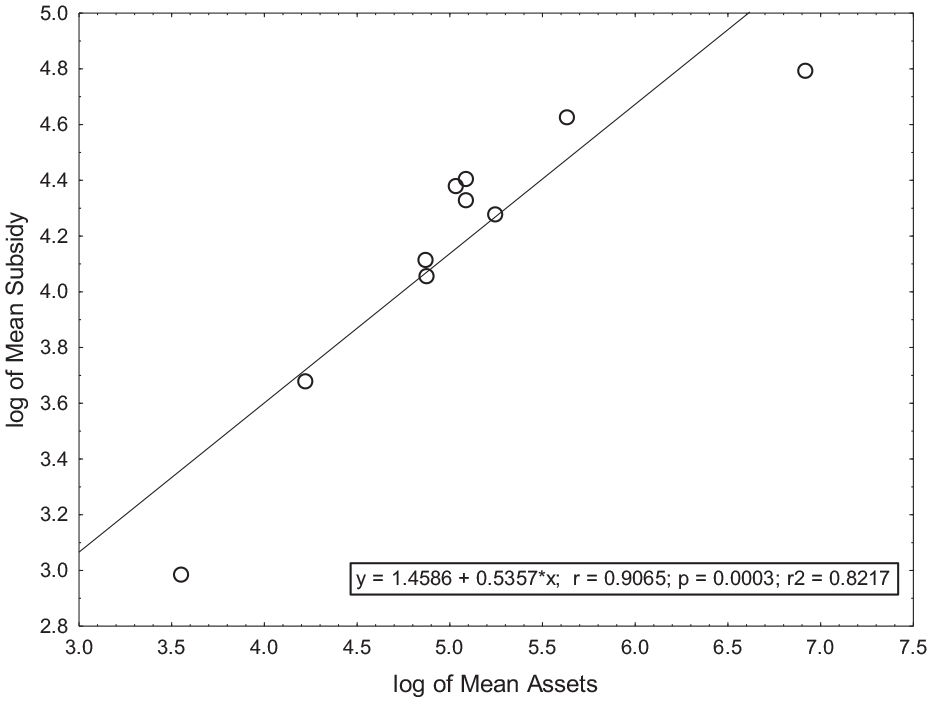
The relationship between the size of enterprises measured by their average annual assets throughout the last 10 years of data (2012–2021) and the average annual size of subsidies over the same period.
The connection between the size of the enterprise and the size of the subsidies may be a consequence of area payments, that is, SAPS-type payments (today BISS and CRISS): the larger the farmed land, the larger the basic agricultural subsidy. But it is not only a question of the total amount of subsidies as with farm size the amount of subsidies received per hectare has also increased (Valach, 2020). In previous research unequal access to subsidies was found, with larger-scale farmers having better access to subsidies (Dinis, 2023), unbalanced distribution is typical especially for eastern EU member states (Sadłowski et al., 2022), which results in technical barriers for smaller or less modernized farms (Ciaian & Kancs, 2012). Non-linearity is then related to other types of subsidies. In the future, the decrease in subsidies with the size of the enterprise should be even more significant due to the change in subsidy schemes—CRISS only up to 150 ha. However analyses of impact of CRISS payments show that they are not exclusively aimed at the smallest farms (Chartier et al., 2023), so this deeply structural issue persist (Gatzweiler & Braun, 2016).
This result, however, does not provide much insight into the fundamental significance of subsidies for the particular enterprise. But this can be the mutual ratio of subsidies and sales of the company, because both are the main income that the agricultural company has. The smaller this number is, the smaller the importance of subsidies for the given enterprise (the dependence is again logarithmic). In our sample, the value of this proportion varied in a wide range of three orders of magnitude, from 0.06 to 2.40. This share is significantly related to the size of the company (Figure 2). The significance of subsidies is negligible for large enterprises, while it is enormous for small enterprises. The average annual volume of subsidies received by our sample of two small businesses over the past 10 years has exceeded sales revenue and, consequently, revenue from the company’s own agricultural business activity (in one instance, the subsidies have amounted to nearly 2.5 times the revenue the business received from selling its products).

The relationship between the size of enterprises measured by their average annual assets throughout the last 10 years of data (2012–2021) and the average value of the share of enterprise size and the size of subsidies.
Therefore, we found that, generally speaking, a company’s need for subsidies declines as it grows in size. Large enterprises receive the largest volumes of subsidies, but these subsidies play a very small role in their economic activities. Small businesses receive smaller amounts of subsidies, but they are significantly more important for their economic activities. The smallest businesses are the most affected; in their economies, subsidies are crucial and have a greater impact than actual agricultural production. This distribution of subsidies is evident from several studies. For example, Kirwan and Roberts’ (2016) research shows that small farms receive relatively higher subsidies, measured as a share of total assets. The crucial dependence on subsidies of small farms was also recently detected by Redlichová et al. (2023). These findings are therefore in direct contradiction to the ideas of small farmers about the distribution of subsidies and their importance for individual enterprises.
It is also interesting to look at the development of the ratio of subsidies to total assets over the entire monitored period. The significance of subsidies for the economy of medium-sized businesses gradually increases, whilst for large businesses, they stay constant (all medium-sized businesses’ sales are roughly stable, but the amount of their subsidies is increasing). They are of fundamentally (and, as past analyses have shown, substantial) relevance for small enterprises, for which the amount of subsidies in a particular year is over four times the sales in that same business for the monitored period (Figure 3). Results of our analyses confirm previously reported high dependence of farms in post-socialistic EU states on subsidies (Lososová et al., 2023). Thus importance of subsidies cannot be labeled as independent from the size of the company (hypothesis H4).

Development of the importance of subsidies for individual enterprises in the years 2012–2021, coding of farms correspond to Table 4.
Conclusion and Implications
Our first two hypotheses were dealing with the issue of perception of the importance of subsidies for farmers business. The most important founding based on qualitative data be can summarized as follows. According to the survey (H1), 66% of respondents have a positive opinion on the support of agriculture in the form of subsidies. Competitiveness in the market for agricultural products is cited as a key aspect. Subsidies help minimise losses and increase farmers’ incomes, thereby improving their decision-making skills and reducing income variability. We have indicated (H2) that the size of the enterprise has a pivotal role in determining the genuine and perceived importance of subsidies. Although both large and small enterprises oppose reductions in subsidies, their reasons are very different.
Financial support contributes to the protection of the agricultural sector against adverse market effects and natural disasters. 72% of farmers consider subsidies to be an important factor in protecting their businesses. It is evident that farmers primarily focus on the economic impacts. Economic dependence on subsidies is criticized and alternative support systems which would be more targeted and effective are proposed. However, sceptical views of subsidies exist as well, emphasizing administrative difficulties, uneven distribution among EU member states, and distortion of market mechanisms.
Survey participants indicate that 45% support increasing agricultural subsidies, and suggestions for cutting them are unfavorable due to financial concerns. Large farmers prefer the extension of subsidy support for the use of modern technologies that contribute to more sustainable agriculture and increase the competitiveness of the sector. Small farmers express the need to equalize support between them and large enterprises, which have easier access to subsidies. The unequal allocation of subsidies, which favors larger farms disproportionately more than smaller ones, is currently being criticized. Capping subsidies for large farms is controversial, with small farms supporting the move as an effort to level the playing field, while large farms argue that agriculture should not be split into two groups. The debate about large farms also includes ethical and political questions about their dominance and power in the agricultural sector.
Some respondents do concur, on the one hand, that subsidies ought to be entirely eliminated across the European Union. This group of interviewees highlights the potential negative effects of removing subsidies on both farmers and consumers, including reduced production and income for farmers and increased global foodstuffs prices. On the other hand, a constructive approach is also presented. Abolition of subsidies, but under the condition that the measure would apply equally to all farmers. This would mean that subsidies would not be given to any farmer, regardless of their size or type of business. This approach emphasizes the effort to create equal conditions for all farmers and minimize inequalities in subsidy distribution.
Farmers perceive subsidies primarily as a financial resource, not as a tool for the development of their businesses. At the same time, it follows that many farmers do not consider subsidies as a means of rural development but rather as necessary support to maintain the current state of the agricultural enterprise or to comply with the prescribed conditions.
Small firms depend heavily on subsidies to stay in operation; this has been recognized for the past 15 years and is unaffected by the modifications made during the last two CAP planning periods. The question is whether or not such a scenario makes sense from both an economic and developmental standpoint. Out of the ten agricultural farms in our sample, four enterprises had at least 1 year when the share of sales and subsidies was greater than 0.5 over the previous 10 years.
Based on the results of the hypothesis test H3 and H4, we can propose the following: the introduction of progressive limits on subsidies, support for smaller enterprises with a higher dependence on subsidies and the distribution of subsidies according to the type of production and efficiency.
Application Implication
Assessing the importance of subsidies is an approach that broadens our present understanding of farmers’ decision-making processes regarding the support of agricultural businesses, following the conditions of CEE countries. This approach is based on the recognition that farmers’ decisions are not only driven by economic factors but are also strongly influenced by institutional, socio-cultural, and environmental aspects. Recognizing these factors and their interrelationships is key to successfully designing policies and support programs that will effectively motivate farmers to participate in environmental protection and agro-biodiversity conservation. This allows for a better understanding of the variety of farmer choices and motives and the adaptation of policy tools to better serve their requirements and promote environmentally positive conduct within the agricultural sector.
Theoretical Implication
Given the dominance of large corporations in the Czech agricultural sector and the lack of medium-sized and family farms that could address the environmental and social issues of rural communities, one may wonder if there is a developmental sense to preserving the economy of the countryside and the rural way of life. It is clear that Czech agriculture heavily relies on financial aid, which is often allocated to large farms and encourages investment in long-term assets such as land rather than the modernization of medium-sized and smaller farms. At the same time, however, policy measures such as subsidies for young farmers and investments in ICT infrastructure and new technologies seem to be aimed at supporting new forms of entrepreneurship along with innovation in the countryside. Still, it is important to consider how these policies affect the social and environmental aspects of rural areas. Subsidies and investment support should be designed to not only promote economic competitiveness but also the sustainable development and social prosperity of rural communities. Emphasis should be placed on promoting the diversity of agricultural holdings and forms in the countryside in order to preserve the economic and ecological diversity of the rural environment. The question remains whether the current model of agricultural business support truly contributes to the maintenance and development of rural areas in accordance with economic, social, and environmental needs and values.
Managerial Implications
Direct payments and redistributive payments are frequently advantageous for small farms as they enable them to stay competitive and endure in the market. Large farms, on the other hand, run the danger of receiving less from these payments and even suffering from redistributive policies that seek to provide smaller farms with more support. To effectively support and maintain the competitiveness of different types of farms, it is important to adapt policies and measures to meet the specific needs and situations of both small and large farms separately because small and large agricultural enterprises have different interests in obtaining subsidies. This way, a more balanced and fair distribution of subsidies and support within the agricultural sector can be achieved, contributing to sustainable development and growth in agriculture.
Policy Implications
The article points to a fundamental imbalance in how subsidies are distributed among businesses of different sizes. Larger enterprises tend to receive disproportionately more financial support, which may not correspond to the real needs of the sector, especially when it comes to small and medium-sized enterprises. To address this issue, policies should seek to improve the redistribution of subsidies so that smaller businesses that rely on these funds for survival receive sufficient support. One approach could be to introduce progressive subsidy limits to prevent the monopolization of financial assistance by larger businesses.
Direct payments and redistributive policies have proven crucial for small farms to remain competitive and survive in a challenging market environment. However, current subsidy programs often favor larger businesses. Measures that specifically address the needs of small farms—such as subsidies for technology upgrades or capacity development for young farmers—need to be put in place to ensure the sustainability of family farms. Small farmers have also expressed concerns regarding the complex administrative processes required to access subsidies, which puts them at a disadvantage compared to larger enterprises with more resources. Simplification of the application processes and better access to advisory services are crucial steps for ensuring that smaller farms can equally benefit from these financial resources.
While subsidies have traditionally focused on increasing productivity and financial stability, there is growing recognition that these programs must be aligned with broader environmental and sustainability goals. For large agricultural enterprises, subsidies need to be better connected to environmental and social responsibilities. Currently, there is limited incentive for large farms to adopt sustainable practices or contribute to rural social development. Specific eco-schemes and incentives aimed at large enterprises should be strengthened, ensuring that the financial assistance they receive is tied to measurable environmental and social outcomes, such as reduced carbon footprints, biodiversity conservation, and rural community engagement. Future agricultural policies should combine subsidies with environmentally positive actions, such as promoting sustainable agricultural techniques, protecting biodiversity and increasing resilience to climate change.
One of the persistent complaints of farmers is the complexity of the administrative processes involved in accessing subsidies. This administrative burden particularly affects small farms, which often lack the resources to navigate complex procedures. Simplifying these processes would make it easier for these farmers to receive the financial support they desperately need, ensuring a more equitable system. Simplifying these procedures could help ensure that more farmers, especially those with limited administrative resources, can benefit from financial support.
Excessive dependence on subsidies has impacts not only on the profitability of farms, but also on the economic and social structure of rural communities. Politicians should consider how subsidies contribute to the long-term development of these areas, not only from an economic point of view, but also from the point of view of improving the quality of life of the inhabitants. Particularly for large enterprises, the role of subsidies should be evaluated in terms of their contribution to the social structure of rural communities, such as supporting local employment or fostering social cohesion. The redistribution of subsidies should thus not only aim at economic efficiency but also at promoting social and environmental well-being in rural areas.
Footnotes
Acknowledgements
We thank Mgr. Stanislav Martinát, Ph.D. Dr. and doc. RNDr. Josef Navrátil, Ph.D. for your help with data collection and valuable comments for manuscript. We also appreciate the work of doc. Ing. Kamil Pícha, Ph.D., MBA. in helping with the preparation of the final text of the manuscript.
Declaration of Conflicting Interests
The author(s) declared no potential conflicts of interest with respect to the research, authorship, and/or publication of this article.
Funding
The author(s) disclosed receipt of the following financial support for the research, authorship, and/or publication of this article: Grant 066/2023/S funded by the Grantová Agentura Jihočeská univerzita v Českých Budějovicích.
Ethic Statement
This is not applicable.

Data Availability Statement
Data sharing not applicable to this article as no datasets were generated or analyzed during the current study.