



Abstract
Farmers’ adaptation behavior is vital in adapting to climate change (CC) effects and is affected by many factors. However, the influence of psychological factors on the farmers’ behavior has been less investigated. This research demonstrates the effect of these factors on the “adaptation behavior” of ethnic minority farmers in Backan province, Vietnam. We selected randomly 362 farmers for interviews. Focus group discussions and key informant interviews were also applied for data collection. Psychological analysis based on “structural equation modeling” was employed to evaluate the relationships between the psychological factors that affected adaptation behavior. We found that psychological factors incentive, behavior barrier, perception of causes of climate change were significantly associated with adaptation behavior among farmers while risk perception, belief, trust, and constraints do not show a significant correlation. The influencing psychological factors can generate accurate policy options for the policymakers in terms of adaptation to CC in the future, providing structural support to farmers when designing and formulating policies that could encourage “adaptation behaviors” among farmers.
Keywords
Introduction
Climate change (CC) threatens the agricultural sectors all over the world rendering it the most vulnerable to changing weather and climatic conditions. Thus, the agricultural sector will face with many serious challenges due to the adverse impacts of CC such as a decrease in crop yields, soil erosion, drought, and increase poverty (Azadi et al., 2019; Feng et al., 2017; Huong et al., 2018). Moreover, extreme weather events induced by CC (e.g., floods, storms, and droughts) negatively affected agricultural activities and directly influence farmers’ livelihoods in rural areas, particularly changes in rainfall patterns and temperatures have directly affected crop yields and productivity (Feng et al., 2017; Thoai et al., 2018). Salt intrusion is likely to damage more than 2.4 million hectares of farmland in South Vietnam, and in 2030, reducing rice, maize, and soybeans yield by 8.37%; 18.71%, and 3.51%, respectively (Dung & Sharma, 2016; Thoai et al., 2018). Crop yields could predict to fall in African by 10 % to 20% or up to 50% by 2050 due to CC (Tesfahunegn et al., 2016).
Not only did CC affect farmers in plain regions but it influenced farmers in mountainous areas. In developing countries ethnic minority farmers have endured more adverse impacts of CC than any other communities due to their heavy depending on agriculture and natural resources (Azadi et al., 2019). Therefore, adaptation strategies to CC are necessary for indigenous farming. Previous studies indicated that enhancing these adaptation strategies at the farm level is an effective way tackle the adverse impacts of CC such as maintaining yields and limiting vulnerability (Azadi et al., 2019; Nguyen et al., 2016). However, farmers must first identify effective adaptation strategies (Abid et al., 2015; Huong et al., 2017), and understanding how well farmers perceive CC and their willingness to adopt the strategies are significant for an effective adaptation process, and farmers who recognized the changes related to the climate are more likely to utilize adaptation strategies to address the negative effects of CC (Li et al., 2017). The farmers’ attitudes toward CC especially in addressing these issues, and the reasons farmers are not acting to cope with the impacts of CC also play an important role. Farmers who are not convinced about the manifestations of CC on their farms and livelihoods may be reluctant to adapt to CC (Arbuckle et al., 2013). Adaptation to CC is defined as adjustments in farming activities to suit the new climate scenarios so that the potential damages can be minimized (Zamasiya et al., 2017). Adaptation practice to climate change such as adjustments in sowing time, change in fertilizer types and use, and irrigation systems could significantly reduce farmers’ vulnerabilities to climatic conditions and can generate benefits for farmers while minimizing the adverse CC impacts (Ali & Erenstein, 2017; Li et al., 2017).
Number of studies investigated CC adaptation and its determinants, with most focusing on socioeconomic and institutional factors that affect farmers’ adaptation practices such as age, households’ size, land ownership, credit, climate information, and policies (Arouri et al., 2015; Deressa et al., 2009; Huong et al., 2017; Thoai et al., 2018). However, the influence of psychological factors on the farmers’ adaptation behavior is less studied (Azadi et al., 2019; Dang et al., 2014), specifically for ethnic minority farmers (EMFs) in Vietnam. Hence, investigation of psychological factors, the understanding of the EMFs’ attitudes toward CC, CC perception, CC belief, CC risks, behavioral barriers, and adaptation behavior are the privation and could play an important role to build climate change policy. Additionally, understanding psychological factors could predict better self-protective action than socioeconomic factors (Grothmann & Patt, 2005). The underlying psychological causes such as risk perception, beliefs, and attitudes toward CC have been increasingly acknowledged as influencing farmers’ response to adaptation processes (Azadi et al., 2019; Grothmann & Patt, 2005). Interestingly, Martinovska Stojcheska et al. (2016) argued that “while cognitive drivers matter, socioeconomic factors have no impact on farmers’ intentions.” Previous research investigated the psychological factors affecting farmers’ adaptation to climate change. Grothmann and Patt, (2005) analyzed psychological factors using a “socio-cognitive model” to understand the farmers’ behavior in Germany and Zimbabwe meanwhile Feng et al. (2017) investigated the psychological causes of farmers’ adaptation behavioral intention in China. Zeweld et al. (2017) reported that socio-psychological factors play a significant role in promoting sustainable practices to tackle the CC impacts meanwhile socioeconomic drivers and resource are necessary but not sufficient. Budhathoki et al. (2020) argued that psychological processes and cognitive factors play a significant part in designing the adaptation framework to develop sustainable adaptation strategies, and it could facilitate effective responses to CC by predicting the adoption of self-protective action. Furthermore, understanding the psychological process of the farmers in response to CC is also more significant and accurate when psychological factors are integrated with socio-economic factors (Azadi et al., 2019; Grothmann & Patt, 2005; Truelove et al., 2015). Therefore, the adaptation theory should be extended to include socio-psychological factors (Swim et al., 2011). “Adaptation behavior” is the cognitive process of individuals that shows people's values and beliefs, attitudes & perceptions, motivations, goals, and culture (Azadi et al., 2019; Grothmann & Patt, 2005). Therefore, the importance of understanding the psycho-social factors of individuals’ adaptation behavior to CC plays an important role in the adaptation process (Truelove et al., 2015).
This research investigates EMFs’ psychological factors influencing individuals’ behavior to adapt to CC in mountainous region of Vietnam, where was recognized as one of the top five countries that are negatively influenced by CC, and has become more vulnerable because of a combination of climatic, geographic, and socioeconomic features especially in agriculture that is the main income source of EMFs ( CARE, 2013; Smyl & Cooke, 2017). We adopted the framework from Azadi et al. (2019) and Arbuckle et al. (2015), which conducted in terms of the psychological factor affected farmers’ adaptation to CC in Iran and Iowa state, the USA, respectively. Both have used four main constructs: trust, CC belief, risk perception, and adaptation. However, the study of Azadi et al. (2019) has utilized two more core constructs in their research including risk silence and psychological distance. They found that the power of prediction of farmers’“adaptive behaviors” has increased. It refers that based on the purpose of study, researchers could add more core variables to build the framework to create more value for the research. Given that idea, we design our framework below. A person is motivated to protect themselves when she or he faces any risks and threats (Ghanian et al., 2020; Grothmann & Patt, 2005). In the CC context, farmers take responses to adapt to CC could be motivated by risk perceptions and vulnerability including exposure, sensitivity, and adaptive capacity (Adzawla et al., 2020). Vulnerability perception was positively associated with the adoption of adaptation practices or vulnerability to CC positively motivated adaptive response to CC (Xu et al., 2020). Farmers who have a better understanding of their vulnerability to climate change and climatic risks are more likely to use adaptation techniques to deal with its effects (Hasan & Kumar, 2019). Also, Arbuckle et al., (2013) found that “if farmers do not perceive climate risks, vulnerability to CC, and concern to be a threat to their farms, they will not likely act to adapt”. Adger et al. (2007) reported that “farmers’ concern about the impacts of CC is a key to successful adaptation, and perceived vulnerability is critical arbitrators of action or inaction among farmers to adapt to CC.” Importantly, actions to adapt were influenced by climate risks, perception of vulnerability to CC, perceived adaptive abilities and observable capacities to adapt, and perceptions of risk, of vulnerability, motivation, and capacity to adapt will also affect behavioral adaptation to CC (Adger et al., 2007; Grothman & Patt, 2005; Moser, 2008).
Moreover, farmers faced climate risks, will take adaptation strategies to protect their farms (Ghanian et al., 2020). Higher risk perception is likely to motivate individual behavior to prevent climate risks, and farmers are less likely to encourage their behavior to protect from risks if they do not perceive climate risks. Furthermore, “adaptation responses to CC can be limited by human cognition,” and key motivator of “adaptation behavior” is that farmers “perceived CC risks” (Azadi et al. 2019; Grothmann & Patt, 2005; Moser, 2008). Therefore, our research framework started with “CC beliefs and risk perceptions”; both variables have emerged and affected farmers’ adaptation behavior. Likewise, Arbuckle et al. (2013) reported that risk perception and belief in CC were the key variables for adaptive behavior. Furthermore, beliefs and risk perceptions worked as a foundation for attitudes to the adaptation of individual’ behaviors (Arbuckle et al., 2015). Beliefs and risk perception have more effects on “farmers' behaviors than actual climate patterns” (Adger et al., 2009). Beliefs in CC are an important predictor of adaptation behavior and farmers' belief also plays a vital role in the adaptation process. Importantly, belief does not depend on risk perception, but risk perceptions come from belief (Nguyen et al., 2016). Dang et al. (2014) indicated that farmers who perceived risks from CC believed that climate change was occurring. Farmers who believed in CC tended to use adaptation strategy methods to deal with the repercussions of CC (Arbuckle et al., 2013; Li et al., 2017). Besides the main variables risk perception of and belief in CC, other important variables including behavioral barriers, trust, constraints, incentives, and perception of causes of CC were also conducted. The rest of this paper is organized as follows: section “Material And Methods” discussed the material and methods; section “Results and Discussions” debated on results and discussion. Finally, section “Conclusions and Implications” is conclusion, and references.
Material and Methods
Research Location, Sampling, and Data Collection
We purposively selected Backan, located between 21°48′ and 22°44′ N, and 105°26′ and 106°15′, as a study location because it is the most exposed to climate hazards like cold spells, landslides, heatwaves, flash floods and Backan is one of the poorest provinces in the northern mountain area of Vietnam, with a big diverse ethnic minority population, high illiteracy, low rate of female education, inadequate access, rainfed agriculture, and an economy that mainly relies on agriculture (Huong et al., 2019; Smyl & Cooke, 2012). Backan province is a suitable place for investigation of EMFs’ adaptation to CC due to ethnic minority people dominated population living together including Tays (45%), Hmong (20%), and Daos (21%) (Backan Statistics Office, 2017).
Three main ethnic minority farmers, namely Tay, Hmong, and Dao ethnic farmers are considered as the target of this research because they faced many constraints compared to plain farmers. Ethnic farmers in Vietnam have always been the most sensitive to the harmful repercussions of CC due to located in remote regions, poor road system, no education, lack of basic need, language barrier to understand the policies, limited income sources, and high poverty rate. Especially, limited research on ethnic minority farmers’ climate change knowledge, cognitive factors impact farmers adaptation to CC. Hence, exploring the significance of EMFs’ psychological factors influencing individuals’ behavior to adapt to CC and solves the geographical knowledge gap in the expansion of core elements in socio-psychological framework to behavior change by using the structural equation modeling to generate more power of research, particularly at a local level.
This research used a multistage sampling technique. First, three districts (Chomoi, Pacnam, and Nganson) were randomly chosen from eight districts (see Figure 1) in Backan as the study area, with different regions such as low, mid, and high altitude, and regional topography that is generally mountainous; small plain areas thinly located between valleys and along large rivers; and highly vulnerable and influenced by CC and natural disasters (CARE, 2013). Second, three communes—Mailap in Chomoi, Langngam in Nganson, and Ngienloan in Pacnam—were purposefully chosen. Finally, we employed a simple random sample strategy to obtain primary data at the home level. From a total of 1,031 families across three communes. We interviewed 376 household heads (farmers) using the formula (1) from Saqib et al. (2016) and Yemane (1968). We obtained complete information from 362 respondents to evaluate with a 95% confidence level and ±7% margin of error.

n = sample size
N = Total population of the research area
e = Level of precision, set at ±7% at 95 % of confidence.


Map of survey areas: Mai lap commune in Chợ Mớ, Lang ngam commune in Ngân Son district, and Nghien loan commune in Pắc Nạm district, Bắc Kạn province of Vietnam.
We developed the questionnaire using open and closed questions to gather data by applying survey techniques. The questionnaire was developed by authors through literature reviewing items that closely followed the measurement of constructs used as a framework in past CC studies were used. A 5-point Likert scale for all variables was also used for observation variables to measure psychosocial variables: beliefs in CC, risk perception, perception of causes of CC, trust, constraint, barriers, incentive, and adaptation behavior. The questionnaires were pretested to make sure that the responses were complete and avoid errors. Tables 1 and 2 show the constructs of survey items in the questionnaire.
Observed Items and Construct Variables.
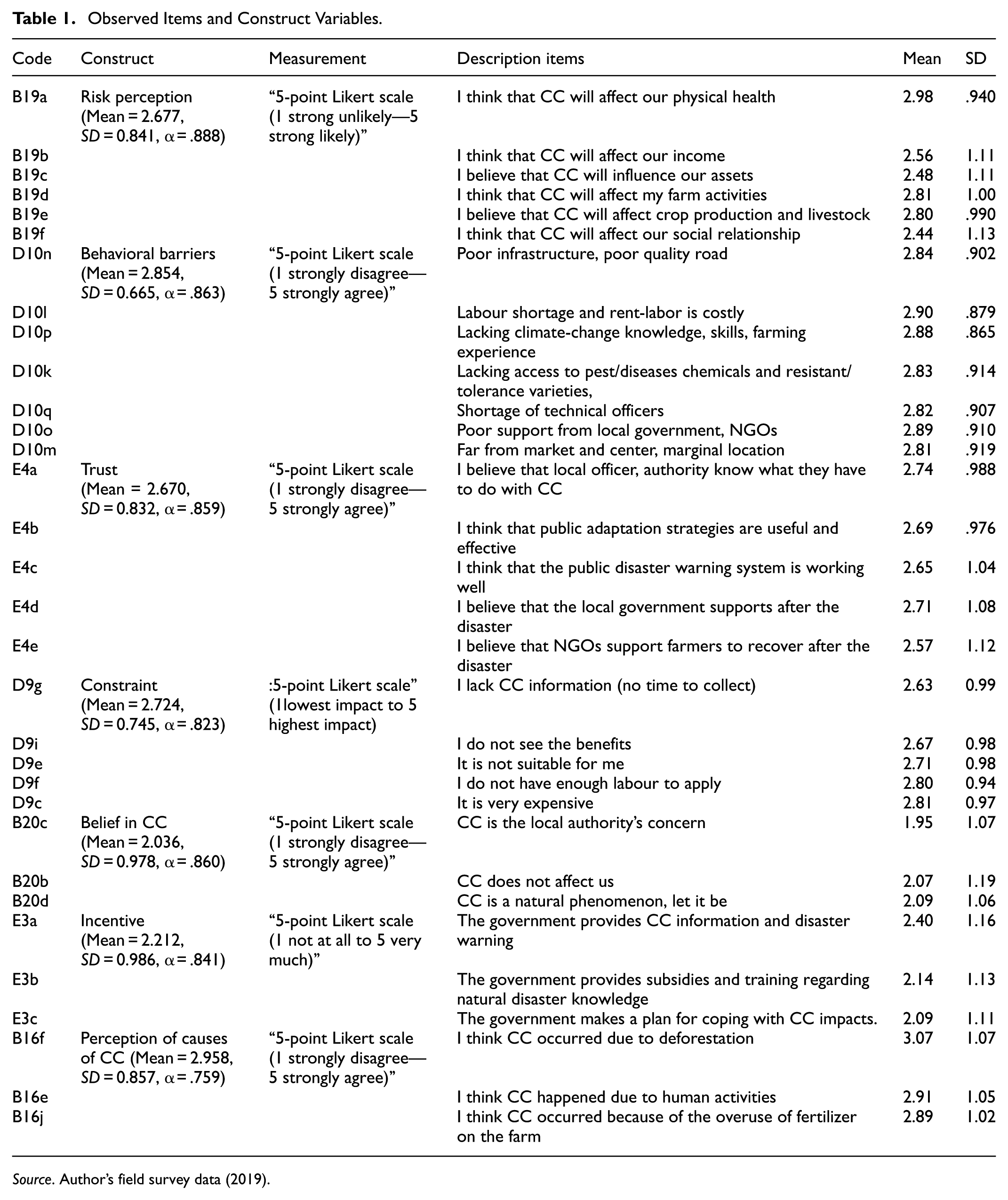
Source. Author's field survey data (2019).
Adaptation Behavior.

Source. Author's field survey data (2019).
Path Model Analysis and Structural Equation Modeling
In this study, we applied path analysis and SEM to analyze the interaction between the psychological factors and the adaptation behavior of the farmers. “Causal knowledge” based on path analysis can improve decision-making quality and hence speed up the process of translating strategic goals into effective actions. Previous research stressed the value of the path and causation analysis method for behavioral change (Keshavarz & Moqadas, 2021; Li et al., 2017; Neisi et al., 2020; Wu, 2010). Moreover, the results of path analysis could explain a significant share of variance changes (Keshavarz & Moqadas, 2021; Neisi et al., 2020). According to Li et al. (2017), path analysis can investigate causation; a relationship that is more than correlational and is sometimes referred to be structural. Furthermore, path-analysis is a subset of multivariate analysis that demonstrates the roles of numerous factors' interrelationships in determining a specific outcome. The proposed causal connections are represented in a path model, shown with a path diagram, and examined for the standardized partial regression coefficients. Therefore, path analysis is used appropriately to explore the causal of psychological factors and behavior adaptation by using SEM to examine the causal relationship between eight constructs including beliefs in CC, risk perception, perception of causes of CC, trust, constraint, barriers, incentive, and adaptation behavior of EMFs.
SEM is an innovative analytical statistical model that is employed to explain the relationships among observed-variables and latent variables in the theoretical model. Also, SEM was used in several studies to test theoretical models when investigating variables and constructs to each other (Dang et al., 2014; Hair et al., 2010). In this model, researchers can also examine both “direct and indirect effects among variables” and estimate the relationships between multiple and interrelated dependent variables. This contrasts with traditional model regression which can only test direct effects (Arbuckle et al., 2015; Budhathoki et al., 2020). Moreover, SEM can analyze several types of theoretical models and SEM accommodates two main types of variables including observed and latent variables. Latent variables are variables that are indirectly measured and inferred from observed variables gained from the survey. Furthermore, SEM models combine path models and confirmatory factor models. In other words, SEM models integrate both latent and observed variables (Schumacker, & Lomax, 2012).
Testing for Multicollinearity, Heteroskedasticity, and Goodness of Fit
Multicollinearity and heteroskedasticity are usually issues in economic regression. Therefore, we pretested before performing structural equation modeling to avoid problems. The multicollinearity is not an issue for the model with a mean of VIF was 1.264, no index was higher than 3, and the “Breusch-Pagan/Cook-Weisberg test for heteroskedasticity” was ch2(1) = 0.17, and Prob > chi2 = 0.6773 (>0.05), indicating that heteroskedasticity is not an issue for the model (Azadi et al., 2019).
The model’s internal consistency and indication dependability were examined. The Cronbach’s α value was at least 0.76 and KMO = 0.85, indicating a high consistency (Hair et al., 2010). Bartlestts’-test shows that df = 630, χ2 = 6,466, p value = .000, Eigenvalues = 1.291, and that the model can explain 65.4% of the variables, indicating that there is a good value of variables for the model. Furthermore, all “Standardized Factor Loadings” are significant, and all Factor Loadings have a value greater than 0.5 levels (see Table 3), which demonstrates that the observed indicators were strongly correlated with the associated constructs (Hair et al., 2010). Moreover, all the “CR values” for the constructs were higher than 0.79, which means that these results have good reliability (Dang et al., 2014). Another crucial indicator of convergent validity is the “average variance extracted”. An AVE presents a value of 0.5 or higher, suggesting that it is adequate convergence (Dang et al., 2014), and the AVE values for all constructs were good (see Table 3).
“Construct Reliability (CR), Factor Loadings, Average Variance Extracted (AVE), and Alpha, in Confirmation Factor Analysis.”

The value does not calculate because loadings were set to 1.0 to control construct variance.
Significant at 1%.
Identifying the model fit, the evaluation of the validity model was checked. Then, the second stage was to test the “structural model.” The CFA was performed in the first stage to assess the validity of the model measurement. Also, Goodness-of-fit (GOF) and “construct validity,” two conditions required for the validity of the measurement model, were assessed (Hair et al., 2010). GOF indicates for the measurement model are χ2 = 148.916, df = 581, p = .000, CFI p = 0.853, RMSEA = 0.065 (90% confidence for RMSEA p = 0.05-0.08), TLI = 0.841, GFI p = 0.846, AGFI = 0.819, and normed χ2 = 2.529<3 (Table 4). Hence, the good of fit indices indicated that the model was well accepted (Hair et al., 2010).
“Confirmatory Factor Analysis Result Model Fit.”

Source. Hair et al. (2010) and Schumacker and Lomax (2012).
Results and Discussions
Socio-economic characteristics of the farmers
A total of 362 household heads were interviewed for data collection, including 31.5% from Mailap commune, 42.5% from Langngam commune, and 26% from Nghienloan commune. Out of 362 responders, 87.6% were men and 12.4% were women. The average age was 45.9 years, and the average number of household members was 4.12. In terms of farming experience, 58.6% of respondents had more than 15 years, 29% had 5 to 10 years, and 12.5% had 3 to 5 years. For education, nearly half (44.2%) of respondents completed secondary school, 29.8% completed elementary school, 13.3% completed high school, 4.7% graduated from college, and a small percentage (8%) never attended school. In terms of poverty, the findings suggest that approximately 38.4% of households were poor, 20.7% were near-poor, 32% had average economic conditions, and 8.8% had good economic circumstances.
Farmers Adopted Adaptation Strategies to Cope with CC
In Backan, CC affected and was the main challenge to the agriculture of EMFs, and farmers recognized the harmful impacts of CC on their farms. Therefore, EMFs have undertaken numerous adaptation practices to decrease the adverse impacts of CC. Four mains CC adaptation strategies were adopted by ethnic-minority-farmers including improved crop strategy (79.8%), about 76 % of the farmers rescheduled the planting time as another strategy to adapt to CC. Farmers indicated that modifying the type and timing of fertilizer application enhanced crop yield when faced with harsh weather conditions thus 71% of the farmers adopted this adaptation strategy, and other farmers (70.4 %) changed the time of pesticide and herbicide application as this enabled the farmers to reduce the negative impacts of CC (see Figure 2).

EMFs adopted adaptation strategies.
The Interpretation of Path Models
Table 5 and Figure 3 present the results of the path-coefficients of the model. Constraints have a direct and indirect effect on adaptation behavior and were positively significantly associated with risk perception (β = .245, p = .0001), and beliefs in CC (β = .141, p = .03).
SEM Results-Standardized Parameter Estimates for Model.

Legend. Belief in CC: Y1; Risk perception: Y2; Adaptation behavior: Y3
Constraints: X1; Behavior barriers: X2; Trust: X3; Perception of causes of CC: X4; Incentive: X5; Structural equation fit (R2)
Source. Authors' calculations.
, **, ***, denotes significant at 10%, 5%, and 1%.

The SEM model results.
However, constraints were insignificantly associated with adaptation behavior (β = .075, p = .251). Similarly, trust affects both adaptation behavior and risk perception. Risk perception was found to be positively influenced by trust at 10% level (β = 0.101, p = .073) but had no significant impact on adaptation behavior (β = .008, p = .894).
Regarding the perception of the causes of CC, the result indicates that it was positively significantly related to adaptation behavior (β = .352, p < .001 and the same relationship was established between intensive and adaptation behavior at 5% level (β = .122, p = .046). Alternatively, behavioral barriers were significantly correlated with risk perception, belief in CC, and adaptation behavior (β = .265, p = .001; β = .139, p = .031; β = .22, p = .002, respectively). Surprisingly, the relationship between risk perception and adaptation behavior was not significant (β = 0.10, p = .137). Furthermore, belief in CC was positively significantly associated with risk perception (β = .231, p = .000) but there was no substantial correlation with “adaptation behavior” (β = .006, and p = 0.92).
Discussion
Findings showed that the estimated model for farmers' climate adaptation behavior has a good match and can predict the “adaptation behavior” of EMFs. It determined that psychological factors have directly and indirectly affected the climate adaptation behavior of EMFs. These findings support previous research by Azadi et al. (2019), Dang et al. (2014), Ghanian et al. (2020). This research confirmed that expanding the core constructs in the research framework is necessary to achieve more predictive power in the model and help local decision-making process in relation to adaptation at the agricultural level in the context of CC (Ghanian et al., 2020).
The results of the SEM indicate that constraint was positively and significantly related to belief in CC and risk perception, indicating that although the respondents faced some constraints (e.g., lack of climate information, do not see benefit of CC adaptation strategies), belief and risk perception of CC of EMFs increased. This is because farmers have recognized the fact that CC is happening, and they perceived the climate risks. Indeed, this result also suggests that the belief in CC and risk perception has existed among the farmers as an endogenous factor based on their knowledge experience and observations of the weather and climate for a long time. The findings provide empirical information for policymakers and local governments to identify how constraining factors affect the farmers’ thoughts and formed CC risks even for both rich and poor farmers. Our results align with the previous findings of Klein et al. (2015). However, the constraint was positively insignificant in related to “adaptation behavior,” indicating that adaptation behavior was not affected even for farmers who were not constrained to adopt the strategies or adaptation behavior is influenced not only by the farmers’ constraints but also by other factors, and understanding of these constraints is significant for policymakers as this assists them in providing adequate support to farmers (Adger et al. 2007; Klein et al. 2015).
Trust is a predictor of adaptation behavior; thus, our result shows that it has a positive impact of risk perception. This suggests that farmers, who believed in public adaptation or the local government’s knowledge in dealing with CC impacts, were more likely to perceive risks and believed that CC is occurring. This is because farmers, particularly EMFs who lived in remote areas, often lack climate knowledge and scientific information, so they often trusted information delivered by the local government. The result was also found in the study of Azadi et al. (2019) who verified the correlation between “trust” and “risk perception”. However, this study did not investigate the relationship between “trust” and “belief in CC.” It could be further investigated in future studies. Moreover, we found that the adaptation behavior of EMFs was not affected by trust. This is probably due to their perception of the negative impacts of CC instead of their beliefs in the policies and programs of the government or it could be the lack of useful information and climate-knowledge on the part of the farmers and inadequate policies. This finding provides crucial information to policymakers to better comprehend how farmers applied autonomous adaptation strategies. Although several households trusted the government, they were unable to practice any adaptation strategies because of several barriers such as lack of money and labor. Our result is similar to the findings of Boon (2016), but a different result of Arbuckle et al. (2015).
Regarding farmers’“perception of the causes of CC,” it was positively and significantly associated with adaptation behavior. Most EMFs realized the causes of CC and argued that deforestation has been happening for a long time now which has led to weather changes. Given that farmers perceived climate risks and formed risk perception, attitudes as well as an understanding of the causes of CC. Accordingly, they can apply an adaptation strategy from the simple method to complicate the ways to cope with CC impacts. Our result is consistent with the findings of earlier studies of Arbuckle et al. (2015), Niles et al. (2016), and Tesfahunegn et al. (2016).
Moreover, the variable incentive was found to be positively and statistically significant with adaptation behavior at a 5% level. This can be attributed to the constraints experienced by EMFs in the remote areas who are the poorest and lack the basic needs necessary to have a decent life. To address these issues, the government of Vietnam started many programs (e.g., P-135, new rural programs, reforestation programs, and sustainable poverty reduction programs) to assist ethnic minority groups overcome the difficulties and cope with CC impacts by providing both technical and finance subsidies for farmers such as new resistant crop varieties, financial support, and technical training. Hence, EMFs perceived the application of climate change adaptation strategies as important to mitigate the CC impacts. However, our result did not match the previous results of Dang et al. (2014) and Ghanian et al. (2020) who reported that incentives did not have a significant relationship with adaptation. Conversely, barriers were significantly correlated with adaptation behavior, risk perception, and belief in CC. This suggests farmers who faced barriers were more likely to perceive climate risks and believed that CC was happening. This perception of climate risks could have probably stemmed from their observations and experience. Thus, barriers, the situations/conditions or factors that could affect farmers reduce adaptation as a response to CC difficult, only strengthened their perception of risk. This analysis supported the earlier result of Masud et al. (2017).
Likewise, belief in CC was positively and significantly related with risk perception, showing that those farmers who believed that CC is happening were more likely to perceive climate hazards (Arbuckle et al. 2015). However, belief in CC and risk perception were not significantly correlated with adaptation behavior. This is because farmers depend on many other factors such as the labor force, finance, technical guidance, and policies. This can be incorporated in climate policies and planning to benefit EMFs in remote areas. Dang et al. (2014) and Li et al. (2017) also reported that belief in CC did not have a relationship with adaptation but this result differed from the earlier result of Arbuckle et al. (2015) and de Matos Carlos et al. (2020).
Conclusions and Implications
Psychological factors affecting ethnic minority farmers’ adaptation behavior in response to CC were investigated. Socioeconomic factors have been widely and commonly discussed, and few studies investigated the role of psychological factors affecting ethnic minority farmers’ adaptation behavior to CC in the case in Vietnam. Indeed, if the psychological factors have less consideration, the understanding of the farmers’ attitudes toward CC, and adaptation behavior are the privation. This research, therefore, contributes in part to solving the knowledge gap, and reinforce the expanding and applying the research framework from previous studies and incorporating the psychological factors in the analysis of farmers’ adaptation behavior, is a step forward in CC research. The findings from this study confirmed that more psychological variables could be added to build a useful framework to investigate the farmer adaptation behavior in adapting to CC. Likewise, path analysis based on structural equation modeling can explain and interpret a good result of the models. Despite trying to investigate most core construct factors into the path model, further research could be done for testing the relationship between psychological constraints and risk perception and belief in CC, and this research did not also conduct of the difference climate change opinions and attitudes of the majority farmers/population and ethnic minority people, and their perception of CC between the ethnic groups themselves. Moreover, this research did not test ethnic minority farmers attitude and perception on specific climate policy in Bac Kan province. Further research could solve these shortcomings.
This research will be more useful if it could be applied in other locations and diversified to the target respondents. Finally, these results proved that ethnic minority farmers’ adaptation behavior could be affected by many socio-psychological factors. It is important to understand that the significant roles of policy and strategic interventions contribute towards the increased adaptation behavior of farmers. Therefore, the conclusions of this investigation have many policy implications; first, policy-makers and local officers such as agricultural extension agencies play important roles in increasing ethnic minority farmers' knowledge, farmers’ perception of the impacts of CC and increasing its visibility, enhancing the awareness of constraints and risk perception, and building trust to improve farmers’ behavior adaptation. To support policymakers and “individual behavioral change,” it should provide more proper information/knowledge that helps farmers accurately understand cognitive problems. Besides, the perception of CC causes, awareness of CC impacts, adaptation aspects of CC, and various adaptation and mitigation methods should all be covered in more training courses offered by extension agencies to help farmers make educated decisions about the best adaptation strategies. Second, while trust is an important understanding of risk perception and adaptation behavior, accurate information regarding enhancement of awareness of the CC impacts, support programs, incentive factors, and behavioral barriers should be provided, making sure that all farmers properly understand the issues and increasing the belief in the government. Similarly, accurate climate forecasts should be provided to farmers to understand properly. Greater efforts to disseminate more accurate information, as well as financial support through loans and credit in the event of serious challenges, should be considered. Importantly, households’ access to markets, designed appropriate support programs regarding poverty reduction, and improved quality of the infrastructure should be promoted by government, and this would likely generate important livelihood opportunities for farmers who have low adaptive capacity to cope with CC impacts, and will make farmers feel adequately protected and built trust by promoting. Finally, the influencing socio-economic, psychological factors, and integration of socio-psychological factors can help generate and design accurate national policy options for the policymakers and local authorities in terms of adaptation to CC in the future, providing structural support to farmers when designing and formulating policies that could encourage adaptation behaviors among farmers, particularly the government decision “No. 896/QD-TTg, July 26, 2022” for “approving the national strategies for climate change until 2050”.
Footnotes

Ethical Consideration
In this study, ethnic minority farmers (households) volunteered.
Consent to Participate
Before collecting survey data, all study participants, including those in households, the local community, and the authorities, provided informed consent, and each participant provided verbal consent. Also, the information and data were kept confidential and analyzed anonymously, with participants agreeing to share their anonymized information.
Funding
The authors received no financial support for the research, authorship, and/or publication of this article.
Declaration of Conflicting Interests
The authors declared no potential conflicts of interest with respect to the research, authorship, and/or publication of this article.
Data Availability Statement
Data sharing not applicable to this article as no datasets were generated or analyzed during the current study.