




Abstract
The move towards reducing environmental and health risks related to pesticide application in smallholder agriculture requires a more detailed understanding of farmers’ awareness and pesticide use practices. Drawing on field observations and interviews with 90 randomly selected farmers, this study assesses the choice of pesticide, use patterns and the level of awareness of pesticide risks among male and female farmers growing vegetables on Idjwi Island, eastern Democratic Republic of Congo. The main crops grown are tomatoes, eggplants, and cabbages, which are vulnerable to pest attacks, leading to fruit rot (70%), leaf holes, and spots (17%), resulting in significant economic losses. To protect crops, farmers use various pesticides, including fungicides (e.g., Metalaxyl, Mancozeb) and insecticides (e.g., profenofos, Cypermethrin), based on their availability on local market, perceived effectiveness, and relatively affordable prices. Although the results did not reveal significant differences in pesticide use patterns between male and female farmers, men (41%) make decisions about pesticide purchase and use within households either alone or jointly with their spouses (31%). Regrettably, farmers disregard safety instructions and hygiene practices following pesticide application, leading to concerns about public health and the environmental impact of using these products. While we highlight the factors influencing farmers’ willingness to wear protective equipment, findings also show that 75% of the participants are willing to pay $US 5 for any alternative method to pesticide use. This study emphasizes the need for improving awareness and recommends field farmers’ schools to train farmers on pesticides’ proper usage and management. The results suggest further research on farmers’ exposure to pesticide and the exploration of existing alternative methods based on integrated pest management to advance sustainable agriculture.
Plain Language Summary
Pesticide-based crop protection has become prevalent among farmers seeking to increase crop yields and minimize losses in market-oriented vegetable farms. While the risk of pesticides for human health and the environment are still minimized and poorly understood by farmers, the choice of pesticides is essentially based on their availability on markets, perceived effectiveness, and affordable prices. In 41% of cases, men generally decide on the purchase and pesticide application. Regrettably, farmers disregard safety instructions and hygiene practices following pesticide application, leading to concerns about public health and the environmental impact of using these products. The results of this study can inform recommendations for the safety of agricultural workers, farmers and the protection of the environment.
Introduction
Smallholder farmers on Idjwi Island in the eastern Democratic Republic of Congo (DRC) supply the cities of Bukavu and Goma with various fresh agricultural products, including vegetables and fruits, mainly pineapple (Balasha & Weremubi, et al., 2022). Over the past decade, smallholding farms on that Island have suffered from pest and plant diseases, leading to low crop yields and food insecurity. This has resulted in many farmers abandoning the cultivation of bananas, coffee, and cassava, which were traditionally considered major crops of economic importance (Heller Evenson, 2019; Ocimati et al., 2020).
Farmers, primarily women (68%) who switched to market gardening production, grow mainly cabbage, tomato, eggplant, and pineapple that they bring to the market to feed the growing population in the region (Balasha & Aganze, et al., 2022). However, within marshlands where vegetable fields are located, crops suffer from disease and pests attack that significantly reduce production and the product’s market value (Balasha et al., 2021; Balasha & Aganze, et al., 2022; Chuma et al., 2022).Fruit rot, holes, and spots on the leaves are major damages reported that result in significant economic losses. For example, Walangululu and Mushagalusa (2000) argue that the combined pressure of cabbage aphids and caterpillars of Plutella Xylostella and Agrotis sp can lead up to 58% of loss in cabbage farms. In recent years, the emergence of polyphagous pests, notably the fall armyworm (Spodoptera frugiperda (J. E. Smith)) has raised concerns among farmers due to its dispersal capacity and significant crop damages (Cokola et al., 2021). These problems drive farmers to use pesticides to protect crops and improve the quality of the harvests. Tudi et al. (2021) argue that without pesticides, there would be a 78% loss in fruit production and a 54% loss in vegetable production. However, besides their beneficial effects, pesticides are accepted to negatively impact human health and the environment (Mahmood et al., 2016; Nicolopoulou-Stamati et al., 2016). Bommarco et al. (2011) stated that the benefits from pesticides of increased yields from sufficient pest control might be outweighed by developed resistance in pests and the killing of beneficial natural enemies.
Here, we aim to provide insight into the determinants of pesticide choice and use practices among vegetable farmers on Idjwi Island, in the context of increasing health concerns and negative environmental impacts. Bakker et al. (2021)explain that the decision to use pesticides in crop fields is complex and influenced by multiple factors. Reported factors include, among others: (i) the absence of non-chemical pest management alternatives, the influence of pesticide retailers (Jallow et al., 2017; Sun et al., 2021), (ii) advertisement and lobbying of agricultural input corporations through mass media campaigns, leading farmers and agricultural entrepreneurs to believe pesticides as the most effective means of crop protection, thus increasing crop productivity (Schiffers, 2011; Tambo et al., 2023); (iii) social norms and pressure from fellow farmers seeking to develop profitable and performant farms (Bakker et al., 2021; Tudi et al., 2021).
Moreover, other factors inherent to the farmer himself can influence the use of pesticides. Studies conducted in Costa Rica, Kuwait, and East Africa have demonstrated that factors such as higher education, training in safe pesticide use, knowledge and awareness gained, and years of farming experience can influence the decision to apply pesticides and use protective equipment.(Jallow et al., 2017; Staudacher et al., 2020).
Gender differences in pesticide use have been investigated, suggesting that men are the primary decision-makers about pesticide use (Atreya, 2007; Erbaugh et al., 2003). Nevertheless, there are notable instances, such as in Uganda and DRC, where women’s independence in decision-making regarding pest and crop management has been established (Balasha et al., 2023; Okonya et al., 2021).Recently, Balasha et al. (2023) observed that women in marshland farming areas around Bukavu use pesticides at a high rate, likely due to their frequent presence on farms and involvement in vegetable production, primarily considered as a source of income. Additionally, studies have found that exchanging information among farmers can significantly impact the adoption of pest control strategies, allowing farmers to learn from each other's successes and failures and improve their pest management practices (Balasha & Nkulu, 2020; Thomas et al., 2020).
Lastly, pesticide regulations and policies can influence pesticide use by limiting the availability or use of certain pesticides, requiring specific application practices or labeling, and promoting alternative pest management practices. Although there are regulatory texts and policies governing the use of pesticides in the DRC, for example (Decree No. 05/162 of November 18, 2005, on phytosanitary regulations in the Democratic Republic of Congo), the reality on the ground (market and crop fields) hides as many irregularities and misuses that are out control of the competent authority (Office National de Protection des vegetaux, Office Congolais de Contrôle). The situation has become increasingly worrying because due to the failure of Congolese authorities to update and apply pesticide regulations on the purchase, transport, storage, and usage, pesticides banned from Europe and Asia (e.g., Dichlorvos, Endosulfan) are often found in the Congolese market and farms (Balasha & Nkulu, 2020; Balasha & Aganze, et al., 2022; SOS-FAIM, 2021).In DRC, like in many developing countries, inadequate management of pesticides and the failure of public authorities to recognize their potential risks have resulted in public health issues. This laxity has contributed to the negative consequences associated with pesticide use, for example, injuries, skin and eyes irritation, suicide (Chelkeba et al., 2018; Lekei et al., 2020). Even within developed nations, the development of certain forms of cancer, congenital malformations, and genetic transformations has been reported as consequences of short- or long-term exposure to pesticides (Kalliora et al., 2018; Sandoval-Insausti et al., 2021).The situation is more delicately critical for small farmers than consumers because they are exposed first to concentrated products that they often handle with less care (without protective equipment) during the preparation of spray mixtures (Gouda et al., 2018; Schiffers, 2011). Then, during pesticide application and the cleaning-up of spraying equipment (Damalas & Koutroubas, 2016). Also, farmers are exposed to pesticide residues when they enter crop fields previously treated to realize different tasks (e.g., pruning, weeding, harvesting, and pest scouting) (Damalas & Koutroubas, 2016; Toumi et al., 2019).Therefore, it is essential to investigate pesticide use practices to raise awareness among farmers, inform policymakers and organizations supporting farmers, and devise strategies to enhance phytosanitary practices. This study was initiated to assess pesticide choice and use practices among vegetable farmers on Idjwi Island, eastern DRC. It addresses the following questions.
(i) What are the determinants of pesticide choice, and how do farmers use these products?
(ii) What factors affect farmers’ willingness to wear personal protection equipment during pesticide application?
(iii) Within the household, who decides on the purchase and application of pesticides?
(iv) Are farmers willing to pay for alternative methods of pest control?
We address these questions through individual interviews, the design of which is developed in the next section. We use different statistical methods to examine farmers’ pesticide choice and use practices. Finally, we discuss our key findings and highlight the limitations inherent to this study before drawing a general conclusion.
Materials and Methods
Study Area
This study was conducted on Idjwi Island, a large territory located in the middle of lac Kivu in the eastern Democratic Republic of Congo. According to the Köppen classification, Idjwi island belongs to climate type Aw4 (tropical climate with 4 months of the dry season). About 70% of the population of Idjwi is engaged in smallholder agriculture, which makes it an important sector for the Island’s economy and development (Balasha & Aganze, et al., 2022). However, agricultural productivity has declined in recent decades due to environmental challenges, for example, land degradation and pest and plant disease propagation (Bisimwa et al., 2019; Heri-Kazi & Bielders, 2020; The New Humanitarian, 2012).
Data Collection
The methodology used to collect data for this study was inspired by Ngowi et al. (2007); and Plianbangchang et al. (2009), who assessed pesticide use practices among vegetable farmers in Tanzania and Thailand. A survey was conducted between March and April 2021. It consisted of interviews with farmers and retailers of pesticides on Idjwi Island, where vegetables (cabbage, amaranths, tomato, and eggplants) were mainly cultivated using farm inputs, particularly pesticides. The sample farmers from whom information was collected comprised 90 randomly selected farmers from Mugote, Mpene, and Nyakalengwa (Figure 1). These farmers were sorted from a list of 150 farmers previously interviewed in the same region by Balasha and Weremubi et al. (2022).

Map of Idjwi Island showing the study areas (eastern Democratic Republic of Congo).
The sites were selected based on vegetable production, pesticide usage, and ease of accessibility of sites. Farmers were selected based on their willingness to participate in the survey, history of using pesticides, and significant land surface dedicated to vegetable production. We are interested in assessing farmers’ pesticide use practices to ensure that these products are used safely and correctly. Also, because pesticide misuse remains a neglected public health concern that demands additional documentation to assist authorities in making informed decisions to decrease pesticide risks, as highlighted by Plianbangchang et al. (2009), Chelkeba et al. (2018), and Nicolopoulou-Stamati et al. (2016). Figure 2 presents comprehensive framework of the determinants of pesticide use practices on Idjwi Island.

A comprehensive framework of the determinants of pesticide use on Idjwi Island.
Data were collected through a farm survey through face-to-face interviews with farmers using a questionnaire. The questionnaire was designed in French, the official language in DRC, and translated into Kihavu, a local language that all farmers understand. Before data collection, a pre-survey was conducted in the middle of February to identify potential vegetable production sites, locate pesticide markets, determine the right time to meet farmers, and define a representative sample size.
The questionnaire covered three important information sections (1) Farmers’ socioeconomic characteristics that included farmers’ sex, age, education level, land tenure, field surface, and role of vegetable production activity for the households (2) pest problems and type of pesticide used, pest damages, type of pesticides, pesticide costs, criteria of choosing pesticides). (3) The last part addressed pesticide use patterns and practices (decision-making about pesticide use, application frequency, reading instruction label, knowledge of re-entry interval, behavior after pesticide application, risk perception, disposal of empty containers, and management of mixture leftovers). Interviews with farmers were supplemented by direct observations during the preparation of the mixtures and the application of pesticides. These two steps are crucial in terms of risk exposure because, on the one hand, farmers are in contact with the concentrated product and spraying solutions (Damalas & Koutroubas, 2016; Gouda et al., 2018; Schiffers, 2011), and on the other hand, it is when farmers behavior and attitudes toward pesticides are properly assessed (Balasha et al., 2019; Plianbangchang et al., 2009; Schiffers, 2011). Farmers participating in the survey provided oral consent confirming their willingness to participate in the survey.
Additionally, we visited three local pesticide shops to identify the active substances of the pesticides sold and used by farmers. The shops visited are those where most farmers said they bought agricultural inputs. To determine the hazard level of each pesticide, we used the classification guide recommended by the World Health Organization. We choose this guide because it classifies plant protection products according to their level of toxicity (WHO, 2020). To determine the current status (if the pesticides used were still approved, see table 2), we consulted the EU Pesticides Database (https://food.ec.europa.eu/plants/pesticides/eu-pesticides-database_en) because a huge quantity of pesticides used in Africa, including DRC is imported from Europe. Also, the DRC is a signatory member of several international conventions regulating pesticides (SOS-FAIM, 2021).
Data Analysis
Data collected were encoded into Microsoft Excel and transferred to SPSS.21 for analysis. Descriptive statistical analyses were performed on all variables to assess the general trend of collected data. A Chi-square (χ2) test was used to investigate the dependence/independence between gender and pesticide use practices. To investigate the determinants of pesticide choice among farmers, we performed a Multiple Correspondence Analysis (MCA). This study considered α < .05 (p-value) as a criterion for statistical significance. A binary logistic regression was performed to determine the factors influencing farmers’ decision to use protective equipment.
Results and Discussion
Socioeconomic Characteristics of Vegetable Farmers on Idjwi Island
Table 1 presents the socio-economic characteristics of the farmers interviewed on Idjwi Island. Most vegetable farmers on the Island are women (68%) with a low level of education, approximately 39% cannot read or write, only 20% have completed high school, and 14% have a university education. Of those surveyed, 72% own the land they farm. Nearly 78% of farmers make a living through agriculture and grow vegetables and fruits for both market demand and self-consumption (70%). These findings are consistent with previous studies by Balasha and Nkulu. (2021), Ndjadi et al. (2020), and FAO (2010), which indicate that women dominate the market gardening sector in both rural and periurban areas of DRC. However, men still play a role in decision-making and participation in this activity, as traditional crops of economic interest for men, such as coffee and banana, have been severely affected by pests and diseases (Heller Evenson, 2019; Ocimati et al., 2020). In comparison, 63% of the respondents’ farm range between 0.24 and 1.2 acres, which is larger than the cropland size observed in periurban areas where land availability is becoming a limiting factor for vegetable production (Balasha & Nkulu, 2021; FAO, 2010).
Socioeconomic Characteristics of Vegetable Farmers on Idjwi Island.

According to Ndjadi et al. (2021), it is common for large fields to be inherited and owned by men. While education is known to have a significant impact on farmers’ behavior and practices (Nafissa et al., 2020; Ríos-González et al., 2013), the interviewed farmers had a limited education. Despite their lack of formal education and technical knowledge on pesticide usage, Nafissa et al. (2020) acknowledge that these farmers possess valuable experience in managing their farms.
Vegetable Crops and Pest Attack Issues on Idjwi Island
Farmers on Idjwi Island cultivate various crops, including tomatoes, cabbage, eggplants, amaranth, and squash. Farmers prefer these crops due to their short production cycle and high demand in the local market. Previous research conducted in farming communities in eastern DRC and Cameroon showed that male gardeners tend to grow market-demanded crops such as tomatoes and pineapple, while women mainly cultivate amaranth, cabbage, and eggplants (Balasha & Weremubi, et al., 2022; Chuma et al., 2022; Okolle et al., 2016). However, these crops face pest attacks, reducing production and market value. According to Figure 3, 70% of tomato and eggplant producers reported fruit rot, a problem also observed by many farmers (87%) in Nyakalengwa. Leaf spots were reported by 12% of farmers across all crops, while 17% reported leaf holes in cabbage and amaranth farms (Figure 3).

Damage and symptoms of disease observed by vegetable farmers on Idjwi Island.
Fruit rot was also reported by tomato growers in Cameroon as a significant problem, leading farmers to use fungicides (Kamsu et al., 2022), whereas spot and hole on leaves were largely reported among cabbage and amaranth farmers in Lubumbashi and Bukavu (Balasha & Nsele, 2019; Walangululu & Mushagalusa, 2000). These damages are often caused by fungi and insects (Kamsu et al., 2022) and result in substantial economic losses and a reduction of the market value of crops (Waterfield & Zilberman, 2012). As considered major limiting factors of crop production, farmers control pests using various pesticides, as shown in Table 2.
Pesticide Typology and Use Frequency in the Study Area.

Note. Class Ib: Very Hazardous, Class II: Moderately Hazardous, Class III: Slightly Hazardous, U: Not known to be acutely hazardous under proper conditions of use, * status not determined or two combined pesticides, one of which is not approved. EC = emulsifiable concentrates; WP = wettable powder; WG = wettable granules; CLP = classification, labeling and packaging.
Typology of Pesticides Used in Vegetable Farming on Idjwi Island
The types of pesticides used in vegetable production are presented in Table 2. Fungicides and insecticides were the two types of pesticides used in the study area. The fungicides used were Copper oxychloride (33%), Métalaxyl 80 g/kg + Mancozeb 640 g/kg (14%), Mancozeb (2%), and sulfur (13%). The insecticides Profenofos 40% + Cypermethrin 4% (24%), Cypermethrin (10%), Endosulfan (1%), Abamectin (10%), Dichlorvos (3%), and Malathion (2%). In comparing the proportion of unapproved pesticides (36%) to those approved (46%), these results confirm the presence of dangerous pesticides on the market and their use in farming landscapes in DRC. Our results are in line with the recent investigation results of SOS-FAIM, which reported that many pesticides banned from Europe and the United States, are sold annually in many African countries, including the DRC (SOS-FAIM, 2021). For example, pesticides that belong to Class Ib are acknowledged as very hazardous. These include Abamectin and Dichlorvos, which can be fatal if swallowed or inhaled according to CLP classification. Being poorly protected, farmers who used some of the pesticides listed in Table 2 in Lubumbashi (Balasha & Nsele, 2019), in Algeria (Nafissa et al., 2020), and in Nigeria (Nwadike et al., 2021)reportedly experienced severe health issues that included skin and eye irritation, headache and respiratory difficulties.
Determinants of Pesticide Choice Among Farmers on Idjwi island
On Idjwi Island, the criteria for choosing pesticides among farmers include the perceived effectiveness, the price, and the availability on the local market (Figures 4 and 5). Figure 4 shows that the Metalaxyl 80 g/kg + Mancozeb 640 g/kg was chosen for its affordable price. In contrast, the Copper Oxychloride 50% WP was used for its perceived effectiveness against pests.

Determinants of fungicide choice among vegetable farmers on Idjwi Island.

Determinants of insecticide choice among vegetable farmers on Idjwi Island.
Gender and Pesticide Use Practices Among Vegetable Farmers on Idjwi Island
Further, Figure 5 indicates that the Dichlorvos, Profenofos 40% + Cypermethrin, and Abamectin were chosen for their affordable price while the Cypermethrin and Malathion 2% were used for their perceived efficacy against pests. However, some farmers selected endosulfan simply because it was available in the local market. Our results agree with Okolle et al. (2016), stating that farmers buy and spray pesticides because of their high perceived efficacy and less labor required compared to other crop protection practices.
Although the price was also a determining factor of pesticide choice, farmers relied on retailers’ recommendations and counseling (Nafissa et al., 2020; Sun et al., 2021). Pesticide retailers often face criticism in numerous countries, such as DRC and China, due to their inadequate or limited knowledge of pests and pesticides. As a result, these retailers may not be able to advise farmers on the correct use of these products (Balasha & Nsele, 2019; Sun et al., 2021).
Understanding gender influence on-farm decision-making, such as crop protection, is crucial if agricultural research and extension programs are to design appropriate technologies for small-scale farming systems (Erbaugh et al., 2003; Kawarazuka et al., 2020). In this study, household decision-making for crop protection involves both men and women (Figure 6). This is interesting because, within farming households, spouses may play different but complementary roles in agricultural food production. In the study area, 41% of the farmers claimed that the decision to buy and use pesticides was taken exclusively by men, 28% by women, and in 31% of cases, the decision was taken jointly.

Household decision-making around crop protection on Idjwi Island.
The study’s findings also reveal that women play a significant role in maintaining and inspecting crop fields, with 80% of respondents reporting an active participation in these activities. Moreover, women are also responsible for purchasing inputs (63% of cases), although predominantly men provide the financial resources for these purchases (87% of respondents). Our results highlight the complementarity of gender roles and the critical contributions of both men and women to the agricultural sector, emphasizing the need for a more nuanced understanding of gender dynamics in agricultural production. The findings align with the research conducted by Mollel and Mtenga (2000) in Morogoro, Tanzania, which explored the gender roles within household and agricultural systems. Their investigation revealed the crucial interdependence of men and women in guaranteeing a successful agricultural season.
In Rwanda and Uganda, Erbaugh et al. (2003) and Kawarazuka et al. (2020) reported that pest management decisions appear to be made by the household head, male or female. In Tanzania, Bangladesh, and Algeria, many results surveys show that men are mainly responsible for pesticide purchase and application (Ali et al., 2020; Mrema et al., 2017; Nafissa et al., 2020). In Nepal, Atreya (2007) found that men (88%) dominated the decision-making about pesticide use.
There are various reasons why comprehending gender differences in knowledge, attitude, and practices regarding pesticide use are significant. By understanding these gender differences in pesticide use, programs and policies can be developed that are more tailored to the specific needs of women and men farmers. For example, programs can be developed to increase women’s access to protective equipment, training, and other resources that can help reduce their pesticide exposure. Additionally, gender-sensitive approaches can be used to promote adopting alternative pest management practices that are safer and more sustainable (Atreya, 2007). Table 3 shows the pesticide use patterns among farmers on Idjwi Island. The pesticide use patterns were not associated with gender (p > .05). This similarity in practices is not surprising because vegetable farmers share or exchange their experiences among themselves and imitate farming practices from one another (Balasha & Nkulu, 2020; Balasha et al., 2021). However, our results differ from those of Okolle et al.(2016) in Cameroon and in Nepal by Atreya (2007), highlighting significant differences between men and women in crop protection practices and awareness about pesticide risks.
Pesticide Use Patterns Among Vegetable Farmers on Idjwi Island.

Regarding pesticide use among farmers, a large proportion relied solely on fungicides (43%), while 40% reported using a combination of insecticides and fungicides. Furthermore, over 45% of farmers sprayed pesticides twice a week, and 27% did so 3 times, which aligns with previous studies highlighting the predominant use of insecticides and fungicides among market gardeners. Farmers often combine and alternate pesticides and apply multiple sprays to optimize their effectiveness when crops are infested (Balasha & Nsele, 2019; Kamsu et al., 2022; Okolle et al., 2016).
When it comes to pesticide application methods, many farmers used buckets and wood sticks (35%) or their bare hands (36.6%). The majority of farmers (64%) applied pesticides in the morning. Alarmingly, almost two-thirds (67%) of respondents claimed that they did not read pesticide instructions on the labels, and a staggering 91% of farmers did not adhere to the re-entry interval. These findings confirm the concerning and worrisome state of pesticide use in the DRC.
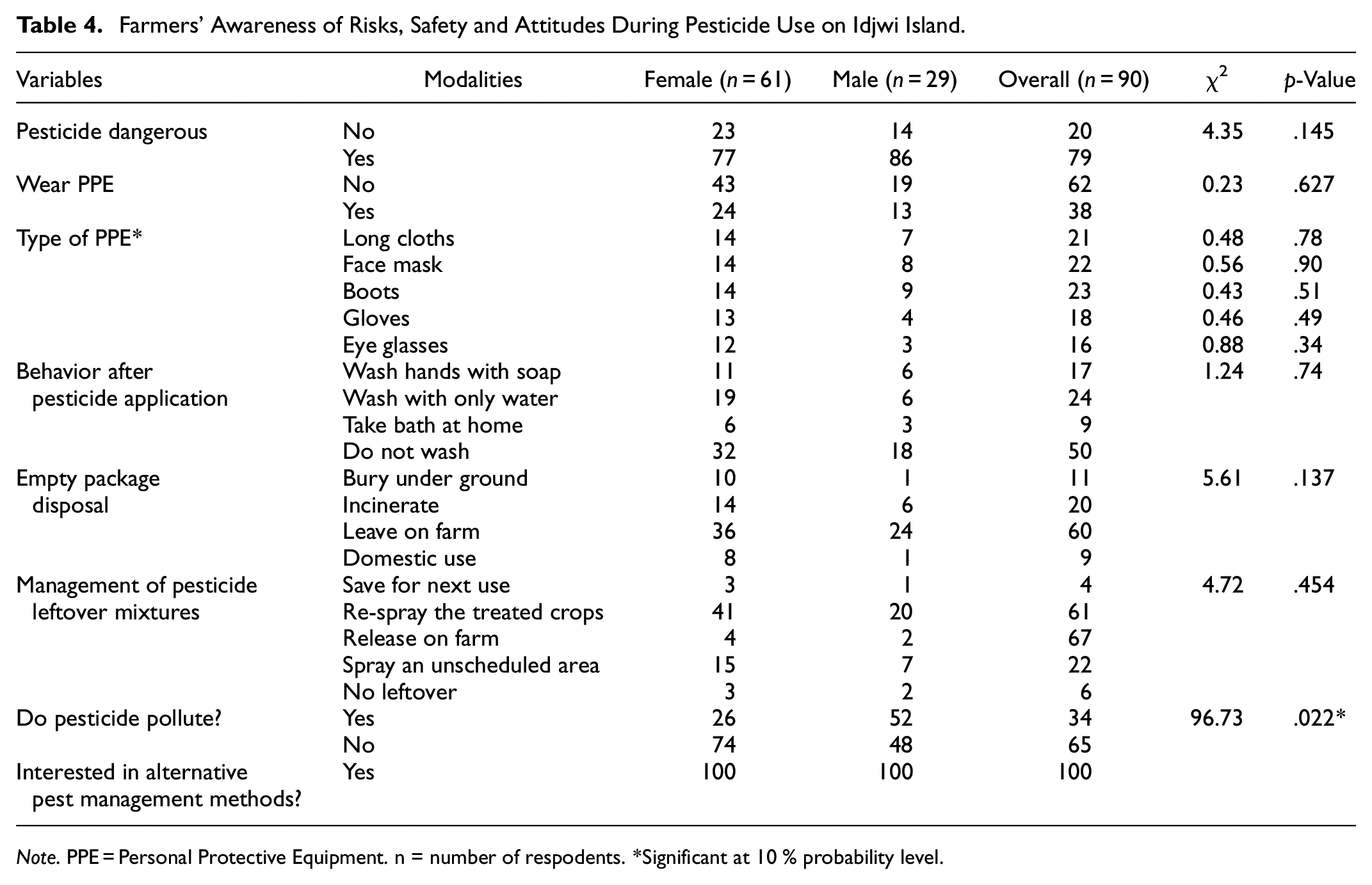
Many surveys carried out on the use of pesticides in market gardening across the country, for example, in Kongo Central (Muliele et al., 2017), in Kinshasa (SOS-FAIM, 2021), in Lubumbashi (Balasha & Nsele, 2019) have reported that farmers do not comply with safety measures regarding pesticides. This is particularly illustrated by the fact the use of inappropriate equipment puts farmers at risk of pesticide exposure and can result in treatment failure when the spraying mixtures are not effectively distributed over crops or fail to reach the intended pests (Balasha & Nsele, 2019; Schiffers, 2011). In their studies conducted in Kenya, India, and Burkina Faso, Badenes-Perez and Shelton (2006) and Son et al. (2017) argue that poor pest control can be attributed to using incorrect pesticides and inadequate application equipment. The level of awareness of risks, safety, and attitudes towards pesticides while spraying pesticides are reported in Table 4. While nearly 80% of participants stated that pesticides were toxic and dangerous to human health, 66% did not protect themselves when handling and applying these products. Interestingly, this level of awareness of the danger of pesticides among farmers can be an essential factor when proposing alternative methods because farmers who perceive pesticide risks are likely willing to pay for and adopt IPMs (Atreya, 2007; Balasha, 2019; Garming & Herman, 2007). However, farmers seemed to know a range of personal protective equipment. They cited gloves (18%), glasses (16%), long clothes (21%), and boots (23%).
Farmers’ Awareness of Risks, Safety and Attitudes During Pesticide Use on Idjwi Island.
Note. PPE = Personal Protective Equipment. n = number of respodents. *Significant at 10 % probability level.
The findings indicated that farmers are aware of the crucial protective equipment necessary for safe pesticide use. Despite this knowledge, various factors, such as low purchasing power, risk minimization, discomfort while working with PPE, negligence, and unavailability in local markets, prevent farmers from acquiring and utilizing such equipment (Ajayi & Akinnifesi, 2007; Balasha et al., 2019). Farmers’ attitudes and behavior while and after applying pesticides can expose them to the risks of pesticides as they may not be aware of the potential health risks associated with pesticide exposure, leading to a lack of concern for their own safety when handling these chemicals.
Table 4 shows that approximately 50% of the observed farmers did not wash their hands immediately after pesticide application, and around 9% took baths or showers at home. While some farmers reported washing their hands with soap (16.6%), 24% washed their hands with only water. This behavior is typical among farmers in various agricultural landscapes despite their awareness of the potential danger of pesticides, indicating a lack of necessary precautions to minimize risks (Atreya, 2007; Balasha et al., 2019; Nafissa et al., 2020)
Table 4 also presents farmers’ management and disposal practices for pesticide mixture leftovers and empty packages. The results indicated that most farmers typically re-sprayed the treated area (61%) or improvised treatment in another field (14%). While re-spraying is recommended to destroy excess mixture and eliminate tank bottoms, farmers should be cautious in calculating proper doses to prevent crop toxicity. Only a minority saved leftovers for future use (4%) or released leftover spray solutions on the farm (7%). Regarding empty containers, most farmers dumped them on the farm (60%) or repurposed them for household use (9%). Many scholars are concerned about the secondary use of pesticide containers for household purposes due to the potential health risks posed by pesticide residues that may remain if the containers are not cleaned properly (Chelkeba et al., 2018; Nwadike et al., 2021)
The practice of burning empty pesticide containers in open fires (20%) or burying them underground (11%) is common among farmers. In managing pesticide mixture leftovers, 61% of farmers re-sprayed the treated field, which is a recommended practice by FAO (2001). Damalas et al. (2008) observed in Greece that 55% of farmers sprayed pesticide leftover on crops that had already been treated, which is a comparable practice. However, releasing leftover pesticide solutions on the farm can result in soil and waterway pollution, as observed in Greece (Damalas et al., 2008; Mahmood et al., 2016).
A significant difference was noticed between male and female farmers’ knowledge about the pollution of pesticides (p < .005). Table 4 shows that 65% of the surveyed farmers lack awareness about the harmful effects of pesticides on non-human organisms, indicating a significant knowledge gap. Specifically, a high percentage of female farmers (74%) were found to be unaware of this issue. This difference in awareness can be attributed to factors such as inadequate education and information among farmers, as documented by Atreya (2007), Okolle et al. (2016), and Nafissa et al. (2020). Moreover, the existing awareness and research programs have not effectively engaged farmers in pesticide risk assessment activities. Overall, farmers’ knowledge about the pollution caused by pesticides is essential for protecting human health, minimizing environmental impact, complying with regulations, and meeting consumer demand for sustainable and environmentally-friendly products (Bakker et al., 2021; Schiffers, 2011).
Determinants of Farmers’ Willingness to Wear Protective Equipment
Table 5 presents descriptive statistics about factors associated with farmers’ willingness to wear personal equipment protection during pesticide application. In general, the results indicate that women comprise the majority (65%) of farmers who wear protective equipment, which is not surprising given the higher representation of women among the survey respondents. Examining age demographics, none of the youngest vegetable farmers (between the ages of 17–30) reported wearing protective equipment. Our findings are inconsistent with the investigation in Uganda and Kuwait, where Staudacher et al. (2020) and Jallow et al. (2017) observed that younger farmers were likely to possess a strong awareness of the risks associated with pesticide use, owing to their high education and access to information. Consequently, they were deeply concerned about safeguarding themselves during pesticide handling.
Farmers’ Willingness to Wear Protective Equipment.


Note. n = number of farmers.
Interestingly, all farmers with a bachelor's degree and 26% of those with a high school diploma reported wearing protective equipment, suggesting the positive impact of education in increasing awareness of pesticide-related risks. In addition, those who considered agriculture their primary occupation had a high rate of protective equipment usage. Lastly, farmers who were aware of the potential hazards of pesticides (82%) and those who had previously experienced skin irritation (71%) demonstrated the greatest care in protecting themselves from pesticide exposure. These findings highlight the need for targeted educational interventions to raise awareness about pesticide safety measures, especially among younger farmers.
Appendix A contains the results of logistic regression that we used to complement the descriptive findings. The logistic regression analysis revealed a positive association between the use of protective equipment and factors such as gender, age, education level, source of pesticide information, and the farmers’ ability to understand pesticide usage instructions. Furthermore, we found a significant correlation between the use of protective equipment and farmers’ reports of coughs and headaches following pesticide application. Notably, farmers who had experienced respiratory difficulties previously were more likely to use protective equipment.
Interestingly, farmers have expressed interest in adopting new pest control strategies that reduce their reliance on pesticides and risks. Approximately 75% of the participants stated that they were willing to pay $US 5 for any alternative method to pesticides (see Appendix B). Farmers’ willingness to pay for alternative strategies can provide valuable feedback to researchers, guide research priorities, and attract funding for further research and development of more effective and sustainable integrated pest management strategies.
Limitations of the Study and Future Research
Pesticide-based crop protection has gained popularity among farmers seeking to increase crop yields and minimize losses in market-oriented vegetable farms. This study shed some light on farmers' current pesticide use practices but has inherent limitations. First, the number of participants is relatively small. As many farmers are shifting to vegetable production in the study area due to profitability and the short growing cycle (Balasha & Aganze, et al., 2022), it will be interesting to interview more farmers during another cropping season to produce more accurate information and reduce the variability of the estimates, as observed, for example, in the binary logit model, examining the determinants of wearing protective equipment (see Appendix A). Doing so will help provide generalizable and relevant recommendations to policymakers, researchers, and farmer organizations, who need to work in partnership on pathways to sustainability in agriculture. Engaging in a collaborative partnership can ensure that all stakeholders’ diverse needs and perspectives are considered to address agriculture’s complex challenges (Aarts et al., 2014). Second, we conducted this survey when the Congolese government imposed strict COVID-19 management measures (e.g., restricting mobility and imports). These measures impacted farmers' access to and acquisition of agricultural inputs, including protective equipment (Benjamin et al., 2020; Nchanji et al., 2021).
Further, although 22% of farmers wore face masks while spraying pesticides, it is uncertain whether they did so to comply with COVID-19 regulations or reduce their exposure to pesticides. Additionally, even farmers who wore long clothes were still at risk of pesticide exposure as their attire was not designed for protection. Hence, future research must assess farmers’ exposure to pesticides using different methods and models such as visual method and the English predictive operator exposure model (Lawson et al., 2017; Son et al., 2018). Such assessments can inform recommendations to safeguard human health, environmental protection, regulatory compliance, and the safety of agricultural workers and farming communities.
Conclusion
This study examined the pesticide choice and use practices among vegetable farmers on Idjwi Island, eastern DRC. The findings show that pest pressure on crops and resulting damage drive farmers to use pesticides as an effective means to reduce crop losses. Pesticides used in vegetable production include fungicides and insecticides, and these products are chosen and sprayed on basis of their affordable price, availability on the local market and perceived effectiveness.
Although farmers pretend to be aware of the risk of pesticides, their poor practices on the ground do not reflect claimed awareness. Overall, the results reveal that pesticide use practices are worrying, favoring farmers’ exposure to the potential risk of pesticides and the failure of pest control. On Idjwi Island, the misuse of pesticides by vegetable growers is evident through the lack of knowledge about the active substances in the pesticides, overuse, improper spraying equipment, disregard for weather conditions, failure to wear protective equipment, and neglect of hygiene practices after applying pesticides.
Despite being far from the point of banning pesticides in agriculture, we urge for the enhancement of both male and female farmers’ abilities to utilize these products safely and correctly. Also, there is a need and an opportunity to explore and test alternative methods oriented toward integrated pest management. Therefore, this study emphasizes the need for improving awareness and recommends field farmers’ schools to train farmers on pesticides’ proper usage and management. It also highlights the need for rigorous control of the pesticide market and other imported agricultural inputs. The Congolese authorities through the Office Congolais de Contrôle and the Office National de la Protection des Végétaux) should ensure that farmers have access to approved and unexpired plant protection products following the laws and regulations in force. This is essential in limiting the use of banned pesticides and promoting safety for farmers and the protection of the environment.
Footnotes
Appendices
Determinants of Farmers’ Willingness to Wear Personal Protection Equipment During Pesticide Application on Idjwi Island.


|
Significant at 10 % probability level.
Acknowledgements
The authors would like to thank the anonymous reviewers for their insightful comments on the manuscript.
Author Contributions
Conceptualization: Arsene Balasha and Janvier Mugisho. Investigation: Dominique Aganze, Mwisha Sage and Mukonde Shadya. Methodology: Arsene Balasha. Data curation and analysis: Aganze and Mwisha Sage and Janvier Mugisho. Supervision: Arsene Balasha. Writing-original draft: Arsene Balasha. Authors have read and agreed on the submitted version of the manuscript.
Declaration of Conflicting Interests
The author(s) declared no potential conflicts of interest with respect to the research, authorship, and/or publication of this article.
Funding
The author(s) received no financial support for the research, authorship, and/or publication of this article.
Ethics Approval and Consent to Participate
Not applicable

Data Availability Statement
The authors want to declare that they can submit the data at whatever time based on request. The data used for the current study will be available from the corresponding author on reasonable request.