



Abstract
In today’s business atmosphere, diverse strategies are essential for fostering innovation and performance. While conventional orientations, such as market and entrepreneurial orientations, have received considerable attention in research, there is a notable gap in understanding the combined effects alongside emerging orientations like digital and sustainability orientations on non-technological innovation capability (NTIC) and firm performance. Furthermore, the mediating role of NTIC in enhancing performance related to these orientations remains unclear. To address this gap, we explore the intervening role of NTIC in the impacts of emerging and conventional strategic orientations on performance among large manufacturers in Ethiopia from a dynamic capability perspective. The study employs a cross-sectional survey of 206 top managers from large manufacturing firms in Ethiopia and analyzes the data using partial least squares structural equation modeling. Results revealed that conventional strategic orientations—proactive market orientation (PMO), responsive market orientation (RMO), and entrepreneurial orientation (EO)—positively impact firm performance. In contrast, emerging orientations like sustainability orientation (SO) and digital orientation (DO) do not. Moreover, conventional (PMO, EO) and emerging (SO, DO) orientations significantly influence NTIC, while RMO has no effect. NTIC partially mediates the impacts of PMO and EO on performance and fully mediates SO and DO, but does not mediate RMO’s impact on performance. This study offers insight into the multiple strategic orientations and innovation literature by demonstrating how conventional and emerging orientations can effectively harness to elevate NTIC and organizational performance. It further underscores the critical role of NTIC in amplifying the performance implications of strategic orientations, offering insights for academia and practitioners.
Plain Language Summary
In today’s rapidly evolving business environment, companies often employ various corporate strategies to enhance performance and remain competitive. Some are more conventional, such as (1) focusing on market trends, (2) responding to customer needs, and (3) encouraging entrepreneurship. Others are emerging, such as (4) adopting sustainable practices or (5) using digital technologies. While conventional approaches are well-studied, there is limited evidence on how they work together with emerging ones and whether they lead to higher performance in emerging economies, such as Ethiopia. This study surveyed 206 senior managers from large Ethiopian manufacturing firms to examine how conventional and emerging strategies affect performance and whether strong internal capabilities, referred to as non-technological innovation capabilities, which encompass innovative management, internal processes, and creative marketing practices, enhance their effectiveness. They found that conventional strategies such as being proactive in anticipating market trends, responding to customer needs, and encouraging entrepreneurship directly improved company performance. In contrast, emerging strategies such as sustainability and digitalization did not show a direct impact. The study also found that internal capabilities played a critical role: NTIC partly explained the influence of anticipating market trends and encouraging entrepreneurship, and fully explained the role of emerging strategies on performance. However, responding to customer needs works independently and does not depend on internal capabilities. Hence, this means that while conventional strategies can boost performance on their own, emerging strategies are effective only when supported by strong internal capabilities. The results highlight a crucial lesson for managers and policymakers: strategies alone are not enough. To achieve real results, companies need to invest not only in devising strategies but also in building the
Keywords
Introduction
The manufacturing sector is essential for steering economic transformation, fueling innovation, creating valuable employment opportunities, and stimulating sustainable growth on a global scale (Kumar et al., 2022). During the past two decades, Ethiopia’s manufacturing industry has been accompanied by significant success (Okereke et al., 2019; Shiferaw & Söderbom, 2019) and is undergoing further transformation as part of a broader industrialization strategy (Kumar et al., 2022). Despite this, the industry operates in a dynamic global environment characterized by rapid technological advancements, intense competition, rising stakeholder expectations, and changing market dynamics (Cirera et al., 2023). The shifts occurring within the economy and manufacturing sectors necessitate that firms refine their competitive approaches in light of increased international competition (Melesse & Knatko, 2024). The interplay between these shifts underscores the importance of embracing strategic orientations (Khizar et al., 2024). Conventional orientations, namely, market orientation (MO) and entrepreneurial orientation (EO), are critical for enabling firms to swiftly adapt to changing conditions, drive innovation, and enhance performance (Melesse & Knatko, 2024; Oduro & Haylemariam, 2019). Moreover, driven by rapid digitalization and the increasing emphasis on sustainability, companies adopt emerging strategies such as digital orientation (DO) and sustainability orientation (SO), providing a critical dimension for innovation and performance (Ardito et al., 2021; Danso et al., 2022; Manjunath et al., 2024; Wang et al., 2023). Specifically, DO entails an organization’s predisposition to embrace and leverage cutting-edge digital technologies such as big data analytics, artificial intelligence, digital platforms, and cloud computing (Raj et al., 2024), in business models, organizational structures, and operations (Aloulou et al., 2024; You & Brahmana, 2023). DO enables companies to build digital capabilities that strengthen their innovation capability, operational efficiency, decision-making, and customer engagement, ultimately enhancing performance (Alshourah et al., 2023; Arias-Pérez et al., 2021; Kindermann et al., 2021; Silva et al., 2023). SO is the process of integrating sustainability values into corporate strategies and pursuing environmental and social goals (Khizar et al., 2021; Shou et al., 2019). This proactive alignment of sustainability with core strategies fosters innovation, efficiency, brand reputation, and competitiveness in the dynamic market (Danso et al., 2022; Khizar et al., 2021, 2024).
While emerging orientations (DO and SO) have attracted scholarly interest, their role in driving firm performance is fragmented. For instance, studies on SO and firm performance indicate a positive impact (Khizar et al., 2024; Lei et al., 2019; Mah et al., 2023). However, Kautonen et al. (2020) SO’s impact is conditional on firms prioritizing profitability over sustainability goals. Others found that environmental orientation affects firm growth, while social orientation does not (Chistov et al., 2023). Similarly, DO has significant performance impacts (Barba-Sánchez et al., 2024; Marczewska et al., 2025), while others show a negative and insignificant association (Aloulou et al., 2024; Barragan & Becker, 2025; Brahmana & Kontesa, 2024). Additionally, Raj et al. (2024) and Yang et al. (2024) report varied results across DO dimensions. Moreover, while existing research demonstrates that conventional orientations (MO and EO) are essential strategic postures for enhancing performance, the empirical evidence remains mixed. For instance, Melesse and Knatko (2024) and Wasim et al. (2024) reported a positive impact of MO. Others have found a negative effect (Petzold et al., 2019; Schulze et al., 2022) and an insignificant effect (Bamfo & Kraa, 2019; Lückenbach et al., 2019). Studies regarding EO report positive outcomes (Salih et al., 2024; Yaghoubi Farani et al., 2024), while others find negative outcomes (Lückenbach et al., 2019). Some reported mixed relationships between the dimensions of EO and performance (Cho & Lee, 2018; Sarkar et al., 2016). The contradictory findings indicate that the performance effects of MO, EO, SO, and DO remain inconclusive, underscoring the need for further research to determine their impact on firm outcomes.
Moreover, scholars advocating multiple strategic orientations argue that combining various strategic orientations establishes a robust framework for navigating the complex and rapidly evolving business environment (Abdulrab et al., 2022; Hakala, 2011; Khizar & Iqbal, 2020) and yields higher performance than examining orientations in isolation (Dutta et al., 2016). Yet, the prevailing literature predominantly investigates MO, EO, SO, and DO separately, largely overlooking the potential synergies that emerge when these orientations are combined. Evidence indicates that integrating MO, EO, and technology orientation enhances performance and innovation in competitive, technology-intensive contexts (Abdulrab et al., 2022; Masa’deh et al., 2018); integrating MO, EO, and SO has been shown to improve performance (Khizar et al., 2024); and combining DO with environmental orientation supports innovation (Ardito et al., 2021). Despite these insights, the synergistic effects of MO, EO, SO, and DO on firm performance remain insufficiently understood, revealing a critical gap in the literature that warrants further investigation.
Furthermore, strategic orientations are critical in driving innovation by aligning resources and strategies to enhance innovative solutions in changing environments (Makhloufi et al., 2021; Robb & Stephens, 2021; Wang et al., 2023). By providing firms with a clear direction and priority-setting mechanism, strategic orientation enables the development of non-technological innovation capabilities (NTIC) such as marketing and managerial innovations that drive competitiveness and growth (Cornejo-Cañamares et al., 2021; Tutar et al., 2015). Although strategic orientation plays a critical role in driving NTIC, the relationship between the two remains insufficiently examined. Most prior studies have focused primarily on technological forms of innovations, including incremental and radical innovations (Kocak et al., 2017; Lin et al., 2021), product innovation (Kim & Hur, 2022; Kunecová et al., 2024), technological innovation (Ardito et al., 2021; Nassani & Aldakhil, 2021), green product innovation (Andersén, 2022; Dogbe & Marwa, 2024; Xiaoyi et al., 2023), innovation performance (Arunachalam et al., 2018; Ince et al., 2021) digital product innovation (Arias-Pérez & Vélez-Jaramillo, 2022; Khin & Ho, 2018; Shah et al., 2024), sustainable innovation (Nasiri, Saunila, Rantala, & Ukko, 2022). This highlights a gap in knowledge regarding how firm strategic orientations drive NTIC, as prior studies have primarily focused on other types of innovation, such as technological innovations. To address this gap, the study proposes a framework to examine the influences of multiple strategic orientations on NTIC.
Importantly, while strategic orientation influences firm performance, its effects remain mixed and contingent on internal capabilities and external conditions (Abdulrab et al., 2022; Balodi, 2020; Frimpong et al., 2025), which determine how effectively strategic orientations drive performance. Accordingly, existing research identifies several mediating factors influencing the relationship between MO and EO with firm performance (Melesse & Knatko, 2024; Nugroho et al., 2022; O’Dwyer & Gilmore, 2019; Sarkar et al., 2016) as well as the relationship between DO and SO with performance (Frimpong et al., 2025; Shah et al., 2024; Silva et al., 2023). While these investigations offer valuable understandings of how various organizational factors mediate the effects of strategic orientation on performance, they overlook the mediating role of NTIC in this link, thereby missing a nuanced understanding of how NTIC shapes this relationship. These gaps are particularly pertinent in developing economies like Ethiopia, where government initiatives such as industrialization policies (FDRE, 2021), the Digital Ethiopia strategy (FDRE, 2025), and the Climate Resilient Green Economy Strategy (CRGE, 2019) aim to boost manufacturing, digital transformation, and sustainable and low-carbon growth. Meanwhile, resource limitations (Oqubay, 2018), limited sustainability integration (Wakjira et al., 2018), intense global competition, and slow technological adoption (Cirera et al., 2023) influence the effectiveness of strategic orientations, NTIC adoption, and firm performance in the sector. Therefore, although strategic orientations and NTIC are drivers of competitiveness and firm performance, there is still no integrative theoretical framework and empirical evidence explaining several critical gaps on the inconclusive effects of individual and synergistic roles of MO, EO, SO, DO on firm performance; the limited understanding of how these orientations influence NTIC; and the mediating role of NTIC in their collective impact on performance, particularly in the Ethiopian manufacturing contexts with multiple contextual contingencies. Building on the dynamic capability perspective, we develop an integrated framework to fill gaps by empirically examining the role of emerging and conventional strategic orientations on enhancing performance and NTIC, and employ mediation analysis to investigate how NTIC facilitates the combined effects of strategic orientations on the firm performance of LMEs in Ethiopia.
The study has the following contributions. Firstly, this study contributes to the growing literature on multiple strategic orientations by deepening our insight into the combined effects of emerging and conventional strategic orientations on enhancing corporate performance and their neglected influences on NTIC that expand the scope of innovation literature beyond technological innovation. Secondly, the investigation adds to the ongoing discourse in the literature about the missing component that mediates the link between multiple strategic orientations and company performance. Finally, this study focuses on LMEs in Ethiopia’s markets and provides insights into employing multiple strategic postures to enhance their NTIC and performance. Furthermore, the study offers valuable insights for policymakers seeking to promote inclusive industrial growth by highlighting strategic paradigms and non-technological innovations within Ethiopia’s manufacturing sector.
Theoretical Framework and Hypothesis
Theoretical Framework: Dynamic Capability
Dynamic capability (DC) is widely studied in the field of strategic management, particularly in the studies of strategic orientation (Cui et al., 2017; Kocak et al., 2017; Marczewska et al., 2025). Teece et al. (1997) defined “DC as a firm’s ability to integrate, build, and reconfigure internal and external resources and competencies in response to rapidly changing environments.” DCs enable firms to deploy, extend, and renew their resources to sustain competitive advantage in fast-changing environments (Fainshmidt et al., 2016; Lin and Wu, 2014; Rahman et al., 2023). Empirical research adopts a DCs perspective, underscoring that firms with strong strategic orientation contribute to forming dynamic capabilities (Abdulrab et al., 2022; Ahmed et al., 2023; Aloulou, 2018; Iyer et al., 2021; Jiang et al., 2020; Marczewska et al., 2025). For example, Chaudhary et al. (2022) demonstrated that MO facilitates firms to monitor the external environment and respond quickly to new market opportunities that drive superior performance. Others, Cui et al. (2017), Balodi (2020), revealed that EO enhances a firm’s capacity to adapt to environmental changes, explore emerging opportunities, and navigate uncertainty, improving firm performance in an emerging market context. Moreover, in today’s rapidly changing market and digital economy, DO is a dynamic capability (Teece, 2018), enables firms to sense emerging technological trends, integrate digital innovations, and reconfigure resources swiftly to respond effectively and maintain competitiveness in dynamic environments (Marczewska et al., 2025; Raj et al., 2024; Suder et al., 2025). The integration of digital technologies with core strategies enables firms to develop DCs that shape a firm’s competitiveness and performance (Joesoep et al., 2023; Marczewska et al., 2025). Similarly, due to the growing societal and political pressure and firms’ sustainability transition, SO functions as a DC (Cezarino et al., 2019; Correggi et al., 2024), enabling firms to adapt to and transform in response to environmental and social challenges and opportunities (Buzzao & Rizzi, 2021; Ortiz-Avram et al., 2024). As market and societal expectations evolve, firms with strong SO can adapt strategies to address climate risks, resource scarcity, and market pressures, turning sustainability into a competitive advantage (Amui et al., 2017; Bari et al., 2022; Liang et al., 2022). Furthermore, innovation capability is a DC that enables firms to sense emerging opportunities, seize them through the development of innovative products, marketing, or managerial practices, and reconfigure organizational resources to adapt to environmental changes, thereby enhancing firm performance (Ferreira et al., 2020; Otache & Usang, 2022; Shafi, 2020). Similarly, NTIC is a DC that complements IC (Adam et al., 2017), mediates the relationship by transforming strategic orientations into reconfigured processes, innovative practices, and ultimately superior firm performance (Kocak et al., 2017; Migdadi et al., 2017). Empirical studies show that firms with strong NTIC more effectively convert strategic orientation into improved performance (Bamfo and Kraa, 2019; Putra et al., 2020; Uzkurt et al., 2016; Veidal & Korneliussen, 2013). Therefore, we argue that MO, EO, SO, and DO are DCs that enable a company to integrate and reconfigure competencies to adapt to rapid changes for the development of NTIC and enhance performance.
Hypothesis Development
Strategic Orientations on NTIC and Firm Performance
Marketing orientation “is the organization culture that most effectively and efficiently develops the necessary behavior for the formation of superior value for customers and superior performance” (Slater & Narver, 1995). MO comprises Responsive MO that gathers and uses market insights about explicit customer current needs, and PMO focuses on identifying and fulfilling undisclosed customer needs (Narver et al., 2004). Market orientation is a firm’s DC that develops a competitive advantage through monitoring and responding quickly to the external environment (Bamfo & Kraa, 2019; Chaudhary et al., 2022). MO enhances firm performance through gathering valuable insights into explicit (RMO) and hidden (PMO) customer needs (Petzold et al., 2019). While the impact of MO on firm performance has been widely studied (Balodi, 2020; Khizar et al., 2024; Wasim et al., 2024), few studies have examined the dual MO on performance (Petzold et al., 2019; Schulze et al., 2022). For instance, Bucktowar et al. (2015) found that RMO and PMO have an impact on firm performance. Iyer et al. (2021) found that RMO has a significant relationship, but PMO has an insignificant relationship with brand performance. Kocak et al. (2017) demonstrated that PMO has a positive impact on firm performance, while RMO has a negative effect. Uzkurt et al. (2016) found that RMO has an insignificant relationship with performance. Beyond its impact on performance, MO enables organizations to concentrate their innovation capability on customer requirements (Huhtala et al., 2014). Cultivating a PMO can powerfully elevate NTIC, as it seamlessly aligns R&D initiatives with the dynamic needs and trends of the market (Liu & Su, 2014; Uzkurt et al., 2016). While considerable empirical studies have been conducted on the effects of RMO on generic innovation capability (Alkandi & Helmi, 2024; Migdadi et al., 2017) or product innovation (Kocak et al., 2017; Lin et al., 2021), the role of dual MO on NTIC is scarce. For example, Tutar et al. (2015) demonstrated that an RMO has no significant link with NTIC, and PMO positively affects NTIC. Uzkurt et al. (2016) found that RMO significantly affects administrative innovation, such as new administrative systems and organizational processes. Thus, the limited focus on RMO’s role in firm performance and NTIC, while overlooking PMO, and the mixed findings form the basis for this study’s hypotheses.
Entrepreneurial orientation is “a strategic organizational posture that captures the specific processes, practices, and activities that enable firms to create value by engaging in entrepreneurial endeavors”(Lumpkin & Dess, 2001). EO involves proactiveness, innovativeness, and risk-taking (Covin & Slevin, 1989). EO contributes to the acquisition of necessary resources, the development of creative solutions to capitalize on recognized opportunities in the external environment, and the transformation of ideas into innovative and performance outcomes (Cui et al., 2017; Ince et al., 2021). While existing empirical studies underscore the role of EO in shaping performance (Abdulrab et al., 2022; Balodi, 2020), the studies report inconsistent results. For instance, the studies revealed that EO enables firms to respond to market changes in pursuit of higher performance (Deutscher et al., 2016; Yadav et al., 2019). Conversely, Lückenbach et al. (2019) found that EO has a negative role on economic performance. Rezaei and Ortt (2018), Nugroho et al.(2022), Abdulrab et al. (2022) reported that EO has insignificant effects on the firm’s performance. In addition to its role in driving a firm’s effectiveness, EO fosters a culture of creativity and innovation (Ferreira et al., 2020) and serves as a crucial resource and capability that drives administrative and marketing innovation (Adam et al., 2017; Putra et al., 2020). Despite this, existing empirical evidence predominantly examines the role of EO on technological innovation (Aljanabi, 2017; Cake et al., 2020; C.-W. Lin et al., 2021), with little attention to NTIC. (Kim & Hur, 2022). For instance, Ndubisi and Agarwal (2014) assert that proactiveness and risk-taking behaviors are critical in impacting administrative innovation. Sulistyo and Ayuni (2020) marketing and administration innovation capabilities blossom from a strong entrepreneurial culture that stimulates innovation, unleashing creativity and pioneering new marketing strategies. Thus, the above discussion serves as the basis for the hypotheses formulated in this study:
Sustainability orientation “is an institutional long-term devotion to incorporating social and ecological aspects into decision-making processes” (Shou et al., 2019). Recently, globalization and societal pressure have inspired businesses to adopt sustainability as a strategic tool for complying with legal obligations while acquiring a competitive edge (Shashi et al., 2018). Consequently, it drives the interest in linking SO to firm performance, yet findings remain mixed. For instance, Khizar et al. (2024) and Danso et al. (2022) identified that SO drives superior performance. Chistov et al. (2023) found that environment orientation is positively associated with firm growth, but social orientation has no relationship. Rotondo et al. (2025) found a negative effect of SO on financial performance. Kautonen et al. (2020) found that the SO improves performance when the firm prioritizes profitability over sustainability goals and vice versa. Moreover, SO studies have mainly focused on the environmental dimension (Adomako et al., 2019; Danso et al., 2019, 2020; Leonidou et al., 2016; Roxas et al., 2017; Yaghoubi Farani et al., 2024), which hinders a comprehensive understanding of how all components influence firm performance. Besides its performance implications, firms that focus strongly on sustainability can enhance their R&D management to enhance innovation outcomes (Jin et al., 2019). The SO of organizations inspires efficient resource allocation for green innovation performance (Cheng, 2020). Consequently, empirical evidence has confirmed that SO is an effective driver of technological innovation (Ardito et al., 2021; Cheng, 2020; Demirel & Kesidou, 2019; Feng et al., 2018; Varadarajan, 2017); however, a dearth of studies has examined the NTIC. For instance, Sáez-Martínez et al. (2014) found that environmentally focused firms play a transformative role by embedding sustainability in their core activities, driving market innovations that champion SDGs. Gabler et al. (2015) found a positive effect of SO on administrative innovativeness. Cornejo-Cañamares et al. (2021) demonstrated that compliance with environmental regulations, such as reduced material usage, energy costs, and environmental impact, is the primary driver of NTIC. Conversely, Klein et al. (2021) found that sustainability commitment may not directly shape business model innovation. Therefore, we argue that SO leads to better performance and NTIC. The following hypothesis is proposed:
Digital orientation encompasses a company’s purposeful strategic positioning to capitalize on growing digital innovations (Quinton et al., 2018) and its integration, transformation, and deployment of expertise to produce value from digital technologies (Arias-Pérez et al., 2021).
DO enables firms to sense and seize technological opportunities, enhancing their dynamic capabilities and ultimately improving firm performance (Joesoep et al., 2023). Recently, firms have shifted from adopting technology to strategically using digital technologies to gain a competitive advantage(Manjunath et al., 2024) and drive their performance in digitized business environments (Kindermann et al., 2021; Quinton et al., 2018). While existing empirical evidence underlines the effects of DO on firm performance, the findings remain inconsistent. For instance, Quinton et al. (2018) and Manjunath et al. (2024) revealed that DO is a vital strategic approach in the digital era, driving value creation and strategically leveraging digital technologies to outperform competitors. Contrarily, Nasiri, Saunila, and Ukko (2022) and Brahmana and Kontesa (2024) adopting digitalization may not ensure improved firm performance. Similarly, Barragan and Becker (2025) found that DO has negative effects on the firm performance of SMEs in Different European countries. In addition to its role in driving a firm’s effectiveness, digitally acquainted companies champion the endorsement of technological advances and the cultivation of mastery, competencies, and skills to navigate the creation of groundbreaking innovations (Khin & Ho, 2018; Nambisan et al., 2019). In this context, digital orientation empowers NTIC (marketing innovation) by embracing new strategies that profoundly influence consumers’ buying decisions (Arias-Pérez et al., 2021). Despite its importance in driving marketing and managerial, considerable empirical evidence linked DO to various forms of innovation (Dogbe & Marwa, 2024; Kunecová et al., 2024; Nasiri, Saunila, Rantala & Ukko, 2022; Shah et al., 2024), while neglecting its role in NTIC. Given the inconsistent findings coupled with limited studies, we argue that digital orientation enhances performance and NTIC of companies, providing a foundation for this study’s hypotheses:
Mediation of Non-Technological Innovation Capability
Strategic orientations, namely PMO, RMO, EO, SO, and DO, have been recognized for their potential to enhance firm performance; however, empirical findings have often been mixed and inconsistent (Barragan & Becker, 2025; Iyer et al., 2021; Klein et al., 2021; Lückenbach et al., 2019). Such inconsistencies suggest that the relationship may be contingent on internal or external factors that mediate or moderate how strategic orientations translate into performance (Aloulou, 2018; Hsu et al., 2014; Narver & Slater, 1990). In response, various mediating factors have been examined in prior research such as digital innovation (Khin & Ho, 2018; Shah et al., 2024), strategic flexibility (Aloulou, 2018), radical and incremental innovations (Kocak et al., 2017; O’Dwyer and Gilmore, 2019), strategic capability (Melesse & Knatko, 2024), IT adoption capability (Nugroho et al., 2022), green innovation (Novitasari & Tarigan, 2022), relational capacity (Silva et al., 2023) and digital maturity (Nasiri, Saunila, & Ukko, 2022). Nevertheless, NTIC has received limited attention as a mediator, despite its potential to operationalize strategic orientation through novel marketing and managerial practices to drive firm performance. NTIC is a key dynamic capability that transforms strategic orientations into performance outcomes by implementing novel practices, reconfiguring processes, and designing innovative routines, enabling proactive, responsive, entrepreneurial, sustainable, and digital orientations to generate measurable firm performance. For example, earlier strategic orientation scholars highlight how administrative innovation can transform an RMO culture to augment business performance (Han et al., 1998). Sari and Indriani (2023) found that value-based marketing innovation mediates the MO and hotel performance relationship in Indonesia, emphasizing the role of marketing innovations in translating strategic intent into measurable performance outcomes. Moreover, existing empirical research has validated the association between EO and competitive success, mediated by marketing innovations (Adam et al., 2017). Administrative innovation is a vital catalyst, influencing the intricate connection between EO—the mindset that drives innovation, risk-taking, and performance (Veidal & Korneliussen, 2013). Yet, empirical evidence on NTIC’s mediating effect on RMO, PMO, and EO is limited.
A firm’s sustainability orientation is a strategic capability that enhances performance by promoting sustainability practices, strengthening stakeholder trust, and improving resource efficiency (Danso et al., 2022; Khizar et al., 2024). Environmentally focused companies integrate sustainability into business activities by introducing market innovations (Cornejo-Cañamares et al., 2021; Sáez-Martínez et al., 2014). Similarly, companies that strategically leverage digital technologies outperform their competitors (Manjunath et al., 2024; Quinton et al., 2018). DO also positively influences the marketing innovation capabilities in South American MNEs (Arias-Pérez et al., 2021). Yet, there is a notable gap in research regarding how NTIC mediates the role of DO and SO on performance linkage. This framework positions NTIC as a key dynamic capability that bridges PMO, RMO, EO, SO, DO, and firm performance, addressing theoretical gaps (limited research on mediators) and empirical gaps (mixed direct effects of strategic orientations). As a result of the above debate, we suggest the following hypothesis:
Figure 1 illustrates a conceptual framework that shows how multiple strategic orientations interact with non-technological innovation capability and firm performance.
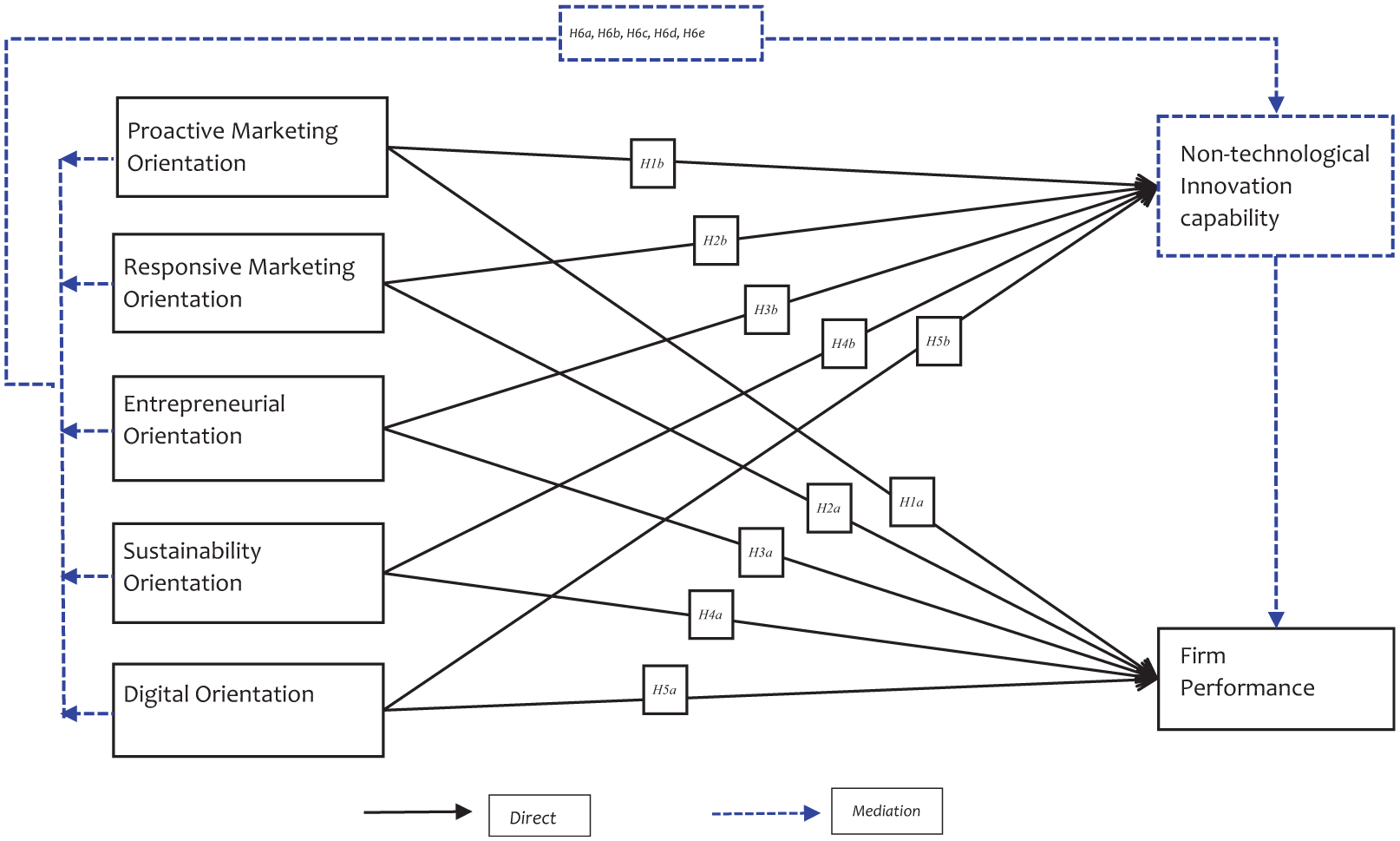
The study’s conceptual framework.
Methodology
Research Design and Sampling
This investigation used a cross-sectional survey approach to quantitatively investigate the performance implications of multiple strategic orientations and the mediating impact of NTIC in Ethiopian LMEs. This study’s target population includes 512 LMEs in Ethiopia, and a sample size of 220 (43%) of the total population. We determine the sample size based on a formula suitable for a finite population, as recommended by Kothari (2004). We employ a stratified sampling technique due to the heterogeneous nature of LMEs in Ethiopia. First, they categorized based on their sector (industry type), including leather and leather products, manufacturing technology and metal, food and beverage agro-processing, chemicals and chemical products, textile and clothing, and others. Additionally, we divide them based on their location (geographic distribution) in regions and cities such as Addis Ababa, Dire Dawa, Oromia, Amhara, Somali, and the Southern Region. Therefore, we proportionally drew samples from the grouped population to ensure sectoral and regional representativeness.
Survey Design and Data Collection
We developed the survey instrument by conducting an extensive review of relevant literature and consulting with multiple stakeholders. The survey includes questions on the profile of respondents and firms, strategic orientations, NTIC, and firm performance, each rated on a five-point Likert scale ranging from 1 (“strongly disagree”) to 5 (“strongly agree”). Then, we assess the content validity and relevance of the survey items of the construct by consulting academicians and industry experts at Addis Ababa University and Ethiopian Manufacturers Promotion and Development Institutions. Following this, we conducted a pilot test with 36 top-level managers working in the Large Manufacturers. This process enabled us to gather feedback on the wording and lengths of items, which was instrumental in refining our instrument. Finally, we invited 220 LME owners/managers physically and virtually using Google Forms. We collected 212 questionnaires, and after the screening, 206 (93.6%) questionnaires fulfilled the requirement to proceed with the analysis. Participation in the investigation was voluntary, and participants provided verbal consent before taking part. To minimize potential risks, personal and firm information was not revealed in the report to ensure the anonymity and confidentiality of respondents. The potential benefits of the study, including generating insights into strategic orientations, NTIC, and firm performance, far outweigh these minimal risks, providing societal significance and practical implications for organizations.
Measures
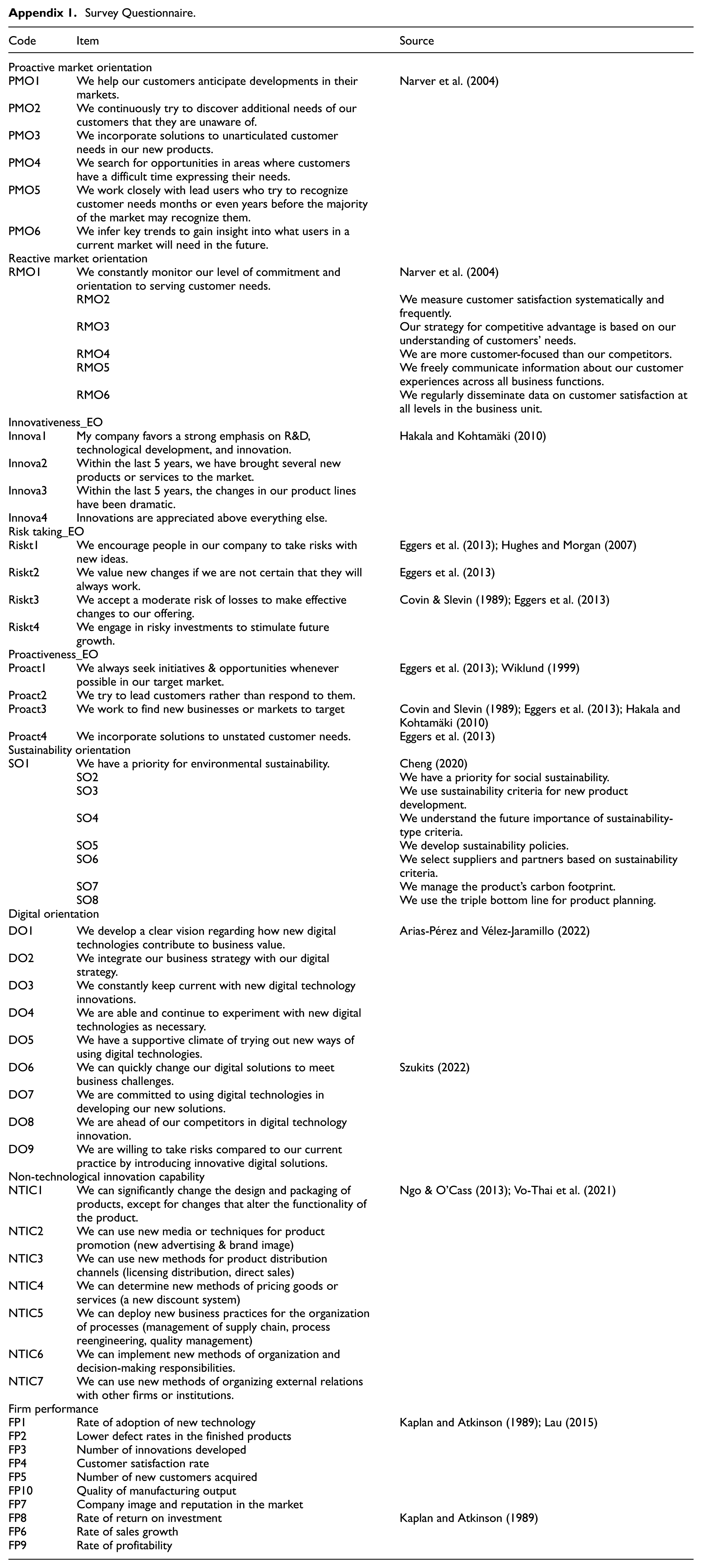
The study utilized well-established scales used in previous studies (see Appendix 1). We employ five independent variables: DO, SO, EO, PMO, and RMO. Particularly, PMO and RMO are first-order constructs assessed by a 12-item scale developed by Narver et al. (2004). The EO is a second-order construct comprising 12 item scales with three lower-order constructs. These include innovativeness, assessed through a four-item scale; proactiveness, evaluated using a four-item scale; and risk taking, measured by a four-item scale, first developed by Covin and Slevin (1989) and Wiklund (1999), and the scale adapted from the work of Hakala and Kohtamäki (2010) and Eggers et al. (2013). DO as a first-order construct assessed using a 9-item scale adapted from the work Arias-Pérez and Vélez-Jaramillo (2022) and Szukits (2022). The SO is a first-order construct measured using an eight-item scale adapted from. The mediating variable, NTIC, is a first-order construct measured by seven items adapted from Ngo and O’Cass (2013), Vo-Thai et al. (2021). The dependent variable FP is a first-order construct, assessed using a 10-item scale developed by Kaplan and Atkinson (1989) and adapted by Lau (2015).
Respondents and Firms Profile
The study included 161 male participants (78.2%) and 45 female participants (21.8%). Furthermore, 69 respondents (33.5%) had 11 to 15 years of experience. Analysis of the positions revealed that 105 respondents (51%) held the position of CEO, indicating a significant representation of top-level managerial roles in our sample. Of the companies surveyed, 114 (55.3%) had been in operation for 16 to 20 years, and 63 (30.5%) reported an annual turnover ranging from 100 to 500 million birr. The majority of the sample comprised three industries: 64 (31.1%) in food and beverage agro-processing, 61 (29.6%) in the manufacturing technology & metal industry, and 59 (28.6%) in chemicals and chemical products (Table 1).
Respondents and Firms Profile.

Assessment of Common Method Bias
The measurement of CMB emerges from the measurement technique rather than the relationships among the variables we study (Kock, 2015). This distinction is crucial for ensuring the integrity of research findings and accurately interpreting cause-and-effect dynamics. To assess the CMB of the constructs, we utilize inner VIF by evaluating the collinearity of the variables in the proposed model, as recommended by Kock and Lynn (2012). Therefore, a VIF value greater than 3.3 signals significant collinearity and potential CMB problems in the model (Kock, 2015). Table 2 summarizes the CMB analysis, showing that the inner VIF values for each exogenous construct range between 1.235 and 3.160. Therefore, all values remain below the critical threshold of 3.3, affirming that the constructs involved are free from CMB issues and do not threaten the validity of our findings.
Common Method Bias (Inner Model VIF).

Analysis and Results
We used Smart-PLS version 3.0 for Structural Equation Modeling (SEM) with a Partial Least Squares (PLS) approach to test our proposed model. SEM allows simultaneous modeling of complex relationships (direct & indirect) among multiple latent constructs and is suited for confirmatory research and exploratory prediction (Hair et al., 2021), which is essential for linking strategic orientations, NTIC, and firm performance. PLS-SEM is particularly effective for estimating formative hierarchical constructs (Sarstedt et al., 2019). For example, entrepreneurial orientation is a formative construct, and PLS-SEM allows accurate estimation of its lower-order constructs (LOCs). It also supports complex relationships and robust predictive capabilities without relying on strict distributional assumptions (Hair et al., 2019, 2021; Sarstedt et al., 2019). The analysis first validated the measurement models, then assessed the structural model to test the proposed direct and indirect relationships.
Measurement Model Assessment
This study labeled PMO, RMO, DO, SO, NTIC, FP, risk-taking, proactiveness, and innovativeness as LOCs, and EO as a higher-order construct. We consider EO as a reflective-formative Type II HOC model because it is formed by risk-taking, proactiveness, and innovativeness as specified by Sarstedt et al. (2019). To validate the measurement model of the LOCs and HOCs, we chose the disjoint two-stage strategy (Cheah et al., 2019). The validity and reliability of the LOCs were assessed first and followed by HOCs
Reliability and Convergent Validity of LOCs
We use Cronbach’s alpha and composite reliability to test the internal validity and consistency of PMO, RMO, DO, SO, NTIC, FP, risk-taking, proactiveness, and innovativeness. Values between 0.70 are considered satisfactory to good (Hair et al., 2021). Thus, Table 3 illustrates that all the indicators show Cronbach’s alpha values of .775 to .929, which indicates adequate internal reliability and consistency of all LOCs. The convergent validity of LOCs was determined using factor loading and average variance extracted (AVE) (Hair et al., 2019). Factor loadings measure how closely the observed indicators connect to an underlying variable (Hair et al., 2021). According to Hair et al. (2019), the indicator loadings must be greater than 0.708. Based on PLS algorithm analysis, we retained 54 items with factor loadings above 0.708, while dropping four items (Risk2, DO2, SO6, and FP6) below 0.708. Moreover, the AVE represents a measure of a construct’s variance explained in its indicators in comparison to the whole variation of the indicators (Cheung et al., 2023). Typically, the acceptable value of an AVE should be greater than or equal to 0.50, suggesting that the construct accounts for 50% of the variation of its items (Hair et al., 2019). Table 3 shows that the AVE values range from 0.543 to 0.731, which satisfies the threshold set by Hair et al. (2021).
Construct Reliability and Convergent Validity LOCs.

Note. Deleted items Risk2, DO2, SO6, and FP6 due to loadings below 0.70. Loading ≥0.70, α ≥ .70, CR ≥ 0.70, and AVE ≥ 0.50
Discriminant Validity of Reflective Model (LOCs)
Establishing discriminant validity is crucial as it determines how uniquely the construct stands apart from other concepts in the structural model (Hair et al., 2019). To assess the discriminant validity of the LOCs, we use the Fornell-Larker criteria and the Heterotrait-Monotrait (HTMT) correlation ratio (Hair et al., 2021). The Fornell-Larcker criteria emphasize the importance of ensuring that the shared variance among all model constructs remains below their AVE (Cheung et al., 2023). As shown in Table 4, the bold diagonal values significantly surpass the inter-construct correlations, providing strong evidence that there are no issues with discriminant validity.
Discriminant Validity-LOCs (Fornell-Larcker Criterion).

Note. Values on the diagonal (bold) are the square root of the AVE, while the off-diagonals are correlations.
The HTMT ratio “is determined by comparing the mean item correlations across constructs to the average correlations for items measuring the same construct” (Henseler et al., 2015). A recommended HTMT threshold is 0.85 or 0.90, whereas a score greater than 0.90 indicates a problem of discriminant validity (Henseler et al., 2015). Table 5 demonstrates that all values are below 0.85, the established threshold for HTMT, confirming the absence of any discriminant validity issues. Thus, the measurement model of the LOCs is free from concerns regarding discriminant validity.
Discriminant Validity-LOCs (Heterotrait-Monotrait).

Validating Formative Model-HOCs
We assess the formative higher-order construct (EO) using scores obtained from the assessments of LOCs (Risk-taking, Proactiveness, and Innovativeness). The latent construct scores used to create and estimate the higher-order construct (EO) and all other LOCs in the path model are estimated using their standard multi-item measures. According to Hair et al. (2019) and Sarstedt et al. (2019), assessing the relationships between HOCs and LOCs in the reflective-formative model requires assessing statistical significance, convergent validity, the relevance of indicator weights, and indicator collinearity. We first evaluate the convergent validity of an HOC via AVE. As Table 6 displays the AVE values, EO (0.747) falls higher than the acceptable threshold of 0.7. Then, we assess the collinearity of reflectively measured LOCs using the VIF values of 3 or lower to ensure robust and reliable results (Hair et al., 2019). Table 6 shows that all three formative indicators have no multi-collinearity problem, as the VIF values obtained are less than 3.
Construct Validity of Formative Model (HOC).

Finally, we executed a bootstrapping procedure with 5,000 subsamples to evaluate indicator weights, statistical significance, and relevance; this enabled us to derive t-values for the indicator weights and the overall model. According to Hair et al. (2021), a two-tailed test with a significance level of 5% (α = .05), finding a t-value greater than 1.96 confirms that the indicator weight is statistically significant. Hence, as shown in Table 6, the indicator weights for proactiveness and risk-taking are statistically significant (p < .05). The t-values are between 7.675 and 3.536, higher than 1.96. However, the indicator weight of innovativeness is insignificant, and its t-value is less than 1.96. While the outer weight result of the LOC (innovativeness) appears negligible, it should be retained if its indicator’s outer loading exceeds 0.50, as it still makes a meaningful contribution to the HOC (Hair et al., 2021). Table 6 indicates that the outer loading of innovativeness exceeds 0.5, with a value of 0.774. Therefore, the validation results for LOCs and HOCs provide a solid foundation for assessing the structural model.
Structural Model Assessment
We examine the structural model by examining collinearity issues, the coefficient of determination (R2), the predictive relevance (Q2), and the out-of-sample predictive power through PLS predict (Hair et al., 2019, 2021).
Multicollinearity, Coefficient of Determination, and Predictive Relevance
Multicollinearity was examined using the inner Variance Inflation Factor (VIF) values, which ranged from 1.23 to 3.12 (Table 7). All values are below the 5 threshold (Hair et al., 2019), confirming no collinearity issues and ensuring the reliability of the results. The coefficient of determination (R2) measures how much variance in the endogenous constructs is explained by the structural model. It ranges from 0 to 1. Generally, an R2 value of .75 indicates substantial, .50 indicates moderate, and .25 indicates weak explanatory power (Hair et al., 2019). Table 7 reveals R2 values for firm performance (FP) at .713 and NTIC at .671, demonstrating substantial and moderate predictive accuracy, respectively. These indicate that integrating PMO, RMO, EO, SO, and DO leads to a remarkable 67.1% improvement in NTIC and a striking 71.3% enhancement in FP. Moreover, the study also used the blindfolding technique with an omission distance of seven to determine the model prediction quality (Q2). Sarstedt et al. (2019) note that Q2 values above 0 indicate small, above 0.25 demonstrate moderate, and above 0.50 indicate the highest predictive relevance of the model. Table 7 illustrates that the Q2 values for the endogenous constructs FP (0.409) and NTIC (0.350) signify that our study’s model possesses moderate predictive relevance, highlighting its effectiveness in capturing the underlying relationships.
Multicollinearity, Coefficients of Determination, Predictive Relevance.

Predictive Performance (PLSpredict)
We use PLSpredict to evaluate the predictive performance of the study’s model. The PLS-predict approach estimates a model based on one data set while evaluating its predictive strength on a separate data set (Shmueli et al., 2016). The PLS-predict method “compares the root mean squared error (RMSE) values of a recommended naive benchmark that uses a linear regression model (LM)” (Shmueli et al., 2019). The results from the PLS Predict analysis presented in Table 8 indicate that all indicators of firm performance and NTIC score lower RMSE values compared to the linear model, achieving consistently lower prediction error across all indicators. This confirms its robust practical and predictive relevance, highlighting the model’s reliability in forecasting endogenous constructs (NTIC and FP). Therefore, our assessment demonstrates that the structural model meets all evaluation criteria.
Predictive Performance.

Hypothesis Testing
Direct Relationship Analysis
The SEM analysis results in Figure 2 and Table 9 present the direct effects of multiple strategic orientations on firm performance and NTIC. Regarding conventional orientations, the results show that proactive market orientation (PMO) has a positive and significant effect on FP (β = .279, p = .000) and NTIC (β = .199, p = .000). Thus, hypotheses H1a and H1b are supported. While responsive market orientation (RMO) has a positive and significant impact on FP (β = .21, p = .000), it has a negative and insignificant effect on NTIC (β = −.021, p = .533). Therefore, hypothesis H2a is supported, but H2b is not supported. Moreover, entrepreneurial orientation (EO) has positive and significant impacts on FP (β = .241, p = .000) and NTIC (β = .331, p = .000). Thus, hypotheses H3a and H3b are accepted. Regarding emerging orientations, sustainability orientation (SO) has an insignificant influence on FP (β = .015, p = .780) and a significant influence on NTIC (β = .294, p = .000). Thus, hypothesis H4a is not supported, but H4b is supported. Digital orientation (DO) has an insignificant influence on FP (β = .086, p = .076) and a significant influence on NTIC (β = .208, p = .000). Thus, hypothesis H5a is not supported, but H5b is supported.

Reflective-formative HOCs (Bootstrapping result).
Direct and Indirect Effect.

Mediation Analysis
We employed a PLS-SEM mediation analysis using a bootstrap procedure with 5,000 iterations. The results presented in Table 9 indicate that NTIC has a partial, full, and no mediation role in the relationship between PMO, RMO, EO, SO, and DO on FP. While the direct effects of NTIC on FP are not hypothesized, for completeness, the effects of NTIC on FP were tested and found to be positive and statistically significant (β = .26, p = .000). The results indicated that PMO had a significant direct effect on FP (β = .279, p = .000) and NTIC (β = .199, p = .000). The bootstrapped indirect effect of PMO on FP via NTIC was positive and significant (β = .054, p = .002). Thus, the results support H6a, confirming that NTIC partially mediates PMO and FP. Conversely, while RMO has a significant direct effect on FP (β = .21, p = .000), and an insignificant effect on NTIC (β = −.021, p = .533). Consequently, the indirect effect of RMO on FP via NTIC was negative and insignificant (β = −.006, p = .554). The results indicate that NTIC has no mediation role in the relationship between RMO and FP. Thus, H6b is not supported. Additionally, the results indicated that EO had a significant direct effect on FP (β = .241, p = .000) and NTIC (β = .331, p = .000). The indirect effect of EO on FP via NTIC was significant (β = .09, p = .000). Thus, the results support H6c, confirming that NTIC partially mediates PMO and FP. Moreover, results from the structural model indicated SO had an insignificant effect on FP (β = .015, p = .780). However, SO significantly influenced NTIC (β = .294, p = .000). This pattern suggests that NTIC fully mediates the relationship between SO and FP, as confirmed by the significant indirect effect (β = .08, p = .001). Thus, the results support H6d. Similarly, DO has an insignificant effect on FP (β = .086, p = .076), but it significantly influences NTIC (β = .208, p = .000). This suggests that NTIC fully mediates the relationship between DO and FP, as confirmed by the significant indirect effect (β = .057, p = .001). Consequently, the results support H6e.
Discussion
This study employs the dynamic capability perspective to examine how emerging and conventional strategic orientations impact the NTIC and performance of large manufacturers in Ethiopia. Furthermore, we investigate the mediating role of NTIC. By leveraging existing literature, we have crafted a robust research model and formulated specific hypotheses, which we rigorously tested using PLS-SEM.
The findings indicate that PMO positively influences FP and NTIC. These findings align with previous studies on linking PMO and FP (Alkandi & Helmi, 2024; Iyer et al., 2021; Petzold et al., 2019) and linking PMO and NTIC (Kolbe, 2022; Tutar et al., 2015). This result signifies that PMOs promote firm performance by emphasizing market foresight and proactive involvement, particularly in volatile and competitive markets that demand agile and informed strategic responses. By anticipating market trends, identifying emerging customer needs, and strategically aligning capabilities, firms can capitalize on opportunities, improve operational efficiency, and achieve better market outcomes. This highlights that PMO is critical for sustaining competitive advantage in the dynamic and evolving Ethiopian manufacturing sector. Similarly, PMO helps businesses to anticipate emerging client needs, market trends, and take forward-looking strategic actions to systematically develop innovative marketing and management practices. PMO fosters a culture of experimentation and continuous improvement, enabling firms to reconfigure processes, adopt innovative managerial practices, and design novel marketing approaches. By emphasizing anticipatory rather than reactive adjustments, PMO ensures innovations are forward-looking and strategically aligned, which is especially valuable in Ethiopia’s dynamic manufacturing markets.
Moreover, the findings demonstrated that RMO significantly influences FP but insignificantly affects NTIC. This finding is consistent with previous studies that found a significant relationship between RMO and FP (Iyer et al., 2021; Melesse & Knatko, 2024; Wasim et al., 2024). This result shows that RMO enables businesses to change swiftly to meet client wants, shifts in the market, and competitive moves, resulting in improved competitive position and customer satisfaction. By matching market offerings with consumer expectations, businesses may enhance operational efficiency and loyalty, resulting in long-term success. Furthermore, RMO promotes stronger customer interactions, which leads to increased retention and market share, particularly in dynamic marketplaces. Conversely, the insignificant implication of RMO on NTIC contradicts prior research (Haryanto & Haryono, 2015; Klein et al., 2021; Uzkurt et al., 2016). This finding contests the notion that developing an RMO can substantially enhance NTIC. The lack of impact of RMO on NTIC may stem from its reactive, short-term, and customer-focused approach lacks the proactive, experimental, and strategically coordinated processes required for developing NTIC. In the context of Ethiopia’s emerging economy, large-scale manufacturing faces increasing market dynamics and competition, which might lead to prioritizing long-term, experimental initiatives over immediate market responses. As a result, the reactive focus of RMO on meeting current customer demands and implementing short-term adjustments might receive less attention, limiting the ability to develop systematic managerial and marketing innovations that constitute NTIC.
Furthermore, the findings show that EO is significantly associated with NTIC and FP. These findings align with previous studies on connecting EO and FP (Balodi, 2020; Khizar et al., 2024; Salih et al., 2024), EO and NTIC (Adam et al., 2017; Putra et al., 2020; Sulistyo & Ayuni, 2020). This finding suggests that EO, which values risk-taking, proactivity, and innovation, generates a culture of continual inquiry and adaptation inside organizations. This entrepreneurial mindset allows firms to capitalize on market opportunities and reallocate resources required to identify and develop NTIC, such as novel business models, organizational structures, and managerial practices, while remaining adaptable to changing market conditions (Masa’deh et al., 2018). Similarly, the positive impact of EO on FP implies that businesses with a strong entrepreneurial mentality can capitalize on developing market possibilities, adapt quickly to changes, and differentiate themselves from rivals. This proactive strategy promotes a culture of continuous improvement, resulting in more efficient operations and improved customer engagement. This allows businesses to acquire a competitive advantage, provide value to consumers, and achieve superior results.
The findings show that SO has an insignificant effect on FP and a significant impact on NTIC. The study result disagrees with prior studies that found a positive linkage between SO and FP (Adomako et al., 2019; Kautonen et al., 2020; Khizar et al., 2024). This finding challenges the expectations that adopting sustainability practices will directly enhance performance, as seen in developed economies. The limited impact of sustainability strategies on firm performance may stem from resource constraints, the long-term nature of sustainability outcomes, and weak institutional support in the Ethiopian LMEs. The nascent stage of sustainability adoption, awareness of sustainability practices, and high investment requirements (Okereke et al., 2019; Wakjira et al., 2018) can further limit the effectiveness of sustainability initiatives. Besides, the lack of mediating or moderating factors may reduce its effectiveness (Danso et al., 2019), as SO alone may be insufficient to drive performance. Conversely, the findings are consistent with previous studies that found a significant relationship between SO and NTIC (Cornejo-Cañamares et al., 2021; Gabler et al., 2015; Sáez-Martínez et al., 2014). This finding revealed that organizations that integrate sustainability into their strategy are better positioned to foster innovation in organizational processes, business models, and management practices. This link highlights the significance of sustainability as a catalyst for generating novel solutions to environmental and operational concerns. In Ethiopia’s dynamic industrial landscape, sustainability-driven initiatives help businesses stay ahead of market expectations and adapt to global trends, ultimately enhancing NTIC and ensuring a long-term competitive edge.
The findings demonstrate that DO has an insignificant impact on FP but a significant effect on NTIC. The insignificant implication of DO on FP contradicts prior research (Kindermann et al., 2021; Manjunath et al., 2024; Silva et al., 2023). This result contests the outlook that strategic digitalization provides companies with a new perspective for adopting digital technologies, leading to value creation, competitive advantage, and company growth. The lack of a significant impact of digital orientation on firm performance in the Ethiopian LME may stem from several contextual factors. Digital transformation requires technological infrastructure, skilled personnel, and financial resources, which are often limited in emerging economies. Its benefits take time to materialize, while performance is typically measured in the short to medium term. In the nascent stage of digital adoption, low awareness of advanced tools may further constrain effective implementation. The lack of mediating or moderating mechanisms may constrain to strengthening of the relationship between digital orientation and performance (Khin & Ho, 2018). On the contrary, the significant consequence of DO on NTIC aligns with past studies (Arias-Pérez et al., 2021; Khin & Ho, 2018). This result underscores the critical importance of digital strategies in enabling firms to foster innovation beyond technological improvements. In Ethiopia’s manufacturing sector, DO enhances NTIC by improving operational efficiency, facilitating data-driven decision-making, and promoting customer-centric innovation. Firms effectively use digital tools to streamline processes, optimize resources, and improve collaboration, establishing a strong foundation for non-technological advancement. DO also allows organizations to leverage analytics for market insights and align innovations with industry demands. Ultimately, these factors empower Ethiopian manufacturers to enhance adaptability, sustain innovation, and increase competitiveness in dynamic markets.
The mediation analysis shows that PMO and EO impact corporate performance through NTIC. These findings align with previous studies on the mediation of NTIC in linking PMO and FP (Kocak et al., 2017; Tutar et al., 2015) and EO and FP (Adam et al., 2017; Putra et al., 2020). These results indicate that NTIC serves as an instrument for adapting, reconfiguring, and leveraging resources that significantly enhance the capacity to translate PMO and EO into performance outcomes in the pursuit of responding to market dynamics. NTIC stimulates firms to proactively anticipate and respond to market shifts, customer needs, and emerging trends. This innovation capacity empowers firms to execute strategies that align with market demands, leading to enhanced performance. When supported by strong NTIC, PMO enhances market adaptation and fosters unique solutions, giving firms a competitive edge and promoting long-term success. Similarly, NTIC allows firms to effectively deploy their entrepreneurial strategies, leading to novel solutions, improved operational practices, and a better market presence. These findings underscore the synergy between EO and NTIC, with NTIC playing a crucial role in maximizing entrepreneurial strategies and driving performance.
Conversely, NTIC does not act as a bridge between RMO and company performance. Our findings present a significant departure from the conclusions drawn by Melesse and Knatko (2024) and Migdadi et al. (2017). They argue that NTICs are fundamental strategic capabilities that drive higher performance by meeting the current preferences of consumers (Melesse & Knatko, 2024). However, the absence of mediation by NTIC between RMO and firm performance stems from the reactive nature of RMO, which focuses on addressing immediate customer demands and market conditions, leading to more short-term, reactive adjustments in operational and tactical aspects rather than fostering long-term, innovation-driven capabilities. NTIC, which drives innovation through proactive strategies, may be less effective in mediating the RMO-performance link. The impact of RMO on performance is predominantly realized through enhanced operational efficiency rather than through NTIC. This observation indicates that the reactive approach of RMO may constrain its capacity to effectively utilize NTIC to bolster performance within Ethiopia’s manufacturing sector.
NTIC fully mediates the performance implication of sustainability (SO) and digital orientation (DO). These findings are consistent with previous studies (Cornejo-Cañamares et al., 2021; Khin & Ho, 2018; Sáez-Martínez et al., 2014). These findings imply that NTIC has a significant mediating function in the impacts of SO and DO on firm performance, emphasizing its critical role in organizational strategy. Specifically, NTIC bolsters firms with a strong SO to integrate sustainability-driven innovation with market and organizational dynamics, allowing them to achieve long-term value that aligns with social and environmental objectives. This mediation effect emphasizes the necessity of NTIC in establishing a sustained competitive advantage that goes beyond operational efficiency and includes strategic market positioning. Similarly, in the context of DO, NTIC’s mediating role underscores the importance of digital transformation as it relates to an organization’s ability to innovate non-technologically. Firms’ capacity to exploit NTIC allows them to fully realize the promise of digital orientation, promoting new business models, process reengineering, and adaptive strategies that lead to long-term performance gains. This conclusion suggests that successful digital initiatives require an innovation-oriented corporate culture that promotes new technologies, maximizing the benefits of digital investments.
Implication and Conclusion
Theoretical Implications
This study provides key theoretical insights into the dynamic capability perspective, advancing our understanding of the intricate relationship between conventional (PMO, EO, RMO) and emerging (SO, DO) strategic orientations, NTIC, and firm performance. First, the findings contribute to our theoretical understanding by demonstrating how conventional orientations, notably PMO and EO, significantly influence NTIC and FP. These findings highlight the importance of proactive, innovation-centric policies in helping organizations develop strong NTICs, which improve their performance. Emerging orientations, such as SO and DO, considerably impact NTIC but not directly on FP. This disparity enhances the theory by indicating that, while emerging orientations are critical for fostering innovative capacities, they require complementary strategies to convert innovation into performance outcomes. Second, the study sheds new light on NTIC’s role in bridging the transition from conventional orientations to FP. This finding advances our theoretical understanding of how NTIC acts as a conduit for transferring strategic orientations into improved company performance. In contrast, the lack of mediation between RMO and FP further refines the hypothesis, suggesting that RMO’s reactive, short-term emphasis may not effectively promote the innovation-driven capabilities required to achieve sustainable performance increases. Third, the full mediating role of NTIC in the effects of emerging orientations (SO and DO) on FP yields key theoretical insights into NTIC’s complex involvement in evolving orientations. Although these orientations do not directly influence FP, NTIC plays a crucial role, highlighting that NTICs are essential for translating sustainability and digital strategies into performance outcomes. This study contributes to the dynamic capability theory by accentuating the role of NTIC in exploiting contemporary strategic orientations for long-term success. Fourth, the varying effects of PMO and RMO on NTIC and the corresponding mediating impacts on FP emphasize the intricacies of strategic orientation adoption in enterprises. The study’s findings enhance the theory by demonstrating that proactive methods (PMO) build innovative capacity more successfully than reactive techniques (RMO). This difference contributes to the strategic orientation literature by highlighting the many channels via which strategic orientations impact company performance and innovation potential. Generally, this study contributes to the existing dialogue by improving our theoretical understanding of how conventional and emerging strategic orientations influence NTIC and FP, providing practical guidance for scholars and practitioners looking to boost performance in organizations via strategic alignment.
Practical and Policy Implications
The findings of this study have important practical and policy implications for firms in the manufacturing sector, particularly in emerging economies. First, the positive influence of PMO, RMO, and EO on FP indicates that managers should fully leverage conventional orientations by developing an organizational capability that enables them to continually anticipate future and current needs of their customers, deliver value, sustain a competitive advantage, and improve performance. Similarly, managers should foster a culture that encourages proactive opportunity-seeking, supports calculated risk-taking, and promotes innovation in strategic planning to enhance performance outcomes. Moreover, NTIC partially mediates the effects of EO and PMO on performance. To fully leverage the role of NTIC in amplifying this relationship, managers should integrate proactive marketing strategies and entrepreneurial initiatives into innovative marketing practices and organizational methods by encouraging an innovation-driven culture and by investing in R&D and talent development that drives firm performance in dynamic markets. Second, while SO and DO have an insignificant influence on FP, NTIC fully mediates the connection between emerging orientations and FP. To fully capitalize on the exclusive role of NTIC in this relationship, the Ethiopian manufacturers should leverage sustainability strategies to build organizational capabilities that enable the development of sustainable branding and communicating eco-friendly values to customers, while adopting sustainable resource management and decision-making practices to complement sustainability strategies for strengthening competitiveness and performance. Additionally, managers should align digitalization strategy with digital capabilities to drive marketing innovation by using e-commerce outlets, social media, and digital customer analytics to expand market reach. Foster managerial innovation by enabling process automation, real-time performance monitoring, and data-driven decision-making, ultimately enhancing competitiveness and firm performance. Finally, while the government advances major national strategies on digitalization and the Green Economy, neither SO nor DO directly improves FP, and in the absence of NTIC. To close this gap, policymakers must enforce policies that build firm-level innovation capacity, includes supporting large-scale digital transformation initiatives, sustainability certification programs, and innovation clusters; offering tax incentives and funding for non-technological innovations; facilitating collaboration with universities and research institutions; and establishing clear regulatory frameworks that guide firms to integrate sustainability and digital strategies into marketing and managerial innovations, thereby enhancing their competitiveness and productivity.
Conclusion
The findings show that conventional orientations (PMO and EO) influence NTIC and FP, stressing the importance of proactive and entrepreneurial strategies in supporting innovation-driven performance. While RMO has a considerable impact on FP, its low influence on NTIC demonstrates the limitations of reactive techniques to nurturing non-technological innovation. In contrast, emerging orientations (SO and DO) considerably boost NTIC but do not directly impact FP, demonstrating that emerging orientations require additional strategies to transform innovative capabilities into performance results. Mediation analysis underscores NTIC’s crucial role in translating PMO, EO, SO, and DO into enhanced performance, and the absence of mediation for RMO-performance linkage implies RMOs’ priority on short-term operational modifications over long-term innovation. These findings contribute to the strategic orientation literature by emphasizing NTIC as a vital capacity for gaining a competitive advantage and matching strategic orientations with company performance.
Limitations and Future Research
The investigation targeted large-scale manufacturing enterprises within a developing economy. However, reliance on cross-sectional data significantly constrains the findings’ applicability to broader contexts. Future research should consider broader contexts, developed economies, and longitudinal studies to capture long-term effects. Furthermore, the study focused on the impacts of emerging and conventional strategic orientations on firm performance and the mediating role of NTIC. We suggested that future researchers consider the interaction between conventional and emerging orientations to understand how firms can balance both to maximize long-term performance. This study treated NTIC as a single construct; future research could adopt a hierarchical measurement approach to examine its sub-dimensions separately for deeper insights. Finally, identifying alternative mediators or moderators, such as market conditions, organizational culture, top management support, digital infrastructure, or maturity, will provide deeper insights into optimizing strategic orientations for enhanced performance.
Footnotes
Appendix
Survey Questionnaire.
| Code | Item | Source |
|---|---|---|
| Proactive market orientation | ||
| PMO1 | We help our customers anticipate developments in their markets. | Narver et al. (2004) |
| PMO2 | We continuously try to discover additional needs of our customers that they are unaware of. | |
| PMO3 | We incorporate solutions to unarticulated customer needs in our new products. | |
| PMO4 | We search for opportunities in areas where customers have a difficult time expressing their needs. | |
| PMO5 | We work closely with lead users who try to recognize customer needs months or even years before the majority of the market may recognize them. | |
| PMO6 | We infer key trends to gain insight into what users in a current market will need in the future. | |
| Reactive market orientation | ||
| RMO1 | We constantly monitor our level of commitment and orientation to serving customer needs. | Narver et al. (2004) |
| RMO2 | We measure customer satisfaction systematically and frequently. | |
| RMO3 | Our strategy for competitive advantage is based on our understanding of customers’ needs. | |
| RMO4 | We are more customer-focused than our competitors. | |
| RMO5 | We freely communicate information about our customer experiences across all business functions. | |
| RMO6 | We regularly disseminate data on customer satisfaction at all levels in the business unit. | |
| Innovativeness_EO | ||
| Innova1 | My company favors a strong emphasis on R&D, technological development, and innovation. | Hakala and Kohtamäki (2010) |
| Innova2 | Within the last 5 years, we have brought several new products or services to the market. | |
| Innova3 | Within the last 5 years, the changes in our product lines have been dramatic. | |
| Innova4 | Innovations are appreciated above everything else. | |
| Risk taking_EO | ||
| Riskt1 | We encourage people in our company to take risks with new ideas. | Eggers et al. (2013); Hughes and Morgan (2007) |
| Riskt2 | We value new changes if we are not certain that they will always work. | Eggers et al. (2013) |
| Riskt3 | We accept a moderate risk of losses to make effective changes to our offering. | Covin & Slevin (1989); Eggers et al. (2013) |
| Riskt4 | We engage in risky investments to stimulate future growth. | |
| Proactiveness_EO | ||
| Proact1 | We always seek initiatives & opportunities whenever possible in our target market. | Eggers et al. (2013); Wiklund (1999) |
| Proact2 | We try to lead customers rather than respond to them. | |
| Proact3 | We work to find new businesses or markets to target | Covin and Slevin (1989); Eggers et al. (2013); Hakala and Kohtamäki (2010) |
| Proact4 | We incorporate solutions to unstated customer needs. | Eggers et al. (2013) |
| Sustainability orientation | ||
| SO1 | We have a priority for environmental sustainability. | Cheng (2020) |
| SO2 | We have a priority for social sustainability. | |
| SO3 | We use sustainability criteria for new product development. | |
| SO4 | We understand the future importance of sustainability-type criteria. | |
| SO5 | We develop sustainability policies. | |
| SO6 | We select suppliers and partners based on sustainability criteria. | |
| SO7 | We manage the product’s carbon footprint. | |
| SO8 | We use the triple bottom line for product planning. | |
| Digital orientation | ||
| DO1 | We develop a clear vision regarding how new digital technologies contribute to business value. | Arias-Pérez and Vélez-Jaramillo (2022) |
| DO2 | We integrate our business strategy with our digital strategy. | |
| DO3 | We constantly keep current with new digital technology innovations. | |
| DO4 | We are able and continue to experiment with new digital technologies as necessary. | |
| DO5 | We have a supportive climate of trying out new ways of using digital technologies. | |
| DO6 | We can quickly change our digital solutions to meet business challenges. | Szukits (2022) |
| DO7 | We are committed to using digital technologies in developing our new solutions. | |
| DO8 | We are ahead of our competitors in digital technology innovation. | |
| DO9 | We are willing to take risks compared to our current practice by introducing innovative digital solutions. | |
| Non-technological innovation capability | ||
| NTIC1 | We can significantly change the design and packaging of products, except for changes that alter the functionality of the product. | Ngo & O’Cass (2013); Vo-Thai et al. (2021) |
| NTIC2 | We can use new media or techniques for product promotion (new advertising & brand image) | |
| NTIC3 | We can use new methods for product distribution channels (licensing distribution, direct sales) | |
| NTIC4 | We can determine new methods of pricing goods or services (a new discount system) | |
| NTIC5 | We can deploy new business practices for the organization of processes (management of supply chain, process reengineering, quality management) | |
| NTIC6 | We can implement new methods of organization and decision-making responsibilities. | |
| NTIC7 | We can use new methods of organizing external relations with other firms or institutions. | |
| Firm performance | ||
| FP1 | Rate of adoption of new technology | Kaplan and Atkinson (1989); Lau (2015) |
| FP2 | Lower defect rates in the finished products | |
| FP3 | Number of innovations developed | |
| FP4 | Customer satisfaction rate | |
| FP5 | Number of new customers acquired | |
| FP10 | Quality of manufacturing output | |
| FP7 | Company image and reputation in the market | |
| FP8 | Rate of return on investment | Kaplan and Atkinson (1989) |
| FP6 | Rate of sales growth | |
| FP9 | Rate of profitability | |
Acknowledgements
We extend our sincere appreciation to Arba Minch University for its support. Additionally, we are grateful to the Ministry of Industry, Ethiopian LMEs promotion and development institutions, and top managers of large-scale manufacturers for providing the necessary information for this study.

Ethical Considerations
This study received ethical clearance from the Research Ethics Committee of the College of Business and Economics, Arba Minch University (Approval Ref. No. REC/101/24, dated May 4, 2024). The Committee reviewed and endorsed the research to ensure adherence to ethical standards for studies involving human participants. Key ethical principles, including respect for informed consent, participant autonomy, voluntary participation, confidentiality, anonymity, data privacy, and protection of vulnerable populations, were strictly observed throughout the study. The study was conducted in full conformity with these authorised procedures to keep participants’ rights and well-being, minimize any potential harm, and maintain the integrity and confidentiality of all collected data.
Consent to Participate
All participants, including top-level executives, were provided with a clear explanation of the study’s purpose, potential risks, and benefits. Moreover, they would not be required to provide personal or sensitive information. Participation was voluntary, with anonymous responses and strict confidentiality maintained to ensure privacy and minimize risk. We obtain verbal informed consent from all participants before data collection in accordance with the approved ethical protocol. Verbal consent was deemed appropriate as the study involved minimal risk, ensured anonymous responses, and obtaining written signatures from busy executives was impractical. Participants’ agreement to complete the questionnaire confirms their consent.
Author Contributions
Wondwosen Tilahun Bekele: Conceptualization, writing—original draft preparation, methodology, investigation, project administration, investigation validation, data curation, resources, formal analysis, and software. Aschalew Degoma Durie: Writing—review and editing, conceptualization methodology, supervision, project administration, validation, and supervision. Abiyot Tsegaye Kibret: Writing—review and editing, project administration, supervision, methodology, and validation.
Funding
The authors received no financial support for the research, authorship, and/or publication of this article.
Declaration of Conflicting Interests
The authors declared no potential conflicts of interest with respect to the research, authorship, and/or publication of this article.