




Abstract
The primary objective of this study is to critically examine the effect of strategic orientation on the performance of small and medium enterprises (SMEs) in Malaysia. Three most comprehensive constructs, namely, entrepreneurial orientation, market orientation, and interaction orientation were adopted to present a holistic picture of the effect of strategic orientation on firm performance. This study adopts a cross-sectional design and uses the stratified random sampling method to select the potential respondents. The complete data were collected from 473 entrepreneurs who operate in the service sector in Malaysia. Findings of this study show that entrepreneurial and market orientations have a positive effect on superior firm performance. As entrepreneurial orientation is shown to be the construct sharing a positive relationship with all the other constructs in the model, it has been identified as the most significant strategic orientation. SMEs in Malaysia should therefore focus on adopting strategies in market orientation by appropriate marketing efforts, and in entrepreneurial orientation where the entrepreneur needs to adopt a proactive stance to counter challenges in the market of new products and changing customer preferences.
Introduction
Small and medium enterprises (SMEs) form a significant portion of the commercial landscape and the backbone of Asian economies (Suprapto, Wahab, & Wibowo, 2009; Yoshino & Taghizadeh-Hesary, 2015; Yoshino, Taghizadeh-Hesary, Charoensivakorn, & Niraula, 2016). Not only do SMEs contribute to the economic development of a country, the level of their success also acts as a measure of efficacy of government policy in nurturing entrepreneurial culture in an economy. In Malaysia, the importance of SMEs first came to prominence with the implementation of the New Economic Policy (NEP) in 1971, aimed at improving the welfare of the citizens and restructuring economic inequities across different ethnic groups (Hoq, Che, & Said, 2009). Making a concerted effort to aid the development of SMEs, the Malaysian government implemented the Malaysia Industrial Master Plan (IMP), followed by IMP 2 (year 2000 to year 2005), and IMP 3 (year 2006 to year 2020) to coincide with the country’s vision to become a developed economy by 2020 (Ministry of International Trade and Industry, 2012). The National SME Development Council defines micro-enterprises as companies with a sales turnover of less than RM250,000 or full-time employees of less than five people for manufacturing/agro-based industry or sales turnover of less than RM200,000 or full-time employees of less than five people for other industries (Bank Negara Malaysia, 2004).
Over recent years, Malaysian SMEs have entered an age of relative maturity, where there is a need to focus on their operations and models as independent businesses rather than state-supported enterprises. It is therefore crucial to identify the effectiveness of business strategies undertaken by SMEs as proactive commercial enterprises and suggest improvements that can help reduce their dependency upon government support. SMEs are one of the most important contributors to economic development in Malaysia (Saleh & Ndubisi, 2006). It is expected that value-added products produced by SMEs will be worth RM120 billion by 2020, which is half of the total production in the manufacturing sector (Saleh & Ndubisi, 2006). Currently, SMEs account for 97% of firms and contribute from 40% to 60% of GDP and up to 70% of employment (National SME Development Council, 2009).
With their smaller operations, lower capital outlay and limited human resources, the business models of SMEs are significantly different from large corporations and require a different approach. In recent years, research in this area has identified and examined a range of approaches that an SME can take in the area of strategic orientation to achieve superior firm performance. Although there are many studies on strategic orientation, most of these have been conducted in developed countries. According to Rauch, Wiklund, Lumpkin, and Frese (2009), it is misleading to assume the homogeneity of strategic orientation in different national contexts, as the sampling variance is low, and this suggests that there are possible moderators influencing the effect of strategic orientation on firm performance that are specific to a certain locale.
Recent studies on strategic orientation suggest the importance of considering the complexity (complementary, compensatory, and contingent nature) of the relationship between strategic orientation and firm performance (Baker & Sinkula, 2009; Grinstein, 2008; Lumpkin & Dess, 1996). A meta-analysis on entrepreneurial orientation by Rauch et al. (2009) also argues that it is inaccurate to assume the homogeneity of strategic orientation and its effect in different national contexts as the sampling variance is low and this suggests that moderators suitable for each national context must be included. Keeping this point in mind, this study attempts to avoid a simplistic reduction of the relationship, and develops pathways between the two constructs that are attuned to the real-life complexities and contextual facts that define Malaysian SMEs.
There have been some criticisms that direct correlation of one particular strategic orientation to firm performance is prone to simplification. For example, Poon, Ainuddin, and Haji Junit (2006) used entrepreneurial orientation as a mediator between internal locus of control and firm performance. It is therefore crucial to conduct a large-scale study devoted to the subject that will also study a combination of strategic orientation constructs and their effect on Malaysian SMEs. This study, therefore, adopts a combination of strategic orientation to reflect significant types of actions in the approach of a business to its marketing techniques, entrepreneurial skills, and customer service/interaction to reflect a more complex and realistic picture of the overall strategic orientations adopted in a firm. This study also uses innovation success as a mediating variable to present a more nuanced picture of the strategic orientation/firm performance relationship by arguing that strategic orientation is able to deliver superior firm performance directly, or indirectly, by affecting innovation success. In addition, market turbulence and competitive intensity are used as control variables on strategic orientation to reflect factors of the external environment that can interfere with the actions of a firm and its performance in real life. This study draws upon the concept of strategic orientation and attempts to utilize it to identify how such approaches can help improve the performance of SMEs in Malaysia.
Review of Literature
The success of SMEs has huge implications for the growth and socioeconomic well-being of a country (Kuwahara, Yoshino, Sagara, & Taghizadeh-Hesary, 2015; Yoshino et al., 2016). SMEs foster economic development as well as encourage the flow of trade and investment between different countries. SMEs are one of the most important contributors to economic development in Malaysia (Saleh & Ndubisi, 2006). In Malaysia, SMEs first came into prominence with the implementation of the NEP in 1971. Although the main objective of the NEP was broader politico-economic restructuring in the nation to alleviate economic inequality between citizens of different ethnic backgrounds, there was also a subsidiary focus on SMEs with the aim of promoting an entrepreneurial culture among the country’s citizens (Hoq et al., 2009). Over the years, the government has even set up a ministry for SMEs and entrepreneurs in Malaysia, and they provide a wide range of services and incentives to SMEs. There is a focus in existing research on the effect of government incentives and assistance on the success of Malaysian SMEs. However, this study takes a different approach by focusing on the strategies and actions to improve performance that these businesses can take on their own accord. With these issues in mind, this research was conceptualized as an investigation into the effect of strategic orientation on firm performance in Malaysian SMEs.
Theoretical Foundation
The resource-based view (RBV) focuses on enterprise resources as the key element of competitive advantage and performance (Das & Teng, 2000; Peteraf & Barney, 2003). The RBV is an efficiency-based explanation of performance, and is one of the leading theories used to explain the role of organizational capabilities in utilizing resources to gain a competitive advantage and superior performance (Akio, 2005; Peteraf & Barney, 2003). The RBV argues that resources are the main resources possessed by any firm and therefore are the primary determinants of their performance, that is, competitive advantage (Powell, 2001). The effect of the external environment on strategic orientation illustrates the SME’s capacity to survive in today’s competitive business environment, the above-mentioned association therefore explained under the premises of RBV. Furthermore, the effect of strategic orientation (i.e., market orientation, entrepreneurial orientation, and interaction orientation) on innovation success and performance of Malaysian SMEs demonstrates a firm’s capacity to combine resources to innovate and improve performance, therefore also explained under the premises of RBV.
Strategic Orientation
Firm performance seems like a self-evident and self-explanatory term, but actually needs to be carefully deconstructed to understand its tangible content. Firm performance is a multidimensional construct consisting of revenue and cost-based financial performance, customer-related performance, innovation-related performance, and employee-related performance. Often, an improvement in one area may contradict that in another, or hold back the overall growth. For example, even if there is an overall improvement in cost-based performance, this may sometimes be due to employee reduction, which does not necessarily mean that there was any improvement in firm performance as such. Another example pertinent to this study is that when there is a rise in innovation-related performance with the launch of a new product, it may not necessarily translate into increased sales and may even harm the company if the product leads to losses. Therefore, to determine firm performance, there is a need to take the figures for each aspect in cohesion with others and the overall business objective for the year. Taking these various aspects of firm performance together into consideration, this study chooses a mix of strategic orientations, which are expected to have an effect on the most significant areas of overall firm performance.
Strategic orientation is a well-regarded and much-used concept in business literature concerned with firm performance (Kumar, Boesso, Favotto, & Menini, 2012). Strategic orientation is the strategic direction implemented by a firm to create the proper behaviors for the continuous superior performance of the business. Over the years, studies have identified several types of strategic orientation such as market orientation, entrepreneurial orientation, customer orientation, cost orientation, innovation orientation, competitor orientation, learning orientation, employee orientation, and interaction orientation. Surveying the literature in the field, Rauch et al. (2009) finds that a large number of studies have examined the relationship between entrepreneurial orientation and performance, but overall there have not been many studies that have examined the holistic effect of a range of strategic orientations. In line with this suggestion, studies by Baker and Sinkula (2009) and Gonzalez-Benito, Gonzalez-Benito, and Munoz-Gallego (2009) have adopted combinatorial forms of strategic orientation and demonstrated that it is better to study the combined effect of strategic orientation rather than a fragmented approach of a single orientation. This study, therefore, selected entrepreneurial, market, and interaction orientation because they are noted in the literature as more rigorous and comprehensive types of strategic orientation, that are also likely to have the greatest effect on firm performance.
Entrepreneurial orientation
Entrepreneurship and management literature have argued that entrepreneurial orientation is very important for firms to achieve superior firm performance. Entrepreneurial orientation is the ability of a firm to discover, and make use of, any possible opportunities to gain access to a new market. Similarly, Zahra (2008) argues that entrepreneurial orientation reflects a firm’s ability to seek out and exploit new opportunities. This concept of opportunity exploitation is also stressed by Lumpkin and Dess (1996) who argue that entrepreneurial orientation is about how firms pursue a new market with methods, practices, and decision-making styles that help managers to act in an entrepreneurial manner.
This ability to recognize and exploit an opportunity is a significant determinant of superior firm performance (Ahuja & Lampert, 2001) and is generally associated with a proactive and innovative leadership in a firm (Zahra, 2008). Firm-specific capabilities, for example, innovativeness, decision-making style, and new technology adoption, are the source of competitive advantage, which can be developed and deployed to increase profits. Besides firm performance, entrepreneurial orientation has also been linked with key organizational outcomes such as innovativeness and strategic flexibility. Studies have investigated the effects of strategic orientation and have found positive effects on innovation and/or performance (Baker & Sinkula, 2009; Deshpande, Grinstein, & Ofek, 2012; Ferraresi, Quandt, Santos, & Frega, 2012; Kumar et al., 2012; Laforet, 2009; Storey & Hughes, 2013). Thus, this study considers entrepreneurial orientation as a key strategic orientation in delivering superior firm performance for SMEs in Malaysia.
Market orientation
Market orientation is a well-established construct in the strategic orientation literature and has been studied extensively in terms of its nature, structure, and outcomes. Market orientation refers to the extent to which the firm’s strategies and operations are ready to respond to market demands and any changes in the market. Zahra (2008) suggests that firms with a high market orientation are likely to have good customer relations and create superior customer value. A meta-analysis of market orientation by Cano, Carrillat, and Jaramillo (2004) revealed that market orientation studies have been conducted in five continents involving more than 200 publications, and generally support the finding that market orientation has a significant influence on firm performance. Findings of earlier empirical studies reported positive effects of market orientation on enterprise innovation adoption and/or performance across enterprise sizes and industries (Baker & Sinkula, 2009; Liao, Chang, Wu, & Katrichis, 2011; Suharyono, Imam, & Zainul, 2014). A study conducted by Suharyono et al. (2014) reported that market orientation significantly affects innovation adoption among SMEs in Indonesia. Some empirical studies have also reported that market orientation is capable of contributing to specific organizational outcomes such as innovation capacity or innovation success (Al Mamun & Nasir, 2016; Grinstein, 2008) and financial performance (Al Mamun & Nasir, 2016; Keh, Nguyen, & Ng, 2008; Wang, 2008). Most recently, a study conducted by Mashahadi, Ahmad, and Mohamad (2016) reported that market orientation has a significant positive effect on the establishment of technological and nontechnological innovation among internationally operated, herbal-based, SMEs in Malaysia.
Interaction orientation
There is a consistent focus on customers in the entrepreneurship and marketing literature, stressing that satisfied customers and improved customer service can lead to superior firm performance. The customer concept is concerned with the realization of superior customer value starting with the individual customer. Ramani and Kumar (2008) argue that the customer is an indispensable entity and interaction orientation is based on the belief that prescribes the unit of analysis for every marketing action and reaction to be the individual customer. This study, therefore, adopted a relatively new concept introduced by Ramani and Kumar (2008), who argue that interaction orientation has a strong relationship with customer performance. Interaction orientation reflects the goodwill and value generated in one-to-one interaction between the customer and firm that can lead to superior firm performance. The increase in customer satisfaction levels leads to the identification of profitable customers and an increase in firm performance (Al Mamun & Nasir, 2016; Ramani & Kumar, 2008).
Strategic Orientation and Firm Performance
The strategic orientations explained above have all been proven to have a positive effect on firm performance, but there is also evidence to suggest that the idea of a direct and positive relationship between strategic orientation and firm performance is perhaps too simplistic (Escriba-Esteve, Sanchez-Peinado, & Sanchez-Peinado, 2008). This study, therefore, uses a multifaceted form of strategic orientation to represent a more holistic picture of a firm’s business strategies in the real world. Keeping this point in mind, this study attempts to avoid a simplistic reduction of the relationship and develops pathways between the two constructs that are attuned to other real-life complexities of this issue.
Innovation success
As any strategic orientation is undertaken to bring a positive improvement or change in current practices, this study suggests that the success of any such effort is an important criterion for firm performance. This study proposes innovation success as a mediating variable between strategic orientation and firm performance. Using innovation success as a mediator can provide a clearer picture of this relationship. For example, the final output of improved sales in superior firm performance can be related to strategic orientation, if it is a product of a conscious action of increasing the sales leading to innovation success in the firm’s sales practices. Otherwise, the increased sales may be due to unforeseen reasons like seasonal demand for goods, or an unexpected rise in cash flow.
There are two perspectives on innovation in the marketing literature (Hult & Ketchen, 2001). One perspective developed by Baker and Sinkula (2009) defines it as the output of any strategy, or action, undertaken to introduce innovation in the firm leading to wholly new product concepts, brand and line extensions, or customer service improvements. Another perspective developed by Verhees and Meulenberg (2004) defines innovation more broadly as a firm’s openness to new ideas. Innovating firms have been found to perform better than noninnovating firms in terms of total sales growth (Klomp & Van Leewen, 2001).
Although a related concept, innovation success is a subsidiary concept of innovation, meant to reflect the extent to which the innovation at hand is able to achieve its projected goals. While innovation is a general principle, innovation success is a more specific construct that actually shows if the innovation is useful for improving firm performance. Baker and Sinkula (2009) draw on the importance of innovation and use innovation success as a mediator between strategic orientation and firm performance; this study attempts to replicate that relationship. Emulating Baker and Sinkula (2009), this study also adopts innovation success as a mediator between strategic orientation and firm performance. This approach is premised on the belief that any action, or strategy, adopted by a firm must be able to deliver a change, or improvement, in its current set of products, ways of doing business or service standards, which will then lead to a rise in sales, market share, or productivity. In other words, a strategic orientation taken in any area of the business must lead to innovation success in that field, which in turn will then result in superior firm performance.
Research Method
Conceptual Framework
The conceptual model for this study is illustrated by a diagrammatic representation of the relationships among all the constructs and their order of influence, as shown in Figure 1. The flow of action in this conceptual framework is initiated from the control variables of external environment, market turbulence, and competitive intensity, which result in the activation of a specific strategic orientation. In other words, under the influence of certain external conditions of environment, the firm is inclined toward taking up a certain strategic orientation.

Conceptual framework.
The next stage relates to the effect produced by the specific strategic orientation at work on the overall firm performance. However, this flow-on effect from strategic orientation to firm performance may be direct, or mediated through innovation success, which acts as a mediating variable that can sometimes intervene in this relationship. From this broad conceptual framework, specific hypotheses related to each relationship and construct can be derived for testing. In summary, there are three main relationships proposed in the conceptual framework: (a) the direct and positive effect of strategic orientation components on firm performance, (b) the direct and positive effect of external environment on strategic orientation components, and (c) the mediation effect of innovation success on the relationship between strategic orientation components and firm performance.
Effect of strategic orientation on firm performance
As established at the very outset, this study is concerned with the overall effect of strategic orientation on firm performance. For this purpose, it selected what are perceived to be the most relevant and significant constructs in the strategic orientation literature targeted at the main areas defining any business. While using the three constructs of entrepreneurial orientation, market orientation, and interaction orientation in combination, this study will also evaluate their individual contribution to firm performance. This section outlines the hypotheses proposed for each strategic orientation in this study.
Rauch et al. (2009) argues that firms are likely to benefit from entrepreneurial orientation and increase their firm performance. Rauch et al. also suggest that the direct effect of entrepreneurial orientation on firm performance is influenced by the size of the business. The smaller the firms (size of the business), the greater the direct effect of entrepreneurial orientation on firm performance. A study of entrepreneurial orientation among Japanese cuisine restaurants (SMEs with less than 50 employees) in South Korea demonstrates that the size of the firm is the strongest factor (Lee & Lim, 2009). Since the respondents for this study are Malaysian SMEs (<50 employees), it is suggested that there will be a direct effect of entrepreneurial orientation on firm performance. Thus, the following were hypothesized:
Market orientation, being one of the oldest concepts in the strategic orientation literature, has been tested in many studies and generally found to have a significant positive effect on firm performance (Baker & Sinkula, 2009). A meta-analysis of existing studies on the subject by Shoham, Rose, and Kropp (2005) proved that market orientation has a general, direct effect on firm performance regardless of the size of the business. Baker and Sinkula (2009) argue that market orientation has a particularly strong direct effect on firm performance for smaller firms. Therefore, this study suggests that market orientation has a direct effect on firm performance of Malaysian SMEs.
The third construct of strategic orientation used in this study is interaction orientation. Although, there needs to be more research to further validate it, the concept as explained in the pioneering research by Ramani and Kumar (2008) seems timely and significant to capture customer service and the interactivity-focused market in which SMEs operate today. Interaction orientation is proposed to have a direct effect on firm performance through customer-based profit performance and customer-based relational performance. Thus, the following is proposed:
Effect of external environment on strategic orientation
Factors of external environment can often influence the level and type of strategic orientation in action and subsequently the output of firm performance. This study proposes market turbulence and competitive intensity as dimensions representing external environment. Market turbulence and competitive intensity have often been used as moderators for strategic orientation (Kirca, Jayachandran, & Bearden, 2005; Ramani & Kumar, 2008). Changes in product offerings or customer preference will influence firms to take more targeted or aggressive marketing techniques, which will affect their market orientation. Therefore, it is argued that:
The influence of market turbulence on entrepreneurial orientation is rarely reported in the literature. However, this study believes that this is a grave oversight as any changes in market will certainly affect the attitudes and actions of the entrepreneur. In fact, the entrepreneur may be the first in line for this flow-on effect of market turbulence, and after adjusting his own orientation, the entrepreneur will take steps that translate his overall attitude to the situation, whether it be in more aggressive marketing or changing product offering. Thus, the following is hypothesized:
Interaction orientation, although a new concept in the literature, is argued here to have a significant relationship to market turbulence. As explained before, market turbulence refers to the stability of customer preferences and this will arguably have a direct controlling effect on interaction orientation, which is by its very definition a customer-focused orientation. Interaction with other firms can enable firms to improve their knowledge of customers’ tastes and preferences (Srinivasan, Anderson, & Ponnavolu, 2002) and deliver a competitive advantage. In conditions of market turbulence with changing customer preferences, interaction can become a part of their customer strategy to retain their current business. Thus, the following is hypothesized:
Competitive intensity refers to the ability of competitors to erode a firm’s product-based advantage by imitating, or improving, the product being offered (Ramani & Kumar, 2008). Like market turbulence, competitive intensity has been regularly used as a moderator for market orientation. A meta-analysis study by Kirca et al. (2005) found that competitive intensity is supported as a moderator for firm performance, but some studies show that the relationship is insignificant (Subramaniam & Gopalakrishna, 2001). This study proposes that there is a direct effect of competitive intensity on market orientation. When the business of a firm is in danger of being usurped by products offered by competitors, firms will adopt more aggressive techniques to fight off such attempts. Thus, the following is hypothesized:
Competitive intensity has never been conceptualized in any relationship with entrepreneurial orientation in existing research. However, Baker and Sinkula (2009) suggest that a dynamic industry, where technology and customer preference change rapidly, may control entrepreneurial orientation. This study takes on their suggestion on the basis of the belief that when firms face competition from others in the business, the entrepreneur will often be at the front-line of such assaults. The entrepreneur will need to recognize his strengths and weaknesses and take proactive action to counter the situation. Thus, it is argued that:
In their original study, Ramani and Kumar (2008) included competitive intensity as a moderator for interaction orientation. This study uses competitive intensity as a control variable that will have a direct effect on interaction orientation. As competitive intensity increases, firms will pay more attention to cementing their relationship with existing customers and delivering superior customer service to attract new customers. Thus, the following is hypothesized:
Mediating effect of innovation success
Baker and Sinkula (2009) explicitly used innovation success as a mediating variable between entrepreneurial orientation and firm performance. Taking a cue from their study, innovation success is used here to calibrate the relationship between strategic orientation and firm performance, and also presents a more complex dynamic between the two. Of course, there may be situations where there is a direct flow-on effect of a strategic orientation on firm performance, but more precisely the strategic orientation would have been directed to bring about a positive change in existing business practices, or product offerings, which would then have led to a rise in firm performance. For example, a new marketing technique (market orientation) may have led to increased sales (superior firm performance), but that is due to the success of this new marketing technique in capturing new customers (innovation success). Therefore, this study proposes that innovation success will fully mediate the relationship between the different constructs of strategic orientation and firm performance. A mediating variable stands between the independent and dependent variable (Creswell, 2009), and here innovation success is a mediating variable that calibrates the final output of the dependent variable.
Baker and Sinkula (2009) argue that firms with a strong entrepreneurial orientation are more likely to adopt innovation in new product concepts that deal with underlying customer needs. This means that when a firm has a high entrepreneurial orientation, it has an entrepreneur with a proactive and creative characteristic who will be open to adopting innovative techniques to further his business. In such a situation, the superior firm performance resulting from entrepreneurial orientation will be a result of innovation success. Thus, it is proposed that:
Although there is limited empirical research reporting on the positive relationship between market orientation, innovation success, and firm performance, Han, Kim, and Srivastava (1998, p.30) argue that “a significant void exists in current models of market orientation because none of the frameworks incorporate constructs related to innovation.” This is supported by an argument put forward by Movando, Chimhanzi, and Steward (2005) that firms gain their market orientation due to the success of their innovations. Thus, it is argued that:
As the concept of interaction orientation is new, there has been no attempt to integrate the relationship between interaction orientation, innovation success and firm performance. Interaction orientation is conceptualized by the idea that customers in today’s interactive markets need the best and most creative types of customer service; in this situation relationship management and a focus on innovation is self-evident. The original “customer concept” in Hoekstra, Leefang, and Wittink (1999) refers to a constant focus on customer motivations, satisfaction levels, and unmet needs, which necessitate continuous innovation on part of the entrepreneur. Thus, it is argued that:
Measurement Scales
For the market orientation construct, this study adopted a measurement scale developed by Deshpande and Farley (1998). For the entrepreneurial orientation construct, this study adopted a measurement scale by Gonzalez-Benito et al. (2009). As for the interaction orientation construct (INTOR), this study adopted the measurement scale named INTOR developed by Ramani and Kumar (2008). The scale measures interaction orientation from four different aspects, that is, customer concept, interaction response capacity, customer empowerment, and customer-value management.
In the literature, the concept of innovation is used in a broad manner and researchers have attempted to relate innovation with almost everything (e.g., performance, competitiveness, skills, product success, etc.). The measurement scale of innovation success used in this study was established by Baker and Sinkula (2009). Although their scale consists of 10 points, this study modified the scale to 7 points. Market turbulence has only been tested on entrepreneurial orientation, but not on market orientation or interaction orientation. Competitive intensity has been tested on market orientation and interaction orientation, but not on entrepreneurial orientation. This study tests market turbulence as competitive intensity on all three strategic orientations, in the capacity of a control variable with direct effect.
The outcome (dependent variable) of this study relates to the combined effect of the three strategic orientations on firm performance. This study used perceived financial performance as an indicator of firm performance. As this study probes managerial perceptions about the effectiveness of firm performance, the perceived category was deemed to be more suitable here. In addition, past studies have indicated that managerial perceptions are as comprehensive and significant, if not more, than archival data (Lyon, Lumpkin, & Dess, 2000) and given the small scale of the SMEs studied here, managerial perception was adequate to furnish the requisite data without complicating things with records, and so on. The perceived firm performance, here, also relates to financial aspects of the business and overlooks nonfinancial gains such as employee satisfaction, or brand reputation.
Research Paradigm
This study used a cross-sectional design, quantitative approach with a positivist ontology, empiricist epistemology, and quantitative methodology. A research approach is also defined by the underlying assumptions it has about the nature of the world and the knowledge it can gather about the issue at hand. Quantitative research is often premised on a positivist ontology, which is best described as a worldview which assumes that there is a tangible reality that can be accessed and interpreted by human cognition. This study considered objectivity as the prime element of the quantitative approach. To explain or to predict the existing relationships, a quantitative methodology based on equations and statistical modeling is used.
Sample selection and data collection
The sample frame for this study was made up from the Malaysian SMEs listed on the public website: Malaysian SME Business Directory by SME Info Portal (2010). This list of registered SMEs includes all sorts of business sectors including manufacturing, manufacturing-related services, mining and quarrying, services (including Information Communication Technology (ICT) ), construction, primary agriculture, and others. The population sample selected for this study was SME operators in the service industry (including ICT), who are registered with the SME Malaysian Business Directory by the SME Info Portal (2010). The preference for this type of firm was based on the need for this study to fit with contemporary marketing thought (Coviello, Brodie, Danaher, & Johnston, 2002). According to the public website, there are 5,423 SMEs (11 July 2010) under the services (including ICT) category. A sample of 1,500 SME firms was randomly selected. As the study is concerned with the subject of firm management, it required potential respondents from participating SMEs to be owners of the business, or from higher levels of the management hierarchy. To achieve this, the survey included a demographical question related to the position of the respondent in the company. The response to this particular question alerted the researcher to the suitability of the respondent for the survey and helped eliminate responses from lower level employees who are not concerned with firm management. This technique is known as purposive sampling, where a certain criterion is used to purposefully select respondents. It is characterized by the use of judgment and a deliberate effort to obtain representative samples by including presumably typical areas, or groups in the sample.
As per data collection, the owners or entrepreneurs of these selected firms were contacted by mail and informed about the nature of the study; they were requested to complete and return the survey questionnaire in a self-addressed, stamped return envelope. At the end, there were 528 completed questionnaires from the 1,500 questionnaires sent out, of which 496 were collected by researchers, and 32 were returned by mail. Out of the 528 questionnaires, only 473 questionnaires were usable for analysis. The other 55 survey questionnaires were not usable due to two reasons: uncompleted questions and respondents who were not the owner, or top-level personnel. Out of these 55 respondents who answered the questionnaires, 37 were low- and mid-level staff members like cashiers, receptionists, and technicians.
Summary of Findings
Demographic Characteristics
Most of the respondents (79.7%) participating in this study were business owners. There were some who held the joint position of CEO/owner (5.8%), while 3.5% were designated CEOs, and 11% had other designations at the higher management level. This other category was made up of people in senior positions such as supervisor, manager, and senior manager. In terms of ethnicity, most respondents were Chinese (49.1%), followed closely by Malay (43.9%) and Indian (5.5%), representing the three major races in Malaysia. Apart from Malay, Chinese, and Indian, other races in Malaysia include Iban, Melanau, and Dayak (indigenous minorities from Sabah and Sarawak) or Indian Muslim (who mostly reside in Penang), but these made up only 1.5% of the sample profile. It seems that formal training for business is not a regular practice among entrepreneurs in Malaysia, as almost half of the respondents (42.4%) had never had any kind of formal training. In summary, the descriptive statistics of the respondents shows some broad trends and patterns.
The demographic profile of the SMEs was organized into different themes, such as location, number of employees, years of operation, and membership in any business organization. First, this study aims to cover the broadest possible geographical area in terms of the locations of SMEs in Malaysia. Malaysia is divided into 16 regions (states and federal territories); the respondents for this study are selected from 11 regions. Perak, Sabah, Putrajaya, Labuan, and Perlis are not represented here in this study. Official data show that these states have a low concentration of SMEs and they also failed to yield any participants in the random sampling of this study (SME Info Portal, 2010). Sarawak, Johor, and Selangor states provided the highest frequency of return rate for this study because these states are reputed to have a higher concentration of commercial businesses and SMEs compared with other states in Malaysia. In light of these facts, distribution of respondents in the sample chosen for this study can be considered as representative of Malaysian SMEs in general.
Construct Validity
Validity consists of content validity and construct validity, where content validity refers to the accuracy of the empirical measurement of a specific domain of the content (Hair, Black, Babin, & Anderson, 2006) and construct validity is the extent to which the construct measured represents the ideas underpinning it. This study examines construct validity through convergent and discriminant validity. Findings of this study show that all items have a standardized loading estimate exceeding 0.50 and a critical ratio exceeding 1.96 (±), indicating significance of the constructs. Discriminant validity was measured by using Pearson’s correlation matrix, which shows that all the constructs are under 0.8, thus suggesting discriminant validity between the constructs. The significance of the relationship between constructs is consistent with the proposed conceptual framework as well as the direction of the relationship.
Moreover, the details of the analyses of all the measurement scales used for the constructs of the conceptual model, that is, market orientation, entrepreneurial orientation, interaction orientation, market turbulence, competitive intensity, innovation success, and firm performance, are presented in Table 1. As noted in Table 1, all of the measures display reasonable Cronbach’s alpha levels of .7 and above (Hair et al., 2006).
Average Variance Extracted and Construct Reliability.

Exploratory Factor Analysis
Findings of the exploratory factor analysis (EFA) shows the factor extraction conducted on all the constructs (market orientation, entrepreneurial orientation, interaction orientation, market turbulence, competitive intensity, innovation success, and firm performance). The results demonstrate that all constructs fit the accurate dimensionality except for interaction orientation. In accordance with the original INTOR developed by Ramani and Kumar (2008), interaction orientation in this study should have found four factors; however, the results only identified two factors. Principal component factoring was conducted to examine the factor structure of INTOR, which was initially comprised of 12 items due to the discrepancy identified in the EFA. The original construct of INTOR consists of four factors—customer concept, interaction response capacity, customer empowerment, and customer-value management. However, the results of EFA show that customer concept, customer empowerment, and customer-value management can actually be subsumed under one factor. Customer empowerment can actually be viewed as a part of the customer concept, because it involves customers directly with the marketing process and strategy making of the firms. As a result, the other two factors of customer empowerment and customer-value management were incorporated under the customer concept. Finally, interaction response capacity emerged as the only other distinct factor. Items under this factor are used to capture the firm’s ability to respond with different strategies to heterogeneous customers (Ramani & Kumar, 2008). Therefore, the EFA delivered two factors under interaction orientation—customer concept (CC) as Factor 1 and interaction response capacity (IRC) as Factor 2.
Structural Equation Modeling
SEM aims to simultaneously test the regression pathways while assessing the model for goodness-of-fit. The results of the testing of this final measurement model are presented in Table 2. No model respecification for this structural model was necessary as all indices show the required level of significance. The ratio of χ2/df is within the acceptable range of 1 to 3 (χ2/df = 2.291; Carmines & McIver, 1981). The value of standardized root mean square residual (SRMR; 0.716) and root mean square error approximation (RMSEA; 0.074) are considered satisfactory. Hu and Bentler (1999) suggested a value of ≤0.08 for RMSEA and SRMR for the absolute fit measures. The incremental fit indices, Tucker–Lewis Index (TLI) and comparative fit index (CFI), are above acceptable values of ≥0.90. It can be concluded that the overall fit indices are good as shown in Table 2; the model significantly fits the data for SMEs in Malaysia.
Structural Model Fit Indices.

Note. SRMR = standardized root mean square residual; RMSEA = root mean square error approximation; TLI = Tucker–Lewis Index; CFI = comparative fit index.
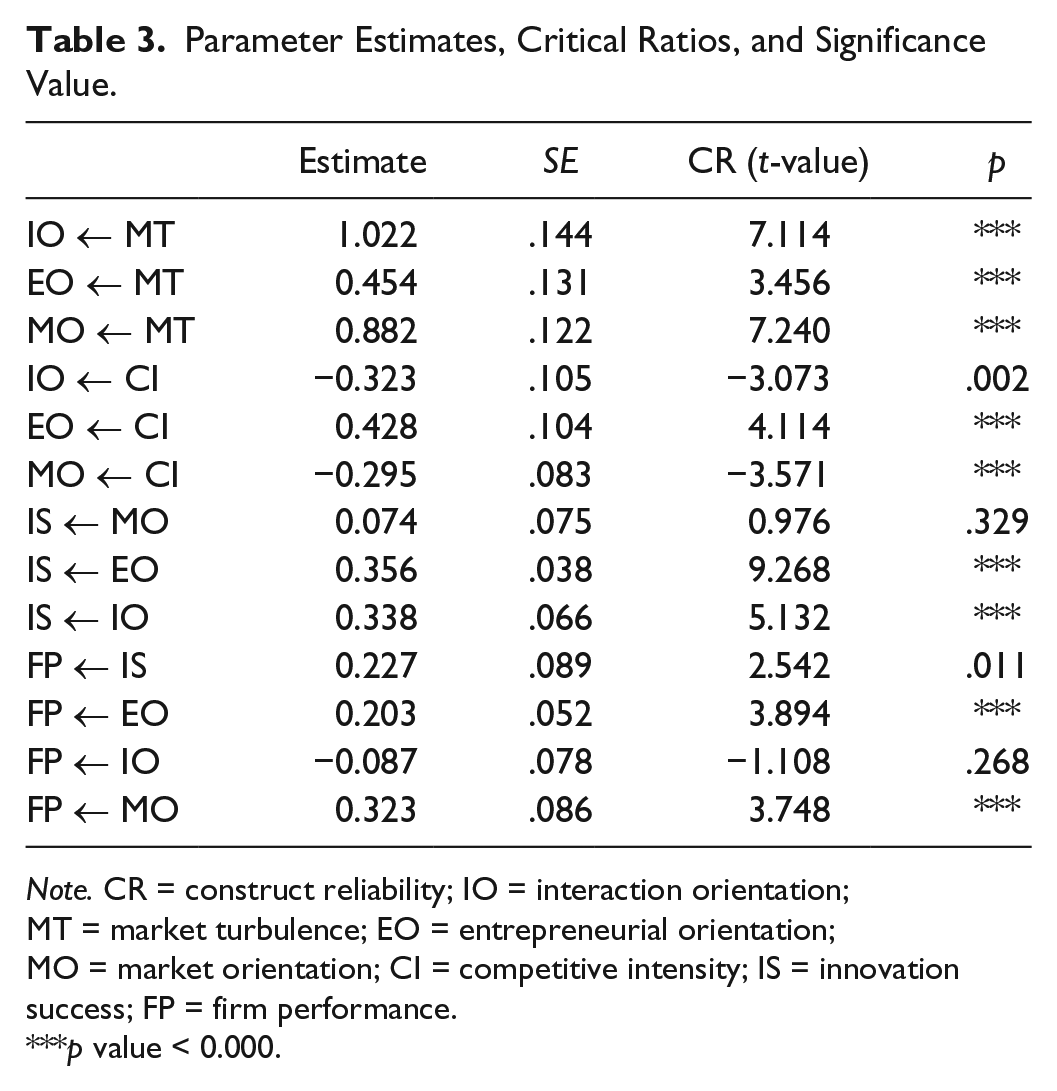
In assessing the structural paths, t-value was applied together with the significance of the regression (beta coefficient). For the path to be considered statistically significant, t-value (C.R.) needs to be greater than ±1.96 at 5% significance level (or greater than ±1.645 at a 10% significance level or greater than ±2.575 at a 1% significance level). Table 3 shows the parameter estimates, standard errors, critical ratios, and the significance values for all the paths are within the full model.
Parameter Estimates, Critical Ratios, and Significance Value.
Note. CR = construct reliability; IO = interaction orientation; MT = market turbulence; EO = entrepreneurial orientation; MO = market orientation; CI = competitive intensity; IS = innovation success; FP = firm performance.
p value < 0.000.
It was anticipated that all relationships within the model would be positive; however, some negative pathways were also found. Competitive intensity was found to negatively affect market orientation (β = −3.073) and interaction orientation (β = −3.571). Previous research had indicated that this path should be positive (Slater & Narver, 1994); the meaning and implications of this converse result will be discussed in greater detail in the next chapter. It must also be noted here that the relationship between market orientation and innovation success is not significant. The relationship between interaction orientation and firm performance is also not significant. The originators of the concept of interaction orientation, Ramani and Kumar (2008), examined and validated interaction orientation as a positive variable against customer-based relational performance and customer-based profit performance, but not directly on firm performance.
Next, the squared multiple correlations (r2) are reported in Table 4. The value of r2 indicates the variance accounted for by the variables in the model up until a specific variable. Of significance, the value of r2 for firm performance was .439, indicating that 43.9% of the variance in firm performance was accounted for by the variables tested within this study. In addition, the variance accounted for innovation success was 63.5%, suggesting a strong association between the strategic orientation variables and innovation success.
Squared Multiple Correlations (r2).

Results of Hypotheses Testing
Altogether, there are three major hypotheses with 12 subhypotheses, covering the direct effect of strategic orientation on firm performance, the direct effect of the external environmental variables on strategic orientation components, and the mediation effect of innovation success on the relation between strategic orientation and firm performance.
Direct effect of strategic orientation
There are three hypotheses relating to the direct effect between the strategic orientation and firm performance. It was hypothesized that there would be a positive and significant relationship between entrepreneurial orientation and firm performance; this was supported by the current research (β, t-value and p value). With a t-value of 3.894, the present study provides evidence that the direct relationship between entrepreneurial orientation and firm performance is significant, thus supporting the hypothesis as well as the extant literature reporting the positive effect of entrepreneurial orientation on firm performance.
It was hypothesized that there would be a positive and significant relationship between market orientation and firm performance. The direct path between market orientation and firm performance was significant as it had a t-value of 3.748. This result supports the hypothesis of this study and the extant literature on the positive effect of market orientation on firm performance. It was hypothesized that there would be a positive and significant relationship between interaction orientation and firm performance. Ramani and Kumar (2008) argued that interaction orientation has a direct effect on customer-based profit performance and customer-based relational performance. This study, however, examined the relationship between interaction orientation and firm performance. The present study showed a t-value of −1.108 implying that the relationship between interaction orientation and firm performance is not significant. This finding will be explored in relation to the available literature, the context, and the reformation of the INTOR measure.
Direct effect of external environment
This study hypothesized that there is a direct effect of factors of external environment (market turbulence and competitive intensity) on strategic orientation. Market turbulence was found to be a significant predictor for all three strategic orientations. The analysis reported t-values of 7.240 for market orientation, 3.456 for entrepreneurial orientation, and 7.114 for interaction orientation, indicating that all the hypotheses are valid. Similarly, it was hypothesized that competitive intensity would have a direct positive effect on strategic orientation. However, the results of the analysis show that competitive intensity only has a direct positive effect on entrepreneurial orientation construct (t-value = 4.114) and not on market orientation (t-value = −3.571) and interaction orientation (t-value = −3.073). This means that while the presence of competitive intensity leads to higher entrepreneurial orientation, it may lower the level of market orientation or interaction orientation adopted by a firm.
Mediating effect of innovation success
This hypothesis was designed to examine the mediation effect of innovation success on the relationship between strategic orientation and firm performance. It was hypothesized that there would be a mediation effect of innovation success between market orientation and firm performance. Prior to determining the mediation effect of innovation success, this study analyzed the direct effect of market orientation and firm performance. Table 5 shows the output of beta coefficient (0.50) for the direct effect of market orientation and firm performance and it has a significant effect; p value is less than .001 levels (two-tailed). Next, the mediator construct included in the model as shown in Table 5 shows the output of the beta coefficient after the mediating construct of innovation success.
Output of Innovation Success as the Mediation Effect.

Note. CR = construct reliability; MO = market orientation; FP = firm performance; IS = innovation success.
p value < 0.000.
These results show that 54.7% of the variance of the direct effect between market orientation and firm performance is accounted for, while the variance of the indirect effect between market orientation and firm performance accounts for 45.2%. The variance of total effect accounts for 51.1%. The variance indicates that the direct effect is more significant compared with the indirect effect and total effect. However, it is observed that the value of direct effect (MO → FP) is reduced when innovation success enters the model (from 0.50 → 0.28). The type of mediation here is called “partial mediation” as the direct effect of market orientation on firm performance is still significant after innovation success entered the model, even if the beta coefficient for market orientation is reduced from 0.50 to 0.28. In this case, market orientation has both a significant direct effect on firm performance and also a significant indirect effect on firm performance through innovation success. Thus, the result indicates that innovation success partially mediates the relationship between market orientation and firm performance; the hypothesis is accepted.
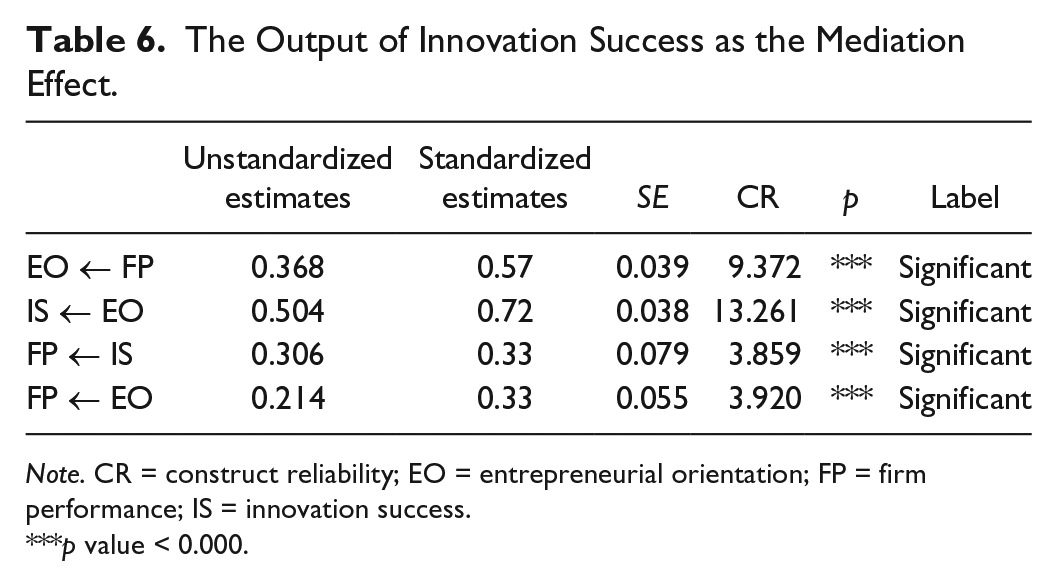
It was also hypothesized that there would be a mediation effect of innovation success between entrepreneurial orientation and firm performance. Table 6 shows the result providing a beta coefficient of 0.57 for the direct effect of market orientation on firm performance and it has a significant effect; p value is less than .001 levels (two-tailed).
The Output of Innovation Success as the Mediation Effect.
Note. CR = construct reliability; EO = entrepreneurial orientation; FP = firm performance; IS = innovation success.
p value < 0.000.
The variance of the direct effect between entrepreneurial orientation and firm performance accounts for 58.2%, while the indirect effect between entrepreneurial orientation and firm performance accounts for 41.9% of the variance. The variance of total effect accounts for 56.7%. It is observed that the value of direct effect (EO → FP) is reduced when innovation success enters the model (from 0.57 → 0.33). The direct effect of market orientation on firm performance is still significant after innovation success enters the model even though the beta coefficient for entrepreneurial orientation is reduced from 0.57 to 0.33, indicating a partial mediating effect. This means that entrepreneurial orientation has both a significant direct effect on firm performance and also a significant indirect effect on firm performance through the mediator construct of innovation success. Thus, the results indicate that innovation success partially mediates the relationship between entrepreneurial orientation and firm performance and the hypothesis is accepted.
Finally, it was hypothesized that there would be a mediation effect of innovation success between interaction orientation and firm performance. For calculating the mediation effect of the third variable, the direct effect between interaction orientation and firm performance needs to be significant. However, the testing of Hypothesis 1c showed that the direct effect of interaction orientation on firm performance was not significant; therefore, the mediation effect of innovation success was not calculated here. If the direct relationship is not significant, then the mediation effect cannot be calculated and the hypothesis must be rejected.
Conclusion
This study attempted to identify strategies and actions that can help Malaysian SMEs to achieve superior performance. This large-scale study used a combination of different constructs of strategic orientation that have never been tested together. The different constructs of strategic orientation were chosen to reflect one significant aspect of managing business in any SME and all of these constructs, namely, entrepreneurial orientation, market orientation, and interaction orientation, taken together combine to create a holistic form of strategic orientation. With this approach, this study provided a more comprehensive study of the impact of strategic orientation as a whole over existing studies that study it in a fragmented way by concentrating on one dimension of strategic orientation.
As the results show entrepreneurial orientation to be the construct that shares a positive relationship with all the other constructs in the model, it has been identified as the most significant strategic orientation. Interaction orientation was proven to have no effect on firm performance for Malaysian SMEs, and market orientation was found to play a reduced role in conditions of competitive intensity. Therefore, it appears that entrepreneurial orientation plays the most significant role for Malaysian SMEs. Entrepreneurial orientation comes from within the company, from the owner, or entrepreneur, and top management. A firm with higher market orientation is actually a firm with a good top-level manager who has also acquired a high level of entrepreneurial orientation as discussed in the last section. Therefore, at a certain point, entrepreneurial orientation and market orientation overlap with each other and firms need to have both orientations to achieve superior firm performance. Market orientation is derived from the organizational culture within a firm directed toward winning over and retaining customers with the best marketing practices. Market orientation is concerned with how SMEs position themselves in exploiting the market.
Innovation success is conceptualized by this study as the success of a firm in launching a wholly new product, concept, brand, and line extensions or customer service improvement. As a mediating variable, innovation success was found to exercise a partial effect on the significant strategic orientations of market and entrepreneurial orientation. External environment of market turbulence and competitive intensity were found to exert influence in some interesting patterns. While market turbulence, or changes in customer preference, was found to drive up all three strategic orientations, competitive intensity was found to adversely affect market orientation and interaction orientation. This could mean that instead of amplifying strategic orientation, in some exceptional circumstances like competitive intensity, firms find it more profitable to reduce strategic orientation in some areas. The positive effect of competitive intensity might sound feasible in theory, but firms find it too risky to practice market and interaction orientation under conditions of competitive intensity in the real world. All these results suggest that firms must adopt a flexible and varied mix of strategic orientations according to their needs and the external conditions in which they operate.
Footnotes
Declaration of Conflicting Interests
The author(s) declared no potential conflicts of interest with respect to the research, authorship, and/or publication of this article.
Funding
The author(s) received no financial support for the research, authorship, and/or publication of this article.