



Abstract
This research investigates how entrepreneurial orientation influences innovation performance in growth-oriented enterprises, examining the sequential chain-mediating roles of enterprise digitalization and dynamic capabilities. Employing panel data from 254 firms listed on China’s Growth Enterprise Market from 2015 to 2023, we test our hypotheses using a series of regression models and an instrumental variable approach to address endogeneity. The findings indicate that entrepreneurial orientation has a direct and positive effect on innovation performance. This relationship is indirectly channeled through two key pathways: enterprise digitalization, which acts as the primary mediator, and dynamic capabilities, which serves as a secondary mediator. Crucially, the sequential chain-mediation effect, while statistically significant, is substantively weak, revealing a “weak coupling” between firms’ digital investments and the subsequent development of their organizational agility. This research contributes by proposing and empirically validating a more sophisticated, sequential model of innovation and offers strategic insights by identifying a critical bottleneck in the innovation value chain for firms in the digital era.
Plain Language Summary
How Innovative Thinking Helps Companies Succeed in the Digital Age: The Power of Technology and Flexibility. When businesses aim to grow, they often face challenges like limited resources. This study looked at how a company’s "innovative mindset" (constantly seeking new ideas) helps overcome these challenges and improve innovation success. We analyzed data from 1,200 fast-growing Chinese tech companies (2015-2023) and found two key insights: (1) Going digital boosts innovation: Companies using technology to improve teamwork and decision-making saw faster results. For example, cloud tools helped teams share resources more effectively. (2) Adaptability matters but needs support: While being flexible to market changes is important, many companies struggle due to outdated habits ("we’ve always done it this way") or poor resource management. Interestingly, combining digital tools with adaptability could create even bigger benefits, but most companies haven’t fully connected these two areas yet. Why this matters: For business leaders: Focus first on upgrading technology systems, then train teams to use these tools flexibly. For policymakers: Support programs helping small companies adopt affordable digital solutions. This research shows that in today’s fast-changing economy, innovation isn’t just about having good ideas—it’s about building the right tools and culture to make those ideas work.
Keywords
Introduction
With the accelerated restructuring of the global innovation system and the deepening evolution of the technological landscape, the “innovation-driven development strategy” has been elevated to a central tenet of national strategy. Growth-oriented enterprises are increasingly demonstrating strategic significance in national innovation ecosystems. Compared to mature enterprises, these market entities characterized by high growth potential, strong technological disruption, and high investment returns exhibit enterprise innovation performance that not only determines their own survival and leapfrog development but also serves as a crucial pivot for industrial upgrading (Y. Du, 2023; Shi, 2021; X. Wang & Xu, 2001). Based on strategic choice theory, entrepreneurial orientation—defined as an organization’s decision-making propensity in innovation, proactive strategies, and risk-taking—is not merely a strategic option but a critical choice for growth-oriented enterprises to navigate their unique challenges. It offers a mechanism to break through technological barriers and achieve sustainable innovation by relying on an agile posture rather than vast resource endowments (S. Hu et al., 2014; Jiao et al., 2008). However, growth-oriented enterprises face dual constraints in innovation practice: they must simultaneously overcome the rigid limitations imposed by finite resource endowments on innovation error-tolerance mechanisms and resolve potential conflicts between frequent organizational restructuring and the flexibility required for technological innovation (Guan & Zhang, 2002) . Therefore, revealing how the strategic choice for an entrepreneurial orientation unfolds through unique mechanisms within the organizational context of growth-oriented enterprises holds particular theoretical value for escaping the “innovation catch-up trap” and constructing innovation governance frameworks compatible with high-growth trajectories.
Enterprise digitalization refers to the process through which organizations reconstruct business models and operational processes using digital technologies to optimize interactions, coordinate operations, and create additional customer value (Legner et al., 2017; Ritter & Pedersen, 2020). Prior research has typically treated digitalization as an independent variable affecting innovation, exploring its effects through mechanisms like digital technologies (H. Wang & Du, 2021), knowledge (Qiang et al., 2024), and capabilities (H. Zhang & Gu, 2023). However, digitalization is not a static attribute but an evolutionary process driven by entrepreneurial orientation, where innovativeness, proactiveness, and risk-taking play indispensable roles in driving digital transformation (Constantinides et al., 2018; Lv et al., 2023; H. Wang, Zhu, et al., 2024). Treating digitalization as the key mechanism linking EO to enterprise innovation performance allows us to elucidate the interdependent development patterns between a firm’s technological upgrading and its organizational transformation within high-growth contexts while expanding the scope of existing digitalization research. Drawing on the resource-based view and dynamic capability theory, Teece (1997) emphasizes that dynamic capabilities essentially represent the core mechanism through which enterprises convert heterogeneous internal and external resources into environmental adaptation advantages via systematic coordination, optimal recombination, and strategic restructuring. These capabilities enable organizations to assimilate knowledge, adapt to environmental changes, and develop new products or markets through resource-capability alignment, thereby achieving innovation performance (J. Zhang & Long, 2022). Enterprise digitalization level is further recognized as a catalyst for developing dynamic capabilities (Kim et al., 2012). This digital-driven evolution of dynamic capabilities helps growth-oriented enterprises amplify their innovation performance under resource constraints (J. Zhang & Long, 2022).
However, despite these important streams of research, significant gaps remain in our understanding. First, the precise mechanisms through which entrepreneurial orientation is converted into enterprise innovation performance remain a conceptual “black box.” While digitalization and dynamic capabilities are recognized as important factors, their sequential interplay as a chain-mediating pathway is poorly understood, leaving the causal architecture of innovation under-theorized. Second, much of the existing research focuses on either early-stage startups or large, mature enterprises (Yun et al., 2021). We know far less about how these complex dynamics unfold in the unique context of resource-constrained, growth-oriented firms, which face the dual pressures of scaling rapidly while managing scarce resources. Finally, the synergistic—or potentially conflicting—relationship between a firm’s digital infrastructure and its organizational agility is a critical but empirically underexplored area (W. Wang & Lin, 2021). This study is designed to address these specific gaps.
Therefore, this study aims to answer the following central research question: How does entrepreneurial orientation influence the enterprise innovation performance of growth-oriented enterprises, and what are the specific mediating roles of enterprise digitalization and dynamic capabilities in this process? Accordingly, this study selects growth-oriented enterprises listed on China’s Growth Enterprise Market from 2015 to 2023 as samples to conduct empirical research. This study proposes and tests a novel sequential pathway where entrepreneurial orientation drives innovation first through digitalization and subsequently through dynamic capabilities, examining this model in the under-studied context of resource-constrained firms. Moreover, the study enriches theoretical understanding of innovation mechanisms in growth-oriented enterprises and provides strategic insights for overcoming innovation catch-up dilemmas.
Theoretical Foundation and Research Hypotheses
Entrepreneurial Orientation and Enterprise Innovation Performance of Growth-Oriented Enterprises
Covin and Slevin (1991) conceptualize entrepreneurial orientation as a competitively driven strategic posture, operationalized as a unidimensional construct comprising innovativeness, risk-taking, and proactiveness. Firms demonstrating this orientation willingly undertake risks while leveraging technological innovation and transformation to secure competitive advantages (Wiklund & Shepherd, 2005). This manifests in three distinct dimensions: continuous product innovation and technological breakthroughs that disrupt existing development trajectories to build differentiated core competencies (Chu et al., 2025; Kollmann et al., 2017); proactive identification of latent market opportunities through anticipatory environmental scanning of niche markets, followed by strategic resource deployment to establish first-mover advantages (Lumpkin & Dess, 2001); and active absorption of high-risk project trial costs through allocating redundant resources to uncertain innovation initiatives, enabling exploration of emerging technologies and business models (Wiklund & Shepherd, 2005). This process strengthens the link between strategic decision-making and technological evolution through resource reconfiguration. Overall, growth-oriented enterprises exhibit a stronger tendency to innovate, take risks, and anticipate future market needs (Hashmi et al., 2023; Kollmann & Stöckmann, 2014; H. Zhang et al., 2014).
For growth-oriented enterprises, strategic orientation must simultaneously address scale expansion pressures and the resource constraint paradox, resulting in distinct manifestations of entrepreneurial orientation. Unlike mature firms that prioritize resource-optimized incremental innovation, growth-oriented enterprises rely more heavily on breakthrough value creation mechanisms inherent in entrepreneurial orientation to overcome challenges (Liu et al., 2025; G. Zhang, 2024). Within these firms, entrepreneurial orientation systematically enhances enterprise innovation performance through the synergistic interaction of innovativeness, proactiveness, and risk-taking. Innovativeness, as the foundational element of entrepreneurial orientation (Miller, 1983), serves as a critical lever to overcome resource constraints. This is exemplified through asset-light business model innovations (e.g., crowdsourced design, user co-creation) and modular product iterations that reconfigure market networks. Such innovation approaches align with the resource endowment characteristics of growth-oriented enterprises—their flat organizational structures facilitate rapid integration of cross-boundary knowledge resources to overcome developmental bottlenecks. For instance, consumer sector growth-oriented enterprises employing user co-creation mechanisms rely on cross-functional team collaboration to significantly compress the cycle from demand insight to value delivery (Liu et al., 2023). By fostering a culture of creative problem-solving and novel resource combination, innovativeness directly contributes to a higher rate of new product, service, and process development.
Second, proactiveness reflects an enterprise’s capacity to anticipate technological trends and respond rapidly, operating through a sequential mechanism of “technology opportunity identification—agile resource allocation—market window capture” (Peng et al., 2019). Unlike mature firms that depend on resource-intensive technology pre-research models, growth-oriented enterprises emphasize applied frontier technologies over basic research, prioritizing precise experimentation and rapid iteration (J. Du et al., 2024). This proactive stance necessitates a distinctive capability for resource bricolage—acquiring critical resources through alliances and swiftly engineering them into differentiated competitive advantages—which directly accelerates the conversion of market opportunities into innovation outcomes.
Third, risk-taking fundamentally represents strategic commitment to high-uncertainty innovation opportunities, providing essential error tolerance through strategic redundancy allocation and trial-and-error mechanisms (Y. Chen & Hao, 2022). When pursuing enterprise innovation performance, growth-oriented enterprises must reconfigure resources to create new value networks—a disruptive process often accompanied by high failure probabilities that demands risk tolerance mechanisms aligned with their growth stage. Growth-oriented enterprises display a high level of strategic ambition within competitive environments and are predisposed to seeking out innovative new opportunities (Singla et al., 2018). By replacing traditional linear R&D processes with “short-cycle sprint”—an agile approach characterized by rapid, iterative development cycles—through cross-functional agile teams, they accelerate hypothesis validation and enhance enterprise innovation performance conversion rates.
In synthesis, these three dimensions of entrepreneurial orientation do not operate in isolation; rather, they form a synergistic and mutually reinforcing strategic posture. Innovativeness provides the novel ideas and solutions, proactiveness ensures they are deployed in a timely and market-aware manner, and risk-taking creates the resilient environment necessary to pursue them despite uncertainty. This integrated orientation creates a robust internal environment that is fundamentally geared toward not just generating novel ideas, but systematically converting them into tangible innovation outcomes. Based on this analysis, we propose the following hypothesis:
The Mediating Role of Enterprise Digitalization
Enterprise digitalization is the process by which companies leverage digital technologies to fundamentally restructure their business processes, organizational frameworks, and value creation models (Nambisan et al., 2017). Unlike mature enterprises, growth-oriented enterprises typically encounter dual challenges of cognitive barriers and resource limitations in their digital transformation journey. These firms often struggle with limited understanding of digital technologies and organizational inertia that creates path dependency, making it difficult to break free from existing operational paradigms while remaining slow to adapt to market changes. In this context, the proactive dimension of entrepreneurial orientation enables forward-looking companies to disrupt conventional growth patterns by establishing agile organizational designs, investing in digital technology R&D, and redefining value creation approaches, thereby achieving rapid internalization of digital capabilities (Covin & Wales, 2012). This strategic initiative not only helps overcome resource constraints but also creates distinctive digital competitive advantages through seamless integration of digital elements with core business operations.
Moreover, the innovative aspect of entrepreneurial orientation requires companies to transcend existing knowledge and technological boundaries, emphasizing continuous and forward-thinking innovation to drive digital transformation (Hoffman & Novak, 2016). Elevating enterprise digitalization demands comprehensive restructuring across all operations, utilizing cutting-edge technologies to revolutionize workflows and business models to meet evolving market demands. The risk-taking component of entrepreneurial orientation plays an equally crucial role in motivating growth-oriented enterprises to pursue digital strategies. As a complex, long-term systemic initiative, enterprise digitalization faces multiple risks including technological obsolescence, organizational adaptation challenges, and market uncertainties—necessitating strategic resilience despite resource limitations. Many small and medium enterprises delay digital transformation due to high trial-and-error costs during transition periods. However, the strategic foresight inherent in risk-taking empowers growth-oriented enterprises to develop error-tolerant systems and agile decision-making frameworks, strengthening their commitment to digital transformation in competitive environments. Based on this analysis, we propose:
The implementation of digitalization strategies significantly enhances enterprise innovation performance in growth-oriented enterprises. Regarding resource optimization, digital transformation establishes collaborative networks that enable dynamic reconfiguration of knowledge and human capital (Fang & Chang, 2021). Practical applications include creating industry-specific digital talent pools to improve R&D efficiency and accelerate patent development cycles. From a technological perspective, AI-powered demand forecasting models and digital twin simulation platforms enable faster product iteration (L. Li, Liu, & Han, 2022). Particularly noteworthy are blockchain-based innovation tracking systems that enhance precision in R&D resource allocation, addressing the transparency challenges in innovation investments. This data-driven approach represents a paradigm shift from traditional experience-based innovation models. In terms of innovation costs, digitalization creates structural advantages through progressively decreasing marginal costs. Virtual testing environments transfer physical prototyping costs to digital spaces, significantly reducing validation expenses for individual innovation projects (Lyytinen et al., 2016). More importantly, platform-based collaborative innovation models provide “subscription-based” access to global premium R&D resources, allowing firms to achieve innovation outcomes at substantially lower costs. Therefore, we hypothesize:
Within the mechanism linking entrepreneurial orientation to enterprise innovation performance, enterprise digitalization serves as a critical mediator. From a resource-based perspective, growth-oriented enterprises with strong entrepreneurial orientation treat digital technologies as strategic assets, embedding digital capabilities through comprehensive restructuring of operations, organizational designs, and value creation systems (Zeng et al., 2024). This process establishes a vital linkage: entrepreneurial orientation drives firms to adopt advanced technologies for digital process transformation, optimizing operations through real-time data integration and intelligent decision-making systems, while simultaneously leveraging IoT solutions to enhance industrial collaboration networks for improved efficiency and ecosystem-wide digital advancement. The proactive nature of entrepreneurial orientation further pushes firms to redefine industry value propositions through digital innovation, creating unique competitive advantages via novel business models and dynamic platforms that integrate stakeholder resources—ultimately enabling comprehensive ecosystem transformation. Enterprise digitalization thus not only facilitates strategic resource allocation driven by entrepreneurial orientation but also translates entrepreneurial vision into sustainable innovation outcomes through dual pathways of “operational efficiency enhancement” and “ecosystem reconfiguration.” Accordingly, we propose:
The Mediating Role of Dynamic Capabilities
Dynamic capability theory, rooted in the resource-based view and incorporating perspectives from core competence theory, posits that organizations must maintain their ability to acquire information, integrate resources, and adapt to evolving environments in complex and volatile competitive landscapes to achieve sustained competitive advantages (Ambrosini & Bowman, 2009; Teece, 2014). While existing literature varies in categorizing dynamic capabilities, this study adopts Wang et al.’s framework, classifying them into three dimensions: innovation capability, absorptive capability, and adaptive capability (C. L. Wang & Ahmed, 2007). Innovation capability emphasizes an organization’s resource endowments and dynamic integration efficiency in product development and market expansion, with its core value residing in the structural linkage between organizational resources and product-market networks. Absorptive capability refers to the systematic process of identifying value in external information, transforming knowledge, and commercializing outcomes based on existing knowledge reserves, characterized by dynamic updating and innovative application of organizational knowledge systems (Warner & Wäger, 2019). Adaptive capability manifests as a strategic response mechanism that optimizes resource allocation by rapidly identifying market opportunities through environmental scanning, enabling synchronized opportunity recognition and resource reconfiguration (Yang et al., 2020).
Entrepreneurial orientation catalyzes the evolution of dynamic capabilities, compelling growth-oriented enterprises to adopt proactive stances toward external environmental changes, actively accumulating first-mover advantages, and embedding these advantages into organizational resource orchestration processes. This catalytic effect operates through three dimensions: First, innovativeness drives the establishment of exploratory learning mechanisms, enabling continuous technological foresight and knowledge recombination to transcend existing capability boundaries. Second, proactiveness enhances market signal identification, accelerating knowledge absorption and conversion through heterogeneous experience accumulation derived from first-mover advantages. Third, risk-taking strengthens strategic flexibility by dynamically allocating redundant resources, establishing safeguards for rapid adaptation to market shifts. These mechanisms collectively empower firms to maintain competitive advantages amid environmental turbulence. Thus, we hypothesize:
Dynamic capability theory highlights that competitive advantages in rapidly changing markets are inherently transient (N. Zhou et al., 2022). Growth-oriented enterprises, characterized by rapid expansion phases, face intensified resource constraints and innovation iteration pressures. Unlike mature firms with stable technological trajectories and market positions, these organizations require systemic adjustments or disruptive changes to resolve the paradox between scale expansion and innovation efficiency. These capabilities not only enhance the identification and absorption of disruptive technologies but also balance short-term survival needs with long-term innovation investments through the dynamic and flexible orchestration of resources, driving innovations across product development, processes, and management systems. This ultimately constructs innovation performance pathways aligned with high-growth trajectories (Amara et al., 2025). Accordingly, we hypothesize:
Dynamic capabilities act as a transmission conduit between entrepreneurial orientation and enterprise innovation performance, actualized through three distinct intermediation pathways. First, entrepreneurial orientation enhances enterprise innovation performance by strengthening innovation capability. Entrepreneurial orientation fosters resource integration and structural optimization, creating foundational conditions for innovation capability development, thereby incentivizing knowledge exploration and risky innovation practices. Enhanced innovation capability improves market trend anticipation and industry dynamics assessment (Mitchell & Skrzypacz, 2015). Specifically: (1) Growth-oriented firms with strong innovation capability excel at transforming fragmented technological reserves into scenario-based innovations under resource constraints, developing niche market-aligned products and services through creative bricolage; (2) Advanced innovation capability heightens environmental sensitivity, enabling precise opportunity recognition and resource allocation to build competitive advantages in product development, service optimization, and process reengineering. Second, entrepreneurial orientation elevates enterprise innovation performance by augmenting absorptive capability. Entrepreneurially oriented firms proactively construct internal-external knowledge networks, systematically gathering intelligence on customer needs, technological advancements, and partner innovations. By establishing standardized knowledge analysis protocols and cross-departmental collaboration mechanisms, growth-oriented enterprises effectively synthesize external knowledge with internal expertise, converting it into strategic resources. This knowledge metabolism mechanism not only mitigates formal management system deficiencies but also builds antifragile competitiveness through rapid knowledge-action cycles. Third, entrepreneurial orientation drives enterprise innovation performance by amplifying adaptive capability. Organizations with such dynamic adjustment mechanisms continuously optimize technology applications and product iterations while refining management models and collaborative workflows, collectively enhancing enterprise innovation performance. Thus, we hypothesize:
The Chain-Mediation Role of Enterprise Digitization and Dynamic Capabilities
Building on theoretical foundations and existing research, enterprises must synchronize with the digital economy’s evolution as network technologies deeply penetrate industrial ecosystems, adapting to digital trends to expand and upgrade their dynamic capabilities (Y. Hu et al., 2025; Jin et al., 2013). First, enterprise digitalization enhances the innovation capability of growth-oriented enterprises (Lin et al., 2025). These firms typically face fragmented R&D resources and constrained trial-and-error capacities. By effectively integrating digital technologies with data resources, enterprises can dynamically capture market intelligence to enhance their responsiveness to external market dynamics. Leveraging big data analytics capabilities, they cleanse and integrate massive external datasets, constructing proprietary information systems to accurately identify shifts in consumer preferences and technological trajectories. This enables triple breakthroughs in product iteration optimization, production process reengineering, and enterprise innovation performance enhancement (Z. Chen & Xu, 2023). Second, enterprise digitalization strengthens the absorptive capability of growth-oriented enterprises. Digital transformation—through adopting advanced equipment, recruiting skilled talent, and engaging technical consultants—enhances a firm’s capacity to acquire and internalize new knowledge (Miao et al., 2024). Finally, enterprise digitalization amplifies the adaptive capability of growth-oriented enterprises. Digital technologies streamline information flows, transforming hierarchical organizational structures into grid-based, flattened architectures. This accelerates the speed and accuracy of information processing, enabling real-time data sharing and updating across departments (J. Wang & Li, 2024). Concurrently, digital tools enhance connectivity with external environments—for instance, deepening interactions with stakeholders to collect and analyze their demands. This improves market insight, consumer need comprehension, and organizational responsiveness to environmental shifts (X. Wang, Luo, & Geng, 2024).
Integrating the relationships hypothesized in H2 and H6, this study posits that this sequential pathway represents a resource-efficient logic for innovation, allowing growth-oriented enterprises to overcome their inherent resource constraints. They leverage their organizational agility and strategic growth orientation to establish a “digital technology penetration-capability iteration” pathway during entrepreneurial orientation implementation. By proactively constructing lightweight digital infrastructures, promoting scenario-specific embedding of AI and blockchain technologies through risk-taking decisions, and aligning technological resources with organizational structures via innovative strategic deployment, these firms develop a “knowledge absorption hub” (X. Zhou et al., 2023). The synergy between flattened organizations and grid-based systems materializes dynamic capability enhancement as three-dimensional breakthroughs: accelerated product innovation, efficient knowledge conversion, and intensified market responsiveness. These mechanisms collectively drive measurable improvements in enterprise innovation performance.
This chain-mediation logic exposes a critical insight: without the foundational step of digitalization, the effect of entrepreneurial orientation on dynamic capabilities would be severely constrained in the modern context. Similarly, without the development of dynamic capabilities, the vast potential of digitalization might remain untapped, resulting only in isolated efficiency gains rather than sustained innovation. It is the synergistic and sequential interplay of these elements that unlocks the full innovation potential of an entrepreneurial orientation. Based on this integrated logic, we propose our final hypothesis:
Figure 1 delineates the conceptual model developed in this research, synthesizing the preceding analytical foundations and propositional frameworks.

Conceptual model.
Research Design
To address the research questions, which involve a complex, multi-stage mediation process and potential endogeneity, we employ a multi-faceted quantitative strategy. We utilize panel data regression models to effectively control for unobserved firm heterogeneity and time-specific shocks. To specifically test our chain-mediation hypothesis, we adopt the widely-accepted procedures recommended by Wen and Ye (2014), supplemented by bootstrapping to ensure robustness. Finally, given that our key variables are based on textual analysis and that firm strategy and performance can be codetermined, we implement a rigorous instrumental variable (IV) approach to mitigate endogeneity concerns. This combination of methods is particularly well-suited to provide a robust and nuanced test of our theoretical model.
Sample Selection and Data Sources
This study selects growth-oriented enterprises listed on China’s growth enterprise market (GEM) from 2015 to 2023 as the research sample. First, since China formally introduced the concept of “digital transformation” in 2015, the industrial digitalization wave—propelled by internet technology innovations—has intensified environmental uncertainties for growth-oriented enterprises during this timeframe (Guo et al., 2023; Xie, 2023). This context compels such firms to enhance their digital capabilities or strengthen adaptive capacities to ensure survival and growth, providing an aligned research backdrop for exploring the theoretical framework. Second, the GEM’s inherent characteristics of high innovation intensity and dynamic competition align with the operational realities of growth-oriented enterprises (Y. Yu et al., 2024). Furthermore, the registration-based IPO reform on the GEM has lowered profitability thresholds, attracting numerous pre-profit firms with high innovation potential. The sample spans enterprises from the startup phase to rapid growth stages, enhancing the generalizability of findings while reflecting the unique innovation logic of emerging markets under policy incentives.
The selection criteria for growth-oriented enterprises prioritize firms demonstrating the following financial patterns for three consecutive years or more: positive net cash flows from operating activities, negative net cash flows from investing activities, and positive net cash flows from financing activities (Z. Zhou et al., 2020). These indicators reflect enterprises in a rapid market expansion phase—products swiftly capture market share with surging sales (evidenced by substantial cash inflows from operations), while aggressive investments to scale market presence (resulting in negative investment cash flows) necessitate external financing to bridge funding gaps beyond operational earnings (positive financing cash flows) . The sample was further refined through sequential filters: (1) exclusion of ST, ST, and PT firms; (2) removal of financial institutions; (3) elimination of entities with discontinuous reporting periods or extensive missing data. To mitigate outlier distortions, all continuous variables (excluding dummies) were winsorized at the 1% and 99% percentiles. The final dataset comprises 1,957 panel observations across 254 growth-oriented enterprises. Financial data were sourced from the CSMAR database, patent records from CNRDS, and annual reports from the CNINFO platform.
Variable Definition and Measurement
Dependent Variable (EIP)
Enterprise innovation performance refers to the outcomes of a firm’s innovation activities. Existing research predominantly employs two approaches to measure enterprise innovation performance: first, using new product sales revenue (Huang et al., 2021) or its ratio to total sales (D. Li et al., 2020) as core metrics; second, constructing evaluation systems based on patent output indicators such as the number of patent applications (X. Li, Dang, & Zhao, 2022) and patent grants (Yi et al., 2015). Considering data availability, accuracy, and stability (W. Li & Zheng, 2016), this study adopts the natural logarithm of patent applications (plus one) to quantify enterprise innovation performance.
Independent Variable (EO)
This study defines entrepreneurial orientation as a three-dimensional construct encompassing innovativeness, proactiveness, and risk-taking, building on prior literature. Accordingly, we employ textual analysis to develop a multidimensional measurement framework that systematically quantifies the intensity of these characteristic dimensions. Compared to traditional scale-based measurements or financial proxy methods, textual analysis effectively mitigates subjective evaluation biases and common method biases, objectively capturing entrepreneurial orientation tendencies reflected in strategic corporate disclosures and more accurately representing organizational innovation decision-making patterns. Drawing on the Chinese entrepreneurial orientation lexicon developed by X. Yu et al. (2022), Python-based web scraping techniques were applied to analyze the “Management Discussion and Analysis (MD&A)” sections of annual reports. Entrepreneurial orientation-related keywords were aggregated, and to address right-skewed distribution characteristics, the natural logarithm of the total word frequency (plus one) was adopted to measure entrepreneurial orientation.
Mediating Variable (DIG&DC)
Enterprise Digitalization, is the process by which a firm leverages digital technologies to fundamentally restructure its business processes, organizational frameworks, and value-creation models. Following Wu et al. (2021), this study measures enterprise digitalization by statistically analyzing word frequencies related to digital technologies (e.g., artificial intelligence, big data, blockchain, cloud computing) in annual reports. A predefined lexicon was systematically searched and matched to calculate total word frequencies. To address right-skewed distribution, the natural logarithm of total word frequency (plus one) is adopted.
Dynamic Capability is a firm’s ability to integrate, build, and reconfigure internal and external resources to adapt to changing environments. This study operationalizes it through three dimensions: innovation capability, absorptive capability, and adaptive capability. Drawing on Zhao et al. (2016) and Yang et al. (2020), dynamic capabilities are operationalized through three dimensions: innovation capability (a composite index of standardized R&D investment intensity and technical personnel ratio), absorptive capability (R&D investment-to-revenue ratio), and adaptive capability (negative coefficient of variation across R&D, capital, and advertising expenditures). The arithmetic mean of these three dimensions constitutes the overall dynamic capability score.
Control Variable
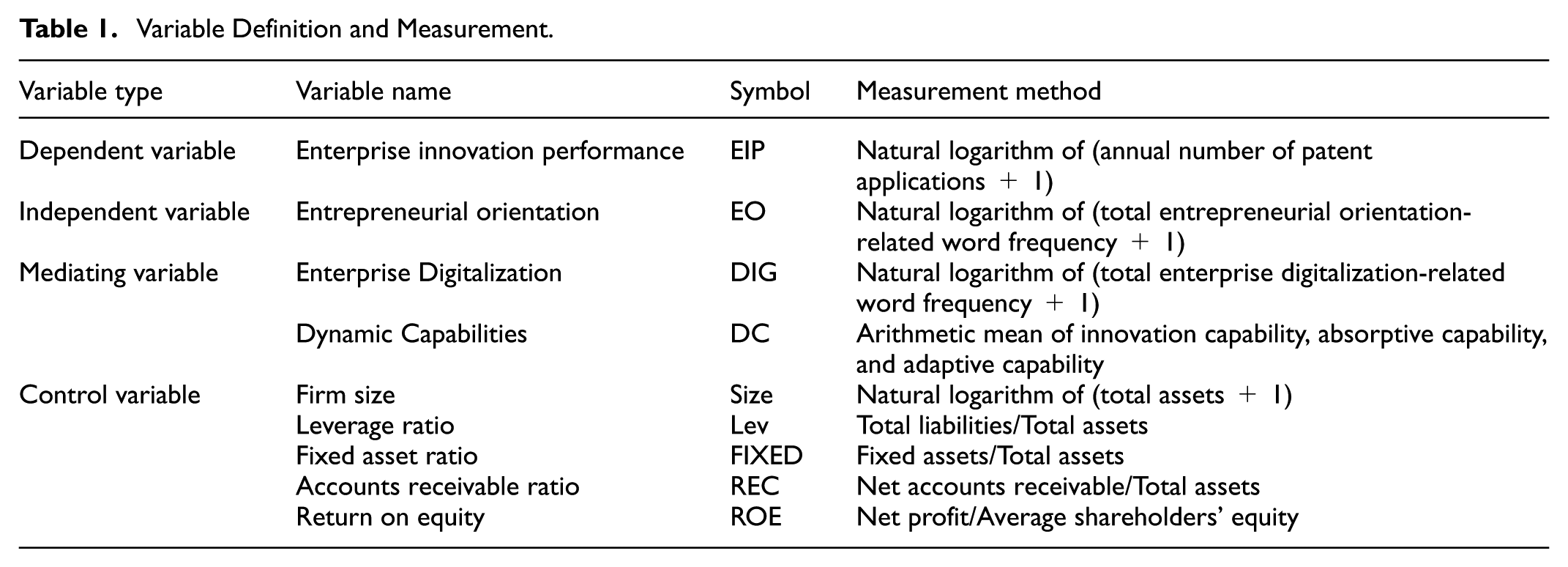
Building on existing literature, this study accounts for key factors influencing the relationship between entrepreneurial orientation and enterprise innovation performance by selecting the following control variables: firm size (Size), leverage ratio (Lev), fixed asset ratio (FIXED), accounts receivable ratio (REC), and return on equity (ROE). Detailed definitions and measurement methods for these variables are summarized in Table 1.
Variable Definition and Measurement.
Model Specification
To validate Hypothesis H1 regarding the impact of entrepreneurial orientation on enterprise innovation performance, this study establishes Model (1) as the baseline regression model. To test Hypotheses H4 and H7—the mediating roles of enterprise digitalization and dynamic capabilities in the relationship between entrepreneurial orientation and enterprise innovation performance—Models (2) to (5) are constructed (Wen & Ye, 2014). To examine Hypothesis H8 proposing a chain mediation effect, Models (6) and (7) are developed (Liu et al., 2022). The specific models are specified as follows:





Where the subscripts i and t denote the enterprise and year, respectively. EIP i,t represents enterprise innovation performance of enterprise i in year t; EOi,t is the entrepreneurial orientation of enterprise i in year t; DIGi,t and DCi,t represent Enterprise digitization levels and dynamic capabilities of enterprise i in year t; Controli,t represents a set of control variables. Year and industry fixed effects are captured by δt and μi, respectively, in the econometric specification. εi.t is the stochastic disturbance, which contains all other unobserved factors that could potentially affect enterprise innovation.
The use of firm and year fixed effects is crucial for our research design as it allows us to isolate the effects of our variables of interest from time-invariant firm characteristics and economy-wide trends that could otherwise bias our results.
Empirical Results and Analyses
Descriptive Statistics and Correlation Analysis
Table 2 reports the descriptive statistical analysis results of all variables. All variance inflation factor (VIF) values are below 2, further confirming the absence of significant multicollinearity issues in the empirical analysis.
Results of Descriptive Statistics and Correlation Analysis.

Note. The values in parentheses represent t-values adjusted with robust standard errors. ***p < .01, **p < .05, *p < .1. The same conventions apply to subsequent tables and analyses.
Main Effects Test
The test results for the relationship between entrepreneurial orientation and enterprise innovation performance in growth-oriented enterprises are reported in columns (1) and (2) of Table 3, with column (2) presenting the baseline regression results of Model (1). The regression outcomes reveal that, after controlling for industry and year fixed effects, the coefficients for entrepreneurial orientation are 0.619 (without control variables) and 0.388 (with control variables), both statistically significant at the 1% level. This demonstrates that entrepreneurial orientation positively influences enterprise innovation performance in growth-oriented enterprises regardless of control variable inclusion, thereby providing support for Hypothesis H1.
Main Effects and Mediation Effects Test Results.

Note. The values in parentheses represent t-values adjusted with robust standard errors. The same conventions apply to subsequent tables and analyses.
p < .1. **p < .05. ***p < .01.
Mediation Effect Tests
Independent Mediation Effect Test
The mediation test results for enterprise digitalization and dynamic capabilities are reported in Table 3. First, the mediating pathway through enterprise digitalization was examined. The results indicate that entrepreneurial orientation exerts a significant positive effect on enterprise digitalization (β = .751, p < .01). Furthermore, when both entrepreneurial orientation and enterprise digitalization are included in the model, enterprise digitalization shows a significant positive association with enterprise innovation performance (β = .198, p < .01). Since the direct effect of entrepreneurial orientation remains significant after introducing the mediator, enterprise digitalization is confirmed to play a partial mediating role. These findings suggest that entrepreneurial orientation enhances innovation performance through the promotion of enterprise digitalization, thus supporting Hypotheses H2 to H4.
Subsequently, the mediating pathway through dynamic capabilities was tested. The results reveal that entrepreneurial orientation significantly predicts dynamic capabilities (β = .624, p < .01), which in turn have a significant positive effect on enterprise innovation performance (β = .090, p < .01). As entrepreneurial orientation remains significant in the final model, dynamic capabilities are also identified as a partial mediator. This outcome provides robust empirical support for Hypotheses H5 to H7.
To address limitations of the three-step mediation test, supplementary Sobel and Bootstrap tests were conducted (see Table 3). Sobel tests confirm the significance of both enterprise digitalization and dynamic capabilities as mediators (1% level). Bootstrap tests with 5,000 resamples yield indirect effect confidence intervals excluding zero, robustly validating the partial mediating roles of enterprise digitalization and dynamic capabilities in the entrepreneurial orientation-innovation performance relationship. These results reinforce the support for H4 and H7.
Chain Mediation Effect Test
Subsequently, a test was conducted to examine the sequential chain-mediation effect (Hypothesis H8), in which entrepreneurial orientation influences enterprise innovation performance through enterprise digitalization, followed by dynamic capabilities. The results, presented in Table 3, support this pathway. First, the relationship between the two mediators was examined by regressing dynamic capabilities on both entrepreneurial orientation and enterprise digitalization. The analysis reveals a significant positive coefficient for enterprise digitalization (β = .168, p < .01), suggesting that digitalization contributes to the enhancement of dynamic capabilities. Finally, in the full model predicting enterprise innovation performance, the coefficients for entrepreneurial orientation (β = .217, p < .01), enterprise digitalization (β = .168, p < .01), and dynamic capabilities (β = .071, p < .01) are all statistically significant. The significance of all paths in the final model confirms the presence of a sequential chain-mediation effect, thereby providing strong support for Hypothesis H8.
To further validate the chain mediation effect, this study employs the Bootstrap method following Wen and Ye’s (2014) approach to test multiple mediation paths. Controlling for industry and year fixed effects, Bootstrap tests with 5,000 resamples were conducted using STATA 18.0, treating entrepreneurial orientation as the independent variable, enterprise innovation performance as the dependent variable, and enterprise digitalization and dynamic capabilities as sequential mediators. Table 4 presents three significant mediation paths:
Path 1 (Entrepreneurial Orientation → Enterprise Digitalization → Enterprise Innovation Performance): The 95% confidence interval excludes zero, reaffirming enterprise digitalization’s critical mediating role (H4 supported).
Path 2 (Entrepreneurial Orientation → Dynamic Capabilities → Enterprise Innovation Performance): The significant interval validates dynamic capabilities as a mediator (H7 confirmed).
Path 3 (Entrepreneurial Orientation → Enterprise Digitalization → Dynamic Capabilities → Enterprise Innovation Performance): The interval excluding zero verifies the chain mediation effect (H8 reinforced).
Collectively, these results demonstrate that entrepreneurial orientation enhances enterprise innovation performance through the synergistic interplay of digitalization and dynamic capabilities, with the total mediation effect statistically established.
Further analysis of effect proportions reveals a total indirect effect of 0.171, accounting for 44.07% of the total effect (0.388). Enterprise digitalization dominates as the primary driver (indirect effect = 0.126, 32.47%), underscoring its pivotal role in enterprise innovation performance. Dynamic capabilities contribute modestly (0.034, 8.76%), suggesting inefficiencies in capability utilization, while the chain mediation effect (0.010, 2.58%) remains underdeveloped, indicating untapped potential in digital-enabled dynamic capability synergies. Practically, firms should prioritize deepening digitalization to optimize dynamic capabilities (e.g., resource integration, agile response) while enhancing organizational flexibility to mitigate “capability silos” and improve innovation conversion efficiency.
Chain Mediator Bootstrap Test Results.

Robustness Tests
Replacement of Dependent Variable
To ensure the robustness of findings, this study substitutes the dependent variable—enterprise innovation performance—with two alternative measures: the natural logarithm of total invention patent applications (plus one) and the natural logarithm of total patent grants (plus one). The regression results, reported in columns (1) and (2) of Table 5, show positive and statistically significant coefficients at the 1% level, consistent with baseline regression outcomes.
Robustness Tests Results.

Note. The values in parentheses represent t-values adjusted with robust standard errors. ***p < .01, **p < .05, *p < .1. The same conventions apply to subsequent tables and analyses.
Replacement of Independent Variable
Drawing on Yang’s (2014) methodology, this study replaces the measurement of entrepreneurial orientation (the core explanatory variable) with a financial indicator-based approach, specifically constructing the metric using the ratios of R&D expenditure and net cash flows from investing activities to sales revenue. The regression results, presented in column (3) of Table 5, show a significantly positive coefficient for the core explanatory variable, aligning with the baseline regression findings.
Fixed Effects Interaction
To address potential omitted variable bias and strengthen the internal validity of model identification strategies, this study incorporates industry-year interaction terms into the regression model for robustness testing. As shown in column (4) of Table 5, after controlling for year, industry, and industry-year interaction fixed effects, the coefficient of entrepreneurial orientation remains significantly positive at the 1% level, confirming the validity of Hypothesis H1. These results demonstrate the robustness of our findings even when accounting for industry-specific temporal trends to mitigate omitted variable concerns.
Endogeneity Tests
Hysteresis Effect
To mitigate endogeneity concerns arising from bidirectional causality, this study introduces a one-period lag to the explanatory variable—entrepreneurial orientation. As reported in column (1) of Table 6, the coefficient of the lagged entrepreneurial orientation is 0.350, statistically significant at the 1% level. Further robustness checks lagging all control variables by one period (column (2) of Table 6) confirm the persistent significance of the baseline regression results, reinforcing the reliability of Hypothesis H1.
Hysteresis Effect and the Instrumental Variable Method.

Note. The values in parentheses represent t-values adjusted with robust standard errors. ***p < .01, **p < .05, *p < .1. The same conventions apply to subsequent tables and analyses.
The Instrumental Variable Method
To mitigate endogeneity concerns, the research implements an instrumental variables (IV) estimation strategy. Specifically, the one-period lagged entrepreneurial orientation (EO_lag1) is selected as the instrumental variable, justified by two critical assumptions: (1) Relevance: The lagged variable strongly correlates with current entrepreneurial orientation; (2) Exclusion restriction: The lagged variable affects enterprise innovation performance solely through its impact on current entrepreneurial orientation, remaining uncorrelated with the error term. The IV estimation is implemented via the ivreghdfe command with year and industry fixed effects, as reported in Table 6.
The first-stage regression results (column (3) of Table 6) confirm a statistically significant positive relationship between EO_lag1 and current entrepreneurial orientation, satisfying the relevance condition. Weak instrument tests reveal a Cragg-Donald Wald F-statistic far exceeding critical thresholds, rejecting the weak IV hypothesis. Overidentification tests further validate model identification adequacy. Second-stage results (column (4)) demonstrate that entrepreneurial orientation retains a significant positive effect on enterprise innovation performance after endogeneity correction, aligning with baseline regression directionality but with adjusted coefficient magnitudes—indicating baseline estimates underestimated true effects due to endogeneity bias. The Durbin-Wu-Hausman test rejects the null hypothesis of exogeneity at the 5% level, confirming the presence of endogeneity and thus justifying our use of an IV approach.
Discussion
In the era of technological innovation-driven development, entrepreneurial orientation has emerged as a critical driver for enhancing enterprise innovation performance in growth-oriented enterprises. Contextualizing the growth enterprise market (GEM), this study empirically examines the mechanisms through which entrepreneurial orientation influences enterprise innovation performance, with particular emphasis on the mediating roles of enterprise digitalization and dynamic capabilities. Key findings reveal: First, entrepreneurial orientation enhances enterprise innovation performance via dual mechanisms: direct causal pathways and mediated transmission channels (X. Li et al., 2010). Second, enterprise digitalization demonstrates the strongest mediating effect, underscoring its role as the core conduit for translating entrepreneurial orientation into innovation outcomes (Covin & Wales, 2012; Hoffman & Novak, 2016). This highlights the strategic imperative for growth-oriented firms to prioritize digital capability building, leveraging technological embedding and process reengineering to unlock innovation potential. Third, the weaker mediating effect of dynamic capabilities suggests bottlenecks in capability conversion, likely due to organizational inertia and inefficient resource integration (Amara et al., 2025). Fourth, the chain mediation effect of “entrepreneurial orientation → digitalization → dynamic capabilities → enterprise innovation performance” proves statistically significant yet limited in practical impact, revealing underactivated synergies between digital and capability drivers (X. Zhou et al., 2023). This further exposes a “weak coupling” issue between digitalization and dynamic capability development: despite digitalization providing technological foundations for dynamic capabilities (e.g., data-driven agile responsiveness), their conversion into enterprise innovation performance remains hindered by insufficient managerial mechanisms and strategic alignment.
Conclusions and Implications
Conclusions
This study sought to unravel the mechanisms through which an entrepreneurial orientation enhances the enterprise innovation performance of growth-oriented enterprises navigating the complexities of the digital era. Research confirms that an entrepreneurial orientation is not just a direct driver of innovation but is instrumental in setting off a strategic cascade of organizational change. The findings provide a clear answer to the central research question: an entrepreneurial orientation boosts enterprise innovation performance through the crucial, yet distinct, mediating pathways of enterprise digitalization and dynamic capabilities. Enterprise digitalization emerges as the primary and most powerful conduit through which the strategic intent of an entrepreneurial orientation is translated into tangible innovative output. While dynamic capabilities also serve as a significant mediator, their role is secondary. Crucially, our test of the sequential chain model uncovers a significant but weak effect, pointing to a “weak coupling” between firms’ investments in digital infrastructure and the subsequent enhancement of their organizational agility. This insight highlights a critical bottleneck in the innovation value chain for growth-oriented firms.
Theoretically, this research contributes by proposing and empirically validating a more sophisticated, sequential model of innovation, moving beyond simplistic direct-effect or parallel-mediation frameworks. It illuminates the pivotal role of digitalization as a necessary antecedent to the development of digitally-empowered dynamic capabilities. Practically, findings carry a clear strategic imperative for managers: fostering an entrepreneurial culture is essential, but it is not sufficient. To unlock their full innovation potential, leaders must not only drive enterprise digitalization but also actively cultivate the organizational structures and processes—the dynamic capabilities—that allow them to fully capitalize on these technological investments.
Management Insights and Policy Implications
Based on our findings, we offer the following strategic recommendations for managers and policymakers.
For Managers:
Prioritize Digitalization as the Core Engine for Innovation. Our results show that enterprise digitalization is the most powerful channel through which an entrepreneurial orientation is converted into innovative output. This provides a clear strategic directive: for firms with an ambitious, risk-taking culture, the most immediate returns on innovation efforts will likely come from prioritizing investments in a robust digital infrastructure. This includes deploying intelligent data analytics platforms to optimize R&D decisions and implementing IoT technologies for real-time process monitoring.
Actively Bridge the “Weak Coupling” Gap Between Technology and Agility. Our most critical finding is the “weak coupling” between digital investments and the development of dynamic capabilities. This highlights a common point of failure for many firms. The strategic imperative is clear: technological investment must be matched with an equal investment in organizational change. Simply acquiring new technology is insufficient. Leaders must actively dismantle departmental silos by forming cross-functional teams, leverage digital tools to capture market shifts, and rapidly reconfigure resources to enhance strategic adaptability. This ensures that the potential of digitalization is fully capitalized upon by a truly agile organization.
Cultivate an “Entrepreneurial Orientation-Driven” Culture to Overcome Inertia. To support the deep changes required by digitalization and dynamic capability building, a supportive organizational culture is essential. Managers should flatten decision-making hierarchies, implement error-tolerant incentive mechanisms, and institutionalize innovation case sharing to transform employees from mere executors into proactive explorers. This cultural foundation is necessary to overcome the organizational inertia that often hinders transformation efforts.
For Policymakers:
Design Holistic Innovation Policies. Our findings suggest that policies or subsidies focused solely on technology acquisition may yield suboptimal results. To foster a vibrant innovation ecosystem, policymakers should consider designing more holistic programs that support both technological and organizational development. This could include funding for agile management training programs, creating industry-university partnerships to cultivate digital talent, and establishing platforms for sharing best practices in organizational transformation alongside technological adoption. By doing so, policy can help firms bridge the critical “weak coupling” gap we identified, leading to more effective and sustainable innovation at a national level.
Limitations and Future Research
This study has several limitations that present valuable avenues for future research.
First, concerning the sample selection, our focus on growth-oriented enterprises listed on the growth enterprise market (GEM) was intended to align with our study’s specific contextual background. However, this approach necessarily excludes other growth-stage firms with lower innovation intensity. Furthermore, mature enterprises also face critical challenges in innovation, and strategies to enhance their performance warrant dedicated investigation. In addition to financial metrics, future research on sample selection should also consider factors such as firm complexity and the timeliness of data when selecting samples of growth-oriented enterprises.
Second, our findings reveal that the chain-mediation effect of enterprise digitalization and dynamic capabilities, while statistically significant, is substantively weak. Subsequent research should therefore consider incorporating potential moderating variables—such as organizational learning culture or external ecosystem support—to test whether the strength of this mediation mechanism improves under specific boundary conditions.
Third, regarding the research methodology, our measurement of entrepreneurial orientation and enterprise digitalization relies on textual analysis. Future studies could provide a richer understanding by collecting direct, first-hand data through qualitative methods like interviews and employing grounded theory or case study approaches. Alternatively, financial data could be used to explore how entrepreneurial orientation manifests in different firm types. Moreover, our use of patent applications to measure enterprise innovation performance has inherent limitations; future research could disaggregate enterprise innovation performance into more granular categories.
Footnotes

Funding
The authors disclosed receipt of the following financial support for the research, authorship, and/or publication of this article: This work was supported by the National Social Science Foundation of China [Grant No.: 24BMZ034].
Declaration of Conflicting Interests
The authors declared no potential conflicts of interest with respect to the research, authorship, and/or publication of this article.
Data Availability Statement
The data are available from the corresponding author upon reasonable request.