



Abstract
Guided by the resource-based view and dynamic capabilities theory, this study investigates the roles of market orientation (MO), entrepreneurial orientation (EO), environmental munificence (EM), and complexity (EC) in shaping crisis adaptiveness and firm performance. The study gathered data from 656 small-to-medium-sized enterprises (SMEs) located in the greater Kuala Lumpur area shortly after the easing of pandemic-related restrictions. The hypotheses were examined through the application of partial least squares structural equation modeling (PLS-SEM). The empirical results indicate that crisis adaptiveness mediates the MO-performance, and EO-performance links, with the individual direct pathways among these variables also remaining significant. Furthermore, EM weakened the direct effect of crisis adaptiveness on firm performance. EC positively moderated EO’s direct and indirect effects on crisis adaptiveness and firm performance. Entrepreneurs can leverage these insights to develop proactive crisis management strategies and cultivate a culture of innovation and market responsiveness within their businesses to remain agile, resilient, and adaptive to unpredictable market forces. Additionally, policymakers and business consultants can use these findings to tailor support programs that enhance SMEs’ crisis adaptiveness, particularly by fostering proactive, innovative, risk-taking behaviors and resource reconfiguration. By integrating the resource-based and dynamic capabilities paradigms, this study not only bridges the gap between MO, EO, crisis adaptiveness, and firm performance but also provides actionable insights for strengthening SMEs’ strategic positioning in uncertain environments.
Plain Language Summary
This research explores how small and medium-sized enterprises (SMEs) in Kuala Lumpur adapt to crises and how this affects their performance. It focuses on the roles of market orientation (MO), entrepreneurial orientation (EO), and environmental factors. The ability to adapt to crises is crucial for SMEs. It acts as a bridge between MO, EO, and firm performance, especially during challenging times. The study found that abundant resources can weaken the impact of crisis adaptiveness on performance, while a complex environment enhances this link. Entrepreneurs can use these findings to create strategies that help their businesses stay agile and competitive during crises. Fostering a culture of innovation and market responsiveness is essential for SMEs to navigate unpredictable markets successfully. The study bridges the gap in understanding how SMEs can leverage their strategic orientations (EO and MO) and adaptiveness to thrive in various environmental conditions. It encourages SMEs to embrace market challenges as opportunities for growth.
Keywords
Introduction
Small and medium-sized enterprises (SMEs) worldwide have faced significant challenges in the post-pandemic era, including economic uncertainty driven by inflation, supply chain disruptions, geopolitical tensions, declining household consumption, a tight labor market, and increased competition (Castro & Moreira, 2024). These external pressures disproportionately affect SMEs, which often have fewer resources and less capacity for crisis adaptiveness compared to larger firms (Cruz & Bivona, 2025). Limited financial reserves, restricted access to credit, and lean workforces make it difficult for SMEs to absorb disruptions and invest in necessary strategic changes.
Unlike larger companies with dedicated departments for risk management and innovation, SMEs frequently lack these functions, making their response to abrupt changes slower and less effective (De Matteis et al., 2023). This vulnerability highlights the need for SMEs to enhance their crisis adaptiveness to survive and thrive in volatile environments (Mohamed Senin et al., 2024). A lack of crisis adaptiveness among SMEs threatens firm survival and risks wider societal consequences. This is so since these enterprises are central to sustaining employment, stabilizing local supply chains, and supporting community well-being in emerging economies.
Key strategic behaviors, including market orientation and entrepreneurial orientation, play crucial roles in shaping SMEs’ strategic responses during crises. Market orientation focuses on understanding customer needs and competitor strategies to generate superior value and establish a sustainable competitive edge (Narver & Slater, 1990). Entrepreneurial orientation, characterized by a firm’s tendency to engage in entrepreneurial behaviors, such as proactiveness, risk-taking, and innovativeness (Covin & Wales, 2012; Lumpkin & Dess, 1996), fosters innovation and enables firms to seize opportunities and navigate uncertainties. Recent meta-analyses have widely acknowledged the positive effects of market orientation and entrepreneurial orientation on SME’s performance (Lin & Chung, 2023; Montiel-Campos, 2018).
However, the effectiveness of these orientations is influenced by the external environment, specifically environmental munificence (the abundance of opportunities) and environmental complexity (the diversity and unpredictability of market conditions; Boso et al., 2013). While environmental munificence offers rich opportunities, it can lead to complacency (Wang & Zhou, 2022). In contrast, environmental complexity, though challenging, can stimulate innovation and drive firms to adapt strategically (Hitt et al., 2021).
Despite the recognition of market orientation and entrepreneurial orientation in aiding SME resilience, existing literature lacks a comprehensive understanding of how these orientations interact with specific environmental conditions during crises (Saezow & Sukhabot, 2025). Some scholars argue that market orientation is crucial for sustaining competitive advantage in dynamic markets (Manurung & Kurniawan, 2022; Özsomer et al., 2023), while others emphasize the dominant role of entrepreneurial orientation in enhancing crisis resilience (Al Issa et al., 2023; Moreno-Menéndez et al., 2022). Recent studies have highlighted potential limitations in current conceptualizations of crisis adaptiveness within the SME context, raising questions about the adequacy of existing models in capturing the nuanced and volatile nature of post-pandemic environments (Lee et al., 2024; Marcazzan et al., 2022). Therefore, the dynamics of entrepreneurial orientation in crisis contexts warrant careful consideration, as its impact on performance can be nuanced and contingent upon various contextual factors, particularly in the rapidly evolving digital landscape (Kwiotkowska, 2022).
While RBV and DCT provide valuable frameworks for explaining how firms build and deploy capabilities, most prior research has concentrated on large firms in stable environments (Boso et al., 2013; Hitt et al., 2016). Consequently, the interplay between strategic orientations (market orientation and entrepreneurial orientation), environmental conditions (munificence and complexity), and crisis adaptiveness in SMEs remains underexplored, particularly in crisis recovery contexts. Few studies have examined these relationships within an integrated moderated mediation model, limiting understanding of how dynamic capabilities operate under environmental contingencies (Mohamed Senin et al., 2024; Saezow & Sukhabot, 2025). This study addresses these gaps by extending RBV and DCT to explain SME performance in turbulent conditions and integrating strategic orientation and environmental perspectives. Accordingly, this research seeks answers to the following questions: In times of crisis, how and when do MO and EO influence SME performance? Do crisis adaptiveness, environmental munificence, and complexity intervene and interact within this relationship?
To ground this investigation in a relevant and distinctive setting, the study examines post-COVID SMEs in Greater Kuala Lumpur. These SMEs experienced rapid digitalization amid persistent resource constraints and uneven digital literacy, conditions that distinguish them from SMEs in more digitally mature economies (Jaish et al., 2024). Malaysia’s recovery was shaped by targeted policy programs such as PENJANA-led grants and digital upskilling initiatives, rendering it unique from earlier crisis contexts not driven by similar government-led ecosystem interventions (Yin & Wan Usamah, 2022). Hence, additional investigation is warranted to explore in greater detail the mechanisms by which market orientation, entrepreneurial orientation, and environmental conditions contribute to the crisis adaptiveness and performance of SMEs in emerging economies such as Malaysia. By addressing this knowledge deficit, scholars can offer fresh theoretical perspectives and practical ramifications for SMEs that aim to fortify their capacity to adjust and prosper amidst unforeseen disruptions.
Theoretical Background
Resource-Based Theory
The resource-based theory (RBT) emphasizes the importance of a firm possessing valuable resources and capabilities that are rare, inimitable, and non-substitutable (VRIN) to achieve a competitive advantage (Barney, 1991). From a market and entrepreneurial orientation perspective, these orientations function as potential sources of VRIN capabilities for SMEs in the context of crises. For instance, a strong market orientation signifies a deep understanding of customer needs and competitor strategies (Narver & Slater, 1990). This valuable and potentially rare capability allows for differentiation and superior value creation, even under adverse conditions. Likewise, entrepreneurial orientation fosters innovation, proactiveness, and risk-taking, leading to capabilities that are difficult for competitors to imitate or substitute, offering a strategic advantage in navigating market turbulence (Covin & Slevin, 1989; Wales, 2016).
In the realm of entrepreneurial marketing literature, RBV has undergone significant adaptation and integration to elucidate the strategic behaviors of SMEs in response to dynamic market conditions and external pressures, particularly in the post-pandemic era marked by economic uncertainties and heightened competition. Recent academic research emphasizes the importance of integrating outside-in and inside-out entrepreneurial marketing capabilities and resources to enhance entrepreneurial firm performance, highlighting the evolving landscape of strategic marketing practices in the context of SMEs (Alqahtani et al., 2022; Saeed et al., 2015). The outside-in perspective focuses on acquiring market intelligence and adapting to customer needs, which aligns with the market orientation concept (Mahdi et al., 2024). Meanwhile, the inside-out view emphasizes leveraging a firm’s unique resources and capabilities to create superior value propositions, in which these values are reflected through entrepreneurial orientation (Morgan et al., 2015).
However, SMEs often lack the extensive resource buffers of larger firms when crises occur. In such contexts, the capacity to reconfigure and deploy VRIN resources dynamically allows SMEs to adapt to rapid environmental changes, positioning them to recover and thrive despite the challenges posed by crises. This is where dynamic capabilities theory comes into play, complementing RBV. While RBV provides clear guidelines for identifying VRIN resources, the dynamic capability paradigm should complement RBV by sensing trends and threats, seizing opportunities, and transforming these resources to enhance their capabilities.
Dynamic Capabilities Theory
As the entrepreneurial marketing landscape evolved, there was a noticeable shift toward incorporating the concept of dynamic capabilities within the RBV framework. Scholars recognized the need for SMEs to develop adaptive marketing strategies that enable them to respond swiftly to changing market dynamics and emerging opportunities (Rashid & Ratten, 2021; You et al., 2023). The dynamic capabilities theory (DCT) emphasizes a firm’s ability to sense, seize, and reconfigure resources in response to a changing environment (D. J. Teece et al., 1997). Thus, this paradigm addresses the RBV’s shortcomings, such as its’ static nature and lack of focus on external changes, by emphasizing the importance of resource flexibility, agility, and learning capabilities in enhancing the resilience of SMEs amidst turbulent environments.
This theory suggests that companies with superior dynamic capabilities have the ability to not only adjust to changes in their environment but also actively influence their surroundings to their advantage (Eisenhardt & Martin, 2000). RBV and DCT are intertwined, especially in the context of SMEs navigating crises, where firms must both leverage existing resources and core competencies, and reconfigure them to rapidly changing conditions. Small firms are increasingly leveraging dynamic capabilities to adapt and innovate in order to not just survive but succeed in uncertain environments characterized by economic instability and intense competition (Quansah et al., 2022; S. Tang et al., 2021). Studies have emphasized the significance of small enterprises acquiring sensing capabilities to recognize emerging possibilities, seizing capabilities to rapidly capitalize on these opportunities, and reconfiguring capabilities to reallocate resources effectively (Rashid & Ratten, 2021; You et al., 2023).
One real-world example is the case of small retail businesses navigating the chaos brought by the COVID-19 pandemic. When physical sales channels were disrupted, these SMEs rapidly acquired dynamic capabilities by shifting to e-commerce and online platforms (Fodouop Kouam, 2025). Sensing changes in customer behavior—more online shopping, they grabbed the opportunity to establish their digital presence and reconfigured their supply chain and marketing plans to fit the new digital landscape (Sutrisno et al., 2024). The restaurant sector is another where small businesses embraced online food orders and delivery systems. Sensing the need for home-delivery meals caused by lockdown, grabbing the opportunity to collaborate with delivery platforms, and reorganizing their operations allow them to survive despite the strict physical distancing measures (González Morales & Cavero Rubio, 2023; Traynor et al., 2024). This quick adaptation emphasizes how SMEs may use dynamic capabilities to pivot in reaction to crises. Nevertheless, there is a continuing scholarly debate surrounding the operationalization and measurement of dynamic capabilities, as well as the ability of small enterprises to effectively nurture and exploit these abilities considering their limited resources and organizational constraints (Leemann & Kanbach, 2022; D. J. Teece, 2022).
Model and Hypothesis Development
Crisis Adaptiveness and Firm Performance
The unprecedented social and economic costs incurred as a result of the Covid-19 pandemic present a critical opportunity to examine the adaptability of SMEs in confronting these challenges (Donthu & Gustafsson, 2020). The adaptability of SMEs in confronting these challenges is crucial for their performance in the post-pandemic landscape. Understanding how crisis adaptiveness relates to SME performance is essential for identifying the capabilities required to effectively respond to dynamic and uncertain environments, ultimately shaping their ability to recover the lost profits and market share suffered during an external crisis (Nenonen & Storbacka, 2020). Recent studies have provided valuable insights into the impact of crisis adaptiveness on firm performance, particularly in the context of SMEs and Covid-19 pandemic.
While crisis adaptiveness shares conceptual space with related constructs such as organizational resilience, agility, and flexibility, it is distinct in its emphasis on proactive and iterative adaptation during prolonged disruption. Organizational resilience typically focuses on a firm’s capacity to absorb shocks and return to a stable state (Duchek, 2020), while agility centers on rapid decision-making and reconfiguration of resources in dynamic environments (D. Teece et al., 2016). Flexibility refers more narrowly to the range of strategic or operational alternatives available to an organization (Volberda, 1996). In contrast, crisis adaptiveness captures the continuous, context-specific adjustments SMEs make to sustain operations and performance throughout the evolving phases of a crisis, integrating both survival-oriented resilience and opportunity-driven agility.
A study conducted by Klyver et al. (2023) on Danish SMEs found that when these firms adapt to a “new normal” and enhance their market and competitive abilities during the crisis, they are more likely to effectively take advantage of opportunities and achieve better results. In this aspect, speed of change is crucial in discovering novel entrepreneurial opportunities and benefiting from them to overcome setbacks caused by the crisis (Cucino et al., 2024). Likewise, crisis adaptiveness serves to prepare SMEs in shielding their profitability and resources against uncertainties, which will help them to be more resilient in acclimatizing to the pandemic crisis, thus leading to higher levels of organizational capability (Zighan et al., 2022).
From the empirical causal-effect perspective, studies have suggested that implementing adaptive strategies as a response to a crisis positively impacts firms’ business performance (Chudziński et al., 2023; Ishak et al., 2023; Paraskevas & Guix, 2023; Puumalainen et al., 2023). These investigations underscore the critical role of adaptive strategies in mitigating the adverse effects of crises, such as economic downturns or unexpected disruptions, on SMEs’ operational continuity, financial stability, and overall competitiveness. Hence, it is hypothetical to consider the following assumption:
Entrepreneurial and Market Orientations, and Crisis Adaptiveness
Since the nature of market orientation involves the firm’s adjustment to evolving market conditions and customer demands, it could be effective and beneficial during periods of crisis (González-Benito et al., 2014). By upholding a strong market orientation, firms can promptly recognize novel opportunities and potential risks and take appropriate actions in response (Kohli & Jaworski, 1990). Among the actions, firms may create novel products or services, modify their pricing strategies, or reorganize their distribution networks (Gotteland & Boulé, 2006). In essence, high levels of market orientation can enhance their ability to adapt quickly and effectively during a crisis, increasing its chances of survival and success (Zighan et al., 2022).
On the other hand, the qualities of the entrepreneurial oriented behaviors may assume heightened significance during a crisis, given that organizations must possess the capability to swiftly adjust to evolving conditions (Eggers, 2020). In order to exploit new opportunities, entrepreneurial firms are more likely to experiment with new ideas and techniques and to be willing to assume associated risks (Wiklund & Shepherd, 2005). This may enable them to emerge from a crisis more resilient and adaptable, with greater strength (Puumalainen et al., 2023). Recent research indicates that the performance of Asian SMEs during the pandemic is significantly influenced by market- and entrepreneurial-oriented behaviors (Norsalehe & Idris, 2023; Suder, 2023; Tjahjadi et al., 2024). Based on the above discussion, the following hypotheses are presented:
Interaction Effects of Environmental Munificence and Environmental Complexity
This research adopts the narrow definition of environmental munificence and refers it as the abundance of resources and opportunities in the target market, characterized by the high demand for products or services and their enduring nature, which prevents them from rapidly becoming obsolete (Boso et al., 2013). In a munificent environment, resources and opportunities are perceived to be abundant, and firms may not face significant threats or challenges (J. Tang, 2008). As a result, firms in such environments may not invest as heavily in developing crisis adaptiveness capabilities, as they may not perceive the need to do so (Gul, 2020). This can lead to a weaker positive influence of crisis adaptiveness on firm performance, as firms may not be as well-prepared to navigate crises when they do occur (Van Egeren & O’Connor, 1998). In contrast, firms in more challenging environments may be more likely to invest in crisis adaptiveness, as they perceive the need to be better prepared for potential crises (Salunkhe et al., 2023). Consequently, it is expected that:
Environmental complexity refers to the degree of variation in customer requirements, buying habits, and the competitive landscape across different product lines (Boso et al., 2013; McArthur & Nystrom, 1991). A business environment that is characterized by rapid changes in customer needs, shifting consumption patterns (in the midst of soaring inflation), and uncertain market dynamics has become the global scenario that has emerged in the aftermath of the pandemic (Chatterjee et al., 2025). In a highly complex environment, actively gathering customer insights and adjusting marketing strategies based on real-time market changes becomes vital for the affected firms in navigating crises effectively (Nenonen & Storbacka, 2020). These market orientation functions allow firms to identify emerging opportunities and threats, leading to a stronger positive impact on crisis adaptiveness compared to a more stable environment (Taghvaee & Talebi, 2023). When firms are able to quickly and effectively respond to changing market conditions, they are better equipped to adapt to crises and maintain their performance (Hernández-Linares et al., 2021; Lin & Chung, 2023). Therefore, it is hypothesized that:
When confronted with high complexity, a proactive and risk-tolerant approach fostered by entrepreneurial orientation becomes even more critical. For instance, during a global economic crisis, a proactive firm might identify a niche market and quickly adapt its products to meet the new demand, showcasing how seizing unexpected opportunities can enhance crisis adaptiveness in a high complexity environment (Beliaeva et al., 2020; Rashid & Ratten, 2021). Entrepreneurial-oriented firms are more likely to experiment with new ideas and approaches, and to be willing to take risks in order to capitalize on emerging opportunities (Covin & Wales, 2012). By exploring innovative ideas and embracing risks, they can stay ahead of competitors and adapt swiftly to changing market conditions, positioning themselves as industry leaders in complex environments (Covin & Lumpkin, 2011; Wiklund & Shepherd, 2005). Ultimately, this resilience and adaptiveness enable firms to not only survive challenges but also thrive in the face of adversity, positioning them for sustainable success in the long run (Eisenhardt & Martin, 2000; Rindova & Kotha, 2001). Thus, the following hypothesis is proposed:
Mediating Effects of Crisis Adaptiveness on Firm Performance
Market orientation, on its own, can positively impact firm performance by ensuring offerings remain relevant to evolving customer needs (Narver et al., 2004). However, during a crisis, even a strong market orientation may not be sufficient (Taghvaee & Talebi, 2023). Firms need the additional capability of crisis adaptiveness to translate customer insights into actionable strategies during disruptions (Puumalainen et al., 2023). Crisis adaptiveness allows firms to effectively modify their value propositions, operations, and marketing approaches based on the specific challenges of the crisis (Leemann & Kanbach, 2022).
Firms with high crisis adaptiveness demonstrated the ability to pivot marketing strategies and product offerings swiftly during the COVID-19 pandemic, highlighting the significance of this capability in times of crisis (Cucino et al., 2024; Nenonen & Storbacka, 2020). Drawing on the strategic management literature, Groenewegen et al. (2023) emphasize that firm adaptiveness during external shocks is crucial for success. Additionally, studies by You et al. (2023) and Bernal-Torres et al. (2023) support this notion, showing that adaptive and dynamic capabilities play a key role in enabling strategic changes and organizational resilience. Furthermore, the positive link between innovation and firm survival during crises emphasizes the importance of adaptability and innovation in navigating challenging circumstances during the pandemic (Özşuca, 2023).
Entrepreneurial orientation, by promoting innovation and risk-taking, can also lead to the development of new products and services that may be well-suited to crisis situations (Sahi et al., 2023). However, simply having innovative ideas is not enough, especially if firms are not able to cope with the required changes. Firms that exhibit crisis adaptiveness can adjust swiftly, reconfigure processes, and maintain resilience even when faced with significant external pressures (Zighan et al., 2022). It allows firms to quickly transform these innovative ideas into viable solutions and effectively implement them during a crisis (Giones et al., 2020). This rapid commercialization of innovative solutions should offer a clearer explanation of how entrepreneurial orientation influences firm performance.
Emerging research suggests that crisis adaptiveness may play a role in mediating this process. For instance, firms with strong levels of entrepreneurial orientation that tend to pivot from their original strategic direction (as a form of coping mechanism) have shown high return on asset and good performance during the pandemic (Puumalainen et al., 2023). In another study, crisis response efficacy mediates antecedents and entrepreneurial responses to crises (Klyver et al., 2023). This rapid and targeted adaptation during a crisis has the potential to serve as an intervention that bridges the gap between the strategic orientations (market orientation and entrepreneurial orientation) and firm performance (Taghvaee & Talebi, 2023). Consequently, it is expected that:
Moderating Roles of Environmental Complexity on the Mediation Effects of Crisis Adaptiveness
Research in the field of crisis management and market orientation has shown that SMEs operating in complex and dynamic environments face various challenges. These challenges can include sudden market shifts (Nenonen & Storbacka, 2020), supply chain disruptions (Ishak et al., 2023), and changes in consumer behavior (Donthu & Gustafsson, 2020). In such environments, the ability of SMEs to modify value propositions, operations, and marketing approaches based on the specific challenges of the crisis, becomes crucial for their survival and success (Salunkhe et al., 2023). However, the impact of crisis adaptiveness on the market orientation-firm performance relationship may vary depending on the level of environmental complexity (Slater & Narver, 1994). In a highly complex environment, SMEs that exhibit strong crisis adaptiveness are likely to benefit more from their market orientation strategies, leading to enhanced firm performance and outcomes (Gotteland & Boulé, 2006; Sun & Cui, 2015; Sun & Pang, 2017). They capitalize on emerging opportunities and threats to their advantage by reconfiguring and reallocating their existing resources (Zheng, 2021).
Since market orientation often drives firms to be more attuned to market demands and competitive actions, their ability to rapidly assimilate and respond to market information becomes even more crucial when the environment becomes more complex (Bui & Tran, 2024; Lin & Chung, 2023). Thus, firms that exhibit strong crisis adaptiveness capabilities are better positioned to pivot their strategies in response to fluctuating market conditions, thereby enhancing their performance (Petzold et al., 2019). In contrast, in a less complex environment, the impact of crisis adaptiveness on the market orientation-firm performance relationship may be weaker or non-existent (González-Benito et al., 2014). This suggests that the conditional effect of crisis adaptiveness on the market orientation-performance link is amplified in more complex settings, supporting the following hypothesis:
Entrepreneurial orientation is critical for firms in navigating uncertainties and seizing opportunities. Entrepreneurial orientation, comprising innovativeness, proactiveness, and risk-taking, is crucial for firms to thrive in dynamic environments (Covin & Wales, 2012). The dynamic nature of complex environments requires firms to not only innovate but also adapt quickly to unforeseen challenges (Rashid & Ratten, 2021). Crisis adaptiveness thus becomes a critical mediator that enables entrepreneurial firms to convert their orientation into tangible performance outcomes. In complex environments, the demands for innovation and proactive risk management are heightened, emphasizing the significance of strong entrepreneurial orientation (Mahdi et al., 2024; Taghvaee & Talebi, 2023).
Firms with robust entrepreneurial orientation can leverage their proactive problem-solving and risk-taking propensity to foster a heightened crisis adaptiveness (Zighan et al., 2022). This, in turn, is likely to buffer the negative effects of environmental complexity on the relationship between market orientation and firm performance (Rueda-Manzanares et al., 2008). This synergy between entrepreneurial orientation and adaptability is essential for firms to succeed amidst multifaceted challenges and uncertainties. The intervention effect of crisis adaptiveness in this context is likely to be more pronounced, as the ability to adapt quickly and effectively is crucial for sustaining competitive advantage (Puumalainen et al., 2023). On the other hand, in less complex environments, the direct impact of entrepreneurial orientation on performance might be sufficient (Mahdi et al., 2024), potentially rendering the mediating role of crisis adaptiveness less significant. Thus, this argument of intensifying the need for adaptive capabilities in complex settings underscores the following hypothesis:
Figure 1 below displays the proposed research framework for this study, which is based on the previously discussed and developed hypotheses.

Research framework.
Methodology
Participants and Survey Procedure
A survey-based approach using a stratified purposive sampling method was employed to collect data from small businesses operating in Malaysia. This method was chosen to ensure that the sample adequately represents SMEs across different industries and firm sizes. Contact data was sourced from existing local business directories, such as the Ministry of Entrepreneur Development and Cooperatives’ National Entrepreneurs Directory and Telekom Malaysia’s Yellow Pages, to ensure legitimacy and coverage of active SMEs. To ensure the measures’ content validity, feedback was sourced from two academic experts to validate the survey instruments. Furthermore, a pre-testing exercise was conducted involving eight owner-managers of small businesses. The pre-testing demonstrated that the panels understood the survey instrument, ensuring (i) that the measures aligned with the Malaysian SME context, and (ii) its effectiveness prior to administration on a larger scale.
The survey was presented in English and then translated into Malay, as it was anticipated that Malaysians would be fluent and comfortable conversing in either one or both of these languages. Data collection in the greater Kuala Lumpur area from July to December 2021 was administered in a structured face-to-face format by trained enumerators. This period coincided with the lifting of movement control orders (MCOs) imposed to curb the COVID-19 pandemic, as the Malaysian government replaced them with the national recovery plan (NRP), allowing for the reopening of more economic activities.
The study targeted approximately 2,000 owner-managers of small businesses that had been operating for at least a year, ensuring that respondents had sufficient experience managing their firms through the pandemic. A total of 656 usable responses were received, representing a response rate of 32.8%. Non-response bias was examined by employing t-tests on the key latent variables, revealing non-significant differences (Armstrong & Overton, 1977).
Research Instrument
In this research study, the variables utilized, with the exception of crisis adaptiveness, were drawn from existing scholarly sources, as detailed in Appendix A1. Market orientation, the first construct under investigation, was assessed using a modified version of Narver and Slater’s (1990) MKTOR scale. This scale specifically focused on two essential facets of market orientation: customer orientation and competitor orientation. Previous studies in the existing body of literature have consistently highlighted these dimensions as pivotal aspects of market orientation. Noteworthy is the omission of inter-functional coordination from the measurements due to the informal organizational structures prevalent in smaller firms, which often lack formal departments and hierarchies (following Eggers et al., 2013).
Entrepreneurial orientation, the second construct of interest, was operationalized as a composite variable encompassing innovativeness (measured by five items), proactiveness (measured by four items), and risk-taking (measured by four items). These measures were adapted from the works of (Wiklund & Shepherd, 2005) and (Eggers et al., 2013). Firm performance, the third construct, was evaluated on a seven-point interval scale, employing a four-item measure ranging from a decrease of more than 10% (coded as 1) to an increase of more than 10% (coded as 7). This scale was adapted from (Eijdenberg et al., 2015).
Additionally, the study considered two moderating variables—environmental munificence and environmental complexity. Items utilized for these variables were borrowed from the research conducted by Boso et al. (2013). It is important to note that all latent variables examined in the model, except for firm performance, were assessed using five-point Likert scales. Respondents were asked to rate their responses on a scale ranging from strongly disagree (coded as 1) to strongly agree (coded as 5), ensuring a nuanced evaluation of the constructs under scrutiny.
Crisis Adaptiveness: Scale Items’ Development
Crisis adaptiveness represents the firm’s capacity to flexibly respond to and thrive in rapidly changing and challenging circumstances, such as during a crisis, by successfully adjusting to new conditions, accommodating emerging norms, and embracing innovative techniques. Given the lack of consensus in the literature regarding the measurement of crisis adaptiveness, the researcher undertook the development of a scale. This scale was developed based on: (a) a comprehensive review of the literature on business survival during the peak of the COVID-19 crisis (for details, see Appendix A2), and (b) a series of in-depth interviews (refer to Appendix A3). Notably, eight interviews were conducted with entrepreneurs who own small and medium-sized businesses from various industries. This approach allowed the researcher to capture a wide range of perspectives. The point of saturation was reached after conducting the eight interviews, where no new themes or insights were emerging, indicating that the data collected was sufficient to comprehensively inform the development of the crisis adaptiveness scale (Guest et al., 2006).
This preliminary study led to the formulation of four items designed to capture a firm’s crisis responsiveness (refer to Appendix A1). To finalize these items for the survey instrument, the selection of the four items that represent the crisis adaptiveness construct involved a structured process guided by established theoretical frameworks and expert validation. The final selection was refined through an expert panel review, following a judgmental content validation protocol (Davis, 1992), to ensure conceptual distinctiveness and relevance to the SME crisis management context. To empirically validate these items, an initial exploratory survey was administered to a sample of 260 small-sized firms. The pilot sample is distinct from the main survey sample, as detailed in Section 4.1, and the sampling and data collection procedure also follows this section.
Exploratory factor analysis (EFA) using principal component analysis and varimax rotation was applied to identify and confirm crisis adaptiveness as a unifying latent factor. This EFA procedure yielded a single factor with loadings ranging from 0.76 to 0.91, along with eigenvalues exceeding 1.0, collectively explaining 75.1% of the variance. The Kaiser-Meyer-Olkin measure of sampling adequacy with a value of 0.79, exceeded the recommended threshold of 0.60, and Bartlett’s test of sphericity was highly significant (χ2 (6) = 664, p < .01).
Additionally, all the diagonals in the anti-image correlation matrix exceeded .50, providing support for the inclusion of each item in the factor analysis. The pattern matrix exhibited a coherent factor structure devoid of significant cross-loadings between factors. The Cronbach’s alpha coefficient of .89 indicates acceptable reliability and internal consistency for the latent construct. This study’s approach to measuring this concept and the subsequent scale development process assumes that the measure of crisis adaptiveness is reflective in nature, as guided by Coltman et al. (2008)’s framework.
Results
Sample Characteristics
The sample, consisting of 656 firms, offers a wide spectrum of business diversity, encompassing various factors such as the legal structure, business type, age, customer focus, size, and revenue, as detailed in Table 1. In terms of legal structure, the majority of these firms operate as sole proprietorships (58.5%), with private limited companies comprising 27.9% and partnerships making up 13.6% of the sample. Concerning firm size, 60.5% of the sample comprises firms with 3 to 5 employees, while 20.3% have 6 to 10 employees, 14.0% have 11 to 25 employees, 3.4% have 26 to 50 employees, and 1.8% have more than 50 employees.
Demographics of the Sampled Firms.

The age distribution of the firms shows that half of them are less than 5 years old (50.0%), with 20.9% aged from 6 to 8 years, and 29.1% operating for 9 years and above. In terms of business types, the sample is primarily composed of retail and trading firms (32.2%), followed by food and beverages (27.9%), services (21.1%), manufacturing (4.3%), and contracting (7.3%), indicating a representative cross-section of industries. In the realm of customer focus, the majority of the firms cater to business-to-consumer (B2C) customers (86.7%), while the remaining serve business-to-business (B2B) customers (13.3%).
Regarding revenue, 57.3% of the sampled firms report revenue of less than RM250,000, with 16.3% falling in the range of RM250,000 to RM499,999, 14.9% in RM500,000 to RM999,999, 5.8% in RM1 million to RM2.49 million, 3.6% in RM2.5 million to RM10 million, and 2.3% exceeding RM10 million. These data suggest that the sample predominantly consists of small businesses in their early stages of development. Importantly, these findings align with the distribution of SMEs in Malaysia, as evidenced in prior strategic marketing studies.
Partial Least Squares—Structural Equation Modeling
The analysis of the data employed the Partial Least Squares Structural Equation Modeling (PLS-SEM) methodology, following the research framework outlined in this study, and was executed using SmartPLS 4 software (Ringle et al., 2022). PLS-SEM was chosen due to its suitability for predictive modeling and theory development, particularly in examining complex mediation and moderation effects in the presence of non-normal data (J. Hair et al., 2017). The PLS-SEM technique was employed through a two-stage evaluation process, encompassing the assessment of the measurement model and the examination of the structural model, aimed at examining the hypothesized relationships among the constructs.
Measurement Model
The evaluation of the measurement model was conducted to ascertain its reliability and validity. This assessment was undertaken through the utilization of the confirmatory factor analysis (CFA) method via PLS algorithm, which scrutinizes pertinent metrics encompassing factor loadings, internal consistency, convergent validity, and discriminant validity (J. F. Hair et al., 2014). To be specific, internal consistency is quantified by the composite reliability metric (CR), convergent validity is assessed through the average variance extracted metric (AVE), and discriminant validity is gaged via the Heterotrait-Monotrait (HTMT) criterion.
All items exhibit factor loadings exceeding 0.7 and VIFs below 5, with the exception of a few indicators (em2 and perf3) which fall short of the required thresholds. To ensure an acceptable level of internal consistency and to mitigate collinearity concerns, these indicators are excluded from the path model. Furthermore, all measures exhibit CR values surpassing 0.7, signifying that the observed constructs maintain a satisfactory degree of internal consistency. The third evaluation pertains to convergent validity, where the AVE score for each construct surpasses 0.5, thus meeting the established criteria (Bagozzi & Yi, 1988; J. F. Hair et al., 2014). Table 2 provides a comprehensive overview of factor loadings, CRs, and AVEs for all latent variables.
Loadings, AVE, and CR.

Note. CpO = competitor orientation; CsO = customer orientation; INV = innovativeness; PR = proactiveness; RT = risk taking.
Lastly, the HTMT criterion was employed to assess discriminant validity (Henseler et al., 2015). As illustrated in Table 3, the correlation values remain significantly below both the HTMT.85 threshold (Kline, 2011) and the HTMT.90 threshold (Gold et al., 2001). This unequivocally confirms that the measures exhibit minimal overlap, thus firmly establishing their discriminant validity.
HTMT Criterion.
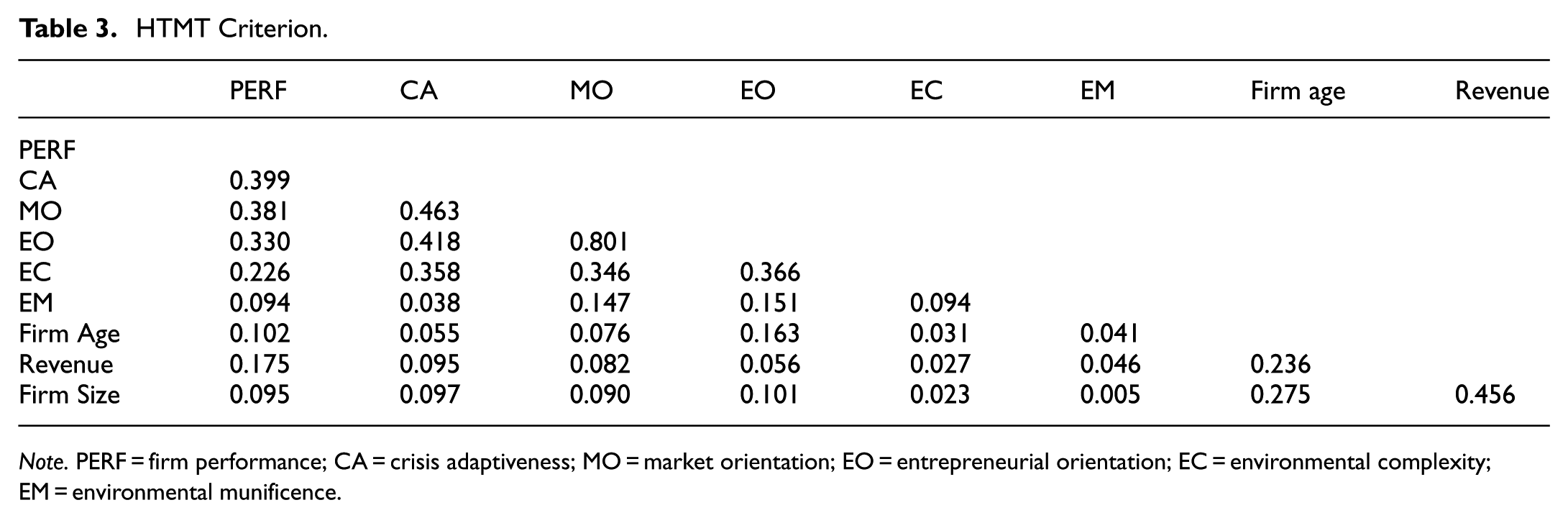
Note. PERF = firm performance; CA = crisis adaptiveness; MO = market orientation; EO = entrepreneurial orientation; EC = environmental complexity; EM = environmental munificence.
The PLS algorithm also computed the coefficient of determination (R2) for the endogenous variable to gage the specified model’s capacity to elucidate relationships. The analysis unveiled that 23.6% of the variability in crisis adaptiveness can be accounted for by market and entrepreneurial orientations, while 18.4% of the variance in firm performance is attributable to changes in crisis adaptiveness. Furthermore, the evaluation of model fit extends to the structural aspects, encompassing an appraisal of how well the model aligns with the observed data. The SRMR attains a value of 0.08, which aligns with the recommended threshold for PLS path models as outlined by Hu and Bentler (1999).
Common Method Bias
To assess that the model is free from common method bias, a full collinearity procedure was performed by regressing the latent variables against a common variable (Kock, 2017). The reported VIF values of the single-source data were lower than the 3.3 thresholds. Hence, the findings indicated that common method bias was not a severe concern. A method factor was created using a marker variable to control for common method bias (Lindell & Whitney, 2001). In this case, “success with traditional advertising” was positioned as an exogenous variable predicting the endogenous construct in the model (Grayson, 2007). The method factor model was compared with the baseline model and it was found that (1) the significant paths in the baseline model remain significant in the method factor model, and (2) the R2 in the method factor model is minimal (less than 0.10; Wolter & Joseph Cronin, 2017). Thus, it can be concluded that common method bias is not an issue within the dataset.
Hypotheses Testing
Following the examination of the measurement model, the structural model is evaluated in terms of the variance explained (R2) and path coefficient. A bootstrapping approach (10,000 samples) is employed to determine the significance of the path coefficients using t-values (J. Hair et al., 2017).
The outcomes of the PLS-SEM analysis, as presented in Table 4, reveal important insights into the hypothesized relationships. To isolate the confounding influence of revenue, firm size (the number of employees), and firm age on firm performance and enhance the accuracy of the estimates, these variables are meticulously controlled (Karlsson, 2021). Firstly, the analysis of direct effects is demonstrated. It is evident that crisis adaptiveness exerts a substantial impact on firm performance (β = .35, t = 8.83), providing support for
Hypotheses Testing of Direct and Indirect Effects.

Second, the proposed interaction effects are evaluated. The findings indicate that environmental munificence serves as a moderating factor in the relationship between crisis adaptiveness and firm performance (β = .10, t = 2.35). This interaction effect exhibits a positive direction, lending credence to the support for

Moderating effect of environmental munificence on firm performance.

Moderating effect of environmental complexity on crisis adaptiveness.
Third, the indirect effects of the hypothesized mediation paths were estimated through bootstrapping procedure (see Table 5). An indirect effect is considered significant if the upper- and lower-level confidence intervals do not straddle zero in between, thus indicating the mediation is statistically significant at 95% CI (Preacher & Hayes, 2008). It was found that crisis adaptiveness mediated the effect of market orientation on firm performance (β = .08, t = 3.67, 95% CI = [0.05, 0.12], and also the effect of entrepreneurial orientation on firm performance (β = .07, t = 3.14, 95% CI = [0.03, 0.10]. Hence,
Hypotheses Testing of Conditional Indirect Effects.

Fourth, conditional mediation in PLS path analysis examines whether the strength or direction of the mediating relationships between market and entrepreneurial orientations, crisis adaptiveness, and firm performance varies under different conditions or levels of the moderating variable (environmental complexity). The empirical results in Table 5 confirmed that environmental complexity moderated the indirect effect of entrepreneurial orientation on firm performance via crisis adaptiveness.
Specifically, the mediation influence of crisis adaptiveness in the relationship between entrepreneurial orientation and firm performance is stronger for firms that reported a higher level of environmental complexity (i.e., conditional mediation effect = 0.22, 95% CI = [0.13, 0.34]) than those that reported a lower level of environmental complexity (i.e., conditional mediation effect = 0.06, 95% CI = [−0.04, 0.16]), and the difference is also significant (difference = 0.10, 95% CI = [0.02, 0.18]). Hence,
However, although the mediation influence of crisis adaptiveness in the relationship between market orientation and firm performance is weaker for firms with high levels of environmental complexity (i.e., conditional mediation effect = 0.15, 95% CI = [0.06, 0.26]) than those with low levels of environmental complexity (i.e., conditional mediation effect = 0.20, 95% CI = [0.09, 0.33]), the difference is not significant (i.e., difference = −0.03, 95% CI = [−0.14, 0.06]). Therefore,
Robustness Checks
In this study, two robustness assessments using the Gaussian Copula and FIMIX-PLS analyses were employed. The Gaussian Copula approach was utilized to address potential endogeneity issues in the PLS-SEM model. Endogeneity arises when there is a bidirectional relationship between the variables, leading to biased parameter estimates. To examine the significance of the Gaussian Copula paths, the researcher conducted a bootstrapping procedure with 10,000 subsamples, using a percentile bootstrap confidence interval and a two-tailed test with α = .05 (Sarstedt et al., 2020). The results indicate that none of the Gaussian Copula paths were significant (p > .05), suggesting that endogeneity concerns were effectively mitigated in the PLS-SEM model (Hult et al., 2018).
Meanwhile, FIMIX-PLS procedure was utilized to examine the dataset for unobserved heterogeneity (J. F. Hair et al., 2016). Unobserved heterogeneity, a phenomenon where variables not encompassed by the model result in variations in estimated path coefficients within distinct sub-groups (J. Hair et al., 2017), necessitates a robustness check to safeguard the integrity of model outcomes when utilizing PLS software. This precautionary step is vital, as it ensures that any omitted variables exerting influence on the outcome are duly accounted for (Sarstedt et al., 2020). To unveil any latent heterogeneity concealed in the dataset, the FIMIX-PLS procedure was executed iteratively (Matthews et al., 2016). The parameters for determining the number of segments are shown in Table 6.
Results of the FIMIX-PLS Procedure.

In the FIMIX-PLS procedure, the optimal solution materializes when pre-established criteria achieve a minimum value, with the exception of LnL, where a higher value is sought (Groß, 2018). It is worth noting that the choice of criteria in FIMIX-PLS can significantly impact the results and interpretation of the model; thus, the segment size should be of sufficient magnitude to facilitate the selection of an appropriate segment. As depicted in Table 7, although the five-segment model presents an array of potential solutions, Segment 3, comprising a mere 8.9% or 58 observations, is deemed inadequate for a segment-specific PLS-SEM analysis. Consequently, Segment 2, constituting 28.9% of the dataset, aligns with the requisites for a sufficient segment partition.
Relative Segment Sizes.

Following the identification of the optimal FIMIX-PLS segment solution, the weighted R2 of segment-specific and FIMIX-PLS data groups was compared (Matthews et al., 2016). As shown in Table 8, the two-segment solution yielded a weighted average R2 value that does not significantly surpass the full dataset. This observation suggests that the results of the overall data analysis remain largely unaffected by unobserved heterogeneity (J. Hair et al., 2017).
R 2 Values for the Two-Segment Solutions.

Discussion and Conclusion
Summary of Findings
This study examined the key factors that influence firm performance and crisis adaptiveness from an emerging economy and post-pandemic context. Following an empirical and quantitative survey of Malaysian SMEs, our research provides several significant contributions to the extant literature on strategic marketing and entrepreneurship. Aligned with the hypothesized statements, the research outcomes offer substantial support for the mediating functions of crisis adaptiveness, as well as the moderating roles of favorable and unfavorable market conditions (environmental munificence and environmental complexity).
The study found significant support for the direct relationships hypothesized between market orientation (MO), entrepreneurial orientation (EO), crisis adaptiveness, and firm performance (
Regarding the moderating propositions, the study revealed mixed results. Environmental munificence significantly weakened the link between crisis adaptiveness and firm performance (
The results concerning the mediating effects of crisis adaptiveness on the relationships between market orientation and firm performance, and between entrepreneurial orientation and firm performance were significant (
Lastly, the study examined the moderated mediating effects of crisis adaptiveness on firm performance via market orientation and entrepreneurial orientation. However, the results only provide significant support for the entrepreneurial orientation pathway (
Theoretical Implications
This research contributes to the strategic management literature in several ways. First, the research extends the strategic management literature by refining the resource-based view (RBV) and dynamic capabilities theory (DCT) in the context of SMEs during post-crisis recovery. Specifically, it demonstrates that market orientation (MO) and entrepreneurial orientation (EO), when coupled with crisis adaptiveness, operate as dynamic, VRIN-aligned capabilities that not only sustain but amplify firm performance in turbulent environments. This finding advances RBV by showing that strategic orientations (MO and EO) become performance drivers when dynamically reconfigured in response to environmental shocks, thus integrating RBV’s resource emphasis with DCT’s processual focus (Eisenhardt & Martin, 2000; D. J. Teece, 2022).
Moreover, the observed mediation of crisis adaptiveness suggests that orientations influence performance indirectly through adaptive mechanisms, supporting calls in the DCT literature for a process-based understanding of capability deployment under crisis conditions (Dyduch et al., 2021). By examining environmental munificence (EM) and complexity (EC) as contextual moderators, this study refines contingency perspectives within RBV/DCT by showing that external resource abundance can dampen the performance benefits of adaptiveness, while environmental complexity selectively strengthens the EO–adaptiveness–performance pathway. This nuance underscores that dynamic capabilities yield asymmetric benefits depending on environmental constraints, thus complementing existing theory that often assumes uniformly positive capability–performance effects (Cruz & Bivona, 2025). These results address the gap noted by Boso et al. (2013) and Hitt et al. (2021) regarding the underexplored boundary conditions under which strategic orientations translate into adaptive advantage.
In this regard, the adverse role of environmental munificence marks the paper’s second important implication. A low level of environmental munificence allows adaptive firms to perform better because it increases competition for dwindling resources, forcing firms to devote greater attention to understanding and mastering their environments. In a less munificent environment, firms must be more resourceful and innovative to survive and thrive, leading to the development of collaborative alliance, product development and market penetration strategies. This increased attention to the environment can result in firms being more agile and responsive to changes in the market, which is crucial for maintaining a competitive advantage. Scarce resources and opportunities (low munificence) can paradoxically foster adaptability, driving firms to develop dynamic capabilities—the ability to adjust and thrive in a changing market for sustained competitive advantage (Arun & Yildirim Ozmutlu, 2022). In this regard, resource-constrained industries like manufacturing or retail, tend to develop stronger dynamic capabilities due to intense competition for scarce resources, as opposed to resource-rich sectors such as oil and gas, government contracting and agriculture.
Third, the study demonstrates that a competitive environment, intricate customer demands, and shifting consumer preferences –especially in times of crisis, are not inherently detrimental (Mossberger et al., 2023). A high level of environmental complexity allows entrepreneurially oriented firms to possess better crisis adaptiveness because it encourages the development of dynamic capabilities and fosters a proactive approach to managing crises. Entrepreneurial firms are characterized by their ability to innovate, take risks, and be proactive, which are essential for navigating complex and uncertain environments. In a complex environment, entrepreneurially-oriented firms are more likely to identify new opportunities and adapt quickly to changing circumstances, as they are more attuned to the dynamic nature of their surroundings (Krishnan et al., 2022). In industries like technology, automotive (e.g., electrified vehicles) and healthcare, where customer preferences and regulatory environments change rapidly, entrepreneurial orientation becomes crucial for maintaining competitive advantage.
Fourth, by operationalizing crisis adaptiveness as a distinct, empirically validated construct, this study contributes a theoretically grounded measurement tool that captures firm-level resilience in dynamic environments. This construct bridges entrepreneurship and strategic management research by enabling future scholars to better precisely model how adaptive processes mediate between strategic orientations and outcomes. Furthermore, the scale’s reflective measurement model aligns with Coltman et al. (2008)’s guidance on capability constructs, offering a replicable basis for comparative studies across industries and crisis types.
Practical Implications
The significance of the intermediary role of crisis adaptiveness in connecting the potential missing links between the firms’ strategic orientations (market orientation and entrepreneurial orientation) and performance –especially during challenging times, has several important managerial implications. SMEs should develop a thorough crisis management plan that details the steps to take in a crisis. This involves reviewing alternative marketing, product development, and customer support strategies to ensure their relevance and effectiveness. SMEs should also accustom themselves to being sensitive to even slight changes in the business environment, such as market trends, regulatory changes, and technological advancements, to help them stay ahead of the competition and respond effectively to gradually changing market conditions.
These initiatives not only strengthen SME competitiveness but also contribute to broader social resilience by safeguarding jobs, sustaining local supply chains, and supporting community economic stability during crises. At the societal level, insufficient crisis adaptiveness among SMEs can amplify economic vulnerability by disrupting local employment, weakening supply chains, and reducing access to affordable goods and services. Conversely, strengthening SME resilience enhances social stability in emerging markets, as these firms collectively form the backbone of community livelihoods and contribute to inclusive economic recovery.
Moreover, the interaction effects of environmental munificence and complexity suggest that (1) firms are increasingly responsive to crises in environments with low munificence, and (2) they can leverage their entrepreneurial orientation to effectively adapt to and excel in complex environments. Since high environmental munificence weakens the link between crisis adaptiveness and performance, SMEs should prioritize building internal capabilities rather than relying solely on favorable external conditions. For instance, firms may form collaborative cross-functional teams to share knowledge, identify innovative solutions during crises, and foster a culture of continuous learning and experimentation to allow employees to adapt to changing situations (Chatterjee et al., 2025).
As for the positive spillover roles of environmental complexity on the direct and indirect effects of entrepreneurial orientation, SMEs should inculcate entrepreneurial behaviors like innovation and proactiveness when faced with high environmental complexity. For instance, through experimentation, the employees are encouraged to try new methods, even if they involve some risk, to identify opportunities in complex environments. A deeper market engagement initiative, on the other hand, will allow the marketing team to actively seek out new market opportunities and customer needs rather than solely reacting to existing market trends (Petzold et al., 2019).
While environmental complexity may not directly moderate the mediation effect of crisis adaptiveness on the market orientation-firm performance relationship, firms should still consider the nuances of their operating environment. Understanding the specific challenges posed by environmental complexity can help firms tailor their crisis adaptiveness strategies to effectively leverage market orientation for improved performance outcomes (Gotteland & Boulé, 2006). By understanding the nuances of their environment, companies can tailor their crisis adaptiveness strategies to effectively leverage market orientation for improved performance outcomes. This may involve implementing targeted measures to address the unique challenges presented by the complexity of their environment, such as capitalizing on the hidden opportunities that arise, thereby maximizing the benefits of their market orientation endeavors.
The findings provide a foundation for policymakers and business consultants to conduct targeted SME support programs and establish policy frameworks that integrate strategic orientation training, adaptive capability development, and sector-specific crisis response planning. Such initiatives can be customized according to different levels of entrepreneurial behaviors and resource configurations, ensuring that SMEs are better equipped to withstand future shocks while contributing to inclusive and sustainable economic growth.
Limitations and Scope for Future Research
Despite the valuable insights provided by this study, several limitations warrant consideration. First, the sample predominantly consists of business-to-consumer (B2C) firms within the retail and service sectors, with limited representation from business-to-business (B2B) and manufacturing industries. This sectoral focus was due to time and budget constraints. Given that different industries experienced varying levels of impact from the COVID-19 pandemic, future research should broaden the scope to include a more diverse range of industries. This inclusion would allow for a comparative analysis of how crisis adaptiveness affects firm performance across different sectors.
Second, the perception of adaptiveness can be subjective and vary significantly across industries. This study primarily relies on self-reported measures, which may not capture the full complexity of adaptiveness. Future research should incorporate secondary data sources and qualitative methods, such as in-depth interviews or case studies, to gain a more nuanced understanding of adaptiveness. This mixed-methods approach could uncover deeper insights into how different industries interpret and implement adaptive strategies.
Third, the study employs a uni-dimensional approach to assess market orientation, potentially oversimplifying its complex nature. Recognizing market orientation’s multi-faceted structure is crucial for a comprehensive analysis (Crick, 2021; Hamzah et al., 2020). Future studies should consider using a multi-dimensional framework to capture the diverse aspects of market orientation, such as customer orientation, and competitor orientation. This approach would provide a more detailed understanding of how each dimension contributes to firm performance.
Fourth, while this study emphasizes the importance of market and entrepreneurial orientations separately, it overlooks the concept of ambidexterity, which involves balancing exploitation and exploration. Recent literature on entrepreneurial marketing suggests that integrating these orientations can enhance dynamic capabilities (Hamzah et al., 2023; Ho et al., 2020; Mehrabi et al., 2019). Future research should investigate how firms can achieve ambidexterity, combining market and entrepreneurial orientations to better navigate crises and improve performance.
Fifth, this study does not delve into the specific resources that firms possess and how these resources influence crisis adaptiveness. Future research should explore how market and entrepreneurial orientations translate into valuable, rare, inimitable, and non-substitutable (VRIN) resources. For instance, examining how firms deploy market intelligence to drive innovation and develop new products could provide insights into the resource-based mechanisms that underpin successful crisis adaptiveness. This focus on resource deployment would offer practical implications for enhancing firm resilience in the face of future crises (You et al., 2023).
Finally, data collection occurred in 2021 during Greater Kuala Lumpur’s immediate post-COVID recovery phase, a period characterized by government-led digitalization incentives (e.g., PENJANA grants, Industry 4.0 automation support), widespread adoption of e-commerce among SMEs, and temporary market distortions (Azahar, 2021; Lim et al., 2021). These unique policy-driven and economic conditions may limit the generalizability of our findings to the current environment, where digital adoption has matured and market conditions have stabilized. Moreover, as the study employed a cross-sectional design, the observed associations should be interpreted as relationships rather than definitive causal effects, and future longitudinal or experimental research could further validate the directional assumptions in the model. Future research should replicate the study under more recent contexts or in different recovery stages to test the stability of the observed relationships over time.
Conclusion
In conclusion, this research highlights the value and importance of crisis adaptiveness by integrating the resource-based and dynamic capabilities paradigms to investigate the complex relationships between market orientation, entrepreneurial orientation, and firm performance. By examining the contingent effects of environmental conditions (munificence and complexity) on these relationships, this study has shed light on the critical role of crisis adaptiveness in enabling firms to navigate and thrive in times of crisis. Specifically, the findings suggest that embracing market conditions, characterized by a mix of favorable (munificence) and unfavorable (complexity) conditions, can facilitate the development of crisis adaptiveness and ultimately lead to sustained firm performance. The novelty and value of this research reside in its capacity to illuminate the intricate relationship between market orientation, entrepreneurial orientation, crisis adaptiveness, and firm performance, and to offer practical insights for firms seeking to enhance their adaptability and resilience in the face of limited resources, uncertainty and disruption.
Footnotes
Appendix
Background of interviewees and sample responses.

| Interviewee | Age | Gender | Type of business | Annual revenue (RM) | Sample responses |
|---|---|---|---|---|---|
| N1 | 43 | M | Confectionery and pastry | 1,200,000 | "[…]. What I can say is that businesses should try their best to adapt to this pandemic. People are worried about getting infected by the coronavirus. Since we cannot operate [our physical store], we have to be creative in finding alternative ways to keep selling our products to the market by using social media.” |
| N2 | 46 | F | Delivery service | 2,700,000 | “To be sustainable [in the face of crisis], we have to adapt to the required changes. Adjust to what is basically a new norm. If the company does not follow or adapt to these kinds of changes, it will surely be the end of it.” […]. It should be as fast as possible, actually, because in this current situation, we will never know the outcome or where it is going to take us. I guess around 3 months tops to see whether the business is able to sustain [itself] or not. |
| N3 | 34 | M | Food manufacturing | 5,000,000 | […]. Due to the COVID-19 [pandemic], we have to change and learn to adapt to the situation. Of course, we will see along the journey of the business, what the right things that we do and what the incorrect things that we do, so we can stop doing them. [We have] to think outside the box. This is because times are changing, technology is changing, and we also see that the demographics of our customers are also changing. […]. Our company always wants to do something new that will keep our company ahead of the competitors. Like the current pandemic situation, we need to improve our presence on online platforms. We increased our resellers, distributors, and agents. We advised them to get the customers’ feedback in order to know what customers like, why they bought them, and what their opinions are regarding the products. |
| N4 | 31 | M | B2B printing service | 230,000 | “It would be a lie if I said that we were not affected by this situation; everybody else will. But in business, in whatever situation, we always need to adapt. For us, we have to cope with this new norm through innovative ways, such as actively creating content and offering promotions through every social media account that we have.” |
| N5 | 35 | F | Retail (eyewear) | 2,500,000 | “We innovate our business model to ensure better business operations. We recruit and train "work-from-home" salespeople to run live TikTok and Facebook promotions to generate more leads and to give "on-demand services" to deliver greater value. We also created our own payment application to make it easier for customers to make payments every time they purchase our products.” |
| N6 | 30 | F | Retail (cosmetic) | 1,000,000 | “I am grateful for this pandemic because, without it, I would not be aggressively promoting my products. A good entrepreneur constantly innovates, is unstoppable at finding solutions, and is comfortable being in an uncomfortable situation.” “The suppliers are always my biggest challenge. If there is demand, there is no supply. If there are supplies, they are problematic and defective. My business has to downsize to cut costs. I’ve seen the therapist. I learned a lot along the way. I would not call myself a success, but I would say I am a work in progress.” |
| N7 | 31 | M | Café and event caterer | 1,300,000 | “The pandemic affects our business. So, the demand for custom cakes drops, and we didn’t get orders from our customers since no one can do events like weddings, birthdays, bachelor parties, or any other events. Then, luckily, there was one customer who suggested we make a filled doughnut, also known as a ‘bomboloni’. We re-invented our doughnut, and suddenly we got a high demand for it.” |
| N8 | 28 | F | Retail (bedsheets) | 900,000 | “It is difficult to balance inventory turnover and cash flow because the stocks cannot keep up with demand, and I do not have enough capital to restock them regularly. Suppliers wouldn’t lower their prices, and I am running out of manpower. Then, I thought of diversifying my business. Then I realized I was drifting away from the right path. I am climbing a hill; why not make it to the top instead of finding other hills to climb? I must deal with these problems. So, I source materials from other suppliers and hire two additional employees to handle the warehouse.” |

Ethical Considerations
This study employed a cross-sectional questionnaire survey with SME firms, adhering to ethical research standards and ensuring participant privacy. No experimentation with human subjects was involved. Ethical review and approval were not required for this study as it adhered to the institutional requirements in place at the time of the research.
Funding
The author disclosed receipt of the following financial support for the research, authorship, and/or publication of this article: This research was funded by the Faculty of Business Management, UNIVERSITI TEKNOLOGI MARA CAWANGAN SELANGOR, MALAYSIA, via the Geran Dana Dalaman Fakulti; grant number 600-TNCPI 5/3/DDF (FPP) (003/2024).
Declaration of Conflicting Interests
The author declared no potential conflicts of interest with respect to the research, authorship, and/or publication of this article.
Data Availability Statement
Data will be made available on request.