



Abstract
Drawing on a sample of 429 Chinese major undergraduates from abroad, this study investigates the relationship between growth mindset, achievement goals and self-regulated strategies in L2 writing. Structural equation modeling and mediation analysis are performed to analyze the data. The results reveal that: (a) the participants adopt multiple achievement goals rather than single achievement goal in L2 writing; (b) L2 writing mindset significantly and positively predicts the endorsement of the three L2 writing achievement goals and the use of self-regulated writing strategies; and (c) both mastery and performance-approach goals act as a significant mediator between L2 writing mindset and self-regulated writing strategies, while the mediating effect of performance-avoidance goals was non-significant. Our findings highlighted important theoretical implications for L2 writing motivation and suggested practical applications for enhancing instructional strategies in L2 (Chinese language) learning.
Plain Language Summary
Learning to write in Chinese as a second language can be challenging for foreign students, but understanding how their mindsets and goals influence their learning strategies could help improve their skills. This study examined 429 international undergraduate students majoring in Chinese, exploring how their growth mindset (the belief that writing ability can be developed through effort), their motivations (called achievement goals), and their use of self-regulated learning strategies (like planning, monitoring, and revising) are connected. Mastering Chinese writing is crucial for academic and cultural success, yet little is known about how students’ attitudes and goals affect their learning approaches. By analyzing these relationships, educators can design better strategies to support learners. We found: (1) Students have a mix of goals: Most did not rely on a single motivation; instead, they combined mastery, performance-approach, and (to a lesser extent) performance-avoidance goals. (2) Growth mindset boosts goals and strategies: Students who believed they could improve through effort were more likely to adopt mastery and performance-approach goals and use self-regulated strategies like planning and revising. (3) Goals act as a bridge: Mastery and performance-approach goals explained why a growth mindset led to better learning strategies—when students focused on improving or doing well (rather than avoiding failure), they used more effective writing techniques. Performance-avoidance goals, however, had no significant impact on this link. This study highlights that a positive, effort-based mindset, combined with the right goals, can empower foreign students to develop stronger Chinese writing skills. By focusing on growth and achievement rather than avoiding mistakes, learners and educators can create more effective pathways for second-language writing success.
Keywords
Introduction
Writing proficiency plays a critical role in learners’ academic achievement and future career development. Most contemporary cognitive models of writing recognize that the writing process involves four interactive cognitive components: planning, translating, transcribing, and revising, characterized by cyclical interactions between multiple cognitive processes (Qiu & Lee, 2020). For learners, successful writing constitutes a challenging endeavor that requires the appropriate integration of cognitive, affective, social, and physical conditions. In second language (L2) writing, learners face additional complexities compared to first language (L1) writing, including fundamentally distinct writing systems (Xu, 2022), more demanding cognitive processes, and heightened potential struggles, rendering L2 writing inherently more recursive, multifaceted, and dynamic (Qiu & Lee, 2020).
Compared to routine tasks, challenging tasks amplify the relationship between mindset patterns and academic performance (C. Dweck, 2016). Given the inherent challenges of L2 writing, it is imperative to investigate learners’ domain-specific mindsets in L2 writing contexts. However, since the introduction of psychological perspectives into second language acquisition research, limited attention has been paid to the domain specificity of mindsets in L2 writing. Although studies in the field of L2 writing had examined individual dimensions of mindset, achievement goals, or self-regulated strategies (Bai et al., 2021; Camacho et al., 2022), no study had systematically explored the integrated relationship among these three constructs in L2 Chinese writing. For instance, Bai et al. (2021) verified the predictive effect of L2 English writing mindset on self-regulated strategies but did not incorporate achievement goals as a mediator; Xu and Wang (2022) focused on the association between mindset and self-regulation, yet used “ideal writing self” as the mediating variable and did not examine the role of achievement goals. Even studies conducted in the Chinese context (Chen & Wong, 2015) mostly focused on L2 English and did not address the complete pathway of “mindset → achievement goals → self-regulation” in L2 Chinese writing.
These three variables were selected because they formed the core logical chain of L2 writing motivation: Mindset (beliefs about whether L2 Chinese writing competence is malleable) served as the starting point of motivation—if learners believed that their writing competence could be improved through practice (growth mindset), they were more likely to adopt positive achievement goals; Achievement goals (e.g., “mastering Chinese character writing,”“outperforming peers in writing”) functioned as the motivational bridge—different goals drove different strategy selections; Self-regulated strategies (e.g., planning paragraphs, monitoring character accuracy) represented the behavioral manifestation of motivation. However, the unique characteristics of L2 Chinese writing (e.g., the need for repeated practice in character learning, the requirement for discourse to align with Chinese cultural contexts) might have led this logical chain to exhibit unique patterns. For example, did a growth mindset more easily foster the goal of “mastering character accuracy”? Would performance-approach goals drive strategies related to “monitoring cultural appropriateness?” These questions have not been addressed. Focusing on the aforementioned gap in the integrated exploration of these variables, this study aimed to examine the predictive effects of L2 Chinese writing mindset on three types of achievement goals (mastery, performance-approach, and performance-avoidance), and verify whether achievement goals played a mediating role between L2 Chinese writing mindset and self-regulated strategies.
L2 Writing Mindsets
Language mindsets refer to learners’ beliefs about the nature of language abilities. Learners with a growth language mindset believe their language competence can be developed through effort, unrestricted by innate talent or age of acquisition (Lou & Noels, 2017). These learners tend to seek challenging tasks, attribute failures to controllable factors such as insufficient effort or strategy use, and subsequently increase their efforts. In contrast, individuals with a fixed language mindset perceive language ability as an innate and unchangeable trait, often avoid challenging tasks, attribute failures to uncontrollable factors like lack of talent, and consequently reduce effort (C. Dweck, 2016). Following theoretical revisions of Dweck (2016), research indicates that language mindsets exist on a continuum rather than as a binary construct, with individual differences primarily reflecting variations in growth mindset orientation (Ryan & Mercer, 2012).
Given the domain specificity of mindsets (C. Dweck, 2016), learners may exhibit distinct mindset patterns across language subdomains (Ryan & Mercer, 2012; Shirvan et al., 2021). In L2 writing, research on mindsets remains limited and has focused on two key areas. First, regarding the relationship between mindsets and writing feedback, a growth mindset enables learners to recognize the value of feedback (Papi et al., 2020), develop positive perceptions of it (Yao et al., 2021), and actively seek feedback (Waller & Papi, 2017). Hybrid human-computer feedback systems have also been shown to enhance growth mindsets in L2 writing (Yao et al., 2021). Second, concerning the relationship between mindsets and self-regulated writing strategies, a growth mindset directly predicts self-regulated writing strategies (Bai et al., 2021; Bai & Wang, 2021; Xu & Wang, 2022) and indirectly influences them through mediators such as feedback-seeking orientation (Xu, 2022) and ideal L2 writing self (Xu & Wang, 2022). To date, no studies have systematically explored the relationship between mindsets and achievement goals in L2 writing contexts—an oversight given that achievement goals serve as a critical motivational bridge between belief systems (e.g., mindsets) and behavioral strategies (e.g., self-regulated writing, Elliot & Hulleman, 2017). Further, existing research on the interplay between mindsets and achievement goals has yielded contradictory findings that remain unaddressed in L2 Chinese writing. Western studies (Lou & Noels, 2017) report growth mindsets negatively predict performance goals, a pattern attributed to individualistic norms that frame success as self-defined. In contrast, Eastern contexts—such as Hong Kong, China (Chen & Wong, 2015) and Iran (Sadeghi et al., 2020)—show positive associations between growth mindsets and performance-approach goals, likely driven by collectivist values that prioritize social validation. This cross-cultural discrepancy highlights a critical gap: how do the unique features of L2 Chinese writing (e.g., logographic character learning, Confucian emphasis on effort as a moral virtue, Fwu et al., 2020) reshape the mindset-achievement goal pathway? L2 writing mindsets thus play a key role in shaping learners’ academic engagement, but their link to achievement goals—especially in Chinese-specific contexts—requires systematic investigation.
L2 Writing Achievement Goals
Achievement goals refer to the purposes individuals pursue in competence-related behaviors (Elliot & Hulleman, 2017). Based on the trichotomous framework, achievement goals are categorized into mastery goals (emphasizing competence development) and performance goals (emphasizing competence demonstration), with the latter further divided into performance-approach goals (seeking to validate competence by outperforming others or appearing intelligent) and performance-avoidance goals (avoiding invalidation of competence by preventing inferior performance or perceived incompetence; Elliot & Church, 1997). Research on achievement goals has generated two perspectives: the mastery-goal perspective and the multiple-goal perspective. The former posits that learners adopt a single achievement goal, where only mastery goals are adaptive, while performance-approach goals are maladaptive due to their emphasis on competition, which diverts attention from task requirements and fosters self-handicapping behaviors (Lou & Noels, 2017). In contrast, the multiple-goal perspective argues that learners pursue multiple goals (Wilby, 2022), and performance-approach goals can yield positive outcomes (Diseth & Kobbeltvedt, 2010). Both perspectives agree that performance-avoidance goals are maladaptive and exert significant negative effects (Diseth & Kobbeltvedt, 2010; Lou & Noels, 2017).
A previous study suggested that achievement goals vary with learning content (Yeung & Han, 2017), yet their applicability to L2 Chinese writing—an area with unique cognitive and cultural demands—remains unvalidated. Existing achievement goal research carries three critical limitations for the present study. First, it predominantly focuses on non-language domains (e.g., mathematics, science, Liu, 2021) or general L2 English learning (Sadeghi et al., 2020), with few studies examining L2 writing and even fewer focusing on Chinese. Paul et al. (2021), for example, explored writing achievement goal typologies in English but did not account for Chinese-specific skills (e.g., character accuracy, discourse alignment with Confucian modesty norms) that may redefine ‘mastery’ or ‘performance’ in goal adoption. Second, Kaplan et al. (2009) framed achievement goals as a component of self-regulation rather than an independent mediator, obscuring how goals might translate mindset beliefs into strategic behavior—such as whether a growth mindset leads to mastery goals that then drive planning strategies. Third, cross-cultural biases persist: Litalien et al. (2017) note most achievement goal research is Western-centric, and while Elliot et al. (2001) documented higher avoidance goal adoption in Asian cultures, no study has tested whether Confucian values (e.g., group harmony, King, 2016) buffer the negative effects of performance-avoidance goals on self-regulation. This question is central to L2 Chinese writing, where failure may signal not just personal inadequacy but unmet social expectations (Tao et al., 2023). Additionally, research in writing contexts has examined typologies of writing achievement goals (Paul et al., 2021), their dynamic development (Wilby, 2022), and their relationships with self-efficacy, self-concept, writing anxiety, and writing performance (Camacho et al., 2022; Sabti et al., 2019). Kaplan et al. (2009) explored the link between writing achievement goals and self-regulation but treated achievement goals as a component of self-regulation rather than independent variables. Scholars note that achievement goal research has predominantly been conducted in Western cultural contexts (Litalien et al., 2017), with minimal focus on Asian settings or participants (Liu, 2021). According to sociocultural theory, students’ goal selection and actions are mediated by sociocultural factors, including cultural artifacts, social others, and self-regulation (Qiu & Lee, 2020). Given the Western-centric nature of existing studies, it is imperative to investigate writing achievement goals within Chinese cultural and educational contexts.
Although prior studies on achievement goals have documented how distinct goal orientations shaped learners’ motivational profiles, self-concept, and emotional responses (e.g., their links to self-efficacy and writing anxiety), these findings have not fully illuminated how writers strategically planned, monitored, and reflected on their composing actions in situ. Writing—an activity that demanded continuous regulation of cognition, behavior, and emotion across the forethought, performance, and reflection phases—has relied heavily on self-regulated writing strategies to translate goals into adaptive behavior. Given that extant studies on writing achievement goals have left notable gaps in topical scope and cultural context—particularly with respect to the Chinese setting—the following section has therefore reviewed the multidimensional structure and functions of L2 writing self-regulated strategies. This synthesis has aimed to clarify how these strategies might have mediated or moderated the relationship between achievement goals and writing performance.
Self-Regulated Writing Strategies
Self-regulated writing strategies are deliberate, goal-oriented efforts to make writing more enjoyable, less challenging, and more effective (L. S. Teng & Zhang, 2016). Self-regulated learning (SRL) comprises three phases—forethought (task analysis/planning), performance (strategy implementation/monitoring), and self-reflection (evaluation; Qiu & Lee, 2020; Zimmerman, 2000, 2002). In L2 writing, we use SRL to refer to learners’ deliberate, goal-oriented regulation of cognition, behavior, motivation, and emotion during writing. Social cognitive theory posits that L2 writing self-regulation involves interactions among environmental processes (regulating the social context of writing), behavioral processes (regulating explicit motor activities), and personal processes (regulating cognitive beliefs and affective states; L. S. Teng & Zhang, 2016). Building on this framework, Teng and Zhang (2016) proposed a multidimensional model of L2 writing self-regulation, encompassing cognitive, metacognitive, social-behavioral, and motivational dimensions. This model was later expanded to six dimensions: writing planning, goal-oriented monitoring, goal-oriented evaluation, emotional control, memorization strategies, and metacognitive judgment (Teng et al., 2022).
While self-regulated strategies have been extensively studied in L1 learning environments, much of this research reflects Western, particularly North American, contexts (Pintrich, 2000). In L2 contexts, self-regulation remains a relatively novel concept (Xu, 2022). Given that self-regulated writing strategies significantly predict writing performance (Sun & Wang, 2020) and that L2 writing demands greater effort and persistence, these strategies warrant heightened attention. Existing studies predominantly examine outcomes of self-regulated writing strategies, with limited focus on their antecedents (Xu & Wang, 2022). Research on antecedents has centered on motivational beliefs (Bai & Wang, 2021), mindsets (Bai et al., 2021), and the ideal L2 writing self (Xu & Wang, 2022), while neglecting the role of achievement goals.
Relationships Among the Three Constructs
Mindsets are pivotal in individuals’ belief systems because they integrate variables such as attributions, goals, and responses into a “mindset meaning system”, serving as the core guide for motivation and behavior (C. S. Dweck & Yeager, 2019). Numerous studies on non-L2 writing in Western contexts indicate that growth mindsets positively predict mastery goals and negatively predict performance goals (C. Dweck, 2016; Lou & Noels, 2017). However, a study of Portuguese students found that growth mindsets positively predicted mastery goals but showed no association with performance goals (Camacho et al, 2022). In contrast, research involving Iranian students (Sadeghi et al, 2020) and learners from Hong Kong, China (W.-W. Chen & Wong, 2015) revealed that growth mindsets positively predicted both mastery goals and performance-approach goals, with no significant effect on performance-avoidance goals.
In the Language-Mindsets Meaning System, language mindsets influence other system components, including achievement goal orientations and self-regulatory tendencies (Lou & Noels, 2019). In the context of L2 (Chinese) writing mindsets, writing mindsets are closely linked to attributions, self-regulated strategies, achievement goal orientations, and feedback-seeking behaviors (Shirvan et al., 2021), suggesting interconnections among L2 writing mindsets, achievement goals, and self-regulation.
Cross-cultural studies have already shown that cultural background could significantly affect the motivational structure and psychological consequences of avoidance goals. For instance, the cross-cultural study by Elliot et al. (2001) found that individuals in Asian cultural contexts had been more inclined to adopt avoidance goals, yet the negative impact of these goals on subjective well-being had not been significant in collectivist cultures; conversely, it had proved more destructive in individualist cultures (Elliot et al., 2001). Moreover, Chinese learners, influenced by Confucian culture, had emphasized effort- and learning-oriented goals over performance goals, which has attenuated the negative association between avoidance goals and self-regulated learning strategies in cross-cultural comparisons (Lee et al., 2003). In view of these cultural differences, when we formulated Hypothesis 3, we anticipated that the negative predictive effect of performance-avoidance goals on self-regulated writing strategies might have manifested a different mechanism in Eastern cultural contexts.
Vygotsky’s Sociocultural Theory (SCT; Lantolf & Thorne, 2006) posits that human cognition and behavior are mediated by cultural tools (e.g., language systems, values) and social interactions. For L2 Chinese writing, two cultural tools are particularly relevant to the mindset-achievement goal-strategy pathway. The first is the logographic Chinese character system, which imposes unique cognitive demands (e.g., memorization of form-meaning connections, Xu, 2022) and may lead learners with growth mindsets to prioritize mastery goals focused on language-specific skills—such as improving character stroke order. The second is Confucian values of social obligation and group harmony (Fwu et al., 2020), which align with the core logic of Social-Oriented Achievement Motivation (SOAM; Tao et al., 2023). Unlike Individual-Oriented Achievement Motivation (IOAM)—dominant in Western contexts where success is self-defined—SOAM frames achievement as meeting social standards, including teacher expectations and peer recognition. This cultural mediation helps explain why Eastern learners with growth mindsets may endorse performance-approach goals to gain social validation, a pattern inconsistent with Western findings (Lou & Noels, 2017) but critical to understanding L2 Chinese writing. Bandura’s Social Cognitive Theory (Bandura & National Inst of Mental Health, 1986) conceptualizes self-regulated learning (SRL) as a cyclical process of forethought (task planning), performance (strategy monitoring), and reflection (evaluation; Zimmerman, 2000)—a model directly applicable to L2 Chinese writing. It further emphasizes that motivation (e.g., achievement goals) drives strategy use. For example, mastery goals rooted in growth mindsets may prompt forethought strategies like planning character use, while performance-approach goals shaped by SOAM may drive performance-phase strategies like monitoring essay alignment with HSK scoring criteria. Against this theoretical backdrop, existing inconsistencies in mindset-achievement goal research become interpretable. Camacho et al. (2022) found no link between growth mindsets and performance goals in Portuguese students, a pattern reflecting IOAM’s influence. In contrast, Chen & Wong (2015) reported positive links in Hong Kong learners, a result aligned with SOAM. However, no study has tested these dynamics in L2 Chinese writing, where cultural tools (characters, Confucian values) and cognitive demands may create a unique mediating pathway between mindsets and self-regulated strategies.
These theoretical and empirical gaps underscore the need for the present study. The gaps include the untested mindset-achievement goal-strategy pathway in L2 Chinese writing, the lack of SLA theory integration in prior variable-focused research, and unresolved cross-cultural contradictions in performance goal effects. To address these, we tested three key questions: whether growth mindsets predict all three achievement goals in L2 Chinese writing, whether mastery and performance-approach goals mediate mindset-strategy links (consistent with SOAM and social cognitive theory), and whether Confucian values buffer performance-avoidance goal effects (as hypothesized in Hypothesis 3 of the present study).
Purpose of the Present Study
The literature review reveals three gaps: (a) Inconsistent conclusions regarding the relationship between growth mindsets and achievement goals; (b) A lack of research on L2 writing achievement goals, the influence of L2 writing mindsets on L2 writing achievement goals, and the relationship between L2 writing achievement goals and self-regulated writing strategies; (c) No studies have examined mindsets, achievement goals, and self-regulation within a unified framework.
In international Chinese writing instruction, learners’ Chinese writing proficiency has shown limited improvement over time. For instance, writing consistently ranks as the lowest-scoring section in standardized Chinese proficiency tests across academic levels. Investigating the types of L2 writing mindsets and achievement goals held by international learners under sociocultural mediation, and clarifying their relationships with self-regulated writing strategies, will deepen understanding of existing controversies and uncover intrinsic patterns among variables, thereby enhancing Chinese writing pedagogy globally. Our study could address important gaps by exploring the interplay between L2 writing mindsets, achievement goals, and self-regulated learning strategies, an area that has received limited attention in current literature on Chinese as a foreign language.
Based on the analysis of relevant literature, this study proposes the following hypotheses: (a) L2 writing mindsets positively predict three types of L2 writing achievement goals and self-regulated writing strategies; (b) L2 writing performance-approach goals and mastery goals positively predict self-regulated writing strategies; (c) L2 writing performance-avoidance goals negatively predict self-regulated writing strategies. Considering cultural background differences (as shown in the study by Elliot et al., 2001, where the role of avoidance goals is different in collectivist cultures), we expect that this negative correlation effect may be attenuated in the context of Chinese culture; (d) Performance-approach goals and mastery goals mediate the relationship between L2 writing mindsets and self-regulated writing strategies, as significant pairwise relationships exist among L2 writing mindsets, performance-approach/mastery goals, and self-regulated writing strategies.
Method
Participants
This study recruited 465 international undergraduate students majoring in Chinese from a university in Guangdong Province, China. All participants had completed at least two semesters of mandatory Chinese writing courses (e.g., Basic Chinese Writing, Academic Chinese Writing) to ensure they had sufficient L2 Chinese writing experience. A total of 429 valid questionnaires were collected (response rate: 92.26%). Participants ranged in age from 19 to 25 years (M = 22.04, SD = 1.249), with 201 males (46.85%) and 228 females (53.15%). Their demographic details related to L2 Chinese learning were as follows: (a) Chinese proficiency: 62.0% (n = 266) held HSK 4 certificates, 38.0% (n = 163) held HSK 5 certificates (HSK, Hanyu Shuiping Kaoshi, is China’s official proficiency test for L2 Chinese learners, with levels 1–6 ranging from beginner to advanced; no participants had HSK 3 or below, ensuring basic writing competence); (b) Country/region of origin: Southeast Asia (Vietnam: 28.0%, n = 120; Thailand: 18.0%, n = 77), East Asia (South Korea: 25.0%, n = 107; Japan: 12.0%, n = 52), and other regions (Malaysia, Indonesia, etc.: 17.0%, n = 73); (c) Chinese learning duration: M = 3.2 years (SD = 1.1), ranging from 1.5 to 5 years. Sample size adequacy was evaluated a priori for a parallel-mediation SEM with latent variables and multiple indicators. Following conventional guidance for ML-SEM (Kline, 2015; Wolf et al., 2013), a minimum size (N ≈ 200) is typically adequate for models with moderate loadings (0.50–0.70) and ≥3 indicators per factor. Sample size in our study (N = 429) exceeds these recommendations, supporting stable estimation and power for indirect effects.
Instruments
A questionnaire was used as the measurement tool. The questionnaire consisted of two parts: the first part collected participants’ demographic information, and the second part included three Likert 5-point scales (1 = “strongly disagree” to 5 = “strongly agree”). The scales of our study were adapted to ensure relevance to the L2 Chinese writing context. Adaptations involved revising item wording for cultural and linguistic appropriateness, and ensuring the constructs accurately reflect the unique challenges of writing in a second language. To aid non-statistical readers, this study lists the common fit indices and their reference thresholds: χ2/df < 3 indicates good model fit; RMSEA < 0.05 denotes near-perfect fit, and 0.05 to 0.08 is acceptable; SRMR < 0.05 indicates minimal residual; GFI, IFI, TLI, and CFI > 0.95 are regarded as excellent fit.
(1) The L2 Writing Mindsets Scale, adapted from Lou and Noels’ (2017) Language Mindsets Scale, comprised two dimensions: beliefs about L2 writing aptitude and beliefs about age sensitivity in L2 writing, each containing three items. Among them, the ability orientation dimension reflects learners’ beliefs in the plasticity of their own L2 writing abilities. In the context of Chinese writing, this belief may influence their sustained efforts and strategy use in mastering Chinese orthography, vocabulary precision, and discourse organization. The age sensitivity dimension involves learners’ views on the impact of age on writing learning outcomes. In Chinese writing, due to the complexity of Chinese character forms, the nuanced semantic expression, and the high reliance on cultural knowledge accumulation, learners may believe that starting to learn at an earlier age helps them achieve higher levels in these areas. The Cronbach’s α values for the two dimensions and the overall scale were .822, .835, and .856, respectively, indicating good reliability. Confirmatory Factor Analysis (CFA) demonstrated satisfactory structural validity (χ2/df = 1.400, RMSEA = 0.031, SRMR = 0.020, GFI = 0.991, IFI = 0.997, TLI = 0.995, CFI = 0.997), with all factor loadings exceeding 0.756, above the acceptable threshold of 0.4. Sample items for this scale are provided below: “It is difficult to change how good you are at learning Chinese.” (beliefs about L2 writing aptitude); “People can’t really learn Chinese well after they reach adulthood.” (beliefs about age sensitivity in L2 writing).
(2) The L2 Writing Achievement Goals Scale, adapted from Elliot and Church (1997), included three dimensions: performance-approach goals, performance-avoidance goals, and mastery goals, each with three items. The Cronbach’s α values for the three dimensions and the overall scale were .792, .832, .845, and .798, respectively. Structural validity was satisfactory (χ2/df = 1.145, RMSEA = 0.018, SRMR = 0.025, GFI = 0.986, IFI = 0.998, TLI = 0.996, CFI = 0.998), with all factor loadings above 0.742. Items from Elliot and Church (1997) were adapted to the Chinese writing context via systematic wording substitutions (e.g., “this class” → “Chinese writing,”“course” → “writing tasks/assignments”). Example: “I hope to have gained a broader and deeper knowledge of Chinese language when I am done with this class” → “… a broader and deeper command of Chinese writing when I complete this course.” Adaptation followed forward-back translation, expert review by five L2 writing specialists, and a pilot (n = 70). Content validity was affirmed; the three-factor structure replicated in CFA. Sample items for this scale are provided below: “I strive to demonstrate my abilities in this Chinese course compared to my other classmates.” (performance-approach goals); “I’m worried about the possibility of getting a bad grade in this Chinese course.” (performance-avoidance goals); “I long to fully master the content taught in this Chinese course.” (mastery goals).
(3) The L2 Self-Regulated Writing Strategies Scale (M. F. Teng et al., 2022) comprised six dimensions: writing planning, goal-oriented monitoring, goal-oriented evaluation, emotional control, memorization strategies, and metacognitive judgment, totaling 30 items. The Cronbach’s α values for the six dimensions and the overall scale were .896, .896, .931, .843, .895, .907, and .951, respectively. Structural validity was satisfactory (χ2/df = 1.630, RMSEA = 0.038, SRMR = 0.037, GFI = 0.904, IFI = 0.971, TLI = 0.968, CFI = 0.971), with all factor loadings exceeding 0.716. Sample items for this scale are provided below: “I will consider how much time to spend on each part of the Chinese composition.” (writing planning); “I will set goals to check my Chinese writing practice or activities.” (goal-oriented monitorin); “I will assess what I have learned from Chinese writing practice or activities.” (goal-oriented evaluation); “When I take a Chinese writing test, I will tell myself not to worry.” (emotional control); “I will memorize key sentences for Chinese writing.” (memorization strategies); “I believe it is important to complete Chinese writing practice independently.” (metacognitive judgment).
Procedure
The questionnaires were distributed and collected through “SoJump” (an online survey and questionnaire platform). Each participant first received a bilingual (Chinese-English) informed consent form, which explained the study’s purpose, data usage (anonymous for research only), right to withdraw at any time, and contact information of the research team. Only participants who clicked “agree” proceeded to the questionnaire.
Data Analytical Procedure
Data analysis was conducted using SPSS 26.0 for descriptive and correlation analyses, and AMOS 24.0 for scale reliability/validity tests, structural equation modeling, and mediation effect analysis. Conceptually, the mediation corresponds to PROCESS Model 4; SEM was chosen to estimate latent variables and account for measurement error. For SEM, L2 writing mindset was modeled with two parcels (aptitude, age sensitivity). Achievement goals used three item-level indicators per factor (approach, avoidance, mastery). Self-regulated writing strategies used six subscale scores (planning, monitoring, evaluation, emotional control, memorization, metacognitive judgment) as indicators of a higher-order factor. No modifications were introduced in our study; the reported fit indices reflect the preregistered/initial model specification.
Open Practices Statement
The materials and data will be publicly shared upon publication.
Results
Descriptive and Correlation Analyses
Descriptive statistics are item-level means on a 1 to 5 scale; values 3.21 to 3.82 reflect moderate endorsement. Missingness (<3% per item) was handled with full information maximum likelihood; no cases were listwise deleted. As shown in Table 1, the absolute values of skewness and kurtosis for all variables were below two, indicating normal distribution. Participants’ L2 (Chinese) writing mindsets and performance-avoidance goals were at moderate levels, while performance-approach goals, mastery goals, and self-regulated writing strategies showed higher mean scores. Pearson correlation analysis revealed significant pairwise correlations among all study variables, meeting the prerequisites for further analyses. All three achievement goals were positively intercorrelated, indicating that learners often endorse multiple goals concurrently rather than mutually exclusively, a pattern aligned with the multiple-goal perspective (Wilby, 2022) and our sociocultural account of goal endorsement.
Descriptive Statistics and Correlation Coefficient Matrix.

Note.***p < .001.
The correlations (Table 1) indicated that growth mindset was positively associated with all three achievement goals and self-regulated strategies, with the strongest link to mastery goals (r = .366***). Mastery goals also showed the highest correlation with self-regulated strategies (r = .513***), suggesting a close connection between skill development orientation and strategic learning behavior.
Structural Equation Modeling
To investigate the relationships among variables, a structural equation model was established with L2 (Chinese) writing mindsets as the independent variable, self-regulated writing strategies as the dependent variable, and three L2 writing achievement goals as parallel mediators (Figure 1).
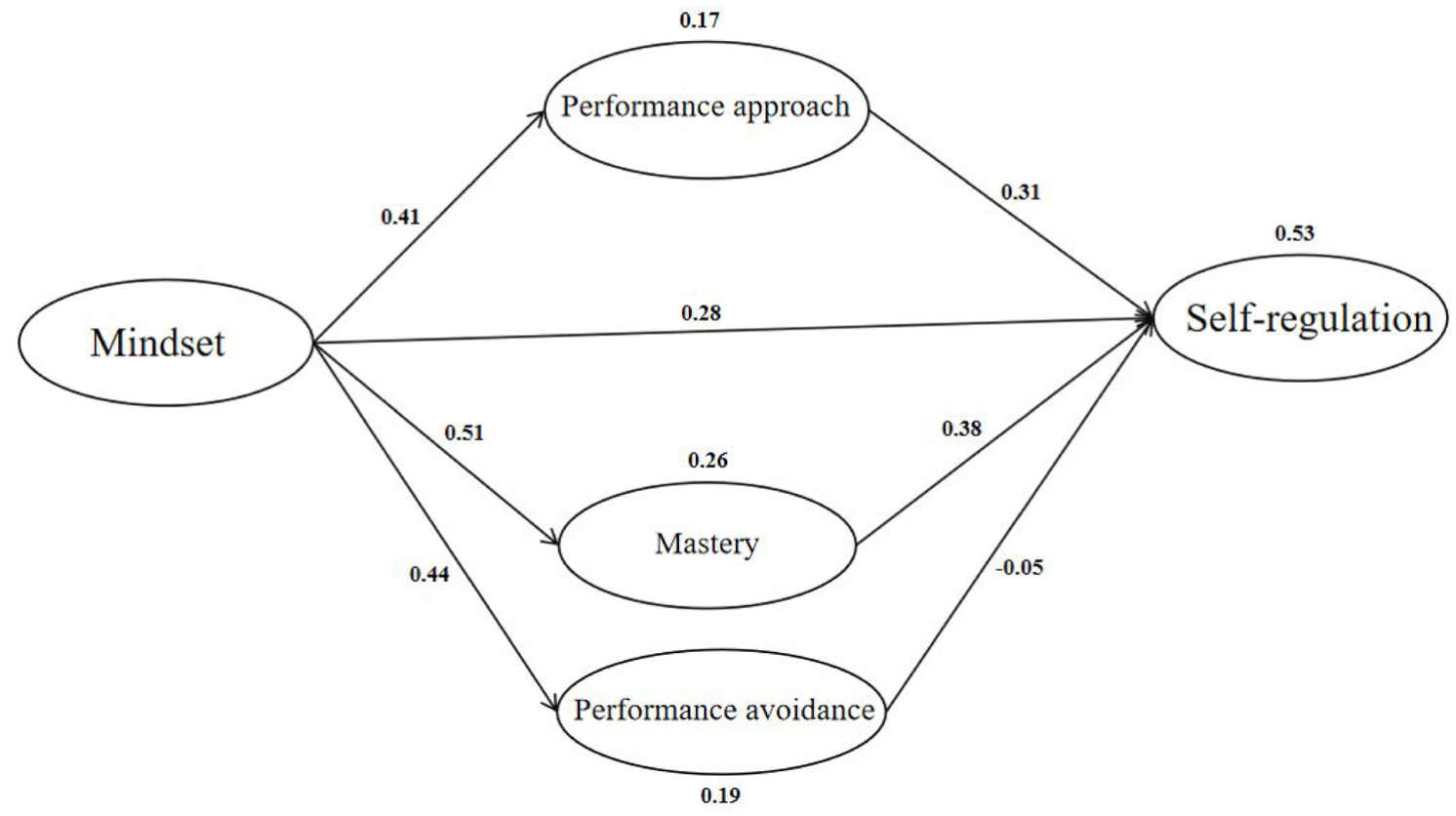
Structural equation model and its standardized path coefficients.
Results showed good model fit indices: χ2/df = 1.826, RMSEA = 0.044, SRMR = 0.053, GFI = 0.946, IFI = 0.969, TLI = 0.962, CFI = 0.969. The squared multiple correlation (R2) for self-regulated writing strategies was .53, indicating 53% of its variance was explained by the model. As shown in Table 2: (a) L2 writing mindsets significantly positively predicted all three L2 writing achievement goals and self-regulated writing strategies (Hypothesis 1 supported); (b) Performance-approach goals and mastery goals significantly positively predicted self-regulated writing strategies (Hypothesis 2 supported); (c) Performance-avoidance goals negatively predicted self-regulated writing strategies, but the effect was non-significant (Hypothesis 3 rejected), p = .325.
Standardized Path Coefficients of the Structural Equation Model.

Note.***p < .001.
The model (Table 2) confirmed that growth mindset directly promoted self-regulated strategies and indirectly did so through performance-approach and mastery goals. Mastery goals had the strongest predictive power for self-regulated strategies (β = .383***), followed by performance-approach goals (β = .310***), while performance-avoidance goals showed no significant effect.
This SEM path diagram (Figure 1) visually illustrated the direct effect of mindset on self-regulated strategies (β = .283***) and the indirect effects through performance-approach (β = .408 → .310) and mastery goals (β = .513 → .383), highlighting the important role of three achievement goals in mediating these relationships.
Mediation Effect Analysis
To examine the mediating effects of L2 writing achievement goals between L2 writing mindsets and self-regulated writing strategies, a bias-corrected Bootstrap test (5,000 resamples) was conducted. Results showed: (a) The 95% confidence interval for the performance-avoidance goal mediation path crossed zero (−0.077~0.022), p = .313, indicating no significant mediation effect; (b) The 95% confidence intervals for performance-approach and mastery goal mediation paths excluded zero (0.075~0.201 and 0.126~0.297, respectively), ps < .001, confirming significant mediation effects (Hypothesis 4 supported); (c) A one-unit increase in L2 writing mindsets predicted a 12.7% and 19.6% increase in self-regulated writing strategies through performance-approach and mastery goals, respectively; (d) The proportions of mediation effects accounted for by performance-approach and mastery goals were 30.976% and 40.833%, respectively, suggesting a stronger mediating role of mastery goals.
Discussion
In this study, learners exhibited moderate levels of growth mindset in L2 (Chinese) writing, consistent with previous findings (Xu & Wang, 2022). This suggests learners generally believe their Chinese writing competence can be improved through sustained effort and strategy use over time, supporting the previous view that growth mindset beliefs are regarded as crucial goals for individual socialization in East Asian cultural contexts (Kim et al., 2017). Learners’ self-regulated writing strategy levels surpassed those reported by Sun and Wang (2020) and aligned with the previous study (Xu, 2022), indicating recent improvements in strategy use while highlighting substantial room for further development. Among the three L2 writing achievement goals, mastery goals showed the highest mean scores, followed by performance-approach goals and performance-avoidance goals. This pattern reveals learners prioritize acquiring writing knowledge and enhancing skills while also desiring high scores/social comparison and expressing concerns about negative evaluations due to underperformance. Significant positive correlations emerged among all three achievement goals, indicating learners simultaneously hold multiple goals in L2 writing. This supports the multiple-goal perspective (Wilby, 2022), showing that achievement goals coexist rather than conflict in learners’ motivational frameworks, thereby precluding simplistic categorization of learners into singular goal orientations.
To unpack the mechanisms underlying these findings, we first analyze the general relationships among L2 writing mindsets, achievement goals, and self-regulated strategies. In this study, L2 (Chinese) writing mindsets significantly predicted all three achievement goals, validating C. Dweck’s (2016) assertion that mindsets are critical antecedents of achievement goals. L2 writing mindsets directly and indirectly predicted self-regulated writing strategies, supporting previous conclusions (Bai et al., 2021; Bai & Wang, 2021). The results further indicate that stronger beliefs in the malleability of L2 writing competence correlate with higher usage of self-regulated strategies. This underscores the positive influence of growth mindsets on adaptive learning strategies, confirming their dual role as antecedents of both achievement goals and self-regulation, consistent with the dominance of mindsets in the Mindset Meaning System. Additionally, L2 writing mindsets significantly influenced self-regulated writing strategies through mastery and performance-approach goals, highlighting achievement goals as motivational-cognitive mediators.
Focusing on specific variable pathways, L2 writing mindsets significantly positively predicted mastery goals, aligning with findings in other achievement domains and general English learning (W.-W. Chen & Wong, 2015; Lou & Noels, 2017). This suggests that learners who perceive their Chinese writing abilities as malleable prioritize knowledge acquisition and skill development, resonating with Confucian ideals of self-cultivation and moral perfection (Fwu et al., 2020). Among the three achievement goals, mastery goals showed the strongest predictive link to L2 writing mindsets, implying that interventions enhancing growth mindsets could most effectively boost mastery goals.
Mastery goals exhibited moderate positive correlations with all six dimensions of self-regulated strategies, indicating that learners actively plan, monitor, evaluate, employ memory/metacognitive strategies, and regulate emotions to improve writing competence. Consequently, mastery goals significantly predicted self-regulated strategies and demonstrated the strongest mediating effect between mindsets and strategies. This reinforces the universal adaptability of mastery goals across cultural and educational contexts.
L2 writing mindsets significantly positively predicted performance-approach goals, contrasting with Western findings (Lou & Noels, 2017) but aligning with studies on Eastern learners (W.-W. Chen & Wong, 2015; Sadeghi et al., 2020). This divergence arises from sociocultural factors: (a) Writing pedagogy: Process/genre approaches dominate Western contexts, emphasizing iterative drafting, whereas Chinese writing instruction often prioritizes test-oriented outcomes (L. S. Teng & Zhang, 2016). (b) Cultural achievement motives: Individual-oriented achievement motivation (IOAM) in Western cultures emphasizes self-defined standards and intra-personal comparisons. In contrast, Eastern collectivist cultures employ social-oriented achievement motivation (SOAM), where achievement standards are defined by others and are internalized by individuals through social connectedness and social identification. These standards are reinforced by positive or negative reactions from others, such as praise or blame, acceptance or rejection, and promotion or demotion (Tao et al., 2023). Influenced by this, international students are sensitive to achievement scores and external standards, have a stronger sense of competition (Yeung & Han, 2017), and focus on gaining self-confidence and external recognition through personal performance. Additionally, under the context of exam-oriented education, students’ learning goals are often driven by a high-score orientation, which not only encourages them to form mastery goals but may also strengthen the pursuit of performance goals. Meanwhile, collectivist culture emphasizes group honor and harmony, which to some extent influences students’ orientations in choosing writing strategies. Therefore, in our study, the L2 writing mindset can significantly positively predict L2 writing performance-approach goals.
Driven by different writing pedagogies and evaluation orientations (regulated by cultural products), expectations from significant others (such as teachers; regulated by others), and individuals’ desires for recognition and honor (regulated by self), learners deliberately use self-regulated writing strategies to strive for higher grades. Therefore, performance-approach goals can significantly positively predict self-regulated writing strategies. This is also confirmed by the correlation analysis: performance-approach goals are moderately and significantly positively correlated with the four dimensions of self-regulated writing strategies, namely writing planning, goal-oriented monitoring, memory strategies, and metacognitive judgments, and are weakly and significantly positively correlated with the two dimensions of goal-oriented evaluation and emotional control. Therefore, performance-approach goals can play a significant mediating role between the L2 writing mindset and self-regulated writing strategies. These two points indicate that performance-approach goals can produce adaptive outcomes, supporting the perspective of multiple goal theory.
Contrary to Western studies (Lou & Noels, 2017), growth mindsets positively predicted performance-avoidance goals in this study. This discrepancy stems from: (a) Cultural interpretations of failure: In collectivist contexts, low scores signify not only personal failure but also unmet social expectations (King, 2016). (b) Role obligation in SOAM: Learners feel compelled to avoid failure as a social duty, with failure eliciting guilt (S.-W. Chen, 2023; Tao et al., 2023). Under the influence of the aforementioned factors, even if international students, like Western learners, believe that their proficiency in Chinese is malleable, the different sociocultural implications of receiving low scores (regulated by cultural products), the varying influence of others’ expectations (regulated by others), and the avoidance of negative emotions associated with failing to fulfill role obligations (regulated by self) can make international students more sensitive to performance-avoidance goals. Therefore, in this study, a growth mindset positively rather than negatively predicts performance-avoidance goals.
Two studies based on Eastern learners (Chen & Wong, 2015; Sadeghi et al., 2020) have shown that a growth mindset positively predicts performance-avoidance goals, but not significantly. In contrast, this study reveals a significant positive prediction. The reason for this discrepancy is that the studies by Chen & Wong (2015) and Sadeghi et al. (2020) focused on overall English learning, whereas this study focuses on L2 learning. This suggests that compared to other language skills, international students are more concerned about their performance in Chinese learning, which corroborates the notion that L2 is the most challenging language skill for learners (relevant literature can be cited based on Chinese learning studies).
International students with performance-avoidance goals often fear exposing their lack of proficiency in Chinese. To protect their self-image and self-confidence from being undermined, they tend to avoid challenging attempts in Chinese learning (regulated by self). In this case, the frequency and level of international students’ use of deep and high-level self-regulated Chinese learning strategies are constrained. This is also confirmed by the correlation analysis: the correlation between performance-avoidance goals and the Chinese learning planning dimension is extremely low (r = .087), indicating that performance-avoidance goals lead to a lack of forethought in self-regulation, passive performance, and blind coping among international students. Moreover, the extremely low correlation between performance-avoidance goals and goal-oriented monitoring (r = .180) and emotional control (r = .130) indicates that performance-avoidance goals reduce self-regulation levels during the behavioral phase, resulting in insufficient monitoring of Chinese learning activities and poor control of Chinese learning emotions among international students. However, compared with Western individualistic cultures, collectivist Confucian values emphasize group harmony, group achievement, and social acceptance (Tao et al., 2023). To avoid the negative impact of poor Chinese performance on group achievement (regulated by cultural products), which in turn affects harmonious teacher-student relationships and leads to a loss of social acceptance (such as recognition from teachers and peers; regulated by others), international students will to some extent employ memory strategies, metacognitive judgments, and goal-oriented evaluations. That is to say, the moderating effect of collectivist and Confucian sociocultural factors buffers the negative impact of performance-avoidance goals on self-regulated Chinese learning strategies, making it insignificant. Therefore, the mediating role of performance-avoidance goals between L2 learning mindset and self-regulated Chinese learning strategies is not significant.
Although the impact of performance-avoidance goals on self-regulated writing strategies did not reach significance in this study, this phenomenon can be explained from a cultural perspective through the buffering mechanism of Confucian culture. In Confucian culture, the core value of “self-restraint and returning to propriety” emphasizes self-discipline and behavioral norms, encouraging individuals to cope with failure and stress by maintaining social harmony. This cultural background prompts students to adjust their learning behaviors through positive self-regulation strategies, such as memory strategies and metacognitive strategies, even when they are concerned about failure and negative evaluations.
Under the context of performance-avoidance goals, students typically aim to avoid failure and poor performance. However, the collectivist values in Confucian culture provide a buffering mechanism. Specifically, Confucian culture emphasizes group harmony and collective responsibility. Even when students feel academic pressure, they protect their social image and avoid negative emotions by employing effective self-regulation strategies, such as enhancing study planning, monitoring progress, and metacognitive regulation. This cultural norm makes the negative impact of performance-avoidance goals on students’ learning strategies less significant.
As King (2016) noted, the social impact of failure in collectivist cultures far outweighs the impact on individual self-perception. Therefore, the value of “group harmony” in Confucian culture not only drives students to seek social recognition in their studies but also enables them to reduce the negative effects of performance-avoidance goals by maintaining intrinsic motivation and regulation strategies, even in the face of failure. Based on this cultural buffering mechanism, students can still use effective self-regulation strategies to cope with challenges and stress when confronted with performance-avoidance goals, thus avoiding a state of learning avoidance. The influence of this cultural background can further explain why, in China and other East Asian cultural contexts, performance-avoidance goals do not show a significant negative correlation with self-regulation strategies. Instead, their relationship remains relatively neutral due to the moderating role of Confucian culture.
Despite these contributions, the present study has limitations. The sample comprised international undergraduates (Chinese-major) from a single province and similar disciplinary backgrounds, which may limit generalizability. Future research should broaden recruitment across regions, majors, proficiency levels, and instructional settings; incorporate longitudinal designs to track goal-system dynamics; include performance outcomes beyond self-report; and test targeted interventions that jointly cultivate growth mindset and mastery goals.
In terms of theoretical and practical implications, this study could contribute to the literature by linking achievement goal theory with self-regulated learning in the context of L2 writing. Educators could utilize these findings to design targeted interventions that promote positive mindsets and achievement goals among foreign language learners. Based on the findings of this study, we propose the following actionable strategies for L2 writing instruction: (a) For students approaching performance targets, design a “personal progress trajectory chart” to replace horizontal ranking systems, which often exacerbate social comparisons. This allows students to track their progress individually and focus on self-improvement; (b) For students with performance-avoidance goals, provide an “anonymous writing feedback platform.” This would reduce anxiety related to public evaluation and encourage students to engage more deeply with their writing tasks without the fear of judgment.
Conclusion
This study investigated the relationships among L2 (Chinese) writing mindsets, achievement goals, and self-regulated writing strategies through questionnaire surveys. Results showed that L2 writing mindsets significantly positively predicted self-regulated writing strategies and all three achievement goals (rather than a single goal). Mastery goals and performance-approach goals significantly positively predicted self-regulated writing strategies and demonstrated significant partial mediating effects between L2 writing mindsets and self-regulated writing strategies.
This study provided four important implications for L2 writing instruction: (a) Both this study and previous research indicated that international undergraduate learners exhibited moderate levels of growth mindset in Chinese writing. Therefore, pedagogical interventions should aim to enhance learners’ beliefs in the malleability of Chinese writing competence. (b) Educators should identify and address learners’ achievement goals in Chinese writing. Students should be encouraged to focus on knowledge acquisition and skill development (mastery goals). (c) For learners high on performance-approach goals, emphasize intrapersonal (self-referenced) progress rather than peer comparison, support accurate goal calibration, and scaffold emotion regulation. (d) For learners with performance-avoidance goals, avoid negative evaluations (especially public criticism) to reduce anxiety, while encouraging writing planning, monitoring, and engagement with challenging tasks and advanced self-regulated strategies.
Footnotes
Acknowledgements
Data collection, analysis and draft writing were completed by Qian Zhou. Qian Zhou and Hasnah Binti Mohamed contributed to the revision of the draft.

Ethical Considerations
Ethical review and approval were not required for this study. The anonymous, voluntary questionnaire collected no identifying or sensitive data and complied with the Declaration of Helsinki.
Consent to Participate
Informed consent was obtained from all individual participants included in the study.
Funding
The authors disclosed receipt of the following financial support for the research, authorship, and/or publication of this article: The work described in this paper was supported by Center for Language Education and Cooperation (CLEC) of China (Project No. YHJXCX23-058).
Declaration of Conflicting Interests
The authors declared no potential conflicts of interest with respect to the research, authorship, and/or publication of this article.